
Systematic Review of Health Literacy and Health Behavior in Adolescents Research



Abstract
1. Introduction
2. Materials and Methods
2.1. Search Strategies
2.2. Eligibility Criteria
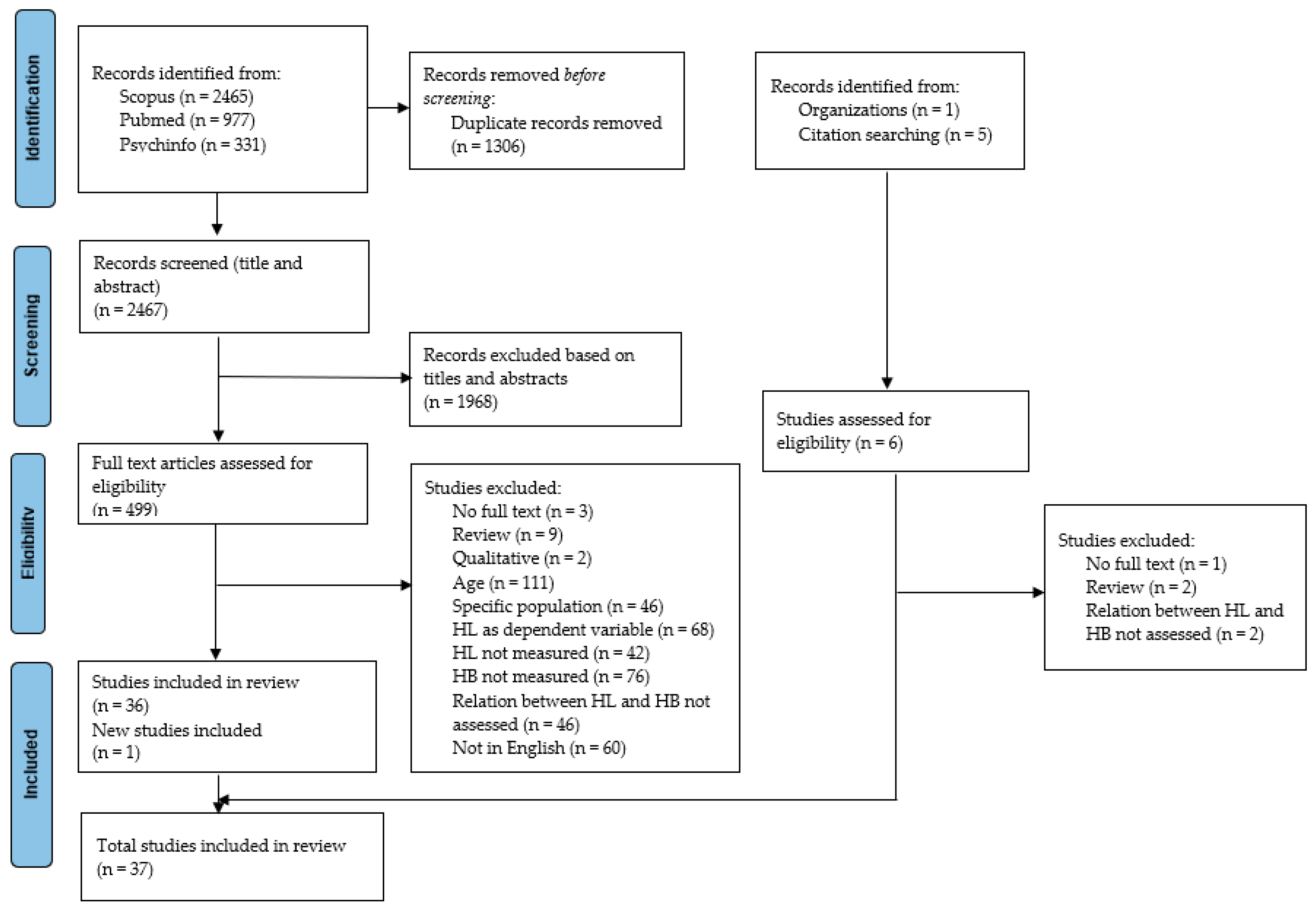
2.3. Study Selection
2.4. Data Extraction and Risk of Bias Assessment
3. Results
3.1. Study Characteristics and Populations
3.2. Assessment of Health Literacy

| Author (Year) | Country | Study Population Characteristics | HL Measure | Assessed Health Behavior | Statistical Analysis | Main Results | Risk of Bias |
|---|---|---|---|---|---|---|---|
| Ayaz-Alkaya et al., 2021 [46] | Turkey | N = 810; Age range: not specified; Mean age = 12.98 years. | Turkish version of HLSAC | Physical activity, nutrition | Descriptive statistics, t-test, ANOVA, Pearson correlation | Positive correlation was observed between HL and healthy nutrition–exercise behavior (r = 0.345 ***) as well as meal pattern (r = 0.230 ***). | Moderate |
| Ayaz-Alkaya et al., 2024 [47] | Turkey | N = 1046; Age range: 11–14 years; Mean age = 12.42 years. | Turkish version of HLSAC | Physical activity, nutrition | Descriptive statistics, t-test, ANOVA, multiple linear regression | HL positively correlated with health promotion behaviors (β = 0.489 ***). | High |
| Azarang et al., 2024 [41] | Iran | N = 275; Age range: 15–18 years; Mean age = 16.86 years. | HELMA | Substance use | Pearson correlation, t-test, ANOVA, multiple linear regression | Significant negative correlation between HL and addiction susceptibility (r = –0.66 ***). | High |
| Bektas et al., 2021 [48] | Turkey | N = 440; Age range: 13–18 years; Mean age = 15.22 years. | Turkish version of HLSAC | Physical activity, nutrition | Descriptive statistics, Pearson correlation, multiple linear regression | HL levels significantly predicted the nutrition sub-dimensions of the healthy lifestyle behavior of the adolescents (β = 0.177 *). | High |
| Brandt et al., 2019 [42] | Austria | N = 5614; Age range: 13–17 years; Mean age not specified. | Adapted version of HLS-EU-Q16 | Tobacco, alcohol use | Structural Equation Modeling (SEM), Confirmatory Factor Analysis (CFA), correlation and regression analyses | Lower HL was associated with higher cigarette smoking both over the lifetime (β = 0.12 ***) and in the past 30 days (β = 0.15 ***). Similarly, lower HL was linked to more frequent alcohol use (lifetime: β = 0.03 *; last 30 days: β = 0.07 ***). | Moderate |
| Delbosq et al., 2022 [34] | Italy | N = 2145; Age range: 13–15 years; Mean age not specified. | Italian version of HLSAC | Fruit, vegetable, sweets, and soft drink consumption; breakfast frequency | Multiple binary logistic regressions | HL was significant predictor of daily consumption of fruit (B = 0.026 *), vegetable (B = 0.244 ***), not related with sweet consumption, significantly negatively related with soft drinks consumption (B = −0.024 *). Not related with breakfast consumption frequency. | High |
| Duplaga et al., 2021 [28] | Poland | N = 2223; Age range: not specified; Mean age = 17.01 years. | Adapted version of HLS-EU-Q47 | Number of meals/day, meal regularity, largest meal, fruit/vegetable and fast-food consumption | Univariate and multivariate logistic regression | Participants with higher HL were more likely than those with lower HL to consume fruit and vegetables at least once per day (OR = 1.03 ** (95% CI: 1.01–1.04). HL was a significant predictor (OR = 0.98 * (95% CI: 0.95–0.999) for fast food consumption. | High |
| Duplaga et al., 2022 [29] | Poland | N = 2223; Age range: not specified; Mean age = 17.1 years. | Adapted version of HLS-EU-Q47 | Tobacco use | Univariate and multivariate logistic regression | HL not significantly related with using cigarettes ever in past and in the last month. | High |
| Fleary et al., 2023 [56] | USA | N = 380; Age rage: 12–19 years; Mean age = 15.98 years. | AAHL | Physical activity, fruit and vegetable, sugar-sweetened drinks, junk food, smoking, vaping, alcohol, binge drinking | Pearson correlations, hierarchical regressions, moderation | Functional HL negatively related with use of sugar-sweetened beverage (β = −0.13 *) and smoking cigarettes during past 30 days (β = −0.16 *). Critical HL negatively related with use of sugar-sweetened beverage (β = −0.24 **). Interactive/communicative HL positively related with daily physical activity (β = 0.11 *) and negatively with alcohol use (β = −0.19 *). | High |
| Fleary & Joseph, 2024 [57] | USA | N = 300; Age range: 13–17 years; Mean age not specified. | NVS | Physical activity, fruit and vegetable, sugar-sweetened drinks, junk food, smoking, vaping, alcohol, binge drinking | Pearson correlations; Actor–Partner Interdependence Model | Adolescents’ HL showed negative correlations with sugar sweetened beverages consumption (p < 0.05), sedentary activity (p < 0.01), cigarette smoking (p < 0.01), vaping (p < 0.01), and binge-drinking (p < 0.01). | High |
| Fleary et al., 2024 [43] | USA | N = 675; Age range: 13–18 years; Mean age = 15.5 years. | AAHL | Substance use avoidance (alcohol, vaping, and cigarette smoking) | Binary and multinomial logistic regression, hierarchical logistic regressions | Higher interactive (OR = 2.12 * (95% CI: 1.12–4.00) and composite HL (OR = 2.06 * (95% CI: 1.10–3.84) were significantly associated with substance use avoidance. | High |
| Guo et al., 2020 [58] | China and Australia | N = 770; Age range: 11–17 years; Mean age = 13.45 years. | HLAT-8; NVS, HLS-47 | Physical activity, breakfast eating, smoking, alcohol. | Descriptive, t-test, ANOVA, linear and logistic regression | HL was positively associated with health-promoting behaviors when using the HLAT-8 (β = 0.06 *) and the HLS-47 (β = 0.07 *), but no significant relationship when using the NVS. | High |
| Guo et al., 2021 [59] | China | N = 650; Age range: 11–17 years; Mean age = 13.42 years. | Chinese version of HLAT-8 | Physical activity, breakfast eating, smoking, alcohol. | Descriptive, t-tests, ANOVA, Pearson/Spearman correlations; Path analysis (SEM)s | Significant and direct relationship between HL and physical activity (r = 0.14 *), but not significant relationship with breakfast eating, cigarette smoking, and alcohol drinking. | High |
| Gürkan, & Ayar, 2020 [49] | Turkey | N = 219; Age range: 14–18 years; Mean age = 16.52 years. | Turkish version of the eHEALS | Physical activity, nutrition behavior | Descriptive statistics, Pearson correlation, simple linear regression | Significant positive association between e-HL and health promotion behaviors (β = 0.416 ***). e-HL positively associated with nutritional behavior subscale (β = 0.270 *) and exercise subscale (β = 0.122 *). | Moderate |
| Hnidková et al., 2024 [50] | Slovakia | N = 508; Age range: 14–15 years; Mean age = 14.50 years. | Slovak version of the HLSAC | Physical activity, body composition | Linear regression, mediation analysis | Higher HL was directly associated with higher moderate-to-vigorous (β = 0.005 ***) and vigorous physical activity (β = −0.08 ***), HL indirectly influenced body composition through physical activity. No direct association with BMI. | High |
| Huang et al., 2024 [60] | Hong Kong | N = 777; Age range: not specified; Mean age = 13.57. | Chinese version of the HELMA | Physical activity, diet (fruits, vegetables, breakfast), smoking, alcohol use | Multivariate logistic regression | Desirable HL was negatively associated with insufficient intakes of vegetables (OR = 0.43 *** (95% CI: 0.28–0.67) and fruits (OR =0.58 ** (95% CI: 0.4–1–0.81), skipping breakfast (OR = 0.64 ** (95% CI: 0.45–0.91), physical inactivity (OR = 0.56 * (95% CI: 0.35–0.90). Not related with smoking and alcohol drinking. | High |
| Jindarattanaporn et al., 2023 [35] | Thailand | N = 1871; Age range: 10–14 years; Mean age = 11.9 years. | MHL | Fruit and vegetable consumption | ANOVA, t-test, multiple linear regression | Adolescents with higher MHL were more likely to consume fruit (β = 0.085 ***) and vegetables (β = 0.101 ***) more often. | High |
| Kanellopoulou et al., 2022 [27] | Greece | N = 1728; Age range: 10–12 years; Median age = 11 years. | Item Response Theory-based composite index | Physical activity, dietary habits (Mediterranean diet adherence, breakfast, meals/day, eating out frequency), body composition | Descriptive stats, χ2, t-test; multiple linear regression | Children with higher l HL were more likely to eat breakfast daily (p < 0.001), and to have more than three meals per day (p < 0.001). They also ate out less often (p < 0.01), and ordered takeaway food less frequently (p < 0.001). In addition, they more regularly had a homemade brunch (p < 0.001), rather than buying one from the school canteen (p < 0.001), and they more often eat meals together with their whole family (p < 0.001). | High |
| Karagözoğlu & İlhan, 2024 [51] | Turkey | N = 649; Age range: 14–18 years; Mean age = 15.54 years. | Turkish version of HLSAC | Physical activity, nutrition | Descriptive stats; t-test, ANOVA, multiple regression | HL significantly positively predicted physical activity (β = 0.163 ***) and nutrition (β = 0.180 ***). | High |
| Kesic et al., 2022 [32] | Croatia | N = 247; Age range: not specified; Mean age = 16.8. | HLS-EU-Q47 | Physical activity | Correlations, K-means clusters, ANOVA | HL was not significantly associated with physical activity. | High |
| Kinnunen et al., 2022 [44] | Finland, Germany, Netherlands | N= 5088; Age range: 12–19 years; Mean age = 14.65 years. | HLSAC | Substance (smoking, alcohol, cannabis) use | Logistic regression, GLMM, path analysis | Lower HL significantly associated with weekly smoking (OR = 2.32 *** (95% CI: 1.56–3.45), monthly alcohol use smoking (OR = 2.32 *** (95% CI: 1.56–3.45). | High |
| Kleszczewska et al., 2022 [45] | Poland | N= 1663; Age range: not specified; Mean age = 17.63 years. | HLSAC | Risk behavior index (smoking, alcohol, marijuana use) | Manan Whitney, Kruskal–Wallis tests, ANOVA, linear regression | Higher HL significantly related with lower Risk Behavior Index (β = −0.063 **). | High |
| Korkmaz Aslan et al., 2021 [52] | Turkey | N = 409; Age range: 14–19 years; Mean age = 16.0 years. | eHEALS | Nutrition, exercise | Multiple regression analysis | e-HL significantly and positively predicted nutrition (β = 0.64 ***) exercise (β = 0.36 ***). | High |
| McCormick et al., 2021 [36] | USA | N = 793; Age range: 11–13; Mean age = 12 years. | NVS | Sugar-sweetened beverage intake | Descriptive statistics; ANOVA; stepwise regression analysis | Higher sugar-sweetened beverage intake was associated with lower HL, less favorable behavioral intentions, affective attitudes, and perceived behavioral control. | High |
| Motemedi et al., 2020 [38] | Iran | Cross-sectional; N = 439; Age range: 15–18 years; Mean age = 16.5 years. | The Newest Vital Sign (NVS) | Body composition | Descriptive statistics; t-tests; ANOVA; Spearman correlation | Students with higher HL had significantly healthier BMI profiles (p < 0.0001). | Moderate |
| Ozturk Eyimaya & Tezel, 2024 [61] | Turkey | N = 1228; Age range: 10–15 years; Mean age = 11.7 years. | Turkish version of HLSAC | Exercising, nutrition, smoking | t-tests, ANOVA, linear regression | Weak negative linear relation between HL and nutrition (r = −0.083 **), exercise (r = −0.238 ***), smoking (r = −0.088 **). | High |
| Ozturk Haney, 2020 [37] | Turkey | N = 204; Age range: 11–14 years; Mean age = 12.8 years. | Turkish version of HLSAC | Body composition | Descriptive statistics, χ2, t-test, ANOVA, multiple regression analysis | No significant correlation between child HL and BMI (r = 0.04). | High |
| Ozturk & Ayaz-Alkaya, 2020 [53] | Turkey | N = 2498; Age range: 11–15 years; Mean age = (mean 11.7 ± 1.2). | Turkish version of HLSAC | Nutrition, exercise | Descriptive stats, t-tests, ANOVA, Spearman correlation | HL positively linearly related with nutrition (r = 0.282 ***) and exercise (r = 0.247 ***). | High |
| Paakkari et al., 2019 [62] | Finland | N = 3833; Age range: 13–15 years. | HLSAC | Physical activity, healthy food, smoking, alcohol use | Pearson correlations, path analysis | HL positively related with physical activity (β = 0.17 ***), use of healthy foods (β = 0.20 ***), and negatively with smoking (β = −0.08 ***) and alcohol use (β = −0.12 ***). | High |
| Prihanto et al., 2021 [63] | Indonesia | Cross-sectional; N = 960; Age range: 14–19 years; Mean age = 16.2 years. | HLS-EU-Q16 | Physical activity, smoking, alcohol use, drug use | Descriptive stats, χ2 tests, binomial logistic regression | Comprehensive HL positively predicted physical activity (OR = 1.8 (95% CI: 0.8–3.8) and not use drug (OR = 9.3 * (95% CI: 2.1–41.3). Functional HL contributed to no smoking behavior (OR = 6.8 *** (95% CI: 2.9–15.9) and alcohol use (OR = 2.2 ** (95% CI: 1.3–3.9). | High |
| Puupponen et al., 2021 [39] | Finland | Cross-sectional; N = 7405; Age range: 13 and 15 years. | HLSAC | Energy drink consumption | Descriptive stats; multilevel mixed-effects binary logistic regression | Lower HL significantly associated with higher weekly energy drink consumption among 13-year-olds (OR = 1.75 ** (95% CI: 1.22–2.49) and 15-years-olds (OR = 1.52 * (95% CI: 1.07–2.16). | High |
| Reid et al., 2021 [54] | USA | Cross-sectional; N = 854; Age range: 11 and older; Mean age = 12.0 years. | NVS | Energy-balance-related behaviors: water, fruit/veg intake, junk food, sugar-sweetened beverages, physical activity | Nonparametric Hodges–Lehmann median difference test | Adolescents with limited HL had significantly lower fruit/vegetable intake, physical activity, and higher sugar-sweetened beverages, junk food, screen time and BMI. | Moderate |
| Sukys et al., 2024 [55] | Lithuania | Cross-sectional; N = 809; Age range: 15–19 years; Mean age = 16.4 years. | Lithuanian version of HLS19-Q12 | Physical activity, smoking, alcohol use | EFA + CFA, t-tests, ANOVA, χ2, Pearson r, multiple linear regression | Higher HL positively related to physical activity (β = 0.10 **), negatively to lifetime smoking (β = −0.10 **) and alcohol use (lifetime β = −0.14 ***; past 30 days β = −0.09 **). | High |
| Sukys et al., 2021 [33] | Lithuania | Cross-sectional; N = 2369; Age range: 13–16 years; Mean age = 14.5 years. | Lithuanian version of HLSAC | Physical activity | χ2 tests and binary logistic regression | Moderate and high HL levels were significantly positively associated with being physically active during leisure time (OR = 0.56 *** (95% CI: 0.45–0.70)). | High |
| Rutkauskaite & Kuusinen, 2019 [30] | Lithuania | Cross-sectional; N = 167; Age range: 14–18 years; Mean age = 16 years. | NVS | Physical activity, body composition | Nonparametric tests: spearman r, Mann–Whitney, Kruskal–Wallis, χ2 | No significant associations between HL and physical activity or BMI. | Moderate |
| Yang et al., 2019 [31] | China | N = 22,628; Age range: not specified; Mean age = 15.36. | CAIHLQ | Smoking, alcohol consumption | Multinomial logistical regression | Higher HL associated with lower probability of smoking/alcohol use and screen time (OR = 0.990 ** (0.982–0.998)). | High |
| Zare-Zardiny et al., 2021 [40] | Iran | Cross-sectional; N = 423; Age range: 15–19 years; Mean age = 16.8 years. | HELMA | Body composition | Descriptive stats, Pearson correlation, t-tests, ANOVA, multiple regression | HL do not relate to BMI (β = −0.03). | High |
3.3. Relationship Between Health Literacy and Physical Activity
3.4. Relationship Between Health Literacy and Smoking, Alcohol and Drug Use
3.5. Relationship Between Health Literacy and Nutrition
3.6. Quality Assessment of Included Studies
4. Discussion
5. Conclusions
Supplementary Materials
Author Contributions
Funding
Institutional Review Board Statement
Informed Consent Statement
Data Availability Statement
Conflicts of Interest
Abbreviations
| HL | Health Literacy |
| HLSAC | Health Literacy for School-aged Children Scale |
| HELMA | Health Literacy Measure for Adolescents |
| HLS-EU-Q16 | European Health Literacy Survey Questionnaire |
| HLS-EU-Q47 | European Health Literacy Survey Questionnaire |
| AAHL | Assessments of Adolescent Health Literacy |
| NVS | The Newest Vital Sign |
| HLS-47 | 47-item Health Literacy Study-Asia-Questionnaire |
| HLAT-8 | The Eight-Item Health Literacy Assessment Tool |
| eHEALS | e-Health Literacy |
| CAIHLQ | The Chinese Adolescent Interactive Health Literacy Questionnaire |
| MHL | Media Health Literacy |
| BMI | Body Mass Index |
References
- Telama, R. Tracking of physical activity from childhood to adulthood: A review. Obes. Facts 2009, 2, 187–195. [Google Scholar] [CrossRef] [PubMed]
- Winpenny, E.M.; Penney, T.L.; Corder, K.; White, M.; van Sluijs, E.M. Change in diet in the period from adolescence to early adulthood: A systematic scoping review of longitudinal studies. Int. J. Behav. Nutr. Phys. Act. 2017, 14, 60. [Google Scholar] [CrossRef] [PubMed]
- Paavola, M.; Vartiainen, E.; Haukkala, A. Smoking, alcohol use, and physical activity: A 13-year longitudinal study ranging from adolescence into adulthood. J. Adolesc. Health 2004, 35, 238–244. [Google Scholar] [CrossRef] [PubMed]
- Mollborn, S.; Lawrence, E. Family, peer, and school influences on children’s developing health lifestyles. J. Health Soc. Behav. 2018, 59, 133–150. [Google Scholar] [CrossRef]
- Cal-Herrera, A.; Corbella-González, A.; Climent-Llinares, S.; Fernández-Rodríguez, O.I. The Impact of Social Media on Adolescents’ Eating and Sleeping Habits: A Systematic Review and Meta-Analysis. Healthcare 2025, 13, 2962. [Google Scholar] [CrossRef]
- Engel, E.; Gell, S.; Heiss, R.; Karsay, K. Social media influencers and adolescents’ health: A scoping review of the research field. Soc. Sci. Med. 2024, 340, 116387. [Google Scholar] [CrossRef]
- Taba, M.; Allen, T.B.; Caldwell, P.H.Y.; Skinner, S.R.; Kang, M.; McCaffery, K.; Scott, K.M. Adolescents’ self-efficacy and digital health literacy: A cross-sectional mixed methods study. BMC Public Health 2022, 22, 1223. [Google Scholar] [CrossRef]
- Sørensen, K.; Van den Broucke, S.; Fullam, J.; Doyle, G.; Pelikan, J.; Slonska, Z.; Brand, H. (HLS-EU) Consortium Health Literacy Project European. Health literacy and public health: A systematic review and integration of definitions and models. BMC Public Health 2012, 12, 80. [Google Scholar] [CrossRef]
- Khanal, S.P.; Budhathoki, C.B.; Okan, O.; van Teijlingen, E.; Sharma, M.K.; Acharya, J.; Wood, C. Systematic review of health literacy and health promotion in school-aged adolescents. J. Educ. Community Health 2023, 10, 49–57. [Google Scholar] [CrossRef]
- Nash, R.; Patterson, K.; Flittner, A.; Elmer, S.; Osborne, R. School-based health literacy programs for children (2–16 years): An international review. J. Sch. Health 2021, 91, 632–649. [Google Scholar] [CrossRef]
- Ribeiro, S.M.; Basso, M.B.; Massignan, C.; Leal, S.C. Playful educational interventions in children and adolescents’ health literacy: A systematic review. Health Promot. Int. 2023, 38, daad089. [Google Scholar] [CrossRef] [PubMed]
- Smith, C.; Goss, H.R.; Issartel, J.; Belton, S. Health literacy in schools? A systematic review of health-related interventions aimed at disadvantaged adolescents. Children 2021, 8, 176. [Google Scholar] [CrossRef] [PubMed]
- Maier, G. Health literacy among children and adolescents-Challenges in measurement, and dealing with a buzzword [Gesundheitskompetenz bei Kindern und Jugendlichen-Herausforderungen des Konzepts und Umgang mit einem Schlagwort]. Padiatr. Prax. 2019, 91, 472–481. [Google Scholar]
- Choudhry, F.R.; Ming, L.C.; Munawar, K.; Zaidi, S.T.R.; Patel, R.P.; Khan, T.M.; Elmer, S. Health literacy studies conducted in Australia: A scoping review. Int. J. Environ. Res. Public Health 2019, 16, 1112. [Google Scholar] [CrossRef]
- Sarhan, M.B.A.; Fujiya, R.; Kiriya, J.; Htay, Z.W.; Nakajima, K.; Fuse, R.; Wakabayashi, N.; Jimba, M. Health literacy among adolescents and young adults in the eastern Mediterranean region: A scoping review. BMJ Open 2023, 13, e072787. [Google Scholar] [CrossRef]
- Olyani, S.; Peyman, N. Health literacy and health outcomes in Iranian adolescents: A systematic review. J. Health Lit. 2021, 3, 78–85. [Google Scholar]
- Mao, Y.; Xie, T.; Zhang, N. Chinese students’ health literacy level and its associated factors: A meta-analysis. Int. J. Environ. Res. Public Health 2021, 18, 204. [Google Scholar] [CrossRef]
- Veshovda, S.; Eik, H.; Andersen, M.H.; Jahre, H.; Riiser, K. Health literacy and musculoskeletal disorders in adolescents: A scoping review. BMJ Open 2023, 13, e072753. [Google Scholar] [CrossRef]
- Riemann, L.; Lubasch, J.S.; Heep, A.; Ansmann, L. The role of health literacy in health behavior, health service use, health outcomes, and empowerment in pediatric patients with chronic disease: A systematic review. Int. J. Environ. Res. Public Health 2021, 18, 12464. [Google Scholar] [CrossRef]
- Navarro Rubio, M.D.; Blay, C. Health literacy in children and adolescents. A review of the state of the art. Med. Res. Arch. 2023, 11, 1–9. [Google Scholar] [CrossRef]
- Fleary, S.A.; Joseph, P.; Pappagianopoulos, J.E. Adolescent health literacy and health behaviors: A systematic review. J. Adolesc. 2018, 62, 116–127. [Google Scholar] [CrossRef] [PubMed]
- Page, M.J.; McKenzie, J.E.; Bossuyt, P.M.; Boutron, I.; Hoffmann, T.C.; Mulrow, C.D.; Shamseer, L.; Tetzlaff, J.M.; Akl, E.A.; Brennan, S.E.; et al. The PRISMA 2020 statement: An updated guideline for reporting systematic reviews. BMJ 2021, 372, n71. [Google Scholar] [CrossRef] [PubMed]
- World Health Organization (WHO). Adolescent Health. Available online: https://www.who.int/health-topics/adolescent-health (accessed on 23 January 2025).
- Belur, J.; Tompson, L.; Thornton, A.; Simon, M. Interrater reliability in systematic review methodology: Exploring variation in coder decision-making. Sociol. Methods Res. 2021, 50, 837–865. [Google Scholar] [CrossRef]
- Herzog, R.; Alvarez-Pasquin, M.J.; Diaz, C.; Del Barrio, J.L.; Estrada, J.M.; Gil, A. Are healthcare workers’ intentions to vaccinate related to their knowledge, beliefs and attitudes? A systematic review. BMC Public Health 2013, 13, 154. [Google Scholar] [CrossRef]
- Wells, G.A.; Shea, B.; O’Connell, D.; Peterson, J.; Welch, V.; Losos, M.; Tugwell, P. The Newcastle-Ottawa Scale (NOS) for assessing the quality of nonrandomised studies in meta-analyses. 2000. Available online: https://www.ohri.ca/programs/clinical_epidemiology/oxford.asp#:~:text=It%20was%20developed%20to%20assess%20the%20quality%20of,quality%20assessments%20in%20the%20interpretation%20of%20meta-analytic%20results (accessed on 14 November 2025).
- Kanellopoulou, A.; Notara, V.; Antonogeorgos, G.; Chrissini, M.; Rojas-Gil, A.; Kornilaki, E.N.; Lagiou, A.; Panagiotakos, D.B. Inverse association between health literacy and obesity among children in greece: A school-based, cross-sectional epidemiological study. Health Educ Behav. 2022, 49, 54–65. [Google Scholar] [CrossRef]
- Duplaga, M.; Grysztar, M. Nutritional behaviors, health literacy, and health locus of control of secondary schoolers in southern poland: A cross-sectional study. Nutrients 2021, 13, 4323. [Google Scholar] [CrossRef]
- Duplaga, M.; Grysztar, M. The use of e-cigarettes among high school students in Poland is associated with health locus of control but not with health literacy: A cross-sectional study. Toxics 2022, 10, 41. [Google Scholar] [CrossRef]
- Rutkauskaite, R.; Kuusinen, K. Links between adolescents’ health literacy and their physical activity and body mass index. Balt. J. Sports Health Sci. 2019, 3, 4–14. [Google Scholar] [CrossRef]
- Yang, R.; Li, D.; Hu, J.; Tian, R.; Wan, Y.; Tao, F.; Fang, J.; Zhang, S. Association between health literacy and subgroups of health risk behaviors among Chinese adolescents in six cities: A study using regression mixture modeling. Int. J. Environ. Res. Public Health 2019, 16, 3680. [Google Scholar] [CrossRef]
- Kesic, M.G.; Savicevic, A.J.; Peric, M.; Gilic, B.; Zenic, N. Specificity of the associations between indices of cardiovascular health with health literacy and physical literacy; A cross-sectional study in older adolescents. Medicina 2022, 58, 1316. [Google Scholar] [CrossRef]
- Sukys, S.; Tilindiene, I.; Trinkuniene, L. Association between health literacy and leisure time physical activity among Lithuanian adolescents. Health Soc. Care Community 2021, 29, e387–e395. [Google Scholar] [CrossRef]
- Delbosq, S.; Velasco, V.; Vercesi, C.; Vecchio, L.P. Adolescents’ nutrition: The role of health literacy, family and socio-demographic variables. Int. J. Environ. Res. Public Health 2022, 19, 15719. [Google Scholar] [CrossRef] [PubMed]
- Jindarattanaporn, N.; Rittirong, J.; Phulkerd, S.; Thapsuwan, S.; Thongcharoenchupong, N. Are exposure to health information and media health literacy associated with fruit and vegetable consumption? BMC Public Health 2023, 23, 1554. [Google Scholar] [CrossRef] [PubMed]
- McCormick, B.A.; Porter, K.J.; You, W.; Yuhas, M.; Reid, A.L.; Thatcher, E.J.; Zoellner, J.M. Applying the socio-ecological model to understand factors associated with sugar-sweetened beverage behaviours among rural Appalachian adolescents. Public Health Nutr. 2021, 24, 3242–3252. [Google Scholar] [CrossRef] [PubMed]
- Ozturk Haney, M. Health literacy and predictors of body weight in Turkish children. J. Pediatr. Nurs. 2020, 55, e257–e262. [Google Scholar] [CrossRef]
- Motemedi, M.; Peyman, N.; Afzalaghaee, M. Relationship of health literacy and regular physical activity self-efficacy with body mass index in adolescent girls aged 15–18 years. J. Health Lit. 2020, 5, 64–73. [Google Scholar]
- Puupponen, M.; Tynjälä, J.; Tolvanen, A.; Välimaa, R.; Paakkari, L. Energy drink consumption among Finnish adolescents: Prevalence, associated background factors, individual resources, and family factors. Int. J. Public Health 2021, 7, 620268. [Google Scholar] [CrossRef]
- Zare-Zardiny, M.R.; Abazari, F.; Zakeri, M.A.; Dastras, M.; Farokhzadian, J. The association between body mass index and health literacy in high school students: A cross-sectional study. J. Educ. Health Promot. 2021, 10, 431. [Google Scholar] [CrossRef]
- Azarang, Z.; Farahaninia, M.; Bozorgnezhad, M.; Haghani, H. Relationship Between Health Literacy and Addiction Susceptibility in High School Adolescents. J. Client-Centered Nurs. Care 2024, 10, 3–14. [Google Scholar] [CrossRef]
- Brandt, L.; Schultes, M.; Yanagida, T.; Maier, G.; Kollmayer, M.; Spiel, C. Differential associations of health literacy with Austrian adolescents’ tobacco and alcohol use. Public Health 2019, 174, 74–82. [Google Scholar] [CrossRef]
- Fleary, S.A.; Rastogi, S.; Srivastava, V. Adolescent health literacy: Sociodemographic determinants and its relationship with substance use avoidance. Health Promot. Int. 2024, 39, daae194. [Google Scholar] [CrossRef]
- Kinnunen, J.M.; Paakkari, L.; Rimpelä, A.H.; Kulmala, M.; Richter, M.; Kuipers, M.A.G.; Kunst, A.E.; Lindfors, P.L. The role of health literacy in the association between academic performance and substance use. Eur. J. Public Health 2022, 32, 182–187. [Google Scholar] [CrossRef]
- Kleszczewska, D.; Mazur, J.; Porwit, K.; Kowalewska, A. Who is able to resist what is forbidden?—The relationship between health literacy and risk behaviours in secondary school students in the broader social and educational context. Int. J. Environ. Res. Public Health 2022, 19, 9381. [Google Scholar] [CrossRef] [PubMed]
- Ayaz-Alkaya, S.; Kulakçı-Altıntaş, H. Nutrition-exercise behaviors, health literacy level, and related factors in adolescents in turkey. J. Sch. Health 2021, 91, 625–631. [Google Scholar] [CrossRef] [PubMed]
- Ayaz-Alkaya, S.; Kulakçi-Altintaş, H. Predisposing factors of health promotion behaviors and health literacy in adolescents: A cross-sectional design. PNH 2024, 41, 416–422. [Google Scholar] [CrossRef] [PubMed]
- Bektas, İ.; Kudubeş, A.A.; Ayar, D.; Bektas, M. Predicting the healthy lifestyle behaviors of Turkish adolescents based on their health literacy and self-efficacy levels. J. Pediatr. Nurs. 2021, 59, e20–e25. [Google Scholar] [CrossRef]
- Gürkan, K.P.; Ayar, D. The impact of e-health literacy on health promotion behaviors of high school students. J. Pediatr. Res. 2020, 7, 286–292. [Google Scholar] [CrossRef]
- Hnidková, L.; Bakalár, P.; Magda, R.; Kolarčik, P.; Kopčáková, J.; Boberová, Z. Adolescents’ health literacy is directly associated with their physical activity but indirectly with their body composition and cardiorespiratory fitness: Mediation analysis of the slovak HBSC study data. BMC Public Health 2024, 24, 2762. [Google Scholar] [CrossRef]
- Karagözoğlu, M.; İlhan, N. The effect of health literacy on health behaviors in a sample of turkish adolescents. J. Pediatr. Nurs. 2024, 77, e187–e194. [Google Scholar] [CrossRef]
- Korkmaz Aslan, G.; Kartal, A.; Turan, T.; Taşdemir Yiğitoğlu, G.; Kocakabak, C. Association of electronic health literacy with health-promoting behaviours in adolescents. Int. J. Nurs. Pract. 2021, 27, e12921. [Google Scholar] [CrossRef]
- Ozturk, F.O.; Ayaz-Alkaya, S. Health literacy and health promotion behaviors of adolescents in turkey. J. Pediatr. Nurs. 2020, 54, e31–e35. [Google Scholar] [CrossRef] [PubMed]
- Reid, A.L.; Porter, K.J.; You, W.; Kirkpatrick, B.M.; Yuhas, M.; Vaught, S.S.; Zoellner, J.M. Low health literacy is associated with energy-balance-related behaviors, quality of life, and BMI among rural Appalachian middle school students: A cross-sectional study. J. Sch. Health 2021, 91, 608–616. [Google Scholar] [CrossRef] [PubMed]
- Sukys, S.; Kuzmarskiene, G.; Motiejunaite, K. Exploring the association between adolescents’ health literacy and health behavior by using the short health literacy (HLS(19)-Q12) questionnaire. Healthcare 2024, 12, 2585. [Google Scholar] [CrossRef] [PubMed]
- Fleary, S.A. The relationship between health literacy and correlates of adolescents’ obesogenic and substance use behaviors. J. Pediatr. Nurs. 2023, 70, e40–e47. [Google Scholar] [CrossRef]
- Fleary, S.A.; Joseph, P.L. Health literacy and health behaviors in parent-adolescent dyads: An actor-partner interdependence model approach. Psychol. Health 2024, 39, 803–822. [Google Scholar] [CrossRef]
- Guo, S.; Yu, X.; Davis, E.; Armstrong, R.; Riggs, E.; Naccarella, L. Adolescent health literacy in Beijing and Melbourne: A cross-cultural comparison. Int. J. Environ. Res. Public Health 2020, 17, 1242. [Google Scholar] [CrossRef]
- Guo, S.; Naccarella, L.; Yu, X.; Armstrong, R.; Browne, G.; Shi, Y.; Davis, E. Health literacy and its mediating role in predicting health behaviors among Chinese secondary students. APJPH 2021, 33, 76–83. [Google Scholar] [CrossRef]
- Huang, J.; Chan, S.C.; Keung, V.M.W.; Cheung, C.K.M.; Lo, A.S.C.; Lau, V.T.C.; Mui, L.W.H.; Lee, A.; Wong, M.C.S. Associations between GoSmart channel, health literacy and health behaviours in adolescents: A population-based study. Health Expect. 2024, 27, e13894. [Google Scholar] [CrossRef]
- Ozturk Eyimaya, A.; Tezel, A. Evaluation of adolescents’ cardiovascular health behaviors and health literacy levels in turkey. J. Pediatr. Nurs. 2024, 79, e24–e30. [Google Scholar] [CrossRef]
- Paakkari, L.T.; Torppa, M.P.; Paakkari, O.-P.; Välimaa, R.S.; Ojala, K.S.A.; Tynjälä, J.A. Does health literacy explain the link between structural stratifiers and adolescent health? Eur. J. Public Health 2019, 29, 919–924. [Google Scholar] [CrossRef]
- Prihanto, J.B.; Nurhayati, F.; Wahjuni, E.S.; Matsuyama, R.; Tsunematsu, M.; Kakehashi, M. Health literacy and health behavior: Associated factors in Surabaya high school students, Indonesia. Int. J. Environ. Res. Public Health 2021, 18, 8111. [Google Scholar] [CrossRef] [PubMed]
- Paakkari, O.; Torppa, M.; Kannas, L.; Paakkari, L. Subjective health literacy: Development of a brief instrument for school-aged children. Scand. J. Public Health 2016, 44, 751–757. [Google Scholar] [CrossRef] [PubMed]
- Sørensen, K.; Van den Broucke, S.; Pelikan, J.M.; Fullam, J.; Doyle, G.; Slonska, Z.; Kondilis, B.; Stoffels, V.; Osborne, R.H.; Brand, H. Measuring health literacy in populations: Illuminating the design and development process of the European Health Literacy Survey Questionnaire (HLS-EU-Q). BMC Public Health 2013, 13, 948. [Google Scholar] [CrossRef] [PubMed]
- Ghanbari, S. Health Literacy Measure for Adolescents (HELMA): Development and psychometric properties. PLoS ONE 2016, 11, e0149202. [Google Scholar] [CrossRef]
- Abel, T.; Hofmann, K.; Ackermann, S.; Bucher, S.; Sakarya, S. Health literacy among young adults: A short survey tool for public health and health promotion research. Health Promot. Int. 2014, 30, 725–735. [Google Scholar] [CrossRef]
- Zhang, S.C.; Wan, Y.H.; Tao, S.M.; Chen, J.; Tao, F.B. Reliability and construct validity of the adolescent interactive health literacy questionnaire. Chin. J. Sch. Health 2014, 35, 332–336. [Google Scholar]
- Pelikan, J.M.; Link, T.; Straßmayr, C.; Waldherr, K.; Alfers, T.; Bøggild, H.; Griebler, R.; Lopatina, M.; Mikšova, D.; Nielsen, M.G.; et al. Measuring comprehensive, general health literacy in the general adult population: The development and validation of the HLS19-Q12 instrument in seventeen countries. Int. J. Environ. Res. Public Health 2022, 19, 14129. [Google Scholar] [CrossRef]
- Weiss, B.D.; Mays, M.Z.; Martz, W.; Castro, K.M.; DeWalt, D.A.; Pignone, M.P.; Mockbee, J.; Hale, F.A. Quick assessment of literacy in primary care: The Newest Vital Sign. Ann. Fam. Med. 2005, 3, 514–522. [Google Scholar] [CrossRef]
- Fleary, S.A.; Freund, K.M.; Nigg, C.R. Development and validation of assessments of adolescent health literacy: A Rasch measurement model approach. BMC Public Health 2022, 22, 585. [Google Scholar] [CrossRef]
- Norman, C.D.; Skinner, H.A. eHEALS: The eHealth literacy scale. J. Med. Internet Res. 2006, 8, e507. [Google Scholar] [CrossRef]
- Levin-Zamir, D.; Lemish, D.; Gofin, R. Media Health Literacy (MHL): Development and measurement of the concept among adolescents. Health Educ. Res. 2011, 26, 323–335. [Google Scholar] [CrossRef]
- Guo, S.; Armstrong, R.; Waters, E.; Sathish, T.; Alif, S.M.; Browne, G.R.; Yu, X. Quality of health literacy instruments used in children and adolescents: A systematic review. BMJ Open 2018, 8, e020080. [Google Scholar] [CrossRef] [PubMed]
- The HLS19 Consortium of the WHO Action Network M-POHL. International Report on the Methodology, Results, and Recommendations of the European Health Literacy Population Survey 2019–2021 (HLS19) of M-POHL.; Austrian National Public Health Institute: Vienna, Austria, 2021. [Google Scholar]
- Le, C.; Guttersrud, Ø.; Sørensen, K.; Finbråten, H.S. Developing the HLS19-YP12 for measuring health literacy in young people: A latent trait analysis using Rasch modelling and confirmatory factor analysis. BMC Health Serv. Res. 2022, 22, 1485. [Google Scholar] [CrossRef] [PubMed]
- Buja, A.; Rabensteiner, A.; Sperotto, M.; Grotto, G.; Bertoncello, C.; Cocchio, S.; Baldovin, T.; Contu, P.; Lorini, C.; Baldo, V. Health literacy and physical activity: A systematic review. J. Phys. Act. Health 2020, 17, 1259–1274. [Google Scholar] [CrossRef] [PubMed]
- Nutbeam, D. The evolving concept of health literacy. Soc. Sci Med. 2008, 67, 2072–2078. [Google Scholar] [CrossRef]
- Nutbeam, D. Health literacy as a public health goal: A challenge for contemporary health education and communication strategies into the 21st century. Health Promot. Int. 2000, 15, 259–267. [Google Scholar] [CrossRef]
- Morton, K.L.; Atkin, A.J.; Corder, K.; Suhrcke, M.; van Sluijs, E.M. The school environment and adolescent physical activity and sedentary behaviour: A mixed-studies systematic review. Obes Rev. 2016, 17, 142–158. [Google Scholar] [CrossRef]
- Andersen, O.K.; Gebremariam, M.K.; Kolle, E.; Tarp, J. Socioeconomic position, built environment and physical activity among children and adolescents: A systematic review of mediating and moderating effects. Int. J. Behav. Nutr. Phys. Act. 2022, 19, 149. [Google Scholar] [CrossRef]
- Watts, L.L.; Hamza, E.A.; Bedewy, D.A.; Moustafa, A.A. A Meta-analysis study on peer influence and adolescent substance use. Curr. Psychol. 2023, 43, 3866–3881. [Google Scholar] [CrossRef]
- Kiechle, E.S.; Bailey, S.C.; Hedlund, L.A.; Viera, A.J.; Sheridan, S.L. Different measures, different outcomes? A systematic review of performance-based versus self-reported measures of health literacy and numeracy. J. Gen. Intern. Med. 2015, 30, 1538–1546. [Google Scholar] [CrossRef]
- Kupersmidt, J.B.; Scull, T.M.; Austin, E.W. Media Literacy Education for Elementary School Substance Use Prevention: Study of Media Detective. Pediatrics 2010, 126, 525–531. [Google Scholar] [CrossRef]
- Qutteina, Y.; Hallez, L.; Raedschelders, M.; De Backer, C.; Smits, T. Food for teens: How social media is associated with adolescent eating outcomes. Public Health Nutr. 2022, 25, 290–302. [Google Scholar] [CrossRef]
- Lafontaine, J.; Hanson, I.; Wild, C. The impact of the social media industry as a commercial determinant of health on the digital food environment for children and adolescents: A scoping review. BMJ Glob. Health 2025, 10, e014667. [Google Scholar] [CrossRef]
- Montgomery, S.C.; Donnelly, M.; Bhatnagar, P.; Carlin, A.; Kee, F.; Hunter, R.F. Peer Social Network Processes and Adolescent Health Behaviors: A Systematic Review. Prev. Med. 2019, 130, 105900. [Google Scholar] [CrossRef]
- Dutil, C.; Podinic, I.; Sadler, C.M.; Da Costa, B.G.; Janssen, I.; Ross-White, A.; Saunders, T.J.; Tomasone, J.R.; Chaput, J.-P. Sleep Timing and Health Indicators in Children and Adolescents: A Systematic Review. Health Promot. Chronic Dis. Prev. Can. 2022, 42, 150–169. [Google Scholar] [CrossRef]
- Bacaro, V.; Miletic, K.; Crocetti, E. A Meta-Analysis of Longitudinal Studies on the Interplay between Sleep, Mental Health, and Positive Well-Being in Adolescents. Int. J. Clin. Health Psychol. 2023, 24, 100424. [Google Scholar] [CrossRef]
- Kim, K.; Shin, S.; Kim, S.; Lee, E. The Relation Between eHealth Literacy and Health-Related Behaviors: Systematic Review and Meta-Analysis. J. Med. Internet Res. 2022, 25, e40778. [Google Scholar] [CrossRef]

| Study inclusion criteria: |
|
| Study exclusion criteria: |
|
Disclaimer/Publisher’s Note: The statements, opinions and data contained in all publications are solely those of the individual author(s) and contributor(s) and not of MDPI and/or the editor(s). MDPI and/or the editor(s) disclaim responsibility for any injury to people or property resulting from any ideas, methods, instructions or products referred to in the content. |
© 2026 by the authors. Licensee MDPI, Basel, Switzerland. This article is an open access article distributed under the terms and conditions of the Creative Commons Attribution (CC BY) license.
Share and Cite
Sukys, S.; Kuzmarskiene, G.; Motiejunaite, K. Systematic Review of Health Literacy and Health Behavior in Adolescents Research. Epidemiologia 2026, 7, 29. https://doi.org/10.3390/epidemiologia7010029
Sukys S, Kuzmarskiene G, Motiejunaite K. Systematic Review of Health Literacy and Health Behavior in Adolescents Research. Epidemiologia. 2026; 7(1):29. https://doi.org/10.3390/epidemiologia7010029
Chicago/Turabian StyleSukys, Saulius, Gerda Kuzmarskiene, and Kristina Motiejunaite. 2026. "Systematic Review of Health Literacy and Health Behavior in Adolescents Research" Epidemiologia 7, no. 1: 29. https://doi.org/10.3390/epidemiologia7010029
APA StyleSukys, S., Kuzmarskiene, G., & Motiejunaite, K. (2026). Systematic Review of Health Literacy and Health Behavior in Adolescents Research. Epidemiologia, 7(1), 29. https://doi.org/10.3390/epidemiologia7010029