Article

HbA1c Across Sex and Age Categories in Type 2 Diabetes: Results from Three Independent Temporal Cohorts Spanning 2012–2024


1
Department of Health Sciences, University “Magna Græcia” of Catanzaro, 88100 Catanzaro, Italy
2
Department of Experimental and Clinical Medicine, University “Magna Græcia” of Catanzaro, 88100 Catanzaro, Italy
3
Operative Unit of Clinical Pathology, “R. Dulbecco” Hospital, 88100 Catanzaro, Italy
4
Rheumatology Clinic ‘Madonna dello Scoglio’, 88900 Crotone, Italy
5
Operative Unit of Endocrinology, “R. Dulbecco” Hospital, 88100 Catanzaro, Italy
*
Authors to whom correspondence should be addressed.
Endocrines 2026, 7(1), 11; https://doi.org/10.3390/endocrines7010011
Submission received: 22 January 2026 / Revised: 19 February 2026 / Accepted: 5 March 2026 / Published: 9 March 2026
(This article belongs to the Section Obesity, Diabetes Mellitus and Metabolic Syndrome)

Abstract

Background/Objectives: The aim of this study is to describe sex- and age-specific patterns of HbA1c in adults with type 2 diabetes (T2D) mellitus across three temporal cohorts from Southern Italy (2012, 2017, and 2024), and to assess whether glycemic differences between men and women persist, narrow, or evolve over time. Methods: We analyzed three independent cohorts of adults with T2D, including 1249 patients in 2012 and 1125 patients in both 2017 and 2024. HbA1c values were summarized as medians and interquartile ranges within sex- and age-stratified groups. Temporal variation in cohort-specific median HbA1c was examined across timepoints within each sex and age category, and sex differences were assessed within each cohort year. Results: At the population level, median HbA1c values remained within a narrow range across all three cohorts, indicating overall temporal stability of glycemic control. No significant sex differences were observed in 2012 or 2024, and only one age stratum (≥80 years) showed a significant sex difference in 2017, with men exhibiting slightly higher median HbA1c. Age-stratified analyses revealed heterogeneous temporal patterns. In older adults (≥70 years), HbA1c medians were remarkably stable in both sexes (approximately 7.2–7.4% in women and 7.2–7.6% in men). In midlife (40–59 years), women tended to show modest increases or partial reversals in HbA1c, whereas men displayed worsening between 2012 and 2017 followed by stabilization thereafter. The youngest adults (18–29 and 30–39 years) showed the highest HbA1c levels in 2017 and the largest subsequent improvements between 2017 and 2024 in both sexes, with median values decreasing toward approximately 7.1–7.6%. Conclusions: Despite well-described biological and social sex differences in T2D, median HbA1c values in this real-world setting were broadly comparable between men and women and largely stable over a 12-year period. Sex differences were small, inconsistent, and age-dependent, with age, and not sex, emerging as the primary determinant of HbA1c over time. These findings suggest that sex-related disparities in glycemic control may be better understood through a dynamic, life-course perspective rather than static cross-sectional comparisons.

1. Introduction

Sex and gender are increasingly recognized as fundamental determinants of metabolic health, influencing the epidemiology, clinical expression, and therapeutic response of type 2 diabetes (T2D) mellitus. Historically, however, medical research has been shaped by a persistent male-biased paradigm, with clinical trials and guideline development relying predominantly on male cohorts and often overlooking sex-specific differences in glucose regulation and cardiometabolic risk [1].
From a biological perspective, several mechanisms underpin sex-dependent differences in glucose homeostasis. Premenopausal women benefit from the insulin-sensitizing effects of estrogens, which modulate adipose distribution, hepatic glucose output, inflammation, and β-cell survival, conferring partial metabolic protection that declines sharply after menopause [2]. Men, conversely, develop T2D at a younger age and at lower BMI due to increased visceral adiposity, lipotoxicity, and early hepatic insulin resistance, which accelerate β-cell exhaustion [3]. These sex-linked differences generate distinct metabolic trajectories across the lifespan, with women often showing glycemic deterioration after menopause and men manifesting earlier metabolic impairment, although the extent to which these mechanisms translate into persistent differences in HbA1c at the population level remains debated.
Beyond biological mechanisms, gendered behavioral, psychological, and social determinants further shape glycemic patterns. Women with diabetes have higher rates of depression, obesity, disordered eating, and physical inactivity, all of which impair glycemic control and treatment adherence [4]. Conversely, men more frequently smoke, consume alcohol, and delay healthcare engagement, yet may paradoxically receive more aggressive therapeutic intensification, particularly in cardiovascular prevention, partly due to clinician biases and gendered risk perception [5,6]. These opposing forces produce complex patterns in glycemic control that may vary across age groups and disease duration.
Epidemiological studies consistently report that women with T2D have higher HbA1c, a lower likelihood of achieving glycemic targets, and a disproportionately higher cardiovascular risk compared with men, despite similar or better cardiometabolic risk profiles in the general (non-diabetic) population [7,8]. Large Italian cohorts, including the MIND.IT study, have shown that women exhibit higher mean HbA1c values across multiple age groups, particularly among individuals aged ≥65 years, highlighting the convergence of metabolic decline and postmenopausal physiological changes [9,10]. However, these findings are not universal, and more recent real-world studies suggest that absolute sex differences in HbA1c may be small, inconsistent, or context-dependent.
Notably, some investigations indicate that static sex differences in mean HbA1c may be modest, while the pattern of glycemic progression over time, its slopes, inflection points, and variability, may differ more substantially between men and women [11,12]. These findings suggest that sex disparities may manifest not only in absolute values but also in age-specific and duration-specific glycemic trajectories, a point particularly relevant for interpreting real-world datasets.
Recent real-world evidence has highlighted that HbA1c trajectories differ not only between men and women but also across age groups, with younger adults showing the greatest glycemic volatility and mid-life patients exhibiting the steepest deterioration slopes [13,14,15]. These observations resonate with long-standing findings that the strongest determinant of worsening glycemic control is disease duration, more than chronological ageing, as progressive β-cell exhaustion supersedes the contribution of age alone [16,17]. Importantly, duration-dependent deterioration may manifest differently in men and women, with women showing more abrupt worsening after menopause due to the loss of estrogenic protection and concurrent increases in visceral adiposity and inflammatory burden [18].
At the same time, HbA1c may underestimate or misclassify glycemic exposure in a sex-specific manner. Men tend to have shorter erythrocyte lifespan and greater hemolysis rates, leading to potentially lower HbA1c for the same degree of hyperglycemia, whereas women often exhibit more pronounced post-prandial hyperglycemia, not well captured by HbA1c, which can delay diagnosis and therapeutic intensification [19,20]. These biological and analytical differences underscore why sex-disaggregated HbA1c measurements should be interpreted cautiously in clinical practice and why population-level trends require contextualization.
In parallel, emerging pharmacological paradigms introduce additional layers of sex-specific complexity. The adoption of SGLT2 inhibitors and GLP-1 receptor agonists (GLP1RAs) has transformed modern T2D management, yet women are less likely to receive early intensification with these agents, even when cardiovascular risk is comparable to or higher than that of men [21,22]. Potential explanations include clinician perception of tolerability, lower treatment persistence among women receiving daily injectable GLP-1RAs, and social barriers such as caregiving roles and reduced access to structured follow-up [23,24]. These inequities are clinically relevant: GLP-1RAs may offer even greater weight-loss and endothelial benefits in women than in men, suggesting that underutilization may contribute to preventable glycemic disparities [25].
The Italian epidemiological context adds further complexity, characterized by one of the oldest populations in Europe, substantial regional socioeconomic disparities, and notable heterogeneity in access to specialist diabetology services. Data from national AMD registries document persistent challenges in achieving HbA1c targets and reveal significant regional variability in therapeutic intensification and risk-factor control, with southern regions showing higher baseline obesity, earlier onset of diabetes, and greater social vulnerability [26]. These factors may modulate sex-specific trajectories of glycemic control and interact with behavioral patterns in ways that are not captured by guideline-driven approaches.
Against this background, the present analysis examines sex-stratified HbA1c medians across multiple years and age groups in Southern Italy to determine whether glycemic disparities between men and women persist, narrow, or evolve over time. Enrolling three large cohorts of diabetic patients (2012, 2017, and 2024), we specifically assess both absolute HbA1c levels and age-dependent temporal variability. Consistent with recent real-world evidence, we demonstrate overall stability of median HbA1c at the population level, with small sex differences but clear age-related divergences, particularly in younger and mid-life adults. These findings align with contemporary literature suggesting that sex differences in T2D may be subtle when examined cross-sectionally, but become more apparent when viewed through the lens of age-interaction, disease duration, and time-dependent trajectories [13,27,28,29].

2. Materials and Methods

2.1. Study Setting and Population

The study was entirely conducted in the city of Catanzaro (Southern Italy) and included three independent cohorts of patients with T2D (or presumed T2D based on HbA1c criteria), recruited in 2012, 2017, and 2024.
2012 cohort
In 2012, 1249 consecutive patients with a known diagnosis of T2D were enrolled at the Unit of Endocrinology and Diabetology of the Hospital “Pugliese–Ciaccio” (now University Hospital “Renato Dulbecco”, Catanzaro). Patients underwent HbA1c testing in the internal laboratory of the Endocrinology and Diabetology Unit over a 3-month period (2 November 2012 to 31 January 2013). For the 2012 cohort, HbA1c was measured using the ADAMS A1c HA-8160 analyzer (Arkray; Menarini Diagnostics). Glycemic control data were recorded in the Smart Digital Clinic electronic medical record system and subsequently retrieved retrospectively by the study investigators for analysis.
2017 cohort
In 2017, consecutive patients of both sexes and all ages who presented over a 3-month period to the Clinical Pathology Unit of University Hospital “Renato Dulbecco” for HbA1c testing were screened for inclusion. To minimize the inclusion of individuals tested for gestational diabetes or forms of prediabetes, patients with HbA1c < 6.5% were excluded. During the 2017 recruitment period, 1125 patients had an HbA1c ≥ 6.5% and were considered eligible. To further reduce the likelihood of rare cases of type 1 diabetes, three pediatric patients (<18 years) performing HbA1c testing during the study period were excluded from the statistical analysis.
2024 cohort
A similar recruitment strategy was applied in 2024. Consecutive patients of both sexes and all ages undergoing HbA1c testing over a 3-month period at the Clinical Pathology Unit of University Hospital “Renato Dulbecco” were screened. Patients with HbA1c < 6.5% were excluded to limit the inclusion of gestational diabetes or prediabetes.
During the 2024 recruitment period, 1125 patients met the eligibility criteria (HbA1c ≥ 6.5%). One pediatric patient (<18 years) was excluded to reduce the possibility of including type 1 diabetes, resulting in a final adult study population included in the statistical analysis. It is important to note that in this clinical laboratory setting, at both time points, HbA1c testing is predominantly requested for routine monitoring of patients with known diabetes rather than for population screening, supporting the comparability of the 2017 and 2024 cohorts with the clinically diagnosed 2012 cohort. In each cohort, age was defined as age at the time of HbA1c measurement.

2.2. Laboratory Testing

HbA1c was tested in venous blood samples collected in EDTA tubes. Due to the long duration of the study and instrumental changes in the laboratory, HbA1c measurements were performed on ADAMS A1c HA-8160 (Arkray, Kyoto, Japan; Menarini Diagnostics, Firenze, Italy) in 2012, and on Premier Hb9210 (Trinity Biotech, Bray, Ireland/Kansas City, MO, USA; Menarini Diagnostics, Firenze, Italy) in 2017 and 2024. Both instruments share the high-performance liquid chromatography (HPLC) technique, but differ in their separation methods, the former exploiting ion-exchange, and the latter affinity boronate chromatography.
Both instruments are National Glycohemoglobin Standardization Program (NGSP)-certified and traceable to International Federation of Clinical Chemistry and Laboratory Medicine (IFCC) targets, with accepted total coefficients of variation < 3% for NGSP (%) and <2% for IFCC (mmol/mol), and with linearity over a wide analytical HbA1c range (3.8–18.5%). In addition, the respective methods have been demonstrated to be highly correlated, ensuring that the use of different analyzers does not introduce systematic bias across study groups [30,31].

2.3. Statistical Analysis

All statistical analyses were performed using three independent cross-sectional cohorts from 2012, 2017, and 2024. HbA1c was analyzed as a continuous variable and summarized using median values and interquartile ranges (IQR) due to the non-normal distribution of glycemic measures. Age was categorized into predefined groups (18–29, 30–39, 40–49, 50–59, 60–69, 70–79, and ≥80 years) based on the original dataset classification. Comparisons between men and women within each age group and cohort year were conducted using the Mann–Whitney U test. To address limited sample sizes in younger age strata, an additional supplementary analysis was conducted in which individuals aged 18–49 years were pooled into a single age group, and sex-stratified comparisons were repeated. In addition, as a sensitivity analysis, linear regression models were fitted separately for each cohort with HbA1c as the dependent variable and sex and age (continuous) as independent variables. To assess temporal variation, absolute and percentage differences in cohort-specific median HbA1c values were calculated for the intervals 2012–2017 and 2017–2024 within each age category. Sex-stratified trajectory plots were generated to visualize temporal patterns, displaying median HbA1c values with corresponding IQRs across the three time points for each age group. A p-value < 0.05 was considered statistically significant. Statistical analyses were performed using JASP Graphical Statistical Software, version 0.17.2.0 (University of Amsterdam, Amsterdam, Netherlands), based on R statistical packages. Graphical analyses were conducted using Python version 3.11.8 (GCC 12.2.0), employing the pandas (v2.2.3), NumPy (v2.2.3), and Matplotlib (v3.10.18) libraries.

3. Results

3.1. Overall HbA1c Levels and Sex Comparisons

The study included 1249 patients with known diagnosis of T2D in 2012, 1125 with presumed T2D in 2017, and 1125 with presumed T2D in 2024. HbA1c values were analyzed as medians and IQRs, stratified by sex and age group (Table 1). At the population level, median HbA1c values remained within a relatively narrow range across the three cohorts. In 2012, median HbA1c was 7.35% (IQR 6.80–8.30) in women and 7.30% (6.80–8.20) in men (p = 0.466). Similar overlap was observed in 2017 (7.30% vs. 7.40%, p = 0.246) and in 2024 (7.40% vs. 7.40%, p = 0.349). The majority of individuals in all cohorts had HbA1c levels ≥ 7.0%, accounting for 62.4% of participants in 2012, 70.4% in 2017, and 71.8% in 2024, supporting the comparability of the study populations and reducing the likelihood of relevant diagnostic misclassification. Across age categories, no significant sex differences were observed in 2012. In 2017, a statistically significant difference emerged only in the ≥80-year group, where men showed a slightly higher median HbA1c than women (7.40% vs. 7.20%, p = 0.025). No age group demonstrated significant sex differences in 2024. Overall, HbA1c medians in men and women were largely overlapping across cohorts, with no consistent sex-specific pattern over time (Table 1). When individuals aged 18–49 years were pooled in a supplementary analysis to overcome limited sample sizes in younger age strata, this regrouping did not affect the observed sex-related HbA1c patterns across cohorts (Supplementary Table S1). Furthermore, age-adjusted linear regression models including sex and continuous age, fitted as sensitivity analyses, confirmed age as an important determinant of HbA1c in later cohorts, while showing no independent association between sex and HbA1c, thereby supporting the robustness of the primary stratified findings (Supplementary Table S2). To further characterize these findings, age-stratified HbA1c trends were examined separately in women and men across the three cohorts.

3.2. Age Stratified HbA1c Trends in Women

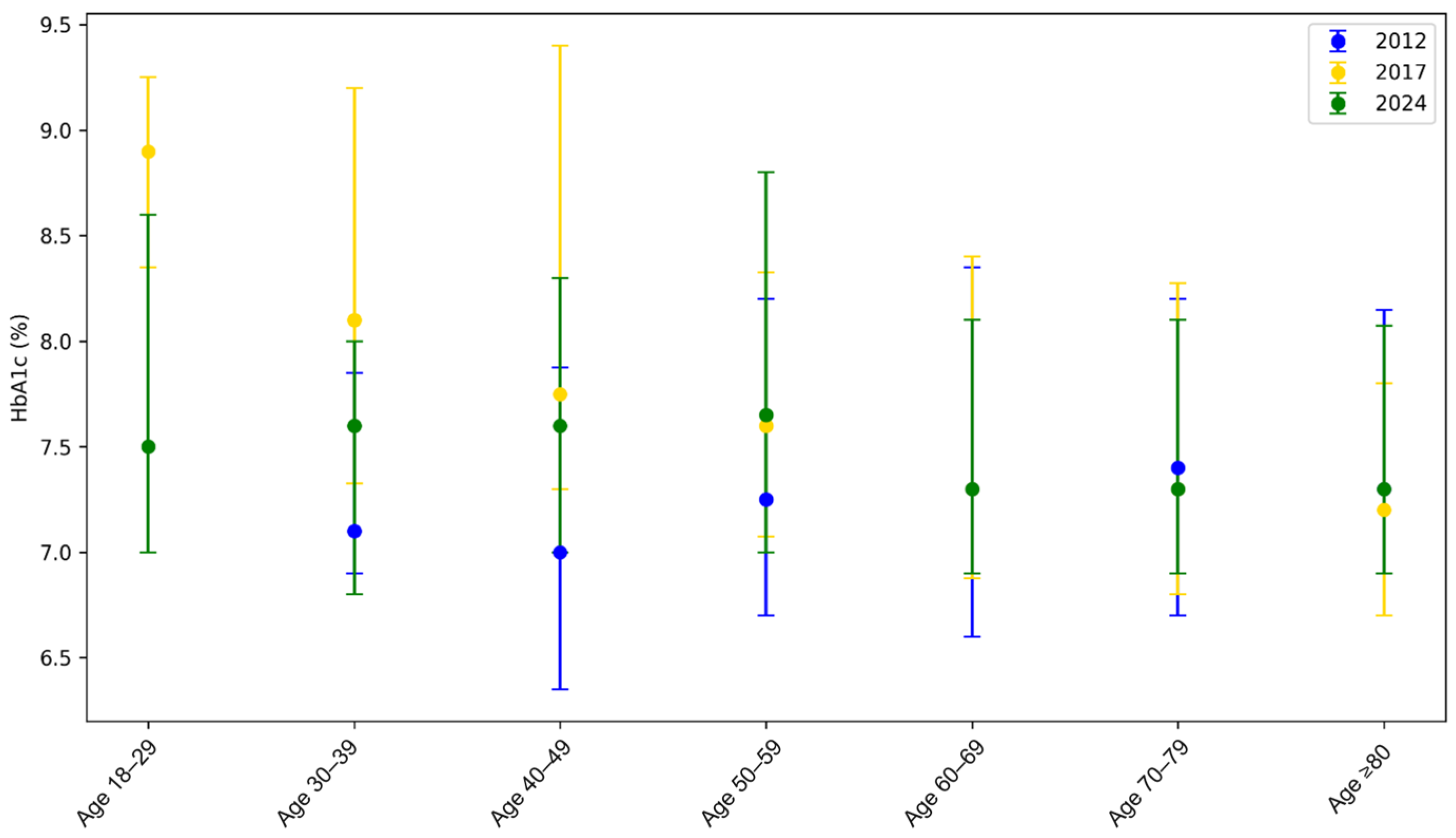
Age-specific HbA1c trajectories in women are shown in Figure 1. Older women exhibited stable glycemic profiles over time. Among those aged ≥60 years, median HbA1c values clustered tightly between 7.2% and 7.4% across all three cohorts, with minimal temporal variation. In contrast, greater variability was observed in younger and midlife women. Women aged 50–59 years showed a progressive increase in median HbA1c from 7.25% in 2012 to 7.60% in 2017 and 7.65% in 2024. In the 40–49-year group, HbA1c increased from 7.00% in 2012 to 7.75% in 2017, followed by a modest reduction to 7.60% in 2024. The highest HbA1c values were observed in the youngest women in 2017. Women aged 18–29 years had a median HbA1c of 8.90%, which declined considerably by 2024 (7.50%). A similar pattern was seen in women aged 30–39 years, although sample sizes were limited. Figure 1 shows an age gradient in HbA1c variability among women, with increasing stability at older ages.

3.3. Age Stratified HbA1c Trends in Men

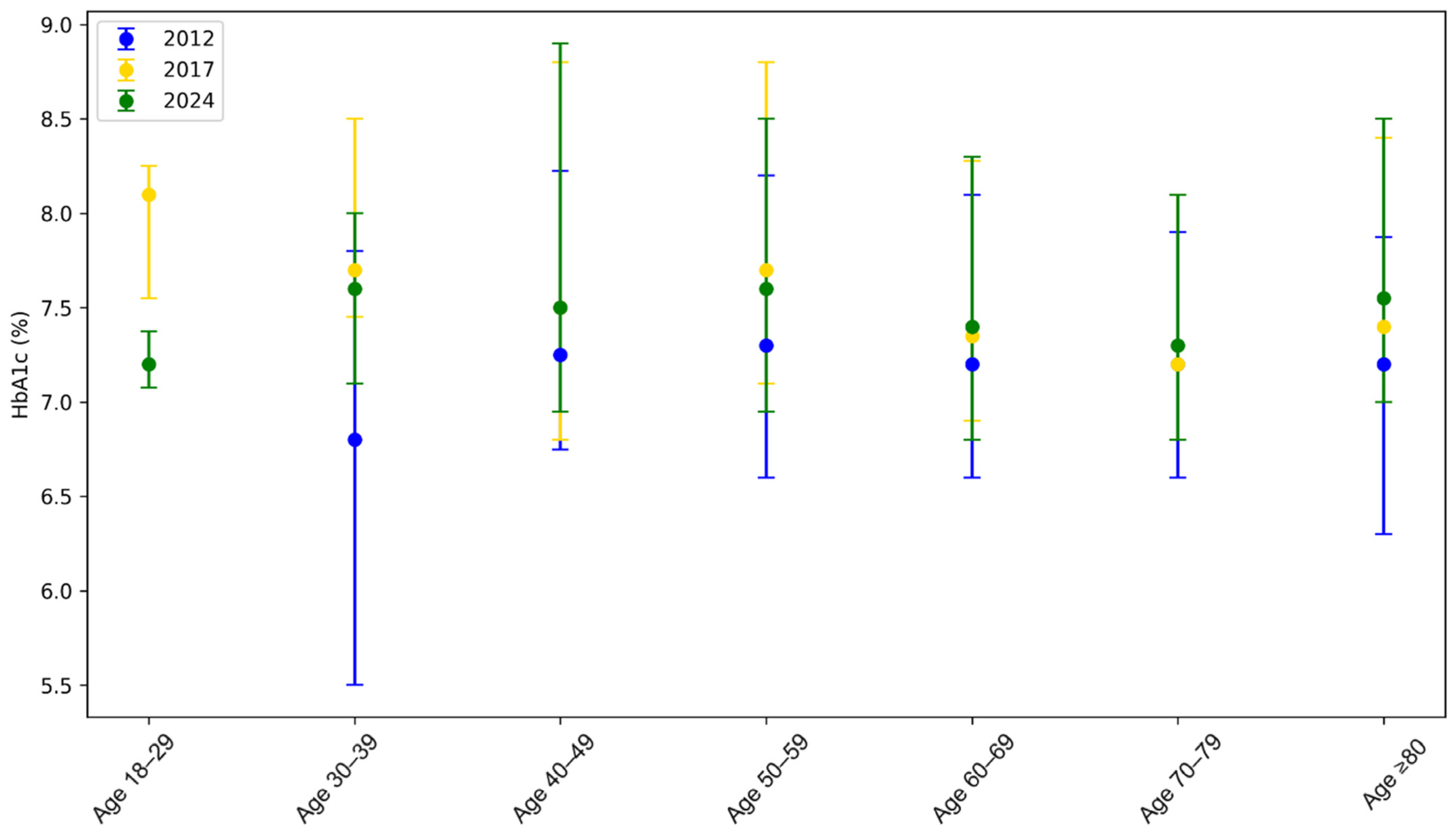
Corresponding age-stratified trajectories in men are shown in Figure 2. As in women, older men (≥60 years) demonstrated stable HbA1c values across cohorts, with medians generally ranging from 7.2% to 7.6% and minimal temporal change. In midlife, men exhibited more dynamic patterns. Men aged 50–59 years experienced an increase in median HbA1c from 7.30% in 2012 to 7.70% in 2017, followed by a slight decrease to 7.60% in 2024. Men aged 40–49 years showed a similar rise between 2012 and 2017, with subsequent stabilization. Younger men showed higher HbA1c levels and greater variability, particularly in 2017. In the 18–29-year group, median HbA1c was 8.10% in 2017, decreasing to 7.20% in 2024. Men aged 30–39 years also showed modest improvement from 2017 to 2024. Figure 2 thus mirrors the pattern observed in women, with greater variability at younger ages and stable glycemic profiles in older adulthood.

3.4. Temporal Changes and Variability

Between-cohort comparisons of HbA1c distributions across age–sex strata are shown in Supplementary Table S3 and Figure S1. Median absolute HbA1c changes were generally small across most age–sex strata, particularly in older adults, where changes were often zero with narrow IQRs. Larger median changes and wider IQRs were observed primarily in younger and midlife groups, indicating greater glycemic volatility. From 2017 to 2024, most age groups showed minimal median change, suggesting stable HbA1c trajectories in recent years.

4. Discussion

In this large, multi-cohort analysis spanning twelve years, we observed that median HbA1c values remained substantially stable between 2012, 2017, and 2024, with only minor fluctuations across age groups and no consistent or linear divergence between men and women across cohorts. The absence of a stable sex gap in aggregated measures contrasts with several historical reports describing poorer glycemic control in women with T2D and highlights the importance of interpreting sex differences within a dynamic, age-specific and context-dependent framework [27]. These findings underscore the complex nature of sex-related disparities, which may manifest in age-specific temporal trajectories rather than in static cross-sectional values.
Although overall HbA1c levels were similar between sexes, our results revealed age-dependent divergences mirroring patterns described in the contemporary literature. Younger adults (18–29 years) exhibited the most substantial improvements in HbA1c between 2017 and 2024 in both sexes, a trend consistent with international observations that younger individuals display the highest glycemic volatility but also respond most markedly to therapeutic intensification and structured diabetes management programs [32,33]. Conversely, adults aged 40–59 years demonstrated more heterogeneous trajectories, with women showing progressive worsening or partial reversals, while men experienced worsening between 2012 and 2017 followed by relative stabilization thereafter. Such patterns may reflect interplay between behavioral, psychosocial, and socioeconomic determinants, which are known to differ by sex and are particularly influential during midlife, when work stress, caregiving responsibilities, and lifestyle stability often diverge between men and women [27].
Older adults (≥70 years) showed remarkably stable HbA1c values across the three cohorts, in line with evidence that glycemic control becomes less variable with advancing age, partly due to therapeutic inertia and partly because disease duration becomes the dominant determinant of glycemic status, outweighing the influence of age alone [34,35]. The absence of increasing sex divergence in these older groups contrasts with earlier observations from Italian and Scandinavian populations, where older women tended to show higher HbA1c and poorer achievement of therapeutic targets compared with age-matched men [36,37]. Our findings suggest that such disparities may be attenuating over time, possibly reflecting improvements in diabetes care pathways, more uniform adoption of guideline-based approaches, and potentially expanded access to cardiometabolic therapies over the past decade.
Despite the overall stability of sex comparisons, the isolated significant difference detected in 2017 among individuals aged ≥80 years, where men exhibited slightly higher median HbA1c and greater dispersion, suggests that sex differences may be episodic and cohort-dependent rather than structural. Considering the multiple sex- and age-stratified comparisons performed, this isolated statistically significant finding should be interpreted as exploratory and does not provide strong evidence of a consistent age-specific sex effect. This is also consistent with the notion that HbA1c itself behaves differently in men and women due to sex-related variation in erythrocyte lifespan, iron metabolism, hemoglobin glycation kinetics, and postprandial glucose excursions, all of which influence the reliability and interpretation of HbA1c as a biomarker [19,38,39]. Women, in particular, tend to exhibit higher postprandial hyperglycemia and greater glucose variability despite similar fasting glucose levels, which may not be fully reflected in HbA1c and could partially attenuate sex differences when using HbA1c medians as the sole measure of glycemic exposure [40,41].
The age-dependent patterns observed in our cohorts are consistent with the notion, supported by the prior literature, that sex differences in glycemic control may emerge not as fixed disparities but as dynamic interactions between biological changes, disease duration, and psychosocial determinants. These mechanisms are not directly measured in the present study but provide a plausible interpretative framework. Biologically, women experience a sharp decline in metabolic resilience after menopause, due to the loss of estrogenic protection, leading to worsening insulin resistance, redistribution of adipose tissue toward visceral depots, endothelial dysfunction, and heightened inflammatory tone [42,43]. These mechanisms could be compatible with the modest upward inflections observed in some female midlife age groups, rather than with a uniform deterioration across all ages. Men, by contrast, accumulate visceral fat earlier in life, develop hepatic insulin resistance sooner, and reach β-cell exhaustion at lower BMI, contributing to worse glycemic markers in young and middle-aged adulthood [44,45]. This biological profile may help explain the deterioration observed in men aged 40–59 years between 2012 and 2017, followed by stabilization in later cohorts. Behavioral and psychosocial determinants further contribute to these sex-specific trajectories. Women with T2D consistently display higher rates of depression, emotional distress, obesity, and reduced physical activity, all of which negatively affect glycemic stability and adherence to therapeutic regimens [46,47]. Compounded by caregiving responsibilities, reduced availability for structured education programs, and gendered patterns of healthcare utilization, these factors may produce intermittent worsening of glycemic control during critical life stages, particularly between ages 40 and 60. Conversely, men tend to engage in riskier behaviors such as smoking and alcohol intake, yet benefit from more aggressive risk-factor management and therapeutic intensification, potentially mitigating the long-term impact of their worse behavioral profile [46,48,49]. Taken together, these factors offer a possible explanation for the relative improvement observed in midlife men from 2017 to 2024.
Importantly, the stability of overall HbA1c medians in our cohorts, despite well-documented sex differences in pathophysiology, should not be interpreted as evidence that men and women experience equivalent diabetes burdens or trajectories. Rather, it reflects the fact that HbA1c alone may not fully capture sex-specific patterns, particularly those driven by higher postprandial excursions in women, differing erythrocyte survival between sexes, variation in glycation kinetics, and social determinants affecting adherence and follow-up.
Indeed, several studies emphasize that HbA1c may underestimate true glycemic exposure in men and overestimate it in women under certain conditions, complicating direct comparisons [19,40,46].
The therapeutic landscape, unfortunately unavailable for the cohorts under study, further shapes these patterns. Contemporary real-world analyses highlight that women are less likely to receive early intensification with SGLT2 inhibitors or GLP-1 receptor agonists, despite strong evidence of cardiovascular and metabolic benefit across sexes [50,51,52]. Concerns about genital infections associated with SGLT2 inhibitors, higher rates of gastrointestinal intolerance with GLP-1RA, and reduced access to specialist evaluation disproportionately affect women, delaying treatment escalation at crucial disease stages [53,54]. This therapeutic inertia is particularly concerning given that GLP-1RA may confer equal or greater benefit in women, especially in terms of weight reduction and endothelial function, potentially narrowing the cardiovascular risk gap that characterizes postmenopausal diabetes [55,56].
The age-specific improvements observed in the youngest adults in our study warrant particular attention. Between 2017 and 2024, individuals aged 18–29 and 30–39 showed the most substantial reductions in median HbA1c, in both sexes. These improvements were accompanied by wider interquartile ranges, indicating high variability but also responsiveness to interventions. Although treatment data were not available, prior studies suggest that younger adults may be more likely to benefit from recent therapeutic and organizational advances, including earlier adoption of newer glucose-lowering agents and structured follow-up programs [57,58]; this interpretation should therefore be regarded as conjectural and based on external evidence rather than on direct observations from the present study. This suggests that recent therapeutic and organizational improvements may be beginning to reduce early-life glycemic disparities, a hypothesis that will require confirmation in studies with detailed treatment information and longitudinal follow-up. By contrast, the stability observed in older adults across all three cohorts likely reflects the predominance of disease duration as a driver of HbA1c, overshadowing the contribution of sex and behavioral factors in later life [59,60]. The limited dispersion of HbA1c values observed in older age groups across cohorts further supports this interpretation, suggesting that late-life glycemic control is characterized by relative stability rather than divergence between men and women.
Several limitations merit consideration. The absence of clinical variables such as BMI, diabetes duration, comorbidities, and treatment regimens limits causal inference and precludes adjustment for key determinants of glycemic control [61]. However, available epidemiological data indicate that overweight and obesity prevalence in Southern Italy has remained largely stable over the study period [62], suggesting that major shifts in adiposity are unlikely to explain the observed temporal patterns. Age was defined as age at the time of HbA1c measurement, and analyses were conducted using independent cross-sectional cohorts rather than longitudinal follow-up. As a result, age-related patterns should be interpreted as differences observed across age strata and cohorts, rather than as within-person changes over time. Although age-adjusted sensitivity analyses yielded results consistent with the primary stratified findings, residual confounding related to age and unmeasured factors associated with ageing cannot be fully excluded.
In conclusion, this real-world analysis demonstrates that median HbA1c values in adults with T2D in Southern Italy have remained stable over the past decade, with minimal and inconsistent differences between men and women. Across cohorts, HbA1c patterns varied more markedly by age group than by sex; however, these associations should be interpreted with caution given the absence of information on diabetes duration, body mass index, treatment intensity, comorbidities, and behavioral or social factors. Residual confounding related to these unmeasured variables cannot be excluded. Overall, the findings are consistent with an age-dependent heterogeneity in glycemic control, rather than a uniform sex-specific pattern. This supports a life-course perspective on sex differences in diabetes, highlighting the importance of considering age and clinical context when interpreting glycemic patterns and designing strategies to optimize diabetes management in both women and men.

Supplementary Materials

The following supporting information can be downloaded at: https://www.mdpi.com/article/10.3390/endocrines7010011/s1, Table S1: Hba1c comparisons by sex in pooled age-groups (18–49 years). Table S2: Continuous age-adjusted linear regression models for HbA1c by cohort. Table S3: Absolute and relative changes in HbA1c by sex and age with interquartile ranges (IQR); Figure S1: Median differences in HbA1c between cohorts (2012–2017 and 2017–2024), by sex and age group.

Author Contributions

Conceptualization, D.P.F., M.M. and A.B.; methodology, M.M. and R.M.; formal analysis, M.M.; investigation, R.M. and M.G.; data curation, M.G. and M.M.; writing—original draft preparation, S.I. and R.M.; writing—review and editing, M.M., A.B. and D.P.F.; visualization, F.S.B. and V.A.; supervision, A.B. and D.P.F.; project administration, D.P.F. All authors have read and agreed to the published version of the manuscript.

Funding

This research received no external funding.

Institutional Review Board Statement

The study was conducted in accordance with the Declaration of Helsinki and applicable data protection regulations. In line with European GDPR principles and Italian regulations, the analysis of fully anonymized, non-identifiable retrospective data does not constitute human subject research and was therefore exempt from Institutional Review Board approval.

Informed Consent Statement

Written informed consent was waived because the study analyzed fully anonymized retrospective laboratory data.

Data Availability Statement

The original contributions presented in this study are included in the article/Supplementary Materials. Further inquiries can be directed to the corresponding authors.

Conflicts of Interest

The authors declare no conflicts of interest.

References

  1. Legato, M.J.; Gelzer, A.; Goland, R.; Ebner, S.A.; Rajan, S.; Villagra, V.; Kosowski, M. Gender-specific care of the patient with diabetes: Review and recommendations. Gend. Med. 2006, 3, 131–158. [Google Scholar] [CrossRef] [Scilit]
  2. Mauvais-Jarvis, F.; Clegg, D.J.; Hevener, A.L. The role of estrogens in control of energy balance and glucose homeostasis. Endocr. Rev. 2013, 34, 309–338. [Google Scholar] [CrossRef] [Scilit]
  3. Faerch, K.; Borch-Johnsen, K.; Vaag, A.; Jørgensen, T.; Witte, D.R. Sex differences in glucose levels: A consequence of physiology or methodological convenience? The Inter99 study. Diabetologia 2010, 53, 858–865. [Google Scholar] [CrossRef] [Scilit] [PubMed]
  4. Gucciardi, E.; Wang, S.C.; DeMelo, M.; Amaral, L.; Stewart, D.E. Characteristics of men and women with diabetes: Observations during patients’ initial visit to a diabetes education centre. Can. Fam. Physician 2008, 54, 219–227. [Google Scholar]
  5. Hoff, N.; Mellace, G.; Menon, S. Gender Differences in Healthcare Utilisation—Evidence from Unexpected Adverse Health Shocks. arXiv 2025, arXiv:2509.01310v1. [Google Scholar] [CrossRef] [Scilit]
  6. Yu, M.K.; Lyles, C.R.; Bent-Shaw, L.A.; Young, B.A. Sex disparities in diabetes process of care measures and self-care in high-risk patients. J. Diabetes Res. 2013, 2013, 575814. [Google Scholar] [CrossRef] [Scilit] [PubMed]
  7. Nilsson, P.M.; Theobald, H.; Journath, G.; Fritz, T. Gender differences in risk factor control and treatment profile in diabetes: A study in 229 Swedish primary health care centres. Scand. J. Prim. Health Care 2004, 22, 27–31. [Google Scholar] [CrossRef] [Scilit]
  8. Kautzky-Willer, A.; Kosi, L.; Lin, J.; Mihaljevic, R. Gender-based differences in glycaemic control and hypoglycaemia prevalence in patients with type 2 diabetes: Results from patient-level pooled data of six randomized controlled trials. Diabetes Obes. Metab. 2015, 17, 533–540. [Google Scholar] [CrossRef] [Scilit] [PubMed]
  9. Franzini, L.; Ardigò, D.; Cavalot, F.; Miccoli, R.; Rivellese, A.A.; Trovati, M.; Zavaroni, I.; Vaccaro, O. Women show worse control of type 2 diabetes and cardiovascular disease risk factors than men: Results from the MIND. IT Study Group of the Italian Society of Diabetology. Nutr. Metab. Cardiovasc. Dis. 2013, 23, 235–241. [Google Scholar] [CrossRef] [Scilit]
  10. Vaccaro, O.; Boemi, M.; Cavalot, F.; De Feo, P.; Miccoli, R.; Patti, L.; Rivellese, A.; Trovati, M.; Ardigò, D.; Zavaroni, I. The clinical reality of guidelines for primary prevention of cardiovascular disease in type 2 diabetes in Italy. Atherosclerosis 2008, 198, 396–402. [Google Scholar] [CrossRef] [Scilit]
  11. Duarte, F.G.; da Silva Moreira, S.; Almeida, M.; de Souza Teles, C.A.; Andrade, C.S.; Reingold, A.L.; Moreira, E.D., Jr. Sex differences and correlates of poor glycaemic control in type 2 diabetes: A cross-sectional study in Brazil and Venezuela. BMJ Open 2019, 9, e023401. [Google Scholar] [CrossRef] [Scilit]
  12. Niedermayer, F.; Su, Y.; von Krüchten, R.; Thorand, B.; Peters, A.; Rathmann, W.; Roden, M.; Schlett, C.L.; Bamberg, F.; Nattenmüller, J.; et al. Trajectories of glycaemic traits exhibit sex-specific associations with hepatic iron and fat content: Results from the KORA-MRI study. Liver Int. 2023, 43, 2153–2166. [Google Scholar] [CrossRef] [Scilit]
  13. Bhattacharjee, A.; Ali, M.R.; Kloecker, D.; Ling, S.; Balasubramanian, G.V.; Gillies, C.; Davies, M.; Khunti, K.; Zac-cardi, F. Five-year trajectories of HbA1c by age, sex, ethnicity and deprivation in adults with newly diagnosed type 2 diabetes: Observational study in England. Diabetes Obes. Metab. 2025, 27, 2896–2900. [Google Scholar] [CrossRef] [Scilit] [PubMed]
  14. Handley, D.; Gillett, A.C.; Bala, R.; Tyrrell, J.; Lewis, C.M. Latent class growth mixture modeling of HbA1C trajecto-ries identifies individuals at high risk of developing complications of type 2 diabetes mellitus in the UK Biobank. BMJ Open Diabetes Res. Care 2025, 13, e004826. [Google Scholar] [CrossRef] [Scilit] [PubMed]
  15. Donnelly, L.A.; Zhou, K.; Doney, A.S.F.; Jennison, C.; Franks, P.W.; Pearson, E.R. Rates of glycaemic deterioration in a real-world population with type 2 diabetes. Diabetologia 2018, 61, 607–615. [Google Scholar] [CrossRef] [Scilit]
  16. Ostgren, C.J.; Lindblad, U.; Ranstam, J.; Melander, A.; Råstam, L. Glycaemic control, disease duration and beta-cell function in patients with Type 2 diabetes in a Swedish community. Skaraborg Hypertension and Diabetes Project. Diabet. Med. 2002, 19, 125–129. [Google Scholar] [CrossRef] [Scilit]
  17. Saisho, Y. β-cell dysfunction: Its critical role in prevention and management of type 2 diabetes. World J. Diabetes 2015, 6, 109–124. [Google Scholar] [CrossRef] [Scilit] [PubMed]
  18. Gaber, M.; Wilson, A.S.; Millen, A.E.; Hovey, K.M.; LaMonte, M.J.; Wactawski-Wende, J.; Ochs-Balcom, H.M.; Cook, K.L. Visceral adiposity in postmenopausal women is associated with a pro-inflammatory gut microbiome and immunogenic metabolic endotoxemia. Microbiome 2024, 12, 192. [Google Scholar] [CrossRef] [Scilit]
  19. Yang, G.; Au Yeung, S.L.; Schooling, C.M. Sex differences in the association of fasting glucose with HbA1c, and their consequences for mortality: A Mendelian randomization study. eBioMedicine 2022, 84, 104259. [Google Scholar] [CrossRef] [Scilit]
  20. Stedman, M.; Heald, A.H.; Holland, D.; Halsall, I.; Green, L.; Wu, P.; Patel, K.; Scargill, J.; Gibson, M.; Hanna, F.W.F.; et al. The Impact of Age and Sex on Fasting Plasma Glucose and Glycated Haemoglobin (HbA1c) in the Non-diabetes Population. Diabetes Ther. 2025, 16, 257–267. [Google Scholar] [CrossRef] [Scilit]
  21. Cromer, S.J.; Lauffenburger, J.C.; Levin, R.; Patorno, E. Deficits and Disparities in Early Uptake of Glucagon-Like Peptide 1 Receptor Agonists and SGLT2i Among Medicare-Insured Adults Following a New Diagnosis of Cardiovascular Disease or Heart Failure. Diabetes Care 2022, 46, 65–74. [Google Scholar] [CrossRef] [Scilit]
  22. Funck, K.L.; Bjerg, L.; Isaksen, A.A.; Sandbæk, A.; Grove, E.L. Gender disparities in time-to-initiation of cardiopro-tective glucose-lowering drugs in patients with type 2 diabetes and cardiovascular disease: A Danish nationwide cohort study. Cardiovasc. Diabetol. 2022, 21, 279. [Google Scholar] [CrossRef] [Scilit]
  23. Febrey, S.; Nunns, M.; Buckland, J.; Abbott, R.; Bethel, A.; Whear, R.; Boddy, K.; Melendez-Torres, G.J.; Coon, J.T.; Shaw, L. What Are the Experiences, Views and Perceptions of Patients, Carers and Clinicians of Glucagon-like Peptide-1 Receptor Agonists (GLP-1 RAs)? A Scoping Review. Health Expect. 2025, 28, e70251. [Google Scholar] [CrossRef] [Scilit]
  24. Zimner Rapuch, S.; Divino, V.; Norrbacka, K.; Boye, K.; Lebrec, J.; Rosilio, M.; DeKoven, M.; Guerci, B. Treatment Patterns and Persistence With GLP-1 RA Treatments Among Patients with Type 2 Diabetes in France: A Retrospective Cohort Analysis. Diabetes Ther. 2021, 12, 1553–1567. [Google Scholar] [CrossRef] [Scilit] [PubMed]
  25. Yang, Y.; He, L.; Han, S.; Yang, N.; Liu, Y.; Wang, X.; Li, Z.; Ping, F.; Xu, L.; Li, W.; et al. Sex Differences in the Efficacy of Glucagon-Like Peptide-1 Receptor Agonists for Weight Reduction: A Systematic Review and Meta-Analysis. J. Diabetes 2025, 17, e70063. [Google Scholar] [CrossRef] [Scilit] [PubMed]
  26. Russo, G.T.; Nicolucci, A.; Cuttone, A.; Ceriello, A.; Manicardi, V.; Rocca, A.; Prattichizzo, F.; Lucisano, G.; Corrao, S.; De Cosmo, S.; et al. Clinical characteristics and intensification patterns in subjects with “early” type 2 diabetes in Italy—An analysis from the AMD annals initiative. Acta Diabetol. 2025; Epub ahead of printing. [CrossRef] [Scilit]
  27. Kautzky-Willer, A.; Harreiter, J.; Pacini, G. Sex and Gender Differences in Risk, Pathophysiology and Complications of Type 2 Diabetes Mellitus. Endocr. Rev. 2016, 37, 278–316. [Google Scholar] [CrossRef] [Scilit] [PubMed]
  28. Peters, S.A.; Huxley, R.R.; Sattar, N.; Woodward, M. Sex Differences in the Excess Risk of Cardiovascular Diseases Associated with Type 2 Diabetes: Potential Explanations and Clinical Implications. Curr. Cardiovasc. Risk Rep. 2015, 9, 36. [Google Scholar] [CrossRef] [Scilit]
  29. Ballotari, P.; Venturelli, F.; Greci, M.; Giorgi Rossi, P.; Manicardi, V. Sex Differences in the Effect of Type 2 Diabetes on Major Cardiovascular Diseases: Results from a Population-Based Study in Italy. Int. J. Endocrinol. 2017, 2017, 6039356. [Google Scholar] [CrossRef] [Scilit]
  30. Parigi, G.; Toni, A.L.; Scapellato, C.; Longini, M. Glycated hemoglobin (HbA1c): Comparison between Premier Hb9210 and ADAMStm A1c HA-8180V analyzers. Biochim. Clin. 2022, 46, 62–67. [Google Scholar] [CrossRef]
  31. Arzuhal, A.E.; Erden, G.; Ucar, F.; Yavuz Taslipinar, M.; Ozcan, N.; Guneyk, A.; Bulut, E.; Ginis, Z.; Ozdemir, S. Comparison of HbA1c analysers: Agilent 1100 HPLC using kits produced by Gordion Diagnostic (Turkey) with Premier Hb9210 using kits produced by Trinity Biotech (USA) in different patient groups. Malays. J. Pathol. 2016, 38, 131–140. [Google Scholar]
  32. Ajjan, R.A.; Battelino, T.; Cos, X.; Del Prato, S.; Philips, J.-C.; Meyer, L.; Seufert, J.; Seidu, S. Continuous glucose monitoring for the routine care of type 2 diabetes mellitus. Nat. Rev. Endocrinol. 2024, 20, 426–440. [Google Scholar] [CrossRef] [Scilit]
  33. Fu, A.Z.; Sheehan, J.J. Change in HbA1c associated with treatment intensification among patients with type 2 diabetes and poor glycemic control. Curr. Med. Res. Opin. 2017, 33, 853–858. [Google Scholar] [CrossRef] [Scilit]
  34. Khunti, S.; Khunti, K.; Seidu, S. Therapeutic inertia in type 2 diabetes: Prevalence, causes, consequences and methods to overcome inertia. Ther. Adv. Endocrinol. Metab. 2019, 10, 2042018819844694. [Google Scholar] [CrossRef] [Scilit]
  35. Du, Y.F.; Ou, H.Y.; Beverly, E.A.; Chiu, C.J. Achieving glycemic control in elderly patients with type 2 diabetes: A critical comparison of current options. Clin. Interv. Aging 2014, 9, 1963–1980. [Google Scholar] [CrossRef] [Scilit]
  36. Penno, G.; Solini, A.; Bonora, E.; Fondelli, C.; Orsi, E.; Zerbini, G.; Trevisan, R.; Vedovato, M.; Gruden, G.; Laviola, L.; et al. Gender differences in cardiovascular disease risk factors, treatments and complications in patients with type 2 diabetes: The RIACE Italian multicentre study. J. Intern. Med. 2013, 274, 176–191. [Google Scholar] [CrossRef] [Scilit]
  37. Gisinger, T.; Azizi, Z.; Alipour, P.; Harreiter, J.; Raparelli, V.; Kublickiene, K.; Herrero, M.T.; Norris, C.M.; El Emam, K.; Pilote, L.; et al. Sex and gender aspects in diabetes mellitus: Focus on access to health care and cardiovascular outcomes. Front. Public Health 2023, 11, 1090541. [Google Scholar] [CrossRef] [Scilit]
  38. Bae, J.C.; Suh, S.; Jin, S.M.; Kim, S.W.; Hur, K.Y.; Kim, J.H.; Min, Y.K.; Lee, M.S.; Lee, M.K.; Jeon, W.S.; et al. Hemo-globin A1c values are affected by hemoglobin level and gender in non-anemic Koreans. J. Diabetes Investig. 2014, 5, 60–65. [Google Scholar] [CrossRef] [Scilit] [PubMed]
  39. Wang, M.; Hng, T. HbA1c: More than just a number. Aust. J. Gen. Pract. 2021, 50, 628–632. [Google Scholar] [CrossRef] [Scilit] [PubMed]
  40. Mauvais-Jarvis, F. Gender differences in glucose homeostasis and diabetes. Physiol. Behav. 2018, 187, 20–23. [Google Scholar] [CrossRef] [Scilit] [PubMed]
  41. Stimson, R.H.; Dover, A.R.; Forbes, S.; Strachan, M.W.J.; McKnight, J.A.; Gibb, F.W. HbA1c Is Disproportionately Higher in Women and Older People with Type 1 Diabetes Compared with Flash Glucose Monitoring Metrics of Glycemic Control. J. Diabetes Sci. Technol. 2022, 16, 446–453. [Google Scholar] [CrossRef] [Scilit]
  42. Russo, G.T.; Manicardi, V.; Rossi, M.C.; Orsi, E.; Solini, A. Sex- and gender-differences in chronic long-term com-plications of type 1 and type 2 diabetes mellitus in Italy. Nutr. Metab. Cardiovasc. Dis. 2022, 32, 2297–2309. [Google Scholar] [CrossRef] [Scilit]
  43. Stachowiak, G.; Pertyński, T.; Pertyńska-Marczewska, M. Metabolic disorders in menopause. Menopause Rev. Przegląd Menopauzalny 2015, 14, 59–64. [Google Scholar] [CrossRef] [Scilit]
  44. Logue, J.; Walker, J.J.; Colhoun, H.M.; Leese, G.P.; Lindsay, R.S.; McKnight, J.A.; Morris, A.D.; Pearson, D.W.; Petrie, J.R.; Philip, S.; et al. Do men develop type 2 diabetes at lower body mass indices than women? Diabetologia 2011, 54, 3003–3006. [Google Scholar] [CrossRef] [Scilit] [PubMed]
  45. Geer, E.B.; Shen, W. Gender differences in insulin resistance, body composition, and energy balance. Gend. Med. 2009, 6, 60–75. [Google Scholar] [CrossRef] [Scilit]
  46. Kautzky-Willer, A.; Leutner, M.; Harreiter, J. Sex differences in type 2 diabetes. Diabetologia 2023, 66, 986–1002. [Google Scholar] [CrossRef] [Scilit]
  47. Baroni, I.; Caruso, R.; Dellafiore, F.; Ausili, D.; Barello, S.; Vangone, I.; Russo, S.; Magon, A.; Conte, G.; Guardamagna, L.; et al. Self-care and type 2 diabetes mellitus (T2DM): A literature review in sex-related differences. Acta Biomed. 2022, 93, e2022277. [Google Scholar] [CrossRef] [Scilit]
  48. Ramírez-Morros, A.; Franch-Nadal, J.; Real, J.; Miró-Catalina, Q.; Bundó, M.; Vlacho, B.; Mauricio, D. Clinical char-acteristics and degree of cardiovascular risk factor control in patients with newly-diagnosed type 2 diabetes in Catalonia. Front. Endocrinol. 2024, 15, 1339879. [Google Scholar] [CrossRef] [Scilit] [PubMed]
  49. Ramírez-Morros, A.; Berenguera, A.; Millaruelo, L.; Buil-Cosiales, P.; Gomez Garcia, C.; Cos, X.; Ávila Lachica, L.; Artola, S.; Millaruelo, J.M.; Mauricio, D.; et al. Impact of Gender on Patient Experiences of Self-Management in Type 2 Diabetes: A Qualitative Study. Patient Prefer. Adherence 2024, 18, 1885–1896. [Google Scholar] [CrossRef] [Scilit]
  50. Azegami, T.; Kaneko, H.; Okada, A.; Suzuki, Y.; Aoyama, K.; Nakayama, T.; Fujiu, K.; Takeda, N.; Morita, H.; Yokoo, T.; et al. Gender differences in the prescription of SGLT2 inhibitors in chronic kidney disease: A real-world database study. Diabetes Obes. Metab. 2025, 27, 6294–6303. [Google Scholar] [CrossRef] [Scilit]
  51. Hammer, A.; Hofer, F.; Kazem, N.; Koller, L.; Steinacher, E.; Baumer, U.; Wollmann, F.; Kautzky-Willer, A.; Beitl, K.; Remer, F.; et al. Sex-Related Disparities in Prescription Patterns of Sodium-Glucose Cotransporter 2 Inhibitors in Patients with Type 2 Diabetes and Heart Failure. J. Womens Health 2023, 32, 1219–1228. [Google Scholar] [CrossRef] [Scilit]
  52. Piccini, S.; Favacchio, G.; Morenghi, E.; Mazziotti, G.; Lania, A.G.; Mirani, M. Real-world sex differences in type 2 diabetes patients treated with GLP-1 receptor agonists. Diabetes Res. Clin. Pract. 2024, 212, 111689. [Google Scholar] [CrossRef] [Scilit]
  53. Dave, C.V.; Schneeweiss, S.; Patorno, E. Comparative risk of genital infections associated with sodium-glucose co-transporter-2 inhibitors. Diabetes Obes. Metab. 2019, 21, 434–438. [Google Scholar] [CrossRef] [Scilit]
  54. Consoli, A.; Formoso, G.; Baldassarre, M.P.A.; Febo, F. A comparative safety review between GLP-1 receptor agonists and SGLT2 inhibitors for diabetes treatment. Expert. Opin. Drug Saf. 2018, 17, 293–302. [Google Scholar] [CrossRef] [Scilit] [PubMed]
  55. Galati, G.; Sabouret, P.; Germanova, O.; Bhatt, D.L. Women and Diabetes: Preventing Heart Disease in a New Era of Therapies. Eur. Cardiol. 2021, 16, e40. [Google Scholar] [CrossRef] [Scilit]
  56. Raparelli, V.; Elharram, M.; Moura, C.S.; Abrahamowicz, M.; Bernatsky, S.; Behlouli, H.; Pilote, L. Sex Differences in Cardiovascular Effectiveness of Newer Glucose-Lowering Drugs Added to Metformin in Type 2 Diabetes Mellitus. J. Am. Heart Assoc. 2020, 9, e012940. [Google Scholar] [CrossRef] [Scilit] [PubMed]
  57. Samuels, S.L.; Chajecki, A.; Hu, P.; Kayser, M.; Weyman, K.; Pan, B.; Brown, E.A.; Van Name, M.; Wolf, R.M. Re-al-world use of glucagon-like peptide-1 receptor agonists in youth with type 2 diabetes is associated with short-term improvements in HbA1c. Diabetes Obes. Metab. 2024, 26, 1305–1313. [Google Scholar] [CrossRef] [Scilit] [PubMed]
  58. King, A.; Tan, X.; Dhopeshwarkar, N.; Bohn, R.; Dea, K.; Leonard, C.E.; de Havenon, A. Recent trends in GLP-1 RA and SGLT2i use among people with type 2 diabetes and atherosclerotic cardiovascular disease in the USA. BMJ Open Diabetes Res. Care 2024, 12, e004431. [Google Scholar] [CrossRef] [Scilit]
  59. McCormick, T.A.; Adams, J.L.; Lee, E.A.; Emptage, N.P.; Palmer-Toy, D.E.; Martin, J.P.; Broder, B.I.; Kanter, M.H.; Davis, A.C.; McGlynn, E.A. Age-Dependent Hemoglobin A1c Therapeutic Targets Reduce Diabetic Medication Changes in the Elderly. EGEMS 2019, 7, 46. [Google Scholar] [CrossRef] [Scilit] [PubMed]
  60. Lee, C.M.Y.; Gibson, A.A.; Humphries, J.; Nassar, N.; Colagiuri, S. Sex and age differences in the use of medications for diabetes and cardiovascular risk factors among 25,733 people with diabetes. PLoS ONE 2023, 18, e0287599. [Google Scholar] [CrossRef] [Scilit]
  61. Mirabelli, M.; Tocci, V.; Donnici, A.; Giuliano, S.; Sarnelli, P.; Salatino, A.; Greco, M.; Puccio, L.; Chiefari, E.; Foti, D.P.; et al. Maternal Preconception Body Mass Index Overtakes Age as a Risk Factor for Gestational Diabetes Mellitus. J. Clin. Med. 2023, 12, 2830. [Google Scholar] [CrossRef] [Scilit]
  62. Masocco, M.; Minardi, V.; Contoli, B.; Minelli, G.; Manno, V.; Cobellis, L.; Greco, D. Sovrappeso e obesità nella po-polazione adulta in Italia: Trend temporali, differenze socio-anagrafiche e regionali con focus sulla Regione Campania. Boll. Epidemiol. Naz. 2023, 4, 1–8. [Google Scholar] [CrossRef]
Figure 1. HbA1c trends in women with T2D across age categories in the 2012, 2017 and 2024 cohorts. Each dot represents the median HbA1c, with interquartile ranges (IQRs) shown as vertical bars. Colors denote the cohort year: blue = year 2012, yellow = year 2017, green = year 2024.
Endocrines 07 00011 g001
Figure 2. HbA1c trends in men with T2D across age categories in the 2012, 2017 and 2024 cohorts. Each dot represents the median HbA1c, with interquartile ranges (IQRs) shown as vertical bars. Colors denote the cohort year: blue = year 2012, yellow = year 2017, green = year 2024.
Endocrines 07 00011 g002
Table 1. Comparison of median HbA1c values by sex and age category in the 2012, 2017, and 2024 cohorts.
Age Group
(Years)
2012
Women
(HbA1c, n)
2012
Men
(HbA1c, n)
2012
p-Value
2017 Women
(HbA1c, n)
2017
Men
(HbA1c, n)
2017
p-Value
2024 Women
(HbA1c, n)
2024
Men
(HbA1c, n)
2024
p-Value
18–298.90 (8.35–9.25), n = 78.10 (7.55–8.25), n = 70.0387.50 (7.00–8.60), n = 177.20 (7.07–7.38), n = 40.530
30–397.10 (6.90–7.85), n = 76.80 (5.50–7.80), n = 90.4588.10 (7.33–9.20), n = 47.70 (7.45–8.50), n = 160.9247.60 (6.80–8.00), n = 57.60 (7.10–8.00), n = 90.640
40–497.00 (6.35–7.88), n = 187.25 (6.75–8.22), n = 360.4357.75 (7.30–9.40), n = 247.50 (6.80–8.80), n = 470.1517.60 (7.00–8.30), n = 137.50 (6.95–8.90), n = 310.615
50–597.25 (6.70–8.20), n = 987.30 (6.60–8.20), n = 1320.9427.60 (7.07–8.33), n = 727.70 (7.10–8.80), n = 1250.3047.65 (7.00–8.80), n = 627.60 (6.95–8.50), n = 830.581
60–697.30 (6.60–8.35), n = 2317.20 (6.60–8.10), n = 2050.5917.30 (6.88–8.40), n = 1447.35 (6.90–8.28), n = 2060.4837.30 (6.90–8.10), n = 1387.40 (6.80–8.30), n = 2110.503
70–797.40 (6.70–8.20), n = 2097.20 (6.60–7.90), n = 1930.1367.30 (6.80–8.28), n = 1307.20 (6.80–8.10), n = 1900.3967.30 (6.90–8.10), n = 1427.30 (6.80–8.10), n = 2200.694
≥807.30 (6.90–8.15), n = 557.20 (6.30–7.88), n = 580.0817.20 (6.70–7.80), n = 737.40 (7.00–8.40), n = 770.0257.30 (6.90–8.07), n = 867.55 (7.00–8.50), n = 1020.140
Overall7.35 (6.80–8.30), n = 6167.30 (6.80–8.20), n = 6330.4667.30 (6.80–8.30), n = 4567.40 (6.90–8.30), n = 6690.2467.40 (6.90–8.20), n = 4647.40 (6.90–8.30), n = 6610.349
Disclaimer/Publisher’s Note: The statements, opinions and data contained in all publications are solely those of the individual author(s) and contributor(s) and not of MDPI and/or the editor(s). MDPI and/or the editor(s) disclaim responsibility for any injury to people or property resulting from any ideas, methods, instructions or products referred to in the content.