1. Introduction
In the fabrication of sub-10 nm logic nodes and high-density memory chips, the continuous evolution of lithography remains the primary driver for extending Moore’s Law, while extreme ultraviolet lithography (EUVL) has entered high-volume manufacturing. High-numerical-aperture (High-NA) 193 nm deep-ultraviolet (DUV) systems maintain critical economic viability and indispensability in multi-patterning processes and specific critical-layer manufacturing due to their mature engineering ecosystem [
1,
2,
3]. As the “heart” of these systems, the performance of antireflective (AR) coatings on strongly curved optical elements within high-NA projection lenses directly determines imaging contrast and system energy throughput. As numerical apertures surpass 1.35, traditional thin-film designs are approaching their theoretical limits in maintaining analytical precision when addressing the complex vector characteristics of light fields over non-planar surfaces [
4,
5].
At the 193 nm wavelength, the intrinsic absorption loss of materials represents the primary design bottleneck. Although LaF
3 and MgF
2 are classic high/low refractive index pairs, their optical properties exhibit strong process dependence. Research indicates that fluoride films prepared by ion-beam sputtering (IBS) exhibit lower scattering losses compared to electron-beam (E-beam) evaporation, with the extinction coefficient
k maintainable at the
order of magnitude [
6,
7]. However, fluctuations in deposition temperature significantly induce refractive index drift; for instance, when MgF
2 is deposited above 200 °C, its refractive index shows a distinct non-linear increase compared to room temperature values [
8,
9]. Recently, the emergence of AlF
3 thin films via atomic layer deposition (ALD) and La
1−xAl
xF
3 nanocomposites has provided new avenues for achieving lower losses and flexible refractive index tuning [
10,
11].
Geometric effects induced by strongly curved substrates (curvature radius
mm) present the main challenge for full-field performance consistency. In planetary rotation deposition systems, geometric flux deviations on the substrate surface result in a significant non-linear distribution of film thickness along the radial direction [
12,
13]. Previous studies have employed mask compensation techniques and optimized magnetron sputtering rotation systems to suppress thickness deviations on curved surfaces to within 1% [
14,
15]. Nevertheless, in the strongly curved edge regions where the incident angle
, these deviations couple with polarization splitting effects, leading to a rapid rebound in reflectance and inducing severe wavefront distortion [
16,
17]. Research on narrowband far-ultraviolet (FUV) multilayers further suggests that even a 2 nm thickness deviation is sufficient to cause a significant shift in the center wavelength, thereby compromising the imaging fidelity of high-NA systems [
18,
19].
Given these multi-dimensional physical constraints, traditional single-objective trial-and-error methods struggle to achieve deep convergence within the generalized parameter space. Although modern optical design has rapidly evolved over the past three years toward statistical robust frameworks [
20] and automated architectures based on deep learning or enhanced evolutionary optimization [
21], a critical deficiency persists. Specifically, contemporary inverse methods primarily optimize for ideal flat-substrate responses or utilize traditional algorithms merely as synthetic data generators to train neural networks. Consequently, these models inherently neglect the localized spatial gradients encountered on strongly curved surfaces, and they completely overlook the severe multi-physical coupling of thermo-optic dispersion (
) and accumulated residual stress. Genetic algorithms, in particular, have been successfully used for the optimization of multilayer optical structures, including perfect absorbers [
22], broadband photonic crystals [
23], and multi-objective inverse design tasks [
24], and the multi-objective synthesized parameters of anti-reflection stacks [
25]. In computational lithography, NSGA-II has also demonstrated success in source-mask co-optimization for process window enhancement [
26]. Building on these validated applications of evolutionary optimization, this study adopts the NSGA-II framework to address the more complex coupling of geometric, thermo-optic, and process constraints.
Building upon our previous work using Zernike descriptors for AR correction on strongly curved substrates [
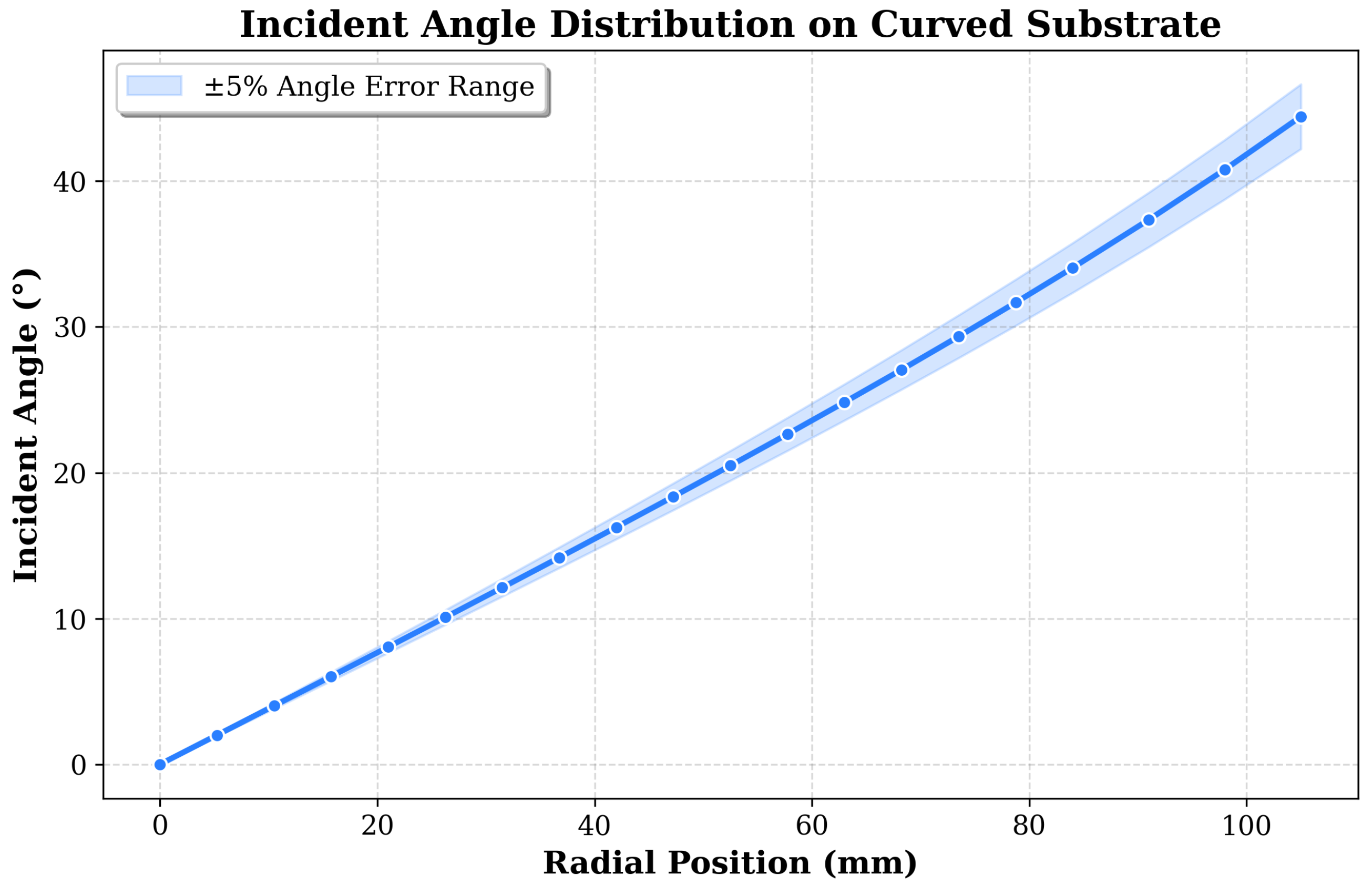
27], this study constructs a full-stack optimization framework integrating material thermo-optic dispersion, edge-refined discrete modeling, and the NSGA-II algorithm. While existing studies have applied TMM with evolutionary algorithms—typically targeting ideal flat-substrate responses or generating synthetic data for neural networks—the novelty here lies in a physics-algorithm co-design that embeds multi-physical constraints directly into the evolutionary loop. Specifically, edge-refined radial discretization captures extreme geometric flux deviations at incident angles up to 44.4°, while thermo-optic dispersion, residual stress modeling, and a hard adjacent-layer thickness constraint (≥4 nm) enforce industrial feasibility. An a posteriori ideal-point decision mechanism then objectively resolves the severe trade-off between paraxial reflectance and full-aperture uniformity, ultimately identifying designs that simultaneously achieve ultra-low reflectance, high radial consistency, and mechanical reliability.
3. Materials and Methods
3.1. Optimization System Architecture
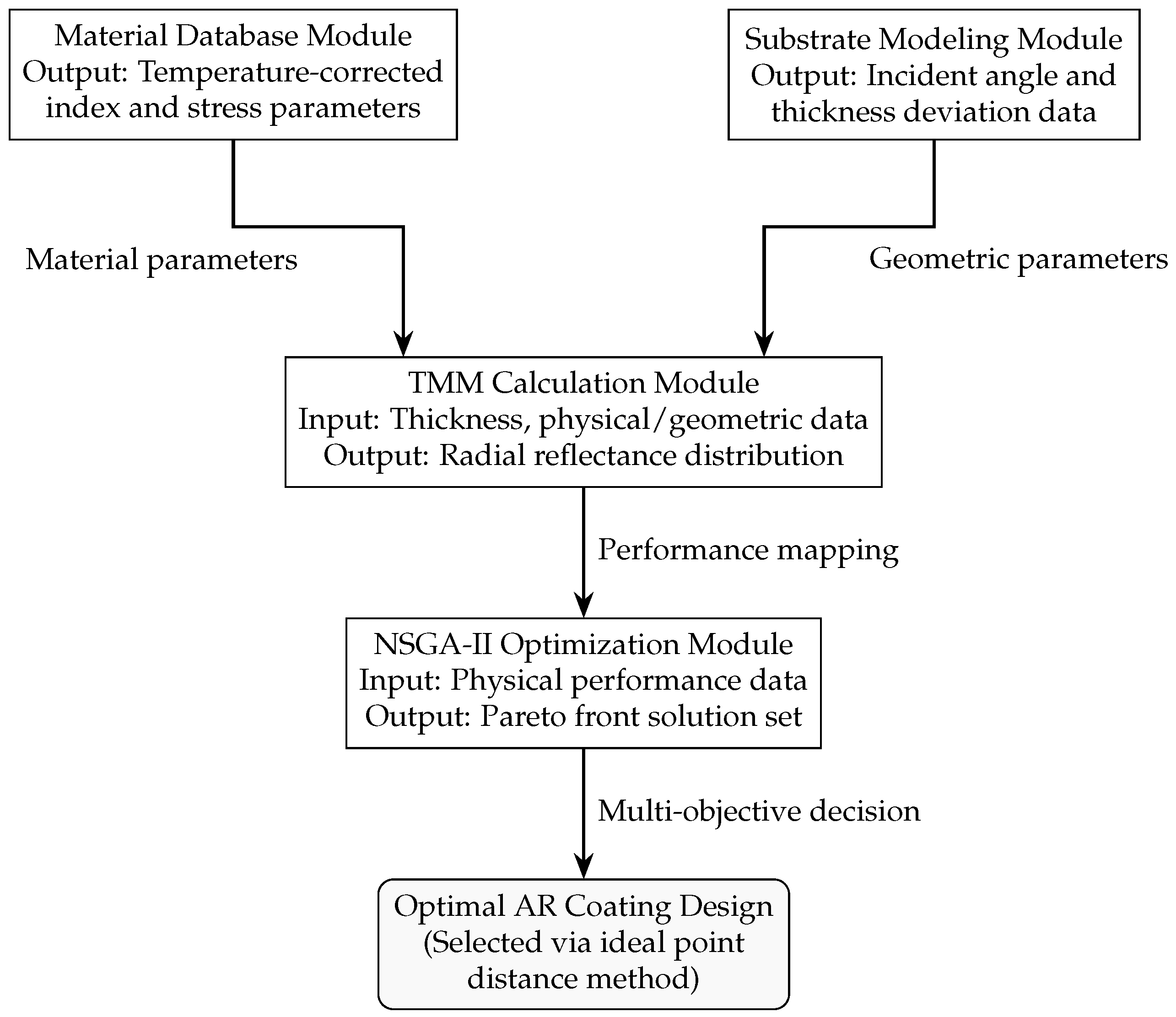
The design architecture for the DUV antireflective (AR) coating constructed in this study, as illustrated in
Figure 2, achieves an automated closed-loop process from initial parameter input to final solution output through the deep coupling of physical modeling, numerical simulation, and multi-objective optimization. The system first integrates a material database with temperature corrections and an edge-refined discrete substrate model to provide precise initial values for the refractive index, stress, and geometric deviations influenced by the deposition process. Subsequently, the Transfer Matrix Method (TMM) is utilized to perform real-time calculations of the reflectance distribution for each radial zone, mapping these physical performances into the objective space of the NSGA-II algorithm for iterative evolution. After completing deep optimization, the architecture introduces decision logic based on the ideal point distance method to perform a normalized comprehensive evaluation of the generated Pareto front solution set, thereby objectively selecting the optimal design that achieves the best balance between core optical indicators and manufacturing constraints. Furthermore, this architecture exhibits excellent modular scalability, allowing for rapid adaptation to novel materials such as Al
2O
3 or HfO
2 based on varying process requirements. A multi-process parallel evaluation mechanism is also implemented to significantly enhance optimization efficiency during iterations on the scale of 10,000 generations. This full-stack design, spanning from underlying physical properties to high-level multi-criteria decision-making, not only effectively shortens the development cycle of high-performance AR coatings but also provides a generic technical framework for addressing fabrication challenges of ultra-precision optical elements with complex surfaces.
Furthermore, the modular architecture ensures broad generalizability to other material systems or wavelength ranges without algorithmic re-tuning. The optimization engine and decision mechanism operate independently of the physical layer, while the material database and geometric model can be updated by simply replacing the corresponding parameters. For example, extending the framework to 248 nm KrF lithography or HfO2/SiO2 coatings requires only updating the refractive index, thermo-optic coefficient, and stress data in the DUVMaterialDatabase class. The TMM engine, curved-substrate discretization, and NSGA-II hyperparameters remain unchanged. This modular scalability allows the framework to serve as a physics-driven digital twin for diverse optical coating design tasks, as long as the underlying assumptions (interference-based design and linear thermo-optics) remain valid.
3.2. NSGA-II Algorithm Configuration
The NSGA-II algorithm model in this study is constructed using the PyMOO optimization framework. Proposed by Deb et al. [
35], this algorithm has become a standard paradigm for addressing high-dimensional multi-objective optimization problems due to its fast non-dominated sorting and crowding distance mechanisms. For the 7-dimensional continuous decision space and five optimization objectives involved in DUV AR coatings, the specific parameter configurations are designed to balance global search efficiency and solution set diversity (as detailed in
Table 2).
To ensure deep convergence within the vast multi-objective solution space, the population size is set to 600, with a maximum iteration limit of 1500 generations. Regarding genetic operators, a combination of Simulated Binary Crossover (SBX) and Polynomial Mutation (PM) is selected to balance global search breadth with local exploration precision. Notably, considering the massive computational overhead of 600,000 cumulative TMM physical evaluations over 1500 generations, the architecture incorporates a multi-process parallel computing mechanism to significantly improve the solving efficiency for a vast number of candidate solutions. Throughout the optimization process, the NSGA-II algorithm does not require human-defined objective weights; instead, it relies solely on non-dominated sorting and crowding distance calculations to adaptively drive the population toward the true Pareto front, providing a high-quality non-dominated solution set for subsequent objective decision-making.
At each generation, the NSGA-II algorithm first constructs an offspring population of 400 individuals. Parents are selected from the current population (size 600) via binary tournament selection: two individuals are randomly drawn, and the one with the lower (better) non-dominated front index wins; in case of equal rank, the one with the larger crowding distance is chosen. Each selected pair generates one offspring through Simulated Binary Crossover (probability 0.9, distribution index ) followed by Polynomial Mutation (distribution index ).
The parent and offspring populations are then merged into a combined pool of 1000 solutions, which undergoes fast non-dominated sorting to be partitioned into Pareto fronts . The next parent population is built by accepting fronts in ascending order; when a front cannot be entirely accommodated without exceeding the fixed size of 600, its members are trimmed by descending crowding distance to preserve diversity. Throughout all comparisons, the feasibility-first rule is strictly applied, meaning that any feasible solution dominates any infeasible one so that only designs satisfying the manufacturing constraint survive to the next generation. This canonical NSGA-II cycle is repeated for 1500 generations.
To ensure the entire optimization pipeline is fully reproducible, the initial population is constructed by FloatRandomSampling, which draws each layer thickness uniformly from nm. All stochastic components are governed by a single fixed random seed = 42, guaranteeing bit-identical results across runs and platforms. Duplicate elimination is activated so that cloned individuals are removed at each generation, thereby maintaining genotypic diversity throughout the 1500-generation search.
3.3. Optimal Solution Selection Method
Upon completing the evolutionary optimization via the NSGA-II algorithm, the Pareto front generates a vast number of mathematically non-dominated candidate solutions. Due to the strong physical trade-off between the average reflectance and radial uniformity of DUV AR coatings, the extreme optimization of a single objective often occurs at the expense of the other. To objectively select the “best compromise solution” from the solution set to meet industrial application requirements, an ideal point distance method based on the TOPSIS philosophy is implemented for a posteriori decision-making [
36,
37]. This approach has been proven to exhibit high objectivity in handling multi-objective trade-offs in optical thin-film systems [
38,
39].
The decision-making process first extracts the two most critical optical objectives from the Pareto front: average reflectance (
) and reflectance uniformity (
). To eliminate the influence of different physical dimensions on the decision, an interval normalization method is employed to map the objective values of each candidate solution into the
space:
where
and
represent the minimum and maximum values of the corresponding indicator within the current non-dominated set, respectively, and
is an infinitesimal constant used to prevent division by zero.
Subsequently, the coordinate origin
in the normalized space is defined as the theoretical “ideal point” (representing an idealized physical state with zero reflectance and zero non-uniformity). The overall performance of each candidate solution is evaluated by calculating its Euclidean distance
D to this ideal point:
the individual with the minimum distance
D is selected as the final design solution. This method does not rely on subjectively defined weighting coefficients; instead, it identifies the mathematical position closest to the theoretical physical limit, ensuring that the selected solution achieves an optimal balance between core optical performance and full-aperture consistency.
To assess the sensitivity of the selected solution to the normalization scheme and distance metric, we additionally compared the choices resulting from Z-score standardization, min–max normalization, and the Manhattan () and Chebyshev () distances. Owing to the similar dynamic ranges of the two leading objectives and the smooth convex shape of the Pareto front, the solutions identified by all methods cluster within a small neighborhood of the front, each maintaining an average reflectance below 1.5% and a uniformity of approximately 10%. This confirms that the selected solution is a robust representative of the optimal compromise region rather than an artifact of a specific decision metric.
4. Results and Discussion
4.1. Computational Environment and Convergence Analysis
The numerical experiments were conducted on a workstation equipped with an Intel (R) Core (TM) i9-10885H processor and 32 GB of RAM. The software environment included Python 3.10.18, along with Matplotlib 3.10.0, Numpy 2.2.5, Scipy 1.15.3, and Pymoo 0.6.1.5. Due to the high total number of evaluations–reaching hundreds of thousands–a multi-process parallel acceleration mechanism was invoked to improve computational efficiency.
To verify the capability of NSGA-II in handling the “adjacent layer thickness difference
” manufacturing constraint,
Table 3 presents the constraint indicators at key iterations. As the optimization progressed, the cumulative number of evaluations increased from 4600 at the 10th generation to 600,200 by the 1500th generation. The data indicate that the constraint violation (cv) of the population dropped to 0.0 in the very early stages of iteration, and the number of non-dominated solutions rapidly filled the entire population size (600). This not only confirms that the “feasibility-first” sorting mechanism can efficiently eliminate unmanufacturable designs but also demonstrates that the expanded population size effectively maintains species diversity within the feasible solution space.
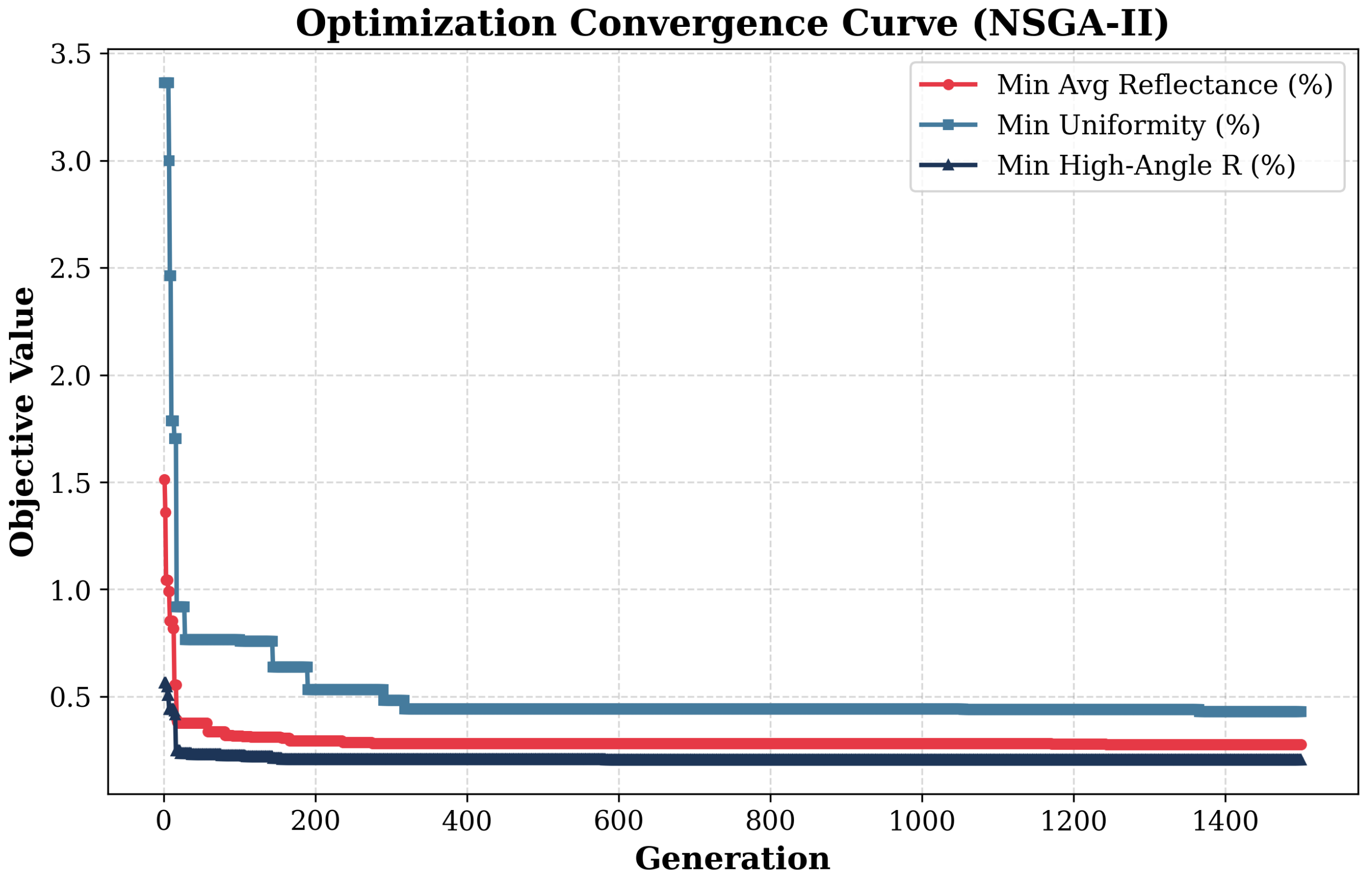
Figure 3 presents the convergence characteristics of the theoretical minima for the three key indicators in the DUV AR coating multi-objective optimization. It is observed that the minimum average reflectance and minimum high-angle reflectance drop rapidly to approximately 0.3% and 0.2%, respectively, within the first 100 generations and maintain extremely low levels thereafter. This demonstrates the high efficiency of the NSGA-II algorithm in optimizing core reflectance-based metrics.
In particular, the minimum reflectance uniformity exhibits a notable stepwise convergence: it undergoes two significant performance breakthroughs for at approximately the 200th and 300th generations, and continues a subtle but consistent optimization trajectory even beyond the 1300th generation, eventually approaching 0.4%. This long-tail convergence characteristic fully demonstrates the complex physical trade-off between reflectance and uniformity under the stringent geometric constraints of the strongly curved substrate. Hence, extending the evolution to 1500 generations is academically imperative to escape local optima and ensure deep convergence of the solution set to the true Pareto front.
4.2. Performance Characterization and Contextual Comparison of the Optimal Solution
Through large-scale parallel evolution over 1500 generations and scientific decision-making based on the ideal point distance method, the optimal compromise solution (Pareto solution No. 65) selected in this study demonstrates exceptional optical balance on the strongly curved substrate. To present the optimization results more clearly, this section provides explanations from two dimensions: macro performance metrics and micro design parameters.
Table 4 lists the optical and mechanical performance metrics of the optimal compromise solution. In terms of core optical efficacy, the design achieves a full-aperture average reflectance of 1.3633%. For strongly curved elements with a curvature radius of only 150 mm and an edge incident angle up to 44.4°, the overall suppression of reflectance is far more difficult than in flat-field collimation systems due to the polarization splitting effect at large angles. Controlling this metric within the industrial reference threshold of 1.5% effectively suppresses multi-beam interference stray light in DUV lithography systems, ensuring fundamental transmission efficiency.
This reflectance level should be viewed together with the achievable index contrast under realistic deposition conditions. Liu et al. [
19] reported superior paraxial reflectance and improved edge uniformity on a similarly curved substrate by simultaneously optimizing the spectra at multiple positions; however, their index values (
,
) reflected high-temperature deposition, and the uniformity was assessed only by graphical overlay of four-point spectra without a quantitative metric. In contrast, the present design is built upon room-temperature E-beam reference indices (
,
), which impose a lower index contrast (
) and intrinsically raise the reflectance baseline. Under this more constrained condition, our multi-objective framework not only delivers a competitive full-aperture average reflectance of 1.3633% with the maximum single-surface reflectance limited to 1.5749% at 44.4°, but also provides a rigorously quantified uniformity of 9.5037% evaluated over 20 edge-refined zones. More importantly, the optimization simultaneously enforces a strict manufacturing constraint (adjacent-layer thickness difference
), caps residual stress at
MPa, and limits thermal drift to 0.0019%-criteria that were not considered in prior designs yet are essential for industrial high-NA lithography. This combination of optical performance and multi-physical robustness under realistic material limitations highlights the practical advantage of embedding mechanical and thermal targets directly into the evolutionary design process.
Table 5 details the precise structure of this optimal coating system. All layer thicknesses strictly fall within the safe design range of 20–140 nm. Notably, the minimum adjacent layer thickness difference of this solution reaches
nm, far exceeding the manufacturing constraint lower limit of 4 nm, while the maximum adjacent thickness difference reaches up to
nm. Such a prominent and large-span layered thickness structure not only physically facilitates the broadband modulation of multilayer interference effects, but also possesses significant superiority in engineering manufacturing. A larger thickness difference means that when the coating equipment switches between materials with different refractive indices, the signal characteristics are more distinct. This greatly reduces the risk of layer misjudgment caused by crystal oscillator thermal drift or signal noise, endowing the coating system with strong process tolerance.
4.3. Pareto Front Analysis
To perform a deep analysis of the distribution characteristics and physical limits of the multi-objective optimization after 1500 generations of deep evolution, this section presents a comprehensive characterization and statistical analysis of the generated non-dominated solution set. Through the geometric morphology of the Pareto front in multi-dimensional space, the projection correlations between performance indicators, and the overall statistical features of the solution set, this analysis aims to quantitatively reveal the intrinsic trade-off laws among the core indicators of DUV AR coatings under strongly curved substrate constraints.
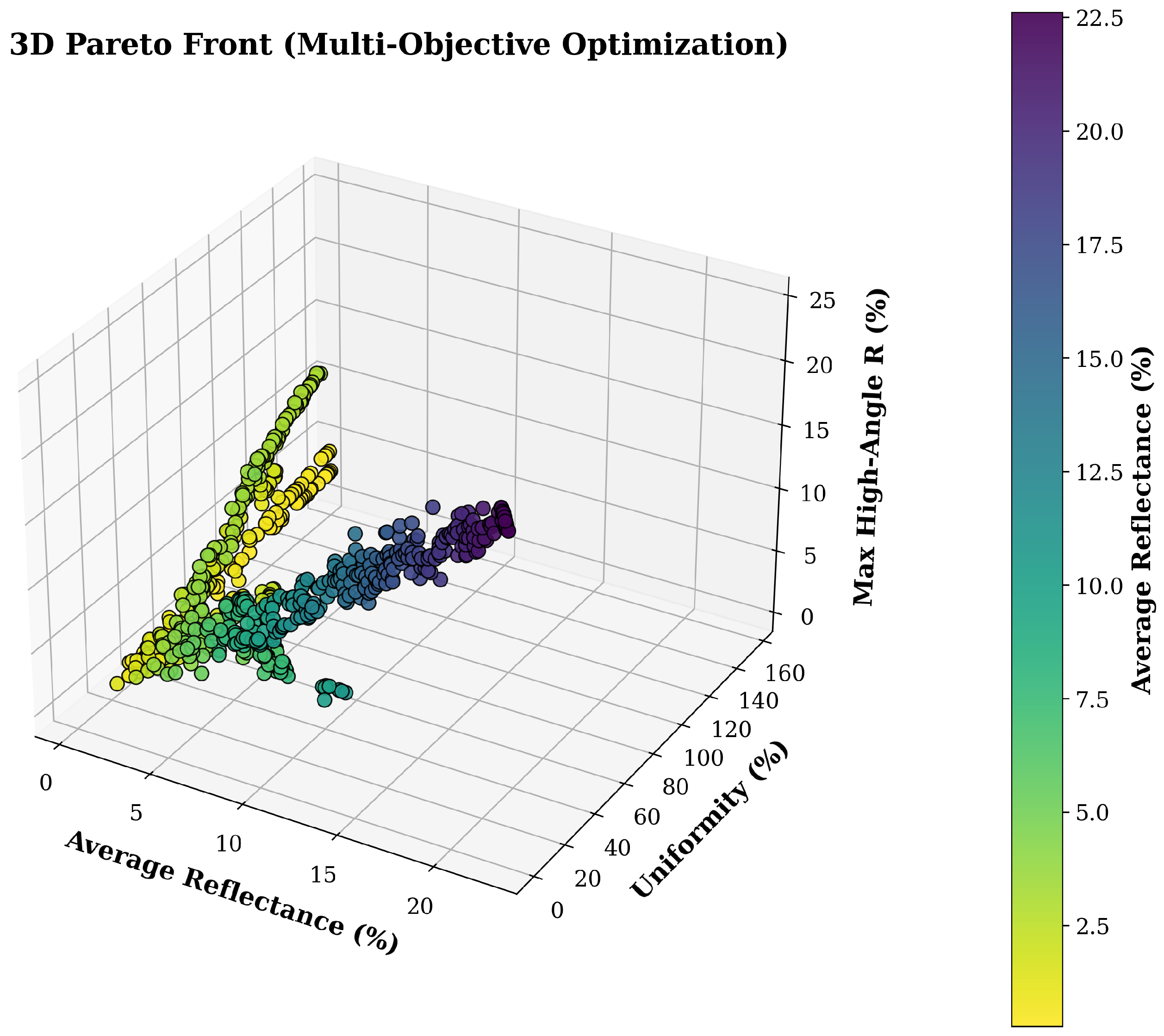
Figure 4 depicts the distribution of average reflectance (
), radial uniformity (
), and maximum high-angle reflectance (
) in the objective space, where the color transition from yellow to purple intuitively maps the variation in average reflectance from low to high. The multi-branched hypersurface formed by the non-dominated solution set profoundly reveals the physical trade-offs among core indicators. Notably, the yellow cluster regions (representing solutions with low average reflectance) exhibit significant divergence and extension in the dimensions of uniformity and high-angle reflectance. This indicates that as the reflectance is pushed toward its physical limit, it is often accompanied by a marked degradation in radial uniformity or large-angle performance. Such a wide-span front distribution with distinct branching characteristics confirms the thorough exploration of the high-dimensional, complex conflict space after 1500 generations of evolution, providing a high-quality candidate library for subsequent objective global decision-making.
To quantitatively analyze the internal correlations among the high-dimensional objectives,
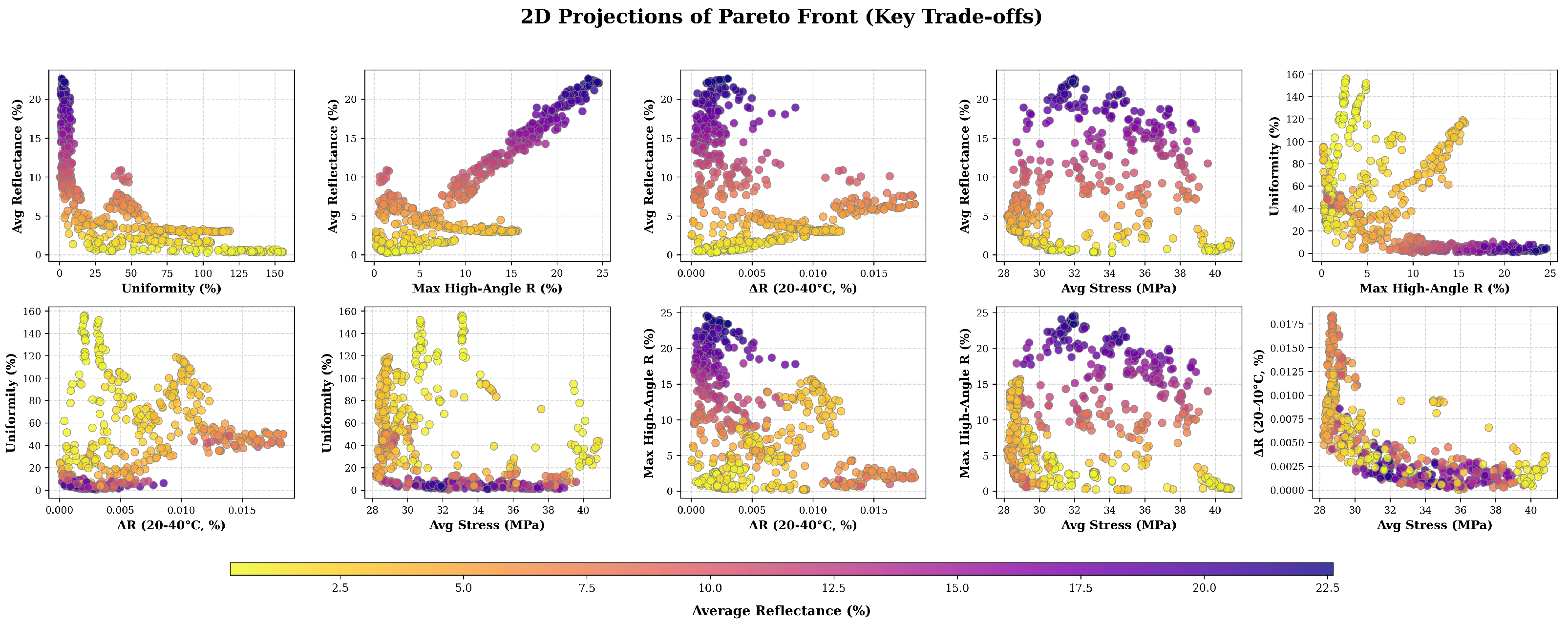
Figure 5 provides the two-dimensional projection scatter plots of the front solutions in pairwise combinations. The matrix analysis clearly reveals the coupling and trade-off laws between key indicators: First, the average reflectance (
) and the maximum high-angle reflectance (
) exhibit a significant positive correlation (scattered points in an approximately linear diagonal distribution), suggesting that the suppression of overall reflectance naturally facilitates the improvement of large-angle performance. Second,
and reflectance uniformity (
) constitute the most critical trade-off dimension in the design, exhibiting a typical “L-shaped” non-linear conflict characteristic; specifically, the extreme pursuit of low reflectance inevitably leads to a sharp deterioration in full-aperture uniformity. In contrast, the average stress (
) and thermal stability (
) not only show concentrated numerical distributions in most projections but also exhibit weak correlations with other optical indicators. This indicates that within the current LaF
3/MgF
2 film system, mechanical reliability and environmental stability possess a favorable independent design margin.
4.4. Radial Performance and Thermal Stability
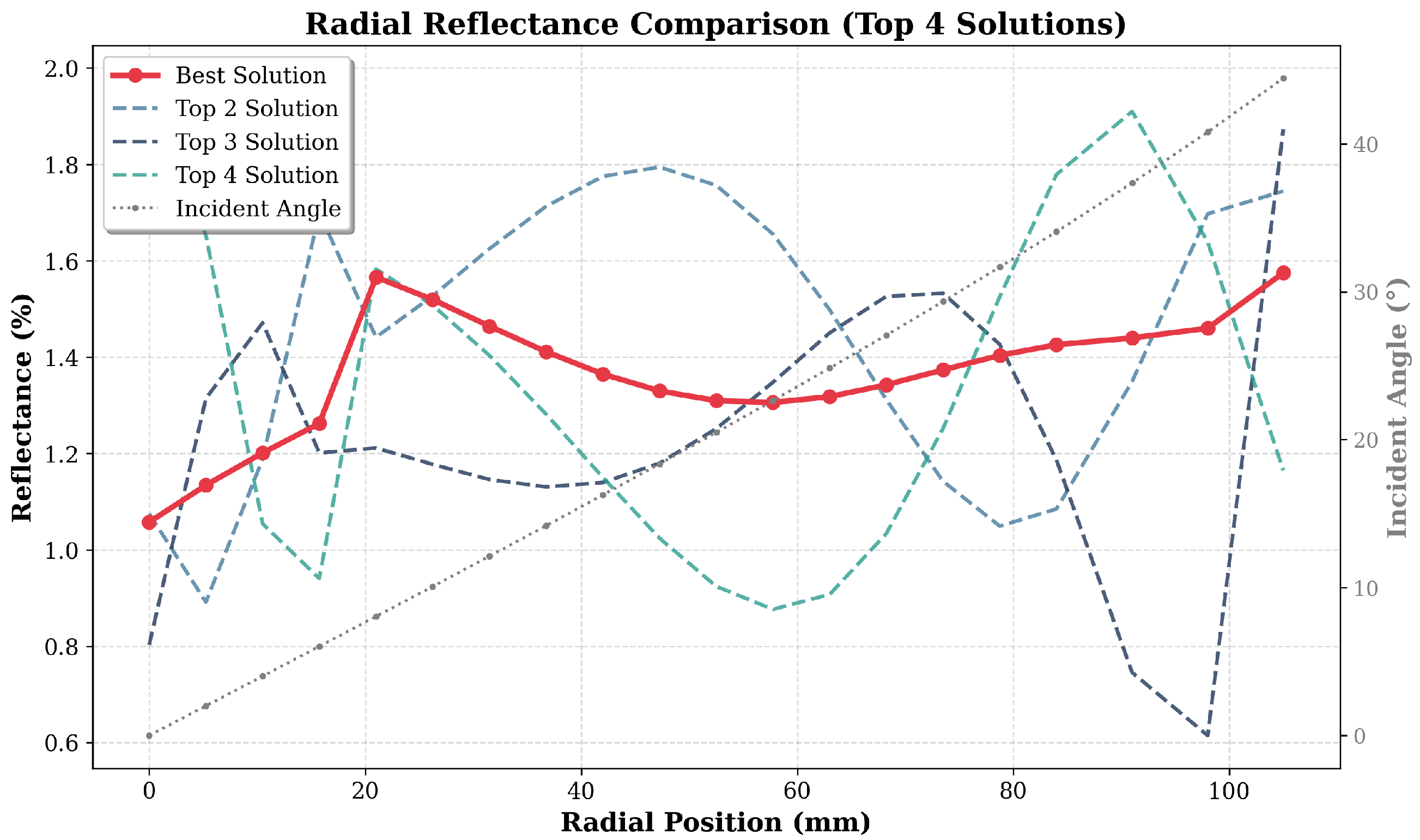
The performance characteristics of the four typical selected non-dominated solutions across the full aperture are compared. As shown in
Figure 6, the optimal compromise solution, represented by the red solid line, demonstrates exceptional field-of-view consistency within the radial span of 105
. Although the strongly curved geometry induces a sharp increase in the edge incident angle to 44.4°, this solution effectively maintains reflectance fluctuations within a narrow range of 1.0% to 1.6%, thereby suppressing stray light within the DUV lithography system.
In contrast, alternative solutions such as Top 2–4 exhibit lower reflectance minima in the central or intermediate regions (e.g., below 0.8%); however, their performance shows strong angular dependence. As the radial position shifts toward the edge, the reflectance of these solutions rebounds significantly, with local peaks approaching 2.0%, leading to a severe degradation in full-aperture uniformity. This comparison highlights the necessity of the multi-objective decision-making mechanism introduced in this study: achieving high stability and robustness across the entire field of view by sacrificing extreme localized performance.
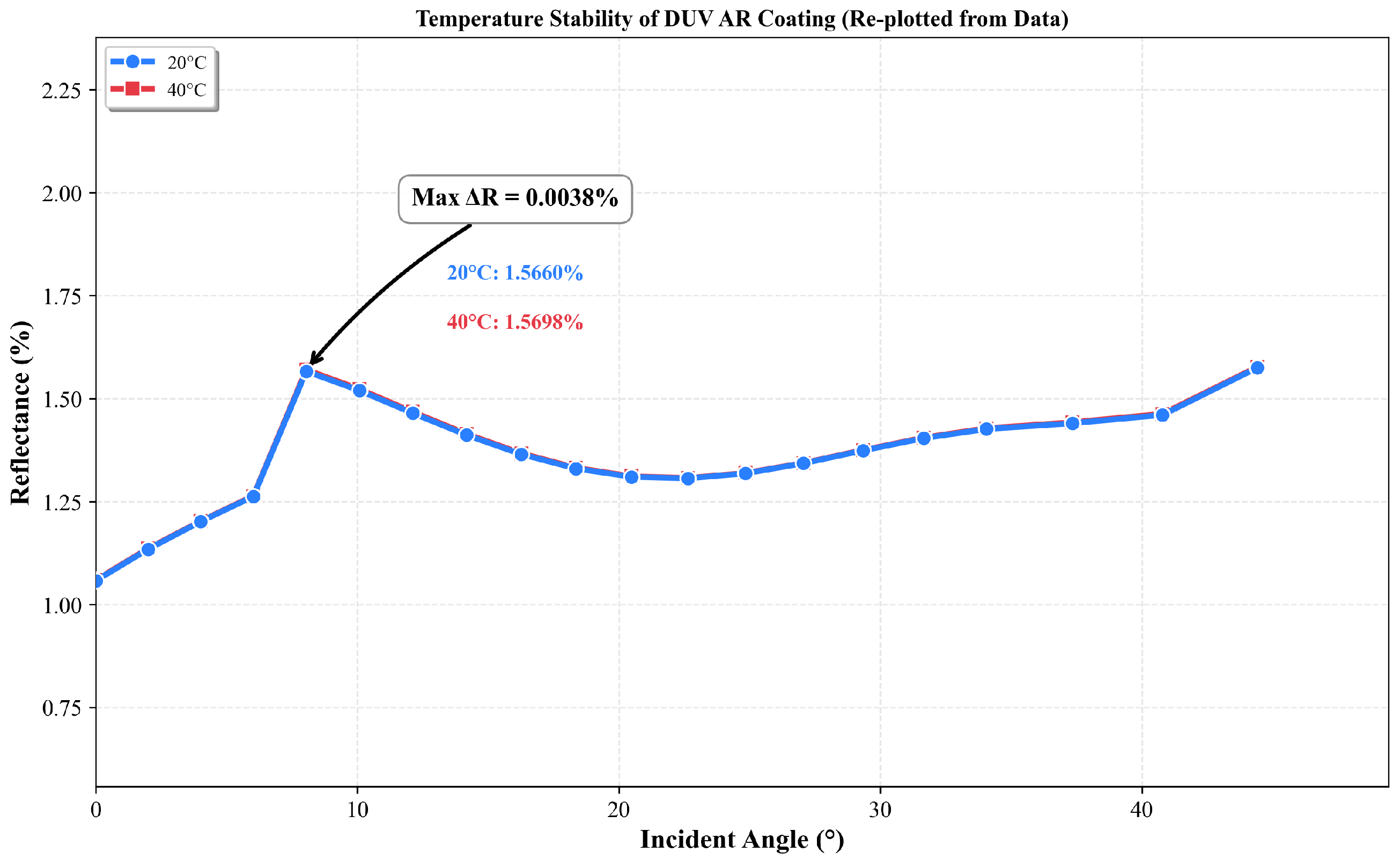
Figure 7 illustrates the angular distribution of reflectance for the optimal solution at two typical temperatures: 20 °C (blue line) and 40 °C (red line). It is intuitively evident that the curves representing these temperatures almost perfectly overlap. Even at the position most susceptible to thermal influence (an incident angle of approximately 8°), the maximum reflectance drift (Max
) is merely 0.0038%.
These results indicate that the design is highly insensitive to temperature variations, benefiting from the extremely low thermo-optic coefficients of the LaF3/MgF2 materials and the optimized layer arrangement. Even under conditions where continuous exposure in lithography equipment inevitably leads to heat generation within the lens, the AR coating maintains remarkably stable optical performance without compromising imaging fidelity due to thermal drift.
4.5. Thickness Sensitivity and Layer Profile
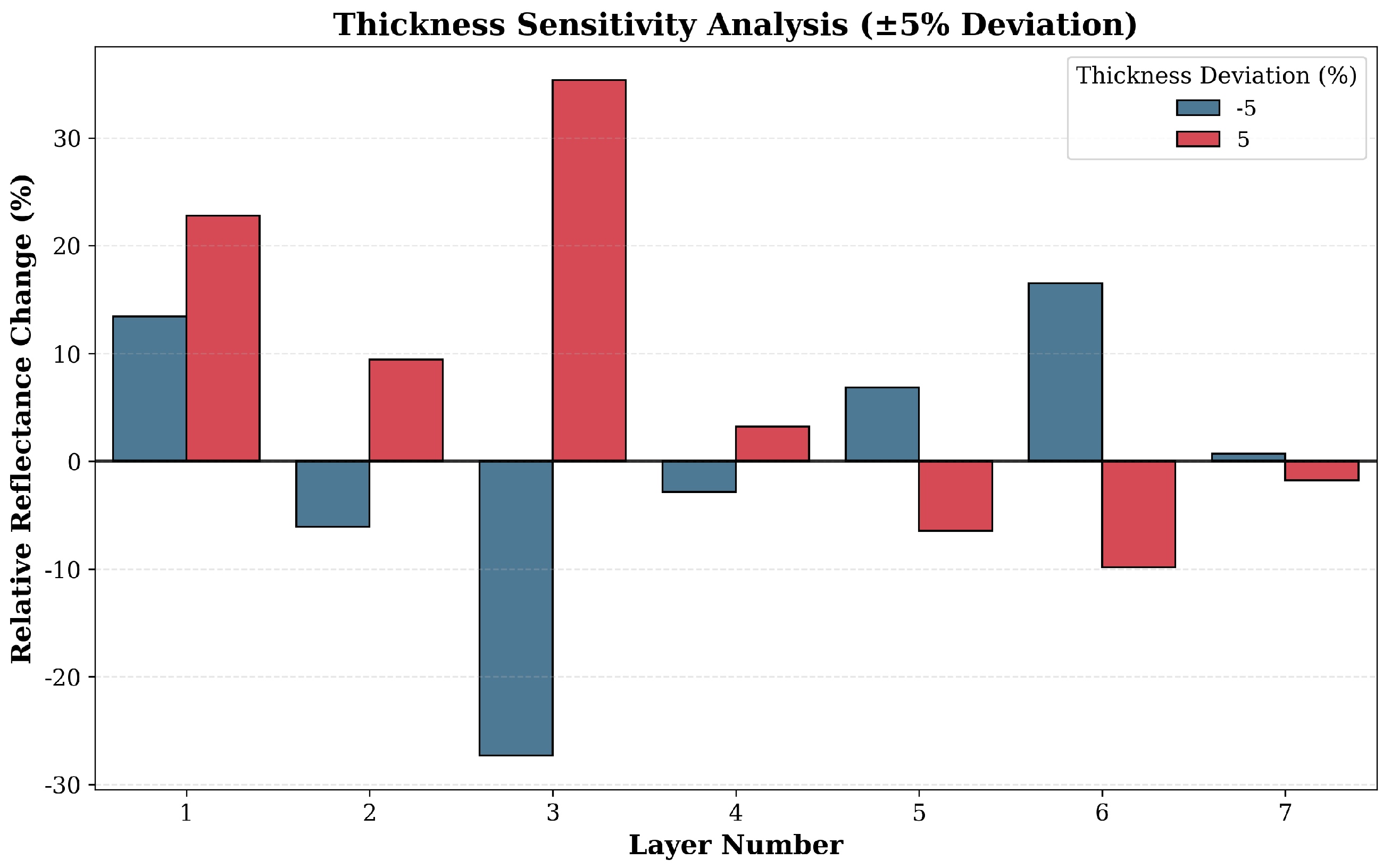
Figure 8 evaluates the impact of unavoidable thickness errors during the deposition process on the final optical performance. In this analysis, a
thickness deviation was artificially introduced into each layer of the optimal film system to calculate the resulting relative percentage change in average reflectance.
The data reveals that sensitivity to thickness errors varies significantly across layers. Layer 3 (LaF3) exhibits the highest process sensitivity: a deviation in this layer leads to a relative reflectance fluctuation of approximately 35%, while a deviation results in a relative change of about −27%. Additionally, Layer 1, which is in contact with air, also falls within a sensitive range, with reflectance fluctuations between 13% and 23%. In contrast, Layer 7, adjacent to the substrate, shows high tolerance, as the same deviation causes almost no noticeable degradation in reflectance.
This asymmetric sensitivity profile is primarily associated with the localized electromagnetic field distribution and phase-accumulation pathways within the multi-objective optimization framework. Layer 1, as the entrance interface interacting directly with the ambient air (), heavily governs the initial phase-matching and polarization splitting correction for wide incident angles up to 44.4°. Layer 3 is embedded within the interference core where the standing-wave electric field gradient is relatively pronounced, bearing a substantial portion of the wide-angle compensation load. Consequently, minor thickness deviations in these specific layers can cause accumulated phase mismatch through subsequent reflections, resulting in a noticeable rebound in reflectance. Conversely, Layer 7 acts predominantly as a structural baseline adjacent to the substrate, where the local electric field intensity is relatively moderated, leading to a naturally damped sensitivity to geometrical fluctuations.
In industrial fabrication, this asymmetry suggests an asymmetric monitoring approach to optimize production throughput and yield. Instead of distributing monitoring tolerances uniformly, computational and hardware control resources-such as narrow-band direct optical monitoring near phase-sensitivity turning points or localized tooling factor updates-can be preferentially allocated to Layers 1 and 3 to maintain a narrower tolerance window (e.g., within
). Meanwhile, the monitoring protocol for the highly robust Layer 7 can be safely relaxed and governed under standard quartz crystal microbalance (QCM) tracking with a wider
boundary. Utilizing this differentiated strategy provides clear guidance for fabrication, serving as a reliable engineering safeguard for maintaining yield in the mass production of complex curved multilayer coatings [
40,
41].
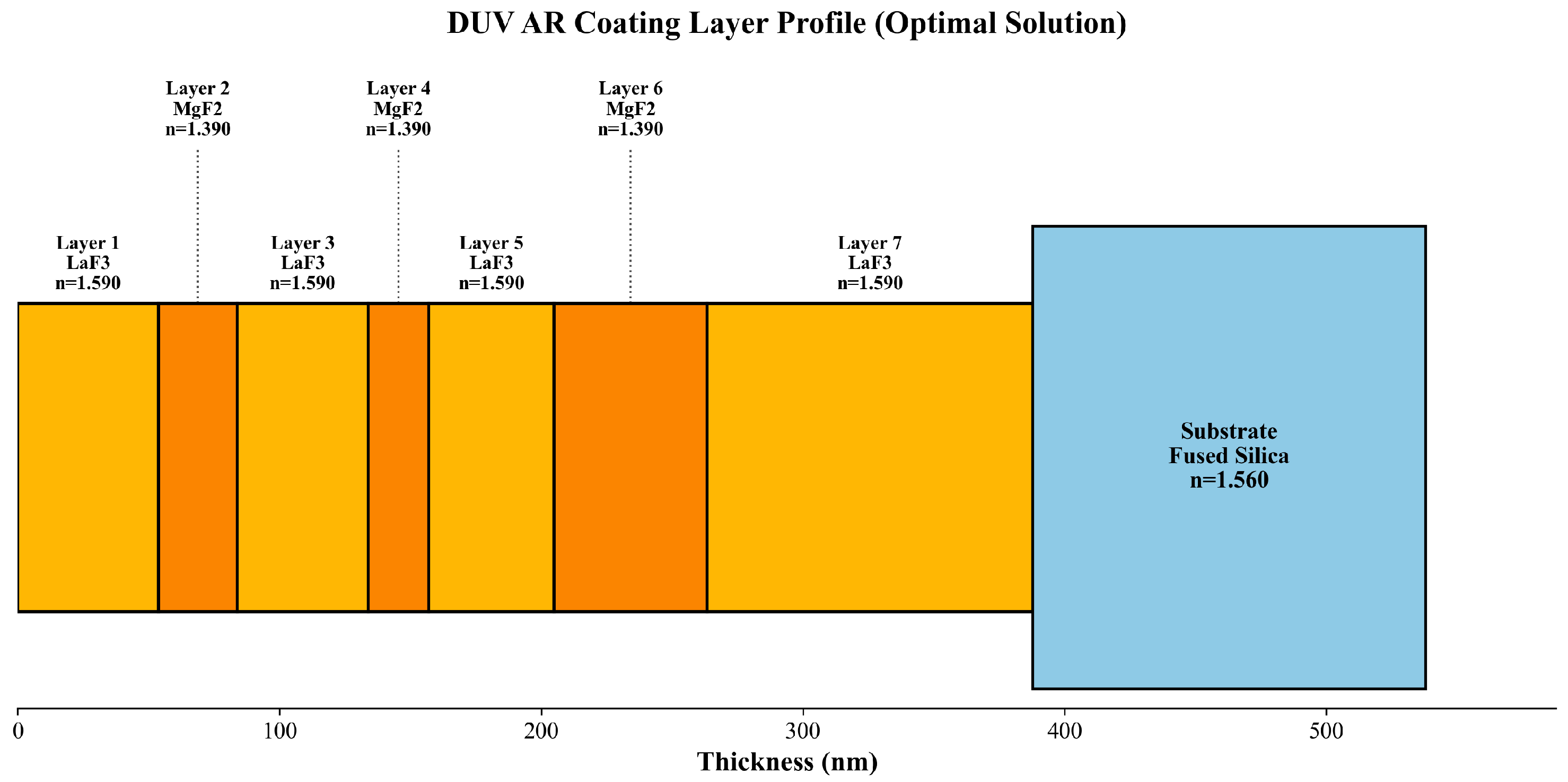
Figure 9 presents the physical cross-sectional profile of the optimal film system selected through multi-objective decision-making. The system is based on a fused silica substrate (
) and utilizes a 7-layer asymmetric structure consisting of alternating high-refractive-index material LaF
3 (
) and low-refractive-index material MgF
2 (
).
The thickness distribution characteristics of each layer are clearly observable. Layer 7 (LaF3), situated next to the substrate, is the thickest, primarily serving the dual roles of index matching and stress buffering. Moving toward the air side, the thicknesses of the middle layers converge to approximately 30 nm. This non-periodic thickness distribution is the result of deep optimization under multiple physical constraints, including wide-angle incidence, polarization separation, and mechanical reliability.
4.6. Manufacturing Tolerance and Monte Carlo Robustness Analysis
To evaluate the industrial feasibility and production yield of the antireflective coating system under realistic semiconductor optical thin-film fabrication processes, a full-stack stochastic robustness analysis framework is introduced. This goes beyond the previous deterministic single-parameter sensitivity study. In physical vapor deposition (PVD) processes such as electron-beam evaporation or ion-beam sputtering, multilayer coatings are simultaneously exposed to multiple concurrent random process noises. These primarily include thickness deviations caused by dynamic deposition-rate fluctuations and drifts in the real part of the refractive index induced by variations in vacuum level and temperature.
For this purpose, a Monte Carlo high-dimensional perturbation simulation with independent random trials was constructed and executed. The framework injects independent per-layer random perturbations, with probability densities strictly following the industry-standard truncated normal distribution to faithfully represent the boundary constraints of real semiconductor manufacturing. Specifically, the physical thickness of each layer is subjected to a maximum of relative random variation, modeling the thermal drift of the quartz crystal monitor and the geometric shadowing errors of the planetary rotation mask. Meanwhile, the real part of the complex refractive index at 193 nm is independently perturbed by up to , capturing refractive-index uncertainties caused by differences in grain growth kinetics, stoichiometry deviations, and packing-density fluctuations during fluoride film formation.
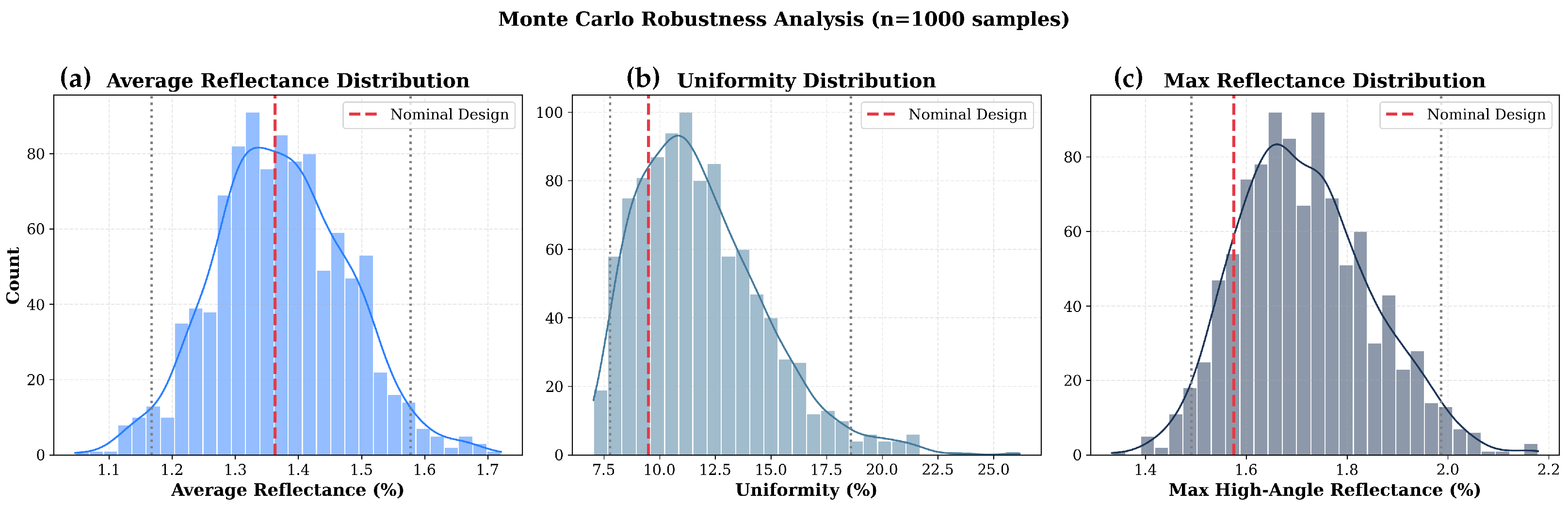
Figure 10 presents the statistical probability distributions of three key full-aperture performance metrics across the 1000 random process samples. The red dashed line marks the nominal theoretical value of the best compromise design, while the grey vertical dotted lines indicate the 95% confidence intervals.
As shown in
Figure 10a, the full-aperture average reflectance exhibits a highly compact quasi-Gaussian distribution. Its statistical mean rises only marginally from the nominal value of 1.3633% to 1.3721%, and the 95% confidence interval is strictly confined within the very narrow range of [1.1677%, 1.5777%]. This negligible mean drift of 0.0088% and the highly concentrated variance strongly demonstrate that, by compressing the standing-wave electric-field gradients in the interference core during multi-objective evolution, the framework has successfully desensitized the coating to phase-mismatch errors, thereby ensuring high energy-throughput reliability for DUV exposure systems.
In contrast, the full-aperture reflectance uniformity (
Figure 10b) reveals a positively skewed, log-normal-like topological character. Its statistical mean shifts from the nominal 9.5037% to 11.8431%, and the 95% confidence interval spans [7.7706%, 18.5945%]. This phenomenon reveals an inherent physical mechanism of strongly curved optics: in the presence of concurrent process noise, the nonlinear geometric flux deviation on the highly curved surface (edge incident angle up to
) significantly amplifies localized phase mismatch. The random errors compound nonlinearly at large angles, making uniformity inherently more sensitive to process fluctuations than the absolute reflectance value. Nevertheless, the main body of the distribution remains comfortably within the industrial benchmark of 15%, exhibiting strong topological tolerance.
Furthermore, the maximum reflectance at high incident angles (>40°) (
Figure 10c) has a statistical mean of 1.7148% and a 95% confidence interval of [1.4912%, 1.9862%], keeping the absolute upper bound of large-angle stray light stably below 2.0%. The above multi-dimensional concurrent quantitative assessment conclusively demonstrates that the solution selected through the physics-algorithm co-design is not an isolated theoretical singularity, but a robust structure with high process tolerance and manufacturing reproducibility, establishing a solid mathematical and physical foundation for the precision fabrication of high-NA DUV optical systems.
5. Conclusions
This study addresses the severe challenges of optical interference distortion and multi-physical constraints encountered in antireflective (AR) coatings for strongly curved substrates within high-numerical-aperture (high-NA) deep-ultraviolet (DUV) lithography systems. A multi-objective optimization framework based on the deep coupling of the NSGA-II algorithm and physical models was proposed and developed, validated using high-resolution Transfer Matrix Method (TMM) simulation data and a planetary deposition geometric model. Numerical results demonstrate that, compared to traditional single-objective or empirically driven designs, the proposed model achieves significant improvements in full-field optical performance, environmental stability, and mechanical reliability.
The primary contribution of this work lies in the integrated design of a multi-dimensional performance evaluation system and physical manufacturing constraints within a unified heuristic evolutionary framework. The introduction of a multi-dimensional evaluation system facilitates the decoupling and balancing of critical optical and thermodynamic conflicts during deep-space optimization, effectively suppressing polarization splitting degradation in the peripheral fields of strongly curved elements. Simultaneously, manufacturing constraints explicitly impose process feasibility boundaries throughout the iterative evolution, eliminating non-physical designs that lack mass-production value. This “physics-algorithm” co-design enables the model to explore extreme optical performance while maintaining high manufacturing rationality, thereby enhancing the robustness of the design solutions under demanding electron-beam evaporation processes.
Despite these advantages, several limitations remain in this study. Current numerical validations are primarily based on ideal geometric optics and deposition deviation models, which do not fully reflect the flow field complexity and real-time rate fluctuations within the vacuum coating chambers of full-scale lithography machines. Furthermore, when constructing stress and thermal drift models, some macroscopic physical parameters were assumed to be constant; however, in actual thin-film microscopic evolution, grain growth kinetics and environmental humidity often cause drifts in microscopic parameters such as refractive index and residual stress. Consequently, future work will focus on conducting experimental trial production of large-aperture curved samples, achieving adaptive identification of microscopic physical parameters, and integrating in situ optical monitoring to form a closed-loop feedback mechanism.
Overall, this study demonstrates that embedding rigid physical manufacturing laws into a deep multi-objective optimization architecture provides an effective pathway for achieving reliable, manufacturable, and robust AR coating designs for next-generation sub- 10 nm process high-NA lithography lenses. The proposed full-stack collaborative modeling method lays a solid foundation for advancing the digital design and intelligent automated manufacturing of ultra-precision optical thin films. Owing to the modular decoupling of the physics and optimization layers, the framework can be readily generalized to other material systems (e.g., AlF3/LaF3 or HfO2/SiO2) and wavelength ranges (e.g., 248 nm or visible band) by updating the material database and, where necessary, the dispersion model, without reconfiguring the core optimization algorithms.