Article

A Hybrid Modelling and Simulation Framework for Energy-Efficient Operation of Heated Crude Oil Pipelines Under Small-Batch and Multi-Condition Operation


1
PipeChina Oil & Gas Control Center, Beijing 100013, China
2
College of Mechanical and Transportation Engineering, China University of Petroleum-Beijing, Beijing 102249, China
*
Author to whom correspondence should be addressed.
Modelling 2026, 7(3), 115; https://doi.org/10.3390/modelling7030115 (registering DOI)
Submission received: 6 May 2026 / Revised: 4 June 2026 / Accepted: 9 June 2026 / Published: 12 June 2026

Abstract

Heated crude oil pipelines transporting high-pour-point, high-viscosity, and high-wax-content crude oil are increasingly operated under small-batch and multi-condition scenarios. Under such conditions, fixed-parameter models and experience-based operating strategies may fail to accurately describe the evolving thermo-hydraulic state, resulting in inaccurate temperature-safety assessment and conservative energy use. To address this problem, this study develops a hybrid modelling and simulation framework for the energy-efficient operation of heated crude oil pipelines. The framework integrates operating-state perception, online parameter inversion, transient thermo-hydraulic simulation, data assimilation, and rolling optimization. First, an online parameter inversion method based on inverse problem solving is established to dynamically identify the overall heat-transfer coefficient and friction correction factor from Supervisory Control and Data Acquisition (SCADA) measurements. Second, a transient thermo-hydraulic simulation and data-assimilation model is constructed to predict pressure, temperature, and safety margins under changing boundary conditions. Third, a constraint-aware rolling optimization strategy is introduced to coordinate heating and pumping operations while satisfying temperature and pressure constraints. The proposed framework is validated using a practical crude oil pipeline. Under a representative low-flow-rate condition, online parameter inversion corrects the overestimation of the thermo-hydraulic state by the fixed-parameter model: the total temperature drop along the pipeline is revised from 33.12 °C to 35.65 °C, and the minimum station-inlet oil temperature is revised from 24.77 °C to 21.61 °C. After optimization is introduced, the total operating energy consumption decreases from 11,715.65 kW to 11,287.43 kW, corresponding to a reduction of 3.66%, while all temperature and pressure constraints remain satisfied. Under time-varying boundary conditions, the rolling optimization strategy further adjusts heating-furnace operation according to variations in inlet flow rate, inlet oil temperature, and ambient temperature, thereby reducing cumulative heating energy consumption while maintaining safe operation. The results demonstrate that the proposed framework provides an implementable modelling and simulation approach for online state assessment, transient prediction, and energy-efficient operation of heated crude oil pipelines under variable operating conditions.

1. Introduction

1.1. Background

Amid global geopolitical conflicts, energy market volatility, and growing energy-security concerns, the strategic importance of crude oil pipelines has once again been highlighted. A crude oil pipeline system is critical infrastructure for transporting pre-treated crude oil from oil fields or storage terminals to refineries and processing plants [1]. Its continuous operation relies on the coordinated functioning of pipe networks, pressure-boosting equipment, heating equipment, valves, instruments, and Supervisory Control and Data Acquisition (SCADA) systems [2]. To ensure safe crude oil transportation, the system must provide sufficient pressure to overcome frictional resistance and maintain an appropriate oil temperature to preserve fluidity [3]. Therefore, pumps and heating furnaces are the primary controllable equipment, while pressure and temperature are key operational variables for evaluating pipeline safety and energy efficiency [4]. Against the background of changing crude oil supply patterns, downstream refining demand, and low-carbon operation requirements, long-distance heated crude oil pipelines require online-data-enabled control methods to support safer and more economical operation [5,6].

1.2. Related Work

Research on long-distance crude oil pipeline operation can be organized along four connected lines: mechanism-based thermo-hydraulic modelling, flow-assurance and safety criteria, operation optimization, and online data-driven correction. In this sequence, steady or quasi-steady operating studies provide the baseline, transient studies extend the model to time-varying conditions, and data-driven correction further supports online decision-making.
Mechanism-based thermo-hydraulic studies established the basis for describing pressure, flow rate, and temperature behaviour in heated crude oil pipelines. Early studies mainly evaluated steady or quasi-steady transport regimes, including optimal thermal regimes for heavy oil pipelines [7], pressure–temperature profile development during crude oil pipe flow [8], and operating schemes for heated oil pipelines under complex industrial conditions [9]. These studies provide the baseline required to judge normal operating points. However, when batch interfaces, shutdown–restart processes, and boundary disturbances appear, the flow and heat-transfer fields become time dependent. Therefore, later work turned to transient representation, including efficient solution of heated-pipeline optimization problems [10], heat-transfer simulation during shutdown and restart [11], and hybrid data-mechanism modelling of unsteady soil temperature fields for non-isothermal batch transportation [12].
Flow-assurance research clarified the safety criteria that must be considered when crude oil properties change along the line. Studies on wax sedimentation prediction [13], AI-based wax-location and wax-amount prediction [14], wax-deposition mechanisms [15], and the viscoelastic-thixotropic characteristics of waxy crude oil [16] explain why temperature reduction may increase viscosity, deposition, gelation, and plugging risks. Reviews on heavy and extra-heavy crude oil transportation further show that pressure boosting, heating, and rheology management must be coordinated rather than considered separately [17]. These studies provide the physical safety boundaries for heated pipeline operation, but they are still often used as offline assessment criteria rather than as online constraints coupled with real-time control.
Operation optimization studies translated physical and safety constraints into executable equipment decisions. Existing work has considered pump scheduling and coordinated control through physics-informed optimization [18], operation optimization of heated oil transportation pipelines [19], and optimal operating schemes for heated pipelines under complex industrial conditions [20]. For more complex network and market conditions, researchers further developed decomposition algorithms for branched multiproduct pipelines [21], systematic reviews of multiproduct pipeline scheduling [22], optimization under variable electricity-price policies [23], dynamic optimization using hybrid evolutionary algorithms [24], and intelligent control of multiphase mixture transportation pipelines [25]. These studies expand the decision space from single equipment settings to coordinated operating schemes. Nevertheless, many optimization models still rely on fixed or periodically updated model inputs, so deviations between the model and the actual pipeline may not be corrected before the next decision is issued.
Online data-driven correction and digital twin studies provide a way to reduce model-to-pipe mismatch. Sequential estimation methods such as the ensemble Kalman filter offer a theoretical basis for assimilating online observations into model states [26]. In pipeline operation, neural-network system identification has been used for online heated-oil pipeline optimization [27], while data-driven discovery combined with knowledge embedding has been applied to hydraulic-parameter identification [28]. Digital-twin studies in the oil and gas industry [29], subsea pipeline monitoring [30], and intelligent pipeline technologies from a life-cycle perspective [31] further emphasize the value of connecting field data, virtual models, and operation decisions. However, these studies are still not always integrated with transient prediction and rolling optimization in a single closed-loop workflow.
In summary, existing studies have established useful steady and quasi-steady operating models, transient thermo-hydraulic descriptions, flow-assurance criteria, optimization algorithms, and online correction tools. A detailed comparison of these existing studies regarding their focus and methodological coverage is summarized in Table 1. The remaining gap is not the lack of a single model or algorithm, but the weak connection among state perception, online parameter updating, transient forecasting, constraint evaluation, and decision execution. This gap becomes particularly evident under small-batch and multi-condition operation, where boundary conditions, fluid properties, pressure safety, temperature safety, and energy efficiency change simultaneously. Therefore, an integrated framework is required to convert SCADA observations into updated states, corrected rolling forecasts, and executable control decisions.

1.3. Contributions

To bridge the aforementioned research gaps, this study departs from the conventional limitations of isolating individual module improvements and introduces, for the first time, a system-level integrated closed-loop control framework specifically tailored for the small-batch and multi-condition transportation of high-viscosity, high-pour-point, and high-wax-content crude oil. Driven by real-time industrial SCADA data streams, this framework seamlessly consolidates online parameter inversion, transient thermo-hydraulic simulation, data assimilation, and proactive rolling optimization into a unified whole. Its core innovations and scientific contributions are mainly reflected in the following three aspects:
  • System-Level Workflow Integration for Non-Steady Operations Driven by Closed-Loop Industrial Data: Addressing the disconnection among state perception, trend prediction, and control execution in traditional control modes, this study constructs the first closed-loop engineering workflow that directly bridges real-time high-noise SCADA data streams with minute-level optimal control actions. It provides a highly adaptive and robust energy-efficient operational scheme for heated crude oil pipelines facing intense multi-condition perturbations and spatial fluid property discontinuities.
  • Dynamic Integration of Thermal-Hydraulic Parameters Balancing Real-Time Calibration and Sequential Assimilation: By coupling sliding-time-window inverse problem solving with sequential data assimilation, this approach effectively resolves the long-standing “model-to-pipe mismatch” challenge caused by continuous boundary shifts and spatial rheological heterogeneity under multi-variety batch sequencing. It dynamically calibrates overall heat transfer and friction coefficients without relying on black-box machine learning algorithms, successfully suppressing forward mathematical cumulative tracking errors in traditional numerical forecasting.
  • Multi-Objective Control Constraint Reformulation Based on Adaptive Composite Risk Penalization: To overcome numerical bottlenecks where strict nonlinear hard constraints frequently lead to solver divergence or computational timeouts under high-frequency scheduling cycles, a risk-aware mathematical programming formulation is introduced to restructure continuous spatio-temporal constraint violations into a composite soft-constraint risk penalty. By prioritizing macro-scale, system-wide thermal safety during rolling horizon iterations, this method thoroughly rectifies the conservative overestimation of temperature margins common in experience-driven operations, maximizing the compression of thermal energy redundancy while rigorously maintaining the global safety baseline.

1.4. Paper Organization

The remainder of this paper is organized as follows. Section 2 introduces the characteristics and operational challenges of crude oil pipelines under the new operating conditions. Section 3 presents the architecture and key methods of the intelligent pipeline control system for the transportation of high-pour-point, high-viscosity, and high-wax-content crude oil under small-batch, multi-condition operation, with emphasis on operating-state perception, online parameter inversion, transient thermo-hydraulic simulation, data assimilation, and multi-objective optimization control. Section 4 validates the proposed method through case studies under complex operating conditions. Finally, Section 5 summarizes the main conclusions and discusses future research directions for broader engineering applications of the system.

2. Problem Description

2.1. Problem Setting Under Small-Batch and Multi-Condition Operation

The problem considered in this study is the operation of a long-distance heated crude oil pipeline transporting crude oil with high viscosity, a high pour point, and a high wax content. The pipeline is equipped with pumps and heating furnaces at stations, and its operating state is monitored through SCADA measurements, including pressure, flow rate, oil temperature, and equipment status.
Under small-batch and multi-condition operation, the pipeline is affected by both spatial and temporal variations. Small-batch operation means that crude oils with different rheological and thermal properties are transported sequentially, leading to spatial variations in density, viscosity, wax content, and minimum safe temperature along the pipeline. Multi-condition operation refers to frequent changes in throughput, inlet oil temperature, ambient temperature, pump and furnace states, and valve operating conditions. These variations make the pressure, temperature, and crude oil property fields time-dependent and increase the difficulty of state prediction and operation optimization.
For high-pour-point, high-viscosity, and high-wax-content crude oil, oil temperature plays a central role in operational safety. A local decrease in oil temperature may increase viscosity, enlarge hydraulic resistance, intensify wax precipitation, and reduce the temperature safety margin. At the same time, heating and pumping actions are strongly coupled: increasing furnace load improves thermal safety but increases heating energy consumption, while pump operation affects hydraulic safety, flow distribution, and pumping energy consumption. Therefore, pipeline operation must coordinate pressure safety, temperature safety, energy consumption, and equipment-operation smoothness within a unified decision-making process.
At each rolling decision step, the available online measurements are used to reconstruct the current thermo-hydraulic state and update key model parameters, such as the overall heat-transfer coefficient and friction correction factor. Based on the corrected state and parameters, the transient model predicts future pressure and temperature evolution over a finite horizon. The control task is then to determine pump and furnace operating decisions that reduce total operating energy consumption while satisfying pressure constraints, minimum oil-temperature constraints, equipment operating limits, and restrictions on excessive switching.
Accordingly, the engineering problem addressed in this study can be summarized as follows: given time-varying SCADA measurements and operating boundary conditions, transform online data into corrected model states, rolling thermo-hydraulic predictions, and executable pump–furnace control decisions, so that heated crude oil pipeline operation remains safe and energy efficient under small-batch and multi-condition scenarios.

2.2. Model Assumptions

To support rolling prediction and optimization while maintaining computational efficiency, several modelling assumptions are adopted. Equipment of the same type is assumed to share identical structural parameters and characteristic curves unless otherwise specified by field operating data. The hydraulic and thermal processes in interstation pipe sections are simplified as one-dimensional distributed processes along the pipeline axis, and radial velocity and temperature gradients are neglected. Within a short prediction window, boundary conditions are treated as piecewise constant or statistically predictable. Soil thermal inertia and external heat-transfer variation are represented through the online-updated overall heat-transfer coefficient, while the far-field soil temperature is assumed to be approximately uniform within a single computational cycle. High-frequency hydraulic transients caused by minor valve or pump adjustments are not considered, because the present study focuses on minute-level thermo-hydraulic prediction and pump–furnace operation optimization.

3. Architecture and Key Methods of the Hybrid Modelling and Simulation Framework

3.1. Overall Architecture and System Integration

To address time-varying operating states, distributed state variables, and coupled control objectives, this study constructs a hybrid modelling and simulation framework for crude oil pipelines. As shown in Figure 1, the framework is organized into three sequential modules corresponding to Section 3.2, Section 3.3 and Section 3.4: operating-state perception and parameter inversion, fast transient simulation with data assimilation, and rolling optimization with adaptive control. SCADA data and safety limits provide the measurement basis and operational constraints. The first module screens field data, updates heat-transfer and friction-related parameters, and reconstructs the full-line pressure-flow-temperature state. The second module uses the reconstructed state to forecast transient pressure–temperature evolution and correct model-state deviations with online observations. The third module evaluates energy and safety objectives, screens feasible control schemes, and generates coordinated pump–furnace decisions. Together, these modules form a closed loop from field measurement to state reconstruction, rolling prediction, and adaptive control. Please see Table A1 for a complete description of the variables.
For convenience of notation, the comprehensive operating state at time k is written as
x k = p k , Q k , T k , μ k , s k , h k T
where p k , Q k , T k denote the pressure, flow-rate, and temperature states at discrete nodes, respectively; μ k denotes the equivalent viscosity distribution; s k denotes the states of equipment such as pumps, valves, and furnaces; and h k denotes auxiliary states related to heat loss and risk. The observations acquired by SCADA at time k can be written as
y k = H x k + v k
where y k denotes the observation vector, H denotes the observation mapping matrix, and v k denotes measurement noise. Equation (2) indicates that field measurements are projections of the system state in the measurement space rather than the complete state itself; therefore, operating-state perception and model correction are required to recover the full-line operating state.

3.2. Operating-State Perception and Online Parameter Inversion

Under changing operating conditions, traditional state-identification methods that rely on offline assays and steady-flow assumptions are unable to accurately characterize the distribution of physical properties and the evolution of thermo-hydraulic states along the pipeline. Although SCADA can acquire pressure, flow rate, temperature, and the states of major equipment in real time, it still cannot directly obtain key states such as equivalent heat-transfer distribution tendency and friction variation. Therefore, it is necessary to construct an operating-state perception method based on multi-source data fusion and, on this basis, establish an online parameter inversion mechanism.
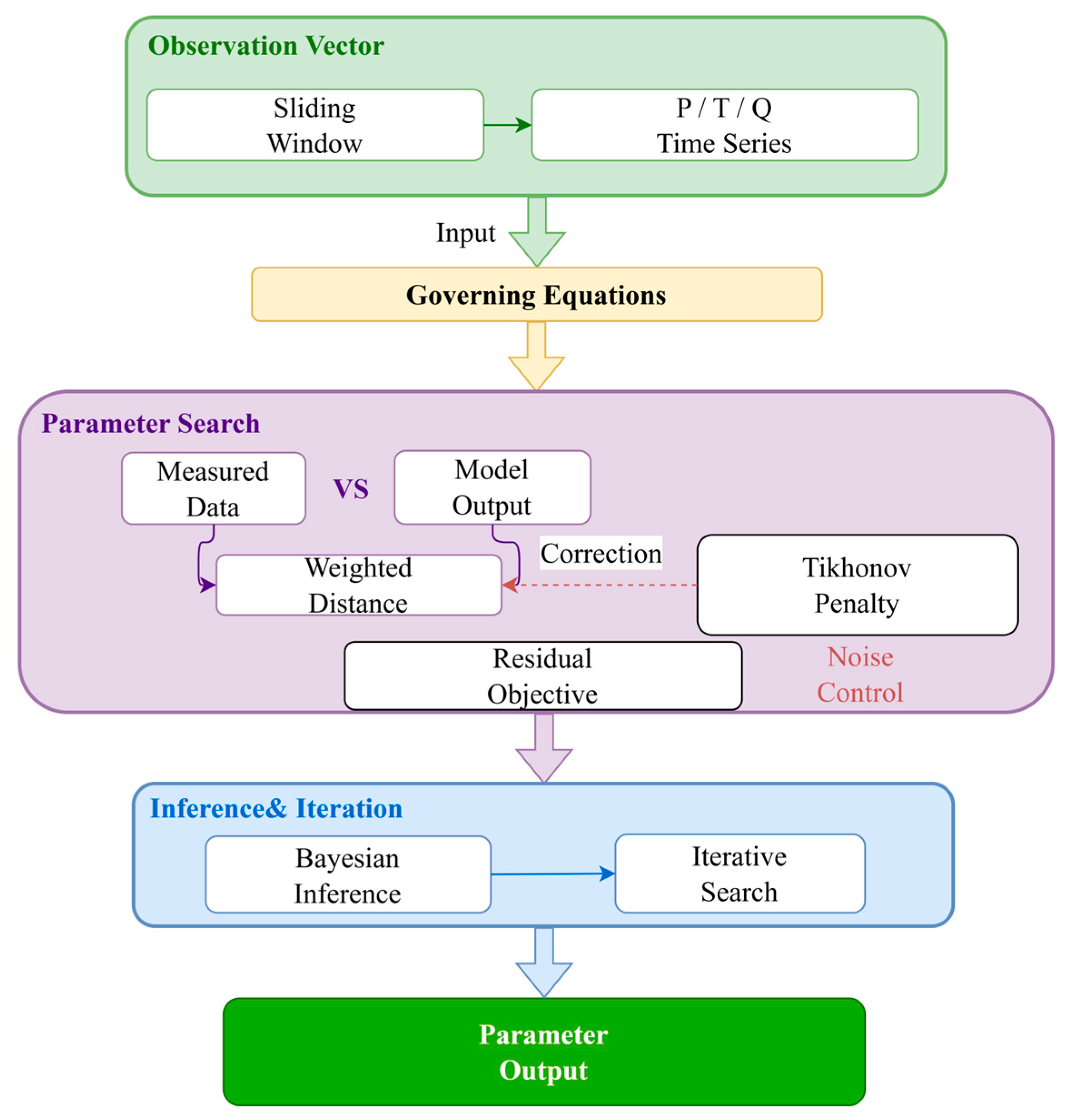
As shown in Figure 2, multi-source operating data are cleaned, checked, and compared with simulated observations within a sliding time window. The resulting friction and heat-transfer parameters are then fed back to the simulation model so that prediction and optimization can track time-varying crude oil properties.
Operating-state perception first requires quality control of the raw data, including time alignment, outlier identification, missing-value repair, noise smoothing, and conservation-consistency checks, to ensure that the data entering the inversion process are sufficiently reliable.
Let the parameter vector to be identified be defined as, including the friction correction parameter and the heat-transfer equivalent parameter. Then, the online inversion problem based on a sliding time window can be written as θ k .
θ k * = a r g m i n θ i = k M + 1 k W 1 / 2 y i y i ^ θ 2 + λ r L θ θ 0 2
Here, y ^ i ( θ ) denotes the predicted observations calculated by the physics-based model, W denotes the observation weight matrix, λ r denotes the regularization coefficient, L denotes the regularization operator, and θ 0 denotes the prior parameter. The first term of Equation (3) is used to minimize the residual between model outputs and measured data, whereas the second term is used to suppress observation noise and the ill-posedness of parameter estimation.
In engineering implementation, the outputs of the operating-state perception layer mainly include three categories of information: (1) the validated sequences of pressure, flow rate, and temperature; (2) the inverted heat-transfer coefficients, friction parameters, and their variation trends; and (3) the unified state initialization quantities and risk-identification information supplied to the model layer. Through this process, discrete monitoring information can be transformed into continuous state information, providing inputs for subsequent transient simulation, trend prediction, and rolling optimization.

3.3. Rapid Transient Simulation and Data Assimilation

Because pressure and temperature fields evolve continuously, steady-state models cannot support real-time decision-making under changing operating schemes. Therefore, this study develops a rapid transient simulation and data-assimilation method for minute-level rolling prediction.
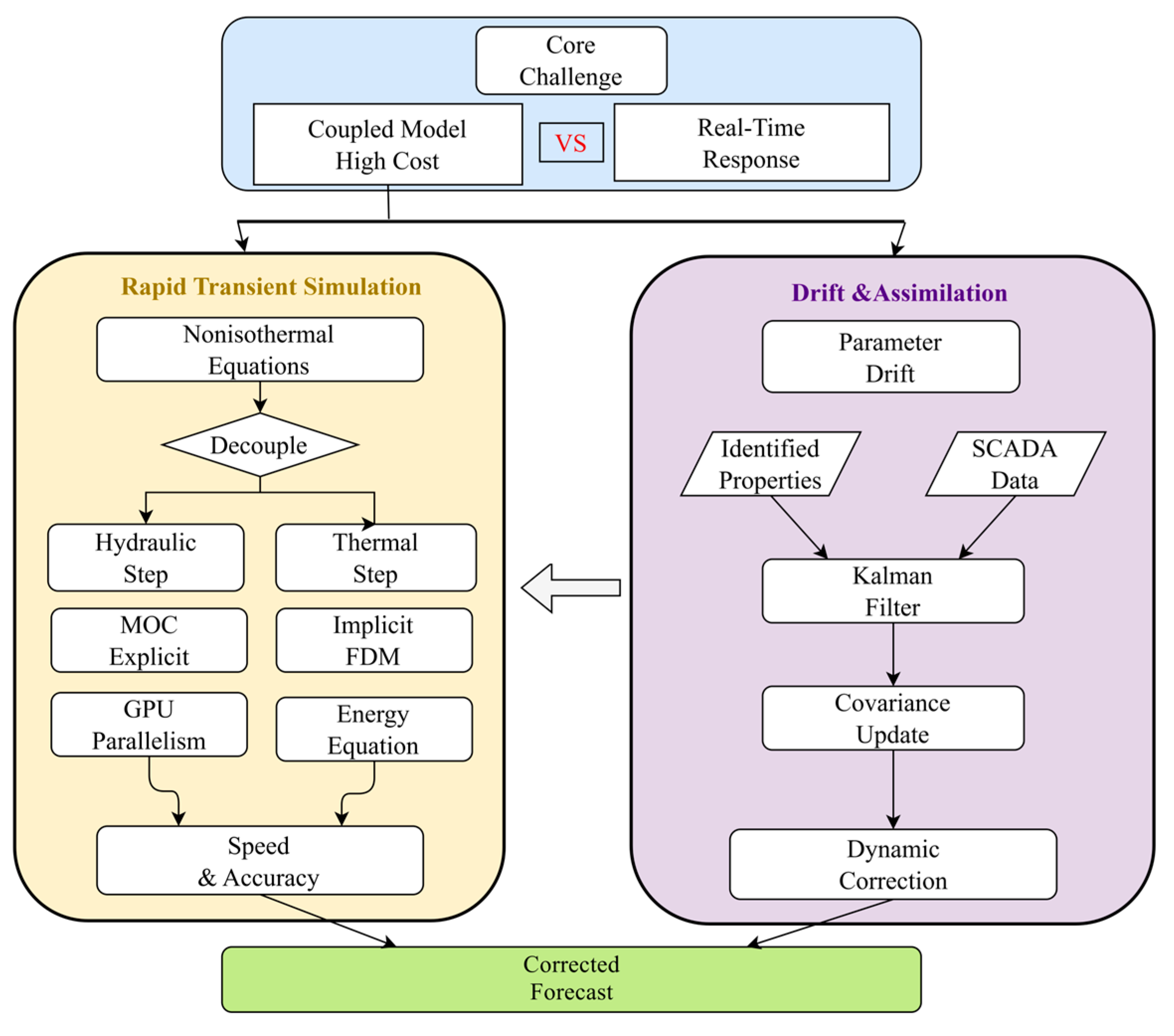
As shown in Figure 3, the module adopts a hydro-thermal decoupled calculation strategy. The hydraulic subsystem is solved first using the method of characteristics to update pressure and flow-rate states under pump, valve, and station boundary conditions. The resulting flow field is then transferred to the thermal subsystem, where the one-dimensional energy equation is discretized using an implicit finite-volume method to calculate the oil-temperature distribution and heat-loss process along each pipe segment. To reduce the computational burden of repeated prediction within the rolling horizon, pipe sections and spatial grids are organized for GPU-based parallel computation. Online observations are then assimilated to correct accumulated pressure–temperature deviations and parameter drift, providing rolling forecasts and safety margins for subsequent optimization.
Within a discrete-time framework, the model layer can be written in a unified form as
p l z = λ m ˙ 2 2 d A 2 ρ ρ g sin θ  
where p l is the internal pipeline pressure, λ is the friction factor along the pipeline, d is the inner diameter of the pipe, θ and is the angle between the pipeline axis and the horizontal plane.
The thermal process is described by a one-dimensional energy conservation equation:
ρ c m ˙ ρ A T l z = 4 K ( T l T s ) d + λ m ˙ 3 2 d A 3 ρ 2 + ( T l + 273.15 ) β m ˙ A ρ p l z
where T l is the internal oil temperature, T s is the soil temperature at burial depth, K is the overall heat transfer coefficient, c is the specific heat capacity of crude oil, and β is the volumetric expansion coefficient.
For the heating furnace, the local pressure loss and temperature rise can be expressed as
( p h ) out ( p h ) in = ξ h m ˙ 2 2 A 2 ρ
( T h ) out ( T h ) in = W h η h m · c
where ξ h is the local resistance coefficient of the heating furnace, W h is the furnace power, and η h is the furnace efficiency. The heating furnace is the core equipment that ensures temperature safety in crude oil pipelines.
For the oil pump, the pressure increase and temperature rise can be expressed as
( p p ) out ( p p ) in = Δ p p = ρ g H p = ρ g a 2 m ˙ ρ 2 + a 1 R p R r m ˙ ρ + a 0 R p 2 R r 2
( T p ) out ( T p ) in = g H p c 1 η p 1
where H p is the pump head; R p is the pump rotational speed; R r is the rated rotational speed; a 0 , a 1 , a 2 are fitting coefficients of the pump characteristic curve; and η p is the pump efficiency.
Within a discrete-time framework, the model layer can be written in a unified form as
x k + 1 f = f x k a , u k , θ k + w k
where x k a is the analysis state, x k + 1 f is the one-step forecast state, u k is the control input, θ k is the current parameter vector, and w k is process noise. The function f ( ) is obtained by discrete coupling of transient hydraulic, thermal, and property-update processes, and is used to describe the joint evolution of pressure, flow rate, and temperature at future times.
For real-time computation, the model is decomposed into serial pipe-section continuity equations and equipment algebraic equations. Station equipment boundary conditions are calculated first, and pressure and temperature fields are then marched along interstation pipe sections. Online observations are assimilated to prevent accumulated prediction errors caused by parameter and boundary-condition drift.
The analysis state can be written as
x k a = x k f + K k y k H x k f
where x k f is the forecast state, K k is the data-assimilation gain matrix, and y k is the real-time observation vector.
To directly reflect the temperature safety boundary in optimization-based decision-making, the minimum temperature safety margin within the prediction horizon can be defined as
η T k = T k key T k min T k min
where T k key is the oil temperature at the key location at the prediction time, and T k min is the corresponding minimum safe oil temperature.

3.4. Multi-Objective Optimization and Adaptive Control

For small-batch and multi-condition pipeline operation, pressure safety, temperature maintenance, energy consumption, and equipment smoothness must be coordinated simultaneously. This section therefore develops a rolling-prediction-based multi-objective optimization and adaptive control method.
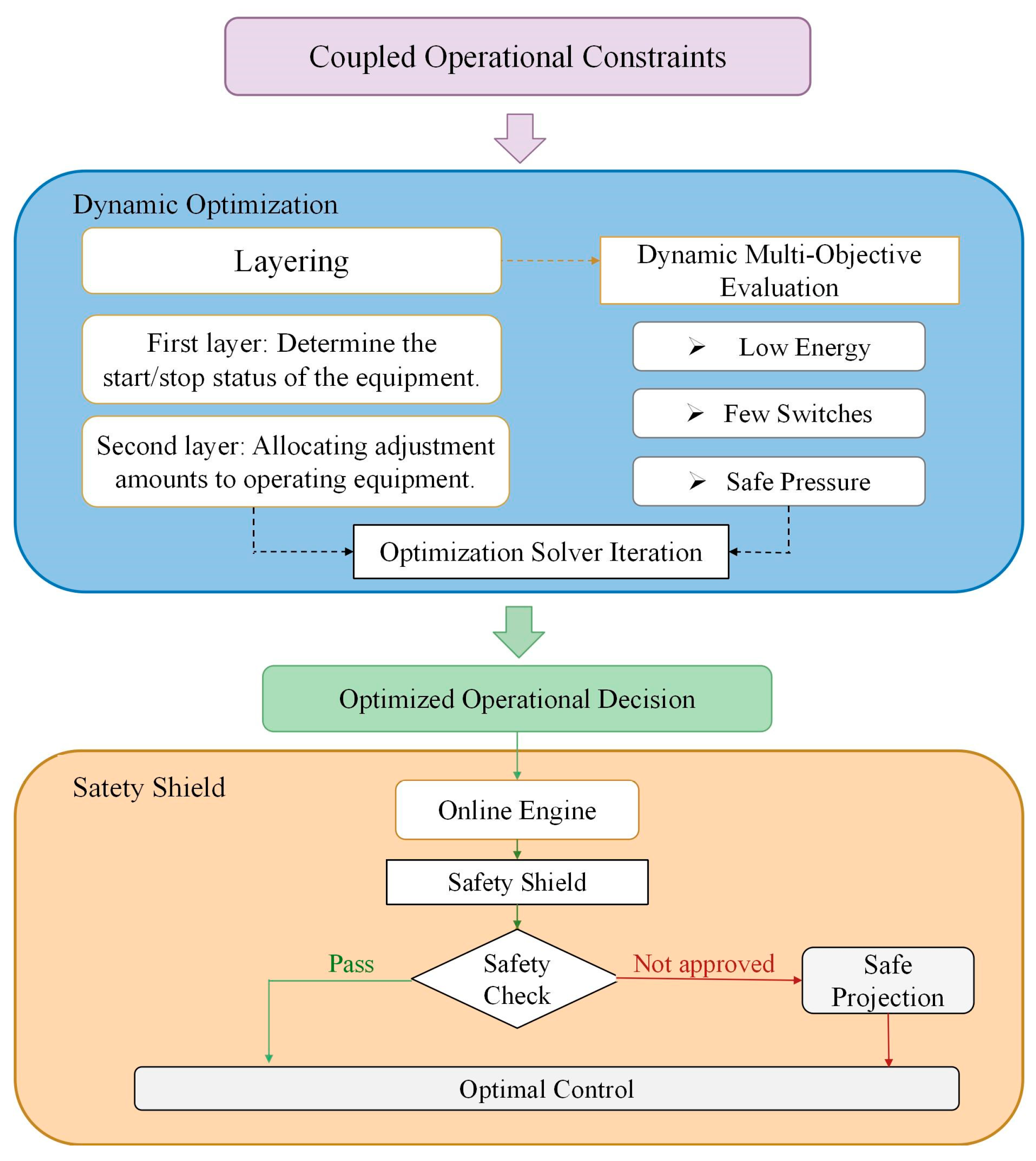
As shown in Figure 4, adaptive control is generated by linking high-dimensional constraints with executable actions through rolling optimization. The control layer evaluates energy consumption, switching frequency, and pressure–temperature safety, while the execution layer checks feasibility and projects unapproved schemes back into the safe operating region.
In terms of control variables, this study mainly considers pump start-stop combinations, setpoints of variable-frequency pump rotational speed, and the allocation of heating-equipment load.
To balance the competing operational requirements of pressure safety, temperature maintenance, energy conservation, and system smoothness under small-batch and multi-condition scenarios, the scheduling problem is formulated within a multi-objective dynamic optimization framework. The operational decision vector u k at each control step   k is expressed as follows:
u k = u k d , u k c T
where u k d and u k c represent the discrete switching decisions, such as pump and furnace start-stop states, and continuous regulation variables, such as pump rotational speeds, heating loads, and valve openings.
For any continuous control variable u k , j c , its allowable range satisfies
u k , j c { 0 } , u k , j d = 0 u j min , u j max , u k , j d = 1
where u k , j d = 0 indicates that the corresponding equipment is out of service, and u k , j d = 1 indicates that the corresponding equipment is in operation.
Based on the transient hydraulic and thermal states reconstructed by the parameter identification module, the objective function J of this mathematical programming problem is constructed to minimize comprehensive energy consumption while suppressing excessive equipment wear. The multi-objective control cost function J is defined as
J c t r l = w 1 e E + w 2 N s w N s w max + w 3 k = 1 N pred φ η p k + w 4 k = 1 N pred ψ η T k
where e E is the comprehensive energy consumption per unit oil throughput, N sw is the number of operations of key equipment such as pumps and furnaces, η p ( k ) is the pressure safety margin, η T ( k ) is the temperature safety margin, ϕ ( ) and ψ ( ) , respectively, denote the pressure and temperature risk penalty functions, and w 1 to w 4 are weighting coefficients. Equation (15) embodies the core idea of coordinated optimization of pumping and heating, namely, achieving optimal overall energy consumption under safety constraints.
For long-distance pipelines under strong transient disturbances, directly solving large-scale hard-constrained optimization models may lead to infeasible initial guesses, divergence, or timeouts. Therefore, complex physical constraints are handled through a composite penalty function suitable for minute-level rolling optimization.
Let L u , r denote the length of the pipeline segment with temperature or pressure violations in the r -th section; L l , n denote the actual length of the n -th section; N u denote the number of violating pipe sections; N u denote the number of violating devices; and N h , N p , N v and denote the total numbers of heating furnaces, pumps, and valves, respectively. Then the composite penalty function is defined as
f p ( u k ) = F 1 r = 1 N u L u , r n = 1 N l L l , n + F 2 N u N h + N p + N v
where the first term is used to characterize the spatial extent of constraint violations, the second term is used to characterize the impact range of violations at the equipment level, and F 1 and F 2 are penalty coefficients. Since the risk of continuous temperature decline over long pipeline sections or large-scale pressure-limit exceedance represents a critical system-wide safety hazard—far more severe than a local over-extension of a single piece of equipment—the penalty weights are set such that F 1 > F 2 . This setting guides the numerical solver to prioritize convergence toward the globally secure hydraulic and thermal feasible domain during rolling time horizon iterations.

4. Case Study

To verify the applicability of the proposed hybrid modelling and simulation framework to the heated transportation of high-pour-point, high-viscosity, and high-wax-content crude oil under multiple operating conditions, a domestic crude oil pipeline is selected as the case study, and analyses are conducted focusing on oil-temperature prediction, coordinated pump–furnace optimization, and safe operation control.

4.1. Pipeline Description and Operating Conditions

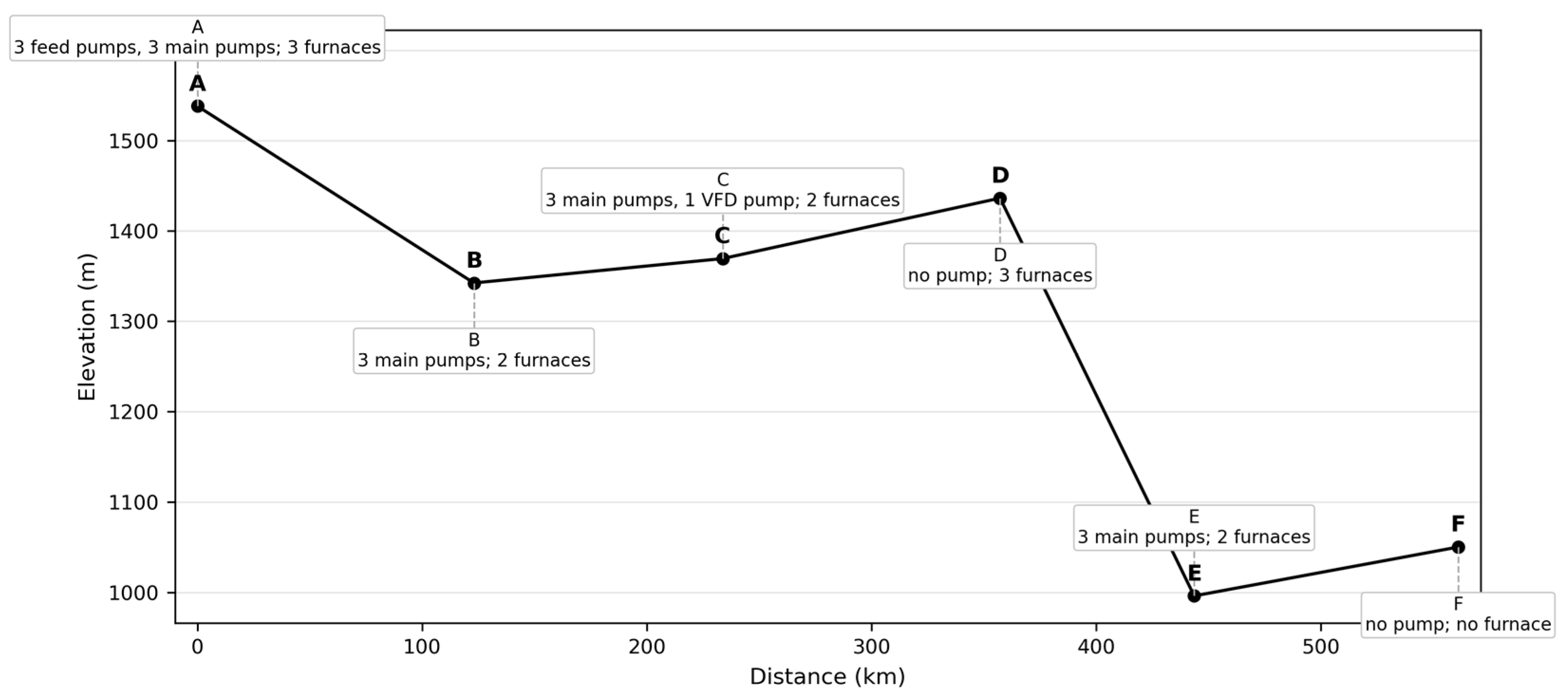
The crude oil pipeline investigated in this study has a total length of 562.1 km, a diameter of 457 mm, a design pressure of 8.0/6.3 MPa, a design throughput of 5.0 × 10⁶ t/a, and a minimum startup throughput of 2.30 × 10⁶ t/a, corresponding to approximately 320 m3/h. The line has six stations. Specifically, Station A, the initial station, is equipped with three feed pumps, two main pumps, and three heating furnaces; Station B is equipped with three main pumps and two heating furnaces; Station C is equipped with three main pumps, one variable-frequency pump, and two heating furnaces; Station D is equipped with three heating furnaces; Station E is equipped with three main pumps and two heating furnaces; and Station F is the terminal receiving station. A 40 mm polyurethane foam insulation layer is applied to the outer wall of the pipeline, as shown in Figure 5.
For the crude oil transported in this pipeline, the density is 844.2 kg/m3 at 20 °C and 823.9 kg/m3 at 50 °C, the wax mass fraction is 6.78%, the resin and asphaltene mass fraction is 13.32%, the wax appearance temperature is 36.5 °C, the abnormal point is 25 °C, and the pour point is 17–20 °C. Because the crude oil has poor low-temperature flowability, the pipeline adopts heated transportation throughout the year, and operation must simultaneously satisfy pressure safety and minimum station-inlet temperature requirements.
Two sets of representative actual operating data are selected as the basis of the case study. The first set of production data is used for historical backtracking and optimization analysis. It covers five independent interstation pipe sections, with a throughput range of 315–600 m3/h, station outlet oil temperatures of 22.6–55.6 °C, station inlet oil temperatures of 20.1–41.5 °C, and ground temperatures along the line of about 13.3–21.8 °C. The second set of operating data is used for pump–furnace combination optimization analysis. The operating scheme corresponding to the typical flow-rate step of 380 m3/h is selected as the case. This condition lies in the low-flow-rate regime, exhibits the typical characteristics of heated transportation of high-pour-point, high-viscosity, and high-wax-content crude oil, and corresponding actual operating schemes and optimization results have been reported in the literature, which facilitates a direct comparison between the results of the proposed method and the literature-based baseline scheme under the same pipeline, the same operating condition, and the same equipment constraints.

4.2. Data Sources, Reference Baseline, and Evaluation Methods

The data used in this chapter mainly come from two sources. The first is historical production data, including the throughput, inlet and outlet oil temperatures of each independent pipe section, ground temperature along the line, and back-calculated overall heat transfer coefficients. The second is the optimized furnace-startup operating results at a given station, including the actual throughput, inlet and outlet oil temperatures at each station, the total temperature drop along the line, and the energy consumption per unit time.
Operating schemes under the same pipeline, the same crude oil, and similar operating conditions are adopted as the reference baseline. To clearly distinguish the operational boundaries and technical characteristics of each method compared in this study, the three key schemes are explicitly defined as follows. The first is the literature baseline: the actual operating results or historical profiles reproduced based on traditional experience-driven or offline control strategies reported in the existing literature. The second is fixed-parameter simulation: the conventional simulation approach that relies on static physical parameters (such as fixed overall heat transfer coefficients and friction correction factors) inherited from the design stage or historical empirical values. The third is online identification optimization: the closed-loop framework developed in this study, which integrates real-time SCADA measurements to dynamically invert parameters and execute constraint-aware rolling optimization based on the updated transient model.
The evaluation methods in this chapter mainly include three aspects. The first is the effect of parameter inversion, focusing on the extent to which the full-line thermo-hydraulic state is corrected relative to the fixed-parameter assumption after online identification is introduced. The second is the effect of simulation-based prediction, focusing on the model’s reconstruction capability in terms of total temperature drop, minimum station-inlet oil temperature, and satisfaction of temperature constraints after parameter identification is introduced. The third is the optimization effect, focusing on the improvement in energy consumption achieved by the proposed method relative to the literature-based baseline scheme under the premise that safety constraints are satisfied.

4.3. Results and Analysis

4.3.1. Historical Operating-Condition Backtracking Test

To quantitatively illustrate the correction effect of online parameter identification on the model’s state-description capability, Table 2 gives the identified overall heat transfer coefficients and friction correction factors of each interstation pipe section under the 380 m3/h operating condition, together with the corresponding temperature and pressure error statistics. By comparing the identified results with the model inputs under the fixed-parameter assumption, the contribution of the operating-state perception layer to thermo-hydraulic state reconstruction can be further analyzed.
As shown in Table 2, the overall heat transfer coefficient and friction correction factor of each interstation pipe section are adjusted to different extents, indicating that the fixed-parameter assumption cannot adequately reflect the actual variations in heat loss and transport resistance along the line under this operating condition. Overall, the temperature errors of all pipe sections are controlled within a relatively small range after parameter identification, indicating that the proposed operating-state perception and parameter-inversion method can provide a credible model basis for subsequent simulation-based prediction and optimization decision-making.

4.3.2. Online Parallel and Open-Loop Test

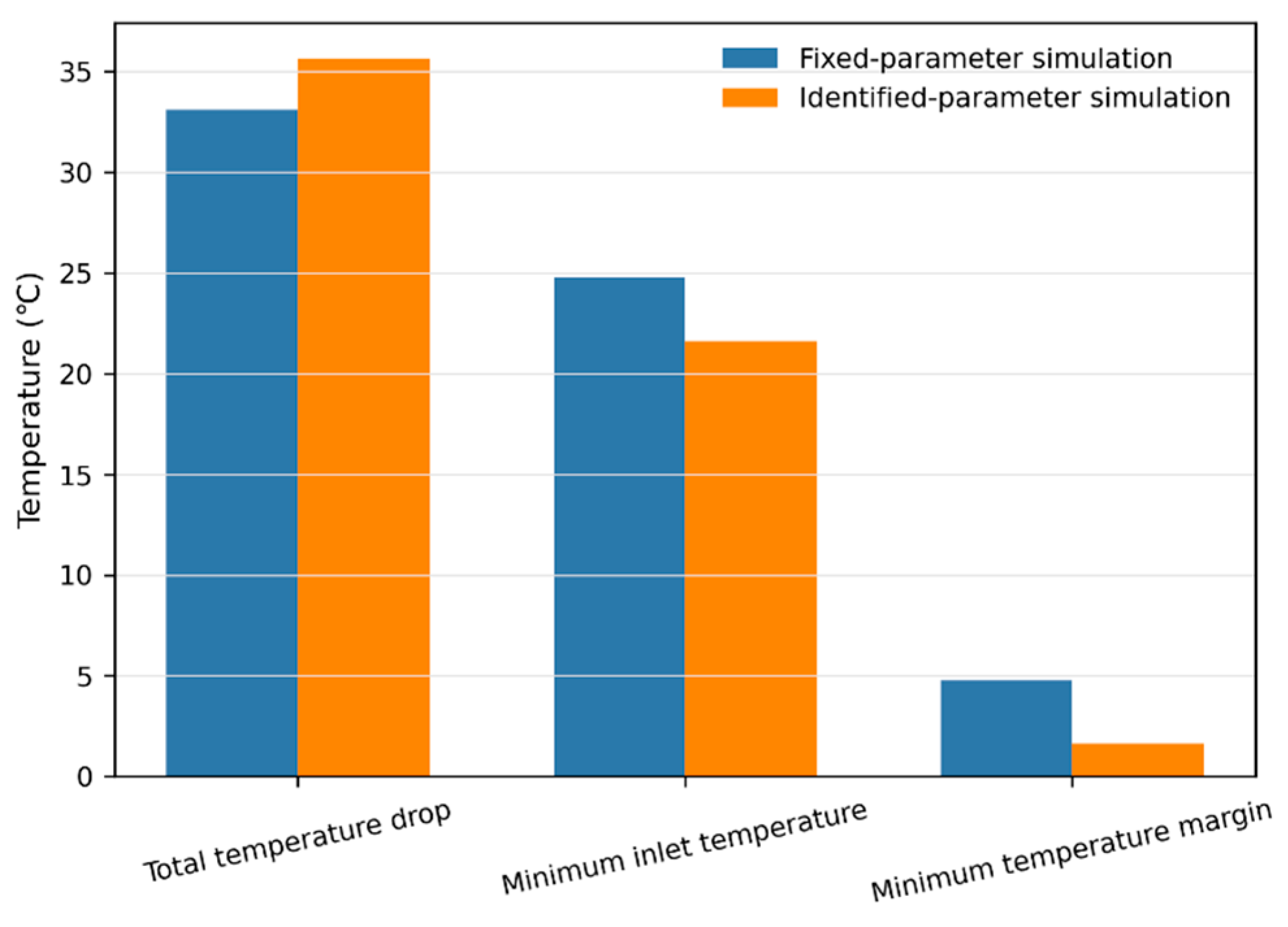
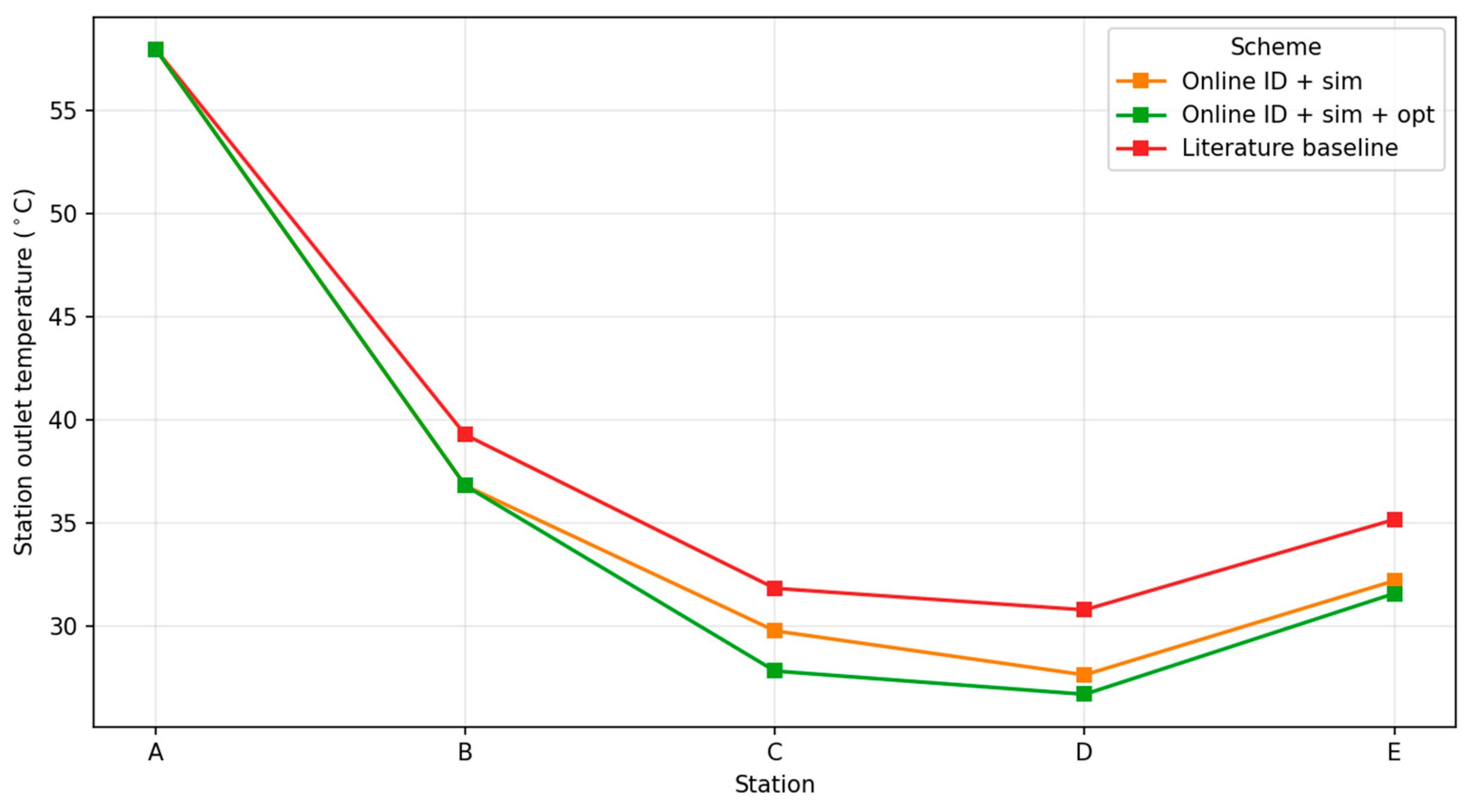
After parameter identification is completed, to further verify the model’s ability to reconstruct key temperature states, the key states under the fixed-parameter simulation and the online-identified simulation are compared, as shown in Figure 6.
After parameter identification, the simulated total temperature drop along the line is revised from 33.12 °C to 35.65 °C, and the minimum station-inlet oil temperature is revised from 24.77 °C to 21.61 °C. Compared with the fixed-parameter results, the total temperature drop increases by 2.54 °C, and the minimum station-inlet oil temperature decreases by 3.16 °C. Physically, fixed-parameter models often inherit design-stage or experience-based values and therefore tend to give overly conservative temperature distributions under low-flow-rate operation of high-pour-point, high-viscosity, and high-wax-content crude oil. By contrast, the online parameter inversion method can effectively reduce the overestimation of temperature safety margin caused by the fixed-parameter assumption, making the model state closer to the actual operating boundary.
Table 3 lists the inlet and outlet oil temperatures at each station under the 380 m3/h operating condition for both the literature-based baseline and the online-identified simulation, together with the minimum safe inlet oil temperature requirement.
As shown in Table 3, the station inlet and outlet oil temperatures obtained after online identification are generally lower than those reproduced by the literature-based baseline scheme, indicating that the fixed-parameter model overestimates the temperature safety redundancy under this operating condition. After optimization is further introduced, the inlet oil temperatures at Stations C, D, E, and F continue to decrease, but all remain higher than the minimum safe station-inlet temperature requirement, indicating that the proposed method can further compress outlet-temperature redundancy without violating the temperature boundary. This shows that the operating-state perception and simulation-prediction chain established in this study can not only reconstruct thermo-hydraulic states, but also provide more realistic safety-constraint information for the optimization module.
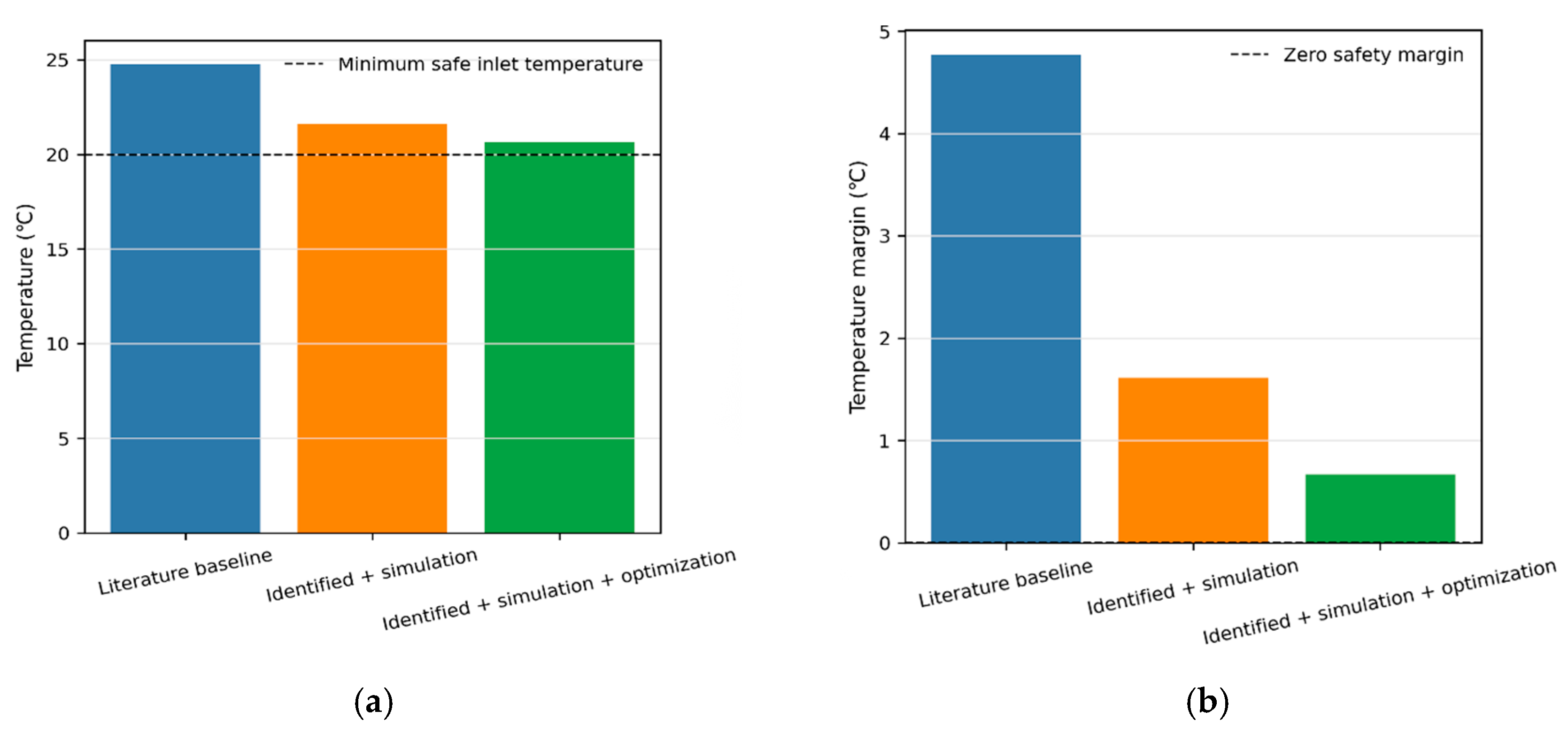
Under the literature-based baseline scheme, the minimum station-inlet oil temperature is 24.77 °C and the minimum safety margin is 4.77 °C. The simulation results after online identification show that, without changing the control strategy, the total temperature drop along the line is revised to 35.65 °C and the minimum station-inlet oil temperature is revised to 21.61 °C. This indicates that, without relying on additional control intervention, the proposed method can provide a description of the thermo-hydraulic state under the literature-based baseline condition that is closer to the actual operating boundary solely through parameter inversion and thermo-hydraulic coupling simulation.
From the perspective of temperature safety alone, although both the literature-based baseline scheme and the online-identified simulation satisfy the minimum safe station-inlet temperature requirement, the latter reveals a smaller temperature redundancy. This is of great significance for pipelines transporting high-pour-point, high-viscosity, and high-wax-content crude oil, because what truly affects the balance between safety and energy saving in actual operation is the amount of additional redundancy retained while satisfying the constraints.

4.3.3. Evaluation of Optimization Benefits Under a Controlled Scenario

The online-identified simulation results in Figure 7 provide the actual temperature-optimization boundary, and the room for optimization is smaller than expected. On this basis, in order to comprehensively evaluate the energy-saving effect and safety feasibility of the proposed method under the 380 m3/h operating condition, Table 4 compares the key indicators of the literature-based baseline scheme and the online-identification optimization scheme, including total energy consumption, pumping power consumption, heating energy consumption, total temperature drop along the line, minimum station-inlet oil temperature, minimum safety margin, and terminal-station inlet pressure.
After the optimization module is introduced, the total energy consumption decreases from 11,715.65 kW to 11,287.43 kW, a reduction of 3.66%. Pumping power consumption remains unchanged, and the energy savings are entirely derived from reduced heating energy consumption.
In terms of safety, the minimum station-inlet oil temperature under both schemes is higher than the safety lower limit of 20 °C, but the actual safety margin is not as high as anticipated by the literature-based baseline, as illustrated in Figure 8. After online identification and optimization, the minimum station-inlet oil temperature decreases to 21.61 °C and 20.67 °C, respectively, and the minimum safety margin decreases to 1.61 °C and 0.67 °C, respectively. Although a safety margin of 0.67 °C appears narrow compared to the traditional empirical operation (which reserves an overly conservative margin like 4.77 °C), it is entirely acceptable and safe in practical operation under the proposed framework. Traditional methods rely on large static redundancy to buffer against severe model uncertainties and delayed operator actions. In contrast, our hybrid framework incorporates real-time data assimilation and online parameter inversion, which drastically minimize model-to-pipe mismatches and predictive errors. Furthermore, the minute-level rolling optimization loop provides a high-frequency proactive tracking capability, allowing the system to dynamically adjust heating loads well before any boundary disturbance can cause a real thermal violation. The energy-saving effect of the proposed method mainly comes from further optimizing heating-load allocation and reducing outlet-temperature redundancy while satisfying both pressure and temperature safety constraints.

4.3.4. Application of Closed-Loop Rolling Optimization Under Variable Operating Conditions

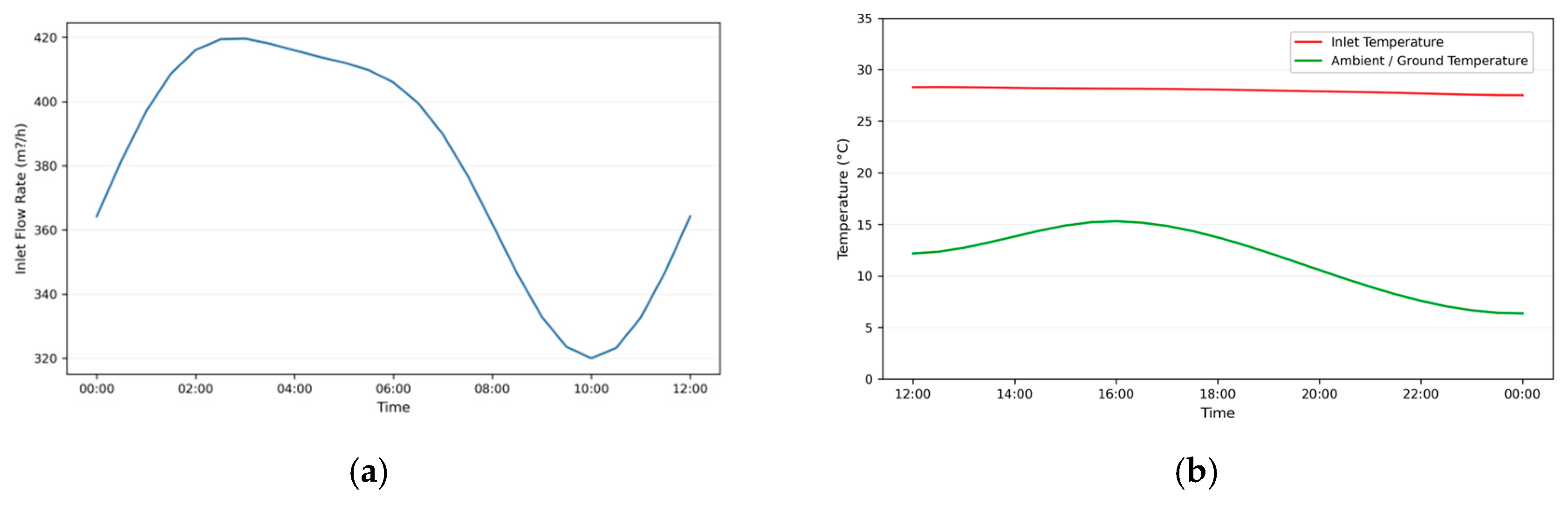
The above comparison is only a theoretical comparison under a single operating condition. In practice, the inlet flow rate, inlet temperature, and ambient ground temperature all change continuously over time; in other words, actual engineering operation faces multiple operating conditions. In this section, a time-varying boundary scenario constructed on the basis of the statistical characteristics of real operating conditions is used to verify the rolling optimization chain, with the steady-state operating scheme in Section 4.3.3 adopted as the reference baseline. The dynamic variations of these boundary conditions over the simulation period are illustrated in Figure 9.
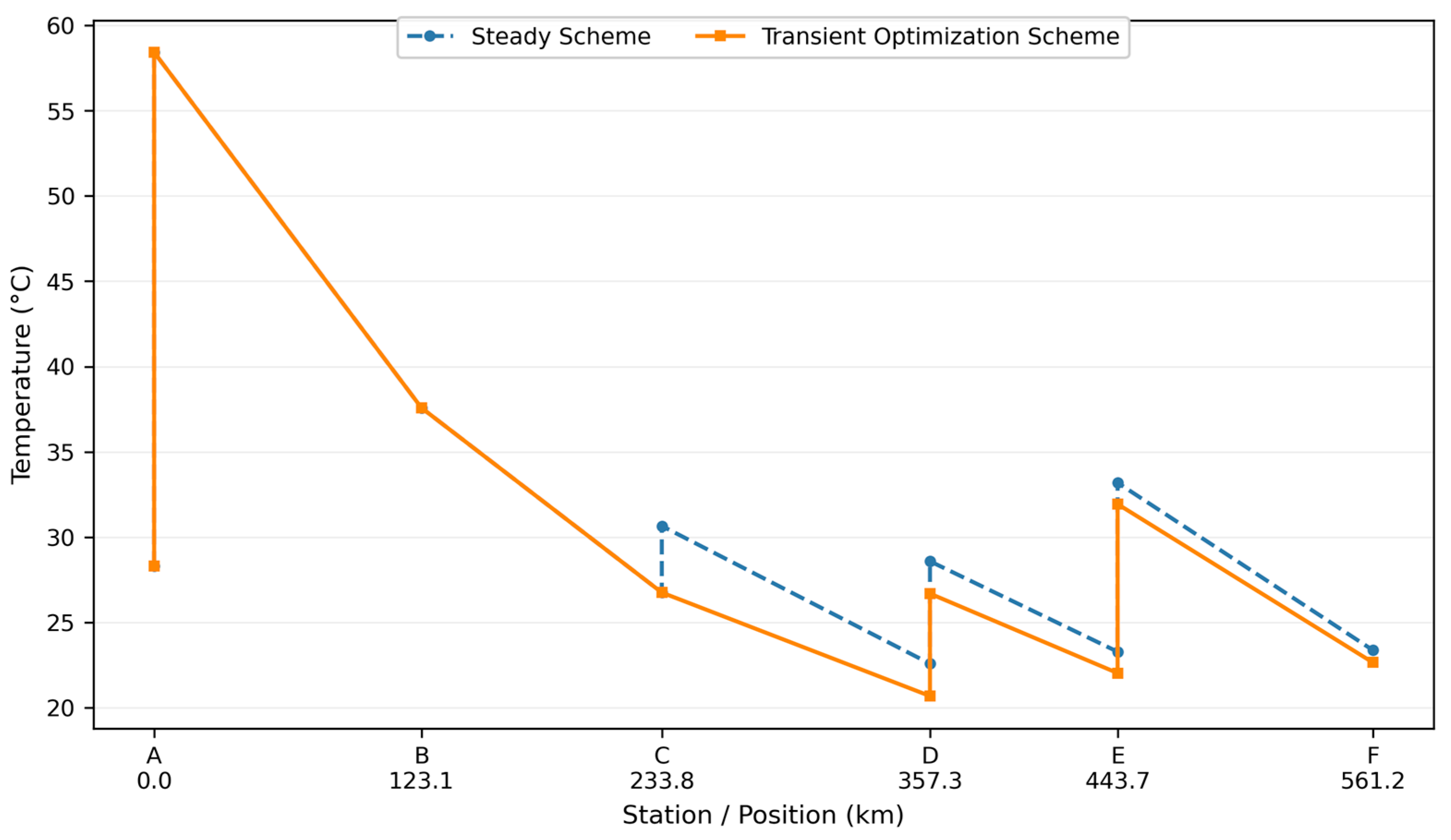
As time proceeds, the inlet flow rate and inlet oil temperature continue to change, while the ambient temperature first rises and then falls. Because heat dissipation of the transported oil is reduced during the daytime, there is room for energy-saving regulation. The closed-loop rolling optimization strategy lowers the heating-furnace power at Station C while ensuring that the oil temperature in the pipeline still satisfies the minimum station-inlet temperature constraint. Under the rolling optimization scheme, the station inlet and outlet oil temperatures are generally lower than those under the fixed steady-state scheme, as illustrated in Figure 10, but no temperature-constraint violation is triggered. This indicates that rolling optimization can proactively reduce unnecessary heating energy consumption in response to boundary changes.
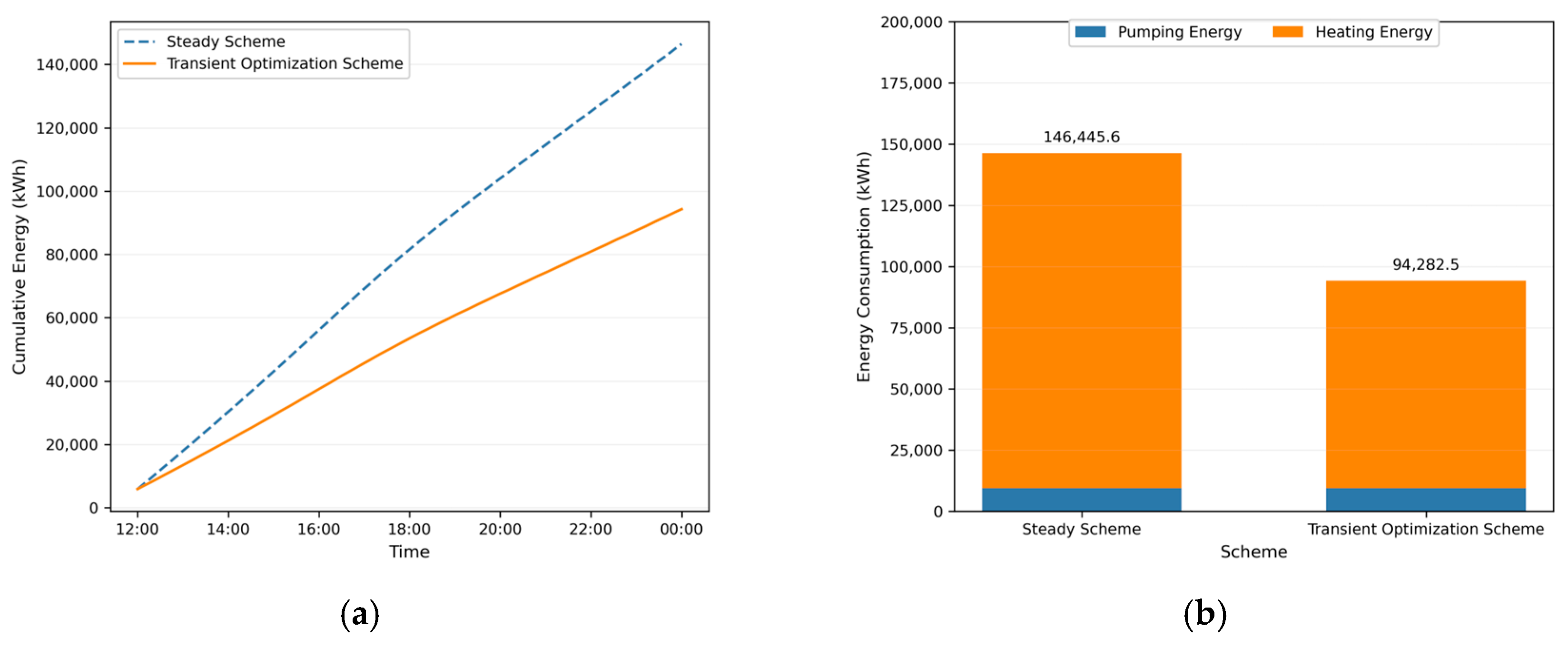
Under time-varying boundary conditions, both the fixed steady-state strategy and the rolling optimization control strategy satisfy temperature and pressure safety constraints, but they show clear differences in economic performance, as illustrated in Figure 11. Rolling optimization control can dynamically adjust equipment operating levels according to boundary-condition changes and reduce the cumulative heating energy consumption to 93,851.5 kWh while satisfying constraints throughout the entire time period. For multi-condition operation of heated crude oil pipelines, rolling optimization can effectively adjust strategies according to real-time operating-condition changes and thereby achieve better overall economy.

5. Conclusions

This study proposes a data-driven hybrid modelling and simulation framework for crude oil pipelines under the small-batch, multi-condition operation of high-pour-point, high-viscosity, and high-wax-content crude oil, and validates its effectiveness through a representative pipeline case study. The main conclusions are as follows:
(1)
An overall architecture of the dynamic optimization control architecture is constructed, consisting of an operating-state perception layer, a physics- and data-driven model layer, and a multi-objective coordinated decision-execution layer. Its integration mode with the SCADA platform, the relationship between data flow and control flow, and the hierarchical closed-loop execution logic are clarified. This architecture extends the traditional monitoring- and alarm-oriented control mode into a closed-loop system covering state identification, trend prediction, optimization decision-making, and execution feedback, thereby providing a system foundation for the intelligent operation of high-pour-point, high-viscosity, and high-wax-content crude oil pipelines under complex operating conditions.
(2)
To address the inability of fixed-parameter models to accurately reflect the actual thermo-hydraulic state, an online parameter inversion method based on inverse problem solving is established and validated under a representative operating condition. The results show that after online identification is introduced, the overall heat transfer coefficient and friction correction factor of each interstation pipe section are corrected to different extents, the total temperature drop along the line is revised from 33.12 °C to 35.65 °C, the minimum station-inlet oil temperature is revised from 24.77 °C to 21.61 °C, and the minimum safety margin is revised from 4.77 °C to 1.61 °C. This demonstrates that online parameter identification can effectively reduce the overestimation of temperature safety redundancy caused by the fixed-parameter assumption and make the model state closer to the actual operating boundary, thereby providing a more credible model basis for subsequent simulation-based prediction and optimization control.
(3)
On the basis of parameter inversion, a transient thermo-hydraulic coupling simulation and data assimilation method is constructed and used for thermo-hydraulic state reconstruction and optimization of high-pour-point, high-viscosity, and high-wax-content crude oil pipelines. The results show that, without violating temperature and pressure safety constraints, the total energy consumption decreases from 11,715.65 kW to 11,287.43 kW after optimization is introduced, corresponding to a reduction of 3.66%. This verifies the capability of the proposed method to optimize economic operation within the safe, feasible domain.
(4)
Under time-varying boundary conditions, the application potential of rolling optimization control is further verified. Rolling optimization can dynamically adjust equipment operating levels according to changes in inlet flow rate, inlet temperature, and ambient temperature, and can effectively reduce cumulative heating energy consumption while satisfying the minimum station-inlet temperature and pressure constraints, thereby mitigating the excessive heating caused by conservative static control. This indicates that, for the heated transportation of high-pour-point, high-viscosity, and high-wax-content crude oil, rolling optimization oriented toward boundary disturbances is more capable of balancing safety margin and overall energy consumption than a fixed steady-state scheme.

Author Contributions

Writing—original draft, methodology, Y.G.; data curation, investigation, writing—review and editing, C.L.; validation, visualization, Y.L. (Yang Lv); visualization, L.L.; investigation, Y.L. (Yangfan Lu); supervision, project administration, K.W. All authors have read and agreed to the published version of the manuscript.

Funding

This research was funded by the Oil and Gas Control Center of National Petroleum and Natural Gas Pipeline Network Group Co., Ltd. through the project “Feasibility Analysis of Intelligent Regulation Top-Level Design for Long-Distance Crude Oil Pipelines and Forward-looking Research on Online Simulation Technology”, grant number YQDK-25-ZC06-0003.

Informed Consent Statement

Not applicable.

Data Availability Statement

The data supporting the findings of this study are available from the corresponding author upon reasonable request. Due to confidentiality restrictions associated with industrial pipeline operation data and proprietary engineering information, the original datasets used and generated during the study are not publicly available.

Acknowledgments

The authors would like to thank the Oil and Gas Control Center of National Petroleum and Natural Gas Pipeline Network Group Co., Ltd. for its support during this study.

Conflicts of Interest

Authors G.Y., L.C., and L.Y. are employed by the Oil and Gas Control Center of National Petroleum and Natural Gas Pipeline Network Group Co., Ltd. The authors declare that the research was conducted in the absence of any commercial or financial relationships that could be construed as a potential conflict of interest.

Appendix A

Table A1. Nomenclature.
SymbolMeaningUnit
x k Comprehensive operating state vector at time k
p k Pressure state vector at discrete nodesMPa
Q k Flow-rate state vector at discrete nodesm3/h
T k Temperature state vector at discrete nodes°C
μ k Parameter vector to be identified
s k Operating state vector of pumps, valves, furnaces, and other equipment
h k Auxiliary state vector related to heat loss and risk
y k SCADA observation vector
H Observation mapping matrix
v k Measurement noise vector
θ k * Optimal parameter vector obtained by online inversion
N w Length of the sliding time window
W Observation weight matrix
λ r Regularization coefficient
L Regularization operator
θ 0 Prior parameter vector
y ^ i ( θ ) Predicted observations calculated by the physics-based model
ρ Crude oil densitykg/m3
A Cross-sectional area of the pipelinem2
z Pipeline mileagem
m · Mass flow ratekg/s
p l Internal pipeline pressurePa or MPa
λ Friction factor along the pipeline
d Inner pipeline diameterm
g Gravitational accelerationm/s2
θ Pipeline inclination anglerad
c Specific heat capacity of crude oilJ/(kg·°C)
T l Internal oil temperature°C
T s Soil temperature°C
K Overall heat transfer coefficientW/(m2·°C)
β Volumetric expansion coefficient°C−1
( p h ) in Heating-furnace inlet pressureMPa
( p h ) out Heating-furnace outlet pressureMPa
( T h ) in Heating-furnace inlet temperature°C
( T h ) out Heating-furnace outlet temperature°C
ξ h Local resistance coefficient of the heating furnace
W h Heating-furnace powerkW
η h Heating-furnace efficiency
( p p ) in Pump inlet pressureMPa
( p p ) out Pump outlet pressureMPa
( T p ) in Pump inlet temperature°C
( T p ) out Pump outlet temperature°C
Δ p p Pump pressure risePa or MPa
H p Pump headm
R p Pump rotational speedr/min
R r Rated pump rotational speedr/min
a 1 , , a 2 Pump characteristic fitting coefficientas defined
η p Pump efficiency
x k + 1 f Forecast state
x k a Analysis state after assimilation
u k Control input vector
w k Process noise vector
f ( ) State transition function
K k Data-assimilation gain matrix
T k key Oil temperature at the key location at the prediction time°C
T k min Minimum safe oil temperature°C
η T k Temperature safety margin
η p k Pressure safety margin
J c t r l Multi-objective control cost function
e E Comprehensive energy consumption per unit oil throughput
N sw Number of operations of key equipment, such as pumps and furnacestimes
N s w max Upper limit on the number of operationstimes
ϕ ( ) Pressure risk penalty function
ψ ( ) Temperature risk penalty function
w 1 , , w 4 Weight coefficient in the objective function
f p ( u k ) Composite penalty function
L u , r Length of the violating pipeline segment in the r-th sectionm
L l , n Actual length of the n-th pipeline sectionm
N u Number of violating pipeline segments
N u Number of violating devices
N h Total number of heating furnaces
N p Total number of pumps
N v Total number of valves
N pred Number of discrete steps in the prediction horizon
F 1 Penalty coefficient
F 2 Penalty coefficient
r k Single-step instantaneous operational evaluation score
Δ N sw ( k ) Number of newly added equipment switching actions at the current steptimes
P p k Pressure-violation penalty term
P T k Temperature-violation penalty term
ω 1 , , ω 5 Objective weight coefficient

References

  1. Li, Z.; Liang, Y.; Liao, Q.; Zhang, B.; Zhang, H. A review of multiproduct pipeline scheduling: From bibliometric analysis to research framework and future research directions. J. Pipeline Sci. Eng. 2021, 1, 395–406. [Google Scholar] [CrossRef]
  2. Alnaimat, F.; Ziauddin, M. Wax deposition and prediction in petroleum pipelines. J. Pet. Sci. Eng. 2020, 184, 106385. [Google Scholar] [CrossRef]
  3. Yu, P.; Lei, Y.; Gao, Y.; Peng, H.; Deng, S.; Liu, Y.; Lv, X.; Zhao, H. Study on the Operation Safety and Reliability of a Waxy Hot Oil Pipeline with Low Throughput Using the Probabilistic Method. ACS Omega 2020, 5, 33340–33346. [Google Scholar] [CrossRef]
  4. Saniere, A.; Henaut, I.; Argillier, J.-F. Pipeline transportation of heavy oils, a strategic, economic and technological challenge. Oil Gas Sci. Technol. 2004, 59, 455–466. [Google Scholar] [CrossRef]
  5. Li, Z.; Liang, Y.; Liang, Y.; Liao, Q.; Wang, B.; Huang, L.; Zheng, J.; Zhang, H. Review on intelligent pipeline technologies: A life cycle perspective. Comput. Chem. Eng. 2023, 175, 108283. [Google Scholar] [CrossRef]
  6. Hart, A. A review of technologies for transporting heavy crude oil and bitumen via pipelines. J. Pet. Explor. Prod. Technol. 2014, 4, 327–336. [Google Scholar] [CrossRef]
  7. Bekibayev, T.; Zhapbasbayev, U.; Ramazanova, G. Optimal regimes of heavy oil transportation through a heated pipeline. J. Process Control 2022, 115, 27–35. [Google Scholar] [CrossRef]
  8. Dunia, R.; Campo, A.; Guzman, R. Study of pressure and temperature developing profiles in crude oil pipe flows. J. Pet. Sci. Eng. 2011, 78, 486–496. [Google Scholar] [CrossRef]
  9. Yuan, Q.; Gao, Y.; Luo, Y.; Chen, Y.; Wang, B.; Wei, J.; Yu, B. Study on the optimal operation scheme of a heated oil pipeline system under complex industrial conditions. Energy 2023, 272, 127139. [Google Scholar] [CrossRef]
  10. Yang, M.; Huang, Y.; Dai, Y.-H.; Li, B. An efficient global optimization algorithm for heated oil pipeline problems. Ind. Eng. Chem. Res. 2020, 59, 6638–6649. [Google Scholar] [CrossRef]
  11. Wei, L.; Lei, Q.; Zhao, J.; Dong, H.; Yang, L. Numerical simulation for the heat transfer behavior of oil pipeline during the shutdown and restart process. Case Stud. Therm. Eng. 2018, 12, 470–483. [Google Scholar] [CrossRef]
  12. Jiang, W.; Wang, J.; Varbanov, P.S.; Yuan, Q.; Chen, Y.; Wang, B.; Yu, B. Hybrid data-mechanism-driven model of the unsteady soil temperature field for long-buried crude oil pipelines with non-isothermal batch transportation. Energy 2024, 292, 130354. [Google Scholar] [CrossRef]
  13. Lonje, B.M.; Liu, G. Review of wax sedimentations prediction models for crude-oil transportation pipelines. Pet. Res. 2022, 7, 220–235. [Google Scholar] [CrossRef]
  14. Kim, J.; Han, S.; Seo, Y.; Moon, B.; Lee, Y. The development of an AI-based model to predict the location and amount of wax in oil pipelines. J. Pet. Sci. Eng. 2022, 209, 109813. [Google Scholar] [CrossRef]
  15. Azevedo, L.F.A.; Teixeira, A.M. A critical review of the modeling of wax deposition mechanisms. Pet. Sci. Technol. 2003, 21, 393–408. [Google Scholar] [CrossRef]
  16. Guo, L.; Xu, X.; Lei, Y.; Wang, L.; Yu, P.; Xu, Q. Study on the viscoelastic-thixotropic characteristics of waxy crude oil based on stress loading. J. Pet. Sci. Eng. 2022, 208, 109159. [Google Scholar] [CrossRef]
  17. Martinez-Palou, R.; Mosqueira, M.L.; Zapata-Rendon, B.; Mar-Juarez, E.; Bernal-Huicochea, C.; de la Cruz Clavel-Lopez, J.; Aburto, J. Transportation of heavy and extra-heavy crude oil by pipeline: A review. J. Pet. Sci. Eng. 2011, 75, 274–282. [Google Scholar] [CrossRef]
  18. Lin, J.; Chen, L.; Sun, Q.; Xu, C.; Liu, G.; Zhong, Y.; Shao, K. A physics-informed reinforcement learning approach for multiproduct pipeline pump scheduling optimization. J. Pipeline Sci. Eng. 2025. [Google Scholar] [CrossRef]
  19. Wang, P.; Yu, B.; Deng, Y.; Zhao, Y. Operation optimization of heated oil transportation pipeline. In Proceedings of the International Conference on Pipelines and Trenchless Technology, Beijing, China, 19–22 October 2011; pp. 721–729. [Google Scholar] [CrossRef]
  20. Liu, Y.; Cheng, Q.; Gan, Y.; Wang, Y.; Li, Z.; Zhao, J. Multi-objective optimization of energy consumption in crude oil pipeline transportation system operation based on exergy loss analysis. Neurocomputing 2019, 332, 100–110. [Google Scholar] [CrossRef]
  21. Yan, Y.; Castro, P.M.; Liao, Q.; Liang, Y. An effective decomposition algorithm for scheduling branched multiproduct pipelines. Comput. Chem. Eng. 2021, 154, 107494. [Google Scholar] [CrossRef]
  22. Sidki, M.; Tchernev, N.; Féniès, P.; Ren, L.; Elfirdoussi, S. Multiproduct pipeline scheduling: A comprehensive bibliometric analysis and a systematic literature review. Comput. Chem. Eng. 2025, 192, 108911. [Google Scholar] [CrossRef]
  23. Chen, Z.; Liu, H.; Yuan, Q.; Liu, H.; Zhao, Y.; Chen, Y.; Li, J.; Yu, B. Intelligent optimization of operation schemes for a crude oil pipeline system under a variable-electricity-price policy. Energy 2025, 338, 138720. [Google Scholar] [CrossRef]
  24. Zhou, M.; Zhang, Y.; Jin, S. Dynamic optimization of heated oil pipeline operation using PSO-DE algorithm. Measurement 2015, 59, 344–351. [Google Scholar] [CrossRef]
  25. Wang, H.; Xu, Y.; Shi, B.; Zhu, C.; Wang, Z. Optimization and intelligent control for operation parameters of multiphase mixture transportation pipeline in oilfield: A case study. J. Pipeline Sci. Eng. 2021, 1, 367–378. [Google Scholar] [CrossRef]
  26. Evensen, G. The ensemble Kalman filter: Theoretical formulation and practical implementation. Ocean Dyn. 2003, 53, 343–367. [Google Scholar] [CrossRef]
  27. Zhang, Y.; Wang, B.; Huang, X. Online optimization of heated-oil pipeline operation based on neural network system identification. J. Pipeline Syst. Eng. Pract. 2020, 11, 04019040. [Google Scholar] [CrossRef]
  28. Du, J.; Li, H.; Zheng, J.; Shen, J.; Liao, Q.; Liang, Y.; Zio, E. Towards parameter identification in pipeline hydraulics: Integrating data-driven discovery and knowledge embedding. npj Artif. Intell. 2026, 2, 6. [Google Scholar] [CrossRef]
  29. Meza, E.B.M.; Souza, D.G.B.; Copetti, A.; Sobral, A.P.B.; Silva, G.V.; Tammela, I.; Cardoso, R. Tools, technologies and frameworks for digital twins in the oil and gas industry: An in-depth analysis. Sensors 2024, 24, 6457. [Google Scholar] [CrossRef]
  30. Chen, B.-Q.; Videiro, P.M.; Soares, C.G. Opportunities and challenges to develop digital twins for subsea pipelines. J. Mar. Sci. Eng. 2022, 10, 739. [Google Scholar] [CrossRef]
  31. Li, B.; Gai, J.; Xue, X. The Digital Twin of Oil and Gas Pipeline System. IFAC-PapersOnLine 2020, 53, 710–714. [Google Scholar] [CrossRef]
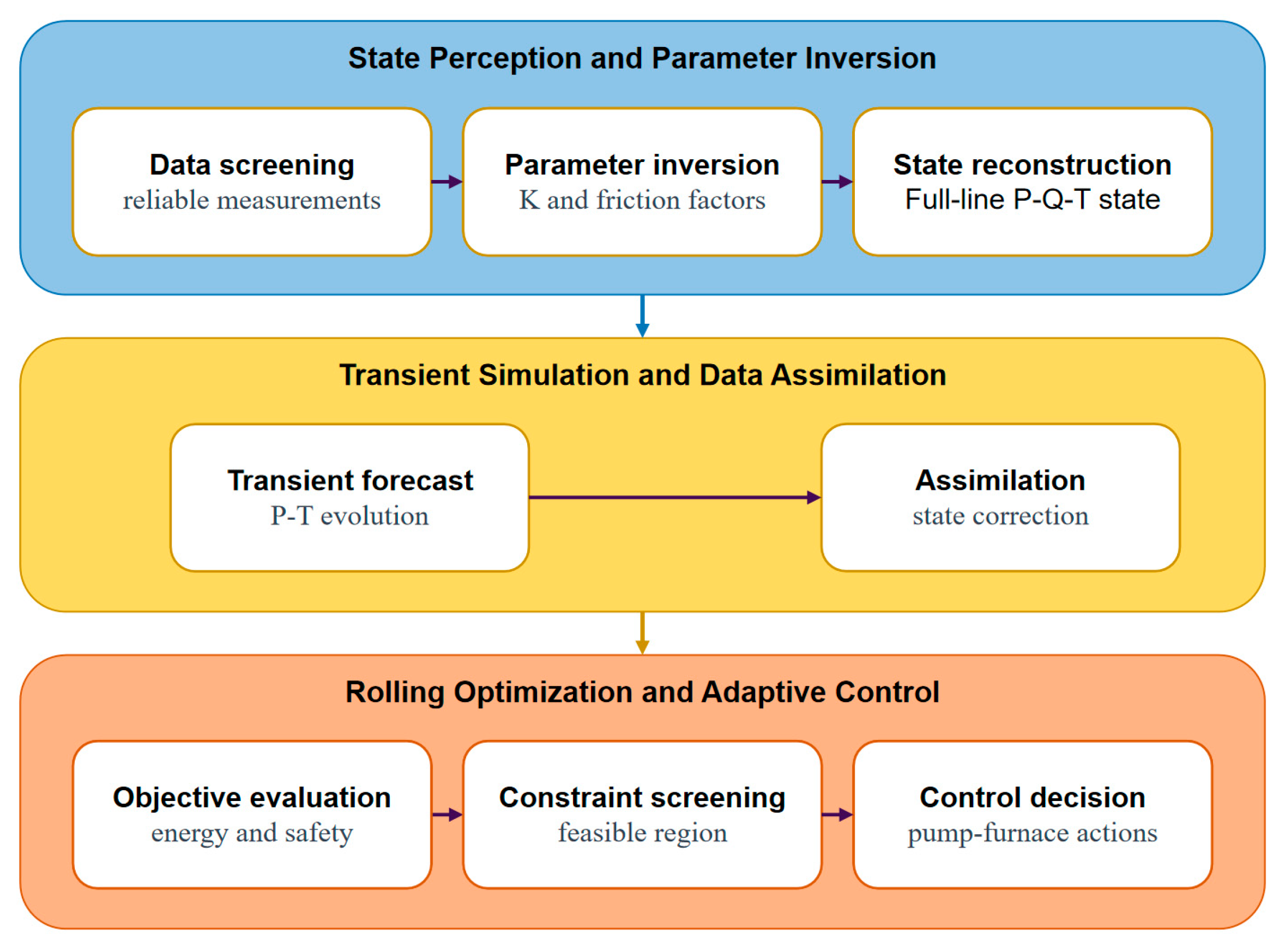
Figure 1. Mechanistic-simulation-based rolling dynamic optimization framework for heated crude oil pipelines.
Modelling 07 00115 g001
Figure 2. Technical flow of online rheological-parameter inversion based on inverse problem solving.
Modelling 07 00115 g002
Figure 3. Technical architecture of rapid transient-flow simulation and data assimilation for real-time decision-making.
Modelling 07 00115 g003
Figure 4. Process for generating adaptive control strategies using rolling optimization under operational constraints.
Modelling 07 00115 g004
Figure 5. Longitudinal profile and station layout of the investigated crude oil pipeline.
Modelling 07 00115 g005
Figure 6. Comparison of key thermo-hydraulic states before and after parameter inversion under the 380 m3/h low-flow-rate condition.
Modelling 07 00115 g006
Figure 7. Comparison of station outlet temperatures under different control schemes for the 380 m3/h operating condition.
Modelling 07 00115 g007
Figure 8. Minimum inlet temperatures and safety margins under different schemes for the 380 m3/h operating condition. (a) Minimum inlet temperature. (b) Minimum temperature safety margin.
Modelling 07 00115 g008
Figure 9. Flow rate and temperature under variable operating conditions. (a) Inlet flow-rate variation. (b) Inlet oil temperature and ambient temperature variation.
Modelling 07 00115 g009
Figure 10. Full-line temperature profiles of the steady and transient optimization schemes at the critical instant.
Modelling 07 00115 g010
Figure 11. Cumulative and final energy consumption comparison between the steady and transient optimization schemes. (a) Cumulative energy consumption. (b) Final energy consumption.
Modelling 07 00115 g011
Table 1. Comparison of existing studies on crude oil pipeline modelling, simulation, and operational control.
ReferenceFocuses
on Oil
Pipelines
Modelling Method
Employs Transient Modelling
Methodological Coverage
Online
Parameter
Identification
SimulationOptimization
-Based
Control
Safety
Assurance
[1]YesNo
[2]YesNo
[3]YesNo
[4]YesNo
[5]YesNo
[6]YesNo
[7]YesNo
[8]YesYes
[9]YesNo
[10]YesNo
[11]YesYes
[12]YesYes
[13]YesNo
[14]YesNo
[15]Yes/PartialNo
[16]NoNo
[17]YesNo
[18]YesNo
[19]YesNo
[20]YesNo
[21]YesNo
[22]YesNo
[23]YesNo
[24]YesYes
[25]YesNo
[26]NoYes
[27]YesNo
[28]Yes/PartialYes
[29]NoNo
[30]Yes/PartialNo
[31]YesNo
This paperYesYes
√ indicates that the above factors have been considered.
Table 2. Identification results of overall heat transfer coefficients and friction correction factors for pipeline segments.
SegmentBaseline Overall Heat Transfer Coefficient
K/W·(m2·°C)−1
(m2·°C)−1
Identified Overall Heat Transfer Coefficient K/W·(m2·°C)−1
(m2·°C)−1
Baseline Friction Correction Factor fIdentified Friction Correction FactorTemperature RMSE/°CTemperature MAE/°CPressure RMSE/kPaPressure MAE/kPa
A–B0.8581.01371.02031.40360.8620.71823.15722.884
B–C0.8580.91381.3392.111.1781.1312.2652.238
C–D0.82351.18941.1061.66910.8020.8018.2878.189
D–E0.8130.97571.02792.10020.4080.37553.56452.931
E–F0.8580.94991.79982.61680.1970.197101.653100.452
Table 3. Prediction results of oil temperature.
StationLiterature Baseline Inlet Oil Temperature/°COnline-Identified Simulated Inlet Oil Temperature/°CLiterature Baseline Outlet Oil Temperature/°COnline-Identified Simulated Outlet Oil Temperature/°CMinimum Safe Inlet Oil Temperature/°C
A27.927.95858
B39.2736.839.2736.820
C27.9225.8531.8229.7520
D24.7721.6130.7727.6120
E25.2622.2935.1632.1920
F24.8822.3520
Table 4. Comparison of key indicators between the baseline scheme and the optimized scheme with online identification.
MetricTotal Energy Consumption/kWPumping Power Consumption/kWHeating Energy Consumption/kWTotal Temperature Drop Along the Line/°CMinimum Station-Inlet Oil Temperature/°CMinimum Safety Margin/°CTerminal-Station Inlet Pressure/kPaTemperature Constraint SatisfiedPressure Constraint Satisfied
Literature baseline11,715.65757.5410,958.1133.1224.774.775781.08SatisfiedSatisfied
Online identification optimization11,287.43757.5410,529.8936.0120.670.672700.7SatisfiedSatisfied
Disclaimer/Publisher’s Note: The statements, opinions and data contained in all publications are solely those of the individual author(s) and contributor(s) and not of MDPI and/or the editor(s). MDPI and/or the editor(s) disclaim responsibility for any injury to people or property resulting from any ideas, methods, instructions or products referred to in the content.