1. Introduction
The performance of a modern electric vehicle is no longer determined by the standalone characteristics of the battery or electric motor. It depends on the coordinated operation of the entire traction system, which includes the energy source, power converter, electric drive, transmission, control loop and mechanical load that varies with the driving cycle. A recent systematic review of electric vehicle energy consumption studies emphasized that extending driving range per charge and improving overall efficiency cannot be achieved through a single local solution alone [
1]. Instead, the coordinated optimization of the electrical, mechanical and algorithmic subsystems is required. Within this framework, control is regarded as one of the main levers for reducing losses and improving the vehicle’s energy performance.
In this system-level context, the speed control problem occupies a central place. The quality of reference speed tracking directly affects not only vehicle dynamics, but also current loading, peak power demand, battery state-of-charge variation and total energy consumption during standard driving cycles. Recent studies increasingly address speed control not as an isolated task, but in combination with energy-related indicators, powertrain delays, road disturbances and variability in operating conditions. For example, an MPC-based approach has been proposed for autonomous electric vehicles that accounts for propulsion system delay to improve longitudinal speed control accuracy, while detailed simulation models under standard driving cycles already evaluate power flow, energy efficiency, SOC and the thermal loading of system components simultaneously [
2,
3].
A review of recent publications shows that current advances in this field are developing along at least three interconnected directions. The first direction is associated with the transition from conventional PI/PID controllers to intelligent or adaptive control structures. For DC-motor-based electric vehicle speed control, an ANFIS-based PID controller has been proposed, with parameters optimized using ant colony optimization and performance verified in MATLAB/Simulink under standard driving conditions. For range-extended electric vehicles, a PI-based control strategy using fuzzy logic methods has been developed, where PI parameters are combined with genetic optimization and fuzzy adaptation during power regulation. For more complex configurations, particularly 4WID-EV systems, researchers have moved toward optimal quadratic and other advanced control laws focused on trajectory tracking, torque distribution and fault tolerance [
4,
5]. In [
6], a PID controller for a DC-motor electric vehicle was developed using the framework of controlled invariant sets and multi-parametric linear programming, which makes it possible to account directly for physical constraints on angular speed and armature voltage already at the tuning stage. The resulting controller is implemented as a piecewise-affine control law with variable coefficients, which fundamentally distinguishes it from the classical PID structure, where signal limiting is introduced only afterwards. It was shown that embedding constraints into the objective function improves electric drive dynamics and prevents motor overvoltage under variable load conditions. In another study [
7], a comparative analysis of linear controllers and a nonlinear controller (NL-PID) was carried out for electric vehicle speed control based on a second-order transfer function. The controller parameters were optimized using the Aquila Optimizer according to a combined criterion that minimized ITAE and the integral of the squared control signal subject to an overshoot constraint. To suppress undesirable oscillations in the control action, the objective function was modified accordingly. MATLAB simulation confirmed the advantages of the NL-PID controller in terms of settling time, tracking deviation and robustness under ±25% variation in model parameters.
The second direction concerns not so much a change in the controller class as a deeper refinement of tuning and evaluation procedures. Recent studies have shown that, even for a conventional PI controller, performance depends strongly on how the tuning problem is formulated. The multi-criterion optimization of controller coefficients makes it possible to improve speed-tracking accuracy and reduce energy consumption at the same time, whereas empirical tuning approaches often remain suboptimal. In parallel, other studies emphasize that the PID controller is still one of the most widely used basic tools for speed stabilization in transport systems. However, its practical application often relies on semi-empirical parameter selection without a sufficiently deep system-level analysis of the consequences for the entire electromechanical drive structure [
8,
9]. In [
10], a method was proposed for synthesizing an optimal PID controller for an electric vehicle by minimizing the integral squared error using the TLBO algorithm, which does not require the computation of the derivatives of the objective function. The tuned controller was evaluated using transient characteristics, impulse response, and Bode and Nyquist plots, as well as time-domain and error-based performance metrics. The results confirmed improved dynamic characteristics and enhanced system stability compared with the baseline control configuration. In another study [
11], the author conducted a comparative analysis of integer proportional–integral (IPI), fractional proportional–integral (FPI) and fractional PI data-trained adaptive neuro-fuzzy inference system (ANFIS) speed controllers for the indirect field-oriented control (IFOC) of an induction motor drive. The ANFIS controller was trained using the input–output data of a genetic algorithm-tuned FPI controller. The performance of all three configurations was evaluated under variable speed tracking, load variation and motor parameter uncertainty. The simulation results demonstrated that the ANFIS controller achieved the lowest peak overshoot of 0.495%, compared to 12.062% for FPI and 14.699% for IPI, while also attaining the reference speed within 0.14 s. The author concluded that ANFIS outperformed both fixed-parameter controllers across all key metrics, including settling time, rise time, overshoot and steady-state error, making it particularly suitable for applications requiring high reference tracking accuracy under transient conditions.
In study [
12], a tuning method for a DC motor PID controller was proposed based on genetic algorithms, where the objective function simultaneously accounts for transient-response quality and electric energy consumption. The optimization problem was formulated as the maximization of a weighted fitness function over a sequence of random step inputs. Here, the relative weight of the energy-related term acts as an adjustable parameter, making it possible to flexibly set the priority between dynamic response and efficiency. Using bootstrap-based estimation, the authors showed that, with an appropriate choice of weighting coefficient, energy consumption can be reduced by up to 60% with only a minor degradation in dynamic performance. In turn, study [
13] proposed a multi-objective method for tuning a PID controller of a DC motor by combining the Taguchi method with grey relational analysis, which makes it possible to minimize both settling time and overshoot simultaneously. In parallel, model reference adaptive control schemes based on the MIT rule, a modified MIT rule and Lyapunov-based adaptation were also investigated. The results showed that the modified MIT rule provides insensitivity to input signal amplitude, whereas the Lyapunov-based rule ensures stability under nonlinear disturbances and parameter variations. A comparative analysis with GA- and PSO-tuned PID controllers confirmed the advantages of the Taguchi-based method in terms of settling time and rise time in a MATLAB/Simulink simulation. In [
14], the authors investigated the synthesis of a fractional-order PID controller for the speed control system of an electric vehicle on a concrete surface, comparing it with PID controllers tuned by the Ziegler–Nichols, Cohen–Coon, Åström–Hägglund and Chien–Hrones–Reswick methods. It was shown that using fractional-order integral and derivative terms expands the tuning capabilities and provides better transient-response performance. As a result, the FOPID controller outperformed the classical IOPID variants in both settling time and overshoot during electric vehicle speed tracking. Similar approaches are also used in studies devoted to systems built on PI controllers. Thus, in [
15], the authors developed an adaptive PI speed controller for an electric drive based on reference-model identification and a Lyapunov function. This approach makes it possible to identify the moment of inertia, viscous friction coefficient and load torque directly during operation. A modified equation of motion was proposed that incorporates a low-pass filter in the speed feedback channel and the friction torque term, which significantly improves identification accuracy and better reflects real operating conditions. A MATLAB/Simulink simulation of a permanent-magnet synchronous motor under a sinusoidal speed reference confirmed that the adaptive PI controller substantially reduces tracking error under uncertainty and a pronounced variation of mechanical parameters compared with a conventional PI controller.
The third direction focuses on improving the physical completeness and validity of electric vehicle models. Recent publications increasingly move away from simplified control objects and toward models that integrate the battery pack, electric motor, converters, standard driving cycles and methods for evaluating energy-related indicators. For example, study [
16] proposed a model whose parameters were calibrated using empirical data, while validation was performed against power consumption, SOC and driving range. Other researchers have developed hybrid simulation approaches that link MATLAB-based models with more advanced external simulation environments [
17]. Energy-flow studies of battery electric vehicles have also shown that energy consumption, energy recovery efficiency and subsystem losses depend strongly on the speed properties of the driving cycle [
18]. Therefore, the current literature clearly shows demand not only for a better controller, but also for a methodologically transparent integration of the mathematical model, the simulation platform and a set of quality indicators suitable for comparative assessment.
At the same time, the analysis of the cited studies suggests that recent research tends to shift either toward complex intelligent control laws or toward specialized problems such as power control, longitudinal control with delay, fault-tolerant torque distribution, thermo-energetic analysis or model validation. Under these conditions, a classical comparison of PI and PID control within the same full electric traction system, where the main technical and mechanical components of the vehicle remain unchanged and only the controller structure is varied, has not been examined in a sufficiently systematic way. It should also be noted that, even when speed control is analyzed in previous studies, the energy consequences of controller selection, particularly their effect on traction battery indicators, motor electrical variables and overall vehicle energy consumption, often remain secondary or are considered only indirectly [
19]. The innovation in the present work is therefore methodological rather than algorithmic. This paper does not claim novelty in the PI or PID control laws themselves. Instead, it addresses the lack of a controlled system-level comparison in which the same electric traction plant is used and only the structure of the speed controller is changed. This formulation is important because a controller that gives almost the same speed-tracking error may still impose a different current profile, braking-command pattern and SOC depletion on the battery.
In view of this, the aim of the present study is to evaluate how the structure of a conventional speed controller affects both tracking accuracy and energy-related behavior in a complete electric vehicle traction model. The comparison is deliberately restricted to PI and PID controllers because these control laws remain widely used in embedded drive systems due to their simplicity, transparency and low computational cost. The objective is not to propose a more complex controller, but to determine whether the derivative channel provides a measurable system-level benefit under a standardized urban driving cycle. This involves analyzing speed-profile tracking, control signal formation, motor electrical variables and traction battery behavior within the same closed-loop model.
To achieve this aim, the following tasks are addressed in the study:
- −
The structure of the electric vehicle traction system is formalized as a set of interconnected subsystems, including the battery, PWM converter, H-bridge, DC motor, transmission and vehicle module;
- −
A mathematical description of the key elements in this system is developed;
- −
Two variants of the closed-loop speed control system are implemented using PI and PID controllers;
- −
A comparative analysis of their operation is carried out under the same input driving cycle and the same plant model.
2. Materials and Methods
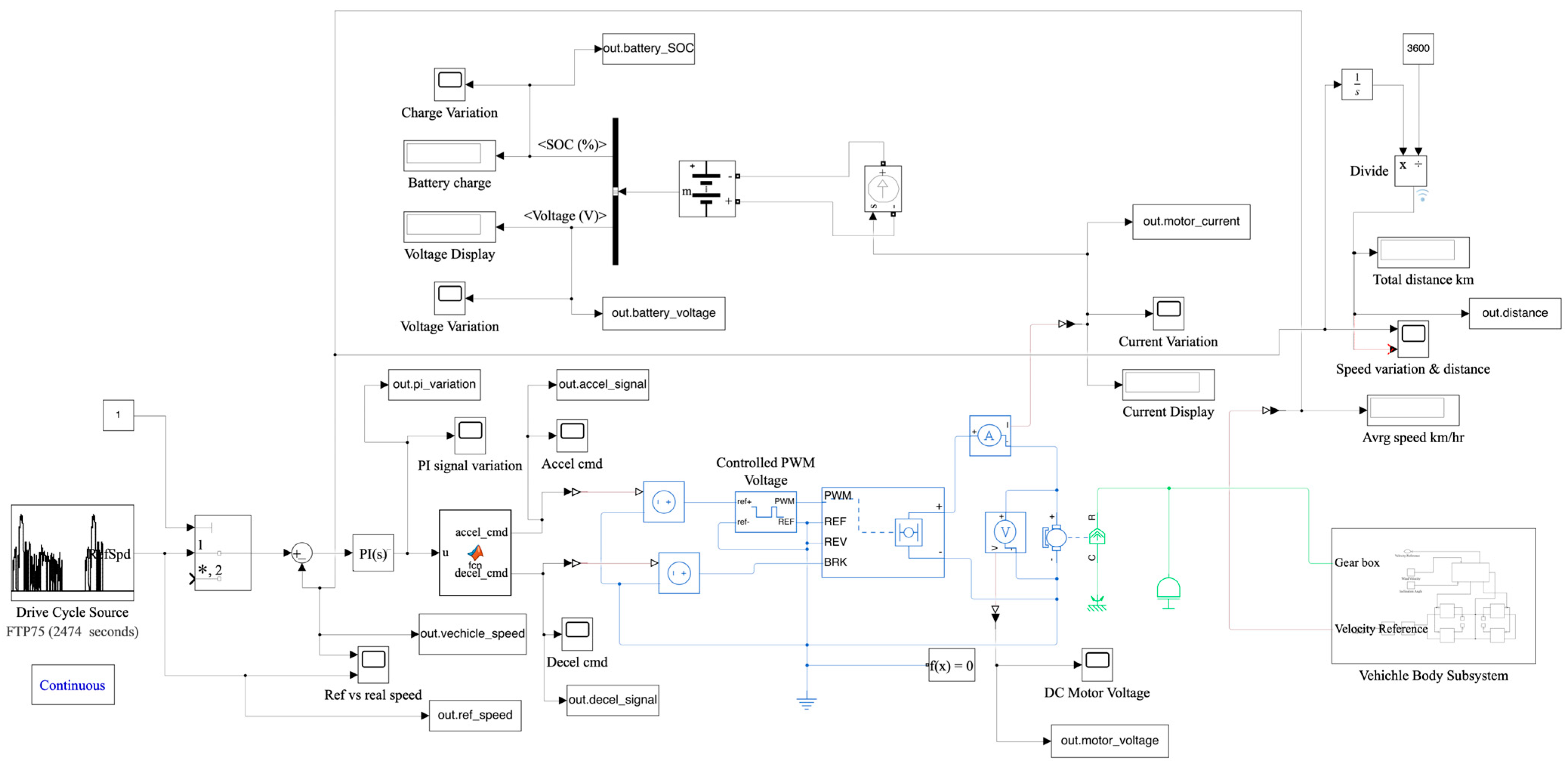
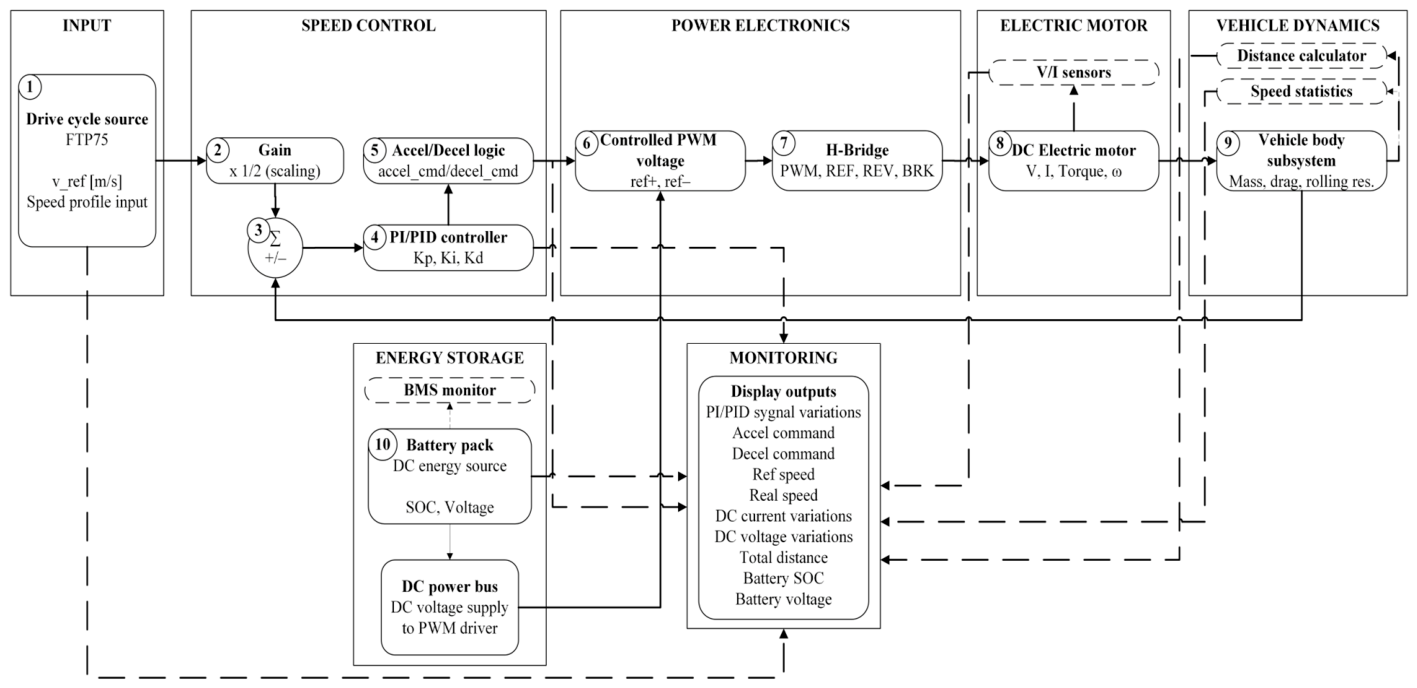
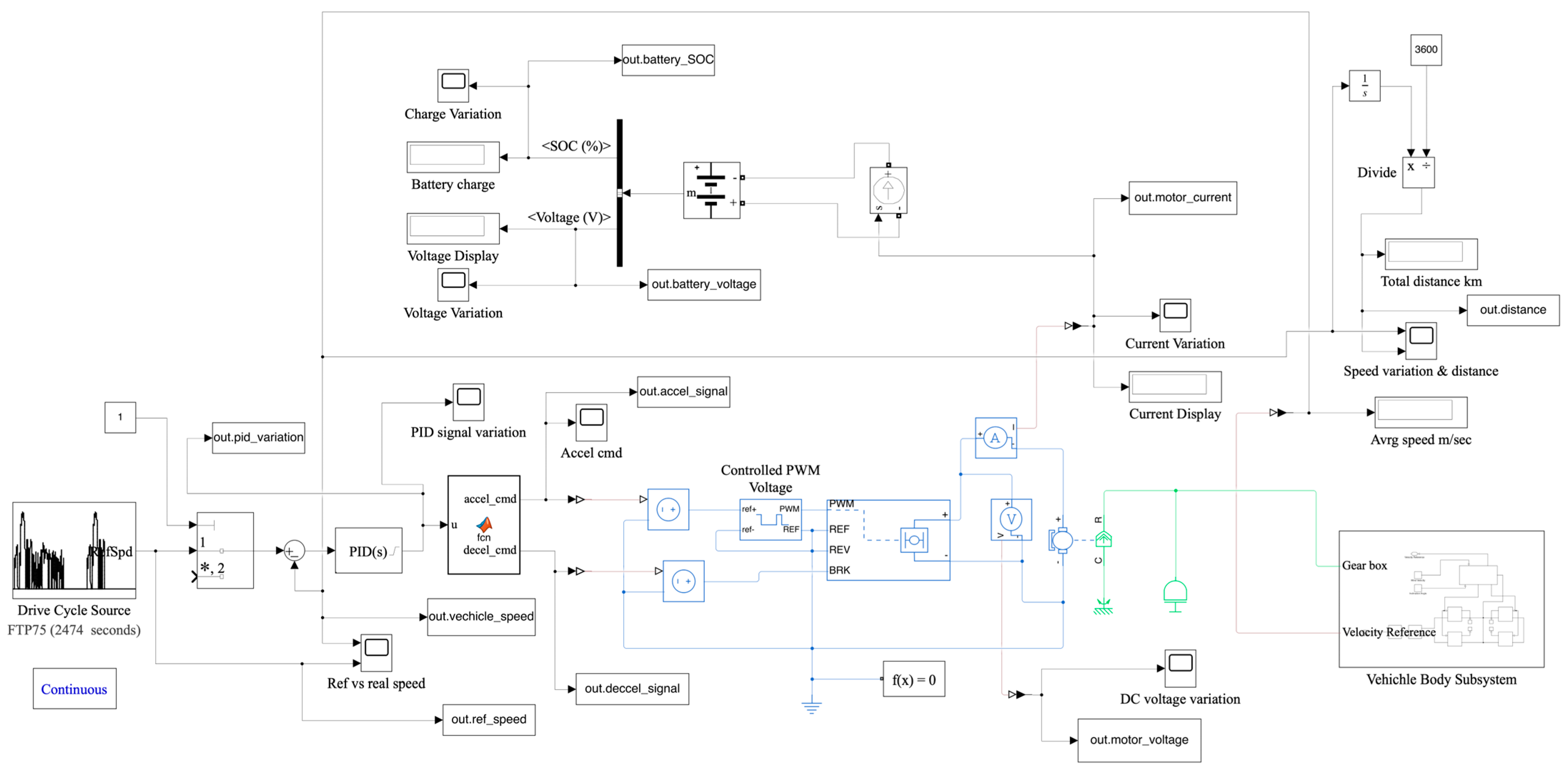
The object of this study is a closed-loop electromechanical traction drive system of an electric vehicle implemented in MATLAB R2025a/Simulink as two functionally equivalent models that differ only in the structure of the speed controller. The overall architecture of the developed model is shown in
Figure 1.
In the first configuration, a proportional–integral controller is used, whereas the second employs a proportional–integral–derivative controller. This setup enables a consistent comparison of the effect of the control law on the dynamic and energy performance of the system while keeping the plant configuration, powertrain structure and external disturbance unchanged in the form of the prescribed speed profile. Simulink implementations of these two configurations with PI and PID controllers are presented in
Figure 2 and
Figure 3.
The overall model architecture is built on the principle of the sequential transformation of the reference speed signal into the control action, the electrical energy of the traction drive and the longitudinal motion of the vehicle. At the system input, the standard FTP75 driving cycle with a duration of 2474 s is applied, generating the time-dependent reference vehicle speed. The FTP75 cycle was developed by the U.S. Environmental Protection Agency as a standardized dynamometer test profile for passenger vehicles and remains one of the most widely used benchmark cycles in electric vehicle research [
20]. The selection of FTP75 is justified by three key considerations:
The cycle includes 23 stops and numerous sharp acceleration and deceleration events, which enables a comprehensive evaluation of the controller under dynamic urban driving conditions;
The alternation of loading and idle intervals makes it possible to assess battery charge behavior over an extended time horizon;
The cycle is implemented as a standard Drive Cycle Source block in the MATLAB/Simulink library, which ensures the reproducibility of results and facilitates comparison with other studies.
In response to the need for additional verification under a more dynamic operating profile, the comparison was also extended to the US06 driving cycle. In this study, US06 was used as an additional dynamic-cycle assessment with a duration of 600 s. This cycle contains sharper acceleration and deceleration events than FTP75 and therefore provides a useful test case for evaluating whether the derivative channel of the PID controller produces a measurable benefit under more demanding speed variations. The US06 results are reported separately from the FTP75 results.
The prescribed speed profile is compared with the actual vehicle speed returned from the vehicle model subsystem through the feedback path. The result of this comparison is the error signal, which is supplied to the input of the speed controller. The controller output is interpreted as a generalized control action that is then split into traction-mode command and deceleration-mode command. This structure makes it possible to distinguish between active acceleration and electric braking intervals and to coordinate the control loop with the switching logic of the power converter. The control signals are then sent to the PWM generation block, which provides the interface between the continuous controller output and the pulse-based control of the electric drive power stage. In the model, this function is implemented by the Controlled PWM Voltage block, for which the associated analytical file already defines the generation of the command signal, the sawtooth carrier and the resulting PWM waveform. Power transfer in the model is realized through a full-bridge H-Bridge converter, which forms the average voltage applied to the electrical part of the traction motor and enables operation in both traction and braking modes. The H-Bridge links the supply voltage of the traction battery, the PWM control signal and the armature voltage of the motor. It also accounts for switching losses in the power devices and for the output current in the electrical load branch. A DC motor is used as the actuator of the traction system. This choice requires clarification because most current production electric vehicles use PMSM or induction-motor drives. In this work, the DC motor is adopted as a transparent electromechanical benchmark for isolating the influence of the speed-controller structure. It provides a direct relationship between the controller output, armature voltage, motor current, electromagnetic torque, vehicle speed and battery SOC. This is suitable for a controlled PI and PID comparison because the main cause-and-effect links remain physically interpretable. In PMSM and induction-motor drives, the outer speed loop is usually embedded in a vector-control architecture with coordinate transformations, inner current controllers, inverter modulation and machine-specific parameter dependencies. These layers are essential for production-grade traction systems, but they can make it more difficult to attribute changes in energy behavior to the speed controller alone. The DC motor model was therefore selected to support a focused comparative study rather than to represent the dominant traction motor technology in modern electric vehicles. Its mathematical description includes both electrical and mechanical subsystems. The electrical part of the model accounts for the inductances and resistances of the armature and field windings, mutual inductance, back electromotive force and the currents and voltages of the corresponding circuits. The mechanical part includes rotor angular speed, electromagnetic torque, load torque and the parameters of mechanical losses. The DC motor therefore acts as the central electromechanical link through which the electrical energy of the battery is converted into mechanical traction energy. The mechanical power from the motor shaft is transmitted to the vehicle part of the model through a reduction gear and then applied to the vehicle subsystem responsible for longitudinal motion. In the model structure, this part is represented by the vehicle body subsystem, which accepts the speed or mechanical input from the electric drive and produces the actual vehicle speed together with auxiliary operating indicators, including traveled distance and average speed. A separate functional subsystem is assigned to the battery pack. It supplies the powertrain and simultaneously serves as a source of data for assessing the energy state of the system. The battery model includes the equations governing the evolution of the state of charge and terminal voltage, which makes it possible to relate powertrain loading to SOC dynamics and the electrical characteristics of the power source. Both models include monitoring channels for the main state variables and output indicators. These include the controller signal, acceleration command, comparison of reference and actual speed, speed variation and travelled distance, battery voltage, and battery charge variation, as well as motor voltage and current. In the PI-based model, these signals are implemented through the blocks PI Signal Variation, Accel Cmd, Ref vs. Real Speed, Speed Variation & Distance, Current Variation, Voltage Variation, Charge Variation and DC Motor Voltage. The PID-based model contains analogous monitoring channels. For further analysis, exported time series were used. To ensure a valid comparison, time series were expressed in a unified system of units consistent with the exported model data. The composition of the main subsystems and their functional roles is summarized in
Table 1.
For reproducibility, the key physical and control parameters used in both Simulink configurations are summarized in
Table 2. The table includes the parameters that define the vehicle load, battery, traction motor, transmission, power converter and controller. The same plant parameters were used in the PI and PID models. The adopted parameters are representative of a simplified mid-size electric vehicle simulation benchmark rather than a direct parameter set for a specific production vehicle. They provide physically plausible vehicle mass, battery voltage, battery capacity and road-load characteristics, while the DC motor and converter parameters are used mainly to ensure a consistent and reproducible comparative control study.
The parameters in
Table 2 define the baseline plant used in both simulations. The PI and PID configurations differ only in the speed-controller structure. Both controllers use the same proportional and integral gains, while the derivative gain is set to zero in the PI case and to 10 in the PID case.
The developed model covers the longitudinal motion dynamics of the electric vehicle and the full traction-drive chain from the controller to the battery circuit. Lateral, yaw and vertical effects are not considered. The DC motor is described by linear equations with fixed parameters, without accounting for temperature-dependent resistance variation, magnetic saturation or degradation effects. The PWM-H-Bridge power path is represented by an averaged model, so a detailed analysis of switching processes and electromagnetic compatibility is beyond the scope of this study. The battery subsystem is described by simplified equations for SOC and terminal voltage, without considering degradation, thermal effects or cell balancing. The mechanical transmission and vehicle body subsystem are also assumed to have fixed parameters. The baseline driving scenario corresponds to motion on a level road without external disturbances. Both investigated configurations therefore share the same subsystem structure and differ only in the control law used in the speed loop. The present study is purely simulation-based and, at this stage, does not include experimental validation on a physical test bench. The use of a DC motor should also be interpreted within this scope. The numerical values obtained for SOC depletion and motor current are specific to the adopted plant and should not be transferred directly to PMSM or induction-motor traction drives. However, the comparative procedure itself can be applied to these motor types by replacing the DC motor subsystem with an appropriate field-oriented or direct-torque-control drive model.
To ensure a physically grounded comparative analysis of PI and PID control, a mathematical description of the main subsystems of the electric vehicle traction drive implemented in MATLAB/Simulink is employed. The mathematical model is constructed to reflect the sequential interaction between the electrical energy source, the power converter, the traction motor, the mechanical transmission and the vehicle subsystem. The analytical description is derived from the governing equations of the individual Simulink blocks, which ensures direct consistency between the schematic implementation and its physical and mathematical interpretation. In general form, the system under study is represented as the interaction of five main subsystems: the battery power source, the PWM generation block, the bridge power converter, the DC motor and the mechanical subsystem, which includes the transmission stage and the longitudinal vehicle dynamics. The analysis begins with the DC traction motor model as the central electromechanical element of the system, followed by the PWM block and the H-bridge converter, which are responsible for generating the motor supply voltage. The battery subsystem is then described. The final step introduces the relationships for the transmission, tractive force and longitudinal vehicle motion, which make it possible to link the electrical processes in the drive with the vehicle dynamics as the controlled object.
The DC motor in the developed model serves as the main electromechanical energy converter through which electrical energy from the battery source is transformed into mechanical torque at the drive shaft. Within the adopted form, the motor is described by a system of differential equations that relate voltages, currents, electromagnetic coupling and rotor mechanical motion. For the electrical part, the voltage balance equations in the armature and field circuits can be written as
where
is the armature voltage,
is the field voltage,
is the armature current,
is the field current,
and
are the active resistances of the respective circuits,
and
are their inductances,
is the mutual inductance between the armature and field windings and
is the motor back electromotive force.
The motor back EMF is determined by the rotor angular speed and the magnetic state of the machine. In simplified form, it can be expressed as
where
is the motor design constant,
is the magnetic flux and
is the rotor angular speed.
The electromagnetic torque developed by the motor is determined by the armature current and the magnetic flux:
where
is the electromagnetic torque and
is the motor torque constant.
The mechanical part of the motor model is described by the rotor motion equation:
where
is the equivalent rotor moment of inertia,
is the load torque on the motor shaft caused by the transmission and vehicle subsystem,
is the viscous friction coefficient and
is the rotor angular speed.
The above system of equations reflects the main cause-and-effect relationships in the DC motor. An increase in armature voltage leads to a rise in armature current , which, under constant or quasi-steady magnetic flux, results in an increase in electromagnetic torque . The latter accelerates the rotor and ensures the transfer of mechanical energy to the vehicle part of the model. Conversely, an increase in rotor angular speed raises the back EMF , which limits any further rise in current and forms the natural electromechanical balance of the motor.
Within the model structure, the Controlled PWM Voltage block provides the interface between the continuous output signal of the speed controller and the discrete pulse-based control of the power converter. Its function is to generate a pulse-width modulation signal whose parameters determine the average voltage applied to the H-bridge and to the traction motor. Let
denote the continuous control signal generated by the speed controller. To produce the PWM signal, it is compared with a periodic carrier voltage
, which in the adopted model is defined as a sawtooth or triangular waveform with frequency
. In general form, the carrier signal can be written as
where
is the carrier amplitude,
is a normalized periodic sawtooth or triangular function and
is the pulse-width modulation frequency.
The output PWM signal
is then generated according to the comparison logic between the control and carrier signals:
In this equation, the instantaneous value of
is a binary variable that determines the switching state of the power device or, equivalently, the command applied to the bridge converter. For further analytical treatment, it is also convenient to use an averaged representation of the PWM block through the duty ratio
, which in normalized form can be expressed as
where
and
are the lower and upper normalization bounds of the control signal. In the case of symmetric bipolar control, an alternative form may be used in which the sign and magnitude of
determine not only the pulse duration but also the polarity of the voltage applied to the motor.
The H-Bridge block in the developed model functions as the bridge-type power converter that supplies the armature of the DC motor in both traction and electric braking modes. Unlike the PWM block, which only generates the pulse control logic, the H-Bridge directly participates in the transfer of energy from the battery source to the electric drive and determines both the polarity and the average value of the voltage applied to the motor input. In a simplified averaged form, the output voltage of the bridge converter can be written as
where
is the equivalent output voltage of the H-Bridge,
is the battery terminal voltage and
is the generalized control coefficient determined by the PWM signal and the switching logic of the bridge devices. In the unipolar case,
may be associated with the duty ratio
, whereas in the bipolar mode it can take values in the range
, which makes it possible to account for the direction of the applied voltage.
If ohmic losses in the power switches are considered, the voltage applied to the electrical part of the motor can be expressed as
where
is the armature voltage,
is the armature current and
is the equivalent active resistance of the conducting power switches and other conductive elements of the bridge path.
In the developed model, the battery subsystem serves as the main power source of the electric vehicle powertrain and, at the same time, as a source of data for analyzing the energy behavior of the system. Unlike the PWM and H-Bridge blocks, which define the mechanism by which the control action is transferred, the battery provides the energetic base of traction-drive operation, and its state is directly linked to the loading imposed by the electric drive under different driving conditions. In this study, the battery is described through the change in the state of charge
and the terminal voltage
. The change in the state of charge is determined by the integral effect of the battery current and can be written as
where
is the battery state of charge,
is the battery current,
is the nominal electrical capacity of the battery and
is a coefficient that accounts for the adopted normalization form or the efficiency of the charge-discharge process. The minus sign in the equation corresponds to the discharge mode, in which current drawn from the battery reduces its current state of charge.
The battery terminal voltage can be described as the sum of or difference between the open-circuit electromotive force and the internal voltage drop:
where
is the open-circuit voltage as a function of the state of charge and
is the equivalent internal resistance of the battery subsystem. In a more detailed formulation,
may be represented as a nonlinear function of
. However, within the scope of the present study, the battery model is used primarily to reproduce the general relationship between the current load of the traction system, the variation in terminal voltage and charge depletion during the driving cycle.
Based on the battery variables, it is also useful to define the instantaneous electrical power delivered by or absorbed by the power source:
If , the battery operates in the energy delivery mode to the powertrain. If , the system is in the energy recovery mode, which may correspond to regenerative braking. Physically, an increase in motor load caused by more intensive acceleration or a more aggressive control action leads to an increase in battery current , and consequently to a more intensive reduction in and a larger drop in terminal voltage.
For a complete mathematical description of the electric vehicle traction system, it is not sufficient to consider only the electrical part of the powertrain, since the controlled variable in this study is not the angular speed of the motor shaft but the linear speed of the vehicle. Therefore, the mathematical model must include the relationships that connect the electromagnetic torque of the motor to the tractive force at the wheel and to the longitudinal dynamics of the vehicle. In the simplest form, the transmission of mechanical energy from the motor to the wheels can be described through the gearbox ratio
and its efficiency
. The torque at the driven wheel is then given by
where
is the wheel torque,
is the electromagnetic motor torque,
is the gearbox ratio and
is the transmission efficiency.
Accordingly, the angular speed of the wheel is related to the motor rotor speed by
where
is the wheel angular speed and
is the motor rotor angular speed.
Assuming negligible tire slip, the linear speed of the vehicle can be expressed through the wheel radius
as
where
is the vehicle linear speed and
is the dynamic wheel radius.
The tractive force transmitted to the road surface is defined as the ratio of wheel torque to wheel radius:
where
is the tractive force at the wheel.
In the baseline version of the model, the longitudinal motion of the vehicle is described by the force balance equation along the direction of travel:
where
is the equivalent vehicle mass,
is the rolling resistance force,
is the aerodynamic drag force and
is the component associated with road slope.
As a first approximation, the rolling resistance force can be written as
where
is the gravitational acceleration,
is the rolling resistance coefficient and
is the road grade angle.
The aerodynamic drag force is defined as
where
is the air density,
is the aerodynamic drag coefficient,
is the frontal area of the vehicle and
is the equivalent wind speed along the direction of motion.
The road grade component is described by
For a level road, and, therefore, , while the rolling resistance term reduces to a constant component if the coefficient is assumed to remain unchanged.
To link the vehicle subsystem with the mechanical dynamics of the motor, it is also useful to define the equivalent load torque referred to the motor shaft. If elastic deformation and the inertia of intermediate mechanical elements are neglected, the load torque can be expressed through the wheel resistance moment as
This equation shows that the mechanical load acting on the motor shaft is formed not only by road resistance, but also by the inertial component associated with vehicle acceleration. As a result, an increase in the demanded acceleration directly raises and the armature current and the energy loading of the battery.
By integrating the above equations with the DC motor model, it can be shown that a change in the controller output in the PI or PID loop affects the vehicle speed through a chain of transformations:
The above equations for the battery subsystem, PWM module, H-bridge converter, DC motor and vehicle dynamics make it possible to represent the developed model as a unified closed-loop electromechanical system. In this form, the input quantity is the reference speed profile , while the main output quantity is the actual vehicle speed .
The speed control error is defined as
For the PI control law, the controller output is given by
where
is the proportional gain and
is the integral gain.
For the PID controller, the corresponding relationship takes the form
where
is the derivative gain.
The resulting signal , that is, either or , is then passed to the PWM block, where it is converted into the pulse control form or into the equivalent duty ratio . The latter, through the H-bridge, determines the voltage applied to the motor armature and the armature current , electromagnetic torque , wheel torque , tractive force and vehicle speed . At the same time, energy-related variables are formed in the system, including the battery current , the change in terminal voltage and the battery state of charge .
Thus, in compact form, the internal relationships of the system can be represented as
with simultaneous energy feedback through
In terms of state variables, the system may be interpreted through the vector
where
is the integral component of the PI/PID control error. For the model with the PID control law, the derivative term
may be introduced separately as the derivative of the error or as an equivalent augmented state, depending on the specific implementation form used in Simulink.
In the investigated closed-loop electric vehicle system, speed control is implemented according to the feedback principle, in which the actual vehicle speed is continuously compared with the prescribed profile generated by the drive cycle source within the model. The result of this comparison is the error signal, which serves as the input to the speed controller. Depending on the controller architecture, the control law is defined either by the PI controller according to Equation (25) or by the PID controller according to Equation (26), where the controller gains are set to the same baseline values: and for both configurations. The derivative gain together with the filter coefficient is used only in the PID variant.
In the developed Simulink model, the controller output is not applied directly to the motor but passes through a logic block that separates the control action into acceleration command and deceleration command. This approach ensures consistency between the sign of the control signal and the operating modes of the power stage. If the controller output is positive, the system interprets it as a demand for tractive acceleration, whereas a negative value corresponds to deceleration or electric braking. In formalized form, this logic can be written as
where
is the controller output,
is the traction command and
is the deceleration command.
Within the scope of this study, the comparison between PI and PID controllers is proposed to be performed using three groups of indicators: dynamic, control-related and energy-related metrics. Dynamic indicators characterize the quality of speed-profile tracking, in particular the control error and the degree of deviation from the reference speed and transient process characteristics. Control-related indicators include the shape and magnitude of the controller output signal, as well as the current and voltage variables associated with it. Energy-related indicators include motor current, battery voltage, SOC variation and integral energy-consumption indicators.
To quantify dynamic tracking performance, the root mean square speed error is used:
where
is the simulation duration. In addition, it is useful to employ integral criteria that characterize not only the magnitude of the error, but also its time distribution:
To assess the intensity of the control action and the electrical loading, the peak and mean values of the controller output signal, the peak and mean current, as well as the integral measure of the control action are used:
In the present set of exported data, the comparison was carried out using the time series of the battery voltage , state of charge and travelled distance . With access to current signals, the analysis can also be extended to the direct estimation of battery power through the additional export of the battery current.
3. Results and Discussion
The comparative analysis was performed for two variants of the closed-loop speed control system with identical plant structure and identical plant parameters. Both controllers were tuned by manual adjustment based on the criterion of acceptable drive-cycle tracking without overshoot. The controller parameters are summarized in
Table 3.
The transfer function of the PI controller in continuous time is given by
For the PID controller with a first-order derivative filter, the transfer function takes the form
where
is the derivative-channel filter coefficient introduced to suppress high-frequency noise amplification. Accordingly, the filter time constant is
, which defines the frequency response of the
-term.
The identical values of and in both controllers ensure the same steady-state and integral behavior of the control loop. Therefore, any differences observed in the modeled response can be directly attributed to the presence of the additional derivative channel. The PID controller with parameters and is also denoted hereafter as PID with filter.
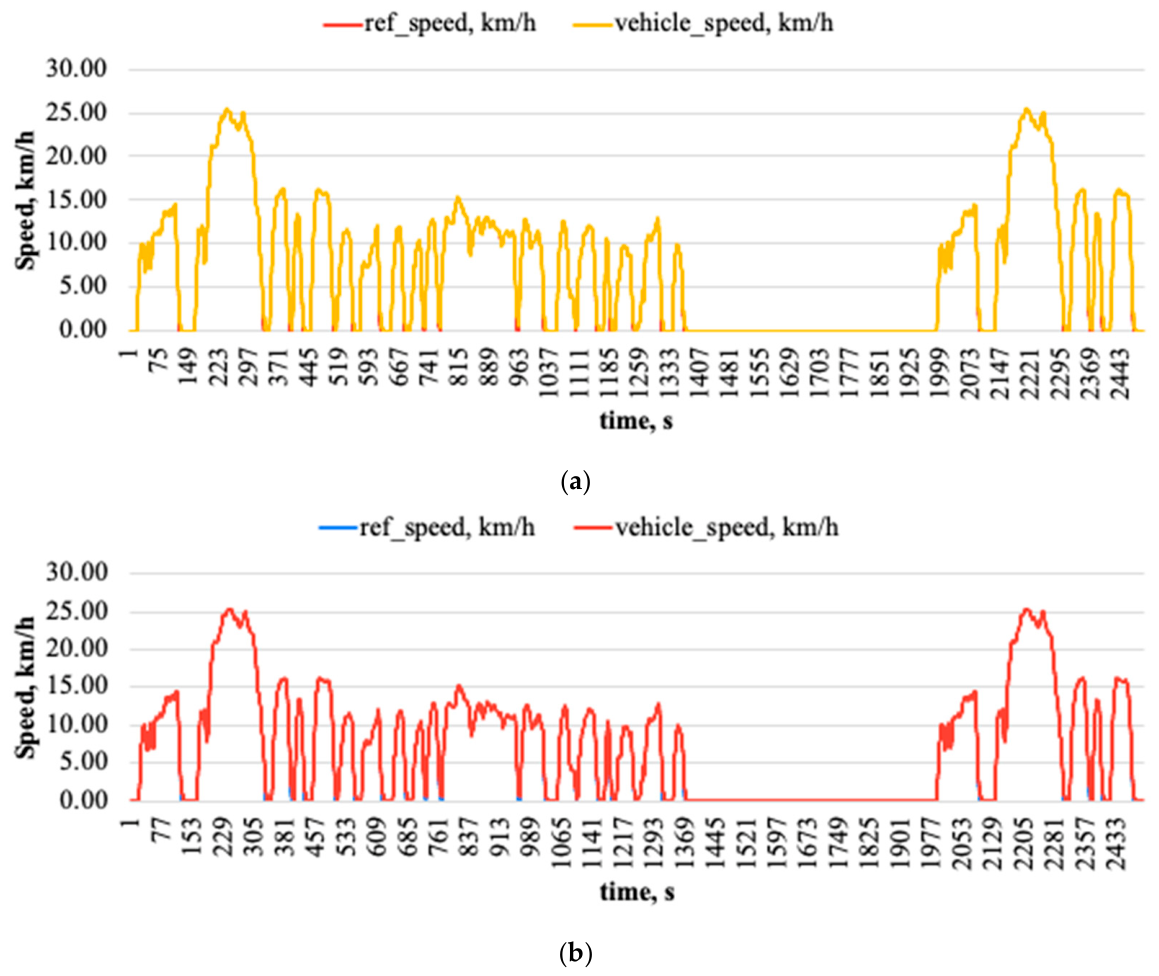
The FTP75 driving cycle used in the simulation has a total duration of 2474 s. In the adopted Simulink profile, two intervals contain vehicle motion: 0–1372 s and 1874–2474 s. The interval from 1372 s to 1874 s corresponds to a zero-speed dwell period and was not included in the calculation of tracking-error metrics. To avoid confusion with the standard FTP75 phase nomenclature, these two moving portions are referred to below as active interval I and active interval II. The subintervals 0–505 s and 505–1372 s are used only for a more detailed breakdown of energy consumption within active interval I. The time series of the reference and actual speed for both controller variants are shown in
Figure 4. The overall tracking quality was assessed over the two active intervals of the cycle.
The results in
Figure 4 and
Table 4 show that both configurations are functionally equivalent in terms of kinematic performance. The RMSE is 0.1386 km/h in active interval I and 0.1665–0.1666 km/h in active interval II. When both active intervals are considered together, the RMSE is 0.1525 km/h for both controllers. The maximum difference between the PI and PID error signals does not exceed 0.01 km/h, while the RMS value of this difference is 7.48 × 10
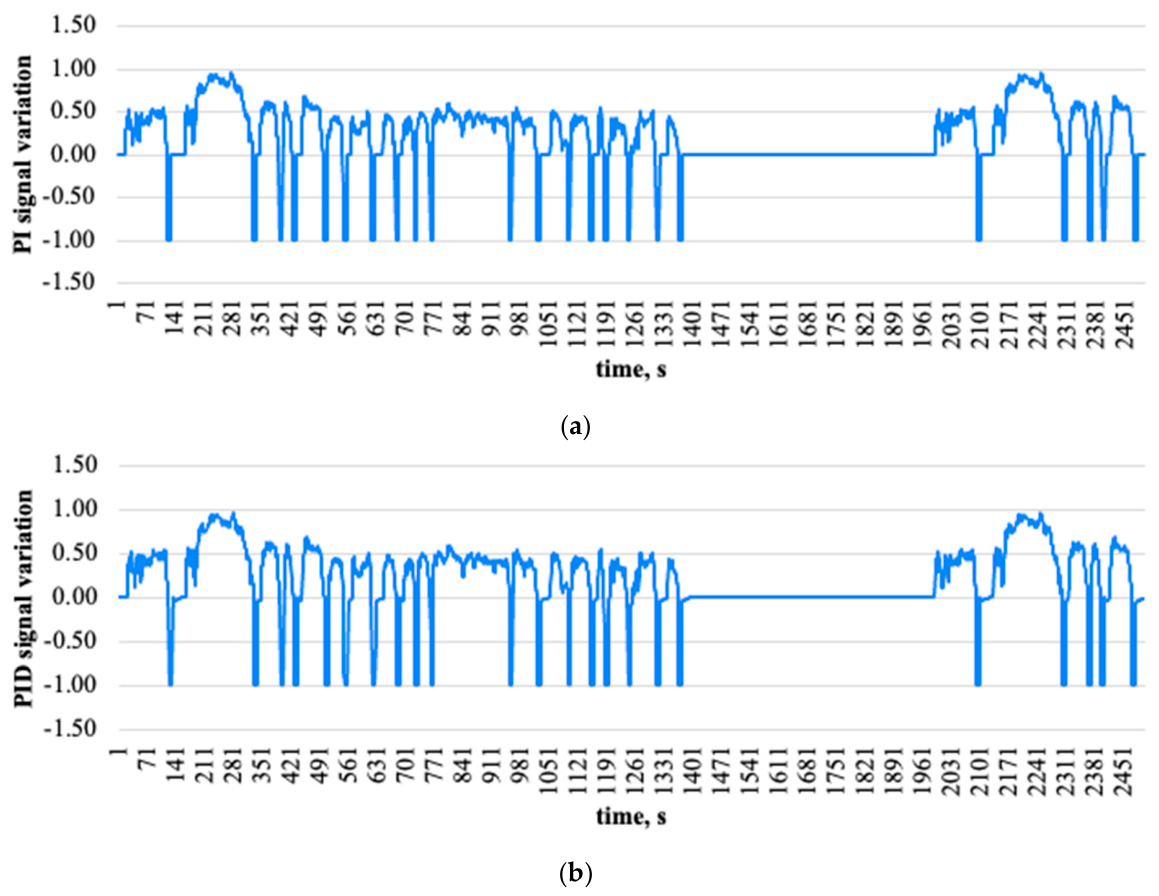
−4 km/h. A more detailed view of the error signals is given in
Figure 5. The largest deviation, 1.62 km/h, occurs during sharp acceleration events in active interval I. This behavior is caused by the finite electromechanical response time of the traction chain rather than by the controller structure.
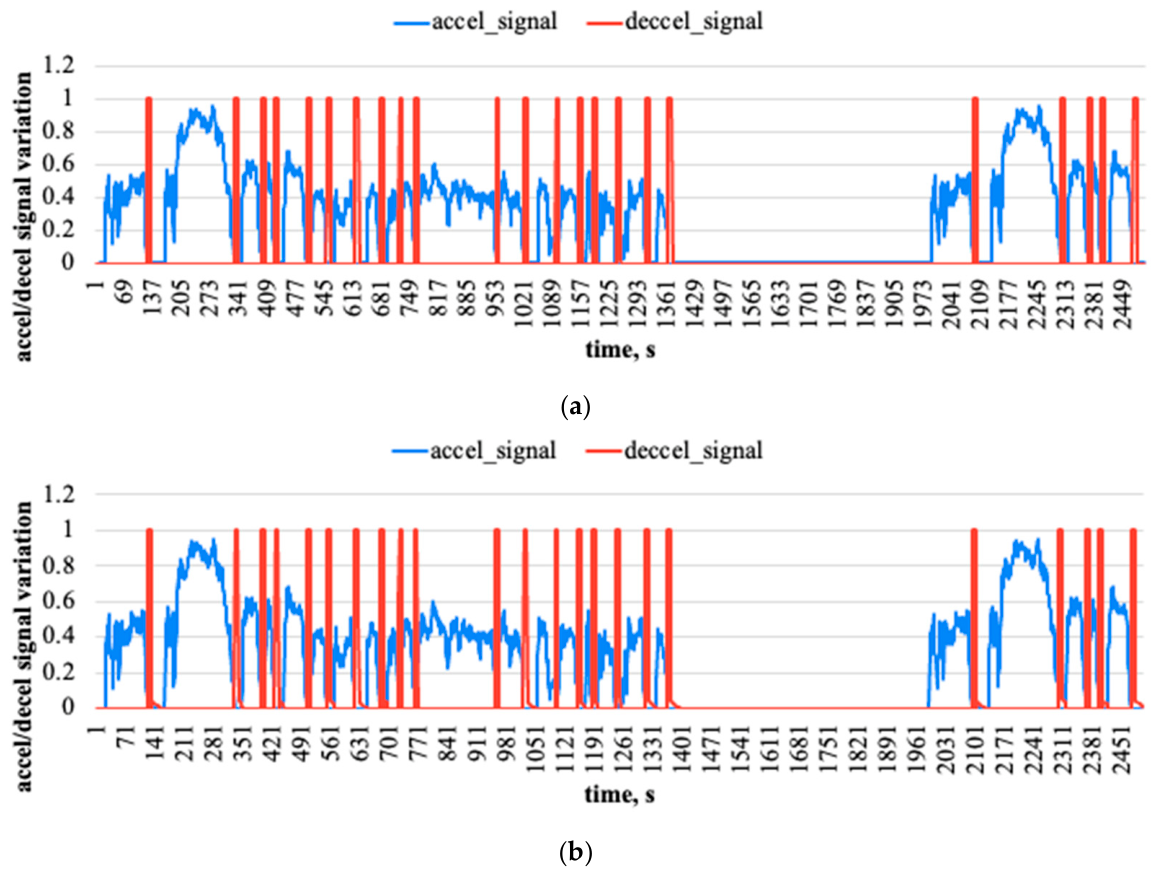
Although the two controllers exhibit essentially identical speed-tracking performance, the structural difference between the PI and PID configurations becomes evident in the formation of the braking command (
Figure 6). In the PI-based configuration, active braking is present during only 8.04% of the total cycle duration, whereas in the PID-based configuration this share increases to 16.63%. At the same time, the mean amplitude of the braking signal in the PI case is approximately twice as high as in the PID case, namely 0.961 versus 0.481 p.u. This indicates that the PI controller generates less frequent but more intensive braking pulses, whereas the PID controller distributes the braking action in smaller and more uniform portions.
The traction control signal is practically identical for both controllers. The maximum difference between the PI and PID configurations in the traction channel is only 0.010 p.u., which corresponds to 1.0% of the normalized signal range, while the RMS difference is p.u. These small discrepancies show that, under FTP75 conditions, the derivative component has almost no influence on the traction command. Its effect is concentrated mainly in the deceleration channel.
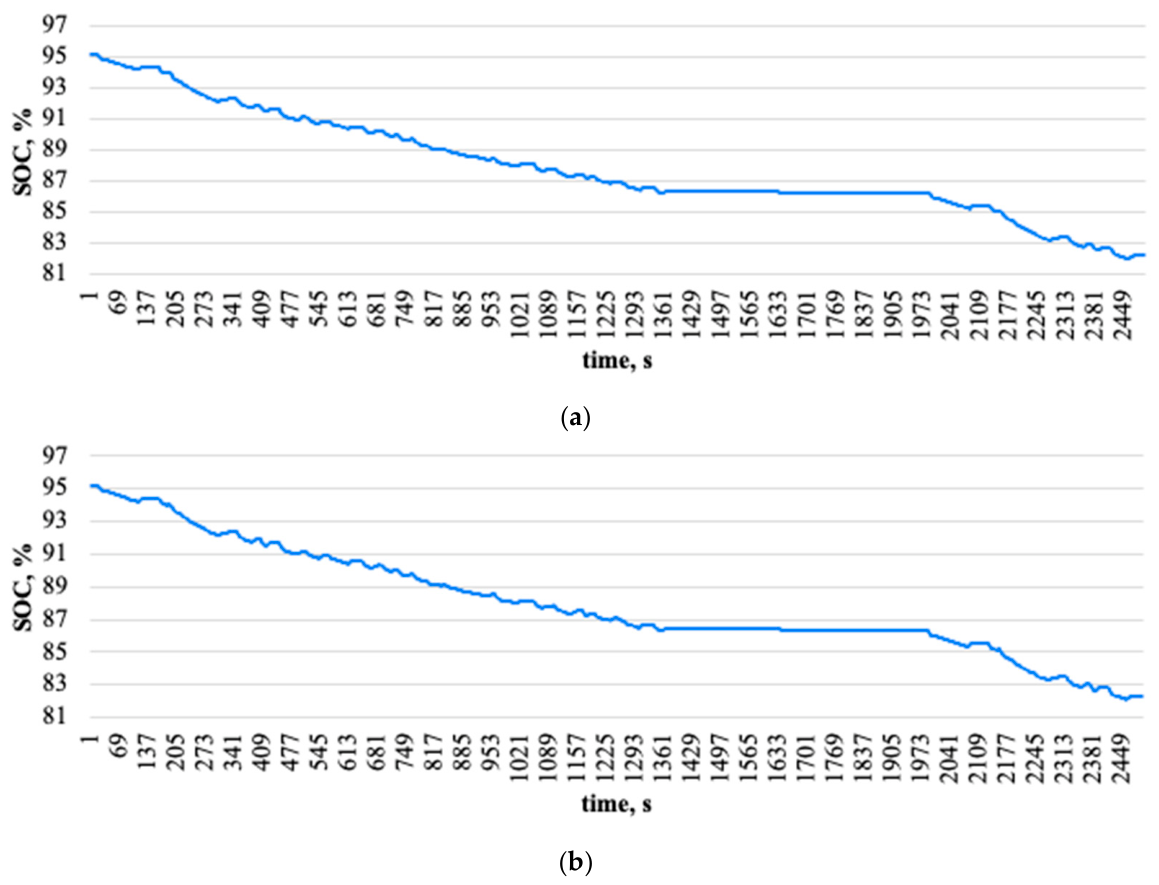
The SOC trajectories and main energy consumption indicators are shown in
Figure 7 and
Table 5 respectively.
For the same travelled distance of 4.964 km and nearly identical speed-tracking accuracy, the PID controller consumes 0.071 kWh less electrical energy, which corresponds to a reduction of 0.82%. This advantage accumulates across the analyzed energy subintervals: the difference is 0.013 kWh in subinterval A and 0.032 kWh in subinterval B.
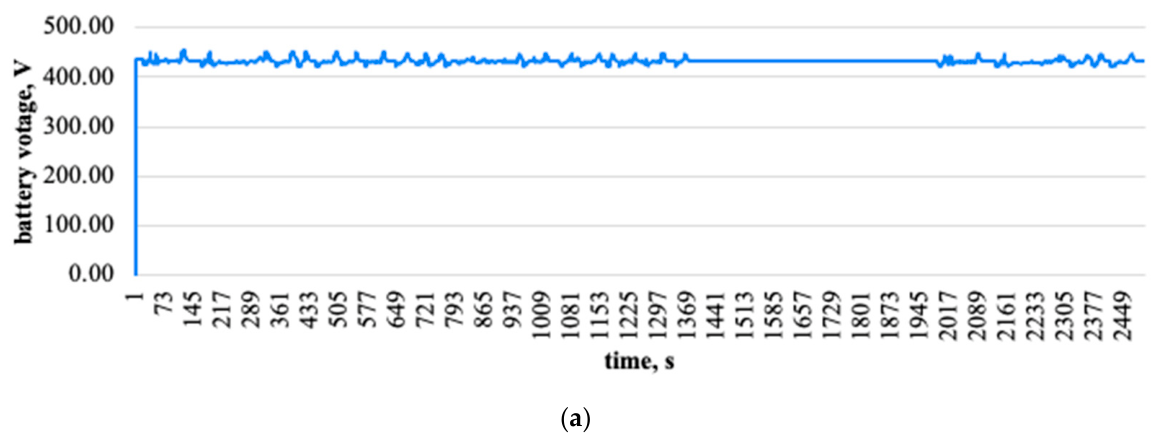
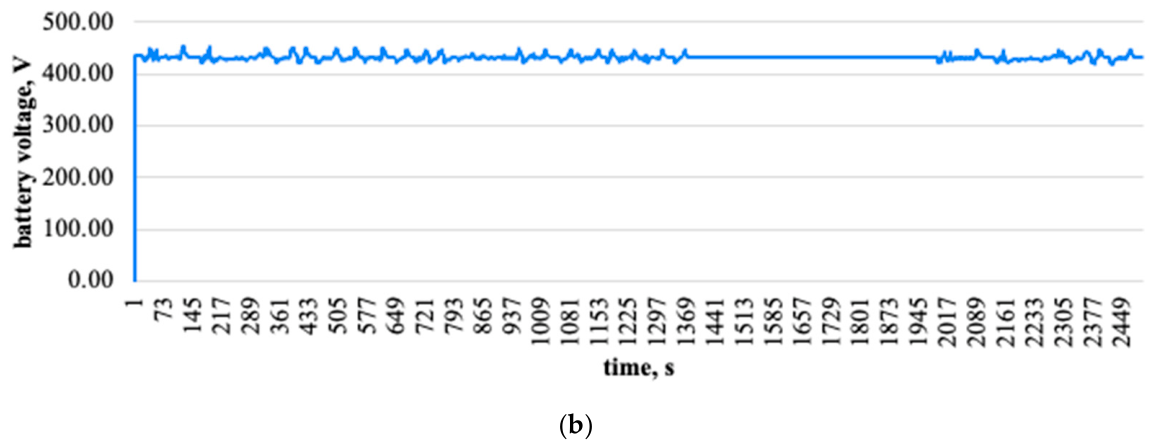
The minimum and mean battery terminal voltages are practically identical for both configurations, with a difference of only 0.01 V (
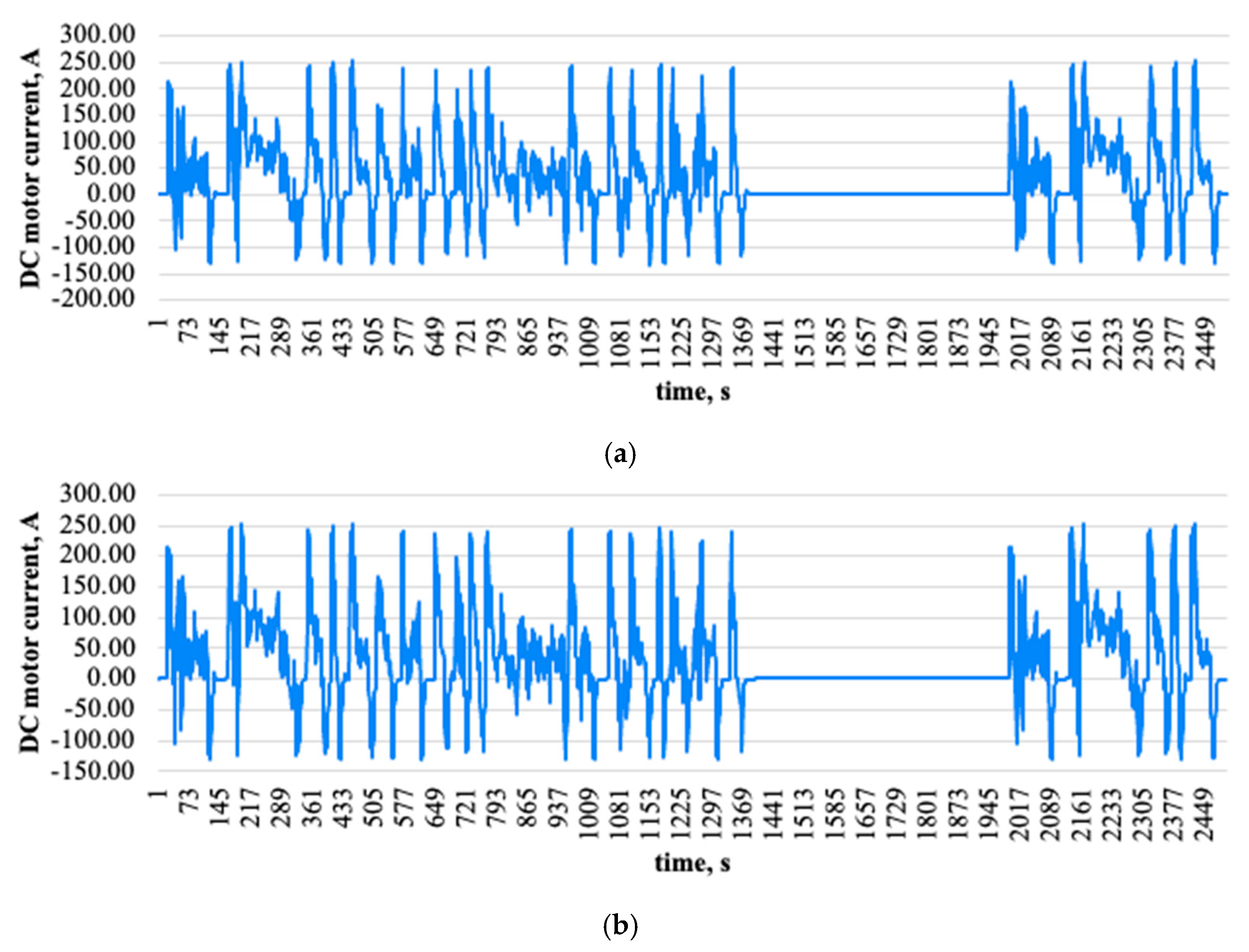
Figure 8). This rules out the supply voltage level as a source of the observed difference in energy consumption and indicates that the discrepancy is caused by the difference in average motor current values (
Figure 9).
The obtained results show that both controllers provide nearly identical tracking of the FTP75 speed profile under the same manual tuning conditions and the same baseline values and . The RMSE values are 0.1386 km/h in active interval I and 0.1665–0.1666 km/h in active interval II. For both active intervals combined, the RMSE is 0.1525 km/h for both configurations. The maximum difference between the PI and PID error signals does not exceed 0.01 km/h. These results indicate that, under the smooth speed profile of the FTP75 cycle, the derivative term neither improves nor degrades the kinematic performance of the speed control loop in a meaningful way.
The physical reason lies in the nature of the input signal. The FTP75 standard profile is relatively smooth, and most acceleration segments do not exceed 1.5–2 m/s
2, with abrupt changes occurring only at a few points. Under such conditions, the control error
varies slowly, remains small and does not allow the derivative channel of the PID controller to contribute significantly to the overall control action. The derivative component reveals its potential primarily in the presence of rapid transients or abrupt disturbances. The limited effectiveness of the
-term under smooth loading conditions is also supported by published studies devoted to the comparative performance of classical controllers in standard driving cycles [
9].
Despite this kinematic equivalence, the two configurations exhibit differences in the energy domain. As shown in
Table 5, both simulations start from the same SOC value of 95.164%. At the end of the FTP75 cycle, the SOC is 82.234% for the PI controller and 83.214% for the PID controller. The corresponding SOC depletion is 12.931 percentage points for PI and 11.951 percentage points for PID. Thus, under the adopted model and tuning conditions, the PID configuration reduces SOC depletion by 0.980 percentage points. This result suggests that the controller structure can affect the energy-related behavior of the traction system even when the kinematic tracking accuracy remains practically unchanged.
The mechanistic interpretation should be made with caution. The braking-command signals in
Figure 6 describe the controller-side deceleration demand, not the recovered electrical energy. Since the present model does not include a dedicated regenerative braking energy-management loop, the difference in braking-command distribution cannot be interpreted as a direct difference in recuperated energy. It is more appropriate to treat this signal as an indicator of how the two controllers distribute deceleration demand. In the FTP75 case, PID spreads this demand over a longer portion of the cycle and with a lower mean active amplitude. This may affect current transients and thermal loading, but its effect on recovered energy requires an explicit regenerative braking model.
The transfer function of the derivative component in the implemented PID configuration is given by
which corresponds to a differentiator with a first-order roll-off filter, where
(or
) and the filter time constant is
. This choice of
means that the derivative channel is sensitive only to relatively slow changes in the error signal, while a stronger high-frequency differentiation of the measured speed is intentionally suppressed. The value
is consistent with recommendations for Simulink PID Controller blocks in systems with a moderate noise level [
21].
In the investigated system, the speed error signal is obtained from the Vehicle Body block, which represents an ideal measurement without superimposed noise. Under such conditions, the filter does not perform noise suppression but rather imposes an additional frequency limitation on the derivative action. This partly explains why, under the FTP75 cycle conditions, the derivative term does not exhibit the function expected from an ideal differentiator and only weakly affects the dynamic response of the speed control loop.
To verify whether the conclusions obtained under FTP75 remain valid for a more dynamic reference profile, an additional simulation was performed using the US06 driving cycle. The main kinematic, energy-related and control-command indicators obtained for the PI and PID configurations are summarized in
Table 6.
The US06 results do not support the hypothesis that the derivative channel provides a clear advantage under a more aggressive driving cycle. Both controllers reach the maximum reference speed of 129.23 km/h, and no positive traction-command saturation is observed. Nevertheless, the tracking indicators remain practically identical. The RMSE is 1.1162 km/h for both controllers, and the difference in MAE is below 0.001 km/h. This indicates that the higher acceleration and deceleration intensity of US06 does not make the PID controller superior in speed tracking under the adopted fixed-gain tuning. The energy-related indicators also do not show a general PID advantage. In the US06 simulation, SOC depletion is 7.386 percentage points for PI and 8.685 percentage points for PID. The mean absolute motor current is almost identical for the two configurations. PID again produces a slightly longer and less intense deceleration command, but this control-side difference does not translate into lower SOC depletion in the present model. Therefore, the US06 analysis supports a more cautious interpretation: the derivative channel changes command distribution, but it does not guarantee improved kinematic or energy performance.
The obtained results are consistent with studies showing that the advantage of PID over PI control is not automatic in speed-tracking tasks. The derivative channel can improve transient behavior when the error signal contains sufficiently informative rapid variations and when the derivative gain and filter are tuned for this purpose. However, in the investigated fixed-gain configuration, this condition is not sufficient by itself. FTP75 produces nearly identical kinematic responses for PI and PID, and the additional US06 simulation confirms that a more dynamic speed profile still does not lead to a meaningful PID tracking advantage.
The present study therefore extends previous findings by showing that controller structure should be evaluated not only through speed-tracking metrics, but also through energy and command-distribution indicators. In FTP75, the PID configuration reduces SOC depletion by 0.980 percentage points while maintaining the same tracking accuracy. However, the US06 simulation shows that this FTP75 result should not be generalized as an inherent PID advantage. Under the more dynamic cycle, PI and PID again provide practically identical tracking accuracy, and PID does not reduce SOC depletion. The comparison therefore supports a conditional conclusion: adding a derivative channel changes the control response, but its benefit depends on the operating cycle, tuning and plant constraints.
From a practical engineering perspective, these results indicate that PI control remains sufficient for speed tracking under the investigated fixed-gain conditions. The PID controller adds calibration effort through the derivative gain and filter coefficient, but it does not provide a meaningful tracking advantage in either FTP75 or US06. Its main effect is observed in the deceleration-command pattern. Therefore, choosing between PI and PID should be based on the full set of criteria, including tracking accuracy, SOC depletion, current loading and command smoothness, rather than on the assumption that the derivative channel is automatically beneficial.
The present study also has several limitations that should be considered when generalizing the conclusions. First, the controller parameters for both groups were selected manually and were kept fixed for the comparative simulations. The results should therefore be interpreted as a baseline fixed-gain comparison rather than as a global comparison of optimally tuned PI and PID controllers. Second, FTP75 was used as the primary driving cycle, while US06 was added as a dynamic-cycle assessment. These two profiles improve the breadth of the comparison, but they do not replace a full sensitivity study over many operating conditions. Third, the model does not include a dedicated regenerative braking energy-management loop. Therefore, braking-command distribution should not be interpreted as recovered braking energy. Under real driving conditions, regenerative braking strategy, torque blending and battery charge acceptance may substantially affect SOC dynamics during deceleration. Finally, the study is limited to use of a DC motor as the traction machine. This choice was made to obtain a clear and reproducible comparison of controller structure, but it limits the direct generalization of the quantitative results to modern PMSM and induction-motor electric vehicles. In these drives, the interaction between the speed controller, current loops and inverter control may change the magnitude of the observed SOC difference. Future work should therefore repeat the same comparative procedure for PMSM, BLDC and induction-motor models under vector-control and inverter-based architectures. Extension to WLTP and NEDC cycles is also required to confirm the generality of the observed patterns.