

A Model-Based Framework for Lithium-Ion Battery SoC Estimation Using a Tuning-Light Discrete-Time Sliding-Mode Observer



Abstract
1. Introduction
- Discrete-time stability guarantees: a Lyapunov-based analysis developed entirely in discrete time offers finite-time reaching and practical convergence limits under bounded disturbances and model uncertainty.
2. Battery System Modeling
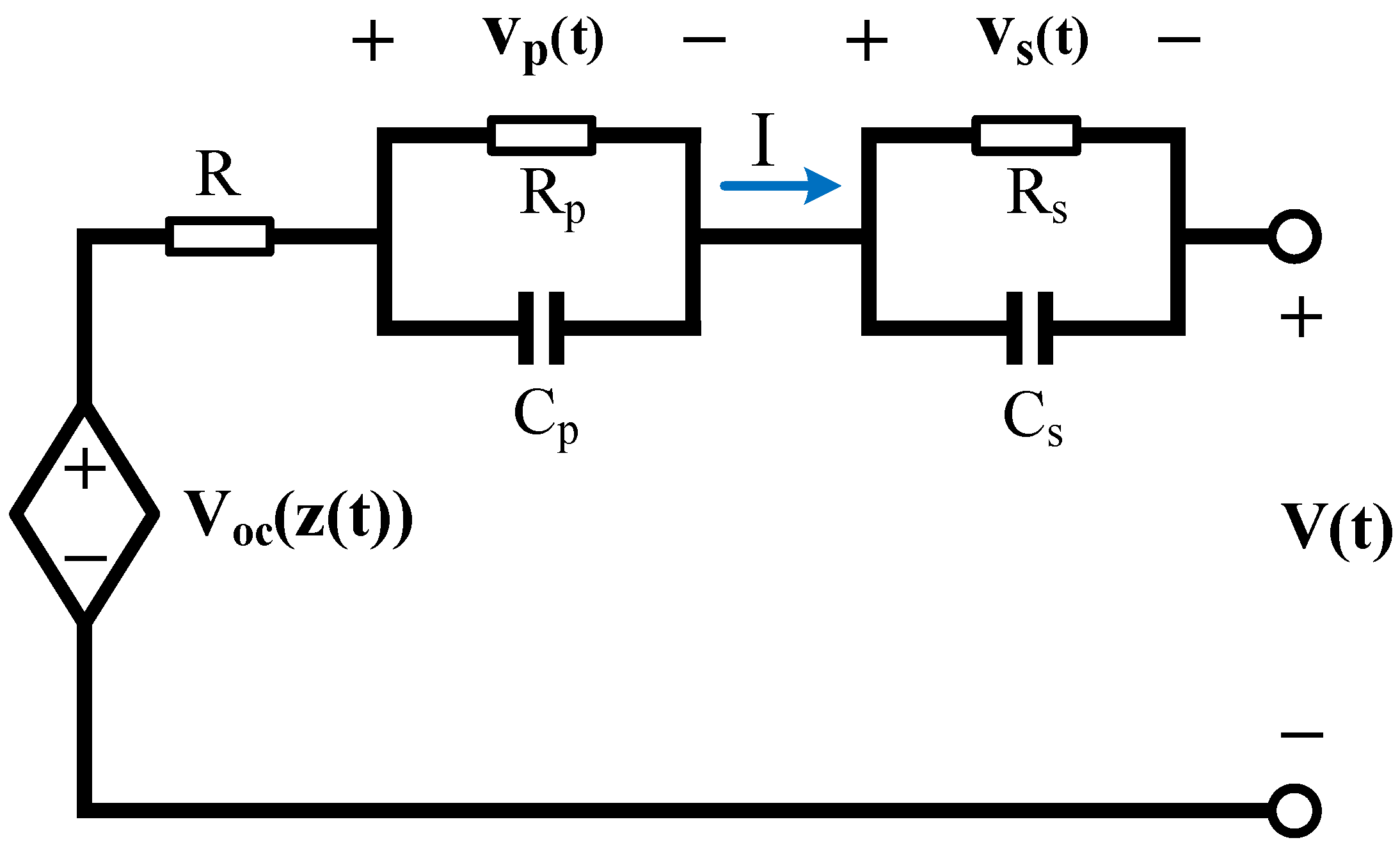
2.1. Continuous-Time DP Model
2.2. Nonlinear OCV–SoC Modeling
2.3. Model Assumptions and Practical Considerations
- The OCV function is continuously differentiable and monotone, which is consistent with experimentally measured OCV, SoC curves for lithium-ion chemistries.
- The DP parameters stay the same during each estimation window. However, they can vary from nominal values because of aging or temperature changes. This reflects parametric uncertainty.
- The measured terminal voltage is affected by limited disturbances and sensor noise. These effects are modeled as additive bounded disturbance in the discrete-time surface dynamics, satisfying .
- The sampling period is fixed and consistent with digital BMS hardware, such as 0.1 to 1 s. The stability analysis does not depend on small limits.
2.4. Motivation for a Discrete-Time Formulation
3. Model-Based Observer Formulation
3.1. Sliding Surface and Output Error Shaping
- 1.
- Clipping to bound large spikes;
- 2.
- Exponentially weighted moving average (EWMA) filtering;
- 3.
- Boundary-layer smoothing via a saturation function.
3.2. Effective-Slope Scaling and Gain Structure
3.3. Observer Update and Bias Compensation
3.4. Surface Increment and Discrete-Time Stability
4. Model Validation and Numerical Experiments
4.1. DP Parameters and Operating Conditions
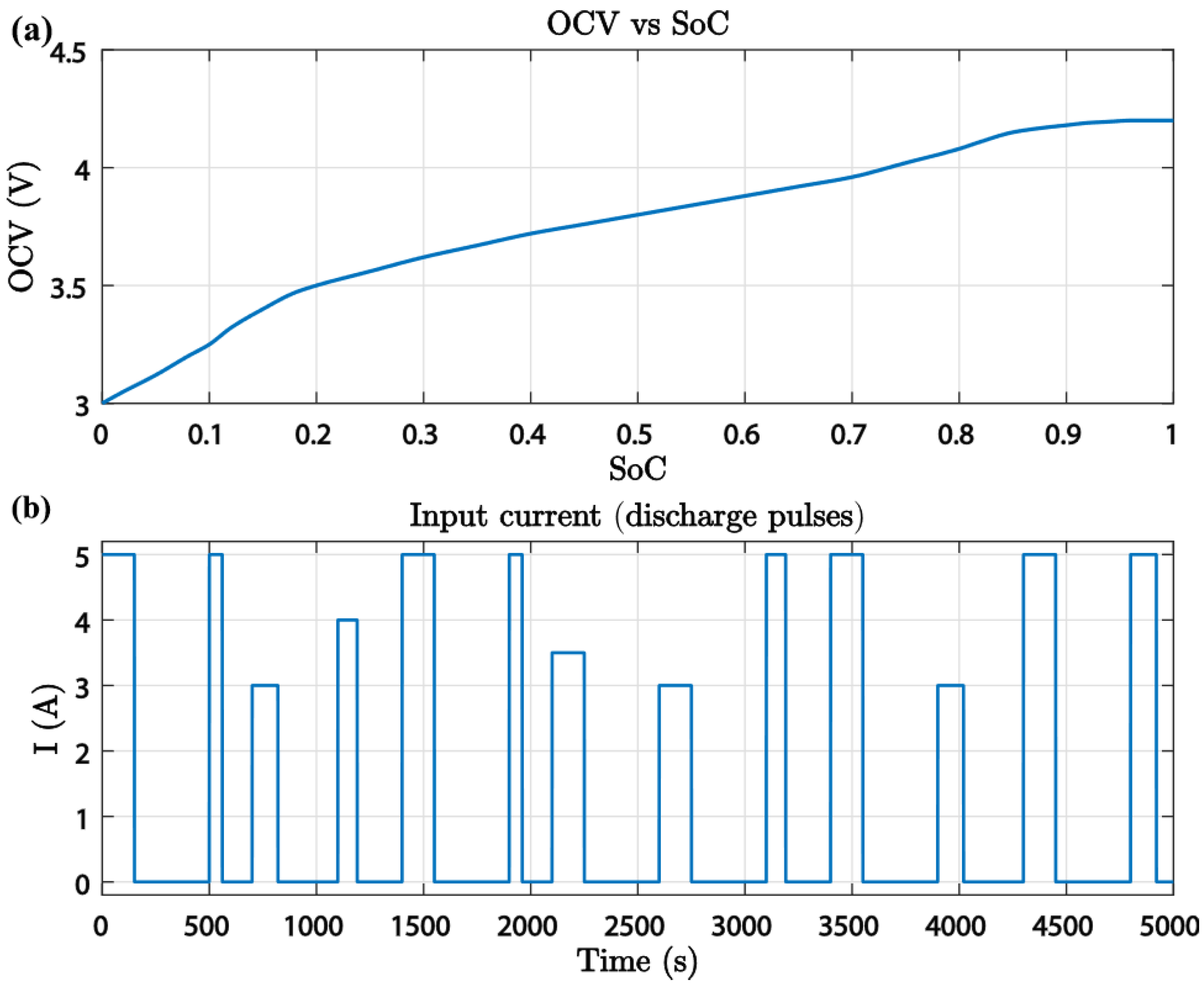
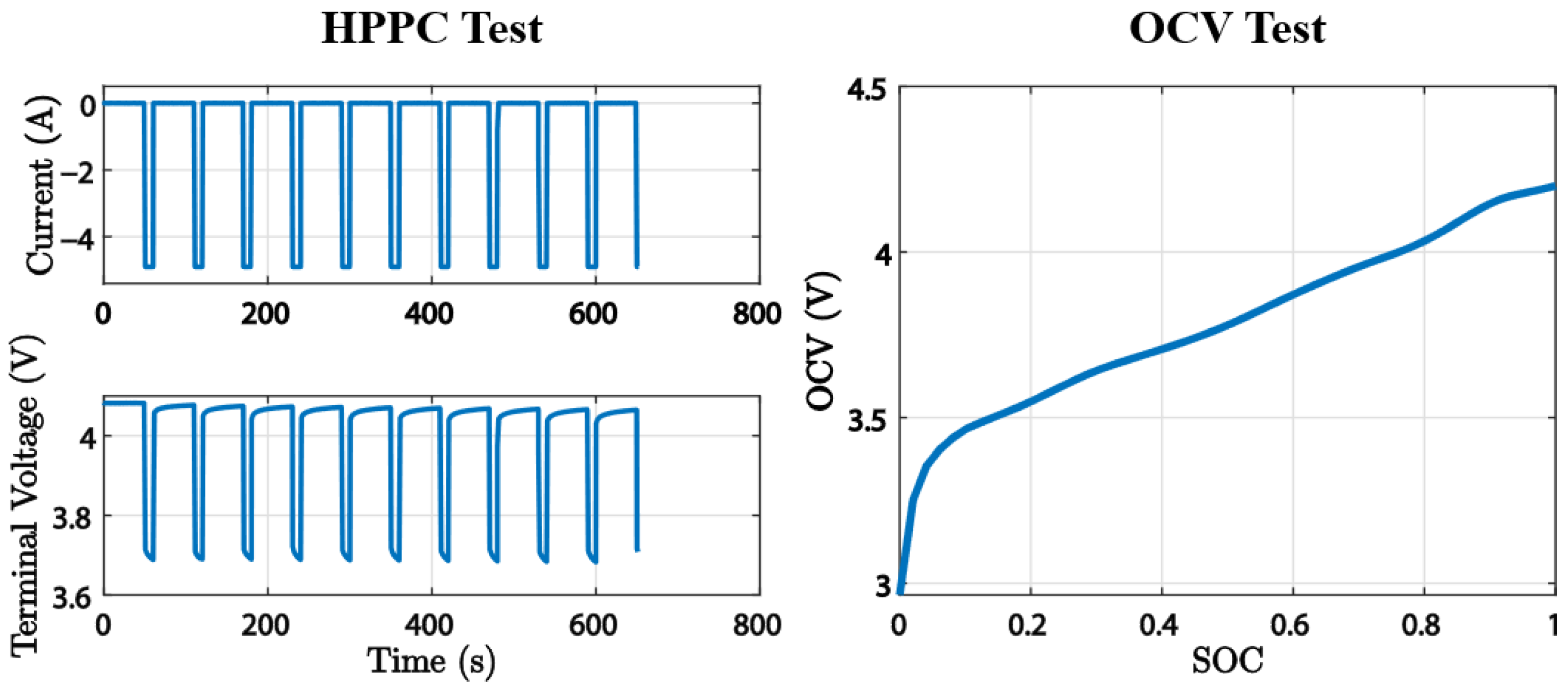
4.2. OCV Curve and Excitation Profile
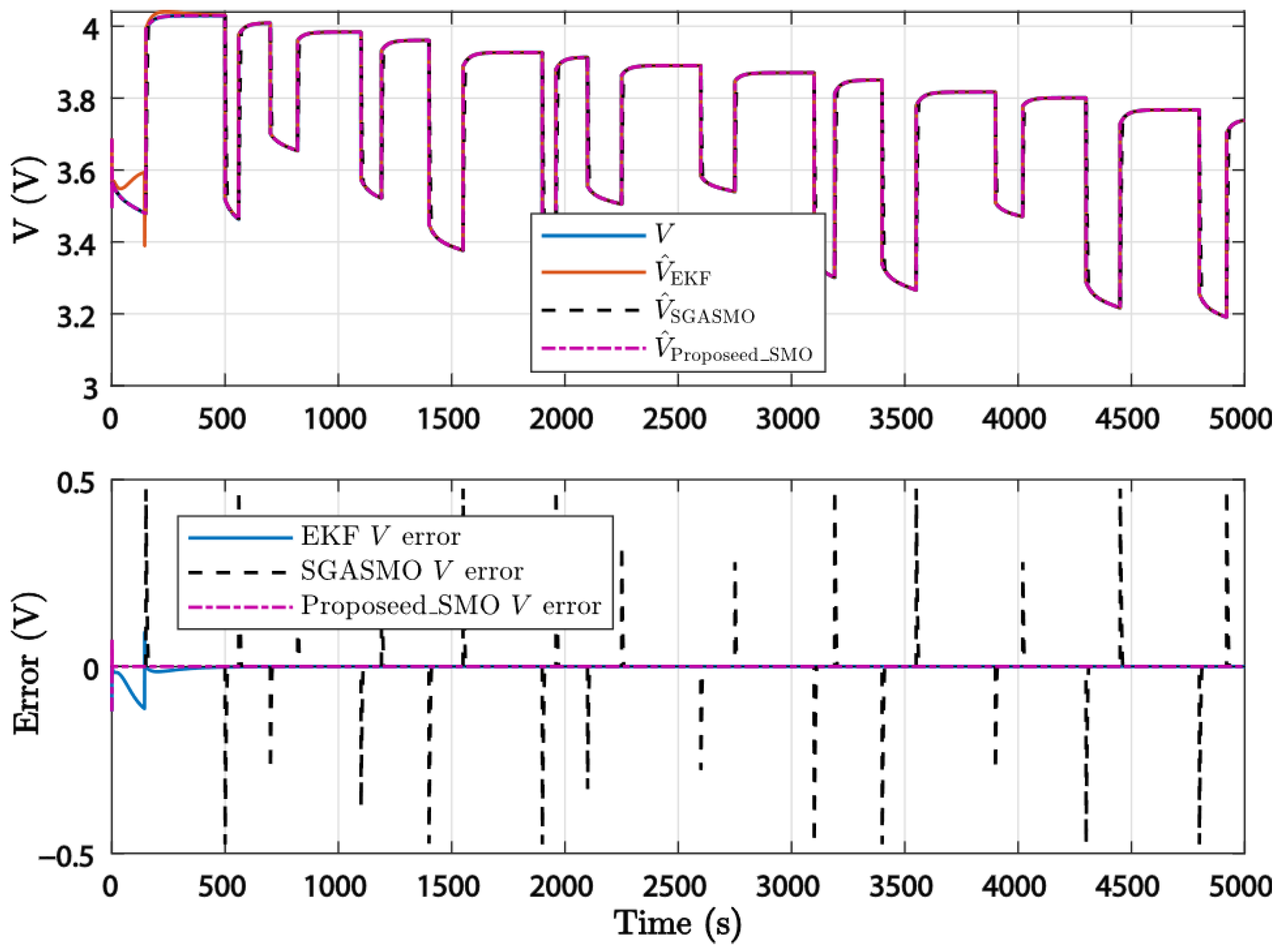
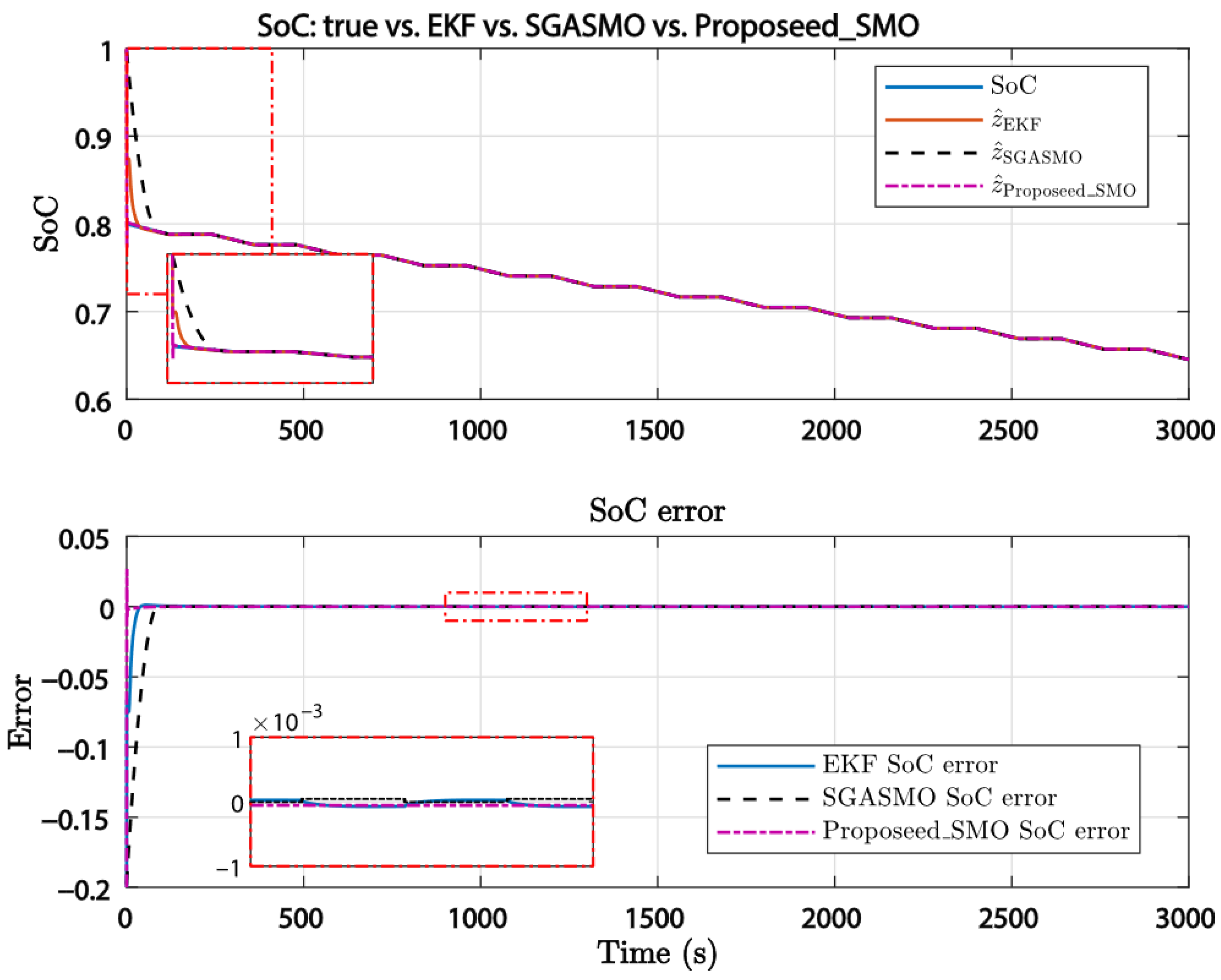
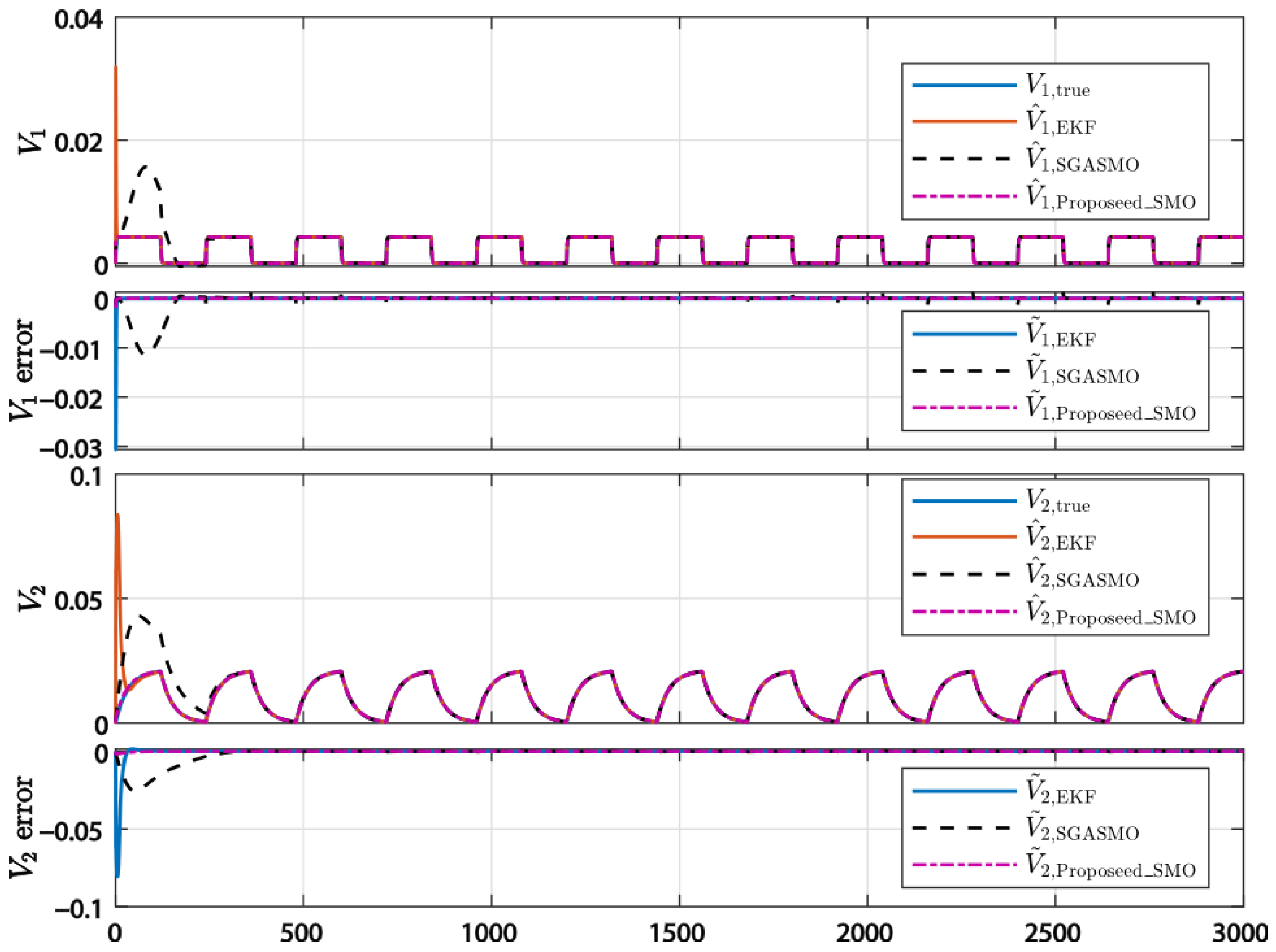
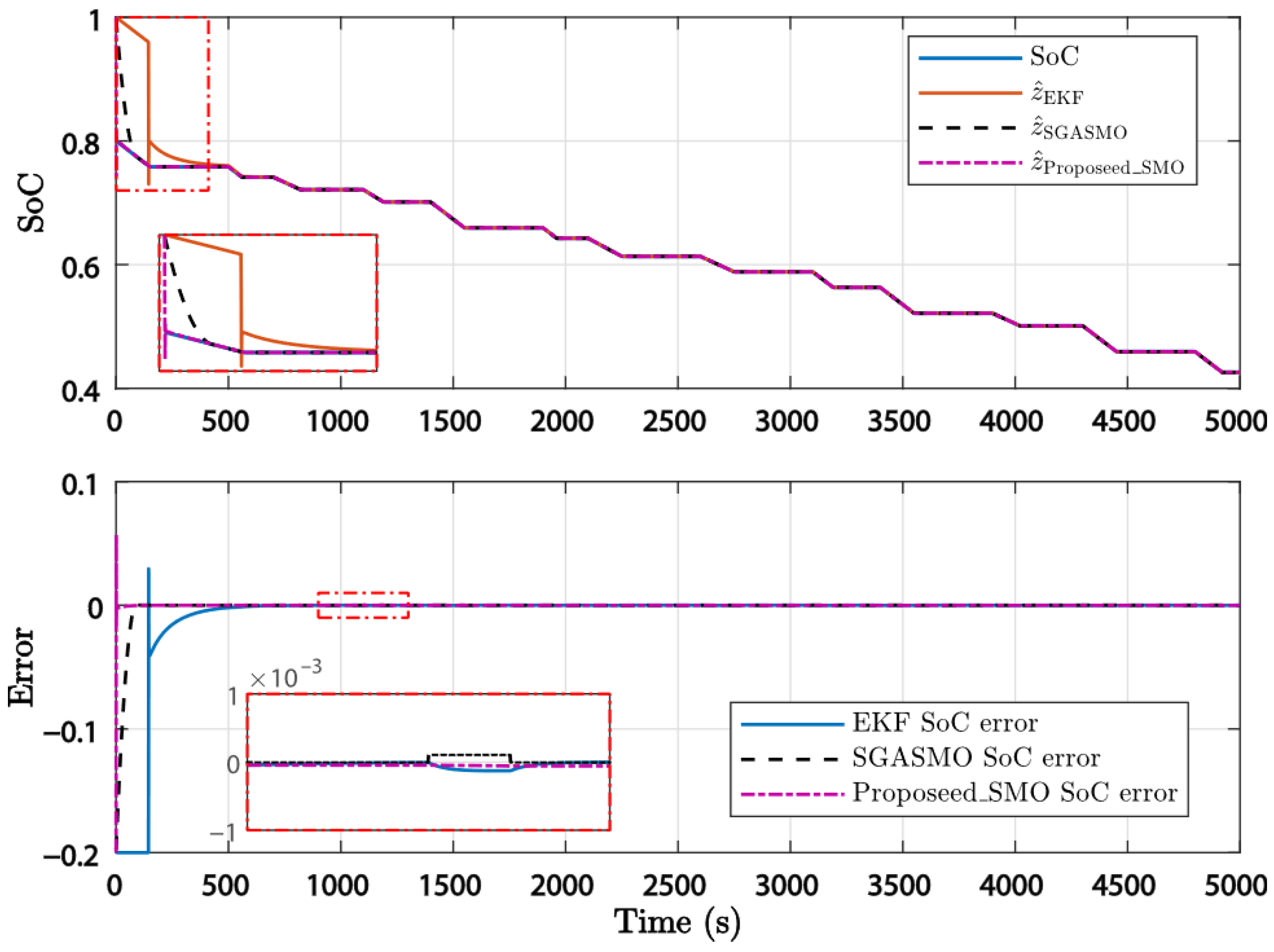
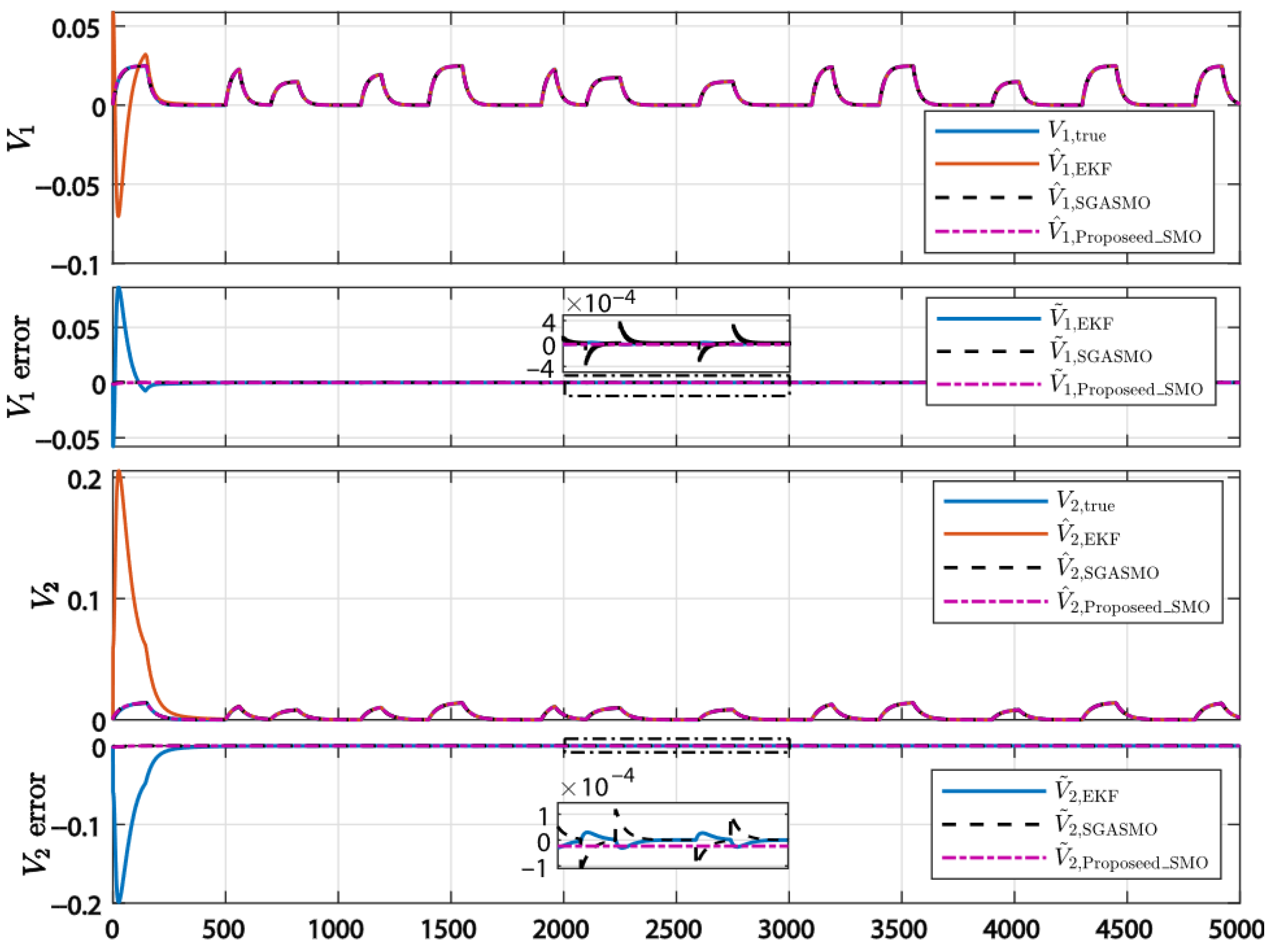
4.3. Observer Benchmarking and Comparative Evaluation
- Extended Kalman filter (EKF): a linearization-based method sensitive to small OCV slopes and model mismatch.
- Switching-gain adaptive SMO (SGASMO) [21]: a nonlinear observer with adaptive-gain tuning that offers strong robustness at the cost of higher complexity.
4.4. Discussion of Modeling-Driven Behavior
- Effective-slope regularization is crucial. It prevents loss of observability in OCV plateau regions and ensures that the sliding-mode correction remains active even when is small.
- Discrete-time formulation improves consistency. SGASMO, originally developed in continuous time, shows mild discretization artifacts, whereas the proposed SMO remains stable and consistent at every sampling instant because its analysis is carried out in discrete time.
5. Experimental Validation and Parameter Identification
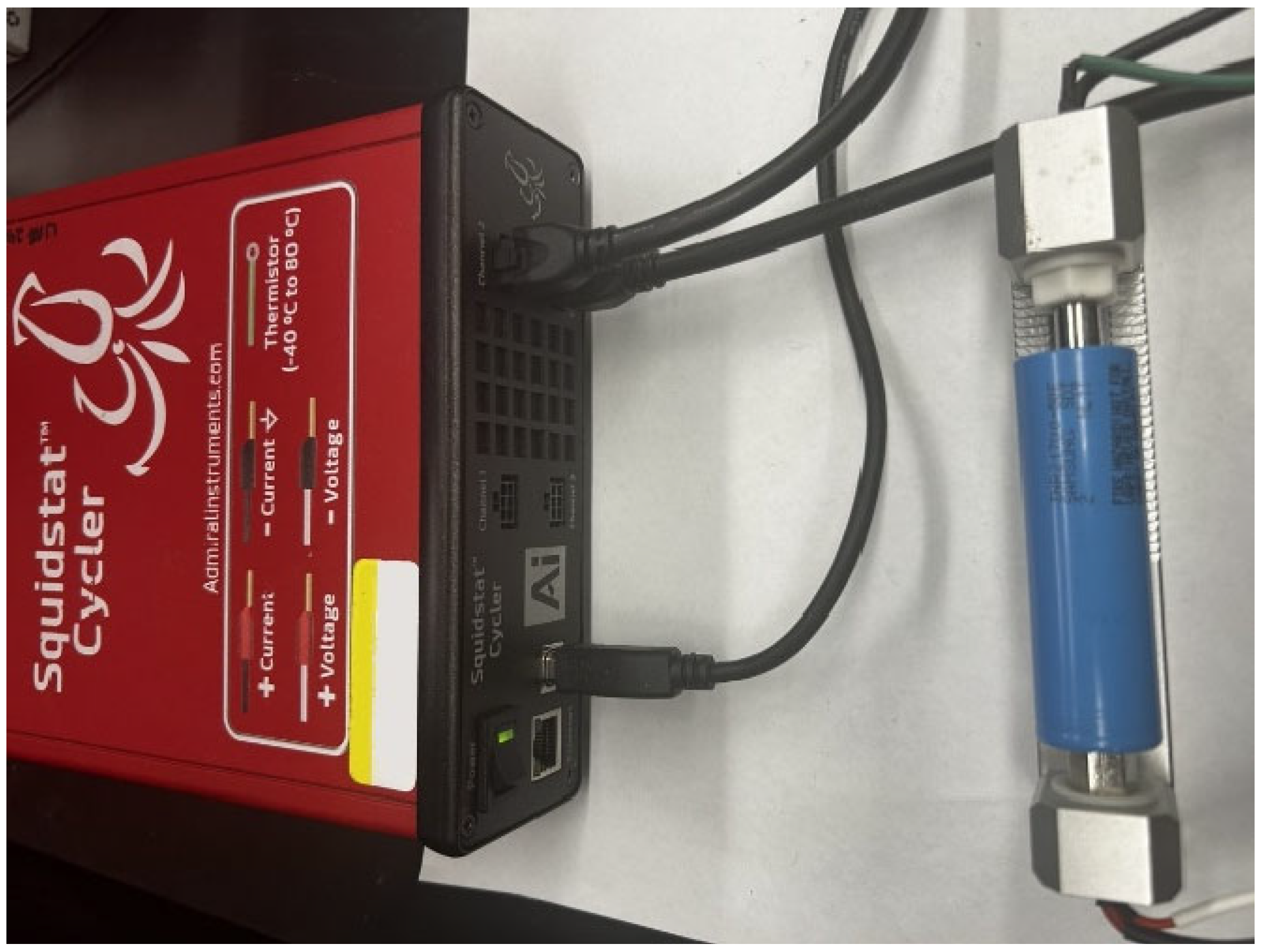
5.1. Experimental Setup
5.2. OCV–SoC Characterization
5.3. HPPC Test Protocol
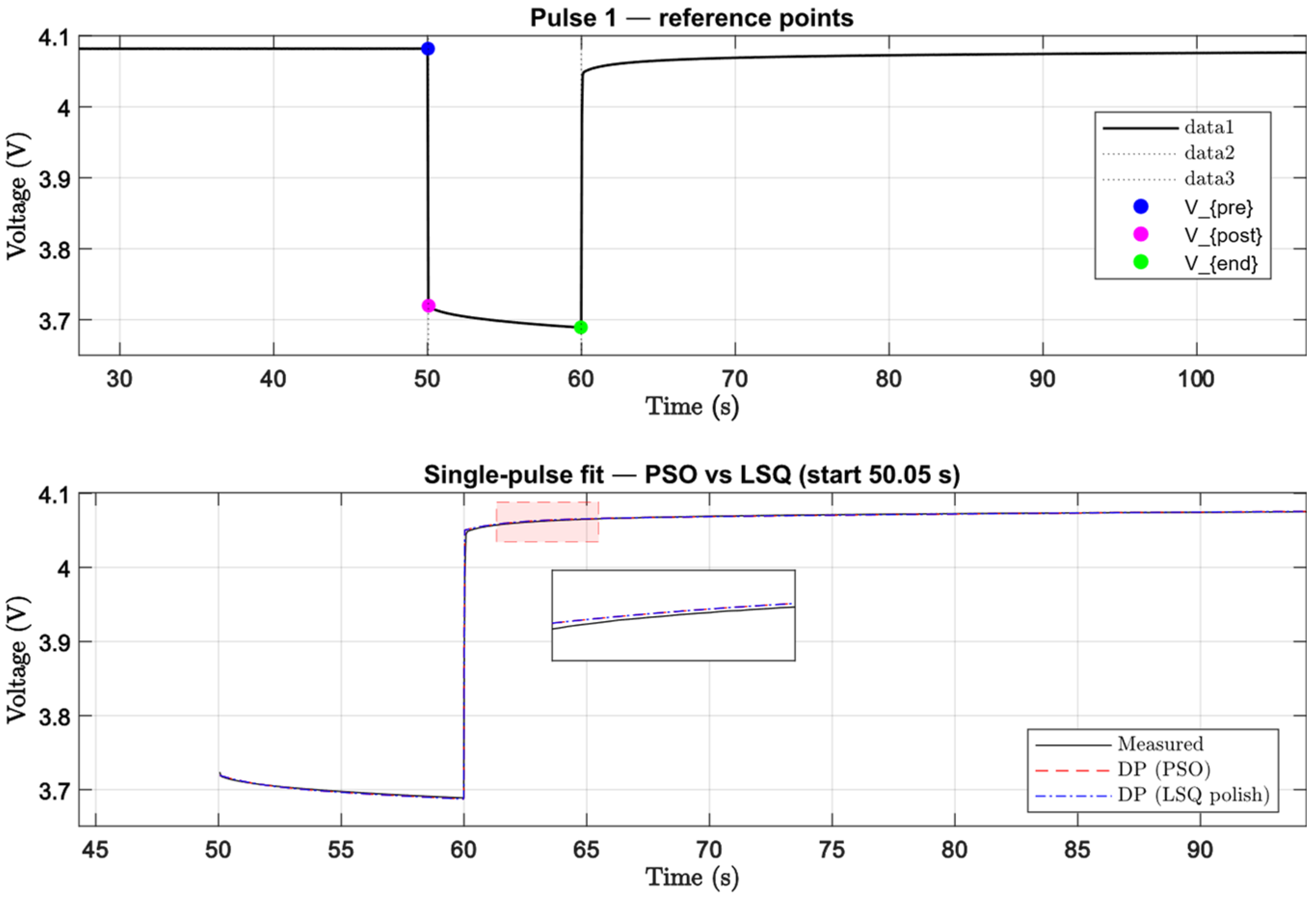
5.4. Parameter Identification Using PSO + LSQ
- Global search: Particle Swarm Optimization (PSO);
- Local refinement: Least-squares (LSQs)/Levenberg–Marquardt.
5.5. Identified Parameters
5.6. Pulse Reconstruction Accuracy
5.7. Long-Duration Pulse-Discharge Validation
6. Conclusions
Author Contributions
Funding
Data Availability Statement
Conflicts of Interest
Abbreviations
| LIB | Lithium-ion battery |
| BMS | Battery management system |
| SoC | State of charge |
| OCV | Open-circuit voltage |
| DP | Dual polarization |
| RC | Resistor–capacitor |
| SMO | Sliding-mode observer |
| EKF | Extended Kalman filter |
| SGASMO | Switching-gain adaptive sliding-mode observer |
Appendix A. Discrete-Time Lyapunov Analysis of the Sliding Surface
- 1.
- AA1: The modeling/shaping mismatch inis bounded as for all , with .
- 2.
- AA2: The gain-dependent coefficientsare uniformly bounded as
- 3.
- AA3: The filtered error is aligned with the surface in the sense that there exists such that
- 4.
- AA4: The design parameters satisfyand the sampling period is small enough thatThen, for any initial , the sequence reaches the boundary layer in a finite number of steps, and once inside, it remains ultimately bounded in a neighborhood of the origin; there exists a constant such that for all sufficiently largewhere and
- (1)
- Outside the boundary layer: .In this region,Under the alignment condition (AA3), . Dropping the nonpositive term from (A19) givesUsing and from (AA2)–(AA4),Next, from (A8)Using , , and , it follows thatAnd thusCombining (A18), (A22) and (A25) yieldsBy condition (A14)so whenever , the right-hand side of (A26) is negative:Hence, (and thus ) strictly decreases while the filtered error is outside the boundary layer, guaranteeing finite-time reaching of the set .
- (2)
- Inside the boundary layer: .In this region,And (A21) becomesWithUsing from (A3) and ,The quadratic term satisfieswhereCombining with (A18), (A22) and (A34), it follows withLet . ThenFor sufficiently large , the negative quadratic term dominates, so decreases. Consequently, there exists a constant such that, for all sufficiently large ,
References
- Hu, X.; Li, S.; Peng, H. A comparative study of equivalent circuit models for li-ion batteries. J. Power Sources 2012, 198, 359–367. [Google Scholar] [CrossRef]
- Xiong, R.; Sun, F.; He, H.; Gong, X. A review of state of charge estimation methods for lithium-ion batteries. Appl. Energy 2018, 229, 247–263. [Google Scholar]
- He, H.; Xiong, R.; Fan, J. Evaluation of lithium-ion battery equivalent circuit models for state of charge estimation by an experimental approach. Energies 2011, 4, 582–598. [Google Scholar] [CrossRef]
- Zhou, L.; Lai, X.; Li, B.; Yao, Y.; Yuan, M.; Weng, J.; Zheng, Y. State Estimation Models of Lithium-Ion Batteries for Battery Management System: Status, Challenges, and Future Trends. Batteries 2023, 9, 131. [Google Scholar] [CrossRef]
- Karimi, D.; Behi, H.; Van Mierlo, J.; Berecibar, M. Equivalent Circuit Model for High-Power Lithium-Ion Batteries under High Current Rates, Wide Temperature Range, and Various State of Charges. Batteries 2023, 9, 101. [Google Scholar] [CrossRef]
- Bizeray, A.; Duncan, S.R.; Howey, D.A. Lithium-ion battery thermal-electrochemical model-based state estimation using orthogonal collocation and a modified extended kalman filter. J. Power Sources 2015, 296, 400–412. [Google Scholar] [CrossRef]
- Franke-Lang, F.; Kowal, R. Electrochemical model-based investigation of thick LiFePO4 electrode design parameters. Modelling 2021, 2, 14. [Google Scholar] [CrossRef]
- Qin, H.; Wang, S.; Li, K.; Jiang, F. Joint Estimation of SOC and SOH Based on Kalman Filter Under Multi-Time Scale. Modelling 2025, 6, 100. [Google Scholar] [CrossRef]
- Waag, W.; Sauer, D.U. Adaptive estimation of the electromotive force of the lithium-ion battery after current interruption for an accurate state-of-charge and capacity determination. Appl. Energy 2013, 111, 416–427. [Google Scholar] [CrossRef]
- Li, L.; Hu, M.; Xu, Y.; Fu, C.; Jin, G.; Li, Z. State of Charge Estimation for Lithium-Ion Power Battery Based on H-Infinity Filter Algorithm. Appl. Sci. 2020, 10, 6371. [Google Scholar] [CrossRef]
- Fang, Y.; Xiong, R.; Wang, J. Estimation of lithium-ion battery state of charge for electric vehicles based on dual extended Kalman filter. Energy Procedia 2018, 152, 574–579. [Google Scholar] [CrossRef]
- Xiong, R.; Yu, Q.; Wang, L.-Y.; Lin, C. A novel method to obtain the open circuit voltage for the state of charge of lithium ion batteries using h-infinity filter. Appl. Energy 2017, 207, 346–353. [Google Scholar] [CrossRef]
- Xia, B.; Wang, H.; Tian, Y.; Wang, M.; Sun, W.; Xu, Z. State of Charge Estimation of Lithium-Ion Batteries Using an Adaptive Cubature Kalman Filter. Energies 2015, 8, 5916–5936. [Google Scholar] [CrossRef]
- Zeng, Z.; Tian, J.; Li, D.; Tian, Y. An Online State of Charge Estimation Algorithm for Lithium-Ion Batteries Using an Improved Adaptive Cubature Kalman Filter. Energies 2018, 11, 59. [Google Scholar] [CrossRef]
- Huangfu, Y.; Xu, J.; Zhao, D.; Liu, Y.; Gao, F. A Novel Battery State of Charge Estimation Method Based on a Super-Twisting Sliding Mode Observer. Energies 2018, 11, 1211. [Google Scholar] [CrossRef]
- Breglio, L.; Fiordellisi, A.; Gasperini, G.; Iodice, G.; Palermo, D.; Tufo, M.; Ursumando, F.; Mele, A. A Model-Based Strategy for Active Balancing and SoC and SoH Estimations of an Automotive Battery Management System. Modelling 2024, 5, 911–935. [Google Scholar] [CrossRef]
- Plett, G.L. Extended kalman filtering for battery management systems of LiPB-based HEV battery packs: Part 1. background. J. Power Sources 2004, 134, 252–261. [Google Scholar] [CrossRef]
- Plett, G.L. Extended kalman filtering for battery management systems of LiPB-based HEV battery packs: Part 2. Modeling and identification. J. Power Sources 2004, 134, 262–276. [Google Scholar] [CrossRef]
- Chen, C.; Xiong, R.; Shen, W. A Lithium-Ion Battery-in-the-Loop Approach to Test and Validate Multiscale Dual H Infinity Filters for State-of-Charge and Capacity Estimation. In IEEE Transactions on Power Electronics; IEEE: New York, NY, USA, 2018; Volume 33, pp. 332–342. [Google Scholar]
- Kim, I.S. A technique for estimating the state of health of lithium batteries through a dual-sliding-mode observer. IEEE Trans. Power Electron. 2010, 25, 1013–1022. [Google Scholar]
- Qian, W.; Li, W.; Guo, X.; Wang, H. A switching-gain adaptive sliding-mode observer for SoC estimation of lithium-ion battery. Energy 2024, 292, 130585. [Google Scholar] [CrossRef]
- Chen, M.; Han, F.; Shi, L.; Feng, Y.; Xue, C.; Gao, W.; Xu, J. Sliding Mode Observer for State-of-Charge Estimation Using Hysteresis-Based Li-Ion Battery Model. Energies 2022, 15, 2658. [Google Scholar] [CrossRef]
- Feng, Y.; Xue, C.; Han, Q.L.; Han, F.; Du, J. Robust estimation for state-of-charge and state-of-health of lithium-ion batteries using integral-type terminal sliding-mode observers. IEEE Trans. Ind. Electron. 2019, 67, 4013–4023. [Google Scholar] [CrossRef]
- Behnamgol, V.; Asadi, M.; Mohamed, M.A.A.; Aphale, S.S.; Faraji Niri, M. Comprehensive Review of Lithium-Ion Battery State of Charge Estimation by Sliding Mode Observers. Energies 2024, 17, 5754. [Google Scholar] [CrossRef]
- Yao, J.; Ding, J.; Cheng, Y.; Feng, L. Sliding mode-based H-infinity filter for SOC estimation of lithium-ion batteries. Ionics 2021, 27, 5147–5157. [Google Scholar] [CrossRef]
- Guo, Y.; Tian, J.; Li, X.; Song, B.; Tian, Y. State of Charge Estimation of Lithium-Ion Batteries Based on Vector Forgetting Factor Recursive Least Square and Improved Adaptive Cubature Kalman Filter. Batteries 2023, 9, 499. [Google Scholar] [CrossRef]
- Fritsch, F.N.; Carlson, R.E. Monotone piecewise cubic interpolation. SIAM J. Numer. Anal. 1980, 17, 238–246. [Google Scholar] [CrossRef]
- Hyman, J.M. Accurate monotonicity preserving cubic interpolation. SIAM J. Sci. Stat. Comput. 1983, 4, 645–654. [Google Scholar] [CrossRef]
- Huang, W. Control and Power Management Schemes for Distributed and Battery Powered Systems. Ph.D. Thesis, University of Alabama, Tuscaloosa, AL, USA, 2016. [Google Scholar]
- Edwards, C.; Spurgeon, S. Sliding Mode Control: Theory and Applications; CRC Press: Boca Raton, FL, USA, 1998. [Google Scholar]
- Sun, J.; Liu, Y.; Kainz, J. A comparative study of parameter identification methods for equivalent circuit models for lithium-ion batteries and their application to state of health estimation. J. Energy Storage 2025, 114, 115707. [Google Scholar] [CrossRef]







| Parameter | () | () | (F) | (s) | () | (F) | (s) |
|---|---|---|---|---|---|---|---|
| PSO Result | 73.98 | 2.8334 | 586.57 | 1.662 | 14.129 | 2311.5 | 32.659 |
| LSQ Result | 73.98 | 2.8339 | 586.69 | 1.6626 | 14.129 | 2311.7 | 32.663 |
Disclaimer/Publisher’s Note: The statements, opinions and data contained in all publications are solely those of the individual author(s) and contributor(s) and not of MDPI and/or the editor(s). MDPI and/or the editor(s) disclaim responsibility for any injury to people or property resulting from any ideas, methods, instructions or products referred to in the content. |
© 2026 by the authors. Licensee MDPI, Basel, Switzerland. This article is an open access article distributed under the terms and conditions of the Creative Commons Attribution (CC BY) license.
Share and Cite
Saberi, S.; Abu Qahouq, J.A. A Model-Based Framework for Lithium-Ion Battery SoC Estimation Using a Tuning-Light Discrete-Time Sliding-Mode Observer. Modelling 2026, 7, 42. https://doi.org/10.3390/modelling7010042
Saberi S, Abu Qahouq JA. A Model-Based Framework for Lithium-Ion Battery SoC Estimation Using a Tuning-Light Discrete-Time Sliding-Mode Observer. Modelling. 2026; 7(1):42. https://doi.org/10.3390/modelling7010042
Chicago/Turabian StyleSaberi, Sajad, and Jaber A. Abu Qahouq. 2026. "A Model-Based Framework for Lithium-Ion Battery SoC Estimation Using a Tuning-Light Discrete-Time Sliding-Mode Observer" Modelling 7, no. 1: 42. https://doi.org/10.3390/modelling7010042
APA StyleSaberi, S., & Abu Qahouq, J. A. (2026). A Model-Based Framework for Lithium-Ion Battery SoC Estimation Using a Tuning-Light Discrete-Time Sliding-Mode Observer. Modelling, 7(1), 42. https://doi.org/10.3390/modelling7010042