1. Introduction
The field of Finite State Model Predictive Control (FSMPC) for multiphase drives has received some attention in the recent literature due to the possibilities opened by the flexibility of the model-based techniques [
1,
2,
3]. In FSMPC the states of the power converter (i.e., the state of its discrete switches) are treated as the control variable. In this way, FSMPC avoids using a modulation stage such as the ubiquitous Pulse Width Modulation (PWM) block and its variants [
4,
5,
6,
7].
This paper proposes a comparison between monovector and multivector approaches. Previous comparisons have been made considering particular members of each family. This can be misleading as the monovector needs tuning, as will be described later. Now, different results can be found for different tunings. The comparison should be made considering the best tuning option for the contender (the monovector in this case). Second, the comparison should consider the same switching frequency for both approaches. Finally, the comparison should consider the computational load for both approaches, making sure that each contender has access to the same computing resources.
Before introducing the proposed comparison setting it is worth recalling that in FSMPC the control signal
S is the actual converter configuration. For instance, in a Voltage Source Inverter (VSI) with three phases (
a–
b–
c) the inverter state is specified by the position of each switch
. The possible states can be enumerated using a binary value for each switch position, i.e.,
for all
. The enumeration process yields
different states for the VSI [
8,
9]. This means that in FSMPC the control signal is quantized, which has two main effects. The first one is that the optimization of the control signal can be made by exhaustive exploration; the second is that the control actions are coarse [
10]. In multiphase converters this second effect is ameliorated with respect to three phase ones. For instance, for a five-phase VSI there are 32 states instead of just 8. This, however, comes at the price of an increased computational load for processes dealing with enumeration, in particular the selection of the control action [
11].
The number of different voltages that the VSI can produce has a profound effect on the kind of modulation that can be made by FSMPC. Unlike traditional methods [
12,
13], the firing patterns of FSMPC are not fixed. This is because in FSMPC the selection of the control action is made by solving an optimization problem at each sampling period. For this purpose, a cost function is designed as a sum of quadratic terms that need be penalized [
14]. The terms represent deviations of predicted trajectories from their objectives. In particular, in multiphase drives, stator currents should follow certain trajectories: sinusoidal ones for the torque-producing subspace and null ones for the harmonic subspace. The different terms in the cost function must be combined using Weighting Factors (WFs) that take care of their relative importance [
15,
16]. The choice of WFs affects the performance of the drive in several ways. Take for instance
, this WF is used in multiphase drives to balance tracking errors in
(torque-producing subspace) and
(harmonic subspace). The choice of
affects not only current quality in
and
content, but also the average switching frequency [
17].
The many variants of FSMPC that have appeared can be classified into two categories: monovector and multivector. Techniques in the first class use just one control action per sampling period. This implies that the VSI maintains its state during the whole sampling period. This state imprints in the system a certain voltage depending on the DC link amplitude and on the VSI structure. The particular phase voltage corresponding to a VSI state S is termed the Basic Voltage Vector (BVV). Monovector approaches thus use just one BVV per sampling period. Techniques in the second class issue more than one BVV per sampling period.
In the literature there are many proposals of multivector FSMPC [
18,
19,
20]. Several variants have been proposed differing in the number of BVVs used to produce the combination, often referred to as Virtual Voltage Vector (VVV) [
21,
22,
23]. The rationale behind this family of methods is that the combined action of two or more BVVs produces an averaging effect that makes the control action less coarse. Also, in some cases a reduction in the computational load is achieved.
The comparison of multi- and monovector strategies has appeared in some papers. Please note that the VVV variants have been analysed mainly in terms of (a) a reduction in the harmonic distortion of phase currents by means of the Total Harmonic Distortion (THD) index, (b) a reduction in cost function complexity thanks of the removal of one WF (
), (c) a reduction in computational load thanks to a reduction in the dimension of the search space. On the other hand, VVV methods have been criticized by their reliance on open loop for the regulation of
currents and for the loss of flexibility. This last aspect is seldom considered in the literature. There is a number of proposals for WF removal both in the monovector and multivector cases [
24,
25]. It must be stressed that the tuning of
allows for more or less secondary subspaces content. As a result, the amount of copper losses is affected by the choice of this WF. Also, the VSI can be made to operate at a reduced average switching frequency by means of another WF (denoted as
) [
26]. In this way commutation losses in the VSI can be reduced.
The comparison of monovector and multivector approaches is not an easy task because VVV methods loose flexibility when they abandon
, thus it is difficult to compare them fairly with methods that retain flexibility. Also, VVV methods have benefited from the fast computation of the control signal not existing for the monovector case until recently [
27]. In addition, the comparison should be made on the basis of an equal switching frequency. Finally, the existence of trade-offs between figures of merit must be acknowledged to avoid erroneous conclusions [
28].
Contributions
This paper presents a comparison of monovector and multivector FSMPC variants for a five-phase induction machine (IM). The comparison setting is novel in that it is designed to reduce or even eliminate the confusing effects of the factors indicated in the previous paragraph. This novel approach relies on using modulation as the main variable for exploring the operational space.
This idea is supported by the following facts: First, the modulation index is independent of the particular parameters of the machine. Second, it is also independent of the speed–torque characteristic of the load. Finally, in FSMPC both monovector and multivector approaches are based on synthesizing the modulation index needed at each operating point. The approach allows us to reduce the effect of the particular electrical and mechanical parameters of the drive in this study, enabling conclusions to be made of a more general character. Also the consideration of different operating regimes is made easier and the effect of the mechanical load characteristic is avoided. Another contribution is the introduction of a reduced set of performance indicators well connected to drive operation.
From the above it can be stated that, unlike previous comparative studies that rely on fixed operating points or parameter-dependent metrics, this work introduces a modulation index-based comparison framework that enables a fair, parameter-independent assessment of monovector and multivector FSMPC strategies under equal switching activity. The results from the experiments leave little doubt about the benefits of each type of controller under comparison.
The rest of this paper is organized as follows.
Section 2 describes the laboratory setup, drive control, predictive model, and figures of merit. The experimental results are shown in
Section 3. These are then discussed and some conclusions are presented at the end.
2. Materials and Methods
The main method is a modulation analysis conducted on each FSMPC variant under consideration: monovector (Slg) and virtual voltage vector (VVV). The analysis is based on a reduced set of performance indicators drawn from the data obtained in the experiments.
The following subsections review the elements of FSMPC that are needed for the comparison. Please note the theoretical novelty lies in the aggregation and use of the model, not in the equations themselves.
2.1. Laboratory Setup
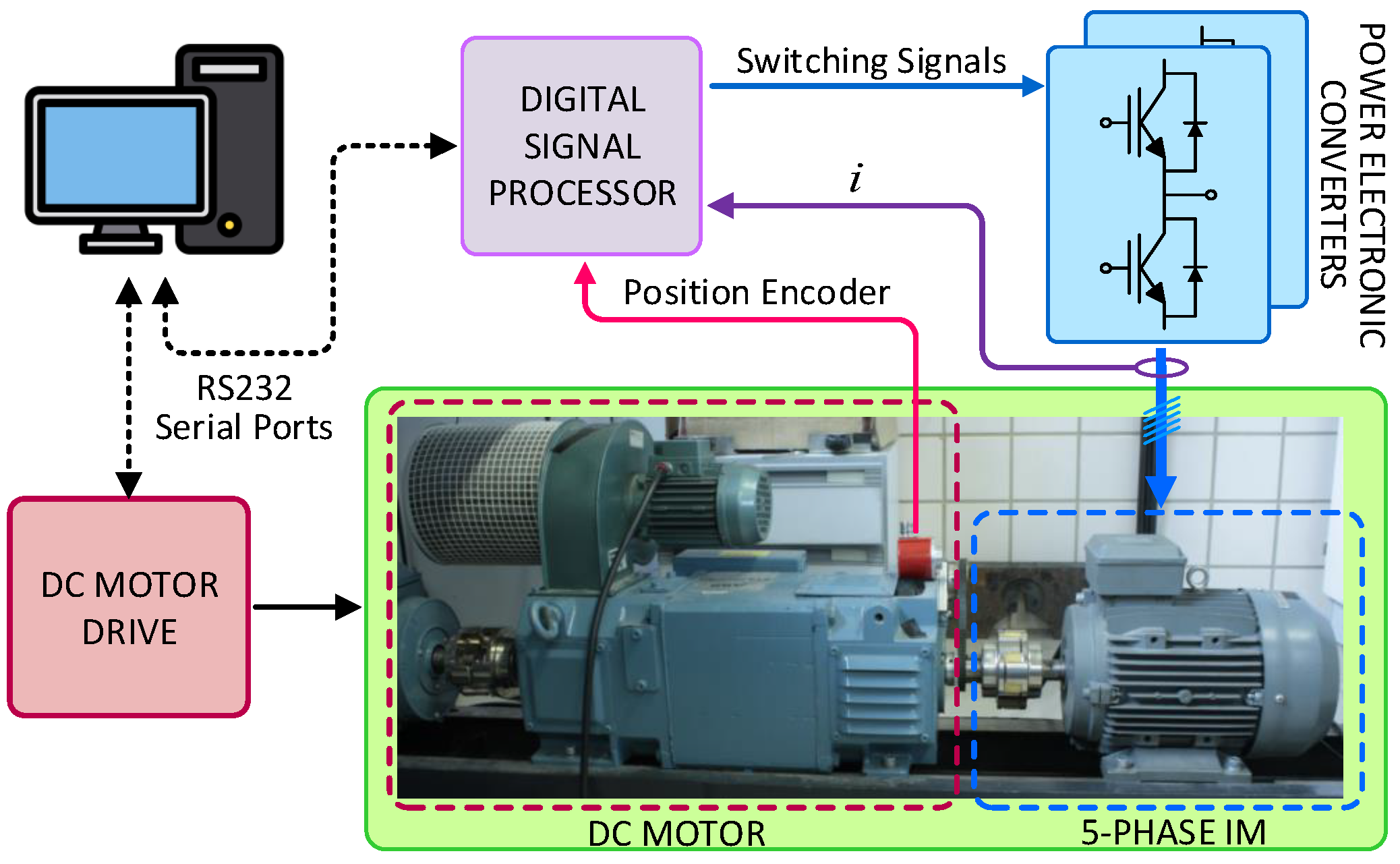
A laboratory system is used for the tests. It includes (see
Figure 1) a five-phase IM (with parameters shown in
Table 1), a power converter using two SEMIKRON SKS 22F (Semikron, Nuremberg, Germany) modules connected to a 300 V DC supply.
The control method is coded in the C programming language and runs in real time on a TMS320F28335 digital signal processor (Texas Instruments, Dallas, TX, USA) inside an MSK28335 system (Technosoft, Bevaix, Switzerland). This system is fed by current measurements provided by Hall effect sensors (LH25-NP) (LEM, Geneva, Switzerland).
The drive can be put into different operating regimes requiring different reference values for the stator currents. To this effect a co-axial DC motor is used to generate an opposing torque load () for the tests.
2.2. Drive Control
FSMPC for multiphase drives uses the Clarke projection of stator currents into the
and
planes as shown in
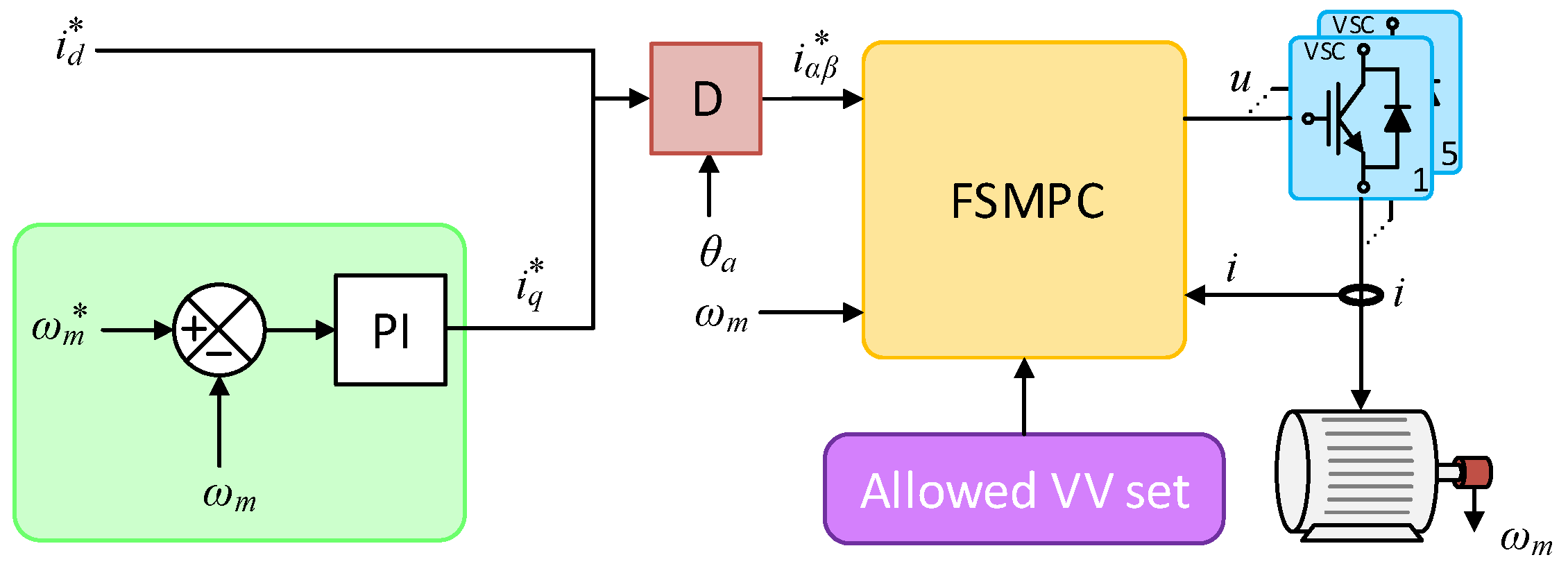
Figure 2. For a five-phase VSI, just one
plane is produced. The torque-producing currents must follow a reference set by the torque/speed control loop. The
current references are set to zero to reduce losses. In this way, flux and torque are independently regulated. The flux set point is provided by
whereas reference
is used for the electrical torque. These references are projected to the
space using the Park transformation, obtaining a reference for stator current in the
plane as
, where matrix
D is given by
The flux angle
is obtained as
. As a result, the set point for stator current tracking
has an amplitude
. The amplitude is provided by a PI (Proportional Integral) controller responsible for the outer loop as shown in
Figure 2. The tuning of the PI is made following the work of Ref. [
3]. For the tests the same PI tuning is used for both types of FSMPC controllers.
The reference for stator current can be expressed as , , , , which are useful expressions for the computation of the cost function, as will be shown later.
2.3. VSI States and Voltages
Phase voltages are set by the VSI state. The state can be represented by a vector
, where the values
indicate the state of the corresponding VSI switch for phase
h. For a five-phase VSI there are 32 configurations. These correspond to values
to
. Each state produces a certain set of phase voltages. The actual state to be issued at sampling time
k is determined by solving an optimization problem, as shown in
Section 2.5.
The stator voltages provided by each VSI state can be found as
, where
is the voltage supplying the DC link and
where
,
,
for
.
The stator voltages can be mapped to
and
subspaces using the Clarke transformation. The resulting voltages in
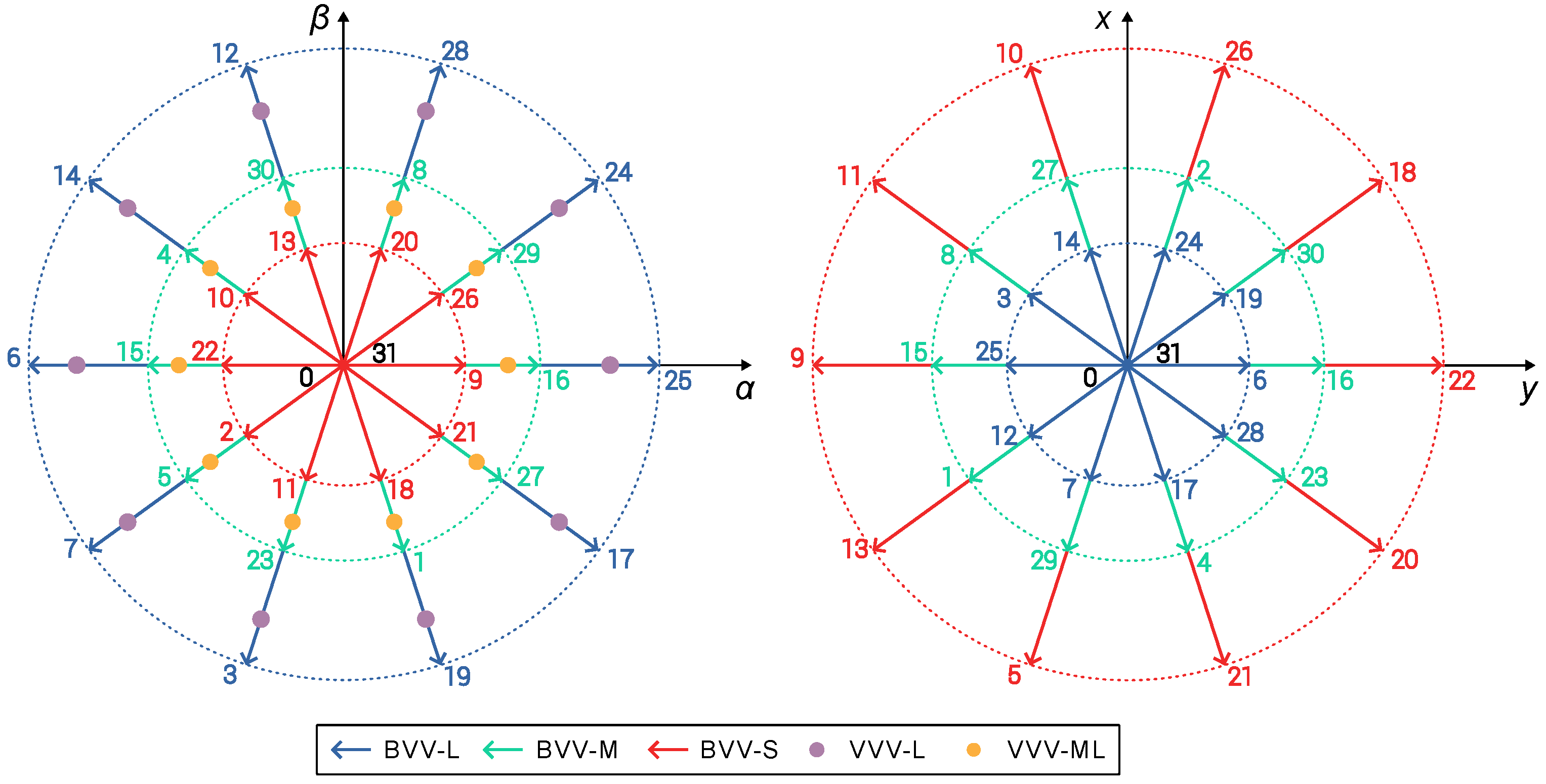
coordinates are referred to as Basic Voltage Vectors (BVVs).
Figure 3 shows the distribution of BVVs.
It is interesting to describe the distribution affecting the modulus of the VV in the subspace. This will be useful for the description of the VVV method and for the modulation analysis.
- 1.
Large VV. This refers to the VV values that have the largest modulus in the
subspace. They lay in the outer corona of the VV distribution in
subspace. These are indicated in
Figure 3 with the following indices: 25, 24, 28, 12, 14, 6, 7, 3, 19, and 17. These VVs will be referred to as large VVs or just LVVs. Please note that in
subspace, their modulus is the smallest possible excluding zero.
- 2.
Medium VV. This refers to VVs with indices 16, 29, 8, 30, 4, 15, 2, 23, 1, and 27. These VVs will be referred to as medium VVs or just MVVs.
- 3.
Small VV. This refers to VVs with indices 9, 26, 20, 13, 10, 22, 5, 11, 18, and 21. These VVs will be referred to as small VVs or just SVVs.
- 4.
Null voltage. This refers to VVs with indices 0 and 31. These VVs will be referred to as null VV, zero VV, or just ZVV. These configurations produce zero voltage in both subspaces.
2.4. Predictive Model
In monovector PSCC, the control action is the state of the VSI
u. The PSCC uses a predictive model to link future stator currents to candidate control actions. This model is often a set of discrete time state space equations as follows:
where
i contains the
,
,
x, and
y stator currents,
is the prediction of
i, and
is the angular speed. Matrices
C and
B are obtained from first principles applying time discretization with sampling time
[
10,
16]. This gives
, and
, where
Term
G accounts for the effect of the rotor currents, which are usually unmeasured variables. In the previous expressions, the coefficients used are
,
,
, depending on machine parameters such as
,
,
, and
. The measured values of the electrical parameters corresponding to the machine used in the experiments are shown in
Table 1.
From Equation (
4) the two-step ahead prediction of the stator currents can be found as
where
has been introduced for better readability. The predicted control error is thus found as
2.5. Cost Function
The cost function for FSMPC can use different numbers of terms. In this work the following one is used, where the predicted control errors and the VSI commutations are penalized.
where
is the number of switch changes produced at the VSI when configuration
is changed to
. The value
can be computed as
With this CF structure, the WF are the parameters and . The first one allows us to put more emphasis on reduction. The second one helps reducing the commutation frequency.
Now, the minimization of the cost function is usually carried out by exhaustive search. This means that for each possible control move, a value of
J is obtained using Equation (
9). This involves exploring each possible BVV in the monovector case and each possible VVV in the multivector case. The control action providing the lesser value for
J is selected as the next control move.
Please note that the model structure described so far is assumed for both monovector and multivector approaches that have appeared in the literature and thus are adequate for system-level comparison.
2.6. Modulation Index
The modulation index is used in this work as a variable to represent the operating point of the induction machine. The concept is usually used to represent the voltage produced by a PWM method. In this work it makes more sense to use it to represent the per unit stator current (in the torque-producing plane) required to maintain a certain operating regime. In this way the current modulation index is defined as
where
is the amplitude of the reference for stator currents (in the torque-producing plane) and
is the modulus of the maximum stator current (in the torque-producing plane) that the VSI can imprint in the IM. The modulation index is thus linked to the VSI states and is less dependent on the particular electrical and mechanical parameters of the drive, enabling us to draw conclusions of a more general character.
2.7. Assessment Criteria
Several figures of merit are used in the literature. These can be decomposed into two categories: (Q1) current quality measures; (Q2) usage of the VSI. The first class includes the following: (Q1a) stator current tracking error in the torque-producing plane, (Q1b) stator current tracking error in the harmonic plane, (Q1c) harmonic distortion in phase currents. The second class includes (Q2a) average switching frequency, (Q2b) switching losses, (Q2c) thermal stress. It must be noted that these measures are not independent, in fact some of them have been shown to be subject to trade-offs. This is one of the factors obscuring the assessment of control schemes as indicated in the Introduction.
In this paper, a reduced set of assessment variables is considered. This choice seeks to enhance the contrast in the comparison of control schemes by removing closely correlated variables. The chosen figures of merit are defined as follows.
where
D is a diagonal matrix whose diagonal elements are
. The value
allows us to give more or less relative importance to stator currents in the
plane compared with tracking error in the
plane. It is used to aggregate the four-element error vector
into just one quantity. In this way, the assessment is made easier.
From the previous Equation (
12) it is easy to see that the first figure of merit
is an estimation of Root Mean Squared (RMS) value for the stator current weighted tracking error, obtained from a sample of instantaneous values
. Similarly, Equation (13) presents an approximation to the Mean value of the switching frequency obtained from the accumulated number of switch changes
divided by the time interval.
It will be shown in the results that the use of and allows for a clear comparison of the monovector and multivector approaches.
2.8. Monovector Scheme
In the monovector case, the control actions are the basic VV that the VSI produces. These are presented in
Figure 3. For the five-phase VSI there are 32 VVV, 30 of which are nonzero and 2 of which produce zero voltages. Note that some monovector schemes in the literature propose the use of a limited number of BVVs. This is represented in
Figure 2 with the block titled Allowed VV set.
Restricting the set of allowed BVVs has the effect of lowering the computation time needed for the cost function optimization. This time is however very low if one uses the recently proposed methods such as the region-based method in Ref. [
27]. For this reason in this work the Allowed VV set is the full set of 32 BVVs.
Regarding WF tuning, this work uses the results of Ref. [
16] to select the values of the WF. In particular, a value of
is selected allowing a certain amount of
content that is not too excessive to approximate this index to the ones found in the multivector case. Following this, a value of
is used just for those modulation indices where the FSMPC produces a switching frequency that is too large, which happens just for low values of
m.
2.9. Multivector Scheme
The most salient representative of the multivector schemes is, arguably, the Virtual Voltage Vectors method. It is also specially designed for the multiphase case, so it is adopted here as a contender to the monovector class. The basic idea supporting VVV is issuing two BVVs during a single sampling period. The BVVs form pairs that provide null
content. For the five-phase VSI, the VVV are formed by issuing a Large VV during a subperiod
followed by a Medium VV during
. To adjust
and
one must note that
and the average
contribution should be zero
. This average voltage is found according to
where
is the Large BVV modulus in
cooordinates and
that of the Medium BVV. It is easy to see that Equation (
14) produces
,
where
is the sampling period.
Figure 3 shows the VVV formed in this way.
Please note that in practice it might be impossible to realize the subintervals and exactly, as the temporal resolution is limited by the DSP internal clock frequency. Also note that the content for this method should be measured midway through the sampling period as content is ideally zero at the end of each period.
3. Experimental Results and Discussion
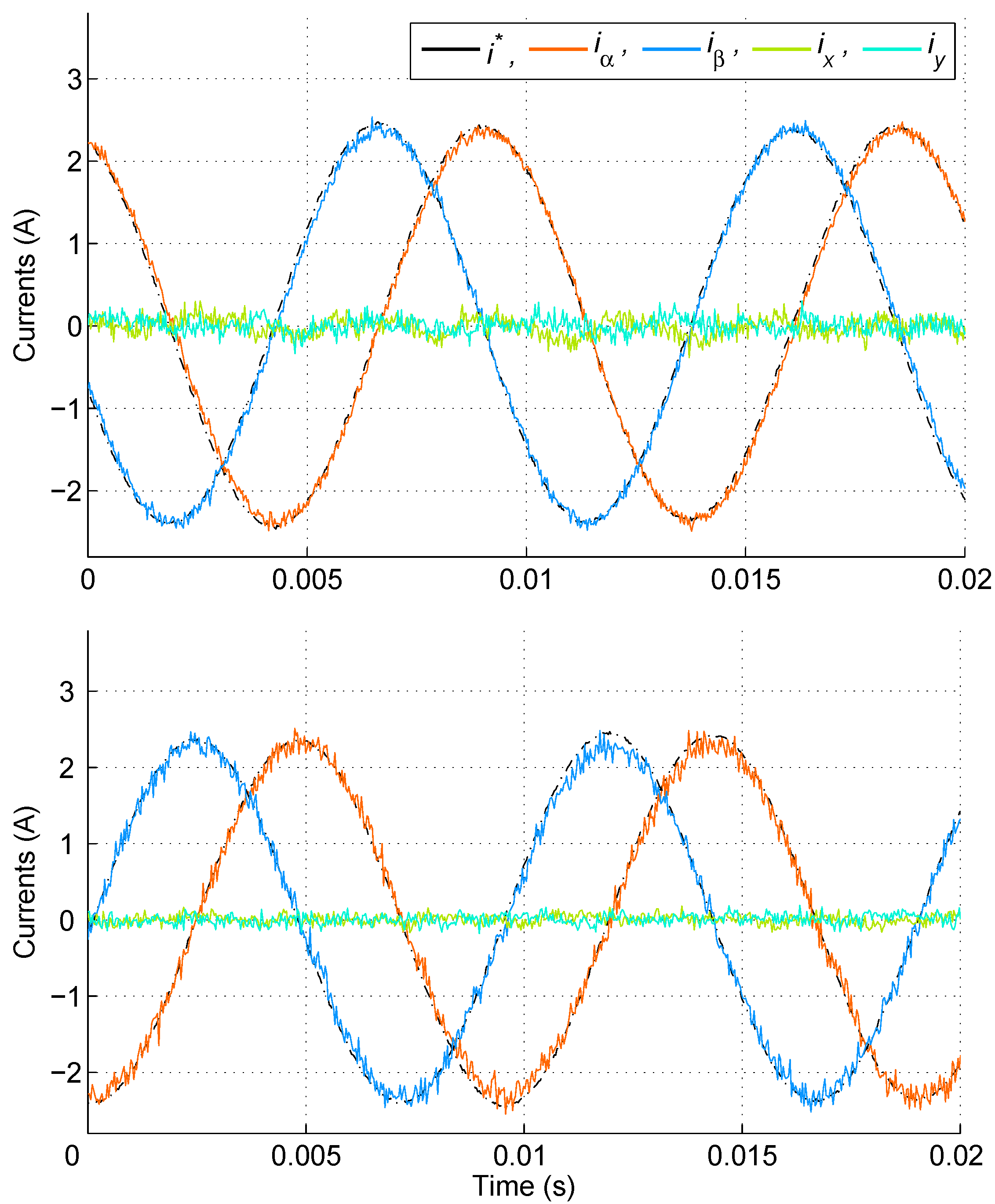
The experiments are performed by issuing a reference to the controllers. The resulting current waveforms are recorded to derive the figures of merit. A typical test for each class (monovector and multivector) is shown in
Figure 4.
From the waveforms alone it is difficult to decide on the merits of each controller. In any case, from the observation of the graphs, it is clear that the monovector approach is best for tracking and less so for regulation. However, in the monovector approach, the use of the factor allows us to reduce the content at the expense of a different usage of the VSI in terms of switching frequency. This trade-off obscures the comparison. To help with this, the comparison must be made in terms of the figures of merit. The first case contemplated here uses . This gives the harmonic subspace a 20% importance compared with the torque-producing plane. Arguably, this situation is of practical interest in many cases as the primary goal of FSMPC for drives is torque production.
Several experiments have been conducted at different operating points, resulting in different values for
m.
Table 2 presents the results in terms of
and
for the multivector controller (indicated with the VVV superscript) and for the monovector controller (
Mono superscript).
It can be seen that both indices for the monovector case take smaller values than those for the multivector case. This takes place for all modulation indices m. The Improvement Ratio (IR) for is also presented. The ratio is computed as (%). It must be noted that the average switching frequency for both approaches is almost the same, with a slight disadvantage for the monovector case. Note that for medium and large values of m the monovector controller uses less commutations in a natural way, that is, without resorting to . However, the VVV controller must always produce the commutations due to the alternating Large and Medium BVV that form the particular VVV used (except in the case of null VVV). Thus, the decline in the switching frequency for the VVV case is less pronounced. It is interesting to notice that the VVV method cannot be used for because of the limited use of the DC link.
Now, one may argue that the choice of
can alter the conclusions. To this end the comparison is now repeated but using
. Please note that this value is quite extreme and difficult to justify in a practical situation. Nevertheless, since the VVV method is designed to nullify the
content, this
value is more favourable to VVV and should be explored. The results for this case are presented in
Table 3. Again, the setting in relation to the
values is favourable to the VVV method since it is allowed a slightly larger switching frequency. Despite this the monovector approach again manages to outperform the VVV one in terms of
, as the Improvement Ratio clearly shows.
4. Conclusions
In the paper a way of comparing different FSMPC approaches is presented. In particular the method is applied to the comparison between monovector and multivector approaches, but it can be applied to other classes or control families. Analyzing the literature, one realizes that comparing different control schemes is not a trivial task. The authors have sought to convey the idea that a proper comparison setting is needed in many cases, and in particular, in the monovector vs. multivector debate. From a narrow view, the results of this paper can be interpreted as an argument favoring monovector techniques; however this is just part of the whole picture.
For the particular context of FSMPC of multiphase drives, the comparison setting proposed in this paper has allowed us to get rid of factors obscuring previous attempts. The proposed setting rests upon several hypotheses: (1) recognizing modulation as an important variable to carry the comparison of different operating points, (2) rejecting conclusions based on particular tunings based on a comparison on the grounds of equal switching frequency, (3) the selection of a reduced set of figures of merit.
This must not be interpreted as a call to abandon further considerations other than figures of merit. For instance, in this particular comparison the DC link usage is an important question. It just so happens that DC link usage is always best for one class of FSMPC, so there is little more to add. In this regard, the structural limitations of VVV, mandatory commutations, limited DC link exploitation, and open loop in harmonic subspace, have already been discussed in other works. Nevertheless this should not be considered as a statement directed to invalidate multivector FSMPC but rather characterize its trade-offs. Under the considered experimental conditions and comparison framework, monovector FSMPC exhibits a superior weighted tracking performance while maintaining a lower switching activity than the multivector approach.