Article

Influence of Temperature on Electron Transport, Current-Voltage Characteristics, and Capacitive Properties of MIM Nanostructures with Amorphous Niobium Pentoxide


by
Vyacheslav Alekseevich Moshnikov
1,
Ekaterina Nikolaevna Muratova
1,*,
Igor Alfonsovich Vrublevsky
2,
Viktor Borisovich Bessonov
1,
Stepan Evgenievich Parfenovich
1,
Alexandr Ivanovich Maximov
1,
Alena Yuryevna Gagarina
1,
Danila Andreevich Kavalenka
2 and
Dmitry Alexandrovich Kozodaev
3
1
Microelectronics Department, Saint Petersburg Electrotechnical University “LETI”, Professora Popova St., 5, 197022 Saint Petersburg, Russia
2
Micro and Nanoelectronics Department, Belarusian State University of Informatics and Radioelectronics, Brovki St., 6, 220013 Minsk, Belarus
3
NT-MDT BV, Hoenderparkweg 96 b, 7335 Apeldoorn, The Netherlands
*
Author to whom correspondence should be addressed.
Appl. Nano 2026, 7(1), 8; https://doi.org/10.3390/applnano7010008 (registering DOI)
Submission received: 19 January 2026 / Revised: 13 February 2026 / Accepted: 20 February 2026 / Published: 1 March 2026

Abstract

Currently, titanium dioxide films are widely used as the electron transport layer material in perovskite solar cells. An alternative to titanium dioxide for this role could be niobium pentoxide (Nb2O5), an n-type conducting semiconductor oxide. However, the application of Nb2O5 in perovskite solar cells is hindered by a lack of data on its electron transport properties, electrophysical parameters, and current–voltage characteristics. Amorphous niobium pentoxide films were obtained by magnetron sputtering. To study their electrical and capacitive properties, a structure of heavily doped n+-silicon (n+)/niobium oxide/aluminum was used. Based on the analysis of the I–V curves, it was concluded that for a sample at 25 °C, the electron mean free path is greater than the width of the Schottky barrier layer, allowing electrons to pass through this layer without collisions. At temperatures of 35 °C and higher, electrons experience numerous collisions within the Schottky barrier layer. The height of the Schottky barrier for the contact between niobium pentoxide and aluminum was determined. The obtained capacitance frequency plots were explained using the concepts of dipole-relaxation polarization in a dielectric, where electric dipoles can reorient in an external electric field. It has been shown that the use of magnetron sputtering to produce amorphous niobium pentoxide films leads to a reduction in the effective Schottky barrier height. This allows for high electron injection density at low voltages when using such an oxide semiconductor as an electron transport layer, thereby potentially increasing the efficiency of solar cells.

1. Introduction

One of the rapidly developing photovoltaic technologies in the world is perovskite solar cell technology, characterized by high conversion efficiency, low cost, the use of solution-based methods, and the ability to manufacture thin and flexible devices [1,2,3,4]. However, a bottleneck of this technology is the long-term stability of solar cells [5]. This is due to the presence of organic components in perovskite solar cells, which can facilitate the migration of ionic defects [6]. Therefore, interfacial boundaries play a crucial role in ensuring device stability. For instance, inefficient interfacial electron extraction due to problems with the electron transport layer can lead to the degradation of the perovskite material through the reaction of photogenerated electrons with molecular oxygen [7]. Hence, it is important to correctly select the material for the electron transport layer to ensure good electron injection and prevent charge accumulation at the interfaces.
Currently, titanium dioxide (TiO2) films (bandgap of 3.2 eV) are widely used as the electron transport layer material in perovskite solar cells [8]. Titanium dioxide films are produced by magnetron sputtering, anodic oxidation of titanium, and atomic layer deposition [9]. An alternative to titanium dioxide for the electron transport layer can be niobium pentoxide (Nb2O5). Niobium pentoxide is an n-type semiconductor oxide. The bandgap of Nb2O5 is 3.4 eV, confirming its semiconductor properties [10]. Currently, Nb2O5 is widely used in photocatalysts, gas sensors, and perovskite solar cells [11]. However, the application of Nb2O5 in perovskite solar cells is limited by insufficient data on electron transport, its electrophysical parameters, and current–voltage characteristics. To obtain Nb2O5 films, atomic layer deposition, electron-beam deposition, and magnetron sputtering are used [12].
In recent years, magnetron sputtering for thin film deposition has gained widespread popularity due to the high precision of the process and greater uniformity over large areas [13]. During magnetron sputtering of Nb in the presence of sufficient oxygen, continuous formation of Nb2O5 occurs, with limited formation of other oxide forms [14,15]. Using magnetron sputtering without substrate heating allows the production of amorphous Nb2O5 films [14,16,17,18,19]. However, there is currently a scarcity of research on the semiconductor properties, electron transport features, and the formation of Schottky barriers for amorphous Nb2O5 films, which is an important prerequisite for their application in electronic devices [15,16,19].
The aim of this work was to investigate the influence of temperature on electronic processes in MIM nanostructures with amorphous niobium oxide. The semiconductor properties of amorphous niobium pentoxide films and the Schottky barrier at the oxide–aluminum interface were studied using current–voltage characteristics (I–V) of the nanostructures. The study also examined the capacitance of MIM nanostructures and its frequency and temperature dependencies.

2. Materials and Methods

Niobium pentoxide films were deposited by reactive magnetron sputtering onto substrates of highly doped monocrystalline silicon Si (100) using an 80 mm diameter, 2 mm thick niobium target. The temperature of the silicon substrates during deposition was room temperature, ensuring the formation of amorphous Nb2O5 films. The process involved evacuating the vacuum chamber to a residual pressure of 10−3 Pa. After preliminary ion cleaning of the substrates, the niobium pentoxide layers were deposited. The Nb target was sputtered in an Ar/O2 gas mixture. The argon flow rate was kept constant at 50 mL/min. The oxygen flow rate was 10 mL/min, resulting in an oxygen ratio of approximately 16%. The discharge voltage was 300 V, and the magnetron discharge current was 1.0 A. The deposition time was 300 s. Under these conditions, the thickness of the deposited Nb2O5 film was approximately 50 nm. These parameters were optimized based on preliminary tests and the literature data [14,15,17,18,19].
The study of the electrophysical properties of Nb2O5 films was conducted using MIM (Al–Nb2O5–n+-Si) structures, where highly doped silicon served as the bottom metallic contact for the Nb2O5 film. Circular aluminum electrodes (diameter 0.5 mm, thickness 100 nm) were formed on the surface of the Nb2O5 film using a mask, deposited by ion-beam evaporation. The Al target was sputtered in an Ar atmosphere. The argon flow rate was maintained constant at 60 mL/min. The residual pressure was 10−3 Pa. The discharge voltage was 310 V, the discharge current was 3.5 A, and the deposition time was 100 s.
Surface morphology characterization was performed by atomic force microscopy (AFM) in tapping mode employing an NTEGRA PRIMA microscope (NT-MDT BV, Apeldoorn, The Netherlands) with an NSG01 probe. The electrical characterization involved measurements of current–voltage (I–V) and capacitance–voltage (C–V) characteristics. These measurements were carried out on a SEMISHARE M6 probe station (SEMISHARE Technology, Changzhou, China) using a Progress-3000 parameter analyzer (NPK Progress, Moscow, Russia) for I–V curves and a TH512 analyzer (Tonghui Electronic, Changzhou, China) for C–V profiling.

3. Results

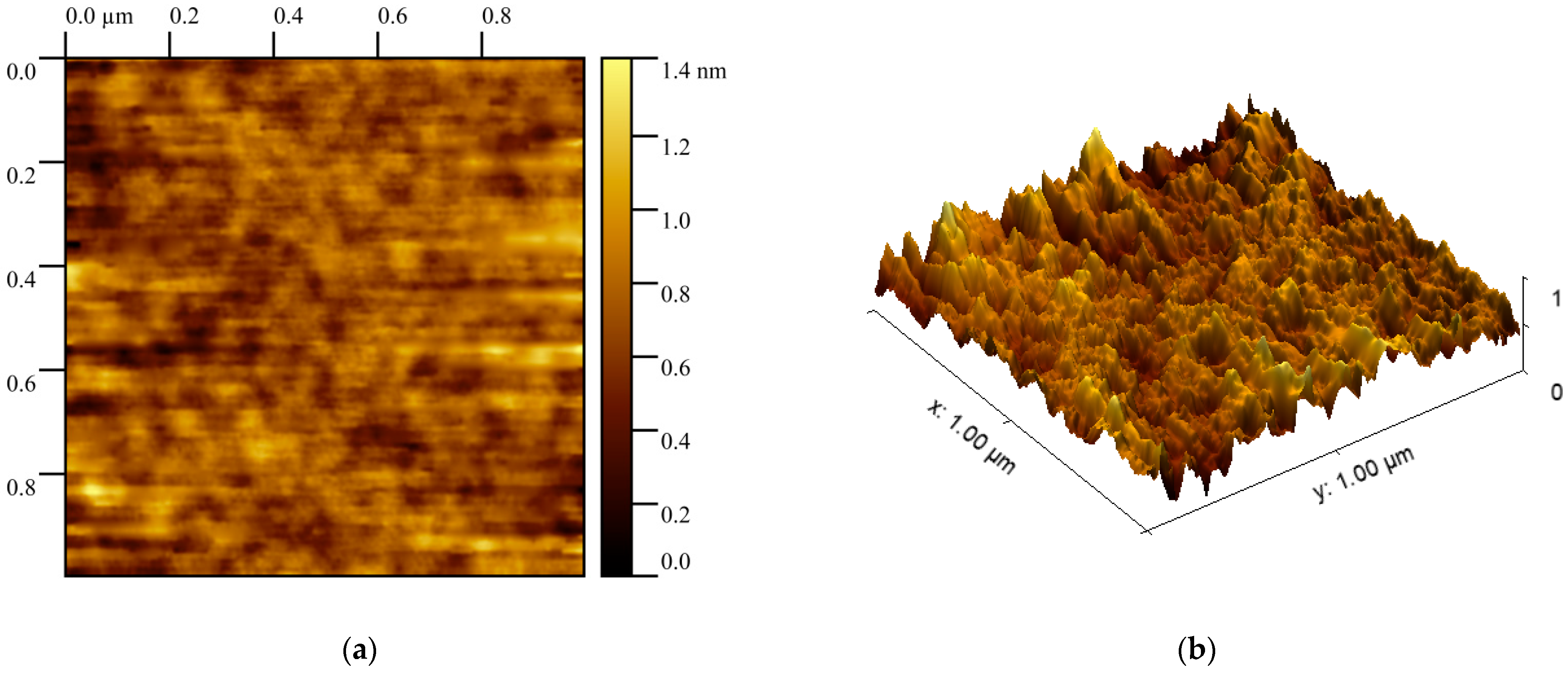
Figure 1 shows the topography (2D) and relief (3D) image of a niobium pentoxide film surface, obtained by atomic force microscopy. The figure shows that the oxide film does not have a granular structure. The height of the peaks and the depth of the valleys do not exceed 0.9 nm. This indicates the amorphous structure of the niobium pentoxide film, in accordance with previous studies [17,19].
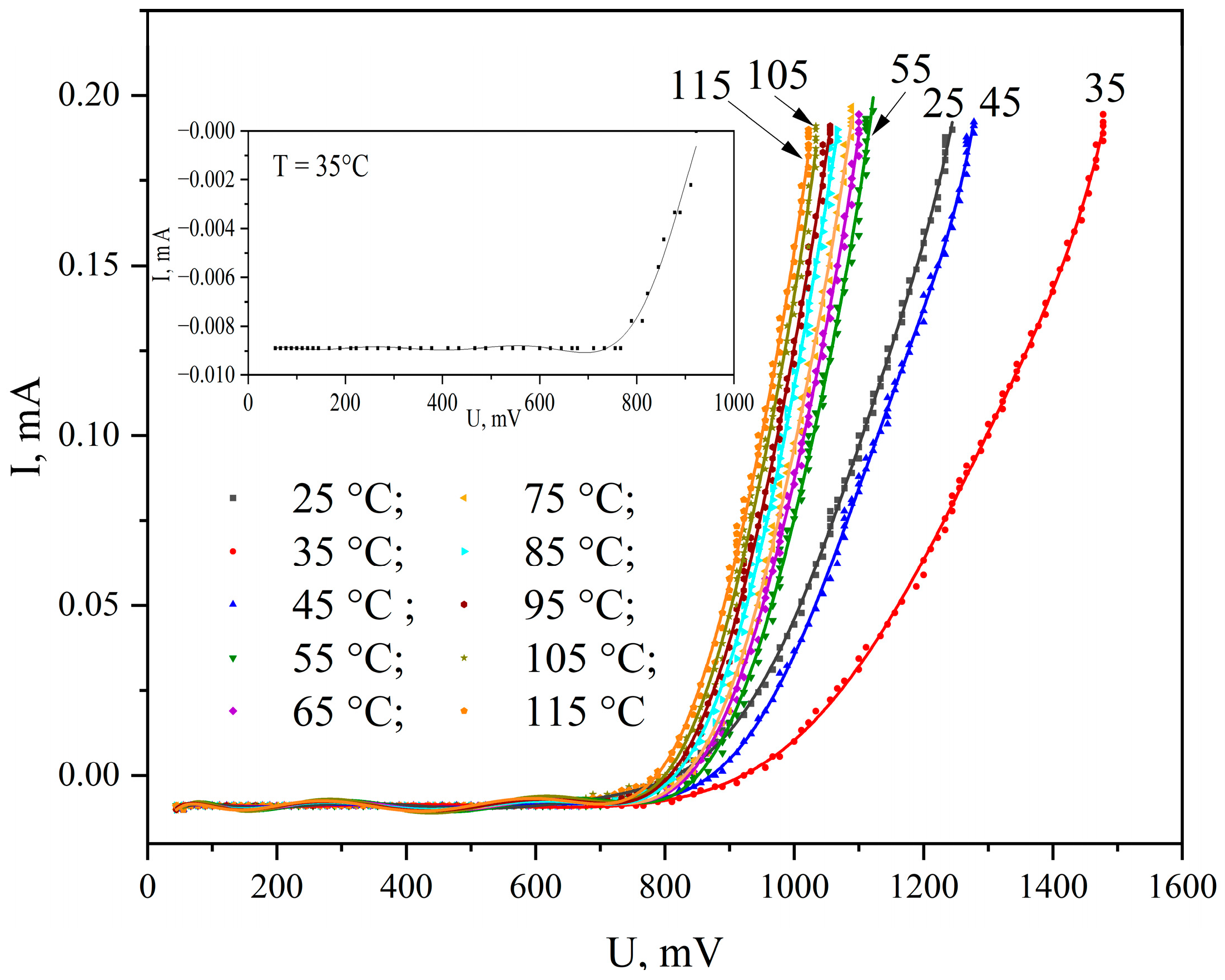
Figure 2 shows the I–V characteristics of the heavily doped n+-silicon (n+)/niobium oxide/aluminum structure measured in the temperature range of 25–115 °C. As can be seen from the figure, all I–V curves exhibit non-linear behavior, which is characteristic of current flow with a Schottky rectifying contact. Under forward bias at a voltage of about 700 mV, a current appears, which begins to change exponentially with increasing voltage.
In turn, if the voltage is less than 700 mV, only a negligible residual current flows in the MIM nanostructure. Moreover, even with significant changes in voltage, the residual current remains unchanged (inset in Figure 2).
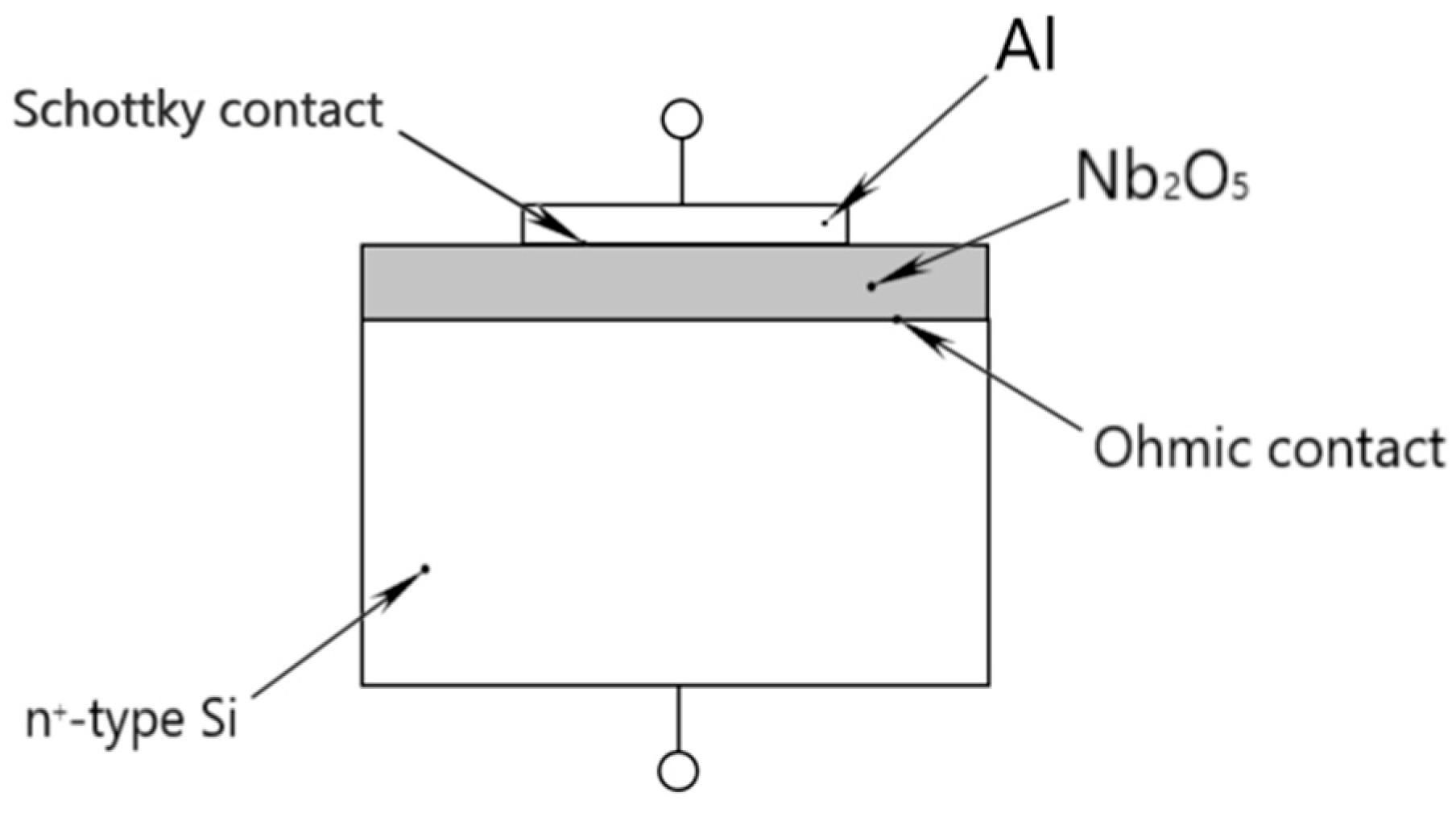
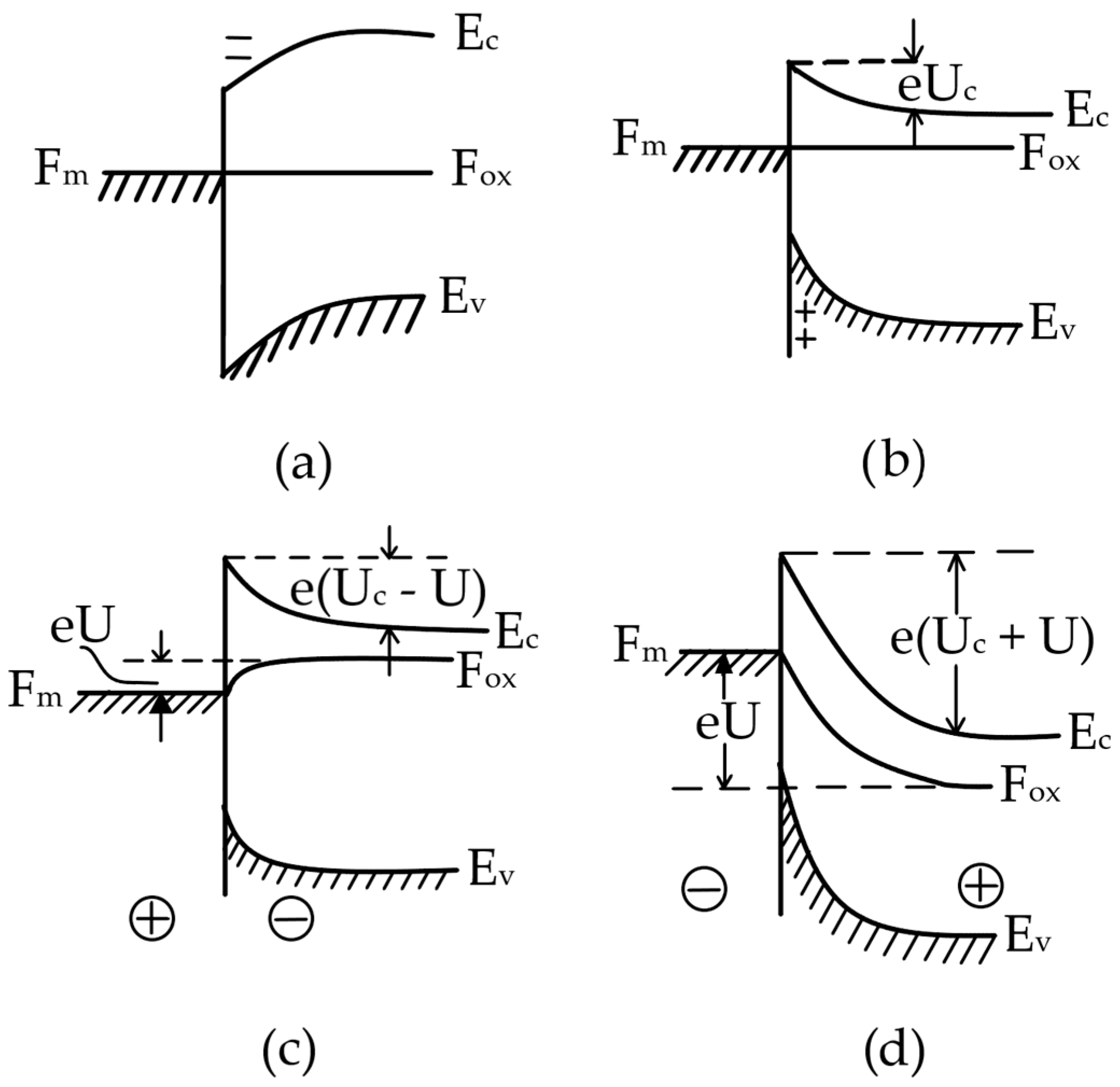
Let us consider the formation of potential barriers in the boundary regions of the oxide for the contacts of niobium pentoxide with a highly doped semiconductor (n+) and with aluminum (Figure 3).
When aluminum contacts niobium oxide, since the Fermi level in the oxide is higher than in aluminum, electrons begin to transfer from niobium pentoxide to aluminum. As a result, aluminum becomes negatively charged, while a positive charge appears on the niobium pentoxide due to uncompensated donors caused by the departure of conduction electrons into aluminum (Figure 4). On the niobium pentoxide side, a Schottky potential barrier will form.
In turn, when niobium pentoxide contacts a highly doped semiconductor (n+), since the Fermi level in niobium pentoxide is lower than in the highly doped semiconductor (n+), electrons will transfer from the semiconductor to niobium oxide. In the contact region of niobium oxide, an enriched layer with a negative charge will form, where the electron concentration is higher than in the bulk (Figure 4).
The formation of regions with different charge signs within niobium pentoxide is accompanied by the emergence of an internal electric field directed from the contact with aluminum (positive charge) to the contact with the highly doped semiconductor (n+) (negative charge). As can be seen from Figure 2, at a voltage of about 700 mV with the plus on aluminum, the external electric field completely compensates for the internal electric field in niobium oxide. This leads to a drop in the voltage across the Schottky barrier, resulting in the appearance of current upon further voltage increase. This voltage (V0), corresponding to the onset of current for each I–V curve, was used to plot the I–V curves in the new coordinates (V–V0), which were necessary for the analysis.
Thus, the non-linearity of the I–V characteristics is caused by the formation of a depletion layer in the contact region of niobium oxide. Therefore, when analyzing the I–V curves, we can focus solely on the aluminum/niobium pentoxide contact region, where the Schottky potential barrier arises.
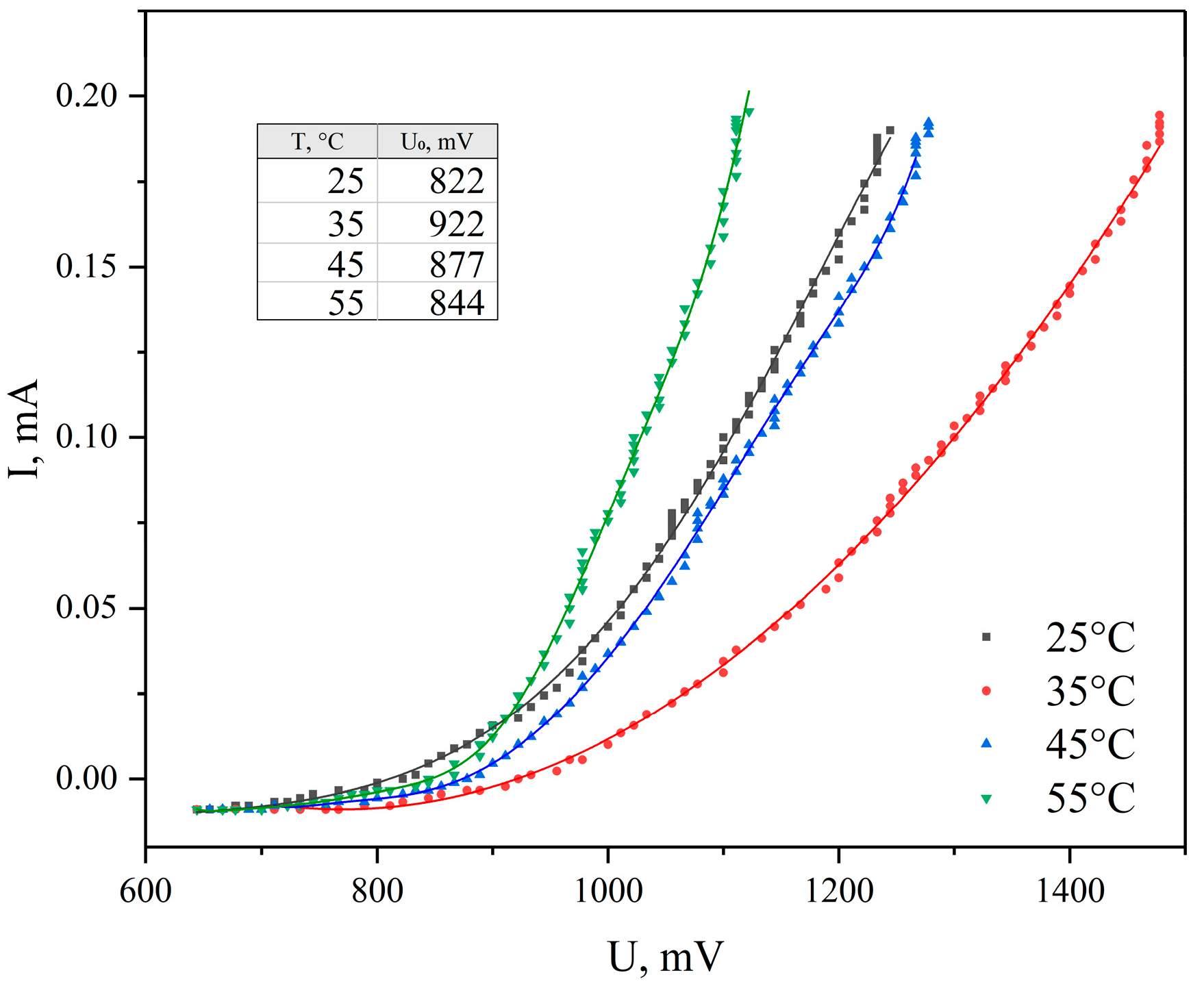
As seen in Figure 2, for temperatures of 25, 35, 45, and 55 °C, there is a strong temperature dependence of the I–V characteristics. This is typical for space-charge-limited currents (SCLC), as the degree of trap filling depends on temperature [20]. For temperatures above 55 °C, the nature of the I–V curves changes, and their behavior no longer shows such a strong temperature dependence. This indicates a change in the conduction mechanism within the niobium pentoxide film for temperatures above 55 °C.
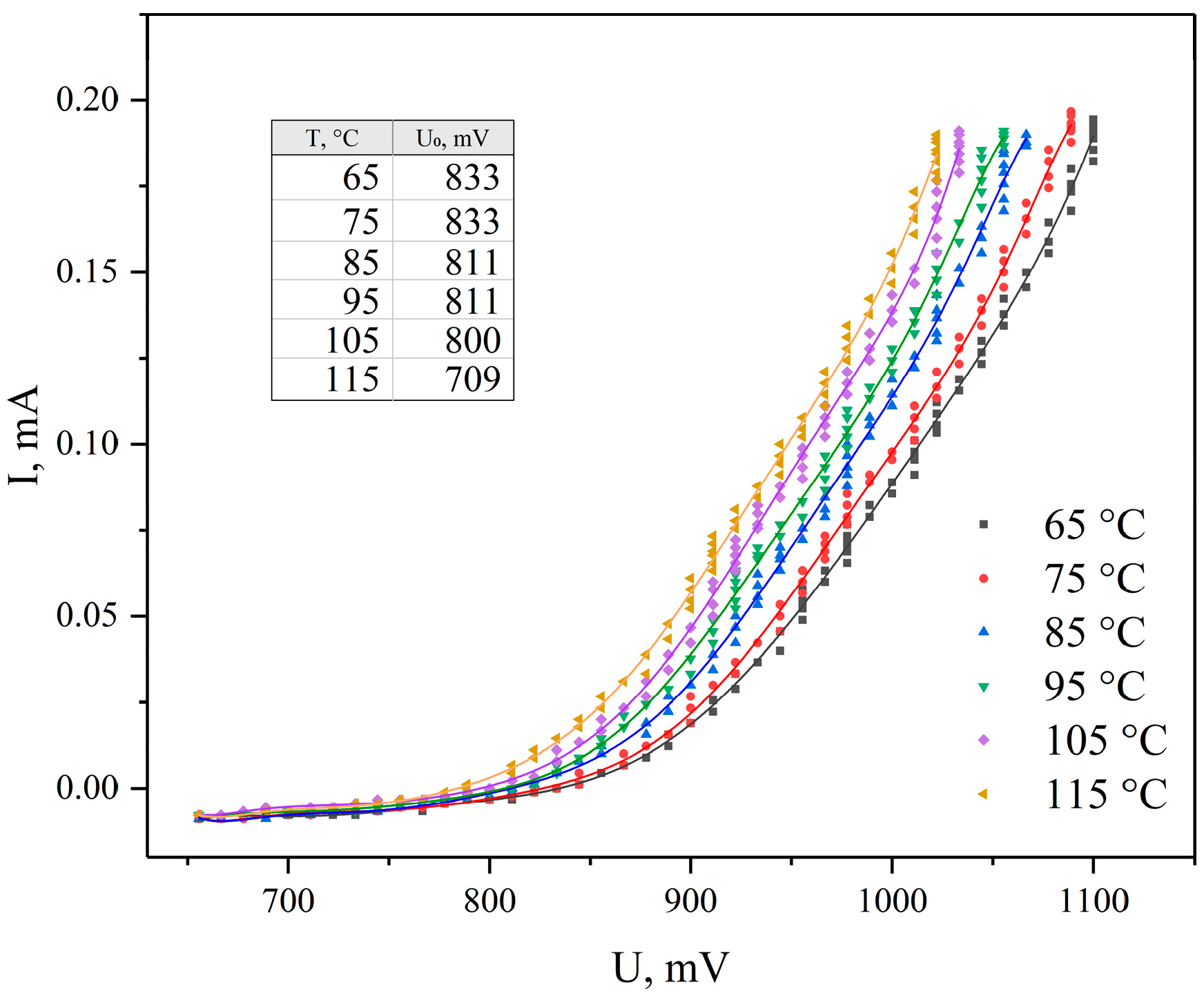
Therefore, in our work, the I–V curves depending on temperature were divided into two groups: Group 1—the temperature range from 25 °C to 55 °C (Figure 5), and Group 2—the temperature range from 65 °C to 115 °C (Figure 6).
When analyzing the I–V characteristics, it is important to consider that the current flow process through a rectifying contact depends strongly on how electrons traverse the Schottky barrier layer. If the electron mean free path, l, is greater than the width of the barrier layer, Lb, (l > Lb), then electrons pass through the Schottky barrier layer almost without collisions. In this case, the currents can be described by the thermionic emission model. This scenario corresponds to the I–V curve at 25 °C (Figure 5), where a small increase in forward voltage leads to a sharp rise in current.
If electrons experience numerous collisions within the Schottky barrier layer (l < Lb), then the current through the contact will be determined by the diffusion and drift motion of electrons. In the I–V characteristics, this occurs at elevated temperatures; in our experiment, such behavior emerges at temperatures of 35 °C and higher.
At low electric fields, the current density flowing through the thin oxide film is small and is typically described by Ohm’s law.
J = σ E = e n 0 μ U d ,
where J is the current density, σ is the electrical conductivity, E is the electric field strength, e is the elementary charge, n0 is the equilibrium concentration of free charge carriers, μ is the electron mobility, U is the applied voltage, and d is the film thickness.
According to Equation (1), for the Ohmic region of the I–V characteristics at the same applied voltage, the ratio of currents for different temperatures will correspond to the ratio of their mobilities.
Given that for T = 25 °C, U = 33.334 mV and I25 = 0.006667 mA, and for T = 35 °C, U = 33.334 mV and I35 = 0.00318 mA, we obtain the following relation for the ratio of electron mobilities:
μ 25 μ 35 = I 25 I 35 = 2.1
Thus, the electron mobility in the oxide film at 35 °C is approximately 2.1 times lower than that at 25 °C.
The behavior of the I–V characteristics in forward and reverse bias can be explained as follows. In the absence of an external voltage, the energy within the niobium pentoxide is lower relative to that of the heavily doped semiconductor. At equilibrium, the electron current flowing from the niobium pentoxide into the semiconductor equals the electron current flowing from the semiconductor into the niobium oxide, resulting in a net zero current. When a negative bias is applied to the niobium oxide, the potential barrier within the oxide decreases by eU. When the applied voltage reaches approximately 700 mV, the potential barrier decreases to such an extent that the current from the semiconductor side begins to increase. Meanwhile, the current from the oxide side remains unchanged due to the barrier on the semiconductor side. Consequently, a current flows from the semiconductor to the oxide, which increases rapidly with increasing voltage.
If the voltage is less than 700 mV, the Schottky potential barrier in the oxide increases, and the current from the oxide decreases. In this case, electrons from the oxide can hardly overcome the potential barrier, so the reverse current becomes independent of the external voltage (inset, Figure 2).
According to the thermionic emission theory, the current density for an applied voltage U is given by [21]
J = J s ( e x p   ( e U / k T ) 1 ) ,
Here, Js is the saturation current, U is the applied voltage, e is the elementary charge, kB is the Boltzmann constant, and T is the absolute temperature, where:
J s = A T 2 e x p   ( φ b / k T ,
Here, A is the Richardson constant, φb is the Schottky barrier height.
For moderately large forward bias voltages such that V > 3 kT/e, the second term in the expression for J is negligible, and it may be written as follows
J = A T 2 e x p   ( e U / k T ) · exp ( φ b / k T ) ,
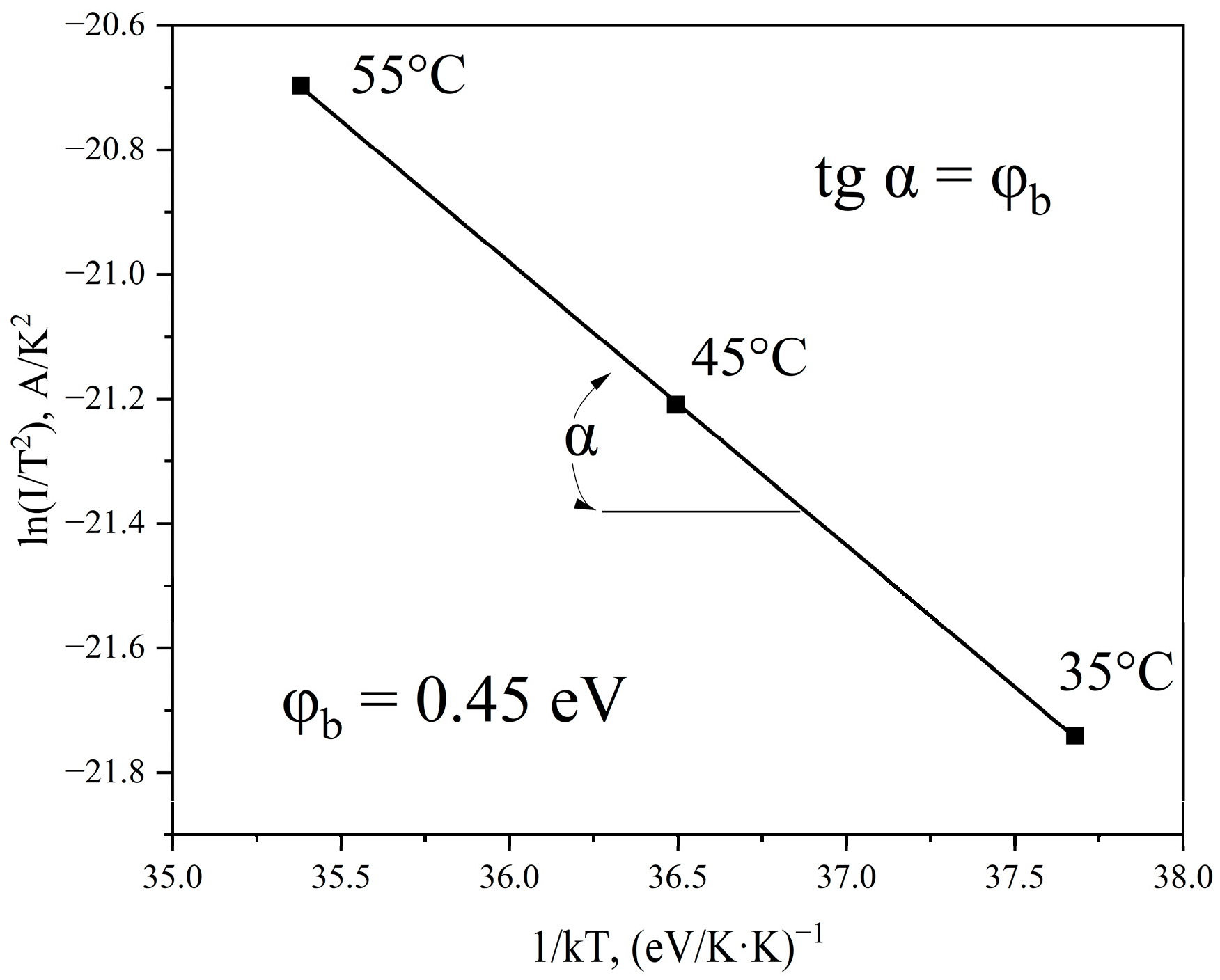
If the multiplier exp (eU/kT) = B is kept constant by selecting the appropriate voltage when the temperature changes, then Richardson’s straight-line method [22] can be used to determine the Schottky barrier height. Taking the logarithm of expression (4), the following expression can be obtained:
l n I T 2 = ln A · B   φ b k T ,
The plot of l n I T 2 = f 1 k T allows the effective Schottky barrier height to be determined from the slope of the resulting straight line (the Richardson plot). It is important to note that the pre-exponential factor in expression (4) does not affect the determination of φb.
For the calculations, three close temperatures were chosen: 35, 45, and 55 °C. On the I–V characteristics, the currents were determined at voltages of 0.181 V (35 °C), 0.188 V (45 °C), and 0.195 V (55 °C), which were selected to maintain a constant value of eU/kT (Figure 5).
Figure 7 shows the Richardson graph in coordinates of ln(I/T2) and (1/kT) plotted from the obtained data. As can be seen from Figure 6, the value of the effective Schottky barrier height for the Nb2O5–aluminum contact was φb = 0.45 eV.
Such a low value of the Schottky barrier may be associated with a high concentration of oxygen vacancies in Nb2O5 obtained by magnetron sputtering, and the proximity of the Fermi level to the conduction band minimum. This is crucial for enhancing the charge transport efficiency (or: current collection efficiency) of the transport layer, which is corroborated by the reported data for Nb2O5 and TiO2 in solar cell applications [16,18,23,24].
For comparison, the Schottky barrier heights of the semiconductor oxides TiO2 and Nb2O5 reported in the literature are presented in Table 1.
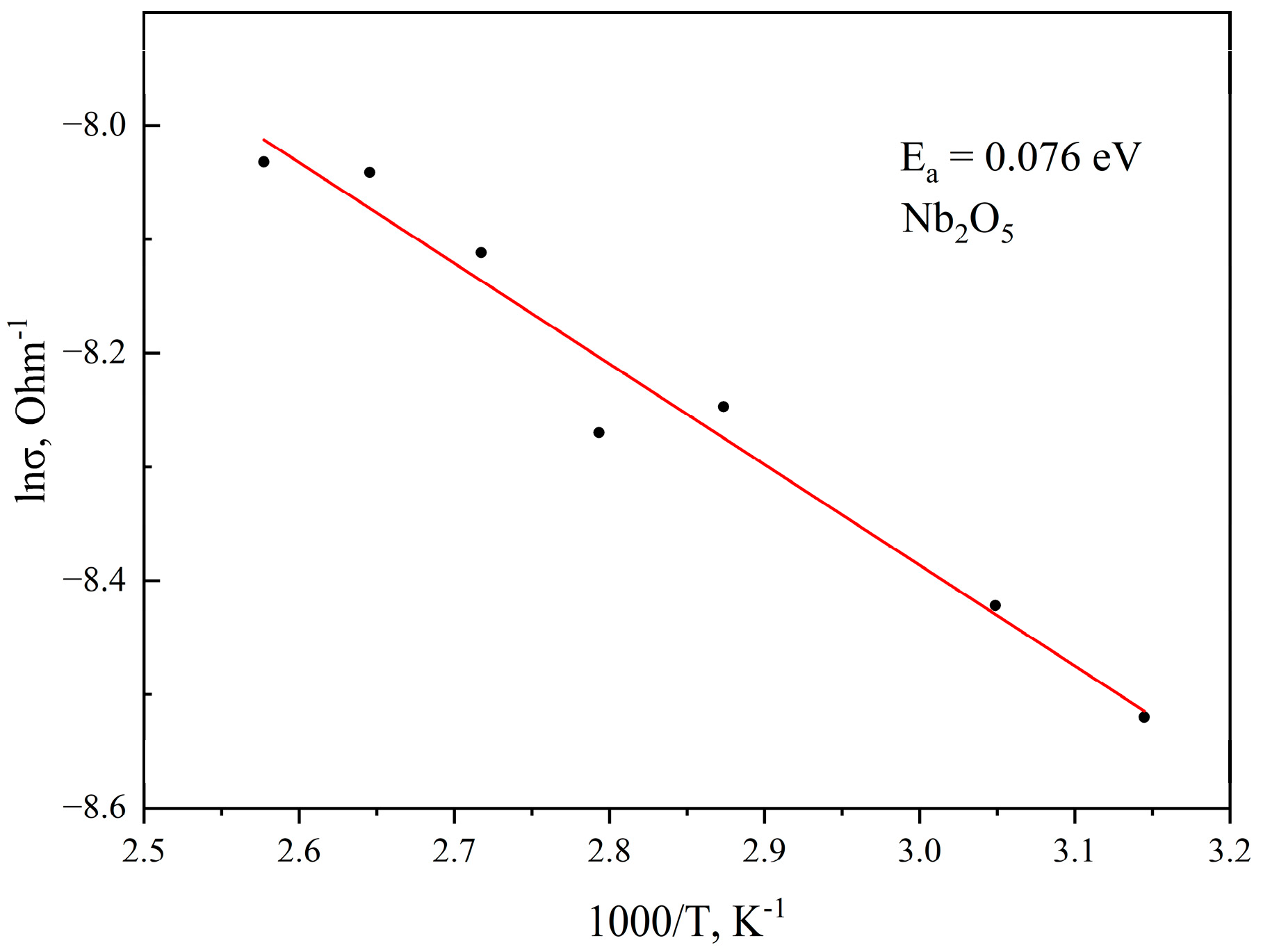
The Ohmic region of the I–V curves can be used to construct an Arrhenius plot of conductivity, since weak donor ionization occurs in the Ohmic region. Figure 8 shows the conductivity curve for the niobium pentoxide film in Arrhenius coordinates for temperatures starting from 35 °C. Resistance values for temperatures below 35 °C were not used for the Arrhenius plot because the electron mobility in the oxide films was higher at these temperatures. The resulting curve of the logarithm of conductivity versus temperature exhibits a typical shape characteristic of a donor semiconductor.
In oxide semiconductors such as TiO2 and Nb2O5, oxygen vacancies act as donors, increasing electrical conductivity. Therefore, the measured conductivity activation energy (Ea) corresponds to the activation energy of the oxygen vacancy.
The activation energy, determined from the slope of the conductivity curve as a function of inverse temperature, was Ea = 0.076 eV.
The obtained results are in good agreement with the activation energy reported for another oxide semiconductor, TiO2 Eₐ = 0.07–0.1 eV. This data supports the conclusion that the conduction mechanism is vacancy-mediated [9,28].
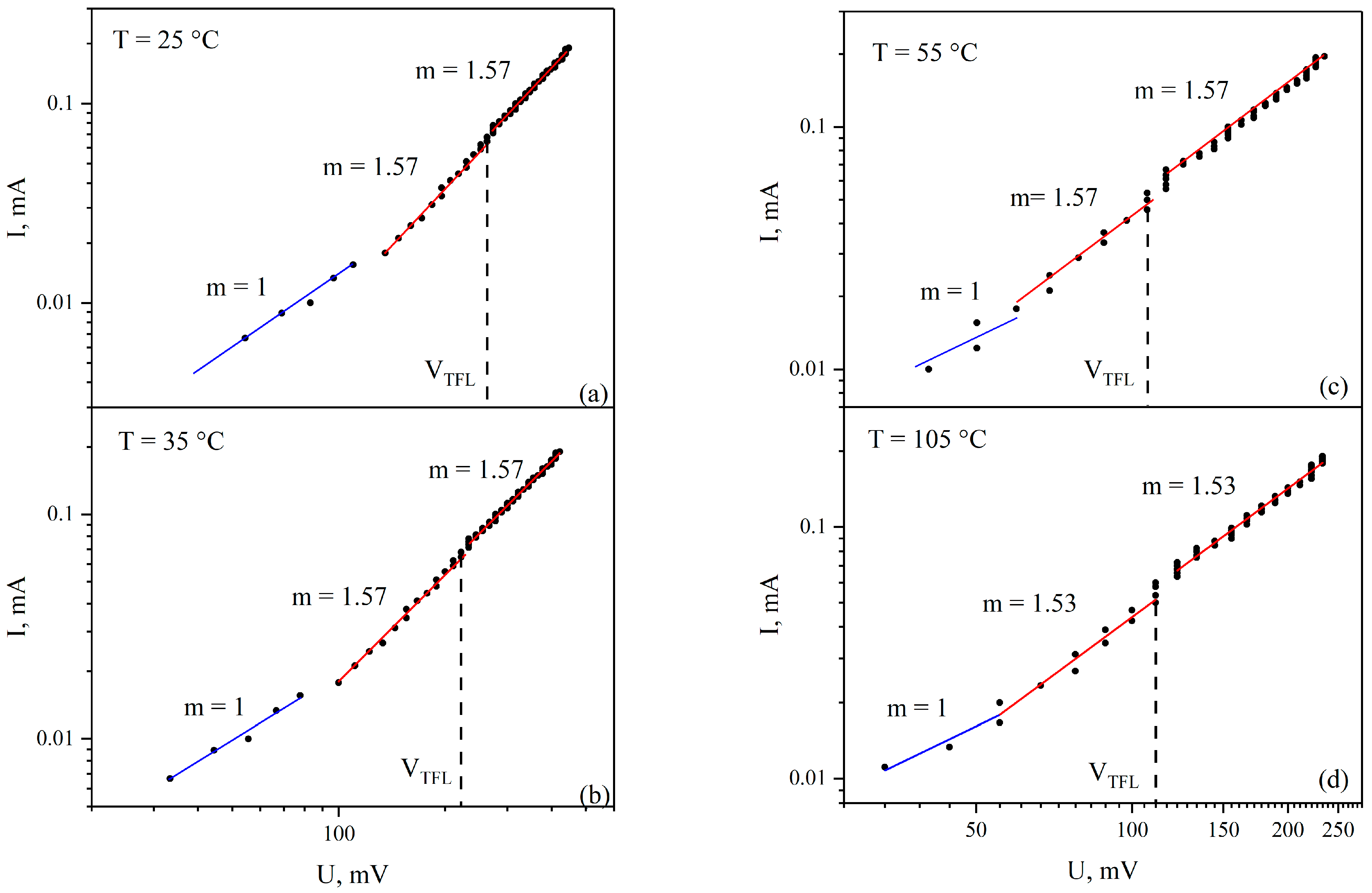
The dominant conduction mechanism can be determined by plotting I–V characteristics in coordinates that reveal linear segments corresponding to specific conduction mechanisms. Figure 9 shows the I–V curves of the heavily doped silicon (n+)–niobium pentoxide structure measured in the temperature range of 25–115 °C in logarithmic coordinates. As seen in Figure 9, regardless of sample temperature, two distinct regions can be identified on the forward I–V curves, each described by a power-law dependence of current on voltage IUm.
The first region has a slope m = 1. The second region has a slope of approximately m = 1.57. The first region with m = 1 corresponds to the low-field regime, where conductivity is independent of the electric field and follows Ohm’s law. The second region with m = 1.57 corresponds to the intermediate-field regime, where conduction is governed by injection SCLC. The SCLC mechanism is associated with the presence of trap levels within the bandgap of the oxide.
A slope of m = 1.57 in the second region, which is less than 2, indicates the presence of SCLC with traps exponentially distributed in energy within the bandgap.
At the trap-filled limit voltage (VTFL), a current jump is observed (Figure 9). Subsequently, the I–V characteristic follows a section corresponding to a trap-free space-charge-limited current (TFSCLC) with the same slope as the section for SCLC with unfilled traps. At voltages above VTFL, the injected electrons remain in the conduction band; consequently, the I–V curve is positioned higher.
The position of the Fermi level is determined by the degree of trap filling. All traps lying below the Fermi level will be filled with electrons, while those above it will be empty. Under electron injection, electrons in the oxide are captured by traps. Consequently, the Fermi level shifts toward the conduction band minimum, leading to a decrease in the activation energy for SCLC. Increasing temperature causes thermal activation of charge carriers from upper trap levels, resulting in a rise in current.
Starting from 55 °C, the I–V characteristics show weak temperature dependence, indicating a change in the conduction mechanism and a weakening of its connection with electron traps. This can be explained by electrons already possessing sufficient energy to transition from the upper trap level to the conduction band. Therefore, for temperatures above 55 °C, the I–V curves exhibit minimal temperature dependence.
The thermal energy, equal to kT at a given temperature, can excite electrons residing at the uppermost level of electron traps. From the obtained results, it is evident that at a temperature of 55 °C, electrons acquire thermal energy kT = 0.0291 eV, which is sufficient to promote them into the conduction band. Therefore, it can be assumed that the energy of the uppermost electron trap level in niobium pentoxide is approximately 0.029 ± 0.001 eV (this estimate takes into account the data obtained with a temperature step of 10 degrees). For temperatures of 25 °C, 35 °C, and 45 °C, the thermal energy kT equals 0.0257 eV, 0.0265 eV, and 0.0274 eV, respectively, which is insufficient to promote electrons into the conduction band.
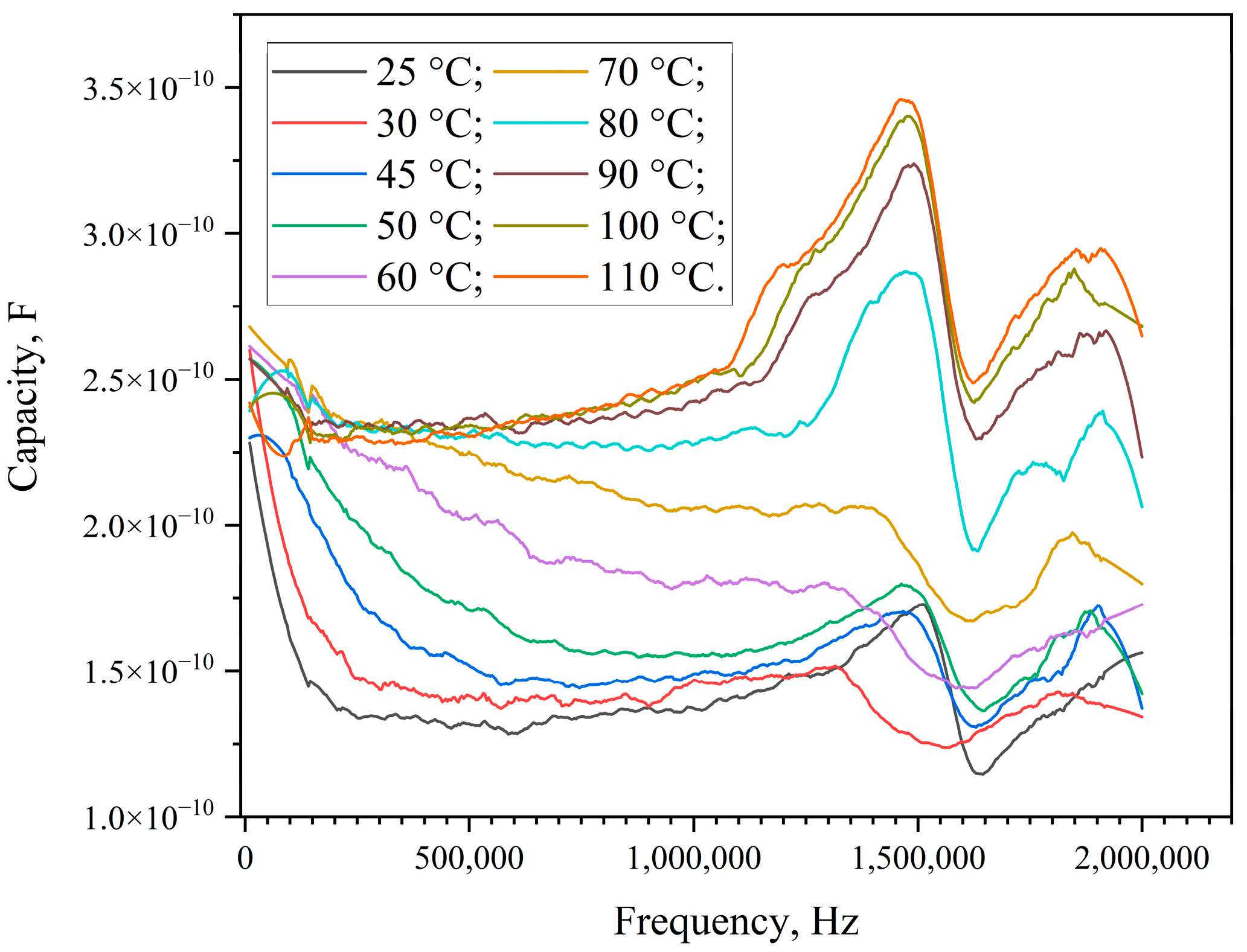
Figure 10 shows plots of capacitance versus frequency obtained for samples at different temperatures. As can be seen, for samples at temperatures of 80, 90, 100, and 110 °C in the frequency range from 150.0 kHz to 1.1 MHz, the capacitance of the MIM structure remains practically unchanged. For temperatures below 80 °C, a common feature for all samples is a decrease in capacitance with increasing frequency in the range from 50.0 kHz to 1.1 MHz. The most significant drop in capacitance is observed for samples at 25, 30, and 45 °C.
The obtained capacitance–frequency plots can be explained in terms of dipole-relaxation polarization in dielectrics, where electric dipoles are capable of reorienting in an external electric field [8]. At a frequency of 50 kHz, the capacitance of the MIM structure and the dielectric permittivity reach their maximum values and remain nearly constant for different sample temperatures.
This is because the permittivity of the dielectric in this case approaches its static dielectric constant. As the frequency of the electric field increases, the electric dipoles begin to lag behind the field. The frequency of the electric field exceeds the rate of thermal molecular oscillations, and the dipoles cannot reorient quickly enough during voltage polarity changes. Their rotation angle continuously decreases with increasing field frequency, leading to a drop in the permittivity value. At high frequencies (around 1.0 MHz), the rate of dipole orientation becomes so slow that the contribution of dipole-relaxation polarization approaches zero, and the dielectric polarization reduces to values associated with electronic polarization and elastic dipole displacement.
With increasing temperature, the lag of polarization behind the field frequency occurs at higher frequencies. Therefore, the region of decreasing permittivity shifts toward higher frequencies. At the same time, in dielectrics with relaxation polarization, the dielectric loss tangent exhibits a maximum at the relaxation frequency. The appearance of a maximum in the capacitance versus frequency plots at 1.45 MHz is caused by the peak in the dielectric loss tangent at the relaxation frequency. The observed curve shape is characteristic of a dielectric with a single relaxation time.
The relaxation time of dipole polarization is related to the frequency by the following expression:
τ = 1 2 π f 0 ,
Thus, the relaxation time of dipole polarization for niobium pentoxide films is 0.11 × 10⁻⁶ s.

4. Conclusions

The results of the topography and surface relief studies of niobium pentoxide films obtained by atomic force microscopy indicate that the films lack a granular structure. This confirms the amorphous nature of the Nb2O5 films. It has been demonstrated that the non-linearity of the I–V characteristics in the heavily doped silicon (n+)/niobium oxide/aluminum structure is caused by the formation of a depletion region in the contact area of niobium pentoxide. Therefore, the analysis of the I–V curves focused solely on the aluminum/niobium pentoxide contact region, where the Schottky potential barrier forms.
Based on the analysis of the I–V curves, it was concluded that for the sample at 25 °C, the electron mean free path exceeds the width of the Schottky barrier layer, allowing electrons to traverse this layer without collisions. At temperatures of 35 °C and higher, electrons undergo numerous collisions within the Schottky barrier layer, and the current through the contact is determined by the diffusion and drift motion of electrons. It was found that the electron mobility in the oxide film at 35 °C is 2.1 times lower than that at 25 °C.
Analysis of the I–V curves for temperatures of 35 and 45 °C allowed the determination of the Schottky barrier height at the niobium pentoxide/aluminum contact to be φb = 0.45 eV. Such a low Schottky barrier value may be attributed to a high concentration of oxygen vacancies in the magnetron-sputtered Nb2O5 and the proximity of the Fermi level to the conduction band minimum. Using the Ohmic region of the I–V curves for different temperatures, an Arrhenius plot of conductivity versus temperature was constructed. The shape of the obtained plot is characteristic of a donor semiconductor. The activation energy, derived from the Arrhenius plot of conductivity, was 0.076 eV.
It was shown that, regardless of sample temperature, two distinct regions can be identified on the I–V curves plotted in logarithmic coordinates, each described by a power-law dependence of current on voltage, IUm. The first region, with a slope m = 1, corresponds to the Ohmic regime. The second region has a slope of approximately m = 1.57, indicating the SCLC mechanism for injection currents.
Analysis of the I–V curve behavior revealed that the energy of the uppermost electron trap level in niobium pentoxide is approximately 0.029 ± 0.001 eV. The obtained capacitance versus frequency plots were explained using the concept of dipole-relaxation polarization in a dielectric, where electric dipoles can reorient in an external electric field. Based on this analysis, it was determined that the dipole polarization relaxation time for the niobium pentoxide films is 0.11 × 10⁻⁶ s.
Thus, the use of magnetron sputtering to produce amorphous niobium pentoxide films has led to a reduction in the effective Schottky barrier height to 0.45 eV. This enables high electron injection density at low voltages when using such an oxide semiconductor as an electron transport layer, thereby potentially increasing the efficiency of solar cells.

Author Contributions

Conceptualization, I.A.V. and V.A.M.; methodology, I.A.V. and V.A.M.; software, I.A.V., V.A.M. and V.B.B.; validation, E.N.M., V.A.M. and I.A.V.; formal analysis, I.A.V., A.I.M. and D.A.K. (Danila A. Kavalenka); investigation, I.A.V., E.N.M., A.Y.G. and S.E.P.; resources, D.A.K. (Dmitry A. Kozodaev) and V.B.B.; data curation, E.N.M.; writing—original draft preparation, I.A.V.; writing—review and editing, E.N.M.; visualization, I.A.V., A.Y.G. and D.A.K. (Danila A. Kavalenka); supervision, E.N.M.; project administration, V.A.M.; funding acquisition, V.A.M. and D.A.K. (Dmitry A. Kozodaev). All authors have read and agreed to the published version of the manuscript.

Funding

Investigations of surface morphology were carried out using an NTEGRA PRIMA™ microscope, supported by NT-MDT BV, The Netherlands. This research was funded by the Belarusian Republican Foundation for Fundamental Research grant number F25B-011.

Data Availability Statement

The original contributions presented in this study are included in the article. Further inquiries can be directed to the corresponding author.

Conflicts of Interest

Author Dmitry A. Kozodaev was employed by the company NT-MDT BV. The remaining authors declare that the research was conducted in the absence of any commercial or financial relationships that could be construed as a potential conflict of interest.

Abbreviations

The following abbreviations are used in this manuscript:
SCLCSpace-Charge Limited Conduction
TFLTrap-filled limit
MIMMetal–Insulator–metal
I–VCurrent–voltage characteristics

References

  1. Ryabko, A.; Ovezov, M.; Tuchkovsky, A.K.; Korepanov, O.; Maximov, A.; Komolov, A.; Lazneva, E.; Muratova, E.; Vrublevsky, I.; Aleshin, A. Synthesis, Structure, and Optoelectronic Properties of a Hybrid Organic–Inorganic Perovskite with a Monoethanolammonium Cation MAxMEA1−xPbI3. Nanomaterials 2025, 15, 494. [Google Scholar] [CrossRef] [PubMed]
  2. Kim, J.Y.; Lee, J.-W.; Jung, H.S.; Shin, H.; Park, N.G. High-Efficiency Perovskite Solar Cells. Chem. Rev. 2020, 120, 7867–7918. [Google Scholar] [CrossRef] [PubMed]
  3. Moshnikov, V.A.; Muratova, E.N.; Vrublevsky, I.A.; Maximov, A.I.; Bessonov, V.B.; Parfenovich, S.E.; Tuchkovsky, A.K.; Kozodaev, D.A. Charge Carrier Transport and Localized States in Graphite-like Amorphous Carbon Films at Room Temperatures. Materials 2025, 18, 3977. [Google Scholar] [CrossRef] [PubMed]
  4. Nenashev, G.V.; Aleshin, A.N.; Ryabko, A.A.; Shcherbakov, I.P.; Moshnikov, V.A.; Muratova, E.N.; Kondratev, V.M.; Vrublevsky, I.A. Effect of barium doping on the behavior of conductivity and impedance of organic-inorganic perovskite films. Solid State Commun. 2024, 388, 115554. [Google Scholar] [CrossRef]
  5. Rong, Y.; Hu, Y.; Mei, A.; Tan, H.; Saidaminov, M.I.; Seok, S.I.; McGehee, M.D.; Sargent, E.H.; Han, H. Challenges for commercializing perovskite solar cells. Science 2018, 361, eaat8235. [Google Scholar] [CrossRef]
  6. Correa-Baena, J.-P.; Saliba, M.; Buonassisi, T.; Grätzel, M.; Abate, A.; Tress, W.; Hagfeldt, A. Promises and challenges of perovskite solar cells. Science 2017, 358, 739–744. [Google Scholar] [CrossRef]
  7. Guerrero, A.; Bisquert, J.; Garcia-Belmonte, G. Interfacial Degradation of Perovskite Solar Cells: The Role of Charge Selective Layers. ACS Energy Lett. 2021, 6, 1006–1014. [Google Scholar] [CrossRef]
  8. Nico, C.; Monteiro, T.; Graça, M.P.F. Niobium oxides and niobates physical properties: Review and prospects. Prog. Mater. Sci. 2016, 80, 1–37. [Google Scholar] [CrossRef]
  9. Gagarina, A.Y.; Bezverkhniy, V.P.; Muratova, E.N.; Moshnikov, V.A.; Vrublevsky, I.A.; Tuchkovsky, A.K.; Lushpa, N.V. Preparation and properties of nanoscale titanium dioxide film for transport layer of n-type photovoltaic cell. Semiconductors 2024, 58, 545–593. [Google Scholar]
  10. Yang, G.; Tao, H.; Qin, P.; Ke, W.; Fang, G. Recent progress in electron transport layers for efficient perovskite solar cells. J. Mater. Chem. A 2016, 4, 3970–3990. [Google Scholar] [CrossRef]
  11. Kogo, A.; Numata, Y.; Ikegami, M.; Miyasaka, T. Nb2O5 blocking layer for high open-circuit voltage perovskite solar cells. Chem. Lett. 2015, 44, 829–830. [Google Scholar] [CrossRef]
  12. Rani, R.A.; Zoolfakar, A.S.; O’Mullane, A.P.; Austin, M.W.; Kalantar-Zadeh, K. Thin films and nanostructures of niobium pentoxide: Fundamental properties, synthesis methods and applications. J. Mater. Chem. A 2014, 2, 15683–15703. [Google Scholar] [CrossRef]
  13. Kelly, P.J.; Arnell, R.D. Magnetron sputtering: A review of recent developments and applications. Vacuum 2000, 56, 159–172. [Google Scholar] [CrossRef]
  14. Al-Baradi, A.M.; El-Nahass, M.M.; Hassanien, A.M.; Atta, A.A.; Alqahtani, M.S.; Aldawsari, A.O. Influence of RF sputtering power on structural and optical properties of Nb2O5 thin films. Optik 2018, 168, 853–863. [Google Scholar] [CrossRef]
  15. Foroughi-Abari, A.; Cadien, K.C. Growth, structure and properties of sputtered niobium oxide thin films. Thin Solid Film 2011, 519, 3068–3073. [Google Scholar] [CrossRef]
  16. Shen, D.; Zhang, W.; Li, Y.; Abate, A.; Wei, M. Facile Deposition of Nb2O5 Thin Film as an Electron-Transporting Layer for Highly Efficient Perovskite Solar Cells. ACS Appl. Nano Mater. 2018, 1, 4101–4109. [Google Scholar] [CrossRef]
  17. Chen, K.-N.; Hsu, C.-M.; Liu, J.; Liou, Y.-C.; Yang, C.-F. Investigation of Antireflection Nb2O5 Thin Films by the Sputtering Method under Different Deposition Parameters. Micromachines 2016, 7, 151. [Google Scholar] [CrossRef]
  18. Fernandes, S.L.; Albano, L.G.; Affonço, L.J.; da Silva, J.H.; Longo, E.; Graeff, C.F. Exploring the Properties of Niobium Oxide Films for Electron Transport Layers in Perovskite Solar Cells. Front. Chem. 2019, 7, 50. [Google Scholar] [CrossRef]
  19. Hossain, N.; Güneş, O.; Zhang, C.; Koughia, C.; Li, Y.; Wen, S.; Wong, R.; Kasap, S.O.; Yang, Q. Structural and physical properties of NbO2 and Nb2O5 thin films prepared by magnetron sputtering. J. Mater. Sci. Mater. Electron. 2019, 30, 9822–9835. [Google Scholar] [CrossRef]
  20. Moshnikov, V.A.; Muratova, E.N.; Vrublevsky, I.A.; Maximov, A.I.; Ryabko, A.A.; Gagarina, A.Y.; Kozodaev, D.A. Electrical properties and charge transfer mechanisms innanoscale anodic tio2 films at low applied voltages. Inorganics 2026, 14, 29. [Google Scholar] [CrossRef]
  21. Rhoderick, E.H. The physics of Schottky barriers. J. Phys. D 1970, 3, 1153–1167. [Google Scholar] [CrossRef]
  22. Werner, J.H.; Güttler, H.H. Barrier inhomogeneities at Schottky contacts. J. Appl. Phys. 1991, 69, 1522–1533. [Google Scholar] [CrossRef]
  23. Ou, J.Z.; Rani, R.A.; Ham, M.H.; Field, M.R.; Zhang, Y.; Zheng, H.; Reece, P.; Zhuiykov, S.; Sriram, S.; Bhaskaran, M.; et al. Elevated Temperature Anodized Nb2O5: A Photoanode Material with Exceptionally Large Photoconversion Efficiencies. ACS Nano 2012, 6, 4045–4053. [Google Scholar] [CrossRef]
  24. Ling, X.; Yuan, J.; Liu, D.; Wang, Y.; Zhang, Y.; Chen, S.; Wu, H.; Jin, F.; Wu, F.; Shi, G.; et al. Room-Temperature Processed Nb2O5 as the Electron Transporting Layer for Efficient Planar Perovskite Solar Cells. ACS Appl. Mater. Interfaces 2017, 9, 23181–23188. [Google Scholar] [CrossRef]
  25. Zhang, X.; Cai, W.; Zhang, J.; Brownless, J.; Wilson, J.; Zhang, Y.; Song, A. Solution-Processed TiO2-Based Schottky Diodes With a Large Barrier Height. IEEE Electron Device Lett. 2019, 40, 1378–1381. [Google Scholar] [CrossRef]
  26. Sun, Z.; Fang, Y. Electrical tuning effect for Schottky barrier and hot-electron harvest in a plasmonic Au/TiO2 nanostructure. Sci. Rep. 2021, 11, 338. [Google Scholar] [CrossRef]
  27. Khairir, N.S.; Abdul Rani, R.; Ab Kadir, R.; Soin, N.; Abdullah, W.F.; Mamat, M.H.; Rusop, M.; Zoolfakar, A.S. Electrical Behavior of a Nanoporous Nb2O5/Pt Schottky Contact at Elevated Temperatures. J. Electron. Mater. 2018, 47, 7462–7469. [Google Scholar] [CrossRef]
  28. Mardare, D.M.; Rusu, G. Electrical conduction mechanism in polycrystalline titanium oxide thin films. J. Non-Cryst. Solids 2010, 356, 1395–1399. [Google Scholar] [CrossRef]
Figure 1. Image of the topography (2D) (a) and relief (3D) (b) of the niobium pentoxide film surface obtained by atomic force microscopy.
Applnano 07 00008 g001
Figure 2. I–V characteristics of the MIM structure with a 50 nm thick niobium pentoxide film. Sample temperatures: 25, 35, 45, 55, 65, 75, 85, 95, 105, and 115 °C. Inset-enlarged view of the reverse branch of the I–V characteristic.
Applnano 07 00008 g002
Figure 3. Schematic representation of an MIM structure with nanoscale-thickness niobium oxide.
Applnano 07 00008 g003
Figure 4. Energy band diagrams for the silicon (n+)/niobium pentoxide contact and the aluminum/niobium pentoxide contact under different bias voltages: (a) n+-silicon (n+)/niobium pentoxide contact, aluminum/niobium pentoxide contact under (b) U = 700 mV, (c) U > 700 mV, (d) U < 700 mV.
Applnano 07 00008 g004
Figure 5. I–V characteristics of an MIM structure with a 50 nm thick niobium pentoxide film. Sample temperatures: 25, 35, 45, and 55 °C.
Applnano 07 00008 g005
Figure 6. I–V characteristics of an MIM structure with a 50 nm thick niobium pentoxide film. Sample temperatures: 65, 75, 85, 95, 105, and 115 °C.
Applnano 07 00008 g006
Figure 7. Richardson plot in the coordinates of ln(I/T2) versus 1/kT for the MIM structure with a 50 nm thick niobium pentoxide film for sample temperatures of 35, 45, and 55 °C.
Applnano 07 00008 g007
Figure 8. Conductivity logarithm versus temperature curve for an MIM structure with a 50 nm thick niobium pentoxide film.
Applnano 07 00008 g008
Figure 9. I–V characteristics of MIM structures with a 50 nm thick niobium pentoxide film in double logarithmic coordinates. Sample temperatures: 25 °C (a), 35 °C (b), 55 °C (c), and 105 °C (d).
Applnano 07 00008 g009
Figure 10. Capacitance versus frequency plots obtained for an MIM structure with a 50 nm thick niobium pentoxide film at different temperatures.
Applnano 07 00008 g010
Table 1. Experimental Schottky barrier height data for TiO2 and Nb2O5 semiconductor oxides.
ElectrodeSemiconductorSchottky Barrier Height (eV)Synthesis MethodSource
AgTiO20.85Solution-based deposition[25]
Pt1.05
1.14–1.23
Si0.73
Au0.8DC Reactive Sputtering.[26]
PtNb2O50.91–1.05Sol–gel process[27]
Al0.45Magnetron
Sputtering
This work
Disclaimer/Publisher’s Note: The statements, opinions and data contained in all publications are solely those of the individual author(s) and contributor(s) and not of MDPI and/or the editor(s). MDPI and/or the editor(s) disclaim responsibility for any injury to people or property resulting from any ideas, methods, instructions or products referred to in the content.