Article

A Scanning Focal-Point Method for Enhancing the Signal Stability of Laser-Induced Acoustic Communication


National and Local Joint Engineering Research Center of Space Optoelectronics Technology, Changchun University of Science and Technology, Changchun 130022, China
*
Author to whom correspondence should be addressed.
Optics 2026, 7(3), 44; https://doi.org/10.3390/opt7030044
Submission received: 16 April 2026 / Revised: 15 June 2026 / Accepted: 16 June 2026 / Published: 18 June 2026
(This article belongs to the Section Laser Sciences and Technology)

Abstract

Laser-induced acoustic communication is a highly adaptable cross-medium technique that combines the advantages of optical transmission through air and acoustic transmission underwater. However, poor signal stability at high repetition frequencies currently hinders its widespread application. To address this, this paper proposes an innovative scanning focal-point method to enhance stability. Traditional methods such as beam scanning, focus control, and distributed interaction are primarily aimed at enhancing sound pressure in a specific direction, achieving near-field/far-field focusing, or improving the signal-to-noise ratio through coherent synthesis of ultrasonic intensity. In contrast, the method proposed in this paper is intended to avoid the interference of droplets and vapor generated by single-point breakdown under high repetition frequencies, which would otherwise degrade the laser-acoustic conversion efficiency. It is therefore an active defense strategy specifically targeting the stability of laser-induced acoustic communication. First, optical simulation software was used to analyze the effects of surface ripples and bubbles on focal spot displacement and size. Next, a single-pulse experimental system was developed to measure the range and duration of surface depressions caused by optical breakdown. Finally, a scanning focal-point system was constructed for comparative experiments, with results recorded via hydrophones and high-speed cameras. The maximum laser-induced acoustic signal generated by the scanning focal-point method is 7.4 times that produced by single-point breakdown. The experimental results demonstrate that the scanning focal-point method can effectively avoid the influence of water surface disturbance and steam on the optoacoustic conversion efficiency and significantly improve the amplitude and stability of the laser-induced acoustic signal.

1. Introduction

The fundamental principle of the laser-induced acoustic (LIA) effect involves directing a laser into a liquid or solid medium. Upon absorbing the laser energy, the medium undergoes energy conversion, causing rapid pressure fluctuations under various effects, which generates acoustic signals. Laser-induced acoustic communication is a contactless information transmission technology that leverages this effect. It capitalizes on the low attenuation characteristics of both atmospheric optical channels and underwater acoustic channels. Compared to Very Low Frequency and Ultra Low Frequency communications, it features smaller transceiver devices and better mobility. Unlike traditional underwater sonar communication, it enables cross-medium communication. Furthermore, compared to buoy-based communication, it requires no pre-deployment of buoy devices and is immune to ocean currents. In summary, cross-medium air-water communication holds immense application potential and promising prospects in both military and civilian sectors [1].
Following early research on laser plasma shockwaves [2], Peng et al. [3] achieved a communication rate of up to 80 bps. Wang et al. [4] theoretically determined a maximum LIA communication rate of 1949 bps after measuring pulse duration. However, their studies only considered the duration of a single laser acoustic signal, failing to account for whether surface disturbances and water vapor, which are generated by long-term laser focusing at a single point under high-repetition-rate, high-energy laser irradiation, would affect the LIA effect.
In experiments conducted by Blackmon [5] using a 200 Hz repetition rate laser, signal loss was observed during repetitive irradiation at a fixed point. Their team speculated that water vapor generated during the acoustic signal generation process failed to diffuse sufficiently in time, thereby affecting the laser energy incident into the water. Additionally, in the communication experiments detailed in Huang Jinxin’s thesis [6], the bit error rate surged sharply when the laser repetition rate exceeded 100 Hz, making it difficult to ensure the reliability of the laser communication process at high repetition rates. In 2018, Fei Zhigang et al. [7] applied the Sato algorithm to equalize frequency-modulated laser acoustic signals, thereby improving the opto-acoustic communication performance. In 2023, Wang Shaofeng [8] investigated joint coding modulation for laser communication using LDPC and MPPM codes. Subsequently, Chen Yingnan et al. [9] proposed a novel LIA communication method based on Pulse Width Modulation to address signal recognition issues at high repetition rates. Their experiments demonstrated that a communication rate of 130 bps could be achieved at a laser repetition rate of 400 Hz, with a Bit Error Rate of 8%. This provides a highly reliable modulation and demodulation method for the application of high-repetition-rate LIA communication technology. While many studies have been conducted to improve the stability of LIA communication, no researcher has yet proposed a solution involving the scanning focal-point method.
Traditional methods have largely focused on improving signal stability through modulation but have not fundamentally resolved the signal instability at high repetition rates. This paper proposes a scanning focal-point method that effectively avoids signal loss caused by high-repetition-rate LIAs at the source. To address the issue of signal instability as the laser repetition rate increases, the impact of surface disturbances induced by laser pulses on laser convergence was analyzed. This study conducted LIA experiments under conditions of both single-point breakdown and scanning focal-points, providing a comparative analysis of the acoustic effects. For the first time, this study demonstrates that scanning laser focal-points can enhance the amplitude of LIA signals without altering the laser repetition rate. This approach allows the signal to be better distinguished from noise, thereby ensuring the stability of the laser communication link. Unlike traditional coding methods, this approach solves the signal instability caused by high repetition rates at the source, offering a new method for enhancing the stability of LIA communication.

2. Materials and Methods

The process of LIA communication involves focusing a laser beam underwater through a converging lens. Upon absorbing the pulsed laser energy, the local water pressure changes due to various effects, facilitating an energy conversion that transforms optical pulses into underwater acoustic signals. These signals are subsequently received by a hydrophone and decoded to retrieve the transmitted information.

2.1. Comparison of Laser-Induced Acoustic Mechanisms

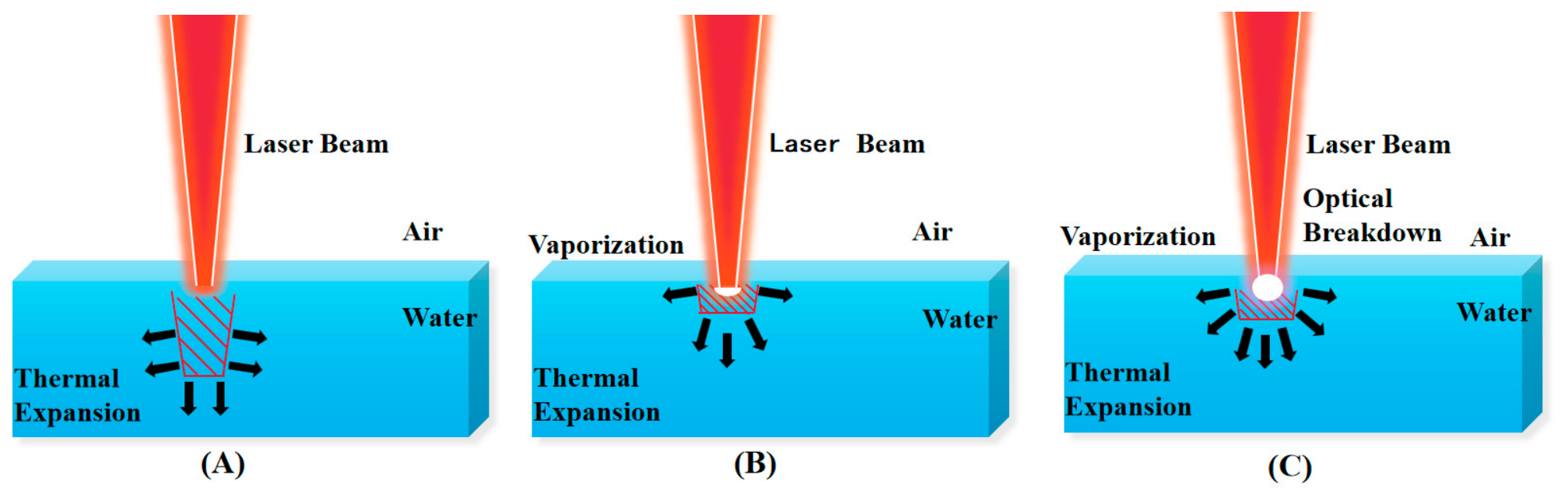
As the power density of the incident laser increases, thermal expansion of water, vaporization, and ionization occur sequentially within the laser focal region. These three phenomena correspond to the thermoelastic mechanism, the vaporization mechanism, and the optical breakdown mechanism, respectively, as illustrated in Figure 1. All three mechanisms induce drastic pressure fluctuations in the water to generate oscillating acoustic signals, with the laser-acoustic conversion efficiency increasing in the aforementioned order.
The thermoelastic mechanism is the most accessible, yet its laser-acoustic conversion efficiency remains below 10−4. The vaporization mechanism occurs alongside thermal expansion and requires a slightly higher incident power density, achievable when the peak density reaches 5 × 10⁸ W/cm2 [10]. Under these conditions, water within the focal region vaporizes, yielding a laser-acoustic conversion efficiency of approximately 10−3 to 10−2. The optical breakdown mechanism requires the power density within the focal region to be sufficiently high to ionize the water. This generates free electrons that continue to absorb energy and collide with surrounding particles, triggering a chain reaction [11]. This mechanism offers the highest laser-acoustic conversion efficiency, ranging from 7% to 30% [12,13]. Furthermore, simulations have demonstrated that acoustic signals generated via optical breakdown using high-energy-density lasers remain detectable at distances of hundreds of meters [14], indicating its suitability for long-range transmission. However, the acoustic generation process via optical breakdown is not an isolated event but a complex phenomenon dominated by optical breakdown and vaporization accompanied by thermal expansion, which results in slightly inferior signal stability.
In the optical breakdown mechanism investigated in this study, the LIA signal is primarily formed by the superposition of three combined mechanisms. Initially, the water vapor and plasma generated by the combined action of the three mechanisms expand to form a cavitation bubble. Subsequently, the water vapor and plasma further absorb laser energy, causing the bubble to expand rapidly and resulting in a swift increase in local pressure. Driven by the pressure difference between the interior and exterior, the bubble volume continues to expand, leading to a continuous decrease in its internal pressure. Due to the inertia of the water, the bubble volume continues to increase even after the internal and external pressures reach equilibrium. This expansion persists until the pressure differential causes the expansion velocity to decelerate continuously, eventually resulting in collapse. In the final stage of the collapse, the water flow converges and impacts the center of the bubble, generating another rapid pressure change that produces an acoustic signal pulse. During this generation process, the water flow at the breakdown location undergoes multiple oscillations, forming an acoustic pulse with a duration significantly longer than the width of the laser pulse. According to studies by Gao [15] and Markus [16], the duration of laser acoustic signals ranges from approximately 10 ns to several hundred ns, which is sufficient to achieve very high communication rates.

2.2. Experimental Investigation of Single Laser Breakdown

Temporal and Spatial Characteristics of Single-Pulse Laser Impact on Water Surface

Based on the research by Zhao [17], an Nd:YAG laser with a wavelength of 1064 nm was selected. The selection of the laser pulse width was based on the study by Yellaiah and Kiran [18], whose findings indicated that nanosecond-level laser pulses generate acoustic pulses with higher energy.
To prevent surface disturbances from interfering with subsequent laser propagation paths, it is essential to first determine the duration and spatial extent of the disturbances caused by laser breakdown. The experimental setup was constructed as follows: A 1064 nm laser with a single-pulse energy of 100 mJ and a pulse width of 10 ns was expanded and focused into a glass tank filled with water. A high-speed camera, operating at 1000 frames per second, was aligned with the breakdown region to continuously capture the entire lifecycle of a laser-induced cavitation bubble, from its formation to its final disappearance.
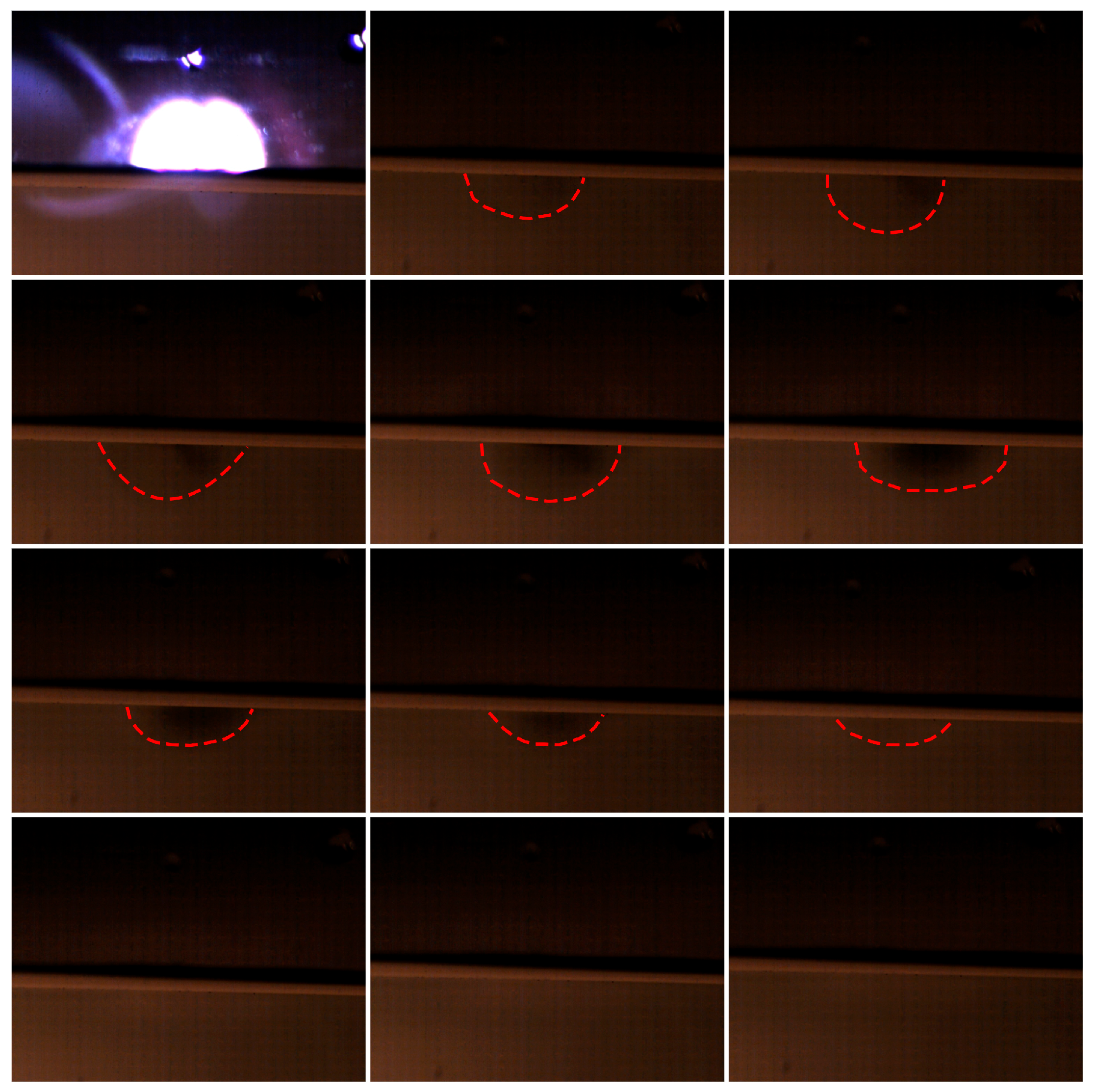
The results are shown in Figure 2. It can be observed that when the laser enters the water surface, optical breakdown occurs, generating a bright plasma. Driven by the combined effects of plasma expansion and water vaporization, a cavitation bubble forms within the water. This bubble expands to its maximum volume and then undergoes rapid collapse until it completely vanishes. This process induces drastic fluctuations in local pressure near the laser focal point, thereby generating an underwater acoustic signal.
Based on the experimental results, the entire process—from the onset of optical breakdown and bubble formation to the complete disappearance of the bubble—lasts approximately 9 ms. Therefore, if the laser focuses on the same location, the repetition rate should not exceed 111 Hz. Otherwise, the surface depression caused by the cavitation bubble from the previous pulse would alter the size of the subsequent focal spot in the water. This would affect the energy density of the focal spot and consequently impact the laser-acoustic conversion efficiency for the next laser incidence.
Using the aforementioned high-speed camera and experimental setup, the spatial extent of the surface depression caused by optical breakdown was also measured. It was observed that the depression occurs after the ionization of the water and approximates a semi-elliptical shape, with the major axis aligned along the water surface and the minor axis perpendicular to it. Throughout the recovery process, the horizontal movement is slow, whereas the vertical recovery is fast.
H real = S pix × H pix × D f
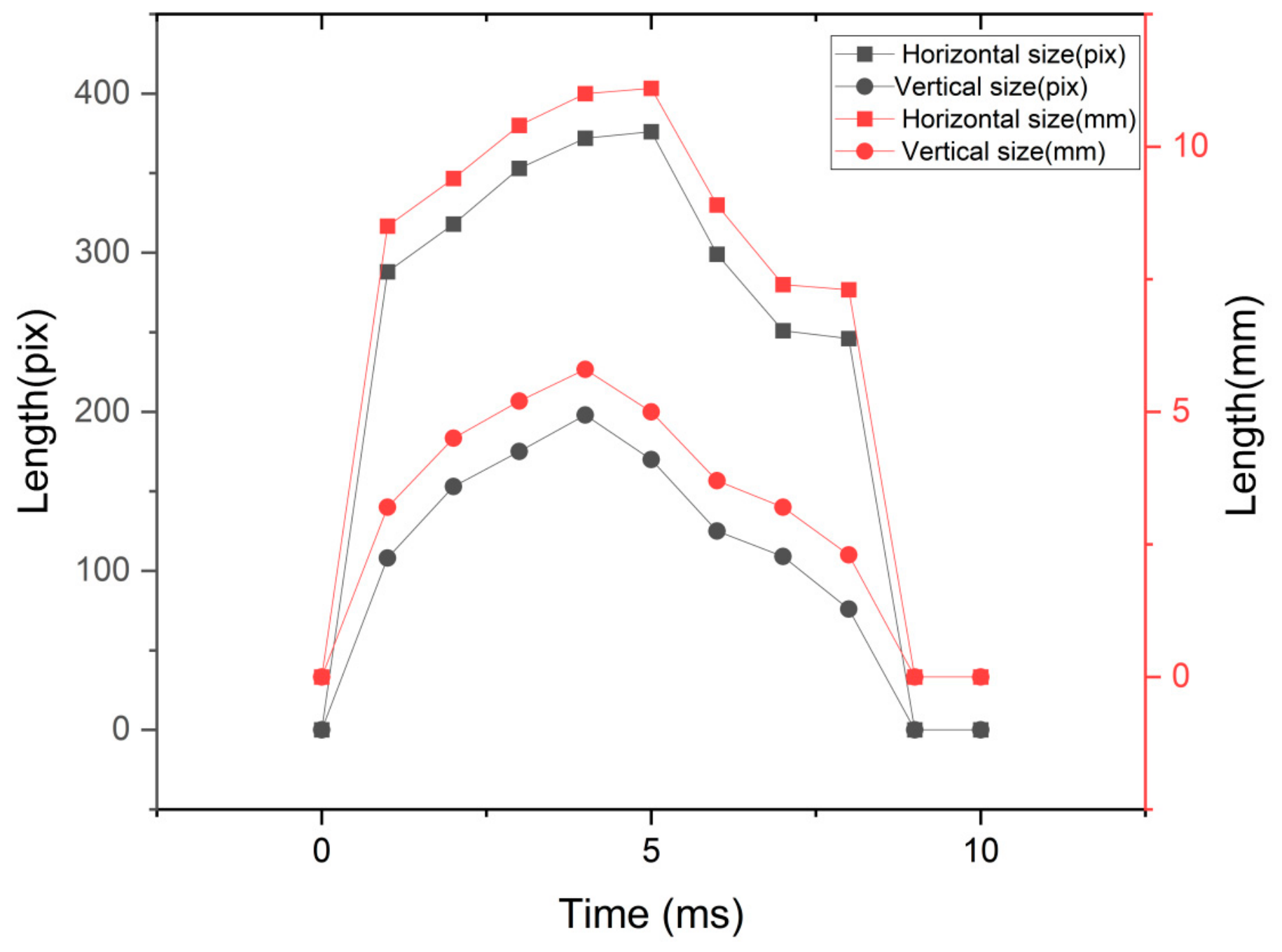
here, Hreal represents the actual object height, Spix is the pixel size, Hpix denotes the image height, D is the object distance, and f is the focal length of the lens. In the conducted experiment, Spix was 7.8 μm, f was 50 mm, and D was approximately 19 cm. Based on the shooting distance, camera focal length, and resolution, calculations were performed on 12 selected photographs to obtain the results of the surface depression range, as shown in Figure 3.
When the surface depression reached its maximum depth at 4 ms, the horizontal diameter and depression depth were 11.0 mm and 5.8 mm, respectively. When the surface depression range was at its maximum, the horizontal diameter and depth were approximately 11.1 mm and 5.0 mm, respectively. Since the bubble completely disappears 9 ms after laser incidence, based on the pulse duration and the single-pulse disturbance range, a distance of more than 12 mm between the current incidence point and the previous one ensures that subsequent laser incidences are not affected by the surface fluctuations generated by the preceding laser.

2.3. Effect of Surface Disturbances on Laser Convergence

When the power density is sufficient to induce optical breakdown and the laser focal point remains stationary, the continuous expansion and collapse of cavitation bubbles at a fixed underwater location generate surface ripples and small bubbles near the water surface above the focal point, disturbing the surface. Prolonged laser irradiation of the fixed spot can also cause water splashing. The intrusion of cavitation bubbles or surface ripples into the optical path alters the propagation of the converging laser beam underwater, ultimately resulting in variations in the position and size of the focal spot. Furthermore, when splashed droplets enter the optical path, they cause scattering of the laser energy and may even induce optical breakdown above the water surface.
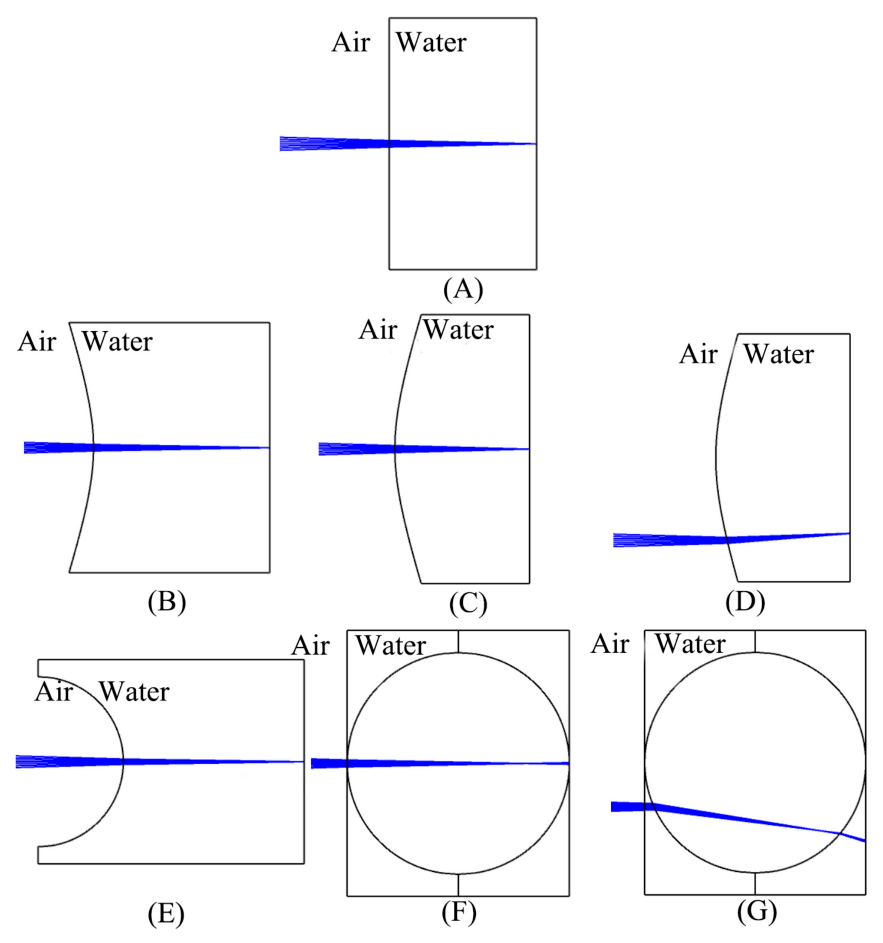
To analyze the impact of surface ripples and bubbles on laser convergence, optical simulations were conducted using ZEMAX 2023 R1.00 to model the propagation of the converging laser beam through these disturbances, as illustrated in Figure 4. In the simulation, the laser beam first passes through a beam expander, yielding a spot size of 12 mm × 6 mm. The beam then passes through a converging lens made of H-K9L glass with a focal length of 200 mm and a numerical aperture (NA) of 0.0635. Given that the refractive index of water is 1.324, the beam is finally focused underwater. The simulations evaluated changes in the optical path, focal spot position, and focal spot size.
High-speed camera observations revealed that tiny ripples form on the water surface during laser breakdown. In single-point breakdown experiments, prolonged laser irradiation also generates bubbles with a radius of approximately 2.5 mm. Accordingly, we conservatively established a surface ripple model with a height of 0.6 mm and a curvature radius of 5 mm, as well as a spherical cavitation bubble model with a radius of 2.5 mm. The interior of the bubbles is assumed to be air with a refractive index of 1. A preliminary sensitivity analysis was conducted for ripples and bubbles of different sizes.
The variations in focal spot position, RMS spot size, and Airy disk radius are presented in Table 1. The sensitivity analysis results for the curvature radius of ripples and the radius of bubbles are listed in Table 2 and Table 3, respectively. The RMS spot radius is a parameter used to quantify beam dispersion. It is calculated by squaring the distance from each light ray to the reference point, computing the average of these squared values, and then taking the square root.
As indicated by the simulation results, when the generated cavitation bubbles or ripples enter the optical path of the converging laser, the profile of the air-water interface is altered. Consequently, the laser propagation path changes after passing through the disturbed surface, leading to a vertical shift in the focal position and an expansion of the spot size. The focused spot size can significantly expand, which leads to a substantial reduction in the theoretical power density. Since laser-acoustic conversion efficiency decreases as laser energy density drops [19], the intensity of the generated acoustic signal is consequently reduced.
According to Table 1, when passing through different regions of a cavitation bubble with a radius of 2.5 mm and a ripple with a curvature radius of 5 mm, the minimum spot size in water is always smaller than the Airy disk size. When the laser passes through a wave crest, the Airy disk radius reaches its minimum of 18.87 μm; when it passes through a ruptured cavitation bubble, the Airy disk radius reaches its maximum of 33.38 μm, which is 1.77 times the minimum value. Its power density is 2.857 × 10 11 W/cm2. With increasing ripple curvature radius, both the spot size and the Airy disk radius exhibit opposite trends depending on the ripple region: they increase after passing through the wave crest, but decrease after passing through the wave slope or trough. Using the laser parameters from previous experiments (single pulse energy 100 mJ, pulse width 10 ns), the maximum Airy disk radius is 29.19 μm, corresponding to a minimum laser power density of 3.74 × 10¹¹ W/cm2. As the bubble radius increases, the Airy disk radius at any position within the bubble exhibits a decreasing trend. The maximum Airy disk radius reaches 85.4 μm. Based on the laser parameters, the calculated laser power density of 4.37 × 10¹⁰ W/cm2, which indicates a significant reduction in power density. Furthermore, when the laser passes through an eccentric bubble, the beam cannot be effectively focused, resulting in energy dispersion and a significant reduction in power density. From the perspective of laser optical power density alone, all cases satisfy the condition of exceeding the breakdown threshold and are therefore capable of triggering optical breakdown.
The absorption of laser energy by water vapor and plasma inside the bubble, together with the spot expansion caused by water surface disturbances, jointly reduces the energy density at the focal point. Additionally, when the laser passes through a disturbed water surface, a vertical shift in the focal position occurs. Because the change in optical path length in water is only on the order of millimeters, the attenuation due to water absorption is negligible. Compared with the reduction in power density caused by spot expansion and by the presence of vapor/plasma within the cavitation bubble, the contribution of water absorption is insignificant. Therefore, this study neglects power-density changes induced by water absorption.
In addition, sensitivity analysis shows that changes in the curvature radius of the ripples have little effect on the laser focusing performance, which remains within the diffraction limit. However, when the converging laser passes through cavitation bubbles of different radii, it causes significant expansion of the spot size.

2.4. LIA Generation System with the Scanning Focal-Point Method

2.4.1. Principle of LIA Systems Based on the Scanning Focal-Point Method

To address the issue of signal instability caused by repetitive laser breakdown at a single point, a strategy of the scanning focal-point across the water surface was adopted. This approach avoids the negative effects of surface disturbances, droplet splashing, and water vapor on laser convergence, thereby ensuring the stability of the laser-induced acoustic signals.
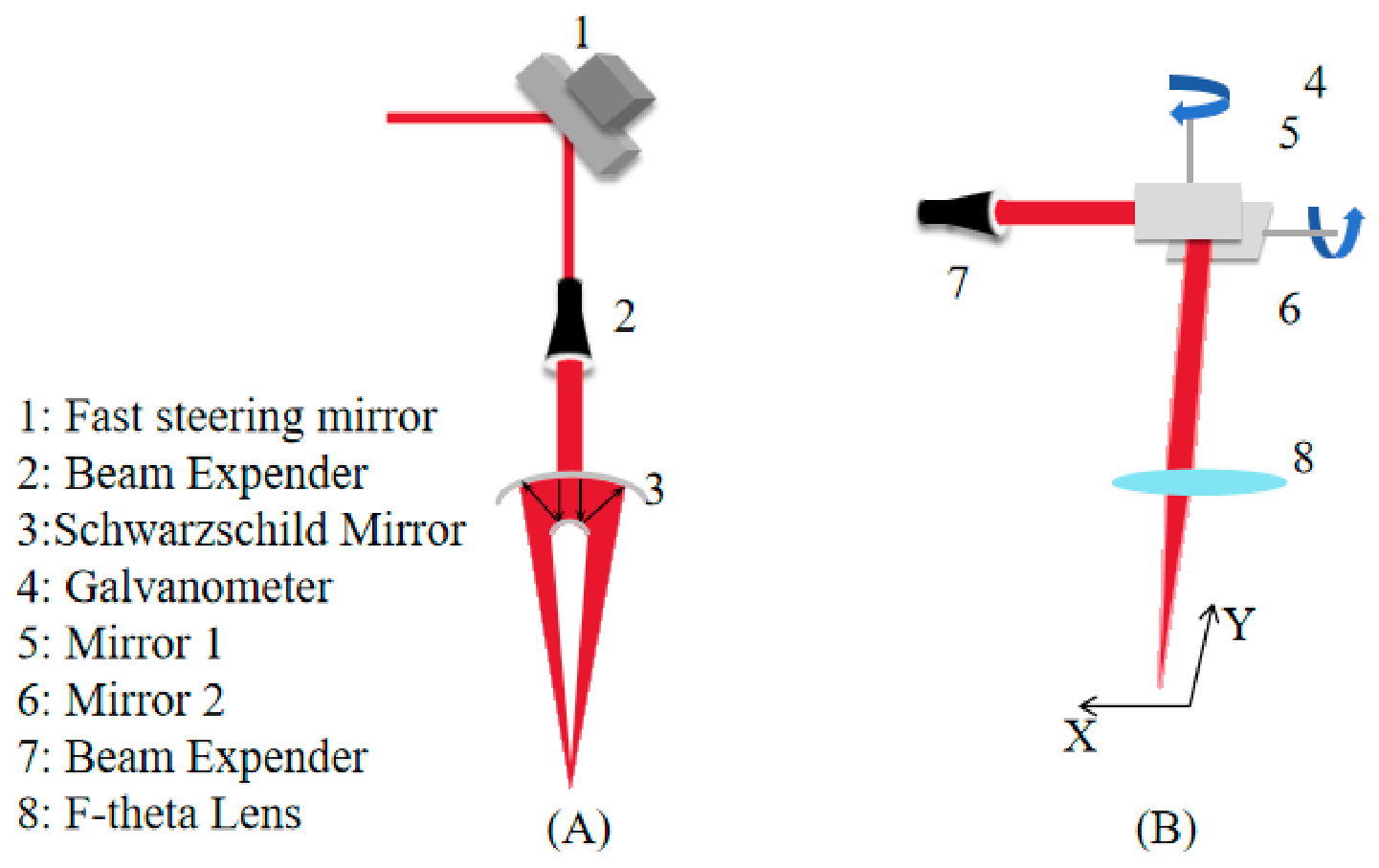
The specific system improvements are as follows: For long-distance scenarios, a 2D galvanometer or a fast steering mirror (FSM) combined with a Schwarzschild mirror is used to alter the emission angle. For short-distance scenarios, a 2D galvanometer combined with an F-theta lens is employed to maintain a consistent focal height across different deflection angles. These configurations are illustrated in Figure 5A and Figure 5B, respectively.
According to the aforementioned experimental results, the cavitation bubble formed under optical breakdown lasts for approximately 9 ms, with an influence range of less than 12 mm. This implies that the spacing between adjacent laser focal points must be greater than 12 mm.
Common laser spot distribution patterns include circular, raster, spiral, and rosette arrangements. Among these, the circular pattern is selected due to its favorable axial symmetry and compatibility with the subsequent circular aperture optical system.
The triggering method we adopted is equal time-interval triggering. The FSM parameters are preset, then the laser is turned on to emit laser pulses, and the FSM provides equal spacing for adjacent laser landing points. In this control strategy, a FSM directs the beam to scan a circular area with a radius of 32.5 mm at a linear speed of 2042 mm/s, and the laser is triggered once every 10 ms. During this interval, the arc length scanned by the FSM is 20.42 mm. The actual focal spots are discrete, and the distance between two adjacent laser impact points is slightly larger than 20 mm. Under a fixed laser repetition rate, an increase in the scanning linear velocity enlarges the spacing between adjacent laser focal points. The scanning velocity and the trigger time interval together determine the arc length spacing between consecutive impact points, while the scanning radius determines the curvature of the circular scanning trajectory.
The F-theta lens we used (focal length f = 254 mm, scan angle max ± 25°) is designed to ensure consistency of spot size and focal plane position at different field angles within the focal plane: F-Theta distortion < 0.05 (%), field curvature < 0.25 mm.
The optical system was imported into the optical simulation software Zemax 2023 R1.00, and focused spots were simulated at field angles of 0°, 3°, 5°, 7°, and 10°. The resulting RMS spot radii were 2.106 μm, 3.219 μm, 5.174 μm, 7.728 μm, and 12.386 μm, respectively, showing a gradual increase. At the maximum field angle, the RMS radius increased to approximately 5.88 times the minimum value. However, even under the largest spot size, the energy density reached 2.075 × 10⁴ J/cm2 and the power density reached 2.075 × 10¹² W/cm2, exceeding the breakdown threshold. At a scanning radius of 32.5 mm, the corresponding half field angle is 7.33°. In this case, the laser energy density is higher than 2.075 × 10¹² W/cm2. This indicates that stable optical breakdown can still be achieved when the distance between two adjacent laser impact points is 20 mm.

2.4.2. Comparative Experimental System

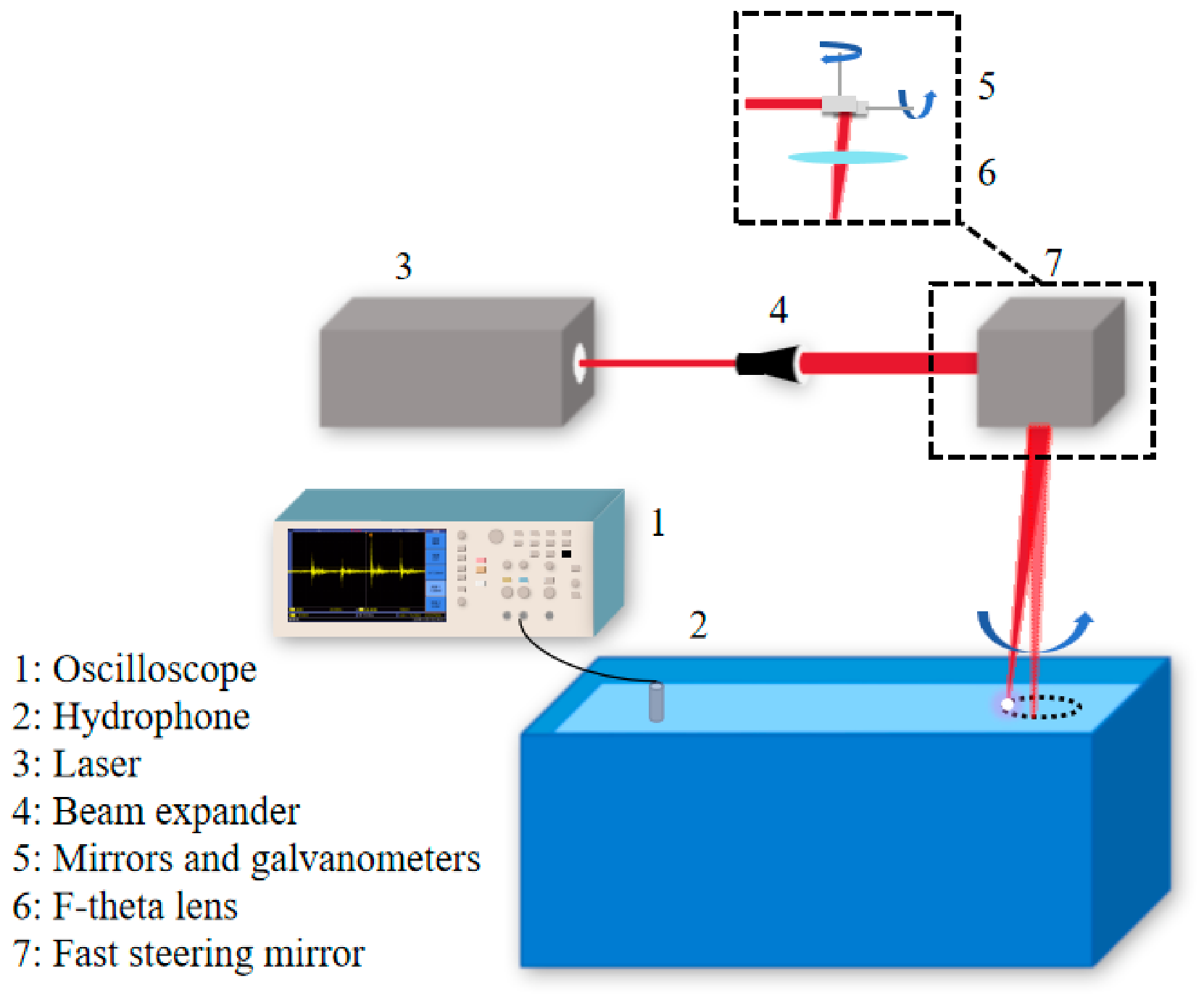
The schematic of the scanning focal-point method testing system is shown in Figure 6. The system consists of the following components: an Nd:YAG laser, a 3× beam expander, a FSM, an F-theta lens, a hydrophone, a water tank, and an oscilloscope. The detailed specifications of these devices are listed in the Table 4.

3. Experimental Verification and Results Analysis

To verify the effectiveness of the laser scanning focal-point scheme, the experimental system shown in Figure 6 was established. Using a laser repetition rate of 100 Hz, experiments were conducted for both long-term single-point breakdown (focused on a single spot) and scanning focal-point acoustic generation. The phenomena associated with both single-point breakdown and scanning focal-point breakdown were recorded using a high-speed camera and a hydrophone.

3.1. Single-Point Breakdown Acoustic Experiment

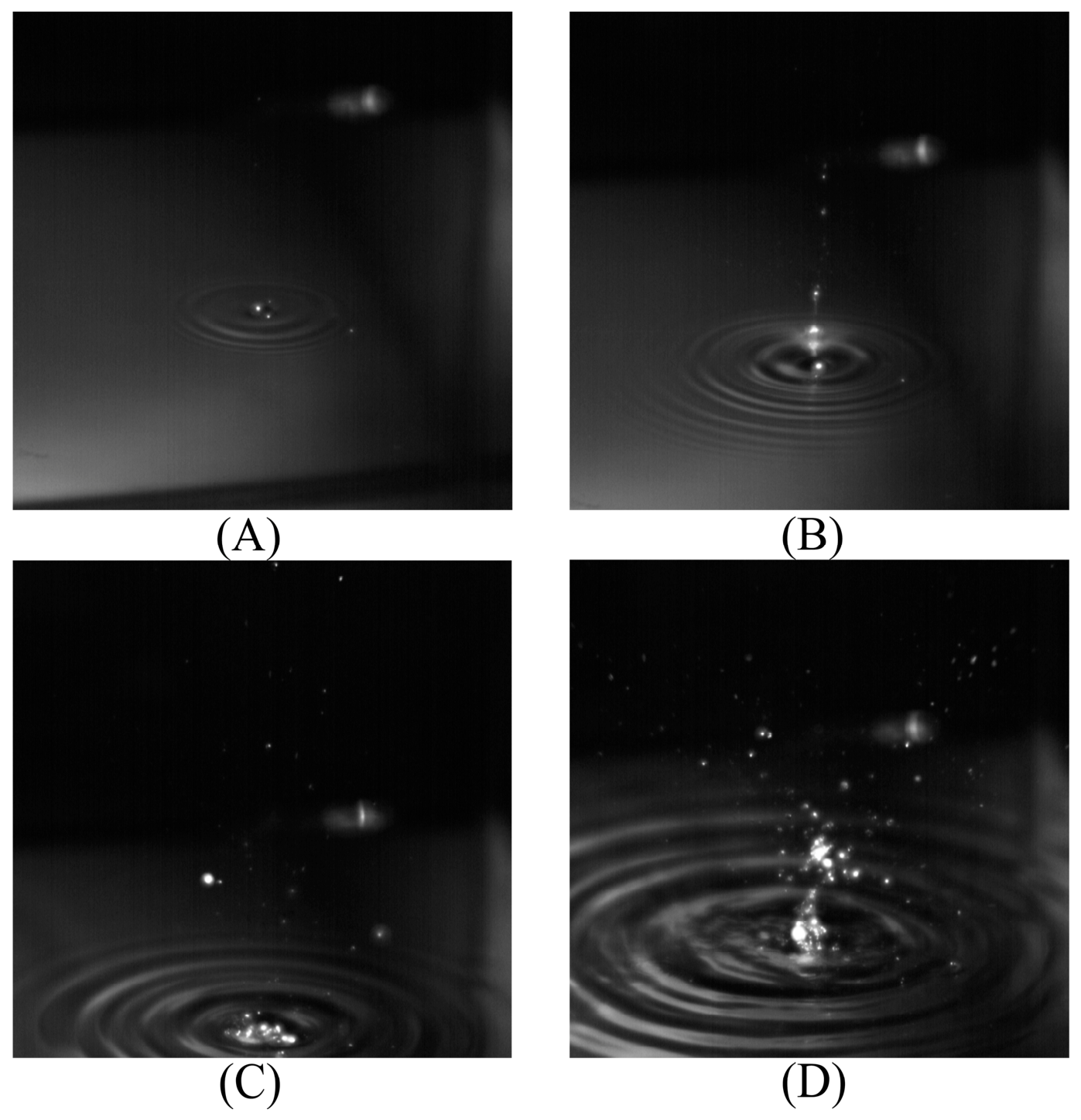
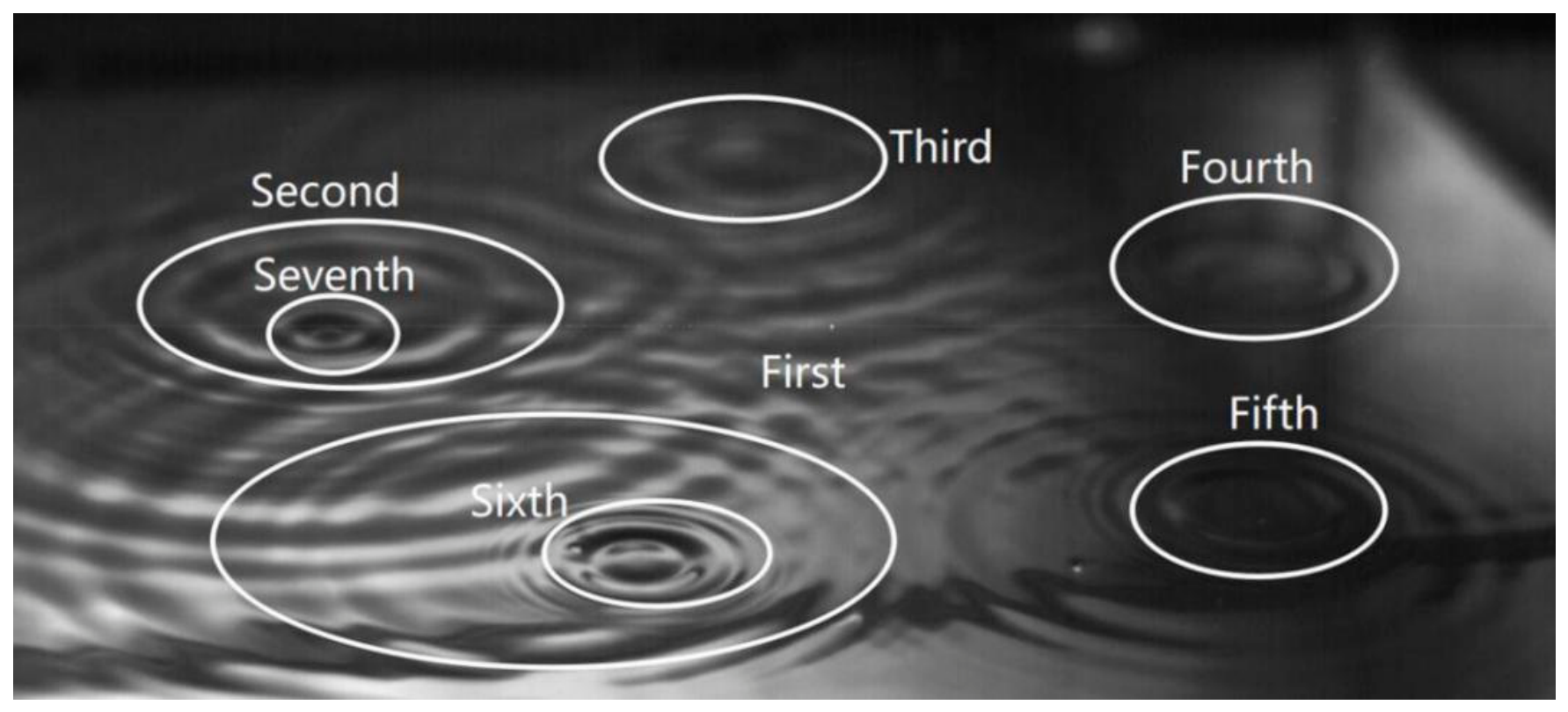
A repetition rate of 100 Hz was employed to repetitively break down a fixed position on the water surface, and a high-speed camera was used to record the experimental phenomena. The recorded footage reveals that the breakdown process becomes increasingly violent as the laser irradiation time increases. As shown in Figure 7A–D depict the phenomena during the 1st, 6th, 20th, and 45th optical breakdowns, respectively.
From Figure 7B, it can be observed that water splashes upwards after the laser repeatedly breaks down the same position six times. During this splashing, the laser may undergo premature optical breakdown within the droplets above the water surface. Consequently, the laser-induced acoustic signal generated by this breakdown cannot propagate into the water, resulting in signal loss. Under prolonged irradiation, the optical breakdown on the water surface can sometimes cause explosive droplet splashing. This may lead to the deflection of the laser transmission path due to refraction by micro-droplets, as well as a reduction in the laser energy reaching the water surface due to energy absorption by the droplets.
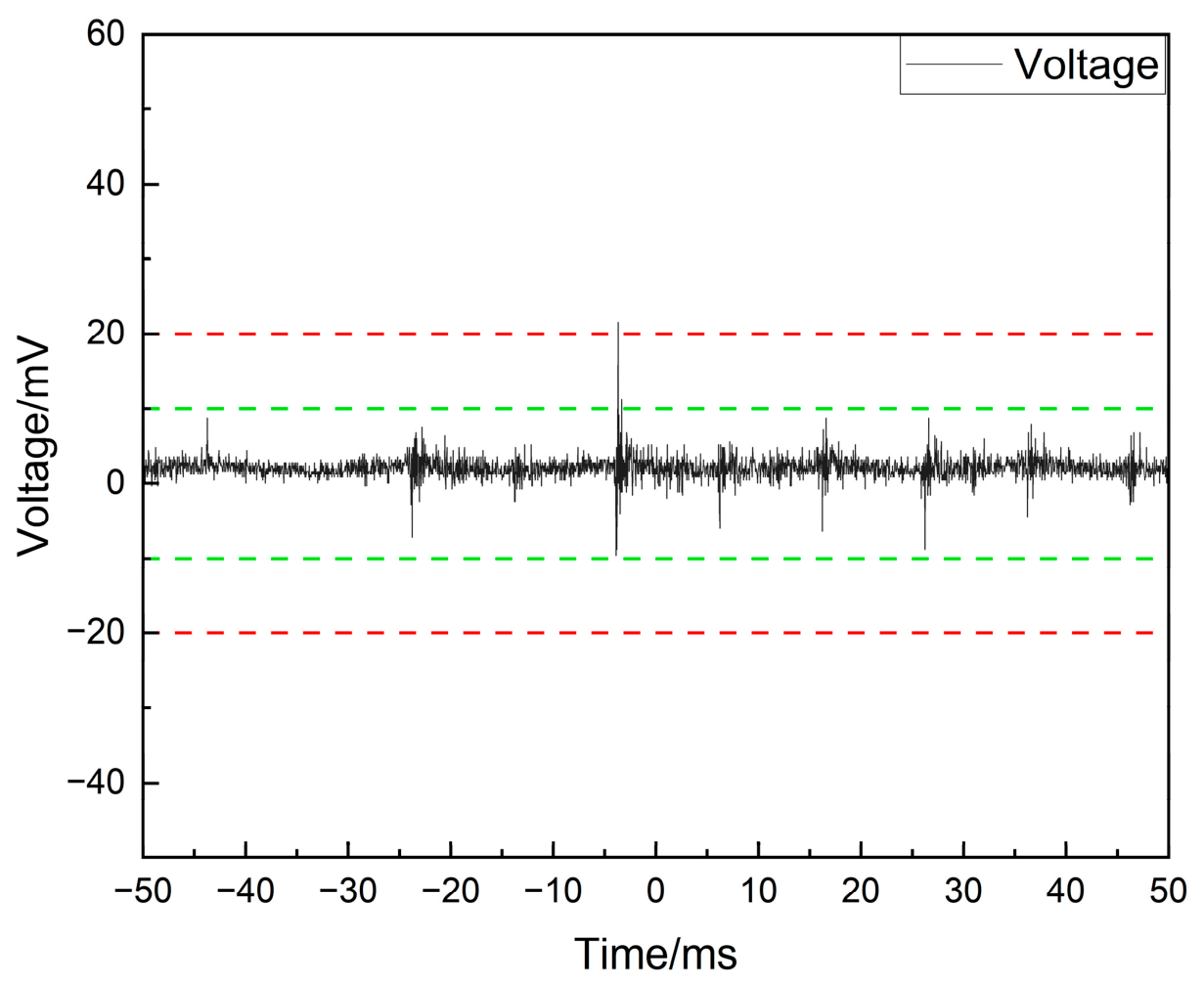
In the case of single-point laser-induced acoustics, the acoustic signal measured after the laser had been operating for 8 s is shown in Figure 8. Due to the interference of water surface ripples, cavitation bubbles, and splashing droplets with the laser focusing path, the photoacoustic conversion efficiency becomes unstable. This leads to extreme fluctuations in the amplitude of acoustic signals generated by laser pulses with identical parameters, rendering some signals difficult to identify.
Among the signals excited by focusing the laser at the same position, only one signal exhibits an amplitude significantly larger than the others, corresponding to a relatively high sound pressure level. One of the remaining signals is submerged in noise, indicating a photoacoustic conversion efficiency of zero, while the others are barely distinguishable from the noise. The overall signal instability makes it difficult to support reliable laser-induced acoustic communication.
This further indicates that, although the surface depression recovers after 9 ms, it is not the only factor affecting the laser-induced acoustic effect. To avoid residual interference from droplets, thermal effects, and water surface vapor, the practical safe repetition frequency should be lower than 100 Hz. This also explains why instability is still observed at a repetition frequency of 100 Hz.

3.2. Scanning Focal-Point Method Experiment

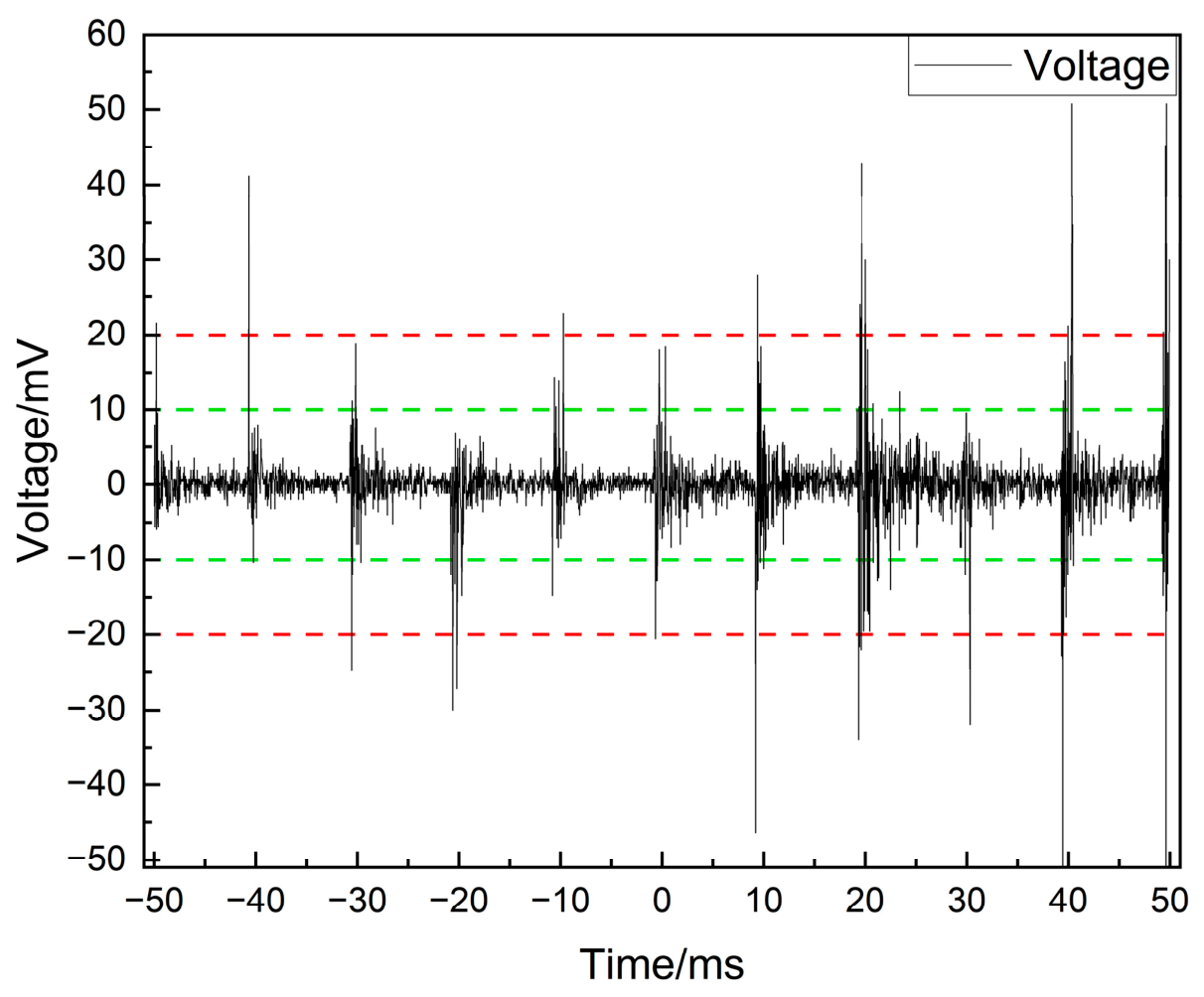
First, based on the results shown in Figure 9, compared with the phenomenon of single-point breakdown, it can be observed that under the scanning focal-point condition, the impact of optical breakdown on the water surface is weaker. The interaction of the laser with the water surface at each focal point resembles the first breakdown in the single-point breakdown case, effectively avoiding the generation of splashing droplets that would interfere with the optical path.
After the water surface settled, the FSM was activated to scan according to a given linear velocity and a circular pattern, achieving the equidistant distribution of the laser focal points as described previously. Following the scanning focal-points method, the amplitude of the laser-induced acoustic signals increased significantly. Although some instability in signal magnitude persisted, the signal peaks could be clearly distinguished from the background.
Multiple experiments were conducted by setting the FSM to scan at the given linear velocity, and the results showed no significant differences. Due to space limitations, a single instance of the underwater acoustic signal recorded after 10 s of laser operation was selected for analysis, as shown in Figure 10. Once the laser focal points began to move across the water surface, the detected underwater acoustic signals exhibited a notable increase in overall amplitude. Although the amplitude variation remained relatively large in this specific recording, the signals differed significantly from the surrounding noise, resulting in a high signal-to-noise ratio (SNR) capable of supporting reliable communication.

3.3. Data Analysis

Hydrophone model: RHSA-5, linear frequency range: 10 kHz~300 kHz, nominal sensitivity within the operating frequency range: −199 to −193 dB re 1 V/μPa, reference sound pressure: 1 μPa (underwater acoustic standard). Since calibration cannot be performed in our laboratory, the device was calibrated by the manufacturer before delivery. The sampling interval of the oscilloscope in Figure 8 and Figure 10 is 4 × 10⁻⁵ s, with a sampling frequency of 25 kHz.
The formula for calculating the underwater sound pressure level is as follows:
S P L = 20 × l g U M
In the formula, U is the voltage value of the underwater acoustic signal measured by the hydrophone, in V. Since the sound pressure amplitude is non-directional, the sound pressure level of the acoustic signal is calculated based on the absolute value of the electrical signal measured by the hydrophone; denotes hydrophone sensitivity in decibels (dB). The average sensitivity is set to 195.15 dB. Since the sound pressure amplitude is non-directional, the sound pressure level of the acoustic signal is calculated based on the absolute value of the electrical signal measured by the hydrophone. Table 5 presents the experimental data, while Table 6 compares the peak characteristics between the single-point breakdown and the scanning focal-point method.
Based on the comparative experimental data presented in Table 5, it can be observed that when the laser focal point position remains unchanged, the maximum acoustic signal has a voltage amplitude of approximately 21.6 mV. Seven signals exhibit amplitudes exceeding 4.4 mV, one signal is indistinguishable from the noise, and the remaining two signals, although distinguishable, have amplitudes that are too small due to poor photoacoustic conversion efficiency. The voltage amplitudes of 21.6 mV and 4.4 mV measured by the hydrophone correspond to underwater acoustic signal sound pressure levels (SPL) of 160.5 dB and 148.0 dB, respectively.
When the laser focal points continuously move across the water surface, data from the oscilloscope indicates that the maximum peak signal detected by the hydrophone is 50.8 mV. Six signals have amplitudes greater than or equal to 30 mV, and the minimum peak signal amplitude is approximately 20.6 mV, corresponding to underwater acoustic SPLs of 169.3 dB, 164.7 dB, and 161.4 dB, respectively. The noise in both cases corresponds to a voltage value of approximately 1.2 mV, which translates to an underwater noise level of 136.7 dB.
The SNR can be approximated by subtracting the noise SPL from the acoustic signal SPL. For single-point breakdown, excluding the submerged signal, the maximum and minimum SNRs are 25.1 dB and 11.3 dB, respectively. For scanning focal-point breakdown, the maximum and minimum SNRs are 32.6 dB and 24.7 dB, respectively. This represents a significant improvement compared to single-point breakdown.
As shown in Table 6, the first data set achieves significant improvements in both signal amplitude and signal stability: the average amplitude increases approximately fourfold, while the coefficient of variation decreases by about 47%. This fully demonstrates that the scanning focal-point method, by avoiding disturbances from water surface fluctuations, splashing droplets, and water vapor that interfere with laser focusing, simultaneously achieves higher signal amplitude and improved signal stability.
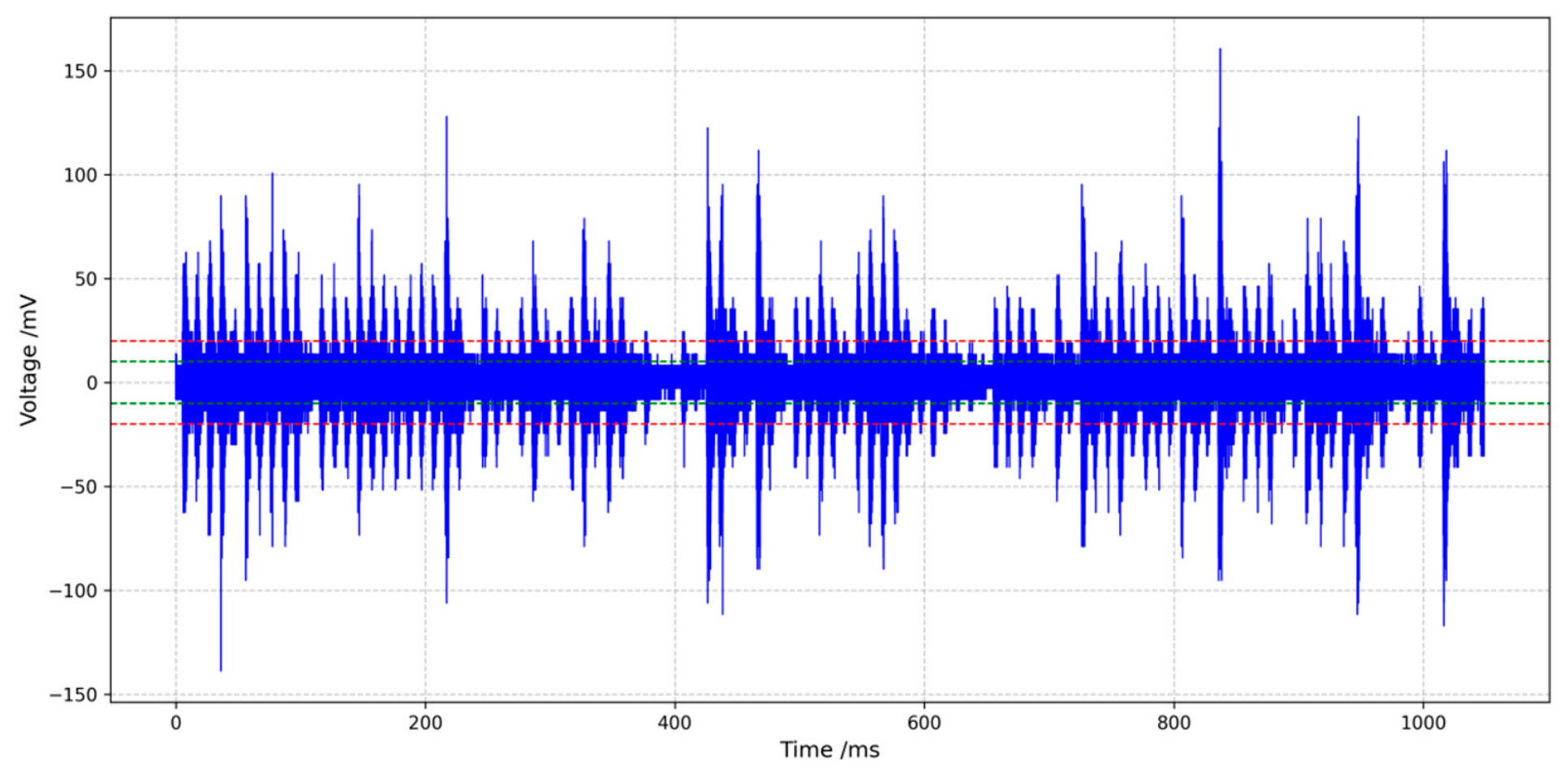
Figure 11 presents the laser-induced acoustic signals over a prolonged period with the scanning focal-point method. During long-term acoustic generation, the noise level ranges from 2 to 8 mV; taking the median value of 5 mV, the corresponding underwater sound pressure level is 149.1 dB. Among the first 100 signals, only 5 are around 15 mV and 7 are around 20 mV. The amplitudes of the other signals are very high, with most exceeding 50 mV, and individual signals even reaching 150 mV.
Based on the experimental results, it is evident that, compared with single-point breakdown method, the scanning focal-point method generates stronger laser-induced acoustic signals and enhances signal stability by avoiding the adverse effects of water surface disturbances, splashing droplets, and water vapor. Consequently, the stronger acoustic signals contribute to an improved SNR in real-world communication environments, significantly enhancing signal stability while maintaining the same laser repetition rate.

4. Discussion

By comparing the experimental results of the two methods, the comparison reveals that the proposed method avoids the influence of water surface disturbances and splashing droplets on laser-induced acoustics, resulting in higher acoustic signal amplitudes. This indicates that adopting the scanning focal-point method is a reasonable and feasible approach to improve the amplitude and stability of high-speed laser-induced acoustic signals.
This study addresses the issue of poor stability in current high-speed laser-induced acoustic communication. The duration of the acoustic signals generated by optical breakdown was measured experimentally. Based on the experimentally observed phenomena, a simulation analysis of water surface disturbances was conducted, and the spatial extent and duration of the resulting cavitation bubbles were evaluated. The phenomena of single-point breakdown and scanning focal-point breakdown were recorded, and laser-induced acoustic signals were detected. A method utilizing scanning focal-point is proposed to improve signal detectability and stability in high-rate scenarios. Experimental verification demonstrates that this method indeed produces acoustic signals with larger amplitudes that are easier to identify. This work provides a new approach for improving the SNR in future high-speed laser-induced acoustic communication systems.

Author Contributions

Conceptualization, C.Y. and Z.L.; methodology, C.Y.; validation, C.Y., J.W. and S.Y.; formal analysis, Z.L.; investigation, C.Y.; resources, Z.L. and Q.F.; data curation, C.Y.; writing—original draft preparation, C.Y.; writing—review and editing, Z.L.; supervision, C.W.; project administration, Q.F.; funding acquisition, Z.L. All authors have read and agreed to the published version of the manuscript.

Funding

This research was funded by the National Natural Science Foundation of China: U22A2008.

Institutional Review Board Statement

Not applicable.

Informed Consent Statement

Not applicable.

Data Availability Statement

The raw data supporting the conclusions of this article will be made available by the authors upon request.

Conflicts of Interest

The authors declare no conflicts of interest.

Abbreviations

The following abbreviations are used in this manuscript:
LIALaser-Induced acoustic
FSMFast Steering Mirror
SNRSignal-to-Noise Ratio
SPLSound Pressure Levels

References

  1. Zhao, Z.Y.; Zhou, H.T.; Wang, Y.F.; Chen, W.W.; Tan, Q.; Ding, X.; Hu, M.Y.; Xu, H.; Yao, J.Q. Review of Research Progress in Sea-Air Cross-Domain Communication Technology (Invited). Laser Optoelectron. Prog. 2025, 62, 161–181. [Google Scholar] [CrossRef]
  2. Bian, B.M.; Chen, X.; Xia, M.; Yang, L.; Shen, Z.H. The Investigation of Laser-Induced Plasma Shock Wave Propagation in Liquids. Acta Phys. Sin. 2004, 53, 508–513. [Google Scholar] [CrossRef]
  3. Peng, S.; Zhang, M.M.; Wang, J.A. Method of Laser-Generated Sound with High Repetition Rate for Underwater Acoustic Communication. Chin. J. Lasers 2012, 39, 148–153. [Google Scholar] [CrossRef]
  4. Wang, X.Y.; Ge, L.; Yue, Y. Research on Photoacoustic information security communication technology. Netw. Secur. Technol. Appl. 2019, 10, 87–89. [Google Scholar] [CrossRef]
  5. Blackmon, F.; Antonelli, L. Experimental Demonstration of Multiple Pulse Nonlinear Optoacoustic Signal Generation and Control. Appl. Opt. 2005, 44, 103–112. [Google Scholar] [CrossRef] [PubMed]
  6. Huang, J.X. Research on Design and Implementation of the Laser Induced Acoustic Cross-Media Communication from Water to Air. Master’s Thesis, Harbin Institute of Technology, Harbin, China, May 2023. [Google Scholar]
  7. Fei, Z.G.; Peng, S.; Chen, B.Z. Study on Equalization Algorithm Based on Opto-acoustic Underwater Communication. Mar. Electr. Electron. Technol. 2018, 38, 18–20,24. [Google Scholar] [CrossRef]
  8. Wang, S.F. Research on LDPC Code and MPPM Coding Technology in Laser Acoustic Communication. Master’s Thesis, Guilin University of Electronic Technology, Guilin, China, June 2023. [Google Scholar]
  9. Chen, Y.N.; Zhao, Y.; Zhou, Z.Q.; Cao, Y.F.; Zhang, F.X. Laser-Induced Acoustic Air-Water Trans-Medium Communication Based on PWM. J. Unmanned Undersea Syst. 2024, 32, 637–643. [Google Scholar] [CrossRef]
  10. Song, L.J. Research on Laser Induced Acoustic Underwater Detection Technology. Master’s Thesis, Tianjin University, Tianjin, China, November 2021. [Google Scholar]
  11. Wang, H.N. Studies on Characteristic and Applications of Laser-Induced Plasma Acoustic Wave. Master’s Thesis, Shenyang Ligong University, Shenyang, China, March 2023. [Google Scholar]
  12. Wang, X.Y.; Wang, J.A.; Zong, S.G.; Liu, T. Laser Acoustic Energy Conversion Efficiency in Optical Breakdown Mechanism. High Power Laser Part. Beams 2013, 25, 579–582. [Google Scholar] [CrossRef]
  13. Diaci, J.; Mozina, J. Measurement of Energy Conversion Efficiency During Laser Ablation by A Multiple Laser Beam Deflection Probe. Ultrasonics 1996, 34, 523–525. [Google Scholar] [CrossRef]
  14. Li, P.; Zhao, Y.; Zhou, Z.Q.; Zhang, P.H.; Bai, X.; Ma, J. Research on Laser Induced Acoustic Detection of Trans-Media Aerial-Underwater. Infrared Laser Eng. 2021, 50, 63–71. [Google Scholar] [CrossRef]
  15. Gao, R.K.; Liu, Y.; Qi, S.M.; Song, L.; Meng, J.; Liu, C.B. Influence Mechanism of the Temporal Duration of Laser Irradiation on Photoacoustic Technique: A Review. J. Biomed. Opt. 2024, 29, S11530. [Google Scholar] [CrossRef] [PubMed]
  16. Sigrist, M.W. Laser Generation of Acoustic Waves in Liquids and Gases. Appl. Phys. 1986, 60, R83–R122. [Google Scholar] [CrossRef]
  17. Zhao, J.; Yu, K.X.; Xu, S.Q.; Wang, M.R.; Yang, Y.G.; Xu, D.G.; Yao, J.Q.; Wang, X. Advances in Laser-Induced Acoustic Technology for Underwater Detection. Water 2025, 17, 3285. [Google Scholar] [CrossRef]
  18. Yellaiah, J.; Kiran, P.P. Input Pulse Duration Effect on Laser-Induced Underwater Acoustic Signals. Appl. Opt. 2021, 60, 4582–4590. [Google Scholar] [CrossRef] [PubMed]
  19. Chen, Q.M.; Cheng, Z.H.; Zhu, H.H. Laser Acoustic Energy Conversion Efficiency Induced by Pulse Laser in Water. Chin. J. Lasers 2007, 34, 341–344. [Google Scholar] [CrossRef]
Figure 1. (A) Thermal expansion mechanism illustration; (B) Vaporization mechanism illustration; (C) Optical breakdown mechanism illustration. The area marked by the red diagonal lines indicates the region where the water body expands. The arrows point from the side with higher water pressure to the side with lower pressure. The white semi-circle represents the cavity formed by the vaporization of water, while the white sphere accompanied by a purple halo represents the plasma generated by the breakdown.
Optics 07 00044 g001
Figure 2. Bubble variation process induced by laser breakdown. The dashed line roughly indicates the profile of the surface depression.
Optics 07 00044 g002
Figure 3. Temporal variation in cavitation bubble size.
Optics 07 00044 g003
Figure 4. (A) Optical path through calm water surface; (B) Optical path through a wave trough; (C) Optical path through a wave crest; (D) Optical path through a wave slope; (E) Optical path through a ruptured bubble; (F) Optical path through an intact bubble; (G) Optical path through an eccentric bubble.
Optics 07 00044 g004
Figure 5. The scanning focal-point method system. (A) for long scenarios; (B) for short distance scenarios. The blue arrows indicate the direction of axis rotation.
Optics 07 00044 g005
Figure 6. Schematic diagram of the experimental setup for the scanning focal-point method. The blue arrows denote the direction of rotation.
Optics 07 00044 g006
Figure 7. Phenomenon of optical breakdown on the water surface during repetitive laser breakdown at a fixed position. (A) The phenomenon of first breakdown; (B) The phenomenon of sixth breakdown; (C) The phenomenon of twentieth breakdown; (D) The phenomenon of forty-fifth breakdown.
Optics 07 00044 g007
Figure 8. Time-domain waveform of the LIA signal without the scanning focal-point method. Green dashed lines: ±10 mV; red dashed lines: ±20 mV.
Optics 07 00044 g008
Figure 9. Optical breakdown phenomenon on the water surface under repetitive laser pulses with scanning focal-point. The numbers in the figure indicate the order in which the breakdown events occur during the process.
Optics 07 00044 g009
Figure 10. Time-domain waveform of the LIA signal with the scanning focal-point method. Green dashed lines: ±10 mV; red dashed lines: ±20 mV.
Optics 07 00044 g010
Figure 11. Laser-induced acoustic signals over a prolonged period using focal-point transfer. Green dashed lines: ±10 mV; red dashed lines: ±20 mV.
Optics 07 00044 g011
Table 1. Variation in the laser focal spot caused by dynamic water surface ripples or bubbles.
ScenarioHorizontal Displacement (mm)Vertical Displacement (mm)Spot Size (μm)Airy Disk
(μm)
Calm Water03.5100.00722.06
Wave Crest02.4200.00518.87
Wave Slope0.1732.662.24320.79
Wave Trough04.8160.00427.71
Bubble Center0515.26629.67
Off-axis bubble0.6144.4275.89133.33
Ruptured Bubble07.8460.01933.38
Table 2. Influence of the ripple’s radius of curvature on the focal spot size.
ScenarioWave CrestWave SlopeWave Trough
R = 40.0022.6880.005
Airy disk18.2220.8329.19
R = 60.0061.8480.003
Airy disk19.3420.7826.8
Table 3. Influence of the bubble radius on the focal spot size.
ScenarioBubble CenterOff-Axis BubbleRuptured Bubble
R = 20.01219.1360.037
Airy disk42.3785.438.3
R = 338.96330.7940.011
Airy disk24.7325.3930.74
Table 4. Main equipment parameters of test system.
EquipmentParameter
Nd:YAG laser (CUST, Changchun, China) Repetition rate: 100 Hz, Pulse energy: 100 mJ, Pulse width: 10 ns
Beam expander (DHC, Beijing, China) 3× magnification
FSM (SINO-GALVO, Zhenjiang, Jiangsu, China) Linearity: 99.9%
F-theta lens (Tharlabs, Newton, NJ, USA) Focal length F = 250 mm
Hydrophone (CSSC, Hangzhou, Zhejiang, China) Linear Frequency Range: 10 kHz·300 kHz; Sensitivity: −194 dB @ 10 kHz
Oscilloscope (Tektronix, Shanghai, China) TBS1202B, input impedance 1 MΩ || 13 pF, vertical resolution 8 bit, sampling rate 2 GS/s
Table 5. Comparison of acoustic signal peak amplitudes between two generation schemes. The calculation of SPL is based on the absolute peak value of the voltage signal. A and B denote LIA signals obtained without and with the scanning focal-point method, respectively.
12345678910
(A) (mV)6.8−0.8−9.2−4.421.6−8−8.4−10.86.44.4
SPL (dB)151.8133.2154.4148.0161.8153.2153.6155.8151.3148.0
(B) (mV)21.641.2−24.8−30.022.8−20.6−46.442.8−32.050.8
SPL (dB)161.8167.4163.0164.7162.3161.4168.5167.8165.3169.3
Table 6. Comparison of peak characteristics between single-point breakdown method and the scanning focal-point method.
AverageStandard DeviationCoefficient of VariationMaxMin
Single-point breakdown method8.28 mV5.2363.1%21.6 mV1.2 mV
Scanning focal-point method33.3 mV11.1733.5%50.8 mV20.6 mV
Disclaimer/Publisher’s Note: The statements, opinions and data contained in all publications are solely those of the individual author(s) and contributor(s) and not of MDPI and/or the editor(s). MDPI and/or the editor(s) disclaim responsibility for any injury to people or property resulting from any ideas, methods, instructions or products referred to in the content.