Article

Femtosecond Laser Microfabrication and Magnetic Manipulation of Functional Magnetic Microspheres


1
Laser Institute, Qilu University of Technology (Shandong Academy of Sciences), No. 3501 Daxue Road, Changqing District, Jinan 250353, China
2
Laboratory of Nanoprocesses and Technology, A.V. Luikov Heat and Mass Exchange, National Academy of Sciences of Belarus, No. 66 Nezavisimosti Avenue, 220072 Minsk, Belarus
3
Shandong Hua’an Biotechnology Co., Ltd., No. 009 Huihe Avenue, Kouzhen Sub-District, Laiwu District, Jinan 271100, China
4
CAS Key Laboratory of Mechanical Behavior and Design of Materials, Department of Precision Machinery and Precision Instrumentation, University of Science and Technology of China, No. 96 Jinzhai Road, Hefei 230026, China
*
Authors to whom correspondence should be addressed.
Optics 2026, 7(3), 30; https://doi.org/10.3390/opt7030030
Submission received: 19 March 2026 / Revised: 17 April 2026 / Accepted: 17 April 2026 / Published: 24 April 2026
(This article belongs to the Topic Optical and Laser Scanning: Systems and Applications)

Abstract

The precise fabrication and controllable actuation of magnetic microspheres hold significant application value in biomedicine, microfluidic chips and other fields. Based on femtosecond laser two-photon polymerization technology (FLTPP), two methods are adopted to prepare magnetic microspheres in this study. Magnetic microspheres are fabricated via photoresist modification and post-treatment processes. Meanwhile, a 3D magnetic actuation system composed of a three-axis movable magnetic drive module and a real-time imaging system is constructed, enabling the flexible 3D actuation and real-time dynamic monitoring and visualized observation of magnetic microspheres. The results demonstrate that the magnetic microspheres exhibit sensitive magnetic response characteristics. The constructed magnetic actuation system features large travel range (XY: ±6.5 mm, Z: 10 mm), high precision (20 μm) and flexible manipulation, enabling stable locomotion of the microrobots in straight channels, L-shaped channels, and square channels. This study provides a technical reference for the fabrication and manipulation of magnetic micro/nano devices, and lays a foundation for their subsequent integrated applications in microfluidic systems.

1. Introduction

The rapid development of micro/nano technology has driven technological innovation in such cutting-edge fields as micro-optics, microfluidics, and biomedical detection, and the evolution of these technologies has placed more stringent requirements on the fabrication precision, structural complexity, and functional integration of micro/nano-scale functional devices. To date, preparation methods of magnetic microspheres mainly include microfluidic technology, emulsion/solvent evaporation, and ion gelation methods. Among these, the microfluidic method enables uniform structural dimensions but cannot fabricate truly three-dimensional complex structures. The emulsion/solvent evaporation method features a simple process and low cost, yet suffers from poor uniformity in microsphere morphology and cannot achieve high-precision preparation. The ionic gelation method exhibits good biocompatibility, but provides low structural strength and poor processing accuracy. In contrast, femtosecond laser two-photon polymerization (FLTPP), as a technique in the field of microsphere fabrication, shows obvious advantages in processing performance. It can achieve submicrometer precision, enabling accurate control over the size and morphology of microspheres. Moreover, it breaks through the limitations of structural design and allows direct fabrication of arbitrary true three-dimensional complex structures, showing broad applications in the manufacturing of microstructures [1,2,3,4,5,6].
The efficient actuation of micro/nano devices is a core step for realizing their engineering applications. At present, the actuation modes of micro/nano structures mainly include magnetic actuation, optical actuation, acoustic actuation, and chemical actuation, among others [7]. Among these, optical actuation and acoustic actuation are susceptible to factors such as medium absorption and scattering, with constrained manipulation distance and precision [8,9,10]. Chemical actuation relies on continuous fuel supply, tends to cause chemical interference to the working system and is difficult to achieve flexible dynamic regulation [11,12]. In contrast, magnetic actuation has obvious advantages: fuel-free propulsion, high spatiotemporal resolution, and strong controllability. Magnetic signals can penetrate biological tissues and various transparent media without loss, cause no interference to the target system, and have become the preferred solution for micro/nano manipulation in the biomedical and microfluidic fields [13,14,15,16,17]. Magnetic structures demonstrate broad application prospects in fields such as biomolecule separation, targeted drug delivery, microfluidic chip detection, and single-cell manipulation [18,19].
Among existing magnetic functional materials, Fe3O4 (magnetite) nanoparticles are suitable functional materials for biomedical magnetic microspheres due to their superparamagnetism, high saturation magnetization, good biocompatibility, and chemical stability. Fe3O4 nanoparticles exhibit sensitive magnetic response and good biocompatibility, enabling precise actuation and targeting under external magnetic fields. They hold significant application value in targeted drug delivery, cell transportation, tissue engineering, and magnetic resonance imaging, and have become a research hotspot in the fields of microrobots and biological micromanipulation [19,20,21,22,23].
The combination of FLTPP and Fe3O4 magnetic functional materials can fully exploit the advantages of true three-dimensional architecture, high precision, and good magnetic response characteristics. Although the combination of FLTPP and magnetic actuation has brought new opportunities for the development and application of magnetic microspheres [24], the fabrication and manipulation of magnetic microspheres still face challenges: Firstly, at the micro/nano scale, the morphological regularity and dimensional uniformity of magnetic microspheres are difficult to guarantee. Secondly, to avoid actuation deviations caused by uneven magnetic domain distribution, the uniform doping and loading of magnetic functional materials are challenging to achieve [25,26]. Thirdly, microfluidic channels in practical application scenarios mostly contain complex microchannel configurations such as bends, bifurcations, and narrow flow restriction. The motion of microspheres within the channels is readily subject to the coupled influences of multiple factors including wall resistance, fluid viscous force, and channel geometric constraints, making it difficult to achieve high-precision, predictable, and jam-free actuation [27,28,29,30,31,32,33,34,35].
This study investigates the controllable fabrication and precise actuation of Fe3O4-based magnetic microspheres. Two fabrication strategies for magnetic microspheres are proposed. One approach is to directly employ magnetic photoresists, achieving their fabrication through a one-step two-photon polymerization (TPP); the other implements the post hoc impartation of magnetic responsiveness to photoresist microspheres via a post-soaking process. The morphology of the two types of microspheres is compared through bright-field, fluorescence, and scanning electron microscope (SEM) images. Meanwhile, precise characterization and analysis of the motion characteristics of magnetic microspheres are realized. A magnetic actuation system comprising three-axis precision actuation, real-time optical imaging, and micro/nano-scale precise positioning is independently constructed. The locomotion of magnetic microspheres within microchannels including straight channels, curved channels, and square channels is achieved. Magnetic actuation and manipulation technology for micro/nano structures provides important experimental support and theoretical reference for engineering applications in fields such as biomedicine and microfluidic detection.

2. Materials and Methods

2.1. Experimental Materials and Equipment

2.1.1. Materials

Materials used include photoresist SZ2080, Fe3O4 nanoparticles, n-Hexane, DI water, and magnetic fluid (self-prepared).

2.1.2. Core Equipment and Software

Core equipment and software used include a Legend Elite-1K-HE regeneratively amplified Ti: sapphire femtosecond laser system (Coherent, Senta Clara, CA, USA), with pulse duration 75 fs, repetition rate 80 MHz, and central wavelength 800 nm, and an independently constructed 3D magnetic actuation platform (including a three-axis translation stage, stepper motor drive module, and inductive sensor overtravel protection unit). Microsphere and channel structures were designed using SolidWorks 2021 software and imported into the femtosecond laser processing control system. A vertical lift imaging system (long-tube microscope objective, CCD sensor, computer terminal), three-axis micro-translation stage (XY travel ±6.5 mm, Z travel 10 mm), scanning electron microscope (JSM-IT700-HR/LV, JEOL, Tokyo, Japan), and inverted fluorescence microscope (CKX53, OLYMPUS, Tokyo, Japan) were also used.

2.2. Preparation of Magnetic Photoresist and Magnetic Microspheres

2.2.1. Preparation of Magnetic Photoresist

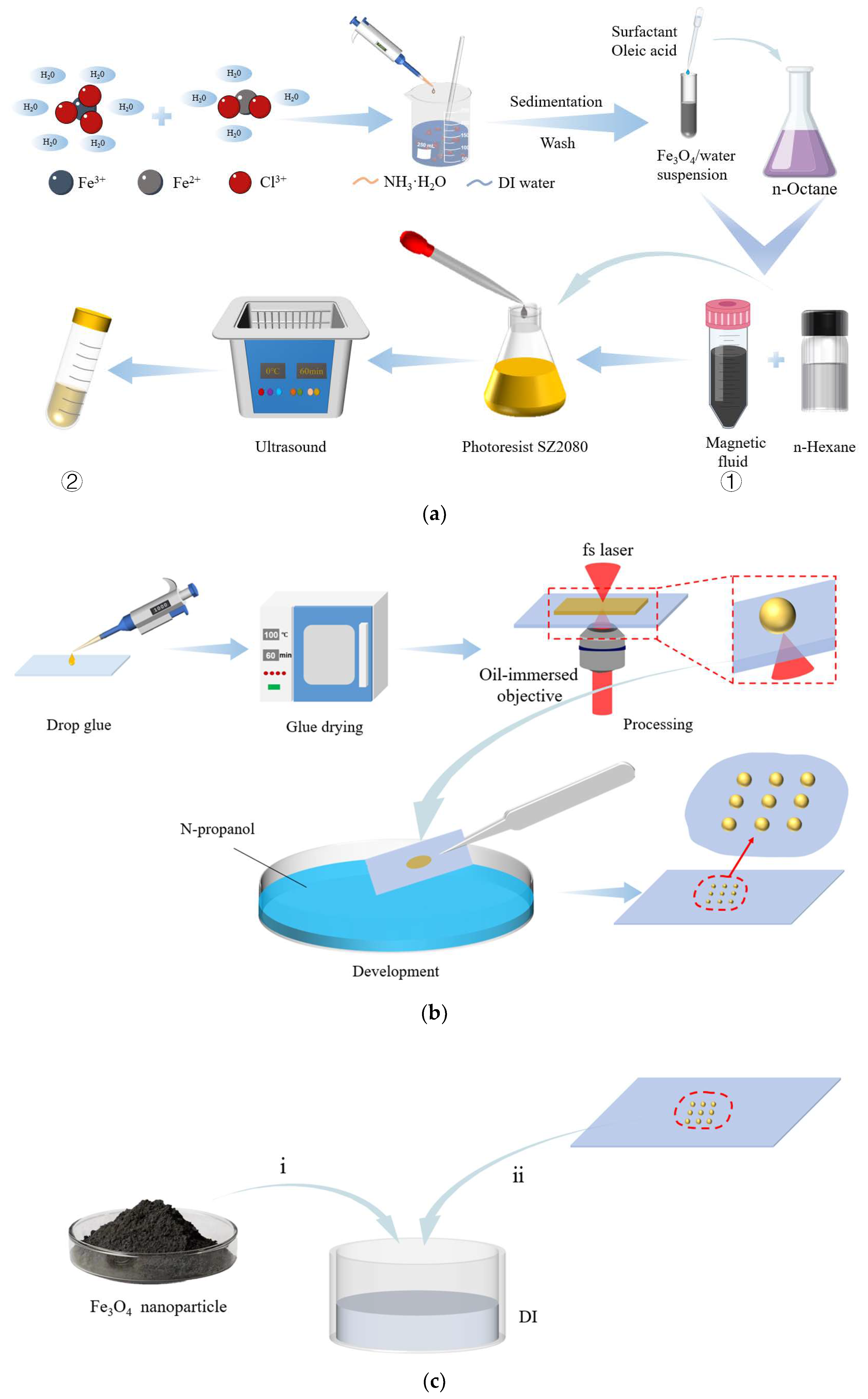
The magnetic photoresist was prepared using the process shown in Figure 1a: A total of 2.69 g (0.1 mol) FeCl3·6H2O and 0.99 g (0.05 mol) FeCl2·4H2O were first dissolved in 100 mL DI water, followed by magnetic stirring for 30 min. Under intense agitation, 4 mL ammonia solution (25 wt.%) was slowly added into the mixture to create a weakly alkaline environment for the growth of Fe3O4 nanocrystals. After stirring continuously for 3 h, the Fe3O4 precipitate was collected with a strong magnet and rinsed three times with DI water. Subsequently, 0.61 g (2.15 mmol) Oleic acid was added dropwise into the Fe3O4 aqueous suspension at 80 °C under nitrogen atmosphere, and the mixture was stirred for another 30 min. The surface-modified Fe3O4 nanoparticles were then dispersed uniformly in 3.2 mL (20 mmol) n-Octane to obtain a stable dispersion [19]. The magnetic fluid and n-Hexane were mixed at a volume ratio of 6:4 and shaken sufficiently to uniformity. Subsequently, the mixture was blended with photoresist SZ2080 at a volume ratio of 1:5 and ultrasonicated for 60 min to form a uniformly dispersed magnetic photoresist. During preparation and usage, sealing should be ensured to prevent failure due to volatilization.

2.2.2. Fabrication Processes of Two Types of Magnetic Microspheres

Method 1: Post-functionalization Modification (Figure 1b,c). Pure photoresist SZ2080 was used as the raw material, and microsphere arrays with a diameter of 20 μm were fabricated using a femtosecond laser two-photon polymerization processing system (Figure S1). During processing, the material was dropped onto a cover glass and baked at 100 °C for 1 h to remove the solvent. Subsequently, a femtosecond laser was focused inside the material through a 60× oil-immersion objective (Olympus, numerical aperture NA = 1.35) to achieve two-photon polymerization of microspheres. The laser beam diameter was 15 μm, the processing fluence was 1.3 J/cm2, and the laser power was set to 6 mW; after processing, the sample was immersed in n-propanol for 3 h to complete development. The developed microspheres were soaked in a magnetic dispersion solution prepared by mixing Fe3O4 particles and DI water at a mass ratio of 1:10 and kept at a constant temperature for 5 h; during this period, ultrasonication was performed for 10 min every 1 h to ensure uniform adsorption of Fe3O4 particles onto the microsphere surface. All microsphere samples obtained by the two preparation methods were sputter-coated with gold, placed into the microscope chamber, and observed by scanning electron microscopy. This approach enables high-resolution characterization of surface morphology, particle dispersion and internal structure of microchannels. According to characterization results, the actual dimensional deviation of the fabricated microspheres is ≤±1.5 μm, and the dimensional accuracy meets the design requirements.
Method 2: Direct Molding Method of Magnetic Photoresist. The above-prepared magnetic photoresist was used as the raw material for two-photon polymerization. Since magnetic nanoparticles were pre-uniformly dispersed in the material, the laser power was adjusted to 8 mW during processing to facilitate resin surface identification and precise molding of microsphere structures. Using this process, microspheres with magnetic response characteristics could be directly prepared; after development, no additional post-treatment steps such as soaking were required, achieving the synchronous and integrated preparation of magnetic response functions and 3D micro/nano structures. According to characterization results, the actual dimensional deviation of the fabricated microspheres is ≤±1 μm, which further verifies the three-dimensional high-precision advantage of the processing system.

2.3. Experimental Platform Construction

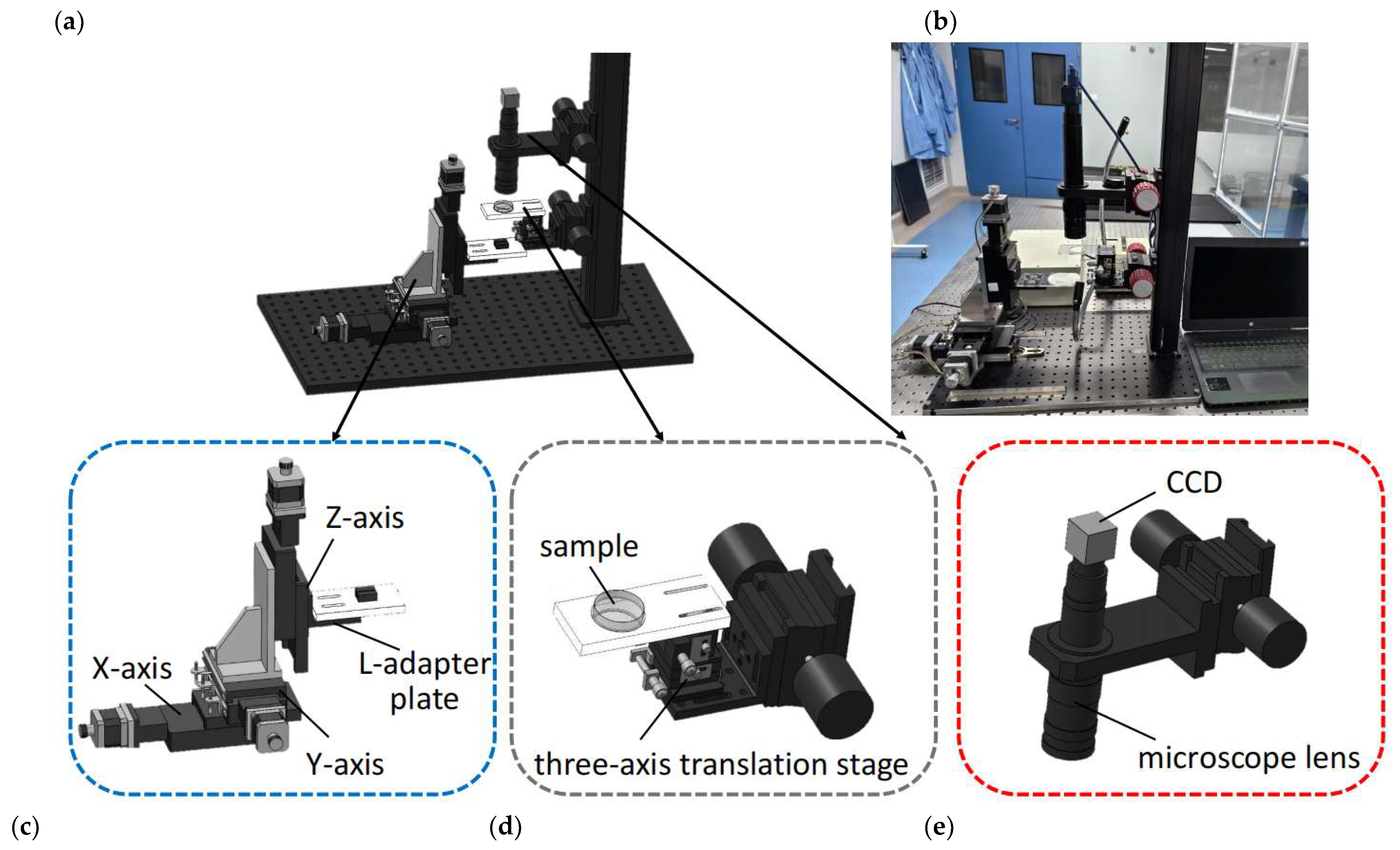
The experimental platform is shown in Figure 2; panel (a) presents the overall integration schematic, and panel (b) shows the physical image of the experimental platform. This platform mainly consists of three functional modules. Module 1: Panel (c) shows the three-axis mobile magnetic actuation module, which includes X-, Y-, and Z-axis sliding stages and stepper motor drive units; the Z-axis sliding stage is connected to the magnet placement platform through a first L-shaped adapter, enabling 3D translational motion of the magnet. Its travel range meets the experimental requirements, and it is equipped with a micro handwheel for manual fine calibration. Module 2: Panel (d) shows the three-axis micro-motion sample module, which is installed on the lifting and focusing sliding stage assembly through a second L-shaped adapter; the sample placement platform is fixed on the three-axis displacement platform, which provides XY travel of ±6.5 mm and Z travel of 10 mm with an adjustment precision of 0.02 mm, enabling precise positioning and real-time fine-tuning of the sample. Module 3: Panel (e) shows the vertical lift imaging module, which is connected to the guide rail slider and vertical column, enabling large-range vertical sliding (travel: 38 mm); the lens mounting arm houses a long-barrel microscope objective, above which a CCD sensor is mounted and communicating with the computer terminal, achieving real-time acquisition and storage of sample images.
The platform also integrates an overtravel protection mechanism: when the distance between the sliding stage mobile end stopper and the inductive sensor reaches 1 mm, a protection signal is triggered, thereby preventing equipment damage from collision.

2.4. Magnetic Microsphere Manipulation

2.4.1. Microchannel Fabrication

The microchannel fabrication procedure is as follows: First, microchannel models with preset dimensions were drawn using SolidWorks software; after exporting the model files, they were converted into control programs recognizable by femtosecond laser processing equipment using dedicated software. Subsequently, baked photoresist samples were placed on the processing platform, and the femtosecond laser was precisely focused inside the photoresist through a 60× oil-immersion objective; 3D molding of microchannels was completed utilizing the two-photon polymerization effect. After processing, samples were developed using n-propanol solution with a purity ≥99.5% to wash away unexposed photoresist; after rinsing and drying, glass slides with the target microchannel structures were finally obtained.

2.4.2. Sample Placement and Precise Focusing

The channel glass slide with magnetic microspheres was placed in the positioning slot of the sample placement platform and fixed with bolts; the light source was placed below the sample, and the light intensity was adjusted until the field of view became clear. The handwheel of the lifting and focusing sliding stage assembly and the imaging system were rotated for axial coarse adjustment (travel: 38 mm). The three-axis displacement platform was operated for axial fine adjustment (travel: 10 mm), combined with images returned by the CCD, until magnetic microspheres and channel structures were clearly imaged, completing focal plane positioning. The field-of-view size was adjusted through the long tube according to observation requirements.

2.4.3. Magnet Positioning and Fine Calibration

The permanent magnet was placed on the magnet placement platform; the stepper motor was controlled through the computer terminal to drive the three-axis sliding stage, rapidly moving the magnet to the initial position below the sample. After switching to manual mode, the micro handwheels of the corresponding axes were rotated for fine calibration, ensuring that both the magnet and microspheres were within the imaging field of view. Three-axis coordinated motion was realized through right-angle connectors for power transmission; the overtravel protection mechanism was triggered by inductive sensors.

2.4.4. 3D Actuation and Real-Time Observation

XYZ three-axis motion trajectories of the magnet (such as straight path, L-shaped path, square path) were preset through the computer terminal; the automatic drive program was started, and magnetic microspheres were driven to move synchronously by external magnetic field. During actuation, motion images were acquired in real time by CCD sensors and transmitted to the computer terminal, realizing dynamic observation. If microspheres exhibited field-of-view offset, real-time fine adjustment was performed through the three-axis displacement platform of the sample module, ensuring the microspheres always remained within the clear field of view.

3. Results and Discussion

3.1. Characterization of Magnetic Microspheres and Microchannel Structures

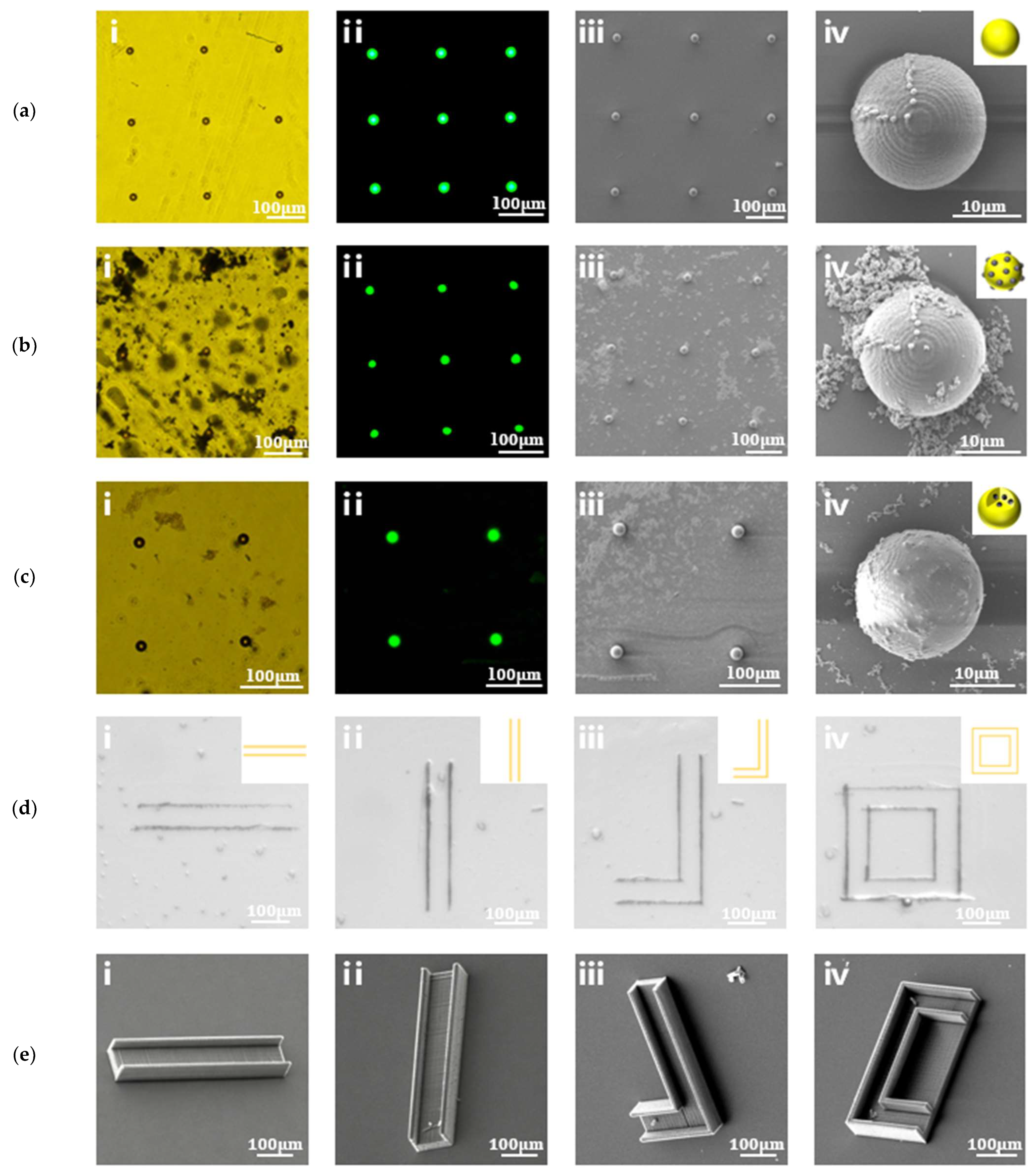
In magnetic microsphere fabrication experiments, microspheres processed from magnetic photoresist only required development in propanol, while those from conventional photoresist required secondary operations after development. Characterization results of magnetic microspheres prepared by the two methods are shown in Figure 3. Pure photoresist microspheres prepared by Method 1 (Figure 3a) exhibited regular morphology, smooth surfaces, and uniform diameter. After soaking in Fe3O4 solution (Figure 3b), SEM images showed a layer of Fe3O4 nanoparticles attached to the microsphere surface, indicating the magnetic properties of the microspheres. Magnetic microspheres directly prepared by Method 2 (Figure 3c) displayed uniform magnetic particle distribution on the surface, with more even dispersion of the magnetic particles. This is attributed to the uniform dispersion system of magnetic photoresist, avoiding potential particle agglomeration caused by post-soaking processes.
Using photoresist SZ2080 as raw material, four typical microchannel structures were fabricated through two-photon polymerization technology (Figure 3d): horizontal straight channel (length 400 μm, width 10 μm, height 25 μm), vertical straight channel (same dimensions as the horizontal straight channel), L-shaped channel (corner angle 90°, consistent channel dimensions), and square closed channel (internal square side length 200 μm, external square side length 300 μm). As shown in Figure 3e, the microchannel exhibits a smooth, defect-free inner surface and good dimensional consistency, which provides direct visual evidence for the validity of the femtosecond laser two-photon polymerization fabrication technique. After processing, magnetic microspheres were transferred to glass slides with channels, and then positioned at specific locations using the magnetic actuation platform.

3.2. Performance Comparison of Microspheres Prepared by Different Systems

In this study, magnetic microspheres with a size of 20 μm were fabricated via the FLTPP process. To highlight the technical advantages of this method, it was compared with existing ultra-precision fabrication systems for magnetic microspheres, and the results are presented in Table 1.
As can be clearly seen from Table 1, the FLTPP process adopted in this study enables the fabrication of magnetic microspheres with high precision at the 20 μm scale, allows flexible preparation of microspheres with arbitrary true three-dimensional structures, and yields microspheres with uniform and consistent internal magnetic distribution. In summary, the FLTPP process exhibits obvious characteristics in the fabrication of high-performance magnetic microspheres.

3.3. Directional Actuation of Magnetic Microspheres

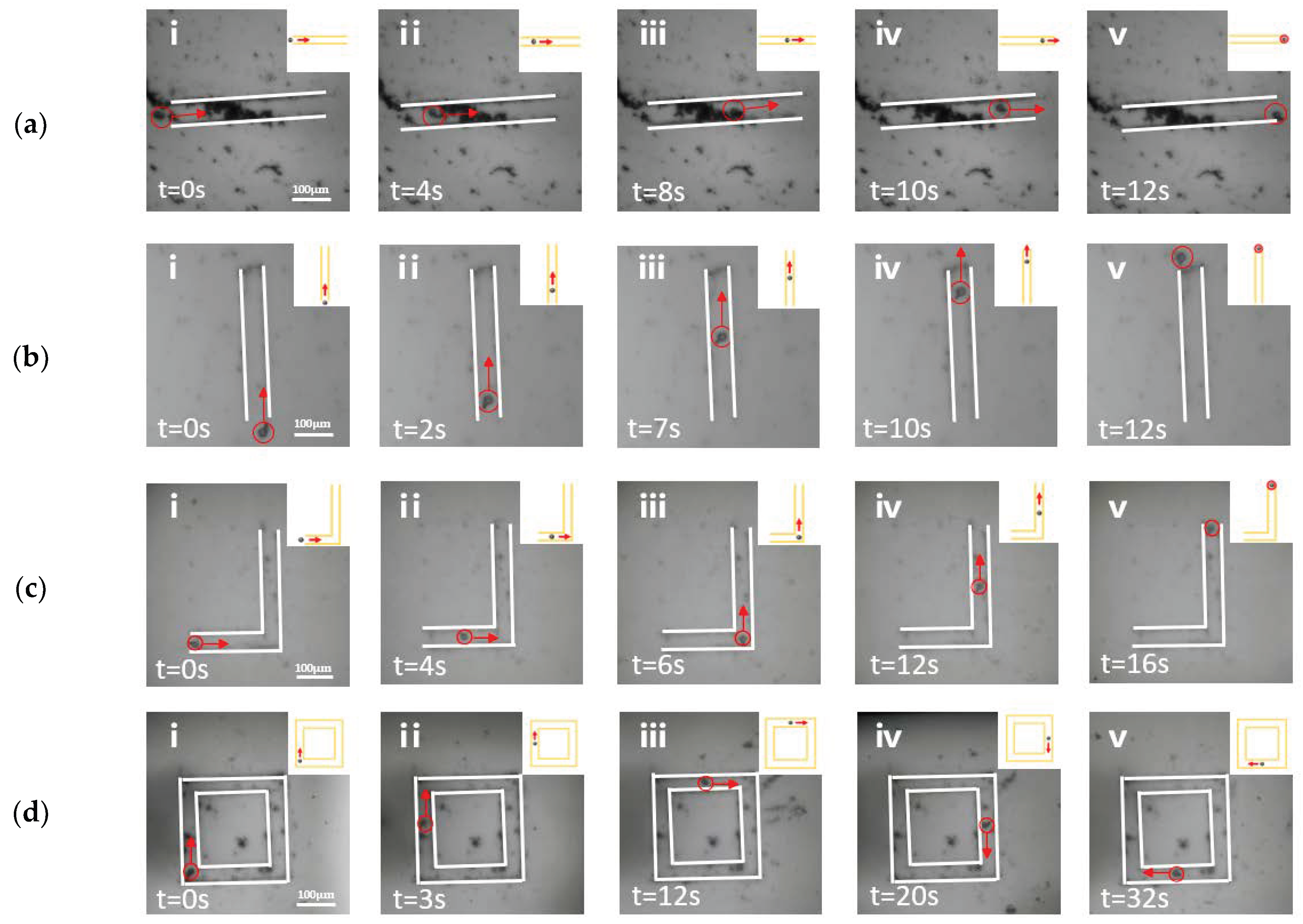
Figure 4 demonstrates the precise manipulation and directional transport of magnetic microspheres in four typical microfluidic channel structures (horizontal, vertical, L-shaped, and square); white indicates the microchannel boundaries, and red arrows indicate the microsphere motion directions.
Horizontal straight channel (Figure 4a): The microsphere departed from the left entrance of the channel, moved rightward stably along the horizontal straight channel, and reached the right exit at t = 12 s, achieving long-distance straight-line transport along a single horizontal direction.
Vertical straight channel (Figure 4b): The microsphere moved upward from the lower entrance of the channel, traveled uniformly along the vertical channel, and arrived at the upper exit at t = 12 s, completing vertical directional delivery. The microsphere velocities in two channels of identical length but different directions were approximately the same, demonstrating stable magnetic actuation performance of this system.
L-shaped corner channel (Figure 4c): The microsphere first moved rightward along the horizontal section; after reaching the corner, it turned to move upward along the vertical section. It exhibited a brief stationary state when passing through the corner and finally reached the top exit of the channel at t = 16 s, clearly demonstrating the flexible turning capability of the microsphere at a 90° corner.
Closed square channel (Figure 4d): The microsphere departed from the lower left corner of the channel, moved sequentially along the cyclic path of lower left → upper left → upper right → lower right → lower left, and completed one full closed-loop transport at t = 32 s, demonstrating the capability of continuous manipulation and path planning in complex topological channels.
In summary, under all configurations, microspheres could travel precisely along preset channels without obvious deviation or jamming, indicating that this magnetic actuation platform achieves stable, controllable, and long-range directional transport of microspheres in microchannels of different dimensions and topological structures. Original images of the relevant actuation processes are provided in Supplementary Figure S2; complete actuation videos of four channels are available in the Supplementary Materials.

3.4. Performance of the Magnetic Actuation and Manipulation Platform

The independently constructed 3D magnetic actuation and manipulation platform possesses the following characteristics: 1. High-precision manipulation: The three-axis mobile platform achieves an adjustment precision of 0.02 mm; combined with manual micro-handwheel calibration, precise positioning of the magnet and microspheres can be realized. 2. Real-time observation and feedback: The imaging system and drive module operate synchronously; CCD sensors acquire images in real time, facilitating timely adjustment of microsphere positions and ensuring the accuracy of experimental data. 3. Safety and reliability: The integrated overtravel protection mechanism prevents equipment collision and damage; meanwhile, automatic and manual mode switching is supported, adapting to experimental scenarios with different precision requirements. 4. Favorable economy: Conventional magnetic actuation and manipulation platforms mostly rely on inverted microscopes to complete microstructure observation, whereas this platform utilizes microscope objectives to achieve equivalent observation functions, significantly reducing equipment costs and exhibiting good cost-effectiveness.

4. Conclusions

Based on femtosecond laser two-photon polymerization (FLTPP) technology, this study proposes two preparation strategies for Fe3O4-based magnetic microspheres, achieving the controllable fabrication of magnetic microspheres with a dimensional accuracy of 20 μm. The independently constructed three-dimensional (3D) magnetic actuation and manipulation platform realizes the stable actuation of magnetic microspheres in specific microchannels. The main conclusions are as follows:
  • Both preparation methods have successfully produced magnetic microspheres with high dimensional accuracy and good magnetic response. Among them, the direct molding method using magnetic photoresist simplifies the preparation process and results in more uniform dispersion of magnetic particles within the microspheres.
  • The self-built three-dimensional magnetic actuation platform enables stable manipulation of 20 μm magnetic microspheres in specific channels. It features a large travel range (XY: ±6.5 mm, Z: 10 mm), an adjustment precision of 0.02 mm, and a motion trajectory deviation of less than 2 μm.
  • Compared with existing ultra-high-precision magnetic microsphere fabrication systems, the FLTPP process in this study exhibits favorable performance in terms of dimensional accuracy, magnetic material integration, and cost, providing a reliable technical route for the processing and fabrication of magnetic micro/nano devices.
This research provides feasible technical solutions for the preparation and manipulation of micro/nano-scale magnetic devices, and is expected to be applied in fields such as biomedical detection and microfluidic chips. In the future, the magnetic particle content and dispersibility of magnetic photoresist can be further optimized to enhance the magnetic response sensitivity of microspheres, and the platform’s capability for multi-microsphere cooperative manipulation can be expanded.

Supplementary Materials

The following supporting information can be downloaded at https://www.mdpi.com/article/10.3390/opt7030030/s1. Figure S1. Schematic of the femtosecond laser processing setup for micro/nano-structure fabrication; Figure S2. Motion processes of magnetically driven microspheres in horizontal straight channel, vertical straight channel, L-shaped bent channel, and square closed channel (original images).

Author Contributions

Conceptualization, J.W., S.Z. and J.N.; Methodology, S.Z. and W.C.; Software, W.C. and Z.X.; Validation, J.W., S.Z., W.C. and S.F.; Formal analysis, J.W., S.Z. and W.C.; Investigation, J.W., S.Z., Z.X. and S.D.; Resources, S.F., G.M. and V.L.; Data curation, J.W., S.Z. and W.C.; Writing—original draft, J.W. and S.Z.; Writing—review and editing, S.F., J.N. and G.M.; Visualization, W.C. and Z.X.; Supervision, S.F. and J.N.; Project administration, S.F. and J.N.; Funding acquisition, S.F., J.N. and S.D. All authors have read and agreed to the published version of the manuscript.

Funding

This research was funded by the Jinan City Science and Technology Program ‘Open Challenge’ Project (No. 202428024), the National Natural Science Foundation of China (No. 62305180), the Jinan “20 New Universities” Funding Project (No. 202333010) and the Shandong Provincial Natural Science Foundation (No. ZR2024QF113).

Data Availability Statement

All data supporting the findings of this study are available within the article and its Supplementary Materials.

Conflicts of Interest

The authors declare no conflicts of interest. The commercial affiliation of the author from Shandong Hua’an Biotechnology Co., Ltd. does not affect the design, conduct, or reporting of this study.

References

  1. Zhang, L.; Abbott, J.J.; Dong, L.; Kratochvil, B.E.; Bell, D.; Nelson, B.J. Artificial bacterial flagella: Fabrication and magnetic control. Appl. Phys. Lett. 2009, 94, 064107. [Google Scholar] [CrossRef]
  2. Ghosh, A.; Fischer, P. Controlled propulsion of artificial magnetic nanostructured propellers. Nano Lett. 2009, 9, 2243–2245. [Google Scholar] [CrossRef] [PubMed]
  3. Li, J.; Sattayasamitsathit, S.; Dong, R.; Gao, W.; Tam, R.; Feng, X.; Wang, J. Template electrosynthesis of tailored-made helical nanoswimmers. Nanoscale 2014, 6, 9415–9420. [Google Scholar] [CrossRef] [PubMed]
  4. Yan, X.; Zhou, Q.; Vincent, M.; Deng, Y.; Yu, J.; Xu, J.; Zhang, L. Multifunctional biohybrid magnetite microrobots for imaging-guided therapy. Sci. Robot. 2017, 2, eaaq1155. [Google Scholar] [CrossRef] [PubMed]
  5. Liu, L.; Chen, B.; Liu, K.; Gao, J.; Ye, Y.; Wang, Z.; Peng, F. Wireless manipulation of magnetic/piezoelectric micromotors for precise neural stem-like cell stimulation. Adv. Funct. Mater. 2020, 30, 1910108. [Google Scholar] [CrossRef]
  6. Yu, Y.; Shang, L.; Gao, W.; Zhao, Z.; Wang, H.; Zhao, Y. Microfluidic lithography of bioinspired helical micromotors. Angew. Chem. 2017, 129, 12295–12299. [Google Scholar] [CrossRef]
  7. Jeon, S.; Hoshiar, A.K.; Kim, K.; Lee, S.; Kim, E.; Lee, S.; Choi, H. A magnetically controlled soft microrobot steering a guidewire in a three-dimensional phantom vascular network. Soft Robot. 2019, 6, 54–68. [Google Scholar] [CrossRef]
  8. Ji, F.; Jin, D.; Wang, B.; Zhang, L. Light-driven hovering of a magnetic microswarm in fluid. ACS Nano 2020, 14, 6990–6998. [Google Scholar] [CrossRef]
  9. Wu, Z.; Lin, X.; Wu, Y.; Si, T.; Sun, J.; He, Q. Near-infrared light-triggered “on/off” motion of polymer multilayer rockets. Acs Nano 2014, 8, 6097–6105. [Google Scholar] [CrossRef]
  10. Mu, G.; Qiao, Y.; Sui, M.; Grattan, K.T.; Dong, H.; Zhao, J. Acoustic-propelled micro/nanomotors and nanoparticles for biomedical research, diagnosis, and therapeutic applications. Front. Bioeng. Biotechnol. 2023, 11, 1276485. [Google Scholar] [CrossRef]
  11. Abbott, J.J.; Peyer, K.E.; Lagomarsino, M.C.; Zhang, L.; Dong, L.; Kaliakatsos, I.K.; Nelson, B.J. How should microrobots swim? Int. J. Robot. Res. 2009, 28, 1434–1447. [Google Scholar] [CrossRef]
  12. Safdar, M.; Khan, S.U.; Jänis, J. Progress toward catalytic micro-and nanomotors for biomedical and environmental applications. Adv. Mater. 2018, 30, 1703660. [Google Scholar] [CrossRef] [PubMed]
  13. Dong, Y.; Wang, L.; Iacovacci, V.; Wang, X.; Zhang, L.; Nelson, B.J. Magnetic helical micro-/nanomachines: Recent progress and perspective. Matter 2022, 5, 77–109. [Google Scholar] [CrossRef]
  14. Xu, T.; Gao, W.; Xu, L.P.; Zhang, X.; Wang, S. Fuel-free synthetic micro-/nanomachines. Adv. Mater. 2017, 29, 1603250. [Google Scholar] [CrossRef]
  15. Li, J.; Wang, H.; Shi, Q.; Zheng, Z.; Cui, J.; Sun, T.; Fukuda, T. Biped walking of magnetic microrobot in oscillating field for indirect manipulation of non-magnetic objects. IEEE Trans. Nanotechnol. 2019, 19, 21–24. [Google Scholar] [CrossRef]
  16. Ongaro, F.; Pane, S.; Scheggi, S.; Misra, S. Design of an electromagnetic setup for independent three-dimensional control of pairs of identical and nonidentical microrobots. IEEE Trans. Robot. 2018, 35, 174–183. [Google Scholar] [CrossRef]
  17. Kummer, M.P.; Abbott, J.J.; Kratochvil, B.E.; Borer, R.; Sengul, A.; Nelson, B.J. OctoMag: An electromagnetic system for 5-DOF wireless micromanipulation. IEEE Trans. Robot. 2010, 26, 1006–1017. [Google Scholar] [CrossRef]
  18. Huang, T.Y.; Sakar, M.S.; Mao, A.; Petruska, A.J.; Qiu, F.; Chen, X.B.; Nelson, B.J. 3D printed microtransporters: Compound micromachines for spatiotemporally controlled delivery of therapeutic agents. Adv. Mater. (Deerfield Beach Fla.) 2015, 27, 6644. [Google Scholar] [CrossRef]
  19. Ren, Z.; Xin, C.; Liang, K.; Wang, H.; Wang, D.; Xu, L.; Wu, D. Femtosecond laser writing of ant-inspired reconfigurable microbot collectives. Nat. Commun. 2024, 15, 7253. [Google Scholar] [CrossRef]
  20. Rodriguez-Gonzalez, B.; Vereda, F.; de Vicente, J.; Hidalgo-Alvarez, R. Rough and hollow spherical magnetite microparticles: Revealing the morphology, internal structure, and growth mechanism. J. Phys. Chem. C 2013, 117, 5397–5406. [Google Scholar] [CrossRef]
  21. Chircov, C.; Pîrvulescu, D.C.; Bîrcă, A.C.; Andronescu, E.; Grumezescu, A.M. Magnetite microspheres for the controlled release of rosmarinic acid. Pharmaceutics 2022, 14, 2292. [Google Scholar] [CrossRef] [PubMed]
  22. Greculeasa, S.G.; Palade, P.; Schinteie, G.; Leca, A.; Dumitrache, F.; Lungu, I.; Kuncser, V. Tuning structural and magnetic properties of Fe oxide nanoparticles by specific hydrogenation treatments. Sci. Rep. 2020, 10, 17174. [Google Scholar] [CrossRef] [PubMed]
  23. Cheng, Y.; Tan, R.; Wang, W.; Guo, Y.; Cui, P.; Song, W. Controllable synthesis and magnetic properties of Fe3O4 and Fe3O4@ SiO2 microspheres. J. Mater. Sci. 2010, 45, 5347–5352. [Google Scholar] [CrossRef]
  24. Davies, B.E.; Mottram, R.S.; Harris, I.R. Recent developments in the sintering of NdFeB. Mater. Chem. Phys. 2001, 67, 272–281. [Google Scholar] [CrossRef]
  25. Bai, G.; Gao, R.W.; Sun, Y.; Han, G.B.; Wang, B. Study of high-coercivity sintered NdFeB magnets. J. Magn. Magn. Mater. 2007, 308, 20–23. [Google Scholar] [CrossRef]
  26. Dong, M.; Wang, X.; Chen, X.Z.; Mushtaq, F.; Deng, S.; Zhu, C.; Pané, S. 3D-printed soft magnetoelectric microswimmers for delivery and differentiation of neuron-like cells. Adv. Funct. Mater. 2020, 30, 1910323. [Google Scholar] [CrossRef]
  27. Gao, W.; Feng, X.; Pei, A.; Kane, C.R.; Tam, R.; Hennessy, C.; Wang, J. Bioinspired helical microswimmers based on vascular plants. Nano Lett. 2014, 14, 305–310. [Google Scholar] [CrossRef]
  28. Jeon, S.; Kim, S.; Ha, S.; Lee, S.; Kim, E.; Kim, S.Y.; Choi, H. Magnetically actuated microrobots as a platform for stem cell transplantation. Sci. Robot. 2019, 4, eaav4317. [Google Scholar] [CrossRef]
  29. Zhang, J.; Ren, Z.; Hu, W.; Soon, R.H.; Yasa, I.C.; Liu, Z.; Sitti, M. Voxelated three-dimensional miniature magnetic soft machines via multimaterial heterogeneous assembly. Sci. Robot. 2021, 6, eabf0112. [Google Scholar] [CrossRef]
  30. Liu, Z.; Li, M.; Dong, X.; Ren, Z.; Hu, W.; Sitti, M. Creating three-dimensional magnetic functional microdevices via molding-integrated direct laser writing. Nat. Commun. 2022, 13, 2016. [Google Scholar] [CrossRef]
  31. Meng, K.; Jia, Y.; Yang, H.; Niu, F.; Wang, Y.; Sun, D. Motion planning and robust control for the endovascular navigation of a microrobot. IEEE Trans. Ind. Inform. 2019, 16, 4557–4566. [Google Scholar] [CrossRef]
  32. Mousavi, A.; Khaksar, H.; Ahmed, A.; Choi, H.; Hoshiar, A.K. Magnetic microrobot control using an adaptive fuzzy sliding-mode method. In 2022 IEEE/RSJ International Conference on Intelligent Robots and Systems (IROS); IEEE: New York, NY, USA, 2022; pp. 6484–6489. [Google Scholar]
  33. Niu, F.; Li, J.; Ma, W.; Yang, J.; Sun, D. Development of an enhanced electromagnetic actuation system with enlarged workspace. IEEE/ASME Trans. Mechatron. 2017, 22, 2265–2276. [Google Scholar] [CrossRef]
  34. Zhang, Z.; Long, F.; Menq, C.H. Three-dimensional visual servo control of a magnetically propelled microscopic bead. IEEE Trans. Robot. 2012, 29, 373–382. [Google Scholar] [CrossRef]
  35. Li, D.; Dong, D.; Lam, W.; Xing, L.; Wei, T.; Sun, D. Automated in vivo navigation of magnetic-driven microrobots using OCT imaging feedback. IEEE Trans. Biomed. Eng. 2019, 67, 2349–2358. [Google Scholar] [CrossRef]
Figure 1. Preparation of magnetic materials and magnetic microspheres. The red circle indicates the magnified view of the corresponding area, where the yellow region represents the photoresist. (a) FeCl3·6H2O, FeCl2·4H2O, DI water, NH3·H2O, surfactant Oleic acid, and n-Octane were processed following specific steps to obtain magnetic fluid (①); this was sequentially mixed with n-Hexane and photoresist SZ2080 (ultrasonication required when mixing with photoresist), and magnetic photoresist material (②) was finally obtained. (b) After processing the photoresist SZ2080, a femtosecond laser was focused inside the material through an oil-immersion objective to fabricate microspheres with a diameter of 20 μm, which were then soaked in n-propanol solution for 3 h to obtain a microsphere array. (c) Fe3O4 nanoparticles were mixed with deionized water at a specific ratio to form a magnetic dispersion (i). The pre-fabricated microspheres were then placed in this solution (ii) to yield the final magnetic microspheres.
Optics 07 00030 g001
Figure 2. Magnetic microsphere manipulation and observation experimental platform. (a) Schematic of the overall integrated layout of experimental device. (b) Photograph of the experimental platform. (c) 3D magnetic actuation platform for precise control of magnet motion. (d) Three-axis micro-motion sample stage for small-range precise positioning and placement of samples. (e) Vertical lift imaging system for precise adjustment of the sample in height direction.
Optics 07 00030 g002
Figure 3. Characterization of microspheres and actuation channels. The corresponding schematic is displayed in the upper right corner. The yellow area represents the photoresist component, and the black area denotes magnetic nanoparticles. (a) Bright-field image (i), fluorescence image (ii), scanning electron microscope (SEM) image (iii), and SEM image of a single microsphere (iv) of microsphere arrays fabricated by femtosecond laser two-photon polymerization. The schematic illustrates the morphology of the fabricated microspheres. (b) Bright-field image (i), fluorescence image (ii), SEM image (iii), and SEM image of a single magnetic microsphere (iv) of microsphere arrays after soaking in magnetic dispersion for 5 h. The schematic illustrates the attachment of magnetic nanoparticles to the microsphere surface. (c) Bright-field image (i), fluorescence image (ii), SEM image (iii), and SEM image of a single magnetic microsphere (iv) of magnetic microsphere arrays fabricated via two-photon polymerization based on magnetic photoresist. The schematic illustrates the uniform distribution of magnetic nanoparticles within the magnetic microsphere. (d) Horizontal straight channel (i), vertical straight channel (ii), L-shaped bent channel (iii), and square closed channel (iv) fabricated by femtosecond laser two-photon polymerization. (e) 40° side-view SEM image of the four microchannels. Horizontal straight channel (i), vertical straight channel (ii), L-shaped bent channel (iii), and half of the square channel (iv).
Optics 07 00030 g003
Figure 4. Schematic of motion path of magnetically actuated microspheres. The red circle represents the magnetic microsphere, the red arrow indicates the direction of motion in the next step, and the white box highlights the channel boundary. The corresponding schematic diagram is shown in the upper right corner, and the motion process of the microsphere follows the sequence (i–v). (a) Directional motion of magnetically actuated microspheres in a horizontal straight channel. (b) Directional motion of magnetically actuated microspheres in a vertical straight channel. (c) Turning motion of magnetically actuated microspheres in an L-shaped bent channel. (d) Cyclic motion of magnetically actuated microspheres in a square closed channel.
Optics 07 00030 g004
Table 1. Performance comparison between the FLTPP process in this study and other ultra-precision fabrication systems.
Fabrication ProcessDimensional AccuracyConstructed Structure DimensionMagnetic Material Incorporation Ability
This work: FLTPP process20 μm
(deviation ≤ ±1.5 μm)
Arbitrary true 3D structuresNo agglomeration of magnetic materials in the structure, consistent magnetic response
Microfluidic method50–100 μm
(deviation ≤ ±5 μm)
2D/simple sphericalProne to agglomeration, uneven magnetic response
Emulsion/solvent evaporation method80–200 μm
(deviation ≤ ±10 μm)
Irregular spherical shapeWeak magnetic response capability
Template-assisted method30–50 μm
(deviation ≤ ±3 μm)
Limited by template apertureCumbersome process, difficult to remove residues
Disclaimer/Publisher’s Note: The statements, opinions and data contained in all publications are solely those of the individual author(s) and contributor(s) and not of MDPI and/or the editor(s). MDPI and/or the editor(s) disclaim responsibility for any injury to people or property resulting from any ideas, methods, instructions or products referred to in the content.