
You are currently viewing a new version of our website. To view the old version click .
Optics
  • Article
  • Open Access

4 December 2025

Optimizing SAW Device Performance Using Titanium-Doped Lithium Niobate Substrates

,
,
,
and
Science and Technology for the Engineer LASTI Laboratory, ENSA of Khouribga, Sultan Moulay Slimane University of Beni Mellal, B.P. 77, Khouribga 25000, Morocco
*
Author to whom correspondence should be addressed.
This article belongs to the Special Issue Strain Engineering of Two-Dimensional Materials for Electronic/Optoelectronic Applications

Abstract

This study introduces a new theoretical framework for the ferroelectric phase transition in lithium niobate (LiNbO3), which explicitly incorporates electrostatic interactions between both first and second nearest-neighbor ions. This extended model is applied to estimate the inverse quality factor (Q−1), the equivalent mechanical resistance (Rm), and the Curie temperature (Tc) of pure and titanium-doped lithium niobate (LiNbO3:Ti). The proposed analytical expression for Tc is given by: T C * = 2 p * 3 c o s ( θ * 3 ) B * 3 2 p 3 c o s ( θ 3 ) B 3   T C . The analysis reveals that variations in Q−1 and Tc are governed by factors such as ionic mass, charge, and defect structure. The theoretical predictions show good agreement with experimental data reported in the literature—particularly for Q−1 in pure LiNbO3 and for Tc in Ti-doped LiNbO3—thus validating the reliability of the proposed model. Moreover, at constant temperature, both the inverse quality factor and the equivalent mechanical resistance decrease as the Ti concentration increases. This trend highlights that titanium doping enhances the acoustic performance of LiNbO3 substrates, making them more suitable for high-performance surface acoustic wave (SAW) device applications.

1. Introduction

Lithium niobate (LiNbO3, or LN) crystals occupy a central position among functional materials due to their remarkable piezoelectric, optical, and electrical properties [1,2,3,4]. Since their first growth by the Czochralski method in the 1960s [5], they have attracted considerable interest in a wide range of technological fields, including nonlinear optics [6,7], optical telecommunications, single-crystal nanodevices [8], acousto-optic components, sensors, and piezoelectric devices. However, to fully exploit the potential of these crystals, it is essential to understand the influence of their chemical composition as well as the role of structural defects on their intrinsic physical properties [9,10].
It is well established that point defects play a decisive role in the behavior of LN, particularly in its congruent form (cLN, Li/Nb ≈ 0.945) and stoichiometric form (sLN, Li/Nb = 1). In cLN, the significant presence of intrinsic defects such as niobium antisite ions (NbLi) and lithium vacancies (VLi) strongly modifies the crystal structure and its electrical and optical properties [11,12]. Processing techniques such as vapor transport equilibration (VTE) are commonly employed to approach the ideal stoichiometry and reduce the concentration of these defects [13,14,15]. At room temperature, the solid solubility range of LiNbO3 extends from 46% to about 50.4% molar Li2O, and this range further evolves at high temperatures, reaching between 45% and 50% at approximately 1210 °C [16].
Lithium niobate undergoes a ferroelectric-to-paraelectric phase transition at a Curie temperature (Tc) of approximately 1200 °C in stoichiometric crystals [17]. Most theoretical models describing this transition consider only electrostatic interactions between first-nearest neighbors [18,19,20], which may not fully capture the experimental behavior, particularly in doped systems.
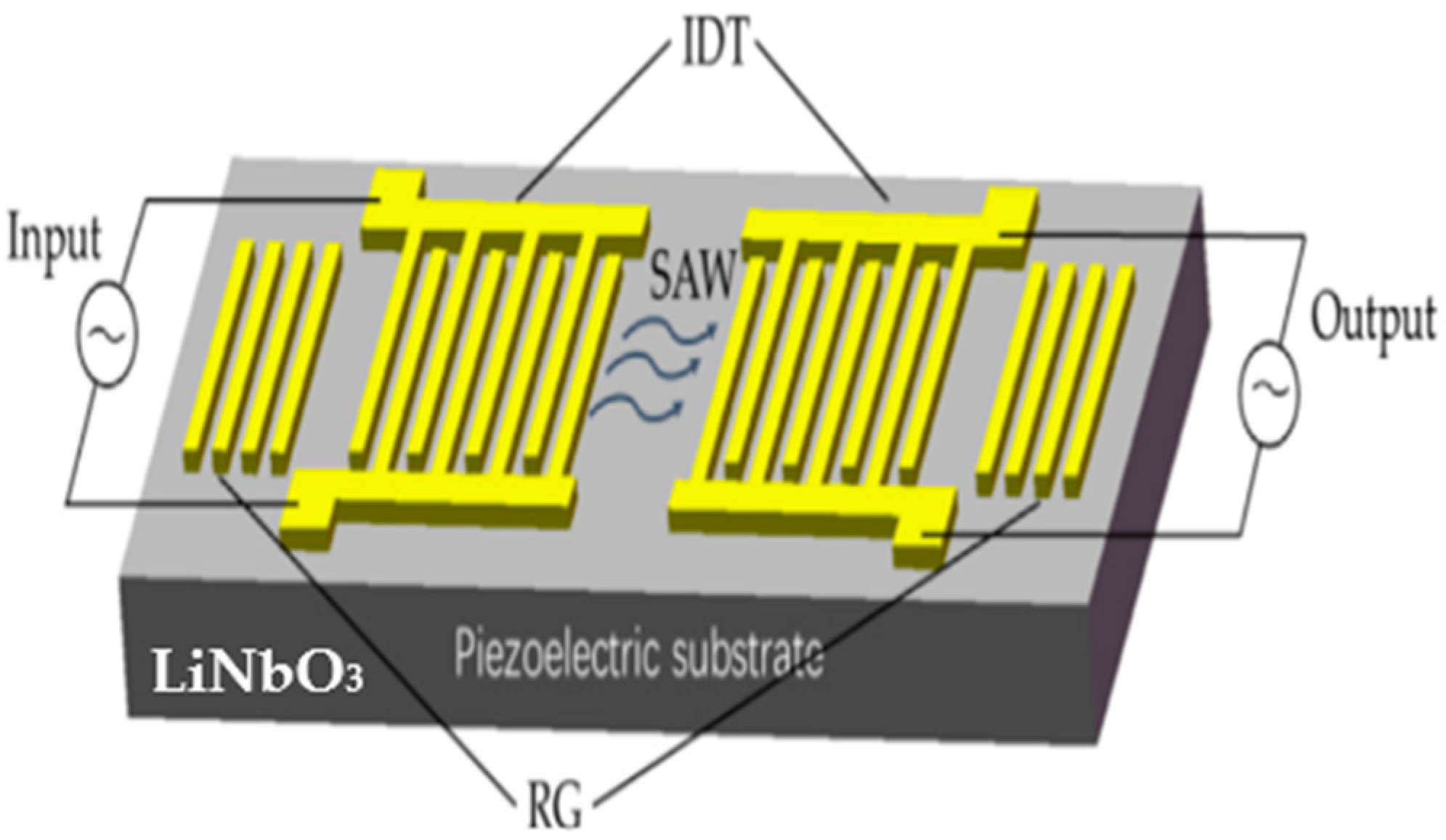
In this context, we propose a new theoretical approach that incorporates electrostatic interactions between the nearest neighbors and the most distant neighbors, which represents a significant extension of classical models. This methodology is applied to both pure LN and titanium-doped LN, using the vacancy model based on the substitution mechanism. The objective is to evaluate and analyze the influence of vacancy defects on the Curie temperature Tc, the quality factor Q, and the equivalent mechanical strength Rm. The results provide key information for optimizing titanium doping in LN, particularly for applications requiring high structural stability, strong electrical response, and improved optical performance, such as SAW resonators (Figure 1) and nonlinear optical modulators.
Figure 1. Basic structure of the SAW resonator [21].

2. Materials and Methods

2.1. Previous Theoretical Model (Th1)

In the pioneering work of Safaryan [19], the ferroelectric phase transition in lithium niobate (LiNbO3) is attributed to the combined effect of ionic dynamics and thermal expansion of the crystal lattice, ultimately leading to a rearrangement of the ionic sublattices. His theoretical model captures the essential ferroelectric behavior of LiNbO3 and reproduces the general features of its phase transition.
To make the analysis tractable, Safaryan simplified the complex three-dimensional ionic motion into a one-dimensional linear model of lattice vibrations, considering only electrostatic interactions between the nearest charged planes. Despite this simplification, the model provides meaningful insights into the origin of ferroelectricity in LiNbO3.
T C * = ω 2 * 2 ω 2 2 = M 0 * + M 1 * + M 2 * M 0 + M 1 + M 2 M 0 M 1 M 2 M 0 * M 1 * M 2 * P 2 P 1 * P 1 P 2 * . T C
where the parameters P 1 and P 2 are defined as:
P 1 = 3 q 0 R 12 2     q 1 R 20 2   q 2 R 10 2 P 2 = ( R 10 R 12 ) 2 q 1   1 M 0 + 1 M 2 + ( R 20 R 12 ) 2 q 2   1 M 1 + 1 M 0   ( R 10 R 20 ) 2 3 q 0   ( 1 M 1 + 1 M 2 )
In these expressions, M i and q i represent the ionic masses and effective charges of Li+, Nb5+, and O2− ions, while R i j corresponds to the equilibrium distances between interacting ions.

2.2. Our Theoretical Approach (Th2)

In the present work, we extend Safaryan’s model by including electrostatic interactions between both nearest and next-nearest neighboring ions. This refinement (denoted as Th2) aims to provide a more accurate and comprehensive description of the ferroelectric phase transition, especially in non-stoichiometric and doped LiNbO3 systems, where long-range lattice distortions and defect-induced charge redistributions play a crucial role.
In the LiNbO3 crystal structure, the lattice is formed by alternating planes of Li+, Nb5+, and O2− ions that interact via long-range Coulomb forces. The equations of motion describing these ions include the restoring forces generated by electrostatic coupling between charged planes. When second-nearest-neighbor interactions are incorporated, additional terms appear in the equations to account for the extended range of interionic forces.
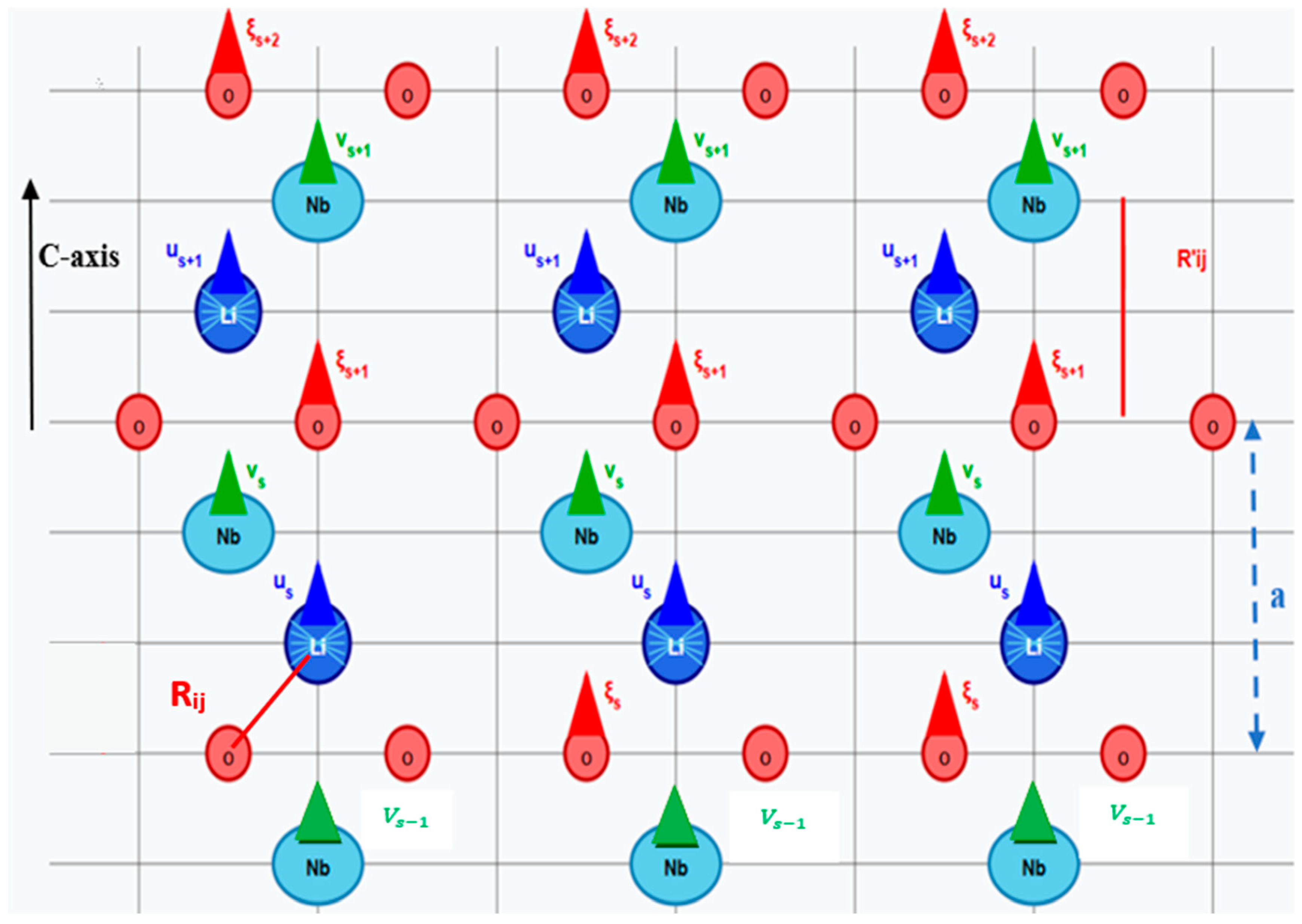
The lattice period a is defined as the distance between two successive oxygen planes. Figure 2 schematically illustrates the spatial arrangement of these ions within the s-th unit cell and the corresponding displacements: Us (Li+) for Li+, V s (B5+) for Nb5+ and ξ s (O2−) for O2−.
Figure 2. Crystalline structure of LiNbO3 showing atomic displacements along the c-axis. Rij denotes the distance between the nearest-neighbor atoms, while Rij′ represents the distance between the next-nearest neighbors.
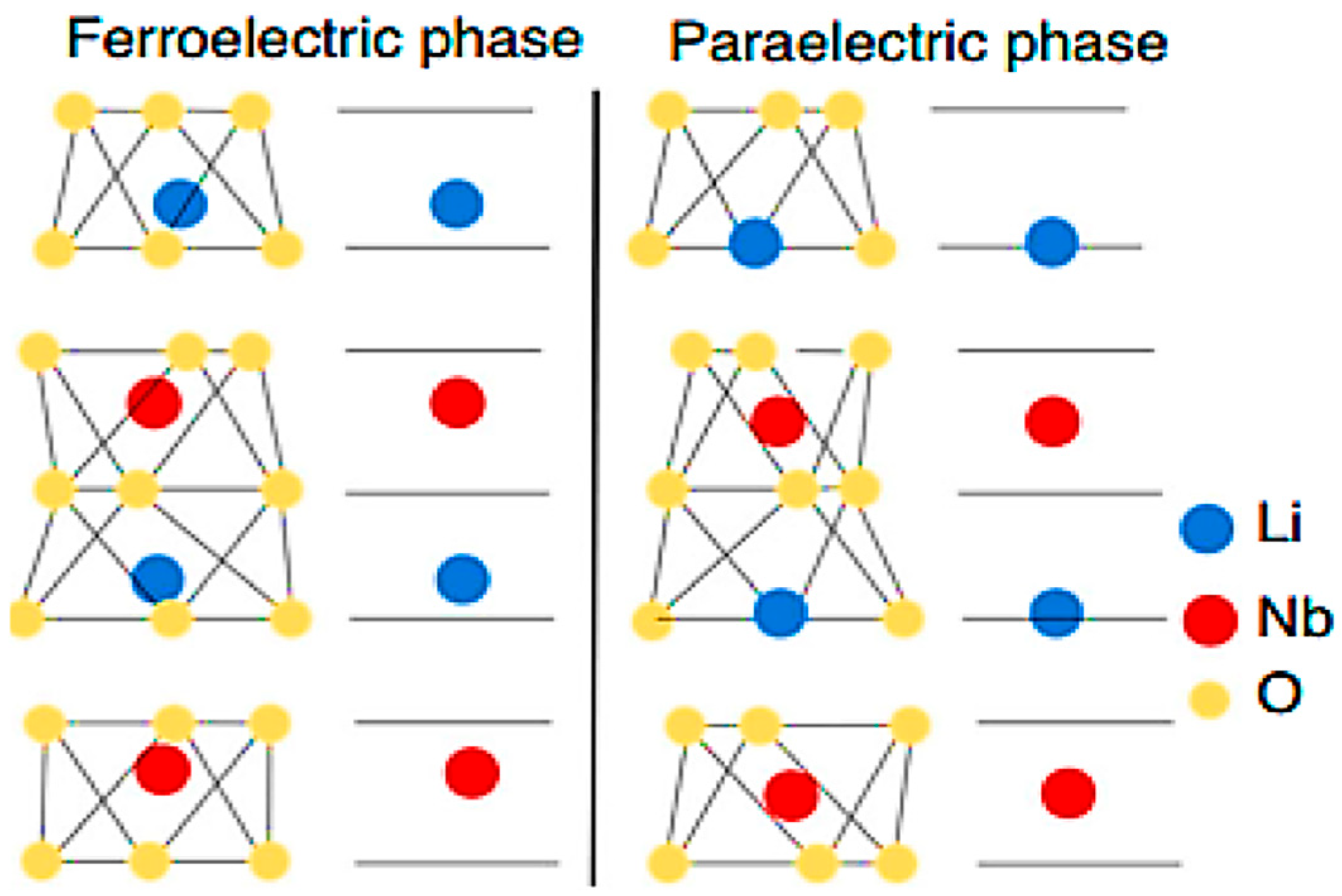
The ferroelectric transition in LiNbO3 is primarily driven by ionic displacements associated with the soft optical vibrational mode along the crystallographic c-axis—the polar direction where Li+, Nb5+, and O2− ions are aligned. It is along this axis that spontaneous polarization develops due to the relative shifts in Li+ and Nb5+ with respect to the oxygen sublattice. Consequently, Coulomb interactions perpendicular to the c-axis are neglected, as they have a negligible contribution to the polarization mechanism responsible for the phase transition, as shown in Figure 3 [22].
Figure 3. Crystal structure of lithium niobate in ferroelectric and paraelectric phase. Adapted with permission from Ref. [22].
Considering the nearest-neighbor (interactions between ions in adjacent planes) and second-neighbor (ions separated by two planes) interactions, the equations of motion for the ions Li+, Nb5+, and O2− can be written as follows:
M 1 U s ¨ = C 10 ξ U s + C 21 V s + 1 U s + C 10 ξ s + 1 U s + C 21 V s + 2 U s M 2 V s ¨ = C 21 U s V s + C 20 ξ s V s + C 21 U s + 1 V s +   C 20 ξ s + 1 V s M 0 ξ s ¨ = C 20 V s ξ s + C 10 U s 1 ξ s + C 20 V s 1 ξ s + C 10 U s 2 ξ s
Variables such as U s , V s and ξ s represent the relative displacements of ions or groups of atoms within the S-th unit cell. Terms with negative or positive indices like V s 1 , V s 2 , ξ s + 1 or V s + 2 indicate displacements in neighboring cells located immediately before or after the cell S. Specifically V s 1 , denotes the displacement in the preceding cell to the left, while V s 2 refers to the displacement in the next-nearest cell on that side. Conversely, V s + 1 and V s + 2 refer to displacements in the adjacent and subsequent cells to the right.
In this model, the terms C 10 , C 20 , and C 21 account for the contributions from second-nearest neighbors, i.e., ions located two planes apart along the trigonal c-axis. The masses M 1 , M 2 , and M 0 correspond to the respective masses of Li+, Nb5+, and O2− ions. The interactions between ions in adjacent planes are characterized by parameters denoted C i j .
It is important to emphasize that, although the notation C i j may resemble that of crystallographic elastic constants, in the present context, these quantities are not true elastic constants of the crystal. Instead, they represent effective coupling coefficients (or bonding force constants) between two ionic sublattices i and j located on adjacent planes along the c-axis. Physically, C i j quantifies the restorative electrostatic force opposing the relative displacement of the ions, and therefore reflects the strength of the interionic binding rather than the macroscopic elastic response of the crystal.
These effective force constants originate from Coulomb interactions between the ions’ effective charges and also incorporate the geometric arrangement of the lattice. In a simplified form, and up to a normalization factor, C i j can be expressed as [19]:
C i j = e 2 q i q j b R i j 0 2 n
where qi and qj are the electric charges of ions i and j, respectively; R i j 0 is the equilibrium distance between these ions; b is the characteristic distance in the lattice, generally the distance between crystal planes; and n is the ionic density. Specifically, for the LiNbO3 crystal, we have:
C L i O = C 20 = 3 e 2 q i q j b ( R 20 0 ) 2 n ; C 20 = 3 e 2 q i q j b ( R 20 0 ) 2 n C B O = C 10 = 3 e 2 q i q j b ( R 10 0 ) 2 n ; C 10 = 3 e 2 q i q j b ( R 10 0 ) 2 n C B L i = C 12 = e 2 q i q j b ( R 12 0 ) 2 n ; C 12 = e 2 q i q j b ( R 12 0 ) 2 n
Here, q0, q1, and q2 are the charges of the ions O2−, Nb5+, and Li+, respectively, and b is the lattice constant. The parameters Rij and R’ij indicate the distances between the nearest and second-nearest neighbors.
The choice of solutions in the form of plane waves, U s = U e i w t e i a s k with U s = V s ,   μ s or ξ s .
After calculating the determinant (Δ = 0), which represents the mathematical condition indicating the existence of non-trivial solutions for the system of motion equations, we identify the natural frequencies of the crystal associated with its vibrational modes: acoustic and optical. Solving this equation allows us to determine the various dispersion branches as functions of the wave vector k, which we take as the wave number equal to zero in this context. This leads to the following equation:
ω 6 + A ω 4 + B ω 2 + D = 0
where the coefficients A, B and D depend on the interaction constants and the masses of the ions.
The coefficients A, B and D are given by:
A = 1 m 2 C 12 + C 20 + C 12 + C 20 1 m 1 c 10 + c 12 + C 10 1 m 0 c 10 + c 20 B = 1 m 1 m 2 C 12 2 + c 10 C 20 + C 12 C 20 + C 20 C 10 + C 12 C 12 + c 10 C 20 + C 12 C 20 + C 10 C 20 + 1 m 0 m 2 c 10 C 12 + c 10 C 20 + C 12 C 20   + C 10 C 12 + C 12 C 20 + c 10 C 20 C 20 C 20 C 20 2 + 1 m 1 m 0 ( c 10 C 12 + c 10 C 20 + C 12 C 20 C 10 C 10 + C 20 C 10 C 10 2 ) D = 1 m 0 m 1 m 2 ( C 10 2 C 20 C 12 C 12 + C 20 C 10 2 C 12 + C 12 + C 20 2 + C 12 C 20 C 12 C 20 + c 10 ( C 12 2 + 2 C 12 C 20 2 C 12 C 10 + C 20 C 10 + C 12 C 12 + C 20 C 12 + 2 C 12 C 20 C 20 C 20 C 12 C 20 C 20 2 ) + C 20 ( C 12 2 + 2 C 12 C 12 C 12 C 10 ) C 12 C 20 2 )
There are several methods for solving the characteristic Equation (4). A classic approach is the Cardan method [23,24].
We pose ω = z B 3 from which Equation (3) becomes
z 3 + p ω + q = 0
where p = 3 A B 2 3 and q = 2 B 3 9 A B + 27 D 27 .
We found that Δ = ( q 2 ) 2 + p 3 3 = 5.31   × 10 170 < 0 , where there are three distinct real roots, which correspond to the fact that the system has three modes of vibration: an acoustic mode (the highest frequency) and two optical modes.
ω 1 2 = 2 p 3 cos θ 3 B 3 ω 2 2 = 2 p 3 cos θ + 2 π 3 B 3 ω 3 2 = 2 p 3 cos θ + 4 π 3 B 3
where r = p 3 27 and θ = cos 1 ( q 2 r ) .
By solving the system and substituting the physical parameters (expressed in the CGS unit system), we obtain the following values: ω 1 2 = 4.11 × 10 27   s 1 , ω 2 2 = 2.56 × 10 28   s 1 et ω 3 2 = 1.20 × 10 29   s 1 .
These values are consistent with the general order of magnitude ( 10 14 s−1) typically reported for the oscillation frequencies in lithium niobate, as described by Safaryan [19]. Among these, the lowest frequency mode, ω 1 2 , corresponds to the soft mode associated with the ferroelectric phase transition.
For non-stoichiometric or doped lithium niobate, the corresponding soft-mode frequency can be written analogously as:
ω 1 2 = 2 p 3 cos θ 3 B * 3
Since the phase transition temperature is proportional to the square of the soft-mode frequency, the Curie temperature of non-stoichiometric or doped lithium niobate can be expressed as:
T C = ω 1 2 ω 1 2 T C = 2 p 3 cos θ 3 B 3 2 p 3 cos θ 3 B 3 T C
This relationship enables the evaluation of T C for different defect models and doping configurations considered in this study.
Here, T C 1210  °C represents the Curie temperature of stoichiometric lithium niobate [14], while the parameters with asterisks refer to non-stoichiometric or doped materials, for which the presence of dopants alters both charge distribution and lattice symmetry.
For titanium-doped lithium niobate (LiNbO3:Ti), the ionic charge and mass parameters used in the calculations are: q Nb = + 5 ,   q Li = + 1 ,   q O = 2 ,   q Ti = + 4 , and M Nb = 92.9   a . u . ,   M Li = 6.94   a . u . ,   M O = 48.0   a . u . ,   M Ti = 47.86   a . u .
The interplanar separations between the first and second nearest-neighbor planes at T = 0   K for Li, Nb, and O atoms are taken from reference [19].
The first-nearest-neighbor distances are: R Nb O = 0.883   Å ,   R Li O = 0.680   Å ,   R Li Nb = 0.747   Å , while the second-nearest-neighbor distances are: R Nb O 1.766   Å ,   R Li O 1.360   Å ,   R Li Nb 1.494   Å [25].

2.3. Estimation of the Inverse Quality Factor, Electrical Conductivity, and Equivalent Mechanical Strength

2.3.1. Estimation of Electrical Conductivity

The electrical conductivity of LiNbO3 is known to be temperature-dependent and follows the classical Arrhenius law [26]:
σ ( T ) = σ 0 e E a K B T
where σ0 is the pre-exponential factor, a characteristic constant specific to each LN sample, Ea is the activation energy, i.e., the energy required for an electron to move from one band to another or overcome an energy barrier, and KB is Boltzmann’s constant (KB = 8. 617 × 10−5 eV/K).
In doped or non-stoichiometric LiNbO3, the introduction of point defects such as vacancies, antisite ions, or substitutional impurities modifies the local potential landscape and therefore alters the thermal activation of conductivity. To incorporate these effects, we introduce an effective temperature T * , which accounts for the influence of lattice distortion and defect-induced energy perturbations. The modified expression for the conductivity then becomes:
σ * ( T * ) σ ( T ) = e E a k B T *   e E a k B T ,   or   equivalently ,   σ * ( T * ) = σ 0   e E a k B T *
Here, σ * ( T * ) represents the effective electrical conductivity of doped or non-stoichiometric LiNbO3, while σ ( T ) corresponds to that of stoichiometric LiNbO3. The distinction between T and T * allows the model to reflect the structural disorder and modifications in the charge transport mechanisms introduced by impurities or deviations from stoichiometry.
For practical calculations, the modified expression can be rewritten as a function of the dopant concentration and the degree of non-stoichiometry:
σ * ( T ) = σ 0   e E a k B f ( x , y ) T
where x and y denote, respectively, the non-stoichiometric composition and the dopant concentration (in molar fraction). The function f ( x , y ) quantifies the influence of these two parameters on the lattice dynamics and on the effective charge mobility.
Based on the vacancy model developed for titanium-doped lithium niobate, the general expression of f ( x , y ) is given by:
f x , y = 2 p * 3 cos θ * 3 B * 3 2 p 3 cos θ 3 B 3
This relation establishes a direct connection between the defect structure (via x and y ) and the electrical conductivity, enabling a quantitative analysis of how dopant type and concentration affect charge transport in LiNbO3.

2.3.2. Titanium-Doping Model

In this study, the incorporation of titanium (Ti) into the lithium niobate (LiNbO3) lattice is described theoretically using the vacancy (defect) model, which captures both the substitutional behavior of dopant ions and the associated charge-compensation mechanisms. The chemical composition of Ti-doped lithium niobate can be expressed as:
[ Li ( Li 1 5 x + y ) Nb ( Li x ) ( Li 4 x y ) ] [ Nb ( Nb 1 y ) Ti ( Nb y ) ] [ O 3 ]
where Li denotes a lithium vacancy.
According to this model, Ti4+ ions are primarily incorporated on Nb5+ lattice sites ( Ti Nb ), due to their similar ionic radii and valence states. However, a small fraction of Ti4+ ions may also occupy lithium sites ( Ti Li ), particularly in non-stoichiometric LiNbO3, where niobium antisite defects ( Nb Li ) are already present. To maintain charge neutrality, these substitutions are compensated by the creation of lithium vacancies ( Li ).
It is important to note that, in the present work, Ti doping is not introduced experimentally. Instead, it is modeled theoretically through its effect on the defect structure, charge distribution, and resulting electrical conductivity of the LiNbO3 crystal lattice.
Within this theoretical framework, the coefficients A , B , and D in the vibrational model are replaced by modified expressions that reflect the changes in ionic mass and charge distributions arising from both non-stoichiometry (x) and titanium concentration (y). The corresponding quantities are defined as follows:
M 0 * = M 0   and   q 0 * = q 0 M 1 * = 1 y M 1 + y M T i   and   q 1 * = 1 y q 1 + y q T i M 2 * = 1 5 x + y M 2 + x M 1   and   q 2 * = 1 5 x + y q 2 + x q 1
These modified parameters play a key role in determining the electrical conductivity and ferroelectric behavior of LiNbO3 as functions of both defect chemistry ( x ) and dopant concentration ( y ).
The non-stoichiometry parameter x , which quantifies the concentration of niobium antisite defects ( Nb Li ), can be expressed as a function of the Ti doping level using the following relationship:
x = 1 r r + 5 + 1 + r r + 5 y
where r denotes the Li/Nb molar ratio in the initial composition. Equation (15) indicates that the concentration of N b L i antisite defects in titanium-doped LiNbO3 increases with the Ti content, revealing a direct correlation between dopant concentration and defect formation. The defect dynamics in LiNbO3 are therefore not limited to a simple vacancy compensation mechanism but also involve the creation and redistribution of point defects depending on the dopant type and concentration.

2.3.3. Modeling of the Inverse Quality Factor

In this work, we investigate the inverse quality factor (Q−1) of lithium niobate (LiNbO3) in order to elucidate the influence of intrinsic structural defects and dopant-induced modifications on acoustic energy losses. Understanding these mechanisms is essential for optimizing the performance of LiNbO3-based materials, especially when used as substrates for surface acoustic wave (SAW) resonators and interdigitated transducers (IDTs) (Figure 1).
The inverse quality factor quantifies the dissipation of acoustic energy and reflects the combined effects of electromechanical coupling, charge transport, and thermally activated relaxation. Its modeling provides a framework to link microscopic defect structures and doping effects to macroscopic performance indicators such as the Q factor.
To describe these loss mechanisms, the inverse quality factor can be expressed by a phenomenological relation that incorporates both electroacoustic relaxation and thermal activation processes. The general form is given by [27]:
Q 1 = K 2 ω τ C 1 + ω 2 τ c 2 + Δ T e E C K B T + C 0
In this equation, K 2 is the electromechanical coupling coefficient, which depends on the piezoelectric properties of the material. The angular frequency ω is defined as   ω = 2 π f , where f is the operating frequency. The relaxation time τc is given by τ C = ε i j σ , with ε i j   representing the dielectric permittivity and σ the electrical conductivity. The second term of the equation accounts for thermally activated loss mechanisms, with Δ T being a fitting parameter and E C the activation energy. kB is the Boltzmann constant, and T is the absolute temperature. The constant term C 0 represents residual losses, independent of both temperature and frequency.
For doped or non-stoichiometric materials, this model can be extended to include the effect of doping on the effective temperature. In this case, the temperature T is replaced by a modified temperature T*, expressed as a function of the dopant type and concentration: T * = f ( x , y ) T . The modified inverse quality factor is then given by:
Q 1 * = K 2 ω τ * C 1 + ω 2 τ * c 2 + Δ T e E C K B T * + C 0
The modified relaxation time τ * C is calculated using τ C = ε i j σ , where the electrical conductivity.
Although Equation (18) was originally derived as an approximation valid for frequencies in the MHz range, it remains physically relevant and applicable to SAW devices that typically operate between hundreds of MHz and several GHz. This is because the parameters it contains, namely the electromechanical coupling coefficient ( K 2 ), the dielectric constant ( ε 11 ), and the elastic stiffness constant ( C 44 ), are intrinsic material properties, independent of the specific acoustic propagation mode.
These quantities govern the velocity of acoustic wave propagation, the strength of piezoelectric coupling, and the extent of energy dissipation within the material. As such, the same physical principles that determine the Q factor in bulk acoustic wave systems apply analogously to surface modes in SAW devices. Consequently, Equation (18) can be used approximately to analyze the dependence of Q−1 on temperature, frequency, and conductivity for LiNbO3-based substrates, including those doped with Ti or other impurities.
This approach therefore provides a consistent and unified framework for understanding acoustic loss mechanisms and performance optimization in doped lithium niobate, across both bulk and surface acoustic applications.

2.3.4. Equivalent Mechanical Resistance

In surface acoustic wave (SAW) devices, the equivalent mechanical resistance (Rm) is a key parameter that quantifies the mechanical energy losses within the system. It is inversely proportional to the mechanical quality factor (Q), which is highly sensitive to the intrinsic properties of the piezoelectric material, temperature variations, and the presence of structural defects induced by doping.
The analytical expression of Rm as a function of Q is given by [28]:
R m = 1 ω s C 0 K t 2 Q = Q 1 ω s C 0 K t 2
where ω s = 2 π f s is the angular resonance frequency, C 0 represents the static capacitance of the interdigital transducer (IDT), K t 2 is the electromechanical coupling coefficient of the material, and Q 1 denotes the inverse of the mechanical quality factor.
In this study, we analyzed a SAW resonator based on titanium-doped lithium niobate (LiNbO3:Ti4+) to investigate the evolution of Rm as a function of both dopant concentration and temperature. For the calculations, the following parameters were used ω s = 3.5   MHz , C 0 = 35.8   fF [29], K t 2 = 0.57 .

3. Results and Discussion

3.1. Curie Temperature of Titanium-Doped Niobate

In this section, we analyze the evolution of the Curie temperature (TC) as a function of titanium (Ti) concentration in lithium niobate (LiNbO3:Ti), using two theoretical approaches: the Safaryan model (Th1) and our extended model (Th2) [30], which includes electrostatic interactions with second-nearest neighbors. The calculations are based on Equation (11) and the vacancy model adapted to describe charge-compensation mechanisms in Ti-doped LiNbO3.
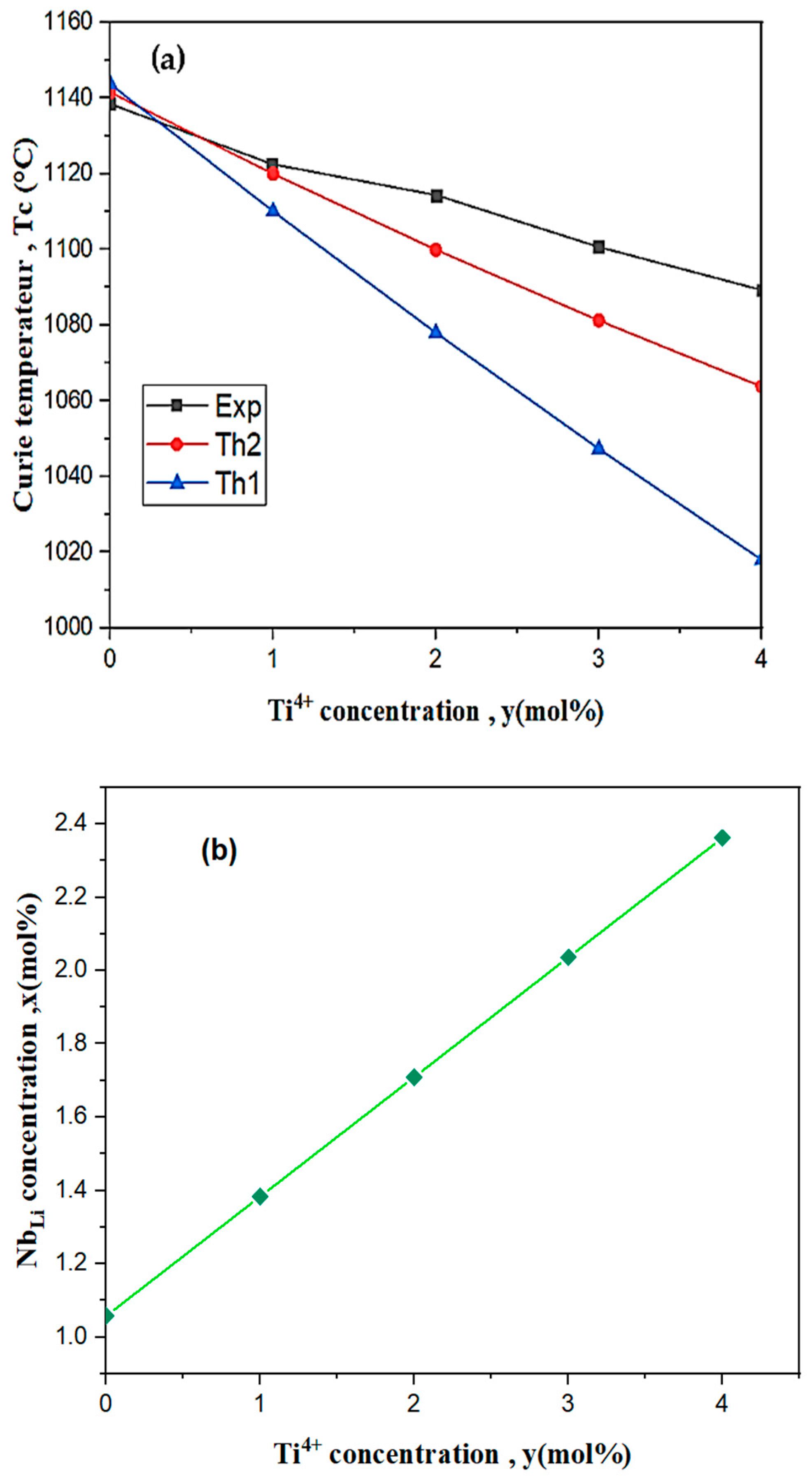
Figure 4a illustrates the variation in the Curie temperature with Ti molar concentration. A gradual decrease in TC is observed as the titanium content increases. This behavior can be attributed to the substitution of Ti4+ ions for Nb5+ ions in the crystal lattice. Such substitution promotes the formation of NbLi antisite defects, which disrupt the balance of intrinsic lattice defects and enhance structural disorder (Figure 4b). This increased disorder weakens the stability of the ferroelectric phase, reduces long-range dipolar interactions, and consequently leads to a lower Curie temperature. Table 1 compares the experimental data with the theoretical predictions obtained from both models (Th1 and Th2), along with the corresponding deviations (ΔTC). The results derived from the Th2 model exhibit better agreement with the experimental values, underscoring the importance of incorporating second-neighbor interactions in accurately describing the ferroelectric behavior of Ti-doped LiNbO3. This improvement demonstrates that accounting for extended electrostatic coupling and charge redistribution within the lattice provides a more realistic representation of the soft-mode dynamics governing the ferroelectric transition.
Figure 4. (a): comparison between the theoretical evolution obtained by Th1 and Th2 and the experimental Curie temperature [31] of titanium-doped lithium niobate, and (b): concentrations of NbLi (x) in titanium-doped LiNbO3 as a function of the concentration of Ti4+ (y) obtained from Equation (17).
Table 1. Comparisons between theoretical and experimental [31] results for the Curie temperature of titanium-doped niobate.

3.2. Inverse of the Quality Factor and Mechanical Strength of Lithium Niobate of Titanium-Doped Lithium Niobate

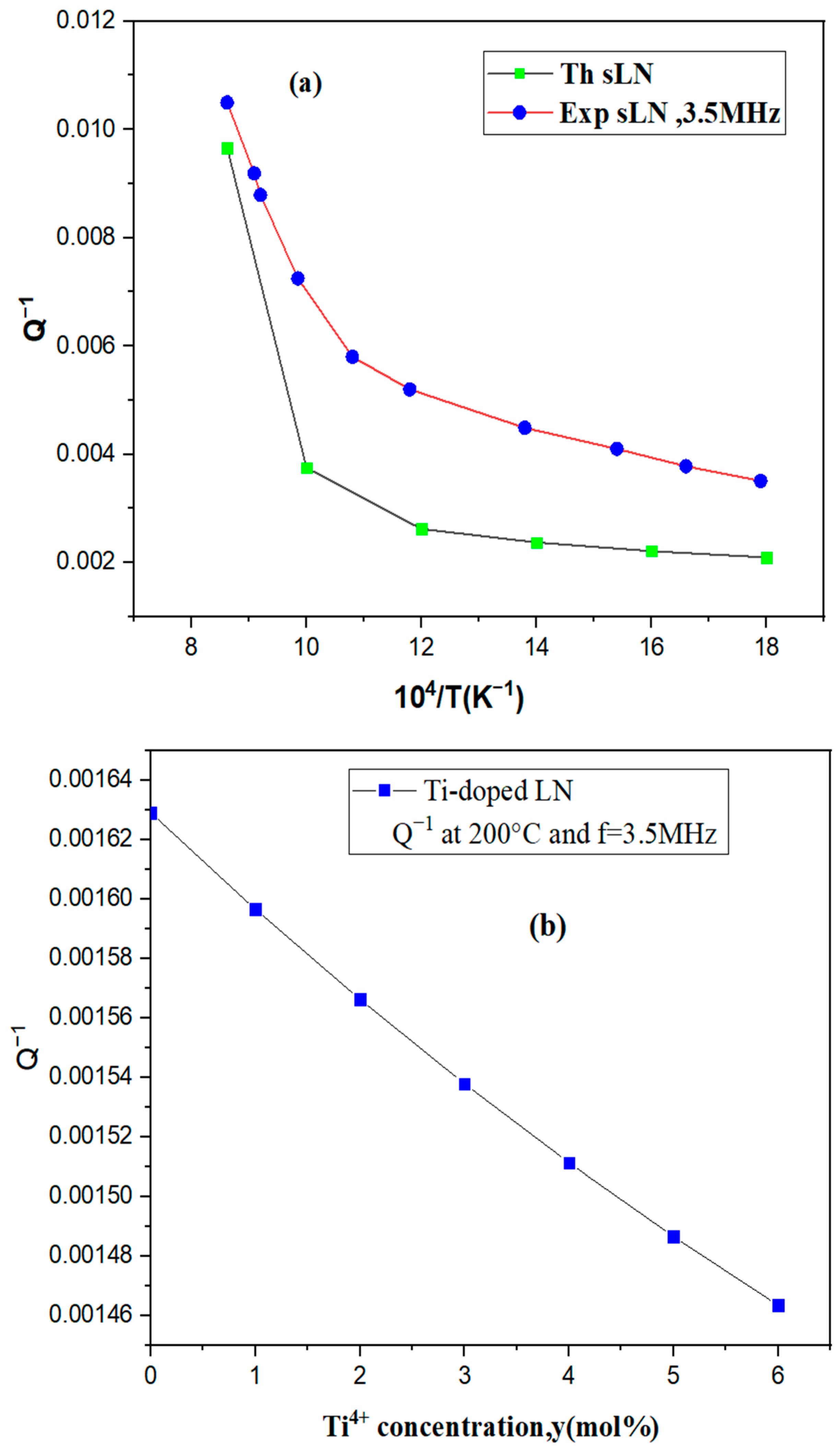
In this section, we analyze the variation in the inverse acoustic quality factor (Q−1) as a function of inverse temperature for two types of lithium niobate (LiNbO3): a stoichiometric sample with a molar ratio of r = [Li]/[Nb] = 0.99, and a congruent sample doped with titanium (LiNbO3:Ti).
To validate our theoretical model, the calculated values of Q−1 were compared with the experimental data reported by Éva Tichy-Rács et al. [27], using the material parameters listed in Table 2. The comparison for both samples is illustrated in Figure 5a.
Table 2. Adjustment parameters obtained from Q−1 (T) adjustments of c.LN and s.LN samples [27].
Figure 5. (a) Inverse quality factor of pure lithium niobate as a function of inverse temperature; (b) Q−1 of Ti4+-doped lithium niobate at a temperature of 200 °C and f = 3.5 MHz.
The variation in Q−1 for stoichiometric LiNbO3 (s-LN) and Ti4+-doped congruent LiNbO3, measured at a frequency of 3.5 MHz, is presented in Figure 5a and Figure 5b, respectively. For the stoichiometric crystal, Q−1 decreases with increasing inverse temperature, indicating that acoustic losses become more pronounced at higher temperatures. This trend is consistent with experimental observations and validates the thermal activation behavior predicted by the Arrhenius-type model. The theoretical predictions show good agreement with previously reported experimental data [27].
Furthermore, titanium doping induces a noticeable reduction in the inverse quality factor Q−1 as shown in Table 3, corresponding to an increase in the overall quality factor (Q). This improvement suggests that Ti4+ incorporation effectively mitigates loss mechanisms, possibly by reducing defect-induced scattering and internal friction. Such behavior is particularly advantageous for surface acoustic wave (SAW) devices employing interdigitated transducers (IDTs), where LiNbO3 serves as a substrate. In these devices, maximizing the quality factor is essential to minimize energy dissipation and enhance frequency stability and sensitivity. Therefore, Ti-doped LiNbO3 can be considered a promising substrate material, particularly for low-temperature or high-frequency SAW applications. The results also provide valuable insights for the optimization of doped LiNbO3, emphasizing the balance between conductivity, defect concentration, and acoustic losses required for advanced piezoelectric and electronic components.
Table 3. Theoretical values of the inverse quality factor Q−1 for congruent lithium niobate (c-LN) and titanium-doped lithium niobate (LN:Ti).
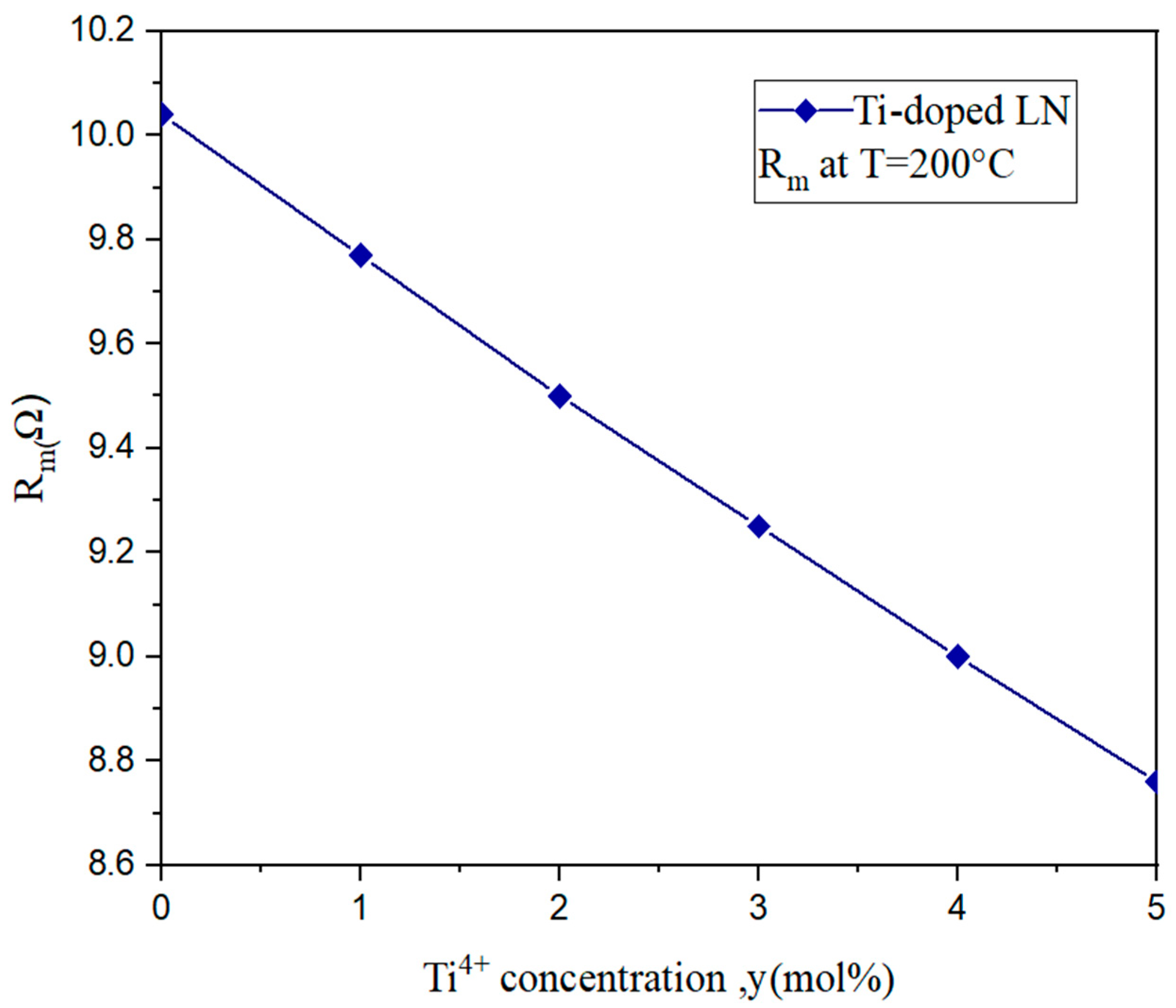
The data presented in Figure 6 reveal a clear and gradual decrease in the equivalent mechanical resistance R m with increasing titanium concentration in lithium niobate (LiNbO3) at 200 °C. For the undoped sample (0% Ti4+), R m is measured at 10.04 Ω, whereas at a titanium concentration of 5% Ti4+, it decreases to 8.76 Ω. This downward trend indicates that the incorporation of titanium effectively reduces mechanical losses within the crystal. The reduction in R m reflects an enhancement of piezoelectric efficiency, likely due to the mitigation of internal friction and the suppression of dissipative mechanisms associated with lattice imperfections. In other words, Ti4+ doping contributes to a more coherent and energetically stable crystal structure, which favors the efficient propagation of acoustic waves. Therefore, titanium incorporation in LiNbO3 can be regarded as beneficial for improving its acoustic performance, making Ti-doped lithium niobate a promising substrate for surface acoustic wave (SAW) devices where low energy dissipation and high signal stability are essential.
Figure 6. Mechanical Rm as a function of titanium dopant concentration at 200 °C.

4. Conclusions

In this work, we developed a theoretical framework based on ferroelectric phase transition theory to investigate the electrical and acoustic behavior of pure and titanium-doped lithium niobate (LiNbO3:Ti). Our results reveal that the Curie temperature (Tc) decreases progressively with increasing titanium concentration. This trend is attributed to the structural disorder induced by Ti4+ substitution at Nb5+ sites, which promotes the formation of NbLi antisite defects and modifies the electrostatic balance within the lattice. The proposed model shows excellent agreement with experimental data reported in the literature, validating its predictive reliability for both stoichiometric and doped LiNbO3. Moreover, titanium doping was found to reduce the inverse acoustic quality factor (Q−1) and the equivalent mechanical resistance (Rm), indicating a decrease in energy dissipation and an enhancement in acoustic efficiency. Overall, these findings underline the promising potential of Ti-doped LiNbO3 as a robust and tunable substrate for surface acoustic wave (SAW) devices. By combining improved thermal stability with enhanced electromechanical performance, Ti incorporation emerges as an effective route to optimize lithium niobate for next-generation SAW resonators and other high-frequency piezoelectric applications.

Author Contributions

Conceptualization, M.B.; Methodology, M.B.; Software, M.B.; Validation, M.B.; Formal analysis, K.M. and A.K.; Investigation, K.M.; Resources, K.M. and A.A.; Data curation, K.M. and A.K.; Writing—original draft, N.E.B.; Writing—review & editing, N.E.B. and A.K.; Visualization, N.E.B.; Supervision, N.E.B.; Project administration, A.A.; Funding acquisition, A.A. All authors have read and agreed to the published version of the manuscript.

Funding

This research received no external funding.

Data Availability Statement

The original contributions presented in this study are included in the article. Further inquiries can be directed to the corresponding author.

Conflicts of Interest

The authors declare no conflict of interest.

References

  1. Zhang, Y.; Xiao, X.; Chen, J.; Zhang, H.; Huang, Y.; Si, J.; Liang, S.; Xu, Q.; Zhang, H.; Ma, L.; et al. Lithium Niobate Crystal Preparation, Properties, and Its Application in Electro-Optical Devices. Inorganics 2025, 13, 278. [Google Scholar] [CrossRef]
  2. Yang, R.; Wei, H.; Tang, G.; Cao, B.; Chen, K. Advanced Crystallization Methods for Thin-Film Lithium Niobate and Its Device Applications. Materials 2025, 18, 951. [Google Scholar] [CrossRef]
  3. Palatnikov, M.; Makarova, O.; Kadetova, A.; Sidorov, N.; Teplyakova, N.; Biryukova, I.; Tokko, O. Structure, Optical Properties and Physicochemical Features of LiNbO3:Mg,B Crystals Grown in a Single Technological Cycle: An Optical Material for Converting Laser Radiation. Materials 2023, 16, 4541. [Google Scholar] [CrossRef]
  4. Zhu, Y.; Wan, Q. Lithium niobate/lithium tantalate single-crystal thin films for post-Moore era chip applications. Moore More 2024, 1, 6. [Google Scholar] [CrossRef]
  5. Uecker, R. The historical development of the Czochralski method. J. Cryst. Growth 2014, 401, 7–24. [Google Scholar] [CrossRef]
  6. Sun, X.; Liang, H.; Luo, R.; Jiang, W.C.; Zhang, X.-C.; Lin, Q. Nonlinear optical oscillation dynamics in high-Q lithium niobate microresonators. Opt. Express 2017, 25, 13504–13516. [Google Scholar] [CrossRef]
  7. Palatnikov, M.N.; Kadetova, A.V.; Smirnov, M.V.; Sidorova, O.V.; Vorobev, D.A. Nonlinear optical properties of lithium niobate crystals doped with alkaline earth and rare earth elements. Opt. Maters 2022, 131, 112631. [Google Scholar] [CrossRef]
  8. Lin, J.; Bo, F.; Cheng, Y.; Xu, J. Advances in on-chip photonic devices based on lithium niobate on insulator. Photon. Res. 2020, 8, 1910–1936. [Google Scholar] [CrossRef]
  9. Kofahl, C.; Ganschow, S.; Bernhardt, F.; El Azzouzi, F.; Sanna, S.; Fritze, H.; Schmidt, H. Li-diffusion in lithium niobate-tantalate solid solutions. Solid State Ion. 2024, 409, 116514. [Google Scholar] [CrossRef]
  10. Beriniz, M.; El Bouayadi, O.; El Barbri, N.; Maaider, K.; Khalil, A. The impact of the simultaneous presence of Li and Nb(Ta) vacancies in the defect structure of pure LiBO3 (B = Nb, Ta) on the curie temperature. E3S Web Conf. 2023, 469, 00007. [Google Scholar] [CrossRef]
  11. Sidorov, N.V.; Teplyakova, N.A.; Makarova, O.V.; Palatnikov, M.N.; Titov, R.A.; Manukovskaya, D.V.; Birukova, I.V. Boron Influence on Defect Structure and Properties of Lithium Niobate Crystals. Crystals 2021, 11, 458. [Google Scholar] [CrossRef]
  12. Kling, A.; Marques, J.G. Unveiling the Defect Structure of Lithium Niobate with Nuclear Methods. Crystals 2021, 11, 501. [Google Scholar] [CrossRef]
  13. Zheng, Y.; Shi, E.; Wang, S.; Lu, Z.; Cui, S.; Wang, L.; Zhong, W. Domain structures and etching morphologies of lithium niobate crystals with different Li contents grown by TSSG and double crucible Czochralski method. Cryst. Res. Technol. J. Exp. Ind. Crystallogr. 2004, 39, 387–395. [Google Scholar] [CrossRef]
  14. Bhatt, R.; Bhaumik, I.; Ganesamoorthy, S.; Karnal, A.; Gupta, P.; Swami, M.; Patel, H.; Sinha, A.; Upadhyay, A. Study of structural defects and crystalline perfection of near stoichiometric LiNbO3 crystals grown from flux and prepared by VTE technique. J. Mol. Struct. 2014, 1075, 377–383. [Google Scholar] [CrossRef]
  15. Bhatt, R.; Bhaumik, I.; Ganesamoorthy, S.; Bright, R.; Soharab, M.; Karnal, A.K.; Gupta, P.K. Control of Intrinsic Defects in Lithium Niobate Single Crystal for Optoelectronic Applications. Crystals 2017, 7, 23. [Google Scholar] [CrossRef]
  16. Han, J.-W.; Joo, K.; Shin, K.-B.; Auh, K.-H. Single Crystal Growth of Optic-Grade LiNbO3 Using a Floating Zone Technique. In Proceedings of the Korea Association of Crystal Growth Conference, Gyeongju, Korea, 1 September 1998; The Korea Association of Crystal Growth: Seoul, Republic of Korea, 1998; pp. 43–46. [Google Scholar]
  17. Sánchez-Dena, O.; Fierro-Ruiz, C.D.; Villalobos-Mendoza, S.D.; Carrillo Flores, D.M.; Elizalde-Galindo, J.T.; Farías, R. Lithium Niobate Single Crystals and Powders Reviewed—Part I. Crystals 2020, 10, 973. [Google Scholar] [CrossRef]
  18. Maaider, K.; Masaif, N.; Khalil, A. Stoichiometry-related defect structure in lithium niobate and lithium tantalate. Indian J. Phys. 2021, 95, 275–280. [Google Scholar] [CrossRef]
  19. Safaryan, F.P.; Feigelson, R.S.; Petrosyan, A.M. An approach to the defect structure analysis of lithium niobate single crystals. J. Appl. Phys. 1999, 85, 8079–8082. [Google Scholar] [CrossRef]
  20. Maaider, K.; Jennane, A.; Khalil, A.; Masaif, N. A new analytical description in C2+ doped LiBO3 C (Ni, Zn…); B (Nb, Ta). Indian J. Phys. 2012, 86, 575–582. [Google Scholar] [CrossRef]
  21. Lei, L.; Dong, B.; Hu, Y.; Lei, Y.; Wang, Z.; Ruan, S. High-Frequency Surface Acoustic Wave Resonator with Diamond/AlN/IDT/AlN/Diamond Multilayer Structure. Sensors 2022, 22, 6479. [Google Scholar] [CrossRef]
  22. Wang, H.; Chen, L.; Wu, Y.; Li, S.; Zhu, G.; Liao, W.; Zou, Y.; Chu, T.; Fu, Q.; Dong, W. Advancing inorganic electro-optical materials for 5 G communications: From fundamental mechanisms to future perspectives. Light Sci. Appl. 2025, 14, 190. [Google Scholar] [CrossRef] [PubMed]
  23. Third-Degree Equation: Cardan’s Method. Available online: https://fr.wikiversity.org/wiki/Équation_du_troisième_degré/Méthode_de_Cardan (accessed on 23 November 2025).
  24. Escofier, J.P. Galois Theory; Springer Science Business Media: Berlin/Heidelberg, Germany, 2000; Volume 204. [Google Scholar]
  25. Iyi, N.; Kitamura, K.; Izumi, F.; Yamamoto, J.K.; Hayashi, T.; Asano, H.; Kimura, S. Comparative study of defect structures in lithium niobate with different compositions. J. Solid State Chem. 1992, 101, 340–352. [Google Scholar] [CrossRef]
  26. Weidenfelder, A.; Shi, J.; Fielitz, P.; Borchardt, G.; Becker, K.D.; Fritze, H. Electrical and electromechanical properties of stoichiometric lithium niobate at high-temperatures. Solid State Ion. 2012, 225, 26–29. [Google Scholar] [CrossRef]
  27. Tichy-Rács, É.; Hurskyy, S.; Yakhnevych, U.; Gaczyński, P.; Ganschow, S.; Fritze, H.; Suhak, Y. Influence of Li-Stoichiometry on Electrical and Acoustic Properties and Temperature Stability of Li(Nb,Ta)O3 Solid Solutions up to 900 °C. Phys. Status Solidi 2025, 222, 2300962. [Google Scholar] [CrossRef]
  28. Larson, J.D.; Bradley, P.D.; Wartenberg, S.; Ruby, R.C. Modified Butterworth-Van Dyke circuit for FBAR resonators and automated measurement system. In Proceedings of the 2000 IEEE Ultrasonics Symposium, San Juan, Puerto Rico, 22–25 October 2000; IEEE: Piscataway, NJ, USA, 2000; Volume 1, pp. 863–868. [Google Scholar]
  29. Colombo, L.; Kochhar, A.; Vidal-Álvarez, G.; Piazza, G. Impact of frequency mismatch on the quality factor of large arrays of X-cut lithium niobate MEMS resonators. J. Microelectromech. Syst. 2020, 29, 1455–1463. [Google Scholar] [CrossRef]
  30. Beriniz, M.; Maaider, K.; El Barbri, N.; Khalil, A.; Amkor, A. Advanced simulations of the Curie temperature of the density in pure and MgO-doped LiNbO3. In Proceedings of the 2025 5th International Conference on Innovative Research in Applied Science, Engineering and Technology (IRASET), Fez, Morocco, 15–16 May 2025; IEEE: Piscataway, NJ, USA, 2025; pp. 1–6. [Google Scholar]
  31. Koyama, C.; Nozawa, J.; Fujiwara, K.; Uda, S. Effect of point defects on Curie temperature of lithium niobate. J. Am. Ceram. Soc. 2017, 100, 1118–1124. [Google Scholar] [CrossRef]
Disclaimer/Publisher’s Note: The statements, opinions and data contained in all publications are solely those of the individual author(s) and contributor(s) and not of MDPI and/or the editor(s). MDPI and/or the editor(s) disclaim responsibility for any injury to people or property resulting from any ideas, methods, instructions or products referred to in the content.

Article Metrics

Citations

Article Access Statistics

Multiple requests from the same IP address are counted as one view.