Case Report

IOL Power Calculation in an Unusual Long Fellow Eye: A Case Report

Department of Biomedical and Dental Sciences and Morphofunctional Imaging, University of Messina, 98125 Messina, Italy
*
Author to whom correspondence should be addressed.
Optics 2023, 4(3), 396-401; https://doi.org/10.3390/opt4030029
Submission received: 17 April 2023 / Revised: 7 June 2023 / Accepted: 28 June 2023 / Published: 3 July 2023
(This article belongs to the Special Issue Advances in Vision Optics, Myopia Control and Refractive Surgery)

Abstract

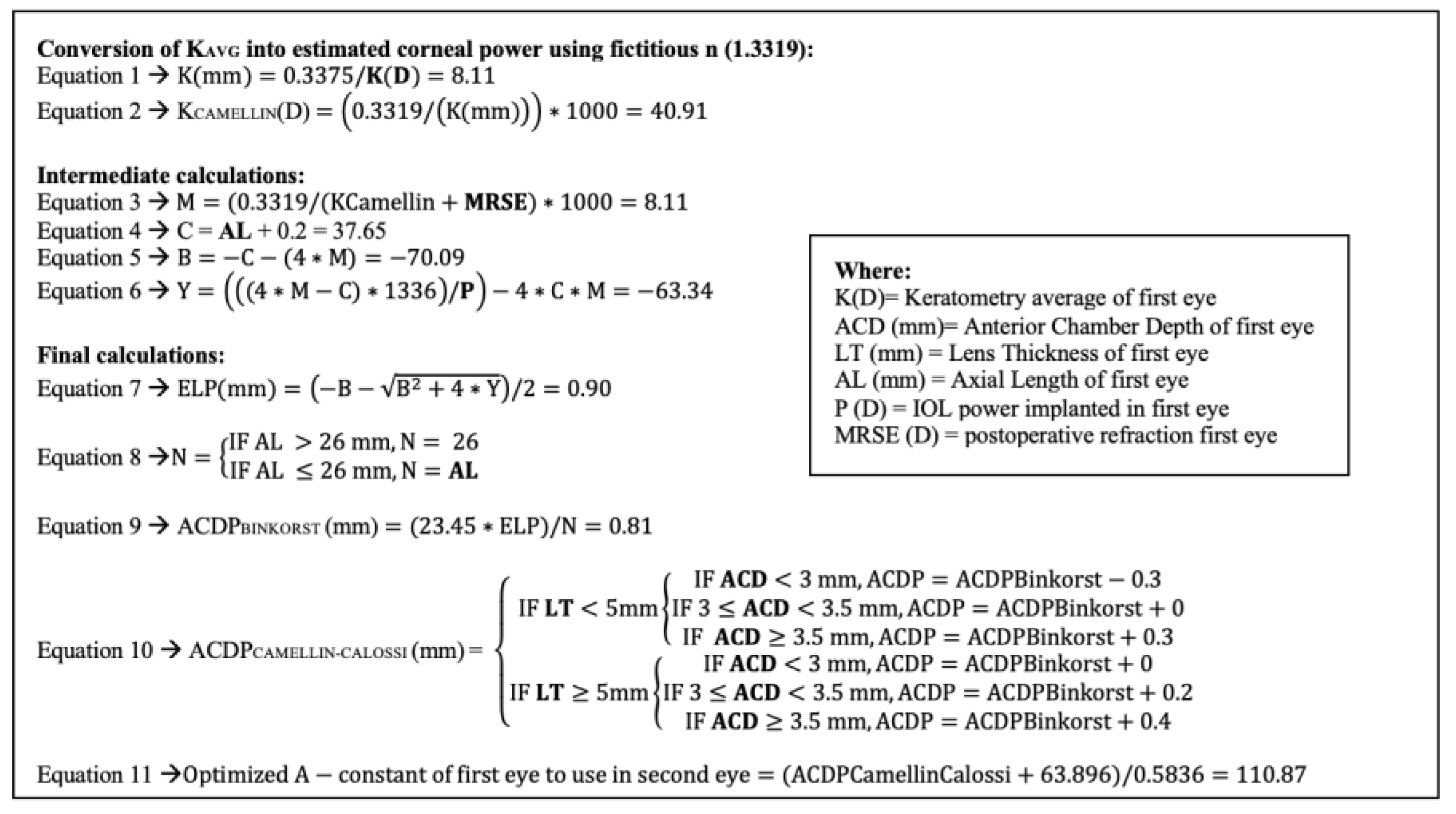
Background: Intra-Ocular Lens (IOL) power calculation in long eyes remains challenging despite the availability of new formulas and biometers. This case report shows that optimization of the A-constant in the first eye can reduce postoperative refractive error in the second eye, even in the case of an IOL with negative power. This report aimed to describe a case in which this method was used to calculate IOL power to reduce postoperative refractive error in a long fellow eye. As far as we know, this is the first paper reporting the use of the optimized constant in the first eye to reduce postoperative error in the second eye in the case of a negative IOL. Case presentation: A highly myopic patient with nuclear cataracts underwent phacoemulsification cataract surgery (PCS) in both eyes. The axial length (AL) was 39.42 mm in the right eye and 37.45 mm in the left eye. All biometric data were obtained via low-coherence reflectometry using an OA-2000 biometer (Tomey, Nagoya, Japan). First, an IOL power calculation using the Barrett II formula and PCS was performed in the shorter eye. To evaluate the postoperative refractive error, the optimized A-constant in the left eye was estimated using the Camellin-Calossi formula. The new A-constant was then used for the right eye IOL power calculation using the same formula. The prediction error (PE) in the left eye was −0.23 D with the Barrett II formula. The optimized A-constant method using the Camellin-Calossi formula in the fellow eye gave −0.28 D of PE. Conclusions: The A-constant optimization for very long eyes, using data from the first operated eye, may be useful to reduce refractive prediction error in the second eye in very long eyes, as well as in the case of IOL power with negative values.
Keywords: a-constant optimization; IOL power calculation; Camellin-Calossi formula; fellow eye a-constant optimization; IOL power calculation; Camellin-Calossi formula; fellow eye