1. Introduction
Additive manufacturing, commonly known as 3D printing, has transformed numerous industries by allowing the fabrication of intricate components with a high degree of design flexibility [
1]. This study explores Atomic Diffusion Additive Manufacturing (ADAM), a metal 3D-printing process introduced by Markforged with their Metal X system. ADAM involves three stages: printing a part from a filament of metal powder and plastic binder, debinding to remove the binder, and sintering to fuse the metal particles into a solid, dense part [
2]. The innovation of ADAM lies in its ability to produce complex, high-strength metal components without expensive tooling, making it a cost-effective solution for small–medium-scale production runs. This process offers significant advancements for industries like aerospace, automotive, and medical [
3].
Additive manufacturing (AM) encompasses a wide range of emerging and mature technologies that have transformed modern design and production strategies across multiple industrial sectors, including aerospace, biomedical engineering, automotive applications, and energy systems. Its ability to enable complex geometries, reduce material waste, and offer rapid prototyping capabilities has positioned AM as a key pillar of advanced manufacturing. According to ASTM International, AM processes are classified into seven major categories [
4] depending on the different material, physical state, and energy conditions used during the printing process [
5]. This classification underscores the breadth of AM approach, ranging from powder-bed fusion and directed energy deposition to material extrusion and vat photopolymerization, each with its own advantages, limitations, and areas of application. Among these different technologies, Fused Deposition Modelling (FDM) has become one of the most widely studied and commercially accessible AM techniques. Its relatively low cost, ease of implementation, and versatility have facilitated extensive research into the mechanical behavior of FDM-processed components. Using (FDM), several authors have analysed the mechanical performance of materials, including the notch effect in fracture conditions [
6,
7,
8]. These contributions highlight the importance of understanding not only the global mechanical response of AM materials but also the role of local geometric discontinuities and microstructural features on failure mechanisms.
Among the materials used, 17-4PH stainless steel is particularly valued for its excellent mechanical properties and its novel application in material extrusion technology, or Bound Powder Extrusion, as used on the Metal X system. The Metal X process enhances design flexibility while streamlining production, offering a more efficient alternative to traditional additive manufacturing techniques [
9]. However, characterizing the fracture toughness of this material when it has been 3D printed remains a challenge. In the last seven years, we tried successively to enhance the failure resistance of 3D printed thermoplastic polymers by fused deposition modeling [
10] and to evaluate their fracture toughness by the use of DIC based on our previous study [
11].
In this study, we aim to describe a robust fracture toughness-based methodology using a coupling of local DIC close to the crack tip and the fracture mechanics analysis.
In order to estimate the fracture toughness of the material, the crack initiation, and the Stress Intensity Factor, or the J-integral, are the two parameters to determine.
We used DIC to assess the fracture toughness of 3D-printed 17-4PH stainless steel under monotonic loading. To carry out this investigation, Single Edge Notch Bending (SENB) specimens were employed. The load–displacement responses displayed linearity up to the point of crack initiation, justifying the use of Linear Elastic Fracture Mechanics (LEFM) under the assumption of small-scale yielding for the tested material. The onset of cracking was identified by monitoring the Crack Opening Displacement (COD) between the crack lips.
The displacement field measured by DIC was fitted using Williams’ approach, considering the first five terms. The results demonstrated a high degree of accuracy when determining the displacement field close to the notch tip.
Two procedures were tested to locate the crack initiation at the notch tip: the geometric procedure and the optimization procedure. The optimization procedure proved more effective, enhancing the accuracy of Stress Intensity Factor (SIF) calculations and yielding a critical SIF. Additionally, the critical J-integral was determined using a finite element sub-model of the crack tip vicinity, driven by the DIC-measured displacement field. The path independence of the J-integral was confirmed, with a critical value of J.
Specimens are analyzed, with the aim to describe the chosen procedure to evaluate the fracture toughness. Therefore, more test specimens are needed if the aim is to determine the precise fracture toughness value of a used material.
This research enhances our understanding of the fracture behavior of the tested 3D-printed material (here, 17-4PH stainless steel) and aims to optimize manufacturing methods for advanced industrial and research applications using such materials.
2. Materials and Methods
2.1. Specimen Printing Method
Also, this work uses an additive manufacturing (AM) process called “Metal X”, recently developed by Markforged Inc., Waltham, MA, USA [
12]; this refers to a range of ‘indirect’ metal AM, and is based on material extrusion technology. The parts are not produced directly; rather, they are crafted using metal powders that are bound into a filament and then selectively extruded through a nozzle [
2]. Markforged has named this method “Atomic Diffusion Additive Manufacturing” (ADAM), which revolves around four fundamental steps: design, printing, de-binding, and sintering. The introduced Metal X process is based on an interesting approach for overcoming dimensional inaccuracy and provides enhanced design freedom and simplified solution compared to other AM processes [
10]. During the sintering process, as the powder burns away, it enables the creation of intricate enclosed internal structures, resulting in lightweight parts without compromising their strength [
13].
Additionally, the metal powder is encased in a polymer binder, which is subsequently removed upon the completion of the printing process [
3]. The polymer removes the inherent toxicity and flammability of powders, making 3D metal printing more accessible and quicker, while also cutting down on manufacturing costs [
14].
2.2. Additive Manufacturing Parameters
The Metal X printing system developed by Markforged integrates metal injection molding (MIM) and fused filament fabrication (FFF) technologies into Bound Powder Extrusion (BPE) for its printing processes.
The printing process consists of four fundamental steps: design, followed by printing, debinding, drying, and sintering. Initially, the 3D model is sliced into layers using the slicer program “Eiger” from Markforged solution and the layered model is then sent to the Metal X printer by Markforged Inc., Waltham, MA, USA. The specific settings used in the “Eiger” software for manufacturing specimens are outlined in
Table 1.
The printing process involves selectively extruding the fused filament through a nozzle to produce the “green” part made of 17-4PH metal (stainless steel) powder bound in a polymer matrix. Martensitic stainless steel filament spools with a diameter of 1.75 mm were utilized for printing specimens.
Then, debinding takes place by immersing this “green” part in a specialized solvent (Opteon SF-79) that dissolves the primary binder, resulting in the “brown” part. After solvent debinding, the part is dried before undergoing thermal debinding using the Sinter-1 unit of the Metal X system to completely remove any remaining binder.
The final step involves sintering the part in a high-temperature horizontal tube furnace of the Sinter-1 unit to melt the metal powders and obtain the “silver” part.
2.3. Specimen Geometry and Mechanical Testing
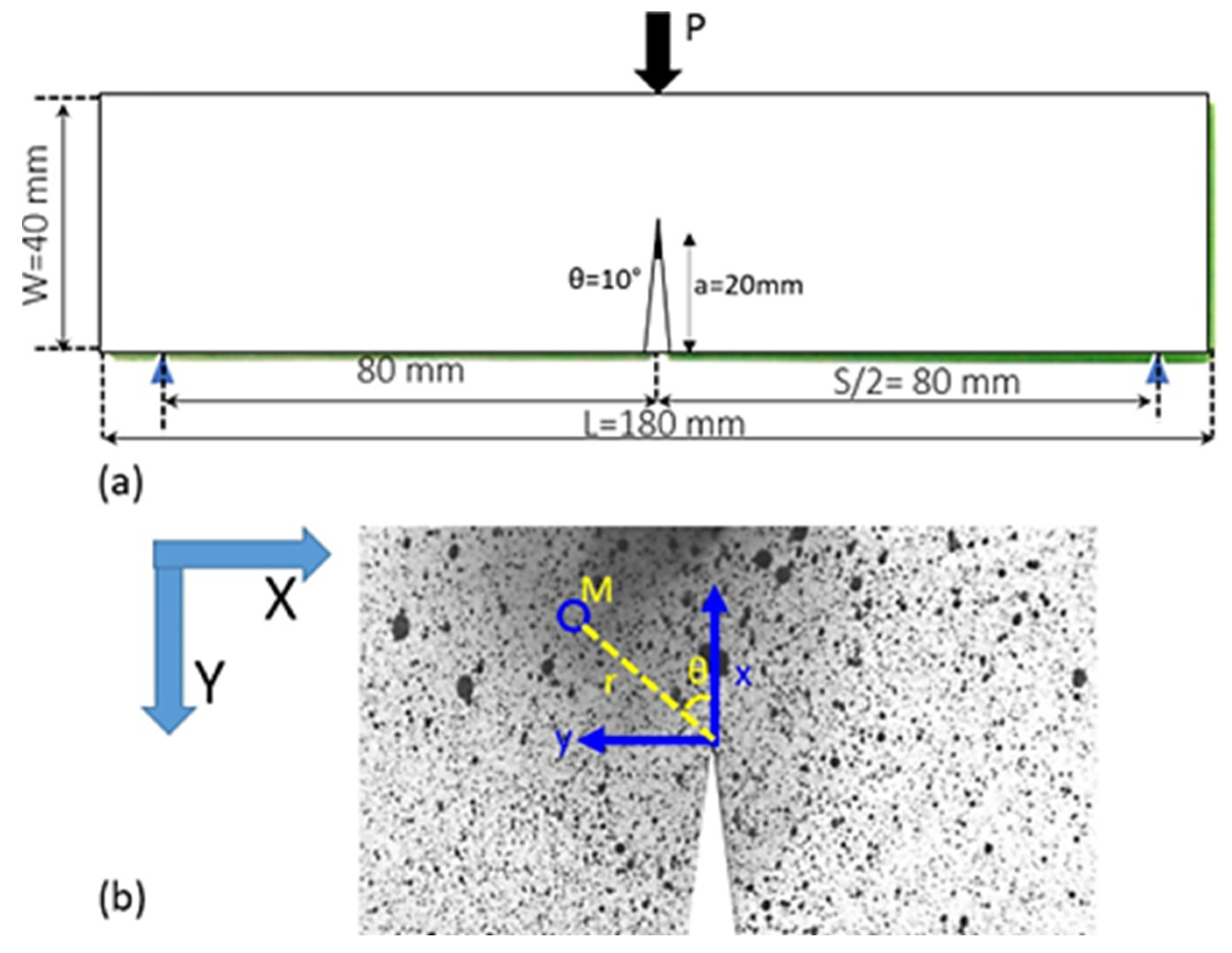
In this study, SENB specimens were utilized to assess the fracture toughness of the printed stainless steel. The geometry and dimensions of the samples are illustrated in
Figure 1a, with the specimen thickness measuring approximately 10 mm. Two-dimensional digital image correlation (2D-DIC) was employed to capture the displacement and strain fields on the specimen’s surface. To enable this, the printed samples were coated with a random speckle pattern, allowing for the precise tracking of surface displacements (see
Figure 1b).
Three-point bending tests were conducted using an Instron 4484 tensile testing machine, Norwood, MA, USA equipped with custom supports designed to prevent out-of-plane specimen rotation. The crosshead speed was set to 0.5 mm/min, and data acquisition occurred at a rate of 500 measurements per second. A 20 kN load cell was used for force measurements. For each configuration “classical” and “optimized”, three specimens were tested. Their results are not individually presented in the manuscript because they showed very limited scatter and were consistent with the representative curves displayed. The testing setup was synchronized with a camera capturing one image every two seconds, with a resolution of 1280 × 960 pixels and a scale of 0.04 mm/pixel. 3. The relevant standard ASTM E1820 [
15] for SENB fracture toughness testing has been used.
2.4. Digital Image Correlation (DIC)
DIC is a technique used to determine the displacement field within a specified Region of Interest (ROI) on a material subjected to deformation. The process involves partitioning the reference image into smaller areas, known as subsets, and tracking their movements in the corresponding deformed image. From the resulting displacement field, the strain field can be calculated by applying spatial differentiation, ensuring that rigid body motions, such as translations and rotations, are properly excluded from the analysis [
16,
17].
In this study, DIC analysis was performed using NCORR software v1.2 by MATLAB, Mathworks, Natick, MA, USA [
18,
19]. Given the relatively low level of deformation, the initial undistorted image of the sample was used as the reference. Displacement and strain fields were then calculated relative to this reference. The ROI was strategically placed away from the image borders to ensure it remained within the field of view after deformation.
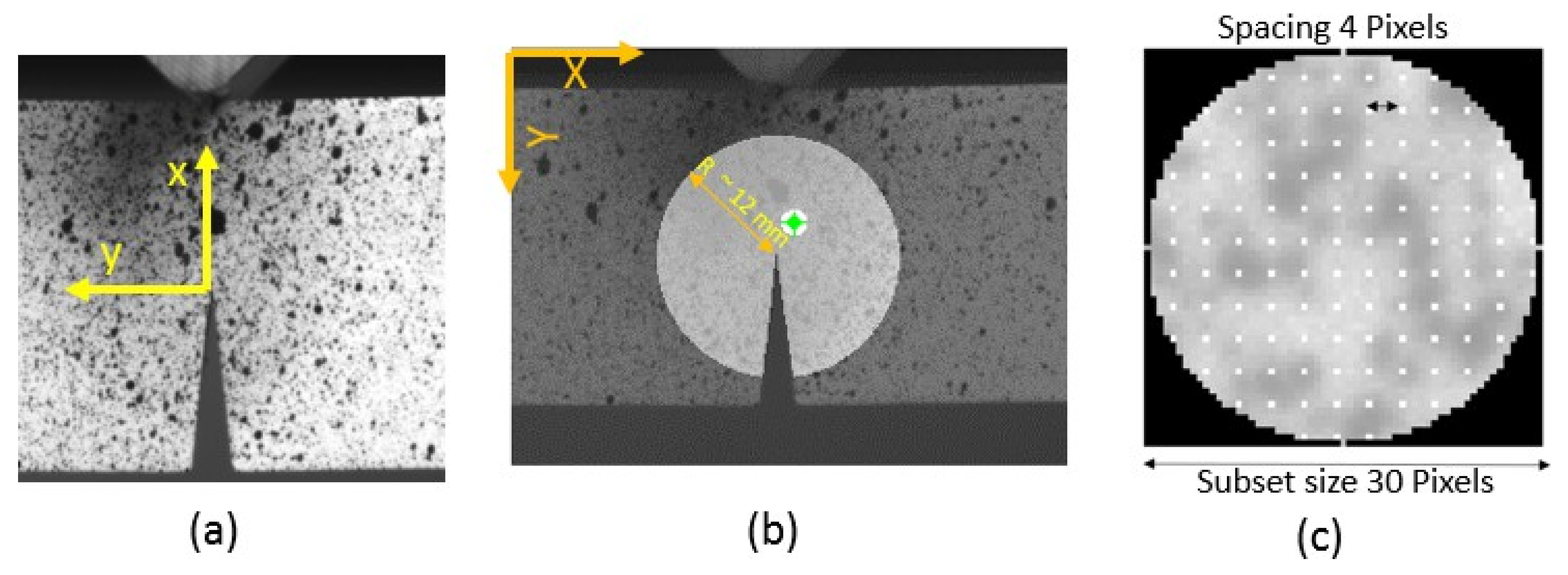
For the analysis, the subset size was chosen to be larger than the filament width to ensure a homogenized displacement value. Specifically, a subset radius of 30 pixels was selected, with a grid spacing of 4 pixels. This configuration resulted in approximately 90% overlap between adjacent subsets, ensuring smoothness in the resulting displacement field. Subset truncation was also applied, as illustrated in
Figure 2.
Accurate strain determination is a critical aspect of DIC, as it requires differentiation of the displacement field, a process that is sensitive to noise. To mitigate this, the displacement gradient is computed using the strain window method [
20]. The displacement components, denoted as U (X, Y) and V (X, Y) over a given range (Xmin < X < Xmax and Ymin < Y < Ymax), are fitted to a plane equation using least-squares curve fitting. The user can adjust the window size (in both the X and Y directions) to achieve optimal accuracy.
The Green–Lagrange strain has been computed by using the resulting plane slopes as follows:
3. Load–Displacement Curves
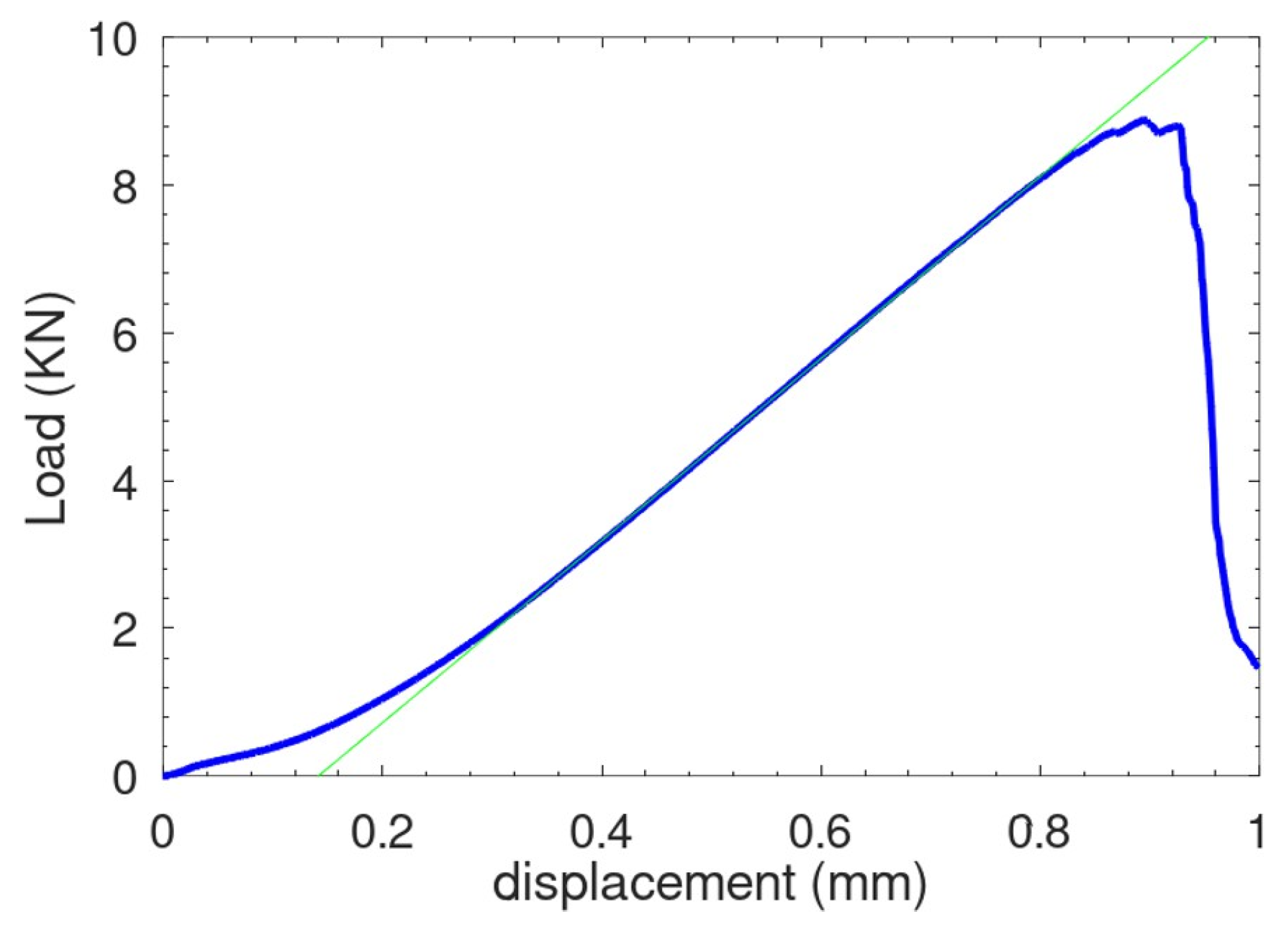
Figure 3 shows the load–displacement curve of the sample, revealing two distinct stages in the ascending portion of the graph. The first regime is for displacement d < 0.15 mm. It is characterized by a low stiffness due to setting the test. The second one is for d > 0.2 mm, where the curve becomes perfectly linear. The slope of this part is equal to 12.16 kN·mm
−1. At the end of the rising branch the force reaches 8.4 KN; after that, it drops down. This behavior corresponds to the crack initiation and growth in the sample. It is worth noting that the sample’s behavior is almost linear until crack initiation. There is an apparent plasticity signature observed during the loading prior to the crack initiation. Therefore, the Linear Elastic Fracture Mechanics assumption is relevant in such a case. Moreover, a finite element simulation of the SENB deformation was performed to calibrate the Young’s modulus of the sample. The results show that a Young’s modulus of 150 GPa leads to a sample stiffness consistent with the one calculated from the experimental results.
4. Detection of Crack Initiation by DIC
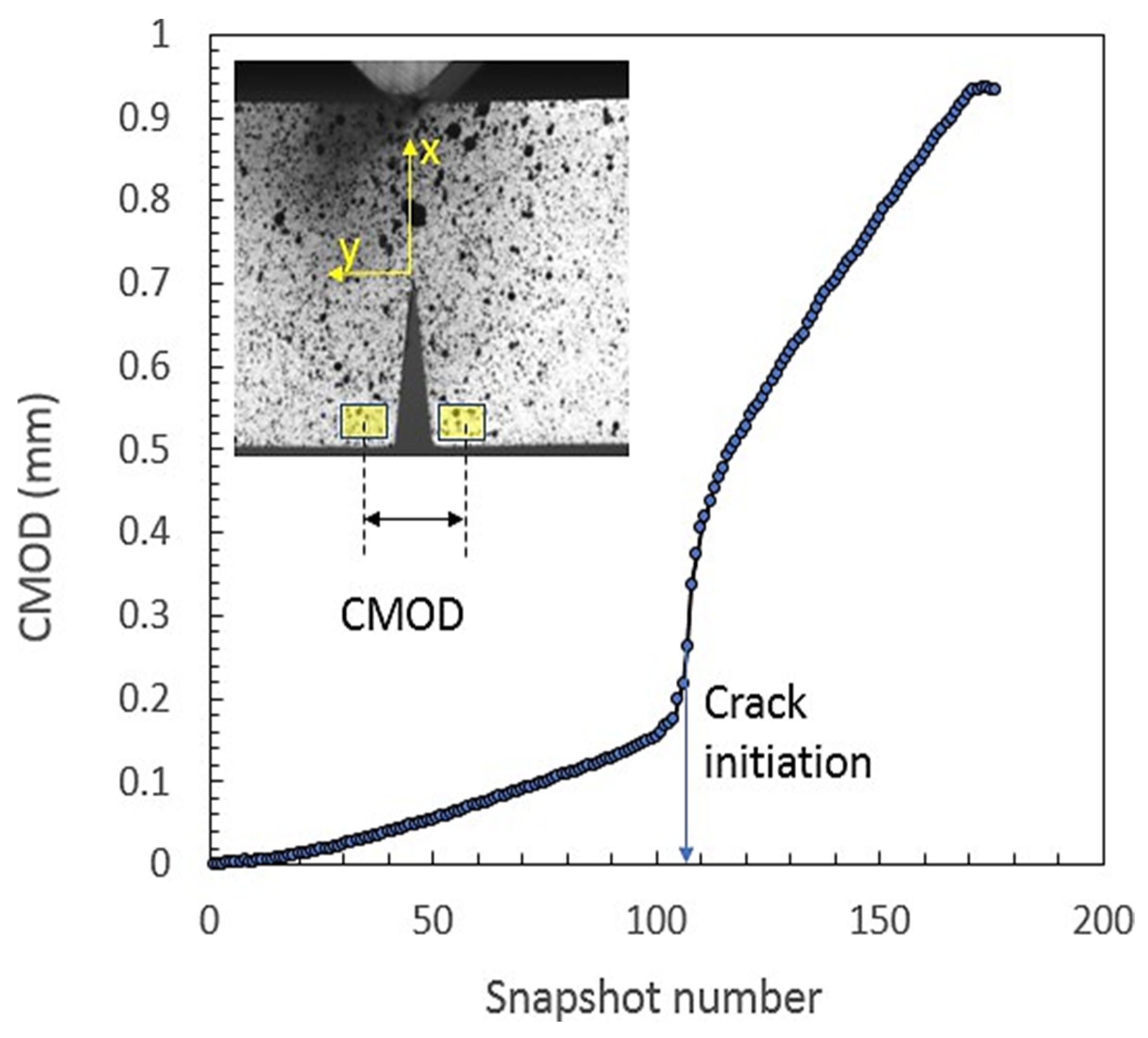
To determine the critical Stress Intensity Factor of the specimen, it is essential to precisely identify the moment when crack initiation occurs. In SENB specimens, crack propagation begins with the upward movement of the singularity tip. This alters the displacement field near the notch tip, thereby affecting the Crack Mouth Opening Displacement (CMOD).
Figure 4 shows the evolution of the Crack Mouth Opening Displacement during the sample deformation. It is plotted with respect to the snapshot number
n, which is proportional to the applied displacement
, so that:
where
is the loading velocity and δt is time variation between two subsequent snapshots.
The curve exhibits two distinct regimes, separated by a sharp increase in the Crack Mouth Opening Displacement (CMOD). In the initial regime, where n < 100, the CMOD increases linearly with the applied load, reflecting the elastic behavior of the material as it deforms without any significant crack growth. During this phase, the sample responds elastically, and the deformation remains relatively uniform across the material. In contrast, for n > 110 the CMOD continues to increase linearly with the applied load, but with a steeper slope, indicating the onset of crack propagation within the sample. This steeper slope reflects the material’s transition from elastic behavior to the irreversible process of crack growth, where the displacement becomes more pronounced as the crack propagates further. The sharp transition between these two regimes signals the initiation of crack growth, with the inflection point at n = 105 being considered the threshold where the crack begins to propagate. This value was determined by calculating the average within the transition region, providing a reliable estimate for the point at which crack growth is triggered.
5. Fracture Toughness Characterization Results
5.1. Determination of the Stress Intensity Factor SIF
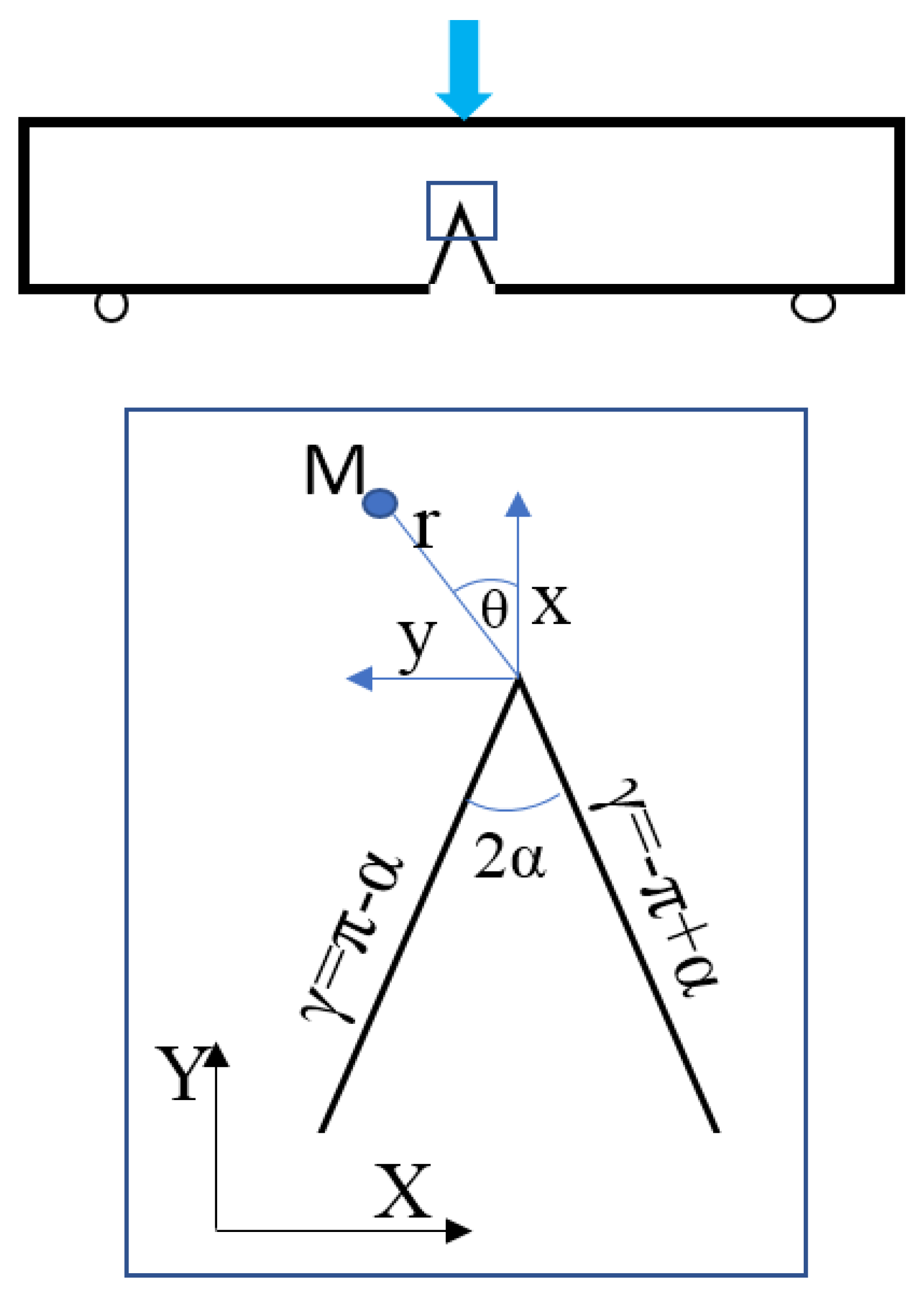
The evaluation of the critical SIF involves analyzing the displacement field within a circular Region of Interest (ROI) centered at the notch tip. This displacement field is obtained through DIC for each captured image throughout the deformation process. The connection between the SIF and the displacement field near the notch tip is described by the Williams analytical solution.
For SENB sample submitted to mode I loading condition (see
Figure 5), the stress field around the V-notch tip can be written as follows [
21]:
where
is the mode I eigenvalues.
are the roots of the following equation:
where
and
is the V-notch tip angle. Only the root with a positive real part can be accepted. Equation (6) has been solved numerically.
Table 2 shows the values of the first five
. As
< 1, the first stress term in Equation (5) is singular with a singularity degree of (1 −
). Therefore, the Notch Stress Intensity Factor (NSIF), in this case, can be written as follows:
where A1 is the first term in the stress Equation (5). To determine the coefficients Ai, the displacement field around the notch tip is used. The displacement field can be expressed as follows:
where µ is the shear modulus and κ is the Kolosov’s constant.
Equation (7) shows the dependence of SIF with the singularity degree
that depends upon the V-notch angle. The measured displacement field has been employed to fit the coefficients
of William’s solution through a numeric method as detailed in
Appendix A. The eigenvalues
are the roots of Equation (6). The first 5 terms are only considered in Equations (8) and (9). The material properties used in this study include a Poisson’s ratio of 0.3.
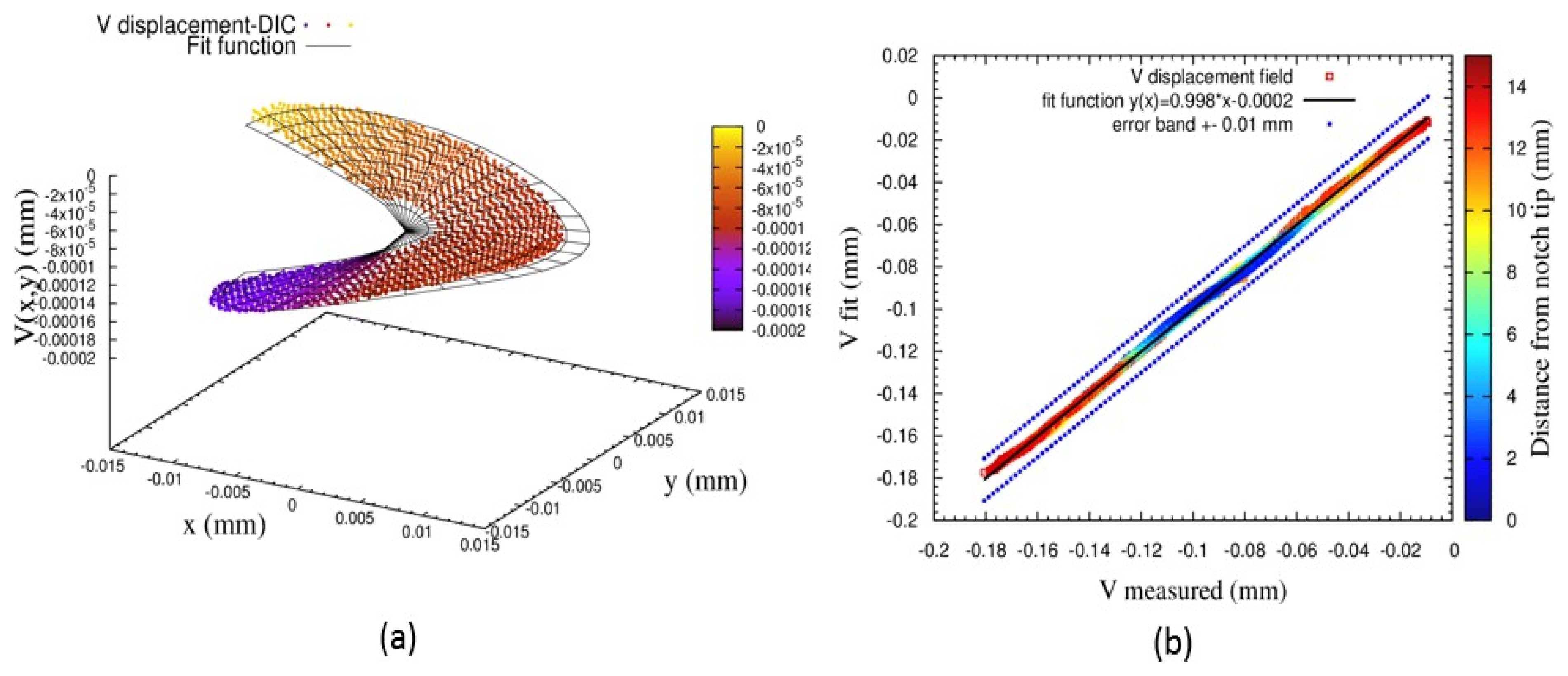
Figure 6a compares the displacement field measured by DIC (dots) and the one fit by William’s solution (mesh). The displacement field normal to the crack surface
is shown in this case.
Figure 6b presents a scatter plot of the fitted displacement values versus those measured by DIC, where each point corresponds to a subset. The color of each point reflects its distance from the crack tip. The alignment of the data along the first bisector indicates a strong agreement between the measured and modeled displacement fields. All points are within a scatter band of ±0.01; however, the points deviate from the first bisector as it becomes closer to the notch tip. In our study, we found that the methodology provides reliable results at a distance of approximately 4 mm from the tip. This is somewhat related to the decrease in the accuracy of the DIC when a subset is close to the tip, as shown by the correlation coefficient of the subsets shown in
Figure 6.
5.2. Accurate Detection of the Crack Tip Position
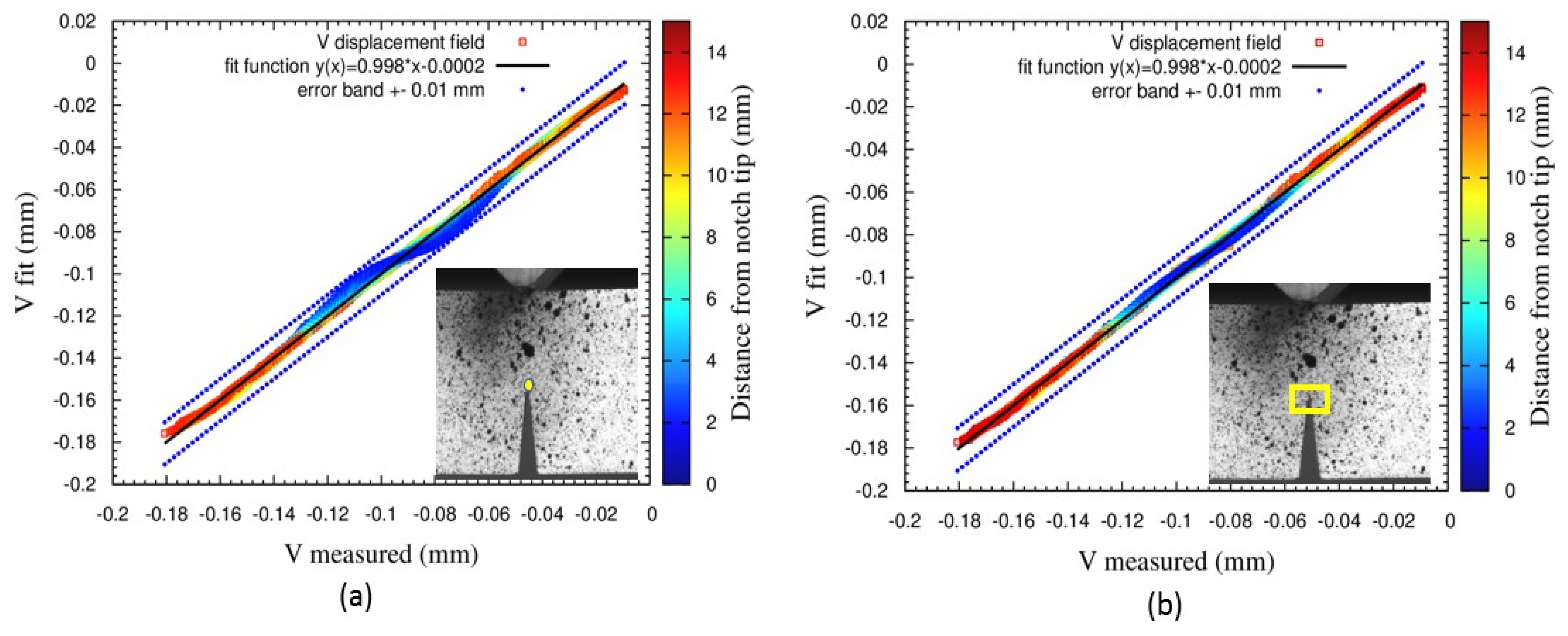
William’s solution gives the displacement field with respect to the polar coordinate of a point taking the tip as the origin of the reference. Thus, the identification of the tip is critical to convert the subset position from cartesian to polar coordinate system. Any shift of the tip position can reduce drastically the precision of the fit. To identify the tip position, two methods were tested:
- -
Geometrical method: The tip position is identified by the contrast of pixel color at the boundary of the V-notch.
- -
Optimization method: The tip is searched within a square of 15 × 15 pixels centered by the expected geometric notch tip. Each pixel is considered as a potential notch tip. Thus, the polar coordinates of each subset were calculated. The measured displacement field fits with William’s equation. Then, a residual is calculated. The pixel that leads to a minimum residual is the one that is considered as the crack tip.
Figure 7 shows the scatter plot between the fitted and the measured displacement field for both methods. Both scatters show a good correlation; however, the scatter width is larger if the tip is determined by geometric method. These results depict that accurate identification of notch or crack tip can be achieved by using the optimization method. The displacement field of the snapshot that corresponds to the onset of the crack was used to determine the critical SIF K
∗. The result shows that
.
5.3. J-Integral Evaluation
In the case of LEFM assumption, the J-integral represents the energy release rate of the crack extension. It is given by the following equation:
where
is the strain energy density,
is the traction vector,
is the displacement vector, and
is the contour around the crack tip.
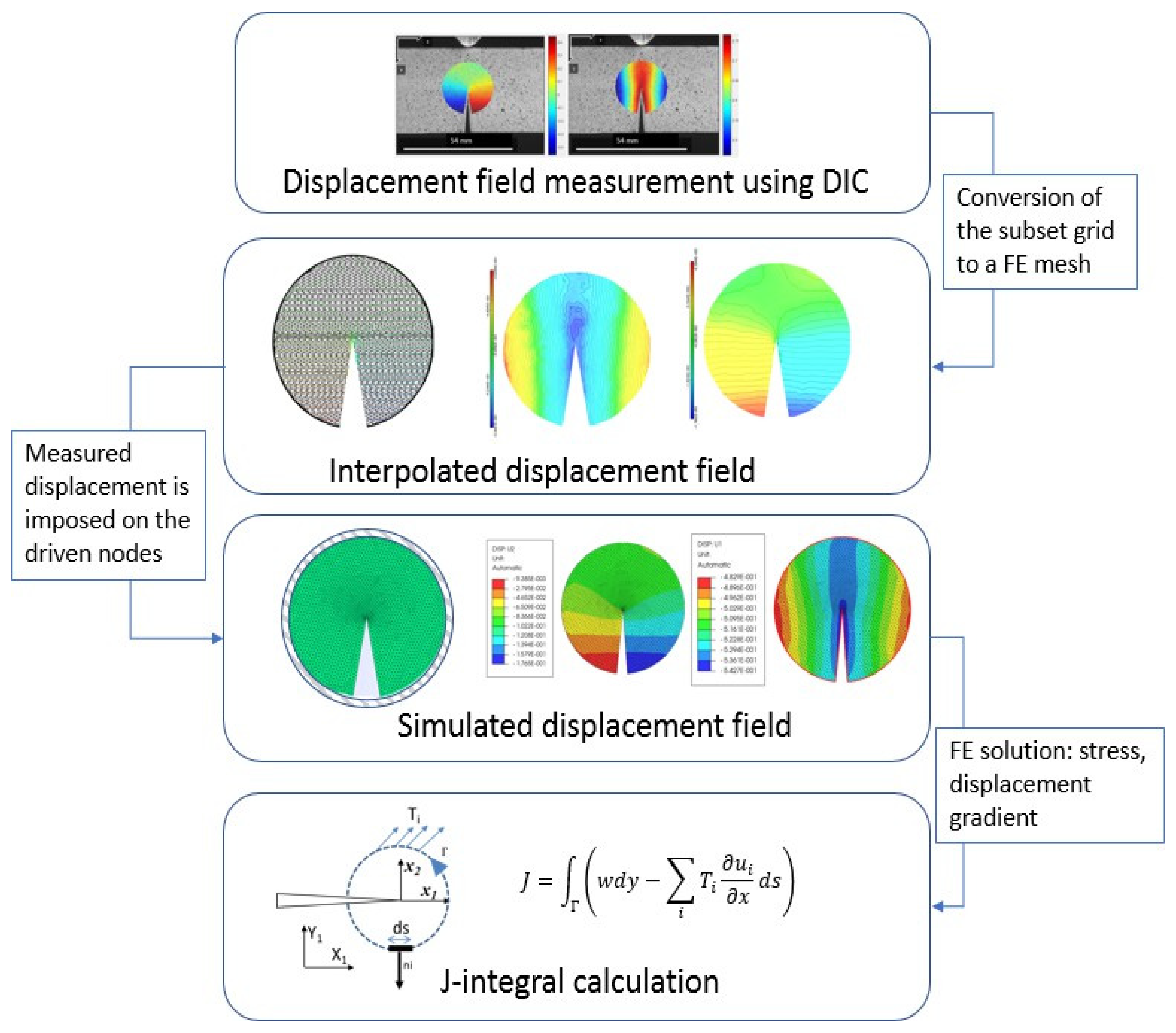
As shown by Equation (11), the J-integral calculation requires stress which cannot be measured. The only information accessible by DIC is the displacement field and its gradient. To circumvent this issue, a method based on the sub-modeling of the crack tip by finite element is suggested.
Figure 8 describes the sequence of steps of this method. It can be summarized as follows:
- -
Considering the ROI used in DIC, the grid of the subsets is converted to finite element mesh.
- -
In each element, the displacement measured by DIC can be written and the same is written for where are the shape functions of quadrangle elements.
- -
In the other side, a finite element sub-model that encircles it defined. The contour of this sub-model is driven by the displacement measured by DIC.
- -
The J-integral is calculated from the FE solution.
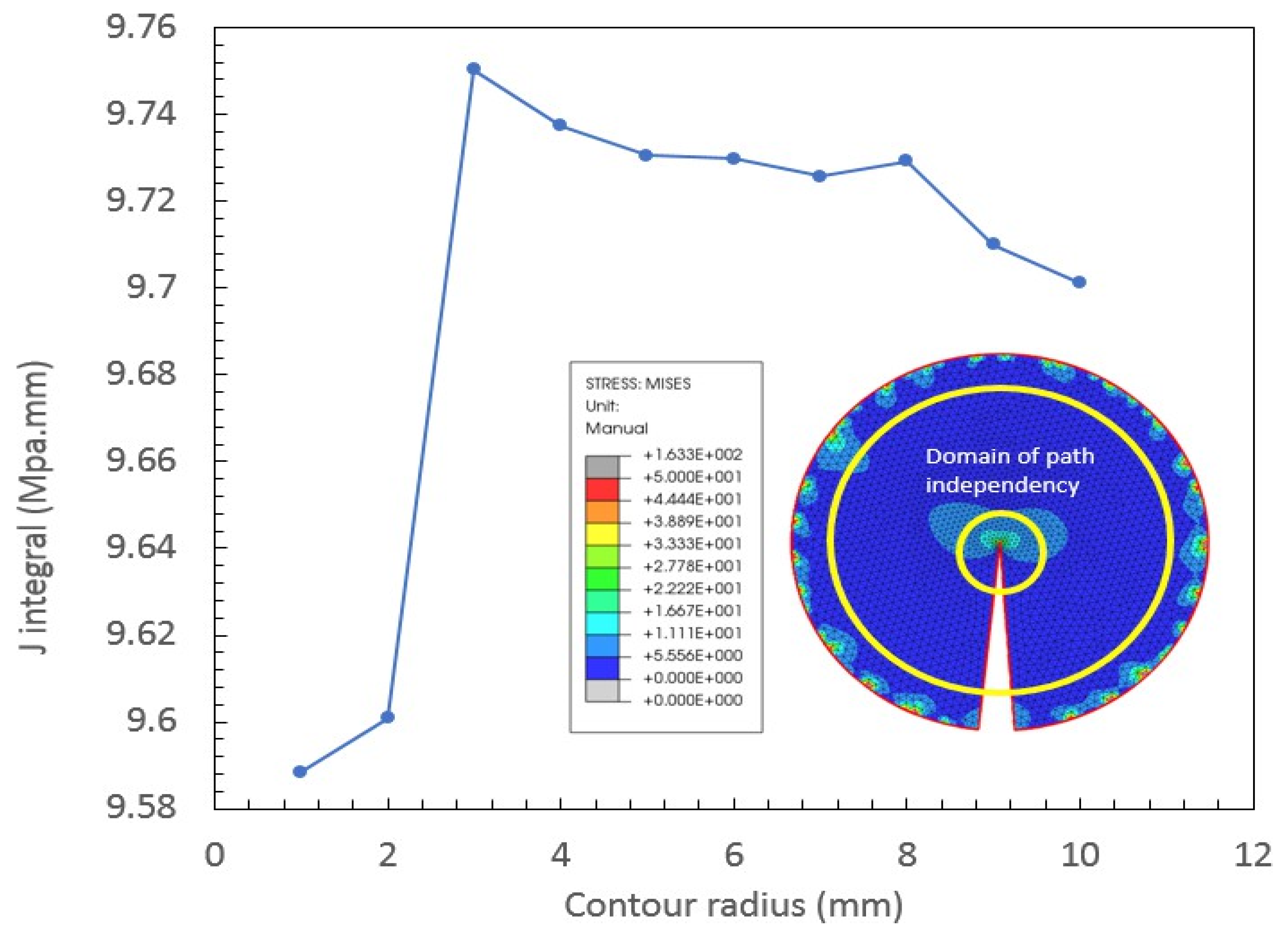
The J-integral was calculated for different circular contours with various radii.
Figure 9 shows the J-integral value with respect to the contour radius. The result depicts that J-integral becomes path independent for contour radius
between 3 mm and 8 mm. For
< 3 mm, the contour is close to the tip; meanwhile, for
> 8 mm, the contour is close to the boundary layer where the driven displacement is applied. The critical J-integral found is
. For the plain stress assumption, we check that the value of
verifies the equation
.
6. Conclusions
Digital image correlation has been employed to characterize the fracture toughness of 3D-printed material (here, 17-4PH stainless steel) following a methodology based on the use of SENB specimens which are submitted to a three-points bending test.
The key findings of this study include the successful extension of a DIC-based methodology to 17-4PH stainless steel produced via metal additive manufacturing, accurate identification of crack initiation using full-field displacement measurements, and reliable evaluation of critical Stress Intensity Factors and the J-integral through a DIC-driven finite element sub-model. The main scientific contributions are the following: (1) demonstrating the feasibility of applying DIC to metal AM specimens with complex microstructures; (2) providing a robust procedure for fracture toughness characterization in materials where conventional testing is challenging; (3) establishing a methodology that can be generalized to other metals and AM processes, bridging the gap between polymer-based DIC studies and metal additive manufacturing.
The load–displacement curve of the sample shows that the behavior is still linear till crack initiation. This behavior reveals that the use of LEFM with a small-scale yielding assumption is justified for this type of material. The load–displacement curve is used to calibrate the Young’ modulus and E = 150 GPa is found.
The snapshot that corresponds to the crack initiation in each sample has been identified using the Crack Mouth Opening Displacement (CMOD).
The displacement field of this sample was fit by William’s equation, taking into consideration the first five terms of the equation. The results show that William’s equations fit the displacement field accurately with a determination coefficient close to one for all cases. This also justifies the use of LEFM assumption.
To identify the position notch tip, two methods were tested in order to guarantee a reliable result: the geometrical method and the optimization method. The results highlight an improvement of the accuracy of SIF calculation when the optimization method is used. The critical SIF found is Otherwise, the geometrical method is easier to use and provides mostly good results.
Finally, the critical J-integral J∗ of the sample has determined using a finite element sub-model at the crack tip vicinity. The sub-model deformation was driven by the displacement field measured by DIC. The path independence of J-integral was verified. The critical value of J-integral found is It is to be noted that -integral determination represents a verification to the Stress Intensity Factor calculation.
Author Contributions
Conceptualization, A.M. and N.R.; methodology, J.G.; software, A.M.; validation, N.R. and M.Z.; formal analysis, A.M.; investigation, A.M.; writing—original draft preparation, A.M.; writing—review and editing, J.G.; supervision, N.R. All authors have read and agreed to the published version of the manuscript.
Funding
This research received no external funding.
Data Availability Statement
No new data were created or analyzed in this study. Data sharing is not applicable to this article.
Acknowledgments
In memory of Ali Makke, a brilliant researcher and dear friend who disappeared amid the conflicts in Lebanon. His curiosity, integrity, and humanity continue to be deeply missed.
Conflicts of Interest
The authors declare no conflict of interest.
Nomenclature
| ADAM | Atomic Diffusion Additive Manufacturing |
| COD | Crack Opening Displacement |
| CMOD | Crack Mouth Opening Displacement |
| DIC | digital image correlation |
| LEFM | Linear Elastic Fracture Mechanics |
| SIF | Stress Intensity Factor |
| J-integral | path-independent integral used in fracture mechanics |
| K_IC | fracture toughness (critical Stress Intensity Factor) |
| σ | applied stress (MPa) |
| ε | strain |
| a | crack length (mm) |
| E | Young’s modulus (GPa) |
| ν | Poisson’s ratio |
| FEM | finite element method |
Appendix A. Determination of the Coefficients Ai
Equations (8) and (9) show that the displacement field results from the summation of several terms. The first term A1 is used in the evaluation of the NSIF. The higher-order terms (
n ≥ 2) have to be taken into account to fit accurately the displacement field around the notch. In this context, several studies [
22,
23,
24,
25] have showed that at least 5 terms are required to converge to a stable value of NSIF. In the following, only the first five terms are considered.
Equations (8) and (9) can be written in a simple matrix equation form as follows:
where
and
and
are the polar coordinates of the
subset; 1 ≤ i ≤ m, m is the total number of the subset in the ROI.
Conversely, the SENB specimens exhibit significant rigid body (RB) displacement at the notch tip due to central bending. As a result, it is necessary to account for the RB contribution within the measured displacement field. To incorporate these effects, translation and rotation terms representing rigid body motion are added to Equation (A3), which is then modified accordingly:
where
is the translation vector and R is the magnitude of RB rotation. The matrix form shown in Equation (A4) is more compatible with numerical treatment. In the following, only the displacement component concerning the notch opening is used. To determine the unknown terms:
in Equation (A4), a nonlinear least square method has been employed to fit the measured displacement field around the notch tip. (implemented in Gnuplot [
26]).
References
- Gardan, J. Additive manufacturing technologies: State of the art and trends. Int. J. Prod. Res. 2016, 54, 3118–3132. [Google Scholar] [CrossRef]
- Galati, M.; Minetola, P. Analysis of density, roughness, and accuracy of the atomic diffusion additive man-ufacturing (ADAM) process for metal parts. Materials 2019, 12, 4122. [Google Scholar] [CrossRef] [PubMed]
- Jones, J.; Vafadar, A.; Hashemi, R. A Review of the Mechanical Properties of 17-4PH Stainless Steel Produced by Bound Powder Extrusion. J. Manuf. Mater. Process. 2023, 7, 162. [Google Scholar] [CrossRef]
- Martínez-García, A.; Monzón, M.; Paz, R. Standards for additive manufacturing technologies: Structure and impact. In Additive Manufacturing; Elsevier: Amsterdam, The Netherlands, 2021; pp. 395–408. Available online: https://www.sciencedirect.com/science/article/pii/B9780128184110000136 (accessed on 4 December 2025).
- Gibson, I.; Rosen, D.; Stucker, B.; Khorasani, M. Additive Manufacturing Technologies; Springer International Publishing: Cham, Switzerland, 2021. [Google Scholar] [CrossRef]
- Cicero, S.; Devito, F.; Sánchez, M.; Arrieta, S.; Arroyo, B. Notch effect in acrylonitrile styrene acrylate (ASA) single-edge-notch bending specimens manufactured by Fused Filament Fabrication. Materials 2024, 17, 5207. [Google Scholar] [CrossRef] [PubMed]
- Cicero, S.; Martinez-Mata, V.; Castanon-Jano, L.; Alonso-Estebanez, A.; Arroyo, B. Analysis of notch effect in the fracture behaviour of additively manufactured PLA and graphene reinforced PLA. Theor. Appl. Fract. Mech. 2021, 114, 103032. [Google Scholar] [CrossRef]
- Cicero, S.; Martínez-Mata, V.; Alonso-Estebanez, A.; Castanon-Jano, L.; Arroyo, B. Analysis of notch effect in 3D-printed ABS fracture specimens containing U-notches. Materials 2020, 13, 4716. [Google Scholar] [CrossRef] [PubMed]
- Alkindi, T.; Alyammahi, M.; Susantyoko, R.A.; Atatreh, S. The effect of varying specimens’ printing angles to the bed surface on the tensile strength of 3D-printed 17-4PH stainless-steels via metal FFF additive manufacturing. MRS Commun. 2021, 11, 310–316. [Google Scholar] [CrossRef]
- Gardan, J.; Makke, A.; Recho, N. Improving the fracture toughness of 3D printed thermoplastic polymers by fused deposition modeling. Int. J. Fract. 2018, 210, 1–15. [Google Scholar] [CrossRef]
- Lenti, A.; Makke, A.; Gardan, J.; Recho, N. Fracture toughness characterization of 3D-printed advanced structured specimens by digital image correlation. Int. J. Fract. 2023, 240, 17–28. [Google Scholar] [CrossRef]
- Campbell, I.; Wohlers, T. Markforged: Taking a Different Approach to Metal Additive Manufacturing. 2017. Available online: https://repository.lboro.ac.uk/articles/Markforged_Taking_a_different_approach_to_metal_Additive_Manufacturing/9346493/files/16955546.pdf (accessed on 15 November 2024).
- Chemkhi, M.; Djouda, J.M.; Bouaziz, M.A.; Kauffmann, J.; Hild, F.; Retraint, D. Effects of mechanical post-treatments on additive manufactured 17-4PH stainless steel produced by bound powder extrusion. Procedia CIRP 2021, 104, 957–961. [Google Scholar] [CrossRef]
- Gonzalez-Gutierrez, J.; Cano, S.; Schuschnigg, S.; Kukla, C.; Sapkota, J.; Holzer, C. Additive manufacturing of metallic and ceramic components by the material extrusion of highly-filled polymers: A review and future perspectives. Materials 2018, 11, 840. [Google Scholar] [CrossRef] [PubMed]
- ASTM E1820-22; Standard Test Method for Measurement of Fracture Toughness. ASTM: West Conshohocken, PA, USA, 2022. Available online: https://store.astm.org/e1820-22.html (accessed on 16 December 2025).
- Chen, X.; Zhang, W.; Ma, R.; Yang, Q.; Liang, F.; Chang, L.; Zhou, C. Fatigue crack initiation and propagation behaviour of 316L under strain-controlled mode considering the interaction of crack closure and compressive load effect. Int. J. Fatigue 2025, 202, 109259. [Google Scholar] [CrossRef]
- Bencherif, M.; Almansba, M.; Ferhoum, R.; Habak, M.; Boudedja, A. Effectiveness of Digital Image Correlation in Capturing the Fracture Toughness in 304L Stainless Steel. J. Fail. Anal. Prev. 2025, 25, 649–660. [Google Scholar] [CrossRef]
- Harilal, R.; Vyasarayani, C.P.; Ramji, M. A linear least squares approach for evaluation of crack tip stress field parameters using DIC. Opt. Lasers Eng. 2015, 75, 95–102. [Google Scholar] [CrossRef]
- Blaber, J.; Adair, B.; Antoniou, A. Ncorr: Open-Source 2D Digital Image Correlation Matlab Software. Exp. Mech. 2015, 55, 1105–1122. [Google Scholar] [CrossRef]
- Pan, B.; Xie, H.; Guo, Z.; Hua, T. Full-field strain measurement using a two-dimensional Savitzky-Golay digital differentiator in digital image correlation. Opt. Eng. 2007, 46, 033601. [Google Scholar] [CrossRef]
- Williams, M.L. Stress Singularities Resulting from Various Boundary Conditions in Angular Corners of Plates in Extension. 1952. Available online: https://asmedigitalcollection.asme.org/appliedmechanics/article-abstract/19/4/526/1106855 (accessed on 18 November 2024).
- Yates, J.R.; Zanganeh, M.; Tai, Y.H. Quantifying crack tip displacement fields with DIC. Eng. Fract. Mech. 2010, 77, 2063–2076. [Google Scholar] [CrossRef]
- Torabi, A.R.; Bahrami, B.; Ayatollahi, M.R. Experimental determination of the notch stress intensity factor for sharp V-notched specimens by using the digital image correlation method. Theor. Appl. Fract. Mech. 2019, 103, 102244. [Google Scholar] [CrossRef]
- Bahrami, B.; Ayatollahi, M.R.; Torabi, A.R. Application of digital image correlation method for determination of mixed mode stress intensity factors in sharp notches. Opt. Lasers Eng. 2020, 124, 105830. [Google Scholar] [CrossRef]
- Miarka, P.; Cruces, A.S.; Seitl, S.; Malikova, L.; Lopez-Crespo, P. Evaluation of the SIF and T-stress values of the Brazilian disc with a central notch by hybrid method. Int. J. Fatigue 2020, 135, 105562. [Google Scholar] [CrossRef]
- Janert, P.K. Gnuplot in Action: Understanding Data with Graphs; Simon and Schuster: New York, NY, USA, 2016; Available online: https://books.google.com/books?hl=fr&lr=&id=RTozEAAAQBAJ&oi=fnd&pg=PT17&dq=Gnuplot+5.2:+an+interactive+plotting+program&ots=7Vg_I8bwXX&sig=yf4un48yKtv1ZDc45dMr4EXxRzs (accessed on 18 November 2024).
| Disclaimer/Publisher’s Note: The statements, opinions and data contained in all publications are solely those of the individual author(s) and contributor(s) and not of MDPI and/or the editor(s). MDPI and/or the editor(s) disclaim responsibility for any injury to people or property resulting from any ideas, methods, instructions or products referred to in the content. |