
From Empowerment to Vulnerability: The Computation–Energy Paradox of AI-Enabled Power-Transport Systems



Abstract
1. Introduction
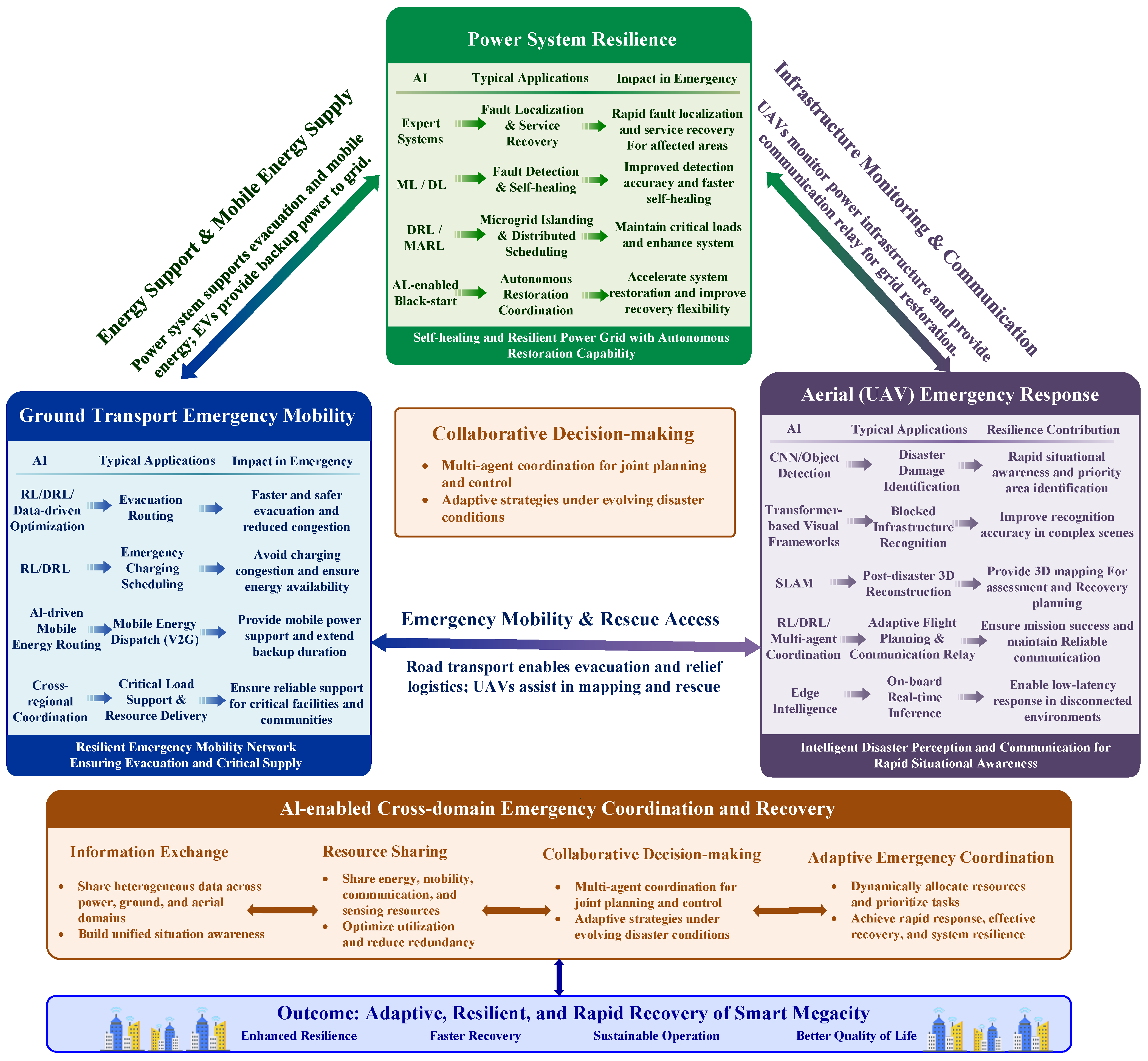
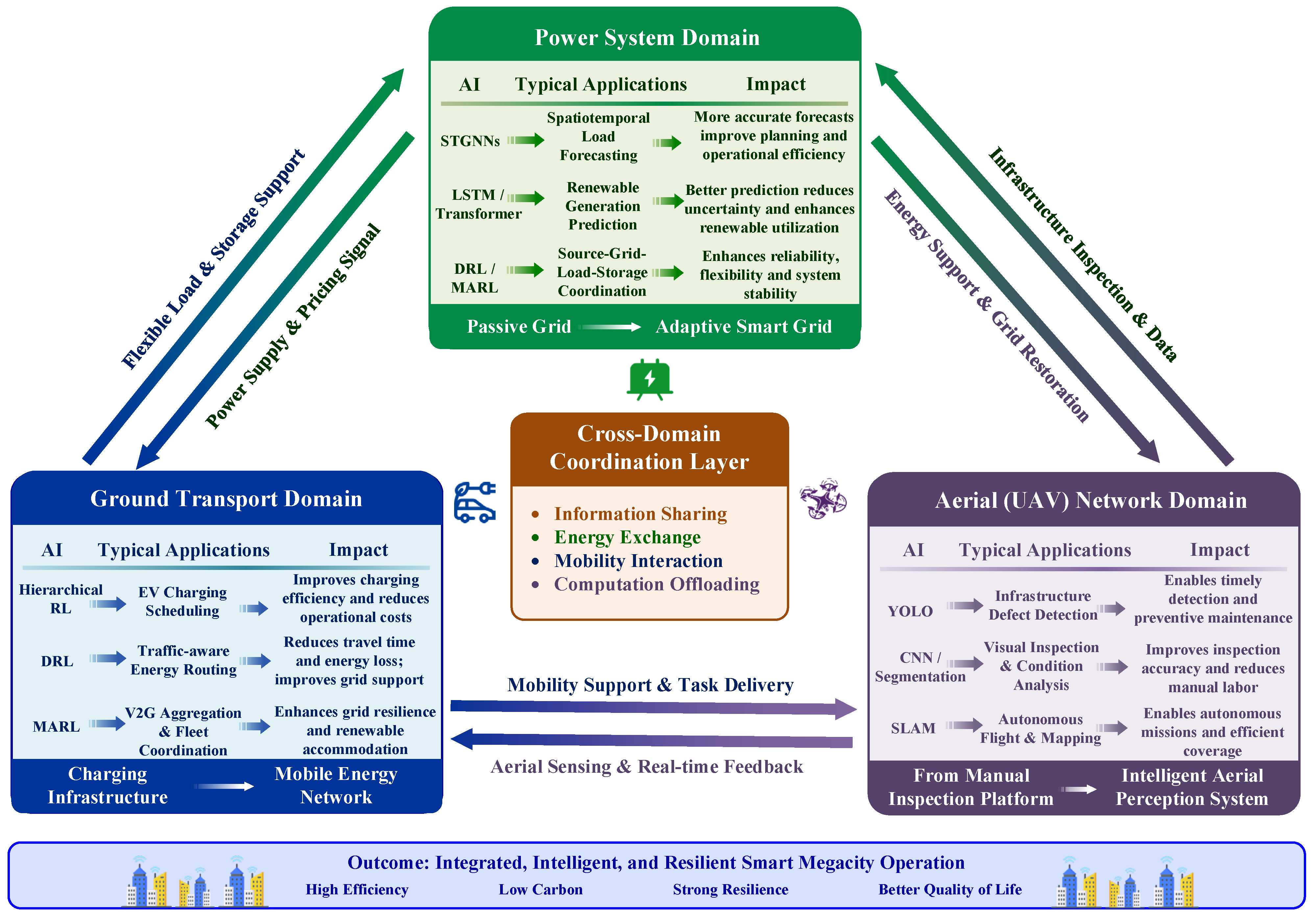
- A structured synthesis of AI applications within the power–transport coupled system is conducted. Moving beyond isolated use cases, this synthesis organizes AI deployments across distinct physical domains—namely, the power grid, ground transport, and aerial networks. By mapping these applications across normal operations and emergency response scenarios, this paper deconstructs the functional dependencies between algorithms and physical infrastructures, establishing a cross-domain baseline of how AI currently empowers the urban nexus.
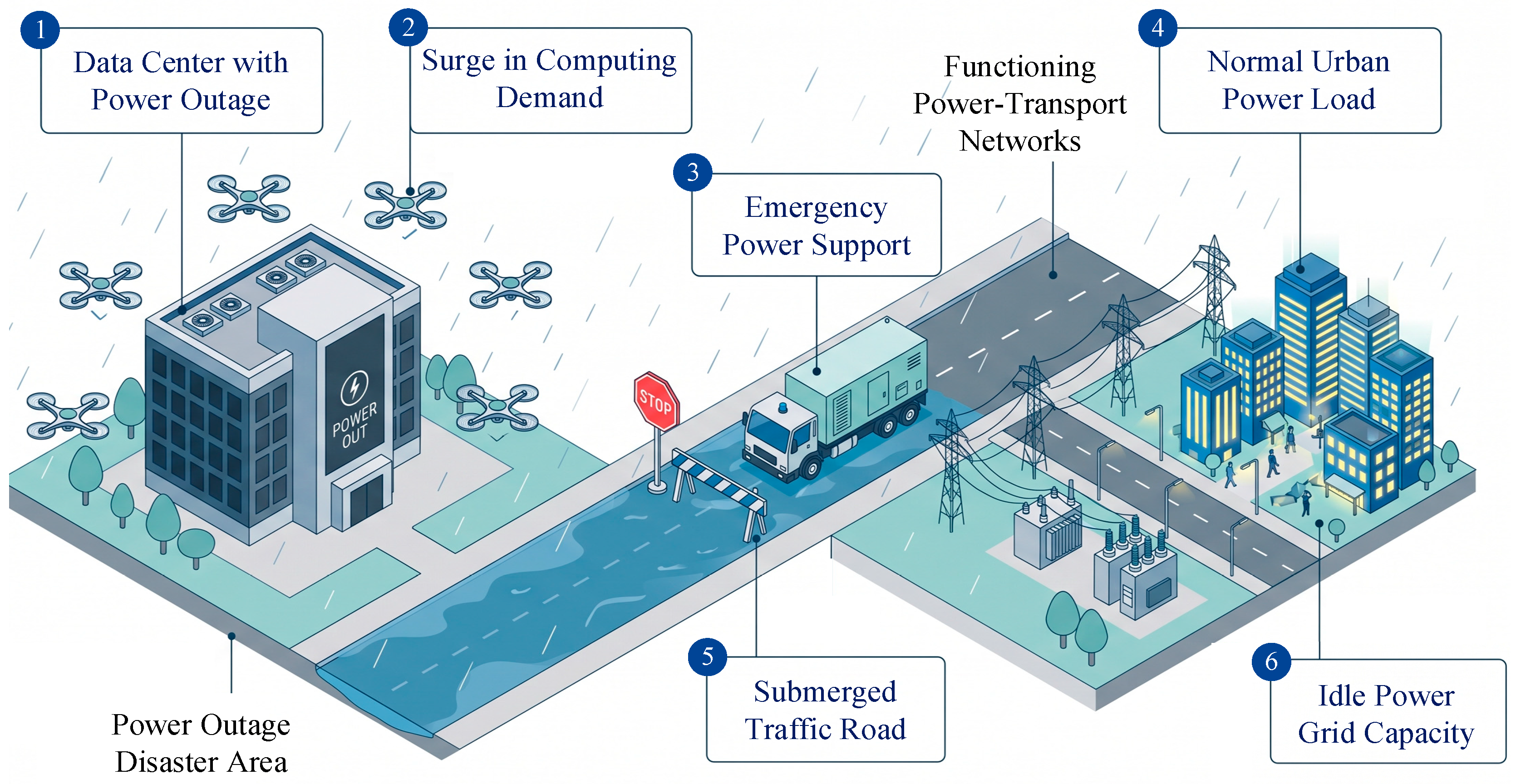
- The “Computation–Energy Paradox” is conceptually formulated for extreme disaster response across coupled power, ground-transport, and aerial networks. Through a community-scale case study, we identify a plausible feedback mechanism: intensified emergency AI invocation creates a concentrated electrical demand that can further reduce the operating margin of an already damaged islanded system. The focused 12-case sensitivity comparison shows that this additional grid burden persists across the tested load magnitudes and connection buses, while its severity varies systematically with demand size and electrical location under fixed resource-control and protection settings. This conditional finding is central to the contribution: the paradox identifies a coupled physical mechanism and a planning variable, rather than asserting that AI demand will cause universal grid collapse.
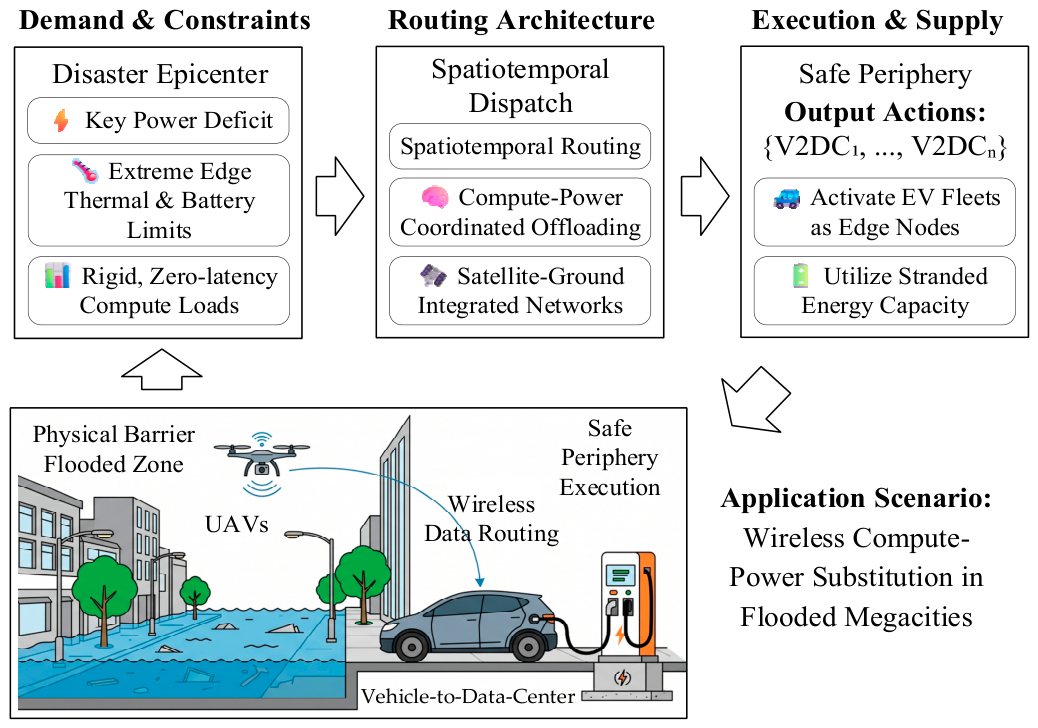
- The core engineering bottlenecks underlying this paradox are examined, including spatiotemporal computation–energy mismatches and physical constraints in extreme edge environments. To address these challenges, we outline a prospective roadmap including lightweight emergency AI and compute–power coordinated offloading mechanisms. This provides a structured conceptual basis and a technological outlook for resolving the fundamental conflict between high-intensity intelligent rescue efforts and fragile physical infrastructures.
2. AI Applications in Power–Transport Systems
2.1. Normal Operations and Optimization
2.1.1. Power System Operations
2.1.2. Ground Transport Operations
2.1.3. UAV Infrastructure Operations
2.1.4. Cross-Network Coordination
2.2. Emergency Response and Disaster Recovery
2.2.1. Power System Resilience
2.2.2. Ground Transport Emergency Mobility
2.2.3. UAV Emergency Response
2.2.4. Cross-Network Emergency Coordination
3. The Overlooked Hidden Danger: The Conflict Between Computing Surges and Power Security Under Disasters
3.1. Physical Interpretation: From AI Computation to Energy Demand
3.2. Simulation and Result Analysis
4. Key Challenges and Technological Outlook
4.1. Analyzing the Core Challenges
4.2. Potential Technological Outlook
5. Conclusions
- Literature-based observations on AI empowerment: AI has profoundly reshaped the operational landscape of urban power and transport systems. From routine multi-network optimization, such as EV cluster scheduling and UAV grid inspections, to emergency disaster response, AI acts as a critical cognitive enabler. It significantly enhances system efficiency, situational awareness, and operational resilience, demonstrating immense potential in driving the evolution of smart megacities.
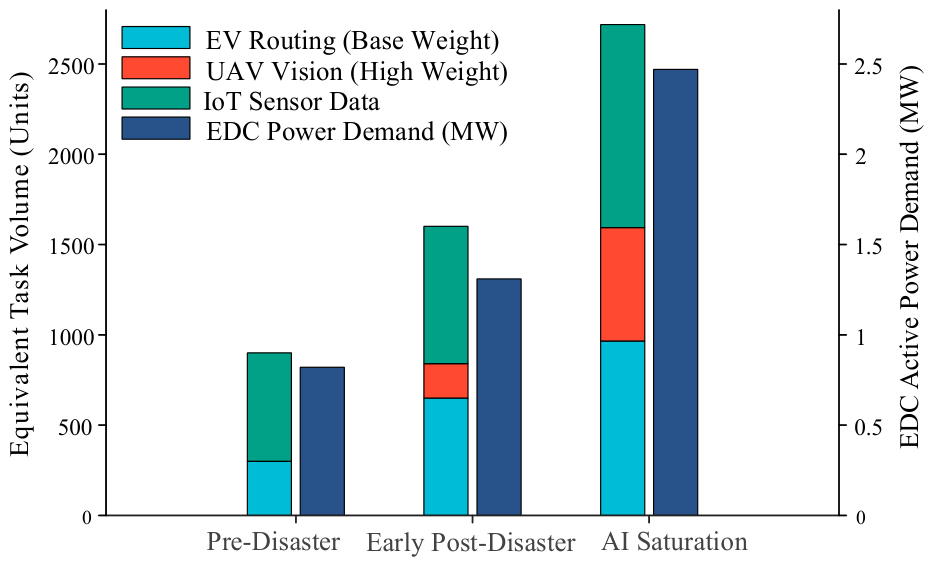
- Conceptual contribution—the “Computation–Energy Paradox”: Despite its cognitive benefits, AI introduces a hidden structural vulnerability during extreme disasters. When the physical grid is severely damaged, the intensified invocation of emergency AI (e.g., real-time UAV video streaming and dynamic path planning) generates surging computational loads whose flexibility depends on task criticality. Paradoxically, this sudden megawatt-level energy demand exacerbates the existing power deficit, reducing the operating margin of islanded systems and potentially contributing to further service loss. In this context, AI transforms from a rescuing “brain” into a “super load” that can challenge the system’s remaining physical resilience margin.
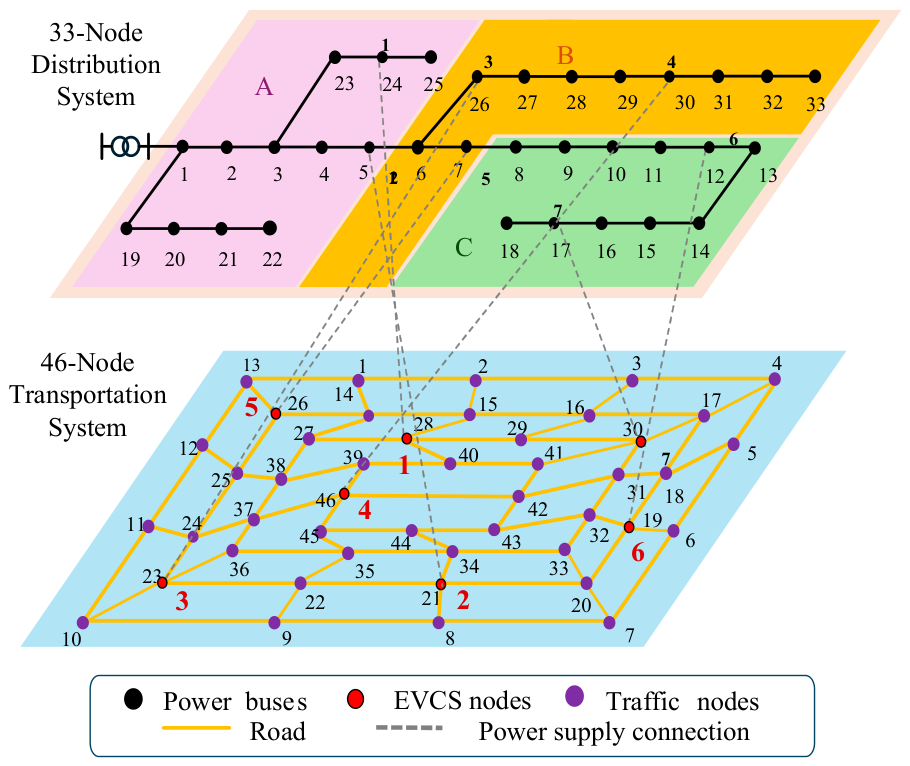
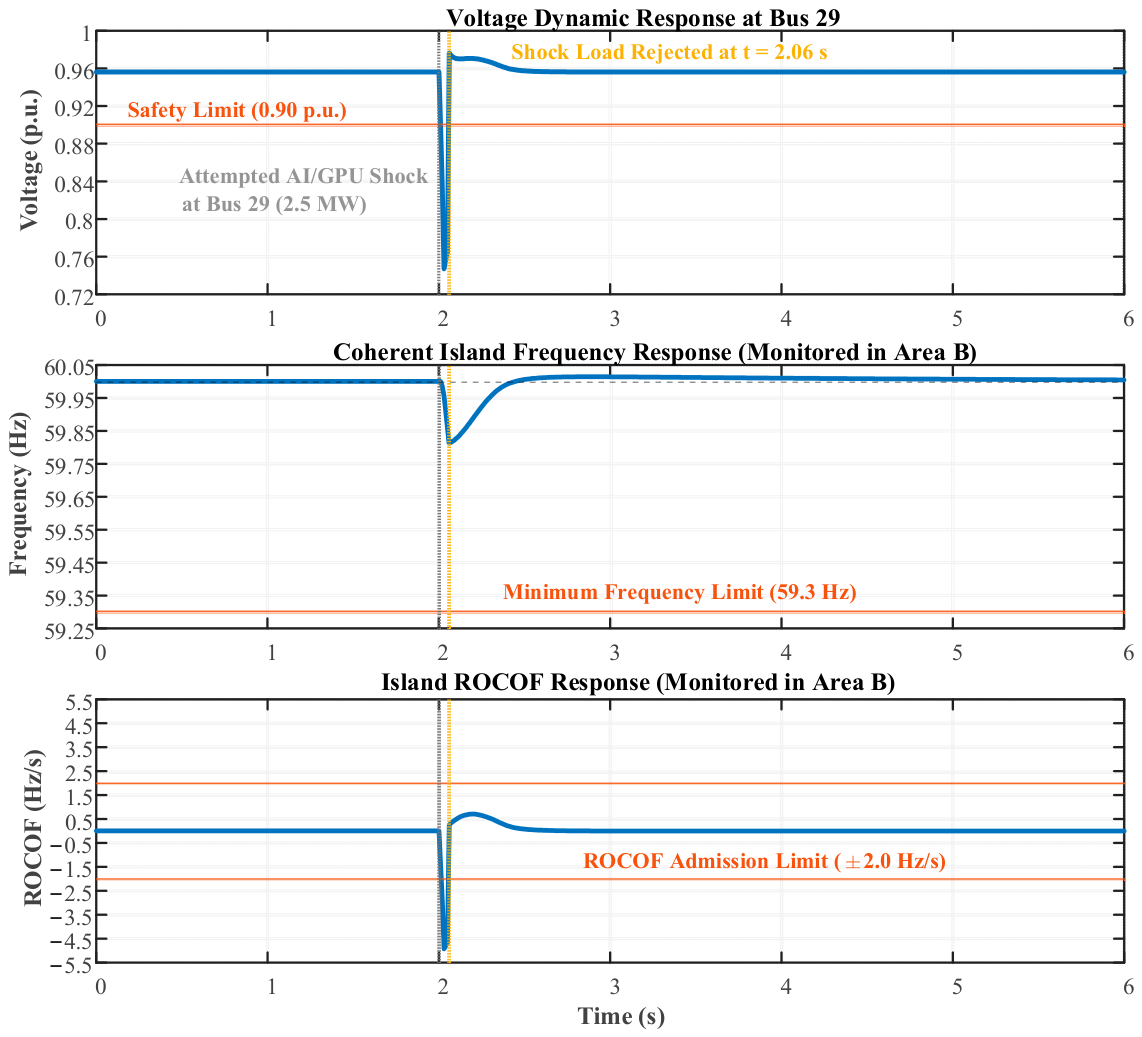
- Case-study evidence and engineering implications: In the baseline case, an attempted 2.50-MW EDC load at Bus 29 reduces the voltage to 0.7470 p.u., produces a frequency nadir of 59.812 Hz and a maximum absolute ROCOF of 4.9259 Hz/s, and is rejected at t = 2.06 s. The sensitivity analysis further shows that the grid impact increases with EDC load and varies with the electrical location of the connection, indicating that emergency computing demand should be considered explicitly in post-disaster grid operation and admission decisions.
- Prospective technological pathways: To resolve these bottlenecks, future engineering practice may consider a targeted technological roadmap: deploying energy-aware Green Edge AI (e.g., model pruning and Spiking Neural Networks) to bypass physical hardware limits, and implementing V2DC compute routing to dynamically offload tasks, effectively substituting physical energy transport with wireless data transmission. Future work should further examine data-informed computing–grid models, coordinated EDC admission, and task-prioritization strategies under different disaster and infrastructure conditions.
Author Contributions
Funding
Institutional Review Board Statement
Informed Consent Statement
Data Availability Statement
Acknowledgments
Conflicts of Interest
Abbreviations
| AI | Artificial Intelligence |
| EV | Electric Vehicles |
| UAVs | Unmanned Aerial Vehicles |
| V2G | Vehicle-to-Grid |
| DERs | distributed energy resources |
| ML | machine learning |
| DL | deep learning |
| XAI | explainable artificial intelligence |
| FL | federated learning |
| GNNs | graph neural networks |
| MARL | multi-agent reinforcement learning |
| ARIMA | autoregressive integrated moving average |
| STLF | short-term load forecasting |
| SVMs | support vector machines |
| RFs | random forests |
| RNNs | recurrent neural networks |
| LSTM | long short-term memory |
| CNNs | convolutional neural networks |
| STGNNs | spatiotemporal graph neural networks |
| BESSs | battery energy storage systems |
| SLAM | simultaneous localization and mapping |
| CV | computer vision |
| EDCs | Edge Data Centers |
| 3D | three-dimensional |
| FPS | frames per second |
| PCC | Point of Common Coupling |
| ROCOF | Rate of Change of Frequency |
| UPS | Uninterruptible Power Supply |
| DTM | dynamic thermal management |
| SNNs | Spiking Neural Networks |
| CFN | Computing Force Network |
| V2X | Vehicle to Everything |
| V2DC | Vehicle-to-Data-Center |
| SIGNs | Satellite-Ground Integrated Networks |
References
- Deep, G.; Verma, J. Embracing the future: AI and ML transforming urban environments in smart cities. J. Artif. Intell. 2023, 5, 57–73. [Google Scholar] [CrossRef] [Scilit]
- Nwaigbo, J.C.; Sanusi, A.N.; Akinode, A.O.; Ekechi, C.C.; Iheoma, J.; Ogunniyi, F.A.; Alademomi, A.P. Artificial Intelligence in Smart Cities: Accelerating Urban Sustainability through Intelligent Systems. Glob. J. Eng. Technol. Adv. 2025, 24, 051–073. [Google Scholar] [CrossRef] [Scilit]
- Lifelo, Z.; Ding, J.; Ning, H.; Qurat-Ul-Ain; Dhelim, S. Artificial intelligence-enabled metaverse for sustainable smart cities: Technologies, applications, challenges, and future directions. Electronics 2024, 13, 4874. [Google Scholar] [CrossRef] [Scilit]
- Fan, P.; Li, S.; Bu, S.; Wen, Y.; Chung, C.Y. Resilient Power Systems against Wildfire Risks: Towards a Human-Centric and Secure Future. CSEE J. Power Energy Syst. 2025, 11, 2553–2575. [Google Scholar] [CrossRef] [Scilit]
- Fan, P.; Bu, S.; Li, S.; Fang, S.; Zhang, C.; Ke, S. Resilience enhancement strategy for multi-microgrids with electric vehicle under extreme weather conditions. CSEE J. Power Energy Syst. 2026. Early Access. [Google Scholar] [CrossRef] [Scilit]
- Fan, P.; Yang, J.; Ke, S.; Wen, Y.; Li, Y.; Xie, L. Load frequency control strategy for islanded multimicrogrids with V2G dependent on learning-based model predictive control. IET Gener. Transm. Distrib. 2023, 17, 4763–4780. [Google Scholar] [CrossRef] [Scilit]
- Sai, S.; Garg, A.; Jhawar, K.; Chamola, V.; Sikdar, B. A comprehensive survey on artificial intelligence for unmanned aerial vehicles. IEEE Open J. Veh. Technol. 2023, 4, 713–738. [Google Scholar] [CrossRef] [Scilit]
- Ahmed, M.; Zheng, Y.; Amine, A.; Fathiannasab, H.; Chen, Z. The role of artificial intelligence in the mass adoption of electric vehicles. Joule 2021, 5, 2296–2322. [Google Scholar] [CrossRef] [Scilit]
- Sandle, D.T. Something to Talk About: ChatGPT’s Enormous Energy Drain Revealed. Digital Journal, 6 September 2024. Available online: https://www.digitaljournal.com/tech-science/something-to-talk-about-chatgpts-enormous-energy-drain-revealed/article (accessed on 15 May 2026).
- IEA. Executive Summary–Electricity 2024–Analysis. Available online: https://www.iea.org/reports/electricity-2024/executive-summary (accessed on 15 May 2026).
- Rane, N.; Choudhary, S.; Rane, J. Artificial intelligence for enhancing resilience. J. Appl. Artif. Intell. 2024, 5, 1–33. [Google Scholar] [CrossRef] [Scilit]
- Huang, Y.; Rong, X.; Bie, Z.; Li, J.; Huang, B.; Zhao, T.; Li, G. Artificial intelligence for resilient power system: Motivations, advances, and challenges. Smart Power Energy Secur. 2025, 1, 65–75. [Google Scholar] [CrossRef] [Scilit]
- Moskalenko, V.; Kharchenko, V.; Moskalenko, A.; Kuzikov, B. Resilience and resilient systems of artificial intelligence: Taxonomy, models and methods. Algorithms 2023, 16, 165. [Google Scholar] [CrossRef] [Scilit]
- Levin, T.; Botterud, A.; Mann, W.N.; Kwon, J.; Zhou, Z. Extreme weather and electricity markets: Key lessons from the February 2021 Texas crisis. Joule 2022, 6, 1–7. [Google Scholar] [CrossRef] [Scilit]
- Flores, N.M.; McBrien, H.; Do, V.; Kiang, M.V.; Schlegelmilch, J.; Casey, J.A. The 2021 Texas Power Crisis: Distribution, duration, and disparities. J. Expo. Sci. Environ. Epidemiol. 2023, 33, 21–31. [Google Scholar] [CrossRef] [Scilit] [PubMed]
- Zhang, G.; Zhong, H.; Tan, Z.; Cheng, T.; Xia, Q.; Kang, C. Texas electric power crisis of 2021 warns of a new blackout mechanism. CSEE J. Power Energy Syst. 2022, 8, 1–9. [Google Scholar] [CrossRef] [Scilit]
- Lee, C.-C.; Maron, M.; Mostafavi, A. Community-scale big data reveals disparate impacts of the Texas winter storm of 2021 and its managed power outage. Humanit. Soc. Sci. Commun. 2022, 9, 335. [Google Scholar] [CrossRef] [Scilit] [PubMed]
- Fan, P.; Bu, S.; Wu, F.; Li, S.; Wen, Y.; Yang, J. Interaction Mechanism Analysis of Rainstorm-Induced Disruptive Incidents in Power and Transportation Systems. IEEE Trans. Smart Grid 2026. Early Access. [Google Scholar] [CrossRef] [Scilit]
- Wu, F.; Yang, J.; Jiang, H.; Zhan, X.; Liao, S.; Xu, J.; Fan, H.; Liang, J. Cascading failure in coupled networks of transportation and power grid. Int. J. Electr. Power Energy Syst. 2022, 140, 108058. [Google Scholar] [CrossRef] [Scilit]
- Ke, S.; Zhang, K.; Mai, W.; Guo, R.; He, S.; Tian, J.; Chung, C.Y. Maximizing intra-day V2G feasible capacity of EVs: A cross-disciplinary approach with traffic flow and prospect theory. IEEE Trans. Transp. Electrif. 2026, 12, 5078–5091. [Google Scholar] [CrossRef] [Scilit]
- Du, Z.; Luo, C.; Min, G.; Wu, J.; Luo, C.; Pu, J.; Li, S. A Survey on Autonomous and Intelligent Swarms of Uncrewed Aerial Vehicles (UAVs). IEEE Trans. Intell. Transp. Syst. 2025, 26, 14477–14500. [Google Scholar] [CrossRef] [Scilit]
- Govindan, S.; Wang, D.; Sivasubramaniam, A.; Urgaonkar, B. Leveraging stored energy for handling power emergencies in aggressively provisioned datacenters. In Proceedings of the Seventeenth International Conference on Architectural Support for Programming Languages and Operating Systems; ACM: London, UK, 2012; pp. 75–86. [Google Scholar]
- Liu, Y.; Lei, S.; Hou, Y. Restoration of power distribution systems with multiple data centers as critical loads. IEEE Trans. Smart Grid 2018, 10, 5294–5307. [Google Scholar] [CrossRef] [Scilit]
- Pilz, K.; Mahmood, Y.; Heim, L. AI’s Power Requirements Under Exponential Growth. RAND Corporation. January, 2025. Volume 28. Available online: https://www.researchgate.net/profile/Konstantin-Pilz-2/publication/391150569_AI’s_Power_Requirements_Under_Exponential_Growth_Extrapolating_AI_Data_Center_Power_Demand_and_Assessing_Its_Potential_Impact_on_US_Competitiveness/links/680baf9dd1054b0207e0d43d/AIs-Power-Requirements-Under-Exponential-Growth-Extrapolating-AI-Data-Center-Power-Demand-and-Assessing-Its-Potential-Impact-on-US-Competitiveness.pdf (accessed on 15 May 2026).
- Takci, M.T.; Qadrdan, M.; Summers, J.; Gustafsson, J. Data centres as a source of flexibility for power systems. Energy Rep. 2025, 13, 3661–3671. [Google Scholar] [CrossRef] [Scilit]
- Alfayan, M.; Hagras, H. Towards an Explainable Artificial Intelligence approach for smart grid systems. Discov. Artif. Intell. 2025, 5, 40. [Google Scholar] [CrossRef] [Scilit]
- Biswal, B.; Deb, S.; Datta, S.; Ustun, T.S.; Cali, U. Review on smart grid load forecasting for smart energy management using machine learning and deep learning techniques. Energy Rep. 2024, 12, 3654–3670. [Google Scholar] [CrossRef] [Scilit]
- Castellazzi, A.; Gurpinar, E.; Wang, Z.; Hussein, A.S.; Fernandez, P.G. Impact of Wide-Bandgap Technology on Renewable Energy and Smart-Grid Power Conversion Applications Including Storage. Energies 2019, 12, 4462. [Google Scholar] [CrossRef] [Scilit]
- Boopathy, P.; Liyanage, M.; Deepa, N.; Velavali, M.; Reddy, S.; Maddikunta, P.K.R.; Neelu Khare, N.; Gadekallu, T.R.; Hwang, W.-J.; Pham, Q.V. Deep Learning for Intelligent Demand Response and Smart Grids: A Comprehensive Survey. arXiv 2021, arXiv:2101.08013. [Google Scholar] [CrossRef] [Scilit]
- Saffari, M.; Khodayar, M. Spatiotemporal deep learning for power system applications: A survey. IEEE Access 2024, 12, 93623–93657. [Google Scholar] [CrossRef] [Scilit]
- Sulaiman, A.; Nagu, B.; Kaur, G.; Karuppaiah, P.; Alshahrani, H.; Al Reshan, M.S.; AlYami, S.; Shaikh, A. Artificial Intelligence-Based Secured Power Grid Protocol for Smart City. Sensors 2023, 23, 8016. [Google Scholar] [CrossRef] [Scilit] [PubMed]
- Nabavi, S.A.; Mohammadi, S.; Motlagh, N.H.; Tarkoma, S.; Geyer, P. Deep learning modeling in electricity load forecasting: Improved accuracy by combining DWT and LSTM. Energy Rep. 2024, 12, 2873–2900. [Google Scholar] [CrossRef] [Scilit]
- Yang, C.; Zhang, W.; Zhou, Y. An Overview of Spatiotemporal Network Forecasting: Current Research Status and Methodological Evolution. Mathematics 2025, 14, 18. [Google Scholar] [CrossRef] [Scilit]
- Guo, W.; Che, L.; Shahidehpour, M.; Wan, X. Machine-Learning based methods in short-term load forecasting. Electr. J. 2021, 34, 106884. [Google Scholar] [CrossRef] [Scilit]
- Harinarayanan, J.; Balamurugan, P. SOC estimation for a lithium-ion pouch cell using machine learning under different load profiles. Sci. Rep. 2025, 15, 18091. [Google Scholar] [CrossRef] [Scilit] [PubMed]
- Deep Learning-Based Forecasting of Electricity Consumption, Scientific Reports. Available online: https://www.nature.com/articles/s41598-024-56602-4?utm_source=chatgpt.com (accessed on 15 May 2026).
- Majeed, M.A.; Phichaisawat, S.; Asghar, F.; Hussan, U. Data-Driven Optimized Load Forecasting: An LSTM-Based RNN Approach for Smart Grids. IEEE Access 2025, 13, 99018–99031. [Google Scholar] [CrossRef] [Scilit]
- Frontiers, Integration of AI-Driven Digital Twins for Real-Time Optimization of Renewable Energy Grids. Available online: https://www.frontiersin.org/journals/energy-research/articles/10.3389/fenrg.2026.1748233/full (accessed on 15 May 2026).
- Liao, W.; Bak-Jensen, B.; Pillai, J.R.; Wang, Y.; Wang, Y. A Review of Graph Neural Networks and Their Applications in Power Systems. arXiv 2021, arXiv:2101.10025. [Google Scholar] [CrossRef] [Scilit]
- Mansoor, H.; Gull, M.S.; Rauf, H.; Shaikh, I.U.H.; Khalid, M.; Arshad, N. Graph Convolutional Networks based short-term load forecasting: Leveraging spatial information for improved accuracy. Electr. Power Syst. Res. 2024, 230, 110263. [Google Scholar] [CrossRef] [Scilit]
- Zhou, H.; Ai, Q.; Li, R. Short-Term Multi-Energy Load Forecasting Method Based on Transformer Spatio-Temporal Graph Neural Network. Energies 2025, 18, 4466. [Google Scholar] [CrossRef] [Scilit]
- Mei, C.; Fan, Z.; Zhu, Q.; Yang, P.; Hou, Z.; Jin, H. A Novel Scene Matching Navigation System for UAVs Based on Vision/Inertial Fusion. IEEE Sens. J. 2023, 23, 6192–6203. [Google Scholar] [CrossRef] [Scilit]
- Hameed, Z. Deep Neural Network-Based Optimisation for Clustered Demand-Side Energy Management in Smart Grids. Ph.D. Thesis, University of Staffordshire, Stroke-on-Trent, UK, 2025. Available online: https://eprints.staffs.ac.uk/8955/ (accessed on 15 May 2026).
- Kiasari, M.; Aly, H. Agentic Artificial Intelligence for Smart Grids: A Comprehensive Review of Autonomous, Safe, and Explainable Control Frameworks. Energies 2026, 19, 617. [Google Scholar] [CrossRef] [Scilit]
- Liu, X.; Zhao, T.; Deng, H.; Wang, P.; Liu, J.; Blaabjerg, F. Microgrid Energy Management with Energy Storage Systems: A Review. CSEE J. Power Energy Syst. 2023, 9, 483–504. [Google Scholar] [CrossRef] [Scilit]
- Singh, A.R.; Sujatha, M.S.; Kadu, A.D.; Bajaj, M.; Addis, H.K.; Sarada, K. A deep learning and IoT-driven framework for real-time adaptive resource allocation and grid optimization in smart energy systems. Sci. Rep. 2025, 15, 19309. [Google Scholar] [CrossRef] [Scilit] [PubMed]
- Zhang, T.; Hao, Z. Two-stage voltage control strategy based on multi-agent reinforcement learning. South. Power Syst. Technol. 2024, 18, 77–86. [Google Scholar]
- Chandra, I.; Singh, N.; Samuel, P. A comprehensive review on coordinated charging of electric vehicles in distribution networks. J. Energy Storage 2024, 89, 111659. [Google Scholar] [CrossRef] [Scilit]
- Mojumder, M.R.H.; Antara, F.A.; Hasanuzzaman, M.; Alamri, B.; Alsharef, M. Electric Vehicle-to-Grid (V2G) Technologies: Impact on the Power Grid and Battery. Sustainability 2022, 14, 13856. [Google Scholar] [CrossRef] [Scilit]
- Hesri, A.; Khaleel, M.; Ahmed, A.A.; Nassar, Y. Grid Integration of EVs: Deploying Measures, Standards and Interoperability and Policy. Int. J. Electr. Eng. Sustain. 2025, 3, 1–18. [Google Scholar] [CrossRef] [Scilit]
- Hu, J.; You, S.; Lind, M.; Ostergaard, J. Coordinated Charging of Electric Vehicles for Congestion Prevention in the Distribution Grid. IEEE Trans. Smart Grid 2014, 5, 703–711. [Google Scholar] [CrossRef] [Scilit]
- Abd El-Raouf, A.; Elkholy, M.M.; Farahat, M.A.; Lotfy, M.E. Demand Response Approach for Coordinated Scheduling of EV Charging in a Micro-Grid. Electr. Power Compon. Syst. 2024, 52, 905–916. [Google Scholar] [CrossRef] [Scilit]
- Hao, X.; Chen, Y.; Wang, H.; Wang, H.; Meng, Y.; Gu, Q. A V2G-oriented reinforcement learning framework and empirical study for heterogeneous electric vehicle charging management. Sustain. Cities Soc. 2023, 89, 104345. [Google Scholar] [CrossRef] [Scilit]
- Shibl, M.M.; Ismail, L.S.; Massoud, A.M. Electric vehicles charging management using deep reinforcement learning considering vehicle-to-grid operation and battery degradation. Energy Rep. 2023, 10, 494–509. [Google Scholar] [CrossRef] [Scilit]
- Zhang, Y.; Chen, X.; Zhang, Y. Transfer Deep Reinforcement Learning-based Large-scale V2G Continuous Charging Coordination with Renewable Energy Sources. arXiv 2022, arXiv:2210.07013. [Google Scholar] [CrossRef] [Scilit]
- Yu, L.; Tan, Z.; Wang, Y.; Liu, T.; Xiao, N.; Xiao, X.; Ou, J.; Lin, X.; Chen, Q. Deep Reinforcement Learning Based Optimization Method for Ordered Charging of Electric Vehicle. South. Power Syst. Technol. 2024, 18, 148–156. [Google Scholar]
- Xie, H.; Song, G.; Shi, Z.; Zhang, J.; Lin, Z.; Yu, Q.; Fu, H.; Song, X.; Zhang, H. Reinforcement learning for vehicle-to-grid: A review. Adv. Appl. Energy 2025, 17, 100214. [Google Scholar] [CrossRef] [Scilit]
- Federated Reinforcement Learning with Constrained Markov Decision Processes and Graph Neural Networks for Fair and Grid-Constrained Coordination of Large-Scale Electric Vehicle Charging Networks | Scientific Reports. Available online: https://www.nature.com/articles/s41598-025-22482-5 (accessed on 15 May 2026).
- Khan, F.; Islam, S.; Ben-Brahim, L.; Gastli, A.; Bakhsh, F.I. Application of Artificial Intelligence Techniques in Smart Interactions Between the EV and Grid Using V2G and G2V Modes: A Comprehensive Review. In 2025 IEEE 4th International Conference on Smart Technologies for Power, Energy and Control (STPEC); IEEE: New York, NY, USA, 2025; pp. 1–6. [Google Scholar] [CrossRef] [Scilit]
- Omerbegović, N.S.; Omerbegović, D. Artificial Intelligence in Energy Optimization and Renewable Energy System Integration. Artif. Intell. Chem. Eng. 2025, 471–498. [Google Scholar] [CrossRef] [Scilit]
- Qin, Y.; Kishk, M.A.; Alouini, M.-S. A Survey on Integrating UAVs Into Public Safety Networks: Advantages and Potential Risks. IEEE Open J. Commun. Soc. 2025, 6, 9343–9372. [Google Scholar] [CrossRef] [Scilit]
- Liu, X.; Zhang, H.; Zheng, K. A Method of Time-frequency Interleave for Broadband Powerline Communication Based on OFDM. In Proceedings of the 2018 International Conference on Information Systems and Computer Aided Education (ICISCAE), Changchun, China, 6–8 July 2018; pp. 383–388. [Google Scholar] [CrossRef] [Scilit]
- Reum, T.; Toepfer, H. Introduction of the Bicomplex Analysis in the Finite Element Method Applied to Electromagnetic Far-Field Calculations. In 2019 19th International Symposium on Electromagnetic Fields in Mechatronics, Electrical and Electronic Engineering (ISEF); IEEE: New York, NY, USA, 2019; pp. 1–2. [Google Scholar] [CrossRef] [Scilit]
- Memari, M.; Shakya, P.; Shekaramiz, M.; Seibi, A.C.; Masoum, M.A.S. Review on the Advancements in Wind Turbine Blade Inspection: Integrating Drone and Deep Learning Technologies for Enhanced Defect Detection. IEEE Access 2024, 12, 33236–33282. [Google Scholar] [CrossRef] [Scilit]
- Comarella, B.V.; Carletti, D.; Yahyaoui, I.; Encarnação, L.F. Theoretical and Experimental Comparative Analysis of Finite Control Set Model Predictive Control Strategies. Electronics 2023, 12, 1482. [Google Scholar] [CrossRef] [Scilit]
- Bozlak, Ç.B.; Yaşar, C.F. An optimized deep learning approach for forecasting day-ahead electricity prices. Electr. Power Syst. Res. 2024, 229, 110129. [Google Scholar] [CrossRef] [Scilit]
- Redmon, J.; Divvala, S.; Girshick, R.; Farhadi, A. You Only Look Once: Unified, Real-Time Object Detection. arXiv 2016, arXiv:1506.02640. [Google Scholar] [CrossRef] [Scilit]
- Krizhevsky, A.; Sutskever, I.; Hinton, G.E. ImageNet classification with deep convolutional neural networks. Commun. ACM 2017, 60, 84–90. [Google Scholar] [CrossRef] [Scilit]
- Ponomarenko-Timofeev, A.; Pyattaev, A.; Andreev, S.; Koucheryavy, Y.; Mueck, M.; Karls, I. Highly dynamic spectrum management within licensed shared access regulatory framework. IEEE Commun. Mag. 2016, 54, 100–109. [Google Scholar] [CrossRef] [Scilit]
- Tacconi, R.; Marini, M.R.; Saraceno, M.; Foresti, G.L.; Cinque, L.; Mecca, A. A Comprehensive Taxonomy of UAVs: A Comparative Feature Matrix for Hardware, Capabilities, and Payloads. IEEE Access 2026, 14, 3821–3851. [Google Scholar] [CrossRef] [Scilit]
- Chen, N.; Wang, M.; Zhang, N.; Shen, X. Energy and Information Management of Electric Vehicular Network: A Survey. IEEE Commun. Surv. Tutor. 2020, 22, 967–997. [Google Scholar] [CrossRef] [Scilit]
- PeerJ Multi-Objective Optimization for Smart Cities: A Systematic Review of Algorithms, Challenges, and Future Directions. Available online: https://peerj.com/articles/cs-3042/ (accessed on 15 May 2026).
- Yang, B.; Zhou, Y.; Yan, Y.; Su, S.; Li, J.; Yao, W.; Li, H.; Gao, D.; Wang, J. A Critical and Comprehensive Handbook for Game Theory Applications on New Power Systems: Structure, Methodology, and Challenges. Prot. Control Mod. Power Syst. 2025, 10, 1–27. [Google Scholar] [CrossRef] [Scilit]
- Fang, Z.; Song, T.; Li, T. Energy Harvesting for Two-Way OFDM Communications under Hostile Jamming. IEEE Signal Process. Lett. 2015, 22, 413–416. [Google Scholar] [CrossRef] [Scilit]
- Hu, C.; Wen, G.; Wang, S.; Fu, J.; Yu, W. Distributed Multiagent Reinforcement Learning With Action Networks for Dynamic Economic Dispatch. IEEE Trans. Neural Netw. Learn. Syst. 2024, 35, 9553–9564. [Google Scholar] [CrossRef] [Scilit] [PubMed]
- Bai, Y.; Zhao, H.; Zhang, X.; Chang, Z.; Jäntti, R.; Yang, K. Toward Autonomous Multi-UAV Wireless Network: A Survey of Reinforcement Learning-Based Approaches. IEEE Commun. Surv. Tutor. 2023, 25, 3038–3067. [Google Scholar] [CrossRef] [Scilit]
- Yuge, K.; Nabatame, T.; Irokawa, Y.; Ohi, A.; Ikeda, N.; Uedono, A.; Sang, L.; Koide, Y.; Ohishi, T. Influence of post-deposition annealing on interface characteristics at Al2O3/n-GaN. In 2019 Electron Devices Technology and Manufacturing Conference (EDTM); IEEE: New York, NY, USA, 2019; pp. 368–370. [Google Scholar] [CrossRef] [Scilit]
- Venkatasubramanian, B.V.; Laoudias, C.; Panteli, M. Cascading Failures and Resilience in Interdependent Critical Infrastructures: A Dynamic Approach. IEEE Syst. J. 2025, 19, 999–1010. [Google Scholar] [CrossRef] [Scilit]
- Lu, Z.; Yan, D.; Jiang, H.; Xue, H.; Xu, Z.-D. Cascading failures in urban infrastructure systems: A comprehensive review of disaster chain mechanisms. J. Infrastruct. Intell. Resil. 2025, 4, 100157. [Google Scholar] [CrossRef] [Scilit]
- Islam, S.N.; Biswas, A.; Chowdhury, A.K. AI-Enabled Cyber-Physical Power Systems: Review of Smart Grid Security, Optimization, and Decision Support. Appl. IT Eng. 2023, 1, 1–9. [Google Scholar]
- Zahraoui, Y.; Korõtko, T.; Rosin, A.; Mekhilef, S.; Seyedmahmoudian, M.; Stojcevski, A.; Alhamrouni, I. AI Applications to Enhance Resilience in Power Systems and Microgrids—A Review. Sustainability 2024, 16, 4959. [Google Scholar] [CrossRef] [Scilit]
- Hybrid Learning-Based Fault Prediction and Cascading Failure Mitigation in Multi-Network Energy Systems | Scientific Reports. Available online: https://www.nature.com/articles/s41598-025-10304-7 (accessed on 15 May 2026).
- Infrastructure Failure Cascades Quintuple Risk of Storm and Flood-Induced Service Disruptions Across the Globe: One Earth. Available online: https://www.cell.com/one-earth/fulltext/S2590-3322(24)00139-8 (accessed on 15 May 2026).
- Liu, C.; Ding, L.; Yu, H. Intelligent Fault Detection in Power Grids Using Deep Learning Algorithms. IEEE Access 2025, 13, 162713–162730. [Google Scholar] [CrossRef] [Scilit]
- Johnphill, O.; Sadiq, A.S.; Al-Obeidat, F.; Al-Khateeb, H.; Taheir, M.A.; Kaiwartya, O.; Ali, M. Self-Healing in Cyber–Physical Systems Using Machine Learning: A Critical Analysis of Theories and Tools. Future Internet 2023, 15, 244. [Google Scholar] [CrossRef] [Scilit]
- Jangam, S.K. Role of AI and ML in Enhancing Self-Healing Capabilities, Including Predictive Analysis and Automated Recovery. Int. J. Artif. Intell. Data Sci. Mach. Learn. 2022, 3, 47–56. [Google Scholar] [CrossRef] [Scilit]
- Karunaharan, V.; Gayan, S.; Luckshan, C.; Singh, R.; Inaltekin, H.; Shin, W.; Han, Z. A Comprehensive Survey on 6G and Beyond for Climate Action: Toward Sustainable Connectivity. IEEE Access 2026, 14, 39400–39438. [Google Scholar] [CrossRef] [Scilit]
- Hamidieh, M.; Ghassemi, M. Microgrids and Resilience: A Review. IEEE Access 2022, 10, 106059–106080. [Google Scholar] [CrossRef] [Scilit]
- Zhang, H.; Feng, T.; Li, Z.; Shi, G. A Distributed Load Restoration Method in Reconfigurable Distribution Networks Based on Multi-Agent Reinforcement Learning. In 2024 8th International Conference on Power and Energy Engineering (ICPEE); IEEE: New York, NY, USA, 2024; pp. 350–354. [Google Scholar] [CrossRef] [Scilit]
- Zhao, J.; Wang, X.; Song, X.; Shen, Y. When the Extreme Events Hit–Rethinking Power System Resilience Through Meteorology, AI, Data Centers, and Beyond. IET Gener. Transm. Distrib. 2026, 20, e70277. [Google Scholar] [CrossRef] [Scilit]
- Babaei, M.H.; Wong, S.D. Electric vehicles in emergencies and evacuations: A review of resilience and future research directions. Transp. Lett. 2025, 17, 1101–1113. [Google Scholar] [CrossRef] [Scilit]
- Power System Resilience: The Role of Electric Vehicles and Social Disparities in Mitigating the US Power Outages | Smart Grids and Sustainable Energy | Springer Nature Link. Available online: https://link.springer.com/article/10.1007/s40866-024-00204-6?utm_source=chatgpt.com (accessed on 16 May 2026).
- Cao, Y.; Xu, X.; Luo, Y.; Xiang, Y.; Liu, Y.; Hu, W.; Liu, J. Human-safe based electric vehicle evacuation in transportation-power networks during emergencies: A two-stage response framework. Int. J. Disaster Risk Reduct. 2024, 114, 104986. [Google Scholar] [CrossRef] [Scilit]
- Aquino, A.D.O.; Talkington, S.; Molzahn, D.K. Managing Vehicle Charging During Emergencies via Conservative Distribution System Modeling. arXiv 2023, arXiv:2311.16975. [Google Scholar] [CrossRef] [Scilit]
- Du, Y.; Zhang, J.; Chen, Y.; Liu, Z.; Zhang, H.; Ji, H.; Wang, C.; Yan, J. Impact of electric vehicles on post-disaster power supply restoration of urban distribution systems. Appl. Energy 2025, 383, 125302. [Google Scholar] [CrossRef] [Scilit]
- Churchill, M.; Monroe, J.; Bristow, D.; Crawford, C. Using electric vehicles to enhance power outage resilience—An agent-based modeling approach. Heliyon 2024, 10, e32104. [Google Scholar] [CrossRef] [Scilit] [PubMed]
- Using Electric Vehicles as Emergency Power Sources for Extreme Weather. Available online: https://www.the-innovation.org/article/doi/10.59717/j.xinn-energy.2025.100097?utm_source=chatgpt.com (accessed on 16 May 2026).
- Dugan, J.; Mohagheghi, S.; Kroposki, B. Application of Mobile Energy Storage for Enhancing Power Grid Resilience: A Review. Energies 2021, 14, 6476. [Google Scholar] [CrossRef] [Scilit]
- Dong, X.; Xiong, X.; Yang, D.; Wang, S.; Zhu, Y. Power Supply Resilience Under Typhoon Disasters: A Recovery Strategy Considering the Coordinated Dispatchable Potential of Electric Vehicles and Mobile Energy Storage. Processes 2025, 13, 1638. [Google Scholar] [CrossRef] [Scilit]
- Mohsan, S.A.H.; Khan, M.A.; Noor, F.; Ullah, I.; Alsharif, M.H. Towards the Unmanned Aerial Vehicles (UAVs): A Comprehensive Review. Drones 2022, 6, 147. [Google Scholar] [CrossRef] [Scilit]
- Erdelj, M.; Natalizio, E. UAV-assisted disaster management: Applications and open issues. In 2016 International Conference on Computing, Networking and Communications (ICNC); IEEE: New York, NY, USA, 2016; pp. 1–5. [Google Scholar] [CrossRef] [Scilit]
- Efficient CNN-Based Disaster Events Classification Using UAV-Aided Images for Emergency Response Application | Neural Computing and Applications | Springer Nature Link. Available online: https://link.springer.com/article/10.1007/s00521-024-09610-4 (accessed on 16 May 2026).
- Kheddar, H.; Habchi, Y.; Ghanem, M.C.; Hemis, M.; Niyato, D. Recent Advances in Transformer and Large Language Models for UAV Applications. arXiv 2025, arXiv:2508.11834. [Google Scholar] [CrossRef] [Scilit]
- Jagatheesaperumal, S.K.; Hassan, M.M.; Hassan, M.R.; Fortino, G. The Duo of Visual Servoing and Deep Learning-Based Methods for Situation-Aware Disaster Management: A Comprehensive Review. Cogn. Comput. 2024, 16, 2756–2778. [Google Scholar] [CrossRef] [Scilit]
- Wang, L.; Wu, J.; Yang, Y.; Tang, R.; Ya, R. Deep Learning Models for Hazard-Damaged Building Detection Using Remote Sensing Datasets: A Comprehensive Review. IEEE J. Sel. Top. Appl. Earth Obs. Remote Sens. 2024, 17, 15301–15318. [Google Scholar] [CrossRef] [Scilit]
- Bircher, A.; Kamel, M.; Alexis, K.; Oleynikova, H.; Siegwart, R. Receding Horizon “Next-Best-View” Planner for 3D Exploration. In 2016 IEEE International Conference on Robotics and Automation (ICRA); IEEE: New York, NY, USA, 2016; pp. 1462–1468. [Google Scholar] [CrossRef] [Scilit]
- Integration of UAVs and FANETs in Disaster Management: A Review on Applications, Challenges and Future Directions-Abbas-2024-Transactions on Emerging Telecommunications Technologies-Wiley Online Library. Available online: https://onlinelibrary.wiley.com/doi/abs/10.1002/ett.70023 (accessed on 16 May 2026).
- MahmoudZadeh, S.; Yazdani, A.; Kalantari, Y.; Ciftler, B.; Aidarus, F.; Kadri, M.O.A. Holistic Review of UAV-Centric Situational Awareness: Applications, Limitations, and Algorithmic Challenges. Robotics 2024, 13, 117. [Google Scholar] [CrossRef] [Scilit]
- Betalo, M.L.; Ullah, I.; Tesema, F.B.; Wu, Z.; Li, J.; Bai, X. Generative AI-Driven Multiagent DRL for Task Allocation in UAV-Assisted EMPD Within 6G-Enabled SAGIN Networks. IEEE Internet Things J. 2025, 12, 35890–35907. [Google Scholar] [CrossRef] [Scilit]
- Sapkota, R.; Roumeliotis, K.I.; Karkee, M. UAVs Meet Agentic AI: A Multidomain Survey of Autonomous Aerial Intelligence and Agentic UAVs. arXiv.org. Available online: https://arxiv.org/abs/2506.08045v1 (accessed on 16 May 2026).
- Yang, H.; Zhang, R.; Zhou, W.; Hui, L. A Graph-Spatiotemporal Prediction-Aware Optimization Framework for Emergency Resource Scheduling in Rainstorm-Induced Multimodal Transportation Networks. IEEE Access 2026, 14, 71059–71079. [Google Scholar] [CrossRef] [Scilit]
- Zhong, J.; Chen, C.; Zhang, H.; Shen, W.; Fan, Z.; Qiu, D.; Bie, Z. Resilient mobile energy storage resources-based microgrid formation considering power-transportation-information network interdependencies. Appl. Energy 2025, 389, 125716. [Google Scholar] [CrossRef] [Scilit]
- Chen, C.; Yan, S.; Zhou, X.; Xiao, J. Multi-stage hierarchical multi-agent reinforcement learning for UAV-quadruped completing search and rescue. Discov. Robot. 2026, 2, 12. [Google Scholar] [CrossRef] [Scilit]
- Zhong, J.; Chen, C.; Yang, Q.; Liu, D.; Shen, W.; Ji, C.; Bie, Z. Resilient Mobile Energy Storage Resources Based Distribution Network Restoration in Interdependent Power-Transportation-Information Networks. arXiv 2024, arXiv:2403.01250. [Google Scholar] [CrossRef] [Scilit]
- Li, S.; Liu, G.; Li, L.; Zhang, Z.; Fei, W.; Xiang, H. A Review on Air-Ground Coordination in Mobile Edge Computing: Key Technologies, Applications and Future Directions. Tsinghua Sci. Technol. 2025, 30, 1359–1386. [Google Scholar] [CrossRef] [Scilit]
- Applications of Deep Reinforcement Learning in Communications and Networking: A Survey. Available online: https://ieeexplore.ieee.org/document/8714026 (accessed on 16 May 2026).
- Wang, L.; Jiao, H. Multi-Agent Reinforcement Learning-Based Computation Offloading for Unmanned Aerial Vehicle Post-Disaster Rescue. Sensors 2024, 24, 8014. [Google Scholar] [CrossRef] [Scilit] [PubMed]
- Wang, Z. On-Orbit Space AI: Federated, Multi-Agent, and Collaborative Algorithms for Satellite Constellations. Algorithms 2026, 19, 318. [Google Scholar] [CrossRef] [Scilit]
- Sirma, A.; Plastropoulos, A.; Tang, G.; Zolotas, A. DRespNeT: A UAV Dataset and YOLOv8-DRN Model for Aerial Instance Segmentation of Building Access Points for Post-Earthquake Search-and-Rescue Missions. arXiv 2025, arXiv:2508.16016. [Google Scholar] [CrossRef] [Scilit]
- Habash, N.; Alqumsan, A.A.; Zhou, T. Recent Real-Time Aerial Object Detection Approaches, Performance, Optimization, and Efficient Design Trends for Onboard Performance: A Survey. Sensors 2025, 25, 7563. [Google Scholar] [CrossRef] [Scilit] [PubMed]
- Wang, J.; Feng, Z.; Chen, Z.; George, S.; Bala, M.; Pillai, P.; Yang, S.-W.; Satyanarayanan, M. Bandwidth-Efficient Live Video Analytics for Drones Via Edge Computing. In 2018 IEEE/ACM Symposium on Edge Computing (SEC); IEEE: Seattle, WA, USA, 2018; pp. 159–173. [Google Scholar] [CrossRef] [Scilit]
- Anand, B.; Grama, A. EV-Planner: A machine learning approach to electric vehicle charging infrastructure planning. Front. Artif. Intell. 2026, 9, 1742351. [Google Scholar] [CrossRef] [Scilit] [PubMed]
- Zhang, Y.; Shen, X.; Wang, Y. Dynamic Electric Vehicle Route Planning via Traffic Flow Prediction and Charging Service Integration. Processes 2026, 14, 762. [Google Scholar] [CrossRef] [Scilit]
- Chen, X.; Wang, X.; Colacelli, A.; Lee, M.; Xie, L. Electricity Demand and Grid Impacts of AI Data Centers: Challenges and Prospects. arXiv 2025, arXiv:2509.07218. [Google Scholar] [CrossRef] [Scilit]
- Li, Y.; Mughees, M.; Chen, Y.; Li, Y.R. The Unseen AI Disruptions for Power Grids: LLM-Induced Transients. arXiv 2024, arXiv:2409.11416. [Google Scholar] [CrossRef] [Scilit]
- Niu, C.; Zhang, W.; Li, J.; Zhao, Y.; Wang, T.; Wang, X.; Chen, Y. TokenPowerBench: Benchmarking the power consumption of LLM inference. In Proceedings of the AAAI Conference on Artificial Intelligence, Singapore, 20–27 January 2026; pp. 32582–32590. Available online: https://ojs.aaai.org/index.php/AAAI/article/view/40535 (accessed on 16 May 2026).
- LLM Inference-EcoLogits. Available online: https://ecologits.ai/latest/methodology/llm_inference/ (accessed on 16 May 2026).
- Initiative, T.M.E. ML.ENERGY Blog-Diagnosing Inference Energy Consumption with the ML.ENERGY Leaderboard v3.0’. Available online: https://mL.energy/blog/measurement/energy/diagnosing-inference-energy-consumption-with-the-mlenergy-leaderboard-v30/ (accessed on 16 May 2026).
- Qin, Z.; Hu, Z.; He, Z.; Prakriya, N.; Cong, J.; Sun, Y. Optimized Multi-Token Joint Decoding with Auxiliary Model for LLM Inference. In Proceedings of the Thirteenth International Conference on Learning Representations (ICLR 2025), Singapore, 24–28 April 2025. [Google Scholar]
- Fernandez, J.; Na, C.; Tiwari, V.; Bisk, Y.; Luccioni, S.; Strubell, E. Energy Considerations of Large Language Model Inference and Efficiency Optimizations. In Proceedings of the 63rd Annual Meeting of the Association for Computational Linguistics (Volume 1: Long Papers), Vienna, Austria, 27 July 2025; pp. 32556–32569. [Google Scholar] [CrossRef] [Scilit]
- The ML.ENERGY Benchmark: Toward Automated Inference Energy Measurement and Optimization. Available online: https://arxiv.org/html/2505.06371v2 (accessed on 16 May 2026).
- Comparing Enterprise NVIDIA GPUs: A100, H100, T4, A30, and Jetson-Which One to Pick. server-parts.eu. Available online: https://www.server-parts.eu/post/nvidia-gpu (accessed on 16 May 2026).
- SolarTech How Much Electricity Does a Data Center Use? Complete 2025 Analysis. IAEI Magazine, 1 January 2026. Available online: https://iaeimagazine.org/electrical-fundamentals/how-much-electricity-does-a-data-center-use-complete-2025-analysis/ (accessed on 16 May 2026).
- Quantifying the Impact on PUE and Energy Consumption when Introducing Liquid Cooling into an air-Cooled Data Center. Available online: https://www.vertiv.com/en-us/about/news-and-events/articles/blog-posts/quantifying-data-center-pue-when-introducing-liquid-cooling/ (accessed on 16 May 2026).
- Demystifying PUE: Optimizing Data Center Power Usage & Efficiency | Huawei. Available online: https://digitalpower.huawei.com/en/blogs/data-center-power-usage (accessed on 16 May 2026).
- Wang, T. Understanding PUE in Data Centers. Expert Green Prefab Data Centers. Available online: https://attom.tech/understanding-pue-in-data-centers/ (accessed on 16 May 2026).
- High-Performance Computing Data Center Power Usage Effectiveness | Computational Science | NLR. Available online: https://www.nlr.gov/computational-science/measuring-efficiency-pue (accessed on 16 May 2026).
- Improve Power Usage Effectiveness. Mitsubishi Electric. Available online: https://mitsubishicritical.com/resources/improve-power-usage-effectiveness/ (accessed on 16 May 2026).
- Son, Y.; Ha, Y.; Jang, G. Frequency Nadir Estimation Using the Linear Characteristics of Frequency Control in Power Systems. Energies 2024, 17, 1061. [Google Scholar] [CrossRef] [Scilit]
- Ma, R.; Bu, S. Design of Joint Cyberattacks on Electric Vehicle Charging via Pricing and Traffic Manipulation to Threaten Secure Operation of Power Systems. IEEE Trans. Transp. Electrif. 2026, 12, 1955–1969. [Google Scholar] [CrossRef] [Scilit]
- Song, X.; Zhang, H.; Akerkar, R.; Huang, H.; Guo, S.; Zhong, L.; Ji, Y.; Opdahl, A.L.; Purohit, H.; Skupin, A.; et al. Big data and emergency management: Concepts, methodologies, and applications. IEEE Trans. Big Data 2020, 8, 397–419. [Google Scholar] [CrossRef] [Scilit]
- Xu, Y.; Li, Y. A real-time urban traffic congestion prediction framework based on dynamic risk field and multi-source data fusion. IEEE Access 2025, 13, 172471–172495. [Google Scholar] [CrossRef] [Scilit]
- Zhang, M.; Fu, H.; Wang, X.; Shu, D.; Yang, J.; Yu, P.; Zhu, M.; Tao, J. Disaster management approaches for active distribution networks based on Mobile Energy Storage System. Electr. Power Syst. Res. 2025, 239, 111242. [Google Scholar] [CrossRef] [Scilit]
- Saboori, H. Enhancing resilience and sustainability of distribution networks by emergency operation of a truck-mounted mobile battery energy storage fleet. Sustain. Energy Grids Netw. 2023, 34, 101037. [Google Scholar] [CrossRef] [Scilit]
- Li, X.; Shi, Y.; Zhang, R.; Zhang, X.; Tang, R.; Yang, X.; Lai, J.; Zhang, Y. Research on the integration of mobile energy storage system for enhancing black start capability and resilience in distribution networks under extreme events. Sustain. Energy Grids Netw. 2025, 43, 101724. [Google Scholar] [CrossRef] [Scilit]
- Pan, T.; Li, X.; Su, L.; Shi, Y.; Gao, Y.; Tang, R.; Yang, C. Resilience enhancement strategy for port distribution networks considering mobile energy storage. Electr. Power Syst. Res. 2025, 246, 111685. [Google Scholar] [CrossRef] [Scilit]
- Ganesh, S.; Gopalasamy, V.; Shibu, N.B.S. Architecture for Drone Assisted Emergency Ad-hoc Network for Disaster Rescue Operations. In 2021 International Conference on COMmunication Systems & NETworkS (COMSNETS); IEEE: New York, NY, USA, 2021; pp. 44–49. [Google Scholar] [CrossRef] [Scilit]
- Ali, H.M.; Hussein, R.R.; Raju, Y.K.; Salayeva, M.; Eshchanova, G. Aerial Drones Enable Real-Time Energy Distribution in Disaster Zones. In Adaptive Technologies for Sustainable Growth; CRC Press: Boca Raton, FL, USA, 2026. [Google Scholar]
- Li, Y.; Long, X.; Li, Y.; Ding, Y.; Yang, T.; Zeng, Z. A Demand–Supply Cooperative Responding Strategy in Power System With High Renewable Energy Penetration. IEEE Trans. Control Syst. Technol. 2024, 32, 874–890. [Google Scholar] [CrossRef] [Scilit]
- Lee, S.; Park, M.; Lee, H.-S.; Ham, Y. Impact of Demand-Side Response on Community Resilience: Focusing on a Power Grid after Seismic Hazards. J. Manag. Eng. 2020, 36, 04020071. [Google Scholar] [CrossRef] [Scilit]
- Zhang, R.; Yu, J. An Orderly Power Utilization Method for New Urban Power Grids Facing Severe Electricity Shortages. J. Mod. Power Syst. Clean Energy 2024, 12, 1710–1723. [Google Scholar] [CrossRef] [Scilit]
- Frontiers | Community-Based Participatory Research: A Lifeline to Achieve People-Centered Care. Available online: https://www.frontiersin.org/journals/public-health/articles/10.3389/fpubh.2025.1693459/full (accessed on 15 May 2026).
- Younis, A.; Maheshwari, S.; Pompili, D. Energy-Latency Computation Offloading and Approximate Computing in Mobile-Edge Computing Networks. IEEE Trans. Netw. Serv. Manag. 2024, 21, 3401–3415. [Google Scholar] [CrossRef] [Scilit]
- Dinh, T.Q.; Tang, J.; La, Q.D.; Quek, T.Q.S. Offloading in Mobile Edge Computing: Task Allocation and Computational Frequency Scaling. IEEE Trans. Commun. 2017, 65, 3571–3584. [Google Scholar] [CrossRef] [Scilit]
- Hao, Y.; Chen, M.; Hu, L.; Hossain, M.S.; Ghoneim, A. Energy Efficient Task Caching and Offloading for Mobile Edge Computing. IEEE Access 2018, 6, 11365–11373. [Google Scholar] [CrossRef] [Scilit]
- Rui, Z.; Xu, X.; Wen, J.; Yan, Z.; Lin, X. Resilience Enhancement of Cyber-Physical Distribution Systems by Coordinating Unmanned Aerial Vehicles and Multi-Function Emergency Trucks. IEEE Trans. Smart Grid 2026, 17, 3491–3503. [Google Scholar] [CrossRef] [Scilit]
- Hildmann, H.; Kovacs, E. Review: Using Unmanned Aerial Vehicles (UAVs) as Mobile Sensing Platforms (MSPs) for Disaster Response, Civil Security and Public Safety. Drones 2019, 3, 59. [Google Scholar] [CrossRef] [Scilit]
- Abel, M.; Ahmad, I.; Alvarez Casado, C.; Berner, R.; Bettinelli, M.; Mikael Björk, K.; Capobianco, M.; Gross, J.; Hong Nguyen, T.; Hui, P.; et al. Large Language Models in the 6G-Enabled Computing Continuum: A White Paper. University of Oulu, January. 2025. Available online: https://hal.science/hal-04958090 (accessed on 15 May 2026).
- West, D.M. The Future of Work: Robots, AI, and Automation; Bloomsbury Publishing USA: New York, NY, USA, 2018. [Google Scholar]
- Hsu, C.H.; Feng, W.C. Reducing overheating-induced failures via performance-aware CPU power management. In Proceedings of the 6th International Conference on Linux Clusters, Chapel Hill, NC, USA, 25–28 April 2005. [Google Scholar]
- Shin, D.; Chung, S.W.; Chung, E.-Y.; Chang, N. Energy-Optimal Dynamic Thermal Management: Computation and Cooling Power Co-Optimization. IEEE Trans. Ind. Inform. 2010, 6, 340–351. [Google Scholar] [CrossRef] [Scilit]
- Yang, J.; Zhou, X.; Chrobak, M.; Zhang, Y.; Jin, L. Dynamic Thermal Management through Task Scheduling. In ISPASS 2008-IEEE International Symposium on Performance Analysis of Systems and Software; IEEE: New York, NY, USA, 2008; pp. 191–201. [Google Scholar]
- Fu, L.; Wan, J.; Yang, J.; Cao, D.; Zhang, G. Dynamic thermal and IT resource management strategies for data center energy minimization. J. Cloud Comput. 2017, 6, 25. [Google Scholar] [CrossRef] [Scilit]
- Jyothi, A.P.; Shankar, A.; Ashwath Narayan, J.R. Synergising 6G technologies, artificial intelligence, and green innovations: A path towards sustainable and intelligent connectivity. In Advances in Computers; Elsevier: Amsterdam, The Netherlands, 2025; Volume 139, pp. 381–432. [Google Scholar] [CrossRef] [Scilit]
- Różycki, R.; Solarska, D.A.; Waligóra, G. Energy-Aware Machine Learning Models—A Review of Recent Techniques and Perspectives. Energies 2025, 18, 2810. [Google Scholar] [CrossRef] [Scilit]
- Fraga-Lamas, P.; Lopes, S.I.; Fernández-Caramés, T.M. Green IoT and Edge AI as Key Technological Enablers for a Sustainable Digital Transition towards a Smart Circular Economy: An Industry 5.0 Use Case. Sensors 2021, 21, 5745. [Google Scholar] [CrossRef] [Scilit] [PubMed]
- Zhang, D.; Listiyani, D.; Singh, P.; Mohanty, M. Distilling Wisdom: A Review on Optimizing Learning From Massive Language Models. IEEE Access 2025, 13, 56296–56325. [Google Scholar] [CrossRef] [Scilit]
- Junaid, A.R. Empowering Compact Language Models with Knowledge Distillation. TechRxiv 2025, 2025. [Google Scholar] [CrossRef] [Scilit] [PubMed]
- Touheed, M.; Zubair, U.; Sabir, D.; Hassan, A.; Butt, M.F.U.; Riaz, F.; Abdul, W.; Ayub, R. Applications of Pruning Methods in Natural Language Processing. IEEE Access 2024, 12, 89418–89438. [Google Scholar] [CrossRef] [Scilit]
- Acharya, K.; Velasquez, A.; Song, H.H. A Survey on Symbolic Knowledge Distillation of Large Language Models. IEEE Trans. Artif. Intell. 2024, 5, 5928–5948. [Google Scholar] [CrossRef] [Scilit]
- Mishra, R.; Gupta, H.P.; Dutta, T. A Survey on Deep Neural Network Compression: Challenges, Overview, and Solutions. arXiv 2020, arXiv:2010.03954. [Google Scholar] [CrossRef] [Scilit]
- Javanshir, A.; Nguyen, T.T.; Mahmud, M.A.P.; Kouzani, A.Z. Advancements in Algorithms and Neuromorphic Hardware for Spiking Neural Networks. Neural Comput. 2022, 34, 1289–1328. [Google Scholar] [CrossRef] [Scilit] [PubMed]
- Rathi, N.; Chakraborty, I.; Kosta, A.; Sengupta, A.; Ankit, A.; Panda, P.; Roy, K. Exploring Neuromorphic Computing Based on Spiking Neural Networks: Algorithms to Hardware. ACM Comput. Surv. 2023, 55, 1–49. [Google Scholar] [CrossRef] [Scilit]
- Nunes, J.D.; Carvalho, M.; Carneiro, D.; Cardoso, J.S. Spiking Neural Networks: A Survey. IEEE Access 2022, 10, 60738–60764. [Google Scholar] [CrossRef] [Scilit]
- Han, X.; Xie, M.; Yu, K.; Huang, X.; Du, Z.; Yao, H. Combining graph neural network with deep reinforcement learning for resource allocation in computing force networks. Front. Inf. Technol. Electron. Eng. 2024, 25, 701–712. [Google Scholar] [CrossRef] [Scilit]
- Hongju, S.; Qin, Q.; Jiawei, X.; Tianni, X.; Sijia, X.; Feng, Z. Computing Force Network Security: Risks, Protection Requirements and Scenarios. In 2024 ITU Kaleidoscope: Innovation and Digital Transformation for a Sustainable World (ITU K); IEEE: New York, NY, USA, 2024; pp. 1–8. [Google Scholar] [CrossRef] [Scilit]
- Fan, P.; Yang, J.; Ke, S.; Wen, Y.; Liu, X.; Ding, L.; Ullah, T. A multilayer voltage intelligent control strategy for distribution networks with V2G and power energy Production-Consumption units. Int. J. Electr. Power Energy Syst. 2024, 159, 110055. [Google Scholar] [CrossRef] [Scilit]
- Ren, Y.; Wang, T.; Zhang, S.; Zhang, J. An intelligent big data collection technology based on micro mobile data centers for crowdsensing vehicular sensor network. Pers. Ubiquitous Comput. 2023, 27, 563–579. [Google Scholar] [CrossRef] [Scilit]
- Yu, L.; Jiang, T.; Zou, Y.; Sun, Z. Joint Energy Management Strategy for Geo-Distributed Data Centers and Electric Vehicles in Smart Grid Environment. IEEE Trans. Smart Grid 2016, 7, 2378–2392. [Google Scholar] [CrossRef] [Scilit]
- Zhou, Z.; Shojafar, M.; Li, R.; Tafazolli, R. EVCT: An Efficient VM Deployment Algorithm for a Software-Defined Data Center in a Connected and Autonomous Vehicle Environment. IEEE Trans. Green Commun. Netw. 2022, 6, 1532–1542. [Google Scholar] [CrossRef] [Scilit]
- Zhou, J.; Zhou, C.; Kang, Y.; Tu, S. Integrated satellite-ground post-disaster emergency communication networking technology. Nat. Hazards Res. 2021, 1, 4–10. [Google Scholar] [CrossRef] [Scilit]
- Xiao, Y.; Ye, Z.; Wu, M.; Li, H.; Xiao, M.; Alouini, M.-S.; Al-Hourani, A.; Cioni, S. Space-Air-Ground Integrated Wireless Networks for 6G: Basics, Key Technologies, and Future Trends. IEEE J. Sel. Areas Commun. 2024, 42, 3327–3354. [Google Scholar] [CrossRef] [Scilit]
- Liu, J.; Shi, Y.; Fadlullah, Z.M.; Kato, N. Space-Air-Ground Integrated Network: A Survey. IEEE Commun. Surv. Tutor. 2018, 20, 2714–2741. [Google Scholar] [CrossRef] [Scilit]



| Network Dimension | Representative System Components | Core AI/ML Algorithms | Operational Metrics & Optimization Targets |
|---|---|---|---|
| Power Grid | Distributed Generation, Battery Energy Storage Systems, Substation Transformers | Long Short-Term Memory, Transformers, Spatiotemporal Graph Neural Network, Deep Reinforcement Learning/Multi-Agent Deep Reinforcement Learning | Maximize renewable hosting capacity; minimize short-term load forecasting error; optimize power flow distribution. |
| Ground transport network | Electric Vehicle Charging Stations, Public Roads, Fleet Charging Piles | Deep Reinforcement Learning, Hierarchical Reinforcement Learning, Multi-Agent Reinforcement Learning | Minimize peak-to-valley load ratios; reduce charging waiting times; mitigate spatial voltage deviations on distribution feeders. |
| Aerial Network | Unmanned Aerial Vehicles Swarms, Transmission Corridors, Inspection Sensors | Convolutional neural networks, YOLO-based Detection, Semantic Segmentation Networks, simultaneous localization and mapping | Maximize defect feature extraction accuracy; optimize autonomous 3D flight path trajectories; minimize manual labor costs. |
| Cross-Domain Coordination | Cyber–Physical Coordination Hubs, Vehicle-to-Grid Aggregators, Edge Computing Platforms | Stackelberg Games, Cooperative Multi-Agent Reinforcement Learning, Federated Learning | Maximize global operational efficiency; minimize cross-domain coordination latency; enable collaborative decision-making across heterogeneous infrastructures. |
| Emergency Subsection | Crisis-State Functional Role | Specialized AI Methodology | Targeted Resilience Goal & Post-Disaster Objective |
|---|---|---|---|
| Power System Resilience | Self-Healing & Black-Start Agent | Deep Reinforcement Learning, Expert Systems, Graph Neural Networks | Rapid fault localization, automated feeder reconfiguration, and islanded microgrid stability control under partial blackout. |
| Ground Transport Emergency Mobility | Mobile Energy Bank & Evacuation Router | Data-Driven Optimization, Online Reinforcement Learning, Spatial Heuristics | Alleviate emergency traffic gridlock; maximize evacuation efficiency; dispatch mobile energy storage to critical survival loads. |
| UAV Emergency Response | High-Mobility Sensor & Communication Relay | Deep Computer Vision, YOLO-based Detection, Multi-Agent Deep Reinforcement Learning, Simultaneous Localization and Mapping | Automated structural defect classification from aerial streams; real-time 3D disaster zoning; adaptive communication relay positioning. |
| Cross-Network Emergency Coordination | Coordinated Air–Ground Rescue Engine | Multi-Agent Reinforcement Learning, Edge Inference | Optimize global survival utility; manage multi-resource spatial competition; sustain ad-hoc network integrity under physical breakdowns. |
| Parameter | Illustrative Value | Basis or Evidentiary Status | Role in the Illustrative Scenario |
|---|---|---|---|
| Concurrent UAV video streams | 50 streams | Scenario-specific engineering assumption | Represents a high-intensity emergency vision workload |
| Aggregate uplink demand | Approximately 500 Mbps | Scenario-level estimate associated with concurrent video transmission | Motivates reliance on localized edge processing |
| Inference batch size | B = 4 | Representative latency-constrained inference assumption | Illustrates the efficiency–latency trade-off of small-batch inference |
| Accelerator power | Approximately 300–700 W per accelerator | Representative hardware range discussed in Section 3.1 | Supports the rack-level IT-demand estimate |
| Aggregated IT load | 1.67 MW | Engineering assumption for multiple high-density computing racks | Input to the facility-load calculation |
| Power Usage Effectiveness | PUE = 1.50 | Degraded emergency-facility assumption | Accounts for cooling and other facility overhead |
| Total EDC demand | Approximately 2.50 MW | Calculated from IT load × PUE | Facility-level load imposed on the islanded microgrid |
| EDC connection point | Bus 29 in Area B | Selected case-study configuration | Defines the electrical location of the load step |
| Admission limits | Voltage: 0.90 p.u.; frequency: 59.30 Hz; |ROCOF|: 2.0 Hz/s; evaluation delay: 0.06 s; maximum provisional connection: 0.16 s | Selected short-timescale protection settings for the illustrative case | Determine acceptance or rejection of the attempted EDC load |
| Connection Bus | EDC Load (MW) | Voltage Nadir at Connection Bus (p.u.) | Island Frequency Nadir (Hz) | Maximum |ROCOF| (Hz/s) | Rejection Time (s) |
|---|---|---|---|---|---|
| 26 | 1.50 | 0.9129 | 59.902 | 2.4842 | 2.06 |
| 26 | 2.00 | 0.8936 | 59.867 | 3.3790 | 2.06 |
| 26 | 2.50 | 0.8734 | 59.831 | 4.3159 | 2.06 |
| 28 | 1.50 | 0.8718 | 59.899 | 2.5777 | 2.06 |
| 28 | 2.00 | 0.8376 | 59.861 | 3.5666 | 2.06 |
| 28 | 2.50 | 0.7995 | 59.820 | 4.6552 | 2.06 |
| 29 | 1.50 | 0.8460 | 59.897 | 2.6360 | 2.06 |
| 29 | 2.00 | 0.8006 | 59.857 | 3.6972 | 2.06 |
| 29 | 2.50 | 0.7470 | 59.812 | 4.9259 | 2.06 |
| 31 | 1.50 | 0.8105 | 59.895 | 2.7092 | 2.06 |
| 31 | 2.00 | 0.7403 | 59.851 | 3.9188 | 2.06 |
| 31 | 2.50 | 0.6407 | 59.794 | 5.5804 | 2.06 |
| Technology | Core Mechanism | Energy Reduction Potential | Strategic Advantages in Disaster Contexts |
|---|---|---|---|
| Model Pruning | Systematically removes redundant weights and neurons from pre-trained networks. | High (up to 60–70% reduction in FLOPs) | Enables high-performance models to bypass strict UAV memory and thermal limits, sustaining real-time autonomous obstacle avoidance before battery depletion. |
| Knowledge Distillation | Transfers intelligence from a large “teacher” model to a lightweight “student” model. | Moderate to High | Drastically cuts computational load while retaining core inference logic, allowing for rapid deployment on low-power, generic edge nodes. |
| Spiking Neural Networks (SNNs) | Utilizes discrete, event-driven binary spikes, mimicking biological neural processing. | Very High (orders of magnitude on neuromorphic chips) | Excels in continuous sensor monitoring and event-triggered processing; its ultra-low standby power perfectly aligns with prolonged grid outages. |
Disclaimer/Publisher’s Note: The statements, opinions and data contained in all publications are solely those of the individual author(s) and contributor(s) and not of MDPI and/or the editor(s). MDPI and/or the editor(s) disclaim responsibility for any injury to people or property resulting from any ideas, methods, instructions or products referred to in the content. |
© 2026 by the authors. Licensee MDPI, Basel, Switzerland. This article is an open access article distributed under the terms and conditions of the Creative Commons Attribution (CC BY) license.
Share and Cite
Zhang, C.; Fan, P.; Bu, S.; Wen, Y. From Empowerment to Vulnerability: The Computation–Energy Paradox of AI-Enabled Power-Transport Systems. AI 2026, 7, 324. https://doi.org/10.3390/ai7080324
Zhang C, Fan P, Bu S, Wen Y. From Empowerment to Vulnerability: The Computation–Energy Paradox of AI-Enabled Power-Transport Systems. AI. 2026; 7(8):324. https://doi.org/10.3390/ai7080324
Chicago/Turabian StyleZhang, Chenxuan, Peixiao Fan, Siqi Bu, and Yuxin Wen. 2026. "From Empowerment to Vulnerability: The Computation–Energy Paradox of AI-Enabled Power-Transport Systems" AI 7, no. 8: 324. https://doi.org/10.3390/ai7080324
APA StyleZhang, C., Fan, P., Bu, S., & Wen, Y. (2026). From Empowerment to Vulnerability: The Computation–Energy Paradox of AI-Enabled Power-Transport Systems. AI, 7(8), 324. https://doi.org/10.3390/ai7080324