Article

No Trust Without Trust Infrastructure: The Extended Kelvin Principle and Its Application to AI Output Governance


School of Science and Technology, Gunma University, Kiryu 376-8515, Japan
AI 2026, 7(6), 218; https://doi.org/10.3390/ai7060218
Submission received: 21 May 2026 / Revised: 10 June 2026 / Accepted: 11 June 2026 / Published: 14 June 2026

Abstract

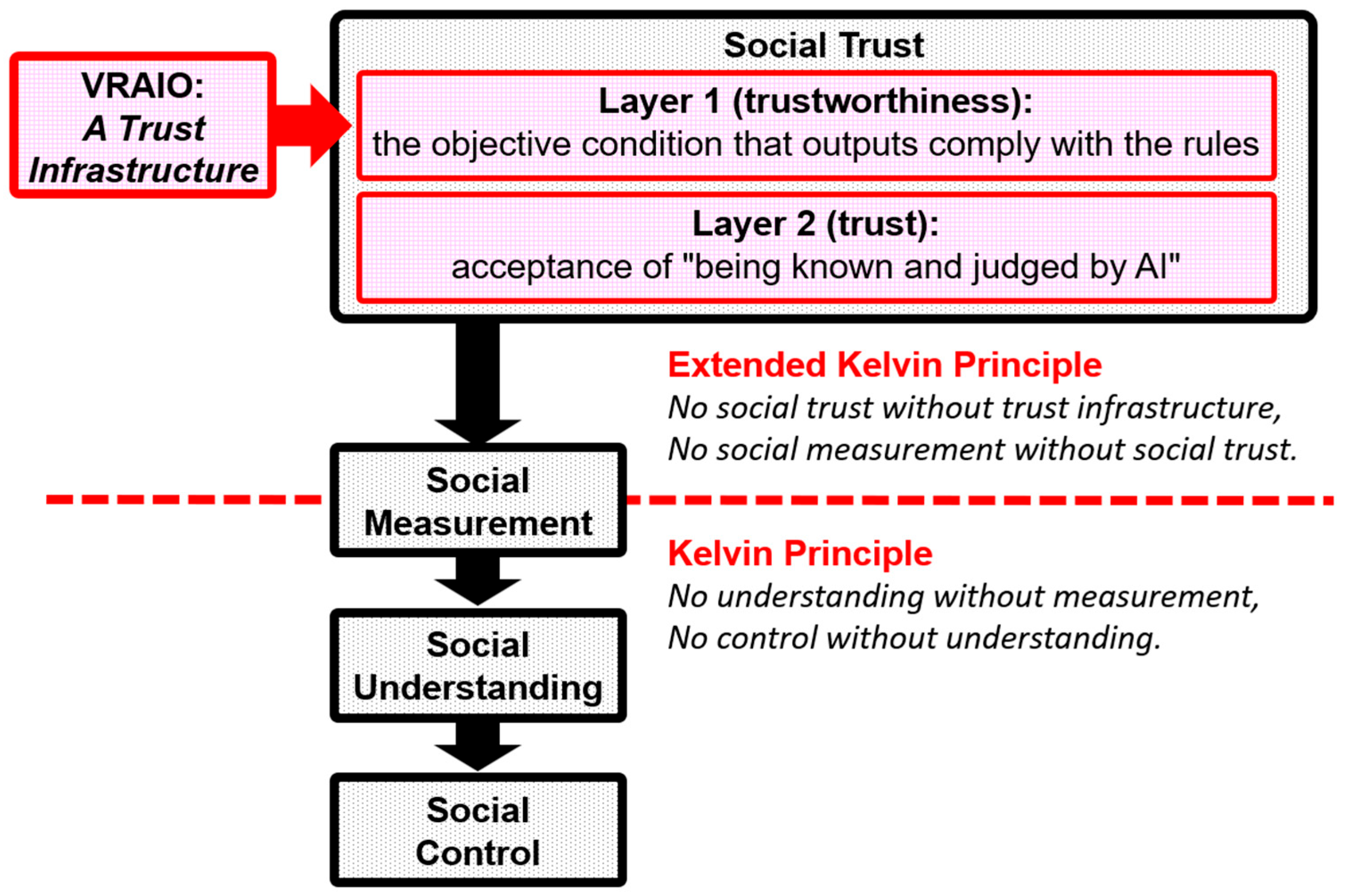
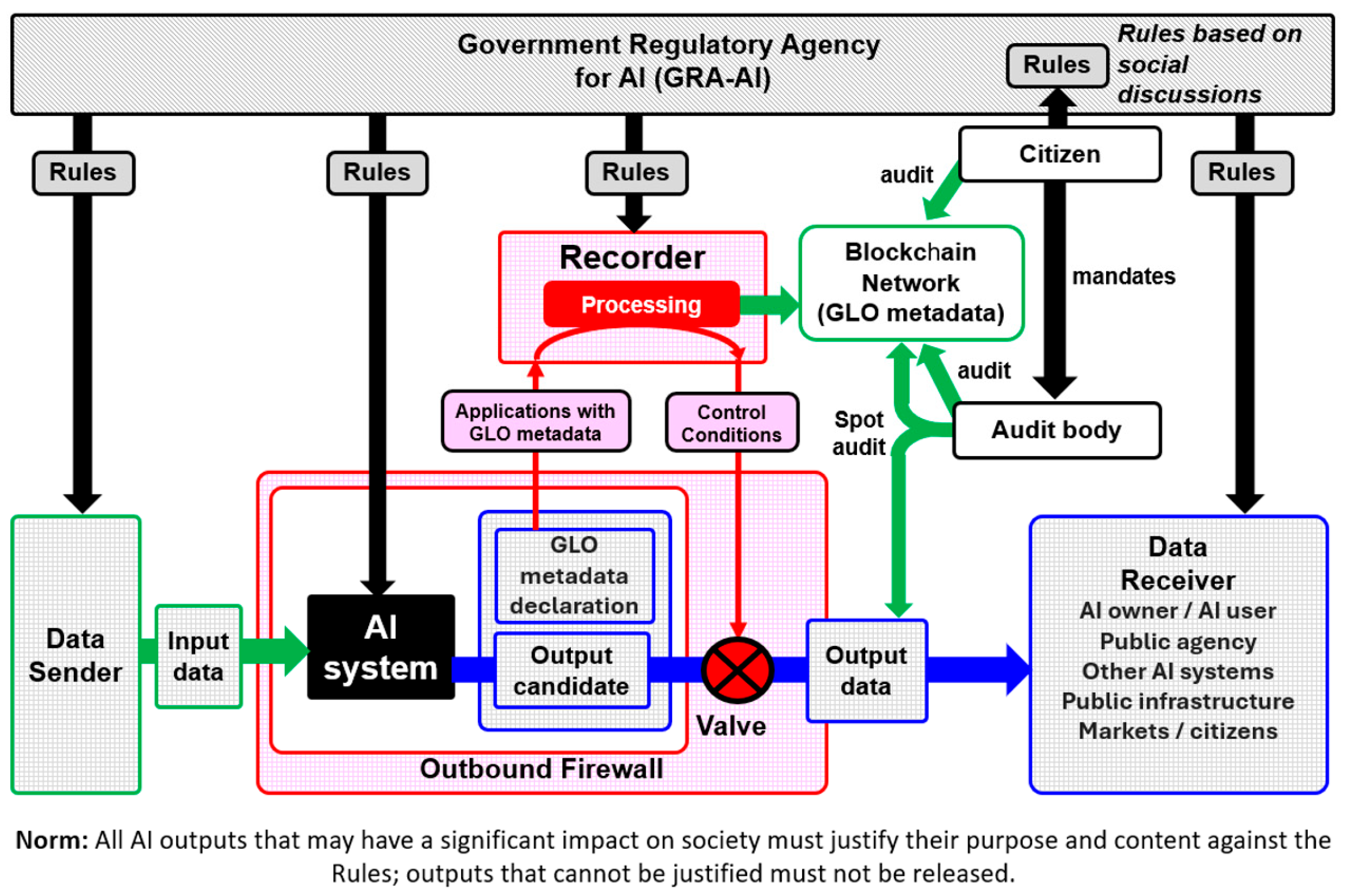
Objectives: This paper presents a principle and framework for generating social trust in AI outputs as an institutional structure rather than an ethical declaration. Sound technical design alone does not guarantee the institutional trust required to establish social measurement. What is needed is not a declaration of trust but the construction of an infrastructure that supports it. Methods: First, the Extended Kelvin Principle is derived by prepending to Kelvin’s measurement–understanding–control chain the links “no social trust without trust infrastructure; no legitimate social measurement without social trust.” Infrastructure-scale trust requires not declarations but verifiability, recordability, and auditability. Just as GUM and calibration infrastructure underpin trust in measured values, AI output governance requires GLO, a common language for expressing output legitimacy, implemented by a VRAIO-type infrastructure. GLO treats an output candidate as a “claim” and declares the rule-conformity of its purpose and content as a legitimacy confidence L, derived from a fact-based argument accompanied by a legitimacy budget. Results: VRAIO integrates declaration, rule verification, tamper-resistant recording, and independent auditing. A sealed, deterministic verifier makes L reproducible: computational falsity is caught by re-computation, factual falsity by checking authoritative records, and severe sanctions render false declaration irrational. Conclusions: GLO is not a mere AI version of GUM but a common language for an underdeveloped domain, whose effectiveness depends on connection to an enforceable output-governance infrastructure.
Keywords: AI output governance; VRAIO (Verifiable Record of AI Output); trustworthy AI; extended Kelvin principle; trust infrastructure; GLO (Guide to the Expression of Legitimacy of Output); social measurement; algorithmic accountability AI output governance; VRAIO (Verifiable Record of AI Output); trustworthy AI; extended Kelvin principle; trust infrastructure; GLO (Guide to the Expression of Legitimacy of Output); social measurement; algorithmic accountability