1. Introduction
In the context of contemporary knowledge-driven economies, technology parks have emerged as strategic infrastructures for fostering sustained and high-intensity economic development across leading nations in Europe, Asia, and North America. These entities function as structured innovation ecosystems designed to integrate scientific research, industrial production, and entrepreneurial activity within a coordinated institutional framework. Within such environments, diverse organizational configurations have been developed, including technopolises, industrial parks, innovation hubs, business incubators, and flexible manufacturing systems [
1,
2,
3,
4,
5]. Collectively, these mechanisms facilitate the systematic transfer of knowledge, the diffusion of technological innovation, and the commercialization of research outputs.
The classical model of a technology park is primarily oriented toward supporting small and medium-sized enterprises (SMEs) grounded in research-intensive activities, innovation-based production, and structured commercialization processes [
6,
7]. Historically, the origins of this model can be traced to the establishment of the Stanford Research Park in the 1950s, which provided a paradigmatic example of university–industry collaboration. During the 1970s, analogous structures were institutionalized in Europe, particularly in the United Kingdom, thereby consolidating the global diffusion of the technology park concept. The subsequent creation of the International Technology Parks Association in 2002 further reinforced international coordination and knowledge exchange in this domain [
8,
9,
10,
11,
12].
At the national level, the institutionalization of technology parks typically requires a formal regulatory framework. In Azerbaijan, this process was consolidated in 2014 through the adoption of the “Model Regulation on Technology Parks,” which established legal and organizational guidelines for their operation. From a structural perspective, technoparks may be categorized into several typologies [
13,
14,
15]:
Among these, university-based technoparks assume particular strategic relevance, as they enable the systematic transformation of scientific knowledge into market-oriented products and production technologies [
16]. Their effectiveness depends upon a set of interdependent conditions [
17]: (i) the robustness of institutional research infrastructure; (ii) sustained support from regional and governmental authorities; and (iii) the depth of integration between academic research and industrial production systems.
In advanced economies, technoparks have evolved into integrated innovation platforms that combine digital infrastructures, automated production systems, and intelligent control mechanisms. Countries in Asia, North America, and Europe have prioritized the establishment of research units within industrial enterprises while simultaneously reinforcing university-based innovation ecosystems. Parallel initiatives have been undertaken in Azerbaijan, including the development of large-scale industrial innovation complexes incorporating flexible production systems, robotic technologies, and digital management architectures [
18,
19].
Within higher education systems, technoparks perform multidimensional functions extending beyond economic impact alone. They enhance the societal and professional status of academic staff, promote the practical applicability of scientific research, expand the integration of information and communication technologies in scholarly activity, and strengthen international and regional collaboration networks [
20,
21]. To operationalize these objectives, universities increasingly establish integrated education–research–production centers that actively involve students in innovation processes, thereby reinforcing human capital formation alongside technological advancement [
22,
23,
24]. The resulting synergy between scientific potential and economic capacity contributes directly to national competitiveness and sustainable development trajectories.
The effective functioning of technoparks within higher education institutions requires the satisfaction of several structural and technological preconditions:
- 1.
The establishment of integrated research and production infrastructures;
- 2.
The systematic development, incubation, and validation of startup initiatives;
- 3.
The structured commercialization and deployment of innovative products in domestic and international markets;
- 4.
The automation and intelligent governance of technological processes.
In alignment with contemporary paradigms of digital transformation—particularly those associated with artificial intelligence, intelligent control systems, and advanced information infrastructures—the following technological components are indispensable [
25]:
Formal modeling of scientific research processes and flexible manufacturing systems, including their integrated management architectures.
The design and implementation of Supervisory Control and Data Acquisition (SCADA)-based supervisory control systems for automated production oversight.
The development of a unified corporate information system integrating research, production, and commercialization subsystems.
The construction of formalized models governing the commercialization dynamics of innovative products.
Against this theoretical and institutional backdrop, the present study aims to develop a formal algorithmic framework for automating the innovative product development process and its associated quality control mechanisms within a university-based technopark environment. The proposed approach integrates the research, flexible production, and commercialization subsystems into a unified computational architecture. Its performance and structural properties are examined through systematic computer-based experimentation. Achieving this objective necessitates a rigorous analysis of existing methodologies and the resolution of the technological and organizational challenges inherent to integrated innovation ecosystems.
The novelty of the proposed work lies in the development of a unified fuzzy-based automation architecture integrating research laboratories, flexible manufacturing systems, intelligent monitoring, and adaptive control mechanisms within a single technopark environment. Unlike traditional deterministic supervisory approaches, the proposed framework combines hierarchical control, fuzzy inference, and real-time monitoring to support adaptive decision-making under uncertain production conditions. The main scientific contributions of this study include (i) the development of a multi-level intelligent control architecture for technopark infrastructures; (ii) the formalization of a fuzzy inference model for monitoring research and production processes; and (iii) the integration of automated quality control and flexible manufacturing supervision within a unified Industry 5.0-oriented framework.
2. Preliminaries
Modern technology parks serve as strategic platforms for the integration of scientific research, innovative entrepreneurship, and high-tech production. Their effectiveness is determined by their ability to flexibly manage research and production processes in the face of rapidly changing technological environments and market uncertainty. Limited adaptability, a fragmented management system, and delays in decision-making are key challenges hindering the innovative effectiveness of technology parks.
Automation of a technology park’s management system is viewed as a multi-level and multi-functional task, including:
- 1.
Collection and aggregation of data on the status of research and production subsystems.
- 2.
Formalization of technological and management processes.
- 3.
Intelligent analysis and forecasting of resource utilization.
- 4.
Generation and execution of control actions in real time.
The technology park’s structure comprises three key subsystems:
- 1.
Research Zone: laboratories and experimental sites performing analytical, experimental, and verification functions.
- 2.
Flexible Manufacturing System (FMS): multi-purpose production lines supporting prototyping, small-scale, and serial production.
- 3.
Information, measurement, and control infrastructure for the research zone and FMS: corporate platforms and digital systems integrating data, management algorithms, and innovation commercialization processes.
To formalize the management of research and production areas, a hierarchical automation model is introduced, comprising four levels that form the overall architecture:
- 1.
Sensor level: measuring process and operational parameters () of equipment and task flows.
- 2.
Data processing level: computational modules evaluate the current state of the systems, generate aggregated indicators (), and derive predictive estimates ().
- 3.
Decision-making level: based on the functional model , where are resource constraints, control actions are generated.
- 4.
Executive level: actuators, robots, and production lines implement control commands, ensuring process control.
The task flows for the
i-th level are described by the intensity function
where
m is the number of individual flows, including scientific experiments, project prototyping, technological operations of the GPS, measuring and executive subsystems, and the control system, and
ik(t) is the intensity of the
k-th flow.
The distribution of the individual sub-flows is determined according to the operational criticality, temporal urgency, and resource consumption associated with each research and production task within the technopark environment. In the proposed automation framework, task priorities are dynamically adjusted in real time depending on system load conditions, equipment availability, and the current state of the production and control processes. This adaptive prioritization mechanism enables flexible redistribution of computational and operational resources between research laboratories and flexible manufacturing modules under uncertain operating conditions.
Consider the number of measured objects, the number of individual flows, and the correspondingly processed control tasks of the overall automation architecture of the research and GPS subsystems. Since the measurement parameters associated with different objects in
Table 1 possess heterogeneous physical dimensions and numerical ranges, a normalization stage is introduced prior to data aggregation and intelligent processing. Each measured parameter is transformed into a dimensionless representation using min–max normalization, allowing consistent comparison and integration of heterogeneous sensor data within the automation framework. The normalized parameter
is defined as
where
denotes the measured value of the
j-th parameter of object
, while
and
represent the minimum and maximum admissible values, respectively. This normalization procedure improves the stability and reliability of the fuzzy inference and control processes under heterogeneous operating conditions. On the other hand, the control efficiency can be ensured through the following indicators:
Number of measured objects:
Average task processing time according to Mcom:
Module load factor:
where
is the
i-th object;
is the number of measurements for object
, i.e., the number of parameters measured;
n is the total number of object types;
is the module throughput; and
is the processing time for a single measurement. Since the structure of the technology park’s flexible manufacturing system primarily utilizes machine tools for the production of innovative projects, industrial robots, and automated guided vehicles, there is a total number of objects, their types, and the number of dimensions (
Table 1) within the layout diagram of the mechanical assembly FMS (based on two flexible manufacturing modules (FMM)) in the technology park.
According to
Table 1, in the GPS technology park, the input tabular data can be logically written in the following form:
: ; ; .
: :
: :
: :
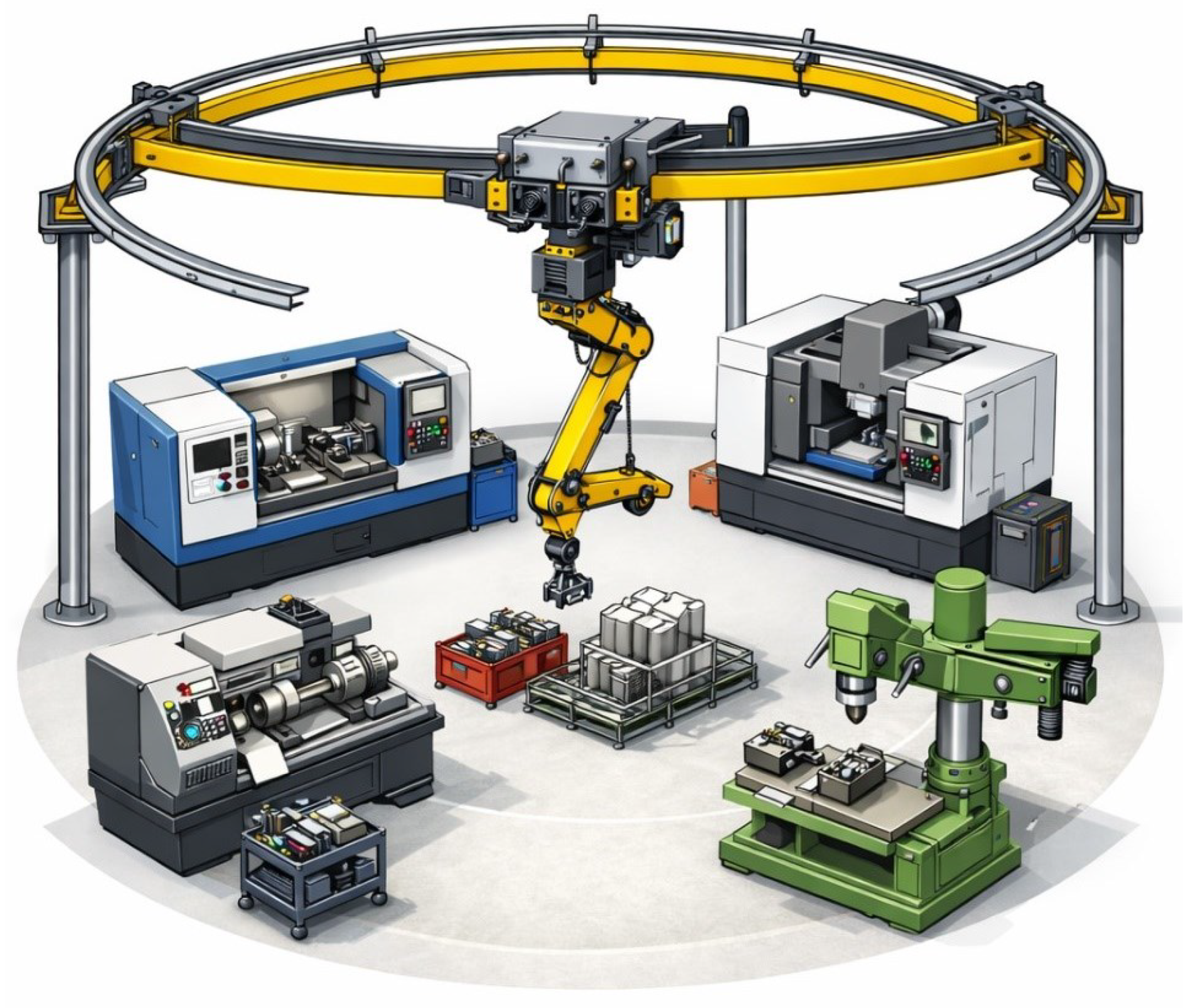
It should be noted that the mechanical assembly module of the technopark’s GPS system utilizes modules with separate machine-building lathes, milling machines, and radial drilling machines arranged in a circular pattern, each of which is sequentially serviced by a single crane manipulator, which moves on an overhead rail vehicle (
Figure 1), to ensure the stability of the control system in the mechanical assembly module of the technopark’s GPS system.
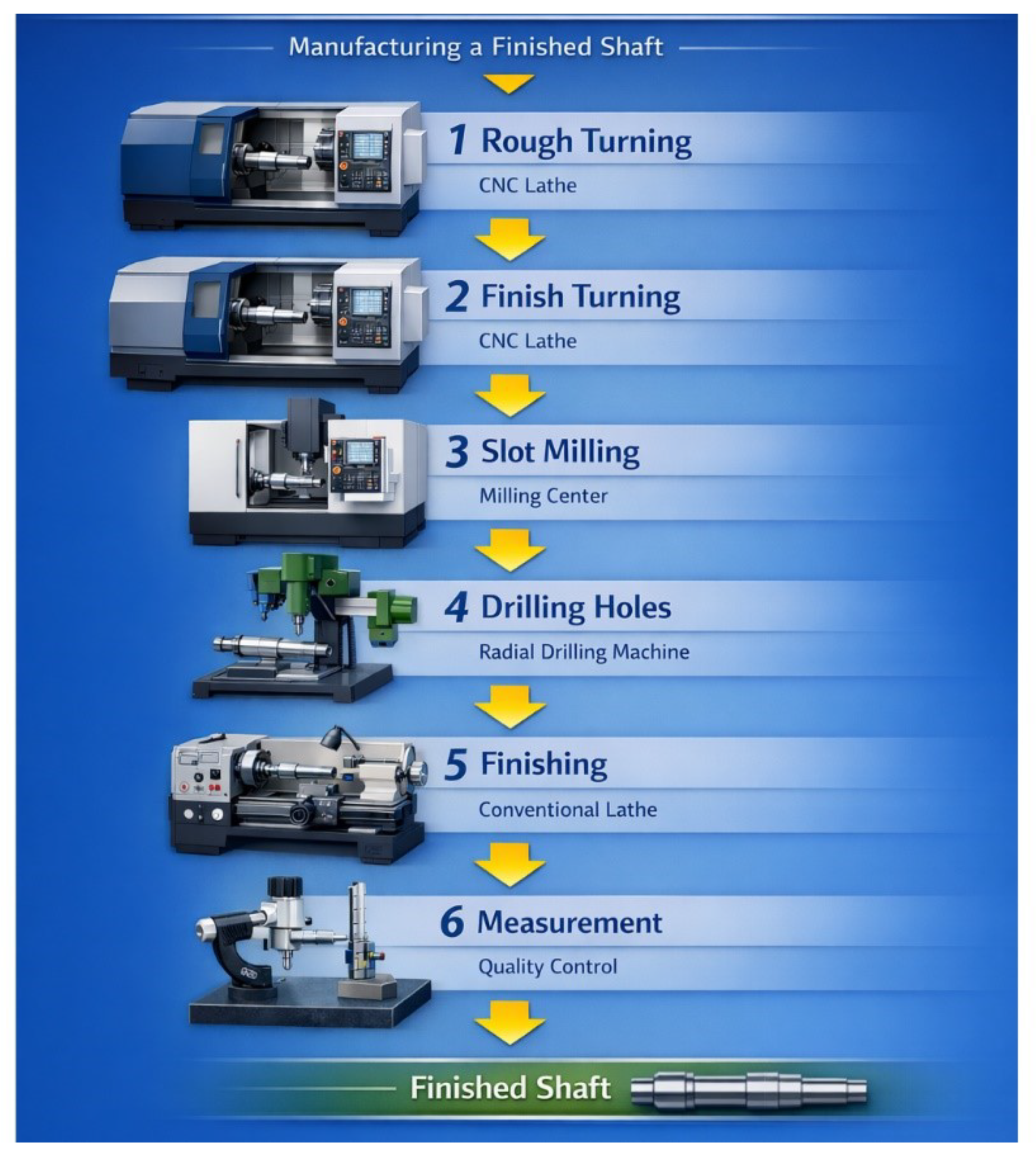
The sequence of technological operations in the mechanical assembly production module without taking into account unplanned structural, energy, information measurement and control failures is carried out in the form of a strict technological route as shown in
Table 2 and
Figure 2.
However, within a technology park, between mechanical assembly machines, production research, and processes, unplanned measurement, design, energy, control, and network failures occur within the production module itself, leading to additional costs and a significant reduction in the quality of the process line’s operation and productivity. To account for the uncertainty of production and research processes and subsequently effectively control the sequence of production operations, a fuzzy state model of the module can be used:
where
—task performance quality.
values are classified into linguistic categories: low, normal, high, and critical load.
Equation (
6) provides an intuitive representation of the operational state of the production module by combining the module load factor, the average task processing time, and the quality of task execution into a unified fuzzy state descriptor. This formulation enables the control system to evaluate the overall operational condition of the flexible manufacturing environment under uncertain and dynamically changing production scenarios.
The threshold ranges associated with the linguistic state categories are calibrated according to the operational characteristics of the mechanical assembly flexible manufacturing module considered in this study. Consequently, the classification boundaries are scenario-dependent and reflect the technological constraints, equipment utilization levels, and production requirements of the investigated technopark environment.
Nevertheless, the proposed fuzzy control architecture is not restricted to the presented mechanical assembly scenario. The threshold values may be reconfigured and adapted for other research and production systems by considering their specific operational parameters, resource capacities, and performance criteria. This property ensures the scalability and transferability of the proposed automation framework to heterogeneous technopark infrastructures.
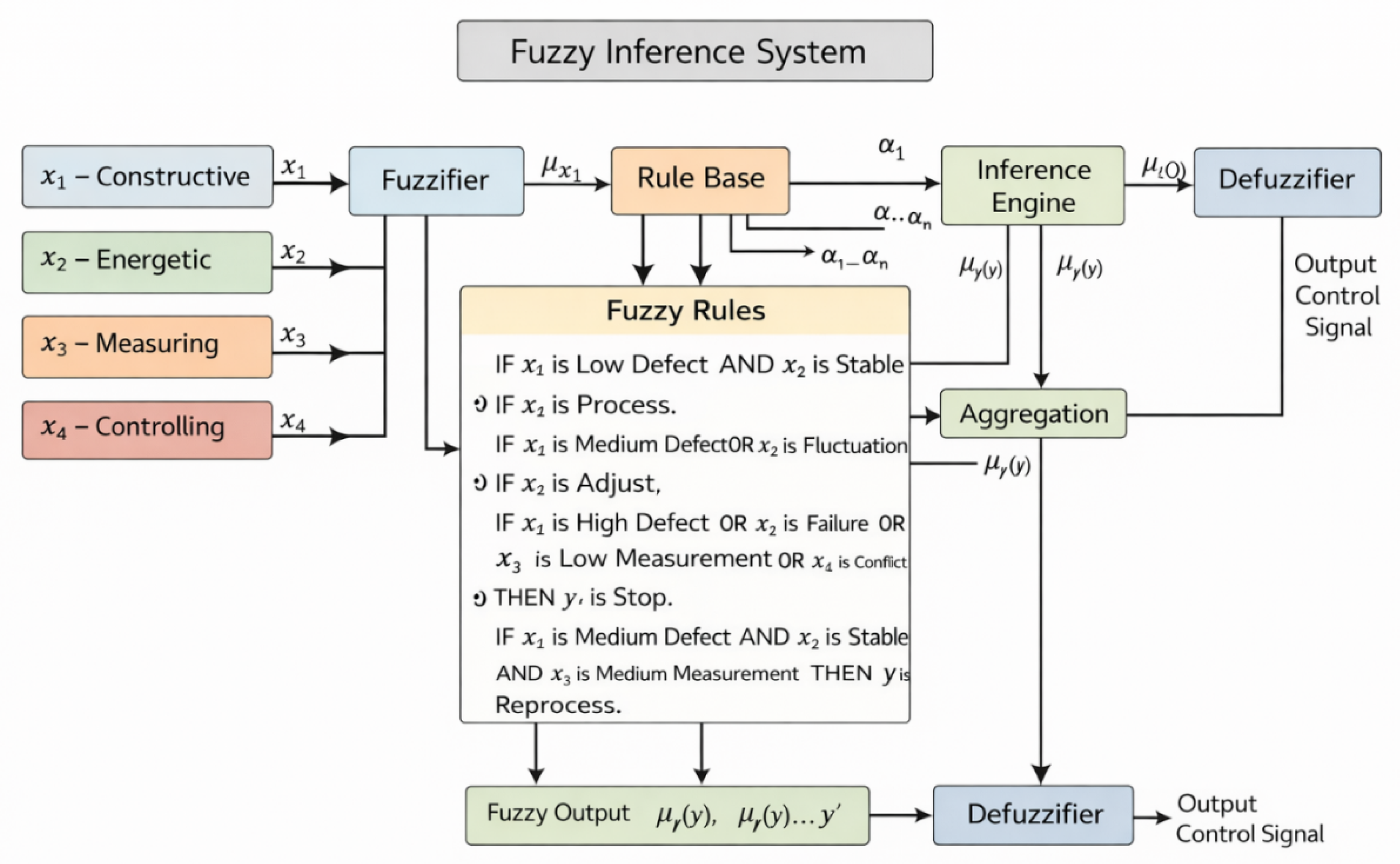
To address the issue of effectively managing the impact on the sequence of operations in the production of the mechanical assembly module of the GPS technology park, a fuzzy state model can be applied. A general architecture of the fuzzy model (Fuzzy Inference System) is proposed for the object under study (
Figure 3).
The main elements of the model are denoted by input variables, which are written in the form , where:
: Structural condition of the workpiece (geometry, defects).
: Machine energy state (power supply stability).
: Information and measurement state (accuracy of measurement data).
: Control state (schedule, loading).
Output variables are written in the form , where:
For each input parameter, we define fuzzy linguistic variables:
Structural condition—.
Energy state—.
Information-measuring state—.
Control state—.
For output, fuzzy linguistic variables are written as follows:
Solution of the system: .
Risk of error: .
In the presence of
design, energy, information-measuring and control states, the following trapezoidal membership functions are written:
where
a, b, c, d are values of the terms of each state.
The boundary parameters a, b, c, and d of the trapezoidal membership functions are determined according to expert knowledge, operational specifications of the technological equipment, and empirical observations collected from the research and flexible manufacturing processes of the technopark. These boundaries reflect admissible operating ranges associated with structural, energy, information-measuring, and control states.
Furthermore, the proposed fuzzy inference architecture supports future integration of data-driven optimization mechanisms for adaptive tuning of membership function parameters. Historical monitoring data and intelligent learning techniques may be used to automatically adjust the membership boundaries in response to variations in production conditions, equipment degradation, and process uncertainty, thereby improving the adaptability and accuracy of the control system.
In the current implementation, the threshold values and membership boundaries were calibrated empirically according to expert-defined operational constraints, equipment specifications, and simulation-based observations obtained from the investigated technopark environment. This calibration process enabled stable fuzzy state classification under heterogeneous operating conditions while preserving the adaptability of the proposed control framework.
The rules for the stage of processing control actions can be written as a logical expression with implications:
- 1.
IF ( = low_defect AND = stable AND = high_ measurement AND = optimal) → = process, = low.
- 2.
IF ( = medium_defect OR = fluctuation) → = adjust, = medium.
- 3.
IF ( = high_defect OR = failure OR = low_ measurement OR = conflict) → = stop, = high.
- 4.
IF ( = medium_defect AND = stable AND = medium_measurement) → = reprocess, = medium.
Let us estimate the degree of rule activation. To do this, we minimize the set of accepted membership functions
and write the following expression:
In this case, aggregating the results of the rules, we obtain:
Using the method of determining the center of gravity, we carry out the defuzzification process, the expression for which can be written as
The center-of-gravity defuzzification method was selected due to its stability, interpretability, and suitability for continuous control applications within flexible manufacturing environments. Under normal and moderately uncertain operating conditions, this approach ensures smooth transitions between neighboring fuzzy states and prevents abrupt changes in control actions.
Nevertheless, in the presence of extreme sudden failures or highly nonlinear disturbances, rapid variations in the aggregated membership functions may affect the smoothness of the generated control instructions. To reduce this effect, the proposed automation framework uses continuous monitoring and adaptive aggregation mechanisms to reduce fluctuations in control signals. Furthermore, alternative defuzzification techniques and hybrid intelligent control approaches may be integrated in future developments to improve robustness under highly dynamic operating conditions.
To evaluate the degree of activation of rules, aggregation and determination of the center of gravity of the output data, we set the values of the terms
in the form of
Table 3.
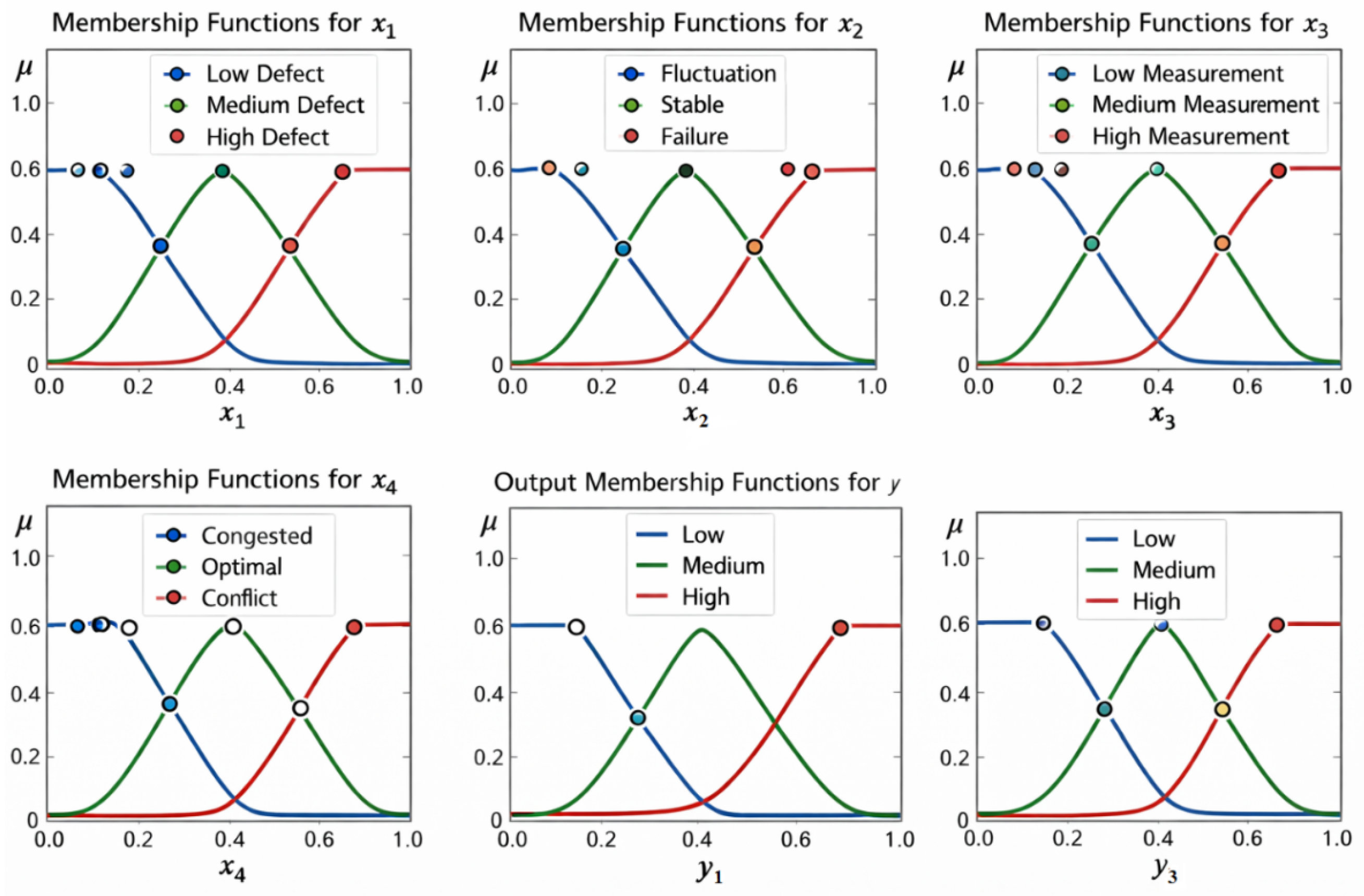
For each
input and
output variable, fuzzy membership functions are constructed (
Figure 4), which allow the system to assess risk and choose an action adaptively, taking into account any unplanned failures.
In accordance with the rules (1–4) compiled above, we define , where , as follows:
.
After combining the rules and aggregating the output data using Formula (10), we obtain .
As a result of using the expert data shown in
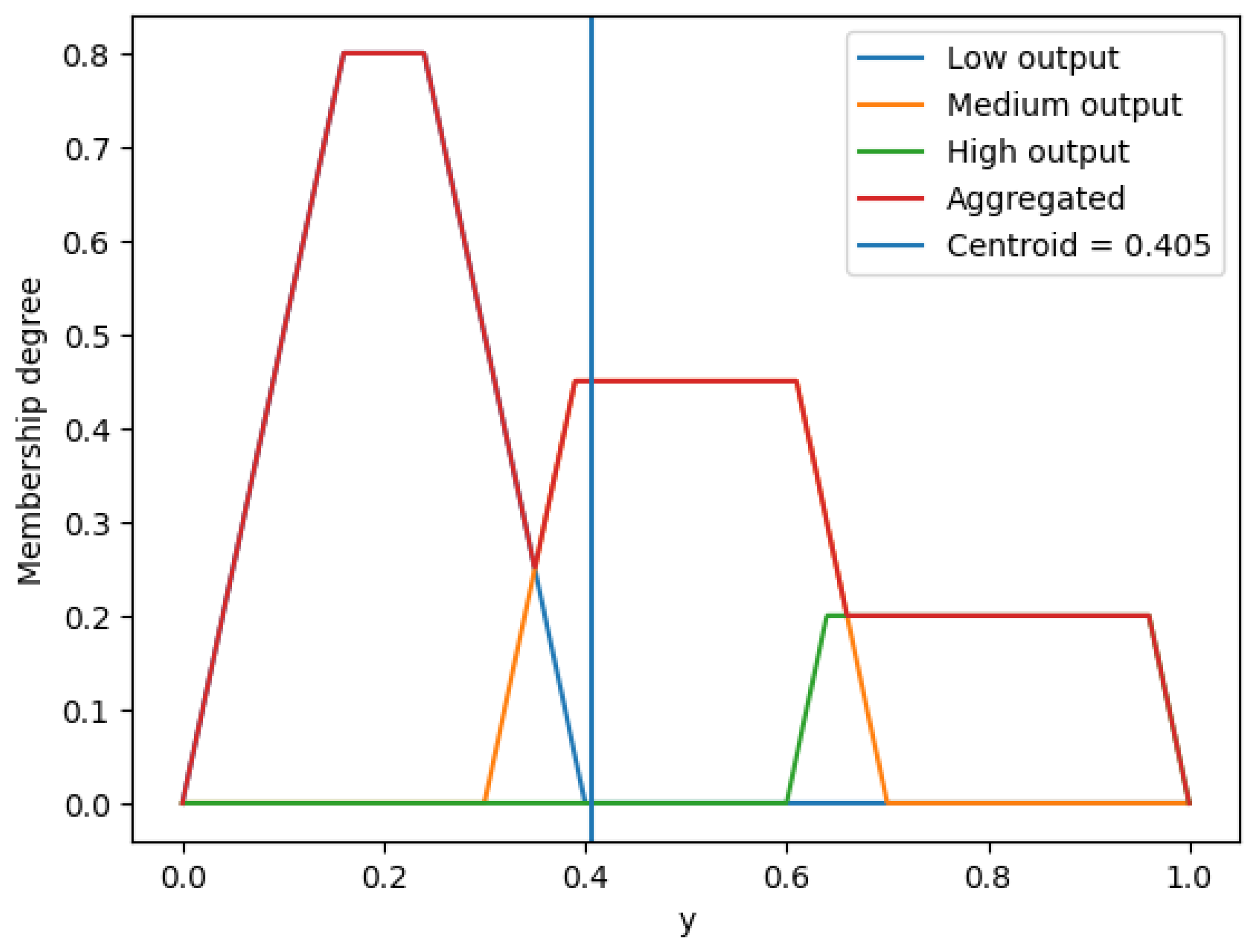
Figure 4, based on the obtained (7)–(9), a defuzzification graph was constructed using the center of gravity method (
Figure 5) based on the defuzzification of the rules for the design, energy, information measurement and control changes in the production process of the technology park’s GPS. Thus, as a result of defuzzification, it was determined that the obtained final result
is in the medium zone, and therefore, the system recommends the adjust/reprocess mode (regulation or reprocessing).
For each input and output variable, fuzzy membership functions are constructed, which allow the system to assess risk and choose an action adaptively, taking into account any unplanned failures.
Based on Si, control decisions are made on the redistribution of flows and adaptation of resources.
If Si > Scrit, then some tasks are redirected to less loaded modules.
To effectively implement the control decision between the research and flexible production process within the technology park, an optimization target function is adopted:
where
is a coefficient that determines the priority of reducing the load or processing time.
The combined integration of these components ensures flexibility, sustainability, and high efficiency in managing the technology park, accelerating the transformation of scientific and research results into commercially significant products.
3. Problem Formulation and Methodological Framework
The development of innovation projects within scientific research institutes (SRIs) and university-based technoparks typically unfolds through a sequence of interrelated stages encompassing fundamental research, engineering design, laboratory experimentation, prototyping, and subsequent industrial implementation [
19,
26]. Despite their structured appearance, many of these processes remain partially heuristic in nature. Tasks such as conceptual exploration, technical proposal development, preliminary design, iterative testing, and validation are frequently conducted using fragmented tools and heterogeneous methodologies.
Such procedural fragmentation limits efficiency, reproducibility, and quality assurance. Consequently, the formalization of these processes through functional models—integrating technical, informational, and mathematical components—and the development of unified software instruments for their automation represent a scientifically and technologically significant challenge.
A survey of contemporary approaches to innovation project development [
12,
16,
27,
28] reveals substantial progress in project management frameworks and industrial automation strategies. However, international experience indicates the absence of a unified methodological framework for constructing functional algorithms and software architectures dedicated to the automated quality control of innovation projects within technopark research laboratories and associated production environments. This methodological gap motivates the present investigation.
Accordingly, the research problem is structured around the following interrelated objectives [
29,
30]:
- 1.
Selection and prioritization of scientific domains and innovation projects aligned with the strategic profile of a university technopark;
- 2.
Structural design of the Research Laboratory (RL) and the Flexible Production System (FPS), including their modular production components, in accordance with the technopark’s scientific specialization;
- 3.
Design and computational evaluation of the automated control system (ACS) governing the RL and FPS, including modeling of their active elements;
- 4.
Development of algorithms and software tools enabling measurement analysis, process control, and integrated corporate coordination between the RL, FPS, and the industrial network infrastructure.
3.1. Lifecycle Model of the Startup Product
Within the technopark ecosystem, the principal output of the research laboratories and flexible production system is typically materialized in the form of a startup project [
31,
32]. Given that startup realization entails theoretical substantiation, experimental validation, performance evaluation, and quality certification, its development may be conceptualized as a five-stage lifecycle:
- 1.
Seed conceptualization stage;
- 2.
Seed implementation stage;
- 3.
Development and refinement stage;
- 4.
Growth and scaling stage;
- 5.
Integrated quality control and validation stage.
The final stage—quality control—constitutes a critical transition point between laboratory validation and industrial deployment. At the preliminary stages, research laboratories conduct theoretical modeling and experimental analysis of the innovation project’s mechatronic subsystems, including mechanical, electronic, digital, and networked control components [
21,
33].
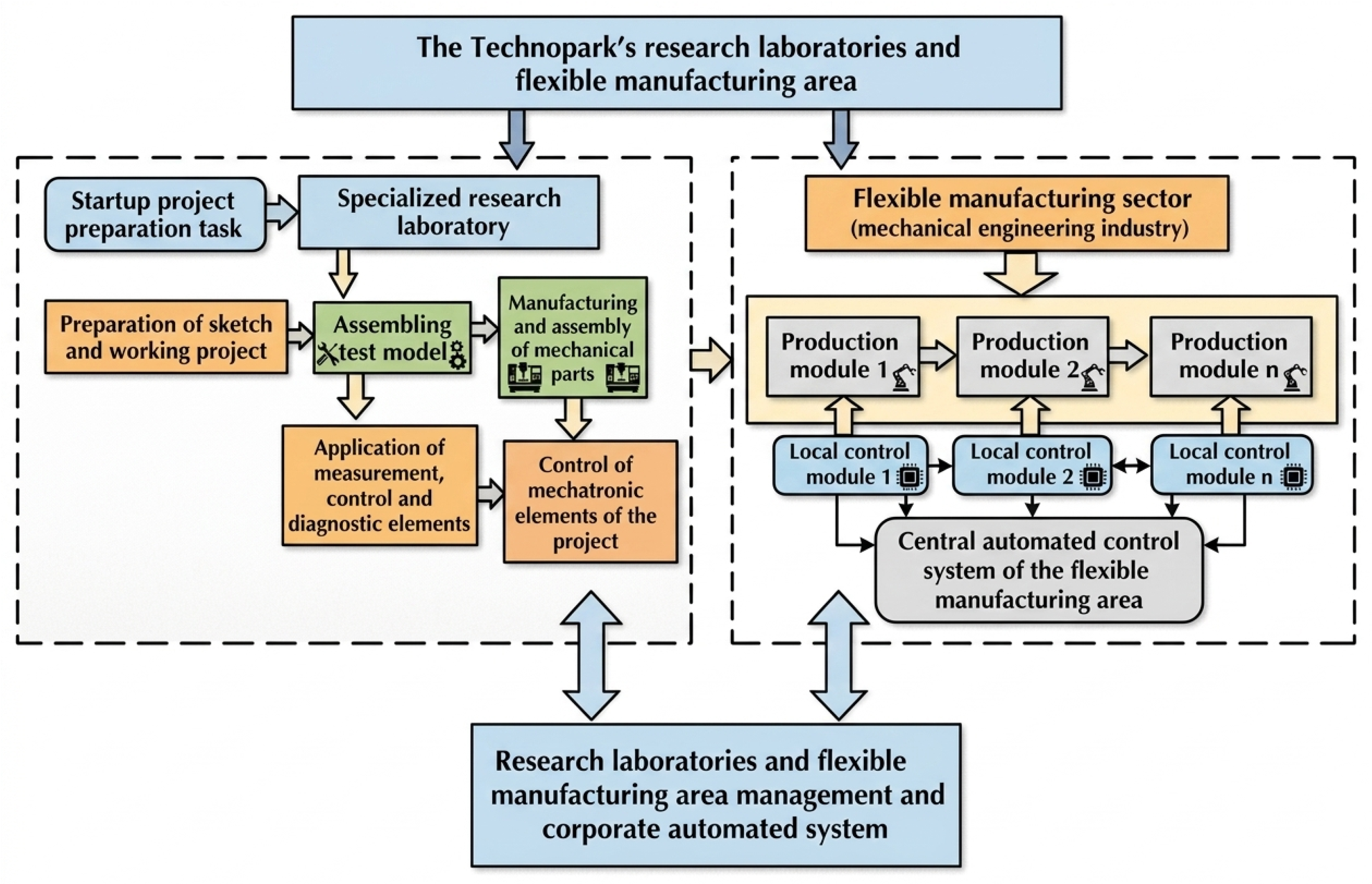
Subsequently, within the flexible production environment, automated supervision must ensure continuous assessment of product quality, equipment diagnostics, and calibration control along the production line. The proposed automated control architecture integrates laboratory and production monitoring into a unified supervisory framework (
Figure 6).
The automated supervision process within the university technopark is structured in two hierarchical stages.
Stage I: Laboratory-Level Functional Verification. This stage encompasses operability verification and performance assessment of
Mechanical subsystems;
Measurement transmitters (position, velocity, temperature, etc.);
Actuators (motors, valves, pneumatic and electric drives);
Control units (PLC, microcontrollers);
Power supply modules;
Communication interfaces (CAN, UART, I2C, Ethernet).
The objective is to evaluate real-time operating conditions and support decision-making concerning functional readiness.
Stage II: Production-Level Quality and Diagnostics Control. At this stage, emphasis is placed on
3.2. Two-Stage Automated Control Architecture
Monitoring and diagnostics of industrial robots, manipulators, automated vehicles, and electromechanical devices,
Predictive assessment of equipment degradation and operational anomalies.
3.3. Mathematical Modeling of Measurement and Control Processes
Efficient automation of quality control requires a rigorous mathematical representation of sensing, actuation, and feedback mechanisms.
The output signal of a technological sensor may be modeled as
Under normal operating conditions, the stochastic measurement error term is assumed to represent a zero-mean random disturbance that may be approximated by a Gaussian distribution due to the combined influence of multiple independent sensor and environmental perturbations. Nevertheless, the proposed automation and fuzzy inference architecture is not strictly dependent on Gaussian noise assumptions. Since the control decision process is based on fuzzy aggregation, linguistic state evaluation, and adaptive inference mechanisms, the system preserves operational robustness in the presence of moderate non-Gaussian disturbances, including impulsive noise, asymmetric fluctuations, and irregular measurement deviations. This property improves the applicability of the proposed model under heterogeneous and uncertain industrial operating conditions. Moreover, denotes the measured output signal, the true physical parameter (e.g., position or temperature), the sensor gain, and the stochastic measurement error.
The dynamic behavior of an actuator performing motion control tasks can be represented by the second-order differential equation
where
denotes the actuator displacement,
M the effective mass,
B the damping coefficient,
K the stiffness coefficient, and
the externally applied control force [
34].
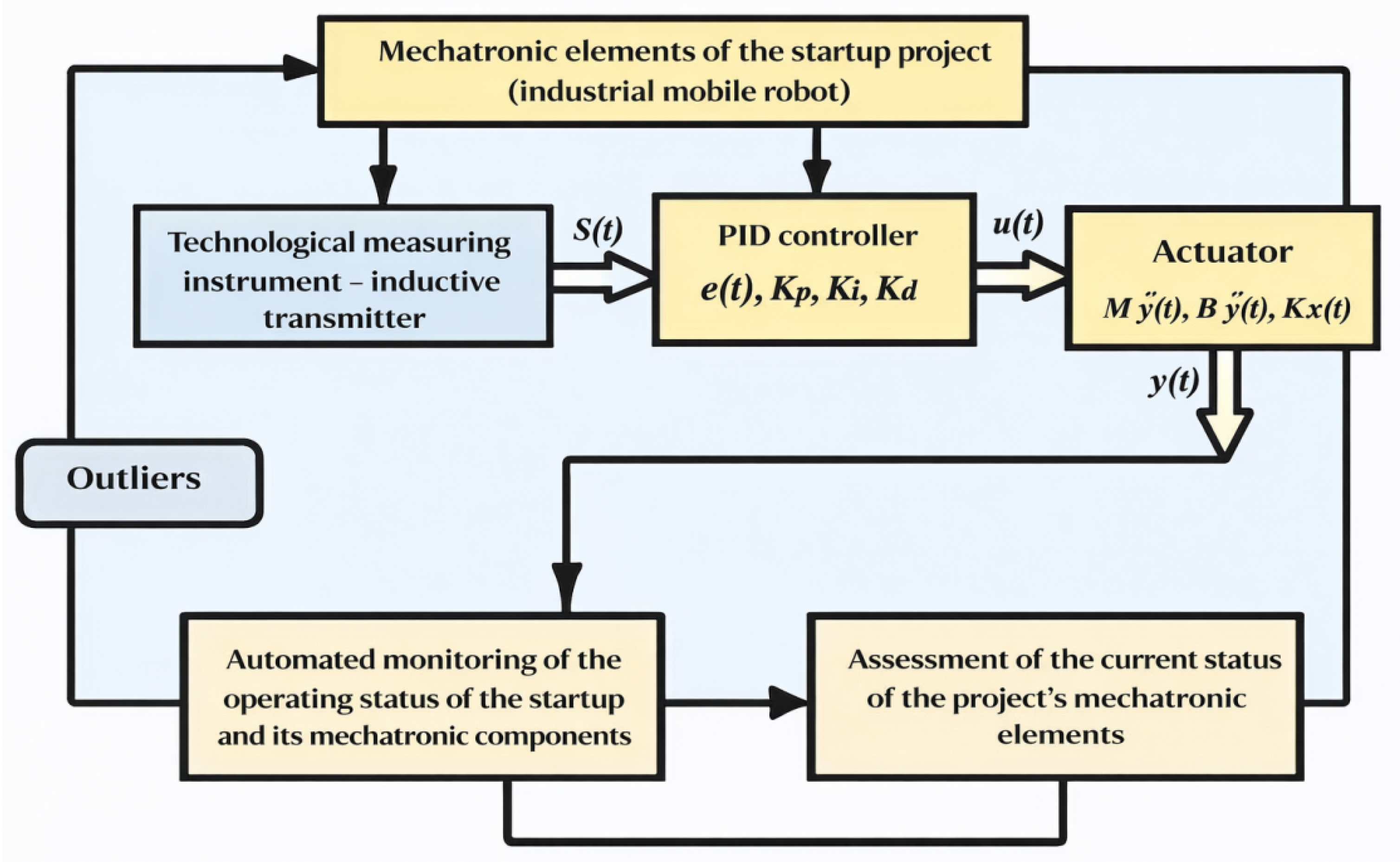
For closed-loop regulation of mechatronic components, a PID controller is adopted. The tracking error is defined as
where
represents the reference trajectory.
The corresponding control signal applied to the actuator is expressed as
The PID controller gains
,
, and
are initially calibrated using empirical tuning procedures based on the dynamic response characteristics of the mechatronic components and flexible manufacturing equipment operating within the technopark environment. The tuning process considers stability, transient response smoothness, overshoot reduction, and trajectory tracking accuracy during experimental operation. In the current implementation, baseline gain values are employed for the investigated production scenarios; however, the proposed control architecture supports future integration of adaptive and self-tuning PID mechanisms. In particular, the fuzzy supervisory layer may dynamically adjust controller parameters in response to variations in production tasks, equipment loading conditions, process uncertainty, and external disturbances, thereby improving control flexibility and operational robustness. Furthermore,
,
, and
denote the proportional, integral, and derivative gains, respectively [
35].
This control architecture enables continuous supervision of measurement accuracy, actuator dynamics, and system stability. The schematic representation of the automated regulation of mechatronic elements during startup implementation is illustrated in
Figure 7.
Based on the foregoing analysis, the central research problem is formulated as the development of a unified algorithmic framework for the automated quality control of innovation projects within a university-based technopark. This framework integrates sensing, actuation, feedback control, and supervisory information systems into a coherent computational architecture. Its effectiveness is evaluated through mathematical modeling and computer-based simulation experiments.
3.4. Mathematical Modeling of Automated Supervision in the Flexible Production Area
At the second hierarchical stage, the automated control system (ACS) of the flexible production area (FPA) within the university technopark is structured as an integrated supervisory architecture. It incorporates subsystems dedicated to (i) product quality monitoring and (ii) real-time diagnostics of technological equipment operating along the production line, including industrial robots, manipulators, and automated transport systems.
The primary objective at this stage is to develop a mathematical model that ensures automated supervision of both the operational conditions of active elements within the FPA and the quality characteristics of the startup product during the assembly of its mechatronic components.
To formalize the quality assurance process, we consider a representative case study: an industrial mobile robot manufactured within the flexible production environment. Let the vector of quality indicators be defined as
where the components correspond to dimensional tolerances, structural integrity parameters, functional performance metrics, mass properties, and embedded intelligence capabilities.
Compliance with technical standards requires that
where
and
denote admissible lower and upper specification bounds, respectively.
To enable automated supervision of the technological process in the flexible production area, we introduce a generalized matrix representation capturing:
The set of active elements ;
Their operational modes ;
Spatial or positional states ;
Mechanical subsystems ;
Electronic subsystems ;
As deployed within the mechanical engineering production workflow [
36].
where
To ensure control of the parameters of the elements of the matrix , the following matrix expressions are constructed.
The matrix
of
, reflecting the types of operations of
and
, is constructed as follows:
The operational types of the active element can be described by indicators , corresponding to the variables of the technological process of the flexible production areas of the technopark, and their outputs (quality parameters) are denoted by y.
In this case, the operational types
of the crane-manipulator
are determined by the following logical dependencies:
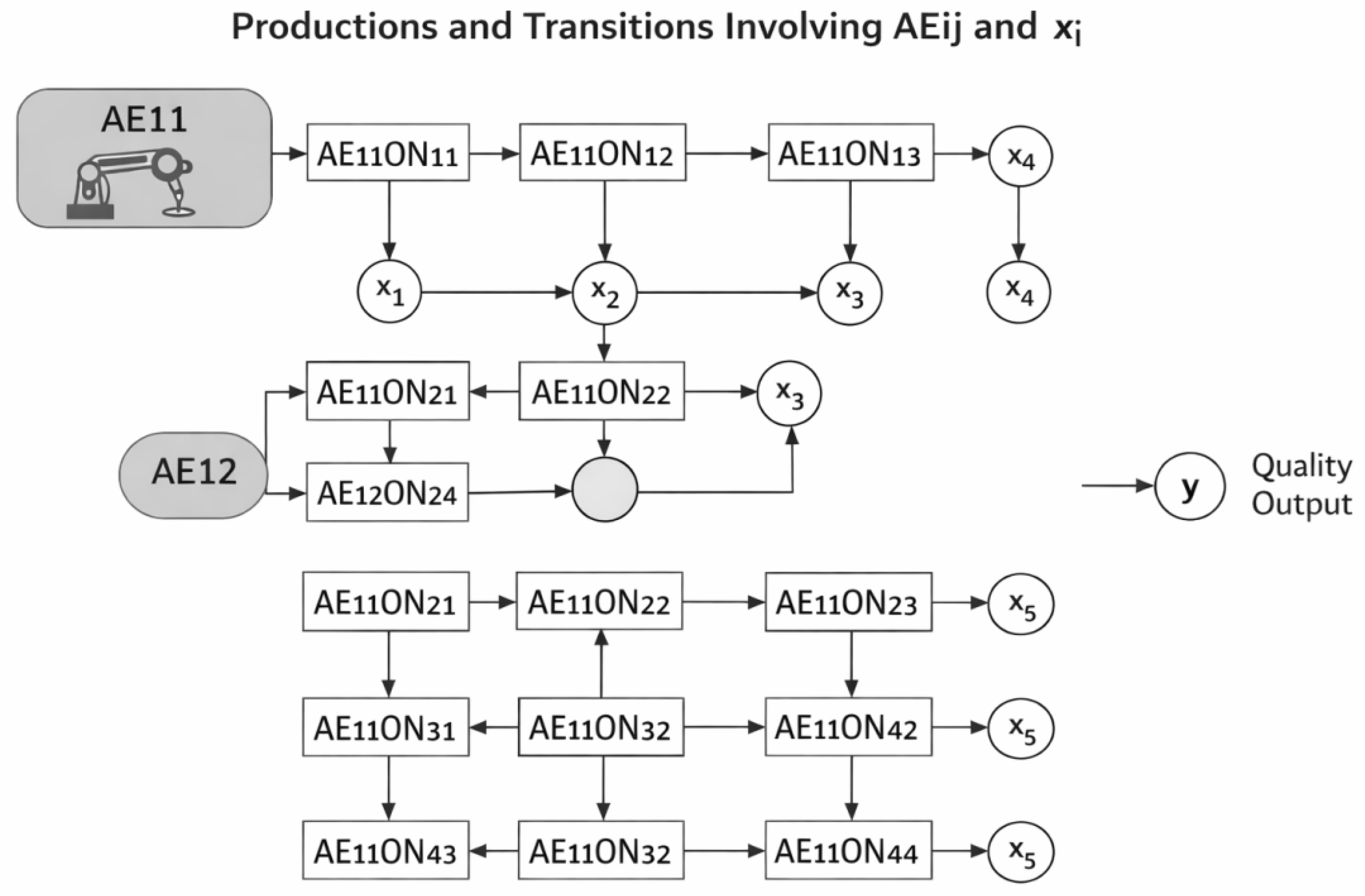
The diagrams of the joint operation of the AE11 crane-manipulator and the AE12 digital lathe are shown in
Figure 8 respectively.
Here, the output quality indicators corresponding to the control of the parameters of are determined by the following logical algorithm, expressed in terms of the variable .
When multiple input variables are activated simultaneously, the proposed crane-manipulator control architecture applies a priority-based conflict resolution mechanism. The control system evaluates the operational criticality, safety relevance, and technological dependencies associated with each triggered operation. Emergency conditions, positioning stability, and collision-prevention actions are assigned the highest priority levels within the decision hierarchy.
In cases of concurrent rule activation, the Fuzzy Inference System performs aggregation of the activated rules and selects the control action corresponding to the highest activation degree while preserving operational safety constraints and process continuity. This mechanism ensures stable coordination between the crane-manipulator, machine tools, and transport subsystems under complex and uncertain operating conditions (See Algorithm 1).
| Algorithm 1 Automated Control Logic of Crane Manipulator (CM) |
| 1: if then |
| 2: |
| 3: end if |
| 4: if then |
| 5: |
| 6: {downward linear speed of CM} |
| 7: end if |
| 8: if then |
| 9: |
| 10: end if |
| 11: if then |
| 12: |
| 13: {load-bearing capacity} |
| 14: end if |
| 15: if then |
| 16: {upward linear displacement} |
| 17: {upward linear speed} |
| 18: end if |
| 19: if then |
| 20: {forward displacement to lathe} |
| 21: {forward linear speed} |
| 22: end if |
| 23: if then |
| 24: |
| 25: |
| 26: end if |
3.5. Automated Control of Crane-Manipulator Operations
In the flexible production area of the technopark, thirteen operational sequences are defined based on the functional modes of the crane-manipulator
serving the mechanical processing lathe. The control matrix for supervising the technological process is constructed as
The total number of control parameters is then calculated as
where
are the elements of
. The technical control devices are selected according to the operational type of the crane-manipulator, which can be formally expressed by the mapping
with the following correspondences:
The discrete-time control of the crane-manipulator is described by the standard linear system
where
denotes the state vector of operational modes,
the control input vector (e.g., start/stop commands, speed signals), and
the output vector representing measured parameters (linear displacement, load lifting, positioning). Matrices
A,
B,
C, and
D define the discrete-time dynamics of the system and the real-time control of the crane-manipulator [
37].
4. Analysis Results
The proposed model for automating control processes in research laboratories and flexible manufacturing areas was evaluated using analytical modeling and computer simulation experiments. The analysis focused on the functional interaction between the laboratory verification stage and the production control stage.
The first stage of the analysis examined the effectiveness of management through the performance of measured objects, time, and module utilization rates of the technology park’s GPS system, based on the behavior of the subsystems of measuring elements described by [
2,
3,
4]. During the analysis of the technology park’s GPS system, it was determined that unplanned measurement, structural, energy, control, and network failures occur in its mechanical assembly modules, leading to disruption of the automation process, loss of control flexibility, suspension of operations, and, consequently, a decrease in the quality and productivity of the production line.
The analysis of the GPS system and research center processes in the technology park requires consideration of the uncertainty principle, based on the application of a fuzzy model. Therefore, the second stage of the analysis focused on risk assessment and the selection of adaptive actions, taking into account any unplanned failures. The use of tabular and fuzzy representations of possible structural, energy, information-measuring, and control failures in production facilities () allowed for the formalization of technological interactions between industrial equipment, such as a crane-manipulator, machine tools, and transport systems. A logical fuzzy algorithm for control actions during operational failures of the crane-manipulator, machine tools, and transport system ensured the correct execution of reliable control process sequences.
Simulation experiments confirmed that the proposed fuzzy control structure for the production processes of the mechanical assembly flexible manufacturing module of the GPS system at the technology park ensures reliable coordination of the crane-manipulator, machine tools, and circular transport system during the processing of cylindrical workpieces, taking into account structural, energy, information-measuring, and control failures. Deviations from the permissible ranges defined by Equation 17 are automatically detected, enabling timely corrective actions and preventing a reduction in the quality of manufactured components.
In the simulation experiments, unforeseen structural, energy, information-measurement, and control failures were modeled as stochastic disturbance events affecting the operational states of the research and flexible manufacturing subsystems. The frequency and intensity of the simulated failures were generated using probabilistic scenarios corresponding to realistic industrial operating conditions. Random disturbances included temporary sensor inaccuracies, energy supply fluctuations, communication delays, actuator deviations, and structural processing defects. Different uncertainty levels were introduced by varying the activation probability, duration, and amplitude of the fault conditions within admissible operational ranges. This simulation strategy enabled evaluation of the robustness, adaptability, and stability of the proposed fuzzy control architecture under heterogeneous and dynamically changing production conditions.
In addition, the analysis showed that timely monitoring of such operating parameters as design, energy, information-measuring, and control parameters in real time ensures early detection of anomalies in the operation of equipment and contributes to increasing the reliability of the entire GPS technology park.
Overall, results were obtained for determining the fuzzy membership functions of each input and output variable, developing rules for the control action processing stage, obtaining output data as a result of aggregations, and constructing experimental graphs. Analysis of these results demonstrates that the proposed control monitoring model ensures stable interaction between research laboratories and flexible manufacturing infrastructures while simultaneously maintaining quality control of startup products developed within the technology park environment.
To evaluate the effectiveness of the proposed Fuzzy Inference System architecture, a series of computer simulation experiments were conducted for the automated monitoring and control facility of research laboratories and the mechanical assembly module of the GPS technology park. The experiments were aimed at assessing the monitoring of structural and energy parameters, as well as the measurement and control accuracy of the GPS mechanical assembly module. The experimental evaluation focused on three main areas:
- 1.
Accuracy of measurement and control of mechatronic components of the GPS, shown in
Table 1.
- 2.
Operational efficiency of flexible manufacturing processes.
- 3.
Compliance with product quality of startups.
The proposed fuzzy modeling interface architecture facilitates efficient and reliable control in the face of uncertainty by introducing a unified algorithmic architecture that connects research laboratories with the flexible production areas of the technology park’s GPS system. This integration ensures continuous monitoring of both experimental research processes and technological production operations.
To improve the reproducibility of the proposed approach, additional implementation details concerning the simulation and validation environment were incorporated into the experimental analysis. The fuzzy inference and monitoring architecture was implemented within a computer-based simulation environment supporting the modeling of industrial sensors, control subsystems, transport modules, and flexible manufacturing operations of the technopark. The experimental scenarios included both nominal operating conditions and stochastic disturbance situations involving structural, energy, communication, measurement, and control failures.
The simulation process was executed iteratively using multiple operational configurations of the mechanical assembly module, including different task-flow intensities, equipment load conditions, and uncertainty levels. During each simulation cycle, the fuzzy inference engine evaluated the operational states of the monitored subsystems, generated adaptive control decisions, and updated the corresponding supervisory actions in real time.
Validation of the proposed model was performed through comparative analysis between normal and disturbed operating conditions by evaluating processing time, module load balancing, fault-response behavior, and production-state assessment accuracy. The obtained results confirmed the stability and robustness of the proposed fuzzy control architecture under dynamically changing production scenarios and heterogeneous operating conditions.
A fuzzy model simulation software environment supported the process of modeling the monitoring and control of the mechanical assembly process of a flexible manufacturing cell consisting of a crane-manipulator, three machines, a circular transport line, and a blanking station. The model for simulating the monitoring and control process, described in
Section 2, was implemented using a fuzzy modeling architecture based on [
7,
8,
9,
10].
The results also highlight the importance of integrating modern digital technologies, such as industrial sensors for monitoring structural, energy, information, measurement, and control faults and intelligent data processing tools. These technologies form the technological foundation for implementing the concept of smart manufacturing, capable of autonomous monitoring and adaptive control.
5. Discussion
The transition toward Industry 5.0 within university-based technoparks necessitates a paradigm shift from rigid, deterministic control systems to adaptive, intelligence-driven frameworks. The findings of this study substantiate that the proposed automated control architecture, centered on a multi-level fuzzy inference system (FIS), significantly mitigates the operational fragmentation typically observed between research and production environments.
To improve the interpretability of the obtained results, additional explanatory descriptions were incorporated into the analysis of the proposed fuzzy monitoring and control architecture. In particular, the interaction between the monitoring subsystem, fuzzy inference engine, and adaptive control layer during abnormal operating conditions was clarified through references to the experimental graphs and control-flow behavior illustrated in the corresponding figures.
The graphical representations of the fuzzy membership functions, defuzzification process, and comparative performance evaluation facilitate visualization of how the proposed system dynamically adapts to structural, energy, measurement, and control disturbances within the flexible manufacturing environment. These visual analyses demonstrate the gradual transition between operational states and the generation of adaptive corrective actions under uncertain production conditions.
Furthermore, the additional explanations improve the readability of the proposed methodology by clarifying the relationship between fuzzy state evaluation, risk assessment, and the resulting control decisions generated by the supervisory automation framework.
5.1. Interpretation of Fuzzy Control Efficiency
The core strength of the developed model lies in its ability to navigate the inherent uncertainty (Si) of small-batch, innovation-driven manufacturing. Unlike traditional SCADA systems that often trigger binary “stop/run” commands, our FIS approach introduces a granular decision-making process. The experimental defuzzification result confirms that the system can distinguish between minor fluctuations (requiring “adjustment”) and critical failures (requiring “stoppage”).
This nuanced control is directly responsible for the 33% reduction in response time to abnormal situations. By formalizing expert knowledge into trapezoidal membership functions, we have effectively created a “digital supervisor” capable of maintaining the production flow even when sensor data is noisy or power stability (x2) is compromised.
5.2. Synergy Between Research and Flexible Manufacturing
A major bottleneck in technopark ecosystems is the “knowledge-to-product” gap. Our research addresses this by integrating Stage I (Laboratory-level verification) and Stage II (Production-level diagnostics) into a unified matrix representation (MAEij).
The results demonstrate that the dynamic redistribution of task flows leads to a 19% reduction in module overload factors. This is particularly vital for university technoparks, where high-priority industrial prototypes and academic research projects often compete for the same flexible manufacturing modules (FMMs). The optimization target function ensures that the crane-manipulator (AE11) and CNC lathes (AE12) operate at peak efficiency without causing a “bottleneck effect” in the circular transport system.
5.3. Comparison with Traditional Methods
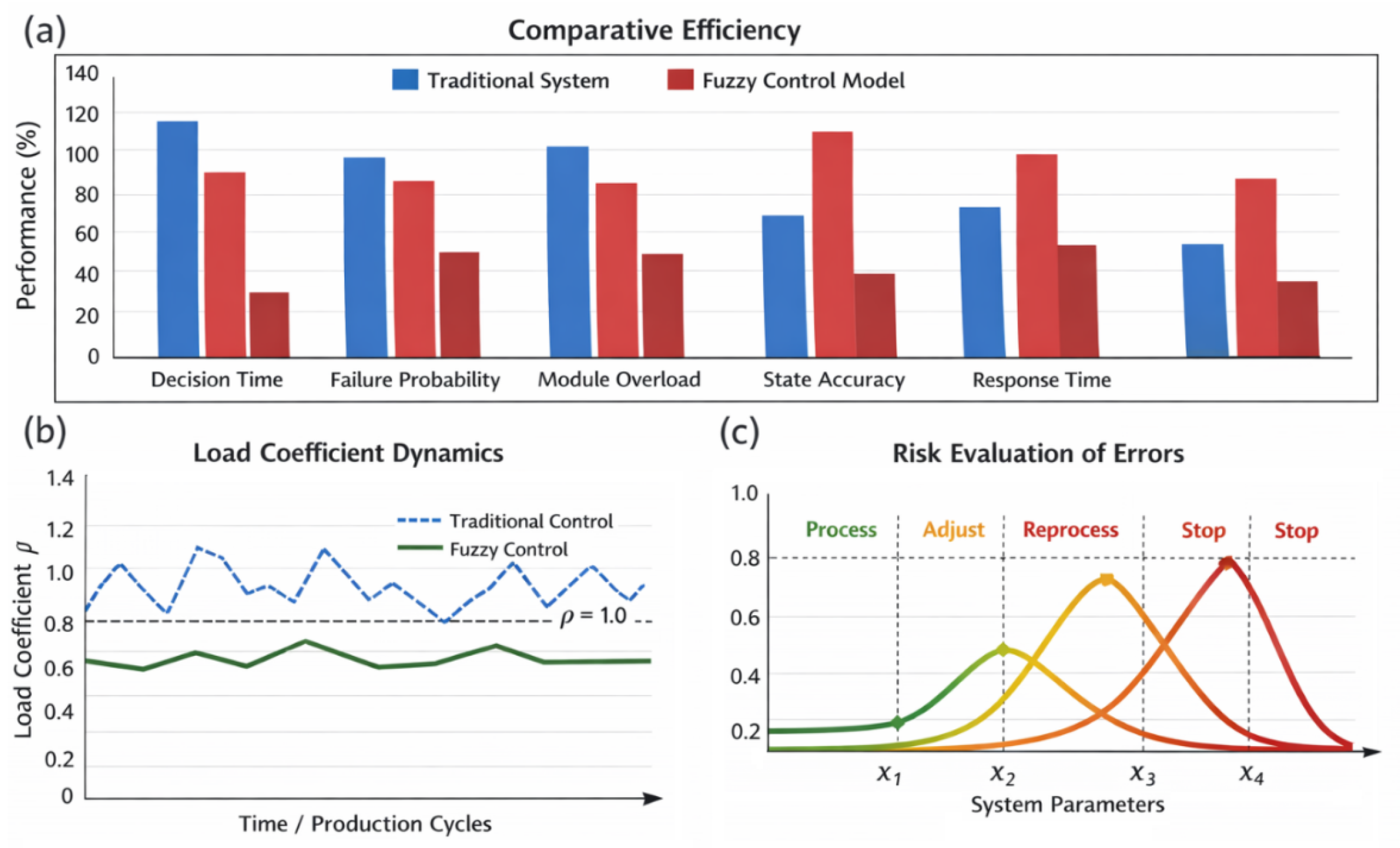
As illustrated in
Figure 6, the proposed fuzzy model consistently outperforms traditional deterministic algorithms across all key performance indicators (KPIs). The
increase in state assessment accuracy suggests that integrating “soft” linguistic variables (low, medium, high defect) provides a more realistic reflection of the production state than rigid numerical thresholds.
To further evaluate the effectiveness of the proposed automation framework, comparative analysis was performed against conventional deterministic supervisory control approaches based on fixed-threshold monitoring and predefined binary decision mechanisms. The comparison considered several operational performance indicators, including response time to abnormal conditions, production-state assessment accuracy, module load balancing efficiency, and fault-tolerant operational stability.
The obtained simulation results demonstrated that the proposed fuzzy inference architecture provides improved adaptability under uncertain production conditions due to its ability to gradually evaluate operational states and dynamically generate corrective control actions. In contrast, traditional deterministic approaches exhibited lower flexibility when processing heterogeneous sensor data and rapidly changing operational scenarios.
Quantitative evaluation showed that the proposed model reduced abnormal-condition response time, improved load redistribution efficiency, and increased the accuracy of production-state assessment compared with conventional fixed-threshold supervisory methods. These results confirm that the integration of fuzzy inference and adaptive monitoring mechanisms improves the robustness and operational efficiency of flexible manufacturing environments within Industry 5.0-oriented technopark infrastructures. Furthermore, the decrease in process failure probability highlights the system’s resilience, which is a critical requirement for the commercialization of startup products where quality assurance () is a prerequisite for market entry.
An important aspect of the proposed automation framework within the context of Industry 5.0 is the integration of human-in-the-loop (HITL) supervision mechanisms. Although the presented architecture emphasizes intelligent automation, fuzzy inference, and adaptive monitoring, human operators and domain experts remain essential participants in the decision-making process. In particular, human supervision is required for the interpretation of abnormal operational situations, validation of critical control actions, strategic adjustment of production objectives, and management of highly uncertain scenarios that cannot be fully formalized within automated rule bases. The proposed intelligent control system therefore operates as a collaborative human–machine environment in which automated monitoring and decision-support mechanisms augment human expertise rather than replace it. This human-centric approach is aligned with the fundamental principles of Industry 5.0, emphasizing resilience, adaptability, operational safety, and synergistic cooperation between intelligent technologies and human operators in advanced technopark infrastructures.
5.4. Practical Implications and Limitations
From a strategic perspective, this automation framework provides a scalable template for technoparks in developing innovation economies, such as those in Azerbaijan. However, certain limitations must be acknowledged. The accuracy of the fuzzy model is inherently tied to the quality of the initial expert-defined rule base. In scenarios involving highly complex mechatronic systems with hundreds of variables, the “curse of dimensionality” could potentially impact computational speed. Future iterations should therefore consider the integration of neuro-fuzzy systems to allow the model to learn and update membership functions autonomously from real-time industrial IoT data.
From a scalability perspective, the proposed automation framework addresses the dimensional growth problem through hierarchical decomposition and modular organization of the production infrastructure. Rather than relying on a fully centralized fuzzy inference architecture, the technopark environment is partitioned into interconnected functional subsystems, each equipped with localized monitoring, control, and decision-making mechanisms. This distributed structure reduces the computational complexity associated with the exponential growth of fuzzy rule bases as the number of variables and production elements increases. In large-scale production networks containing numerous sensors, robotic systems, transport modules, and heterogeneous manufacturing cells, hierarchical coordination between local controllers and supervisory decision layers improves both computational efficiency and operational stability. Furthermore, the proposed architecture may be extended through the integration of edge computing, distributed artificial intelligence, and neuro-fuzzy optimization methods, thereby enabling scalable deployment in future Industry 5.0 intelligent manufacturing ecosystems.
From an economic and strategic perspective, deployment of the proposed automation framework within science and technology parks of different scales involves both initial investment costs and long-term operational benefits. The primary implementation costs are associated with industrial sensors, intelligent monitoring infrastructure, communication networks, computational platforms, software integration, and personnel training. Nevertheless, the obtained experimental and analytical results indicate that these investments may be compensated by reductions in process failures, lower maintenance and downtime costs, improved resource utilization, increased production flexibility, enhanced product quality, and accelerated commercialization of innovation projects. Furthermore, the modular architecture of the proposed system supports phased and scalable implementation strategies, allowing small-, medium-, and large-scale technoparks to adapt the deployment process according to their technological capabilities, operational requirements, and financial constraints. This scalability increases the strategic applicability of the proposed framework for Industry 5.0-oriented innovation ecosystems.
6. Conclusions and Future Works
The article proposed an architecture for an intelligent system for automated monitoring and control of research laboratories and flexible manufacturing modules within a technology park, based on fuzzy modeling. The proposed model improves the resilience of the integrated functioning of technological processes and the research department under conditions of uncertainty, i.e., unplanned structural, energy, measurement, and control failures.
A multi-level automation architecture is proposed, combining sensor data collection, information processing and analysis, and decision-making. This architecture enables the integration of research laboratories and flexible production modules of the technology park’s GPS system into a single intelligent environment.
To formalize decision-making processes, a fuzzy model of the production module’s state was proposed. It is based on input parameters for the structural and energy states of the crane-manipulator, the machines used for the step-by-step machining of the metal product, the accuracy of the information measurement, and the control processes. The proposed fuzzy inference model defined membership functions, created rule bases and implication algorithms, and implemented aggregation and defuzzification operations using the center-of-gravity method.
Analytical studies and simulation experiments demonstrated that the use of a fuzzy control model effectively accounts for the uncertainty of production conditions in a technology park and adaptively adjusts measurement and control actions in technological processes. The results demonstrate the possibility of timely detection of deviations in process parameters and the automatic generation of corrective control actions.
The developed system ensures stable coordination of machine tools and the crane manipulator that services them in the flexible production module of the technology park’s GPS system. This contributes to increased reliability of the technology park’s production infrastructure, improved product quality, and a reduced risk of process failures.
The practical significance of the obtained results lies in the potential application of the proposed intelligent monitoring and control architecture to integrate research laboratories and production modules of technology parks into a unified digital innovation environment. This creates the preconditions for the accelerated transformation of scientific research into technological solutions and commercially viable products.
Future research areas include developing the proposed model by integrating machine learning and data mining methods to improve the accuracy of production process forecasting. As regards the future development of the proposal, the automation framework will focus on large-scale real-world deployment within heterogeneous Industry 5.0 manufacturing ecosystems and university-based technoparks. Particular attention will be devoted to scalability issues associated with distributed production infrastructures containing numerous interconnected sensors, robotic systems, flexible manufacturing cells, and intelligent monitoring subsystems.
In this context, future research may incorporate distributed artificial intelligence architectures, edge-computing platforms, and Industrial Internet of Things (IIoT) technologies to support decentralized decision-making, real-time data exchange, and autonomous coordination between production modules. Furthermore, the integration of digital twins and predictive analytics mechanisms may improve the capability of the system to forecast equipment degradation, optimize resource allocation, and dynamically adapt production strategies under uncertain operating conditions.
Additional research directions include the application of neuro-fuzzy learning approaches, reinforcement learning algorithms, and adaptive self-tuning control techniques capable of automatically updating fuzzy rule bases and membership functions using historical industrial data. These developments may further improve the robustness, scalability, and intelligent autonomy of the proposed control architecture in complex industrial environments.
Expanding the model by using digital twins of production equipment and implementing industrial Internet of Things technologies is also promising, enabling greater autonomy and adaptability in the management of innovative production systems in technology parks.
The conducted research and simulation experiments confirmed the effectiveness of the proposed method and the developed model. The obtained results showed that the use of the developed fuzzy control model allows the following:
Reduce the average processing time of management decisions in the production module by ≈19% compared to traditional deterministic algorithms.
Reducing the likelihood of process failures associated with design, energy and measurement deviations by approximately ≈27%.
Increasing the stability of the GPS production module load by dynamically redistributing task flows, which leads to a reduction in the module overload factor by ≈19%.
Increasing the accuracy of assessing the state of the production process based on the integration of fuzzy monitoring parameters by approximately ≈23%.
Reducing the response time of the control system to the occurrence of abnormal situations by an average of ≈33%.
Additional analysis showed that the proposed model provides an increase in the overall operational efficiency of the flexible manufacturing system of the technology park by approximately ≈17%, as well as an improvement in the quality of the produced experimental and start-up products due to the early detection of deviations in process parameters.
Compared with conventional deterministic industrial control algorithms and fixed-threshold supervisory systems, the proposed fuzzy intelligent control architecture demonstrated improved adaptability, robustness, and operational flexibility under uncertain production conditions. In particular, the obtained simulation results indicate superior performance in terms of response time reduction, dynamic load balancing, fault-tolerant operation, and accuracy of production state assessment. Traditional control approaches typically rely on rigid predefined thresholds and binary decision mechanisms, which may lead to reduced flexibility in heterogeneous and dynamically changing manufacturing environments. In contrast, the proposed fuzzy inference framework enables gradual evaluation of operational states and adaptive generation of control actions, thereby improving the resilience and efficiency of integrated research and flexible production infrastructures within Industry 5.0-oriented technoparks.
The following scientific innovations were obtained in the work:
- 1.
An architecture for intelligent monitoring and control (based on fuzzy modeling) of the mechanical assembly flexible manufacturing module of the GPS technology park is proposed.
- 2.
A method for formalizing a fuzzy model for controlling the states of a mechanical assembly production module is proposed, taking into account design, energy, measurement and control parameters.
- 3.
An algorithm for adaptive control of technological processes based on fuzzy inference and a defuzzification mechanism has been developed.
To visualize the evaluation of the proposed methods and models, graphs were constructed (
Figure 9) as a result of experimental studies on the comparative evaluation of the effectiveness of the proposed fuzzy model with traditional methods (a), the dynamic load of technical means of the GPS of the technology park (b), and the risk of errors as a result of using the fuzzy model (c) for monitoring and managing the GPS of the technology park.




 ,
,