Article

A Radiomics-Based Machine Learning Model for Predicting Pneumonitis During Durvalumab Treatment in Locally Advanced NSCLC


by
Takeshi Masuda
1,*,†,
Daisuke Kawahara
2,†,
Wakako Daido
1,3,
Nobuki Imano
2,
Naoko Matsumoto
3,
Kosuke Hamai
4,5,
Yasuo Iwamoto
6,
Yusuke Takayama
7,8,
Sayaka Ueno
4,
Masahiko Sumii
1,
Hiroyasu Shoda
7,
Nobuhisa Ishikawa
4,
Masahiro Yamasaki
3,
Yoshifumi Nishimura
9,
Shigeo Kawase
10,
Naoki Shiota
11,
Yoshikazu Awaya
12,
Soichi Kitaguchi
13,
Yuji Murakami
2,
Yasushi Nagata
2,14 and
Noboru Hattori
1
add Show full author list remove Hide full author list
1
Department of Respiratory Medicine, Hiroshima University Hospital, Hiroshima 734-8551, Japan
2
Department of Radiation Oncology, Hiroshima University Hospital, Hiroshima 734-8551, Japan
3
Department of Respiratory Medicine, Hiroshima Red Cross Hospital & Atomic-Bomb Survivors Hospital, Hiroshima 730-8619, Japan
4
Department of Respiratory Medicine, Hiroshima Prefectural Hospital, Hiroshima 734-8530, Japan
5
Department of Respiratory Medicine, JA Onomichi General Hospital, Onomichi 722-8508, Japan
6
Department of Medical Oncology, Hiroshima City Hiroshima Citizens Hospital, Hiroshima 730-8518, Japan
7
Department of Respiratory Internal Medicine, Hiroshima City Hiroshima Citizens Hospital, Hiroshima 730-8518, Japan
8
Department of Internal Medicine, Hiroshima City Funairi Citizens Hospital, Hiroshima 734-0844, Japan
9
Department of Respiratory Medicine, Higashi-Hiroshima Medical Center, Higashi-Hiroshima 739-0041, Japan
10
Department of Respiratory Medicine, Kure Kyosai Hospital, Kure 737-8505, Japan
11
Department of Respiratory Disease, Chugoku Rousai General Hospital, Kure 737-0193, Japan
12
Department of Respiratory Medicine, Miyoshi Central Hospital, Miyoshi 728-8502, Japan
13
Department of Respiratory Medicine, Hiroshima City Asa Citizens Hospital, Hiroshima 731-0293, Japan
14
Department of Radiation Oncology, Chugoku Rousai General Hospital, Kure 737-0193, Japan
*
Author to whom correspondence should be addressed.
These authors contributed equally to this work.
AI 2026, 7(1), 32; https://doi.org/10.3390/ai7010032 (registering DOI)
Submission received: 6 December 2025 / Revised: 5 January 2026 / Accepted: 9 January 2026 / Published: 16 January 2026
(This article belongs to the Section Medical & Healthcare AI)

Simple Summary

Pneumonitis is a serious adverse event during durvalumab therapy following chemoradiotherapy (CRT) in patients with locally advanced non-small-cell lung cancer. We retrospectively analyzed 123 patients and developed a radiomics-based machine learning model using pre-treatment CT scans. The support vector machine model achieved an AUC of 0.88 and accuracy of 0.81, outperforming conventional predictors such as V20 and interstitial lung abnormalities. This approach enables objective and individualized risk assessment, supporting early intervention and personalized management of patients receiving durvalumab after CRT.

Abstract

Introduction: Pneumonitis represents one of the clinically significant adverse events observed in patients with non-small-cell lung cancer (NSCLC) who receive durvalumab as consolidation therapy after chemoradiotherapy (CRT). Although clinical factors such as radiation dose (e.g., V20) and interstitial lung abnormalities (ILAs) have been reported as risk predictors, accurate and objective prognostication remains difficult. This study aimed to develop a radiomics-based machine learning model to predict grade ≥ 2 pneumonitis. Methods: This retrospective study included patients with unresectable NSCLC who received CRT followed by durvalumab. Radiomic features, including first-order and texture and shape-based features with wavelet transformation were extracted from whole-lung regions on pre-durvalumab computed tomography (CT) images. Machine learning models, support vector machines, k-nearest neighbor, neural networks, and naïve Bayes classifiers were developed and evaluated using a testing cohort. Model performance was assessed using five-fold cross-validation. Conventional predictors, including V20 and ILAs, were also assessed using logistic regression and receiver operating characteristic analysis. Results: Among 123 patients, 44 (35.8%) developed grade ≥ 2 pneumonitis. The best-performing model, a support vector machine, achieved an AUC of 0.88 and accuracy of 0.81, the conventional model showed lower performance with an AUC of 0.71 and accuracy of 0.64. Conclusions: Radiomics-based machine learning demonstrated superior performance over clinical parameters in predicting pneumonitis. This approach may enable individualized risk stratification and support early intervention in patients with NSCLC.

1. Introduction

Lung cancer is a major contributor to global cancer mortality. According to global estimates from international cancer surveillance organizations, it accounts for approximately 2.5 million new diagnoses and 1.8 million deaths each year [1]. Among its histological subtypes, non-small-cell lung cancer (NSCLC) predominates, representing approximately 76% of cases, while small-cell lung cancer (SCLC) comprises roughly 13%. Despite advances in diagnosis, approximately one-third of patients with NSCLC present with locally advanced disease [2], and the standard treatment is concurrent chemoradiotherapy (CRT) followed by durvalumab, which is an anti-programmed death ligand-1 antibody as well as an immune checkpoint inhibitor (ICI) [3].
Pneumonitis represents a clinically important toxicity associated with ICI, cytotoxic chemotherapy, and thoracic radiotherapy, and may lead to treatment interruption or discontinuation in severe cases. Previous large-scale analyses have indicated that patients with NSCLC are particularly susceptible to ICI-related pneumonitis compared with those with other malignancies [4,5], and approximately 10% of cases were fatal [6]. A previous phase III study revealed that the incidence of any grade pneumonitis during durvalumab treatment following CRT was 33.9% [3]. Furthermore, evidence from real-world clinical practice has indicated that treatment-related pneumonitis occurs at relatively high rates—reported in approximately 60–80% of cases—particularly among patients receiving durvalumab [7,8,9,10,11,12].
Several factors have been implicated in the development of pneumonitis among patients receiving durvalumab after (CRT), including radiation-related variables such as the lung volume exposed to ≥20 Gy (V20) and the mean lung dose (MLD) [12,13,14]. Additionally, pre-existing interstitial lung disease (ILD) is reported to be a risk factor for radiation pneumonitis. In our previous work, we demonstrated that interstitial lung abnormalities (ILAs)—subtle parenchymal changes detected on computed tomography (CT) in individuals without a prior clinical suspicion of interstitial lung disease—are clinically relevant [13,14], and were an independent risk factor for grade ≥ 2 pneumonitis during durvalumab treatment after CRT [15]. However, the detection of ILAs relies on visual assessment, which is inherently subjective, posing a limitation in consistency and reproducibility. Therefore, an objective method to predict severe pneumonitis is urgently needed.
Recently, radiomics, an advanced image analysis technique that extracts high-dimensional, quantitative features from standard medical images such as CT, has gained traction for its potential in predictive modeling in oncology. When integrated with artificial intelligence (AI) and machine learning algorithms, radiomics has shown promising results in predicting treatment response and adverse events, including radiotherapy-related pneumonitis [16,17,18,19]. In addition, radiomics may offer a novel opportunity to objectively quantify subclinical lung abnormalities, potentially capturing patterns undetectable to the human eye. Thus, constructing a radiomics-based model that extracts features from the non-tumorous lung prior to treatment may allow more accurate and reproducible prediction of pneumonitis during durvalumab therapy. Previous studies have performed radiomics analyses using features from the tumor or irradiated lung regions, but not from the underlying lung parenchyma. In addition, to our knowledge, no prior study has developed a radiomics-based predictive model for pneumonitis during durvalumab treatment after CRT in patients with locally advanced NSCLC.
Therefore, the primary aim of this study was to develop and validate a radiomics-based machine learning model using pre-treatment whole-lung CT images to predict the occurrence of grade ≥ 2 pneumonitis among patients with locally advanced NSCLC treated with CRT followed by durvalumab. In addition, we aimed to compare the predictive performance of this radiomics-based approach with conventional clinical and radiotherapeutic risk factors, including dose–volume parameters and ILAs.
In the following sections, we describe the study design and radiomics-based machine learning methodology, present the predictive performance of the developed models, discuss the clinical implications of our findings, and conclude with future perspectives.

2. Materials and Methods

2.1. Study Design and Study Population

We retrospectively identified consecutive patients with unresectable NSCLC who underwent CRT followed by durvalumab between July 2018 and June 2021 across ten institutions. Patients were eligible if pre-durvalumab chest CT images were available for radiomics analysis. Patients without available CT Digital Imaging and Communications in Medicine (DICOM) data were excluded. Clinical information obtained prior to durvalumab initiation, including radiographic findings on chest CT and laboratory parameters, was collected for analysis. An opt-out consent procedure was applied in accordance with institutional regulations. The study protocol was approved by the Institutional Review Board of Hiroshima University (Approval No. E-1590, 18 April 2019) as well as the ethics committees of all participating institutions, and was conducted in compliance with the principles of the Declaration of Helsinki (1975, revised 2013). This study was reported in accordance with the STROBE guidelines for observational research.

2.2. CT Acquisition and Image Evaluation

Pre-treatment chest CT scans acquired in the supine position at full inspiration were reviewed to evaluate the presence of interstitial pneumonia, pre-existing ILAs, and other radiographic findings prior to durvalumab initiation. The presence of ILAs was assessed based on predefined CT findings, including ground-glass attenuation, reticular patterns, honeycombing, traction bronchiectasis, diffuse centrilobular nodules, and non-emphysematous cystic changes. In addition, ILAs were defined as non-dependent parenchymal abnormalities affecting more than 5% of at least one lung zone. For anatomical classification, the lungs were divided into upper, middle, and lower zones according to the inferior border of the aortic arch and the level of the right inferior pulmonary vein, as previously described [14]. All CT images were independently reviewed by two experienced pulmonologists who were blinded to patients’ clinical information. In cases of disagreement between the two primary reviewers, a third pulmonologist performed an additional assessment, and the final judgment was determined by consensus.

2.3. Definition and Evaluation of Pneumonitis During Durvalumab Treatment

The diagnosis of pneumonitis occurring during durvalumab therapy was diagnosed based on the following criteria: (1) the emergence of new abnormal findings on chestCT; (2) the absence of evidence for pulmonary infection (pneumonitis that did not improve even after antibiotic administration or absence of bacteria in the sputum culture); (3) exclusion of heart failure using laboratory data and/or transthoracic echocardiography; and (4) exclusion of tumor progression using laboratory data and version 1.1 of the Response Evaluation Criteria in Solid Tumors. Pneumonitis was classified based on the Common Terminology Criteria for Adverse Events (CTCAE) v5.0 [20].

2.4. Radiomics Workflow and Predictive Model Development

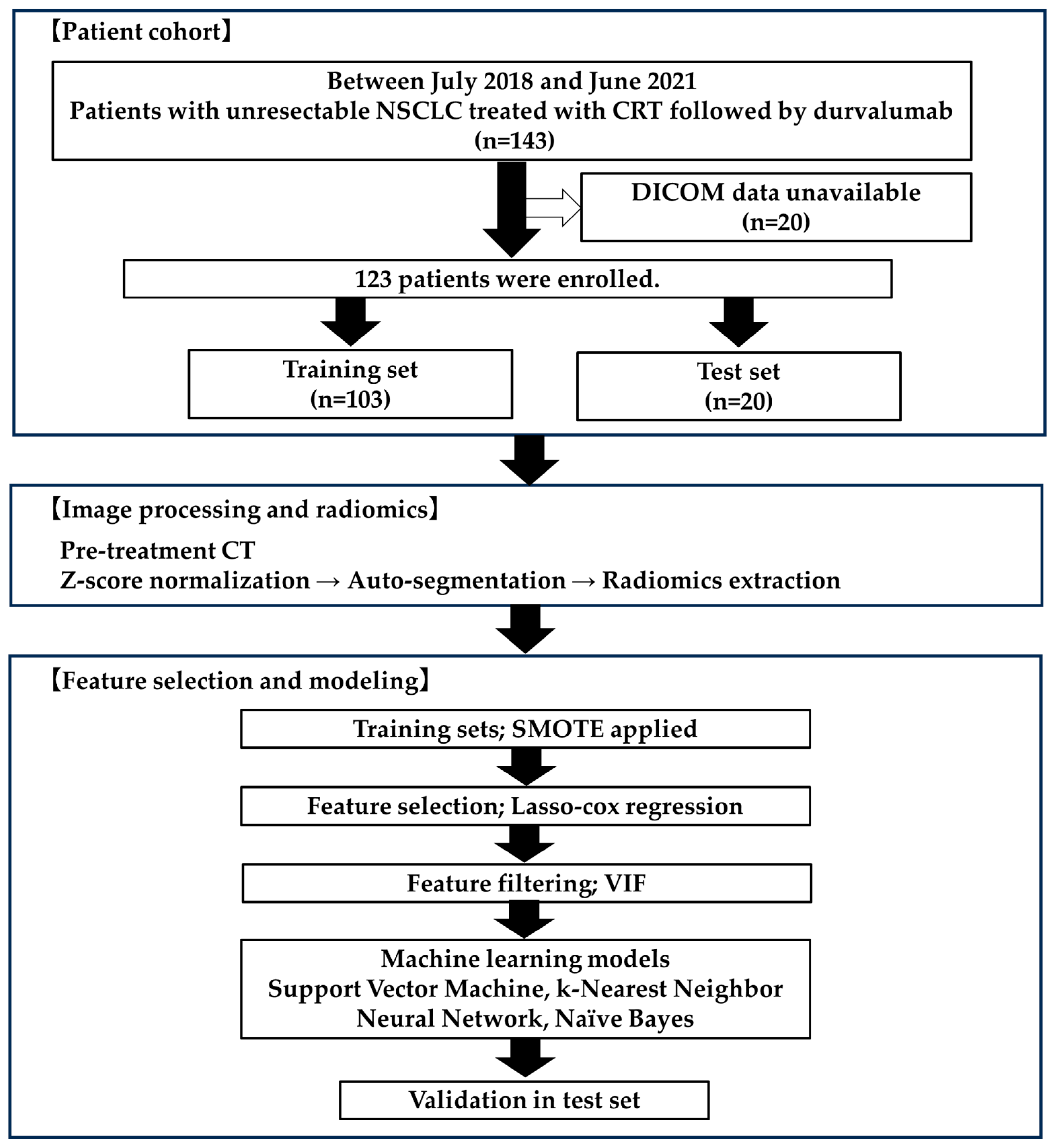
Figure 1 illustrates the workflow of the hybrid auto-segmentation–based radiomics approach used to predict grade ≥ 2 pneumonitis. A radiomics model was developed using a training cohort comprising 103 patients, and its predictive performance was subsequently evaluated in an independent testing cohort of 20 patients. The overall pipeline consisted of image preprocessing, auto-segmentation of lung regions, radiomics feature extraction, feature selection, handling of class imbalance, and machine-learning-based model development and validation.
NSCLC: non-small-cell lung cancer; CRT: chemoradiotherapy; SMOTE: synthetic minority over-sampling technique; VIF: variance inflation factor

2.4.1. Image Preprocessing and Auto-Segmentation

Prior to radiomics analysis, all CT images were first z-score-normalized to standardize the intensity values across patients and imaging protocols. This normalization step facilitates inter-patient comparability and reduces variability introduced by acquisition conditions. Subsequently, radiomics feature extraction was conducted on auto-segmented lung regions using PyRadiomics (version 3.0.1), an open-source radiomics extraction tool kit implemented in Python (version 3.9.18) [21]. The auto-segmented regions were derived from pre-treatment CT images using the Chest Imaging Platform on 3D Slicer [22]. When obvious segmentation errors were identified—such as inclusion of the chest wall, large airways, or exclusion of peripheral lung regions—manual corrections were performed using the built-in editing tools in 3D Slicer (version 5.6.0; Brigham and Women’s Hospital, Harvard Medical School, Boston, MA, USA) (e.g., paint and erase functions). Cases with segmentation errors that could not be adequately corrected were excluded from further radiomics analysis. This combined auto-segmentation and visual verification process was applied uniformly across all cases to ensure reproducibility and reliability of the extracted radiomic features.

2.4.2. Radiomics Feature Extraction

Radiomic features were extracted from full three-dimensional lung volumes, ensuring that feature calculation was not influenced by slice selection or partial-volume effects. This volumetric approach allowed consistent feature extraction across patients with varying lung sizes and anatomical differences. All lung compartments were defined using fixed Hounsfield unit (HU) thresholds determined a priori, which were applied uniformly across all scans, without adaptation to individual patients or imaging conditions. HU ranges were defined as follows: Lung parenchymal components were classified according to HU ranges as follows: emphysematous regions (−1050 to −950 HU), normally aerated lung (−950 to −750 HU), infiltrative areas (−750 to −400 HU), collapsed lung (−400 to 0 HU), and vascular structures (0 to 1000 HU) [23]. In addition, radiomics features were extracted from additional compartments including air, healthy lungs, and ground glass opacity and consolidation [24]. A total of 127 radiomics features were extracted from the various regions, including 21 first-order statistical features (e.g., mean, skewness, kurtosis), 13 shape-based features (e.g., maximum 2D diameter slice, elongation), and 93 texture-based features (GLCM, GLRLM, GLSZM, NGTDM, and GLDM). To enhance feature richness, wavelet transformation was applied to the original CT images, using eight decomposition filters: HLL, LHL, LHH, LLH, HLH, HHH, HHL, and LLL. This allowed the capture of fine-grained textural differences within various lung compartments.

2.4.3. Feature Selection and Class Imbalance Handling

To address class imbalance in the dataset, the synthetic minority over-sampling technique (SMOTE) was applied to the training cohort prior to model construction. The SMOTE algorithm was applied to augment the minority class in the dataset while preserving the underlying data distribution [25]. In the current study, the incidence of grade ≥ 2 pneumonitis was 35.8%. Class imbalance in the training dataset was addressed using SMOTE during the development of the predictive model. To identify the most relevant radiomics features associated with grade ≥ 2 pneumonitis, we employed Least Absolute Shrinkage and Selection Operator (LASSO) Cox regression, implemented via the glmnet package in R. This method is particularly well-suited for high-dimensional datasets where the number of features exceeds the number of observations. LASSO applies a regularization penalty to the regression coefficients, effectively shrinking less informative variables toward zero. As the penalty term (λ) increases, only the most predictive features are retained, leading to a sparse and interpretable model. Prior to model construction, we assessed potential collinearity among features using the variance inflation factor (VIF). Features with a VIF > 10 were excluded to mitigate multicollinearity and enhance model stability. Feature selection and penalty tuning were performed using 10-fold cross-validation on the training dataset. This approach minimizes over-fitting by iteratively rotating subsets for training and validation, and selecting the λ value that yields the lowest cross-validated error.

2.4.4. Machine Learning Model Construction and Validation

After feature selection, predictive models were developed using multiple machine learning algorithms, including support vector machine (SVM), k-nearest neighbor (k-NN), neural networks, and naïve Bayes classifiers. All models were trained using the training cohort, and their discriminative performance was initially evaluated by receiver operating characteristic (ROC) curve analysis together with multiple classification metrics, including accuracy, sensitivity, specificity, precision, and F1 score. Based on this evaluation, the model demonstrating the best overall performance was selected as the final model and subsequently subjected to validation analyses. To ensure robustness and generalizability, we also performed cross-cohort validation by swapping the training and validation cohorts and re-evaluating the models. This role-swapping validation helps confirm the stability of the predictive performance across different patient sets.

2.5. Statistical Analysis

Continuous variables are presented as medians with corresponding ranges. Comparisons between groups were performed using the Pearson chi-square test for categorical variables and the Wilcoxon rank-sum test for continuous variables, as appropriate. To explore factors associated with the development of grade ≥ 2 pneumonitis, univariate logistic regression analyses were first performed, followed by multivariate logistic regression modeling. Variables demonstrating statistical significance in univariate analyses (p < 0.05) were subsequently incorporated into the multivariate model. In addition, V20 was included a priori among radiotherapy-related variables based on prior evidence supporting its role as a dosimetric parameter associated with the risk of radiation pneumonitis [10,11,12,26,27]. ROC curve analysis was performed to determine optimal cutoff thresholds for continuous variables, including white blood cell count, KL-6 level, V5, V20, and MLD. In addition, we performed ROC analysis for grade ≥ 2 pneumonitis using significant factors in the multivariate logistic regression analysis. Interobserver agreement for CT findings was assessed using Cohen’s κ. All statistical tests were conducted using two-sided p-values, with a significance threshold defined as p < 0.05. Data analyses were carried out with JMP Pro version 16 (SAS Institute Inc., Cary, NC, USA).

3. Results

3.1. Overview of the Results

The Results Section is organized to progressively address the study objectives, beginning with patient characteristics and the incidence of pneumonitis, followed by analyses of clinical. Subsequently, the performance of conventional clinical predictors is compared with that of radiomics-based machine learning models. This structured presentation is intended to provide a clear rationale for the transition from traditional risk factor analysis to advanced predictive modeling.

3.2. Patient Characteristics

In total, 143 patients were identified for inclusion in this study. After excluding 20 patients due to unavailable DICOM data, 123 patients were eligible for and included in the final analysis. Baseline clinical characteristics, laboratory data, treatment-related variables, and pre-durvalumab CT findings are summarized in Table 1. The study population consisted mainly of men (71.5%), patients with an Eastern Cooperative Oncology Group performance status of 0–1 (96.8%), and individuals with a history of current or former smoking (84.9%). Most patients (90.2%) were diagnosed with stage III disease. Interstitial pneumonia was identified in 2 patients, ILAs in 44 patients, and emphysema in 70 patients. Interobserver agreement between Reader 1 and Reader 2 was fair for interstitial pneumonia (κ = 0.39), substantial for ILAs (κ = 0.65), and almost perfect for emphysema (κ = 0.82). The lower κ value observed for interstitial pneumonia should be interpreted with caution. Because positive findings were rare in this cohort, the κ statistic was substantially affected by class imbalance, a phenomenon that can lead to paradoxically low κ values even when the observed agreement is high.

3.3. Incidence and Severity of Pneumonitis During Durvalumab Treatment

The frequency and severity of pneumonitis identified during durvalumab therapy are presented in Table 2. Among the 78 patients in whom pneumonitis occurred after administration of durvalumab, 44 (35.8%) developed grade ≥ 2 pneumonitis, durvalumab was discontinued in 34 (43.6%) with pneumonitis, and 36 (46.2%) were administered systemic corticosteroids.

3.4. Clinical and Radiotherapeutic Characteristics by Pneumonitis Grade

As shown in Table 3, patients who developed grade ≥ 2 pneumonitis were older than those who did not. In addition, radiotherapy-related dosimetric parameters, including V5, V20, and MLD, were significantly elevated in the grade ≥ 2 pneumonitis group. Pre-existing ILAs on CT were also more frequently observed in patients with grade ≥ 2 pneumonitis compared with those without (54.0% vs. 23.3%, p < 0.001).

3.5. Risk Factors for Grade ≥ 2 Pneumonitis

In the univariate logistic regression analysis, age ≥ 65 years, higher lung dose–volume parameters (V5, V20, and mean lung dose), and pre-existing ILAs were significantly associated with grade ≥ 2 pneumonitis (Table 4). In the multivariate model, which accounted for potential confounding among these variables, V20 (OR 2.56, 95% CI: 1.14–5.88) and ILAs (OR 2.95, 95% CI: 1.29–6.93) remained independent predictors of grade ≥ 2 pneumonitis (Table 5), whereas age lost statistical significance.

3.6. ROC Analysis for Grade ≥ 2 Pneumonitis Using V20 and ILAs

We performed ROC analysis for grade ≥ 2 pneumonitis using two significant factors, V20 and pre-existing ILAs. ROC analysis demonstrated that the prediction model yielded an AUC of 0.71 with an accuracy of 64%, a sensitivity of 84%, and a specificity of 69%. These metrics indicate moderate performance in predicting pneumonitis (Table 6).

3.7. Radiomics Feature Selection

In the radiomics analysis, a total of 14,467 features were initially extracted from CT images using wavelet-transformed data from various lung compartments. Feature extraction encompassed a broad set of metrics, such as first-order statistics, texture features, and shape-based parameters. After feature normalization and multicollinearity reduction, LASSO Cox regression was applied for feature selection. As shown in Table S1, a small number of highly predictive features were retained. Notably, no predictive features were selected from normally aerated lung regions (i.e., inflated compartment), suggesting that the most relevant signals for pneumonitis prediction were derived from regions with higher density. In the vessel regions, multiple predictive features were retained, including not only first-order skewness, but also GLRLM-based texture features such as Large Dependence Emphasis, Long Run Low Gray Level Emphasis, Informational Measure of Correlation 1 (IMC1), and Dependence Variance, highlighting the complex heterogeneity within vascular compartments. In addition, a shape-based feature, Maximum 2D Diameter Slice, selected from the thoracic cavity region, reflected structural abnormalities. GLSZM-based Low Gray Level Zone Emphasis feature, identified from ground-glass opacity area, and wavelet HHH First order Kurtosis, derived from the infiltrated region, were both selected as predictive features. In addition, GLRLM-based Small Area Low Gray Level Emphasis, derived from the wavelet HHH, was selected from the collapse area. These findings suggest that regions with abnormal densities or structures, rather than normally inflated lung parenchyma, carry the most significant radiomic signatures for predicting pneumonitis progression.

3.8. Predictive Modeling of Grade ≥ 2 Pneumonitis Using Radiomics Features

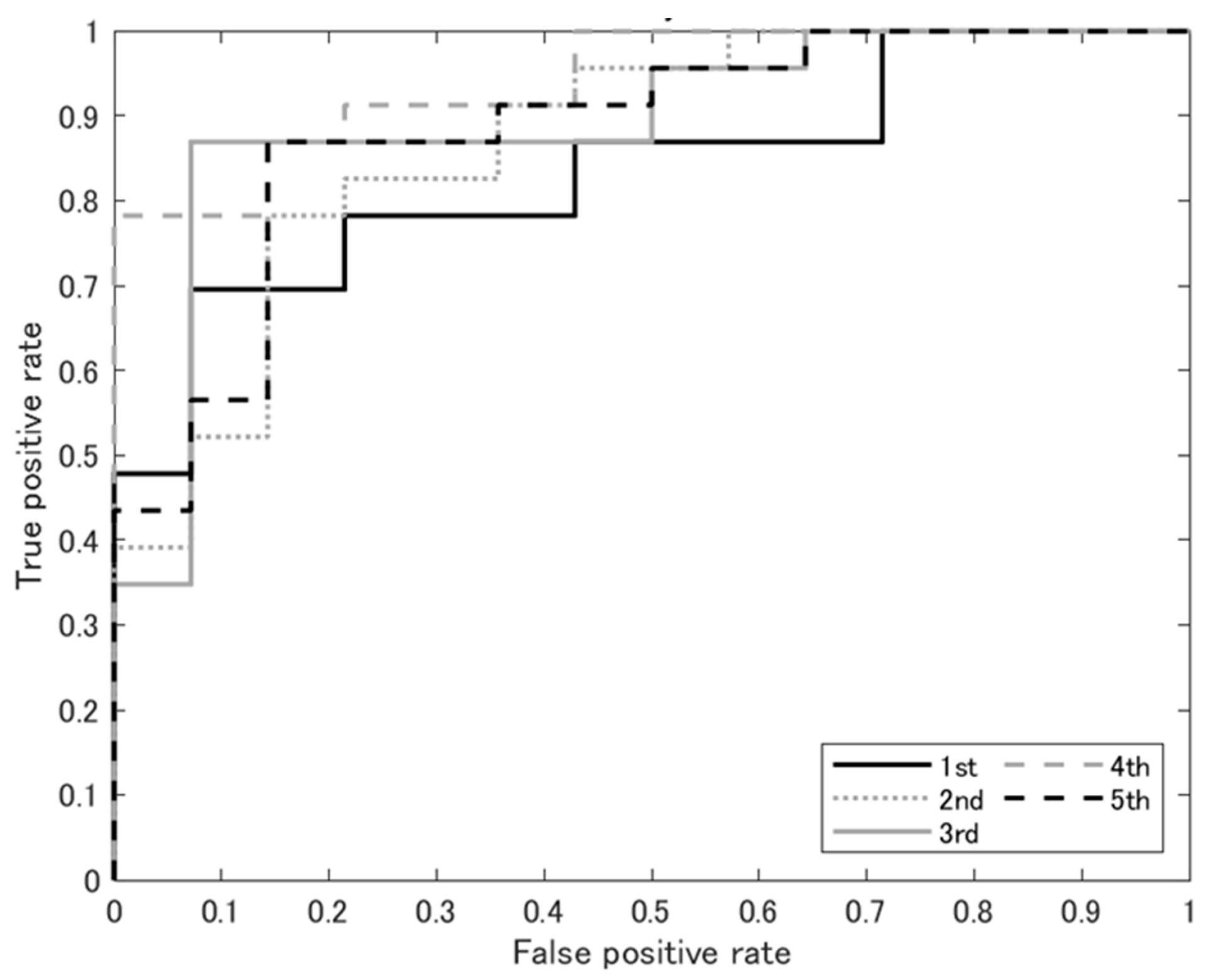
To evaluate the predictive utility of the radiomics features selected by LASSO Cox regression, multiple machine learning algorithms were constructed to predict the onset of grade ≥ 2 pneumonitis. The algorithms tested included SVM, k-NN, neural networks, and naïve Bayes classifiers (Table 6). The SVM-Coarse Gaussian model demonstrated the highest predictive performance with an accuracy of 0.81, a sensitivity of 0.78, and a specificity of 0.84. The model also yielded an area under the ROC curve AUC of 0.88, indicating a high discriminative capability. In addition, the SVM model with five-fold cross-validation was applied to assess model generalizability (Figure 2).
ROC curves for the Coarse Gaussian SVM model generated through five-fold cross-validation to predict grade ≥ 2 pneumonitis during durvalumab therapy following chemoradiotherapy. Each curve represents one of the five validation folds, demonstrating the model’s discriminative performance across datasets. The model showed consistently high sensitivity with specificity, yielding an overall AUC of 0.88 in the test cohort.

4. Discussion

Grade ≥ 2 pneumonitis during durvalumab treatment following CRT is a critical adverse event that often requires discontinuation of durvalumab or administration of corticosteroids, and can be life-threatening in severe cases. In this study, we developed a radiomics-based machine learning model to predict the occurrence of grade ≥ 2 pneumonitis during durvalumab treatment and evaluated its predictive performance. To date, clinical and radiotherapeutic factors such as V20 [10,11,12,26,27] and the presence of ILAs on CT prior to durvalumab initiation [15] have been reported as predictors of pneumonitis risk. Consistent with previous reports, the AUC of the clinical factor-based model in our study was 0.71. In contrast, the radiomics-based machine learning model demonstrated superior predictive performance, with an AUC of 0.88. These findings suggest that radiomics-based models, which objectively and quantitatively assess underlying lung conditions, offer a promising approach for predicting pneumonitis risk. Early identification of patients at high risk for pneumonitis would enable closer monitoring during durvalumab treatment. Furthermore, this approach could provide patients and their families with valuable information to make informed decisions regarding whether to proceed with durvalumab treatment, considering the potential risk of severe pneumonitis.
The incidence of pneumonitis during durvalumab treatment after CRT in patients with NSCLC is high, having been reported in the range of approximately 60–80% in the real-world setting [7,8,9,10,11,12]. Therefore, the development of a predictive model with high performance is urgently needed. To our knowledge, this is the first study to develop a radiomics-based machine learning model specifically designed to predict the incidence of grade ≥ 2 pneumonitis during durvalumab treatment following CRT. Pneumonitis during durvalumab treatment after CRT is considered to be induced by both radiotherapy and durvalumab. While previous studies have investigated the performance of radiomics-based models in predicting pneumonitis following radiotherapy or ICI monotherapy [16,19,28,29], these studies have notable limitations. One prior study was limited by a small cohort (e.g., 11 cases) treated with stereotactic body radiation therapy plus ICI [30], while others failed to clearly distinguish between patients receiving CRT alone and those receiving CRT followed by ICI [30,31], thereby limiting their external validity. In contrast, our study collected data from a total of 123 patients across ten institutions, all of whom received the same treatment protocol (CRT followed by durvalumab), under a consistent clinical management framework. This combination of a homogeneous patient population and multicenter design strengthens the reproducibility and generalizability of our model, highlighting its potential for future clinical application.
Several previous studies have explored the use of radiomics features derived from gross tumor volume (GTV) or radiotherapy planning parameters (e.g., dose-volume histograms), with feature extraction limited to the tumor or irradiated lung regions, to predict the onset of radiation pneumonitis or ICI-induced pneumonitis [16,19,28,29,30]. In contrast, the present study does not limit the analysis to the tumor or irradiated field, but rather utilizes radiomic features extracted from the entire lung, including normal lung regions, areas of low ventilation, ground-glass opacities, and vascular structures. This approach incorporates pre-existing pulmonary abnormalities such as ILAs and emphysema. By capturing baseline pulmonary vulnerability that cannot be fully assessed through conventional visual evaluation, this method may enhance the early prediction of severe pneumonitis and offer advantages over tumor-based models. Furthermore, class imbalance was corrected using the SMOTE algorithm, and model performance was validated in an independent cohort, achieving an AUC of 0.88, accuracy of 0.81, sensitivity of 0.78, and specificity of 0.84, demonstrating both avoidance of overfitting and generalizability. These findings suggest that our model has greater clinical applicability compared to previous studies and may contribute to risk stratification and optimization of treatment strategies in the context of post-CRT durvalumab therapy.
In this study, radiomic features extracted from multiple anatomical regions were identified as predictive factors for pneumonitis. In the vascular region, first-order features derived from wavelet-HHH transformations may reflect endothelial injury and perivascular edema. Additionally, high dependence variance and IMC1 in the vascular area indicate increased textural complexity and heterogeneity, potentially capturing inflammation and early fibrosis. Features such as long-run low gray-level emphasis and large dependence emphasis may capture long, low-attenuation structures or broad homogeneous regions within or around vessels, possibly reflecting inflammation such as vascular congestion or perivascular edema. It is well-known that radiation therapy induces direct as well as indirect DNA damage through the production of reactive oxygen species. The radiomic features extracted in our study may reflect under lying tissue injury caused by radiation therapy that cannot be detected on conventional CT imaging [32]. In the ground-glass opacity region, increased low gray-level zone emphasis may indicate early inflammatory changes, such as alveolar exudation and interstitial edema. In infiltrative regions, elevated kurtosis following wavelet HHH transformation suggests the presence of outlier-like structures within otherwise homogenous tissues, which may correspond histologically to inflammatory cell infiltration and tissue injury. In collapsed lung regions, small-area low gray-level emphasis emerged as a predictive factor, likely reflecting microatelectasis, early fibrotic changes, or localized inflammation. Collectively, these inflammatory and tissue-destructive processes within the lung—whether induced by radiation or pre-existing—are likely to underlie the increased risk of pneumonitis observed in this study.
This study has some limitations. First, it was a retrospective observational study; therefore, the possibility of selection bias in patient enrollment and data collection cannot be excluded. However, consecutive patients were enrolled across multiple institutions, which may partially mitigate this concern. Second, radiomic analysis inherently involves a large number of variables in AI model construction, which carries a risk of overfitting. In particular, the relatively limited sample size of this study (n = 123) in relation to the high dimensionality of radiomic features may increase this risk. Although we mitigated this risk through LASSO regression and cross-validation, as well as by evaluating model performance in an independent test cohort, external validation using an independent cohort is necessary to fully assess the model’s generalizability. Lastly, the model developed in this study is based on radiomic features extracted from the entire lung, and the relationship between these features and local radiation dose or irradiation field was not thoroughly examined. Future studies incorporating dosiomics analysis and multi-region radiomics based on the irradiated field may enable the development of more refined and accurate predictive models. Despite these limitations, the current findings demonstrate the potential value of whole-lung radiomics for pneumonitis risk stratification.

5. Conclusions

In this study, we developed and validated an AI model to predict grade ≥ 2 pneumonitis in patients with locally advanced NSCLC who received durvalumab following CRT. The model was constructed using radiomic features extracted from the entire lung combined with machine learning techniques. Compared to conventional prediction models based on clinical parameters such as V20 and ILAs, our model demonstrated superior predictive performance, with an AUC of 0.88 and an accuracy of 0.81.
Moving forward, further accumulation of cases and external validation will be necessary to assess the generalizability and real-world applicability of this model. Prediction models leveraging radiomics and AI technologies hold great promise for preemptive risk assessment of treatment-related toxicities and for advancing personalized medicine in lung cancer care.

Supplementary Materials

The following supporting information can be downloaded at: https://www.mdpi.com/article/10.3390/ai7010032/s1, Table S1: Selected features by Lasso-Cox regression for radiomics analysis.

Author Contributions

Conceptualization: T.M. and D.K. Data curation: T.M., D.K. and W.D. Formal analysis: T.M. and D.K. Investigation: T.M., D.K., W.D., N.I. (Nobuki Imano), N.M., K.H., Y.I., Y.T., S.U., M.S., H.S., N.I. (Nobuhisa Ishikawa), M.Y., Y.N. (Yoshifumi Nishimura), S.K. (Shigeo Kawase), N.S., Y.A., S.K. (Soichi Kitagushi), Y.M., Y.N. (Yasushi Nagata) and N.H. Methodology: T.M. and D.K. Project administration: T.M., D.K. and N.I. (Nobuki Imano). Supervision: Y.M., Y.N. (Yasushi Nagata) and N.H. Writing—original draft: T.M. and D.K. Writing—review and editing: W.D., N.I. (Nobuki Imano), N.M., K.H., Y.I., Y.T., S.U., M.S., H.S., N.I. (Nobuhisa Ishikawa), M.Y., Y.N. (Yoshifumi Nishimura), S.K. (Shigeo Kawase), N.S., Y.A., S.K. (Soichi Kitagushi), Y.M., Y.N. (Yasushi Nagata) and N.H. All authors have read and agreed to the published version of the manuscript.

Funding

This research did not receive any specific grants from funding agencies in the public, commercial, or not-for-profit sectors.

Data Availability Statement

Data from this study can be obtained from the corresponding author upon reasonable request.

Acknowledgments

We would like to thank the following radiologists for providing clinicalinformation on radiotherapy: Ippei Takahashi (Hiroshima Red Cross Hospital and Atomic-bomb Survivors Hospital), Kozo Kashiwado (Hiroshima Red Cross Hospital and Atomic-bomb Survivors Hospital), Hideo Kawabata (Hiroshima Prefectural Hospital), Koji Kiryu (Hiroshima City Asa Citizens Hospital), Nobuyoshi Takazawa (JA Onomichi General Hospital), Ikuno Nishibuchi (Chugoku Rousai General Hospital), Junichi Hirokawa (Miyoshi Central Hospital), Kazushi Fujita (Higashi-Hiroshima Medical Center), Kanji Matsuura (Hiroshima City Hiroshima Citizens Hospital), and Atsushi Yoshida (Kure Kyosai Hospital). This study was supported by the Japan Society for the Promotion of Science Program for Forming Japan’s Peak Research Universities (J-PEAKS; grant number JPJS00420230011). During the preparation of this work, the authors used artificial intelligence–assisted technologies (specifically, machine learning algorithms implemented with open-source platforms) in order to perform radiomics feature extraction and predictive model development. After using these AI-assisted tools, the authors reviewed, validated, and interpreted the results, and take full responsibility for the accuracy and integrity of the content of the published article. AI-assisted technologies were used solely for data analysis and model construction, and no generative AI tools were used for drafting, editing, or revising the manuscript text.

Conflicts of Interest

T.M. has received honoraria for lectures from Daiichi-Sankyo Co., Ltd., Taiho Pharmaceutical Co., Ltd., Nippon Boehringer Ingelheim Co., Ltd., Kyowa Kirin Co., Ltd., Eli Lilly Japan K.K., Ono Pharmaceutical Co., Ltd., Otsuka Pharmaceutical Co., Ltd., Chugai Pharmaceutical Co., Ltd., and AstraZeneca K.K. K.D has received grant from Varian Medical Systems. W.D. has received support for attending meetings from Nippon Boehringer Ingelheim Co., Ltd., and honoraria for lectures from AstraZeneca K.K. N.I has received honoraria for lectures from AstraZeneca K.K. K.H. has received honoraria for lectures from Daiichi-Sankyo Co., Ltd., Nippon Boehringer Ingelheim Co., Ltd., Eli Lilly Japan K.K., and AstraZeneca K.K. S.U. has received honoraria for lectures from AstraZeneca K.K. and Nippon Boehringer Ingelheim Co., Ltd. N.I. has received honoraria for lectures from Nippon Boehringer Ingelheim Co., Ltd., AstraZeneca K.K., GlaxoSmithKline plc, Ono Pharmaceutical Co., Ltd., Chugai Pharmaceutical Co., Ltd., and Merck Sharp & Dohme LLC. H.S. has received honoraria for lectures from AstraZeneca K.K. S.K. has received honoraria for lectures from Nippon Boehringer Ingelheim Co., Ltd., AstraZeneca K.K., Sanofi K.K., and GlaxoSmithKline plc. Y.A. has received honoraria for lectures from AstraZeneca K.K., Chugai Pharmaceutical Co., Ltd., Nippon Boehringer Ingelheim Co., Ltd., Sanofi K.K., Bristol-Myers Squibb K.K., and Shionogi & Co., Ltd. N.H has received a speaker honorarium from Nippon Boehringer Ingelheim Co., Ltd., Chugai Pharmaceutical Co. Ltd., and AstraZeneca K.K., and donations from Taiho Pharmaceutical Co. Ltd., Kyowa Kirin Co., Ltd., Nippon Boehringer Ingelheim Co., Ltd., and Chugai Pharmaceutical Co. Ltd. All other authors declare no conflicts of interest.

References

  1. Bray, F.; Laversanne, M.; Sung, H.; Ferlay, J.; Siegel, R.L.; Soerjomataram, I.; Jemal, A. Global cancer statistics 2022: GLOBOCAN estimates of incidence and mortality worldwide for 36 cancers in 185 countries. CA Cancer J. Clin. 2024, 74, 229–263. [Google Scholar] [CrossRef]
  2. Siegel, R.L.; Kratzer, T.B.; Giaquinto, A.N.; Sung, H.; Jemal, A. Cancer statistics, 2025. CA Cancer J. Clin. 2025, 75, 10–45. [Google Scholar] [CrossRef] [PubMed]
  3. Antonia, S.J.; Villegas, A.; Daniel, D.; Vicente, D.; Murakami, S.; Hui, R.; Yokoi, T.; Chiappori, A.; Lee, K.H.; de Wit, M.; et al. Durvalumab after Chemoradiotherapy in Stage III Non-Small-Cell Lung Cancer. N. Engl. J. Med. 2017, 377, 1919–1929. [Google Scholar] [CrossRef] [PubMed]
  4. Nishino, M.; Giobbie-Hurder, A.; Hatabu, H.; Ramaiya, N.H.; Hodi, F.S. Incidence of Programmed Cell Death 1 Inhibitor-Related Pneumonitis in Patients With Advanced Cancer: A Systematic Review and Meta-analysis. JAMA Oncol. 2016, 2, 1607–1616. [Google Scholar] [CrossRef]
  5. Wu, J.; Hong, D.; Zhang, X.; Lu, X.; Miao, J. PD-1 inhibitors increase the incidence and risk of pneumonitis in cancer patients in a dose-independent manner: A meta-analysis. Sci. Rep. 2017, 7, 44173. [Google Scholar] [CrossRef]
  6. Borghaei, H.; Paz-Ares, L.; Horn, L.; Spigel, D.R.; Steins, M.; Ready, N.E.; Chow, L.Q.; Vokes, E.E.; Felip, E.; Holgado, E.; et al. Nivolumab versus Docetaxel in Advanced Nonsquamous Non-Small-Cell Lung Cancer. N. Engl. J. Med. 2015, 373, 1627–1639. [Google Scholar] [CrossRef] [PubMed]
  7. Jung, H.A.; Noh, J.M.; Sun, J.M.; Lee, S.H.; Ahn, J.S.; Ahn, M.J.; Pyo, H.; Ahn, Y.C.; Park, K. Real world data of durvalumab consolidation after chemoradiotherapy in stage III non-small-cell lung cancer. Lung Cancer 2020, 146, 23–29. [Google Scholar] [CrossRef]
  8. Mayahara, H.; Uehara, K.; Harada, A.; Kitatani, K.; Yabuuchi, T.; Miyazaki, S.; Ishihara, T.; Kawaguchi, H.; Kubota, H.; Okada, H.; et al. Predicting factors of symptomatic radiation pneumonitis induced by durvalumab following concurrent chemoradiotherapy in locally advanced non-small cell lung cancer. Radiat. Oncol. 2022, 17, 7. [Google Scholar] [CrossRef]
  9. Miura, Y.; Mouri, A.; Kaira, K.; Yamaguchi, O.; Shiono, A.; Hashimoto, K.; Nishihara, F.; Shinomiya, S.; Akagami, T.; Murayama, Y.; et al. Chemoradiotherapy followed by durvalumab in patients with unresectable advanced non-small cell lung cancer: Management of adverse events. Thorac. Cancer 2020, 11, 1280–1287. [Google Scholar] [CrossRef]
  10. Saito, G.; Oya, Y.; Taniguchi, Y.; Kawachi, H.; Daichi, F.; Matsumoto, H.; Iwasawa, S.; Suzuki, H.; Niitsu, T.; Miyauchi, E.; et al. Real-world survey of pneumonitis and its impact on durvalumab consolidation therapy in patients with non-small cell lung cancer who received chemoradiotherapy after durvalumab approval (HOPE-005/CRIMSON). Lung Cancer 2021, 161, 86–93. [Google Scholar] [CrossRef]
  11. Shintani, T.; Kishi, N.; Matsuo, Y.; Ogura, M.; Mitsuyoshi, T.; Araki, N.; Fujii, K.; Okumura, S.; Nakamatsu, K.; Kishi, T.; et al. Incidence and Risk Factors of Symptomatic Radiation Pneumonitis in Non-Small-Cell Lung Cancer Patients Treated with Concurrent Chemoradiotherapy and Consolidation Durvalumab. Clin. Lung Cancer 2021, 22, 401–410. [Google Scholar] [CrossRef]
  12. Zhang, T.; Xu, K.; Bi, N.; Zhang, L.; Jiang, W.; Liang, J.; Deng, L.; Wang, X.; Wang, J.; Wang, J.; et al. Efficacy and safety of immune checkpoint inhibitor consolidation after chemoradiation in patients of Asian ethnicity with unresectable stage III non-small cell lung cancer: Chinese multicenter report and literature review. Thorac. Cancer 2020, 11, 2916–2923. [Google Scholar] [CrossRef]
  13. Hatabu, H.; Hunninghake, G.M.; Lynch, D.A. Interstitial Lung Abnormality: Recognition and Perspectives. Radiology 2019, 291, 1–3. [Google Scholar] [CrossRef]
  14. Hatabu, H.; Hunninghake, G.M.; Richeldi, L.; Brown, K.K.; Wells, A.U.; Remy-Jardin, M.; Verschakelen, J.; Nicholson, A.G.; Beasley, M.B.; Christiani, D.C.; et al. Interstitial lung abnormalities detected incidentally on CT: A Position Paper from the Fleischner Society. Lancet Respir. Med. 2020, 8, 726–737. [Google Scholar] [CrossRef] [PubMed]
  15. Daido, W.; Masuda, T.; Imano, N.; Matsumoto, N.; Hamai, K.; Iwamoto, Y.; Takayama, Y.; Ueno, S.; Sumii, M.; Shoda, H.; et al. Pre-Existing Interstitial Lung Abnormalities Are Independent Risk Factors for Interstitial Lung Disease during Durvalumab Treatment after Chemoradiotherapy in Patients with Locally Advanced Non-Small-Cell Lung Cancer. Cancers 2022, 14, 6236. [Google Scholar] [CrossRef] [PubMed]
  16. Kawahara, D.; Imano, N.; Nishioka, R.; Ogawa, K.; Kimura, T.; Nakashima, T.; Iwamoto, H.; Fujitaka, K.; Hattori, N.; Nagata, Y. Prediction of radiation pneumonitis after definitive radiotherapy for locally advanced non-small cell lung cancer using multi-region radiomics analysis. Sci. Rep. 2021, 11, 16232. [Google Scholar] [CrossRef] [PubMed]
  17. Krafft, S.P.; Rao, A.; Stingo, F.; Briere, T.M.; Court, L.E.; Liao, Z.; Martel, M.K. The utility of quantitative CT radiomics features for improved prediction of radiation pneumonitis. Med. Phys. 2018, 45, 5317–5324. [Google Scholar] [CrossRef]
  18. Parmar, C.; Grossmann, P.; Rietveld, D.; Rietbergen, M.M.; Lambin, P.; Aerts, H.J. Radiomic Machine-Learning Classifiers for Prognostic Biomarkers of Head and Neck Cancer. Front. Oncol. 2015, 5, 272. [Google Scholar] [CrossRef]
  19. Zhang, Z.; Wang, Z.; Yan, M.; Yu, J.; Dekker, A.; Zhao, L.; Wee, L. Radiomics and Dosiomics Signature From Whole Lung Predicts Radiation Pneumonitis: A Model Development Study With Prospective External Validation and Decision-curve Analysis. Int. J. Radiat. Oncol. Biol. Phys. 2023, 115, 746–758. [Google Scholar] [CrossRef]
  20. National Cancer Institute. Common Terminology Criteria for Adverse Events (CTCAE) v5.0. Available online: https://ctep.cancer.gov/protocolDevelopment/electronic_applications/ctc.htm#ctc_50 (accessed on 18 October 2024).
  21. van Griethuysen, J.J.M.; Fedorov, A.; Parmar, C.; Hosny, A.; Aucoin, N.; Narayan, V.; Beets-Tan, R.G.H.; Fillion-Robin, J.C.; Pieper, S.; Aerts, H. Computational Radiomics System to Decode the Radiographic Phenotype. Cancer Res. 2017, 77, e104–e107. [Google Scholar] [CrossRef]
  22. Fedorov, A.; Beichel, R.; Kalpathy-Cramer, J.; Finet, J.; Fillion-Robin, J.C.; Pujol, S.; Bauer, C.; Jennings, D.; Fennessy, F.; Sonka, M.; et al. 3D Slicer as an image computing platform for the Quantitative Imaging Network. Magn. Reson. Imaging 2012, 30, 1323–1341. [Google Scholar] [CrossRef]
  23. Risoli, C.; Nicolò, M.; Colombi, D.; Moia, M.; Rapacioli, F.; Anselmi, P.; Michieletti, E.; Ambrosini, R.; Di Terlizzi, M.; Grazioli, L.; et al. Different Lung Parenchyma Quantification Using Dissimilar Segmentation Software: A Multi-Center Study for COVID-19 Patients. Diagnostics 2022, 12, 1501. [Google Scholar] [CrossRef]
  24. Zaffino, P.; Marzullo, A.; Moccia, S.; Calimeri, F.; De Momi, E.; Bertucci, B.; Arcuri, P.P.; Spadea, M.F. An Open-Source COVID-19 CT Dataset with Automatic Lung Tissue Classification for Radiomics. Bioengineering 2021, 8, 26. [Google Scholar] [CrossRef]
  25. Blagus, R.; Lusa, L. SMOTE for high-dimensional class-imbalanced data. BMC Bioinform. 2013, 14, 106. [Google Scholar] [CrossRef]
  26. Li, F.; Zhou, Z.; Wu, A.; Cai, Y.; Wu, H.; Chen, M.; Liang, S. Preexisting radiological interstitial lung abnormalities are a risk factor for severe radiation pneumonitis in patients with small-cell lung cancer after thoracic radiation therapy. Radiat. Oncol. 2018, 13, 82. [Google Scholar] [CrossRef]
  27. Palma, D.A.; Senan, S.; Tsujino, K.; Barriger, R.B.; Rengan, R.; Moreno, M.; Bradley, J.D.; Kim, T.H.; Ramella, S.; Marks, L.B.; et al. Predicting radiation pneumonitis after chemoradiation therapy for lung cancer: An international individual patient data meta-analysis. Int. J. Radiat. Oncol. Biol. Phys. 2013, 85, 444–450. [Google Scholar] [CrossRef] [PubMed]
  28. Du, Y.; Zhang, S.; Jia, X.; Zhang, X.; Li, X.; Pan, L.; Li, Z.; Niu, G.; Liang, T.; Guo, H. Radiomics Biomarkers to Predict Checkpoint Inhibitor Pneumonitis in Non-small Cell Lung Cancer. Acad. Radiol. 2025, 32, 1685–1695. [Google Scholar] [CrossRef] [PubMed]
  29. Zhang, G.Y.; Du, X.Z.; Xu, R.; Chen, T.; Wu, Y.; Wu, X.J.; Liu, S. Development and Validation of a Machine Learning-Based Model Using CT Radiomics for Predicting Immune Checkpoint Inhibitor-related Pneumonitis in Patients With NSCLC Receiving Anti-PD1 Immunotherapy: A Multicenter Retrospective Case Control Study. Acad. Radiol. 2024, 31, 2128–2143. [Google Scholar] [CrossRef]
  30. Kraus, K.M.; Oreshko, M.; Bernhardt, D.; Combs, S.E.; Peeken, J.C. Dosiomics and radiomics to predict pneumonitis after thoracic stereotactic body radiotherapy and immune checkpoint inhibition. Front. Oncol. 2023, 13, 1124592. [Google Scholar] [CrossRef] [PubMed]
  31. Thomas, H.M.T.; Hippe, D.S.; Forouzannezhad, P.; Sasidharan, B.K.; Kinahan, P.E.; Miyaoka, R.S.; Vesselle, H.J.; Rengan, R.; Zeng, J.; Bowen, S.R. Radiation and immune checkpoint inhibitor-mediated pneumonitis risk stratification in patients with locally advanced non-small cell lung cancer: Role of functional lung radiomics? Discov. Oncol. 2022, 13, 85. [Google Scholar] [CrossRef]
  32. Giuranno, L.; Ient, J.; De Ruysscher, D.; Vooijs, M.A. Radiation-Induced Lung Injury (RILI). Front. Oncol. 2019, 9, 877. [Google Scholar] [CrossRef] [PubMed]
Figure 1. Flowchart of radiomics-based machine learning analysis.
Ai 07 00032 g001
Figure 2. ROC curves of the radiomics-based support vector machine model for predicting grade ≥ 2 pneumonitis during durvalumab treatment.
Ai 07 00032 g002
Table 1. Clinical and laboratory characteristics of patients at baseline.
Characteristics of the Enrolled PatientsPatients, No. (%)
(n = 123)
Age (years)
median (range)
71 (49–86)
Sex
Male/Female
88 (71.5)/35 (28.5)
Body mass index
median (range)
21.2 (13.4–31.2)
ECOG performance status
0/1/2/3
90 (73.2)/29 (23.6)/3 (2.4)/1 (0.8)
Smoking history
Never smokers/Former or current smokers
19 (15.1)/107 (84.9)
Brinkman index
median (range)
800 (0–3840)
History of autoimmune disease
+/−
6 (4.9)/117 (95.1)
Clinical stage at diagnosis
stage II/stage III/postoperative recurrence
9 (7.3)/111 (90.2)/3 (2.5)
Histological subtype
Adenocarcinoma/squamous cell
carcinoma/others
64 (52.0)/52 (42.3)/7 (5.7)
Baseline laboratory parametersMedian (range)
(n = 123)
White blood cell count (/μL)3900 (1300–11,900)
Lymphocyte count (/μL)730 (180–5000)
C-reactive protein (mg/dL)0.512 (0–13.58)
KL-6 (U/mL)297 (116–2221)
SpO2 (%)98 (92–100)
Chemoradiotherapy-related informationPatients, No. (%)
(n = 123)
Concurrent chemotherapy regimen
Weekly carboplatin plus paclitaxel71 (57.7)
Cisplatin plus S-113 (10.6)
Cisplatin plus vinorelbine32 (26.0)
Daily carboplatin4 (3.3)
Cisplatin plus docetaxel3 (2.4)
Total radiation dose, Gy
median (range)
63 (40–70)
V5 (%)
median (range)
42.3 (11.5–69.8)
V20 (%)
median (range)
22.3 (2.9–38.6)
Mean lung dose (Gy)
median (range)
12.3 (3.1–19.2)
Details of radiotherapy technique, (%)
3D-CRT/IMRT/3D + IMRT
79 (64.2)/41 (33.3)/3 (2.5)
Interval from completion of CRT to durvalumab initiation (days)
median (range)
16 (1–54)
CT findingsPatients, No. (%)
(n = 123)
IP
+/−
2 (1.6)/121 (98.4)
ILAs
+/−
44 (35.7)/79 (64.3)
Emphysema
+/−
70 (56.9)/53 (43.1)
ECOG, Eastern Cooperative Oncology Group; CRT, chemoradiotherapy; V5, percentage of lung parenchyma receiving a radiation dose of ≥5 Gy; V20, percentage of lung parenchyma receiving a dose of ≥20 Gy; IMRT, intensity-modulated radiation therapy; CT, computed tomography; IP, interstitial pneumonitis; ILAs, interstitial lung abnormalities.
Table 2. Incidence and severity of pneumonitis associated with durvalumab treatment.
CharacteristicsPatients, No. (%)
(n = 123)
No pneumonitis45 (36.7)
CTCAE grade of pneumonitis
All
1
2
3
78 (63.4)
34 (27.6)
33 (26.8)
11 (8.9)
Patients with pneumonitis
(n = 78)
Discontinuation of durvalumab treatment
+
34 (43.6)
44 (56.4)
Use of systemic corticosteroids
+
36 (46.2)
42 (53.8)
CTCAE, Common Terminology Criteria for Adverse Events, version 5.0.
Table 3. Comparison of clinical characteristics according to the presence of grade ≥ 2 pneumonitis.
Characteristics of the Enrolled PatientsGrade ≤ 1, n = 79Grade ≥ 2, n = 44p-Value
Age, (years)
median (range)
70 (49–86)73 (51–85)0.002
Sex, (%)
Male/Female
53 (67.1)/26 (32.9)35 (79.5)/9 (20.5)0.142
Body mass index
median (range)
20.8 (13.4–31.2)21.2 (16.4–28.3)0.368
ECOG-
performance status, (%)
0/≥1
62 (78.5)/17 (21.5)28 (63.6)/16 (36.4)0.78
Smoking status, (%)
Non-smokers/former or current smokers
12 (15.2)/67 (84.8)7 (15.9)/37 (84.1)0.915
Brinkman Index
median (range)
800 (0–2500)880 (0–3840)0.107
Autoimmune disease, (%)
+/−
4 (5.1)/75 (94.9)2 (4.6)/42 (95.4)0.897
Histology, (%)
Ad/non-Ad
45 (56.9)/34 (43.1)19 (43.2)/25 (56.8)0.142
Clinical stage, (%)
II/III/postoperative recurrence
6 (7.6)/71 (89.9)/
2 (2.5)
4 (9.1)/39 (88.6)/
1 (2.3)
0.956
Baseline laboratory
parameters
White blood cell count (/μL)
median (range)
4380 (1700–9200)3550 (1300–111,900)0.076
Lymphocyte count (/μL),
median (range)
798 (210–2140)688 (180–5000)0.762
C-reactive protein (mg/dL), median (range)0.56 (0.02–13.58)0.48 (0–4.70)0.948
KL-6 (U/mL), median (range)275 (116–869)315 (135–2221)0.153
Information of CRT
Concurrent chemotherapy
Weekly caboplatin + paclitaxel
+/−
38 (48.1)/41 (51.9)27 (61.4)/17 (38.6)0.157
Total irradiation dose, Gy
median (range)
63 (40–70)63 (50–70)0.561
V5, %, (%)
median (range)
40.6 (10.7–83.2)46.8 (24–78.9)0.001
V20, %, (%)
median (range)
20.1 (2.9–38.6)22.8 (7–29.8)0.007
Mean lung dose, Gy
median (range)
11.3 (2.8–18.8)12.9 (5.3–19.2)<0.001
Details of radiotherapy technique
3D-CRT/IMRT/3D + IMRT
52 (65.8)/26 (33.0)/
1 (1.2)
27 (61.4)/15 (34.1)/
2 (4.5)
0.524
Interval from completion of CRT to durvalumab initiation (days)
median (range)
18 (1–53)15 (1–54)0.488
CT findings
IP, (%)
+/−
1 (1.2)/78 (98.8)1 (2.3)/43 (97.7)0.679
ILAs (%)
+/−
17 (23.3)/56 (76.7)27 (54.0)/23 (46.0)<0.001
Emphysema, (%)
+/−
42 (53.2)/37 (46.8)28 (63.7)/16 (36.3)0.259
ECOG PS, Eastern Cooperative Oncology Group; Ad, adenocarcinoma; CRT, chemoradiotherapy; V5, percentage of lung parenchyma receiving a radiation dose of ≥5 Gy; V20, percentage of lung parenchyma receiving a dose of ≥20 Gy; CT, computed tomography; IP, interstitial pneumonitis; ILAs, interstitial lung abnormalities.
Table 4. Univariable logistic regression analysis of factors associated with grade ≥ 2 pneumonitis.
Odds Ratio (OR)95% Confidence
Interval
p-Value
Age (years)
</≥65
5.191.85–18.620.001
ECOG-
performance status
0/≥1
2.080.92–4.740.078
White blood cell count (/µL)
</≥ 3600 (cutoff)
0.490.22–1.040.063
KL-6 level (U/mL)
</≥500
1.050.36–2.860.916
V5, %
</≥43.1 (cutoff)
3.901.81–8.75<0.001
V20, %
</≥22.4 (cutoff)
2.781.31–6.030.008
MLD, Gy
</≥11.8 (cutoff)
3.911.79–8.99<0.001
ILAs
+/−
3.861.80–8.56<0.001
ECOG, Eastern Cooperative Oncology Group; V5, percentage of lung parenchyma receiving a radiation dose of ≥5 Gy; V20, percentage of lung parenchyma receiving a dose of ≥20 Gy; MLD, mean lung dose; ILAs, interstitial lung abnormalities.
Table 5. Multivariable logistic regression analysis of factors associated with grade ≥ 2 pneumonitis.
Odds Ratio (OR)95% Confidence
Interval
p-Value
Age (years)
</≥65
3.100.99–11.770.051
V20
</≥22.4%
2.561.14–5.880.021
ILAs
+/−
2.951.29–6.930.01
ECOG PS, Eastern Cooperative Oncology Group performance status; ILAs, interstitial lung abnormalities; V20, volume of lung parenchyma that received ≥20 Gy.
Table 6. Predictive performance metrics of clinical factor-based model and the radiomics-based machine learning model for grade ≥ 2 pneumonitis.
ModelTest
Accuracy
SensitivitySpecificityAUC
ROC
PrecisionF1 Score
Clinical factor-based model0.640.840.690.710.600.70
Support vector
machine
Linear0.750.80.700.840.600.68
Quadratic0.700.810.600.770.530.64
Cubic0.690.850.540.760.510.64
Fine Gaussian0.540.980.100.750.380.55
Medium Gaussian0.790.810.770.870.660.73
Coarse Gaussian0.810.780.840.880.730.75
k-Nearest Neighbor
Method
Fine0.710.870.540.710.510.65
Medium0.740.710.780.830.640.67
Coarse0.750.840.650.840.570.68
Cosine0.770.730.820.860.690.71
Cubic0.720.730.720.810.590.65
Weighted0.740.810.670.830.580.67
Subspace0.510.610.410.740.370.46
Neural NetworkNarrow0.690.820.550.810.500.62
Medium0.720.850.600.710.540.66
Bilayered0.680.810.550.770.500.62
Trilayered0.750.820.680.740.590.69
Naive BayesGauss0.770.880.670.870.600.71
Kernel0.770.860.680.850.600.71
Disclaimer/Publisher’s Note: The statements, opinions and data contained in all publications are solely those of the individual author(s) and contributor(s) and not of MDPI and/or the editor(s). MDPI and/or the editor(s) disclaim responsibility for any injury to people or property resulting from any ideas, methods, instructions or products referred to in the content.