Article

Reorganization of the Arabian Sea Oxygen Minimum Zone in Response to Monsoon Fluctuations During Dansgaard–Oeschger Events 12–11


by
Patricia Silva Rodrigues
1,2,*,
Wilfried Bauer
1,2 and
Marlon Carlos França
3
1
Department of Applied Geoscience (AGEO), German University of Technology in Oman-GUtech, Muscat 130, Oman
2
Energy and Mineral Resources Group (EMR), RWTH Aachen University, 52056 Aachen, Germany
3
Instituto Federal de Educação, Ciência e Tecnologia do Espírito Santo (IFES), Vitória 29056-264, ES, Brazil
*
Author to whom correspondence should be addressed.
Oceans 2026, 7(1), 19; https://doi.org/10.3390/oceans7010019
Submission received: 16 October 2025 / Revised: 28 January 2026 / Accepted: 4 February 2026 / Published: 17 February 2026
(This article belongs to the Special Issue Oceans in a Changing Climate)

Abstract

Understanding the impact of monsoonal oscillations during past climatic changes in the Arabian Sea is crucial for improving climate model predictions under ongoing global warming. This study investigates whether millennial-scale climate shifts in Greenland, specifically Dansgaard–Oeschger events 12–11, affected the Indian Ocean monsoon system and the associated productivity and oxygen minimum zone (OMZ) dynamics in the northwestern Arabian Sea. In the Arabian Sea, DO stadials correspond to reduced water-surface productivity, well-ventilated intermediate water masses, and a weakened or absent OMZ. Contrarily, DO interstadials are distinguished by enhanced water-surface productivity, a reorganization of intermediate water masses, and a reinvigoration of the OMZ. Eleven sediment samples from ODP Site 721A were analyzed using a multiproxy approach combining total organic carbon, C/N ratios, bulk-sediment isotopes (δ15N, δ13C), and the relative abundances of Globigerina bulloides and Globigerinoides ruber, complemented by isotopic data (δ13C, δ18O) from G. ruber shells. Further Mg/Ca–δ18O and δ18Osw measurements were included to refine the reconstruction of surface-water hydrography linked to productivity changes. Results reveal significant oscillations in water-surface productivity and OMZ intensity, modulated by shifts in monsoon strength and water-column ventilation. Enriched δ15N values, elevated TOC, and increased G. bulloides relative abundances reflect intensified denitrification and organic matter preservation under a stronger southwest monsoon, whereas depleted δ15N, reduced TOC, and higher G. ruber abundance indicate enhanced ventilation and a weaker OMZ under northeast monsoon dominance. These findings provide new evidence that refines the paleoceanographic history of the Arabian Sea. Additionally, they demonstrate that high-latitude climatic forcing during DO events modulated Arabian Sea monsoon dynamics and oxygenation through strong interhemispheric teleconnections.

1. Introduction

The Arabian Sea has a critical role in regulating both regional and global climates through its influence on biogeochemical cycling. In particularly, its oxygen minimum zone (OMZ) is responsible for approximately one third of global marine nitrogen loss to the atmosphere via denitrification [1,2,3,4]. This process not only alters nutrient availability but also contributes to the emission of climate-relevant greenhouse gases, including nitrous oxide (N2O), carbon dioxide (CO2), and methane (CH4), making the Arabian Sea a significant source of atmospheric radiative forcing [5,6]. Although perennial in nature, the OMZ undergoes seasonal and interannual variations in dissolved oxygen and nitrite concentrations, reflecting fluctuations in ventilation and productivity [7,8] associated with monsoon dynamics [1,9].
The Arabian Sea is subjected to seasonal changes in atmospheric forcing, associated with changes in wind direction and precipitation [9,10,11,12]. This atmospheric reversal is broadly known as the Indian Ocean monsoon (IOM). The IOM has two main phases: the southwest (SW) monsoon and the northeast (NE) monsoon. The SW monsoon or summer monsoon occurs from July–September and causes strong and persistent southerly and southwesterly winds with an average speed of 15 m/s. The NE monsoon occurs during late fall and winter with moderate strength (<5 m/s) winds blowing from the northeast [13,14].
During the SW monsoon, an upwelling system develops along the Somalian and Arabian coasts driven by the atmospheric low-level jet that blows across the region from the east African coast to the west coast of India [15,16,17]. The Findlater/Somali Jet is a continuation of the Southern-Hemisphere trade winds into the Arabian Sea in the form of a narrow atmospheric jet. It modulates the thermocline in the Arabian Sea during the summer monsoon [15,18].
Over geological timescales, both the extent and the intensity of the Arabian Sea OMZ have fluctuated in response to different climatic drivers. At the orbital timescale, variations in monsoon strength are primarily governed by astronomical forcing, particularly changes in precession and obliquity, with glacier and ice-volume changes exerting a secondary influence [19,20]. At millennial to centennial timescales, regional oceanographic processes and remote climate anomalies driven by high-latitude variability exert a stronger control, revealing strong teleconnections between the Northern Hemisphere and the Arabian Sea, pointing to the sensitivity of this low-latitude basin to high-latitude climate forcing [21,22,23].
During the last glacial period, a series of abrupt millennial-scale climate oscillations known as Dansgaard–Oeschger events dominated the North Atlantic and Greenland climate records. These events are characterized by a rapid warming phase (interstadial) followed by a gradual cooling phase (stadial), with interstadials showing a temperature increase of 8–15 °C during MIS 3 [24,25]. Associated with DO events, Heinrich events correspond to particularly dry and dusty periods over the Arabian Peninsula and indicate a dramatically weakened SW monsoon and increased NE monsoon circulation [26].
While the influence of DO events on the Northern Hemisphere climate is well recognized, their effects on Arabian Sea biogeochemistry and monsoon variability, particularly during events 12 and 11 remain poorly understood. To address this gap, we apply a multiproxy approach combining the analysis of total organic carbon (TOC), C/N ratios, and stable isotopes (δ15Nbulk, δ13Cbulk) in bulk sediments, as well as the relative abundances of planktonic foraminifera (Globigerinoides ruber, Globigerina bulloides) and isotopic shell geochemistry (δ13C, δ18O) of Globigerinoides ruber from sediments of ODP Site 721A.
These proxies were selected for their ability to capture important environmental signals: TOC, δ15N, and G. bulloides as indicators of productivity and OMZ strength [27,28], and δ18O and δ13C of G. ruber as tracers of surface-water hydrography [29]. Our objective is to demonstrate how different paleoenvironmental archives, foraminiferal relative abundance and shell geochemistry, combined with inorganic bulk-sediment isotopes, record past variations in productivity and OMZ intensity and to assess whether these changes are linked to climatic shifts in the Arabian Sea, driven by the rapid warming and gradual cooling cycles documented in the North Atlantic.
Previous studies have shown that stronger denitrification rates, together with a more intense OMZ, typically developed during warmer intervals such as interstadials and interglacials. In contrast, during colder periods—including stadials, Heinrich events, and glacial stages—reduced productivity and led to a weakened or, at times, largely absent OMZ [26,27,30]. Based on these propositions, we hypothesize that intensified SW-monsoon phases during DO interstadials enhanced surface productivity and strengthened the OMZ through increased organic matter flux. Contrarily, stadial phases were likely characterized by weaker monsoon circulation, lower productivity, and a contraction of the OMZ driven by improved ventilation. Understanding the Arabian Sea’s response to past abrupt climate events is essential for assessing its sensitivity to ongoing and future climate change, particularly in relation to monsoon dynamics and OMZ expansion.

2. Study Site

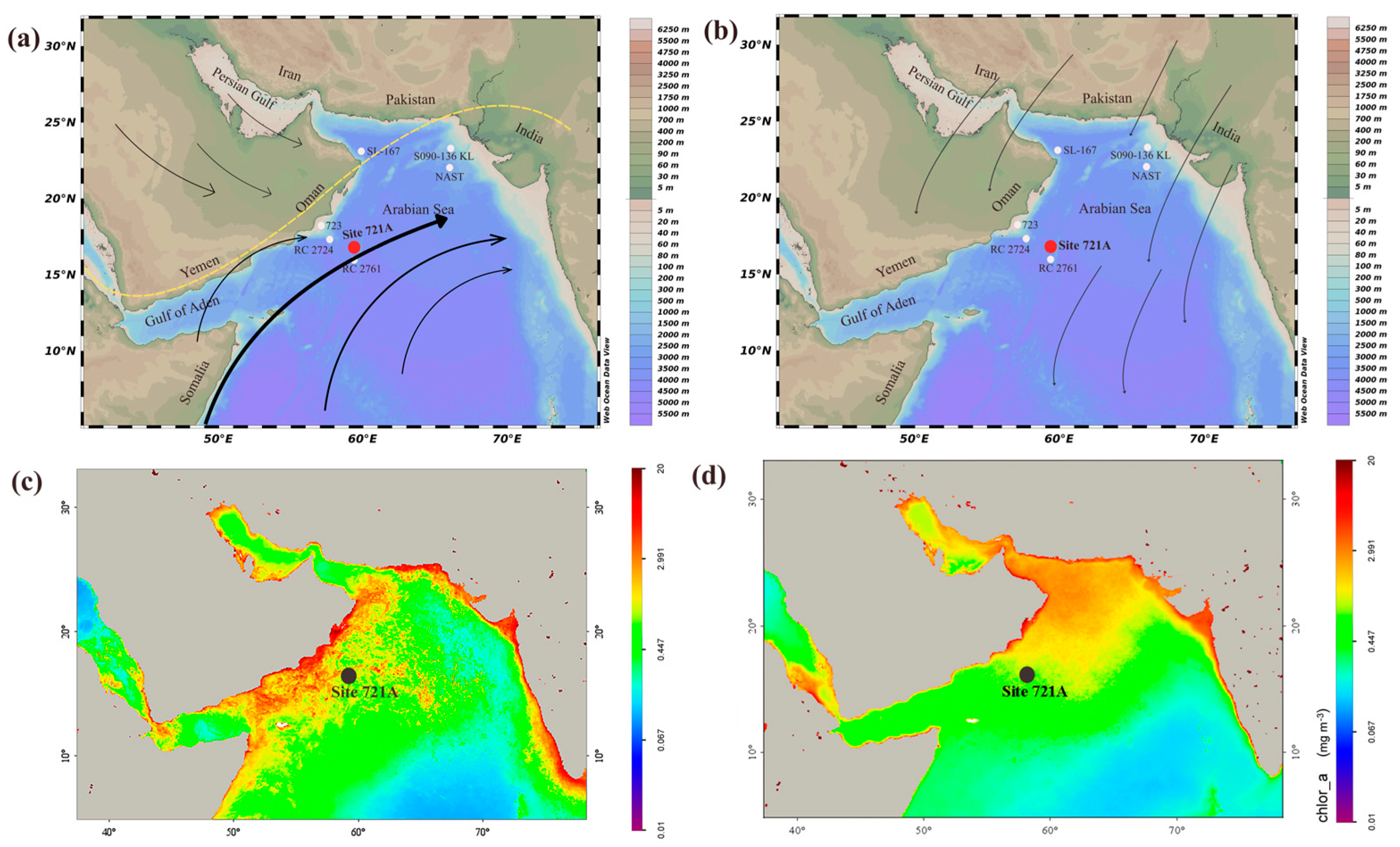
ODP Site 721A is influenced by the seasonal reversal winds of the Indian Ocean monsoon, (Figure 1). During the SW monsoon, an upwelling of deep, cold and nutrient-rich waters reach the sea surface. Sea surface temperatures drop to 20–22 °C, and a near-surface chlorophyll maximum develops. During the NE monsoon, water stratification takes place and SST increases to 26–27 °C [13].
The productivity pattern at the Owen Ridge is attributed to periodic NW-SE displacements of the Findlater Jet (FJ) axis and related line of zero wind stress curl in tune with glacial–interglacial changes [31]. North and northwest of the FJ axis, Ekman suction drives the upwelling of deep, cold, nutrient-rich water, enhancing biological productivity. Contrarily, to the south and southeast of the axis, Ekman pumping leads to downwelling and the retention of warm surface waters [18,32].
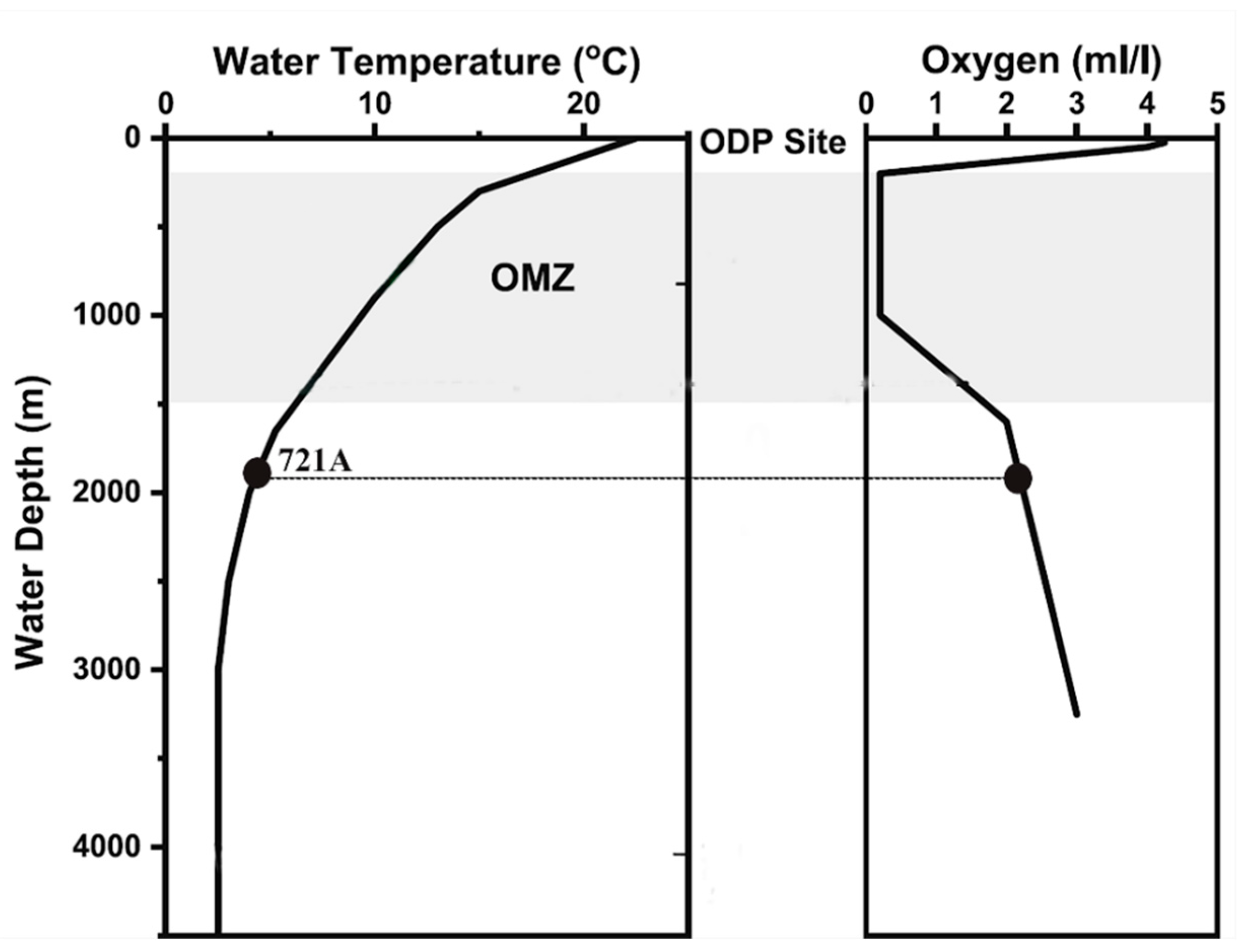
The Arabian Sea’s OMZ is a major denitrification site, with high primary production and suboxic/anoxic conditions, (O2 < 1–20 µM) (Figure 2), leading to the reduction of fixed nitrogen to free nitrogen gas [9]. The Arabian Sea OMZ extends meridionally between 60 and 75° E, zonally between 10 and 25° N and vertically between 150 and 1200 m depths with a denitrification rate of ~30 Tg Ny−1.
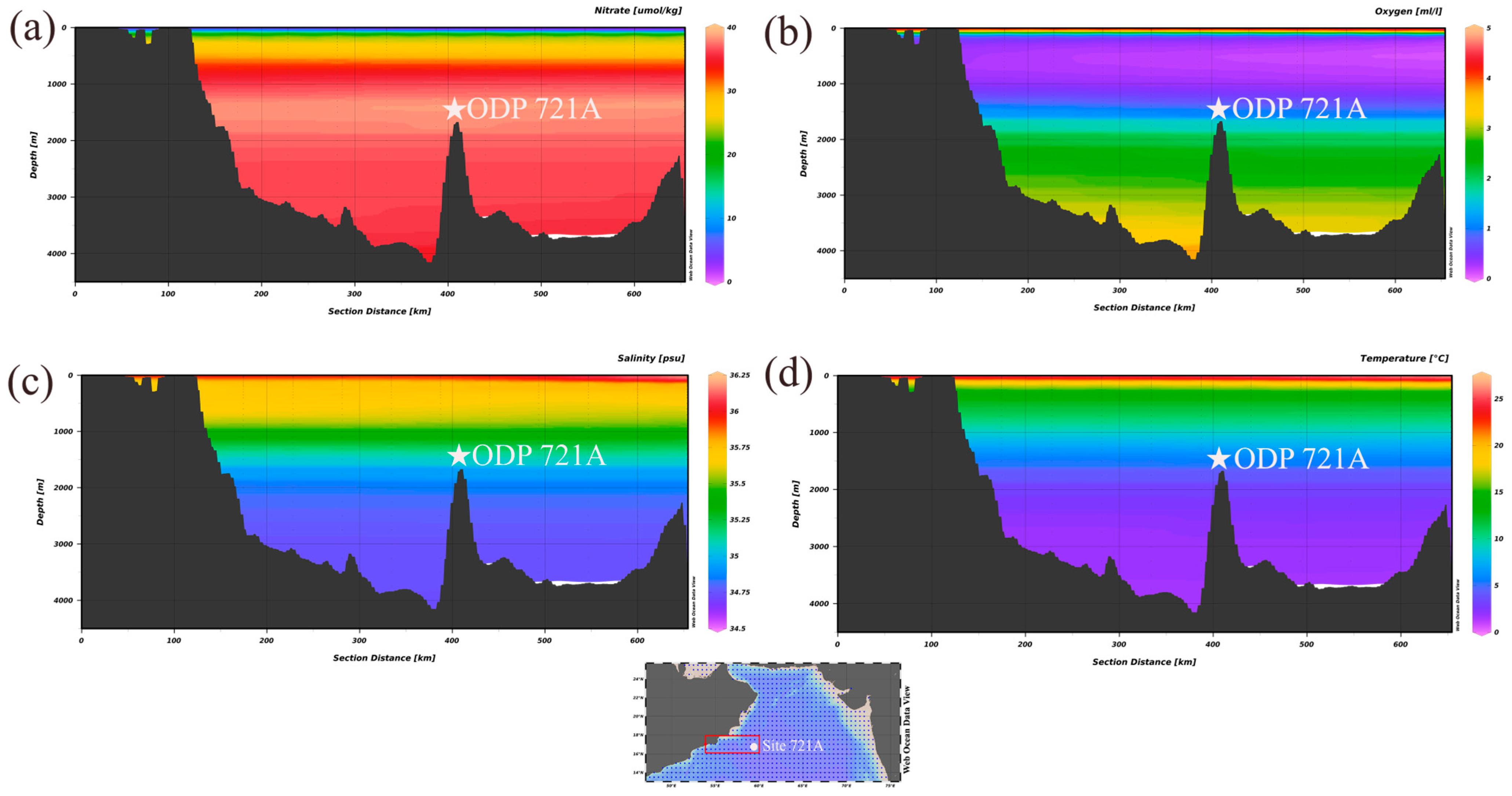
Figure 3 illustrates the modern vertical structure of nitrate, oxygen, salinity, and temperature along the transect crossing ODP Site 721A. An interesting aspect of the OMZ is that it is located northeastward of the high productive upwelling area off Somalia and Oman coasts [33,34,35].
The δ15NO3 oceanic average value is 4.7‰, before any denitrification [36]. In the Arabian Sea, the δ15NO3 modern values just below the euphotic zone are >7.5‰ [37]. This configuration confirms the overall 15N enrichment produced regionally by water column denitrification. These authors have also found values of δ15N bulk of ~10‰ at the neighboring site 722B, for periods when the OMZ was active and denitrification took place.
Figure 1. Bathymetric map of the Arabian Sea showing atmospheric circulation during the (a) southwest monsoon and (b) Northeast monsoon. The location of ODP site 721A (16°40.636′ N, 59°51.879′ E) is marked by a red circle. The bold arrow indicates the position of the Findlater Jet, and additional arrows show the dominant wind directions for each season. The dashed yellow line represents the position of the ITCZ during summer. Additional cores used for comparison are marked by white circles. SL167 (22°37.15′ N, 59°41.49′ E; 774 m water depth) [38]; SO-136 KL (SO90-136KL (23°07′0.80″ N, 66°30′0.98″ E, 568 m water depth) [39]; RC-2761 (16°37′0.50″ N, 59°51′0.70″ E; 1893 water depth); RC-2724 (17°43′0.10″ N, 57°49′.20″ E; 1416 m water depth) [40]; NAST (19°59.9′ N 65°41.0′ E; 3167 m water depth) [41]. ODP site 723 (18°3.79′ N, 57°36.61′ E) [42]. (c,d) Seasonal chlorophyll-a concentration (mg m−3) derived from MODIS-Aqua Level 3 climatology highlighting phytoplankton distribution during the (c) SW monsoon and (d) NE monsoon.
Oceans 07 00019 g001
Figure 2. Depth profile of the measured sea surface temperature and dissolved oxygen in the western Arabian Sea and position of ODP site 721A. Modified after Kharwar et al., 2025 [43].
Oceans 07 00019 g002
Figure 3. Modern hydrographic structure along a transect across the Arabian Sea showing (a) nitrate (µmol kg−1), (b) dissolved oxygen (mL L−1), (c) salinity (psu), and (d) temperature (°C). All panels are based on the GK-2004 global hydrographic climatology [44], distributed through Ocean Data View (ODV). The position of ODP site 721A is marked by a white star.
Oceans 07 00019 g003

3. Material and Methods

For this work, we selected ODP Site 721A, core 117-721A-1H-1, located in the northwestern Arabian Sea, on the crest of Owen Ridge at a depth of 1944 mbsl. The site is strategically positioned above the regional carbonate lysocline but below the modern OMZ. This location allows for little calcareous dissolution, which likely potentiates a better record of any changes in the monsoonal circulation system.
The 54 cm interval analyzed in this study comes from ODP core 117-721A-1H-1 and was resampled with 5 cm spacings, resulting in a total of 11 samples. This interval consists of very fine, light-green pelagic sediments, including foraminifer-bearing ooze-chalk and foraminifer–nannofossil ooze-chalk, with minimal evidence of bioturbation [45].

3.1. Isotopic and Elemental Data in Bulk Sediments (TOC, δ13C, δ15N, C/N)

All samples were analyzed for total organic carbon and nitrogen, as well as δ13C and δ15N carried out at the Stable Isotope Laboratory of the Center for Nuclear Energy in (Agriculture/University of São Paulo/Brazil). Samples were chemically treated with 5% hydrochloric acid (HCl) to remove carbonate, washed with distilled water, dried at 50 °C, and homogenized. δ13C analysis was performed by an ANCA SL2020 mass spectrometer (Sercon Ltd., Crewe, UK). Total organic carbon (TOC) and total nitrogen (TN) were read on a LECO Truspec CHNS elemental analyzer (LECO Corporation, St. Joseph, MI, USA). The δ13C results are expressed in ‰ with reference to VPDB (Vienna Pee Dee Belemnite) and ±0.2‰ of analytical precision. δ15N were measured in bulk sediments and expressed relative to atmospheric N2 with an analytical precision of ±0.2‰. TOC and TN results are expressed as a percentage of dry weight, with analytical precisions of 0.09% (TOC) and 0.07% (TN).

3.2. Radiocarbon 14C Ages

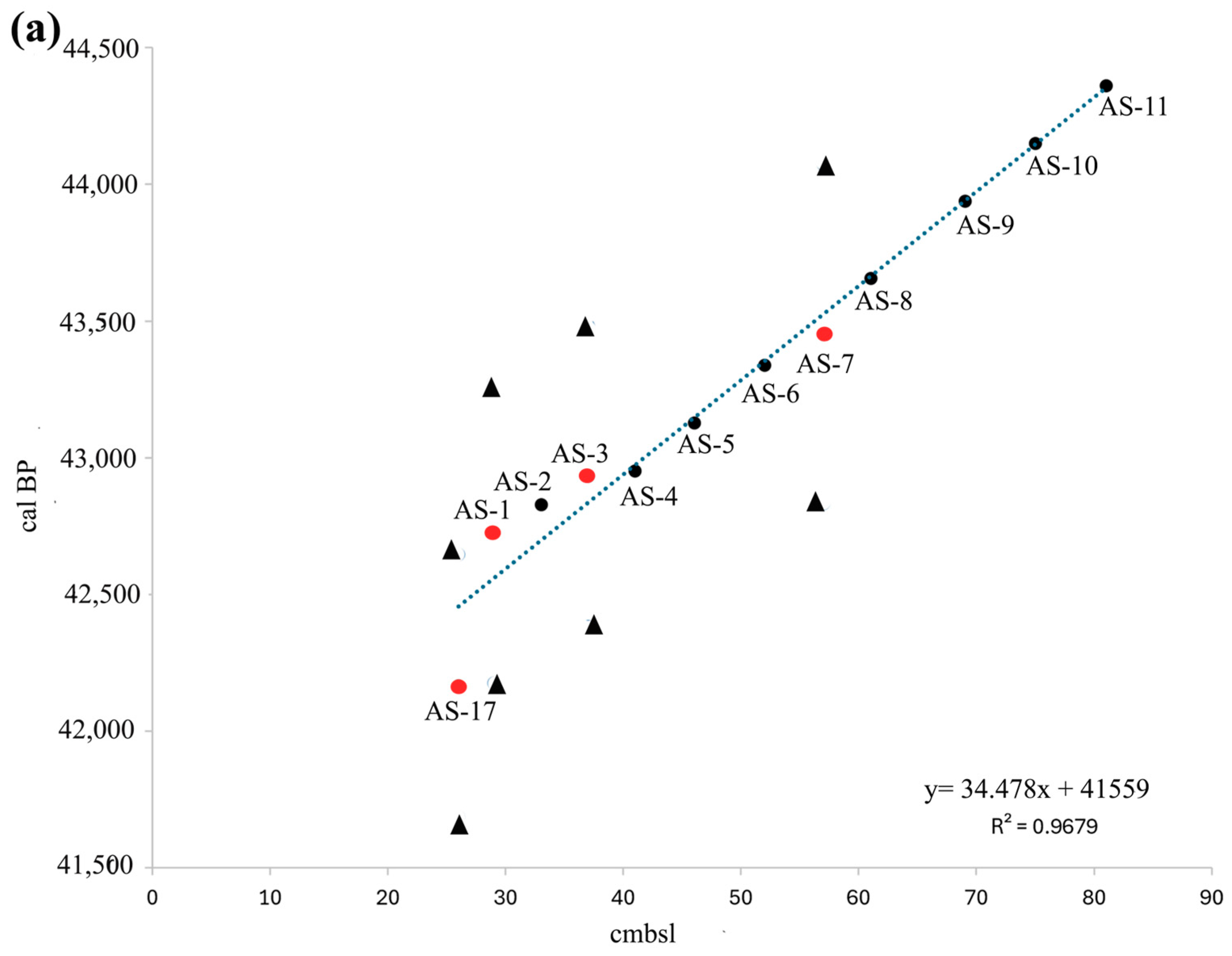
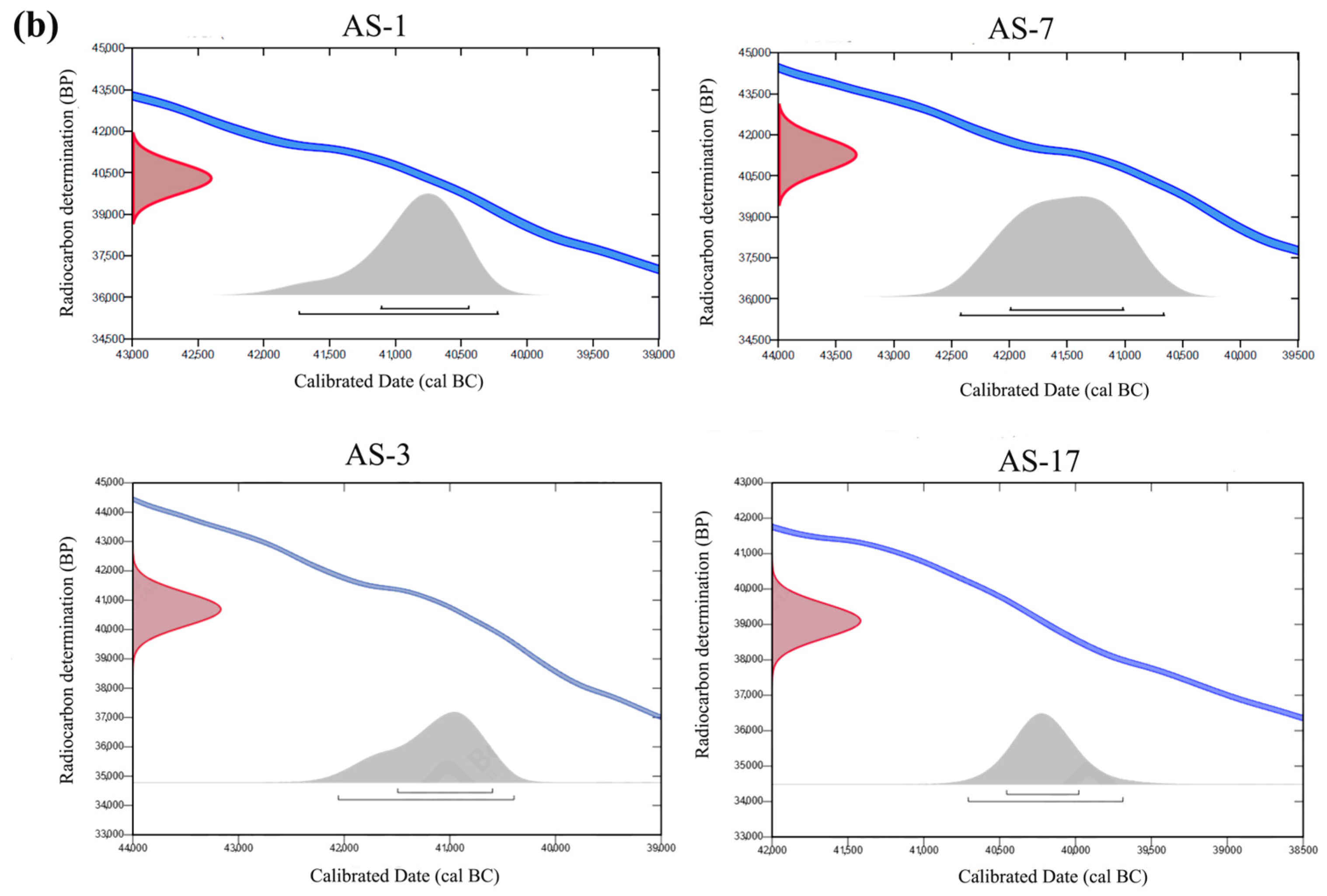
Six samples of Globigerinoides ruber (250–355 µm) were selected for radiocarbon (14C) analysis. Specimens were handpicked under a binocular microscope and submitted to Beta Analytic Inc. (Miami, FL, USA), where measurements were performed using accelerator mass spectrometry (AMS). One sample (AS-4) was excluded from further consideration due to an age reversal, and another (AS-13) yielded an age beyond the detection limit. All reported ages were calibrated using the MARINE20 calibration curve [46] in BetaCal4.20, applying the highest posterior density (HPD) method. Calibrated results were obtained as probability ranges, from which the mean of the 68.2% probability interval was used in the age–depth model. Interpolation between dated horizons was carried out using linear regression through the accepted 14C ages (Figure 4a,b).

3.3. δ13CG.ruber, δ18OG.ruber

For a simultaneous measurement of δ13C and δ18O, a subsample was taken in a mass suitable to provide a peak within the operating window of our Thermo Fisher Delta V Advantage IRMS (50–40,000 mV) (Thermo Fisher Scientific, Bremen, Germany). Samples were flushed with He, and 5 drops of phosphoric acid (H3PO4) were added to the sample, which stimulates the release of CO2 into the headspace of the vial. The sample was then placed in a 72 °C temperature-controlled tray where equilibration of the CO2 took place for one hour. Using a Pal autosampler in conjunction with a Thermo Fisher GasBench 2.0, the helium enters the sample and a mixture of He + CO2 is injected using the ISODAT 3.0 software, which synchronizes the sample label with the data output. Detection of CO2 was via gas chromatography (GC) with ISODAT control. Correction for drift was applied by normalizing the in-house standards to the expected values. Reported results are calibrated to the International Standard VPDB (±0.3‰). δ18Ow was calculated using the G. ruber-specific calibration of [47]: δ18Osw,VSMOW = (TMg/Ca − 14.2)/4.44 + δ18Ocarbonate, VPDB + 0.27.

3.4. Foraminifera Relative Abundance

Sediment samples were freeze-dried for 48 h and subsequently wet-sieved with ultrapure water through a 63 µm mesh to separate the coarse fraction from the mud. The retained material was oven-dried at 50 °C for 24 h prior to further processing. Foraminiferal analyses focused on the 250–355 µm size fraction. This size fraction was selected to minimize combined vital effect, e.g., ontogenetic, metabolic, and photosymbiotic [48,49]. The dried residue was then split into subsamples containing approximately 300 specimens each to enable the identification of the main components of the planktonic foraminiferal assemblage. Overall, the planktonic foraminifera shells were well preserved, allowing reliable taxonomic identification.
A Zeiss KL 300 LED binocular microscope (Carl Zeiss Microscopy GmbH, Jena, Germany) was used for the identification and separation of the planktonic foraminiferal species. Based on these counts, the relative abundance of each taxa was calculated. Although the full assemblage was identified, only the concentrations of G. ruber (d’Orbigny, 1839) and G. bulloides (d’Orbigny, 1826) were used in the present study.

4. Results

4.1. Age Model

A linear regression age–depth relationship was applied across the core section, except in the interval 29–37 cm, where regression resulted in a stratigraphic inversion (i.e., an age at 33 cm is younger than at 29 cm). In this interval, piecewise linear interpolation between dated tie points was applied to maintain stratigraphic consistency.
The age model is based on four calibrated radiocarbon 14C dates from Core ODP 117-721A-1H-1-W, covering the interval between 27 and 81 cm below the seafloor (cmbsf) (Figure 1a,b). The ages obtained for this section differ considerably from the timeframe expected using the sedimentation rates (3.5 cm kyr−1) of [50]. It is noteworthy to mention that the studied interval shows a high sedimentation rate of ~30 ± 5 cm kyr−1, approximately ten times greater than the mean rate calculated for site ODP 721A. While elevated, such rates are within the range observed for the Arabian Sea in the past. Bhattacharya et al. (2021) [51] analyzed two cores in the Eastern Arabian Sea in the past 12 kyr, and recorded sedimentation rates ranging from 11 to 132 cm kyr−1 within this interval.Shukla et al. (2025) [52] studied the interval between Henrich Stadial 2 and Younger Dryas in sediment cores from the eastern Arabian Sea and found that sedimentation rated up to 30.9 cm kyr−1, within the interval spanning 28,477 to 926 cal BP.
It is important to acknowledge that the chronology established here is constrained by four reliable radiocarbon dates. While the linear regression (R2 = 0.973) between these points provides a seemingly robust relationship, such an approach implicitly assumes constant sedimentation, which may not reflect the true depositional history. This limitation introduces significant chronological uncertainty when aligning our record with Greenland DO events (Figure 1a,b).
To assess the broader climatic context, our results were correlated with the INTIMATE event stratigraphy [24], which provides a widely used chronological framework for Dansgaard–Oeschger variability based on the Greenland ice-core record. The calibrated uncertainties of the radiocarbon ages (±480–620 years), combined with the broader INTIMATE event stratigraphy errors (±1600–1800 years), further complicate precise correlation. As a result, exact synchroneity between Arabian Sea and Greenland signals cannot be firmly established. Instead, our results should be interpreted as reflecting broad regional responses rather than event-synchronous changes.
The resulting age model places the studied interval (~42.2–44.3 cal kyr BP) within the timeframe of DO Events 12 and 11, as defined in the INTIMATE stratigraphy. However, overlapping error margins prevent us from resolving whether the observed changes were synchronous with the Greenland transitions, or lagging.
Nevertheless, the overall agreement between our chronology and the INTIMATE stratigraphy reinforces the view that the Indian Ocean monsoon system responded to abrupt high-latitude climate variability during Marine Isotope Stage 3. This adds to growing evidence for teleconnections between Northern Hemisphere climate dynamics and monsoon variability, though higher-resolution dating will be required to refine the temporal relationships and better understand the mechanisms involved.

4.2. Total Organic Carbon (TOC) and C/N

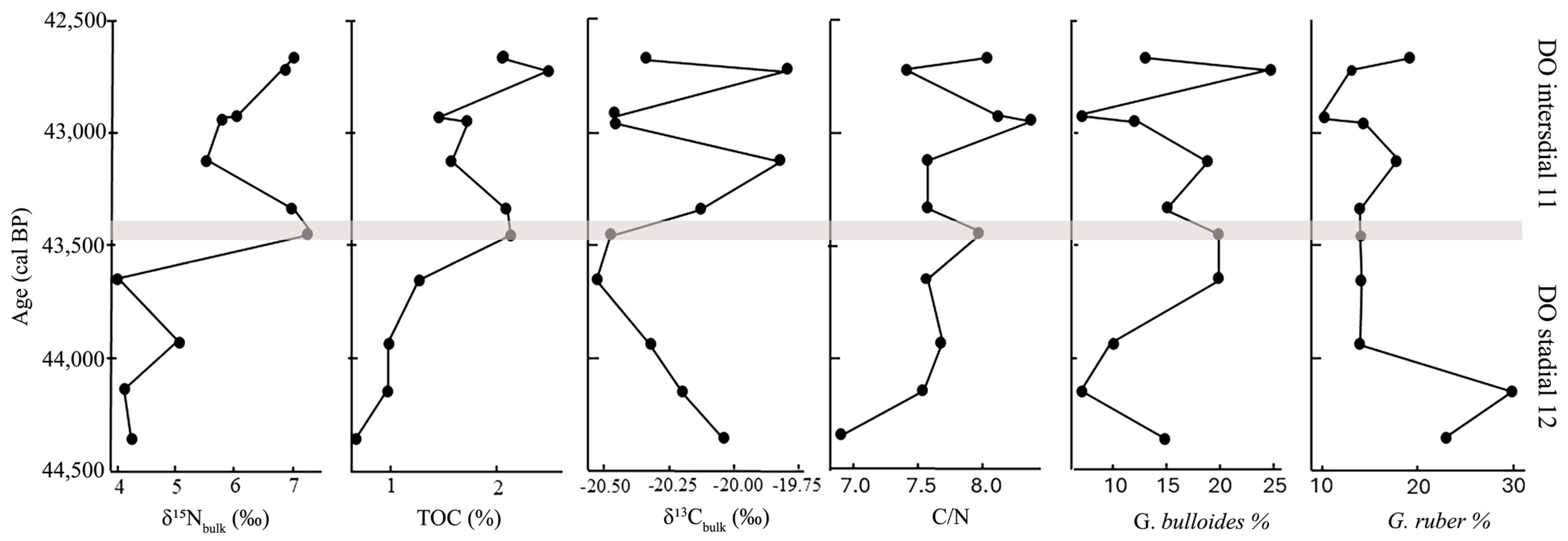
Total organic carbon (TOC) concentrations in bulk sediments from ODP Site 721A range from 0.59% to 2.52%, with an average of 1.47%, (median = 1.59% and standard deviation = 0.58%) (Figure 5). The TOC profile shows a general increasing trend toward the top of the record, suggesting enhanced organic matter accumulation over time. The lowest TOC value (0.69%) occurs at DO stadial 12. This is followed by a noticeable increase to 0.98%, and values stabilized at approximately 1.29% during the transition into DO interstadial 11. Within DO 11, TOC concentrations rose sharply, reaching 2.12% and 2.16%, before declining to 1.56%. A phase of minor oscillations is observed between 1.76% and 1.46% at 43,038 cal BP and 42,934 cal BP. At the top of the profile, values peak again at 2.09% and 2.52% at 42,726 cal BP.
The C/N ratio ranges from 6.9 to 8.4, with an average of 7.7. Overall, the C/N record remains relatively stable, exhibiting only minor fluctuations throughout the studied interval.

4.3. δ13Cbulk Sediment

The δ13Cbulk values from ODP Site 721A range from −20.52‰ to −19.78‰, with an average of −20.22‰ (mean = −20.31‰ and standard deviation = 0.26‰) (Figure 5). The profile displays considerable variability throughout the studied interval, with an overall amplitude of approximately 1‰. During DO stadial 12, the record shows a gradual depletion trend, beginning at −20.03‰ and fluctuating slightly between −20.19‰ and −20.31‰, before reaching a minimum of −20.52‰ at the transition into DO interstadial 11. Within DO 11, δ13Cbulk records its most pronounced excursion, rising sharply from −20.12‰ to −19.81‰, followed by an abrupt return to more negative values at −20.44‰. This is succeeded by brief stabilization at −20.45‰. Values then shift to −20.31‰, followed by a slight enrichment trend that results at −19.78‰, the highest δ13Cbulk value observed in the profile. This isotopic variability partly mirrors the trend observed in TOC concentrations, suggesting potential coupling between the carbon source or preservation and isotopic signature.

4.4. δ15Nbulk Sediment

The δ15Nbulk values from ODP Site 721A range from 4.02‰ to 7.29‰, with an average of 5.73‰, (median = 5.8‰ and standard deviation = 1.22‰) (Figure 5). Overall, the values remain relatively low compared with modern Arabian Sea values. During the DO stadial 12, δ15Nbulk shows pronounced variability, starting at 4.27‰, decreasing slightly to 4.17‰, and then increasing to 5.08‰. This is followed by a relative depletion to 4.02‰ at the transition into DO 11. Within DO interstadial 11, values rise sharply to a peak of 7.29‰, the highest in the record, before declining to 6.98‰. This is followed by two smaller excursions to 5.56‰ and 5.80‰. At 42,934 cal BP, a renewed increasing trend is observed, starting at 6.04‰ and oscillating between 6.88‰ and 7.01‰ by the end of the profile. The δ15Nbulk trend closely follows the TOC concentration profile.

4.5. Relative Abundance G. ruber & G. bulloides

The relative abundances of G. ruber and G. bulloides from ODP Site 721A exhibit distinct variability across the interval spanning DO events 12–11 (Figure 5). These variations indicate changes in surface-water conditions and productivity in the northwestern Arabian Sea during millennial-scale climate oscillations.
The relative abundance of G. bulloides ranges from approximately 8% to 30%. During DO 12, values are relatively low, starting around 10% and showing a gradual increase to ~18% toward the transition into DO 11. In DO 11, G. bulloides reach their highest abundance in the record, peaking at ~30%.Following this peak, values decrease slightly to ~25%, then show minor oscillations, fluctuating between ~22% and 27%.
The relative abundance of G. ruber ranges from approximately 10% to 35% across the studied interval. During DO stadial 12, G. ruber is most abundant, with values between 22% and 35%. This is followed by a steady decline during the transition into DO 11, reaching a minimum of around 12%. Within DO 11, G. ruber shows relatively low variability, with a modest peak at ~20%, increasing again to ~20%, then declining once more to ~10% near the top of the profile.
The abundance patterns of G. ruber and G. bulloides show an almost opposite relationship, with peaks in G. ruber corresponding to troughs in G. bulloides, and vice versa, highlighting contrasting preferences for stratified, warm surface waters versus cooler, nutrient-rich upwelling conditions.

4.6. δ13CG.ruber, δ18OG.ruber, and δ18Osw

Isotopic measurements of G. ruber13C and δ18O) and calculated δ18Osw values were obtained for selected intervals due to analytical constraints and sample preservation (Figure 6). Nonetheless, reliable data covering the periods corresponding to DO events 12–11 are available, and discernible trends are evident across these intervals, allowing comparison with other proxies.
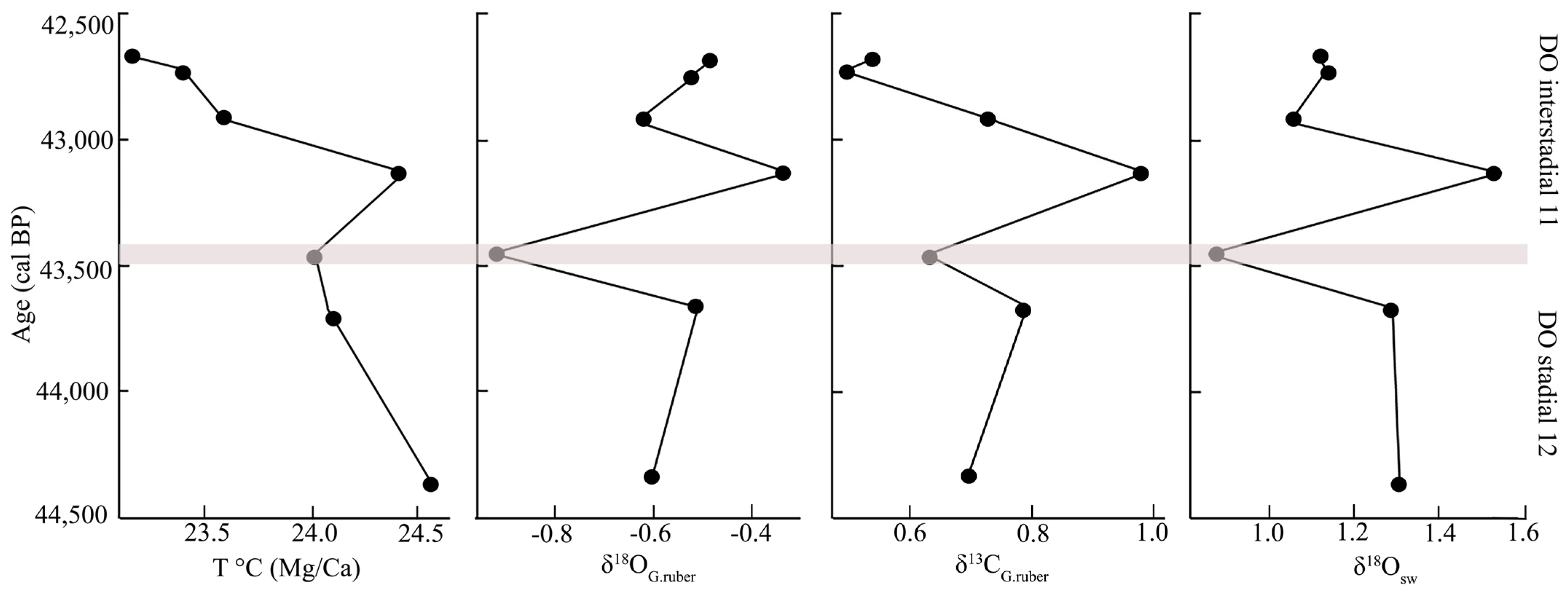
The δ18OG.ruber values show substantial variability across the studied interval, ranging from −0.93‰ to −0.31‰ (Figure 6). During DO 12, values are relatively depleted (−0.60‰), followed by slight enrichment to −0.50‰ at the transition into DO 11. Within DO interstadial 11, δ13C exhibits pronounced shifts, decreasing to −0.93‰ and subsequently increasing to −0.31‰, then returning to more depleted va;ues −0.63‰, followed by smaller oscillations between −0.47‰ and −0.50‰ toward the top of the profile.
δ13CG.ruber remain positive throughout the interval and range from 0.5‰ to 1.0‰. During DO stadial 12, values start at 0.7‰, slightly enriching to 0.8‰ at the DO 12–11 boundary (Figure 6). Within DO interstadial 11, values show the highest variability in the record, decreasing to 0.63‰, then sharply enriching to 1.0‰ and falling again to 0.75‰. At ~42,830 cal BP, values stabilize around 0.55‰ to 0.5‰.
Calculated and ice-volume-corrected δ18Osw values were used to assess surface-water salinity and temperature variability (Figure 6). During DO 12, values are relatively enriched, starting at 1.32‰ and remaining stable through the transition to DO 11 (1.30‰). Within DO 11, δ18Oswfluctuates markedly, decreasing to 0.85‰, then increasing to 1.57‰, followed by a drop to 1.06‰. Values are relatively stable around 1.12‰ to 1.14‰ At ~42,830 cal BP, the combined δ13CG.ruber, δ18OG.ruber, and δ18Osw records exhibit mirrored trends, reflecting their sensitivity to external environmental drivers such as surface-water temperature, salinity, and productivity variations during millennial-scale climate oscillations.

5. Discussion

5.1. Productivity and OMZ Variability

The relatively low to moderate values of δ15Nbulk resulting from the studied core, ODP 721A, indicate that denitrification intensity varied between moderate to low and was sometimes completely absent, reflecting a less pronounced and/or absent OMZ. Modern values of δ15Nbulk in the Arabian Sea for sediments deposited in the OMZ are between 9 and 10‰ [37], whereas in regions not affected by denitrification values of δ15Nbulk, <6‰ are preserved in the sediments [40,54,55]. Based on that, it is possible to interpret our results as recording two distinct responses of the OMZ to DO stadial and interstadial. During DO stadial 12, values of δ15Nbulk are low and therefore represent absence of denitrification. Towards the boundary between DO 12 and 11, results show that denitrification increased to values > 7‰, indicating a weak but possibly present OMZ.
Two primary mechanisms may drive changes in denitrification records: variations in local productivity affecting remineralization rates, and/or changes in ocean circulation and temperature altering the physical supply of dissolved oxygen. Simulations of the last glacial period suggested that changes in ocean circulation alone could account for the observed variations during glacial periods in dissolved oxygen levels, with a corresponding reduction in water-column denitrification of approximately 46% to 65% compared with present-day conditions [55].
At ODP Site 721A, the TOC profile closely parallels the trend observed in bulk sediments δ15N values, indicating a strong coupling between these two proxies. This correlation suggests that both responded similarly to changes in oceanographic and climatic conditions. TOC in marine sediments is a measure of the amount of organic matter that has accumulated over time. When surface water is very productive (i.e., it has high levels of algae and plankton growth), more organic material sinks and eventually gets buried as TOC in the sediments [56]. The coupling between TOC and δ15Nbulk in sediments from the Arabian Sea has also been observed by other authors and have been associated with an interplay between variability in surface-water productivity and OMZ strength [39,56].
The productivity signal inferred from δ15N values at Site 721A during DO Events 12–11 indicates an overall low-productivity regime, with relatively higher productivity rates during the interstadial. A similar pattern has been documented in core 136 KL from the northeastern Arabian Sea, where C37-alkenone concentrations over the past 65 kyr reveal persistently low productivity during stadials and Heinrich events and comparatively higher productivity during DO interstadials [30]. More recent work by Ma et al. (2022) [57] on sediments from the eastern Arabian Sea also supports this interpretation. Their analyses of TOC and G. bulloides relative abundance show that productivity was reduced during the Younger Dryas and Heinrich Stadial compared with Holocene conditions.
Our results are consistent with productivity trends observed at other sites in the western Arabian Sea. Pathak et al. (2020) [58] investigated monsoon-driven productivity changes at the nearby ODP Site 722 during late Quaternary and found that both the planktonic foraminiferal assemblage— including G. bulloides—and the Ba/Al productivity proxy increased during interglacial periods. Similarly, Kharwar et al. (2025) [43] examined millennial-scale hydrographic variability at ODP Site 728 using a multiproxy approach, including δ13C of G. ruber as an indicator of surface-water productivity. Their results also indicate enhanced productivity during interglacials.
In the Arabian Sea, periods of low productivity are typically associated with a weakening or collapse of the OMZ during glacial and stadial conditions (Figure 6). This reduced OMZ intensity is consistently reflected in sediment records across the basin through notably lower denitrification rates. For example, in the eastern Arabian Sea, core SO90-111KL, off the Pakistan margin, showed values of δ15Nbulk ranging between 4.0 and 6.5‰; core NAST in the central Arabian Sea δ15Nbulk < 8.5‰ and core SO42-74KL from the upwelling zone in the northewestern Arabian Sea are < 7‰, with lowest values found during Heinrich events [41,59]. Additionally, other cores from the northwestern Arabian Sea have also recorded a similar pattern of low δ15Nbulk during galcials/stadials such as ODP Site 723 and RC-27-24 on the Oman margin (δ15Nbulk < 6‰), and RC-27-61 on the Owen Ridge (δ15Nbulk 5–6‰) [40].
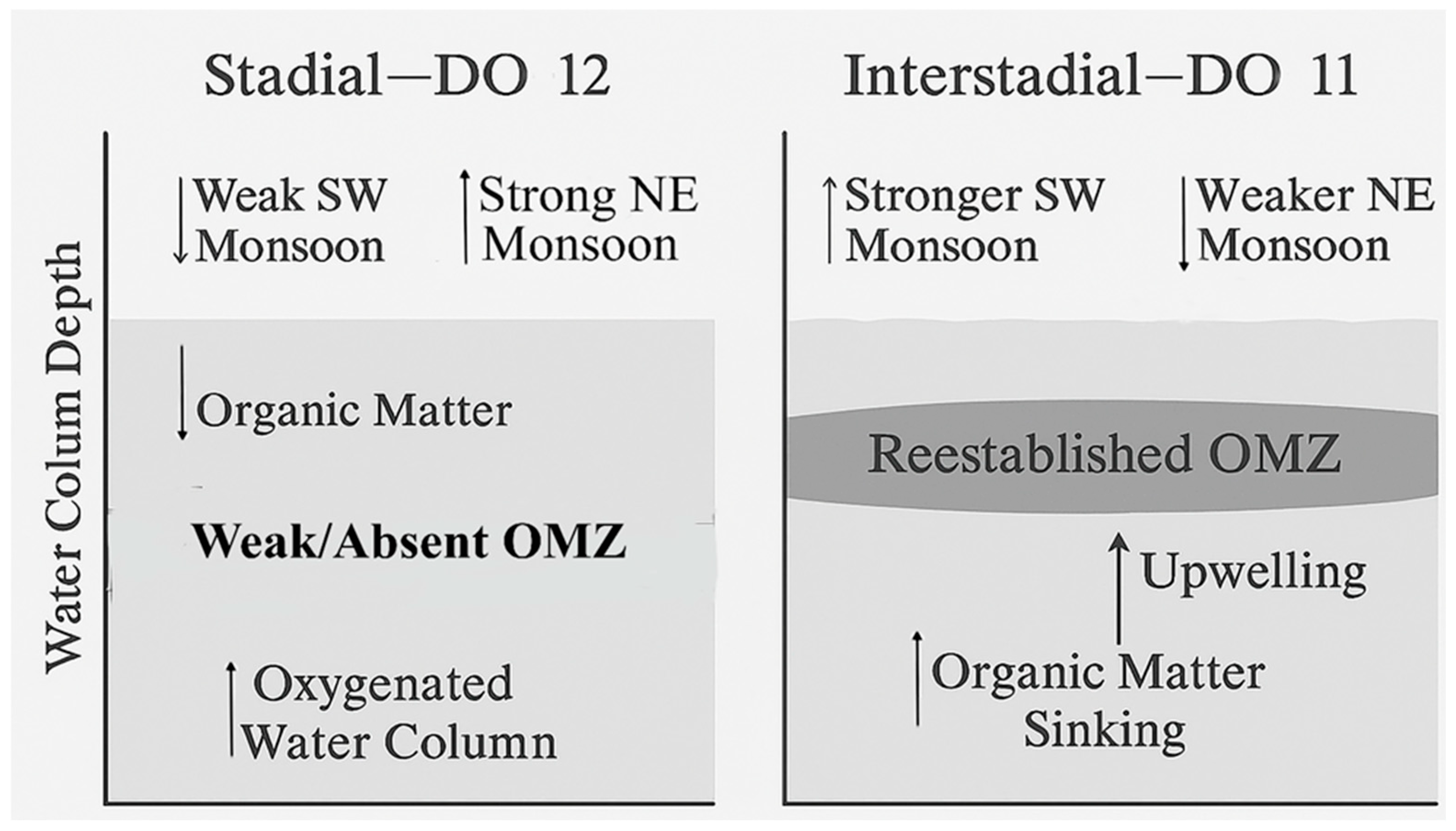
This pattern of weakened OMZ during colder intervals, associated with lower surface productivity, occurs under a reduced SW monsoon forcing. Under this scenario, low productivity rates, can be explained by the reduction in nutrient concentration in the surface water due to weak upwelling, and relative increase in water stratification associated with the dominance of the winter monsoon [60,61]. With less organic matter reaching intermediate depths, the demand for dissolved oxygen during remineralization is reduced, allowing these waters to remain better oxygenated, further increasing oxygen availability and suppressing denitrification [62,63,64]. Another possible explanation for the low productivity rates coupled with a weaker OMZ is an increase in intermediate water-mass ventilation due to the northwards incursion of the AAIW increasing the physical supply of oxygen to intermediate depths of the Arabian Sea [52,55].
To further examine the relationship between productivity rate and OMZ state, we have also analyzed the relative abundance of two planktonic foraminifera species G. ruber and G. bulloides. Conan & Brummer (2000) [65] observed that during the SW monsoon, G. bulloides exhibited very high shell fluxes, making up 21% and 54% of the foraminiferal assemblage. This increase is associated with enhanced upwelling, eddy transport, and elevated primary productivity, all of which modify the oceanographic structure of the Arabian Sea during the summer months. G. ruber, in constrast, is strongly influenced by the seasonal changes in surface-water hydrography that are dictated by the mode of the monsoon cycle. During the NE monsoon, G. ruber can dominate the assemblage, reaching up to 38%, while G. bulloides may account for only ~5%. The dominance of G. ruber during non-upwelling seasons suggests it is well adapted to the stratified, nutrient-poor surface mixed layer typical of this period.
Moreover, the relative abundance of G. bulloides aligns well with δ15Nbulk and TOC records (Figure 4). Intervals marked by low δ15Nbulk and TOC coincide with low G. bulloides and high G. ruber abundances, indicating more stratified surface-water conditions, reduced upwelling and low productivity, responsive to a weak SW monsoon. In contrast during intervals marked by high δ15Nbulk and TOC values, assciated with more intense upwelling due to a stronger SW monsoon. G. bulloides and G. ruber do not exhibit the expected abundance trends. G. bulloides shows an increase in abundance only at the onset of DO 11, followed by a decline toward the end of this interval.This indicates that despite the reinvigoration of the SW monsoon relative to the previous period, upwelling conditions were still insufficient to shift the assemblage toward a dominance of G. bulloides over G. ruber.
To complete the multiproxy approach applied in this study, we have traced the origin of organic matter to the Owen Ridge during DO events and investigated if there have been any changes. The results for δ13Cbulk, with an average of −20.22‰, and C/N ratios, averaging 7.7, indicate a constant marine source of organic matter with a mix between algae and marine particulate organic matter (POM) signals. Carbon isotope ratios (δ13Cbulk) and organic carbon to total nitrogen ratios (C/N) are powerful tools in tracing the source of organic carbon to the sediments in coastal and marine environments [66,67]. Marine bacteria and algae typically have low C/N ratios of 4–10. The organic matter of marine source (particulate organic matter (POM), dissolved organic matter (DOM)) typically has δ13C values between −25‰ and −15‰ [66,68,69,70]. In the modern ocean, suspended POM varies from −20 ± 2‰, at low to mid latitudes, to −30 ± 4‰ in the Southern Ocean [71]. The minor negative excursion in δ13Cbulk, at 43,167 cal BP, can be explained by changes in the type and composition of marine organic matter predominant at the time, i.e., diatoms, marine algae, dinoflagellates, zooplankton, bacteria, etc., without changing its fully marine origin [66,68]. The isotopic signature observed in sediments from ODP site 721A is in agreement with the organic matter source from other ODP sites off the Oman margin, ODP site 720, 723 and 724, as being of full marine origin [42].
Results of the ratio of bulk sediments δ13C and C/N have provided important information regarding the source of organic matter being the Owen Ridge at the time of DO 12–11.

5.2. Surface-Water Hydrography

Up to this point, all proxies consistently indicate low productivity during DO stadial 12 and relatively higher productivity during the warmer DO interstadial 11. In this section, we expand the multi-proxy approach by incorporating stable isotopic signals measured from G. ruber shells. These isotopic records are also interpreted in the context of past surface-water salinity and productivity, providing an additional perspective on the environmental conditions that prevailed during these climatic oscillation.
The isotopic signals recorded in G. ruber at ODP site 721A, do not fully align with the other productivity-related proxies previously discussed, suggesting that G. ruber capture a more complex combination of environmental influences. We start by analyzing δ18O values. The pattern displayed by G. ruber δ18O values are opposite to what would be expected at the boundary between DO stadial 12 to DO interstadial 11. At this point, values transition from relatively depleted values to a positive excursion recording more enriched values.
Foraminferal shells reliably record ice-volume changes during glacial–interglacial periods. During glacial periods, preferential sequestration of 16O in ice sheets leaves the ocean water enriched in 18O, whereas when the climate warms up and these ice sheets melt they flood the ocean with water rich in 16O [70]. In the Arabian Sea, several studies have successfully applied G. ruber isotopic records to track changes in monsoonal strength, surface-water stratification, and productivity [72,73,74].
Based on that premise, the values of δ18O on G. ruber shell was expected to show enriched values during DO stadial 12 and shift to more depleted values as DO interstadial 11 set in. However, our data shows the exact opposite behavior. We interpret this uncoupling as G. ruber recording local processes rather than being in phase with Greenland oceanographic changes. Besides from being influenced by ice volume, the δ18O recorded by foraminfera shells can also be affected by changes in water temperature and salinity. We have then analyzed the temperature record obatined for these smaples in Rodrigues (2025) [75]), to investigate if temperature or salinity had played a major role controlling the signal recorded by G. ruber (Figure 7).
Based on the data, SST has not significantly changed over this interval; however, the δ18Osw has shown strong changes synchronously to δ18O. Figure 7 shows that the δ18Osw trend mirrors δ18O. The strong correlation between these proxies suggests that both are being influenced by a common environmental process. Since we have corrected δ18Osw for ice volume, the changes in the isotopic composition of sea water represent local changes in salinity. Sea surface salinity, in turn, is controlled by the interaction between evaporation and precipitation. When evaporation is the dominant process, the lighter 16O isotope preferentially enters the vapor phase, leaving the surface water enriched in 18O [73].
Therefore, we interpret that G. ruber shells δ18O have recorded local oceanographic processes mainly driven by changes in the Indian Ocean monsoon led by Greenland’s climatic dynamic. At the end of DO stadial 12, both isotopes indicate a freshening associated with a depletion in δ18O. We attribute that to the initiation phase of stronger upwelling that brought up fresher water, simultaneously reducing δ18O G. ruber and δ18Osw. The enrichment, rather than a depletion, which happened at DO interstadial 11, was led by an intensification of the NE monsoon that increased evaporation at the surface.
Almogi-Labin et al. (2000) [76] investigated benthic and selected planktonic foraminifera, along with stable isotope records from sediments in the Gulf of Aden, to reconstruct past variations in the influence of the NE monsoon on surface productivity. Unlike the northwestern Arabian Sea, the Gulf of Aden is primarily affected by the NE monsoon system. Their study revealed that between approximately 60 and 13 kyr, the NE monsoon was exceptionally strong. The results of our work are consistent with their interpretation, further supporting the persistence of intensified NE monsoon conditions during this interval.
To investigate past surface-water productivity, we analyze the variations in the δ13C signal recorded in G. ruber shells. Variations in the sources of upwelled waters can influence the δ13C of dissolved inorganic carbon (DIC), thereby affecting the isotopic composition of foraminiferal shells [77]. Additionally, δ13C is influenced by local processes, particularly the preferential uptake of 12C by phytoplankton during photosynthesis, which enriches the surface-water DIC pool in 13C [48,77,78,79,80].
In this context, the δ13C enrichment observed in our dataset, particularly the increase from 0.6‰ (43,453 cal BP) to 1.0‰ (43,167 cal BP) across the transition between DO stadial 12 and DO intersatdial 11, may reflect either (i) a temporal lag in recording the increased productivity signal marked by bulk-sediment proxies and/or (ii) an enhanced contribution of southern-sourced water masses, such as AAIW. Similarly, during DO 11, at 42,934 cal BP, δ13C remains relatively enriched (~0.75‰) even as bulk proxies show a slight decline before resuming an increasing trend (Figure 5). This offset suggests that the isotopic signals in G. ruber may be capturing a different or earlier hydrographic response, potentially related to changes in water-mass characteristics rather than immediate productivity shifts.
In our record, variations in δ13C of G. ruber thus likely reflect shifts in surface-water properties driven by local monsoonal hydrology and regional oceanographic processes. These changes, occurring in phase with millennial-scale climatic oscillations in Greenland, suggest a teleconnection in which high-latitude perturbations modulated monsoon intensity and surface productivity in the Arabian Sea during DO events.

6. Conclusions

Understanding how oscillations in the IOM system influence the Arabian Sea is essential for predicting the region’s response to future climate change. Sediment samples from ODP Site 721A provided valuable information into past oceanographic and climatic conditions in the northwestern Arabian Sea, particularly during DO events 12–11. The strong coupling among the different productivity proxies shows that DO stadial 12, was marked by low δ15N values, low TOC, and reduced G. bulloides abundances, indicating a decline in productivity and reflecting conditions in which the OMZ was largely absent. Contrarily, DO interstadial 11 is associated with high δ15N values, elevated TOC concentrations, and higher relative abundances of G. bulloides, reflecting periods of increased productivity and a more developed OMZ.
The isotopic signal recorded in G. ruber shells (δ18O, δ13C) primarily reflects local hydrographic conditions. The enrichment of δ18OG.ruber records increased surface-water evaporation under a stronger NE monsoon and a relatively weaker SW monsoon, rather than by global ice-volume effects. δ13CG.ruber values provide additional information on the disctinct surface-water productivity scenario at each DO event. Enriched δ13C during DO interstadial 11 aligns with the productivity increase inferred from bulk-sediment isotopic markers and supports the interpretation of the dominance of local processes in the surface-water hydrography.
Further insights come from δ18Osw values, corrected for global ice volume. These values are significantly enriched compared with the modern ocean average (~0‰) and the modern Arabian Sea δ18Osw (~0.4–0.8‰) [81], indicating that oceanographic conditions during DO events were markedly different from today. This enrichment likely results from increased evaporation during strong NE monsoon phases, combined with variations in upwelling and water-mass mixing, which influenced surface salinity and regional hydrography. These processes, together with enhanced winter mixing and changes in intermediate water ventilation, played a central role in modulating the strength and structure of the OMZ, ultimately affecting both productivity and organic matter preservation.
These fluctuations were likely driven by a complex interplay between intermediate water-mass changes and local hydrographic processes modulated by the monsoon system. Our results also suggest that during DO events, the NE monsoon was overall stronger than the SW monsoon.
The organic matter preserved in the sediments is of fully marine origin, with negligible terrestrial input, further supporting the interpretation that the recorded signals primarily reflect marine processes. The multi-proxy approach applied here, integrating foraminifera relative abundance, geochemical, and isotopic indicators, highlights the value of combining surface and subsurface records to unravel the dynamics of past monsoonal variability.
To further improve the resolution and accuracy of these interpretations, refining the age model is essential. Enhanced chronological control will allow for more precise reconstructions of the timing and progression of climatic shifts, thereby deepening our understanding of how regional monsoon systems responded to abrupt global climate events and contributing to broader perspectives on future climate behavior in the Arabian Sea.

Author Contributions

Conceptualization, P.S.R.; methodology, P.S.R.; software, P.S.R.; validation, P.S.R.; formal analysis, P.S.R.; investigation, P.S.R. and M.C.F.; resources, P.S.R.; data curation, P.S.R.; writing—original draft, P.S.R.; writing—review and editing, M.C.F.; visualization, P.S.R.; supervision, W.B. and M.C.F.; project administration, W.B.; funding acquisition, W.B. All authors have read and agreed to the published version of the manuscript.

Funding

This work was supported by The Research Council (TRC) of the Sultanate of Oman under the Block Funding Program. TRC Block Funding Agreement No. BFP/RGP/EBR/21/181.

Data Availability Statement

The data supporting the findings of this study will be deposited at Mendeley Data and made publicly available at https://data.mendeley.com/drafts/xdtb6v3n8h, accessed on 10 December 2025, following a temporary embargo to allow for the completion and publication of the associated PhD thesis. During the embargo period, the data are available from the corresponding author upon reasonable request.

Acknowledgments

This research used samples provided by the International Ocean Discovery Program (IODP), provided by Kochi Core Center (KCC).

Conflicts of Interest

The authors declare no conflicts of interest.

References

  1. Jensen, M.M.; Lam, P.; Revsbech, N.P.; Nagel, B.; Gaye, B.; Jetten, M.S.; Kuypers, M.M. Intensive nitrogen loss over the Omani Shelf due to anammox coupled with dissimilatory nitrite reduction to ammonium. ISME J. 2011, 5, 1660–1670. [Google Scholar] [CrossRef]
  2. Naqvi, S.W.A.; Naik, H.; Pratihary, A.; D’Souza, W.; Narvekar, P.V.; Jayakumar, D.A.; Devol, A.H.; Yoshinari, T.; Saino, T. Coastal versus open-ocean denitrification in the Arabian Sea. Biogeosciences 2006, 3, 621–633. [Google Scholar] [CrossRef]
  3. Rixen, T.; Cowie, G.; Gaye, B.; Goes, J.; Gomes, H.D.R.; Hood, R.R.; Lachkar, Z.; Schmidt, H.; Segschneider, J.; Singh, A. Reviews and syntheses: Present, past, and future of the oxygen minimum zone in the northern Indian Ocean. Biogeosciences 2020, 17, 6051–6080. [Google Scholar] [CrossRef]
  4. Ward, B.B.; Devol, A.H.; Rich, J.J.; Chang, B.X.; Bulow, S.E.; Naik, H.; Pratihary, A.; Jayakumar, A. Denitrification as the dominant nitrogen loss process in the Arabian Sea. Nature 2009, 461, 78–81. [Google Scholar] [CrossRef]
  5. Naqvi, S.W.A.; Bange, H.W.; Farías, L.; Monteiro, P.M.S.; Scranton, M.I.; Zhang, J. Marine hypoxia/anoxia as a source of CH4 and N2O. Biogeosciences 2010, 7, 2159–2190. [Google Scholar] [CrossRef]
  6. Paulmier, A.; Ruiz-Pino, D. Oxygen minimum zones (OMZs) in the modern ocean. Prog. Oceanogr. 2009, 80, 113–128. [Google Scholar] [CrossRef]
  7. De Sousa, S.N.; Dileepkumar, M.; Sardessai, S.; Sarma, V.; Shirodkar, P.V. Seasonal variability in oxygen and nutrients in the central and eastern Arabian Sea. Curr. Sci. 1996, 71, 847–851. [Google Scholar]
  8. Naqvi, S.W.A. Some aspects of the oxygen-deficient conditions and denitrification in the Arabian Sea. J. Mar. Res. 1987, 45, 1049–1072. [Google Scholar] [CrossRef]
  9. Morrison, J.; Codispoti, L.; Gaurin, S.; Jones, B.; Manghnani, V.; Zheng, Z. Seasonal variation of hydrographic and nutrient fields during the US JGOFS Arabian Sea Process Study. Deep-Sea Res. Part. II Top. Stud. Oceanogr. 1998, 45, 2053–2101. [Google Scholar] [CrossRef]
  10. Chaichitehrani, N.; Allahdadi, N.; Allahdadi, M.N. Overview of Wind Climatology for the Gulf of Oman and the Northern Arabian Sea Sediment transport modeling View project Wave Prediction Using a Mathematical model and comparing results with empirical prediction methods View project Overview of Wind Climat. Am. J. Fluid. Dyn. 2018, 8, 1–9. [Google Scholar]
  11. Cheng, H.; Sinha, A.; Wang, X.; Cruz, F.W.; Edwards, R.L. The Global Paleomonsoon as seen through speleothem records from Asia and the Americas. Clim. Dyn. 2012, 39, 1045–1062. [Google Scholar] [CrossRef]
  12. Morrison, J.M. Inter-monsoonal changes in the T-S properties of the near-surface waters of the northern Arabian Sea. Geophys. Res. Lett. 1997, 24, 2553–2556. [Google Scholar] [CrossRef]
  13. Peeters, F.J.C.; Brummer, G.-J.A. The seasonal and vertical distribution of living planktic foraminifera in the NW Arabian Sea. Geol. Soc. Spec. Publ. 2002, 195, 463–497. [Google Scholar] [CrossRef]
  14. Weller, R.; Fischer, A.; Rudnick, D.; Eriksen, C.; Dickey, T.; Marra, J.; Fox, C.; Leben, R. Moored observations of upper-ocean response to the monsoons in the Arabian Sea during 1994–1995. Deep-Sea Res. Part II Top. Stud. Oceanogr. 2002, 49, 2195–2230. [Google Scholar] [CrossRef]
  15. Findlater, J. Mean Monthly Airflow At Low Levels. Geophys. Mem. 1971, 16, 1–53. [Google Scholar]
  16. Findlater, J. Observational aspects of the low-level cross-equatorial jet stream of the western Indian Ocean. Pure Appl. Geophys. PAGEOPH 1977, 115, 1251–1262. [Google Scholar] [CrossRef]
  17. Weller, R.; Baumgartner, M.; Josey, S.; Fischer, A.; Kindle, J. Atmospheric forcing in the Arabian Sea during 1994–1995: Observations and comparisons with climatology and models. Deep-Sea Res. Part II Top. Stud. Oceanogr. 1998, 45, 1961–1999. [Google Scholar] [CrossRef]
  18. Kushwaha, V.K.; Kumar, S.P.; Feba, F.; Ashok, K. Findlater jet induced summer monsoon memory in the Arabian Sea. Sci. Rep. 2022, 12, 13037. [Google Scholar] [CrossRef]
  19. Le Mézo, P.; Beaufort, L.; Bopp, L.; Braconnot, P.; Kageyama, M. From monsoon to marine productivity in the Arabian Sea: Insights from glacial and interglacial climates. Clim. Past. 2017, 13, 759–778. [Google Scholar] [CrossRef]
  20. Clemens, S.C.; Prell, W.L.; Murray, D.W.; Shimmield, G.B.; Weedon, G.P. Forcing Mechanisms of the Indian Ocean monsoon. Nature 1991, 353, 720–725. [Google Scholar] [CrossRef]
  21. Gupta, A.K.; Anderson, D.M.; Overpeck, J.T. Abrupt changes in the Asian southwest monsoon during the Holocene and their links to the North Atlantic Ocean. Lett. Nat. 2003, 421, 354–356. [Google Scholar] [CrossRef]
  22. Hong, Y.T.; Hong, B.; Lin, Q.H.; Zhu, Y.X.; Shibata, Y.; Hirota, M.; Uchida, M.; Leng, X.T.; Jiang, H.B.; Xu, H.; et al. Correlation between Indian Ocean summer monsoon and North Atlantic climate during the Holocene. Earth Planet. Sci. Lett. 2003, 211, 371–380. [Google Scholar] [CrossRef]
  23. Singh, D.P.; Saraswat, R.; Mohtadi, M.; Kumar, P. Warm northern tropical Indian Ocean strengthened the ocean circulation prior to the last glacial termination. Glob. Planet. Change 2022, 209, 103733. [Google Scholar] [CrossRef]
  24. Rasmussen, S.O.; Bigler, M.; Blockley, S.P.; Blunier, T.; Buchardt, S.L.; Clausen, H.B.; Cvijanovic, I.; Dahl-Jensen, D.; Johnsen, S.J.; Fischer, H.; et al. A stratigraphic framework for abrupt climatic changes during the Last Glacial period based on three synchronized Greenland ice-core records: Refining and extending the INTIMATE event stratigraphy. Quat. Sci. Rev. 2014, 106, 14–28. [Google Scholar] [CrossRef]
  25. Siddall, M.; Rohling, E.J.; Thompson, W.G.; Waellbroeck, C. Marine isotope stage 3 sea level fluctuations: Data synthesis and new outlook. Rev. Geophys. 2008, 46, 1–29. [Google Scholar] [CrossRef]
  26. Deplazes, G.; Lückge, A.; Stuut, J.-B.W.; Pätzold, J.; Kuhlmann, H.; Husson, D.; Fant, M.; Haug, G.H. Weakening and strengthening of the Indian monsoon during Heinrich events and Dansgaard-Oeschger oscillations. Paleoceanography 2014, 29, 99–114. [Google Scholar] [CrossRef]
  27. Tripathi, S.; Behera, P.; Tiwari, M. Evolution and dynamics of the denitrification in the Arabian Sea on millennial to million-year timescale. Curr. Sci. 2020, 119, 282–290. [Google Scholar] [CrossRef]
  28. Nagoji, S.; Tiwari, M. Causes and climatic influence of centennial-scale denitrification variability in the southeastern Arabian Sea since the last glacial period. Quat. Res. 2021, 101, 156–168. [Google Scholar] [CrossRef]
  29. Kumar, B.; Govil, P.; Agrawal, S.; Kumar, P.; Verma, D.; Khan, H. Western equatorial Indian Ocean surface hydrographic variations inferred from isotopic record of planktic foraminifera Globigerinoides ruber during last ~412,000 years. J. Earth Syst. Sci. 2025, 134, 58. [Google Scholar] [CrossRef]
  30. Schulte, S.; Müller, P.J. Variations of sea surface temperature and primary productivity during Heinrich and Dansgaard-Oeschger events in the Northeastern Arabian Sea. Geo-Mar. Lett. 2001, 21, 168–175. [Google Scholar] [CrossRef]
  31. Budziak, D. Late Quaternary monsoonal climate and related variations in paleoproductivity and alkenone-derived sea-surface temperatures in the western Arabian Sea. In Berichte, Fachbereich Geowissenschaften; Universität Bremen: Bremen, Germany, 2001. [Google Scholar]
  32. Bauer, S.; Hitchcock, G.L.; Olson, D.B. Influence of monsoonally-forced Ekman dynamics upon surface layer depth and plankton biomass distribution in the Arabian Sea. Deep. Sea Res. Part. A Oceanogr. Res. Pap. 1991, 38, 531–553. [Google Scholar] [CrossRef]
  33. Naqvi, S.W.A. Denitrification processes in the Arabian Sea. Proc. Indian Acad. Sci.—Earth Planet. Sci. 1994, 103, 279–300. [Google Scholar] [CrossRef]
  34. Olson, D.B.; Hitchcock, G.L.; Fine, R.A.; Warren, B.A. Maintenance of the low-oxygen layer in the central Arabian Sea. Deep-Sea Res. Part. II 1993, 40, 673–685. [Google Scholar] [CrossRef]
  35. Shenoy, D.M.; Suresh, I.; Uskaikar, H.; Kurian, S.; Vidya, P.J.; Shirodkar, G.; Gauns, M.U.; Naqvi, S.W.A. Variability of dissolved oxygen in the Arabian Sea Oxygen Minimum Zone and its driving mechanisms. J. Mar. Syst. 2020, 204, 103310. [Google Scholar] [CrossRef]
  36. Sigman, D.M.; Altabet, M.A.; Michener, R.; McCorkle, D.C.; Fry, B.; Holmes, R.M. Natural abundance-level measurement of the nitrogen isotopic composition of oceanic nitrate: An adaptation of the ammonia diffusion method. Mar. Chem. 1997, 57, 227–242. [Google Scholar] [CrossRef]
  37. Altabet, A.M.; Murray, D.W.; Prell, W.L. Climatically linked oscillations in Arabian Sea denitrification over the past lm.y.: Implications for the marine N cycle. Paleoceanography 1999, 14, 732–743. [Google Scholar] [CrossRef]
  38. Maier, J.; Burdanowitz, N.; Schmiedl, G.; Gaye, B. Spatial and temporal variability of sea surface temperatures and monsoon dynamics in the northwestern Arabian Sea during the last. EGUsphere 2024, 30, 1–29. [Google Scholar] [CrossRef]
  39. Schulz, H.; Von Rad, U.; Erlenkeuser, H. Correlation between Arabian Sea and Greenland climate oscillations of the past 110,000 years. Nature 1998, 393, 54–57. [Google Scholar] [CrossRef]
  40. Altabet Mark, A.; Francois, R.; Murray, D.W.; Prell, W.L. Climate-related variations in denitrification in the Arabian Sea from sediment15N/14N ratios. Nature 1995, 373, 506–509. [Google Scholar] [CrossRef]
  41. Ivanova, E.; Schiebel, R.; Singh, A.D.; Schmiedl, G.; Niebler, H.S.; Hemleben, C. Primary production in the Arabian Sea during the last 135 000 years. Palaeogeogr. Palaeoclimatol. Palaeoecol. 2003, 197, 61–82. [Google Scholar] [CrossRef]
  42. Lückge, A.; Boussafir, M.; Lallier-Vergès, E.; Littke, R. Comparative study of organic matter preservation in immature sediments along the continental margins of Peru and Oman. Part I: Results of petrographical and bulk geochemical data. Org. Geochem. 1996, 24, 437–451. [Google Scholar] [CrossRef]
  43. Kharwar, A.; Rai, A.K.; Maurya, A.S.; Pathak, V.K. Millennial-scale hydrographic changes in surface and intermediate waters of the western Arabian Sea over the last 135 kyr. J. Earth Syst. Sci. 2025, 134, 72. [Google Scholar] [CrossRef]
  44. Gouretski, V.V.; Koltermann, K.P. WOCE Global Hydrographic Climatology; Berichte des Bundesamtes für Seeschifffahrt und Hydrographie, Nr. 35/2004. 2004. Available online: https://odv.awi.de/data/ocean/woce-global-hydrographic-climatology/ (accessed on 20 December 2025).
  45. Prell, W.L.; Niitsuma, N.; Emeis, K.-C.; Al-Sulaiman, Z.K.; Al-Tobbah, A.N.K.; Anderson, D.M.; Barnes, R.O.; Bilak, R.A.; Bloemendal, J.; Bray, C.J.; et al. (Eds.) Shipboard Scientific Party. Site 721. In Proceedings of the Ocean Drilling Program, Initial Reports; Ocean Drilling Program: College Station, TX, USA, 1989; Volume 117, pp. 197–254. [Google Scholar] [CrossRef]
  46. Heaton, T.J.; Köhler, P.; Butzin, M.; Bard, E.; Reimer, R.W.; Austin, W.E.N.; Ramsey, C.B.; Grootes, P.M.; Hughen, K.A.; Kromer, B.; et al. Marine20—The Marine Radiocarbon Age Calibration Curve (0–55,000 cal BP). Radiocarbon 2020, 62, 779–820. [Google Scholar] [CrossRef]
  47. Mulitza, S.; Boltovskoy, D.; Donner, B.; Meggers, H.; Paul, A.; Wefer, G. Temperature: δ18O relationships of planktonic foraminifera collected from surface waters. Palaeogeogr. Palaeoclimatol. Palaeoecol. 2003, 202, 143–152. [Google Scholar] [CrossRef]
  48. Birch, H.; Coxall, H.K.; Pearson, P.N.; Kroon, D.; O’Regan, M. Planktonic foraminifera stable isotopes and water column structure: Disentangling ecological signals. Mar. Micropaleontol. 2013, 101, 127–145. [Google Scholar] [CrossRef]
  49. Xu, Y.; Li, B.H. δ18O and δ13C of planktonic foraminifer Globigerinoides ruber: Effects of test size sampling and ultrasonic cleaning on stable oxygen and carbon isotopes. Palaeoworld 2023, 33, 257–268. [Google Scholar] [CrossRef]
  50. Prell, W.L.; Niitsuma, N.; Emeis, K.-C.; Al-Sulaiman, Z.K.; Al-Tobbah, A.N.K.; Anderson, D.M.; Barnes, R.O.; Bilak, R.A.; Bloemendal, J.; Bray, C.J.; et al. (Eds.) Shipboard Scientific Party. Introduction, background, and major objectives for ODP Leg 117. In Proceedings of the Ocean Drilling Program, Initial Reports; Ocean Drilling Program: College Station, TX, USA, 1989; Volume 117, pp. 5–10. [Google Scholar] [CrossRef]
  51. Bhattacharya, S.; Mapder, T.; Fernandes, S.; Roy, C.; Sarkar, J.; Rameez, M.J.; Mandal, S.; Sar, A.; Chakraborty, A.K.; Mondal, N.; et al. Sedimentation rate and organic matter dynamics shape microbiomes across a continental margin. Biogeosciences 2021, 18, 5203–5222. [Google Scholar] [CrossRef]
  52. Shukla, A.; Kumar, T.; Kumar, S.; Deo, A. Substantial invasion of Antarctic Intermediate Water into the Arabian Sea during Younger Dryas and Heinrich Stadials. Quat. Sci. Rev. 2025, 349, 109115. [Google Scholar] [CrossRef]
  53. Kim, J.E.; Khim, B.K.; Ikehara, M.; Lee, J. Orbital-scale denitrification changes in the Eastern Arabian Sea during the last 800 kyrs. Sci. Rep. 2018, 8, 7027. [Google Scholar] [CrossRef] [PubMed]
  54. Altabet, M.A.; Francois, R. Sedimentary nitrogen Isotopic Ratio As a Recorder for Surface ocean nitrate utilization. Glob. Biogeochem. Cycles 1994, 8, 103–116. [Google Scholar] [CrossRef]
  55. Meissner, K.J.; Galbraith, E.D.; Völker, C. Denitrification under glacial and interglacial conditions: A physical approach. Paleoceanography 2005, 20, 1–13. [Google Scholar] [CrossRef]
  56. Reichart, G.J.; Lourens, L.J.; Zachariasse, W.J. Temporal variability in the northern Arabian Sea oxygen minimum zone (OMZ) during the last 225,000 years. Paleoceanography 1998, 13, 607–621. [Google Scholar] [CrossRef]
  57. Ma, R.; Sépulcre, S.; Licari, L.; Haurine, F.; Bassinot, F.; Yu, Z.; Colin, C. Changes in productivity and intermediate circulation in the northern Indian Ocean since the last deglaciation: New insights from benthic foraminiferal Cd/Ca records and benthic assemblage analyses. Clim. Past. 2022, 18, 1757–1774. [Google Scholar] [CrossRef]
  58. Pathak, V.K.; Kharwar, A.; Rai, A.K.; Das, S.S. Late Quaternary monsoon and productivity variability in the northwestern Arabian Sea. Res. Commun. 2020, 119, 398–401. [Google Scholar] [CrossRef]
  59. Suthhof, A.; Ittekkot, V.; Gaye-Haake, B. Millenial-scale oscillation of denitrification intensity in the Arabian Sea during late Quaternary and its potential influence on atmospheric N2O and global climate. Glob. Biogeochem. Cycles 2001, 15, 637–649. [Google Scholar] [CrossRef]
  60. Lu, W.; Costa, K.M.; Oppo, D.W. Reconstructing the Oxygen Depth Profile in the Arabian Sea During the Last Glacial Period. Paleoceanogr. Paleoclimatol. 2023, 38, e2023PA004632. [Google Scholar] [CrossRef]
  61. Reichart, G.; Brinkhuis, H.; Huiskamp, F.; Zachariasse, W.J. Hyperstratification following glacial overturning events in the northern Arabian Sea. Paleoceanography 2004, 19, 1–8. [Google Scholar] [CrossRef]
  62. Palter, J.B.; Trossman, D.S. The Sensitivity of Future Ocean Oxygen to Changes in Ocean Circulation. Glob. Biogeochem. Cycles 2018, 32, 738–751. [Google Scholar] [CrossRef]
  63. Pourmand, A.; Marcantonio, F.; Schulz, H. Variations in productivity and eolian fluxes in the northeastern Arabian Sea during the past 110 ka. Earth Planet. Sci. Lett. 2004, 221, 39–54. [Google Scholar] [CrossRef]
  64. Schmittner, A.; Galbraith, E.D.; Hostetler, S.W.; Pedersen, T.F.; Zhang, R. Large fluctuations of dissolved oxygen in the Indian and Pacific oceans during Dansgaard-Oeschger oscillations caused by variations of North Atlantic Deep Water subduction. Paleoceanography 2007, 22, 1–17. [Google Scholar] [CrossRef]
  65. Conan, S.-H.; Brummer, G. Fluxes of planktic foraminifera in response to monsoonal upwelling on the Somalia Basin margin. Deep-Sea Res. Part. II Top. Stud. Oceanogr. 2000, 47, 2207–2227. [Google Scholar] [CrossRef]
  66. Lamb, A.L.; Wilson, G.P.; Leng, M.J. A review of coastal palaeoclimate and relative sea-level reconstructions using δ13C and C/N ratios in organic material. Earth-Sci. Rev. 2006, 75, 29–57. [Google Scholar] [CrossRef]
  67. Mackensen, A.; Schmiedl, G. Stable carbon isotopes in paleoceanography: Atmosphere, oceans, and sediments. Earth-Sci. Rev. 2019, 197, 102893. [Google Scholar] [CrossRef]
  68. Combes, H.J.D.; Esper, O.; De La Rocha, C.; Abelmann, A.; Gersonde, R.; Yam, R.; Shemesh, A. Diatom δ13C, δ15N, and C/N since the last glacial maximum in the southern ocean: Potential impact of species composition. Paleoceanography 2008, 23, 1–12. [Google Scholar] [CrossRef]
  69. Meyers, P.A. Preservation of elemental and isotopic source identification of sedimentary organic matter. Chem. Geol. 1994, 114, 289–302. [Google Scholar] [CrossRef]
  70. Rohling, E.J.; Cooke, S. Stable oxygen and carbon isotopes in foraminiferal carbonate shells. In Modern Foraminifera; Gupta, B.K.S., Ed.; Kluwer Academic Publishers: Dordrecht, The Netherlands, 1998; pp. 239–258. [Google Scholar]
  71. Hoogakker, B.A.A.; Thornalley, D.J.R.; Barker, S. Millennial changes in North Atlantic oxygen concentrations. Biogeosciences 2016, 13, 211–221. [Google Scholar] [CrossRef]
  72. Anderson, D.M.; Prell, W.L. A 300kyr record of upwelling off Oman during the late quaternary: Evidence of the asian southwest monsoon. Paleoceanography 1993, 8, 193–208. [Google Scholar] [CrossRef]
  73. Dahl, K.A.; Oppo, D.W. Sea surface temperature pattern reconstructions in the Arabian Sea. Paleoceanography 2006, 21, 1–16. [Google Scholar] [CrossRef]
  74. Peeters, F.J.C.; Brummer, G.J.A.; Ganssen, G. The effect of upwelling on the distribution and stable isotope composition of Globigerina bulloides and Globigerinoides ruber (planktic foraminifera) in modern surface waters of the NW Arabian Sea. Glob. Planet. Change 2002, 34, 269–291. [Google Scholar] [CrossRef]
  75. Rodrigues, P.S. Paleoclimatic Reconstruction of the Indian Ocean Monsoon During Dansgaard–Oeschger Events 12–11 Using a Multiproxy Approach. Ph.D. Thesis, RWTH Aachen University, Aachen, Germany, 2025. [Google Scholar]
  76. Almogi-Labin, A.; Schmiedl, G.; Hemleben, C.; Siman-Tov, R.; Segl, M.; Meischner, D. The influence of the NE winter monsoon on productivity changes in the Gulf of Aden, NW Arabian Sea, during the last 530 ka as recorded by foraminifera. Mar. Micropaleontol. 2000, 40, 295–319. [Google Scholar] [CrossRef]
  77. Jung, S.J.A.; Kroon, D.; Ganssen, G.; Peeters, F.; Ganeshram, R. Enhanced Arabian Sea intermediate water flow during glacial North Atlantic cold phases. Earth Planet. Sci. Lett. 2009, 280, 220–228. [Google Scholar] [CrossRef]
  78. Katz, M.E.; Cramer, B.S.; Franzese, A.; Hönisch, B.; Miller, K.G.; Rosenthal, Y.; Wright, J.D. Traditional and emerging geochemical proxies in foraminifera. J. Foraminifer. Res. 2010, 40, 165–192. [Google Scholar] [CrossRef]
  79. Naidu, P.D.; Niitsuma, N. Atypical δ13C signature in Globigerina bulloides at the ODP site 723A (Arabian Sea): Implications of environmental changes caused by upwelling. Mar. Micropaleontol. 2004, 53, 1–10. [Google Scholar] [CrossRef]
  80. Naik, S.N.; Naik, S.S. Glacial–interglacial contrast in deep-water δ13C of the Arabian Sea. J. Earth Syst. Sci. 2021, 131, 49. [Google Scholar] [CrossRef]
  81. LeGrande, A.N.; Schmidt, G.A. Global gridded data set of the oxygen isotopic composition in seawater. Geophys. Res. Lett. 2006, 33, 1–5. [Google Scholar] [CrossRef]
Figure 4. (a). Interpolated ages based on four calibrated radiocarbon (14C) dates. Red dots represent dated samples. Black dots represent interpolated ages plotted against core depth (cm below seafloor, cmbsf), with triangles indiating the 2σ age uncertainties: AS-17 (26 cmbsf, ±480 years), AS-1 (29 cmbsf, ±550 years), AS-3 (37 cmbsf, ±550 years), and AS-7 (57 cmbsf, ±620 years). The dotted line shows the linear interpolation, calculated from the 14C ages using the regression equation displayed in the graph. (b) Probability density plots of the four radiocarbon ages, displayed at their respective depths, with the calibrated probability distribution (gray), calibration curve (blue), and radiocarbon determination (red).
Oceans 07 00019 g004aOceans 07 00019 g004b
Figure 5. Multiproxy records from ODP Site 721A spanning Dansgaard–Oeschger events 12–11. Gray bars represent DO boundaries for this work based on [24].
Oceans 07 00019 g005
Figure 6. Contrasting behavior of the OMZ in the NW Arabian Sea during DO events 12 and 11. The arrows denote changes in monsoon strength and vertical processes influencing OMZ dynamics [26,40,53].
Oceans 07 00019 g006
Figure 7. Temporal evolution of stable isotopes (δ18O, δ13C, and δ18Osw) and Mg/Ca calculated temperature measured on G. ruber from ODP Site 721A capturing hydrographic, productivity and temperature changes across Dansgaard–Oeschger events 12 to 11. The interval around the DO 12 to DO 11 boundary is marked by coherent changes across all proxies. Gray bars represent DO boundaries for this work based on Rasmussen et al., (2014) [24].
Oceans 07 00019 g007
Disclaimer/Publisher’s Note: The statements, opinions and data contained in all publications are solely those of the individual author(s) and contributor(s) and not of MDPI and/or the editor(s). MDPI and/or the editor(s) disclaim responsibility for any injury to people or property resulting from any ideas, methods, instructions or products referred to in the content.