


Abstract
The coastal zone of the Gulf of Guinea is characterised by the intensive harvesting of Crassostrea tulipa oysters, locally known as ‘Adakpin’ or ‘Atcha’, which serve as a vital source of income for local communities. This study aims to identify the optimal areas, depths, and seasonal periods that favour the growth of juvenile C. tulipa oysters in the coastal lagoon waters of southern Benin. Relatively uniform juvenile oysters were cultured at three depths (surface, mid-water, and bottom) in three production zones (Ahouandji, Dégouè, and Djondji) over the course of one year, covering the four climatic seasons of southern Benin. Juvenile oyster growth (in length, width, height, and weight) was monitored monthly. Simultaneously, key environmental variables (salinity, temperature, pH, water transparency, and dissolved oxygen) were measured in situ to evaluate their influence. A three-way ANOVA revealed that the month of the year had a significant main effect on oyster growth, defining two main growth periods: from October to December 2022 and from March to May 2023. Growth rates decreased during December 2022 to January 2023 and showed no growth from January to March 2023. Growth stopped again from May to September 2023, after the second growth period. Although the main effects of the farming level and production zone were not individually significant, significant two-way interactions were found for ‘Month × Depth’ and ‘Month × Production Zone’. This indicates that the effect of the month on growth depended on both the depth (farming level) and the location (production zone). Survival was highest at the mid-water column (97%) and at the surface (95%). Throughout the study period, survival rates remained consistently high, with the lowest monthly value at or above 80%.
1. Introduction
Fisheries products remain a critical resource for the global population, serving as a key source of food, income, and livelihoods [1,2]. In response to increasing pressure on wild fish stocks, the promotion and diversification of aquaculture have become a key strategy to ensure sustainable seafood production, particularly in developing countries where capture fisheries still dominate [3]. Among cultivated aquatic organisms, bivalve molluscs, and especially oysters, play an important role in global aquaculture.
The Pacific cupped oyster (Crassostrea gigas ≡ Magallana gigas) is the most widely farmed oyster species worldwide, having been introduced to numerous countries and contributing substantially to global aquaculture production [4]. Other oyster species, including Crassostrea virginica, Ostrea edulis, Saccostrea glomerata, and Magallana bilineata, are also cultivated in different regions of the world [5,6,7,8]. Oysters account for approximately 54% of the global harvest of bivalve molluscs [9] and are highly nutritious, providing proteins, vitamins, and minerals that contribute to human health [10]. This global experience highlights that the success of oyster farming largely depends on an appropriate site selection, where environmental conditions support optimal growth and survival.
Understanding the natural variability in oyster growth is essential for interpreting the performance of cultured oysters at fixed sites. In natural environments, growth varies spatially and temporally in response to abiotic factors such as salinity and temperature [11,12]. Habitat characteristics, including the patch size, fragmentation, and edge effects, also modulate ecological processes and can influence oyster growth and survival by affecting food availability, sedimentation, and predation pressure [13,14,15,16,17]. Consequently, identifying spatially suitable habitats is a central requirement for the development of efficient and sustainable oyster aquaculture.
In addition to spatial variability, oyster growth is not constant throughout the year. Seasonal fluctuations in environmental conditions may lead to periods of accelerated or reduced growth. Although oysters generally require several years to reach market size, understanding seasonal growth dynamics is important for improving production efficiency, identifying favourable harvest periods, and informing farm-management decisions. Variations in environmental factors such as salinity and temperature may require adjustments in culture practices, including the vertical repositioning of oyster bags within the water column to reduce exposure to stressful conditions [11,12]. A spatio-temporal approach is therefore necessary to optimise both site selection and farm management.
In West Africa, oyster production remains largely based on traditional harvesting of wild stocks, particularly the mangrove oyster (Crassostrea tulipa) [18,19,20,21,22,23]. Throughout the Gulf of Guinea, this species represents an important source of food and income for coastal communities [21,23]. In Benin, and more broadly across West Africa, C. tulipa plays a significant socio-economic role for local populations, particularly through small-scale harvesting and local trade [24,25,26]. However, increasing exploitation pressure has led to a decline in natural populations, raising concerns about the long-term sustainability of this resource [27,28]. Promoting the aquaculture of C. tulipa therefore appears necessary, provided that suitable habitats supporting optimal growth can be identified [29].
Over the past two decades, several studies have focused on the ecology and biology of C. tulipa in West Africa, particularly on spat collection and natural settlement conditions [30,31,32,33], as well as on the effectiveness of artificial collectors and spatio-temporal variability in the settlement [34,35]. Nevertheless, knowledge of the growth dynamics of juvenile stages remains limited, especially in relation to habitat characteristics and seasonal variability. This lack of information represents a major constraint for the development of oyster farming, as growth performance is a key criterion for site suitability and production efficiency.
In this context, the present study aims to assess the spatial and seasonal variability of juvenile C. tulipa growth in the coastal lagoon waters of Benin, in order to identify habitats that are most favourable for oyster farming and to determine periods of optimal growth relevant for harvest planning.
2. Material and Methods
2.1. Presentation of the Study Area and Site Selection
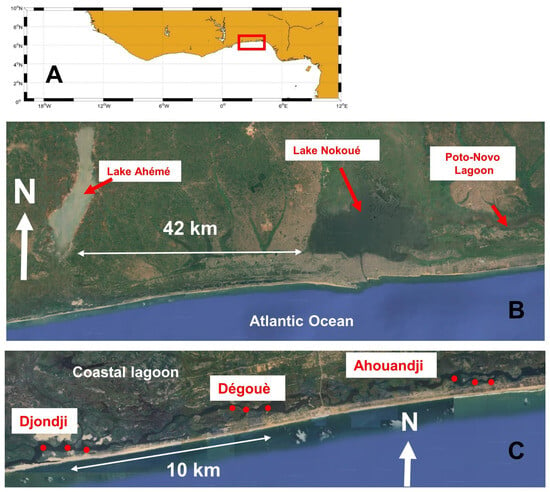
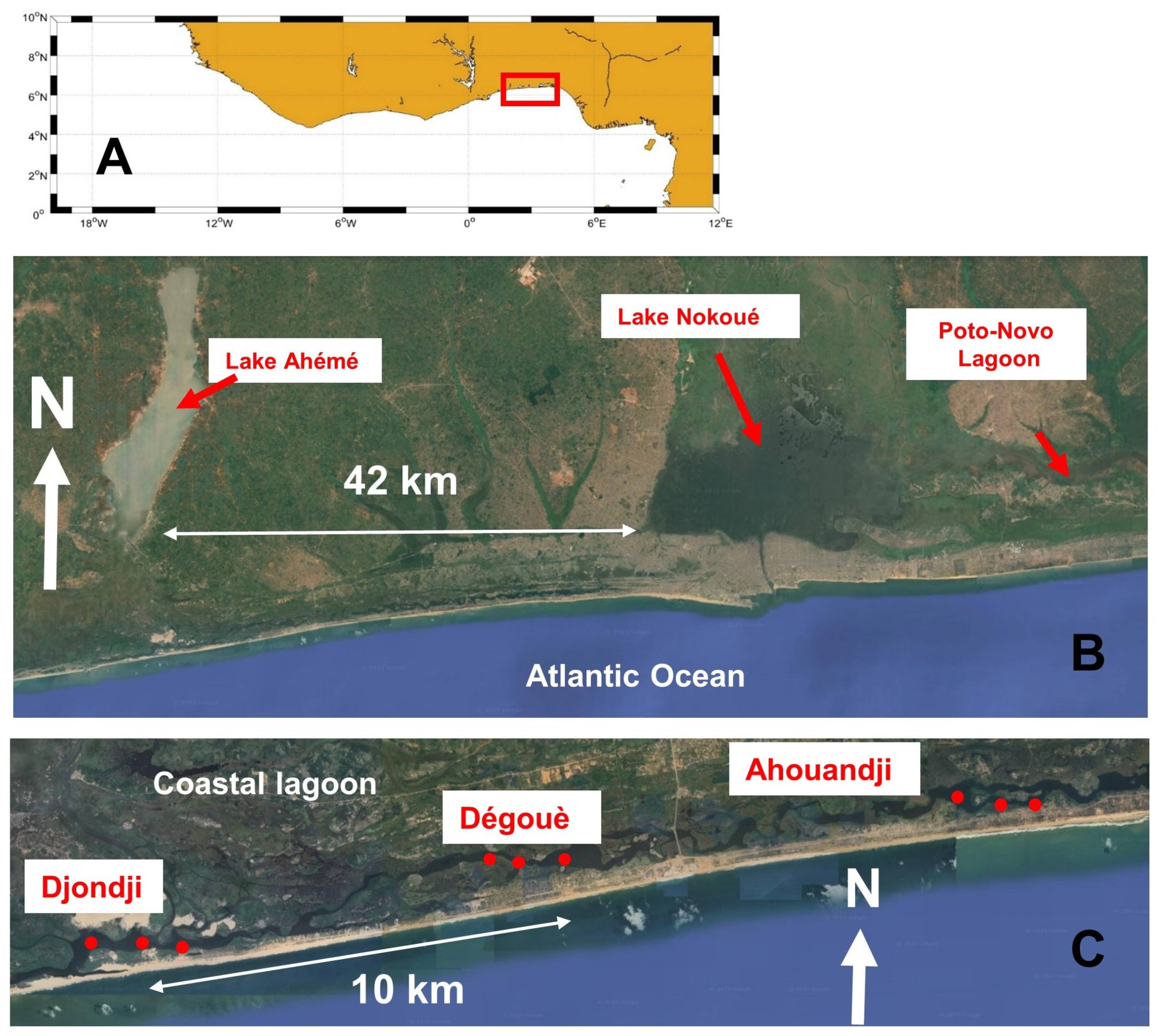
Benin has two main estuarine complexes: the Eastern Estuarine Complex, which includes the Cotonou Channel, Lake Nokoué, and the Porto-Novo Lagoon; and the Western Estuarine Complex, which encompasses the Coastal Lagoon and Lake Ahémé [36]. This study was conducted within the Western Estuarine Complex, specifically in the Coastal Lagoon of Benin. The lagoon is located between longitudes 1°48′ and 2°16′ East and latitudes 6°16′ and 6°20′ North, covering an area of approximately 55 km2. It stretches almost parallel to the Atlantic Ocean for about 60 km, from Grand-Popo to Togbin. The Grand-Popo section of the lagoon receives inflows from the Mono River and Lake Ahémé, and discharges into the sea through the ‘La Bouche du Roi’ mouth, near the village of Avlo-Plage [37] (Figure 1).
Figure 1.
Map of the study area. (A) Gulf of Guinea. (B) Estuarine complexes in southern Benin. The position of Lakes Ahémé, Nokoué and Porto-Novo Lagoon are indicated. (C) Zoom of the experimental area showing the three sampling stations in different production zones: Ahouandji, Dégouè, and Djondji (from east to west). Maps were generated using Landsat/Copernicus data (SIO, NOAA, U.S. Navy, NGA, GEBCO). Images of the Benin Coastal Lagoon were extracted from Google Earth (2025) [https://earth.google.com/web/] (accessed on 9 July 2025).
For administrative purposes, the lagoon is divided into sections based on municipal boundaries. From the Onkouihoué Bridge at the village of Hokouê, the lagoon is referred to as the ‘Grand-Popo Coastal Lagoon’, indicating the portion under the jurisdiction of the Grand-Popo municipality in the Mono region. From the village of Djondji onward, within the Ouidah municipality, it is referred to as the ‘Ouidah Coastal Lagoon’, corresponding to the section within the Atlantic Department. Further east, from Djègbadji onward, the lagoon is locally known as ‘Djèssin’ (meaning saltwater), designating the area used for salt production that extends to Togbin [38].
At the local scale, the lagoon is characterised by the following environmental and habitat features. The region experiences a subequatorial climate, with two rainy seasons (April to July and mid-September to October) and two dry seasons (December to March and mid-August to mid-September) [39]. Average annual rainfall is approximately 1307.3 mm, and ambient temperatures range from 26 °C to 28 °C [40]. The coastal vegetation is highly diverse but predominantly consists of mangrove species such as Rhizophora racemosa and Avicennia germinans (syn. Avicennia africana), which have been heavily degraded due to domestic use, particularly for firewood. Recent conservation and restoration initiatives by governmental and non-governmental organisations have contributed to a partial recovery of mangrove cover, which is now relatively dense in many areas. The area also supports the sedge Cyperus articulatus and the halophytic grass Paspalum vaginatum, as well as cultivated species such as Cocos nucifera and Elaeis guineensis, which are harvested for food and oil [24].
Fishing is the primary economic activity for communities living along the lagoon, which lies between the Atlantic Ocean and the lagoon itself. Among the most permanent fishing activities are oyster harvesting and traditional oyster farming, both of which are predominantly carried out by women.
2.2. Methodology
2.2.1. Site Selection and Experimental Setup
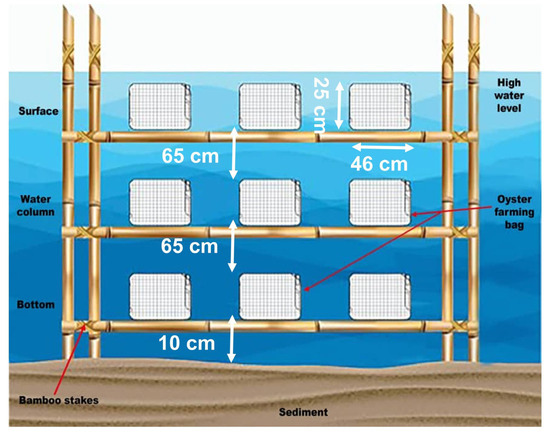
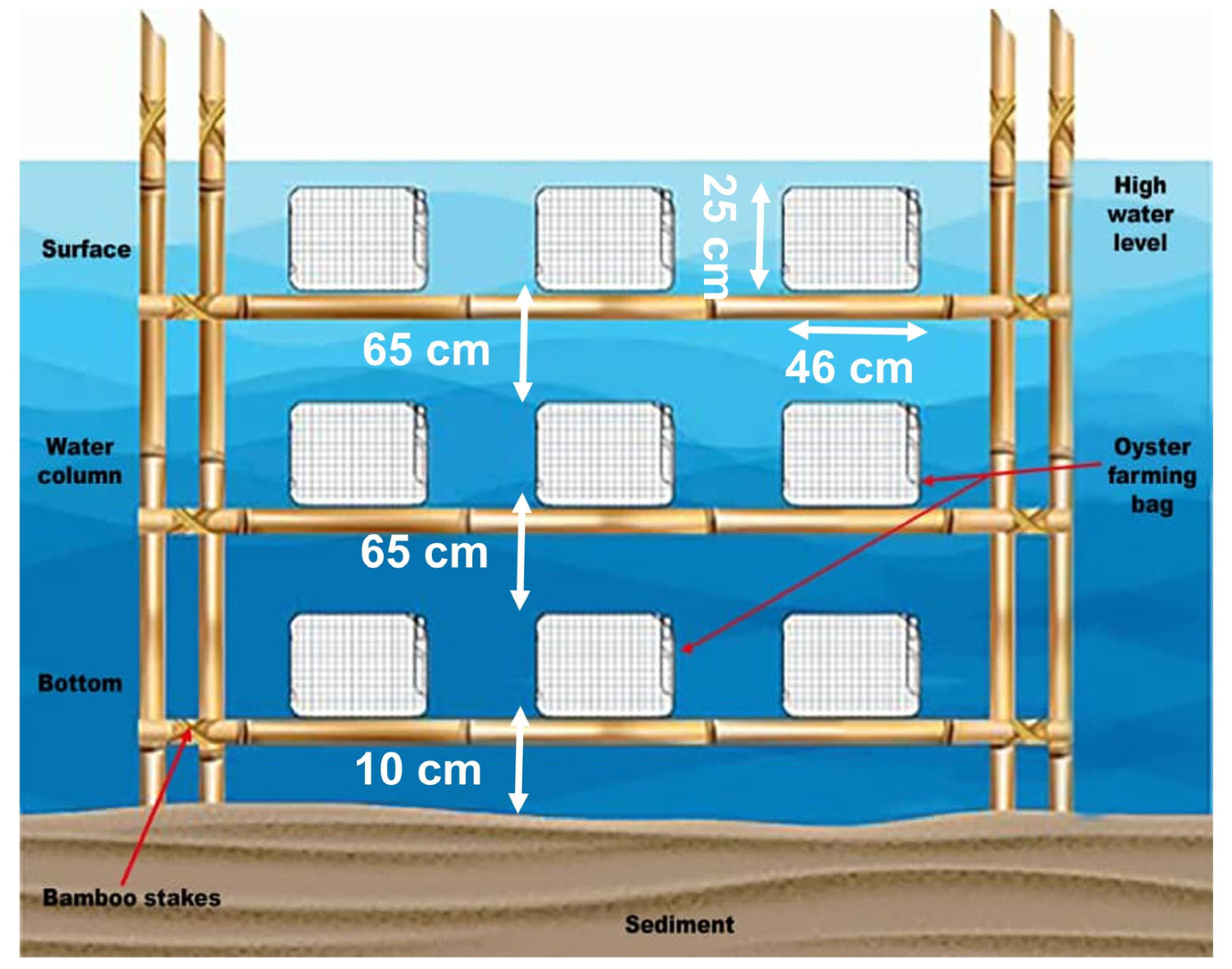
For this study, three traditional C. tulipa oyster farming sites were selected along the coastal lagoon: Ahouandji, Dégouè, and Djondji. Within each site, three sampling stations were established to assess oyster growth and to monitor environmental conditions (Figure 1C). The experimental setup for evaluating oyster growth was installed at the central station of each site and was modelled after traditional oyster farming racks commonly used worldwide [41]. The two additional stations, located on either side of the central setup, were intended to capture local environmental heterogeneity within each site. Environmental variables measured at all three stations were averaged to represent site-level conditions for subsequent analyses. The setup consisted of four bamboo stakes firmly anchored in the sediment and connected by horizontal supports positioned at three different depths. The first level was placed just below the water surface, the second in the mid-water column, and the third near the bottom, a few centimetres above the sediment surface (Figure 2). Oyster farming bags were affixed to these horizontal supports, with a total of nine bags per setup, three at each depth level.
Figure 2.
Experimental farming setup for the study of oyster growth. Nine oyster farming bags were placed at three depth levels at each of the three areas of study.
For identification purposes, each oyster bag sample was labelled using a two-number code. The first number represents the farming site: 1 for Ahouandji, 2 for Dégouè, and 3 for Djondji. The second number corresponds to the farming depth: 1 for the surface level, 2 for mid-water column, and 3 for bottom level. For example, sample 2–3 refers to the oyster bag located at the bottom level at the Dégouè site.
2.2.2. Stocking and Growth Monitoring of Juvenile Oysters
Each oyster farming bag was stocked with 50 juvenile oysters of a relatively uniform size (average length 5.50 ± 0.79 cm, average width 4.23 ± 0.64 cm, average height 2.36 ± 0.59 cm, and average weight 30.43 ± 9.82 g), resulting in a total of 1350 oysters under cultivation, 450 individuals per production area. The oyster juveniles used in this study were purchased locally from oyster harvesters in the village of Hôkouè, near the mouth of the Grand Popo River. To minimise the risks associated with thermal shock and salinity variations, the oysters underwent a two-week acclimatisation period in identical farming bags, which were suspended at an intermediate depth in the experimental area under uniform environmental conditions. They were then distributed between the depth treatments.
The cultivation period lasted for 13 months, from September 2022 to September 2023, encompassing the four climatic seasons of southern Benin (two rainy seasons and two dry seasons; see Section 2.1). Oyster growth was monitored through monthly sampling. At the end of each month, the farming bags were detached, emptied and cleaned. Juvenile oysters were cleared of debris, and 10 individuals were randomly selected from each bag for measurement and weighing.
During measurements, oysters were temporarily placed in a small container filled with lagoon water collected at the experimental site to minimise handling stress and avoid desiccation. After recording the data, all individuals were carefully returned to their respective farming bags. Four growth variables were recorded for each specimen: shell length, width, height, and total weight. Shell dimensions were measured using a digital calliper with a precision of 0.01 mm, and weight was recorded using an electronic balance with a precision of 0.01 g.
2.2.3. Water Quality Analysis in the Coastal Lagoon at the Experimental Sites
Physicochemical variables of the water were measured monthly throughout the duration of the study. During each sampling campaign, the water temperature, pH, salinity, transparency, and dissolved oxygen levels were recorded at the three stations within each production zone, with the farming setup located at the central station (Figure 1B).
Temperature, pH, salinity, and dissolved oxygen were measured using a multiparameter probe (Aquaread AP-700 &AP, Aquaread Ltd., Broadstairs, UK), while water transparency was assessed with a Secchi disk.
2.3. Data Analysis
All statistical analyses conducted during data processing in this study were performed using MATLAB software (vR2023b), functions anovan, multcompare, and kruskalwallis.
2.3.1. Analysis of Environmental Data
Descriptive statistics were applied to the environmental data, with monthly mean values ± standard deviations calculated for each variable (temperature, salinity, dissolved oxygen, pH, and transparency). Differences between zones and across months were assessed using the non-parametric Kruskal–Wallis test, as these data were not normally distributed. For significant results (p < 0.05), post hoc pairwise comparisons were performed using Dunn’s test.
2.3.2. Growth Data Analysis
Monthly gains in length (L), width (W), height (H), and weight (Wt) of the oysters were calculated by subtracting the current month’s measurements from those of the next month (see Equation (1a–d)). Growth in length, width, height, and weight will be denoted as GL, GW, GH, and GWt, respectively, and calculated for each month as follows:
where sub-index i represents the current month, i + 1 is the following one, and T is the time interval (in days) between the two monthly measurements.
GLi = (Li+1 − Li)/T
GWi = (Wi+1 − Wi)/T
GHi = (Hi+1 − Hi)/T
GWti = (Wti+1 − Wti)/T
2.3.3. Principal Component Analysis
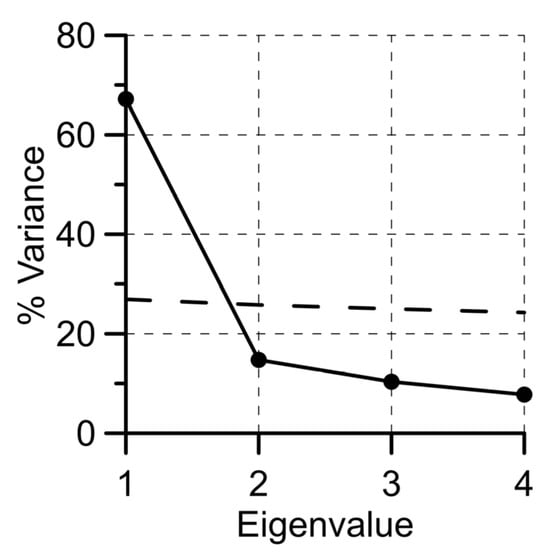
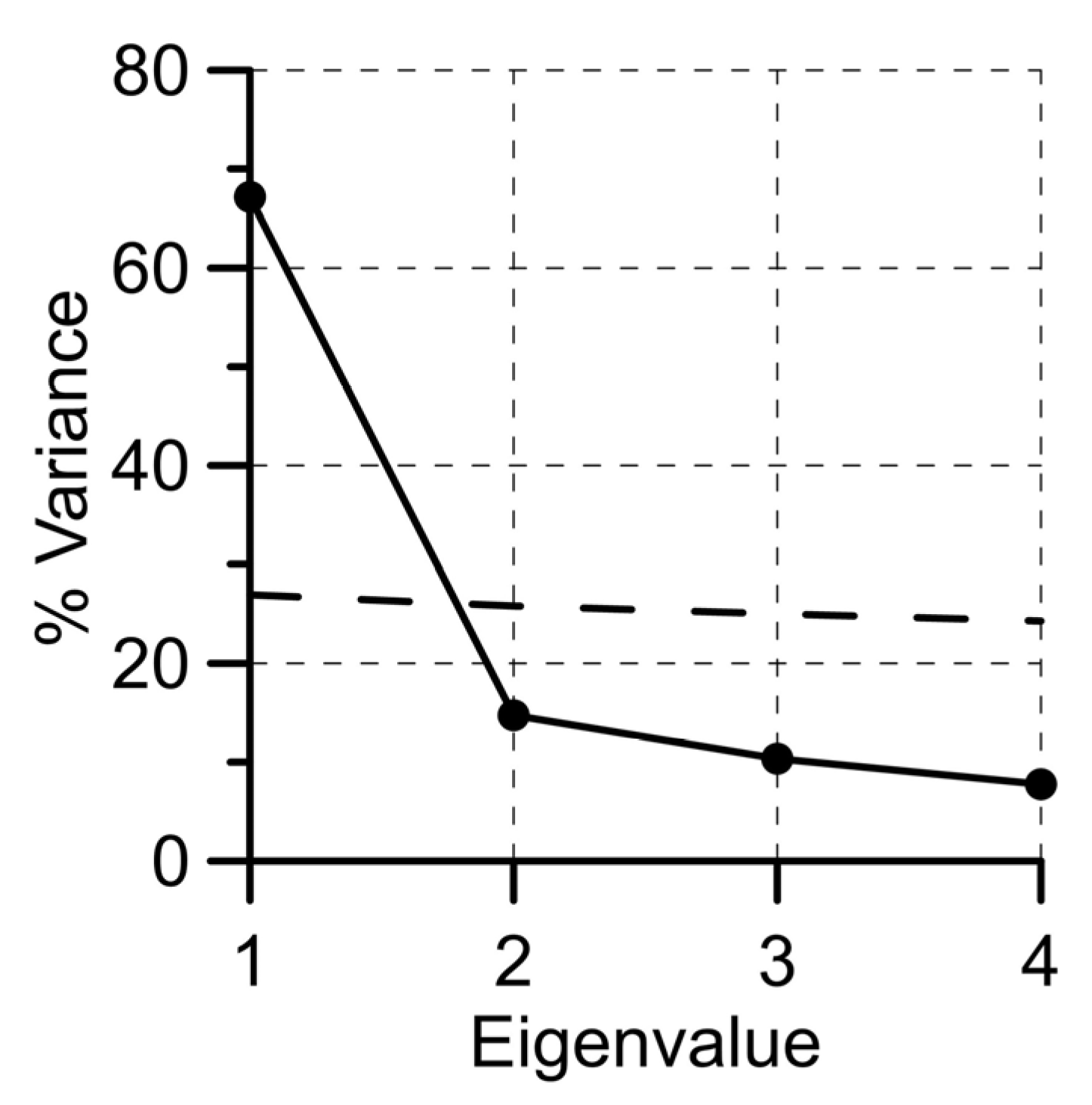
This study primarily aims to investigate the relationship between oyster growth/survival and key factors, namely depth and location within the Benin Coastal Lagoon. Growth was assessed by tracking monthly changes in several morphological variables: shell length (GL), width (GW), height (GH), and total weight (GWt) (for methodology, see Section 2.3.2). Consequently, the analysis involves examining these four variables to identify potential correlations with the aforementioned factors, as well as with other relevant environmental variables. However, a preliminary analysis revealed that changes in these four variables were highly correlated, rendering their simultaneous analysis redundant. To address this multi-collinearity and reduce the dimensionality of the problem, we applied Principal Component Analysis (PCA). This technique transforms the original correlated variables (after standardisation) into a new set of uncorrelated variables, known as Principal Components (PCs), which are linear combinations of the originals. Eigenvalues from the PCA decomposition provide the variance explained by each PC. The solid black line in Figure 3 shows such percentages (eigenvalues), and the dashed black line shows the 95% confidence level. The first PC explained 67% of the variance. PC2, PC3, and PC4 were not statistically significant, explaining 15%, 10%, and 8% of the variance, respectively (see Figure 3).
Figure 3.
Solid black line is the percentage of variance explained by the Principal Components. Dashed black line is the 95% confidence value for each eigenvalue estimated for a bootstrap analysis.
Consequently, we used this first PC (GPC1 hereafter) as a composite measure of growth for all subsequent analyses, in place of the four original variables. This PC can be expressed as follows:
GPC1 = 0.51 × GL + 0.49 × GW + 0.46 × GH + 0.54 × GWt
Note that this component is readily interpretable, as it represents a weighted average of the growth in the four morphological variables measured in this study. Thus, it provides a concise summary of the overall change in oyster size. The coefficients of the other three PCs are presented in Table 1. Notice that GPC1 and eigenvectors in Table 1 are dimensionless as original variables are previously standardised. A detailed explanation of this methodology can be consulted in any text book (see for instance [42]) and also in the Supplementary Material. The significance at the 95% confidence level of the PCs was estimated by means of a bootstrap (see [42] for instance and Supplementary Material).
Table 1.
Eigenvectors or loadings from the PCA.
2.3.4. Analysis of Factor Effects and Survival Rates
In the case of GPC1 (the first Principal Component), normality and homogeneity of variances were verified using Mauchly’s sphericity test. Therefore, a three factor Analysis of Variance (ANOVA) was used for testing the effects of the farming depth, production zone, and month of the year. For significant ANOVA results at the 5% significance level, post hoc comparisons were conducted with Tukey’s HSD test. Statistical significance was set at p < 0.05 for all analyses.
The survival rate (SR) of the oysters in culture was calculated for each month using the following formula:
where Ni and Nf are the initial and final numbers of oysters, respectively, for each month.
SR (%) = 100 × Nf/Ni
As the oyster survival data did not follow a normal distribution, the non-parametric Kruskal–Wallis test was applied to compare survival rates, followed by Dunn’s test (multiple comparisons of mean ranks) in the case of a significant difference at the 5% level. Environmental variables (temperature, salinity, pH, transparency, and dissolved oxygen) neither followed a normal distribution, and Kruskal–Wallis tests were also used to test the effect of different factors.
3. Results and Discussion
3.1. Results
3.1.1. Water Quality of the Coastal Lagoon
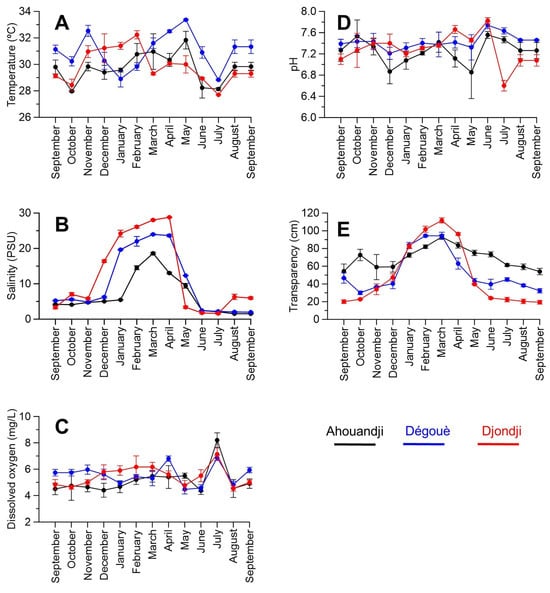
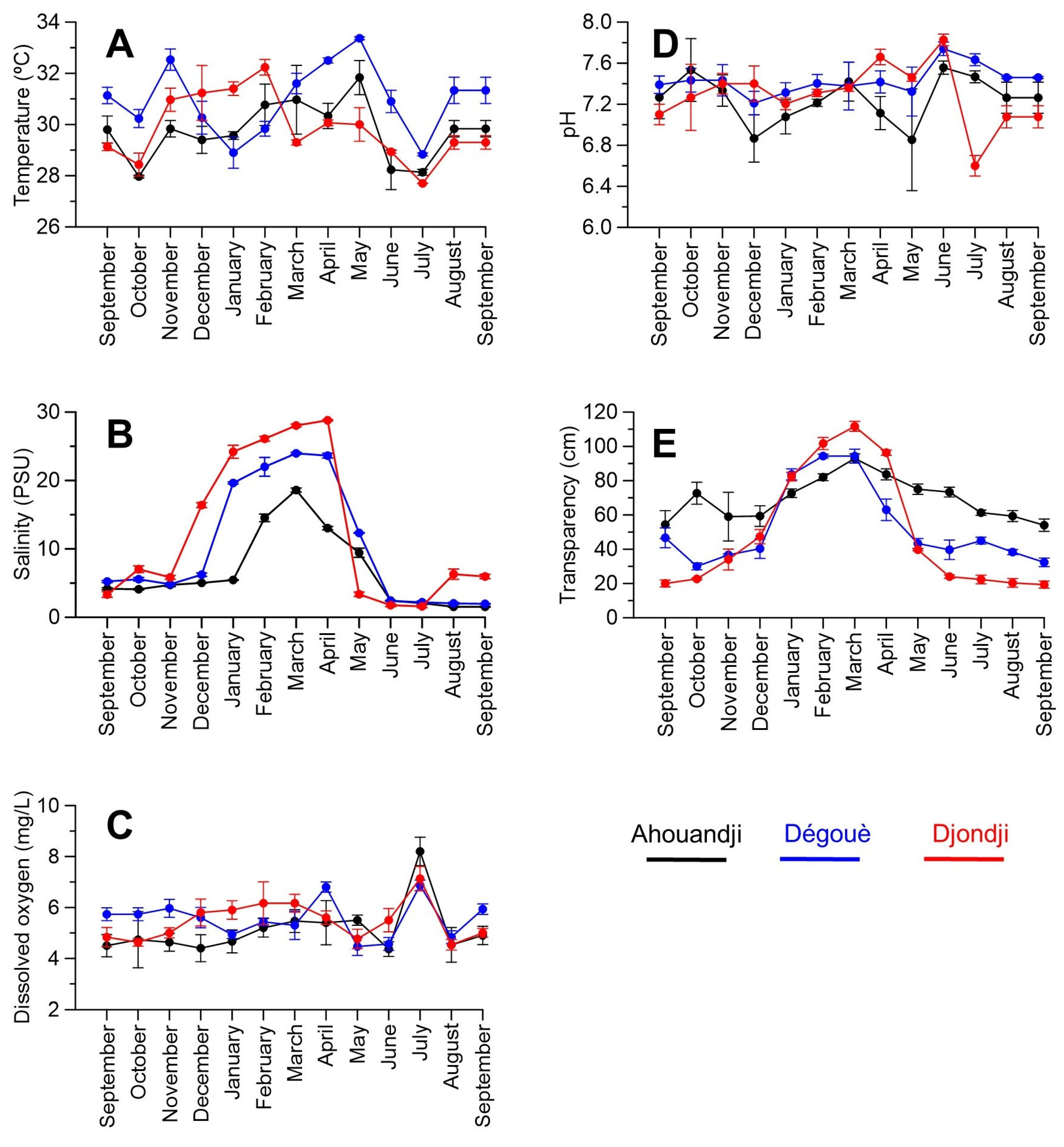
The physicochemical variables analysed showed significant differences between months (p < 0.05). Figure 4 illustrates the monthly variations of these physicochemical variables across the production zones. Salinity values are reported according to the Practical Salinity Scale (PSS-78).
Figure 4.
Monthly variations of temperature (A), salinity (B), dissolved oxygen content (C), pH (D), and transparency (E) for the three production zones of the coastal lagoon waters. Black lines correspond to Ahouandji, blue lines to Dégouè, and red lines to Djondji.
Temperature remained generally stable (between 27.70 °C and 33.37 °C, Figure 4A). Salinity exhibited significant seasonal and spatial variability, characterised by two distinct phases: an initial period of high salinity that started in December in Djondji and followed in January and February in Dégouè and Ahouandji, respectively. Salinity peaked in March in Ahouandji and in April in Djondji and Dégouè with values around 28.03. Salinity experienced a substantial decline from April and May to July (dropping to 1.53, Figure 4B). Overall, the water remained well oxygenated at all three production sites, with dissolved oxygen concentrations ranging from 4.37 mg/L to 8.20 mg/L. A decrease in dissolved oxygen was observed between May and June, followed by a sharp increase in July (Figure 4C). The pH value remained relatively stable throughout the period (7.18 ± 0.01), although a slight decrease was noted in May at Ahouandji, in July at Djondji, and in December across all three sites (Figure 4D). Transparency fluctuated significantly, being high from January to April, with values of around 120 cm, and lower values for the rest of the year. This period of reduced transparency was more pronounced in Djondji and Dègouè where values around 20 cm were recorded (Figure 4E).
3.1.2. Growth of Oysters in the Coastal Lagoon
Table 2 displays the results of the multifactorial ANOVA comparing oyster growth (GPC1) in the coastal lagoon waters across three factors: month, production zone, and farming level.
Table 2.
F and p values for Multifactorial ANOVA test conducted on monthly growth. Significant results are highlighted in red and bold.
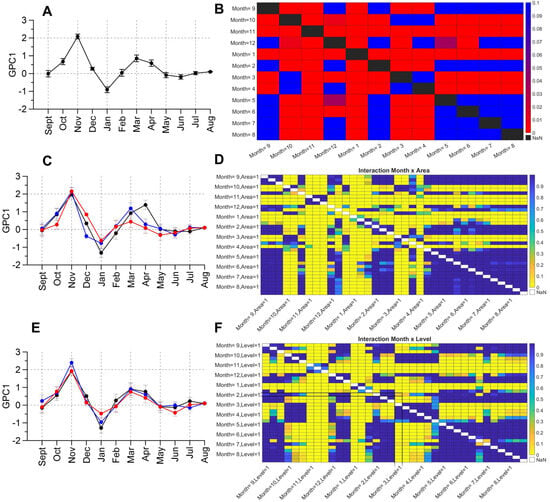
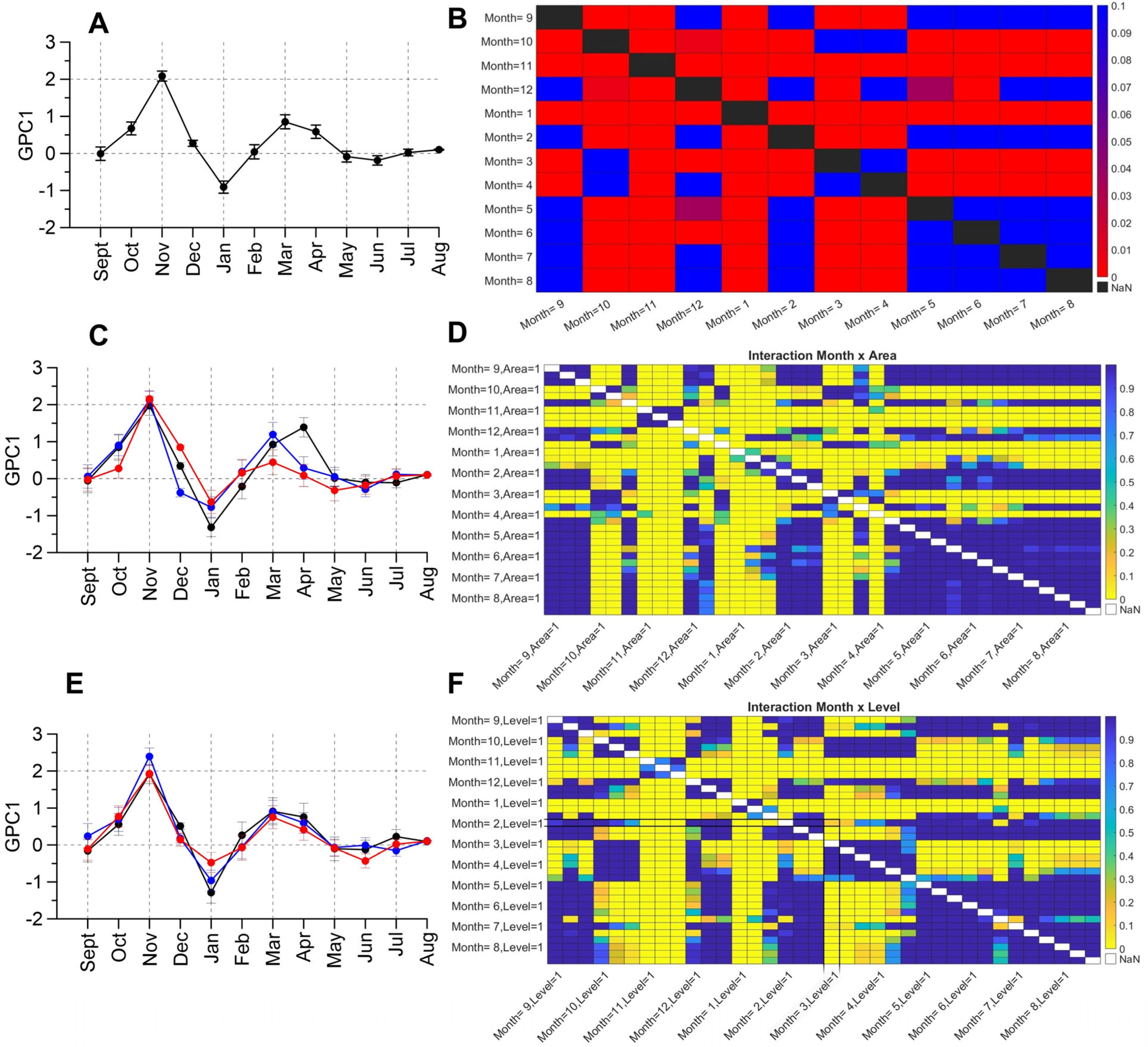
The analysis revealed significant monthly variations in oyster growth (p < 0.001), demonstrating strong seasonal patterns. Figure 5A presents the monthly growth rates across all farming levels and zones, along with a comparison between all pairs of months (Figure 5B). Red squares in Figure 5B indicate those pairs statistically different. Notice that according to Figure 5A, the highest growth rate corresponds to November (change from November to December). Figure 5B shows that this value is statistically different from all the values corresponding to the rest of the year. On the contrary, the lowest growth rate is observed in January (change from January to February; Figure 5A) being this value also different from all the other months of the year (Figure 5B).
Figure 5.
Oyster growth rates expressed as monthly variations of Principal Component 1. Notice that Principal Components were calculated from standardised variables and therefore are dimensionless. (A) Shows the mean growth rates as a function of one single factor (month of the year). (B) Red squares show those pairs of months with statistically different growth rates. (C) Shows the mean growth values for the two-factor interaction (month and zone), and (E) shows the interaction for the month and depth level. Growth rates are presented as a function of the month of the year. In (C), the black line corresponds to Ahouandji, blue line to Dégouè, and red line to Djondji. In (E), the black line is for the surface, blue for the water column, and red for the bottom. (D,F) Shows the p-values for the interactions of all the pair of categories of Month × Area (D) and Month × Level (F).
The results indicate two distinct favourable periods for oyster growth across the production zones (see the two maxima in Figure 5A). The value reported for September, for example, represents the change from September to October. Consequently, September shows no significant growth and is followed by a steady growth period from October to December. The peak in November indicates that the oyster size in December exceeded that in November, confirming continued growth through December. Thereafter, growth gradually slowed until March 2023 (GPC1 is near zero in February, indicating no growth from February to March). In other words, January, February, and March showed no growth compared with the preceding months. A second growth phase began with substantial gains from March to May, and no significant growth was observed for the remainder of the observation period through September 2023 (Figure 5A).
This behaviour is well captured and summarised by the first PC, which represents a weighted combination of length, width, height, and weight, as described in the Methods section (Section 2). The same overall pattern, with slight shifts in the timing of the maxima and minima, was observed for each original variable (see Figure S2 in the Supplementary Material).
While neither production zone nor farming level alone showed significant differences (p > 0.05; Table 2), their interactions with month significantly affected growth patterns (p < 0.05). Figure 5C,D reveal how monthly growth patterns varied spatially across production zones.
Similarly, Figure 5E illustrates depth-dependent growth variations through the seasonal cycle and Figure 5F shows the significance of the differences between all the pairs of Month × Level interactions. Oysters in the water column achieved highest growth rates during the September–November period, while surface-level oysters showed the lowest rates during the slow down phases. All depth levels shared a common growth peak in March during the second growth phase, followed by declines through June that were most pronounced in bottom-level cultures. These interactive effects between temporal, spatial, and depth factors collectively shaped the observed growth dynamics throughout the study period.
3.1.3. Survival of Oyster Juveniles During Cultivation in the Production Zones
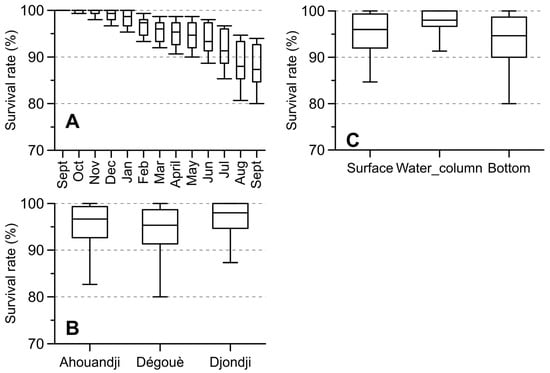
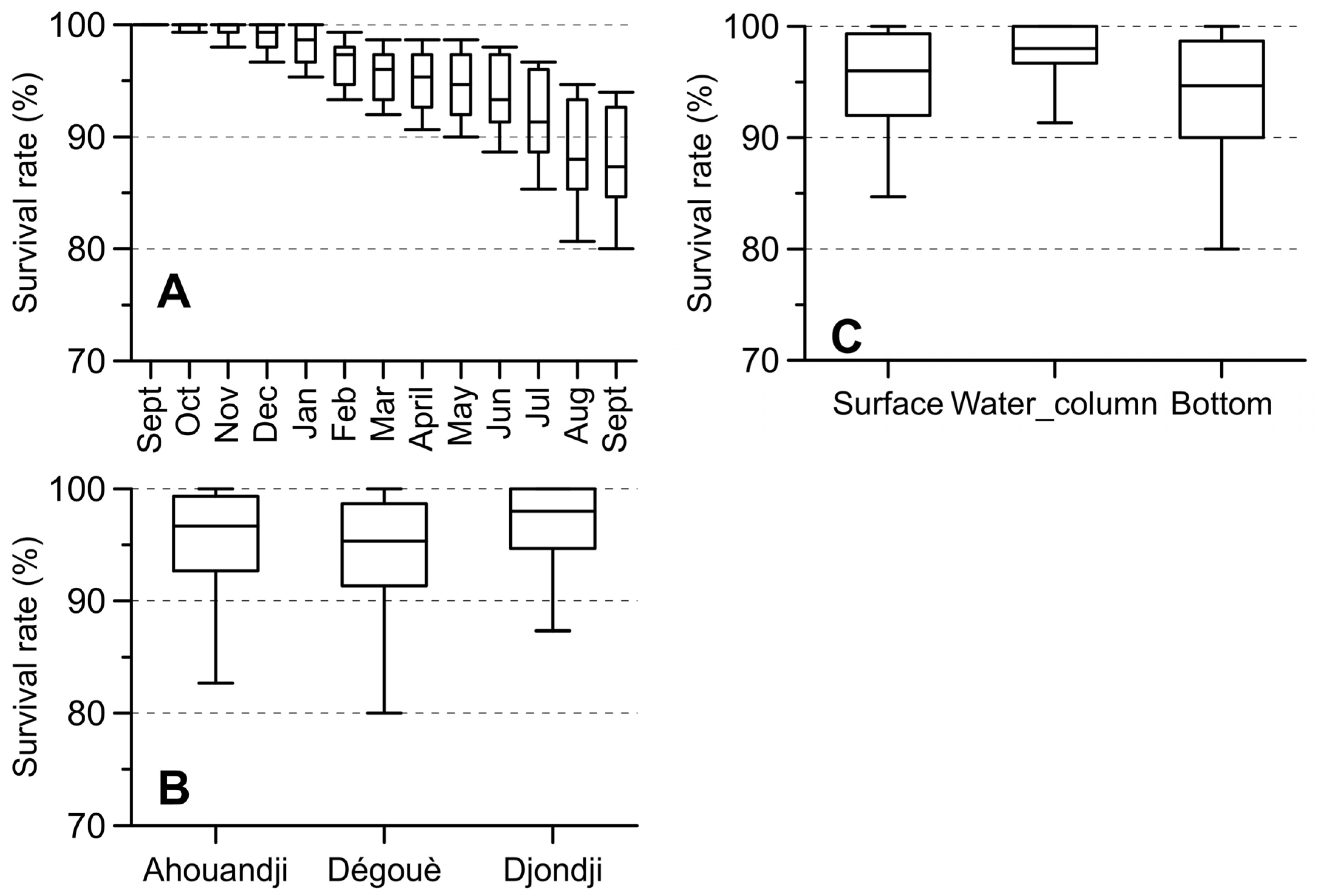
The evolution of the survival rate of oyster juveniles (expressed as percentages) in the waters of the coastal lagoon was analysed by means of box-and-whisker plots (Figure 6). The three factors month, location, and depth level were considered. In Figure 6A, the survival rate for each month of the year was different, depending on the location and depth level. This figure shows the median survival rate (horizontal line), 25th and 75th percentiles (box), and extreme values (whiskers). In Figure 6B, the survival rate at each location was also different depending on the month of the year and depth level. As in the case of Figure 6A, horizontal lines show the median survival rate at each location, and boxes show 25th and 75th percentiles. Finally, Figure 6C shows the median and 25th and 75th percentiles of the survival rates for each depth level.
Figure 6.
Box-and-whisker plots for the oyster survival rate as a function of month (A), zone (B), and depth level (C). Y-axes show the survival rates for each value of the corresponding factor: boxes show the 25th and 75th percentiles of the survival rates, the horizontal line is the median of the survival rate, and vertical error bars are the minimum and maximum values recorded.
A Lilliefors test showed that survival rates for different depth levels did not follow a normal distribution, and a Kruskal–Wallis test showed that these differences were significant at the 0.05 significance level. A post-hoc test showed that the water column had a higher survival rate (97%) than the surface and bottom, between which there was no significant difference. This difference was significant at the 0.05 significance level. Farmed oysters showed high overall monthly survival rates (the lowest being ≥ 80%). However, survival rates gradually declined as the experiment progressed. This decline became more pronounced from May onwards. The differences between survival rates corresponding to different months were also significant at the 0.05 significance level (Kruskal–Wallis), and post-hoc tests showed that the rates corresponding to the final months of the experiment were statistically lower than those corresponding to the first months.
3.2. Discussion
This study aimed to identify optimal zones, cultivation depths, and favourable periods for juvenile C. tulipa oyster growth in southern Benin’s coastal lagoon near Ouidah. As a brackish water species that attaches to mangrove roots [24,43], C. tulipa tolerates wide salinity ranges (6–60‰, [30]). Our farming experiment across three depth levels (surface, water column, and bottom) in three production zones revealed two distinct growth periods: October to December 2022 and March to May 2023, interrupted by growth slowdown from December to March and May to September. Notably, negative PC1 growth values (combining length, width, height, and weight) indicated biometric reductions during some months in these decline periods (Figure 5 and Figure S2 in Supplementary Material). In the context of our study, this negative growth can mainly be attributed to a loss of oyster weight during farming. However, it may also be attributed to shell shrinkage, which can result from several factors. The reduction in the shell sizes of some oysters may not indicate a halt in growth, but rather the dissolution or erosion of calcium carbonate. Local acidification of the microenvironment within the oyster’s farming bag (due to CO2 accumulation, organic matter, or hypoxia) can reduce the carbonate saturation state (Ω <1), promoting partial shell dissolution [44,45]. Similar phenomena have been reported in Mosquito Lagoon, Florida, USA, where oyster reefs were subjected to sediment acidification linked to mangrove expansion caused by tropicalization [46]. Increased chemical variability of the rearing waters can also favour shell shrinkage [47]. Therefore, the loss of shell dimensions may result from a combination of chemical dissolution, mechanical abrasion, and bio-erosion, rather than active biological regression.
The observed growth patterns correlate strongly with phytoplankton availability, the primary food source for C. tulipa [24,48]. Benin’s coastal waters show particularly high phytoplankton densities (43.361 × 10⁶ cells/L of diatoms) [49], during growth periods, especially March–July in Lake Nokoué [50], which overlaps with the second growth period from March to May, and also during rainy seasons [24], coinciding with the beginning of both the first and second growth periods. The December to March slowdown in growth coincides with oyster reproduction, triggered by salinity increases (16.4 to 26.1 in Djondji, 6.2 to 22 in Dégouè, 5.0–14.5 in Ahouandji) from marine water intrusion. This reproductive stress, driven by peak dry-season temperatures, more severely affected surface-cultured oysters. These findings mirror those from Brazil [51], Ghana [26,52], and Casamance [30], where a salinity of 35 induced spawning. Zounon et al. [53] reported a high abundance of oyster larvae in the coastal lagoon waters during the dry season, confirming intense oyster spawning in these months. Similarly, growth slowdown after May followed a period of rapid desalination (April-June declines from 28.8 to 1.8 in Djondji, 23.6 to 2.4 in Dégouè) caused by Nangbeto Dam discharges [37], as C. tulipa cannot sustain prolonged salinity extremes [29,48]. Lavaud et al. [54] showed that low salinity values were associated with low growth rates because of a reduction in energy input through feeding. Lowe et al. [12] also found a relation between mortality of the oyster C. virginica and the temperature and salinity interaction. These results suggest that the salinity variability must also play an important role in our study area. Notice that salinity is closely linked to transparency (Figure 4E), indicating that low salinity values are associated with river discharges, whereas high salinity values are produced by sea water intrusions.
Additional factors influencing growth include reduced feeding efficiency due to low water transparency [55] and shell erosion caused by wind-driven turbulence [56]. Habitat characteristics and predation rates can also influence the growth and survival of oysters [55,57]. Other studies have highlighted factors such as competition for food and space [58] and pathogenic parasites [59] as influencing oyster growth and mortality. Ahouandji’s growth from April to May would reflect its larger distance from the mouth ‘Bouche du Roy’ (if compared to Djondji and Dégouè), delaying the marine water influence [60]. Indeed, the mouth of the Bouche du Roi lagoon is practically the only point of contact between the lagoon and the Atlantic Ocean. However, the Ahouandji production area is located far from the lagoon’s mouth, positioned between the lagoon and the Atlantic Ocean [60]. Consequently, during periods of lagoon low water, characterised by significant seawater intrusion into the lagoon, the Djondji and Dégouè production areas, which are closer to the mouth, receive the seawater first. This seawater then spreads towards areas further from the mouth, such as Ahouandji. Conversely, Dégouè and Djondji’s proximity to the inlet facilitated faster post-May recovery when dredging restored marine inflows [60].
Surface and water column cultures showed better performance during the second growth period, likely due to greater phytoplankton availability and higher dissolved oxygen levels compared to deeper, stratified waters [61], aligning with Venezuelan findings for Pinctada imbricata [62]. The results of the survival rate analysis showed that the water column had a higher survival rate (97%) than the surface and the bottom. However, the significant interaction among the month, farming area, and depth level suggests that the survival and growth of oysters in Benin’s coastal lagoon waters are influenced by a complex combination of environmental factors that vary over time and space. Similar results were reported by [63] in Kapontori Bay, Indonesia, for the Pinctada maxima oyster. Cassis et al. [64] came to the same conclusion in a study of C gigas in British Columbia, Canada. Both studies showed that the cultivation depth and local environmental conditions, such as temperature and sedimentation, had a strong influence on juvenile mortality.
The results obtained highlight general trends that can inform the optimisation of C. tulipa farming in the coastal lagoon of Benin. While acknowledging the significant interactions among the farming zone, period, and depth, mid-water cultures generally showed better growth and survival performance than bottom and surface cultures, although their efficiency may vary according to local conditions. A broad and extended favourable growth window was observed from October to December, prior to the spawning period. However, the slowdown in growth observed between May and September 2023 suggests the need to adapt farming practices to the environmental dynamics specific to each site. Temporarily relocating oysters to deeper layers during periods of high salinity and temperature may help to reduce physiological stress, although the effectiveness of this depends on local hydrological conditions. Finally, regular monitoring of salinity and transparency, together with improved coordination of Nangbeto dam management, appears to be essential to anticipate disturbances and strengthen the resilience of oyster farms.
4. Conclusions
This study demonstrates that the coastal lagoon waters in southern Benin provide favourable conditions for oyster farming, with two optimal growth periods identified: October to December and March to May. While oysters can be cultivated year-round at any depth, our findings recommend surface or water column placement for optimal growth, with seasonal adjustments to mitigate environmental stressors. Specifically, relocating oysters to deeper waters during January would help counterbalance the combined physiological stresses of elevated salinity and temperature during the peak dry season. The implementation of such adaptive farming practices, combined with improved water-management policies, could significantly enhance the sustainability and productivity of Benin’s oyster aquaculture sector.
Supplementary Materials
The following supporting information can be downloaded at: https://www.mdpi.com/article/10.3390/oceans7010017/s1, Figure S1: Black line represents the percentage of variance explained by the Principal Components, and the red line indicates the 5% significance threshold for eigenvalues obtained from the bootstrap analysis; Figure S2: Monthly growth rates of oyster length, width, height, and weight over the observation period, shown as month-to-month differences, with panels (A–H) illustrating seasonal patterns consistent with those summarised by the first Principal Component in the main text and minor shifts in the timing of maxima and minima among variables; Table S1: Eigenvalues or loadings from the PCA.
Author Contributions
Conceptualisation, Y.Z., Z.S., M.V.-Y., D.C.A., L.S.D., T.G., F.M.R., and M.C.G.M.; Methodology, Y.Z., Z.S., M.V.-Y., D.C.A., L.S.D., T.G., F.M.R., and M.C.G.M.; Formal analysis, Y.Z., M.V.-Y.; Investigation, Y.Z., D.C.A., and T.G.; Data curation, Y.Z., D.C.A., and T.G.; Writing—original draft, Y.Z.; Writing—review and editing, Z.S., M.V.-Y., D.C.A., L.S.D., T.G., F.M.R., and M.C.G.M.; Supervision, Z.S., M.V.-Y., F.M.R., and M.C.G.M. All authors have read and agreed to the published version of the manuscript.
Funding
Consejo Superior de Investigaciones Científicas (Grant Number: CSIC/I-COOP2023/COOPB23085).
Institutional Review Board Statement
Committee of the Ministry of Higher Education and Scientific Research and the Ministry of Agriculture, Livestock, and Fisheries of the Republic of Benin (Protocol code: law N° 2014-19, approved on 7 August 2014), and complied with Directive 2010/63/EU of the European Parliament on the protection of animals used for scientific purposes. The study was conducted in accordance with the local legislation and institutional requirements.
Data Availability Statement
The original contributions presented in this study are included in the article and Supplementary Material. Further inquiries can be directed to the corresponding author.
Conflicts of Interest
The authors declare no conflicts of interest.
References
- Moreira, V. Role of Fisheries in Global Food Security: Economic Impact, Challenges and Technological Innovations. Poult. Fish. Wildl. Sci. 2024, 1, 280. [Google Scholar]
- Zhan, H. Fisheries’ Significance to Worldwide Food Security. Fish. Aqua. J. 2024, 15, 375. [Google Scholar]
- FAO. The State of World Fisheries and Aquaculture—Blue Transformation in Action; Food and Agriculture Organization: Rome, Italy, 2024. [Google Scholar] [CrossRef] [Scilit]
- Martínez-García, M.F.; Ruesink, J.L.; Grijalva-Chon, J.M.; Lodeiros, C.; Arreola-Lizárraga, J.A.; de la Re-Vega, E.; Chávez-Villalba, J. Socioecological factors related to aquaculture introductions and production of Pacific oysters (Crassostrea gigas) worldwide. Rev. Aquac. 2022, 14, 613–629. [Google Scholar] [CrossRef] [Scilit]
- Thompson, E.L.; Taylor, D.A.; Nair, S.V.; Birch, G.; Hose, G.C.; Raftos, D.A. Proteomic analysis of Sydney Rock oysters (Saccostrea glomerata) exposed to metal contamination in the field. Environ. Pollut. 2012, 170, 102–112. [Google Scholar] [CrossRef] [Scilit] [PubMed]
- Barr, J.M.; Munroe, D.; Rose, J.M.; Calvo, L.; Cheng, K.M.; Bayer, S.; Kreeger, D. Seasonal feeding behavior of aquaculture eastern oysters (Crassostrea virginica) in the mid-Atlantic. Estuaries Coasts 2024, 47, 789–804. [Google Scholar] [CrossRef] [Scilit]
- Pouvreau, S.; Lapègue, S.; Arzul, I.; Boudry, P. Fifty years of research to counter the decline of the European flat oyster (Ostrea edulis): A review of French achievements and prospects for the restoration of remaining beds and revival of aquaculture production. Aquat. Living Resour. 2023, 36, 13. [Google Scholar] [CrossRef] [Scilit]
- Lebata-Ramos, J.H.; Solis, E.F.; Almeida, M.J. Grow-out culture of oyster Magallana bilineata (Röding, 1798) using pouches: A comparison of growth and survival in the river and earthen pond. Philipp. Agric. Sci. 2023, 106, 55–65. [Google Scholar] [CrossRef] [Scilit]
- FAO. The State of World Fisheries and Aquaculture—Meeting the Sustainable Development Goals; Food and Agriculture Organization: Rome, Italy, 2018. [Google Scholar]
- Schug, D.M.; Baxter, K.; Wellman, K. Valorisation des Services Ecosystémiques Issus de la Restauration, de la Valorisation et de la Gestion des Coquillages: Une Revue de la Littérature; Northern Economics Inc.: Anchorage, AK, USA, 2009; 58p. [Google Scholar]
- Levinton, J.; Doall, M.; Allam, B. Growth and Mortality Patterns of the Eastern Oyster Crassostrea virginica in Impacted Waters in Coastal Waters in New York, USA. J. Shellfish. Res. 2013, 32, 417–427. [Google Scholar] [CrossRef] [Scilit]
- Lowe, M.R.; Sehlinger, T.; Soniat, T.M.; Peyre, M.K.L. Interactive effects of water temperature and salinity on growth and mortality of eastern oysters, Crassostrea virginica: A meta-analysis using 40 years of monitoring data. J. Shellfish. Res. 2017, 36, 683–697. [Google Scholar] [CrossRef] [Scilit]
- Harwell, H.D.; Posey, M.H.; Alphin, T.D. Landscape aspects of oyster reefs: Effects of fragmentation on habitat utilization. J. Exp. Mar. Biol. Ecol. 2011, 409, 30–41. [Google Scholar] [CrossRef] [Scilit]
- Carroll, J.M.; Peterson, B.J. Ecological trade-offs in seascape ecology: Bay scallop survival and growth across a seagrass seascape. Landsc. Ecol. 2013, 28, 1401–1413. [Google Scholar] [CrossRef] [Scilit]
- Boström, C.; Pittman, S.; Simenstad, C.; Kneib, R. Seascape ecology of coastal biogenic habitats: Advances, gaps, and challenges. Mar. Ecol. Prog. Ser. 2011, 427, 191–217. [Google Scholar] [CrossRef] [Scilit]
- Carroll, J.M.; Keller, D.A.; Furman, B.T.; Stubler, A.D. Rough Around the Edges: Lessons Learned and Future Directions in Marine Edge Effects Studies. Curr. Landsc. Ecol. Rep. 2019, 4, 91–102. [Google Scholar] [CrossRef] [Scilit]
- Hanke, M.H.; Posey, M.H.; Alphin, T.D. The influence of habitat characteristics on intertidal oyster Crassostrea virginica populations. Mar. Ecol. Prog. Ser. 2017, 571, 121–138. [Google Scholar] [CrossRef] [Scilit]
- Yankson, K. Fish from the Shell: Its Potential in the Quest for Adequate Protein in Ghana: An Inaugural Lecture Delivered at the University of Cape Coast; Media Graphics & Press Ltd.: Accra, Ghana, 2004. [Google Scholar]
- Ansa, E.J.; Bashir, R.M. Fishery and culture potentials of the mangrove oyster (Crassostrea gasar) in Nigeria. Res. J. Biol. Sci. 2007, 2, 392–394. [Google Scholar]
- Anyinla, O.A.; Ansa, E.J.; Edun, O.M.; Bekibele, D.O.; Ogori, K.T. Compendium of Oyster Culture in Nigeria; Nigerian Institute Oceanography and Marine Research: Lagos, Nigeria, 2011; 55p. [Google Scholar]
- Asare, B.; Obodai, E.A.; Acheampong, E. Mangrove oyster farming: Prospects as supplementary livelihood for a Ghanaian fishing community. J. Fish. Coast. Manag. 2019, 1, 7–14. [Google Scholar] [CrossRef] [Scilit]
- Osei, I.K.; Yankson, K.; Obodai, E.A. Comparative analysis of growth performance and survival of the West African man-grove oyster, Crassostrea tulipa (Lamarck, 1819) cultivated by suspension and bottom culture methods in the Densu Estuary, Ghana. Aquac. Fish Fish. 2022, 2, 233–242. [Google Scholar] [CrossRef] [Scilit]
- Chuku, E.O.; Effah, E.; Adotey, J.; Abrokwah, S.; Adade, R.; Okyere, I.; Crawford, B. Spotlighting women-led fisheries live-lihoods toward sustainable coastal governance: The estuarine and mangrove ecosystem shellfisheries of West Africa. Front. Mar. Sci. 2022, 9, 884715. [Google Scholar] [CrossRef] [Scilit]
- Adite, A.; Sonon, S.P.; Gbedjissi, G.L. Feeding ecology of the mangrove oyster, Crassostrea gasar (Dautzenberg, 1891) in traditional farming at the coastal zone of Benin, West Africa. Nat. Sci. 2013, 5, 1238–1248. [Google Scholar] [CrossRef]
- Agadjihouede, H.; Akele, D.G.; Gougbedji, A.U.M.; Laleye, P.A. Exploitation de l’huître des mangroves Crassostrea gasar (Adanson, 1757) dans le lac Nokoué au Bénin. Eur. Sci. J. 2017, 13, 352. [Google Scholar] [CrossRef] [Scilit]
- Yankson, K. Études préliminaires sur l’élevage de l’huître de mangrove d’Afrique de l’Ouest, Crassostrea tulipa, en laboratoire. Découverte Innov. 1990, 2, 45–51. [Google Scholar]
- Cabral, R.B.; Halpern, B.S.; Lester, S.E.; White, C.; Gaines, S.D.; Costello, C. Concevoir des AMP pour la sécurité alimentaire dans les pêcheries à accès libre. Sci. Rep. 2019, 9, 8033. [Google Scholar] [CrossRef] [Scilit]
- Arthur, R.I. Small-scale fisheries management and the problem of open access. Mar. Policy 2020, 115, 103867. [Google Scholar] [CrossRef] [Scilit]
- Mahu, E.; Sanko, S.; Kamara, A.; Chuku, E.O.; Effah, E.; Sohou, Z.; Zounon, Y.; Akinjogunla, V.; Akinnigbagbe, R.O.; Diadhiou, H.D.; et al. Climate Resilience and Adaptationin West African Oyster Fisheries: An Expert-Based Assessment of the Vulnerability of the Oyster Crassostrea tulipa to Climate Change. Fishes 2022, 7, 205. [Google Scholar] [CrossRef] [Scilit]
- Gilles, S. Observations sur le captage et la croissance de l’huître creuse ouest-africaine, Crassostrea gasar, en Casamance, Sénégal. In Les Mollusques Marins: Biologie et Aquaculture; Ifremer: Brest, France, 1992. [Google Scholar]
- Gilles, S. Observations sur le captage et la croissance de l’huître ouest-africaine Crassostrea gasar en Casamance. Rev. Hydr. Trop. 1991, 24, 197–207. [Google Scholar]
- Gilles, S.; Le Pennec, M. Aquaculture trials of the tropical oyster Crassostrea gasar in basse Casamance (Sénégal). J. Aqua. Trop. 1992, 7, 157–164. [Google Scholar]
- Diadhiou, H.D.; Ndour, I. Artificial capture of mangrove oyster spat Crassostrea gasar (Mollusca, Bivalvia) in Casamance estuary (Senegal). Aquac. Aquar. Conserv. Legis. 2017, 10, 48–55. [Google Scholar]
- Chuku, E.O.; Yankson, K.; Obodai, E.A.; Acheampong, E.; Boahemaa-Kobil, E. Effectiveness of different substrates for col-lecting wild spat of the oyster Crassostrea tulipa along the coast of Ghana. Aquac. Rep. 2020, 18, 100493. [Google Scholar] [CrossRef] [Scilit]
- Chuku, O.E.; Kobin Yankson, K.; Adzesiwor, E.O.; Acheampong, E.; Aheto, D.W. Spatiotemporal spatfall dynamics and prevailing estuarine conditions for optimal oyster (Crassostrea tulipa) spat availability in selected Gulf of Guinea brackish systems. Front. Mar. Sci. 2023, 10, 1075313. [Google Scholar] [CrossRef] [Scilit]
- Burgis, M.J.; Symoens, J.J. African Wetland and shallow water bodies: Director. Collect. Trav. Doc. 1987, 211, 650. [Google Scholar]
- Adandédjan, D. Diversité et Déterminisme des Peuplements de Macroinvertébrés Benthiques de Deux Lagunes du Sud-Bénin: La Lagune de Porto-Novo et la Lagune Côtière. Ph.D. Thesis, Université d’Abomey-Calavi-Bénin, Berlin, Germany, 2012; 239p. [Google Scholar]
- Viaho, C.C. Inventaire de la faune ichtyologique du lac Ahémé et ses Chenaux, Sud-ouest Bénin (Afrique de l’Ouest). Programme Intercommunal de Réhabilitation du lac Ahémé et ses Chenaux et de Création d’une Zone de Développement Economique (PIRA). J. Biodiv. Environ. Sci. 2020, 16, 121–132. [Google Scholar]
- Boko, M. Saisons et types de temps au Bénin: Analyse objective et perceptions populaires. L’Espace Géographique 1992, 21, 321–332. [Google Scholar] [CrossRef] [Scilit]
- Sinsin, B.; Assogbadjo, A.E.; Tente, B.; Yo, T.; Adanguidi, J.; Lougbégnon, T.; Ahouansou, S.; Sogbohossou, É.; Padonou, E.; Agbani, P. Inventaire Floristique et Faunique des Ecosystèmes de Mangroves et des Zones Humides Côtières du Bénin; Food and Agriculture Organization: Rome, Italy, 2018; 89p. [Google Scholar]
- Doiron, S. Manuel de Référence de L’ostréiculture; Universitatea din California: Berkeley, CA, USA, 2018; ISBN 978-1-55471-118-582. [Google Scholar]
- Efron, B.; Tibshirani, R.J. An Introduction to the Bootstrap; Chapman & Hall/CRC: Boca Raton, FL, USA, 1993. [Google Scholar]
- Lapegue, S.; Boutet, I.; Leitao, A.; Heurtebise, S.; Garcia, P.; Thiriot-Quiévreux, C.; Boudry, P. Trans-Atlantic distribution of a mangrove oyster species revealed by 16S mtDNA and karyological analyses. Biol. Bull. 2002, 202, 232–242. [Google Scholar] [CrossRef] [Scilit] [PubMed]
- Ries, J.B.; Cohen, A.L.; McCorkle, D.C. Marine calcifiers exhibit mixed responses to CO2-induced ocean acidification. Geology 2009, 37, 1131–1134. [Google Scholar] [CrossRef] [Scilit]
- Waldbusser, G.G.; Brunner, E.L.; Haley, B.A.; Hales, B.; Langdon, C.J.; Prahl, F.G. A developmental and energetic basis linking larval oyster shell formation to acidification sensitivity. Geophys. Res. Lett. 2013, 40, 2171–2176. [Google Scholar] [CrossRef] [Scilit]
- Harris, K.; Bradburn, M.; Walters, L. Mangrove-driven acidification and shell dissolution on intertidal oyster reefs in a sub-tropical estuary. Mar. Ecol. Prog. Ser. 2025, 765, 17–38. [Google Scholar] [CrossRef] [Scilit]
- Simpson, E.; Ianson, D.; Kohfeld, K.E.; Franco, A.C.; Covert, P.A.; Davelaar, M.; Perreault, Y. Variability and drivers of carbonate chemistry at shellfish aquaculture sites in the Salish Sea, British Columbia. Biogeosciences 2024, 21, 1323–1353. [Google Scholar] [CrossRef] [Scilit]
- Abgrall, M.J.; Bastien Daigle, S.; Miron, G.; Ouellette, M. Interactions Potentielles Entre les Populations de Soft Palourdes (Mya Arenaria) et Huîtres Orientales (Crassostrea virginica) Dans les Estuaires Tempérés, Une Revue de la Littérature; Ocean and Science Branch Fisheries and Oceans: Moncton, NB, Canada, 2010. [Google Scholar]
- Houelome, T.M.A.; Adandedjan, D.; Noukpo, M.; Capo-Chichi, H.B.P.; Chikou, A.; Laleye, P. Peuplement du phytoplancton dans le lac Nokoué au Sud du Bénin: Mise à jour et dynamique spatiotemporelle. J. Appl. Biosci. 2022, 175, 18192–18208. [Google Scholar]
- Akogbeto, H.K.; Zanklan, A.S.; Adjahouinou, C.; FIOGBE, E.D. Degré d’eutrophisation et diversité phytoplanctonique de la lagune de Porto-Novo, République du Bénin. Afr. Sci. 2018, 14, 42–57. [Google Scholar]
- Sühnel, S.; José Lagreze-Squella, F.; Legat, J.F.A.; Puchnick-Legat, A.; Strand, Å.; Sühnel Lagreze, S.; Manoel Rodrigues de Melo, C. Effets de la salinité sur le cycle de reproduction de l’huître de mangrove Crassostrea tulipa en conditions d’écloserie. Rech. Aquac. 2023, 1, 7409585. [Google Scholar]
- Obodai, E.A.; Yankson, Y.; Jnr, J.B. Changements saisonniers des facteurs hydrographiques et reproduction dans deux pop-ulations de Crassostrea tulipa (Lamarch). J. Des Sci. Du Ghana 1996, 36, 1. [Google Scholar]
- Zounon, Y.; Adjahouinou, D.C.; Barbier, P.; Wanou, S.E.; Godome, T.; Moya Ruiz, F.; Vargas-Yáñez, M.; García Martínez, M.C.; Sohou, Z. Unveiling Seasonal Variability in Crassostrea tulipa Larval Dispersal in Gulf of Guinea Coastal Waters: Foundations for Sustainable shellfish farming. Front. Mar. Sci. 2025, 12, 1634636. [Google Scholar] [CrossRef] [Scilit]
- Lavaud, R.; La Peyre, M.K.; Casas, S.M.; Bacher, C.; La Peyre, J.F. Integrating the effects of salinity on the physiology of the eastern oyster, Crassostrea virginica, in the northern Gulf of Mexico through a Dynamic Energy Budget model. Ecol. Model. 2017, 363, 221–233. [Google Scholar] [CrossRef] [Scilit]
- Tedford, K.N.; Castorani, M.C. Meta-analysis reveals controls on oyster predation. Front. Mar. Sci. 2022, 9, 1055240. [Google Scholar] [CrossRef] [Scilit]
- Gianni, B.; Pagani, S.; Graha, P. The shell growth of Crassostrea gigas and Ostrea edulis in windy condition: A preliminary evaluation. Italy Aquac. Res. 2021, 15511, 6802–6807. [Google Scholar] [CrossRef] [Scilit]
- Hart, J.L.; Smith, R.L.; Poore, A.G.; Erickson, K.R.; Figueira, W.F.; Bishop, M.J.; Gribben, P.E. Habitat-setting affects biodiversity while predation determines oyster survival on experimental oyster reefs. Restor. Ecol. 2024, 32, e14133. [Google Scholar] [CrossRef] [Scilit]
- Pernet, F.; Lugué, K.; Petton, B. Competition for food reduces disease susceptibility in a marine invertebrate. Ecosphere 2021, 12, e03435. [Google Scholar] [CrossRef] [Scilit]
- Batchelor, S.; Harrison, J.S.; Greiman, S.E.; Treible, L.M.; Carroll, J.M. Assessment of infection prevalence and intensity of disease-causing parasitic protozoans Perkinsus marinus and Haplosporidium nelsoni in Georgia oysters. Microorganisms 2023, 11, 1808. [Google Scholar] [CrossRef] [Scilit]
- Capo-Chichi, H.B.P.; Adandédjan, D.; Adandédjan, H.A.; Houélomè, M.A.; Lalèyè, P.A. Diversité des macro-invertébrés benthiques du complexe lagunaire TohoTodougba au Sud-Ouest du Bénin. In H.B.P. Bulletin de la Recherche Agronomique du Bénin (BRAB), Numéro Spécial Développement Agricole Durable (DAD); Institut National des Re-cherches Agricoles du Bénin: Godomey, Benin, 2018; pp. 12–23. [Google Scholar]
- Howarth, R.; Chan, F.; Conley, D.J.; Garnier, J.; Doney, S.C.; Marino, R.; Billen, G. Coupled biogeochemical cycles: Eutrophication and hypoxia in temperate estuaries and coastal marine ecosystems. Front. Ecol. Environ. 2011, 9, 18–26. [Google Scholar] [CrossRef] [Scilit]
- Lodeiros, C.; Pico, D.; Prieto, A.; Narváez, N.; Guerra, A. Growth and survival of the pearl oyster Pinctada imbricata (Röding 1758) in supended and bottom culture in the Golfo de Cariaco, Venezuela. Aquac. Int. 2002, 10, 327–338. [Google Scholar] [CrossRef] [Scilit]
- Hamzah, M.S. The Relationship Between Season Variations And Depth Level On The Growth And Survival Rate Of Pearl Oyster Seeds (Pinctada maxima) in Kapontori Bay, Buton Island. J. Ilmu Dan Teknol. Kelaut. Trop. 2014, 6, 143–155. [Google Scholar]
- Cassis, D.; Pearce, C.M.; Maldonado, M.T. Effects of the environment and culture depth on growth and mortality in juvenile Pacific oysters in the Strait of Georgia, British Columbia. Aquac. Environ. Interact. 2011, 1, 259–274. [Google Scholar] [CrossRef] [Scilit]

Disclaimer/Publisher’s Note: The statements, opinions and data contained in all publications are solely those of the individual author(s) and contributor(s) and not of MDPI and/or the editor(s). MDPI and/or the editor(s) disclaim responsibility for any injury to people or property resulting from any ideas, methods, instructions or products referred to in the content. |
© 2026 by the authors. Licensee MDPI, Basel, Switzerland. This article is an open access article distributed under the terms and conditions of the Creative Commons Attribution (CC BY) license.