


Abstract
Background/Objectives: This retrospective study aimed to evaluate the five-year clinical performance of removable partial dentures (RPDs) made of chromium–cobalt–molybdenum alloy, comparing two different post-casting cooling methods: slow furnace cooling (LRF) and room temperature air cooling (RATA). The investigation aimed to determine whether LRF treatment could reduce the incidence of technical complications, such as fractures and clasp deformations, particularly on RPD with thin clasps for aesthetic reasons. Methods: In total, 22 RPDs were examined, 11 of which were treated with LRF (test group) and 11 with RATA (control group). The prostheses in the LRF group had clasps intentionally reduced by 2/3 tenths of a millimeter compared to those in the RATA group. All the prostheses were made and evaluated by the same operator, who analyzed the presence of changes, fractures, or clasp widening after five years. Statistical analysis was performed using Fisher’s exact test with a significance level of p < 0.05. Results: Clinical data showed a lower complication rate in the LRF group compared to the RATA group in all parameters evaluated: prosthesis modification (9.1% vs. 18.2%), clasp fractures (9.1% vs. 36.4%), and enlarged clasps (54.4% vs. 72.7%). However, the statistical comparison between the two groups did not show significant differences, p-value ˃ 0.05 for all parameters. Conclusions: Despite the lack of statistical significance, likely due to the limited size of the cambium and the confounding variable of clasp thickness, clinical trends indicate a potential superiority of the LRF method in the parameters examined, such as modification prosthesis, fractured clasp, and enlarged clasp. The reduction in complication rates in the LRF group suggests that the superior mechanical properties conferred by this treatment may compensate for the potential structural weakening caused by clasp thickness. Future studies with a larger sample size and a prospective design will be needed to validate these results and confirm LRF as the preferred protocol for the production of aesthetic RPD.
1. Introduction
The enormous progress made in the use of implants to restore edentulous posterior regions has raised high expectations among patients. In non-implant-based cases, removable partial dentures still represent a valid treatment option for some patients [1]. The removable partial denture (RPD) made of chromium cobalt molybdenum (Cr-Co-Mo) is a metal structure with biomechanical functions. It contains several components, each with different functions, including clasps, which retain the RPD, anchored to the resistance units (teeth). Clasps can often break due to factors such as material fatigue, clasp design, incorrect insertion of the RPD, and manufacturing issues, compromising the retention of the denture [2,3,4]. Functionality, clasp strength and aesthetics have always been the objectives that dentists aim to achieve. Heat treatments of an alloy are the only laboratory operations to which metallic materials are subjected in order to obtain a certain structure with certain properties to improve certain aspects [5,6,7]; heat treatments represent a great opportunity to improve the resistance of an alloy [8,9,10,11]. Heat treatments of dental alloys aim to optimize the mechanical properties and microstructure in order to obtain greater resistance and therefore better performance applicable in different rehabilitation situations. Heat treatment does not only concern the melting phase, but also the cooling itself is a form of heat treatment; in fact, the cooling speed directly influences the final microstructure of the alloy [12,13]. Kim MJ et al. in 2018 used ice quenching to evaluate the hardening of a porcelain bonding alloy; in conclusion, they recommend oxidation treatment followed by ice quenching instead of slow cooling due to the simultaneous oxidation and hardening effects on the alloy [14]. Yamana Ka K et al. in 2015 conducted a study on the evaluation of the behavior of precipitants during the casting of a Co-Cr-Mo alloy and demonstrated in the study that precipitants contribute to the strength of the alloy, which is not achieved with slow cooling, and that to achieve precipitation control in dental castings of Co-Cr-Mo alloys, one should intervene in the design of new Co-Cr-based biomedical dental alloys that offer better performance [15]. Jiménez-Marcos C. et al. in a recent 2025 study examined how cooling methods, slow furnace quenching, and water quenching influence their electrochemical and mechanical properties, particularly corrosion resistance and hardness, reporting that the choice of cooling methods and alloy composition is critical to improve the corrosion resistance and mechanical properties of dental structures [16]. Today, dental laboratories perform casting according to the alloy manufacturer’s instructions, so the casting time and temperature are predefined. The need to minimize the visibility of metal parts in the mouth during a smile remains a challenging goal when a metal RPD is present. Research today is primarily focused on alternative solutions such as new materials or implantology, but in non-surgical, non-implantology cases where the only prosthetic solution is an RPD, it is possible to modify the clasp thickness using slow furnace cooling (LRF) as an alternative to room-temperature air cooling (RATA). The aim of our study was to investigate, after 5 years, whether the heat treatment of slow cooling in a furnace after casting compared to air cooling at room temperature of removable partial dentures can reduce the risk of fractures of the thinned clasps or alterations of their parts (widened hooks, prosthesis modification) regardless of the type of Kennedy edentulism class.
2. Materials and Methods
In this study, we examined two post-cast cooling methods for RPDs to evaluate their clinical performance over time. Specifically, we considered two types of post-cast cooling for the alloy:
- -
- Room temperature air cooling (RATA): This type of cooling is performed in daily practice in dental laboratories. After casting the alloy, the flask is left to cool in room air until the bright red color of the alloy disappears. Alloy manufacturers then recommend immersion in cold water to prevent a continuous arrangement of carbides along the grain contours. Carbides, being the last to solidify, tend to settle at the edges, reducing strength and plasticity.
- -
- Slow furnace cooling (LRF): This type of cooling, first explored in 2004, is used at the dentist’s request. Once the alloy has been cast, the flask is left to cool slowly for 24 h in a furnace (model WARMY 9, Manfredi), heated to 980°C (1980°F), and then turned off, leaving the door open approximately 5 cm (2 in). This type of cooling allows the atoms to rearrange into a more stable and homogeneous crystalline structure, helping prevent the formation of internal stresses, structural defects, and precipitation of unwanted phases along grain boundaries. It effectively increases the mechanical properties while maintaining good ductility.
All the selected prostheses were manufactured by the same laboratory (Niraniumsrl), and the same operator designed and reassessed them after 5 years. The RPD were made using the lost-wax technique, and the alloy used was Remarium GM700 stellite alloy (61% Co, 32% Cr, 0.7% Mo, 0.7% Si, 0.4% Mn), breaking expansion 4%, elastic modulus 225,000 N/mm2, specific weight 8.2 g/cm2, hardness HV 10,390.
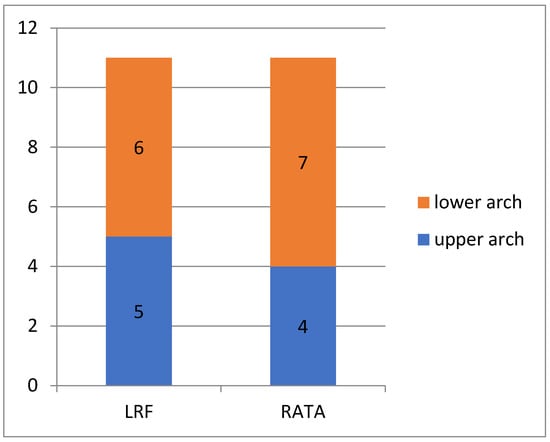
In our study, we analyzed a total of 11 RPDs for the LRF (test group) with thinner clasps designed for aesthetics, and 11 RPDs for the RATA (control group), for a total of 22 RPDs. Of the RPDs made with the LRF method, 5 in the upper arch and 6 in the lower arch were made in 36.36% of cases of Class I edentulism, 54% in Class II edentulism, and 9% in Kennedy Class III edentulism; of the RPDs made with the RATA method, 4 in the upper arch and 7 in the lower arch were made in 18.18% of cases of Class I edentulism, 18.18% in Class II edentulism, and 63.63% in Kennedy Class III edentulism.
A total of 22 RPD were examined: 9 in the upper arch and 13 in the lower arch. 27.27% of the total RPD were in Kennedy class I, 36.36% in Kennedy class II, and 36.36% in Kennedy class III (Figure 1, Table 1).
Figure 1.
RPD distribution for heat treatment. Slow quenching furnace (LRF) and room temperature air quenching (RATA).
Table 1.
Number of prostheses made with slow cooling in an oven and in ambient air.
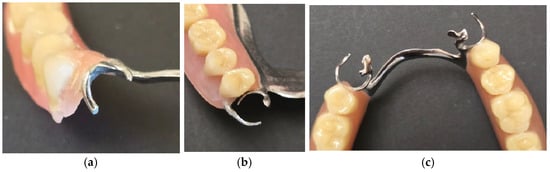
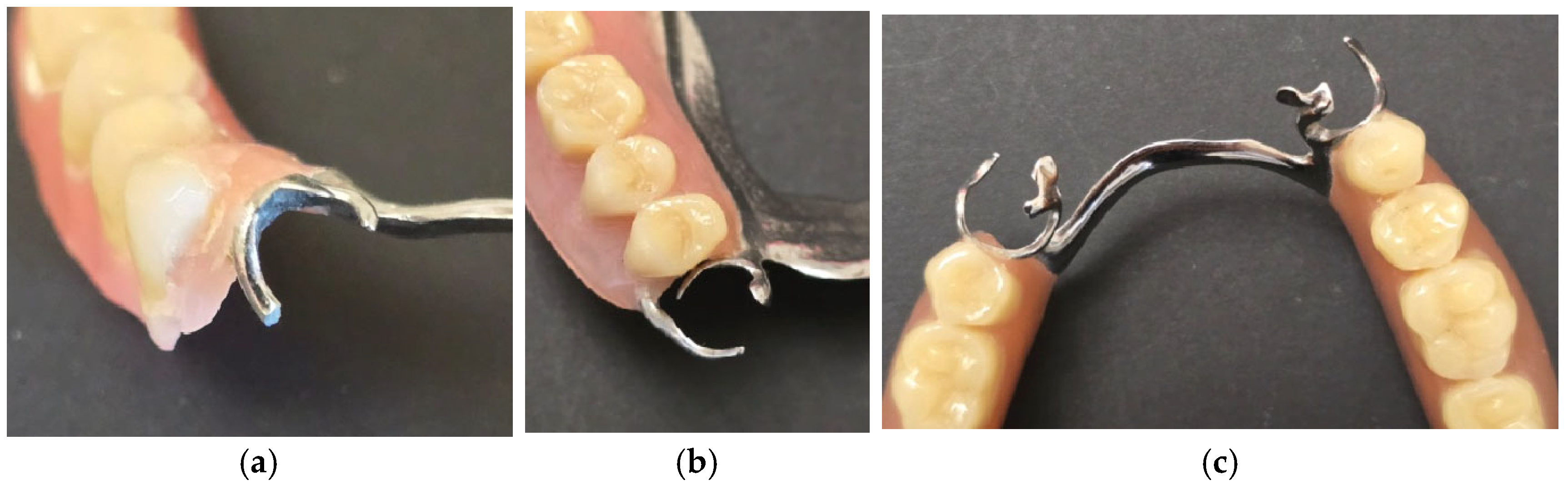
This study was based on a cluster analysis of 22 RPD prosthetic devices produced in 2017 with written informed consent where the method of construction of the removable partial denture was also reported. In 2022, for routine check-ups, the dentures were sent to the dental technician. Data collection focused exclusively on the technical characteristics of the prostheses (such as prosthesis modifications, prosthesis clasp fractures, and enlarged clasps). The prostheses are completely anonymous, and it is not possible to trace the data from one prosthesis to any specific patient, in accordance with the Helsinki Declarations. The prostheses were evaluated by completing a questionnaire by the dental technician to whom the prostheses were sent for cleaning and polishing. No reference to the type of cooling performed (LRF or RATA) was included when the prosthesis was sent, so as not to subjectively influence the evaluation. The small sample size is due to the actual production of only 11 RPDs using the LRF method with clasps 2/3 tenths of a millimeter thinner, obtained from preformed wax used in ring clasps(thinner preforms), to verify whether the durability of these clasps was comparable to clasps with normal thicknesses(larger preforms for type 1 hooks). Furthermore, the choice to use the different Kennedy classes for the study was due to the lack of standardization of the class and to verify the resistance and behavior of the deliberately reduced clasp in different edentulisms and dental situations. In the RPDs, the following were evaluated: fracture of the prosthesis clasps, enlarged clasps, modification of the prosthesis (rebasing), and control of the RPD was performed after 5 years (Figure 2a–c).
Figure 2.
(a) Fractured clasp; (b) prosthesis modification; (c) enlarged clasp.
Statistical Evaluation
Given the small sample of RPDs, the Fisher exact test was used to assess the statistical significance of the differences observed in the frequencies of the various outcomes between the two groups, with a significance level of p < 0.05. Statistical analysis was performed using the R software version 4.3.3.
3. Results
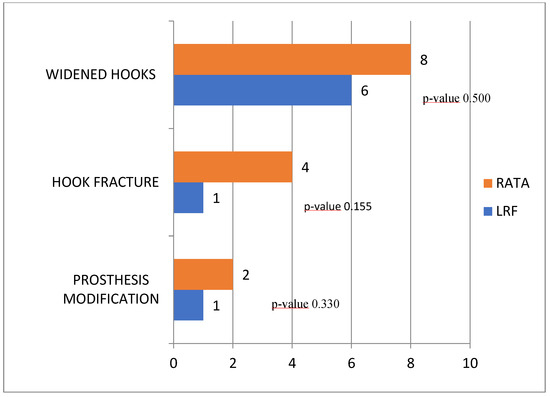
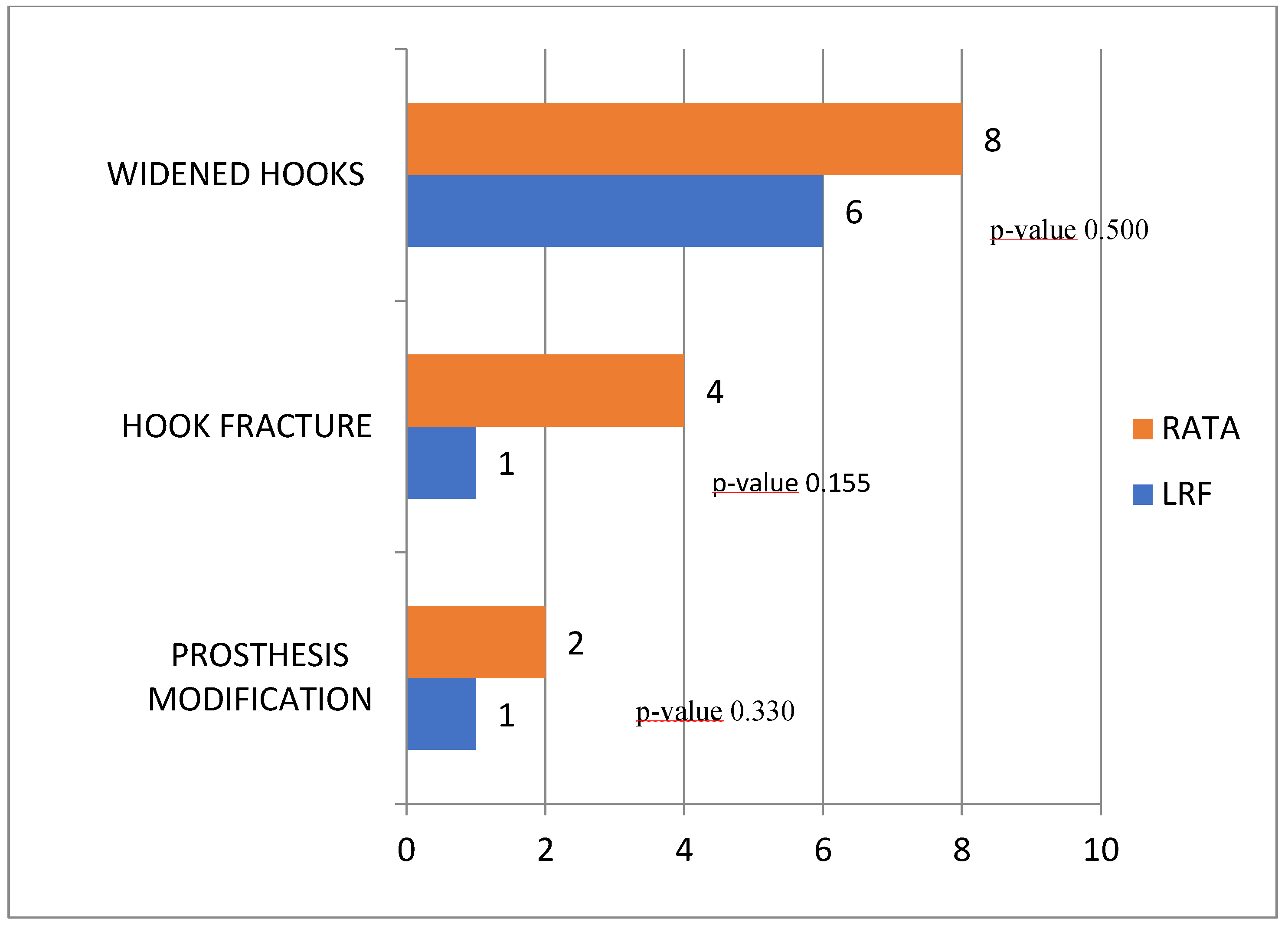
The evaluation of the prosthetic characteristics highlighted that only 3 of the 22 RPDs were modified; furthermore, in 17 of the 22 RPDs, a relining was performed in correspondence with the saddles. The RPD made with the slow cooling method showed slightly lower percentages in the three parameters evaluated—prosthesis modification 9.1%; clasp fracture 9.1%; widened clasps 54.4%—compared to the RPD made with the room air cooling method—prosthesis modification 18.2%; clasp fracture 36.4%; and bent clasps 72.7% (Table 2).
Table 2.
Statistical comparative analysis of the comparison between LRF and RATA techniques.
The statistical analysis of the comparison between the two methods did not highlight any statistical significance in the parameters evaluated. For the test group (LRF), 1 prosthesis modification out of 11 and 2 prosthesis modifications out of 11 in the control group (RATA) were observed, showing no significant statistical differences, with a p-value of 0.500; 1 case of clasp fracture out of 11 prostheses in the test group and 4 clasp fractures out of 11 prostheses in the control group showed no significant statistical differences, p-value 0.155; 6 cases of widened clasps out of 11 prostheses for the test group and 8 cases of widened clasps out of 11 prostheses in the control group showed no significant statistical differences, p-value 0.330 (Figure 3).
Figure 3.
Values obtained with the two different methods of cooling the alloy after melting.
4. Discussion
Removable partial dentures (RPDs) offer a wide range of aesthetic and restorative features for partially edentulous patients [17]. In this study we analyzed the presence of some negative aspects of RPD, and, in particular, the modification of the prosthesis due to tooth extractions, the fracture of the clasps due to continuous incorrect stress on them, and the widened clasps which are also due to the incorrect insertion of the prosthesis or the possible incorrect design of prostheses obtained with a slow cooling method in a furnace (LRF) and other RPDs obtained with the room temperature air cooling method (RATA). All the prostheses obtained in this work have in common the chromium cobalt molybdenum alloy and the laboratory that created the RPDs. In the literature, there are a few works that analyze the heat treatments of a Cr Co Mo alloy to increase the mechanical characteristics; works on the heat treatment of NiTi alloys and on the adhesion of porcelain to metal are reported [18,19]. An immediate modification of the mechanical characteristics using a heat treatment is observed in the orthodontic field where nickel–titanium wires tested at 55 °C showed a significant variation as a function of temperature in terms of behavior and strength, both for traditional and thermo-activated wires. Stresses at high temperatures can induce permanent deformations, while the residual deformation detected at low temperatures can be recovered with increasing temperature [20]. Furthermore, through an appropriate heat treatment, it is possible to obtain the desired hardness of Co-Cr-Mo alloys [21,22]. Our study compared two cooling methods: slow furnace cooling (LRF), used for the test group, and room-temperature air cooling (RATA), for the control group. The aim was to determine whether the increase in the alloy’s mechanical properties achieved with LRF could provide greater strength to reduced RPD clasps, thus improving aesthetics. This approach builds on the results of a 2004 study, the first to examine slow furnace cooling at 980 °C for RPDs. That research, conducted on rectangular and cylindrical specimens made of Niranium 801046K Cr-Co-Mo alloy, had already shown a significant improvement in mechanical properties. In particular, the tensile strength increased from 40.7–55.1 daN/mm2 with RATA to 59.1–70.3 daN/mm2 with LRF, while the compressive strength increased from 170.75–185.12 daN/mm2 with RATA to 193.48–199.08 daN/mm2 with LRF [23]. This study allowed us to exploit the increased mechanical characteristics to make the RPD clasps thinner and more aesthetic. The statistical analysis revealed no statistically significant differences between the two post-cast alloy cooling methods (LRF and RATA). This conclusion holds true for all Kennedy edentulousness classes, both in the upper and lower arch, regardless of subclassification. However, these results underscore the importance of ongoing clinical monitoring. Evaluating RPDs over time is crucial, especially those with intentionally thinned clasps to improve their aesthetic appearance. Further evidence of this is the “clasp fracture” parameter, which showed a clear difference: 9.1% incidence for clasps obtained with the LRF method versus 18.2% for those obtained with RATA. Despite the lack of statistical significance, this trend suggests that the LRF method may offer a potential advantage in terms of reducing the risk of fractures over time, justifying careful post-delivery follow-up. The widened clasps highlight a possible pain in the insertion and removal of the prosthesis, which was found in those clasps performed mainly in the premolars and canines without support from the adjacent teeth with a percentage of 9.1% in the subjects who used RPD with RLF against 36.4% in the RATA [24,25]. This phenomenon is often caused by incorrect management of the prosthesis by patients who, ignoring the clinicians’ instructions on the insertion axis, position it by applying pressure by closing their mouth [4,26,27]. Despite the lack of statistical significance (prosthesis modification p-value of 0.500—clasp fracture p-value 0.155—widened clasps p-value 0.330), the observed trends suggest better potential for the LRF method. Only three RPD were modified and relined. The modifications to the prosthesis, however, did not affect the correct biomechanical functioning of the RPDs [28,29]. The prostheses of the test group showed lower complication rates in all parameters, indicating greater stability and a reduced need for maintenance. This better performance can be attributed to the superior mechanical properties conferred by the LRF. Recent studies have in fact confirmed that adequate heat treatment can increase the fatigue and deformation resistance of the Cr-Co alloy, making the clasps more robust and durable [30]. This study has some limitations that deserve consideration, the main one being the small sample size, which significantly impacts statistical power and consequently did not allow for the achievement of significance. Furthermore, some biases may have influenced the results (Table 3).
Table 3.
Limitations and potential bias of the study.
5. Conclusions
The results of this five-year retrospective study indicate that removable partial dentures (RPDs) made of cobalt–chromium–molybdenum alloy are a valid rehabilitation solution, with a low rate of complications such as clasp fractures and prosthetic modifications, provided that a rigorous maintenance protocol is followed (check-ups). Although the statistical comparison between the two post-fusion cooling methods (LRF and RATA) did not reveal significant differences, clinical data suggest a potential superiority of the LRF method. Specifically, the LRF group showed lower complication rates in all evaluated parameters, such as modification prosthesis, fractured clasp, and enlarged clasp. This result is clinically relevant, especially considering that the clasps in this group were intentionally made thinner for aesthetic reasons. This improved clinical performance suggests that the superior mechanical properties afforded by the LRF heat treatment may offset the potential structural weakening due to the reduction in thickness. However, it is essential to interpret these results in light of the study’s limitations. The small sample size compromised statistical power, preventing statistical significance from being achieved. Future studies with a larger sample size will be needed to confirm the clinical trend observed here and to validate the LRF method as the preferred protocol for producing RPDs with thin clasps, standardizing clasp thickness, and to definitively isolate the impact of the heat treatment alone.
Author Contributions
Conceptualization and methodology, S.C.; writing—original draft preparation, writing—review and editing, G.C. and D.L.; supervision, validation, F.C. All authors have read and agreed to the published version of the manuscript.
Funding
This research received no external funding.
Institutional Review Board Statement
IRB approval is not required according to the Declaration of Helsinki.
Informed Consent Statement
Informed Written consent was obtained from all subjects involved in the study.
Data Availability Statement
Data from this study are available upon reasonable request by writing to the corresponding author.
Acknowledgments
The authors thank dental technician Giovanni Ceraulo for his valuable contribution to the creation of the prosthetic devices.
Conflicts of Interest
The authors declare no conflicts of interest.
Abbreviations
The following abbreviations are used in this manuscript:
| CK | Kennedy class |
| RPD | Removable partial denture |
| LRF | Slow cooling in the oven |
| RATA | Air cooling at room temperature |
References
- Kim, J.J. Revisiting the Removable Partial Denture. Dent. Clin. N. Am. 2019, 63, 263–278. [Google Scholar] [CrossRef] [Scilit] [PubMed]
- Behr, M.; Zeman, F.; Passauer, T.; Koller, M.; Hahnel, S.; Buergers, R.; Lang, R.; Handel, G.; Kolbeck, C. Clinical performance of cast clasp-retained removable partial dentures: A retrospective study. Int. J. Prosthodont. 2012, 25, 138–144. [Google Scholar] [PubMed]
- Alhamoudi, F.H.; Aldosari, L.I.N.; Alshadidi, A.A.F.; Bin Hassan, S.A.; Alwadi, M.A.M.; Vaddamanu, S.K.; Cicciù, M.; Minervini, G. An Investigation of the Fracture Loads Involved in the Framework of Removable Partial Dentures Using Two Types of All-Ceramic Restorations. Biomimetics 2023, 8, 113. [Google Scholar] [CrossRef] [Scilit] [PubMed] [PubMed Central]
- Ceraulo, S.; Caccianiga, P.; Barbarisi, A.; Caccianiga, G.; Biagi, R. Insertion axis in removable prosthesis: A preliminary report. Minerva Dent. Oral Sci. 2024, 73, 328–334. [Google Scholar] [CrossRef] [Scilit] [PubMed]
- Sun, W.; Ma, Y.; Li, P.; Moumni, Z.; Zhang, W. Effects of Build Direction and Heat Treatment on the Defect Characterization and Fatigue Properties of Laser Powder Bed Fusion Ti6Al4V. Aerospace 2024, 11, 854. [Google Scholar] [CrossRef] [Scilit]
- Oliveira, R.; Kakitani, R.; Cangerana, K.C.B.; Garcia, A.; Cheung, N. Microstructural Refinement and Improvement of Microhardness of a Hypoeutectic Al–Fe Alloy Treated by Laser Surface Remelting. Mater. Proc. 2020, 2, 16. [Google Scholar] [CrossRef] [Scilit]
- Dawid, M.-T.; Moldovan, O.; Rudolph, H.; Kuhn, K.; Luthardt, R.G. Technical Complications of Removable Partial Dentures in the Moderately Reduced Dentition: A Systematic Review. Dent. J. 2023, 11, 55. [Google Scholar] [CrossRef] [Scilit]
- Strandman, E. The influence of different heat treatments on a dental Co-Cr alloy. Odontol. Revy. 1976, 27, 287–302. [Google Scholar] [PubMed]
- Ko, K.-H.; Kang, H.-G.; Huh, Y.-H.; Park, C.-J.; Cho, L.-R. Effects of heat treatment on the microstructure, residual stress, and mechanical properties of Co-Cr alloy fabricated by selective laser melting. J. Mech. Behav. Biomed. Mater. 2022, 126, 105051. [Google Scholar] [CrossRef] [Scilit] [PubMed]
- Aktürk, D.; Yildiz, M.T.; Yurtkuran, E.; Babacan, N. Microstructural and fatigue properties of dental structures produced via selective laser melting: Comparing Co-Cr-Mo, Co-Cr-Mo-W and Co-Cr-W alloys. Rapid Prototyp. J. 2025, 31, 1280–1290. [Google Scholar] [CrossRef] [Scilit]
- Huang, Z.; Wang, B.; Liu, F.; Song, M.; Ni, S.; Liu, S. Evoluzionedellamicrostruttura, trasformazionedella martensite e proprietàmeccanichedelleleghe Co-Cr-Mo-W trattatetermicamentemediantefusione laser selettiva. Int. J. Refract. Met. Hard Mater. 2023, 113, 106170. [Google Scholar] [CrossRef] [Scilit]
- Brantley, W.; Alapati, S.B. Heat Treatment of Dental Alloys: A Review. In Metallurgy—Advances in Materials and Processes; InTech: London, UK, 2012. [Google Scholar] [CrossRef] [Scilit]
- Zhou, Y.; Liu, Z.; Du, H.; Jiang, J.; Li, J.; Ma, X.; Yi, Y. Effects of rapid infrared radiation heating on the warping deformation and mechanical properties of selective laser melted Co-Cr dental alloy. J. Prosthet. Dent. 2025, 133, 907.e1–907.e9. [Google Scholar] [CrossRef] [Scilit] [PubMed]
- Kim, M.-J.; Shin, H.-J.; Kim, H.-I.; Kwon, Y.H.; Seol, H.-J. Effect of ice-quenching after oxidation treatment on hardening of a Pd-Cu-Ga-Zn alloy for bonding porcelain. J. Mech. Behav. Biomed. Mater. 2018, 79, 83–91. [Google Scholar] [CrossRef] [Scilit] [PubMed]
- Yamanaka, K.; Mori, M.; Chiba, A. Assessment of precipitation behavior in dental castings of a Co-Cr-Mo alloy. J. Mech. Behav. Biomed. Mater. 2015, 50, 268–276. [Google Scholar] [CrossRef] [Scilit] [PubMed]
- Jiménez-Marcos, C.; Mirza-Rosca, J.C.; Vermesan, D.; Saceleanu, A. Evaluation of the Structure, Microhardness and Corrosion Properties of Cobalt-chromium Dental Alloys with Two Different Cooling Media. Int. J. Met. 2025. [Google Scholar] [CrossRef] [Scilit]
- Htat, H.L.; Takaichi, A.; Kajima, Y.; Kittikundecha, N.; Kamijo, S.; Hanawa, T.; Wakabayashi, N. Influence of stress-relieving heat treatments on the efficacy of Co-Cr-Mo-W alloy copings fabricated using selective laser melting. J. Prosthodont. Res. 2024, 68, 310–318. [Google Scholar] [CrossRef] [Scilit] [PubMed]
- Yildiz, M.T.; Babacan, N. Comparison of tensile properties and porcelain bond strength in metal frameworks fabricated by selective laser melting using three different Co-Cr alloy powders. J. Prosthet. Dent. 2024, 131, 936–942. [Google Scholar] [CrossRef] [Scilit] [PubMed]
- Lombardo, L.; Toni, G.; Stefanoni, F.; Mollica, F.; Guarneri, M.P.; Siciliani, G. The effect of temperature on the mechanical behavior of nickel-titanium orthodontic initial archwires. Angle Orthod. 2013, 83, 298–305. [Google Scholar] [CrossRef] [Scilit] [PubMed] [PubMed Central]
- Vutova, K.; Stefanova, V.; Markov, M.; Vassileva, V. Study on Hardness of Heat-Treated CoCrMo Alloy Recycled by Electron Beam Melting. Materials 2023, 16, 2634. [Google Scholar] [CrossRef] [Scilit]
- Kajima, Y.; Takaichi, A.; Kittikundecha, N.; Nakamoto, T.; Kimura, T.; Nomura, N.; Kawasaki, A.; Hanawa, T.; Takahashi, H.; Wakabayashi, N. Effect of heat-treatment temperature on microstructures and mechanical properties of Co–Cr–Mo alloys fabricated by selective laser melting. Mater. Sci. Eng. A 2018, 726, 21–31. [Google Scholar] [CrossRef] [Scilit]
- Ceraulo, S.; Buzzanca, R.; Geraci, D.; Passi, P. Variazionedellaresistenza a trazione e compressione di unastellite con diversimetodi di raffreddamento. Protech Anno. 2004, 5, 15–20. [Google Scholar]
- Shifman, A.; Ben-Ur, Z. The mandibular first premolar as an abutment for distal-extension removable partial dentures: A modified clasp assembly design. Br. Dent. J. 2000, 188, 246–248. [Google Scholar] [CrossRef] [Scilit] [PubMed]
- Fiorillo, L.; Cervino, G.; Herford, A.S.; Lauritano, F.; D’Amico, C.; Lo Giudice, R.; Laino, L.; Troiano, G.; Crimi, S.; Cicciù, M. Interferon Crevicular Fluid Profile and Correlation with Periodontal Disease and Wound Healing: A Systemic Review of Recent Data. Int. J. Mol. Sci. 2018, 19, 1908. [Google Scholar] [CrossRef] [Scilit] [PubMed] [PubMed Central]
- Curinga, M.R.S.; da Silva, D.J.; Pereira, A.L.C.; da Silva, N.R.; Carreiro, A.F.P. Digital planning and surveying for a rotational path removable partial denture: A case report. Gen. Dent. 2024, 72, 69–73. [Google Scholar] [PubMed]
- Schittly, J. Détermination de l’axed’insertion et impératifsesthétiquesenprothèseadjointepartielle [Determination of the axis of insertion and the esthetic requirements of removable partial dentures]. Rev. Odontostomatol. 1985, 14, 293–298. (In French) [Google Scholar] [PubMed]
- Ceraulo, S. Vertical dimension modification. Case report [Modifica della dimensione verticale. Caso clinico]. PROTECH 2008, 9, 17–22. [Google Scholar]
- Hakkoum, M.A. New Clasp Assembly for Distal Extension Removable Partial Dentures: The Reverse RPA Clasp. J. Prosthodont. 2016, 25, 411–413. [Google Scholar] [CrossRef] [Scilit] [PubMed]
- Renani, M.S.; Meysami, A.; Najafabadi, R.A.; Meysami, M.; Khodaei, M. Effect of Cooling Rate on Structural, Corrosion, and Mechanical Properties of Cobalt–Chromium–Molybdenum Dental Alloys. J. Bio-Tribo-Corros. 2024, 10, 15. [Google Scholar] [CrossRef] [Scilit]
- Kittikundecha, N.; Kajima, Y.; Takaichi, A.; Cho, H.H.W.; Htat, H.L.; Doi, H.; Takahashi, H.; Hanawa, T.; Wakabayashi, N. Fatigue properties of removable partial denture clasps fabricated by selective laser melting followed by heat treatment. J. Mech. Behav. Biomed. Mater. 2019, 98, 79–89. [Google Scholar] [CrossRef] [Scilit] [PubMed]

Disclaimer/Publisher’s Note: The statements, opinions and data contained in all publications are solely those of the individual author(s) and contributor(s) and not of MDPI and/or the editor(s). MDPI and/or the editor(s) disclaim responsibility for any injury to people or property resulting from any ideas, methods, instructions or products referred to in the content. |
© 2025 by the authors. Licensee MDPI, Basel, Switzerland. This article is an open access article distributed under the terms and conditions of the Creative Commons Attribution (CC BY) license (https://creativecommons.org/licenses/by/4.0/).