Enhancing Crash Severity Prediction Using Explainable Ensemble Machine Learning and Deep Learning Approaches: A Case Study of Qassim




Abstract
1. Introduction
2. Literature Review
2.1. Factors Influencing Crash Severity
2.2. Existing Analytical Approaches
3. Methodology
3.1. Data Description
3.2. Model Development
3.2.1. Support Vector Machine (SVM)
3.2.2. Random Forest (RF)
3.2.3. Gradient Boosting Machine (GBM)
3.2.4. Feedforward Neural Networks (FFNNs)
3.3. Model Evaluation
3.4. Model Interpretation
4. Results
4.1. Comparative Assessment of Model Performance
4.2. Model Interpretation Results
4.2.1. SHAP Interpretability Analysis
4.2.2. Consistency of Crash Influencing Factors Between ML and DL Models
5. Discussion and Policy Implications
6. Conclusions
Author Contributions
Funding
Institutional Review Board Statement
Data Availability Statement
Acknowledgments
Conflicts of Interest
References
- Ahmed, S.K.; Mohammed, M.G.; Abdulqadir, S.O.; El-Kader, R.G.A.; El-Shall, N.A.; Chandran, D.; Rehman, M.E.U.; Dhama, K. Road Traffic Accidental Injuries and Deaths: A Neglected Global Health Issue. Health Sci. Rep. 2023, 6, e1240. [Google Scholar] [CrossRef] [Scilit] [PubMed]
- World Health Organization. Global Status Report on Road Safety 2023: Country and Territory Profiles; WHO: Geneva, Switzerland, 2024. [Google Scholar]
- Jamal, A.; Zahid, M.; Tauhidur Rahman, M.; Al-Ahmadi, H.M.; Almoshaogeh, M.; Farooq, D.; Ahmad, M. Injury Severity Prediction of Traffic Crashes with Ensemble Machine Learning Techniques: A Comparative Study. Int. J. Inj. Control Saf. Promot. 2021, 28, 408–427. [Google Scholar] [CrossRef] [Scilit] [PubMed]
- Alshammari, T.O. Future Vision for Improving Riyadh City to Become a Smart Mobility City. Nat. Vol. Essent. Oils 2021, 8, 398–417. [Google Scholar]
- Akin, D.; Sisiopiku, V.P.; Alateah, A.H.; Almonbhi, A.O.; Al-Tholaia, M.M.H.; Al-Sodani, K.A.A. Identifying Causes of Traffic Crashes Associated with Driver Behavior Using Supervised Machine Learning Methods: Case of Highway 15 in Saudi Arabia. Sustainability 2022, 14, 16654. [Google Scholar] [CrossRef] [Scilit]
- Rahman, M.M.; Islam, M.K.; Al-Shayeb, A.; Arifuzzaman, M. Towards Sustainable Road Safety in Saudi Arabia: Exploring Traffic Accident Causes Associated with Driving Behavior Using a Bayesian Belief Network. Sustainability 2022, 14, 6315. [Google Scholar] [CrossRef] [Scilit]
- Jamal, A.; Rahman, M.T.; Al-Ahmadi, H.M.; Mansoor, U. The Dilemma of Road Safety in the Eastern Province of Saudi Arabia: Consequences and Prevention Strategies. Int. J. Environ. Res. Public Health 2020, 17, 157. [Google Scholar]
- Jamal, A.; Mahmood, T.; Riaz, M.; Al-Ahmadi, H.M. GLM-Based Flexible Monitoring Methods: An Application to Real-Time Highway Safety Surveillance. Symmetry 2021, 13, 362. [Google Scholar] [CrossRef] [Scilit]
- Al-Ahmadi, H.M.; Jamal, A.; Ahmed, T.; Rahman, M.T.; Reza, I.; Farooq, D. Calibrating the Highway Safety Manual Predictive Models for Multilane Rural Highway Segments in Saudi Arabia. Arab. J. Sci. Eng. 2021, 46, 11471–11485. [Google Scholar] [CrossRef] [Scilit]
- Abdulrahman, R.; Almoshaogeh, M.; Haider, H.; Alharbi, F.; Jamal, A. Development and Application of a Risk Analysis Methodology for Road Traffic Accidents. Alex. Eng. J. 2025, 111, 293–305. [Google Scholar] [CrossRef] [Scilit]
- Lord, D.; Mannering, F. The Statistical Analysis of Crash-Frequency Data: A Review and Assessment of Methodological Alternatives. Transp. Res. Part A Policy Pract. 2010, 44, 291–305. [Google Scholar] [CrossRef] [Scilit]
- Mannering, F.; Bhat, C.R.; Shankar, V.; Abdel-Aty, M. Big Data, Traditional Data and the Tradeoffs between Prediction and Causality in Highway-Safety Analysis. Anal. Methods Accid. Res. 2020, 25, 100113. [Google Scholar] [CrossRef] [Scilit]
- Pervez, A.; Jamal, A. Exploring E-Scooter Risk Factors Based on Interpretable Machine Learning Framework; Elsevier: Amsterdam, The Netherlands, 2025; Volume 94, pp. 128–140. [Google Scholar]
- Ma, X.; Dai, Z.; He, Z.; Ma, J.; Wang, Y.; Wang, Y. Learning Traffic as Images: A Deep Convolutional Neural Network for Large-Scale Transportation Network Speed Prediction. Sensors 2017, 17, 818. [Google Scholar] [CrossRef] [Scilit] [PubMed]
- Zhang, J.; Li, Z.; Pu, Z.; Xu, C. Comparing Prediction Performance for Crash Injury Severity among Various Machine Learning and Statistical Methods. IEEE Access 2018, 6, 60079–60087. [Google Scholar] [CrossRef] [Scilit]
- Delen, D.; Sharda, R.; Bessonov, M. Identifying Significant Predictors of Injury Severity in Traffic Accidents Using a Series of Artificial Neural Networks. Accid. Anal. Prev. 2006, 38, 434–444. [Google Scholar] [CrossRef] [Scilit] [PubMed]
- Jamal, A.; Umer, W. Exploring the Injury Severity Risk Factors in Fatal Crashes with Neural Network. Int. J. Environ. Res. Public Health 2020, 17, 7466. [Google Scholar] [CrossRef] [Scilit] [PubMed]
- Chen, T.; Guestrin, C. XGBoost: A Scalable Tree Boosting System. In Proceedings of the 22nd ACM SIGKDD International Conference on Knowledge Discovery and Data Mining; ACM: San Francisco, CA, USA, 2016; pp. 785–794. [Google Scholar]
- Dong, S.; Khattak, A.; Ullah, I.; Zhou, J.; Hussain, A. Predicting and Analyzing Road Traffic Injury Severity Using Boosting-Based Ensemble Learning Models with SHAPley Additive exPlanations. Int. J. Environ. Res. Public Health 2022, 19, 2925. [Google Scholar] [CrossRef] [Scilit] [PubMed]
- Friedman, J.H. Greedy Function Approximation: A Gradient Boosting Machine. Ann. Stat. 2001, 29, 1189–1232. [Google Scholar] [CrossRef] [Scilit]
- Ditcharoen, A.; Chhour, B.; Traikunwaranon, T.; Aphivongpanya, N.; Maneerat, K.; Ammarapala, V. Road Traffic Accidents Severity Factors: A Review Paper. In 2018 5th International Conference on Business and Industrial Research (ICBIR); IEEE: Bangkok, Thailand, 2018; pp. 339–343. [Google Scholar]
- Eboli, L.; Forciniti, C. The Severity of Traffic Crashes in Italy: An Explorative Analysis among Different Driving Circumstances. Sustainability 2020, 12, 856. [Google Scholar] [CrossRef] [Scilit]
- Paleti, R.; Eluru, N.; Bhat, C.R. Examining the Influence of Aggressive Driving Behavior on Driver Injury Severity in Traffic Crashes. Accid. Anal. Prev. 2010, 42, 1839–1854. [Google Scholar] [CrossRef] [Scilit] [PubMed]
- Zhang, J.; Lindsay, J.; Clarke, K.; Robbins, G.; Mao, Y. Factors Affecting the Severity of Motor Vehicle Traffic Crashes Involving Elderly Drivers in Ontario. Accid. Anal. Prev. 2000, 32, 117–125. [Google Scholar] [CrossRef] [Scilit] [PubMed]
- Dong, C.; Shao, C.; Li, J.; Xiong, Z. An Improved Deep Learning Model for Traffic Crash Prediction. J. Adv. Transp. 2018, 2018, 3869106. [Google Scholar] [CrossRef] [Scilit]
- Wen, X.; Xie, Y.; Wu, L.; Jiang, L. Quantifying and Comparing the Effects of Key Risk Factors on Various Types of Roadway Segment Crashes with LightGBM and SHAP. Accid. Anal. Prev. 2021, 159, 106261. [Google Scholar] [CrossRef] [Scilit] [PubMed]
- Rahim, M.A.; Hassan, H.M. A Deep Learning Based Traffic Crash Severity Prediction Framework. Accid. Anal. Prev. 2021, 154, 106090. [Google Scholar] [CrossRef] [Scilit] [PubMed]
- Alshehri, A.H.; Alanazi, F.; Yosri, A.M.; Yasir, M. Comparing Fatal Crash Risk Factors by Age and Crash Type by Using Machine Learning Techniques. PLoS ONE 2024, 19, e0302171. [Google Scholar] [CrossRef] [Scilit] [PubMed]
- Zhang, H.; Qu, W.; Ge, Y.; Sun, X.; Zhang, K. Effect of Personality Traits, Age and Sex on Aggressive Driving: Psychometric Adaptation of the Driver Aggression Indicators Scale in China. Accid. Anal. Prev. 2017, 103, 29–36. [Google Scholar] [CrossRef] [Scilit] [PubMed]
- Ali, F.; Ali, A.; Imran, M.; Naqvi, R.A.; Siddiqi, M.H.; Kwak, K.-S. Traffic Accident Detection and Condition Analysis Based on Social Networking Data. Accid. Anal. Prev. 2021, 151, 105973. [Google Scholar] [CrossRef] [Scilit] [PubMed]
- Huang, T.; Wang, S.; Sharma, A. Highway Crash Detection and Risk Estimation Using Deep Learning. Accid. Anal. Prev. 2020, 135, 105392. [Google Scholar] [CrossRef] [Scilit] [PubMed]
- Wen, X.; Xie, Y.; Jiang, L.; Pu, Z.; Ge, T. Applications of Machine Learning Methods in Traffic Crash Severity Modelling: Current Status and Future Directions. Transp. Rev. 2021, 41, 855–879. [Google Scholar] [CrossRef] [Scilit]
- Sattar, K.; Chikh Oughali, F.; Assi, K.; Ratrout, N.; Jamal, A.; Masiur Rahman, S. Transparent Deep Machine Learning Framework for Predicting Traffic Crash Severity. Neural Comput. Appl. 2023, 35, 1535–1547. [Google Scholar] [CrossRef] [Scilit]
- Abdel-Aty, M.; Uddin, N.; Pande, A.; Abdalla, M.F.; Hsia, L. Predicting Freeway Crashes from Loop Detector Data by Matched Case-Control Logistic Regression. Transp. Res. Rec. J. Transp. Res. Board 2004, 1897, 88–95. [Google Scholar] [CrossRef] [Scilit]
- Hossain, M.; Muromachi, Y. Understanding Crash Mechanism on Urban Expressways Using High-Resolution Traffic Data. Accid. Anal. Prev. 2013, 57, 17–29. [Google Scholar] [CrossRef] [Scilit] [PubMed]
- Wang, L.; Abdel-Aty, M.; Lee, J.; Shi, Q. Analysis of Real-Time Crash Risk for Expressway Ramps Using Traffic, Geometric, Trip Generation, and Socio-Demographic Predictors. Accid. Anal. Prev. 2019, 122, 378–384. [Google Scholar] [CrossRef] [Scilit] [PubMed]
- Chen, S.; Wang, W. Decision Tree Learning for Freeway Automatic Incident Detection. Expert Syst. Appl. 2009, 36, 4101–4105. [Google Scholar] [CrossRef] [Scilit]
- Agarwal, S.; Kachroo, P.; Regentova, E. A Hybrid Model Using Logistic Regression and Wavelet Transformation to Detect Traffic Incidents. IATSS Res. 2016, 40, 56–63. [Google Scholar] [CrossRef] [Scilit]
- Shao, Y.; Shi, X.; Zhang, Y.; Shiwakoti, N.; Xu, Y.; Ye, Z. Injury Severity Prediction and Exploration of Behavior-Cause Relationships in Automotive Crashes Using Natural Language Processing and Extreme Gradient Boosting; Elsevier: Amsterdam, The Netherlands, 2024; Volume 133, p. 108542. [Google Scholar]
- Zhang, Z.; Niu, Z.; Li, Y.; Ma, X.; Sun, S. Research on the Influence Factors of Accident Severity of New Energy Vehicles Based on Ensemble Learning. Front. Energy Res. 2023, 11, 1329688. [Google Scholar] [CrossRef] [Scilit]
- Bao, J.; Liu, P.; Ukkusuri, S.V. A Spatiotemporal Deep Learning Approach for Citywide Short-Term Crash Risk Prediction with Multi-Source Data. Accid. Anal. Prev. 2019, 122, 239–254. [Google Scholar] [CrossRef] [Scilit] [PubMed]
- Wenqi, L.; Dongyu, L.; Menghua, Y. A Model of Traffic Accident Prediction Based on Convolutional Neural Network. In Proceedings of the 2017 2nd IEEE International Conference on Intelligent Transportation Engineering (ICITE); IEEE: Singapore, 2017; pp. 198–202. [Google Scholar]
- Iranitalab, A.; Khattak, A. Comparison of Four Statistical and Machine Learning Methods for Crash Severity Prediction. Accid. Anal. Prev. 2017, 108, 27–36. [Google Scholar] [CrossRef] [Scilit] [PubMed]
- Almoshaogeh, M.; Abdulrehman, R.; Haider, H.; Alharbi, F.; Jamal, A.; Alarifi, S.; Shafiquzzaman, M. Traffic Accident Risk Assessment Framework for Qassim, Saudi Arabia: Evaluating the Impact of Speed Cameras. Appl. Sci. 2021, 11, 6682. [Google Scholar] [CrossRef] [Scilit]
- Savolainen, P.T.; Mannering, F.L.; Lord, D.; Quddus, M.A. The Statistical Analysis of Highway Crash-Injury Severities: A Review and Assessment of Methodological Alternatives. Accid. Anal. Prev. 2011, 43, 1666–1676. [Google Scholar] [CrossRef] [Scilit] [PubMed]
- Fiorentini, N.; Losa, M. Handling Imbalanced Data in Road Crash Severity Prediction by Machine Learning Algorithms. Infrastructures 2020, 5, 61. [Google Scholar] [CrossRef] [Scilit]
- Abdullah, D.M.; Abdulazeez, A.M. Machine Learning Applications Based on SVM Classification a Review. Qubahan Acad. J. 2021, 1, 81–90. [Google Scholar] [CrossRef] [Scilit]
- Sen, P.C.; Hajra, M.; Ghosh, M. Supervised Classification Algorithms in Machine Learning: A Survey and Review. In Emerging Technology in Modelling and Graphics; Mandal, J.K., Bhattacharya, D., Eds.; Advances in Intelligent Systems and Computing; Springer: Singapore, 2020; Volume 937, pp. 99–111. [Google Scholar]
- Yu, R.; Abdel-Aty, M. Utilizing Support Vector Machine in Real-Time Crash Risk Evaluation. Accid. Anal. Prev. 2013, 51, 252–259. [Google Scholar] [CrossRef] [Scilit] [PubMed]
- Cortes, C.; Vapnik, V. Support-Vector Networks. Mach. Learn. 1995, 20, 273–297. [Google Scholar] [CrossRef] [Scilit]
- Schölkopf, B.; Smola, A.J. Learning with Kernels: Support Vector Machines, Regularization, Optimization, and Beyond; MIT Press: Cambridge, MA, USA, 2002. [Google Scholar]
- Breiman, L. Random Forests. Mach. Learn. 2001, 45, 5–32. [Google Scholar] [CrossRef] [Scilit]
- Breiman, L. Bagging Predictors. Mach. Learn. 1996, 24, 123–140. [Google Scholar] [CrossRef] [Scilit]
- Pande, A.; Abdel-Aty, M. Assessment of Freeway Traffic Parameters Leading to Lane-Change Related Collisions. Accid. Anal. Prev. 2006, 38, 936–948. [Google Scholar] [CrossRef] [Scilit] [PubMed]
- Ke, G.; Meng, Q.; Finley, T.; Wang, T.; Chen, W.; Ma, W.; Ye, Q.; Liu, T.-Y. Lightgbm: A Highly Efficient Gradient Boosting Decision Tree. Adv. Neural Inf. Process. Syst. 2017, 30, 3146–3154. [Google Scholar]
- Prokhorenkova, L.; Gusev, G.; Vorobev, A.; Dorogush, A.V.; Gulin, A. CatBoost: Unbiased Boosting with Categorical Features. Adv. Neural Inf. Process. Syst. 2018, 31, 6638–6648. [Google Scholar]
- Basheer, I.A.; Hajmeer, M. Artificial Neural Networks: Fundamentals, Computing, Design, and Application. J. Microbiol. Methods 2000, 43, 3–31. [Google Scholar] [CrossRef] [Scilit] [PubMed]
- Svozil, D.; Kvasnicka, V.; Pospichal, J. Introduction to Multi-Layer Feed-Forward Neural Networks. Chemom. Intell. Lab. Syst. 1997, 39, 43–62. [Google Scholar] [CrossRef] [Scilit]
- Jamal, A.; Reza, I.; Shafiullah, M. Modeling Retroreflectivity Degradation of Traffic Signs Using Artificial Neural Networks. IATSS Res. 2022, 46, 499–514. [Google Scholar] [CrossRef] [Scilit]
- Hornik, K.; Stinchcombe, M.; White, H. Multilayer Feedforward Networks Are Universal Approximators; Elsevier: Amsterdam, The Netherlands, 1989; Volume 2, pp. 359–366. [Google Scholar]



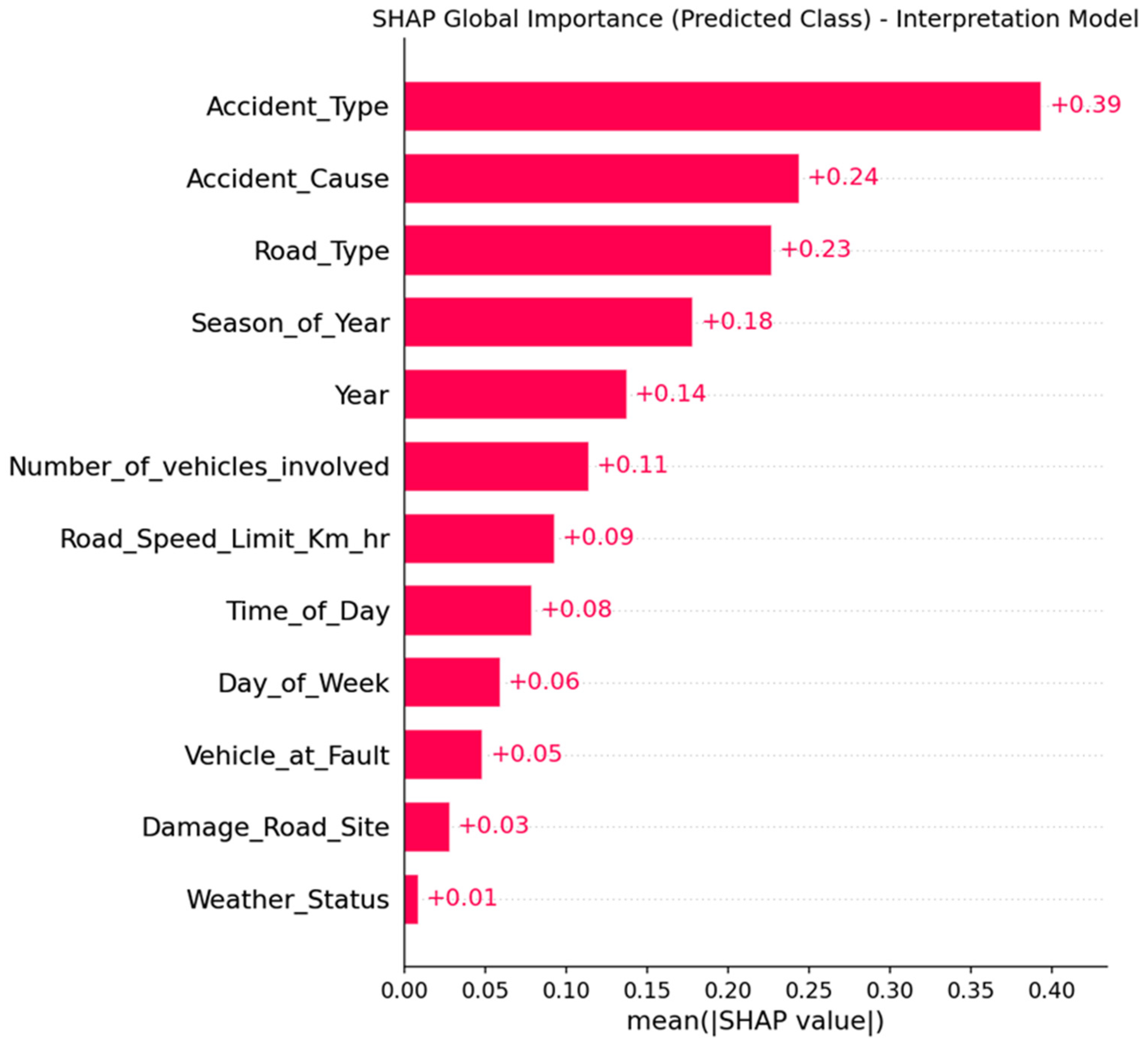


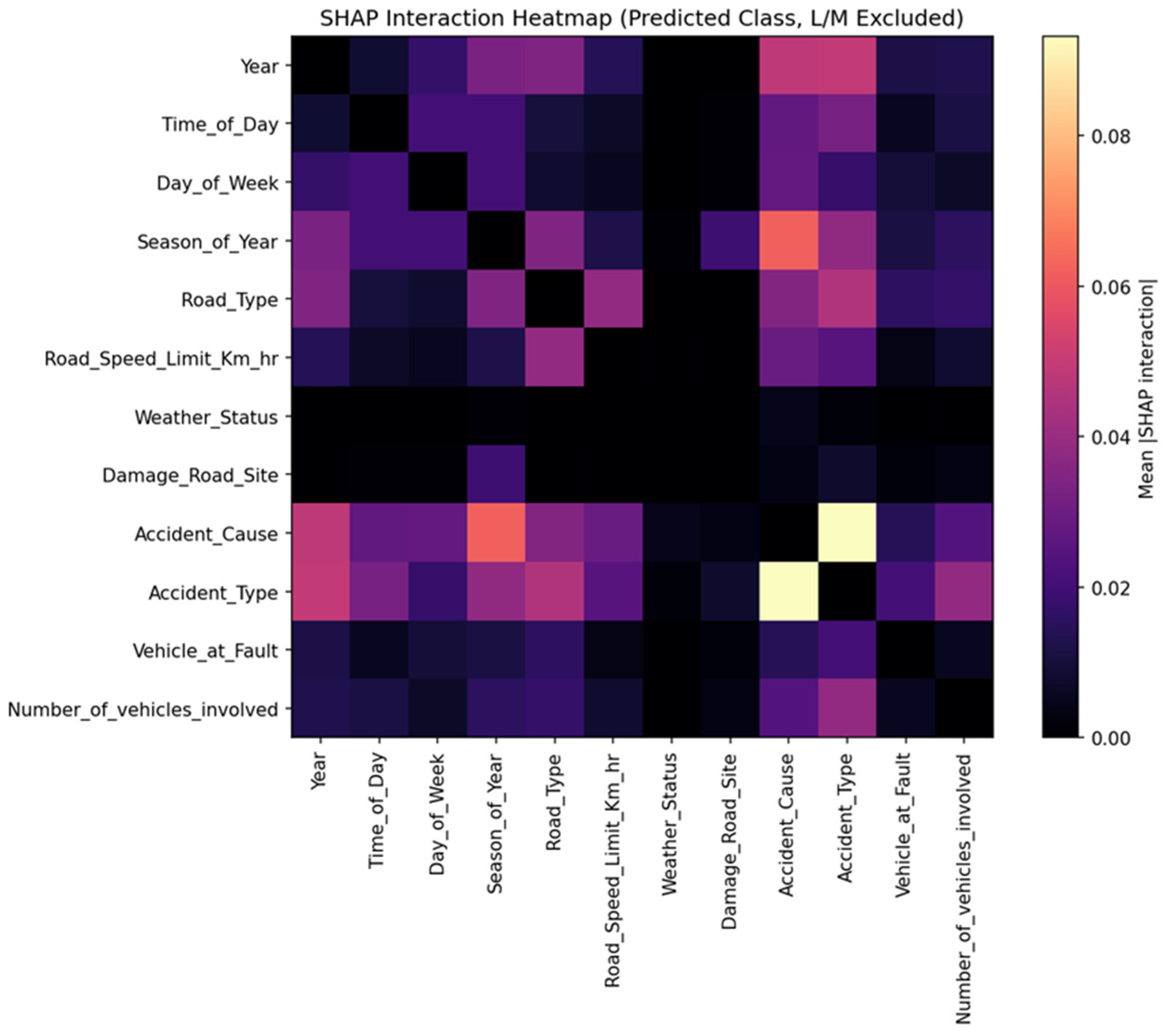


| # | Study Objective | Data Used | Methodology | Factors Affecting Severity | Key Findings | References |
|---|---|---|---|---|---|---|
| 1 | To examine factors influencing the severity of crashes involving elderly drivers in Ontario. | Canadian Traffic Accident Information Databank (TRAID). | Multivariate unconditional logistic regression. | Age, sex, failing to yield, seat belt usage, snowy weather, roads with high speed limits, and head-on collisions. | Older drivers and factors like not wearing seat belts and adverse weather significantly increase crash severity. | [24] |
| 2 | To analyze the impact of road, driver, and environmental characteristics on crash severity. | Italian crash data from 2016. | Logistic regression models. | Distracted driving, speeding, and not maintaining a safe distance. | Circumstances such as distracted driving and speeding significantly influence crash severity. | [22] |
| 3 | To evaluate the role of personal behavior, age, and sex in aggressive driving behaviors. | Driver Aggression Indicators Scale (DAIS) applied to 422 participants in Beijing, China. | Psychometric analysis and correlation studies. | Personality traits, age, and sex. | Neuroticism correlates with aggressive driving, and older age groups exhibit more hostile aggression. | [29] |
| 4 | To assess how aggressive driving moderates the effects of various variables on injury severity. | National Motor Vehicle Crash Causation Study (NMVCCS). | Accommodate moderating effect for aggressive driving and injury severity. | Aggressive driving, seat belt usage, speed limits, and demographic variables. | Aggressive driving behavior significantly increases injury severity; addressing it could reduce crash impacts. | [23] |
| 5 | To review factors influencing traffic accident severity globally. | The literature on global traffic accidents. | Review of logistic regression and other models. | Speed, alcohol consumption, driver fatigue, and vehicle types. | Speed and human behaviors are primary determinants of crash severity. | [21] |
| 6 | To compare the performance of MNL, NNC, SVM, and RF for crash severity prediction. | 2012–2015 Nebraska two-vehicle crash data. | MNL, NNC, SVM, RF with K-means and Latent Class Clustering. | Crash costs, data clustering effects. | NNC outperformed others for severe crashes; K-means improved performance. | [43] |
| 7 | To develop a deep learning model with regression for traffic crash prediction. | Tennessee roadway information management system and pavement management system. | Deep learning with multivariate regression layer. | Roadway geometry, traffic, and weather. | Model improved prediction accuracy by 84.58% over baseline models. | [25] |
| 8 | To review ML applications in crash severity modeling. | Survey on ML methods for crash severity. | Survey of ML techniques like RF, SVM, ANNs. | Imbalanced data, spatiotemporal correlations, and interpretability. | ML outperforms traditional methods but lacks interpretability. | [32] |
| 9 | To assess the impact of speed cameras on accident reduction in Qassim, Saudi Arabia. | Crash data from MOT in Riyadh, three years’ accident records (2017–2019). | ArcGIS risk scoring and analysis. | Speed, road conditions, driver behavior, environmental conditions. | Speed cameras led to a 70% decline in total accidents counts, and 84% in injury crashes, and a complete absence of accidents with fatalities. | [44] |
| 10 | To develop a framework using deep learning to predict crash severity. | Crash data from work zones in Louisiana (2014–2018). | CNN with a customized loss function. | Road, vehicle, and human-related features. | Improved performance for fatal and injury crash prediction. | [27] |
| 11 | To detect traffic accidents using social networking data. | Traffic information from social networks. | FastText model and Bi-LSTM. | Traffic-related sentiments, dynamic data. | Achieved 97% accuracy for event detection. | [30] |
| 12 | Feasibility of using deep learning models to detect crashes and predict crash risk on highways. | Sensor data from Interstate 235, Des Moines. | Deep learning algorithms, including several model variants. | Traffic volume, speed, and occupancy. | Deep learning models have better crash detection performance than shallow models for crash detection. | [31] |
| 13 | To examine risk factors for crashes by age and type using machine learning. | Dataset of traffic crashes in Jeddah, Saudi Arabia (2020–2022). | Machine Learning algorithms (XGBoost, CatBoost, LightGBM, and RF). | Driver demographics, crash location, weather, and vehicle type. | LightGBM achieved the highest accuracy (95.4%), identifying specific age-related risks. | [28] |
| 14 | Analyze the effects of risk factors on crash frequency and types. | Texas crash dataset (2015–2017). | LightGBM and SHAP. | Speed limits, area type, number of lanes, roadway classes, shoulder width, and type. | Speed limits and narrow lanes are critical factors. | [26] |
| Attribute | Description | Frequency (n) | Percentage (%) |
|---|---|---|---|
| Crash Severity Distribution | 1: PDO; 2: injury; 3: fatal | 1535/803/115 | 62.5/32.7/4.6 |
| Accident year | 1: 2023; 2: 2024; 3: 2025 | 683/1135/635 | 27.9/46.3/25.8 |
| Traffic Accident Types | 1: Rear-end collision; 2: collision with fixed object; 3: vehicle rollover; 4: sideswipe; 5: run-off-road accident; 6: collision with object; 7: vehicle fire; 8: collision with an animal; 9: head-on collision; 10: pedestrian collision; 11: intersection collision | 757/506/455/291/155/84/79/67/40/10/9 | 30.8/20.6/18.5/11.8/6.3/3.4/3.2/2.7/1.6/0.4/0.4 |
| Traffic Accident Causes | 1: Driver inattention/distraction; 2: tire blowout; 3: driver fatigue; 4: speeding; 5: electrical/mechanical issues; 6: sudden swerve; 7: animal-related; 8: improper passing; 9: road obstruction; 10: insufficient safe distance; 11: sudden deceleration; 12: wet road surface; 13: wrong-way driving; 14: failure to yield; 15: traffic signal violation; 16: strong wind | 1182/278/226/152/132/118/68/67/65/49/37/36/16/14/8/5 | 48.1/11.3/9.2/6.2/5.3/4.8/2.7/2.7/2.6/1.9/1.5/1.4/0.6/0.5/0.3/0.2 |
| Time of Day (ToD) | 1: Day; 2: night | 1353/1100 | 55.1/44.9 |
| Day of the Week (DoW) | 1: Weekday; 2: weekend | 1818/635 | 74.1/25.9 |
| Season of the Year | 1: Winter; 2: spring; 3: autumn; 4: summer | 659/661/619/514 | 26.8/26.9/25.2/20.9 |
| Road Type | 1: Main highway; 2: dual carriageway; 3: single carriageway | 1419/518/516 | 57.9/21.1/21 |
| Road Speed Limit | 1: 140; 2: 120; 3: 110; 4: 100; 5: 90; 6: 80 | 1411/365/493/60/87/80 | 57.5/14.9/20.1/2.5/3.6/1.5 |
| Weather Status | 1: Clear; 2: rainy; 3: cloudy; 4: windy | 2397/24/19/13 | 97.7/1.0/0.8/0.5 |
| Damage at the Site | 1: Undamaged road/site; 2: damaged road/site | 2310/143 | 94.1/5.9 |
| Vehicle at Fault | 1: Private vehicle driver; 2: truck drive; 3: bus driver; 4: motorcycle rider | 1984/447/19/3 | 81/18.2/0.7/0.8/0.05 |
| Number of Vehicles Involved | 1: Single vehicle; 2: two vehicles; 3: multi-vehicles | 1208/1182/63 | 49.3/48.2/2.5 |
| Model | Key Parameter | Search Space | Optimized Value |
|---|---|---|---|
| SVM | Kernel | RBF, linear, polynomial | RBF |
| Kernel coefficient (gamma) | 0.001–1 | 0.01 | |
| Penalty parameter (c) | 0.1–100 | 10 | |
| RF | max_depth | 5–30 | 20 |
| n_estimators | 100–500 | 300 | |
| max_features | log2, sqrt, or 0.3–1.0 | sqrt | |
| min_samples_split | 2–10 | 2 | |
| GBM | learning_rate | 0.01–0.3 | 0.05 |
| Number of boosting rounds | 100–500 | 250 | |
| max_depth | 2–6 | 3 | |
| Subsample rate | 0.5–1.0 | 0.7 | |
| FFNN | Activation function | ReLU/sigmoid/tanh | Sigmoid |
| Hidden layers | 1–4 | 2 | |
| Neurons per layer | 32–256 | 128 | |
| Epochs | 50–200 | 150 | |
| Optimizer | Adam/RMSprop/SGD | Adam | |
| Batch size | 16–128 | 64 |
| Actual Condition | Predicted Positive | Predicted Negative |
|---|---|---|
| Positive | True positives (TP) | False negatives (FN) |
| Negative | False positives (FP) | True negatives (TN) |
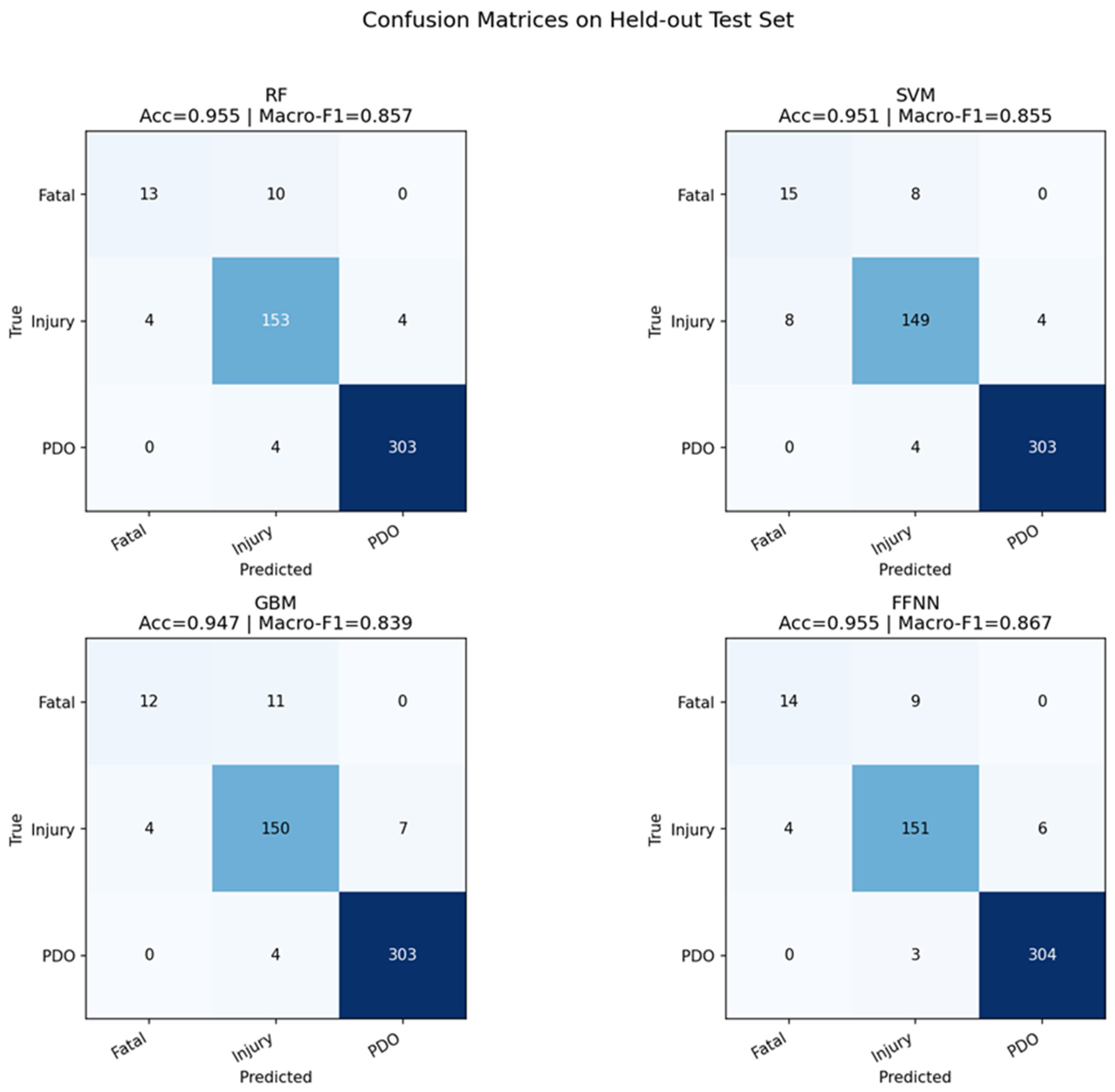
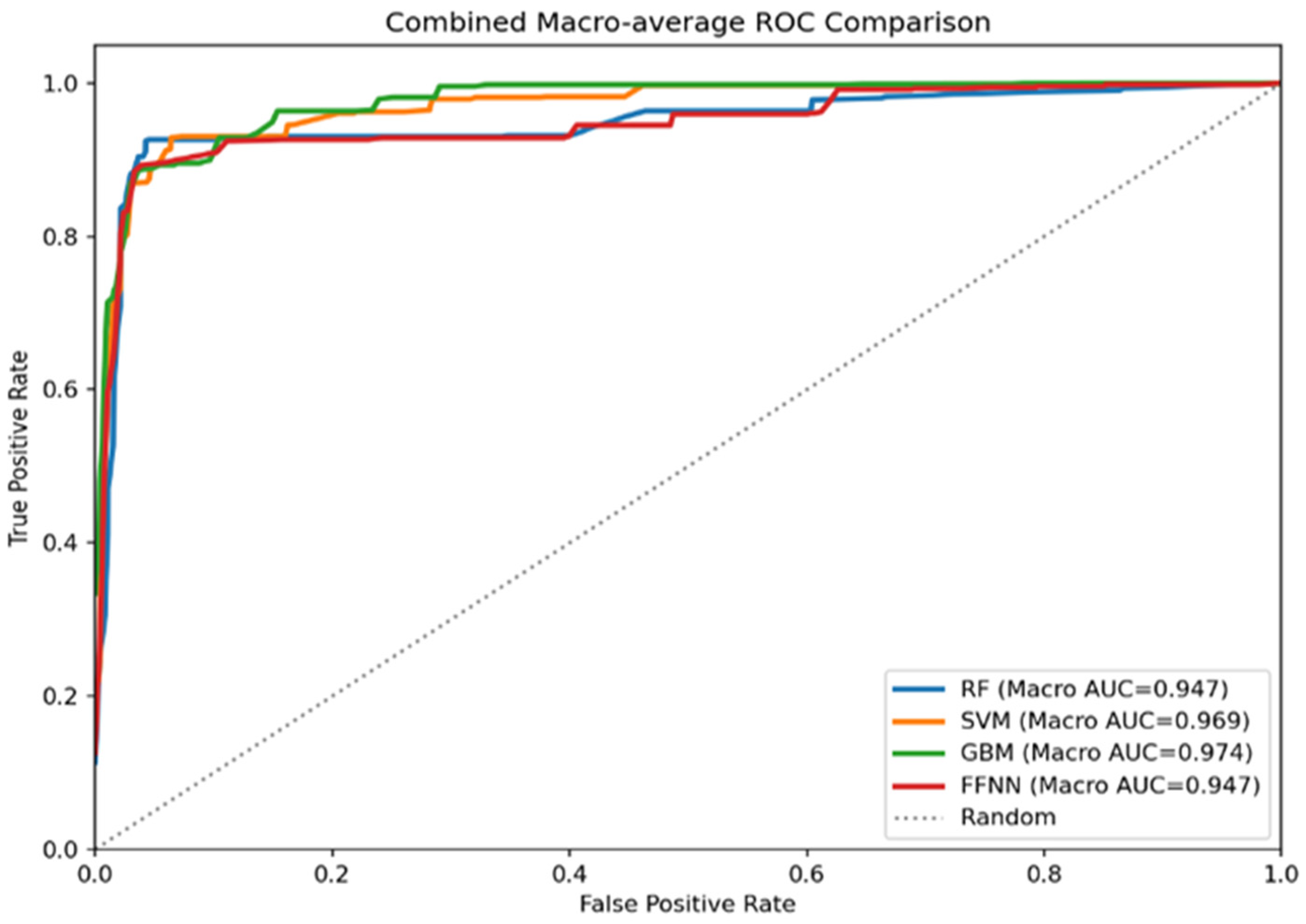
| Model | Accuracy | Macro F1-Score | Balanced Accuracy | Macro ROC-AUC |
|---|---|---|---|---|
| FFNN | 0.95 | 0.86 | 0.85 | 0.94 |
| RF | 0.96 | 0.86 | 0.83 | 0.95 |
| SVM | 0.94 | 0.84 | 0.85 | 0.96 |
| GBM | 0.94 | 0.84 | 0.81 | 0.97 |
| Classifier Model | Severity Class | Recall | Precision | F1-Score |
|---|---|---|---|---|
| SVM | Fatal | 0.62 | 0.71 | 0.67 |
| Injury | 0.84 | 0.86 | 0.85 | |
| PDO | 0.97 | 0.96 | 0.96 | |
| Macro avg. | 0.81 | 0.84 | 0.83 | |
| RF | Fatal | 0.67 | 0.79 | 0.72 |
| Injury | 0.89 | 0.91 | 0.90 | |
| PDO | 0.98 | 0.97 | 0.97 | |
| Macro avg. | 0.85 | 0.89 | 0.86 | |
| GBM | Fatal | 0.74 | 0.73 | 0.73 |
| Injury | 0.87 | 0.85 | 0.86 | |
| PDO | 0.96 | 0.95 | 0.95 | |
| Macro avg. | 0.85 | 0.85 | 0.85 | |
| FFNN | Fatal | 0.71 | 0.76 | 0.73 |
| Injury | 0.86 | 0.89 | 0.88 | |
| PDO | 0.97 | 0.96 | 0.97 | |
| Macro avg. | 0.85 | 0.87 | 0.86 |
| Influential Factor | RF | SVM | GBM | FFNN | Level of Agreement | Interpretive Comment |
|---|---|---|---|---|---|---|
| Crash Type | Very High | High | Very High | Very High | Very High | All models agreed that crash type is the most influential factor, particularly head-on collisions and rollovers. |
| Crash Cause | Very High | Very High | Very High | Very High | Very High | The models agreed that distraction, speeding, fatigue, and improper passing are among the most important causes of increased crash severity. |
| Roadway Type | High | Moderate | High | Very High | High | FFNN and GBM assigned greater importance to highways compared with SVM. |
| Speed Limit | Very High | Very High | High | High | Very High | All models showed that increasing speed is associated with a higher probability of fatal crashes. |
| Head-on Collision | Very High | Very High | Very High | Very High | Very High | This was the factor most strongly associated with fatal crashes in all models. |
| Improper Passing | Very High | High | High | Moderate | Moderate to High | FFNN was the most sensitive to this factor, indicating its ability to capture complex interactions. |
| Driver Fatigue | High | High | High | Moderate | High | This appeared as an important factor, particularly in severe and fatal crashes. |
| Tire Blowout | High | High | Moderate | High | Moderate to High | RF and FFNN assigned greater weight to this factor because of its association with fatal crashes on highways. |
| Distraction/Inattention | Very High | High | Very High | Very High | Very High | This was the most common factor across all crash severity levels, although it had less ability to distinguish between severe and non-severe crashes. |
| Weather and Environmental Conditions | Low | Low | Moderate | Low | Low | These factors had less influence compared with human- and roadway-related factors. |
Disclaimer/Publisher’s Note: The statements, opinions and data contained in all publications are solely those of the individual author(s) and contributor(s) and not of MDPI and/or the editor(s). MDPI and/or the editor(s) disclaim responsibility for any injury to people or property resulting from any ideas, methods, instructions or products referred to in the content. |
© 2026 by the authors. Licensee MDPI, Basel, Switzerland. This article is an open access article distributed under the terms and conditions of the Creative Commons Attribution (CC BY) license.
Share and Cite
Alfallaj, S.; Almoshaogeh, M.; Jamal, A.; Alharbi, F. Enhancing Crash Severity Prediction Using Explainable Ensemble Machine Learning and Deep Learning Approaches: A Case Study of Qassim. Vehicles 2026, 8, 151. https://doi.org/10.3390/vehicles8070151
Alfallaj S, Almoshaogeh M, Jamal A, Alharbi F. Enhancing Crash Severity Prediction Using Explainable Ensemble Machine Learning and Deep Learning Approaches: A Case Study of Qassim. Vehicles. 2026; 8(7):151. https://doi.org/10.3390/vehicles8070151
Chicago/Turabian StyleAlfallaj, Sulaiman, Meshal Almoshaogeh, Arshad Jamal, and Fawaz Alharbi. 2026. "Enhancing Crash Severity Prediction Using Explainable Ensemble Machine Learning and Deep Learning Approaches: A Case Study of Qassim" Vehicles 8, no. 7: 151. https://doi.org/10.3390/vehicles8070151
APA StyleAlfallaj, S., Almoshaogeh, M., Jamal, A., & Alharbi, F. (2026). Enhancing Crash Severity Prediction Using Explainable Ensemble Machine Learning and Deep Learning Approaches: A Case Study of Qassim. Vehicles, 8(7), 151. https://doi.org/10.3390/vehicles8070151