Article

Distributed Hierarchical MPC for Consensus and Stability of Vehicle Platoons with Mixed Communication Topologies


School of Electronic and Electrical Engineering, Bengbu University, Bengbu 233030, China
*
Author to whom correspondence should be addressed.
Vehicles 2026, 8(4), 82; https://doi.org/10.3390/vehicles8040082
Submission received: 9 February 2026 / Revised: 23 March 2026 / Accepted: 31 March 2026 / Published: 7 April 2026

Abstract

This paper presents a distributed hierarchical model predictive control (MPC) framework designed to ensure dynamic consensus and stability in nonlinear vehicle platoons, addressing challenges posed by mixed communication topologies and hard constraints. By directed graph modeling of the mixed communication topologies, the dynamic consensus goal for the platoon is defined by the inter-vehicle distances between the host and its neighbors, whereas the stability criterion for an individual vehicle is expressed as a positive definite function of its position and velocity deviations. Then, a contractive constraint is elegantly designed to correlate these two objectives in a hierarchical model predictive control framework, where the lower layer optimizes the stability objective and the upper layer optimizes the dynamic consensus objective. The conditions ensuring stability and string stability for the vehicle platoon are shown to be only dependent on the deviations of the host vehicle, which achieves dynamic consensus and string stability simultaneously for nonlinear vehicle platoons. Several representative scenarios are used to validated the performance of the proposed strategy.

1. Introduction

With increasing traffic congestion and accidents, road capacity and safety face significant challenges. The coordinated control of vehicle platoons, such as those involving autonomous vehicles and formation control, has consequently garnered widespread attention in recent years. Fundamentally, this coordinated control aims to synchronize the velocities of platoon members while strictly adhering to minimum safety headways [1,2,3]. Such a framework exhibits substantial promise in optimizing traffic throughput, bolstering road safety, and mitigating the risk of vehicular accidents [4,5].
In practice, constraints on vehicle speed, acceleration, and formation control exist within platoon systems. Each vehicle maintains communication and exchanges state information to enable coordinated platoon control. Consequently, distributed model predictive control (DMPC) has recently been widely adopted to explicitly address these constraints and communication challenges, such as in consensus control and flocking problems for multi-agent systems [6,7,8,9,10]. To characterize the varying degrees of collaboration and rivalry within the network, a new weight function based on inter-agent distance is introduced. This design facilitates consensus tracking control in MASs featuring both cooperative and competitive interactions, even when communications are asynchronous [11]. Furthermore, various MPC controllers have been proposed to achieve cooperative formation behavior for vehicle platoons [12,13,14,15]. For instance, a distributed MPC strategy utilizing V2V communication topologies was proposed to achieve string stability [12]. An L2-norm control synthesis approach was designed for string stability [13]. A distributed nonlinear model predictive control (DNMPC) strategy was formulated to coordinate platoon following control with individual vehicle dynamics [14]. A distributed economic MPC (EMPC) algorithm demonstrated up to 6.84% savings compared to conventional tracking-focused approaches [15].
However, most existing platoon control approaches rely on rigid or single-mode communication topologies and maintain strict formations. In these setups, followers typically receive state information directly from the platoon leader. This reliance on the leader becomes problematic in large-scale platoons, as not all followers can reliably obtain the necessary information. Furthermore, real-world deployment faces additional complexities such as communication delays, vehicle heterogeneity, and dynamic interaction patterns. Recent studies have explored advanced solutions including category-guided graph representations for complex topologies [16], robust offset-free strategies for delay compensation [17], and personalized federated learning frameworks for heterogeneous systems [18,19]. While this paper primarily focuses on establishing theoretical stability guarantees under mixed switching topologies with fixed parameters, we dedicate a new section (Section 6) to comprehensively discussing how our proposed framework can be extended by integrating these state-of-the-art concepts, including adaptive parameter tuning via dynamic learning [20].
With advancements in coordinated vehicular control, research has increasingly focused on dynamic processes within vehicle platoons [21,22]. However, most existing work neglects the coordination between dynamic consensus and platoon stability. Typically, platoon stability is ensured by adopting coupled cost functions across vehicles and imposing additional assumptions on these functions. Few results address string stability, large-scale platoon scalability, or the coordination between dynamic consensus and stability in linear platoons.
Conversely, distributed consensus protocols have been developed for connected and automated vehicle platooning under various distance strategies [23,24,25,26,27]. A predictive spacing for vehicles modeled by a third-order system was proposed [23], and a robust strategy was designed for platoons [24]. A distributed direct adaptive control law is employed to control longitudinal motion of the vehicles [25]. To mitigate platoon failures, a finite-time fault estimation law and robust DSMC architecture were formulated for platoon operations [26,27].
Most efforts concentrate on fixed vehicle coupling modes, often resulting in string-unstable spacing and overlooking consensus-stability coordination during platooning. Furthermore, achieving stability frequently relies on linearizing nonlinear vehicle models via Taylor expansion or intermediate variables, which introduces limitations.
Maintaining safe inter-vehicle distances is essential. This necessitates optimizing dynamic consensus while ensuring platoon stability and considering dynamic consensus performance during travel. Consequently, platooning control involves dual objectives: stability (a local vehicle-level objective) and dynamic consensus (a global platoon-level objective). A cooperative relationship exists between these objectives. Some studies address both aspects, such as using weighted cost functions to reconcile them [28,29,30,31,32], where weights are determined through extensive offline experimentation. However, this often results in non-convex or non-positive definite dynamic consensus cost functions concerning vehicle consensus errors. These limitations complicate stability analysis and restrict the applicability of platooning control.
This paper designs a distributed hierarchical MPC framework for vehicle platoons subject to state or control constraints and mixed communication topologies. We define the stability constraint for the dynamic consensus optimization problem using the optimal value function of the tracking stability objective. Building on the standard MPC triplet framework [33], we establish asymptotic stability of the system about the equilibrium point while guaranteeing dynamic consensus. The recursive feasibility of the dynamic consensus objective and platoon string stability are derived using the receding horizon principle and the stability constraint. The main contributions are as follows: (1) The proposed dual-layer MPC strategy coordinates stability and dynamic consensus objectives under mixed communication topologies, guaranteeing both for the platoon system. (2) Decoupling dynamic consensus and stability objectives eliminates the need for weight selection in cost functions and influence balancing, highlighting the critical role of communication topology in platoon stability and consensus. Numerical simulations using a seven-vehicle scenario verify the strategy’s effectiveness.
The remainder of this paper is structured as follows: Section 2 outlines the problem formulation and provides necessary preliminaries. Section 3 proposes the distributed hierarchical MPC strategy for solving the consensus and tracking stability optimization problems. Section 4 details the recursive feasibility and string stability analysis. Section 5 provides simulation results. Notably, Section 6 offers an in-depth discussion on bridging our current work with recent advances in robust control, federated learning, and graph representation, specifically addressing the five key dimensions highlighted by recent literature. Finally, Section 7 concludes the paper.
Notation: We denote real numbers and non-negative integers by Z, and I, respectively. Given a vector x and a positive semi-definite matrix P, the P-weighted Euclidean norm is defined as x P .

2. Problem Formulation and Preliminaries

Consider a system of n interconnected vehicles, where p 1 represents the lead car, and p n represents the tail car. Each vehicle p i can receive the information transmitted to it in the platoon. At initial time, the platoon tracks desired position and speed trajectory s L , v 0 , where the reference signal v 0 is shared with all the followers p i , i = 1, ⋯, n. At other times, the lead car p 1 will track the desired trajectory, and other vehicles p 1 will track the immediate predecessor p i 1 , i = 2, ⋯, n, and maintain a desired safe spacing d > 0 with it. It is assumed that the communication network performance of all vehicles is good, there is no network delay or packet loss phenomenon, the vehicles move on a flat road, and the model has no disturbance.
Let s i and v i represent the position and speed of vehicle p i , i = 1, ⋯, n, respectively. The expected deviations of position and speed of vehicle pi are defined as e p , i = s L s i i 1 d and e v , i = v i v 0 . Then, the longitudinal deviation model of vehicle pi is described by [28]
e p , i k + 1 = e p , i k + e v , i k Δ t e v , i k + 1 = e v , i k + Δ t m i η T , i r i u i k φ i e v , i k
where φ i e v , i k = C A , i e v , i 2 k + m i g μ i , Δ t is the sampling time interval, mi is the vehicle mass, C A , i is the aerodynamic resistance coefficient, g is the gravitational acceleration, μ i is the rolling resistance coefficient, r i is the tire radius, and η T , i is the mechanical efficiency of the car. The vehicle state variable is expressed as x i k = [ e p , i k , e v , i k ] T , u i is the control input representing the desired driving/braking torque. The constraints on state and control variables of vehicle p i are given by
u min , i u i u max , i , x min , i x i x max , i
where umin,i < 0 and umax,i > 0 are the upper and lower bounds, and xmin,i < 0 and xmax,i > 0 are the upper and lower bounds of the state variable. For simplicity, (1) is written as
x i k + 1 = f i x i k , u i k
where fi(xi,ui) ∈ R2×1 is defined as
f i = e p , i + e v , i Δ t e v , i Δ t / m i C A , i e v , i 2 + m i g μ i + u i η T , i Δ t / m i r i
Definition 1 
[34]. Given a step variation in the reference velocity v at instant k = 0, the platoon is considered stable if the state error of every vehicle converges asymptotically to zero.
Definition 2 
[34]. At the initial moment, the expected speed  v 0  takes a step change, and the state vector of every vehicle converges asymptotically to zero. For i = 2,⋯, n, there exists a ρi ∈ (0, 1), and the closed-loop position error satisfies
max k 0 e p , i k ρ i   max k 0 e p , i 1 k
From Definition 2, the Predecessor–Follower string stability characterizes the capability, which suppresses the amplification of position errors as they propagate through the platoon.
Remark 1. 
For the purpose of performance evaluation, a recommended separation error bound of ±0.5 m is established, reflecting a balance between tight formation and maintaining system stability and safety.
The mixed communication topology of the vehicle platoon is characterized as a directed graph G = {H,C,A}. Here, H = {1, …, n} denotes the set of vehicles, C signifies the set of communication links, and A = [aij] ∈ R n × n is the adjacency matrix capturing the information exchange patterns among the platoon members. For any (i,j) ∈ C, ji, and aij = 1, where (i,j) ∈ C means the directed edge from i to node j, i.e., vehicle j receives the information transmitted by vehicle i. Conversely, there is no communication between vehicle i and j. Let Θi and Ωi denote the out-neighbor and in-neighbor sets of node i, respectively. Specifically, Θi= {j ∈ H∖{i}∣aij = 1} represents the set of nodes to which ii transmits information. Conversely, the dual set Ωi= {j ∈ H∖{i}∣aji = 1} comprises the nodes from which i receives data. A directed graph is said to contain a directed spanning tree if there exists at least one root node ii such that a directed path connects ii to every other node j ∈ H.
The mixed communication topology means that the communication between vehicles is arbitrary, i.e., it contains unidirectional communication and an undirected communication mode.
This paper presents a distributed hierarchical control framework tailored for vehicle platoons operating under mixed communication topologies, while explicitly accounting for state and control constraints. This strategy efficiently coordinates the trade-off between dynamic consensus performance and platoon stability while guaranteeing both stability and consensus performance, as well as string stability. Moreover, the controller satisfies all system constraints.

3. Distributed Control Strategy

3.1. Control Strategy

State measurements are acquired at discrete time instant k , with a prediction horizon of length NI≥0. The optimal control sequence, denoted as u i o k , is obtained by solving the optimization problem over the prediction horizon N at time step k. The sequence u i a k represents the assumed control trajectory for time k, which was pre-computed at step k − 1 by vehicle pi, to be used by vehicle pj, j ∈ Θi at time k. For simplicity, x i , 1 t k , l = max t 0 , , N x i , 1 t k , l ∈ {0, ⋯, N} and xi,1 = ep,i are the first element of the state variable xi, i.e., the deviations of position.
Consider a feasible predictive control sequence ui(k) = {ui(0|k),ui(1|k), ⋯, ui(N − 1|k)} of system (3) and its predictive state sequence is xi(k) = {xi(1|k), xi(2|k), ⋯, xi(N|k)}. In order to minimize the dynamic consensus performance in prediction horizon, it is defined as follows:
J i , c x i k , u i k = t = 0 N 1 L i , c x i t | k , u i t | k
and
L i , c x i t k , u i t k = x i t k x i a t k F i + j Ω i x i t k x j a t k G j
where, x i a j k denotes the predicted state trajectory of vehicle pj, computed at time k − 1. Based on this information, the finite-horizon optimal dynamic consensus objective for each vehicle pi at the current step k is defined as
u i o k = arg min u i k J i , c x i k , u i k
s . t .   x i t | k = f i x i t | k , u i t | k
x i t | k , u i t | k X i × U i , t = 1 , , N
x i 0 | k = x i k , x i N | k X i , T , i = 1 , , n
x i , 1 j | k , l ρ i max r 0 , , k x i 1 , 1 j | r , l , l 0 , 1 , , N
J i x i k , u i k ϕ i x i k , λ i
where u i o k represents the optimal solution of Problem 1. xi(0|k) = xi(k) is the initial condition. xi(N|k) ∈ Xi,T is the terminal constraint. The constraint (12) is a sufficient condition to ensure the establishment of Equation (5), which can refer to [34]. The terminal constraint set is Xi,TXi, and function ϕ i : X i × Z i Z i . The contractive stability constraint (13) is imposed to ensure the stability.
It is important to note that the contractive constraint (13) serves primarily as a recursive feasibility guarantee for the distributed optimization problem, especially during dynamic speed transitions. Unlike hard safety constraints that directly bound the inter-vehicle distance, Equation (13) ensures that a feasible solution satisfying both stability and consistency requirements exists at every time step. This solvability is crucial for maintaining continuous control authority, which indirectly supports safety and allows the objective function to optimize for tight, efficient gaps without the risk of infeasibility-induced failures.
To evaluate the tracking performance of the vehicle platoon, the cost function characterizing individual vehicle stability is formulated as
J i x i k , u i k = E i x i N | k + t = 0 N 1 L i x i t | k , u i t | k
where
J i x i k , u i k = x i T N k P i x i N k + t = 0 N 1 x i T t k Q i x i t k + u i T t k R i u i t k
Q i = Q i T > 0 , R i = R i T > 0 , L i : X i × U i Z i , E i : X i Z i is continuous and bounded, and Xi and Ui are convex. Then, the optimization problem can be solved as follows:
Problem 2:
u i s = arg min u i k J i x i k , u i k | 9 12
where the variable u i s k denotes the optimal solution obtained from Problem 2 at the current time step k.
Now we define the function ϕi as
ϕ i x i k , λ i = J i s x i k + λ i J i o x i k 1 J i s x i k
where the coefficient λi ∈ [0,1), and
J i s x i k : = J i x i k , u i s k J i o x i k : = J i x i k , u i o k
Remark 2. 
For Problem 1, the optimal solution  u i o k  represents a feasible trajectory for Problem 2 at time step k, satisfying all imposed constraints;  0 J i s x i k J i o x i k . Similarly, the sequence  u i s k  satisfies constraint Equation (13); it is the feasible solution for Problem 1 and generally not the optimal solution at time k, then  0 J i , c o x i k J i , c s x i k .
Remark 3. 
This paper applies the hierarchical control strategy to coordinate the trade-off relationship between the dynamic consensus and stability of the platoon. Then, some efforts adopt the weighted function method to handle it, which is denoted as
J i , w x i k , u i k = x i T N k P i x i N k + t = 0 N 1 x i T t k Q i x i t k + u i T t k R i u i t k + τ x i t k x i a t k F i + j V / j x i t k x j a t k G j
where τ is the weighted coefficient, which is set by a large number of off-line experiments. Then, the weighted function method optimization problem is established with constraints Equations (9)–(12).
Provided that Problem 1 admits a feasible solution at time k, the receding horizon strategy dictates that the control input be implemented as
u i k = u i c m p c k : = u i o 0 | k
where u i o 0 | k is the first element of u i o k , corresponding to the closed-loop system.
x i k + 1 = f i x i k , u i c m p c
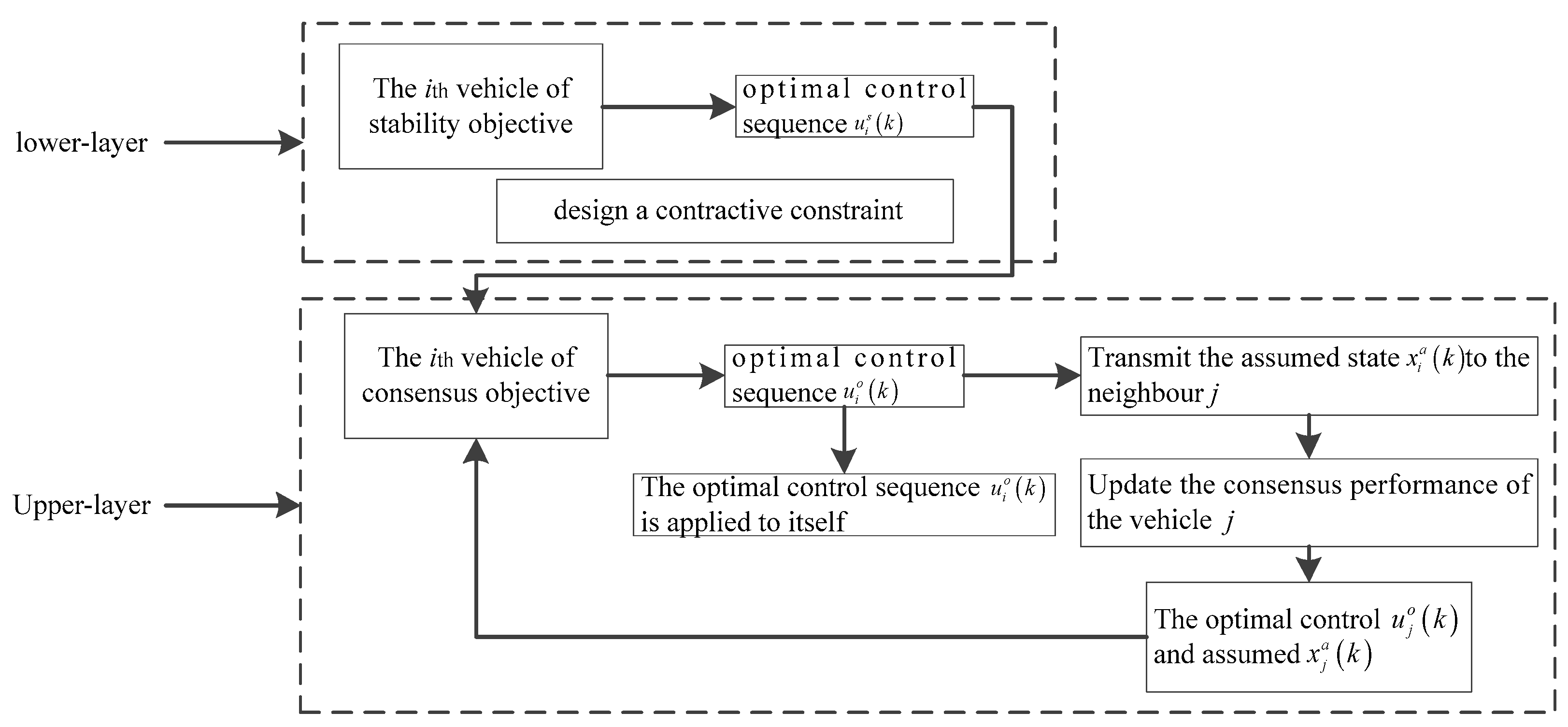
Figure 1 illustrates the overall control architecture proposed in this study.

3.2. Algorithm

1.
Initialization (k = 0):
(1)
At k = 0, vehicle p i , i = 1, ⋯, n, receives reference speed v 0 , let ϕi(xi(0),λi) be a sufficiently large value. The lead car p 1 solves Problem 1 without considering the constraint (12), transmits the optimal state to all the followers, then applies the optimal control input sequence to itself.
(2)
Each vehicle p i , i = 2, ⋯, n, receives the state x 1 , 1 o t 0 , t 0 , N from the lead car. Problem 1 is solved by replacing (12) with
1 ξ i γ i x 1 , 1 o t | 0 , l x i , 1 t | 0 , l 1 + ξ i γ i x 1 , 1 o t | 0 , l ,
vehicle pi will transmit the assumed sequence x i a j 1 to the vehicle p j , j Θ i , and the optimal control sequence u i o t 0 will be applied to itself, where the parameter (ζii) ∈ (0, 1).
2.
Iteration (k = 1, ⋯):
(1)
Vehicle p i , i = 2, ⋯, n, receives the assumed state information from vehicle p j , j Θ i .
(2)
Solve Problem 1, where an additional constraint Equation (23) is added for the lead car:
x 1 , 1 t | k x 1 , 1 a t | k ε 1 , k x 1 , 1 t | k , l
for i = 2, ⋯, n − 1
x i , 1 t | k x i , 1 a t | k ε i , k min x i , 1 t | k , l x i 1 , 1 a t | k , l
for i = n, the right-hand side of the inequality (24) is replaced by ε n , k x n 1 , 1 a j k , l .
(3)
Vehicle p i , i = 1, ⋯, n, receives the state information from vehicle p j , j Θ i , and solves Problem 1 to obtain the optimal control input, then the assumed state sequence of pi is transmitted to the vehicle p j , j Θ i , and the optimal control input u i o t k is applied to itself. Let k = k + 1 go back to step 1).
Remark 4. 
The algorithm is designed to solve the hierarchical optimization problem. Solving Problem 2 yields the optimal control law  u i s k , which can be substituted into Ji(xi(k),ui(k)) to update ϕi(xi(k),λi) in addition to initialization, then iterating constraint Equation (13) in Problem 1. The values of parameters ζiii,k in (22)–(24) are followed from [34], and (22) is defined at the initialization. The position error of vehicle pi, i = 2, ⋯, n, satisfies  x i , 1 o j 0 α i x i 1 , 1 o j 0 , where the parameter α2 = (1 + ξ2)·γ2, αi((1 + ξi)/(1 − ξi−1))·(γii−1), i = 3, ⋯, n. The parameter εi,k = εk ensures that (23) and (24) satisfy the Equation (12) and establish the Predecessor–Follower string stability of the vehicle platoon.
The assumed control input trajectory is similar to the receding horizon control strategy [20]. At time k, the assumed control trajectory for each vehicle pi is generated by u i a j k = u i o j k 1 , j ∈ [1,N), and u i a j k = K i x i o N k 1 , where Ki is a feedback matrix, which can be obtained by solving the LQR problem. Then, the assumed state trajectory can be denoted as
x i a k = x i o 2 k 1 , , x i o N k 1 , x i a N k
where x i a N k = f i x i o N k 1 , K i x i o N k 1 .

4. Stability and String Stability Analysis

Assumption 1. 
For a given region Xi,T, we assume the existence of a local feedback control law ui = κi(xi) satisfying κi(xi) Ui for all xi ∈ Xi,T. Furthermore, this control law ensures that the terminal cost Ei satisfies the descent condition Ei(fi(xii(xi))− Ei(xi) ≤ −Li (xi, κi(xi)), and Li(xi,ui) is a positive definite.
Lemma 1 
[34]. Provided that the subsequent parametric constraint is satisfied for arbitrary pi, i = 2, ⋯, n
α i + α i h = k 1 k ε i 1 , h + ε i , k 1 1 + ε i 1 , k 1 < 1
the closed-loop position error satisfies Equation (12), where (αii−1,ki,k) ∈ (0, 1).
Definition 3. 
An initial state xi(0) is termed feasible (i.e., xi(0) ∈ Xi) if a valid prediction sequence xi(k) exists for the closed-loop system at any time step. The collection of all such states constitutes the feasible initial set, denoted by Xi,N, which contains all feasible initial states, and Xi,T   Xi,N   Xi.

4.1. Recursive Feasibility Analysis

Theorem 1. 
Under Assumption 1, the inclusion of constraint (5) in Problem 1 guarantees recursive feasibility within Xi,N. Furthermore, Xi,N serves as a robust invariant set for the closed-loop dynamics described by (21).
Proof of Theorem 1. 
Let u i o k 1 denote the optimal solution to Problem 1 at instant k − 1. The control sequence u i f k for time k is then synthesized by shifting this previous optimal trajectory.
u i f k = u i o 1 | k 1 , u i o 2 | k 1 , , u i o N 1 | k 1 , κ i x i o N | k 1
where state x i o N k 1 is the terminal predicted state corresponding to u i o k 1 , and satisfies x i o N k 1 Xi,T. Substituting u i f k into system (3) to obtain the state sequence,
x i f k = x i o 2 k 1 , , x i o N k 1 , x i f N k
where x i f N k = f i x i o N k 1 , κ i x i o N k 1 . Then, (Ei,Xi,T,κi) satisfies Assumption 1, x i o N k 1 Xi,T and Xi,T are invariant sets of xi(k + 1) = fi(xi(k),κi(xi(k))). Therefore, x i f N k Xi,T and κ i x i o N k 1 Ui. Based on the triplet of MPC, it can be shown that (28) satisfies the constraints Equations (9)–(11) of Problem 1.
According to (28) and (26), the state sequence x i a k is the same as x i f k , which are constructed by the optimal solution of Problem 1 at time k − 1. From the triangle inequality, (23) for the lead car and (24) for all predecessor cars, for any p i 1 , i = 2, ⋯, n,
x i 1 , 1 f j | k ε i 1 , k x i 1 , 1 o j | k , l + x i 1 , 1 o j | k
The transformation of Equation (30) gives
x i 1 , 1 f j | k , l 1 + ε i 1 , k x i 1 , 1 o j | k , l
From the triangle inequality and (24), we derive that
x i , 1 o j | k 1 x i , 1 o j | k 1 x i , 1 f j | k 1 + x i , 1 f j | k 1 ε i , k 1 x i 1 , 1 f j | k 1 , l + x i , 1 f j | k 1
From Lemma 3 in [34], and initial time inequality (22), we have
x i , 1 f j | k 1 α i x i 1 , 1 f j | k 1
(29), (30) and (32) are substituted into (31), which gives
x i , 1 o j | k 1 ε i , k 1 1 + ε i 1 , k 1 + α i ε i 1 , k 1 x i 1 , 1 o j | k 1 , l + α i x i 1 , 1 o j | k 1
From (23), (24) and (33), for any pi, i = 2,3, ⋯, n, we have
x i , 1 f j | k ε i , k 1 1 + ε i 1 , k 1 + α i ε i 1 , k 1 × x i 1 , 1 o j | k 1 , l + α i x i 1 , 1 f j | k
Substituting (30) into (34) can obtain that
x i , 1 f j | k ε i , k 1 1 + ε i 1 , k 1 + α i ε i 1 , k 1 x i 1 , 1 o j | k 1 , l + α i ε i 1 , k x i 1 , 1 o j | k , l + α i x i 1 , 1 o j | k
Therefore, (36) is bounded and satisfies
x i , 1 f j | k , l max g = k 1 , k x i 1 , 1 o j | g , l × α i + α i ε i 1 , k 1 + ε i 1 , k + ε i , k 1 1 + ε i 1 , k 1
The coefficient on the right-hand side of Equation (37) meets the requirements of Lemma 1. Thus, the constructed state sequence x i f k satisfies (12). Likewise, a feasible solution is similarly derived by the above proof for Problem 2. Furthermore, letting u i s k denote the optimal optimizer of Problem 2 at instant k, we have
J i x i k , u i s k J i x i k , u i f k
Considering (28), (37) and combining (18), we derive that
J i x i k , u i s k J i x i k 1 , u i o k 1     J i x i k , u i f k J i x i o k 1 , u i o k 1   = E i x i f N | k + t = 0 N 1 L i x i f k , u i f k   E i x i o N | k 1 t = 0 N 1 L i x i o k 1 , u i o k 1   = E i x i o N | k 1 + L i x i o N | k 1 , κ i x i o N | k 1   + E i f i x i o N | k 1 , κ i x i o N | k 1 L i x i o 0 | k 1 , u i o 0 | k 1
From (39) with Assumption 1, we have
J i x i k 1 , u i o k 1 J i x i k , u i s k L i x i o 0 | k 1 , u i o 0 | k 1 0
Combining (17) with (18), and substituting inequality (39) into Equation (17), the value function J i o x i k 0 yields ϕi(xi(k),λi) ≥ 0. Furthermore, substituting u i s k into the left-hand Ji(xi(k),ui(k)) of Equation (13),we derive that
J i x i k , u i s k J i s x i k + λ J i o x i k 1 J i s x i k   = : ϕ i x i k , λ i
holds for any given λi ≥ 0. Thus, given that u i s k constitutes a feasible candidate for Problem 1, invoking Definition 3 ensures that the initial state satisfies xi(k) ∈ Xi,N. Consequently, Xi,N is established as an invariant set for the closed-loop dynamics described by (21). □

4.2. Stability Analysis

Theorem 2. 
If Assumption 1 holds, Problem 1 has a feasible solution at the initial time. Then, the equilibrium point xi,s of the closed-loop system (21) is asymptotically stable and feasible in Xi,N for any given λi ≥ 0. Furthermore, if (22)–(24) hold, then the platoon system satisfies the string stability under the above conditions.
Proof of Theorem 2. 
Problem 1 is feasible at the initial time for any given λi ∈ [0, 1). u i o k 1 and u i o k represent the optimal solution of Problem 1 at time k − 1 and k, respectively. According to [35], the candidate Lyapunov function Vi satisfies σ 1 x V i x σ 2 x , where σ1(·) and σ2(·) are K-class functions [35]. V i o k = J i x i k , u i o k , V i s k = J i x i k , u i s k are defined about the closed-loop system (21). Then, the difference operation is calculated about Vi at adjacent time along the trajectory of the closed-loop system (21); considering Equations (13) and (18), we derive that
V i o x i k V i o x i k 1 = J i x i k , u i o k J i x i k 1 , u i o k 1     J i x i k , u i s k + λ i J i o x i k 1 J i s x i k   J i x i k 1 , u i o k 1   = 1 λ i   J i s x i k J i o x i k 1
From Assumption 1, (39), (40), (41), we have
V i o x i k V i o x i k 1 = J i o x i k J i o x i k 1     1 λ i   J i s x i k J i o x i k 1     = 1 λ i   J i x i k , u i s k 1 J i x i k 1 , u i o k 1     = 1 λ i E i x i o N | k 1 + L i x i o N | k 1 , κ i x i o N | k 1 + E i f i x i o N | k 1 , κ i x i o N | k 1 L i x i o 0 | k 1 , u i o 0 | k 1     1 λ i L i x i o 0 | k 1 , u i o 0 | k 1 0
Here, λi ∈ [0, 1), and Li(xi,ui) is a positive definite function. Consequently, the value function Vi(xi)Vi(xi) exhibits strict monotonic decay along the trajectories of the closed-loop system (21). This implies that the cost function Ji(xi,ui) is positive definite with respect to the equilibrium point, thereby guaranteeing asymptotic stability of the equilibrium within the set Xi,N for system (21). □

4.3. Guaranteed String Stability

Theorem 3 (String Stability). 
If recursive feasibility of the optimization problem is maintained, then the platoon is guaranteed to achieve strict string stability with an attenuation rate of ρ.
Proof of Theorem 3. 
By enforcing the constraint max k 0 e p , i k ρ i   max k 0 e p , i 1 k for all pre-diction steps k, and given that the optimal control input is implemented (receding horizon), the actual closed-loop error satisfies max k 0 e p , i k ρ i   max k 0 e p , i 1 k . Since ρ < 1, the errors do not amplify upstream, thus guaranteeing string stability. □
There exists a feasible solution for Problem 1 at any time, and the closed-loop system (21) is asymptotically stable about the equilibrium point. The values of parameters ζi,γi,εi,k in (22)–(24) refer to Lemma 3 of [34]. Combining (22)–(24) derives (5). Thus, the string stability of the closed-loop system can be established.
Remark 5. 
The above proof presents that the stability of the vehicle is independent of states of the neighboring vehicles. If the vehicles merge into a platoon, whose stability will not be affected, then the whole platoon satisfies tracking stability. Thus, the platoon system is flexible and scalable in this paper.

5. Simulation Verification and Analysis

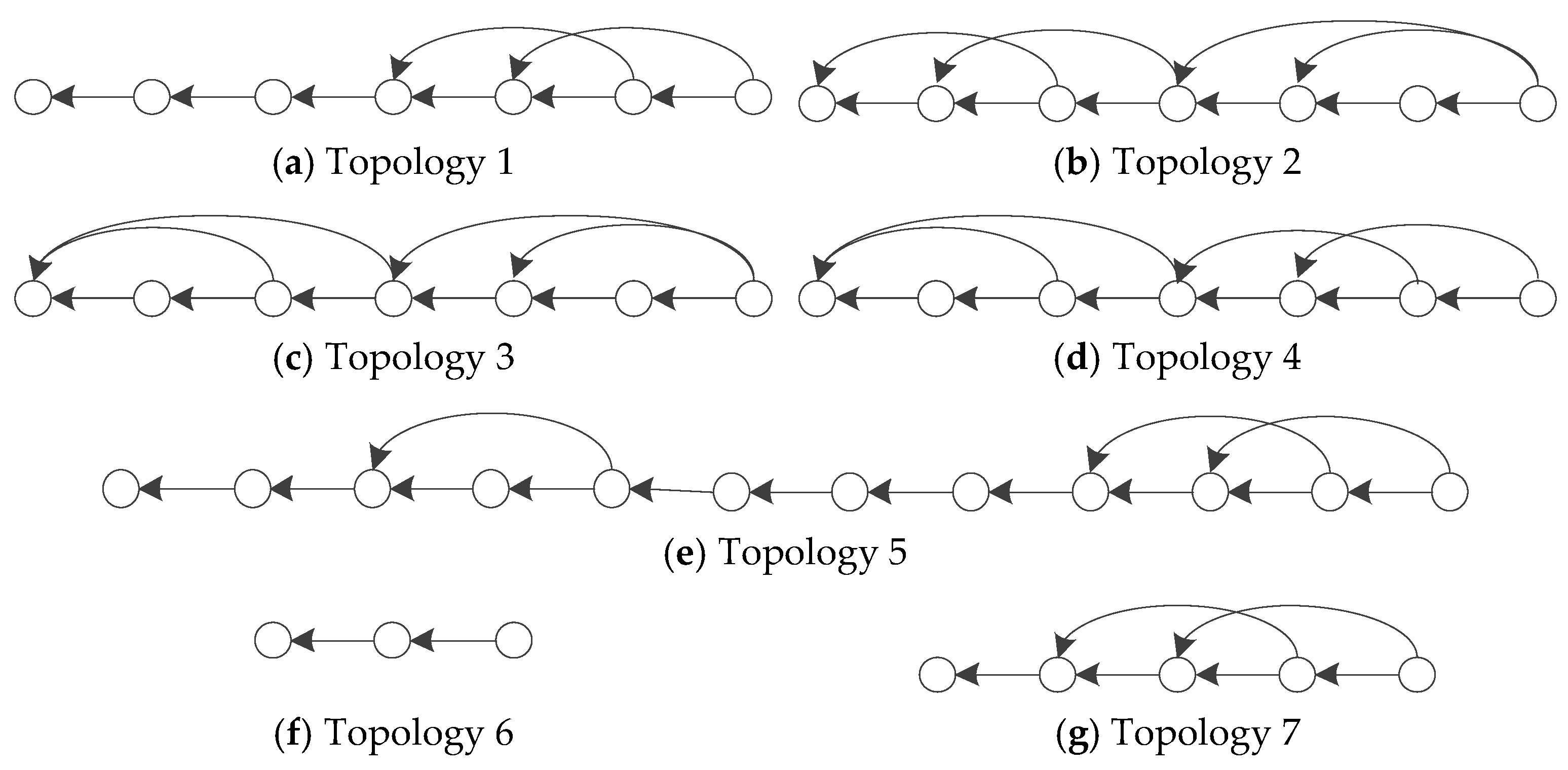
This section presents a series of simulation scenarios designed to evaluate the performance of the hierarchical strategy under mixed communication topologies. First, we compare the proposed strategy with the weighted function method. Second, we discuss heterogeneous vehicles and scalability, then verify that the vehicles can achieve a consensus state under various mixed communication topologies. Third, we analyze the impact of weights on dynamic consensus performance. Finally, we demonstrate the performance under complex dynamic conditions. The simulation employs a platoon system comprising seven vehicles, with the mixed communication topologies illustrated in Figure 2.
In this simulation, the sampling period is set to Δt = 0.3 s, and the prediction horizon is set as N = 8. All optimization problems are solved by MATLAB 2021a with the fmincon function in this paper. At the initial time, a reference speed transitioning from 19 m/s to 20 m/s and a desired spacing of d = 20 m are broadcast to all vehicles in the platoon. The platoon tracks a new desired speed and ensures safety until the velocity error is 0 and the relatively expected position error is 0. The relative position error of each vehicle is 0, and the velocity error is −1 m/s at k = 0. The simulation parameters and controller gain parameters are as follows (Table 1 and Table 2), where xiXi = {xi Z i + x i 1 }, uiUi = { ui Z i + u i 3000   N , −5 m/s2ai ≤ 5 m/s2. The LQR problem is solved by linearization of the model at equilibrium point (xi,s,ui,s), then the terminal penalty function E i x i = x i x i , s T P i x i x i , s and local controller κi(xi) = Ki (xixi,s) + ui,s are obtained, where the equilibrium point is (xi,s,ui,s)T = (0, 0, 48.9087)T, and the terminal region is Xi,T = {xi R 2 : Ei(xi) ≤ 0.0318}.

5.1. Comparison of Proposed Strategy and Weighted Method

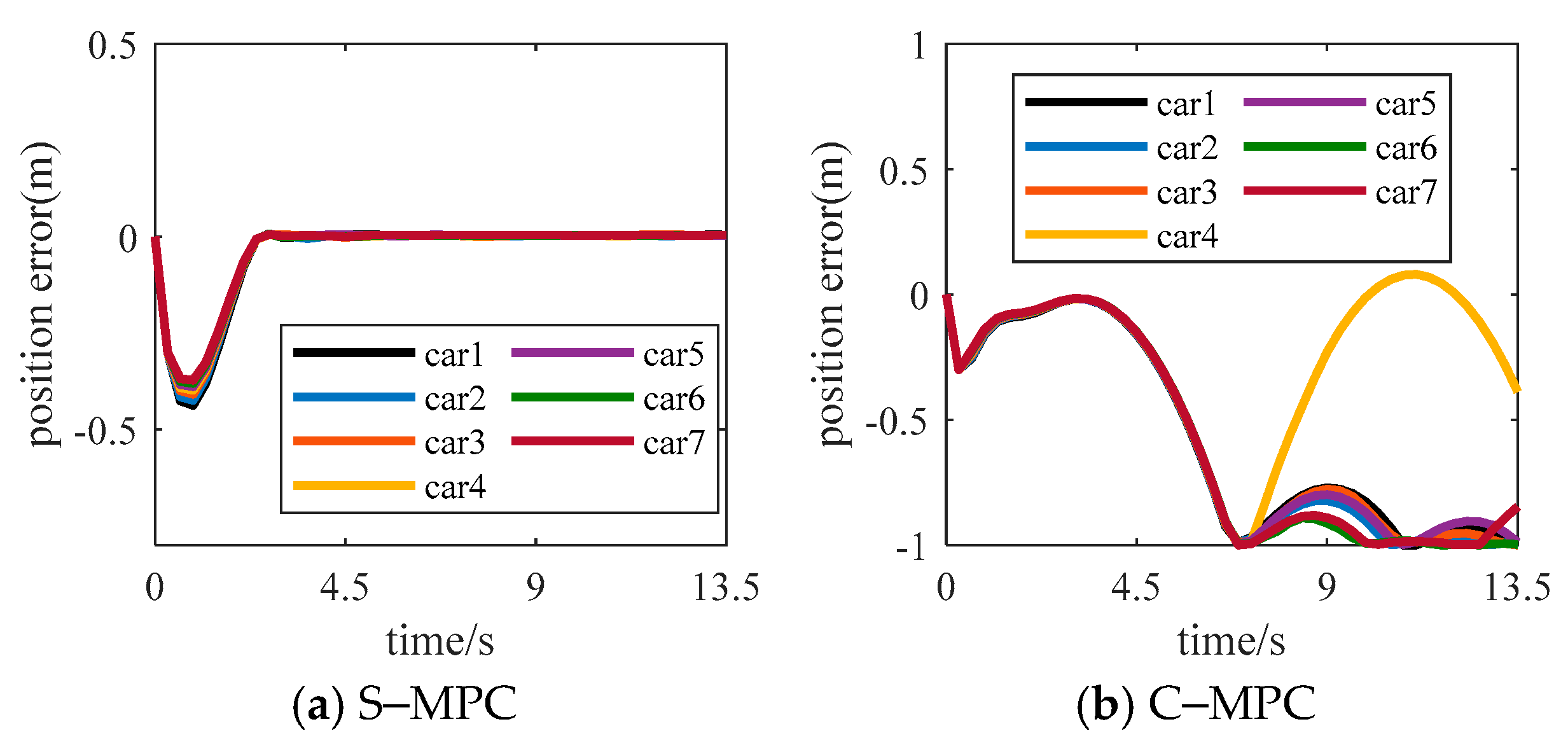
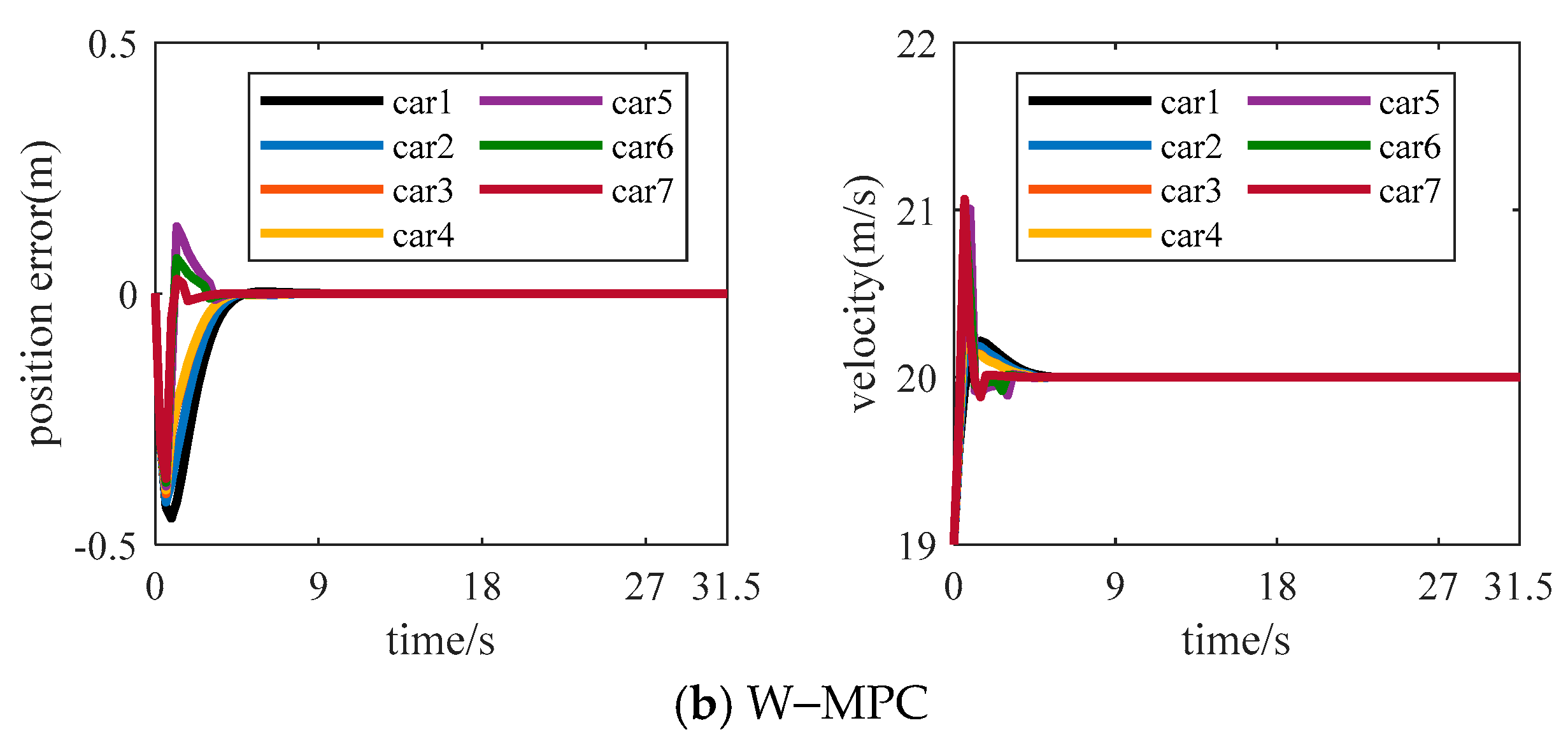
In Figure 2a, Problem 1 and Problem 2 are solved separately, where the constraints are Equations (9)–(12), and they are denoted as C–MPC and S–MPC, respectively. The simulations are shown in Figure 3. Then, we compare the proposed hierarchical strategy with the weighted function method, where τ = 0.7. In this paper, the proposed strategy and the weighted method are denoted as D–MPC and W–MPC.
Figure 3b demonstrates a scenario where tracking stability is not guaranteed; the platoon system becomes unstable when only the dynamic consensus objective is considered (e.g., in C–MPC approaches). While the system is stable when solely tracking performance is optimized, this approach does not address the trade-off between dynamic consensus and stability. We next compare the proposed strategy with the weighted function method.
To investigate the robustness of the control strategies against variations in controller design parameters, a comparative simulation was conducted. It is important to note that no external disturbances were introduced in this scenario. Instead, we intentionally adjusted the parameters defining the contractive constraint (Equation (12)) and modified the weighting matrices Gi and Fi in the cost function. This setup evaluates the sensitivity of each method to sub-optimal or varied parameter selections, which is a common challenge in practical implementation.
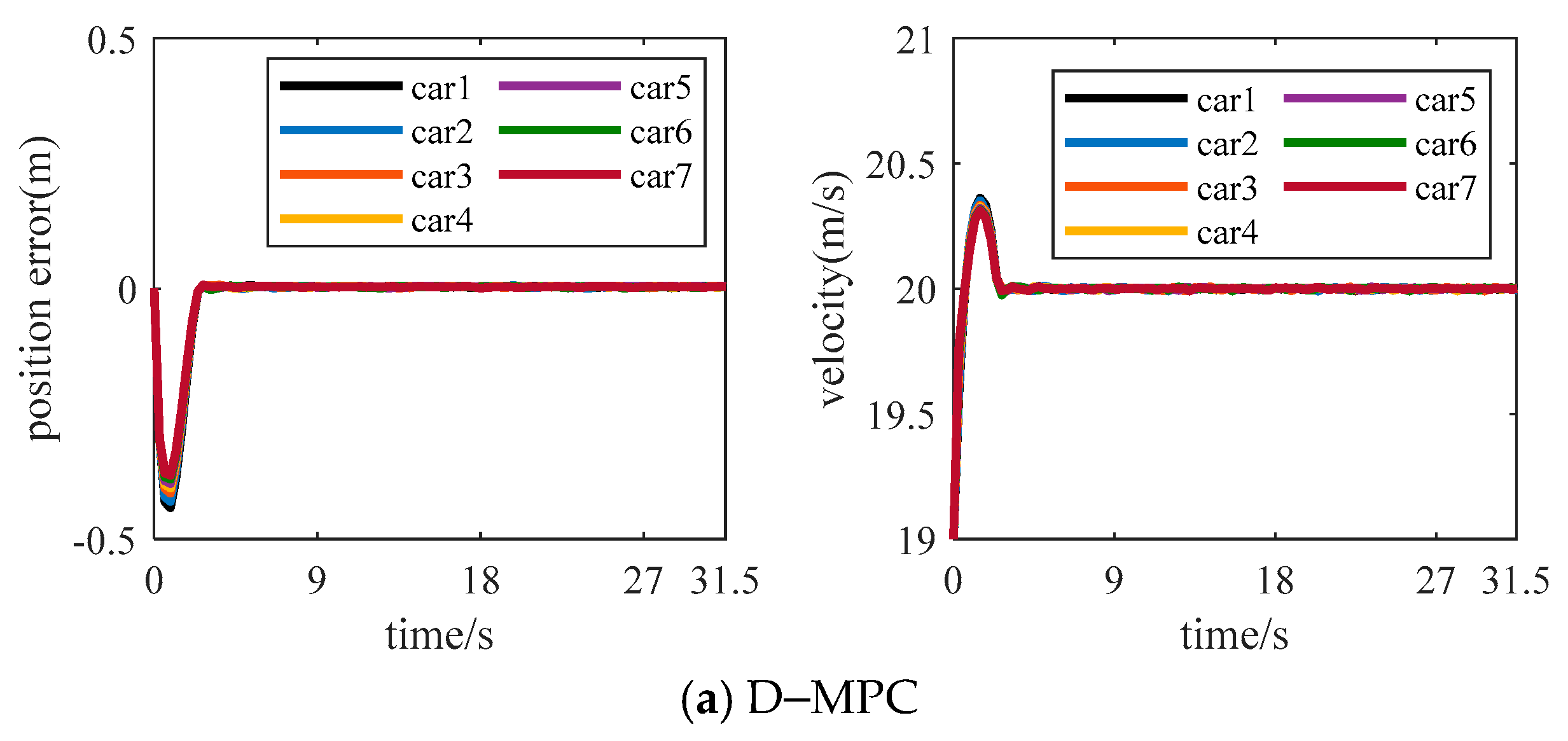
As shown in Figure 4b, the Traditional Weighted MPC exhibits pronounced oscillatory behavior in both spacing errors and vehicle velocities when the weights (Gi, Fi) and constraint parameters deviate from their nominal values. The states fluctuate significantly before settling. This phenomenon reveals that the stability of the traditional approach is highly sensitive to the precise tuning of the weighting matrices; slight deviations can compromise the damping characteristics of the closed-loop system, leading to undesirable transients. Conversely, the proposed strategy demonstrates remarkable insensitivity to parameter variations, as depicted in Figure 4a.
In contrast, the proposed method guarantees a smooth transient response regardless of moderate parameter tuning errors. This result validates that the proposed framework offers a more robust design with a wider stability margin, reducing the reliance on exhaustive trial-and-error tuning required by traditional weighted MPC approaches. Additionally, this method necessitates auxiliary stability conditions, making its implementation more complex than our proposed strategy.
The relative position errors of the seven vehicles during the last 6 s of the simulation were statistically analyzed to compute the mean and standard deviation. The results are presented in Table 3. These negligible values confirm the absence of any significant error drift or low-frequency oscillation.
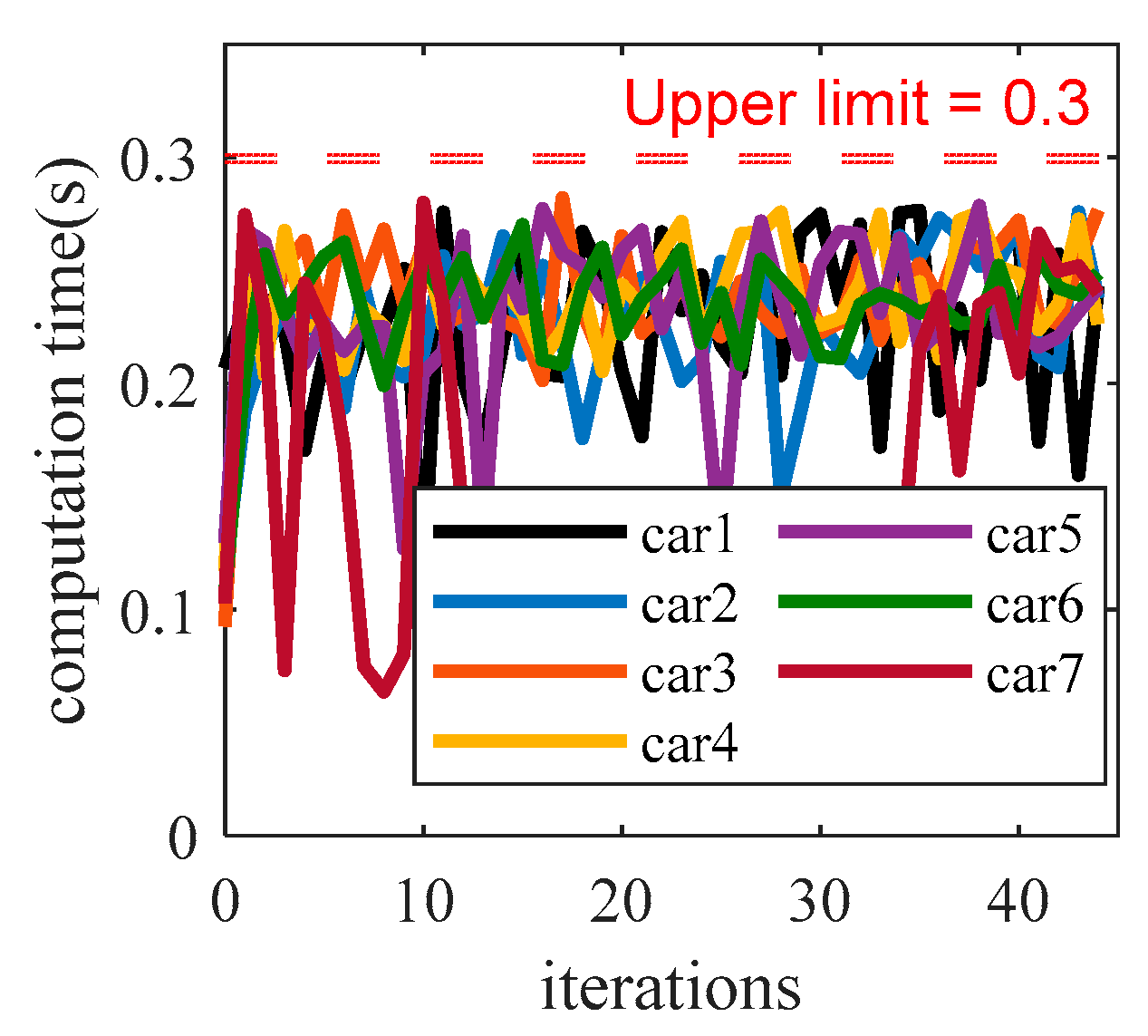
To demonstrate the real-time feasibility of the system, the single-step computation time of the platoon optimization control was statistically analyzed, with the results presented in Figure 5.
As shown in Figure 5, The computational burden remains well within the sampling interval. The maximum and average single-step computation times for each vehicle are presented in Table 4, confirming that the controller can comfortably update the control inputs within the required timeframe without causing delays or packet drops.

5.2. Heterogeneity Analysis

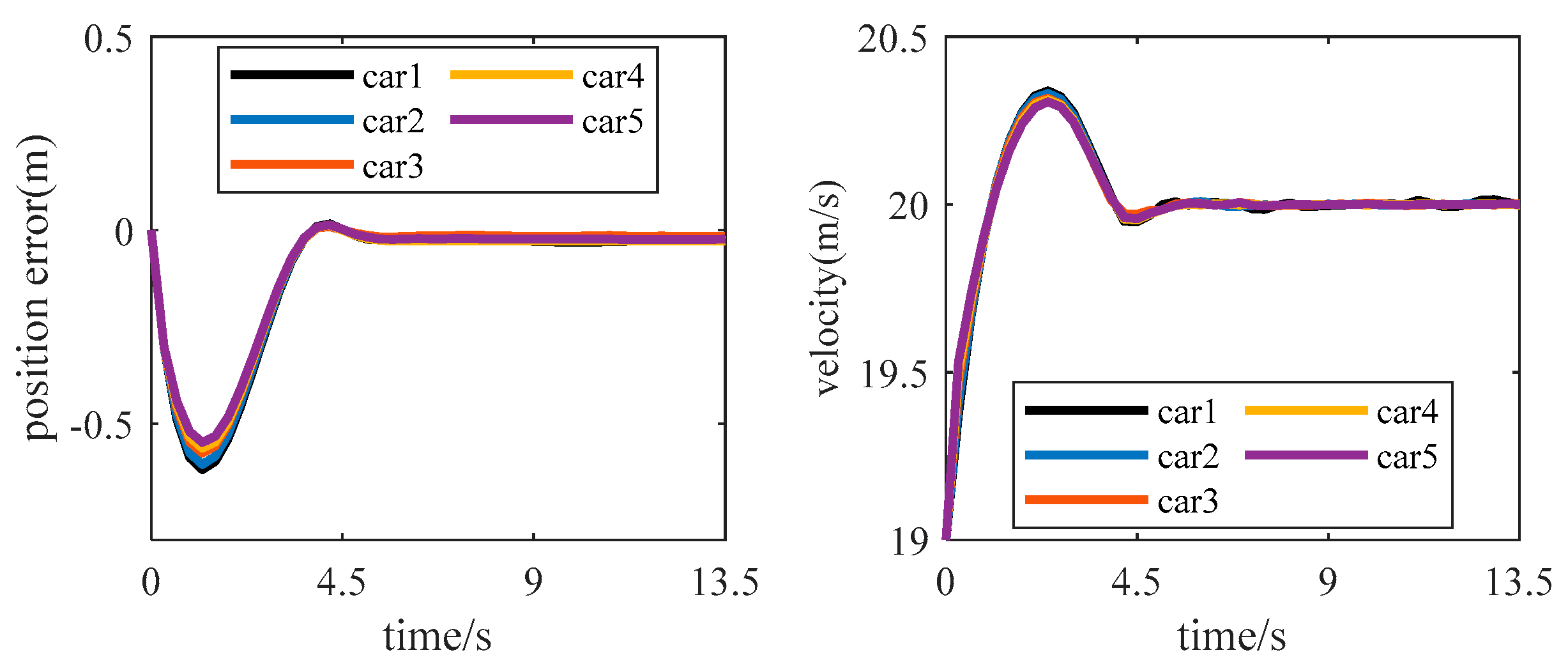
In practical scenarios, vehicle platoons typically consist of heterogeneous vehicles characterized by distinct dynamic models. To validate the stability of the proposed strategy under such conditions, this subsection considers a platoon comprising five heterogeneous vehicles with parameters detailed in Table 5. The associated communication topologies are depicted in Figure 2g.
Regarding the controller design, the weighting matrices Qi, Ri, Fi, and Gi in the cost function are selected as specified in Table 2. The feedback gain matrix Ki and the terminal weight matrix Pi are subsequently derived via the Linear Quadratic Regulator (LQR) approach. The resulting simulation performance is illustrated in Figure 6.
As shown in Figure 6, cooperative control among the vehicles is successfully achieved. The relative position errors asymptotically converge to 0, while the vehicle velocities precisely track the reference trajectories, thereby realizing consensus control for the entire platoon system.

5.3. Scalability

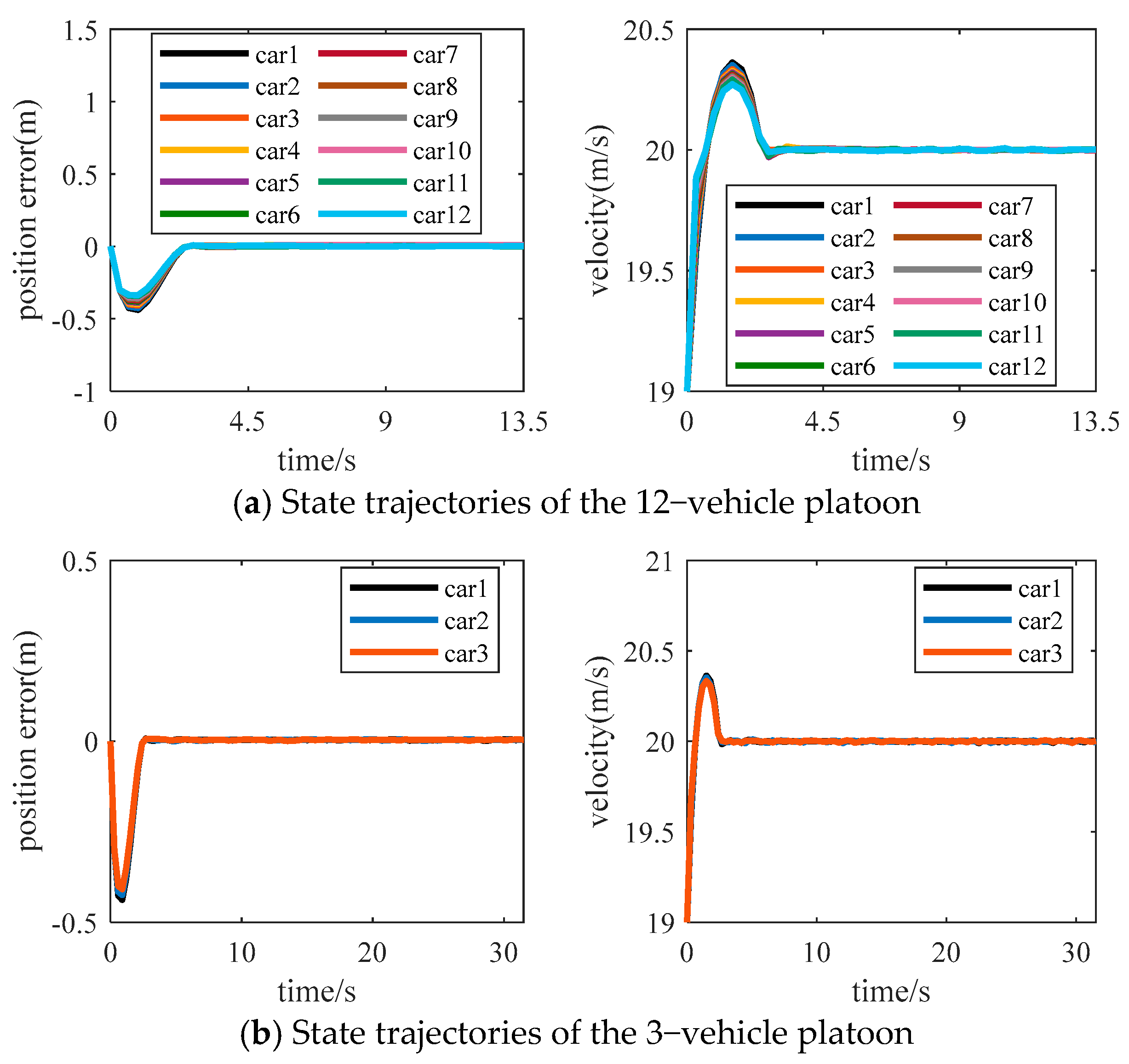
To assess the scalability of the proposed strategy, simulations were performed on homogeneous platoons of varying sizes (3 and 12 vehicles). The specific parameter configurations are enumerated in Table 1 and Table 2, while the associated communication topologies are depicted in Figure 2e,f. The resulting performance metrics are summarized in Figure 7. The proposed strategy achieves effective cooperative control for platoons of both 3 and 12 vehicles. The system demonstrates stability, with relative position errors converging to zero and vehicle velocities tracking the desired reference.

5.4. Consensus Under Mixed Communication Topologies

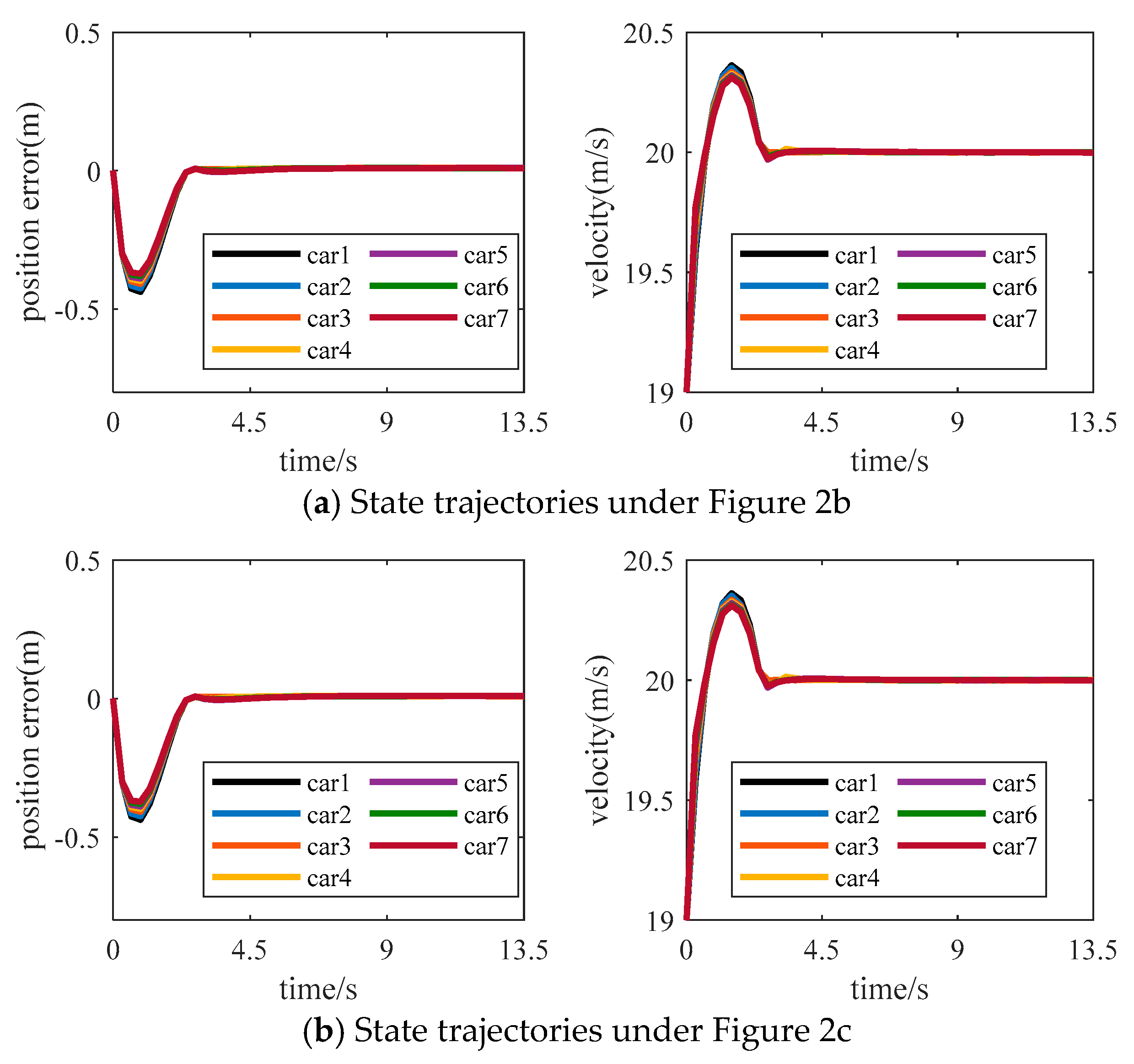
To demonstrate that the proposed strategy guarantees both stability and state consensus under varying mixed communication topologies, simulations corresponding to the configurations in Figure 2b,c were conducted. The resulting performance is illustrated in Figure 8.
From Figure 8, it is indicated that each vehicle attains the desired velocity while fulfilling the conditions outlined in Definition 1; the relative expected position deviation of each vehicle in the platoon ultimately converges to 0 and reaches steady point. Hence, the hierarchical strategy can coordinate platoon stability and dynamic consensus, and the stability and consensus performance are also guaranteed subject to various mixed communication topologies.

5.5. Convergence Analysis Under Different Weights

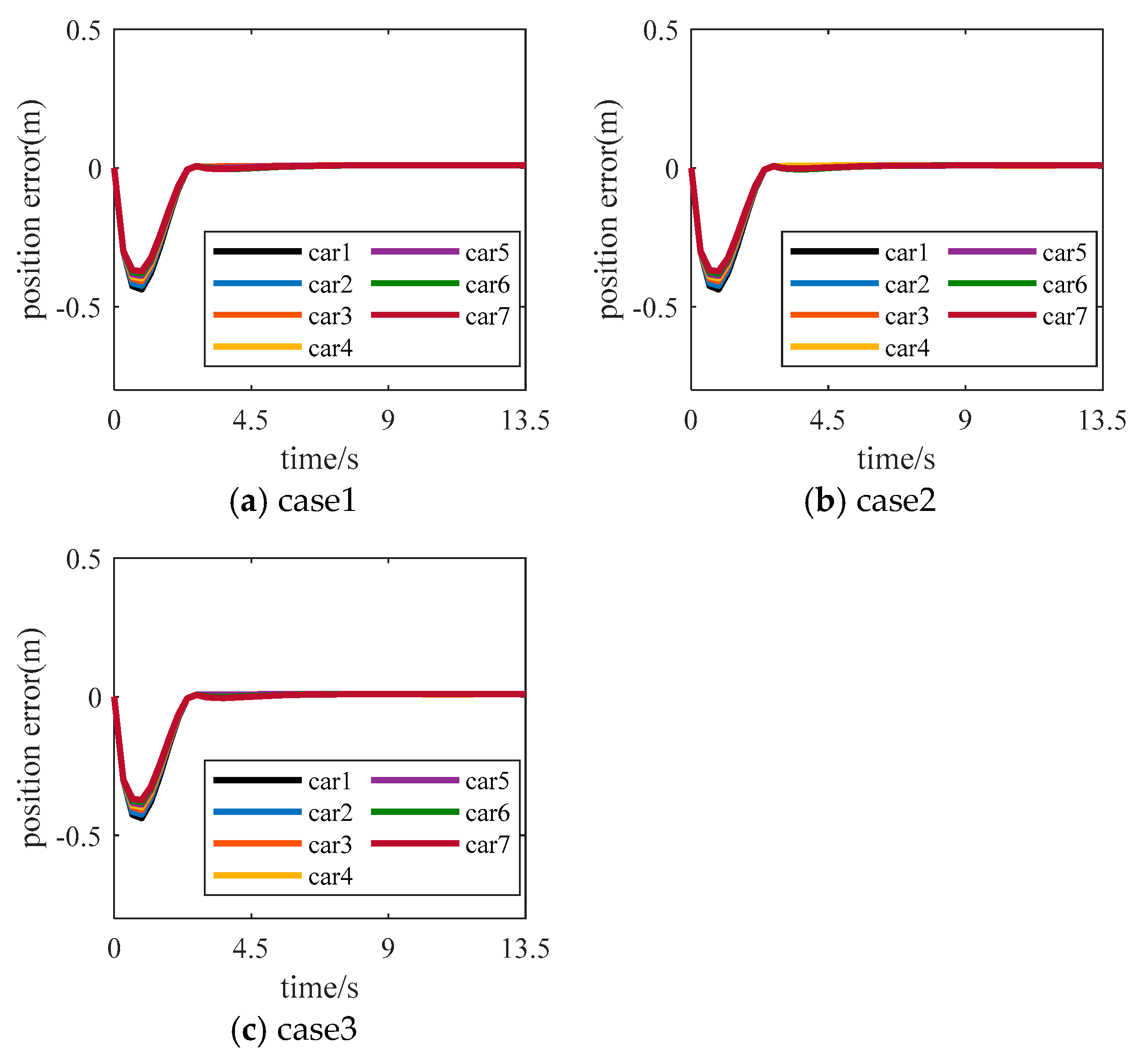
In the subsection, we present that the weights Fi and Gi have an effect on the consensus performance subject to the mixed communication topology. Figure 2d is chosen in the subsection, the specific weight parameters are enumerated in Table 6, and the corresponding simulation results are presented in Figure 9.
Figure 9 illustrates that the platoon converges to the desired velocity and attains steady-state operation, demonstrating the performance of the strategy against variations in dynamic consensus weighting parameters.
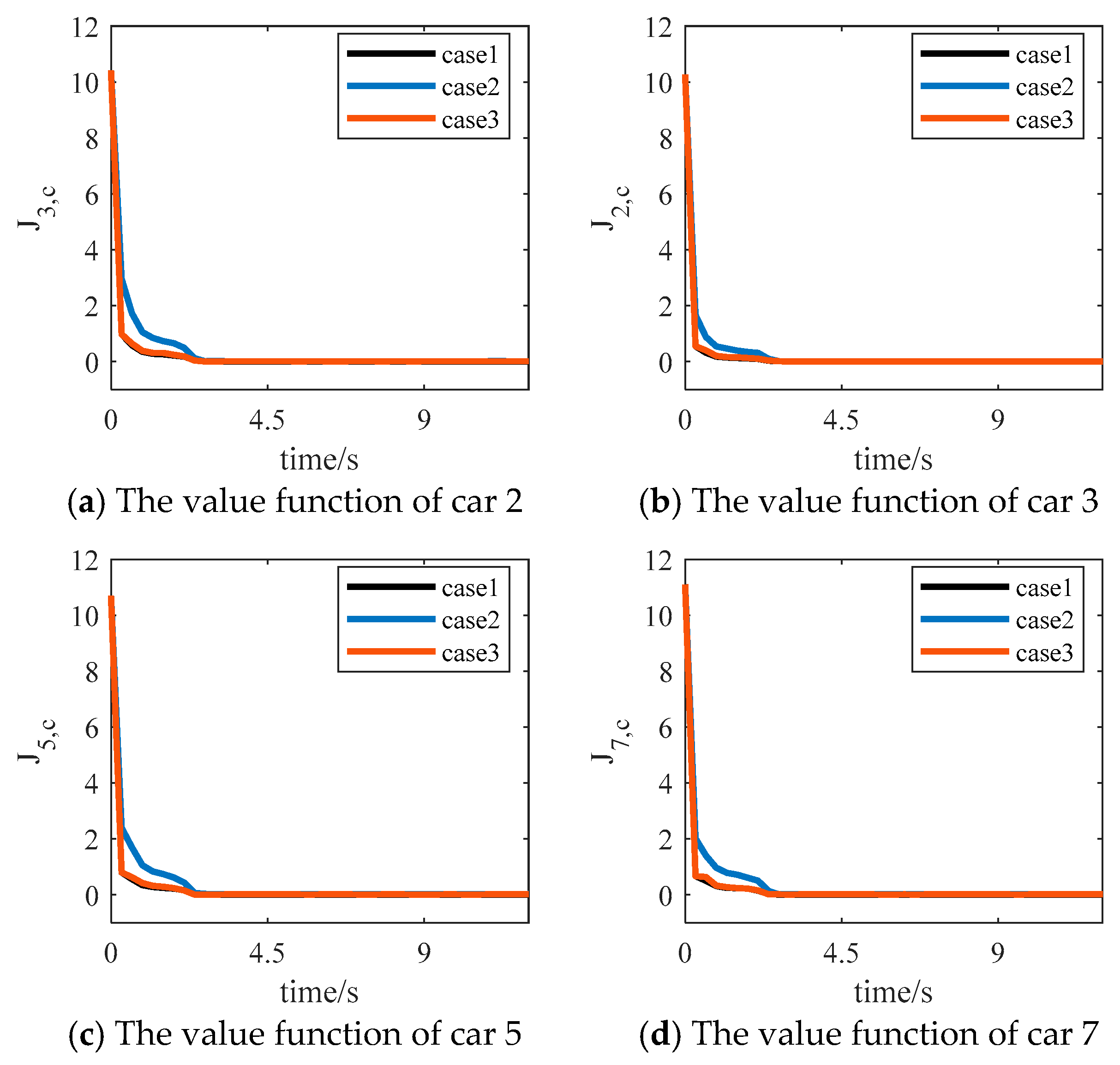
Figure 10 gives the dynamic consensus performance of four vehicles. In case 1, the rate of convergence is fastest; it is slowest in case 2, and in case 3, it is in between both. Therefore, the sizes of matrices Fi and Gi have an effect on the dynamic consensus, which is an extension of the result [34]. Then, the corresponding control strategy can be designed according to the actual system.

5.6. Performance Validation Under Complex Dynamic Conditions

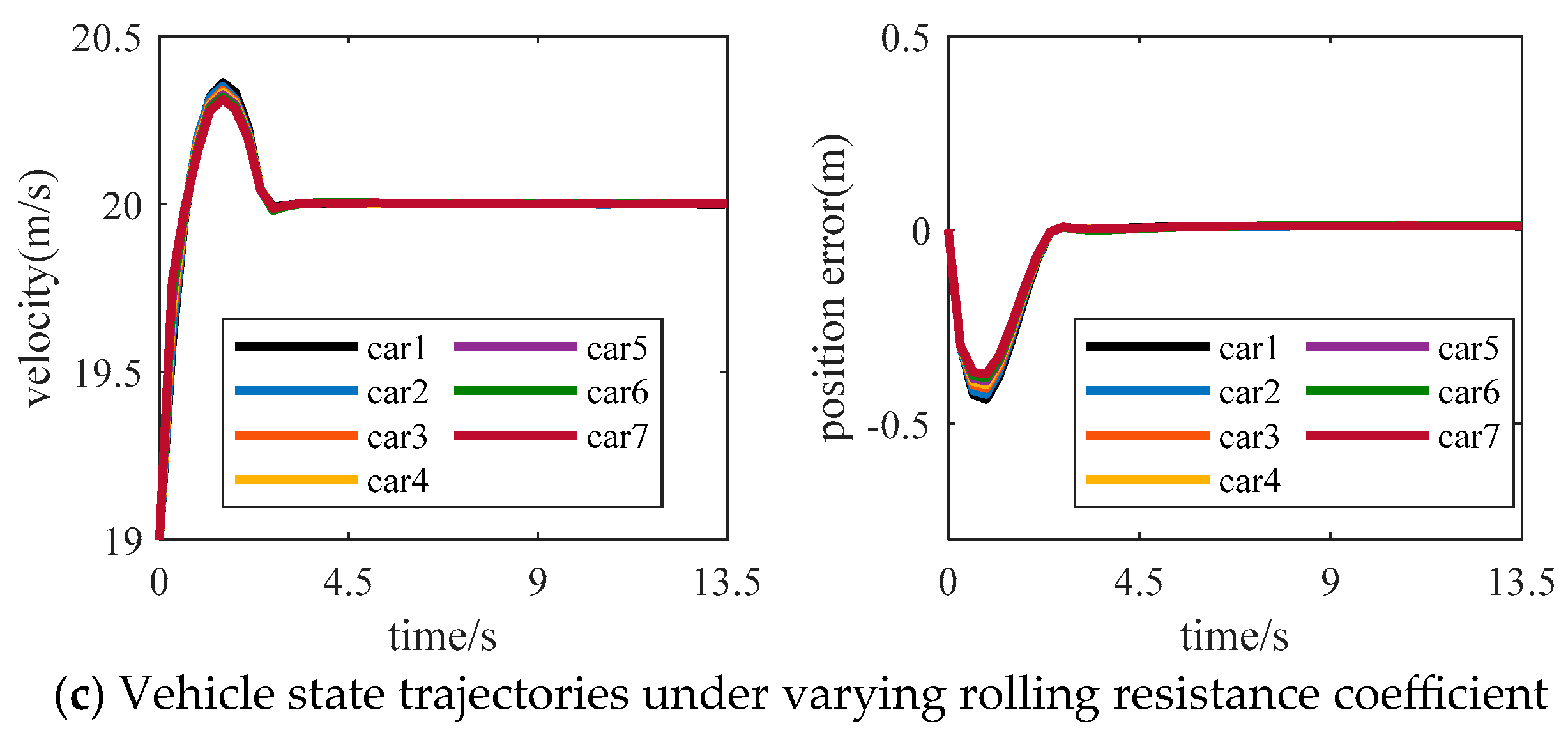
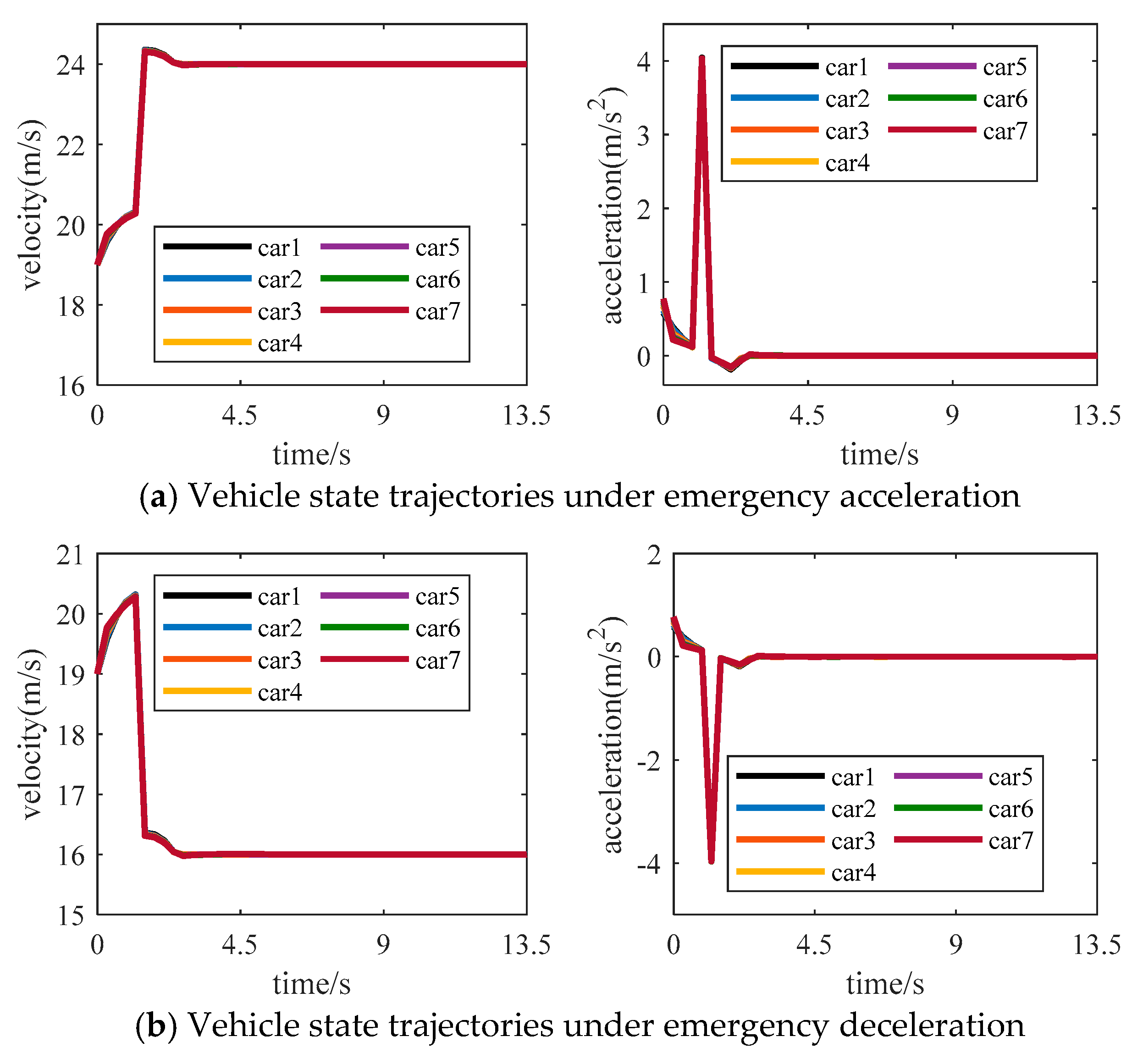
The efficacy of the strategy is substantiated through extensive simulations conducted under a wide spectrum of operating conditions. Specifically, we consider emergency acceleration and deceleration maneuvers to test dynamic response capabilities, alongside scenarios with changing road friction (road friction μi ± 10%) to assess performance under varying environmental parameters. Figure 11 illustrates the dynamic behavior of the system obtained from the simulations.
As shown in Figure 11a, under the emergency acceleration scenario, the platoon system tracks the desired speed of 24 m/s. After a transient period, the system achieves cooperative control, reaching the target velocity while the relative position errors ultimately vanish, indicating successful formation-keeping. Figure 11b illustrates the emergency deceleration case, where the desired speed is reduced to 16 m/s. Following a short duration, the system stabilizes and meets the control requirements. The system acceleration satisfies the performance requirements under emergency acceleration and deceleration scenarios. Figure 11c demonstrates that under varying road friction coefficients, the platoon system similarly achieves cooperative control and satisfies the consensus.

6. Discussion

While the proposed hierarchical DMPC framework demonstrates robust stability under mixed switching topologies, real-world vehicular platooning faces additional complexities, including communication imperfections, vehicle heterogeneity, and dynamic environmental variations. In this section, we discuss how our current directed graph framework and contractive constraint mechanism can be extended by incorporating recent advances in robust control, federated learning, and graph representation learning. Specifically, we address three key dimensions: handling communication delays via robust constraint tightening, bridging our architecture with federated learning for heterogeneous systems, and evolving our topology modeling using category-guided graph concepts and adaptive learning.

6.1. Advanced Graph Representations and Adaptive Parameter Learning

The modeling of mixed communication topologies can be significantly enhanced by moving beyond binary adjacency matrices toward semantically enriched graph structures. Inspired by [16], our directed graph framework can be extended to capture complex, asymmetric interaction patterns. In the current model, all neighbors contribute equally to the cost function. In an advanced extension, edge weights would become category-dependent functions, assigning higher “semantic importance” to critical nodes (e.g., a heavy truck ahead or the platoon leader) and lower weights to less influential neighbors. This mirrors the category-guided mechanism where specific node types dictate the aggregation strategy, enabling the controller to prioritize information flows that are most vital for safety and stability.
The hierarchical graph convolution concept in [16] captures both local details and global context. Our existing hierarchical MPC structure naturally aligns with this. We can interpret the lower control layer as processing local high-frequency interactions (immediate predecessors, analogous to fine-grained graph convolutions), while the upper coordination layer handles long-range low-frequency dependencies (global consensus, analogous to coarse-grained pooling). This allows the framework to explicitly model asymmetric information flows, where broadcast messages (global) and V2V unicast messages (local) are processed with different granularities.
Complementing this structural evolution, the fixed contractive parameter λ in our simulations could be replaced by an intermittent dynamic learning mechanism. Drawing from adaptive control strategies like intermittently dynamic fuzzy learning [20], a lightweight online learner could monitor real-time traffic conditions and topology switching frequencies to dynamically adjust λ. For instance, in dense, highly dynamic traffic, λ could be tightened to enforce faster convergence, whereas in sparse, stable conditions, it could be relaxed to reduce control effort and fuel consumption. This synergy between category-aware graph modeling and adaptive parameter tuning would transform our static framework into a responsive, intelligent system capable of self-optimizing its interaction patterns and convergence rates in real time.

6.2. Robustness Against Communication Imperfections and Offset-Free Mechanisms

The current formulation assumes ideal information exchange; however, practical V2X networks are inherently characterized by time-varying communication delays and stochastic packet losses. To maintain stability and consensus under such conditions, our framework can be extended by integrating robust constraint tightening mechanisms, as systematically explored in recent works on offset-free distributed control for networked systems [17].
Specifically, regarding the impact of latency on our hierarchical framework:
On Hierarchical Consensus: The upper-layer consensus optimization relies on neighbor state information. A communication delay τ means vehicle i uses outdated state xj(kτ) instead of xj(k). In our formulation, this introduces a bounded disturbance term in the consensus cost function (Equation (6)). Since the lower-layer MPC operates at a faster sampling rate and relies heavily on local onboard sensors for immediate tracking, it can effectively compensate for the “jitter” in the reference trajectory generated by the delayed upper layer, provided τ is within the prediction horizon N.
On Overall Stability: Theoretical analysis of contractive MPC suggests that stability is preserved if the delay-induced error remains within the contraction region defined by Equation (13). Specifically, if the delay τ satisfies τ < Tmargin (where Tmargin is derived from the Lipschitz constant for the system and the contraction coefficient γ), the Lyapunov function decrease condition (Theorem 2) still holds, albeit with a potentially slower convergence rate. If τ exceeds this bound, the contractive constraint may become infeasible, leading to potential instability or string instability where errors amplify upstream.
In this extended view, the state constraints Xi in our optimization problem would be replaced by a tightened set Xi⊖ℜi, where ℜi is a robust invariant set that absorbs the worst-case estimation errors caused by delays and dropouts. The size of ℜi would dynamically evolve based on the observed communication quality. Furthermore, drawing from the offset-free control strategies in [17], an integral action or disturbance observer could be embedded within the local MPC layer of our hierarchy. This would ensure that even if delayed information leads to temporary trajectory deviations, the system can asymptotically reject these disturbances and achieve zero steady-state error. We further elaborate on how the federated earning paradigm mentioned in [17] could enhance our approach. Instead of using conservative, fixed bounds for delay/loss, vehicles could collaboratively learn the statistical distribution of communication quality across the platoon without sharing raw data.
This learned model would allow for dynamic adjustment of the tightening margins: shrinking the margin when the network is healthy (improving performance) and expanding it when congestion or interference is detected (ensuring safety). This creates a balance between robustness and optimality.

6.3. Conceptual Bridges to Federated Learning for Heterogeneous Platoons

Real-world platoons often consist of diverse vehicle types (e.g., heavy-duty trucks vs. passenger cars) with distinct dynamic parameters. A standard homogeneous DMPC may struggle to optimize performance for all agents simultaneously. By adopting insights from personalized federated learning [18], our upper coordination layer could function as a “global model aggregator” that learns a common traffic flow pattern, while the lower local layers act as “personalized clients”. Each vehicle would maintain a local dynamic model tailored to its specific physical characteristics, utilizing predictive error compensation to correct for model mismatches. In this hybrid setup, Equation (5) would be adaptively weighted: stricter for homogeneous clusters to ensure string stability, and more relaxed for heterogeneous boundaries to allow for necessary local adaptation. This approach balances the need for platoon-wide coherence with the flexibility required for diverse vehicle dynamics. This analogy provides a powerful pathway to address vehicle heterogeneity.
It is worth noting that the proposed hierarchical MPC architecture shares conceptual similarities with recent advances in federated learning-based distributed control [19]. Specifically, the contractive constraint mechanism defined in Equation (13) bears a strong resemblance to the consensus regularization terms commonly employed in federated optimization.
In federated settings, regularization terms are introduced into the local loss functions to penalize the divergence between local model parameters and the global aggregate, thereby driving the network towards consensus without sharing raw data. Analogously, our contractive constraint (Equation (13)) enforces that the state deviation of each vehicle shrinks over time, effectively coupling the individual tracking performance with the platoon’s consensus goal. While the conceptual goal of promoting agreement is similar, the mathematical role of Equation (13) in our framework is more stringent. Unlike the soft penalties in federated learning which guide the gradient descent direction, Equation (13) is imposed as a hard constraint within the MPC optimization problem (Problem 1). This design choice is critical for recursive feasibility and stability. We highlight that this connection opens new avenues: future work could integrate federated learning algorithms to adaptively tune the contraction parameter λ or the consensus reference based on data-driven insights, combining the rigorous stability of our method with the adaptability of federated learning.

7. Conclusions

This paper presents a distributed hierarchical control framework designed for discrete-time nonlinear systems that incorporates both state and control input constraints and mixed communication topologies. By incorporating the tracking stability optimal value function as a constraint in the dynamic consensus optimization problem, we establish sufficient conditions for platoon string stability and recursive feasibility of the consensus optimization. Numerical simulations demonstrate that the proposed strategy effectively balances the trade-off between stability and dynamic consensus under mixed topologies, while simultaneously guaranteeing both performance metrics. Further simulations involving heterogeneous dynamics, emergency maneuvers, and variable friction conditions demonstrate the algorithm’s superior performance, confirming the platoon’s ability to achieve cooperative control in diverse scenarios. Furthermore, we analyze the impact of penalty weights on dynamic consensus performance. Future research will be directed towards experimental validation and the extension of the proposed framework to accommodate heterogeneous vehicle dynamics. Crucially, while this study assumes ideal communication, real-world deployments face challenges such as time-varying delays and packet losses. Drawing inspiration from recent advances in offset-free distributed control for networked systems [17], our future research will integrate robust constraint tightening mechanisms into the hierarchical MPC framework. This extension aims to systematically compensate for communication imperfections, ensuring that both stability and consensus performance are maintained under realistic network constraints.

Author Contributions

All authors contributed equally to this work. Specifically, they collectively contributed to the conceptualization, methodology, software, validation, formal analysis, investigation, data curation, writing (original draft preparation, review, and editing), visualization, supervision, project administration, and funding acquisition. All authors have read and agreed to the published version of the manuscript.

Funding

This research was funded by Anhui Provincial Department of Education, grant number 2025AHGXZK20025, and the APC was funded by 2025AHGXZK20025.

Data Availability Statement

The data presented in this study are available on reasonable request from the corresponding author. The simulation models and algorithms are described in sufficient detail within the article to allow for replication.

Acknowledgments

During the preparation of this manuscript, the authors used MATLAB 2021a for the purposes of numerical simulation. The authors have reviewed and edited the output and take full responsibility for the content of this publication.

Conflicts of Interest

The authors declare no conflict of interest.

Abbreviations

The following abbreviations are used in this manuscript:
MPCModel predictive control
LQRLinear quadratic regulator

References

  1. Shladove, S.E.; Desoer, C.A. Auto-mated Vehicle Control Developments in the PATH Program. IEEE Trans. Veh. Technol. 1991, 40, 114–130. [Google Scholar] [CrossRef]
  2. Thunberg, J.; Lyamin, N.; Sjöberg, K.; Vinel, A. Vehicle-to-Vehicle Communications for Platooning: Safety Analysis. IEEE Netw. Lett. 2019, 1, 168–172. [Google Scholar] [CrossRef]
  3. Zhang, M.Q.; Wang, C.Y.; Zhao, W.Z.; Liu, J.; Zhang, Z. A Multi-Vehicle Self-Organized Cooperative Control Strategy for Platoon Formation in Connected Environment. IEEE Trans. Intell. Transp. Syst. 2025, 26, 4002–4008. [Google Scholar] [CrossRef]
  4. Zhang, P.Y.; Tian, D.X.; Zhou, J.S.; Duan, X.; Sheng, Z.; Zhao, D.; Cao, D. Joint Optimization of Platoon Control and Resource Scheduling in Cooperative Vehicle-Infrastructure System. IEEE Trans. Intell. Veh. 2023, 8, 3629–3646. [Google Scholar] [CrossRef]
  5. Du, G.D.; Zou, Y.; Zhang, X.D.; Fan, J.; Sun, W.; Li, Z. Efficient Motion Control for Heterogeneous Autonomous Vehicle Platoon Using Multilayer Predictive Control Framework. IEEE Internet Things J. 2024, 11, 38273–38290. [Google Scholar] [CrossRef]
  6. Li, H.; Li, X. Distributed Fixed-Time Consensus of Discrete-Time Heterogeneous Multi-Agent Systems via Predictive Mechanism and Lyapunov Approach. IEEE Trans. Circuits Syst. II Exp. Briefs 2024, 71, 321–325. [Google Scholar] [CrossRef]
  7. Wang, Q.S.; Duan, Z.S.; Lv, Y.Z.; Wang, Q.; Chen, G. Distributed Model Predictive Control for Linear-Quadratic Performance and Consensus State Optimization of Multiagent Systems. IEEE Trans. Cybern. 2021, 51, 2905–2915. [Google Scholar] [CrossRef]
  8. Wei, H.L.; Hu, B.B.; Wang, Y.; Lv, C. Scalable and Constrained Consensus in Multiagent Systems: Distributed Model Predictive Control-Based Approaches. IEEE Trans. Ind. Inform. 2024, 20, 5969–5978. [Google Scholar] [CrossRef]
  9. Zhou, J.S.; Wang, M.Q.; Tian, D.X.; Shao, Y.; Sheng, Z.; Leung, V.C.M. Joint Fuel-Efficient Vehicle Platooning and Data Transmission Scheduling for MEC-Enabled Cooperative Vehicle-Infrastructure Systems. IEEE Trans. Intell. Transp. Syst. 2025, 26, 2057–2074. [Google Scholar] [CrossRef]
  10. Wen, J.H.; Wang, S.; Wu, C.Z.; Xiao, X.; Lyu, N. A Longitudinal Velocity CF-MPC Model for Connected and Automated Vehicle Platooning. IEEE Trans. Intell. Transp. Syst. 2023, 24, 6463–6476. [Google Scholar] [CrossRef]
  11. Li, W.; Yan, S.; Shi, L.; Yue, J.; Shi, M.; Lin, B.; Qin, K. Multiagent Consensus Tracking Control Over Asynchronous Cooperation–Competition Networks. IEEE Trans. Cybern. 2025, 55, 4347–4360. [Google Scholar] [CrossRef]
  12. Gratzer, A.L.; Thormann, S.; Schirrer, A.; Jakubek, S. String Stable and Collision-Safe Model Predictive Platoon Control. IEEE Trans. Intell. Transp. Syst. 2022, 23, 19358–19373. [Google Scholar] [CrossRef]
  13. Guo, J.Z.; Guo, H.Y.; Liu, J.; Cao, D.; Chen, H. Distributed Data-Driven Predictive Control for Hybrid Connected Vehicle Platoons With Guaranteed Robustness and String Stability. IEEE Internet Things J. 2022, 9, 16308–16321. [Google Scholar] [CrossRef]
  14. Wang, S.Y.; Yang, X.J.; Chen, Z.; Zhang, Y.J. Distributed Nonlinear Model Predictive Control of Vehicular Platoon Orienting Practical Driving Conditions. IEEE Trans. Transp. Electrif. 2025, 11, 2684–2695. [Google Scholar] [CrossRef]
  15. Hu, M.J.; Li, C.K.; Bian, Y.G. Fuel Economy-Oriented Vehicle Platoon Control Using Economic Model Predictive Control. IEEE Trans. Intell. Transp. Syst. 2022, 23, 20836–20849. [Google Scholar] [CrossRef]
  16. Xu, Z.; Yang, Z.; Wang, D.; Wu, Z. Category-Guided Graph Convolution Network for Semantic Segmentation. IEEE Trans. Netw. Sci. Eng. 2024, 11, 6080–6089. [Google Scholar] [CrossRef]
  17. Xu, Z.Y.; Wang, Y.J.; Wu, Z.; Hu, C. Federated Learning-Based Offset-Free Distributed Control of Nonlinear Networked Systems With Application to IIoT. IEEE Trans. Netw. Sci. Eng. 2025, 12, 1859–1871. [Google Scholar] [CrossRef]
  18. Xu, Z.Y.; Wu, Z. Personalized Federated Learning-Based Distributed Model Predictive Control With Predictive Error Compensation for Nonlinear Networked Systems. IEEE Trans. Autom. Sci. Eng. 2025, 22, 20837–20853. [Google Scholar] [CrossRef]
  19. Xu, Z.; Zheng, W.X.; Wang, Y.; Wang, D.; Wu, Z. Federated learning-based distributed model predictive control. J. Process Control 2025, 152, 103472. [Google Scholar] [CrossRef]
  20. Xu, Z.Y.; Ge, S.Z.; Liu, W.H.; Yi, G.; Xie, Z.; Li, K. Intermittently dynamic fuzzy learning-based tracking control of amplitude signals for vibratory gyroscopes with composite identification. IEEE Trans. Instrum. Meas. 2025, 74, 9518508. [Google Scholar] [CrossRef]
  21. Ge, X.H.; Han, Q.L.; Wang, J.; Zhang, X.M. Scalable and Resilient Platooning Control of Cooperative Automated Vehicles. IEEE Trans. Veh. Technol. 2022, 71, 3595–3608. [Google Scholar] [CrossRef]
  22. Qiu, M.; Liu, D.; Baldi, S.; Yin, G.; Yu, W.; Cao, M. Scalable Input-to-State Stability of Heterogeneous Systems With Applications in Vehicle Platooning. IEEE Trans. Intell. Veh. 2024, 10, 3743–3754. [Google Scholar] [CrossRef]
  23. Chen, Y.Z.; Yan, B.Z. Vehicle Platoon Control Based on Third-Order Heterogeneous Model and Predictive Spacing Strategy. IEEE Trans. Intell. Transp. Syst. 2024, 25, 4458–4469. [Google Scholar] [CrossRef]
  24. Lin, Y.D.; Tiwari, A.; Fabien, B.; Devasia, S. Constant-Spacing Connected Platoons With Robustness to Communication Delays. IEEE Trans. Intell. Transp. Syst. 2023, 24, 3370–3382. [Google Scholar] [CrossRef]
  25. Wang, B.; Gu, G.X.; Patton, R.J. A Passivity Approach to String Stability and Distributed Adaptive Control of Vehicle Platoons. IEEE Trans. Veh. Technol. 2025, 74, 11698–11714. [Google Scholar] [CrossRef]
  26. Han, J.H.; Zhang, J.Z.; He, C.K.; Lv, C.; Hou, X.; Ji, Y. Distributed Finite-Time Safety Consensus Control of Vehicle Platoon With Senor and Actuator Failures. IEEE Trans. Veh. Technol. 2023, 72, 162–175. [Google Scholar] [CrossRef]
  27. Wu, Y.; Li, S.B.; Cortes, J.; Poolla, K. Distributed Sliding Mode Control for Nonlinear Heterogeneous Platoon Systems With Positive Definite Topologies. IEEE Trans. Control Syst. Technol. 2020, 28, 1272–1283. [Google Scholar] [CrossRef]
  28. Zheng, Y.; Li, S.; Li, K.; Borrelli, F.; Hedrick, J.K. Distributed model predictive control for heterogeneous vehicle platoons under unidirectional topologies. IEEE Trans. Control Syst. Technol. 2017, 25, 899–910. [Google Scholar] [CrossRef]
  29. Pauca, O.; Lazar, M.; Caruntu, C.F. Hybrid Cost Function Distributed MPC for Vehicle Platoons With Stability and String Stability Properties. IEEE Control Syst. Lett. 2023, 7, 2257–2262. [Google Scholar] [CrossRef]
  30. Wang, S.Y.; Yang, X.J.; Chen, Z.; Zhang, Y.J. Integrated Distributed Model Predictive Control for Vehicular Platoon Considering Node Vehicle Dynamics. IEEE Trans. Veh. Technol. 2025, 74, 11939–11950. [Google Scholar] [CrossRef]
  31. Bian, Y.G.; Du, C.K.; Hu, M.J.; Li, S.E.; Liu, H.; Li, C. Fuel Economy Optimization for Platooning Vehicle Swarms via Distributed Economic Model Predictive Control. IEEE Trans. Autom. Sci. Eng. 2022, 19, 2711–2723. [Google Scholar] [CrossRef]
  32. Qiu, M.; Liu, D.; Wang, H.; Yu, W.; Baldi, S. A Cooperative Implementation of Mesh Stability in Vehicular Platoons. IEEE Trans. Netw. Sci. Eng. 2023, 10, 1537–1550. [Google Scholar] [CrossRef]
  33. Mayne, D.Q. Model predictive control: Recent developments and future promise. Automatica 2014, 50, 2967–2986. [Google Scholar] [CrossRef]
  34. Dunbar, W.B.; Caveney, D.S. Distributed receding horizon control of vehicle platoons: Stability and string stability. IEEE Trans. Autom. Control 2012, 57, 620–633. [Google Scholar] [CrossRef]
  35. Chen, H.; Allgower, F. A quasi-infinite horizon nonlinear model predictive control scheme with guaranteed stability. Automatica 1998, 34, 1205–1217. [Google Scholar] [CrossRef]
Figure 1. Control block diagram. (The arrows represent the transmission direction of control sequences and state information.)
Vehicles 08 00082 g001
Figure 2. Mixed communication topologies.
Vehicles 08 00082 g002
Figure 3. The relative states and valued function of each vehicle in the platoon.
Vehicles 08 00082 g003
Figure 4. The relative states of each vehicle in the platoon.
Vehicles 08 00082 g004aVehicles 08 00082 g004b
Figure 5. Computation time.
Vehicles 08 00082 g005
Figure 6. The relative states of heterogeneous vehicle in the platoon.
Vehicles 08 00082 g006
Figure 7. The trajectories of vehicles in the platoon.
Vehicles 08 00082 g007
Figure 8. States of each vehicle in the platoon under different topologies.
Vehicles 08 00082 g008
Figure 9. Relative states under different weights.
Vehicles 08 00082 g009
Figure 10. Dynamic consensus performance function.
Vehicles 08 00082 g010
Figure 11. State trajectories under different driving maneuvers and conditions.
Vehicles 08 00082 g011aVehicles 08 00082 g011b
Table 1. Parameters of vehicles.
mi (kg)CA,i (N·s2·m−2)ri (m)μiηT,i
1035.70.300.300.01550.965
Table 2. Gain parameters of vehicles.
QiRiFiGiPiKiλi
[0.05, 0; 0, 2]1 × 10⁻⁵[2, 0; 0, 2][2, 0; 0, 2][1110.5572, 159.9096; 159.9096, 47.0108][14,903.5714, 4381.4081]0.8
Table 3. The mean and standard deviations of relative position errors.
Vehicle1234567
Mean (m)9.4011 × 10−39.7291 ×
10−3
9.5974 ×
10−3
9.4428 ×
10−3
9.8525 ×
10−3
9.3977 ×
10−3
9.8703 ×
10−3
std (m)1.3932 × 10−41.5916 ×
10−4
2.4344 ×
10−4
1.8980 ×
10−4
1.3932 ×
10−4
3.5266 ×
10−4
1.4889 ×
10−4
Table 4. The maximum and average computation times.
Vehicle1234567
Max (s)0.27660.27560.28180.27560.27840.27000.2798
Avg (s)0.22450.22520.23780.23740.22970.23370.1373
Table 5. Heterogeneous vehicle parameters.
mi (kg)CA,i (N·s2·m−2)ri (m)μiηT,i
11625.331.100.350.01650.950
21801.691.120.390.01500.950
31885.351.150.400.01540.960
41725.331.100.360.01600.950
51805.281.130.370.01500.955
Table 6. Weights of consensus objective function.
WeightsCase1Case2Case3
Fi2I22I26I2
Gi2I26I22I2
Disclaimer/Publisher’s Note: The statements, opinions and data contained in all publications are solely those of the individual author(s) and contributor(s) and not of MDPI and/or the editor(s). MDPI and/or the editor(s) disclaim responsibility for any injury to people or property resulting from any ideas, methods, instructions or products referred to in the content.