1. Introduction
The concepts of production, productivity and efficiency are very different yet closely interconnected. The high milk production of Holstein cows has driven a worldwide expansion of this breed in recent decades [
1,
2]. Productivity is defined as the ratio of production to a scaling factor often related to the size or cost of the production unit. As the major “fixed” cost of producing food for humans from animals is the feed needed to maintain the animals, productivity is often expressed as the ratio between the food yield (the numerator) and the “size” (scaling unit) of the productive animal (the denominator). Size could be represented simply by the animal’s body weight (BW), or by a predictor of its nutrient requirements for maintenance, such as metabolic weight (MW) or body protein weight (PW). For example, Jersey cows produce much less milk than Holsteins, but they are much smaller, making it debatable whether their productivity per unit of BW or MW is lower or higher than that of Holsteins. Production efficiency is even more complicated to define and measure. It implies complete equilibrium of production activities (i.e., materials, energy, and environmental and economic factors) and can be expressed as the ratio between production output (the nominator) and the sum of all production inputs (the denominator) [
3]. A simple alternative way of representing economic efficiency is to calculate the difference between total revenue and the major production cost, known as “income over feed costs” (IOFC) [
4].
The primary genetic characteristic of a cow, its breed, has been shown to have a substantial effect on milk yield and on cheese, the main derived product of milk. Scientific papers comparing different breeds vary from those analyzing a large amount of precise data obtained from a few dozen cows on an experimental farm [
5,
6] to those analyzing little data obtained from entire cattle populations enrolled in milk recording systems, the majority of which are in single-breed herds [
7,
8]. In the latter case, the effects of herd and dairy system are often confounded with the effect of breed, especially in mountain dairy farming.
Comparisons may therefore be influenced by a lack of representativeness, or by different individual (parity, stage of lactation) or herd (facilities, feeding, management) characteristics. Additionally, very different dairy systems and levels of farming intensity may interact with breed. For these reasons, a large research project (Cowplus Project) was established, in which several factors, including milk yield, quality and coagulation properties, cheese-making-related phenotypes [
9,
10], were measured in individual cows from several multi-breed herds, allowing the independent evaluation of effects of farm and breed.
Knowledge of the differences and relationships among production, productivity, and production efficiency across dairy and dual-purpose breeds could contribute to the optimization of breed-specific selection indices and genomic evaluations. It could also provide valuable guidance for identifying the most suitable crossbreeding strategies according to environmental conditions, production systems, and target markets.
The specific aims of this study were (1) to quantify and characterize the effects of herd production level on several indicators of the cows’ productivity and milk-processing efficiency in cheese-making; (2) to quantify the variability of herds within herd production classes; and (3) to conduct a within-herd comparison of three dairy and three dual-purpose breeds for these productivity and efficiency indicators.
2. Materials and Methods
The present research is mainly obtained from the fourth chapter of the doctoral thesis of Giorgia Stocco, available only in the university repository.
2.1. Multi-Breed Herd Selection and Herd Classification
Forty-one multi-breed herds (an average of 3, and a range of 2 to 5 breeds per herd, from among 3 dairy and 3 dual-purpose breeds) located in Trento province in the northeastern Italian Alps were selected for evaluation of body characteristics, daily milk yield and composition, and cheese yield. The selected herds were classified into two categories based on herd production level, according to the procedure described by Stocco et al. (2018) [
10], using the average daily milk energy output (dMEO) of all the lactating cows in the herd.
Table 1 shows the main features differentiating the two farm categories. The majority of High-dMEO farms (15 out of 20) housed the cows loose in modern barns, used milking parlours, and, with only two exceptions, employed total mixed rations. In contrast, most Low-dMEO farms (15 out of 21) operated very traditional mountain dairy systems with tied animals and used feeds based on farm hay and some compound feed. Each herd was visited once (generally one herd per week, with a few exceptions) by a technician and a veterinarian from the University of Padua, along with technicians of the Breeders Federation of Trento Province, to record body characteristics, evaluate body condition scores, and collect milk samples.
2.2. Selection of Cows and Breed Characteristics
Individual cows within each herd were selected according to the following criteria: (a) lactating cows between 8 and 301 days in milk (DIM) were included; (b) cows with clinical symptoms of any disease were excluded; (c) crossbred or purebred cows not registered in the appropriate Herd Book and registered cows of breeds only sporadically present were excluded; (d) all eligible cows in smaller herds (≤40 lactating cows) were included; (e) a maximum of 80 cows were selected in larger herds, with cows excluded as surplus based on breeds and parity, regardless of daily milk yield; and (f) cows with incomplete data were excluded.
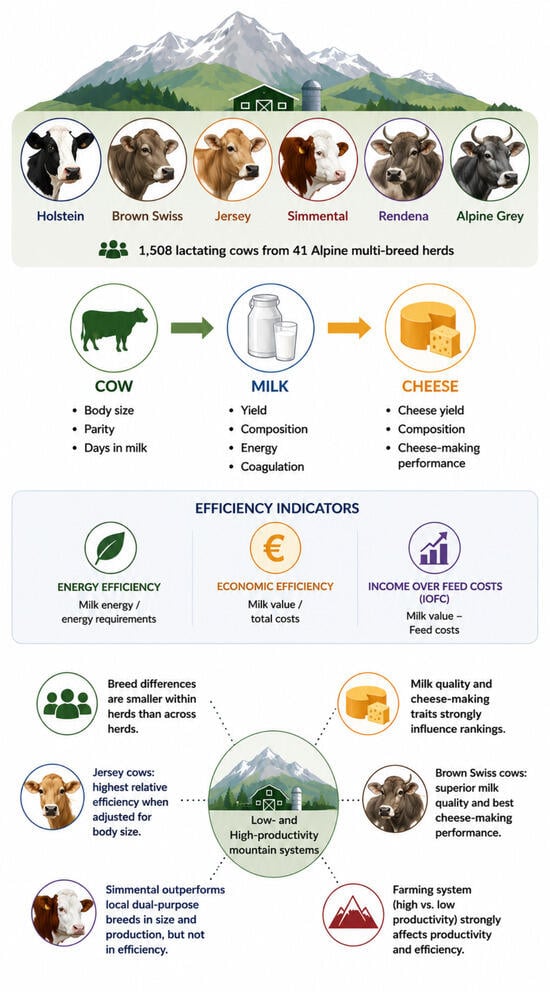
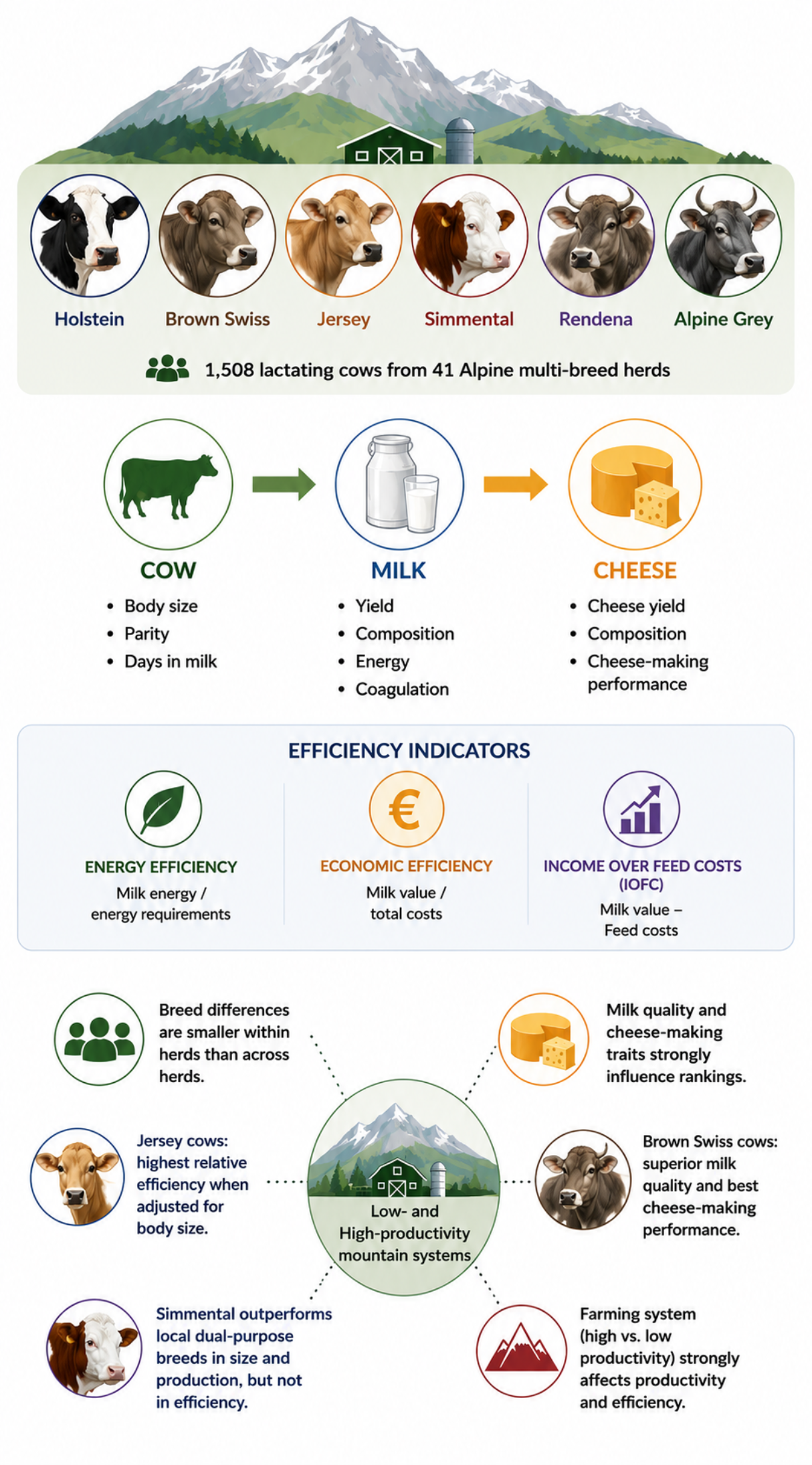
After recording and sampling, data were collected from 1508 lactating cows of three specialized dairy breeds, Holstein Friesian (HF = 31 herds, 471 cows), Brown Swiss (BS = 36 herds, 663 cows), and Jersey (Je = 7 herds, 40 cows), as well as three dual-purpose breeds, Simmental (Si = 20 herds, 158 cows), and two autochthonous breeds, Alpine Grey (AG = 13 herds, 73 cows) and Rendena (Re = 8 herds, 103 cows). These breeds were distributed across the herds of both production classes, except for Jerseys, which were found only in High-dMEO herds, and the local breeds, Rendena and Alpine Grey, which were found only in Low-dMEO herds.
2.3. Evaluation of Body Characteristics
The same trained operator supervised the measurement of each cow’s heart girth and height at withers, subjectively assessed their body weight (BW, in kg), and evaluated body condition scores (BCS) from 1 (lean) to 5 (obese) in increments of 0.25 [
11]. All the cows of each herd were evaluated once during the same day in the case of smaller herds, or in two or three consecutive days in the case of larger herds.
Metabolic weight (MW, kg) was derived from BW (MW = BW0.75) for all cows, regardless of their breed [
12].
We estimated the body composition of the cows using Equations 2–20, 2–21 and 2–22 from the Nutrient Requirements of Dairy Cattle [
12], as described in the parallel study on purebred Holstein and three-breed rotational crossbred cows [
13], and calculated the body protein mass (PW, in kg) multiplying the empty body weight (85% of BW) by the body protein proportion.
2.4. Milk Sampling and Analysis
Daily milk yield (dMY, kg/d) was recorded, and a milk sample was taken from all selected cows for analysis of milk composition and technological properties [
12]. Briefly, a 2.5 L milk sample was collected from each cow and divided into three subsamples. The first subsample was refrigerated and sent to the Provincial Milk Recording Laboratory for milk composition analyses. The second subsample was refrigerated and transported to the Milk Laboratory of the Department of Agronomy, Food, Natural Resources, Animals and Environment (DAFNAE), University of Padova, for milk coagulation and cheese-making analyses. The third subsample was frozen and subsequently freeze-dried for the determination of detailed mineral, protein, and fatty acid profiles. Milk coagulation properties were assessed using lactodynamographic techniques, whereas cheese yield and the recovery of milk nutrients in cheese were determined through an individual laboratory-scale cheese-making procedure [
10].
Daily milk fat, protein and energy production of each cow were obtained by multiplying its dMY (kg/d) by its fat, protein and NEL content per kg, respectively.
2.5. Cheese Yield and Cheese-Making Efficiency
We estimated the theoretical and actual cheese yield and cheese-making efficiency as reported in detail in a previous study [
10] carried out on 508 of the 1508 cows used in the present study. We found the cheese-making efficiency to be significantly affected by breed of cow and parity and therefore used the solutions for breed and parity effects to estimate the actual cheese yield of the remaining cows. The daily cheese production (dCY) of every cow was obtained multiplying their dMY by their cheese yield.
2.6. Productivity of Lactating Cows
The productivity of each lactating cow was calculated as the ratio between an output and a scaling unit representing an input predictor. The output in the numerator of this ratio was either milk yield (dMY), energy yield (dMEO), or cheese yield (dCY); the scaling factor of the input in the denominator was either unit of body weight (BW), unit of metabolic weight (MW), or unit of body protein weight (PW). Nine productivity ratios were thus calculated:
Milk yield/BW, g/kg
Milk yield/MW, g/kg
Milk yield/PW, g/kg
Energy yield/BW, MJ/kg
Energy yield/MW, MJ/kg
Energy yield/PW, MJ/kg
Cheese yield/BW, g/kg
Cheese yield/MW, g/kg
Cheese yield/PW, g/kg
Details are presented in a study carried out on the comparison between purebred Holstein and three-breed rotational crossbred cows from Viking Red, Montbéliarde, and Holstein Sires [
13].
2.7. Energy Requirements and Predicted Efficiency
As it is not possible to control the daily feed intake of individual lactating cows on commercial dairy farms, the energy efficiency of each cow was estimated as the ratio between the daily milk energy output (dMEO, MJ/d) and the sum of all energy requirements (lactation, maintenance, activity, growth, body reserve variations, and pregnancy) expressed as NEL (MJ/d). The details are described in the study previously cited [
13].
The energy efficiency of each cow was obtained by dividing the dMEO (MJ/d) by the estimated total energy requirement (MJ/d) and was expressed as a % value. The economic efficiency indicator (expressed as a %) was obtained by dividing the daily monetary output (dMY × 0.30 €/kg of milk corrected for cheese yield) by the predicted daily monetary cost of feeding (€0.03/MJ of NEL). The reference monetary values of milk corrected for cheese yield and for dietary energy refer to average conditions in Italy in the period 2016–2019 (before the large fluctuations due to the COVID-19 pandemic and the Russia–Ukraine war). In any case, after fluctuations, in recent years the prices of milk and feedstuffs have grown due to inflation, but their ratio remained almost constant, so that comparability of results remains preserved. Economic efficiency was also expressed as IOFC (income over feed costs, €/d) by subtracting the cost of daily energy intake from the value of the milk produced daily.
2.8. Statistical Analysis
Experimental data were analyzed using the MIXED procedure (SAS Institute Inc., Cary, NC, USA) according to the following model (base model):
where y
ijklmn is the observed trait; μ is the overall intercept of the model; dMEO
i is the fixed effect of the ith herd production class (i = 2 levels); Herd
j is the random effect of the jth herd (j = 1 to 41) within the ith herd dMEO class; Breed
k is the fixed effect of the kth breed (k = HF, BS, Je, Si, Re or AG); Parity
l is the fixed effect of the parity (l = 1 to ≥4); DIM
m is the fixed effect of the mth class of days in milk [m = 1 to 10; class 1, 5–34 days (31 samples); class 2, 35–64 d (26 samples); class 3, 65–94 d (41 samples); class 4, 95–124 d (56 samples); class 5, 125–154 d (64 samples); class 6, 155–184 d (58 samples); class 7, 185–214 d (63 samples); class 8, 215–244 d (57 samples); class 9, 245–274 d (32 samples); class 10, ≥275 d (84 samples)]; and e
ijklmn is the random residual~N (0,
).
A model that also included the breed × herd dMEO class interaction was fitted to test the data from the breeds present in both herd production classes (Holstein Friesian, Brown Swiss, and Simmental). As this interaction was never significant, the results of this model analysis are nor discussed.
We estimated orthogonal contrasts between the LSM of traits for the effect of breed as follows:
- (a)
Specialized dairy (HF, BS, and Je) vs. dual-purpose breeds (Si, AG, and Re);
- (b)
Within specialized dairy, large-framed vs. small-framed breeds (HF + BS vs. Je);
- (c)
comparison between the two large-framed dairy breeds (HF vs. BS);
- (d)
Within dual-purpose, large- vs. medium-framed local breeds (Si vs. Re + AG);
- (e)
Comparison between the two medium-framed local dual-purpose breeds (Re vs. AG).
3. Results
As the effects of parity and DIM did not fall within the aims of our study, we will not summarize the results in this section, nor will we discuss them.
3.1. Body Characteristics and Milk and Cheese Production of Lactating Cows
The effects of herd dMEO level on the body characteristics and on the milk and cheese yield of cows resulting from the model corrected for breed, parity, DIM, and related interactions were significant for all traits, with the only exception of the lactose content of milk (
Table 2).
As
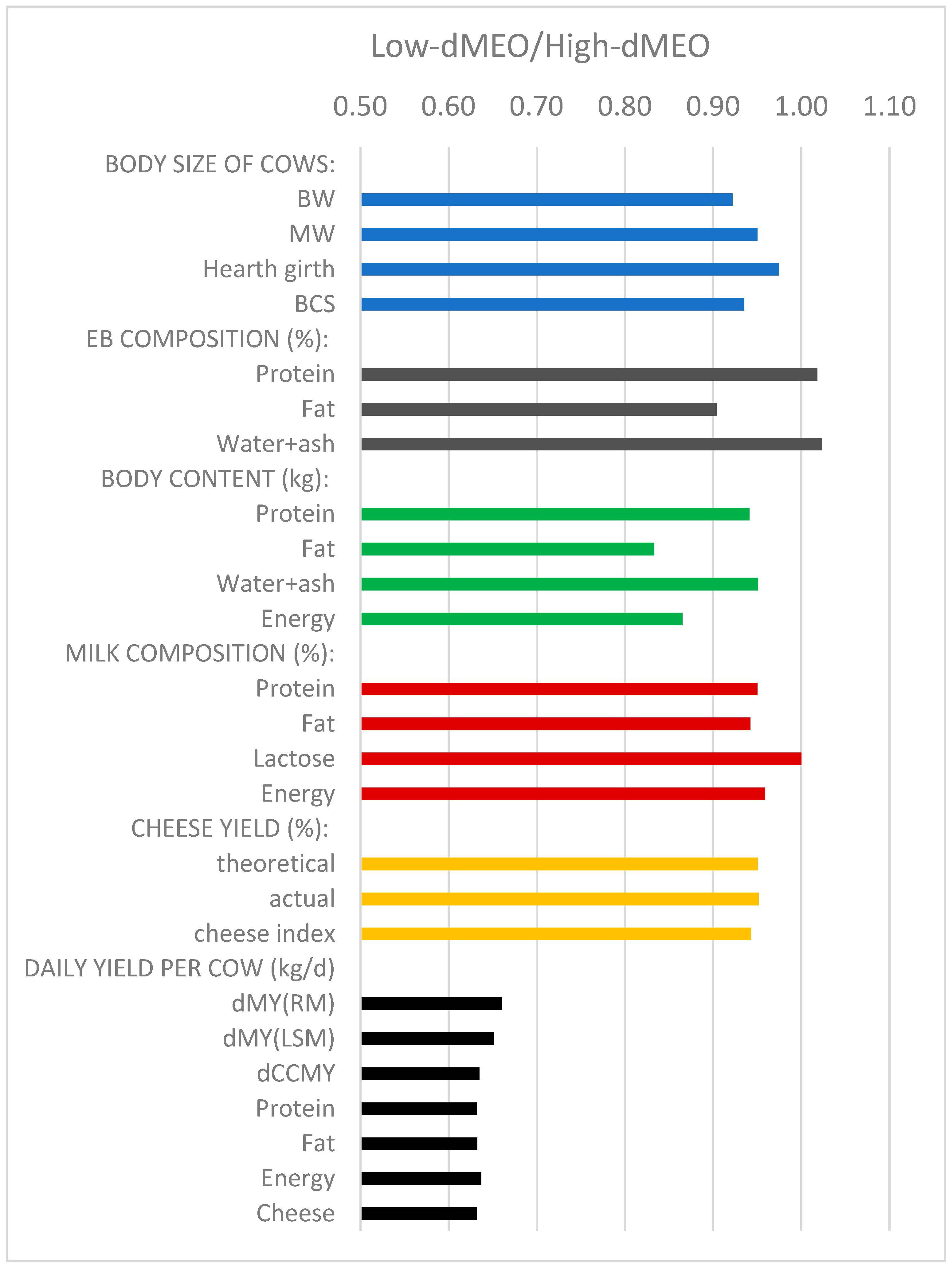
Figure 1 clearly shows, compared with cows reared in High-dMEO herds, the values for cows reared in Low-dMEO herds were inferior for all body, milk and production traits, except for protein and water + ash proportion in empty body measurements.
There were large differences between the six breeds in all the body traits examined (
Table 3).
The three specialized dairy breeds were, on average, smaller (lower average BW, MW, heart girth, estimated body content of protein, fat, water + ash, and energy) and leaner (lower BCS and estimated body fat proportions, and higher estimated body protein and water + ash proportions) than the three dual-purpose breeds, especially because of the low values of the Jerseys in the former group and the high values of the Simmentals in the latter group. There were also large differences between the six breeds in all the milk yield and composition traits examined (
Table 3). Orthogonal contrasts revealed that the three specialized dairy breeds had, on average, similar daily milk and protein production levels to the three dual-purpose breeds but slightly greater daily fat and energy yields due to the higher protein, fat and energy contents of their milk (lactose content was slightly lower), but with lower yield and better quality of milk from Jerseys, among the dairy breeds, and lower differences among the dual purpose breeds. Lastly, there were large differences between the six breeds in all the cheese-making traits examined, so the differences in daily cheese yield were much smaller than those in milk yield (
Table 3). Aside from the effects of parity and DIM, the dMEO × DIM interaction was generally not significant or biologically relevant (
Table 2). The dMEO × Parity interaction indicated that the increase in production with advancing parity was generally greater in High-dMEO than in Low-dMEO herds, and this was also reflected in differences in cow body composition. Finally, the Breed × Parity interaction revealed only minor differences among breeds in terms of physiological development and productive precocity.
3.2. Productivity Ratios and Estimated Efficiency Indicators
Table 4 shows a significant effect of dMEO class on all nine productivity ratios, which were obtained by dividing three measures of each cow’s daily output (milk yield, milk energy output, and fresh cheese yield) by three scaling units considering the cows’ different sizes and feeding costs (BW, MW and PW).
As
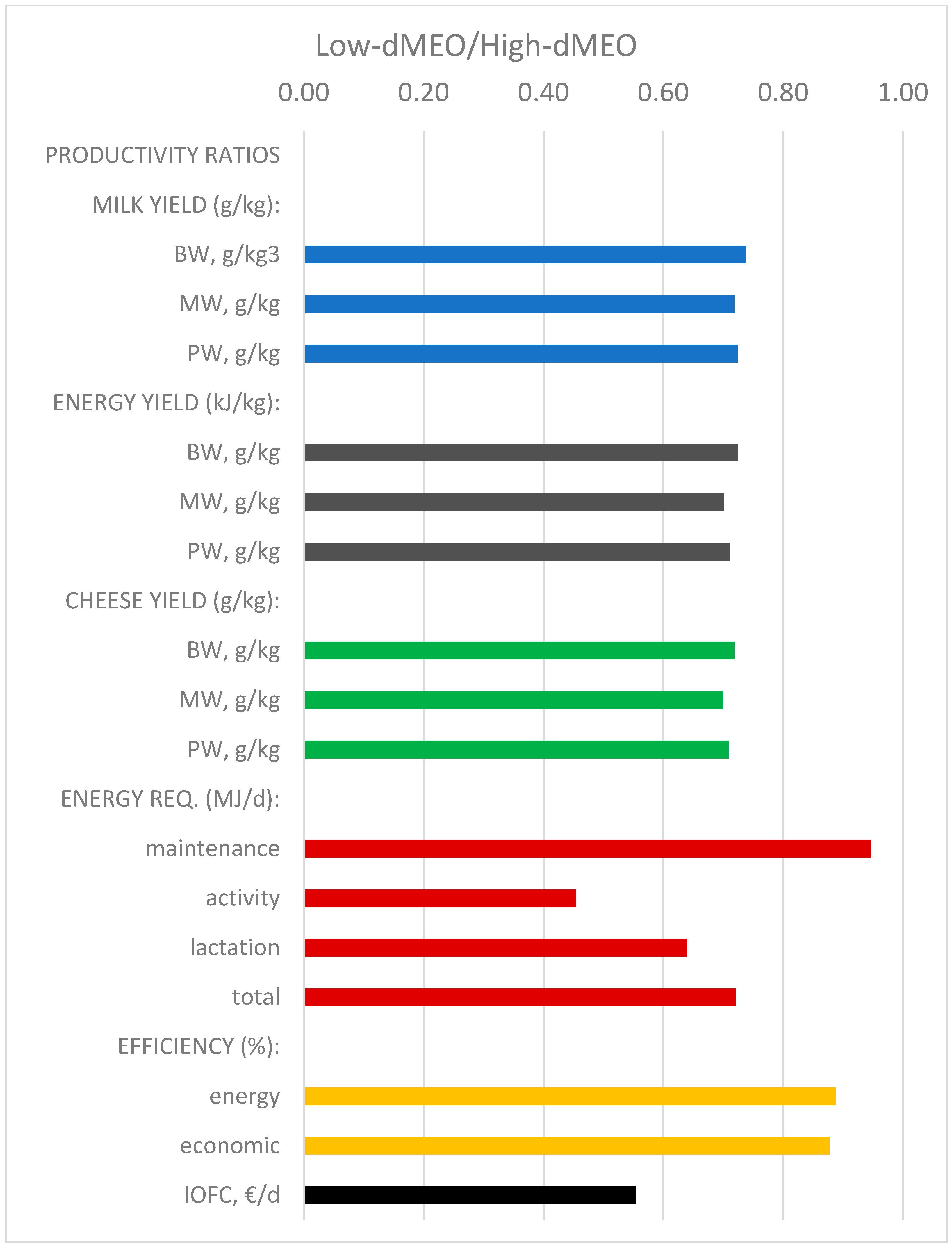
Figure 2 shows, the Low-dMEO herds were consistently inferior to the High-dMEO herds for all productivity indicators, regardless of the output measure or scaling unit (−26% to −30%). The cows from Low-dMEO farms were also less efficient in terms of energy (−11%) and economics (−12%), especially with respect to IOFC (−45%), compared to cows from High-dMEO farms.
Breed of cow also strongly affected all the productivity ratios, but in this case, the six breeds were ranked differently according to the different productivity ratios yielded, even though all the data were corrected for the effects of herd, parity, and DIM (
Table 5).
The orthogonal contrasts revealed that the three specialized dairy breeds had, on average, higher productivity ratios than the dual-purpose breeds, especially because of the much lower values of the three scaling units used in the denominator of the ratios (BW, MW and PW,
Table 3) of the Jerseys. The differences between the two large-framed dairy breeds narrowed when the ratios replaced milk with energy and cheese output measures, as the milk of the Brown Swiss had a higher nutrient content and better technological properties than the milk of the Holstein Friesians. The differences within the dual-purpose breeds were small because the Simmentals yielded greater daily output measures than the local breeds but also had a larger body size (i.e., higher numerators as well as denominators).
The six breeds also differed substantially for all the energy requirements, especially, as expected, when breeds with very different body sizes and production traits were compared (
Table 5). There were much smaller differences among the breeds in terms of efficiency indicators than in terms of absolute energy requirements. The orthogonal contrasts revealed the following: the three specialized dairy breeds had, on average, greater energy and economic efficiencies and also higher IOFC than the three dual-purpose breeds; within the specialized dairy breeds, Jersey cows had similar IOFC and energy efficiency to the cows of the two large-framed breeds (Holstein and Brown Swiss) but greater economic efficiency; of the two large-framed dairy breeds, the Holsteins had greater energy efficiency than the Brown Swiss cows, but both economic indicators were lower; and among the dual-purpose breeds, the Simmentals had slightly greater energy efficiency than the two local breeds, which had similar efficiency indicators.
The dMEO × DIM interaction was generally not significant, indicating that the effect of the dairy production system remained relatively constant throughout lactation (
Table 4). The dMEO × Parity interaction indicated that the increase in production associated with advancing parity was generally greater in High-dMEO than in Low-dMEO herds, resulting in higher nutrient requirements of cows in the former herds. However, because the interaction often affected both numerator and denominator traits in a similar manner, productivity ratios and efficiency indicators were only marginally influenced by this interaction. In contrast, the Breed × Parity interaction frequently affected numerator and denominator traits differently, leading to several significant breed differences in terms of productive precocity.
4. Discussion
4.1. Which Output for Lactating Cows?
Having classified the herds according to daily milk energy yield, there was an evident effect of herd production class on milk and cheese production, productivity, and efficiency, which has been discussed in previous articles from the same project [
9,
10]. Our discussion, therefore, will focus on the effects of breed of cow, and possible interactions with the other factors, on the productivity and efficiency of lactating cows.
Please note that body traits, milk and cheese production traits, productivity ratios, and efficiency indicators of lactating cows were derived from cross-sectional measurements rather than from repeated observations collected throughout lactation.
Here, the cheese index, i.e., the value of milk for cheese production, varied from 0.90 for Holstein milk and 1.24 for Jersey milk (
Table 3). Cheese yield was found to depend not only on the fat and casein content of milk, but also on the relative amounts of these nutrients recovered in the fresh cheese or lost in the whey. Cheese-making efficiency, i.e., the ratio between actual cheese production and that expected on the basis of the milk composition, varied from 0.96 for Holstein milk and 1.04 for Rendena milk, although the milk of these breeds has a similar composition [
10]. It is worth noting that, in this same project, we found that these differences in cheese-making efficiency between different breeds is, to a large extent, related to the detailed profiles and effects of milk minerals [
14] and of milk protein fractions and their genetic variants [
15]. It is obvious that the cows’ productivity and efficiency should be based on the main end-use of the milk and on the payment system of the dairy chain under consideration. In the case of Alpine dairy systems, the milk is mainly used for the production of traditional cheeses, and their valorization relies especially on their quality. Simply using milk yield, fat and protein content in a dairy chain based on cheese production can lead to heavily biased conclusions.
4.2. Which Scaling Unit for Lactating Cows?
The results show there is very large variation among breeds within a herd in terms of cow size, milk yield and composition, and cheese yield.
A correct comparison of breeds should consider not only milk and cheese production per cow, but also the cow’s productivity by correcting the production value for a measure of “fixed” costs for energy requirements for functions other than production. The cows of different dairy and dual-purpose breeds are known to have different body frames and compositions, and we also found this to be the case for the breeds compared here in the same area of production [
16]. Compared with the cows of the heaviest breed (Simmental), those of the smallest breed (Jersey) are, on average, 43% lighter in terms of BW, 34% in terms of MW, and 40% in terms of PW (
Table 3). The question of choosing appropriate scaling for maintenance requirements is not an easy one to resolve [
17]. Historically, MW, the curvilinear function of the weight raised to the power of 0.75, was the most widely used scaling factor, based on the assumption that heavier animals are generally fatter than lighter ones, which is not always true, and that fatty tissues have low daily maintenance requirements. It was therefore also assumed that two cows of the same LW, hence also the same MW, would have the same body composition and maintenance requirements, which is not always true. Dong et al. (2015) [
18] found in calorimetric respiration chambers that the energy maintenance requirement is not directly proportional to MW, regardless of milk production level, but the more productive cows consume more energy per kg of MW for maintenance than the less productive cows. This could be explained, as least in part, by the fact that more productive cows are generally leaner (less fat and more protein in their bodies) than less productive cows.
Moreover, it is assumed that a heavier cow will be fatter than a lighter cow, and that the maintenance requirement of the former is less than proportional to the body weight of the latter, which is not always true. Beef cattle belonging to a British breed have a different composition compared to a double-muscled bovine with a similar bodyweight, but the maintenance energy of the former is much lower than that of the latter [
19]. However, Jersey cows are not young, light, lean Holsteins. In the current experiment, the average BCS of the Jerseys cows was very close to that of the Holsteins and only slightly lower than the Brown Swiss cows (
Table 3), so the proportions of body protein, fat, and water + ash were similar in all three dairy breeds. This would suggest that using MW as a maintenance scaling factor is not justified, and that PW could better adapt to different production phases and genetics of dairy cows of different breeds.
4.3. Confounding Environment and Genetics in Breed Comparisons
In Italy, the average milk production of the dairy breeds studied here is much higher (+40%) than that of the dual-purpose breeds [
20], and similar results have been found in other countries. National differences in average milk production are evidently attributable in part to the different geographical distributions of individual breeds and to differences in the proportions of the various dairy systems operating in a country. Also in more restricted Alpine areas, there are many single-breed herds, and these are distributed differently across the different dairy systems, which range from very small, traditional systems to very modern ones [
9]. However, large differences also clearly emerged within the 41 multi-breed herds investigated in our study. In our study, breed distribution was unbalanced because Holstein, Brown Swiss, and Simmental cows were represented in both High-dMEO and Low-dMEO farming systems, whereas Jersey cows were present only in High-dMEO herds and Rendena and Alpine Grey cows only in Low-dMEO herds. In a preliminary analysis, we evaluated data from the breeds represented in both dMEO classes (Holstein, Brown Swiss, and Simmental) using a model that included the Breed × dMEO class interaction. This interaction was generally not significant or biologically not relevant. On this basis, we adopted a model including the main effects of breed and dMEO class, without their interaction, for the analysis of all breeds. Nevertheless, the results obtained for the less represented breeds should be interpreted with caution.
If we look at the raw means of the daily milk yields of the cows of the different breeds (data included for comparison in
Table 3), we see that the yield of the dairy breeds is on average 48% greater than that of the dual-purpose breeds. Correcting the LSM for the different incidences and proportions of breeds, and the cows’ parities and DIM within herd, the average production of the dairy breeds was only 3% greater than the dual-purpose breeds (not significant;
Table 3). The consequence of this is that, on average, the phenotypic difference observed at the national and local levels between dairy and dual-purpose breeds in terms of milk yield seems largely due to differences in farming systems, not genetic factors. Not only are the differences among breeds overestimated when the effects of farming systems are not accounted for, but the differences among farming systems are also overestimated when breed distribution is ignored. Nevertheless, after correcting for these confounding effects, the influence of farming system remained much greater than that of breed on milk yield, milk component yields, and productivity ratios, whereas its effect was considerably smaller on milk quality traits, body traits, and efficiency indicators. High-dMEO herds are often characterized by superior environmental and welfare conditions, more balanced nutritional management, more effective health prevention and reproductive management practices, and a higher overall standard of farm management.
4.3.1. Jersey Breed
The Jerseys are the most unusual of the three dairy breeds in the Alpine system. The LSM for this breed should be treated with caution, as these were the least numerous cows in our study (40 cows from 7 herds). Jerseys, as is well known, have the smallest body size, the lowest daily milk yield and the highest milk fat, protein and energy content, not just of the three dairy breeds, but also of all six breeds analyzed. The milk produced by Jersey cows is also very unusual from a technological point of view [
21]: due to its high fat and protein content, and excellent coagulation and curd firming properties, Jersey milk has the greatest theoretical %CY and actual %CY [
8,
9,
22].
The excellent composition and cheese-making properties of Jersey cows’ milk explain why this breed produced, on average, 30% less milk per day but only 12% less full-fat, fresh cheese than the Holstein and Brown Swiss cows (
Table 3). Capper and Cady (2012) [
22] also found that Jersey cows produced only 11% less cheddar cheese per day of lactation than Holsteins.
If we use the PW of cows as the scaling factor (
Table 3), we find that the Jerseys’ indicator of productivity (grams of milk produced daily per kg of PW maintained) seems greater than that of the other two breeds (+19%,
Table 5). When we replaced dMY with the daily yield of milk energy (+45%) or fresh cheese (+57%) as an output measure, the Jersey breed appeared to perform even better than the other two dairy breeds (
Table 5). Turning now to energy efficiency indicators (
Table 5), we see that the Jersey breed appeared to be slightly more efficient (+5%) than the other two dairy breeds. However, given the limited number of herds and cows of this breed included in the study, the results obtained for Jersey cattle should be confirmed in larger and more representative populations.
4.3.2. Holstein and Brown Swiss Breeds
In Italy as a whole, Holstein cows produce much more milk than Brown Swiss cows (10.396 vs. 7.764 kg of milk per lactation, +33%) [
20]. However, in a more homogeneous environment (Trento province), Holsteins produce, on average, 18% more milk than Brown Swiss cows. Using the raw averages of all the cows in the present study across the 41 multi-breed farms, Holsteins produced 14% more milk than Brown Swiss cows. After correcting the dMY for dMEO class, individual herd, parity, and DIM, Holstein cows still produced 14% more milk than Brown Swiss cows (both breeds are more commonly found on modern farms). These corrections are essential for disentangling the major environmental effects from genetic effects and for obtaining unbiased estimates of their respective contributions.
Based on milk composition, the theoretical %CY of Brown Swiss cows is 8% higher than that of Holsteins, but their actual %CY, obtained from individual model cheeses, is 16% higher (
Table 3). Not only does Brown Swiss cows’ milk contain more fat and protein than Holstein milk, but higher percentages of milk fat and protein are retained in the curd, thereby reducing losses in the whey, as shown in a study on these same cows [
9] and also in other studies carried out in other countries [
5]. As a result of the greater nutrient recovery, the daily production of cheese on mountain dairy farms was similar for the two major breeds, even though it was nominally higher for Brown Swiss cows (
Table 3).
As the two major breeds had very similar body sizes, condition scores, and predicted body composition, the two breeds were ranked roughly equally for the milk productivity indicators and output measures, regardless of the size scaling factor (
Table 5). Holsteins were superior to the Brown Swiss in terms of milk indicators, and also (but to a lesser extent) milk energy, but not in terms of cheese productivity. On the contrary, the Brown Swiss were superior to the Holsteins when dCY was scaled on BP mass.
Moving on to efficiency indicators, there were no differences between the two large-framed breeds in terms of energy efficiency of milk production and IOFC, but the Brown Swiss breed was more economically efficient than the Holstein breed (
Table 5). It is worth noting that calorimetric balances carried out in respiration chambers also showed little or no difference between Holstein and non-Holstein dairy cows [
18].
4.3.3. Simmental Breed
In Italy, Simmental cows produce less milk than Holsteins and Brown Swiss cows [
20]. In Trento province, Simmental cows produce, on average, 23% less milk than Holsteins and 9% less than Brown Swiss cows. If we compare only the cows in the present study on the basis of the raw means, the Simmental cows produced 29% less milk than the Holsteins and 19% less than the Brown Swiss cows (
Table 3). After correcting dMY for dMEO class, individual herd, parity, and DIM, the Simmental cows produced only 11% less milk than Holsteins and about the same as Brown Swiss cows (a large proportion of Simmental cows are reared on Low-dMEO farms). If we look at the fat and protein contents of milk, we see that the Simmentals’ daily production is very similar to that of the Brown Swiss and only 7% (fat) and 6% (protein) lower than the Holsteins (
Table 3).
The coagulation and curd-firming properties of Simmental cows’ milk were close to those of Brown Swiss milk and better than those of Holstein milk [
9]. The combined effect of correcting data for herd factors, milk protein and fat contents, milk coagulation and curd-firming properties, and cheese-making efficiency explains the fact that these three large-framed breeds produce very similar daily quantities of fresh cheese (
Table 3).
With regard to productivity ratios, it should be borne in mind that Simmental cows have slightly greater BW (+4%,
Table 3) and MW, but the predicted lean body mass of the three large-framed breeds are quantitatively very similar, whereas the greater BW of Simmental cows over the other two breeds is almost entirely explained by a greater weight of fatty tissues (
Table 3). This is why the productivity ratios of the Simmentals were slightly lower than those of the Holsteins (and similar to the Brown Swiss) when milk production was scaled on BW and MW but were very similar when cheese production was scaled on PW (
Table 5). Regarding efficiency indicators, Simmental cows are slightly less energy efficient than Holsteins, but their economic efficiency indicators are similar to the two large-framed dairy breeds (
Table 5).
4.3.4. Local Rendena and Alpine Grey Breeds
The daily milk production of both the local breeds is much lower than that of the large-framed, dual-purpose breed (Simmental) when averaged across herds (Rendena −16%, Alpine Greys −35%;
Table 3). Once corrected for the effects of herd, parity, and DIM, the differences fell to −5% and −19%, respectively (
Table 3). It is worth noting that Rendena milk has a similar protein content to Holstein milk and a lower milk fat content, therefore presenting a lower theoretical %CY than Holstein milk (
Table 3). However, in terms of traditional milk coagulation properties and curd-firming modelling [
9], Rendena cows’ milk was better than Holstein milk. This could explain the fact that, unlike theoretical %CY, the local breed had a higher actual %CY than the international breed (
Table 3).
The composition of the Alpine Grey milk did not differ much from that of the major dual-purpose breed, nor the Brown Swiss breed, so their %CY values were similar. Consequently, Rendena cows produced 10% less and Alpine Greys 16% less cheese per day than Simmental cows (
Table 3). These differences were very similar to the differences in cow size (BW, MW and PW). There were therefore no differences between the local breeds and the Simmentals, nor between the two local breeds with respect to any of the productivity indices (
Table 5). Regarding milk production efficiency, the Simmentals had a higher energy indicator than the local breeds, but similar economic indices (
Table 5).
4.4. Limitation of the Research and Implications for Crossbreeding and Selection
The results of the present study provide insights into the different roles and relative importance of various production, qualitative and technological traits in a mountain dairy sector focused mainly on cheese production rather than fluid or dried milk [
23].
This study was conducted in a specific mountain region (the province of Trento) and included a number of farms that were representative of that area, although not necessarily of other mountainous regions. The number of animals was adequate for the major breeds but more limited for some of the minor breeds. In addition, the distribution of breeds across farming systems was not balanced. Nevertheless, the study area shares many characteristics with other mountain regions, particularly those within the Alpine system. Therefore, although caution is warranted when extrapolating these results to other areas, the findings may provide useful reference values for several Alpine regions and contribute to a broader understanding of the relationships among breed, farming system, productivity, and efficiency. The concepts and methodological framework developed in this study may also be relevant beyond mountain environments.
The knowledge acquired may be more directly useful in defining selection indices for purebred dairy and dual-purpose populations [
24,
25] and in planning crossbreeding schemes for the various dairy sectors [
26]. Moreover, it is now clearer that cheese yield efficiency and dairy product quality rely only partially on the fat and protein content of milk and that the efficiency of the dairy chain depends on, and demands, a more thorough knowledge of milk technological properties, beginning with the detailed protein composition and the factors affecting coagulation, curd firming and nutrients losses in the whey. It is worth noting that these aspects are also linked to the environmental impact of the dairy chain [
27,
28].
Crossbreeding of dairy cattle, on the other side, is becoming more widespread [
2], and several studies show the positive results that may be obtained, especially regarding milk performance [
29], fertility traits [
30], and lifetime production and profitability [
31]. Milk properties have generally been studied only in terms of milk composition, while much less attention has focused on the protein fractions, milk coagulation properties, and cheese yields of crossbred cows compared with purebreds. A better understanding of specific cheese-making traits and overall cheese-making efficiency may therefore be highly valuable in designing crossbreeding programmes, provided that the heterosis and recombination effects in different crossings are similar.
5. Conclusions
We have demonstrated that the differences in the milk production efficiencies of different dairy and dual-purpose bovine breeds depend on many interrelated factors. Among the main sources of the differences in production levels observed among the various breed populations are the different dairy systems and herd characteristics. When different breeds are compared within dairy systems and within individual herds, we see fewer differences in production traits, and these are dependent on differences in the animals’ body size and composition. Scaling production traits on the basis of body size indicators gave us a more accurate indication of the productivity (rather than production) of the breeds. Body protein weight allows for a more accurate comparison then metabolic weight, especially when breeds and individual animals are characterized by different body conditions and, consequently, different body compositions and maintenance requirements. Metabolic weight assumes that body composition and maintenance requirements depend solely on body weight. However, this assumption is not valid and introduces bias into comparisons among animals. At the same level of milk production and the same body and metabolic weight, cows may differ in body condition score, body composition, and maintenance requirements, resulting in differences in productivity and efficiency.
Although within-herd comparisons and correctly scaling the production traits greatly reduces the differences in productivity between herds, it does not reduce the differences in milk composition, technological properties, and cheese-making efficiencies (milk nutrient recoveries in the cheese). There are considerable differences among breeds with respect to these factors, and these differences are amplified in the overall evaluation of breed efficiency, especially if the local dairy sector is focused mainly on cheese production. Both the energy and economic efficiencies of milk production depend on all the above-mentioned factors. Given their importance, a better understanding and correct quantification of the productive, qualitative, and technological properties, as well as the scaling factors of different breeds and individuals, will provide the necessary underpinnings to modify the selection indices of dairy and dual-purpose breeds and to plan crossbreeding programmes.
Author Contributions
Conceptualization, G.B.; methodology, G.S. and A.C.; software, G.S. and A.C.; validation, G.B., L.G. and S.S.; formal analysis, G.S.; investigation, G.B., L.G. and S.S.; resources, G.B.; data curation, G.S.; writing—original draft preparation, G.B., G.S. and S.S.; writing—review and editing, G.B., G.S., A.C., L.G. and S.S.; visualization, G.B.; supervision, G.B.; project administration, A.C.; funding acquisition, G.B. All authors have read and agreed to the published version of the manuscript.
Funding
This research received no external funding.
Institutional Review Board Statement
Ethical review and approval were waived for this study since data and milk samples from animals were obtained during the milk recording activity routine of the Trento Federation of Breeders (Trento, Italy).
Informed Consent Statement
Not applicable.
Data Availability Statement
The original contributions presented in this study are included in the article. Further inquiries can be directed to the corresponding author.
Acknowledgments
The authors acknowledge the collaboration of the Trento Federation of Breeders (Trento Italy) for the collaboration in the selection of herds and collection of data and milk samples from animals. Generative AI (ChatGPT-5.5) was used only as an help for preparing the graphical abstract.
Conflicts of Interest
The authors declare no conflicts of interest.
References
- Prescott, M.S. History of Holstein Friesian; Jubilee, D., Ed.; Holstein-Friesian World: Lacona, NY, USA, 1960. [Google Scholar]
- Guinan, F.L.; Norman, H.D.; Dürr, J.W. Changes Occurring in the Breed Composition of U.S. Dairy Herds; Interbull Bulletin: Uppsala, Sweden, 2019. [Google Scholar]
- Bach, A.; Terré, M.; Vidal, M. Symposium Review: Decomposing Efficiency of Milk Production and Maximizing Profit. J. Dairy Sci. 2020, 103, 5709–5725. [Google Scholar] [CrossRef] [PubMed]
- de Ondarza, M.B.; Tricarico, J.M. REVIEW: Advantages and Limitations of Dairy Efficiency Measures and the Effects of Nutrition and Feeding Management Interventions. Prof. Anim. Sci. 2017, 33, 393–400. [Google Scholar] [CrossRef]
- Mistry, V.V.; Brouk, M.J.; Kasperson, K.M.; Martin, E. Cheddar Cheese from Milk of Holstein and Brown Swiss Cows. Milchwissenschaft 2002, 57, 19–23. [Google Scholar]
- Martin, B.; Pomiès, D.; Pradel, P.; Verdier-Metz, L.; Rémond, B. Yield and Sensory Properties of Cheese Made with Milk from Holstein or Montbéliarde Cows Milked Twice or Once Daily. J. Dairy Sci. 2009, 92, 4730–4737. [Google Scholar] [CrossRef] [PubMed]
- Malacarne, M.; Summer, A.; Fossa, E.; Formaggioni, P.; Franceschi, P.; Pecorari, M.; Mariani, P. Composition, Coagulation Properties and Parmigiano-Reggiano Cheese Yield of Italian Brown and Italian Friesian Herd Milks. J. Dairy Res. 2006, 73, 171–177. [Google Scholar] [CrossRef] [PubMed]
- Bland, J.H.; Grandison, A.S.; Fagan, C.C. Effect of Blending Jersey and Holstein-Friesian Milk on Cheddar Cheese Processing, Composition, and Quality. J. Dairy Sci. 2015, 98, 1–8. [Google Scholar] [CrossRef] [PubMed]
- Stocco, G.; Cipolat-Gotet, C.; Bobbo, T.; Cecchinato, A.; Bittante, G. Breed of Cow and Herd Productivity Affect Milk Composition and Modeling of Coagulation, Curd Firming, and Syneresis. J. Dairy Sci. 2017, 100, 129–145. [Google Scholar] [CrossRef] [PubMed]
- Stocco, G.; Cipolat-Gotet, C.; Gasparotto, V.; Cecchinato, A.; Bittante, G. Breed of Cow and Herd Productivity Affect Milk Nutrient Recovery in Curd, and Cheese Yield, Efficiency and Daily Production. Animal 2018, 12, 434–444. [Google Scholar] [CrossRef] [PubMed]
- Gallo, L.; Sturaro, E.; Bittante, G. Body Traits, Carcass Characteristics and Price of Cull Cows as Affected by Farm Type, Breed, Age and Calving to Culling Interval. Animal 2017, 11, 696–704. [Google Scholar] [CrossRef] [PubMed]
- NRC. Nutrient Requirements of Dairy Cattle, 7th ed.; National Academy Press: Washington, DC, USA, 2001. [Google Scholar]
- Piazza, M.; Schiavon, S.; Saha, S.; Berton, M.; Bittante, G.; Gallo, L. Body and Milk Production Traits as Indicators of Energy Requirements and Efficiency of Purebred Holstein and 3-Breed Rotational Crossbred Cows from Viking Red, Montbéliarde, and Holstein Sires. J. Dairy Sci. 2023, 106, 4698–4710. [Google Scholar] [CrossRef] [PubMed]
- Stocco, G.; Summer, A.; Cipolat-Gotet, C.; Malacarne, M.; Cecchinato, A.; Amalfitano, N.; Bittante, G. The Mineral Profile Affects the Coagulation Pattern and Cheese-Making Efficiency of Bovine Milk. J. Dairy Sci. 2021, 104, 8439–8453. [Google Scholar] [CrossRef] [PubMed]
- Amalfitano, N.; Cipolat-Gotet, C.; Cecchinato, A.; Malacarne, M.; Summer, A.; Bittante, G. Milk Protein Fractions Strongly Affect the Patterns of Coagulation, Curd Firming, and Syneresis. J. Dairy Sci. 2019, 102, 2903–2917. [Google Scholar] [CrossRef] [PubMed]
- Piazza, M.; Berton, M.; Amalfitano, N.; Bittante, G.; Gallo, L. Cull Cow Carcass Traits and Risk of Culling of Holstein Cows and 3-Breed Rotational Crossbred Cows from Viking Red, Montbéliarde, and Holstein Bulls. J. Dairy Sci. 2023, 106, 312–322. [Google Scholar] [CrossRef] [PubMed]
- Emmans, G.C.; Kyriazakis, I. Consequences of Genetic Change in Farm Animals on Food Intake and Feeding Behavior. Proceeding Nutr. Soc. 2001, 60, 115–125. [Google Scholar]
- Dong, L.F.; Yan, T.; Ferris, C.P.; McDowell, D.A. Comparison of Maintenance Energy Requirement and Energetic Efficiency between Lactating Holstein-Friesian and Other Groups of Dairy Cows. J. Dairy Sci. 2015, 98, 1136–1144. [Google Scholar] [CrossRef] [PubMed]
- NRC. Nutrient Requirements of Beef Cattle, 8th Rev. ed.; The National Academies: Washington, DC, USA, 2016. [Google Scholar]
- AIA Bollettino on Line—Controlli Sulla Produttività Del Latte. Associazione Italiana Allevatori. Available online: http://bollettino.aia.it/ (accessed on 16 January 2026).
- Auldist, M.; Mullins, C.; O’Brien, B.; O’Kennedy, B.T.; Guinee, T. Effect of Cow Breed on Milk Coagulation Properties. Milchwissenschaft 2002, 57, 140–143. [Google Scholar]
- Capper, J.L.; Cady, R.A. A Comparison of the Environmental Impact of Jersey Compared with Holstein Milk for Cheese Production. J. Dairy Sci. 2012, 95, 165–176. [Google Scholar] [CrossRef] [PubMed]
- IDF. Bulletin of the IDF N°527/2023: The World Dairy Situation Report 2023; IDF-International Dairy Federation: Brussels, Belgium, 2023. [Google Scholar]
- VandeHaar, M.J.; Armentano, L.E.; Weigel, K.; Spurlock, D.M.; Tempelman, R.J.; Veerkamp, R. Harnessing the Genetics of the Modern Dairy Cow to Continue Improvements in Feed Efficiency. J. Dairy Sci. 2016, 99, 4941–4954. [Google Scholar] [CrossRef] [PubMed]
- Tempelman, R.J.; Lu, Y. Symposium Review: Genetic Relationships between Different Measures of Feed Efficiency and the Implications for Dairy Cattle Selection Indexes. J. Dairy Sci. 2020, 103, 5327–5345. [Google Scholar] [CrossRef] [PubMed]
- Mäntysaari, P.; Liinamo, A.E.; Mäntysaari, E.A. Energy Efficiency and Its Relationship with Milk, Body, and Intake Traits and Energy Status among Primiparous Nordic Red Dairy Cattle. J. Dairy Sci. 2012, 95, 3200–3211. [Google Scholar] [CrossRef] [PubMed]
- de Haas, Y.; Pszczola, M.; Soyeurt, H.; Wall, E.; Lassen, J. Invited Review: Phenotypes to Genetically Reduce Greenhouse Gas Emissions in Dairying. J. Dairy Sci. 2017, 100, 855–870. [Google Scholar] [CrossRef] [PubMed]
- Martínez-Marín, G.; Toledo-Alvarado, H.; Amalfitano, N.; Gallo, L.; Bittante, G. Lactation Modeling and the Effects of Rotational Crossbreeding on Milk Production Traits and Milk-Spectra-Predicted Enteric Methane Emissions. J. Dairy Sci. 2024, 107, 1485–1499. [Google Scholar] [CrossRef] [PubMed]
- Clasen, J.B.; Fogh, A.; Kargo, M. Differences between Performance of F1 Crossbreds and Holsteins at Different Production Levels. J. Dairy Sci. 2019, 102, 436–441. [Google Scholar] [CrossRef] [PubMed]
- Buckley, F.; Lopez-Villalobos, N.; Heins, B.J. Crossbreeding: Implications for Dairy Cow Fertility and Survival. Animal 2014, 8, 122–133. [Google Scholar] [CrossRef] [PubMed]
- Hazel, A.R.; Heins, B.J.; Hansen, L.B. Herd Life, Lifetime Production, and Profitability of Viking Red-Sired and Montbéliarde-Sired Crossbred Cows Compared with Their Holstein Herdmates. J. Dairy Sci. 2021, 104, 3261–3277. [Google Scholar] [CrossRef] [PubMed]
Figure 1.
Traits of cows in low daily milk energy output farms (Low-dMEO) expressed as ratio of cows in high daily milk energy output farms (High-dMEO): body size, empty (EB) body composition, body content of nutrients, milk composition, cheese yield and daily yield per cow (all traits are significantly different in Low-dMEO respect to High-dMEO, except lactose content of milk, see
Table 2).
Figure 1.
Traits of cows in low daily milk energy output farms (Low-dMEO) expressed as ratio of cows in high daily milk energy output farms (High-dMEO): body size, empty (EB) body composition, body content of nutrients, milk composition, cheese yield and daily yield per cow (all traits are significantly different in Low-dMEO respect to High-dMEO, except lactose content of milk, see
Table 2).
Figure 2.
Traits of cows in low daily milk energy output farms (Low-dMEO) expressed as ratio of cows in high daily milk energy output farms (High-dMEO): Productivity ratios, energy requirements, efficiency traits and income over feed costs (IOFC) (all traits are significantly different in Low-dMEO with respect to High-dMEO, except lactose content of milk; see
Table 2).
Figure 2.
Traits of cows in low daily milk energy output farms (Low-dMEO) expressed as ratio of cows in high daily milk energy output farms (High-dMEO): Productivity ratios, energy requirements, efficiency traits and income over feed costs (IOFC) (all traits are significantly different in Low-dMEO with respect to High-dMEO, except lactose content of milk; see
Table 2).
Table 1.
Characteristics of multi-breed herds in northeastern Italian Alps based on classification as high or low herd daily milk energy output (dMEO).
Table 1.
Characteristics of multi-breed herds in northeastern Italian Alps based on classification as high or low herd daily milk energy output (dMEO).
| Item | High-dMEO | Low-dMEO |
|---|
| Number of multi-breed herds | 20 | 21 |
| Number of cows | 920 | 588 |
| Average number of cows/herd | 46 | 28 |
| Utilized agricultural area, ha 1 | 38.2 ± 26.3 | 24.0 ± 13.2 |
| Concentrates, kg/d 1 | 12.9 ± 4.9 | 6.7 ± 2.8 |
| Breeds 2 | HF, BS, Je, Si | HF, BS, Si, Re, AG |
| Milk yield, kg/d 1 | 28.0 ± 8.3 | 18.5 ± 6.9 |
| Milk composition 1 | | |
| Fat, % | 4.19 ± 1.00 | 3.75 ± 0.80 |
| Protein, % | 3.73 ± 0.48 | 3.48 ± 0.50 |
| Casein, % | 2.92 ± 0.37 | 2.73 ± 0.36 |
| Lactose, % | 4.84 ± 0.23 | 4.85 ± 0.24 |
| Urea, mg/100 g | 21.7 ± 7.9 | 29.2 ± 9.9 |
| pH | 6.51 ± 0.11 | 6.51 ± 0.10 |
| SCS 3, U | 2.89 ± 1.81 | 2.79 ± 1.94 |
| Average dMEO, MJ/d | 90.9 | 57.3 |
Table 2.
Mean, residual standard deviation, effect of class of herd daily milk energy output, (dMEO) herd within dMEO variance, and interactions on body size, condition, estimated empty body (EB) composition and nutrient contents, milk composition, percentage cheese yield and daily milk (dMY), cheese (dCY), and cheese-corrected milk (dCCMY) yields of lactating cows.
Table 2.
Mean, residual standard deviation, effect of class of herd daily milk energy output, (dMEO) herd within dMEO variance, and interactions on body size, condition, estimated empty body (EB) composition and nutrient contents, milk composition, percentage cheese yield and daily milk (dMY), cheese (dCY), and cheese-corrected milk (dCCMY) yields of lactating cows.
| | Mean | ±RSD 2 | dMEO
Effect
(F-Value) | Herd 1 Variance (%) | Interactions (F-Value): |
|---|
dMEO
× Parity | dMEO × DIM | Breed
× Parity |
|---|
| Body size 3: | | | | | | | |
| BW, kg | 581 | ±38.1 | 70.4 *** | 14.0 | 0.4 | 1.1 | 1.8 * |
| MW, kg | 118 | ±6.6 | 58.2 *** | 11.2 | 0.0 | 0.6 | 1.4 |
| hearth girth, cm | 195 | ±10.0 | 17.9 *** | 7.8 | 0.4 | 1.1 | 1.0 |
| BCS (1–5) 4: | 3.0 | ±0.3 | 35.6 *** | 14.6 | 3.5 * | 0.8 | 1.7 |
| EB composition 5: | | | | | | | |
| protein, % | 16.8 | ±0.4 | 33.3 *** | 13.1 | 3.2 * | 0.6 | 1.7 |
| fat, % | 18.9 | ±2.3 | 33.3 *** | 14.0 | 3.2 * | 0.6 | 1.7 |
| water + ash, % | 64.5 | ±1.9 | 33.3 *** | 14.0 | 3.2 * | 0.6 | 1.7 |
| Body content: | | | | | | | |
| protein, kg | 83 | ±5.2 | 48.4 *** | 9.8 | 0.4 | 0.5 | 1.3 |
| fat, kg | 94 | ±16.8 | 51.8 *** | 14.4 | 2.2 | 0.8 | 1.4 |
| water + ash, kg | 317 | ±19.9 | 43.1 *** | 9.3 | 0.6 | 0.5 | 1.2 |
| energy, MJ | 5628 | ±726 | 57.2 *** | 14.4 | 1.5 | 0.8 | 1.5 |
| Milk composition: | | | | | | | |
| protein, % | 3.73 | ±0.30 | 13.6 *** | 20.1 | 1.9 | 2.9 * | 1.1 |
| fat, % | 4.37 | ±0.90 | 4.9 * | 10.0 | 0.7 | 0.9 | 0.5 |
| lactose, % | 4.99 | ±0.30 | 0.0 | 7.2 | 1.5 | 1.0 | 0.5 |
| energy, MJ/kg | 3.35 | ±0.40 | 6.1 * | 10.2 | 0.8 | 1.0 | 0.4 |
| Cheese yield: | | | | | | | |
| dCY theoretical, % | 13.9 | ±2.08 | 8.1 ** | 10.5 | 0.6 | 1.1 | 0.4 |
| dCY actual, % | 14.2 | ±2.11 | 8.2 ** | 10.6 | 0.6 | 1.1 | 0.4 |
| cheese index 6 | 1.02 | ±0.153 | 8.2 ** | 10.6 | 0.6 | 1.1 | 0.4 |
| Daily yield per cow 7: | | | | | | | |
| dMY (RM), Kg/d | 23.3 | | | | | | |
| dMY (LSM), kg/d | 21.6 | ±5.0 | 63.2 *** | 31.9 | 3.7 * | 1.2 | 1.5 |
| dCCMY, kg/d | 21.5 | ±5.8 | 63.9 *** | 27.8 | 2.9 | 1.0 | 2.4 ** |
| protein, g/d | 783 | ±200 | 66.1 *** | 29.9 | 5.3 ** | 1.4 | 2.4 |
| fat, g/d | 922 | ±306 | 57.4 *** | 21.3 | 2.3 | 0.7 | 1.8 |
| energy, MJ/d | 70.8 | ±18.8 | 63.9 *** | 28.0 | 3.6 * | 0.9 | 2.3 |
| cheese, kg/d | 2.97 | ±0.8 | 63.9 *** | 27.8 | 2.9 | 1.0 | 2.4 ** |
Table 3.
Effect of breed on body size, condition, and estimated body composition and on milk composition, percentage cheese yield, daily milk, and cheese yield of lactating cows.
Table 3.
Effect of breed on body size, condition, and estimated body composition and on milk composition, percentage cheese yield, daily milk, and cheese yield of lactating cows.
| | Holstein Friesian (HF) | Brown Swiss 1
(BS) | Jersey 2
(Je) | Simmental 3
(Si) | Rendena 4 (Re) | Alpine Grey (AG) | HF+BS+Je
vs. Si+Re+AG 5 |
|---|
| Body size 6: | | | | | | | |
| BW, kg | 645 | 643 | 384 *** | 669 *** | 592 *** | 552 | *** |
| MW, kg | 128 | 127 | 87 *** | 132 *** | 120 *** | 113 | *** |
| hearth girth, cm | 202 | 200 | 174 *** | 204 *** | 195 | 190 | *** |
| BCS (1–5) 7: | 2.7 | 2.9 *** | 2.7 | 3.2 | 3.2 | 3.3 | *** |
| EB composition 8: | | | | | | |
| protein, % | 17.1 | 16.9 *** | 17.1 | 16.5 | 16.5 | 16.4 | *** |
| fat, % | 16.8 | 18.2 *** | 16.9 | 20.1 | 20.1 | 20.9 | *** |
| water + ash, % | 66.1 | 65 *** | 66.1 | 63.4 | 63.4 | 62.7 | *** |
| Body content: | | | | | | | |
| protein, kg | 94 | 92 *** | 56 *** | 94 *** | 83 | 76 | *** |
| fat, kg | 92 | 100 *** | 52 *** | 115 *** | 102 | 100 | *** |
| water + ash, kg | 362 | 353 *** | 218 *** | 361 *** | 317 *** | 292 | *** |
| energy, MJ | 5850 | 6106 *** | 3378 *** | 6736 *** | 5974 | 5724 | *** |
| Milk composition: | | | | | | |
| protein, % | 3.51 | 3.79 *** | 4.08 *** | 3.67 | 3.52 *** | 3.79 | *** |
| fat, % | 4.06 | 4.32 *** | 5.54 *** | 4.38 * | 3.77 * | 4.17 | *** |
| lactose, % | 4.99 | 4.98 | 4.88 * | 4.97 * | 5.11 * | 5.00 | * |
| energy, MJ/kg | 3.18 | 3.34 *** | 3.89 *** | 3.34 ** | 3.07 * | 3.28 | *** |
| Cheese yield: | | | | | | | |
| theoretical, % | 12.8 | 13.9 *** | 16.7 *** | 13.7 * | 12.4 ** | 13.6 | *** |
| actual, % | 12.4 | 14.4 *** | 17.1 *** | 14.0 | 13.0 ** | 14.1 | *** |
| cheese index 9 | 0.90 | 1.04 *** | 1.24 *** | 1.01 | 0.94 ** | 1.02 | *** |
| Daily yield per cow 10: | | | | | | |
| dMY (RM), kg/d | 28.4 | 25.0 | 21.1 | 20.2 | 16.9 | 13.1 | |
| dMY (LSM), kg/d | 25.9 | 22.7 *** | 17.0 *** | 23.0 *** | 21.8 ** | 18.7 | |
| dCCMY, kg/d | 22.8 | 23.5 | 20.3 * | 22.5 ** | 20.5 | 19.4 | * |
| protein, g/d | 890 | 849 * | 662 *** | 826 ** | 763 | 704 | |
| fat, g/d | 1035 | 967 * | 914 | 970 ** | 841 | 800 | * |
| energy, MJ/d | 81.2 | 75. 2 *** | 62.3 *** | 74.9 *** | 67.6 | 62.3 | * |
| cheese, kg/d | 3.15 | 3.25 | 2.81 * | 3.11 ** | 2.83 | 2.67 | * |
Table 4.
Mean, residual standard deviation, effect of class of herd daily milk energy output (dMEO), herd within dMEO class variance, and interactions on milk productivity ratios obtained by dividing the measure of daily output of individual cows (milk weight, milk energy or fresh cheese weight) by a scaling unit (BW, body weight; MW, metabolic weight; PW, estimated body protein weight), and effect on estimated energy requirements, energy and economic efficiency, and on income over feed costs (IOFC) of lactating cows.
Table 4.
Mean, residual standard deviation, effect of class of herd daily milk energy output (dMEO), herd within dMEO class variance, and interactions on milk productivity ratios obtained by dividing the measure of daily output of individual cows (milk weight, milk energy or fresh cheese weight) by a scaling unit (BW, body weight; MW, metabolic weight; PW, estimated body protein weight), and effect on estimated energy requirements, energy and economic efficiency, and on income over feed costs (IOFC) of lactating cows.
| | Mean | ±RSD 2 | dMEO Effect
(F-value) | Herd 1 Variance (%) | Interactions (F-Value): |
|---|
dMEO
× Parity | dMEO
× DIM | Breed
× Parity |
|---|
| Productivity ratios: | | | | | | | |
| Milk yield: | | | | | | | |
| BW, g/kg 3 | 37.1 | 8.4 | 38.6 *** | 29.0 | 2.1 | 1.2 | 1.8 |
| MW, g/kg | 181 | 41.7 | 43.7 *** | 29.7 | 2.4 | 1.2 | 1.9 * |
| PW, g/kg | 260 | 57.5 | 41.6 *** | 30.9 | 1.8 | 1.2 | 2.0 * |
| Energy yield: | | | | | | | |
| BW, MJ/kg | 125 | 30.8 | 42.2 *** | 26.4 | 2.3 | 0.9 | 2.4 * |
| MW, MJ/kg | 609 | 152 | 47.5 *** | 27.2 | 2.6 | 0.9 | 2.4 * |
| PW, MJ/kg | 876 | 211 | 45.2 *** | 27.2 | 2.0 | 0.9 | 2.6 ** |
| Cheese yield: | | | | | | | |
| BW, g/kg | 5.29 | 1.32 | 42.0 *** | 26.6 | 1.8 | 0.9 | 2.8 ** |
| MW, g/kg | 25.7 | 6.5 | 47.3 *** | 27.6 | 2.1 | 0.9 | 2.7 ** |
| PW, g/kg | 36.9 | 9.1 | 45.0 *** | 27.8 | 1.5 | 1.0 | 3.0 ** |
| Energy requirements: | | | | | | | |
| maintenance, MJ/d | 34.3 | 2.2 | 48.4 *** | 11.2 | 0.4 | 0.5 | 1.3 |
| activity, MJ/d | 2.4 | 0.2 | 12.6 ** | 98.4 | 4.6 * | 0.8 | 2.1 * |
| lactation, MJ/d | 71.2 | 19.2 | 64.1 *** | 27.1 | 3.4 * | 0.9 | 2.2 * |
| total, MJ/d | 90.0 | 19.1 | 76.6 *** | 28.7 | 3.8 * | 1.0 | 2.2 * |
| Efficiency: | | | | | | | |
| energy, % | 62.9 | 7.3 | 22.8 *** | 28.4 | 0.4 | 2.4 * | 3.8 *** |
| economic, % | 192 | 23.3 | 24.4 *** | 30.2 | 0.3 | 1.9 | 4.2 *** |
| IOFC 4, €/d | 3.23 | 1.19 | 56.7 *** | 27.2 | 2.6 | 1.0 | 2.5 ** |
Table 5.
Effect of breed of cows on milk productivity ratios obtained by dividing a measure of daily output of individual cows (milk weight, milk energy or fresh cheese weight) by a scaling unit (BW, body weight; MW, metabolic weight; PW, estimated body protein weight), and effect on estimated energy requirements, energy and economic efficiency, and on income over feed costs (IOFC) of lactating cows.
Table 5.
Effect of breed of cows on milk productivity ratios obtained by dividing a measure of daily output of individual cows (milk weight, milk energy or fresh cheese weight) by a scaling unit (BW, body weight; MW, metabolic weight; PW, estimated body protein weight), and effect on estimated energy requirements, energy and economic efficiency, and on income over feed costs (IOFC) of lactating cows.
| | Holstein Friesian (HF) | Brown Swiss 1
(BS) | Jersey 2
(Je) | Simmental 3 (Si) | Rendena 4 (Re) | Alpine Grey (AG) | HF+BS+Je vs. Si+Re+AG 5 |
|---|
| Productivity ratios | | | | | | | |
| Milk yield: | | | | | | | |
| BW 6, g/kg | 39.8 | 35.2 *** | 44.9 *** | 34.4 | 36.0 * | 32.5 | *** |
| MW, g/kg | 201 | 177 *** | 197 | 175 | 178 * | 159 | *** |
| PW, g/kg | 273 | 245 *** | 308 *** | 244 | 256 | 232 | *** |
| Energy yield: | | | | | | | |
| BW, g/kg | 125 | 117 *** | 177 *** | 113 | 112 | 109 | *** |
| MW, g/kg | 632 | 588 *** | 776 *** | 571 | 554 | 530 | *** |
| PW, g/kg | 860 | 814 *** | 1215 *** | 798 | 792 | 774 | *** |
| Cheese yield | | | | | | | |
| BW, g/kg | 4.87 | 5.03 | 7.8 *** | 4.67 | 4.68 | 4.65 | *** |
| MW, g/kg | 24.5 | 25.4 | 34.3 *** | 23.7 | 23.2 | 22.7 | *** |
| PW, g/kg | 33.4 | 35.2 * | 53.7 *** | 33.1 | 33.2 | 33.2 | *** |
| Energy requirements: | | | | | | | |
| maintenance, MJ/d | 38.9 | 38.1 *** | 23.4 *** | 39.1 *** | 34.3 *** | 31.7 | *** |
| activity, MJ/d | 2.7 | 2.6 *** | 1.5 *** | 2.7 *** | 2.5 * | 2.4 | *** |
| lactation, MJ/d | 81.8 | 75.6 *** | 63.6 *** | 75.4 *** | 68.4 | 62.5 | * |
| total, MJ/d | 123.0 | 115.8 *** | 88.5 *** | 116.6 *** | 104.6 * | 96.3 | |
| Efficiency: | | | | | | | |
| energy, % | 64.0 | 62.9 | 66.6 * | 62.1 | 61.0 | 60.4 | *** |
| economic, % | 180 | 197 *** | 211 ** | 187 | 186 | 188 | *** |
| IOFC 7, €/d | 3.16 | 3.58 *** | 3.45 | 3.25 | 3.01 | 2.91 | * |
| Disclaimer/Publisher’s Note: The statements, opinions and data contained in all publications are solely those of the individual author(s) and contributor(s) and not of MDPI and/or the editor(s). MDPI and/or the editor(s) disclaim responsibility for any injury to people or property resulting from any ideas, methods, instructions or products referred to in the content. |




 ,
,