
Communication

No Evidence for Highly Pathogenic Avian Influenza H5N1 Virus in Direct-To-Consumer Raw Cow’s Milk Samples in Switzerland

1
Institute for Food Safety and Hygiene, Vetsuisse Faculty, University of Zurich, 8057 Zurich, Switzerland
2
Institute of Virology and Immunology, 3147 Mittelhäusern and Department of Infectious Diseases and Pathobiology, Vetsuisse Faculty, University of Bern, 3012 Bern, Switzerland
*
Author to whom correspondence should be addressed.
Dairy 2026, 7(2), 29; https://doi.org/10.3390/dairy7020029
Submission received: 25 February 2026 / Revised: 30 March 2026 / Accepted: 31 March 2026 / Published: 3 April 2026
(This article belongs to the Section Milk and Human Health)

Abstract

Highly pathogenic avian influenza virus (HPAIV) H5N1 has been detected in dairy cattle in the United States, with high viral loads observed in milk from infected animals. This raises public health concerns regarding potential transmission through exposure to raw milk. The sale of raw milk via vending machines represents a well-established distribution model in many European countries, including Switzerland. Although a notice must be posted on these milk vending machines stating that it is raw milk, together with appropriate processing instructions (heating to over 70 °C required, storage below 5 °C, consumption within 3 days), these notices are sometimes missing, and consumers often do not follow these guidelines. Over a four-month period, spanning from June 2025 to September 2025, 124 raw milk samples were collected from vending machines across Switzerland. Samples were screened for influenza A using reverse-transcription quantitative PCR (RT-qPCR). No samples tested positive for influenza A virus. The data from this study demonstrate the feasibility of implementing a sampling and detection system for HPAIV H5N1 in direct-to consumer raw milk samples and highlight the currently very low risk of HPAIV in raw milk samples sold via vending machines in Switzerland.

1. Introduction

Alphainfluenzavirus influenzae, also known as influenza A virus (IAV) causes recurring pandemics and represents a major global threat to human health [1]. The viral RNA genome is negative-sense, single-stranded, and consists of eight segments that encode acidic polymerase (PA), basic polymerase 1 (PB1), basic polymerase 2 (PB2), hemagglutinin (HA), neuraminidase (NA), non-structural proteins (NS), nucleoprotein (NP) and matrix (M) [2]. The HA and NA genes encode the envelope proteins of the influenza A virus and play key roles in the attachment of the virus to host receptors and in the release of progeny virus in host cells, respectively [3]. These genes also determine the subtypes of the viruses [2,4]. The H5N1 subtype originated in Asia in wild birds and poultry and evolved through mutations in individual genes and by genetic reassortment events towards highly pathogenic avian influenza virus (HPAIV) H5N1, which was first isolated from geese in China in 1996 [5,6]. Since 2020, H5N1 viruses belonging to the clade 2.3.4.4b have spread globally among wild and domestic birds, marine mammals and farmed fur animals, leading to outbreaks, mass die-offs and culling [5]. To date, wild bird cases and poultry outbreaks continue to occur across most of northern and central Europe [7]. In March 2024, a newly reassorted genotype of clade 2.3.4.4b (genotype B3.13) was detected in the mammary tissue of lactating dairy cattle and in unpasteurized (raw) milk in the USA [8]. Experimental infections in the USA and Germany showed the importance of intramammary transmission for high H5N1 viral loads in milk and, importantly, that European 2.3.4.4b genotypes also can use this pathway and be shed in milk [9]. More recently, the Dutch public health authorities reported the detection of HPAIV antibodies in milk from a dairy cow, indicating exposure of cattle in Europe [10]. These developments mark an alarming shift in H5N1 ecology and raise concerns about milk safety and transmission through the consumption of raw milk and unpasteurized dairy products. Studies from the USA and Switzerland have shown that HPAIV H5N1 may retain its infectivity at pH-values typically used during cheese-making processes and can remain infectious for extended periods in cheeses from both spiked and naturally infected raw milk [11,12]. Further, H5N1 remains at low levels in kefir after fermentation of contaminated raw milk, indicating that raw milk kefir may be unsafe for human consumption [13]. Over the last two decades, the consumption of unpasteurised milk and milk products has increased in popularity in high-income developed countries, likely due to perceptions of the nutritional value and health benefits of raw milk [14]. In Switzerland, raw milk is not considered ready for consumption but can be sold from vending machines operated by dairy farms. Pursuant to Swiss food legislation, the machines must be labelled with information on the shelf life, storage conditions and correct heating of unpasteurized milk, but there remains a risk to the consumer due to the potential presence of pathogens in raw milk [15].
The purpose of this study was to establish a surveillance approach for HPAI viruses in direct-to-consumer raw milk from vending machines on dairy farms across Switzerland. The generated data might facilitate targeted milk surveillance should the epidemiological risk of HPAI infections in cows increase for Europe and Switzerland and would enhance consumer safety and confidence.

2. Materials and Methods

Over a four-month period, spanning June 2025 to September 2025, a total of 124 raw milk samples from 124 different farms across Switzerland were analysed. Samples were collected from officially registered milk vending machines. One milk sample from each farm was obtained. Sampling was performed without prior notification of the farmers. All samples were collected aseptically by the same person following an identical standardized procedure. At each vending machine, 500 mL of raw milk was collected into a sterile bottle. Samples were transported under chilled conditions (4 °C) and stored frozen (−20 °C) until further analysis.
Viral RNA was extracted from milk following methods described previously [16,17,18]. In brief, raw milk samples were diluted 1:3 in a phosphate-buffered saline (PBS) solution. Total RNA was extracted from 200 µL of the diluted milk samples using the NucleoMagVet kit (Machéry-Nagel, Düren, Germany) on a Labgene-32 extraction robot (Labgene Scientific, Châtel-Saint-Denis, Switzerland). An exogenous internal positive control RNA was added to all samples and to the positive/negative virus controls to monitor RNA extraction efficiency and potential RT-qPCR inhibition.
Virus genome detection by reverse-transcription quantitative polymerase chain reaction (RT-qPCR) was performed on the QuantStudio 5 real-time PCR system (Thermo Fisher Scientific) using the AgPath-ID One-Step RT-PCR kit (Life Technologies) and avian influenza virus (AIV) M-gene (segment 7) specific oligonucleotide primers and probe in a multiplex RT-qPCR assay for the parallel detection of the exogenous internal positive control [18,19]. The reaction was performed in a 25 µL volume using 400 nM of forward primer PanA-FWD 5′-AGA TGA GYC TTC TAA CCG A-3′ and reverse primers PanA-Rev1 5′-GCA AAG ACA TCT TCA AGT YTC′-3′ and PanA-Rev2 5′-GCA AAG ACA CYT TCC AGT CTC-3′ with 200 nM of probe FAM-BHQ-1 5′-TCA GGC CCC CTC AAA GCC GA-3′.
Cycling conditions were as follows: reverse transcription at 45 °C for 10 min and 95 °C for 10 min, followed by 45 cycles at 95 °C for 15 s, 54 °C for 30 s, and 72 °C for 30 s. An inactivated H5-avian influenza virus strain was included in all extractions and RT-qPCR runs as positive virus control.

3. Results and Discussion

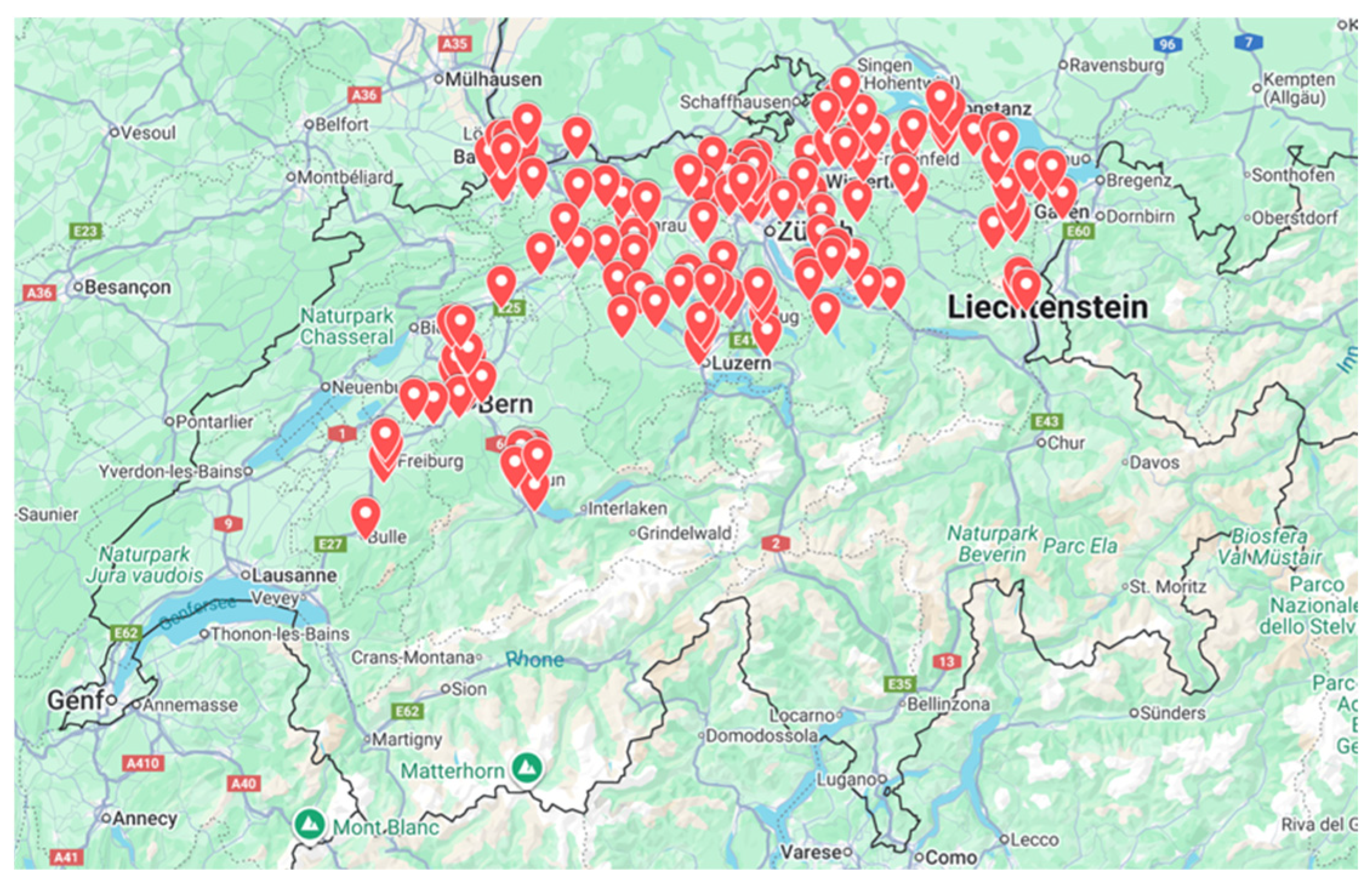
In March 2024, HPAIV was discovered in the raw milk of infected dairy cattle in the US [20]. By contrast, no contaminated raw cow’s milk has been detected in European countries so far [21,22], although sheep’s milk from a seropositive ewe tested positive for HPAIV in GB in 2025 [23]. Transmission of H5N1 to humans is thought to occur mainly, but not exclusively, by the ocular route via direct contact with raw milk from infected cows [24,25]. Ingestion of raw milk contaminated with H5N1 has been associated with severe illness and mortality in household cats [26]. In this study, we applied and evaluated a protocol for the detection of HPAIV H5N1 in raw milk samples and generated data for raw milk sold directly to consumers. The samples were obtained from on-farm vending machines. This approach enabled access to fresh raw milk and allowed for the assessment of direct exposure of the consumer to milk-associated HPAIV. The samples represented 124 different dairy farms distributed in 13 Swiss cantons: Zurich (n = 29), Bern (n = 19), Aargau (n = 16), Thurgau (n = 14), Lucerne (n = 10), St. Gallen (n = 10), Basel–Landschaft (n = 8), Fribourg (n = 4), Schwyz (n = 4), Solothurn (n = 3), Zug (n = 3), Appenzell Ausserrhoden (n = 2), and Appenzell Innerrhoden (n = 2) (Figure 1).
After the screening for viral AI-RNA by RT-qPCR, no samples were found to be positive for AIV, suggesting the absence of the virus in the dairy cows from farms included in this study (Table S1). This finding is in line with the current assessment of the risk of HPAIV H5N1 infection in EU dairy cattle, which is thought to be very low, although there has been one case of avian influenza antibodies found in a dairy cow in the Netherlands [10,27]. As confirmed by the inclusion of an internal inhibition control and validations using virus-spiked milk at different viral concentrations, there was no evidence of PCR inhibition, providing confidence in the applied methodological approach and the negative results obtained.
This study has limitations which do not allow for generalized evaluation of the occurrence of HPAIV H5N1 in raw cow’s milk. Firstly, the sample size was small, and the study only includes a small portion of the dairy farms in Switzerland. However, it represents most parts of the country and includes the regions with the most dairy herds and regions known to be avian flu risk areas, such as Lake Constance, which is a key surveillance area for AI in wild birds [18]. Secondly, no information on cases of mastitis on individual dairy farms was recorded. Clinically, lactating dairy cows with HPAIV H5N1 infection present with symptoms of mastitis, and milk from affected cows would have been removed from the dairy chain [27,28,29]. Therefore, H5N1 that may have been present in Swiss dairy cows would most likely have remained undetected in this study. Nevertheless, our results strongly indicate the absence of H5N1 in raw cow’s milk sold through vending machines in Switzerland. Notably, in addition to the previously identified B3.13 strain, a novel H5N1 variation, D1.1, first detected in a wild duck in Alaska, was discovered in Nevada dairy cattle in February 2025 and has subsequently been associated with three fatal or critically ill cases in humans [30,31]. The emergence of this novel genotype in dairy cows strongly suggests that bovine H5N1 infections are the result of independent spillover occurrences from avian reservoirs to cattle, highlighting the need for continued monitoring of wild and domestic birds (in particular, waterfowl) [30,31].

4. Conclusions

The influenza A viral genome was not detected in direct-to-consumer raw cow‘s milk samples collected from vending machines located on Swiss dairy farms, indicating that currently, the risk of HPAIV in raw milk in Switzerland is likely low. Moreover, the applied detection system demonstrated a good potential surveillance approach for influenza A(H5N1) virus in direct-to-consumer raw milk. Surveillance in the avian reservoirs remains crucial to track potential changes in the risk of a spillover into the cattle population, and to enable timely preventive measures in the dairy sector.

Supplementary Materials

The following supporting information can be downloaded at: https://www.mdpi.com/article/10.3390/dairy7020029/s1, Table S1: Results of reverse transcription quantitative polymerase chain reaction (RT-qPCR) assay for the detection of highly pathogenic avian influenza virus (HPAIV) H5N1 in 124 raw milk samples, Switzerland 2025.

Author Contributions

Conceptualization, C.B. and R.S.; Methodology, C.B. and K.D.; Formal Analysis, T.P., M.N.-I., K.D. and C.B.; Investigation, M.M.; Resources, C.B. and R.S.; Data Curation, C.B. and R.S.; Writing—Original Draft Preparation, M.N.-I.; Writing—Review & Editing, T.P., M.N.-I., K.D., C.B. and R.S.; Visualization, T.P.; Supervision, C.B. and R.S.; Project Administration, R.S. All authors have read and agreed to the published version of the manuscript.

Funding

This research received no external funding.

Institutional Review Board Statement

Not applicable.

Informed Consent Statement

Not applicable.

Data Availability Statement

The original contributions presented in this study are included in the article. Further inquiries can be directed to the corresponding author.

Conflicts of Interest

The authors declare no conflicts of interest.

Abbreviations

The following abbreviations are used in this manuscript:
AIVAvian influenza virus
HAHemagglutinin
HACCPHazard Analysis and Critical Control Point
HPAIHighly pathogenic avian influenza
MMatrix
NANeuraminidase
NPNucleoprotein
PAAcidic polymerase
PB1Basic polymerase 1
PB2Basic polymerase 2
PBSPhosphate-Buffered Saline
PCRPolymerase chain reaction
RT-qPCRReverse-transcription quantitative polymerase chain reaction

References

  1. Krammer, F.; Barclay, W.S.; Beer, M.; Brown, I.H.; Cox, R.J.; de Jong, M.D.; Fodor, E.; Fouchier, R.A.M.; Gabriel, G.; García-Sastre, A.; et al. Europe needs a sustainably funded influenza research and response network. Lancet Infect. Dis. 2025, 25, 369–372. [Google Scholar] [CrossRef]
  2. Xie, Z.; Yang, J.; Jiao, W.; Li, X.; Iqbal, M.; Liao, M.; Dai, M. Clade 2.3.4.4b highly pathogenic avian influenza H5N1 viruses: Knowns, unknowns, and challenges. J. Virol. 2025, 99, e0042425. [Google Scholar] [CrossRef] [PubMed]
  3. Jang, J.; Bae, S.-E. Comparative co-evolution analysis between the HA and NA genes of influenza A virus. Virology 2018, 9, 1178122x18788328. [Google Scholar] [CrossRef] [PubMed]
  4. World Health Organization/World Organisation for Animal Health/Food and Agriculture Organization (WHO/OIE/FAO). H5N1 Evolution Working Group Revised and updated nomenclature for highly pathogenic avian influenza A (H5N1) viruses. Influenza Other Respir. Viruses 2014, 8, 384–388. [Google Scholar] [CrossRef]
  5. Peacock, T.P.; Moncla, L.; Dudas, G.; VanInsberghe, D.; Sukhova, K.; Lloyd-Smith, J.O.; Worobey, M.; Lowen, A.C.; Nelson, M.I. The global H5N1 influenza panzootic in mammals. Nature 2025, 637, 304–313. [Google Scholar] [CrossRef]
  6. Sims, L.D.; Domenech, J.; Benigno, C.; Kahn, S.; Kamata, A.; Lubroth, J.; Martin, V.; Roeder, P. Origin and evolution of highly pathogenic H5N1 avian influenza in Asia. Vet. Rec. 2005, 157, 159–164. [Google Scholar] [CrossRef] [PubMed]
  7. Gale, P.; Arter-Hazzard, M.; Bacigalupo, S.; Perrin, L. High Pathogenicity Avian Influenza (HPAI) in Great Britain and Europe. 2026. Available online: https://www.gov.uk/government/collections/animal-diseases-international-monitoring (accessed on 25 March 2026).
  8. Nguyen, T.-Q.; Hutter, C.; Markin, A.; Thomas, M.; Lantz, K.; Killian, M.L.; Janzen, G.M.; Vijendran, S.; Wagle, S.; Inderski, B.; et al. Emergence and interstate spread of highly pathogenic avian influenza A(H5N1) in dairy cattle in the United States. Science 2025, 388, eadq0900. [Google Scholar] [CrossRef]
  9. Halwe, N.J.; Cool, K.; Breithaupt, A.; Schön, J.; Trujillo, J.D.; Nooruzzaman, M.; Kwon, T.; Ahrens, A.K.; Britzke, T.; McDowell, C.D.; et al. H5N1 clade 2.3.4.4b dynamics in experimentally infected calves and cows. Nature 2025, 637, 903–912. [Google Scholar] [CrossRef]
  10. European Centre for Disease Prevention and Control (ECDC). Detection of Avian Flu Antibodies in Dutch Dairy Cow: ECDC Risk Assessment Remains Unchanged. Available online: https://www.ecdc.europa.eu/en/publications-data/detection-avian-flu-antibodies-dutch-dairy-cow-ecdc-risk-assessment-remains (accessed on 11 February 2026).
  11. Lenz-Ajuh, N.; Rau, L.; Butticaz, L.; Moreira, É.A.; Zimmer, B.; Beuret, V.; Loosli, F.; Ingenhoff, J.-E.; Wieland, B.; Zimmer, G. Impact of pH and temperature in dairy processing on the infectivity of H5N1 avian influenza viruses. Int. J. Food Microbiol. 2025, 441, 111328. [Google Scholar] [CrossRef]
  12. Nooruzzaman, M.; de Oliveira, P.S.B.; Butt, S.L.; Martin, N.H.; Alcaine, S.D.; Walker, S.P.; Diel, D.G. H5N1 influenza virus stability and transmission risk in raw milk and cheese. Nat. Med. 2025, 31, 4265–4273. [Google Scholar] [CrossRef]
  13. Porto-Fett, A.C.S.; Alvarez-Narvaez, S.; Vinayamohan, P.G.; Harrell, T.; Shwani, A.; Suarez, D.L.; Luchansky, J.B. Inactivation of avian influenza virus in raw milk kefir. Food Environ. Virol. 2026, 18, 13. [Google Scholar] [CrossRef]
  14. Belluco, S.; Pinto, A.; Mascarello, G.; Crovato, S.; Mancin, M.; Boscolo Anzoletti, A.; Losasso, C. Understanding European consumers’ perception of food safety risks: A multicountry analysis of raw milk and raw milk-based cheeses. Food Sci. Nutr. 2025, 13, e70409. [Google Scholar] [CrossRef] [PubMed]
  15. Eidgenössische Departement des Innern (EDI). Verordnung Lebensmittel Tierischer Herkunft (VLtH, SR 817.022.108); Eidgenössische Departement des Innern (EDI): Bern, Switzerland, 2016. [Google Scholar]
  16. Caserta, L.C.; Frye, E.A.; Butt, S.L.; Laverack, M.; Nooruzzaman, M.; Covaleda, L.M.; Thompson, A.C.; Koscielny, M.P.; Cronk, B.; Johnson, A.; et al. Spillover of highly pathogenic avian influenza H5N1 virus to dairy cattle. Nature 2024, 634, 669–676. [Google Scholar] [CrossRef] [PubMed]
  17. Snoeck, C.J.; Sausy, A.; Bourg, M.; Hübschen, J.M. Comparison of extraction methods for the detection of avian influenza virus RNA in cattle milk. Viruses 2024, 16, 1442. [Google Scholar] [CrossRef] [PubMed]
  18. Baumer, A.; Feldmann, J.; Renzullo, S.; Müller, M.; Thür, B.; Hofmann, M.A. Epidemiology of avian influenza virus in wild birds in Switzerland between 2006 and 2009. Avian Dis. 2010, 54, 875–884. [Google Scholar] [CrossRef]
  19. Spackman, E.; Senne, D.A.; Myers, T.J.; Bulaga, L.L.; Garber, L.P.; Perdue, M.L.; Lohman, K.; Daum, L.T.; Suarez, D.L. Development of a real-time reverse transcriptase PCR assay for type A influenza virus and the avian H5 and H7 hemagglutinin subtypes. J. Clin. Microbiol. 2002, 40, 3256–3260. [Google Scholar] [CrossRef]
  20. Burrough, E.R.; Magstadt, D.R.; Petersen, B.; Timmermans, S.J.; Gauger, P.C.; Zhang, J.; Siepker, C.; Mainenti, M.; Li, G.; Thompson, A.C.; et al. Highly pathogenic avian influenza A(H5N1) clade 2.3.4.4b virus infection in domestic dairy cattle and cats, United States, 2024. Emerg. Infect. Dis. 2024, 30, 1335–1343. [Google Scholar] [CrossRef]
  21. European Food Safety Authority (EFSA); Alvarez, J.; Bortolami, A.; Ducatez, M.; Guinat, C.; Stegeman, J.A.; Broglia, A.; Jensen, H.; Kryemadhi, K.; Gervelmeyer, A. Risk posed by the HPAI virus H5N1, Eurasian lineage goose/Guangdong clade 2.3.4.4b. genotype B3.13, currently circulating in the US. EFSA J. 2025, 23, e9508. [Google Scholar]
  22. Moreno, A.; Pongolini, S.; Merialdi, G.; Cattoli, G.; Terregino, C.; Santini, N.; Benedetti, S.; Piccolomini, L.L.; Padovani, A.; Rosamilia, A.; et al. Inactivation of influenza A viruses (H1N1, H5N1) during Grana-type raw milk cheesemaking: Implications for foodborne transmission risk. Viruses 2025, 17, 1535. [Google Scholar] [CrossRef]
  23. Banyard, A.C.; Coombes, H.; Terrey, J.; McGinn, N.; Seekings, J.; Clifton, B.; Mollett, B.C.; Genova, C.D.; Sainz-Dominguez, P.; Worsley, L.; et al. Detection of clade 2.3.4.4b H5N1 high pathogenicity avian influenza virus in a sheep in Great Britain, 2025. Emerg. Microbes Infect. 2025, 14, 2547730. [Google Scholar] [CrossRef]
  24. Coleman, M.E. Deliberating the scientific evidence base for influenza transmission to raw milk consumers. Risk Anal. 2025, 45, 2939–2955. [Google Scholar] [CrossRef] [PubMed]
  25. Garg, S.; Reinhart, K.; Couture, A.; Kniss, K.; Davis, C.T.; Kirby, M.K.; Murray, E.L.; Zhu, S.; Kraushaar, V.; Wadford, D.A.; et al. Highly pathogenic avian influenza A (H5N1) virus infections in humans. N. Engl. J. Med. 2025, 392, 843–854. [Google Scholar] [CrossRef]
  26. Frye, E.A.; Nooruzzaman, M.; Cronk, B.; Laverack, M.; de Oliveira, P.S.B.; Caserta, L.C.; Lejeune, M.; Diel, D.G. Isolation of highly pathogenic avian influenza A(H5N1) Virus from cat urine after raw milk ingestion, United States. Emerg. Infect. Dis. 2025, 31, 1636–1639. [Google Scholar] [CrossRef]
  27. EFSA AHAW Panel (EFSA Panel on Animal Health and Welfare); Alvarez, J.; Boklund, A.E.; Dippel, S.; Dórea, F.; Figuerola, J.; Herskin, M.S.; Michel, V.; Miranda Chueca, M.Á.; Nannoni, E.; et al. Risk of infection of dairy cattle in the EU with highly pathogenic avian influenza virus affecting dairy cows in the United States of America (H5N1, Eurasian lineage goose/Guangdong clade 2.3.4.4b. genotype B3.13). EFSA J. 2025, 23, e9801. [Google Scholar]
  28. Baker, A.L.; Arruda, B.; Palmer, M.V.; Boggiatto, P.; Sarlo Davila, K.; Buckley, A.; Ciacci Zanella, G.; Snyder, C.A.; Anderson, T.K.; Hutter, C.R.; et al. Dairy cows inoculated with highly pathogenic avian influenza virus H5N1. Nature 2025, 637, 913–920. [Google Scholar] [CrossRef]
  29. Peña-Mosca, F.; Frye, E.A.; MacLachlan, M.J.; Rebelo, A.R.; de Oliveira, P.S.B.; Nooruzzaman, M.; Koscielny, M.P.; Zura-kowski, M.; Lieberman, Z.R.; Leone, W.M.; et al. The impact of highly pathogenic avian influenza H5N1 virus infection on dairy cows. Nat. Commun. 2025, 16, 6520. [Google Scholar] [CrossRef] [PubMed]
  30. Crespo-Bellido, A.; Trovão, N.S.; Maksiaev, A.; Baele, G.; Dellicour, S.; Nelson, M.I. Emergence of D1. 1 reassortant H5N1 avian influenza viruses in North America. bioRxiv 2025. [Google Scholar]
  31. Owusu, H.; Sanad, Y.M. Comprehensive insights into highly pathogenic avian influenza H5N1 in dairy cattle: Transmission dynamics, milk-borne risks, public health implications, biosecurity recommendations, and One Health strategies for outbreak control. Pathogens 2025, 14, 278. [Google Scholar] [CrossRef] [PubMed]
Figure 1. Geographic location of 124 dairy farms with raw milk vending machines in Switzerland.
Dairy 07 00029 g001
Disclaimer/Publisher’s Note: The statements, opinions and data contained in all publications are solely those of the individual author(s) and contributor(s) and not of MDPI and/or the editor(s). MDPI and/or the editor(s) disclaim responsibility for any injury to people or property resulting from any ideas, methods, instructions or products referred to in the content.