


Abstract
A cross-sectional study was carried out on small-scale dairy farms in Paraíba State, Brazil, to evaluate the prevalence and anatomical distribution of integument injuries in grazing dairy cows. Twelve herds (n = 12) were assessed, recording herd size, milk yield, and daily hours of pasture access. The integument of five body regions (back/shoulder/neck, carpus, flank/side/udder, tarsus, and hindquarters) was scored for hairless spots, lesions, and swellings (0 = absent; 1 = present). Among 335 cows observed, 267 (81.5%) presented at least one injury. The most frequent conditions were hairless patches on the hock (65.4 ± 5.03%), lesions on the flank/side/udder (34.5 ± 1.46%), and swelling in the back/shoulder/neck region (52.9 ± 5.86%). Cluster analysis revealed distinct patterns of integument injuries among cows. The high prevalence of integument injuries indicates that even in grazing systems, welfare concerns persist. Neck swelling and hairless spots on the hock were the most common problems, emphasizing the need for improved management and environmental practices to enhance welfare outcomes. These findings have practical implications for welfare assessment and management strategies in tropical grazing dairy systems.
1. Introduction
Integumentary injuries, such as those affecting the hock, knee, and neck, are widely recognized as key indicators of welfare in dairy cows and have been incorporated into standardized assessment protocols worldwide [1,2]. Lower injury prevalence is associated with improved welfare status [3], as these conditions reflect the combined effects of housing, management, and environmental factors on animal comfort. Lesions may range from mild hair loss to ulceration and swelling, potentially progressing to more severe clinical outcomes [4].
Several studies have investigated the prevalence and risk factors associated with integumentary injuries in dairy cows [5,6,7,8,9,10,11]. However, most of these investigations have been conducted under confined housing conditions in temperate regions or in herds with only seasonal access to pasture, typically during summer months [12,13,14]. Factors such as flooring type, bedding material, daily grazing time, number of grazing months per year, distance between the pasture and the milking parlor, and pathway conditions have been identified as major determinants of lesion occurrence [15,16,17,18,19].
Nevertheless, information remains scarce for tropical dairy systems, particularly those based on permanent grazing, where animals experience environmental and management conditions markedly different from those in temperate systems. In tropical countries, including Brazil, dairy production is predominantly pasture-based and often characterized by low-input management, smaller herd sizes, and limited housing infrastructure [20,21,22]. These characteristics may influence the occurrence, anatomical distribution, and severity of integumentary injuries, emphasizing the need for assessment protocols and mitigation strategies adapted to tropical production systems [23,24,25].
Therefore, this study aimed to determine the prevalence and anatomical distribution of integumentary injuries and to identify management- and environment-related risk factors, including grazing duration, night housing, and floor type, in grazing dairy cows under tropical conditions. We hypothesized that the pattern and determinants of integumentary injuries under tropical grazing systems differ from those reported for confined or temperate herds, reflecting the specific environmental and management characteristics of tropical dairy production. Understanding these differences is crucial for adapting welfare assessment tools and management recommendations to the specific realities of tropical dairy production.
2. Materials and Methods
2.1. Ethical Approval
All experimental procedures and animal handling protocols complied with institutional and national guidelines for the ethical use of animals in research. The study protocol was reviewed and approved by the Ethics Committee on Animal Use of the Biotechnological Center, Federal University of Paraíba (protocol number 105/2017).
2.2. Study Area and Herds
A cross-sectional study was conducted between January and June 2017 on twelve dairy herds located in the Brejo microregion, Paraíba State, Brazil. According to the Köppen–Geiger classification, the region presents a tropical climate with a dry summer (As), characterized by mild temperatures, high humidity, and marked seasonal rainfall. During the study period, the mean air temperature was 23.8 ± 1.0 °C, the average relative humidity was 81.6 ± 4.6%, and the mean monthly rainfall was 152.5 ± 67.0 mm.
The study population consisted of dairy cows from herds with more than ten lactating cows, managed under pasture-based systems. As an inclusion criterion, herds were required to provide at least five hours of daily access to pasture. Pasture served as the main feed resource throughout the year, complemented with forage supplementation during periods of lower availability. Management routines were similar among farms: after the morning milking, cows were released to pasture and returned in the afternoon for the second milking, when concentrate feed was offered. These management characteristics are representative of tropical pasture-based dairy systems commonly found in humid regions of northeastern Brazil [26,27].
2.3. Studied Farms
The study herds were selected from dairy farmers identified through local farmers’ associations and key informants working in the regional dairy sector. To minimize selection bias, informants were only informed of the general purpose of the research. Fifteen small-scale dairy farms were initially identified, and producers were contacted by telephone or in person to explain the study objectives. Participation was voluntary, and twelve producers agreed to take part, while three declined and were excluded from the sampling frame.
Visits to the participating farms (n = 12) were scheduled between 08:00 and 14:00 h. During each visit, data were collected on herd size, number and type of daily milking sessions, average milk yield per cow, total daily milk production per herd, daily pasture access time, and housing floor type. Facility dimensions—including standing, feeding, and resting areas—were also measured to characterize the structural environment of each herd.
2.4. Observation of the Herds
Observations were carried out in all twelve herds by two evaluators specializing in ethology and animal welfare, who had been previously trained in assessing integumentary alterations using standardized photographs and videos. Each herd was visited and evaluated once. All lactating cows present in each herd at the time of the visit were evaluated. Thus, the number of cows assessed per herd corresponded to the total number of lactating cows on each farm, resulting in a total of 335 cows across the twelve herds. Clinical examinations of the integument were conducted visually on one randomly selected side of the animal’s body, as described by Welfare Quality® protocols [2].
Observations took place during calm periods—typically when animals were resting in corrals, shaded areas, or under trees—to facilitate a stress-free approach and minimize behavioral interference during evaluation.
2.5. Animal Measures
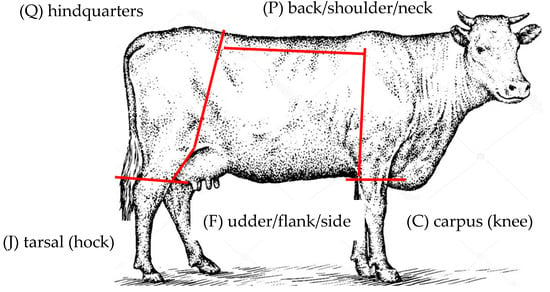
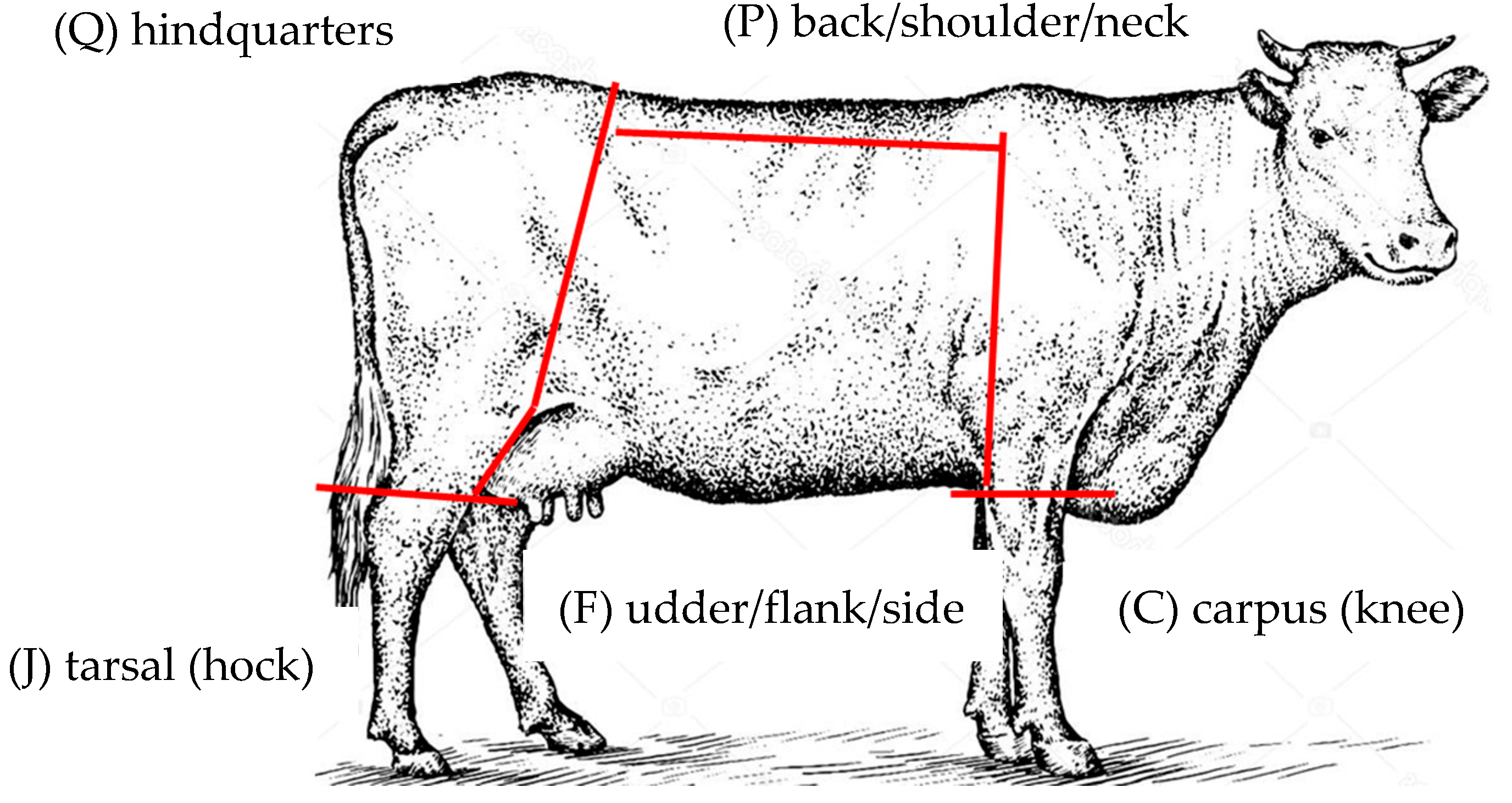
The skin condition of each cow was assessed following the Welfare Quality® protocol for dairy cattle [2]. Five body regions were visually inspected: back/shoulder/neck (P), carpal or knee (C), flank/side/udder (F), tarsal or hock (J), and hindquarters (Q) (Figure 1). For each region, the numbers of hairless spots, lesions, and swellings were recorded.
Figure 1.
Body regions evaluated for integument injury score in dairy cows. The red lines indicate the anatomical boundaries used to define and evaluate each body region.
Hairless spots were defined as areas of hair loss with intact skin; lesions as areas of damaged skin (including scabs, open wounds, or amputations); and swellings (including vaccine abscesses) as abnormal skin protrusions with or without hair. Only injuries with a minimum diameter of 2 cm were considered in the assessment.
2.6. Statistical Analysis
All statistical analyses were conducted using R software (version 4.3.2; R Foundation for Statistical Computing, Vienna, Austria). Descriptive statistics were first used to estimate the prevalence of each integumentary injury type (hairless spots, lesions, and swellings) by herd and body region. Subsequently, cluster analysis using the Partitioning Around Medoids (PAM) algorithm was applied to identify similarity patterns among cows based on the distribution of injuries [28]. Multiple Correspondence Analysis (MCA) was then performed to explore associations between injury types and anatomical locations. Variables exhibiting the highest inertia and cos2 values were considered the most influential in defining clusters.
To evaluate relationships between integumentary injuries and management-related factors (pasture access time, housing type, floor surface, and milk yield), binary logistic regression models were fitted with the presence or absence of injury as the dependent variable [26]. Herd was included as a random effect to account for within-farm clustering. Odds ratios (OR) and 95% confidence intervals (CI) were estimated for each explanatory variable. Statistical significance was set at p < 0.05, and trends were discussed when 0.05 ≤ p < 0.10.
3. Results
Descriptive characteristics of the herds are summarized in Table 1. A total of 335 crossbred Holstein × Zebu dairy cows were evaluated across twelve herds (mean = 28 cows; range = 14–43). All farms used a mechanized milking system with two daily milkings.
Table 1.
Description of the herds studied.
Of the 335 dairy cows examined, 267 (81.5% ± 12.3; mean ± SD) presented integumentary injuries. Swellings, hairless spots, and lesions were observed in 76.6% ± 14.2, 59.8% ± 15.9, and 8.0% ± 8.3 of the cows, respectively (Table 2).
Table 2.
Number of herds, number of cows examined, and percentage of cows presenting integumentary injuries. For injured cows, percentages of hairless spots, lesions, and swellings are shown.
The highest prevalence of hairless spots occurred in the hock and knee. Lesions occurred predominantly in the flank/side/udder and back/shoulder/neck regions. In its turn, swelling occurred mainly in the neck/palette/back region and hocks (Table 3).
Table 3.
Mean percentage (±SD) of cows with integumentary injuries by body region.
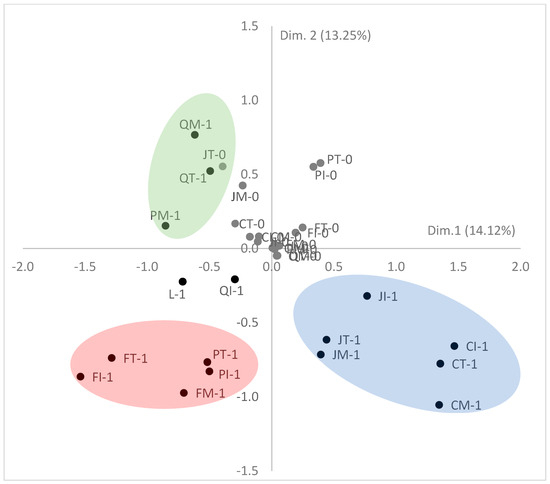
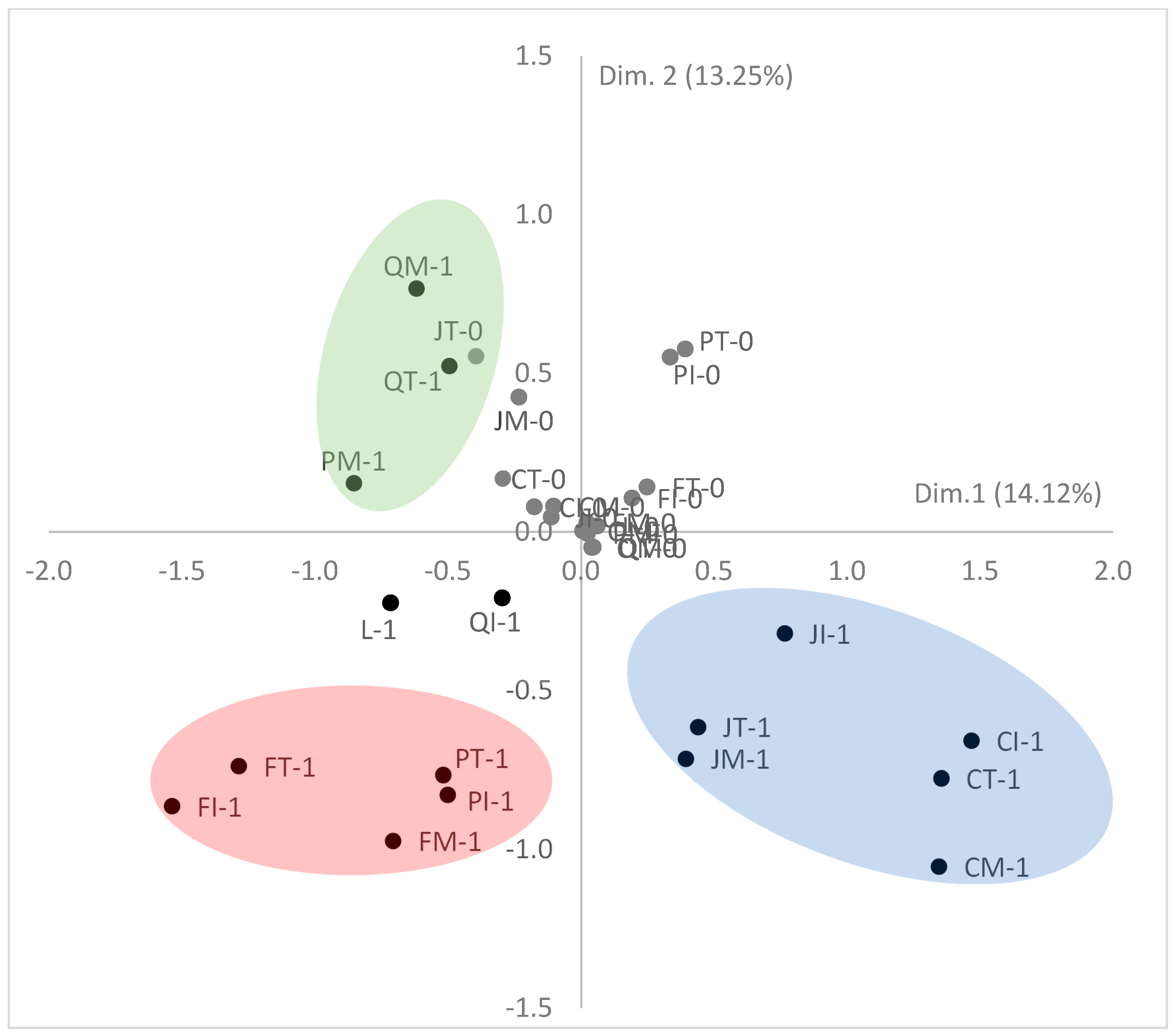
The Multiple Correspondence Analysis (MCA) identified three distinct clusters representing associations between injury types and body regions (Figure 2). Cows grazing for more than 18 h/day were 3.2 times more likely to present swelling in the neck region (p = 0.01), whereas those housed on earthen floors showed higher odds of hindquarter injuries (OR = 2.73; p = 0.03). No significant associations were observed for flank or hock injuries with grazing time or housing type (p > 0.05).
Figure 2.
Multiple correspondence analysis (MCA) illustrating the associations between integumentary injury types and body regions in grazing dairy cows. Green ellipse: injuries in hindquarters and neck; Red ellipse: lesions and swellings in flank and neck; Blue ellipse: injuries in carpal and hock regions. Abbreviations indicate body region and injury type, where P = back/shoulder/neck, C = carpal (knee), F = flank/side/udder, J = tarsal (hock), and Q = hindquarters; I = lesion, T = hairless spot, and M = swelling. The suffixes “-1” and “-0” indicate the presence and absence of the respective condition, respectively. Colored ellipses represent clusters of categories with similar patterns of integumentary injuries identified by the MCA.
The perceptual map derived from the MCA (Figure 2) illustrates the associations between integumentary injury types and body regions. Three correspondence groups were identified based on variable contributions. The first group (green) included hairless spots and swellings located in the hindquarters and back/shoulder/neck regions. The second group (red) comprised lesions and swellings affecting the flank/side/udder and neck areas. The third group (blue) consisted of injuries concentrated in the carpal and hock regions, typically associated with contact with hard or abrasive surfaces. Variables clustered near the plot center, corresponding to the absence of injuries, had minimal contribution to discrimination among body regions.
These clusters suggest that integumentary injuries tend to co-occur in anatomically related areas subjected to similar mechanical or management conditions.
Beyond the anatomical associations revealed by the MCA, the next step was to identify the main risk factors influencing the occurrence of integumentary injuries. Therefore, multilevel logistic regression analyses were conducted, considering both cow- and herd-level variables such as grazing duration, housing type, and floor surface (Table 4). These models provide a quantitative assessment of how environmental and management conditions affect the likelihood of injuries across body regions.
Table 4.
Final multilevel logistic regression model for integumentary injuries considering cow- and herd-level risk factors across 12 grazing dairy herds (n = 335 cows) under tropical conditions. OR = Odds Ratio; SE = Standard Error; CI = 95% Confidence Interval; RC = Reference Category.
According to the multilevel logistic regression models (Table 4), grazing duration was significantly associated with integumentary injuries in the back/shoulder/neck region and with claudication. Cows exposed to long grazing hours (>18 h/day) showed higher odds of injuries in the back/shoulder/neck region (OR = 3.25; p = 0.01) and increased odds of claudication (OR = 4.47; p = 0.022) compared with cows with short grazing duration (<8 h/day). In addition, floor type was significantly associated with injuries in the hindquarters, with cows housed on earthen floors presenting higher odds of integumentary injuries in this body region than those on concrete floors (OR = 2.73; p = 0.03). No statistically significant associations were observed for the remaining body regions or environmental factors.
At the herd level, a positive trend was observed between grazing time and the overall prevalence of integumentary injuries (r = 0.46; p = 0.08), whereas a weak negative association was found with milk yield per cow (r = −0.31; p = 0.15). Although not statistically significant, these patterns suggest that prolonged daily grazing may increase exposure to abrasive surfaces, while higher-yielding herds tend to present fewer injuries, possibly reflecting better management and housing conditions.
4. Discussion
4.1. General Prevalence and Welfare Implications
A high proportion of cows presented integumentary injuries (81.5%), of which 76.6%, 59.8%, and 8.0% were identified with swellings, hairless spots, and open lesions, respectively. Among the evaluated body regions, the hock showed the highest prevalence of hairless spots, the back/shoulder/neck area exhibited the greatest incidence of swellings, and the flank/side/udder region presented the highest occurrence of lesions. Although the back, shoulder, and neck were assessed as a single anatomical unit, swellings occurred almost exclusively in the neck region. This pattern strongly suggests a management-related origin, particularly improper vaccination techniques and the use of oil-based adjuvanted vaccines [29]. Such conditions can induce levels of discomfort and pain comparable to those observed in locomotor disorders [30] and therefore represent an important welfare and economic concern for dairy producers [31].
The exploratory correlations between herd-level variables and the prevalence of integumentary injuries were consistent with the multilevel logistic regression results. Herds with long grazing time (>18 h/day) exhibited higher injury rates, reinforcing the hypothesis that prolonged exposure to compacted or irregular ground surfaces within grazing areas increases the likelihood of integumentary damage. Similar associations have been reported in Swiss dairy herds using logistic models to estimate injury risk [11]. Taken together, the descriptive, multivariate, and regression analyses provide a coherent picture of how management practices in small-scale, pasture-based tropical dairy systems can shape the occurrence and anatomical distribution of integumentary injuries.
Although factors such as breed composition, horn status, body weight, age, and agonistic interactions have been associated with injury risk in dairy cattle, these variables were not directly assessed in the present study. The herds evaluated consisted of crossbred Holstein × Zebu cows managed under pasture-based tropical systems, and the analytical focus was placed on management- and environment-related factors. Future studies incorporating individual animal characteristics and behavioral observations are warranted to further elucidate the role of social interactions in the occurrence of integumentary injuries.
4.2. Patterns of Integumentary Injuries and Comparison with Previous Studies
In this study, hock and neck injuries emerged as the most prevalent integumentary problems in grazing dairy cows. To date, little information has been available regarding the occurrence of lesions, swellings, or hairless spots in cattle maintained exclusively under pasture-based tropical systems. Compared with previous research, our findings differ considerably. These differences are likely explained by the distinct environmental, climatic, and management conditions inherent to tropical pasture-based dairy systems, including prolonged exposure to grazing areas, variable ground surfaces, and less standardized housing structures when compared with confined or temperate systems. Costa [23], studying semiconfined dairy cows in southern Brazil, reported a low (13%) incidence of hock injuries, identifying pasture access as a protective factor. Conversely, research conducted under confined conditions has shown a high prevalence of integumentary injuries affecting the hocks, knees [5,9,32], and neck [9]. In Canada, for example, hock injury prevalence can reach up to 73% [5], while European herds report lower rates (approximately 47%) [15,33], probably due to their seasonal access to pasture [15,17].
Unlike the present study—where cows grazed continuously throughout the year—several investigations have highlighted the beneficial effects of pasture access or outdoor exercise on limb integument health. Keil et al. [34] demonstrated that both large and small Swiss herds benefited from pasture access, showing reduced prevalence of limb injuries. Other studies have corroborated the protective effect of grazing and outdoor movement [15,16,17]. This apparent contrast can be attributed to environmental and management differences: while lesions in confined systems are primarily caused by contact with abrasive flooring or collisions with structural elements [4,6], injuries observed in continuous grazing systems may result from compacted or uneven soil, steep terrain, or long walking distances between paddocks and milking areas. These conditions can produce repeated mechanical stress and friction on distal regions such as the hocks and carpal joints, leading to hairless spots or localized swellings. Therefore, the higher prevalence of integumentary injuries observed here likely reflects the specific physical and topographic challenges inherent to tropical, pasture-based dairy systems.
4.3. Effects of Pasture Management and Topographical Features on Integumentary Injuries
Cluster analysis divided the cows into six groups, with groups 1 and 3 containing animals that exhibited a higher prevalence of integumentary injuries across multiple body regions. These animals were mainly from farms 1, 6, 7, 10, and 11—herds that shared similar management practices and allowed long grazing time (>18 h/day). The association between prolonged pasture exposure and integumentary injuries has been previously documented [35,36]. Baird et al. [36] also reported poorer hoof and limb health in pasture-based cows compared with continuously confined animals, suggesting that pasture quality and terrain characteristics play critical roles in integumentary integrity.
A plausible explanation for the present findings involves overgrazing, a recurrent issue in small-scale dairy systems, where continuous use of the same paddocks leaves the soil bare, compacted, and uneven. These conditions generate abrasive surfaces that increase friction and mechanical trauma, particularly on distal body parts. Additionally, the distance and condition of walking paths between paddocks and milking parlors may further contribute to the occurrence of integumentary injuries [37]. The topographical irregularity observed in several of the studied farms—often located on sloping or mountainous terrain—may intensify physical strain, predisposing cows to slips, falls, and pressure-related injuries.
Despite these observations, few studies have quantified how pasture characteristics, soil compaction, or path conditions affect integumentary health. Future investigations should therefore incorporate objective measures such as soil hardness, slope inclination, and walking distance to better understand the mechanical and environmental determinants of integumentary injuries in grazing dairy cows.
4.4. Anatomical Vulnerability and Mechanistic Insights
In this study, injuries located on the knees, hocks, back/shoulder/neck, and hindquarters were less frequent overall but contributed the most to group differentiation in the multiple correspondence analysis. Conversely, neck swellings and hock hairless spots were the most influential variables in defining the classification clusters. The hock region, which includes the tarsal joint and its bony prominences, is particularly vulnerable to friction and pressure during lying and rising movements, explaining the predominance of hairless spots and localized swellings in this area [9,38]. Similarly, the neck region is subject to intense mechanical stress due to frequent handling during sanitary procedures such as vaccination, deworming, and restraint, which increase the likelihood of localized trauma.
These anatomical susceptibilities are further exacerbated by environmental and management conditions typical of small-scale tropical dairy systems. Inadequate ground surfaces and structural aspects of pasture areas, such as uneven or compacted ground surfaces, can amplify friction and impact forces on contact points between the animal’s body and the environment. In addition, repeated mechanical stress and uneven weight distribution during locomotion on compacted or sloping ground can predispose animals to tissue compression and subcutaneous inflammation. Such findings support the idea that integumentary injuries in grazing cows are the result of multifactorial interactions between anatomical structure, environmental exposure, and management practices, rather than isolated causes.
4.5. Management Implications and One Welfare Approach
The present findings highlight that improving surface conditions and vaccination practices can simultaneously enhance animal welfare and farm sustainability. Management actions such as alternating injection sites, selecting appropriate needle gauges, and adopting proper aseptic techniques can minimize the occurrence of neck swellings. Similarly, maintaining even and non-abrasive ground surfaces in resting and walking areas, particularly around milking parlors and feeding zones, can significantly reduce the risk of integumentary injuries. Although milking parlors were not specifically assessed in this study, their surrounding areas represent important transit and standing zones that may contribute to injury risk when surface conditions are inadequate. The adoption of earthen floors with adequate drainage and periodic maintenance may offer better comfort and lower impact forces than poorly maintained concrete surfaces.
Furthermore, adequate pasture management—avoiding overgrazing and ensuring rotational rest periods—reduces soil compaction and the formation of rough or uneven areas that cause friction injuries. Providing shaded resting areas or access to tree canopies can also encourage lying behavior in more comfortable positions, lowering the incidence of hock and limb injuries. These preventive measures align with a One Welfare framework, recognizing that improvements in animal health and comfort contribute directly to farmer well-being and environmental sustainability. By reducing the need for veterinary interventions and maintaining healthier, more productive animals, farms achieve both ethical and economic benefits, reinforcing the mutual interdependence among animal welfare, human livelihoods, and ecosystem integrity.
Overall, the results of this study emphasize the multifactorial nature of integumentary injuries in grazing dairy cows and highlight the importance of integrating animal management, environmental conditions, and welfare-oriented practices. The identification of anatomical and environmental risk factors provides valuable insights for adapting health and welfare protocols to tropical, pasture-based systems. Continued research combining behavioral, physiological, and environmental measurements will be essential to deepen the understanding of injury mechanisms and to refine welfare indicators tailored to these production contexts. By fostering healthier animals and more sustainable practices, these strategies strengthen the interconnection between animal welfare, farmer livelihoods, and environmental integrity.
5. Conclusions
This study demonstrated that integumentary injuries are highly prevalent in grazing dairy cows raised under tropical conditions, with distinct anatomical and environmental patterns. Swellings, hairless spots, and open lesions occurred predominantly in the neck, hock, and flank regions, reflecting the combined effects of handling, terrain irregularities, and prolonged grazing.
The findings indicate that long grazing time (>18 h/day) and earthen floor surfaces are important risk factors for specific types of injuries, particularly neck swellings and hindquarter lesions. These associations highlight the role of management and environmental conditions in shaping injury patterns even in pasture-based systems traditionally regarded as low-risk for integumentary problems.
Improving vaccination techniques, maintaining even and non-abrasive ground surfaces, and adopting rotational grazing strategies are practical measures to mitigate integumentary injuries. Such interventions reinforce a One Welfare approach, integrating animal well-being, farm productivity, and environmental sustainability.
Altogether, the results provide valuable baseline information for refining welfare assessment protocols and developing preventive strategies tailored to tropical, pasture-based dairy systems.
Author Contributions
Conceptualization, S.G.C.G.d.S., E.P.S., S.G.N., C.A.S.S., A.C.S. and V.d.F.C.F.; methodology, S.G.C.G.d.S., E.P.S., V.d.F.C.F. and A.C.S.; software, S.G.C.G.d.S. and W.A.d.A.S.; validation, S.G.C.G.d.S., E.P.S. and V.d.F.C.F.; formal analysis, S.G.C.G.d.S., A.C.S., W.A.d.A.S. and P.V.d.N.; investigation, S.G.C.G.d.S., M.I.L.M., L.A.d.A.L., L.K.d.C.M., D.I.B.A., T.N.S.V. and W.A.d.A.S.; resources, E.P.S. and S.G.N.; data curation, S.G.C.G.d.S., A.C.S., W.A.d.A.S. and T.N.S.V.; writing—original draft preparation, W.A.d.A.S., M.I.L.M. and S.G.C.G.d.S.; writing—review and editing, S.G.C.G.d.S., E.P.S., C.A.S.S., A.C.S. and V.d.F.C.F.; visualization, S.G.C.G.d.S., W.A.d.A.S. and L.A.d.A.L.; supervision, E.P.S., S.G.N. and C.A.S.S.; project administration, S.G.C.G.d.S. and E.P.S.; funding acquisition, E.P.S. All authors have read and agreed to the published version of the manuscript.
Funding
This research received no external funding.
Institutional Review Board Statement
The animal study protocol was approved by the Ethics Committee on Animal Experimentation of the Federal University of Paraíba (protocol code 105/2017; approval date: 10 November 2017).
Informed Consent Statement
Not applicable.
Data Availability Statement
The data presented in this study are available on reasonable request from the corresponding author (E.P.S.). The data are not publicly available due to ethical and privacy restrictions.
Acknowledgments
The authors express their gratitude to the dairy farmers who participated in this research and to the members of the Research Group in Bioclimatology, Ethology, and Animal Welfare of the Federal University of Paraíba for their invaluable technical support during fieldwork. The authors also acknowledge the contributions of undergraduate and graduate students who assisted in data collection and analysis.
Conflicts of Interest
The authors declare no conflicts of interest.
Abbreviations
The following abbreviations are used in this manuscript:
| AS | Tropical wet and dry climate (Köppen classification) |
| CI | Confidence interval |
| MCA | Multiple correspondence analysis |
| OR | Odds ratio |
| PAM | Partitioning Around Medoids |
| SD | Standard deviation |
| Welfare Quality® | Welfare Quality assessment protocol for cattle |
References
- Knierim, U.; Winckler, C. On-farm welfare assessment in cattle: Validity, reliability and feasibility issues and future perspectives with special regard to the Welfare Quality® approach. Anim. Welf. 2009, 18, 451–458. [Google Scholar] [CrossRef] [Scilit]
- Welfare Quality Consortium. Welfare Quality Assessment Protocol for Cattle; Welfare Quality Consortium: Lelystad, The Netherlands, 2009; 180p. [Google Scholar]
- Jewell, M.T.; Cameron, M.; Spears, J.; McKenna, S.L.; Cockram, M.S.; Sanchez, J.; Keefe, G. Prevalence of hock, knee, and neck skin lesions and associated risk factors in dairy herds in the Maritime Provinces of Canada. J. Dairy Sci. 2019, 102, 3376–3391. [Google Scholar] [CrossRef] [Scilit]
- Kester, E.; Holzhauer, M.; Frankena, K. A descriptive review of the prevalence and risk factors of hock lesions in dairy cows. Vet. J. 2014, 202, 222–228. [Google Scholar] [CrossRef] [Scilit] [PubMed]
- Weary, D.M.; Taszkun, I. Hock lesions and free-stall design. J. Dairy Sci. 2000, 83, 697–702. [Google Scholar] [CrossRef] [Scilit] [PubMed]
- Lombard, J.E.; Tucker, C.B.; von Keyserlingk, M.A.G.; Kopral, C.A.; Weary, D.M. Associations between cow hygiene, hock injuries, and free stall usage on US dairy farms. J. Dairy Sci. 2010, 93, 4668–4676. [Google Scholar] [CrossRef] [Scilit] [PubMed]
- Huxley, J.N. Impact of lameness and claw lesions in cows on health and production. Livest. Sci. 2013, 156, 64–70. [Google Scholar] [CrossRef] [Scilit]
- Kara, N.K.; Galic, A.; Koyuncu, M. Effects of stall type and bedding materials on lameness and hygiene score and effect of lameness on some reproductive problems in dairy cattle. J. Appl. Anim. Res. 2011, 39, 334–338. [Google Scholar] [CrossRef] [Scilit]
- Zaffino Heyerhoff, C.; von Keyserlingk, M.A.G.; Weary, D.M. Prevalence and risk factors for hock, knee, and neck injuries in dairy cows in tiestalls in canada. J. Dairy Sci. 2014, 97, 4207–4216. [Google Scholar] [CrossRef] [Scilit]
- Cook, N.B.; Hess, J.P.; Foy, M.R.; Bennett, T.B.; Brotzman, R.L. Management characteristics, lameness, and body injuries of dairy cattle housed in high-performance dairy herds in Wisconsin. J. Dairy Sci. 2016, 99, 5879–5891. [Google Scholar] [CrossRef] [Scilit]
- Bernhard, J.K.; Vidondo, B.; Achermann, R.L.; Rediger, R.; Müller, K.E.; Steiner, A. Carpal, tarsal, and stifle skin lesion prevalence and potential risk factors in Swiss dairy cows kept in tie stalls: A cross-sectional study. PLoS ONE 2020, 15, e0228808. [Google Scholar] [CrossRef] [Scilit]
- Faull, W.B.; Hughes, J.W.; Clarkson, M.J.; Downham, D.Y.; Manson, F.J.; Merritt, J.B.; Murray, R.D.; Russell, W.B.; Sutherst, J.E.; Ward, W.R. Epidemiology of lameness in dairy cattle: The influence of cubicles and indoor and outdoor walking surfaces. Vet. Rec. 1996, 139, 130–136. [Google Scholar] [CrossRef] [Scilit]
- Olmos, G.; Boyle, L.; Hanlon, A.; Patton, J.; Murphy, J.J.; Mee, J.F. Hoof disorders, locomotion ability and lying times of cubicle-housed compared to pasture-based dairy cows. Livest. Sci. 2009, 125, 199–207. [Google Scholar] [CrossRef] [Scilit]
- Navarro, G.; Green, L.E.; Tadich, N. Effect of lameness and lesion-specific causes of lameness on time budgets of dairy cows at pasture and when housed. Vet. J. 2013, 197, 788–793. [Google Scholar] [CrossRef] [Scilit]
- Rutherford, K.M.D.; Langford, F.M.; Jack, M.C.; Sherwood, L.; Lawrence, A.B.; Haskell, M.J. Hock injury prevalence and associated risk factors on organic and nonorganic dairy farms in the United Kingdom. J. Dairy Sci. 2008, 91, 2265–2274. [Google Scholar] [CrossRef] [Scilit]
- Potterton, S.L.; Green, M.J.; Millar, K.M.; Brignell, C.J.; Harris, J.; Whay, H.R.; Huxley, J.N. Prevalence and characterisation of, and producers’ attitudes towards, hock lesions in UK dairy cattle. Vet. Rec. 2011, 169, 634. [Google Scholar] [CrossRef] [Scilit] [PubMed]
- Burow, E.; Thomsen, P.T.; Rousing, T.; Sørensen, J.T. Daily grazing time as a risk factor for alterations at the hock joint integument in dairy cows. Animal 2013, 7, 160–166. [Google Scholar] [CrossRef] [Scilit]
- Wagner, K.; Brinkmann, J.; March, S.; Hinterstoißer, P.; Warnecke, S.; Schüler, M.; Paulsen, H.M. Impact of daily grazing time on dairy cow welfare—Results of the Welfare Quality® protocol. Animals 2018, 8, 1. [Google Scholar] [CrossRef] [Scilit]
- Chesterton, R.N.; Pfeiffer, D.U.; Morris, R.S.; Tanner, C.M. Environmental and behavioral factors affecting the prevalence of foot lameness in New Zealand dairy herds: A case control study. N. Z. Vet. J. 1989, 37, 135–142. [Google Scholar] [CrossRef] [Scilit] [PubMed]
- Aguiar, A.P.A. Produção de leite em pastagens. In Anais do 6º Encontro de Produtores de Gado Leiteiro F1: Avanços Tecnológicos; Minas: Belo Horizonte, Brazil, 2008. [Google Scholar]
- Sá, C.O.; Araújo, G.G.L.; Sá, J.L. Tecnologias Para Produção de Leite na Região Semiárida do Brasil. Juiz de Fora: Embrapa. 2011. Available online: http://www.cnpgl.embrapa.br (accessed on 18 November 2019).
- Zoccal, R.; Alves, E.R.; Gasques, J.G. Estudo Preliminar: Contribuição Para o Plano Pecuário. Diagnóstico da Pecuária de Leite Nacional. Embrapa Gado de Leite. 2011. Available online: http://www.cnpgl.embrapa.br (accessed on 12 June 2020).
- Costa, J.H.C. Bem-Estar Animal em Rebanhos Leiteiros no Noroeste de Santa Catarina. Master’s thesis, Universidade Federal de Santa Catarina, Florianópolis, Brazil, 2012; 91p. [Google Scholar]
- Santos, S.G.C.G.; Amorim, M.L.C.M.; Almeida, M.E.V.; Fidelis, S.S.; Fonseca, V.F.C.; Saraiva, E.P. Prevalência de injúrias no jarrete de vacas leiteiras em fazendas na Mesorregião do Agreste da Paraíba, Brasil: Um estudo de caso. In Proceedings of the Anais do VII Brazilian Congress of Biometeorology, Ambience, Behaviour and Animal Welfare, Jaboticabal, Brazil, 30 July–2 August 2017; pp. 1–4. [Google Scholar]
- Santos, S.G.C.G.; Saraiva, E.P.; Fonseca, V.F.C.; Saraiva, C.A.S.; Gonzaga Neto, S.; Fidelis, S.S.; de Amorim, M.L.; dos Santos, J.D. Assessment of welfare indicators in grazing dairy cows in Northeast Brazil. Semin. Ciências Agrárias 2020, 41, 3225–3236. [Google Scholar] [CrossRef] [Scilit]
- Kaufman, L.; Rousseeuw, P.J. Clustering by means of medoids. In Statistical Data Analysis Based on the L1 Norm and Related Methods; Elsevier: Amsterdam, The Netherlands, 1987; pp. 405–416. [Google Scholar]
- Macheridis, S. The use of multiple correspondence analysis (MCA) in taphonomy: The case of Middle Helladic Asine, Greece. Int. J. Osteoarchaeol. 2017, 27, 477–487. [Google Scholar] [CrossRef] [Scilit]
- Chibisa, G.E.; Vinyard, J.R.; Laarman, A.H. Effects of meloxicam administration on protein metabolism and growth performance in transported Jersey calves. J. Dairy Sci. 2018, 101, 11435–11440. [Google Scholar] [CrossRef] [Scilit]
- Cresswell, E.; Remnant, J.G.; Butterworth, A.; Wapenaar, W. Injection-site lesion prevalence and potential risk factors in UK beef cattle. Vet. Rec. 2016, 179, 542. [Google Scholar] [CrossRef] [Scilit]
- Rushen, J.; Haley, D.; de Passille, A.M. Effect of softer flooring in tie stalls on resting behavior and leg injuries of lactating cows. J. Dairy Sci. 2007, 90, 3647–3651. [Google Scholar] [CrossRef] [Scilit] [PubMed]
- Bruijnis, M.R.N.; Hogeveen, H.; Stassen, E.N. Measures to improve dairy cow foot health: Consequences for farmer income and dairy cow welfare. Animal 2013, 7, 167–175. [Google Scholar] [CrossRef] [Scilit] [PubMed]
- Busato, A.; Trachsel, P.; Blum, J.W. Frequency of traumatic cow injuries in relation to housing systems in Swiss organic dairy herds. J. Vet. Med. A Physiol. Pathol. Clin. Med. 2000, 47, 221–229. [Google Scholar] [CrossRef] [Scilit] [PubMed]
- Brenninkmeyer, C.; Dippel, S.; Brinkmann, J.; March, S.; Winckler, C.; Knierim, U. Hock lesion epidemiology in cubicle housed dairy cows across two breeds, farming systems and countries. Prev. Vet. Med. 2013, 109, 236–245. [Google Scholar] [CrossRef] [Scilit]
- Keil, N.M.; Wiederkehr, T.U.; Friedli, K.; Wechsler, B. Effects of frequency and duration of outdoor exercise on the prevalence of hock lesions in tied Swiss dairy cows. Prev. Vet. Med. 2006, 74, 142–153. [Google Scholar] [CrossRef] [Scilit]
- Barker, Z.E.; Leach, K.A.; Whay, H.R.; Bell, N.J.; Main, D.C.J. Assessment of lameness prevalence and associated risk factors in dairy herds in England and Wales. J. Dairy Sci. 2010, 93, 332–341. [Google Scholar] [CrossRef] [Scilit]
- Baird, L.G.; O’Connell, N.E.; McCoy, M.A.; Keady, T.W.J.; Kilpatrick, D.J. Effects of breed and production system on lameness parameters in dairy cattle. J. Dairy Sci. 2009, 92, 2174–2182. [Google Scholar] [CrossRef] [Scilit]
- Burow, E.; Thomsen, P.T.; Rousing, T.; Sørensen, J.T. Track way distance and cover as risk factors for lameness in Danish dairy cows. Prev. Vet. Med. 2014, 113, 625–628. [Google Scholar] [CrossRef] [Scilit]
- Greenough, P.R.; MacCallum, F.J.; Weaver, A.D. Lameness in Cattle; Wright: Bristol, UK, 1981. [Google Scholar]

Disclaimer/Publisher’s Note: The statements, opinions and data contained in all publications are solely those of the individual author(s) and contributor(s) and not of MDPI and/or the editor(s). MDPI and/or the editor(s) disclaim responsibility for any injury to people or property resulting from any ideas, methods, instructions or products referred to in the content. |
© 2026 by the authors. Licensee MDPI, Basel, Switzerland. This article is an open access article distributed under the terms and conditions of the Creative Commons Attribution (CC BY) license.