
Iodine Concentration in Milk, Ricotta Cheese, and Yogurt, and Their Contribution to Dietary Iodine Intake

Abstract
1. Introduction
2. Materials and Methods
2.1. Sample Collection
2.2. Iodine Extraction and Quantification
2.3. Data Editing and Statistical Analysis
3. Results and Discussion
3.1. Descriptive Statistics of Iodine Concentration
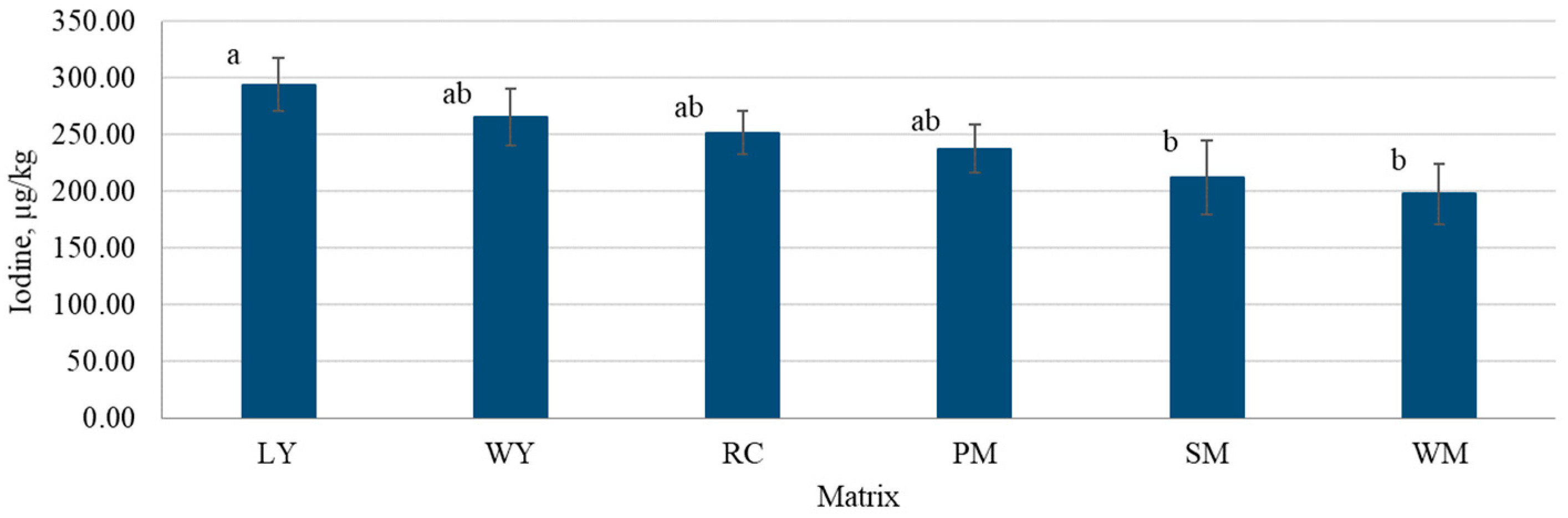
3.2. Least Squares Means for Iodine Concentration
3.3. Descriptive Statistics of Iodine Intake from Milk, Ricotta Cheese, and Yogurt
4. Conclusions
Author Contributions
Funding
Institutional Review Board Statement
Informed Consent Statement
Data Availability Statement
Conflicts of Interest
Abbreviations
| WM | Whole pasteurized milk |
| PM | Partially skimmed pasteurized milk |
| SM | Skimmed pasteurized milk |
| RC | Ricotta cheese |
| WY | Whole yogurt |
| LY | Low-fat yogurt |
References
- Chung, H.R. Iodine and thyroid function. Ann. Pediatr. Endocrinol. Metab. 2014, 19, 8–12. [Google Scholar] [CrossRef] [PubMed]
- Sorrenti, S.; Baldini, E.; Pironi, D.; Lauro, A.; D’Orazi, V.; Tartaglia, F.; Tripodi, D.; Lori, E.; Gagliardi, F.; Praticò, M.; et al. Iodine: Its role in thyroid hormone biosynthesis and beyond. Nutrients 2021, 13, 4469. [Google Scholar] [CrossRef]
- Mattei, D.; Pietrobelli, A. Micronutrients and brain development. Curr. Nutr. Rep. 2019, 8, 99–107. [Google Scholar] [CrossRef]
- World Health Organization. Assessment of Iodine Deficiency Disorders and Monitoring Their Elimination: A Guide for Programme Managers; WHO: Geneva, Switzerland, 2007; Available online: https://apps.who.int/iris/bitstream/handle/10665/43781/9789241595827_eng.pdf (accessed on 18 July 2025).
- Laurberg, P.; Cerqueira, C.; Ovesen, L.; Rasmussen, L.B.; Perrild, H.; Andersen, S.; Pedersen, I.B.; Carlé, A. Iodine intake as a determinant of thyroid disorders in populations. Best Pract. Res. Clin. Endocrinol. Metab. 2010, 24, 13–27. [Google Scholar] [CrossRef]
- Levie, D.; Korevaar, T.I.M.; Bath, S.C.; Murcia, M.; Dineva, M.; Llop, S.; Espada, M.; van Herwaarden, A.E.; de Rijke, Y.B.; Ibarluzea, J.M.; et al. Association of maternal iodine status with child IQ: A meta-analysis of individual participant data. J. Clin. Endocrinol. Metab. 2019, 104, 5957–5967. [Google Scholar] [CrossRef]
- Smyth, P.P. Iodine, seaweed, and the thyroid. Eur. Thyroid J. 2021, 10, 101–108. [Google Scholar] [CrossRef]
- Smyth, P.P.A.; Burns, R.; Huang, R.J.; Hoffman, T.; Mullan, K.; Graham, U.; Seitz, K.; Platt, U.; O’Dowd, C. Does iodine gas released from seaweed contribute to dietary iodine intake? Environ. Geochem. Health 2011, 33, 389–397. [Google Scholar] [CrossRef] [PubMed]
- Herrick, K.A.; Perrine, C.G.; Aoki, Y.; Caldwell, K.L. Iodine status and consumption of key iodine sources in the U.S. population with special attention to reproductive age women. Nutrients 2018, 10, 874. [Google Scholar] [CrossRef]
- Censi, S.; Manso, J.; Barollo, S.; Mondin, A.; Bertazza, L.; De Marchi, M.; Mian, C. Changing dietary habits in Veneto Region over two decades: Still a long road to go to reach an iodine-sufficient status. Nutrients 2020, 12, 2399. [Google Scholar] [CrossRef] [PubMed]
- Niero, G.; Censi, S.; Mian, C.; Manuelian, C.L.; Rovai, M.; Tsiplakou, E.; Da Costa, L.; Fuerst-Waltl, B.; Da Cruz, A.G.; Berry, D.P.; et al. Low public awareness opens up new opportunities for highlighting milk as an iodine dietary source. J. Dairy Sci. 2024, 107, 10231–10243. [Google Scholar] [CrossRef]
- Niero, G.; Franzoi, M.; Vigolo, V.; Penasa, M.; Cassandro, M.; Boselli, C.; Giangolini, G.; De Marchi, M. Validation of a gold standard method for iodine quantification in raw and processed milk, and its variation in different dairy species. J. Dairy Sci. 2019, 102, 4808–4815. [Google Scholar] [CrossRef]
- Stevenson, M.C.; Drake, C.; Givens, D.I. Further studies on the iodine concentration of conventional, organic and UHT semi-skimmed milk at retail in the UK. Food Chem. 2018, 239, 551–555. [Google Scholar] [CrossRef]
- Costa, A.; Niero, G.; Franzoi, M.; Cassandro, M.; De Marchi, M.; Penasa, M. Iodine content in bovine milk is lowly heritable and shows limited genetic variation. J. Dairy Sci. 2021, 104, 3292–3297. [Google Scholar] [CrossRef]
- Flachowsky, G.; Franke, K.; Meyer, U.; Leiterer, M.; Schöne, F. Influencing factors on iodine content of cow milk. Eur. J. Nutr. 2014, 53, 351–365. [Google Scholar] [CrossRef] [PubMed]
- Niero, G.; Visentin, G.; Censi, S.; Righi, F.; Manuelian, C.L.; Formigoni, A.; Mian, C.; Bérard, J.; Cassandro, M.; Penasa, M.; et al. Invited review: Iodine level in dairy products—A feed-to-fork overview. J. Dairy Sci. 2023, 106, 2213–2229. [Google Scholar] [CrossRef] [PubMed]
- van der Reijden, O.L.; Galetti, V.; Herter-Aeberli, I.; Zimmermann, M.B.; Zeder, C.; Krzystek, A.; Haldimann, M.; Barmaz, A.; Kreuzer, M.; Berard, J.; et al. Effects of feed iodine concentrations and milk processing on iodine concentrations of cows’ milk and dairy products, and potential impact on iodine intake in Swiss adults. Br. J. Nutr. 2019, 122, 172–185. [Google Scholar] [CrossRef] [PubMed]
- Haldimann, M.; Walther, B.; Dudler, V.; Aubert, R.; Wechsler, D. Increase of iodine content in brine-salted soft, semi-hard and hard cheeses by diffusion of iodide. Food Addit. Contam. A 2019, 36, 1787–1799. [Google Scholar] [CrossRef]
- Nerhus, I.; Wik Markhus, M.; Nilsen, B.M.; Øyen, J.; Maage, A.; Ødegård, E.R.; Midtbø, L.K.; Frantzen, S.; Kögel, T.; Graff, I.E.; et al. Iodine content of six fish species, Norwegian dairy products and hen’s egg. Food Nutr. Res. 2018, 62. [Google Scholar] [CrossRef]
- Beauchemin, D. Encyclopedia of Spectroscopy and Spectrometry, 2nd ed.; Academic Press: Oxford, UK, 1999. [Google Scholar]
- Eldridge, A.L.; Kotzakioulafi, E.; Debras, C.; Tsai, L.T.; Meijer, G.W.; Salesse, F.; Gibney, E.R. Method to define recommended portion sizes for consumer guidance. Eur. J. Nutr. 2025, 64, 62. [Google Scholar] [CrossRef]
- Walther, B.; Wechsler, D.; Schlegel, P.; Haldimann, M. Iodine in Swiss milk depending on production (conventional versus organic) and on processing (raw versus UHT) and the contribution of milk to the human iodine supply. J. Trace Elem. Med. Biol. 2018, 46, 138–143. [Google Scholar] [CrossRef]
- O’Kane, S.M.; Pourshahidi, L.K.; Mulhern, M.S.; Weir, R.R.; Hill, S.; O’Reilly, J.; Kmiotek, D.; Deitrich, C.; Mackle, E.M.; Fitzgerald, E.; et al. The effect of processing and seasonality on the iodine and selenium concentration of cow’s milk produced in Northern Ireland: Implications for population dietary intake. Nutrients 2018, 10, 287. [Google Scholar] [CrossRef] [PubMed]


| Matrix | N | Mean (µg/kg) | Standard Deviation | Coefficient of Variation (%) | Minimum | Maximum | 95% Confidence Interval |
|---|---|---|---|---|---|---|---|
| WM | 11 | 190.91 | 59.78 | 31.32 | 90.00 | 270.00 | 150.75–231.07 |
| PM | 19 | 234.47 | 65.91 | 28.11 | 115.00 | 335.00 | 202.70–266.24 |
| SM | 7 | 207.86 | 32.26 | 15.52 | 170.00 | 260.00 | 178.03–237.69 |
| RC | 26 | 260.00 | 93.90 | 36.12 | 100.00 | 540.00 | 222.07–297.93 |
| WY | 13 | 258.46 | 96.01 | 37.15 | 165.00 | 480.00 | 200.44–316.48 |
| LY | 15 | 289.33 | 141.09 | 48.76 | 155.00 | 640.00 | 211.20–367.47 |
| Matrix | N | Mean (%) | Standard Deviation | Coefficient of Variation (%) | Minimum | Maximum | 95% Confidence Interval |
|---|---|---|---|---|---|---|---|
| WM | 11 | 31.82 | 9.96 | 31.32 | 15.00 | 45.00 | 25.12–38.51 |
| PM | 19 | 39.08 | 10.99 | 28.11 | 19.17 | 55.83 | 33.78–44.37 |
| SM | 7 | 34.64 | 5.38 | 15.52 | 28.33 | 43.33 | 29.67–39.61 |
| RC | 26 | 21.66 | 6.26 | 36.11 | 8.33 | 46.25 | 17.97–24.39 |
| WY | 13 | 21.54 | 8.00 | 37.15 | 13.75 | 40.00 | 16.70–26.37 |
| LY | 15 | 24.11 | 11.76 | 48.76 | 12.92 | 53.33 | 17.60–30.62 |
Disclaimer/Publisher’s Note: The statements, opinions and data contained in all publications are solely those of the individual author(s) and contributor(s) and not of MDPI and/or the editor(s). MDPI and/or the editor(s) disclaim responsibility for any injury to people or property resulting from any ideas, methods, instructions or products referred to in the content. |
© 2025 by the authors. Licensee MDPI, Basel, Switzerland. This article is an open access article distributed under the terms and conditions of the Creative Commons Attribution (CC BY) license.
Share and Cite
Niero, G.; Pozza, M.; Marchi, M.D. Iodine Concentration in Milk, Ricotta Cheese, and Yogurt, and Their Contribution to Dietary Iodine Intake. Dairy 2026, 7, 6. https://doi.org/10.3390/dairy7010006
Niero G, Pozza M, Marchi MD. Iodine Concentration in Milk, Ricotta Cheese, and Yogurt, and Their Contribution to Dietary Iodine Intake. Dairy. 2026; 7(1):6. https://doi.org/10.3390/dairy7010006
Chicago/Turabian StyleNiero, Giovanni, Marta Pozza, and Massimo De Marchi. 2026. "Iodine Concentration in Milk, Ricotta Cheese, and Yogurt, and Their Contribution to Dietary Iodine Intake" Dairy 7, no. 1: 6. https://doi.org/10.3390/dairy7010006
APA StyleNiero, G., Pozza, M., & Marchi, M. D. (2026). Iodine Concentration in Milk, Ricotta Cheese, and Yogurt, and Their Contribution to Dietary Iodine Intake. Dairy, 7(1), 6. https://doi.org/10.3390/dairy7010006