Opinion

Potential Effect of Bovine Colostrum on Mesenchymal Stem Cells for Regenerative Therapy


1
Laboratory of Molecular Haematopoiesis and Stem Cell Biology, Department of Experimental and Clinical Medicine, University “Magna Græcia” of Catanzaro, Viale Europa, 88100 Catanzaro, Italy
2
Department of Health Sciences, University “Magna Græcia” of Catanzaro, Viale Europa, 88100 Catanzaro, Italy
3
Interdepartmental Center Veterinary Service for Human and Animal Health, University “Magna Græcia ” of Catanzaro, Viale Europa, 88100 Catanzaro, Italy
*
Author to whom correspondence should be addressed.
Dairy 2024, 5(1), 173-179; https://doi.org/10.3390/dairy5010014
Submission received: 9 November 2023 / Revised: 12 January 2024 / Accepted: 13 February 2024 / Published: 20 February 2024
(This article belongs to the Section Milk and Human Health)

Abstract

Bovine colostrum is the first mammary secretion after parturition; it is rich in Igs and bioactive compounds and could play a role in the development of naturally based products with positive effects on human health. In this discussion, we critically examine the effect of bovine colostrum on the properties of mesenchymal stem cells. Multipotent mesenchymal stem cells (MSCs) are a heterogeneous subset of fibroblast-like cells that can be isolated from various biological tissues, such as bone marrow, umbilical cord, and adipose tissues. They are characterized by their ability to self-renew and differentiate into cells of the mesodermal lineage, including adipocytes, osteocytes, and chondrocytes. Additionally, MSCs display an immunomodulatory capacity due to their ability to interact with effector cells typical of both innate and adaptive immune responses. Considering these important properties, MSCs have gained increasing attention in the field of regenerative medicine in recent decades. To date, most experimental protocols are based on cell culture media supplemented with fetal bovine serum (FBS) to promote the ex vivo expansion of MSCs while preserving their differentiative and immunomodulatory capacities. Future trends could involve the application of bovine colostrum in regenerative medicine.
Keywords: mesenchymal stem cells (MSCs); bovine colostrum; osteogenesis; inflammatory liver disease; regenerative therapy; functional foods; nutraceutical mesenchymal stem cells (MSCs); bovine colostrum; osteogenesis; inflammatory liver disease; regenerative therapy; functional foods; nutraceutical
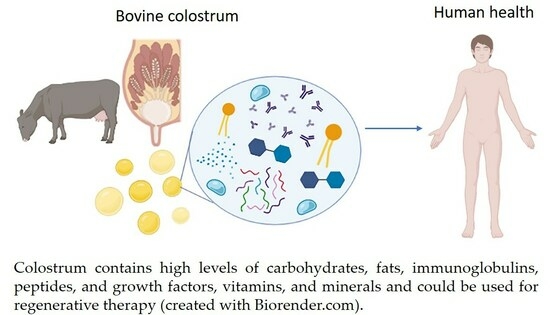
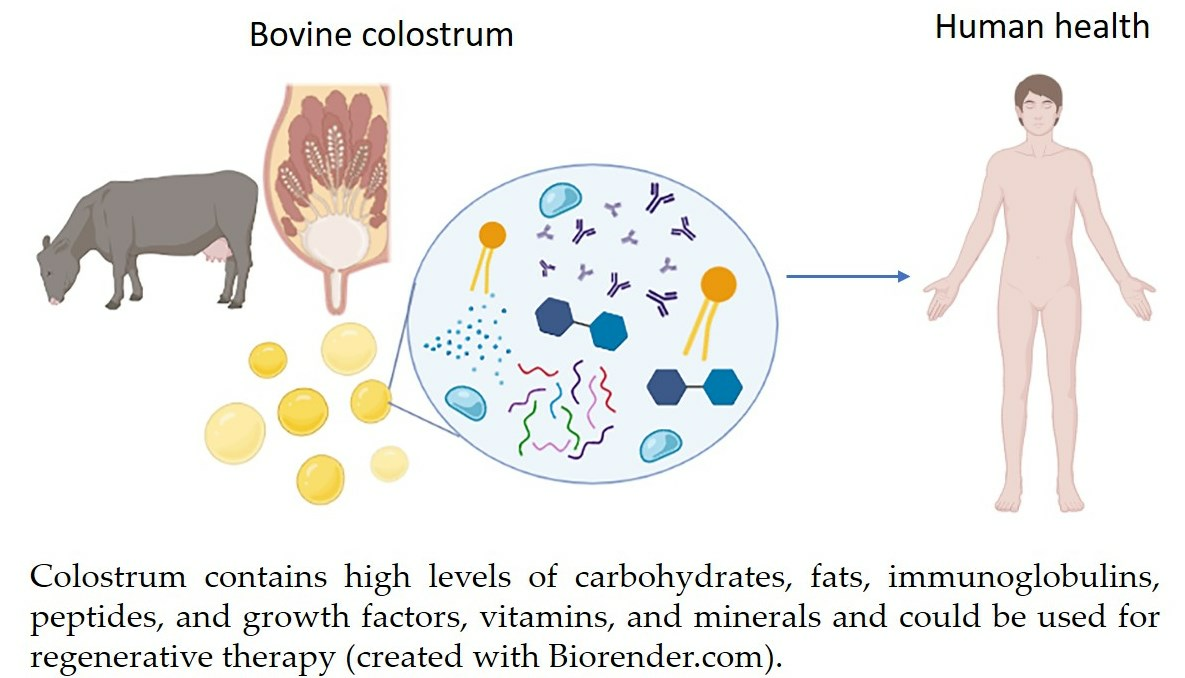
Graphical Abstract