Article

Relationship Between the Morphology and Catalytic Properties of Mn-Ni Multiphase Nanostructures for the Reduction of 4-Nitrophenol


by
Philip Asare
*,
J. Jesús Velázquez Salazar
and
Miguel José Yacamán
Applied Physics and Materials Science Department, Northern Arizona University, Flagstaff, AZ 86011, USA
*
Author to whom correspondence should be addressed.
Chemistry 2026, 8(5), 69; https://doi.org/10.3390/chemistry8050069
Submission received: 7 April 2026 / Revised: 15 May 2026 / Accepted: 18 May 2026 / Published: 21 May 2026
(This article belongs to the Section Chemistry at the Nanoscale)

Abstract

The catalytic reduction of 4-nitrophenol (4-NP) requires highly efficient and cost-effective materials, making Mn-Ni nanostructures a promising candidate. In this study, Mn-Ni nanoparticles with distinct morphologies (specifically spheres, stars, and core–shell structures) were synthesized by tuning the precursor composition. The structural and optical properties of the synthesized catalysts were characterized via electron microscopy and UV-Vis spectroscopy. Kinetic evaluations of the 4-NP reduction demonstrated that the core–shell architecture yielded the highest catalytic activity, outperforming both the star-shaped and spherical nanoparticles. Furthermore, the high-index facets at the tips of the nanostars appeared to have contributed to enhanced catalytic activity by providing additional active surface sites for the reduction process. Ultimately, this work suggests that structural morphology and interfacial interactions play important roles in determining catalytic performance, rather than absolute surface area, providing valuable insights into the design of future bimetallic catalysts.

1. Introduction

4-Nitrophenol (4-NP) is a hazardous anthropogenic pollutant commonly found in industrial wastewater, originating from the production of pesticides, dyes, and explosives [1,2]. Beyond the urgent need for environmental remediation, the catalytic reduction of 4-NP yields 4-Aminophenol (4-AP), a commercially vital intermediate in the synthesis of antipyretic drugs such as paracetamol (acetaminophen) and other analgesic compounds [3]. Consequently, the development of efficient catalytic systems for this transformation is of significant industrial and environmental interest. Historically, noble metal nanoparticles (NPs) such as Au, Pd, and Ag have served as the benchmark catalysts for this reduction due to their exceptional activity and stability [4,5]. Recent studies have further refined the understanding of noble metal-catalyzed 4-nitrophenol reduction at the nanoscale. For example, Pd6 nanoclusters exhibit high catalytic efficiency, where activity is strongly dependent on ligand environment and surface accessibility. These findings highlight that catalytic performance is not governed solely by composition, but is also strongly influenced by interfacial structure, surface chemistry, and the availability of active sites in ultrasmall metallic systems [6]. However, the high cost and scarcity of these noble metals severely limit their scalability for large-scale wastewater treatment. To address this, significant research has shifted toward earth-abundant 3d transition metals, particularly Ni, Co, and Cu, which offer a sustainable alternative. While cost-effective, monometallic transition metals often suffer from lower intrinsic activity or rapid passivation compared to their noble counterparts [7]. To overcome these limitations, bimetallic engineering and heterostructure design have emerged as a promising strategy. Such approaches not only reduce costs by minimizing or entirely eliminating noble metal content, but they also induce synergistic effects. In these systems, the interaction between two distinct metals modifies the electronic structure and geometric arrangement of the active sites, yielding catalytic performance superior to that of either monometallic component. Previous studies have demonstrated that coupling metals with different electronegativities can induce beneficial charge transfer, which alters the local electronic structure to optimize reactant binding; therefore, we selected Mn and Ni to investigate these synergistic effects [8,9].
Mn-Ni-based materials present a unique and underexplored opportunity because manganese is highly abundant and possesses distinct redox properties [10]. Mn-Ni alloys and related Mn-Ni-based systems have been widely studied for their mechanical and magnetic properties, as well as their applications in sensing and phase transformation control. These systems are synthesized using various methods, including auto-combustion, high-temperature pyrolysis, epitaxy, and ion irradiation [11,12,13,14]. Beyond these physical properties, a key area of research is the catalytic activity of Mn-Ni-based systems [15,16,17]. However, to the best of our knowledge, limited research has addressed their catalytic performance in degrading the widely known pollutant 4-NP. The reduction of 4-NP by NaBH4 serves as an ideal model reaction for evaluating catalytic activity due to its distinct spectroscopic signature, while simultaneously addressing the remediation of a common industrial pollutant. Consequently, the goal of this work is to fabricate Mn-Ni nanoparticles to understand how varying the bimetallic ratio dictates morphology, and subsequently, to investigate the effect of the Mn-Ni system on the catalytic reduction of 4-NP. Unlike noble metals, the inevitable surface oxidation of Mn species may facilitate the formation of oxides, and not only a pure bimetallic of Mn-Ni which will also be a point of investigation [18].

2. Materials and Methods

2.1. Reagents

Nickel chloride (NiCl2), manganese chloride (MnCl2), poly(diallyldimethylammonium chloride) (PDDA), sodium hydroxide (NaOH), 4-nitrophenol (4-NP), diethylhydroxylamine (DEHA), hydrazine, and ethylene glycol (EG). All reagents were bought from Sigma Aldrich (St. Louis, MO, USA) and were used without further purification.

2.2. Synthesis of MnNi NPs

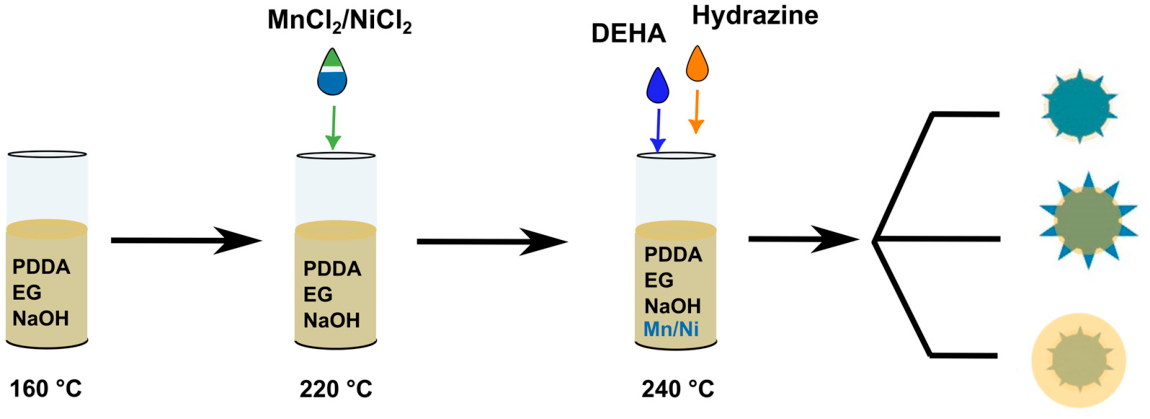
Two precursor solutions (0.1 M NiCl2 and 0.1 M MnCl2) were prepared in 1 mL of water. Subsequently, 40 µL of PDDA and 90 µL of NaOH (1 M) were added to 5 mL of ethylene glycol. Strongly basic conditions were established by the addition of NaOH (pH values 9–12). The mixture was then heated to 160 °C for 5 min, followed by heating at 220 °C for 10 min.
Morphology control was achieved by varying the Ni:Mn precursor ratio. For spherical particles, 300 µL NiCl2 and 150 µL MnCl2 were added dropwise; for star-like structures, 200 µL NiCl2 and 200 µL MnCl2 were added dropwise; and for core–shell structures, 200 µL NiCl2 and 300 µL MnCl2 were added dropwise. After 5 min, 50 µL DEHA and 50 µL hydrazine were introduced as reducing agents. The reaction temperature was then increased to 240 °C and maintained for 5 min. The mixture was then cooled to room temperature.
Heating was performed using a conventional heating mantle without measurement of the ramp rate; only target temperatures and dwell times were defined.
The resulting nanoparticles were purified by repeated centrifugation with ethanol (four cycles) to remove residual PDDA and by-products, and finally redispersed in ethanol.

2.3. Characterization

The Mn-Ni NPs were characterized through scanning electron microscopy (SEM) using a Thermo Scientific Phenom Pure G6 Desktop SEM (Waltham, MA, USA) to visualize the morphology. The crystalline structure was determined through transmission electron microscopy (TEM) using a Thermo Scientific Talos F200i (Waltham, MA, USA) microscope operated at 200 keV.

2.4. UV-Vis 4-Nitrophenol Degradation

A stock solution (S1) containing NaBH4 (0.3 M) and 4-NP (1 mM) was prepared in 5 mL of water. The reaction was conducted in a quartz cuvette by mixing 500 µL of S1 with 1 mL of water. The reaction was initiated by introducing aliquots of Mn-Ni nanostructures, and the reduction of 4-NP to 4-AP was monitored using Thermo Scientific Evolution One Plus UV–Vis Spectrophotometer (Waltham, MA, USA). Completion of the reaction was determined by the disappearance of the absorption peak at ~400 nm.
A control experiment without a catalyst was performed under identical conditions, showing negligible reduction of 4-nitrophenol within the experimental timeframe.
The catalytic experiments were repeated to confirm the consistency of the observed catalytic trends. Surface area analysis was not performed in this study. However, identical synthesis and reaction conditions were used across all samples, allowing comparative evaluation of catalytic performance based on morphology and structure.

3. Results and Discussion

3.1. Morphology and Structural Composition

Mn-Ni nanostructures were synthesized in the presence of a stabilizing agent (PDDA) in an EG solution. Different MnCl2:NiCl2 concentrations (1:2, 1:1, and 3:2) and pH values (9–12) were used. Hydrazine was added as a reducing agent. The solution immediately turned black after the process, indicating the formation of Mn-Ni nanostructures. The schematic of the Mn-Ni nanostructure synthesis methodology is shown in Figure 1.
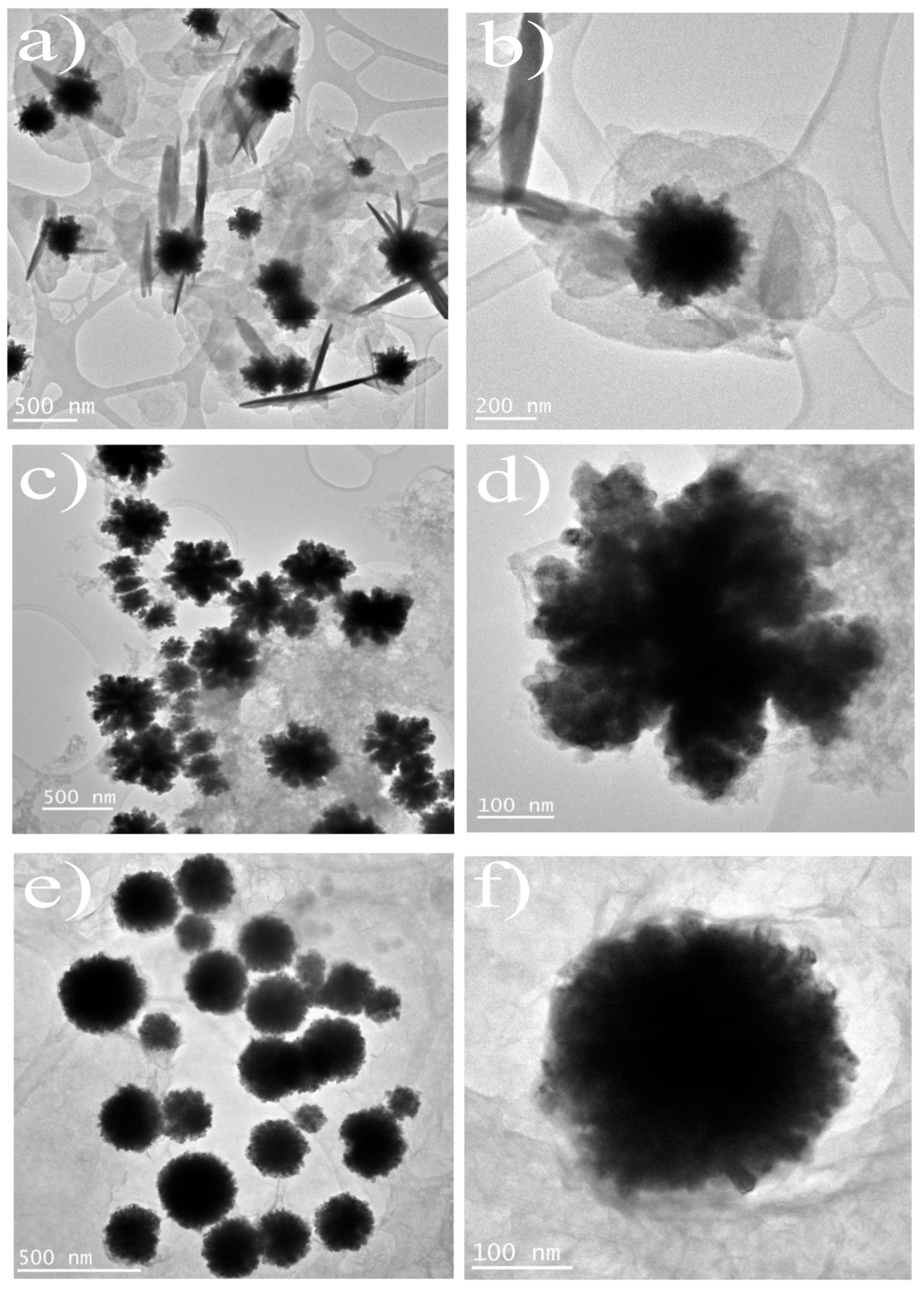
These variations in Ni and Mn composition drove the formation of three distinct structures, core–shell particles, stars, and spheres, captured in the TEM images of Figure 2. The morphological images from the TEM further highlighted nanoscale architecture, showing the biphasic boundary of the core–shell structures and the branched tips characteristic of the star morphology.
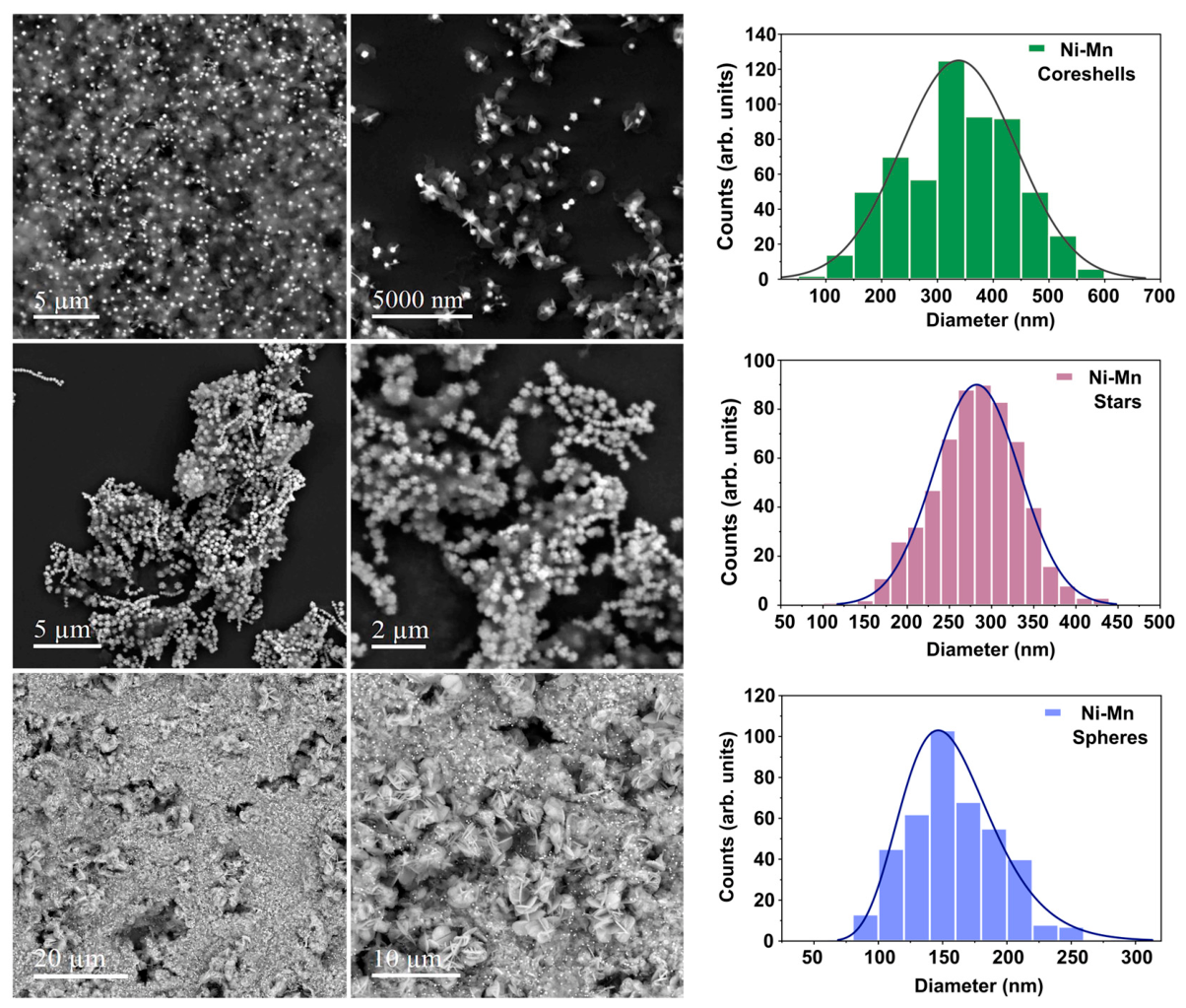
The particle size distributions for the three morphologies were determined via statistical analysis of the SEM images (Figure 3). As illustrated in the histograms of Figure 3, the core–shell structures exhibited the largest average diameter (approximately 340 nm) and a relatively broad distribution ranging from 100 to 600 nm. This larger size reflects the total particle diameter, encompassing both the core and the outer shell. In contrast, the star-shaped particles displayed a narrower distribution with a mean diameter of 285 nm. The spheres represented the smallest and most monodisperse structures, characterized by a mean diameter of 150 nm. All samples followed a Gaussian distribution, as indicated by the overlaid fit curves in Figure 3. Contrary to the conventional paradigm where smaller nanoparticles exhibit higher catalytic activity [19,20], our core–shell structures and stars outperformed the smaller spheres despite their larger diameters (340 nm vs. 150 nm). This deviation from the expected surface-area-to-volume relationship suggests that other structural factors are dominant in this system, as discussed later in this work.
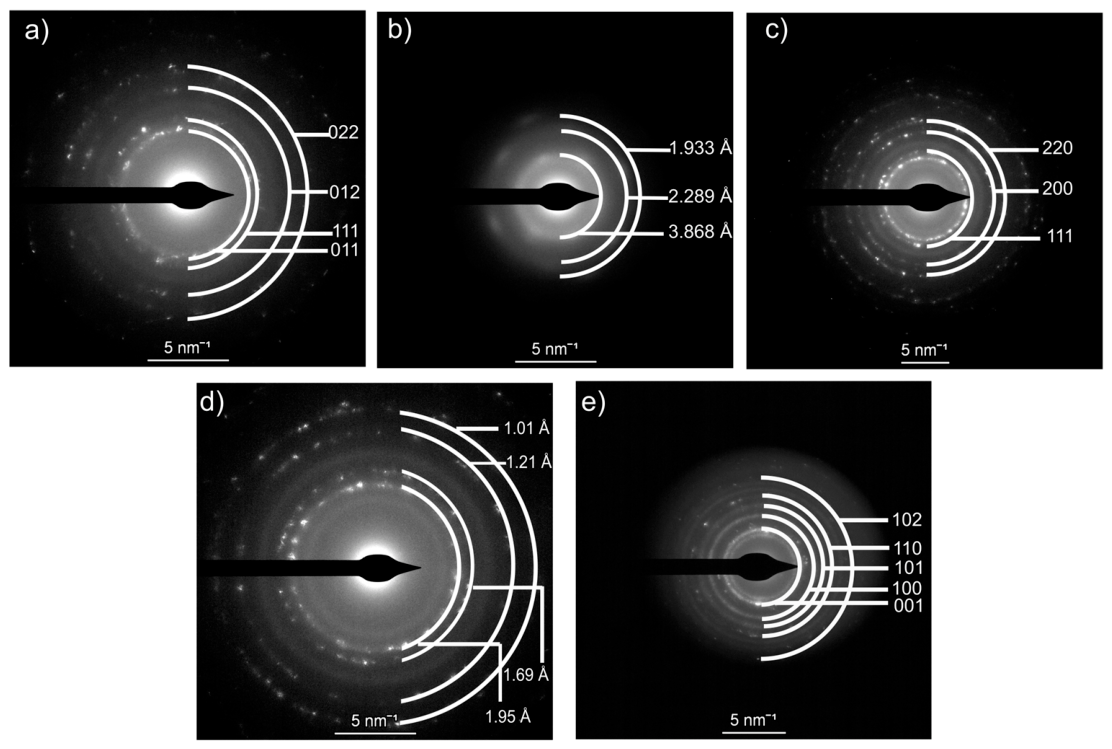
The Selected Area Electron Diffraction (SAED) patterns obtained from each of the nanoparticles exhibit distinct Debye-Scherrer rings, characteristic of a polycrystalline nature (Figure 4). In Figure 4a, the reflections from the inner core for the core–shell structure suggest a cubic MnNi3 structure (space group No. 221). The interplanar spacings (d-spacing) values of 2.52 Å, 2.10 Å, 1.56 Å, and 1.29 Å correspond to the (011), (111), (012), and (022) planes, respectively. Conversely, reflections from the outer shells of the core–shell architecture represented in Figure 4b are consistent with Mn2O3 oxide phases; d-spacings of 3.868 Å, 2.289 Å, and 1.933 Å align with the (112), (104), and (224) planes, respectively.
The d-spacing of the stars in Figure 4c are consistent with a disordered FCC solid solution of MnNi 2.06 Å, 1.44 Å and 1.22 Å corresponding to (111), (200), and (220). In addition to the primary reflections associated with the star-structured system, supplementary rings observed at the tips of the stars (Figure 4d) had the following d-spacings of 1.95Å, 1.69 Å, 1.21 Å, and 1.01 Å. These values align closely with the d-spacings of MnO2 and Mn3O4 suggesting partial oxidation of the bimetallic nanoparticles, likely forming a thin oxide shell or secondary phase.
The measured d-spacings of the spheres (Figure 4e) are 3.43 Å, 2.8 Å, 2.12 Å, 1.84 Å and 1.46 Å and correspond closely to the (001), (100), (101) (110) and (102) planes of the tetragonal system with the chemical formula MnNi in the P4/mmm space group. With all these preliminary structures, further stoichiometric analysis is required for definitive phase identification.

3.2. Catalytic Activity and the Reduction of 4-Nitrophenol to 4-Aminophenol

The reduction reaction followed the chemical equation described in Equation (1).
C 6 H 4 N O 2 O H + 3 N a B H 4 + H 2 O M n - N i   C 6 H 4 N H 2 O H + 3 N a B O H 4
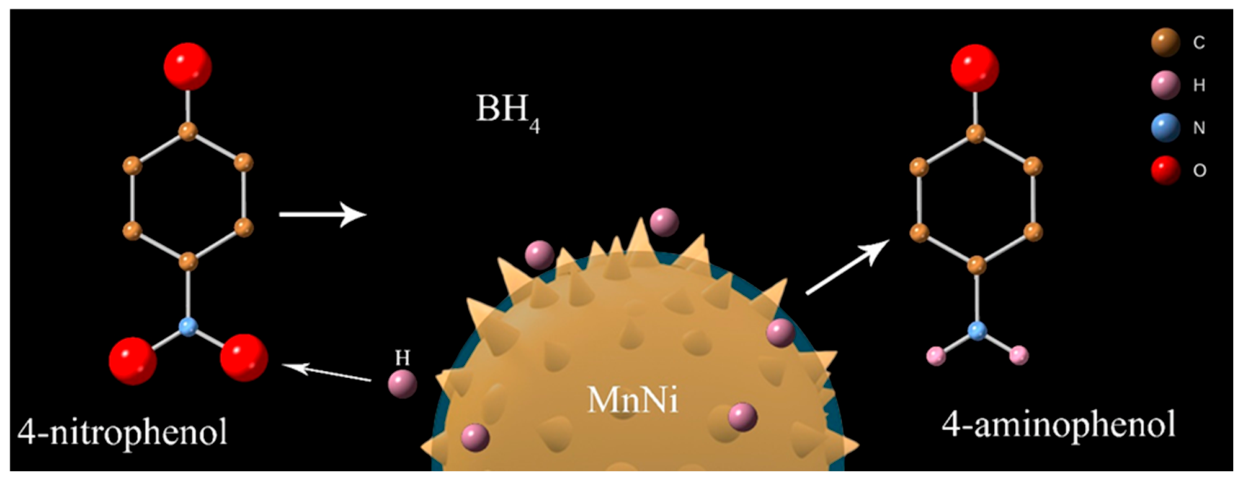
The reduction of 4-NP by NaBH4 in the presence of Mn-Ni catalysts is commonly described in the literature as proceeding via a Langmuir–Hinshelwood-type mechanism, involving adsorption of both reactants onto the catalyst surface followed by surface-mediated electron transfer [21]. In the present system, we propose that the Mn-Ni surface provides active sites for the adsorption of both borohydride ions and 4-NP, enabling electron transfer and subsequent reduction (Figure 5). However, detailed mechanistic pathways are not directly probed in this study and are therefore discussed qualitatively.
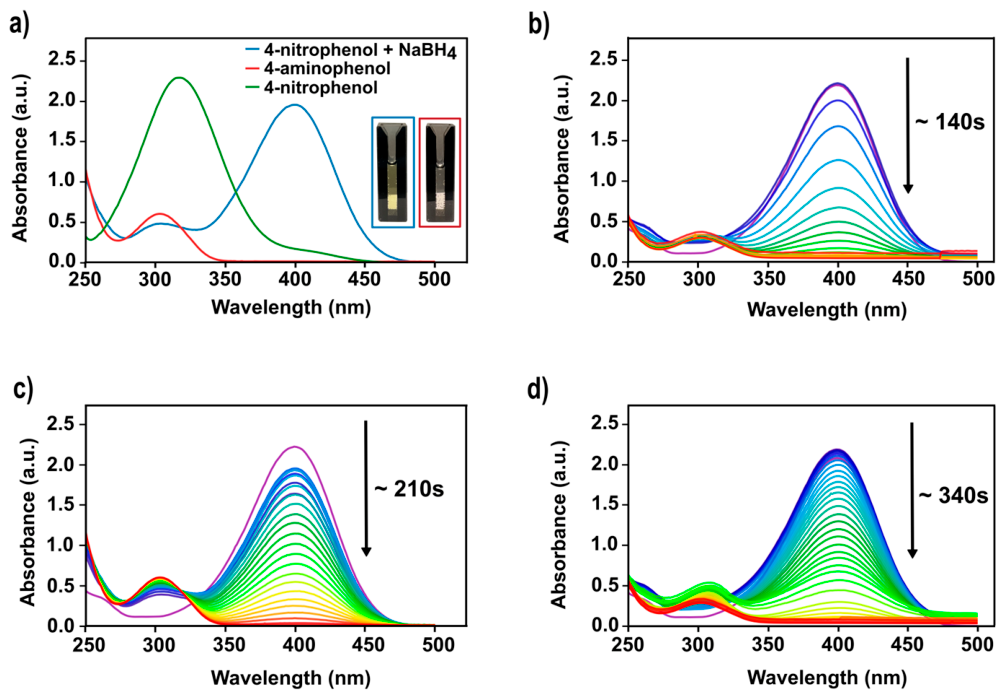
Upon addition of NaBH4, the characteristic absorption peak of 4-NP at 318 nm shifts to 400 nm due to the formation of 4-nitrophenolate ions under alkaline conditions, as shown in Figure 6a. Following catalyst addition, the intensity of the 400 nm peak progressively decreases, while a new peak emerges at approximately 300 nm, corresponding to the formation of 4-AP [22]. No significant conversion was observed in the absence of a catalyst, confirming that the reaction is catalytically driven by the Mn-Ni nanostructures. This is further supported by the control experiment (4-NP + NaBH4), where the absorbance at ~400 nm remained constant over time, as shown in the inset of Figure 6a.
Based on these spectral changes, the catalytic performance of the three morphologies was compared. The core–shell nanoparticles exhibit the highest activity, with complete disappearance of the 400 nm peak within ~140 s. Star-like structures show intermediate activity with completion at ~210 s, while spherical nanoparticles require ~340 s for full conversion, as shown in Figure 6b–d.
Within Mn-Ni bimetallic systems, catalytic activity arises from the complementary roles of the two components. Ni-rich phases are expected to facilitate electron transfer due to their metallic conductivity, while Mn species contribute to metal–metal interaction and electronic modulation of the Ni environment. In some morphologies (stars and core–shell structures), partial surface oxidation of Mn is observed, which can further enhance adsorption and activation of reactant molecules. This intrinsic combination enables synergistic catalytic behavior across Mn-Ni nanostructures [23,24].
All synthesized morphologies exhibit Mn-Ni-based catalytic functionality; however, differences in structural architecture and surface chemistry lead to variations in catalytic performance.

3.3. Conversion Efficiency and Stability

The reduction reaction was analyzed using pseudo-first-order kinetics, as described in Equation (2), due to the large excess of NaBH4 relative to 4-nitrophenol.
ln A A m a x = k o b s t
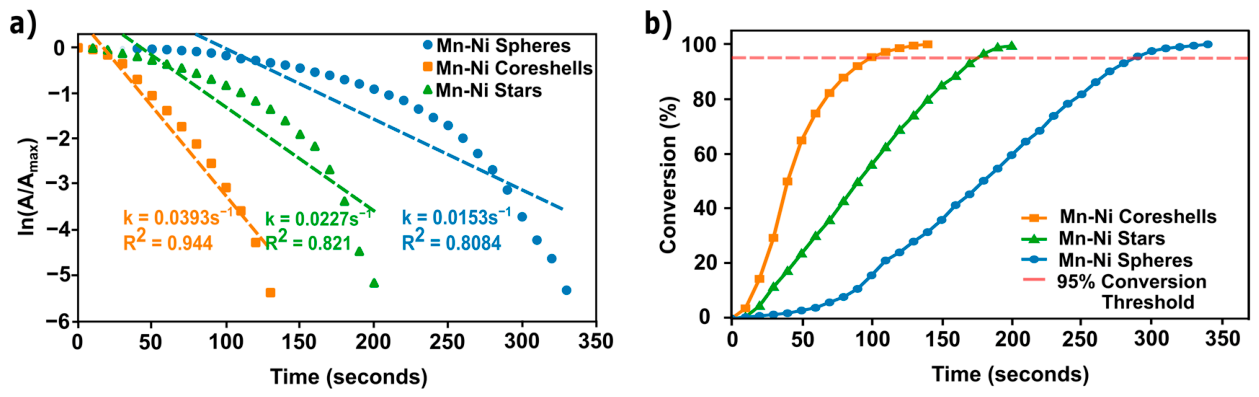
Kinetic analysis revealed a pronounced, morphology-dependent trend in the reaction rate. The pseudo-first-order rate constants (kobs) demonstrated that the core–shell nanoparticles exhibited the highest catalytic activity (0.0393 s−1). This value is approximately 1.7 times higher than that of the star-like structures (0.0227 s−1) and over 2.5 times higher than that of the spherical nanoparticles (0.0153 s−1), with all three morphologies achieving near-complete conversion (Figure 7).
The pseudo-first-order kinetic model was applied under excess NaBH4 conditions to enable comparative evaluation of catalytic activity across different morphologies. The resulting coefficient of determination (R2) values were 0.944, 0.821, and 0.8084 for the respective samples. These values reflect the degree of linearity within the selected kinetic regime and were used to compare apparent reaction rates across the different catalysts. Deviations from ideal linear behavior are commonly observed in heterogeneous catalytic systems, particularly for multiphase nanostructured catalysts, where surface heterogeneity and adsorption phenomena can influence apparent kinetics. Importantly, the kinetic analysis was employed for comparative benchmarking of catalytic performance rather than strict mechanistic validation.
Mass-normalized kinetic constants were not determined due to the difficulty in defining the accessible active surface area across morphologically distinct nanostructures; however, identical catalyst loadings were used for all experiments to ensure valid comparison.
To place the catalytic performance of the Mn-Ni nanostructures in context, a comparison with representative catalysts reported for the reduction of 4-nitrophenol was conducted (Table 1). Noble metal systems such as Au-based and Ag-based nanoparticles typically exhibit rapid kinetics with rate constants in the range of 0.01 to 0.1 s−1 under comparable NaBH4 excess conditions, while earth-abundant transition metal systems generally show lower or comparable activity depending on structure and dispersion. The Mn-Ni core–shell architecture developed in this work exhibits competitive performance within this range, highlighting the effectiveness of morphology and interfacial engineering in enhancing catalytic activity. It should be noted that variations in catalyst loading, reaction conditions, and support effects across literature systems limit strict quantitative comparison; however, the observed trends can provide a meaningful benchmark for evaluating catalytic efficiency.
Conversion efficiency quantifies the extent to which the initial 4-nitrophenol (4-NP) was successfully reduced to 4-aminophenol (4-AP) by the conclusion of the reaction. Assuming a linear relationship between absorbance and concentration as per the Beer-Lambert law, the conversion efficiency was calculated using the relative decrease in the 4-nitrophenolate absorbance peak at 400 nm ( A 0 and A t representing initial and instantaneous absorbance, respectively).
These values are determined using Equation (3):
C o n v e r s i o n   % = A 0   A t A 0 100
Although the samples exhibited distinct reaction rates (Figure 7a), all three morphologies achieved near-complete conversion (Figure 7b). The core–shell structures reached the 95% conversion threshold within only 100 s, while the stars and spheres required 180 and 290 s, respectively (Figure 7b). These results highlight the high catalytic efficacy of the Mn-Ni systems; furthermore, precise tailoring of morphology presents a clear pathway toward achieving even higher efficiencies and accelerated reaction rates.
Star-like nanostructures, with their arms and branches, provide a higher effective surface area and a greater density of accessible active sites compared to smooth spherical particles, contributing to their intermediate catalytic activity [29]. In contrast to the common expectation that smaller nanoparticles always exhibit higher catalytic activity due to increased surface area, the core–shell architecture shows superior performance despite its relatively larger size. These results highlight clear morphology-dependent differences in catalytic performance. A more detailed discussion of the core–shell mechanism, including structural and interfacial contributions, is provided in the following section.

3.4. Core–Shell Activity

The highest catalytic activity is observed for the core–shell nanoparticles. Structural characterization suggests a heterogeneous architecture comprising a manganese oxide-rich shell and a Ni–Mn core containing an intermetallic compound. Inferred from SAED analysis, the coexistence of multiple crystallographic contributions, including features consistent with Mn2O3 and an MnNi3-type intermetallic structure (Pm-3m, space group 221). These observations support a multiphase core–shell-type architecture rather than a single homogeneous phase. The formation of this structure is likely driven by the higher oxygen affinity of Mn, which promotes preferential surface oxidation during synthesis or post-synthesis exposure, leading to the formation of a Mn2O3-enriched shell [30]. Concurrently, the subsurface region becomes enriched in Ni, where Mn and Ni can adopt a more ordered or partially ordered arrangement, consistent with an MnNi3-type intermetallic core as inferred from SAED analysis. Although direct spatially resolved elemental mapping was not performed, the coexistence of oxide-related and intermetallic-type diffraction features, together with the observed particle morphology, supports the formation of a core–shell-type heterostructure. While electronic structure measurements were not carried out in this study, the presence of an oxide/intermetallic interface is expected to introduce interfacial strain and electronic redistribution. Such interfacial effects have been widely reported to influence adsorption energetics through modification of surface electronic states [31,32,33,34]. We therefore suggest that interfacial coupling between Mn2O3 and the underlying Mn-Ni core contributes to the enhanced catalytic activity observed in the core–shell nanoparticles. In particular, the enhanced activity can be attributed to interfacial effects involving both electronic charge transfer and lattice strain at the oxide–metal interface. Charge redistribution between the Mn2O3 shell and the Mn-Ni core is expected to modify the electronic structure of surface-active sites, thereby optimizing adsorption strength and facilitating electron transfer during the catalytic reaction. In addition, the Mn oxide phases are proposed to play a dual role, acting as adsorption and activation sites for reactant species while simultaneously modulating the electronic properties of adjacent metallic sites through interfacial coupling. The combination of these effects provides a synergistic framework for the improved catalytic performance of the core–shell architecture.

4. Conclusions and Future Work

This work demonstrated the successful synthesis of diverse Mn-Ni morphologies, including spheres, stars, and core–shell architectures, for the catalytic reduction of 4-NP to 4-AP. The core–shell structures exhibited superior catalytic efficiency, outperforming spherical nanoparticles despite their lower surface area-to-volume ratio. This indicates that catalytic performance in Mn-Ni systems may be governed more strongly by structural architecture and interfacial effects than by surface area alone, particularly in the core–shell configuration. Based on SAED analysis and the proposed structural core–shell model, interfacial strain effects may further contribute to the modulation of the electronic structure of active sites, although the precise contributions of these effects cannot be resolved from the present dataset. While these catalysts show high activity for 4-NP reduction under controlled laboratory conditions, their practical use is more suited to point-source treatment applications such as industrial wastewater remediation rather than complex in situ environmental systems.
Future studies should focus on deeper structural and mechanistic validation of these findings. In particular, post-reaction characterization would be valuable to assess possible phase evolution or surface reconstruction during catalysis. Surface area analysis was not performed in this work; inclusion of such analysis in future work would help further clarify the relative contributions of surface area and interfacial effects. Mass-normalized kinetic parameters were also not determined due to the difficulty in defining accessible surface areas across morphologically distinct nanostructures; future work incorporating surface measurements would enable more rigorous comparison. Furthermore, catalyst recyclability and long-term structural stability were not investigated, as each experiment was conducted using freshly prepared samples. Future work should examine reusability and structural durability. Finally, more detailed spectroscopic or computational studies would be beneficial to further elucidate the respective roles of Mn and Ni and to directly validate proposed interfacial effects such as charge transfer and lattice strain.
Overall, these results demonstrate that structural morphology and interfacial interactions influence the catalytic performance of Mn-Ni systems in the reduction of 4-NP to 4-AP, offering useful insights into the design of future bimetallic catalysts.

Author Contributions

Writing—original draft, writing—reviewing and editing, methodology, formal analysis, visualization, and investigation, P.A.; methodology and writing—reviewing and editing, J.J.V.S.; conceptualization, supervision, funding acquisition, formal analysis and writing—reviewing and editing, M.J.Y. All authors have read and agreed to the published version of the manuscript.

Funding

National Science Foundation, Partnerships for Research and Education in Materials program, Materials Interfaces Research and Access-(MIRA-PREM)—an NSF PREM Center, Grant No. 2425226. National Science Foundation, Expanding Capacity in Quantum Information Science and Engineering program, ExpandQISE: Track 2: Integrating research and education pathways to the quantum future: synthesis, control and readout of spin-phonon quantum states for QISE education, Grant No. 2427169. This work was supported by the Center for Materials Interfaces in Research and Access (¡MIRA!) at Northern Arizona University.

Institutional Review Board Statement

Not applicable.

Informed Consent Statement

Not applicable.

Data Availability Statement

The raw data supporting the conclusions of this article will be made available by the authors on request.

Conflicts of Interest

The authors declare no conflicts of interest. The funders had no role in the design of the study; in the collection, analyses, or interpretation of data; in the writing of the manuscript; or in the decision to publish the results.

References

  1. Qi, L.; Jiang, H.; Lin, T.; Chang, X.; Jiang, B. Fabrication of MIL-53(Al) Based Composites from Biomass Activated Carbon (AC) for Efficient p-Nitrophenol Adsorption from Aqueous Solution. J. Taiwan Inst. Chem. Eng. 2021, 127, 220–227. [Google Scholar] [CrossRef]
  2. Gholivand, K.; Tizhoush, S.K.; Kozakiewicz, A. Two New Micro-Isostructural Metal–Organic Polymers Based on Mixed-Ligand Copper(I): Structures and Selective Sensing of Nitro Explosives in Water. Appl. Organomet. Chem. 2020, 34, e5701. [Google Scholar] [CrossRef]
  3. Park, J.; Hatzell, M.; Sievers, C.; Bommarius, A.S. Simultaneous Hydrogenation and Acetylation of 4-Nitrophenol in a Two-Stage Packed-Bed Reactor as a Process Intensification Strategy for Highly Selective Paracetamol Synthesis. ACS Sustain. Chem. Eng. 2025, 13, 5906–5915. [Google Scholar] [CrossRef]
  4. Meir, N.; Plante, I.J.-L.; Flomin, K.; Chockler, E.; Moshofsky, B.; Diab, M.; Volokh, M.; Mokari, T. Studying the Chemical, Optical and Catalytic Properties of Noble Metal (Pt, Pd, Ag, Au)–Cu2O Core–Shell Nanostructures Grown via a General Approach. J. Mater. Chem. A 2013, 1, 1763–1769. [Google Scholar] [CrossRef]
  5. Pretzer, L.A.; Heck, K.N.; Kim, S.S.; Fang, Y.-L.; Zhao, Z.; Guo, N.; Wu, T.; Miller, J.T.; Wong, M.S. Improving Gold Catalysis of Nitroarene Reduction with Surface Pd. Catal. Today 2016, 264, 31–36. [Google Scholar] [CrossRef]
  6. Guo, Q.; Zhang, W.-F.; Zhang, S.-F.; Su, Z.-Y.; Gao, X.-Y.; Yu, B.-R.; Wang, D.; Fan, Y.-J.; Hoseini, S.J.; Zheng, F.-Q.; et al. Catalytic activity of Pd6 nanoclusters for 4-nitrophenol reduction: Strong effect of protecting ligand content. Rare Met. 2025, 44, 4294–4301. [Google Scholar] [CrossRef]
  7. Formenti, D.; Ferretti, F.; Scharnagl, F.K.; Beller, M. Reduction of Nitro Compounds Using 3d-Non-Noble Metal Catalysts. Chem. Rev. 2019, 119, 2611–2680. [Google Scholar] [CrossRef] [PubMed]
  8. Gilroy, K.D.; Ruditskiy, A.; Peng, H.-C.; Qin, D.; Xia, Y. Bimetallic Nanocrystals: Syntheses, Properties, and Applications. Chem. Rev. 2016, 116, 10414–10472. [Google Scholar] [CrossRef]
  9. Sankar, M.; Dimitratos, N.; Miedziak, P.J.; Wells, P.P.; Kiely, C.J.; Hutchings, G.J. Designing Bimetallic Catalysts for a Green and Sustainable Future. Chem. Soc. Rev. 2012, 41, 8099–8139. [Google Scholar] [CrossRef]
  10. Smith, M.R.; Fernandes, J.; Go, Y.-M.; Jones, D.P. Redox Dynamics of Manganese as a Mitochondrial Life-Death Switch. Biochem. Biophys. Res. Commun. 2017, 482, 388–398. [Google Scholar] [CrossRef]
  11. Ren, Y.; Chen, Q.; Lu, Z.; Su, G.; Wu, C.; Rao, H.; Wang, Y.; Wei, X.; Sun, M. MnNi@PVP Nanoenzyme Based on Regulating Inflammation and Immune Homeostasis for the Therapy of Inflammatory Bowel Disease. ACS Appl. Mater. Interfaces 2024, 16, 64463–64475. [Google Scholar] [CrossRef]
  12. Shen, J.; Dai, Q.; Ren, S. Phase Transformation Controlled Tetragonality of MnNi-Based Nanocrystals. Nanotechnology 2016, 27, 10LT01. [Google Scholar] [CrossRef]
  13. Wang, D.; Tian, Q.; Liu, X.; Ren, Z.; Yin, F.; Ji, P. Microstructure Characterisation of Directionally Solidified MnNi Damping Alloy under Strong Magnetic Field. Mater. Sci. Technol. 2023, 39, 2018–2027. [Google Scholar] [CrossRef]
  14. Liu, H.; Li, Q.; Xu, B.; Liu, W.; Shu, G. The Effect of Dislocations on MnNi-Rich Clusters in Self-Ion Irradiated FeMnNi Alloy. J. Nucl. Mater. 2019, 519, 64–73. [Google Scholar] [CrossRef]
  15. Duan, Y.; Gao, B.; Liu, J.; Wang, X.; Sillanpää, M. Treatment of Landfill Leachate in the MBR and Catalytic Ozonation Coupled System Based on MnNi Catalyst: Efficiency and Bio/Chemical Mechanism. J. Water Process Eng. 2024, 66, 106033. [Google Scholar] [CrossRef]
  16. Karki, B.; Ali, A.B.M.; Singh, N.S.S.; Rusho, M.A.; AL-Khafaji, M.O.; Muniyandy, E.; Abdullaev, A.; Latipova, M.; Siddikov, R.; Smerat, A.; et al. Advanced MnNi-P/ZIF8@CNT Electrocatalyst for CO2 Reduction: Achieving High Efficiency, Stability, and Low Energy Demand. Synth. Met. 2025, 315, 117952. [Google Scholar] [CrossRef]
  17. Lu, F.; Li, L.; Zhang, X.; Nie, Y.; Geng, Z. Cooperative Effect of Hetero-Nuclear MnNi+ Cation Enhancing C–H Bond Activation of Cyclohexane: A Theoretical Study. Theor. Chem. Acc. 2020, 139, 48. [Google Scholar] [CrossRef]
  18. Li, S.; Lv, Y.; Song, G.; Li, C.; Gao, D.; Chen, G. Ultrafine NiMoOx Nanoparticles Confined in Mesoporous Carbon for the Reduction of Nitroarenes: Effect of the Composition and Accessibility of the Active Sites. RSC Adv. 2019, 9, 4571–4582. [Google Scholar] [CrossRef]
  19. Hu, Z.; An, D.; Zhang, L.; Wang, X.; Fang, S.; Tian, X.; Qiu, L.; Sun, J.; Li, T.; Dong, L. Effect of CeO2 Nanoparticle Sizes on Catalytic Performances of Sulfated CeO2/Al2O3 Catalyst in NH3-SCR Reaction. J. Rare Earths 2024, 42, 515–522. [Google Scholar] [CrossRef]
  20. Cao, S.; Tao, F.F.; Tang, Y.; Li, Y.; Yu, J. Size-and Shape-Dependent Catalytic Performances of Oxidation and Reduction Reactions on Nanocatalysts. Chem. Soc. Rev. 2016, 45, 4747–4765. [Google Scholar] [CrossRef]
  21. Gómez-Marín, A.M.; Hernández-Ortiz, J.P. Langmuir–Hinshelwood Mechanism Including Lateral Interactions and Species Diffusion for CO Electro-Oxidation on Metallic Surfaces. J. Phys. Chem. C 2014, 118, 2475–2486. [Google Scholar] [CrossRef]
  22. Pradhan, N.; Pal, A.; Pal, T. Silver Nanoparticle Catalyzed Reduction of Aromatic Nitro Compounds. Colloids Surf. A Physicochem. Eng. Asp. 2002, 196, 247–257. [Google Scholar] [CrossRef]
  23. Healy, E.; Zhang, Q.; Rodriguez, B.J.; Rafferty, A.; Bekarevich, R.; Ersek, G.; Portale, G.; Villano, R.; Negahdar, L.; Sofianos, M.V. Modulating the Bimetallic Ratio of Amorphous Nickel-Manganese MBenes for Direct Seawater Electrolysis. Mater. Today Energy 2025, 52, 101958. [Google Scholar] [CrossRef]
  24. Hu, G.; Song, Y.; Wang, Z.; Ji, Z.; Zhao, S.; Liu, C. Ni–Co–Mn Trimetallic Nanoparticles as Hierarchical Electrocatalysts for Highly Efficient Urea Oxidation via Spatial Decoupling. ACS Appl. Nano Mater. 2023, 6, 17473–17481. [Google Scholar] [CrossRef]
  25. Berahim, N.; Basirun, W.J.; Leo, B.F.; Johan, M.R. Synthesis of Bimetallic Gold-Silver (Au-Ag) Nanoparticles for the Catalytic Reduction of 4-Nitrophenol to 4-Aminophenol. Catalysts 2018, 8, 412. [Google Scholar] [CrossRef]
  26. Li, J.; Zheng, Z.; Huang, Y.; He, L.; Guo, H.; Wu, C.; Liu, W.; Huan, W. Highly Efficient Reduction of 4-Nitrophenol by the Au/MoS2 Catalyst with the Promotion of Cobalt Introduction. Prog. Nat. Sci. Mater. Int. 2025, 35, 396–403. [Google Scholar] [CrossRef]
  27. Luo, L.; Bock, L.; Liang, Y.; Anwander, R. Gold-Loaded Mesoporous Organosilica-Silica Core-Shell Nanoparticles as Catalytic Nanoreactors. Eur. J. Inorg. Chem. 2020, 2020, 3967–3976. [Google Scholar] [CrossRef]
  28. Ni, S.; Yang, L.; Qu, H.; Zhu, X.; Xu, Z.; Yuan, M.; Xing, H.; Wang, L.; Yu, J.; Liu, H. Tailoring the Structure and Energy Level over Transition-Metal Doped MoS2 towards Enhancing 4-Nitrophenol Reduction Reaction. J. Environ. Chem. Eng. 2021, 9, 105101. [Google Scholar] [CrossRef]
  29. Nehra, K.; Pandian, S.K.; Byram, C.; Moram, S.S.B.; Soma, V.R. Quantitative Analysis of Catalysis and SERS Performance in Hollow and Star-Shaped Au Nanostructures. J. Phys. Chem. C 2019, 123, 16210–16222. [Google Scholar] [CrossRef]
  30. Ma, W.; Liang, Z.; Liu, Y.; Zhang, X.; Zhao, Q. High-Selective Separation Recovery of Ni, Co, and Mn from the Spent LIBs Via Acid Dissolution and Multistage Oxidation Precipitation. ChemSusChem 2025, 18, e202400672. [Google Scholar] [CrossRef]
  31. Yu, J.; Li, J.; Xu, C.-Y.; Li, Q.; Liu, Q.; Liu, J.; Chen, R.; Zhu, J.; Wang, J. Modulating the d-Band Centers by Coordination Environment Regulation of Single-Atom Ni on Porous Carbon Fibers for Overall Water Splitting. Nano Energy 2022, 98, 107266. [Google Scholar] [CrossRef]
  32. Yang, X.; Wan, J.; Zhang, H.; Wang, Y. In Situ Modification of the D-Band in the Core–Shell Structure for Efficient Hydrogen Storage via Electrocatalytic N2 Fixation. Chem. Sci. 2022, 13, 11030–11037. [Google Scholar] [CrossRef] [PubMed]
  33. Tanuja; Tomar, S.; Singha, T.; Satpati, B. Tuning the D-Band Center via Strain and Ligand Effects in Core–Shell Pentatwinned Au@Pd Nanoparticles for Enhanced Ethanol Oxidation Reaction. Adv. Funct. Mater. 2026, 36, e14936. [Google Scholar] [CrossRef]
  34. Xie, Y.; Chang, C.; Luo, F.; Yang, Z. Modulation in the d Band of Ir by Core–Shell Construction for Robust Water Splitting Electrocatalysts in Acid. ACS Appl. Mater. Interfaces 2023, 15, 20081–20088. [Google Scholar] [CrossRef] [PubMed]
Figure 1. Schematic of the synthesis process and composition-dependent morphology evolution in the Mn-Ni system.
Chemistry 08 00069 g001
Figure 2. TEM images of Mn-Ni nanostructures showing (a,b) clustered and isolated core–shell morphologies, (c,d) clustered and isolated star-shaped morphologies, and (e,f) clustered and isolated spherical morphologies.
Chemistry 08 00069 g002
Figure 3. SEM images of the samples with the accompanying histogram for the varying size distribution.
Chemistry 08 00069 g003
Figure 4. Electron Diffraction patterns and phase analysis of Mn-Ni nanostructures: (a) core–shell architecture displaying a cubic MnNi3 core and (b) an Mn2 O3 oxide shell; (c) star-shaped structures showing reflections consistent with a disordered FCC MnNi solid solution and (d) surface oxide phases MnO2 or Mn3O4 at the star tips; and (e) spheres indexed to the tetragonal MnNi phase (P4/mmm).
Chemistry 08 00069 g004
Figure 5. Schematic representation of the proposed catalytic reduction pathway of 4-NP by NaBH4 over Mn-Ni nanoparticles. Both 4-NP molecules and B H 4 ions adsorb onto the catalyst surface. B H 4 is activated on the metal surface, generating surface-bound hydrogen species. The nitro group of 4-NP is subsequently reduced through a sequence of surface-mediated electron and hydrogen transfer steps to form 4-AP.
Chemistry 08 00069 g005
Figure 6. (a) Color change during the catalytic reduction of 4-NP to 4-AP in the presence of NaBH4 and Mn-Ni catalyst (reactant and product states shown). Time-dependent UV–Vis spectra for the reduction of 4-NP over (b) core–shell, (c) star-like, and (d) spherical Mn-Ni nanoparticles, respectively.
Chemistry 08 00069 g006
Figure 7. (a) Pseudo-first-order kinetic plots for the synthesized nanoparticles. To accurately characterize the rate of the active catalytic period, the induction phase was excluded from the linear regression analysis. (b) The conversion efficiency at 95% for each of the 3 nanostructures.
Chemistry 08 00069 g007
Table 1. Comparison of catalytic performance for 4-NP reduction catalysts reported in the literature.
Catalyst SystemMorphology/Structurek (s−1)Reference
Au-AgSpherical0.0103[25]
Au/CoMoS2Flowerlike nanoclusters0.01772[26]
Au/SilicaCore–shells0.00417[27]
Ni-MoS2Flowerlike nanoclusters0.0181[28]
Mn-Ni spheresSpherical0.0153This work
Mn-Ni StarsBranched/Stellated0.0227This work
Mn-Ni core–shellCore–shells0.0393This work
Disclaimer/Publisher’s Note: The statements, opinions and data contained in all publications are solely those of the individual author(s) and contributor(s) and not of MDPI and/or the editor(s). MDPI and/or the editor(s) disclaim responsibility for any injury to people or property resulting from any ideas, methods, instructions or products referred to in the content.