Article

Polyphenol-Mediated Green Synthesis of TiO2 and ZnO Nanoparticles from Vaccinium corymbosum: Integrating Structural Characterization, Antimicrobial Mechanisms, and Cytocompatibility Assessment


by
Iván Balderas-León
1,
Martha Reyes-Becerril
2,
Martín Zermeño-Ruiz
3,
Luis Miguel Anaya-Esparza
4,
Ian Vitola
3,
Omar Fabela-Sánchez
5,
Carlos Arnulfo Velázquez-Carriles
6,
Miguel Ángel López-Álvarez
7,*,
Azucena Herrera-González
8,
César Ricardo Cortez-Álvarez
3 and
Jorge Manuel Silva-Jara
3,*
1
Departamento de Ingenierías, Centro Universitario de Tlaquepaque (CUTlaquepaque), Universidad de Guadalajara, Leocares, Col, Cerro del Cuatro, San Pedro Tlaquepaque 45500, Mexico
2
Immunology & Vaccinology Group, Centro de Investigaciones Biológicas del Noroeste (CIBNOR), Instituto Politécnico Nacional 195, Playa Palo de Santa Rita Sur 23096, Mexico
3
Departamento de Farmacobiología, Centro Universitario de Ciencias Exactas e Ingenierías (CUCEI), Universidad de Guadalajara, Blvd, Marcelino García Barragán 1421, Guadalajara 44430, Mexico
4
Centro de Estudios para la Agricultura, la Alimentación y la Crisis Climática (CEAACC), Centro Universitario de Los Altos (CUAltos), Universidad de Guadalajara, Rafael Casillas Aceves 1200, Tepatitlán de Morelos 47600, Mexico
5
Departamento de Química Macromolecular y Nanomateriales, IxM SECIHTI—Centro de Investigación en Química Aplicada, Enrique Reyna H. 140, San José de los Cerritos, Saltillo 25294, Mexico
6
Departamento de Ingeniería Biológica, Sintética y de Materiales, Centro Universitario de Tlajomulco (CUTlajomulco), Universidad de Guadalajara, Carretera Tlajomulco, Santa Fé, Km 3.5, 595, Tlajomulco de Zúñiga 45641, Mexico
7
Departamento de Ingeniería Mecánica, Centro Universitario de Ciencias Exactas e Ingenierías (CUCEI), Universidad de Guadalajara, Blvd, Marcelino García Barragán 1421, Guadalajara 44430, Mexico
8
Departamento de Ingeniería Química, Centro Universitario de Ciencias Exactas e Ingenierías (CUCEI), Universidad de Guadalajara, Blvd, Marcelino García Barragán 1421, Guadalajara 44430, Mexico
*
Authors to whom correspondence should be addressed.
Chemistry 2026, 8(5), 61; https://doi.org/10.3390/chemistry8050061
Submission received: 26 February 2026 / Revised: 18 April 2026 / Accepted: 28 April 2026 / Published: 3 May 2026
(This article belongs to the Section Chemistry at the Nanoscale)

Abstract

Developing eco-friendly metal oxide nanoparticles (NPs) with plant-based reducing and stabilizing agents offers a sustainable alternative to traditional chemical methods. Nonetheless, the detailed mechanisms by which phytochemicals influence NPs formation, antimicrobial properties, and cytocompatibility remain poorly understood, especially in systems mediated by Vaccinium. This study aimed to synthesize TiO2 NPs and ZnO NPs using Vaccinium corymbosum (blueberry) extract, analyze their structural and surface characteristics, assess their antimicrobial effectiveness and cytotoxicity, and explore potential molecular mechanisms through computational docking. ZnO NPs were produced via alkaline precipitation (pH 12) from ZnCl2, while food-grade TiO2 was mixed with blueberry extract. A comprehensive characterization was carried out using techniques like X-ray diffraction (XRD), Fourier-transform infrared spectroscopy (FTIR), X-ray photoelectron spectroscopy (XPS), Raman spectroscopy, transmission and scanning electron microscopy (TEM/SEM), dynamic light scattering (DLS), and high-performance liquid chromatography (HPLC) for polyphenol profiling. The antimicrobial activity was tested against Escherichia coli and Salmonella Typhimurium, and the minimum inhibitory concentration (MIC) and minimum bactericidal concentration (MBC) were determined. Cytotoxicity was assessed using Gallus gallus domesticus leukocytes and Artemia salina bioassays, and molecular docking simulations were performed to examine polyphenol interactions with the bacterial DNA gyrase subunit B (GyrB). XRD analysis confirmed the presence of wurtzite ZnO (with a crystallite size of 18.2 nm) and anatase TiO2 (12.8 nm after functionalization). HPLC identified key polyphenols, including quercetin, cyanidin, malvidin, and cyanidin-3-glucoside, with patterns indicating stronger adsorption onto TiO2 NPs surfaces. ZnO NPs showed higher antimicrobial effectiveness (>90% inhibition at 2 mg/mL; MIC 0.5–1 mg/mL) compared to TiO2 (72% inhibition at 16 mg/mL; MIC 8–16 mg/mL). Cytotoxicity results indicated concentration-dependent effects. Molecular docking simulations revealed favorable binding energies (−6.2 to −8.4 kcal/mol) for blueberry polyphenols with GyrB, suggesting potential synergistic antimicrobial effects and ROS production. The study highlights a successful green synthesis of bioactive TiO2 NPs and ZnO NPs using Vaccinium corymbosum extract, where polyphenol surface functionalization enhances both colloidal stability and biological activity. This comparative research offers mechanistic insights into how polyphenol-coated NPs work and supports the development of eco-friendly antimicrobial oxide nanomaterials.

1. Introduction

The rapid emergence of antibiotic-resistant pathogens poses a major global health challenge, driving the search for alternative antimicrobial strategies [1]. Nanomaterials have gained significant attention as potential tools against multidrug-resistant (MDR) microorganisms due to their ability to act through multiple mechanisms, including membrane disruption, metal ion release, and generation of reactive oxygen species [2,3,4,5]. Moreover, their tunable physicochemical properties enable surface functionalization, controlled delivery, and sustained antimicrobial activity [3].
Within this context, titanium dioxide nanoparticles (TiO2 NPs) and zinc oxide nanoparticles (ZnO NPs) stand out as leading antimicrobial nanomaterials. TiO2 NPs produces reactive oxygen species (ROS) that damage microbial membranes and biomolecules, while its high stability sustains this activity. ZnO NPs exhibit strong antimicrobial activity, primarily through ROS generation, Zn2+ release, and direct membrane disruption against both Gram-positive and Gram-negative bacteria and fungi. These findings underline the relevance of TiO2 NPs and ZnO NPs for antimicrobial applications [2,5].
However, the same properties that make TiO2 NPs and ZnO NPs effective antimicrobials can also pose risks to eukaryotic cells. For this reason, both materials are widely studied as reference systems in nanotoxicology. TiO2 NPs have been shown to induce oxidative stress and DNA damage under UV exposure, with responses influenced by particle size, crystallinity, and illumination conditions [6]. ZnO NPs often exhibit stronger, dose-dependent toxicity, mainly through excessive ROS generation, Zn2+ release, and mitochondrial dysfunction, which can trigger apoptosis. These effects, which vary with synthesis method and surface modifications, underscore the importance of carefully evaluating the safety of TiO2 and ZnO NPs in cellular systems [6].
Berries from the Vaccinium genus (Ericaceae family) have attracted significant attention due to their rich bioactive compounds, which can be harnessed for the eco-friendly synthesis of NPs. Phytochemicals such as anthocyanins, flavonoids, tannins, and phenolic acids act as both reducing and stabilizing agents during NPs synthesis [7,8], resulting in biocompatible NPs with enhanced antimicrobial properties [7]. Despite their potential, the biomedical and environmental applications of Vaccinium-derived NPs remain underexplored, offering a promising opportunity for developing sustainable nanomaterials for specific applications.
As summarized in Table 1, research on the green synthesis of metallic and metal-oxide NPs using fruit extracts from the genus Vaccinium remains comparatively limited and fragmented in comparison with the extensive literature available for other plant systems. Existing studies primarily report the formation of predominantly spherical NPs within the nanoscale range and their associated antimicrobial activity. However, structural characterization in these works has largely relied on conventional techniques such as UV–Vis spectroscopy, FTIR, X-ray diffraction, and electron microscopy [8,9,10,11,12,13,14,15,16,17,18], with fewer investigations addressing deeper mechanistic aspects related to phytochemical involvement, NPs stability, or biological safety. Nevertheless, a critical examination of this body of literature indicates that most investigations have focused primarily on NP formation and antimicrobial screening, whereas integrated evaluations that combine detailed structural characterization with cytocompatibility assessment and mechanistic interpretation remain limited [11]. Particularly, correlations between phytochemical composition and biological performance are rarely explored through chromatographic monitoring of extract transformation, and only a few studies incorporate computational approaches, such as molecular docking, to elucidate antimicrobial interactions at the molecular level [12].
Furthermore, comparative analyses investigating how the same botanical extract influences the formation, surface chemistry, and functional behavior of different metal-oxide NPs remain scarce. This represents an important knowledge gap, as phytochemicals present in berry extracts are expected to play a central role not only in the nucleation and stabilization of NPs, but also in modulating biological responses [13].
Vaccinium corymbosum extract was selected due to its high content of anthocyanins and flavonols bearing hydroxyl and carbonyl groups that can participate in metal coordination, reduction, and surface functionalization during NPs formation. Moreover, blueberry biomass is widely available as an agro-industrial byproduct, supporting sustainable and potentially scalable synthesis [13,15]. Despite these advantages, phytochemical-capped metal oxide NPs often exhibit limited colloidal stability in aqueous media, where aggregation and sedimentation arising from insufficient electrostatic or steric repulsion can compromise suspension homogeneity, reproducibility, and biological performance [16,18].
To address these limitations, this study presents a comparative green synthesis of TiO2 NPs and ZnO NPs mediated by blueberry extract, integrating chromatographic, structural, biological, and molecular docking analyses. Correlating phytochemical transformation with NP surface chemistry, cytocompatibility, and antimicrobial mechanisms provides a mechanistic framework for the rational design of sustainable oxide nanomaterials.

2. Materials and Methods

2.1. Materials

Food-grade TiO2 was sourced from Alday Ingredientes (Puebla, Mexico), while zinc chloride (ZnCl2, CAS# 7646-85-7, purity ≥ 9.0%) and sodium hydroxide (NaOH, CAS# 1310-73-2, purity ≥ 97.0%), formic acid (CAS# 64-18-6, purity ≥ 95.0%), acetonitrile (CAS# 75-05-8, purity ≥ 99.8%), quercetin (CAS# 117-39-5, purity ≥ 95.0%), cyanidin (CAS# 528-58-5, purity ≥ 95.0%), cyanidin-3-glucoside (CAS# 7084-24-4, purity ≥ 98.0%), malvidin (CAS# 643-84-5, purity ≥ 95.0%), resazurin (CAS# 62758-13-8, purity ≥ 85.0%), dimethyl sulfoxide (DMSO, CAS# 67-68-5, purity ≥ 99.7%), penicillin (CAS# 69-57-8, purity 96.0–102.0%), streptomycin sulfate (CAS# 3810-74-0, purity ≥ 720 I.U. per mg (dried basis)), and heparin (CAS# 9041-08-1, purity ≥ 180 USP units/mg) were obtained from Sigma-Aldrich (St. Louis, MO, USA) unless otherwise specified. Complex media and supplements, including RPMI 1640 medium, fetal bovine serum, Histopaque-1077, trypticase soy agar, Luria–Bertani broth, and Mueller–Hinton broth, were purchased from Thermo Fisher Scientific (Waltham, MA, USA). Non-premium fresh blueberries, sourced as byproducts from a local market in the metropolitan area of Guadalajara, Mexico, were used to prepare the extract. All experimental reactions were carried out using deionized water.

2.2. Proximate Analysis of Fresh Blueberries

Proximate analyses followed AOAC methods. Crude protein was determined by the Kjeldahl method (6.25 conversion factor; AOAC 960.52), lipids by Soxhlet extraction (AOAC 960.39), crude fiber by acid/alkaline hydrolysis (AOAC 962.09), and ash by muffle furnace incineration at 550 °C (AOAC 923.03). Available carbohydrates were calculated by difference, with all measurements performed in triplicate.

2.3. Preparation of the Blueberry Extract

To prepare the aqueous extract, freeze-dried blueberries (75034 Bench Top Freeze Dryer, Labconco, Kansas City, MO, USA) were ground into a fine powder using a mortar and pestle. Subsequently, 1 g of the powdered material was mixed with 100 mL of distilled water and heated at 90 °C for 15 min under constant magnetic stirring at 400 rpm (VWR International LLC, West Chester, PA, USA). After cooling at room temperature, the mixture was centrifuged at 14,000× g for 15 min at 25 °C (LaboGene LZ-1580 R, Lynge, Denmark). The resulting supernatant was filtered through Whatman No. 1 filter paper (Sigma-Aldrich, St. Louis, MO, USA), transferred to an amber glass bottle, and stored at 4 °C until further use.

2.4. Chromatographic Characterization of the Blueberry Extract

The phytochemical profile of V. corymbosum extract was screened by high-performance liquid chromatography (HPLC), using an Agilent 1120 Compact HPLC system (Agilent Technologies, Santa Clara, CA, USA) with UV detection at 350 nm. Separation was performed on a Phenomenex Luna® C18 column (150 mm × 4.6 mm, 5 µm) maintained at 40 °C. The mobile phases consisted of phase A (water with 0.05% formic acid (CAS# 64-18-6, purity ≥ 95.0%, v/v, Sigma-Aldrich, St. Louis, MO, USA) and phase B (acetonitrile (purity ≥ 99.8%, Sigma-Aldrich, St. Louis, MO, USA) with 0.05% formic acid, v/v). Sample elution was performed using a gradient of 95% A–5% B at the start (0 min), 75% A–25% B at 9.6 min, 5% A–95% B at 9.7 min for 3 min, and finally 95% A–5% B from 5 min until completing 19 min of re-equilibration, while maintaining a constant flow rate of 0.95 mL/min throughout the run. An injection volume of 10 μL was applied. Commercial standards of ≥98% purity—cyanidin-3-glucoside (C3G, purity > 98.0%, PhytoLab GmbH & Co. KG, Vestenbergsgreuth, Germany), cyanidin (purity ≥ 98%, Supelco®, St. Louis, MO, USA), malvidin (purity ≥ 95.0%, Sigma-Aldrich, St. Louis, MO, USA), and quercetin (purity 98.5%, HWI pharma services GmbH, Rülzheim, Alemania)—were used for identification purposes based on retention times.

2.5. Synthesis of Titanium Dioxide Nanoparticles

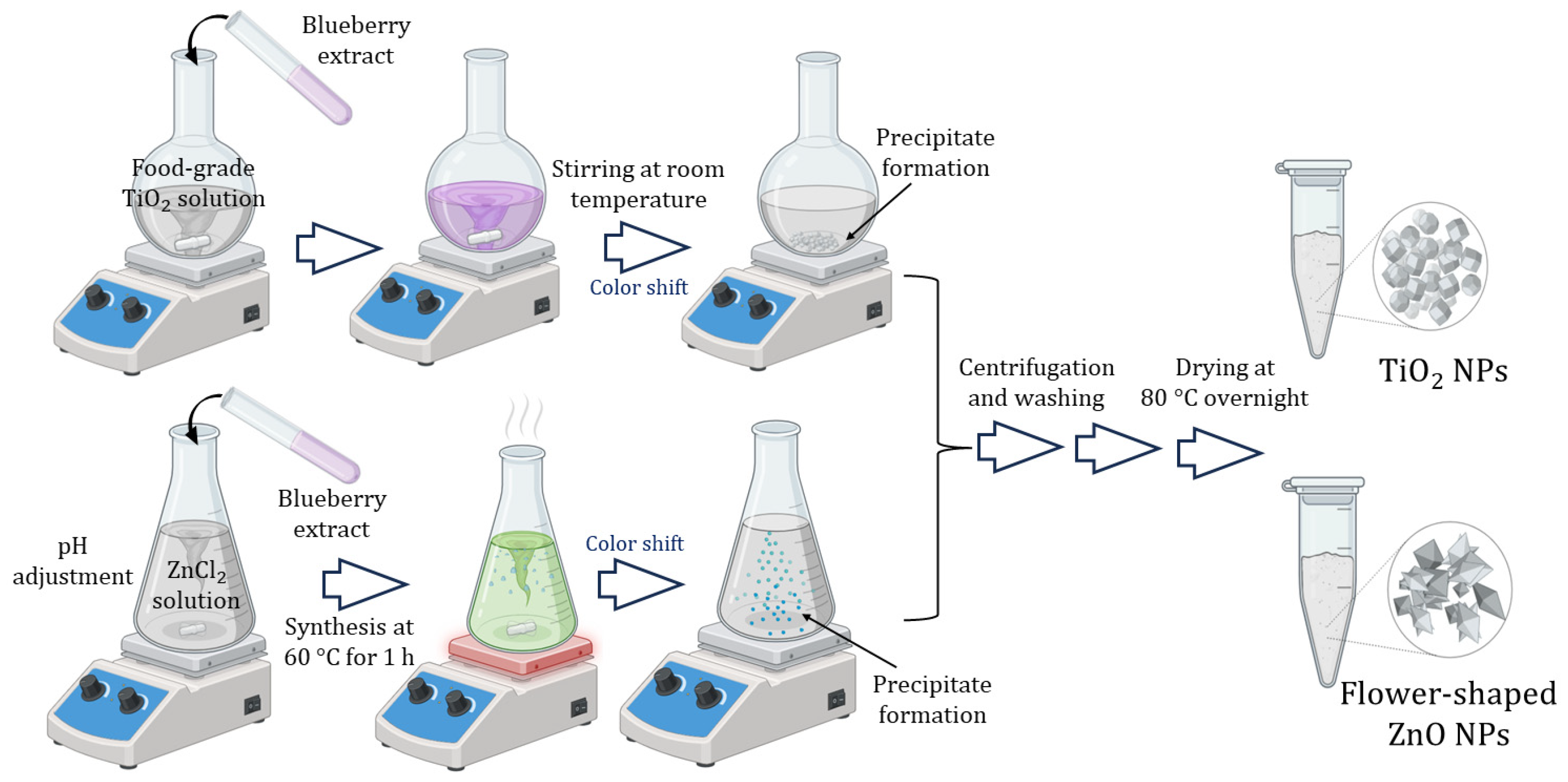
A 90 mL suspension of 1 × 10⁻³ M food-grade TiO2 was stirred at room temperature for 2 h. Then, 10 mL of blueberry extract was added while stirring continuously at room temperature (25 °C). After 2 h, the mixture was heated at 60 °C for 1 h. The product was recovered by centrifugation at 10,000 rpm for 15 min, washed repeatedly with deionized water, and dried at 80 °C overnight.

2.6. Synthesis of Zinc Oxide NPs

As depicted in Figure 1, ZnO NPs were synthesized through a green method [19] by mixing 90 mL of a 10 mM ZnCl2 solution, which was stirred for 20 h at room temperature. After this time, 1 M NaOH solution was added dropwise to a final pH of 12. Then, 10 mL of blueberry extract was added dropwise to the solution, and the mixture was heated to 60 °C for 1 h with continuous stirring. The precipitate formed was separated by centrifugation at 10,000 rpm for 15 min. The resulting product was then washed and dried overnight at 80 °C.

2.7. Characterization of TiO2 NPs and ZnO NPs

The structural characterization of TiO2 NPs and ZnO NPs was performed using multiple solid-state analytical techniques. The FTIR spectra were recorded in the range of 4000–400 cm−1 using a PerkinElmer 400 FTIR spectrometer (PerkinElmer, Waltham, MA, USA). XRD analysis was conducted in an Empyrean diffractometer (PANalytical, Westborough, MA, USA) to determine the crystalline structure in a range of 2θ angles from 10 to 70. The morphology and particle size were assessed by TEM using a JEM-1010 microscope (Japan Electron Optics Laboratory Co., Ltd., Tokyo, Japan). SEM imaging was performed using a JEOL 7610F microscope, with the samples coated with a thin Au-Pd layer using a Denton Vacuum Desk V sputter coater under an argon atmosphere to enhance conductivity. All powder samples were sputter-coated prior to imaging. A thin layer of Au was used as the conductive coating material. The sputtering process was performed for 30 s for each sample. Based on calibration data from the sputtering equipment, the deposition rate was approximately 1 nm·s−1. Consequently, the thickness of the Au coating is estimated at ~30 nm across all analyzed samples. The elemental composition of TiO2 NPs and ZnO NPs was examined via XPS using a Sigma2 XPS and Theta-probe system (Thermo Fisher Scientific, East Grinstead, UK) to identify surface chemical species. Binding energies were calibrated to the adventitious C 1s line at 284.5 eV, and chemical-state assignments followed the Perkin–Elmer XPS Handbook [20]. Additionally, Raman spectroscopy was performed with an alpha300 RA confocal microscope (WITec-Oxford Instruments, Ulm, Germany), employing a 532 nm excitation laser at 50–60 mW power and a 50× objective lens to analyze the vibrational modes of the samples. The particle size, polydispersity index (PDI), and zeta potential (ζ) of the NPs were determined using dynamic light scattering (DLS) with a Zetasizer Nano instrument (Malvern Instruments, Worcestershire, UK). A 1 mg sample of each material was dissolved in HPLC water and sonicated for 10 min (split into two 5 min sessions) at 25 °C. Serial dilutions were prepared, and particle size measurements were carried out in four-sided polystyrene cells. Zeta potential was measured at 25 °C. Each test was performed in triplicate, with 20 runs per sample and a 5 s stabilization period between runs. UV-Vis absorption spectra were recorded in a Nanodrop 2000 (Thermo Scientific, Waltham, MA, USA).

2.8. Biological Activity of TiO2 NPs and ZnO NPs

2.8.1. Maintenance and Preservation of Microorganisms

The bacterial strains were grown on trypticase soy agar plates (Becton Dickinson, Cockeysville, MD, USA) at 37 °C for 18–20 h. The cultures were stored at 4 °C for maintenance; an isolated colony was subsequently harvested and re-streaked onto a second agar plate every seven days. A glycerol stock of bacteria was stored at −80 °C.

2.8.2. Antimicrobial Activity Assay

Three isolated colonies of each strain (uropathogenic Escherichia coli and Salmonella Typhimurium) were grown in 3 mL of Luria–Bertani (LB) broth at 37 °C and 250 rpm until 0.5 McFarland (~106 CFU/mL) was reached. Separately, serial dilutions of TiO2 NPs and ZnO NPs (sonicated previously) were performed in Mueller–Hinton broth, ranging from 16 mg/mL to 0.25 mg/mL, in a 96-well plate with a final volume of 100 µL. Each well was spiked with 100 µL of the bacterial inoculum and incubated at 37 °C for 18 h. Two controls were used: the growth control (Mueller–Hinton broth with NPs and a bacterial suspension) and the sterility control (Mueller–Hinton broth without a bacterial suspension). Growth was quantified using a Multiskan FC plate reader (Thermo Fisher Scientific, Waltham, MA, USA) at 595 nm [21,22].
MIC and MBC Determination
The MIC and MBC values were determined by adding 10 μL of resazurin (Sigma-Aldrich, St. Louis, USA; 0.01 mg/mL in saline) to each well after incubation, following the same aforementioned protocol. The mixture was then incubated for an additional 75 min at 37 °C. The MIC was defined as the lowest concentration that did not cause a color change (from blue to pink), indicating no bacterial growth. To assess the MBC, 20 μL samples from wells without visible growth were spread onto Mueller–Hinton agar (DIFCO, Franklin Lakes, NJ, USA) and incubated. The MBC was determined as the lowest concentration at which bacterial colonies failed to form on the agar plate [23].
Probit Regression Analysis
Dose–response relationships were analyzed using probit regression, transforming NPs concentrations (0.25–16 mg/mL) logarithmically to base 10 and Abbott-corrected inhibition proportions to probit units via [24]:
Y = Φ 1 ( P )
where Y is the probit unit, Φ−1 the inverse cumulative standard normal distribution function, and P the inhibition proportion. The linear probit model,
Y = α + β log 10 ( C )
where α is the intercept, β the slope, and C the concentration (mg/mL), was fitted by weighted least squares with weights.
The LD50 was estimated as the concentration corresponding to probit = 5 (50% inhibition):
LD 50 = 10 5 α β
Bootstrap Resampling
To quantify uncertainty in LD50 estimates, nonparametric bootstrap resampling with 1000 iterations per treatment combination was performed, generating each replicate by case resampling (random sampling with replacement) and fitting a complete probit model. The convergence criterion required a positive-definite Hessian matrix and finite parameters, resulting in 99.4% of iterations converging. Bootstrap confidence intervals were constructed using the percentile method, defining 95% CI by the 2.5th and 97.5th percentiles [25]:
CI 95 % bootstrap = [ Q 0.025 ( LD 50 ) , Q 0.975 ( LD 50 ) ]
where Q represents percentiles of the bootstrap estimates. Relative bias was quantified as:
Bias ( % ) = Median bootstrap LD 50 probit LD 50 probit × 100
with ±10% considered indicative of negligible systematic error. Precision was evaluated via the coefficient of variation
CV ( % ) = SD bootstrap Mean bootstrap × 100
where SD is the bootstrap standard deviation, with CV < 30% considered indicative of acceptable precision. Subsampling stability analysis assessed the convergence of CI and LD50 medians by extracting subsamples of n = 50 to 994 (in steps of 20), defining convergence as stabilization within ±10% of the final value at n = 994.

2.8.3. Toxicity

Isolation of Peripheral Blood Leukocytes
Laying hens (Gallus gallus domesticus) peripheral blood leukocytes (PBLs) were used to determine the cytotoxic properties in vitro. The viability, or cytotoxicity effect, of TiO2 NPs and ZnO NPs was evaluated in PBLs. To obtain PBLs, blood was withdrawn from the caudal vein with a heparinized syringe under sterile conditions and diluted with RPMI 1640 medium (3× heparin, 1:1). Posteriorly, and very carefully with a Pasteur pipette, 1.25 mL of this suspension were layered on 2 mL of Histopaque 1077 and centrifuged at 1500 rpm at 25 °C for 10 min. The leucocyte bands were collected and washed twice with sRPMI medium. The viability was counted using trypan blue in a TC20 Coulter Particle Counter (BioRad, Hercules, CA, USA) and adjusted to 1 × 10⁶ cells/mL of RPMI (enriched with 100 IU/mL penicillin, 100 mg/mL streptomycin, 30 IU/mL heparin, and 5% fetal bovine serum).
80 µL of leukocytes were dispensed into a 96-well flat-bottomed plate (Nunc, Waltham, MA, USA) containing 1 × 10⁶ cells/mL per well. Afterward, leukocytes were stimulated with 20 μL of TiO2 NPs or ZnO NPs at 50, 100, and 500 µg/mL for 24 h at 37 °C, with 85% relative humidity and a 5% CO2 atmosphere. PBLs stimulated with different treatments, PBLs without any treatment, and PBLs incubated with DMSO (controls) were studied in quintuplicate.
Cell Viability Assay in Gallus gallus domesticus
The leukocytes from Gallus gallus (PBLs) were used as a sensitive biological model to assess the immunocompatibility of the synthesized NPs. This model was selected due to its reliability in toxicological screening and its ability to provide a representative response of the vertebrate immune system to xenobiotics. The resazurin method was used to assess leukocyte activity [26]. Briefly, PBLs were stained with 10 μL of resazurin solution (Sigma, St. Louis, MO, USA) and incubated at 37 °C and 5% CO2 for 4 h. Then, the fluorescence was measured in a Varioskan™ Flash Multimode Reader (Thermo Scientific, Waltham, MA, USA) with excitation at 530 nm and emission at 590 nm. The assay was performed in sixfold and viability (%) was calculated using Equation (7).
V i a b i l i t y ( % ) = A s a m p l e A n e g a t i v e × 100
where Asample is the absorbance of treated cells, and Anegative is the absorbance of untreated control cells.
All animal procedures were approved by the Research Ethics Committee from Centro de Investigaciones Biológicas del Noroeste, S.C. (CIBNOR), under ethical approval code CIBNOR-CEI-2024-07. The study was conducted in compliance with the Mexican regulations NOM-062-ZOO-1999 for the use and care of laboratory animals and NOM-087-ECOL-SSA1-2002 for the management of biological hazardous waste.
Artemia salina Bioassay (Mortality)
The Artemia salina lethality assay was employed as a preliminary, standardized toxicological screening tool due to its high correlation with general toxicity in higher organisms and its efficiency in assessing the environmental safety of nanomaterials. Artemia salina cysts (Fish & Animals, Guadalajara, Mexico) were incubated for 24 h at 28 °C in synthetic seawater (30 g/L) under constant light and aeration. Subsequently, ten A. salina nauplii were placed in each well of a six-well cell culture plate, with the total volume adjusted to 5 mL of synthetic seawater, and the plate was exposed to NPs. Potassium dichromate was used as a positive control. Nauplii were observed under a light chamber to facilitate counting. The organisms were kept in darkness, and after 24 h of exposure to different concentrations of NPs, the mortality percentage was determined using Equation 8 [27].
M o r t a l i t y ( % ) = ( D e a d   n a u p l i   i n   t h e   b i o a s s a y T o t a l   n a u p l i   a t   t h e   b e g i n n i n g ) × 100

2.9. Molecular Docking Analysis

After analyzing the chemical composition by HPLC, we selected compounds with known or potential antimicrobial activity based on prior research. For molecular docking, AutoDock Vina version 1.2.0 (The Scripps Research Institute, La Jolla, CA, USA) was used. The structure data files (sdf) were downloaded from PubChem and then optimized in Avogadro version 1.2.0 (open-source; Kitware, Clifton Park, NY, USA; https://avogadro.cc, accessed on 18 January 2026) using the Molecular Mechanics Force Field 94 (MMFF94) and the Steepest Descent algorithm. These methods address bond stretching, angles, twists, Van der Waals forces, and partial charges to lower the compounds’ energy levels [28] before aligning them with the relevant protein sites.
The crystal structures were sourced from the RCSB protein database, specifically for the DNA gyrase of E. coli (PDB ID: 6KZV) and S. Typhimurium (PDB IDs: GyrB-P0A2I3 and GyrA-P37411). In Autodock 4, the structures underwent processing that involved the removal of water molecules, the repair of missing bonds, and the addition of Kollman charges.

2.10. In Silico of Drug-Likeness Assessments and Toxicity

The SwissADME web tool (Swiss Institute of Bioinformatics, Lausanne, Switzerland; https://www.swissadme.ch) and pkCSM (University of Cambridge, Cambridge, UK, available at http://biosig.unimelb.edu.au/pkcsm, accessed on 18 January 2026) were used to evaluate the ADMET profile. To assess the toxicological risks of specific compounds, the ProTox-III server (version 3.0, Charité-Universitätsmedizin Berlin, Berlin, Germany) was employed. This platform combines molecular similarity, pharmacophores, fragment propensities, and machine learning models to predict various toxicity endpoints.

2.11. Statistical Analysis

All data were presented as mean values with standard deviations (n = 3, 3 biological replicates). The data’s normality was evaluated with the Shapiro–Wilk test, and homogeneity of variance was checked using Levene’s test. These tests were conducted and analyzed through two-way ANOVA or one-way ANOVA, followed by Dunnett’s or Tukey’s multiple comparisons test (GraphPad Prism version 6.01 for Windows, GraphPad Software Inc., San Diego, CA, USA, and Python version 3.10, Python Software Foundation, Wilmington, DE, USA). p-values < 0.01 or <0.00001 were considered significant. Pairwise comparisons of bootstrap distributions were performed using Welch’s t-test (α = 0.05), robust to heteroscedasticity.

3. Results and Discussion

The proximate analysis of blueberries (per 100 g of fresh matter) revealed the following composition: moisture content of 82.2 ± 0.3 g, crude protein (calculated as nitrogen × 6.25) of 1.0 g (RSD < 1%, n = 3), total lipids ND (not detected), crude fiber of 2.4 g (RSD < 1%, n = 3), ash content of 0.2 g (RSD < 1%, n = 3), and total carbohydrates (calculated by difference) of 16.6 ± 0.54 g.

3.1. Characterization of the Blueberry Extract

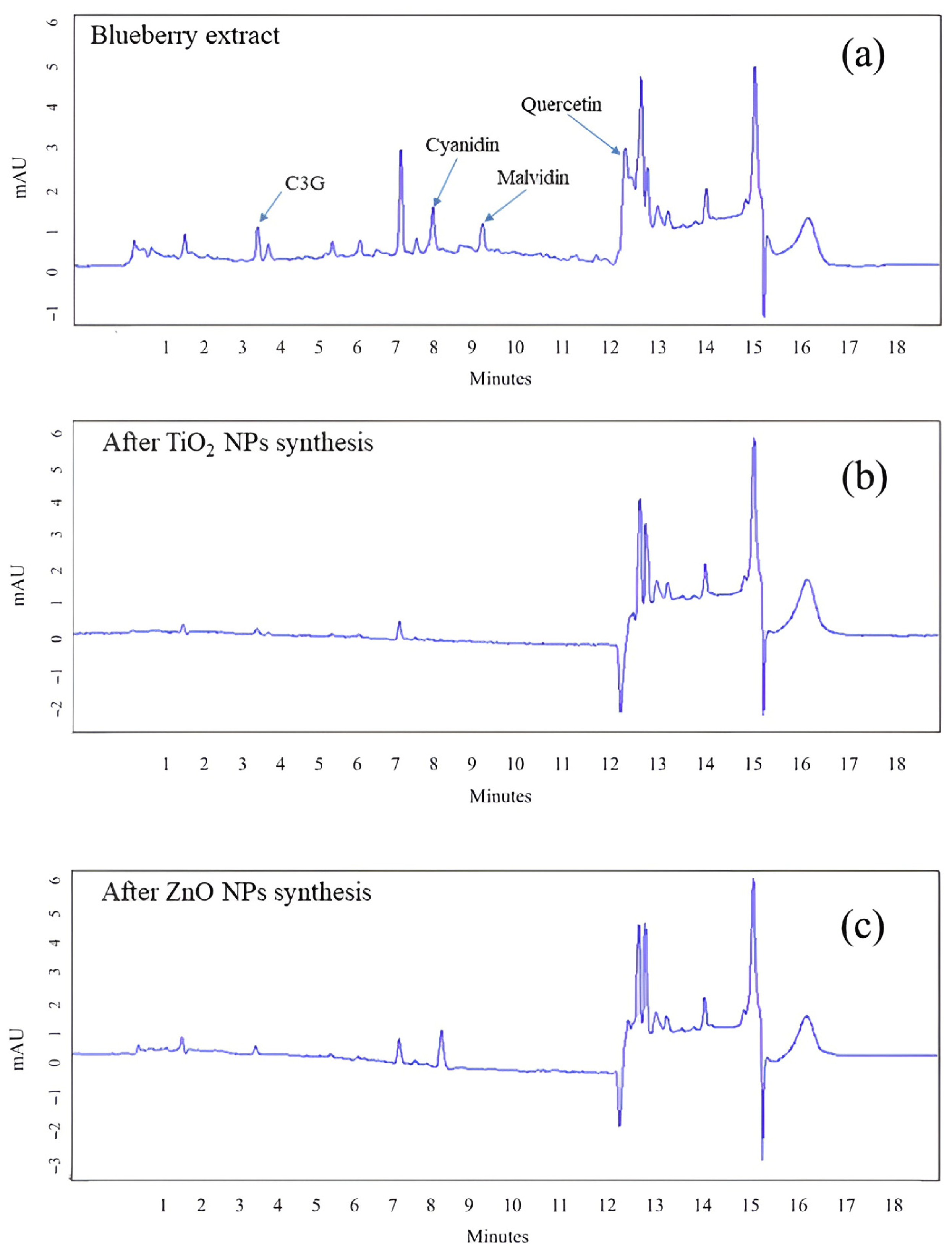
The HPLC chromatographic profiles demonstrate clear compositional changes in the blueberry extract after its use in the green synthesis of TiO2 NPs and ZnO NPs. In the untreated extract (Figure 2a), multiple distinct peaks—assigned to cyanidin-3-glucoside (C3G), cyanidin, malvidin, and quercetin—reflect a rich phenolic composition [29]. Following TiO2 NP formation (Figure 2b), a pronounced reduction in both the number and intensity of these peaks is observed, indicating that these constituents were consumed, transformed, or immobilized during the synthesis process [11,12,16,17].
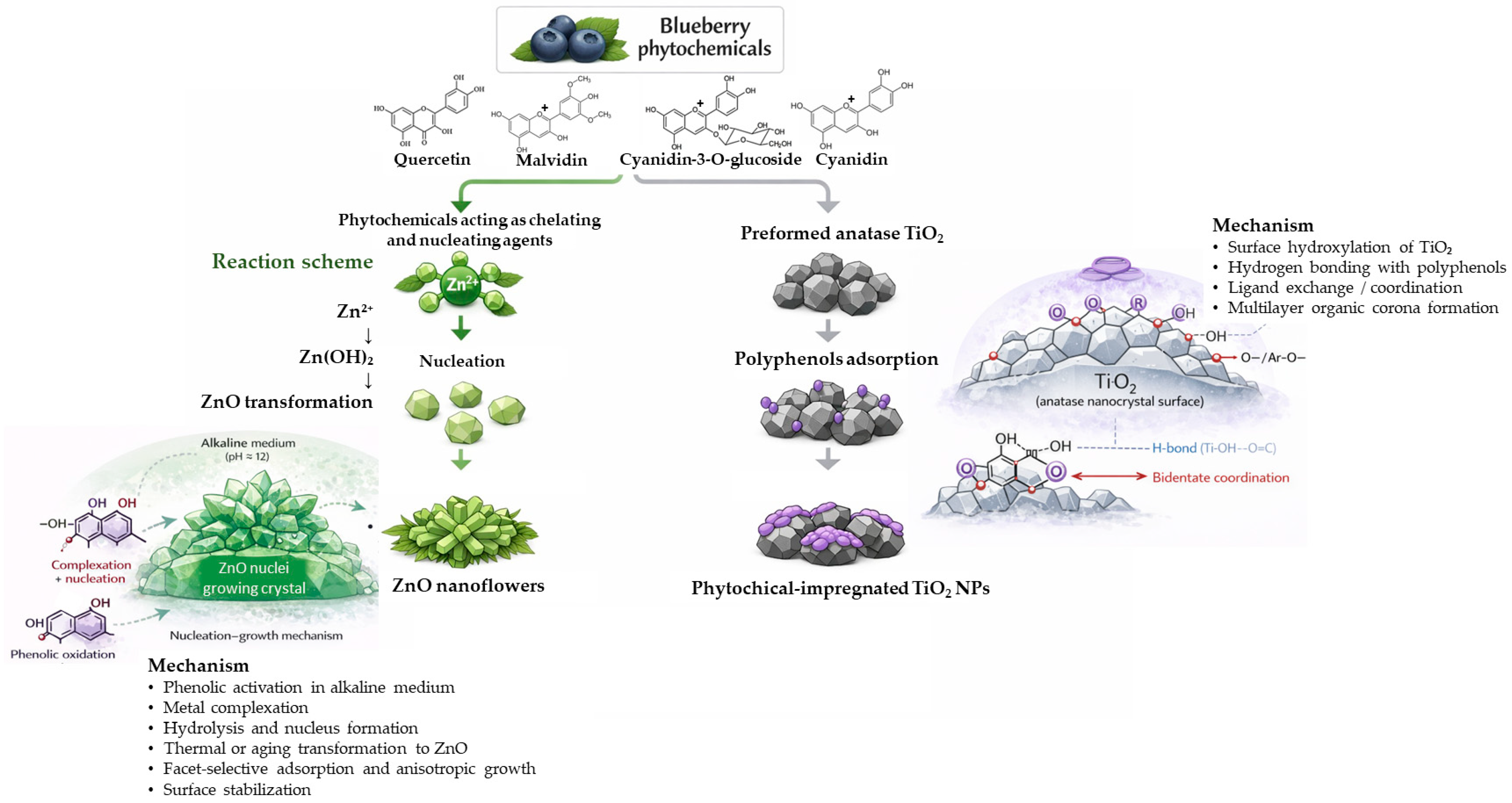
This behavior is consistent with the affinity of TiO2 NPs surfaces, particularly anatase, for polyphenolic compounds containing catechol and hydroxyl groups [29]. Anthocyanins and flavonoids can interact with TiO2 NPs through bidentate coordination involving hydroxyl and carbonyl functionalities, forming surface complexes that may not be fully recovered during extraction [30,31,32]. Consequently, the observed decrease likely reflects not only chemical transformation but also adsorption and surface immobilization of these compounds [31,33]. Together, these factors indicate the more pronounced depletion observed in the TiO2 NPs system.
In contrast, the extract recovered after ZnO NP synthesis (Figure 2c) retains a larger fraction of the original peaks, albeit at lower intensities. This profile is consistent with the formation mechanism of ZnO NPs, which is mainly controlled by alkaline hydrolysis–condensation processes (Zn2+ → Zn(OH)2 → ZnO), where saturation and pH drive nucleation in the bulk phase [18,30]. Under these conditions, polyphenols primarily function as complexing and stabilizing agents, interacting momentarily with zinc species and NPs surfaces rather than being extensively consumed or immobilized [5,8]. As a result, a significant portion of these compounds remains in solution, leading to a comparatively lower depletion of phenolic signals in the chromatographic profile.
The identified compounds—quercetin, cyanidin, malvidin, and C3G—are likely involved in both NP formation through direct interactions with metal species and NP surfaces (Figure 3). Their hydroxyl and carbonyl groups enable coordination with metal ions and adsorption onto NPs surfaces, contributing primarily to stabilization and modulation of particle growth [6,30]. While their redox properties may allow some participation in chemical transformations, this is not expected to be the dominant mechanism, particularly in the ZnO NPs [3,4,7]. Such behavior is consistent with plant-mediated synthesis, in which polyphenols primarily act as surface-associated stabilizing agents [9].
These differences in chromatographic profiles suggest that polyphenols behave differently across systems. In the case of TiO2 NPs, the greater decrease in peak intensity is consistent with increased surface association and possible transformation under the synthesis conditions. In contrast, the ZnO NPs show a more preserved profile, indicating a more limited involvement, mainly related to stabilization and growth processes.

3.2. FTIR Analysis

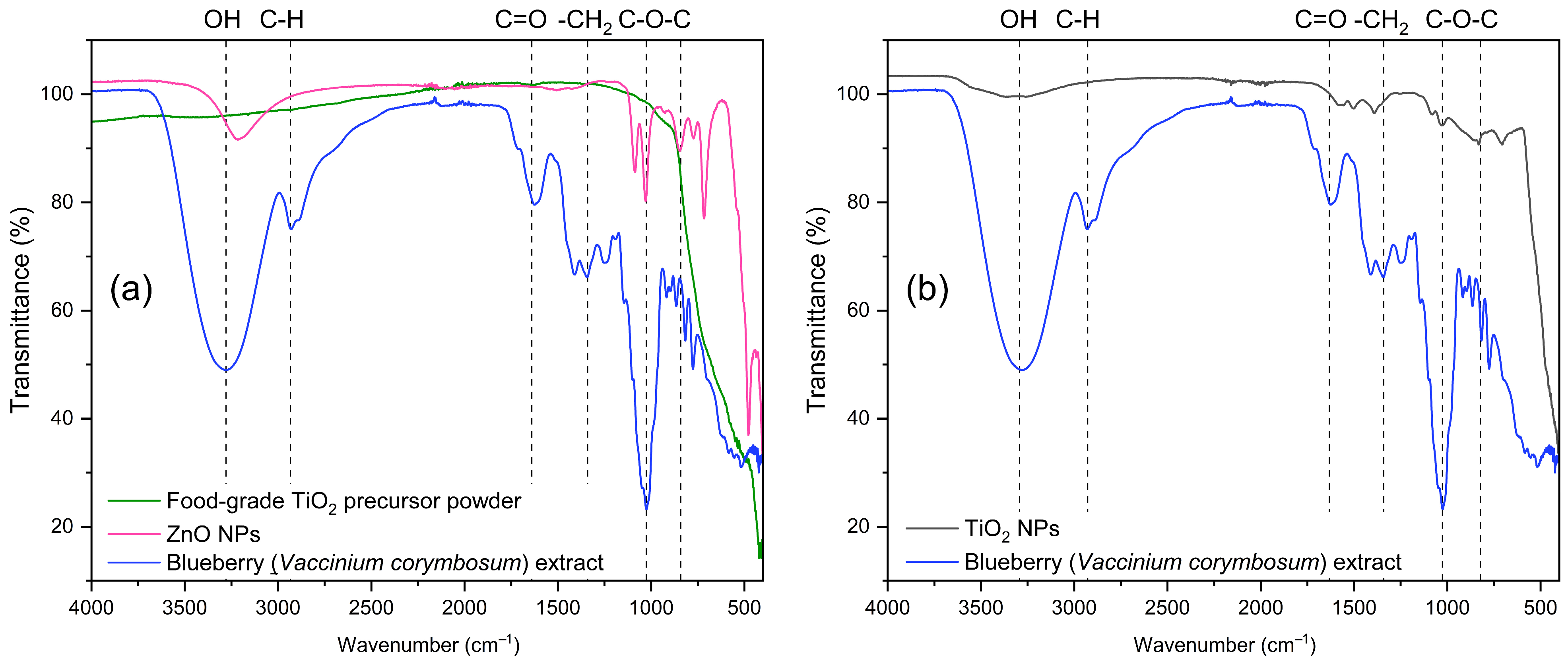
As observed in Figure 4a, the blueberry extract exhibits a broad absorption band centered at ~3300–3400 cm−1, characteristic of O–H stretching vibrations from hydrogen-bonded phenolic compounds. Additional bands at ~2920 cm−1 correspond to aliphatic C–H stretching, while signals in the ~1600–1700 cm−1 region are associated with C=O and aromatic C=C vibrations of polyphenolic structures [7,14,33]. Intense features between ~1200 and 1000 cm−1 are attributed to C–O and C–O–C stretching modes typical of glycosylated flavonoids and anthocyanins [11,34,35]. In the ZnO NPs, a noticeable decrease in intensity and slight displacement of hydroxyl and carbonyl bands is detected, indicating coordination of phytochemical ligands with Zn2+ species during ZnO NPs formation [36,37]. Furthermore, the emergence of absorption features in the low-wavenumber region (<600 cm−1) is consistent with Zn–O lattice vibrations, confirming the generation of ZnO structures [36,38,39]. The persistence of weak organic signals suggests that residual phytochemicals remain adsorbed on the ZnO NPs surface, acting as stabilizing agents and influencing crystal growth and morphology [11,12,16].
In contrast, the FTIR spectrum shown in Figure 4b indicates that TiO2 NPs retain several characteristic vibrational bands of the blueberry extract, including hydroxyl, carbonyl, and C–O–C signals associated with polyphenolic compounds. The preservation of these organic features, together with only moderate band attenuation and slight shifts, suggests that phytochemicals are not consumed during particle formation but rather become associated with the oxide surface. This behavior is consistent with a phytochemical impregnation process, in which pre-formed TiO2 NPs act as nanocarriers that immobilize and stabilize bioactive molecules through surface interactions such as hydrogen bonding and coordination with Ti-OH groups [21,22,30]. The resulting organic coating may enhance colloidal stability and modify interfacial reactivity, highlighting a mechanism dominated by ligand loading rather than TiO2 NPs nucleation.

3.3. XRD Analysis

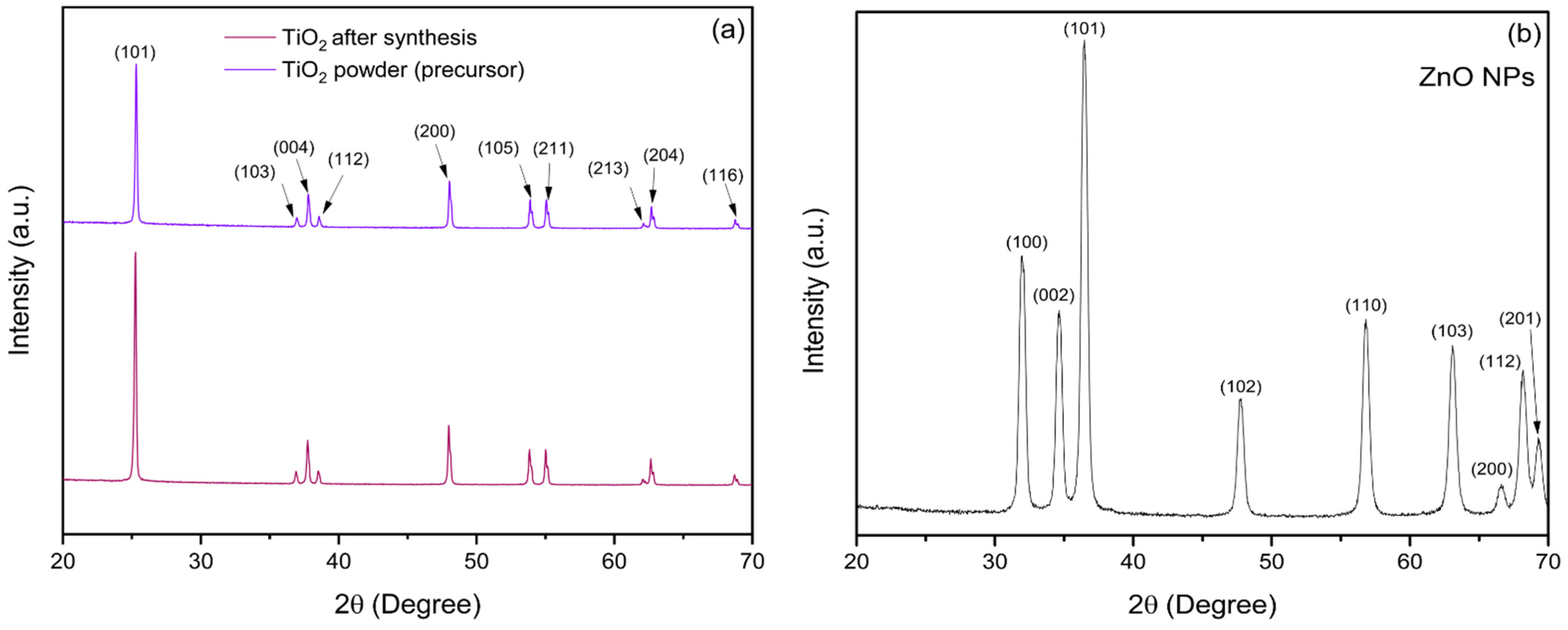
The structural properties of the TiO2 NPs and green-synthesized ZnO NPs were investigated using X-ray diffraction (XRD). Figure 5a overlays the food-grade TiO2 precursor and TiO2 NPs on the same axes. The XRD pattern of TiO2 NPs (Figure 4a) displayed prominent diffraction peaks at 2θ values corresponding to the (101), (004), (200), (105), (211), (204), (213), and (116) planes, which are consistent with the anatase phase of TiO2, as referenced by JCPDS card No. 21-1272. Among these, the (101) peak at 25° exhibited the highest intensity, indicating it as the preferentially oriented plane. The sharp and well-defined peaks reflect the high crystallinity of the anatase phase, which is critical for photocatalytic applications. This phase purity is advantageous, as the anatase form is known to exhibit superior photocatalytic activity due to its higher surface area and enhanced charge separation efficiency compared to the rutile phase [4,40].
For ZnO NPs, the XRD pattern (Figure 5b) revealed diffraction peaks at 2θ values corresponding to the (100), (002), (101), (102), (110), (103), (200), (112), and (201) planes, which match the hexagonal wurtzite structure of ZnO, according to JCPDS card No. 36-1451. The most intense peak at 36°, corresponding to the (101) plane, indicates a preferential growth orientation that may influence the material’s optical and catalytic properties. The narrow and sharp diffraction peaks confirm the high crystallinity of the ZnO NPs. Importantly, no secondary phases or impurity-related peaks were observed, suggesting high phase purity. The wurtzite structure, known for its anisotropic optical and piezoelectric properties, renders ZnO NPs suitable for a wide range of applications, including optoelectronics, photocatalysis, and antimicrobial systems [41,42].
The anatase TiO2 NPs phase, with its superior photocatalytic activity, can also support light-triggered antimicrobial effects, while the wurtzite ZnO NPs structure is well-suited for sustained antimicrobial action under ambient conditions [3,42].
Figure 5a shows the diffraction patterns of the TiO2 NPs (red line) and commercial food-grade powders as a precursor (violet line). All main diffraction peaks were identified and assigned to the anatase phase in both cases (JCPDS #21-1272).
On the other hand, comparing the diffractograms, the intensity of the TiO2 NPs’ diffraction peaks increases, along with their width. Based on the above, the crystallinity percentage and crystallite size were determined using Equations (9) and (10), respectively. The results are shown in Table 2. As observed, the formation method increases the crystallinity of the TiO2 powders while decreasing the crystallite size. Additionally, the bioassisted synthesis of TiO2 NPs shows a slight shift towards smaller angles compared to commercial powders. This shift can be associated with oxygen vacancies introduced during synthesis [43].
C r i s t a l l i n i t y = A r e a c r y s t a l l i n e   p e a k s A r e a a l l   p e a k s
D = ( 0.95 ) ( λ ) ( β ) ( cos θ )

3.4. XPS Analysis

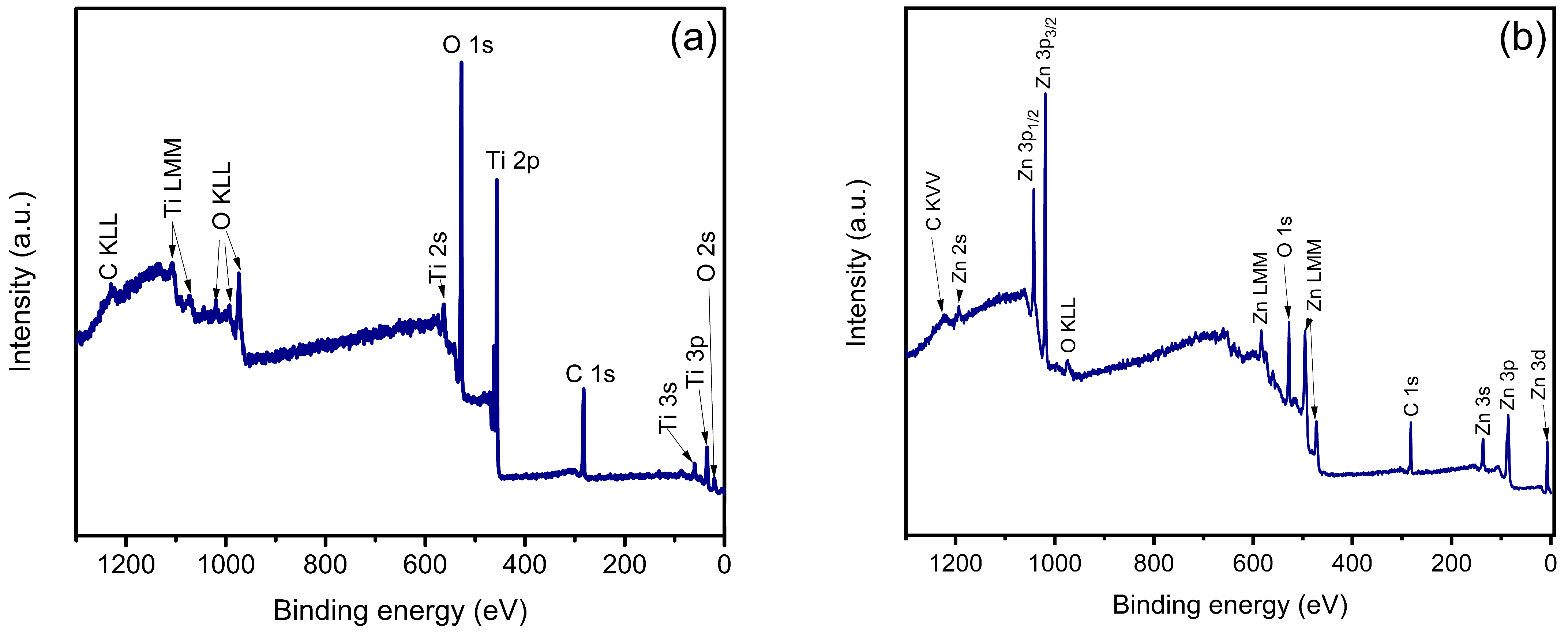
The full survey XPS spectra were acquired for each synthesized TiO2 and ZnO sample (Figure 6). As can be clearly observed, no additional chemical species were detected beyond those expected from the intrinsic composition of the studied metal oxides, confirming the high purity of the prepared materials.
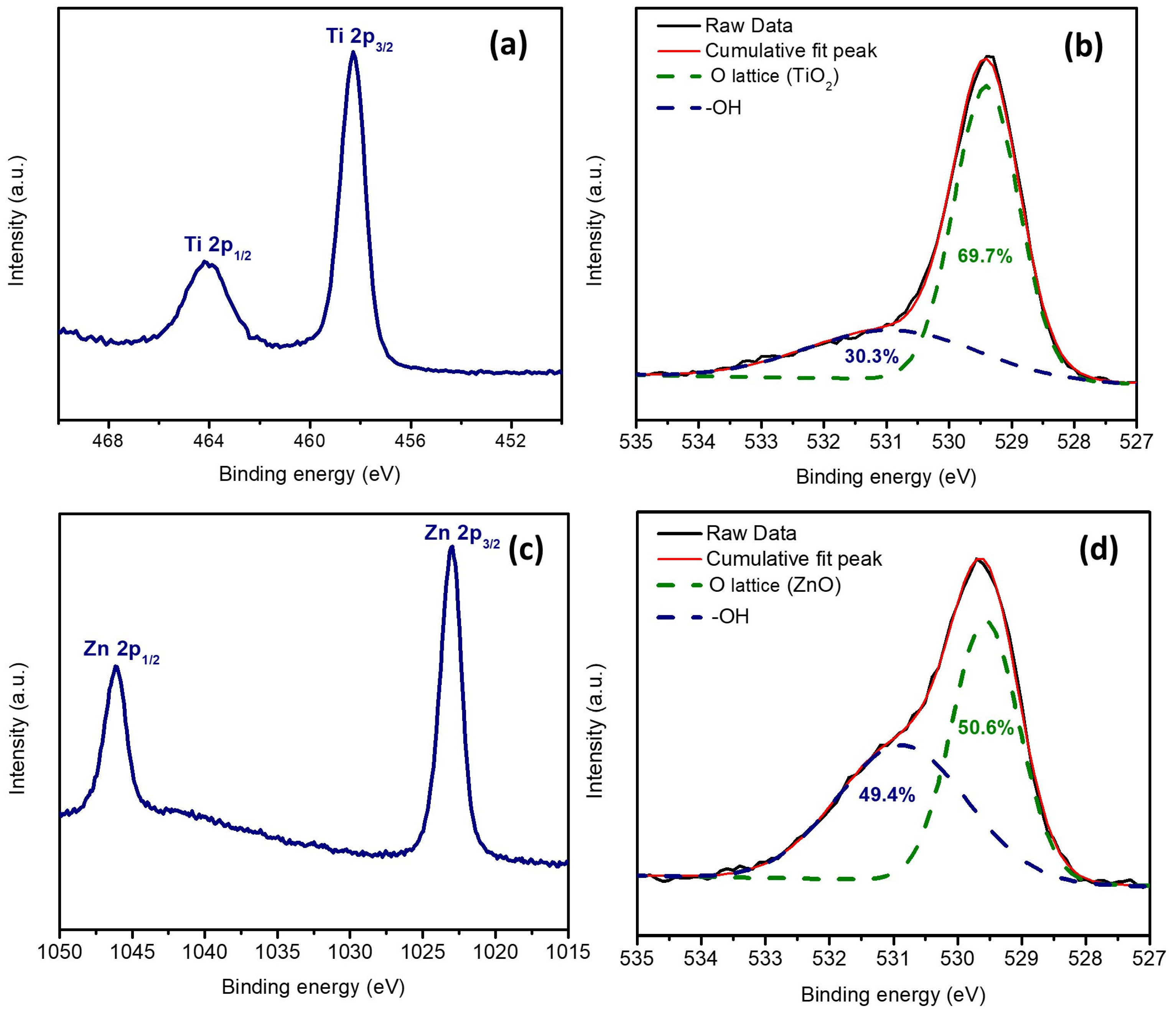
Figure 7 shows the XPS spectra of Ti 2p (a), Zn 2p (c), and O 1s (b–d) core levels. The latter is associated with TiO2 NPs and ZnO NPs, respectively. The Ti 2p XPS spectrum shows two peaks centered at 458.6 eV (2p3/2) and 464.1 eV (2p1/2) (Figure 7a). These binding energies are associated with the +4-oxidation state of Ti. Similarly, the Zn 2p XPS spectrum shows two peaks at 1022.9 eV (2p3/2) and 1046 eV (2p1/2) (Figure 7c). These energies are typical of Zn2+. On the other hand, the O 1s XPS spectrum of TiO2 (Figure 7b) was deconvoluted, yielding two Gaussians. The Gaussian centered at 529.4 eV was attributed to lattice oxygen (OL), while the one centered at 531 eV was associated with the presence of hydroxyl groups (-OH). Additionally, the percentage of the area covered by each was estimated at 69.7% (OL) and 30.3% (-OH). Similarly, the XPS spectrum of O 1s associated with ZnO (Figure 7d) was also deconvoluted into two Gaussians centered at 529.5 (OL) eV and 530.9 (-OH) eV.
Based on other research [44,45], the formation of these chemical groups is related to toxicity in metal oxides. Surface-bound hydroxyl (-OH) groups have been reported to contribute to the toxicity of metal oxides. This effect is primarily attributed to their role in generating reactive oxygen species (ROS), which are highly potent oxidizing agents. Although the precise mechanisms underlying ROS formation mediated by -OH groups within the human body remain not fully elucidated, experimental evidence suggests that Fenton-type reactions constitute the predominant pathway in this process [46,47]. The O 1s spectra were deconvoluted into lattice oxygen (529.4–529.5 eV) and a higher-binding component at ≈ 531.0 eV, assigned primarily to surface -OH/defect-related oxygen on the oxides. A minor contribution from residual phenolic/organic O from the green extract cannot be excluded, as suggested by FTIR signals; however, samples were repeatedly washed and dried (80 °C, overnight), and HPLC shows post-synthesis depletion of key phenolics, indicating limited carryover. This clarification does not affect the Ti 2p/Zn 2p oxidation-state assignments (Ti4+/Zn2+).

3.5. Raman Analysis

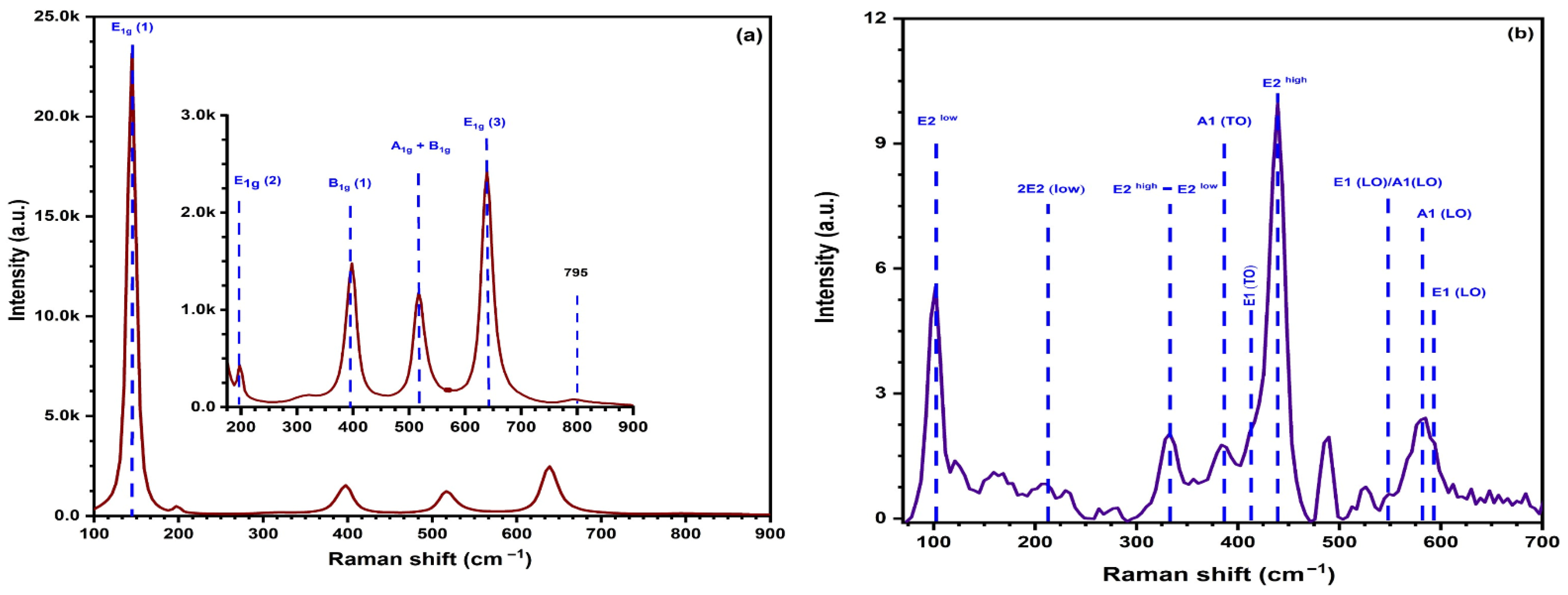
Raman spectral analysis of TiO2 and ZnO NPs provides critical insight into their structural integrity, crystallinity, and defect-related properties, which directly influence their physicochemical and functional properties. The Raman spectrum of the TiO2 NPs (Figure 8a) displays characteristic peaks at 145 cm−1 (E1g(1)), 319 cm−1, 398 cm−1 (B1g(2)), 517 cm−1 (A1g + B1g), 635 cm−1 (E1g(3)), and 795 cm−1, which correspond to the vibrational modes of the anatase phase [48]. The E1g(1) peak at 145 cm−1 is the most intense, indicating the dominance of the anatase phase, which is highly desirable for photocatalytic and biomedical applications due to its superior charge-separation efficiency [49]. A closer examination of the 145 cm−1 mode reveals a slight broadening and redshift, suggesting phonon confinement effects, which typically occur when the TiO2 NPs size is below 10 nm. This effect is expected, given the nanocrystalline nature of the TiO2 NPs. Furthermore, the weak but distinguishable peak at 795 cm−1 suggests the presence of oxygen vacancies and surface defects, which can significantly influence the electronic band structure and enhance photoinduced charge-transfer processes [50].
Two additional peaks at 398 cm−1 ((B1g(1)) and 517 cm−1 (A1g + B1g) confirm the symmetry-preserved vibration modes of the TiO2 lattice, reinforcing the structural integrity of the NPs. These modes, associated with translational and rotational motions of Ti–O bonds, are crucial for understanding electron-phonon interactions in semiconductor applications [51]. The absence of prominent rutile-phase peaks further confirms the phase purity, which is critical for maintaining the high surface area and active sites required for catalytic and antimicrobial performance [52].
The Raman spectrum of the ZnO NPs (Figure 8b) presents several distinct vibrational bands, confirming a highly crystalline wurtzite phase. The most intense peak at 437 cm−1 (E2 high) is the characteristic non-polar optical phonon mode of ZnO, signifying long-range crystalline order and minimal lattice distortion [53,54]. However, the presence of additional vibrational bands, particularly the E1 (LO) mode at ~580 cm−1, indicates a high density of oxygen vacancies and zinc interstitials, which strongly influence optical, electrical, and catalytic properties [55].
The observed E2 (low) mode at ~100 cm−1, arising from lattice vibrations associated with Zn atoms, shows a slight shift and broadening, suggesting phonon localization due to nanoscale strain [56]. Furthermore, the presence of the A1 (LO) and E1 (LO) modes at 488–500 cm−1 suggests strong defect-related disorder, which plays a crucial role in enhancing the photocatalytic and antimicrobial activities of ZnO NPs. Oxygen vacancies, in particular, act as electron donors, enhancing ROS generation, making ZnO NPs highly effective in antimicrobial applications.

3.6. TEM and SEM Analysis

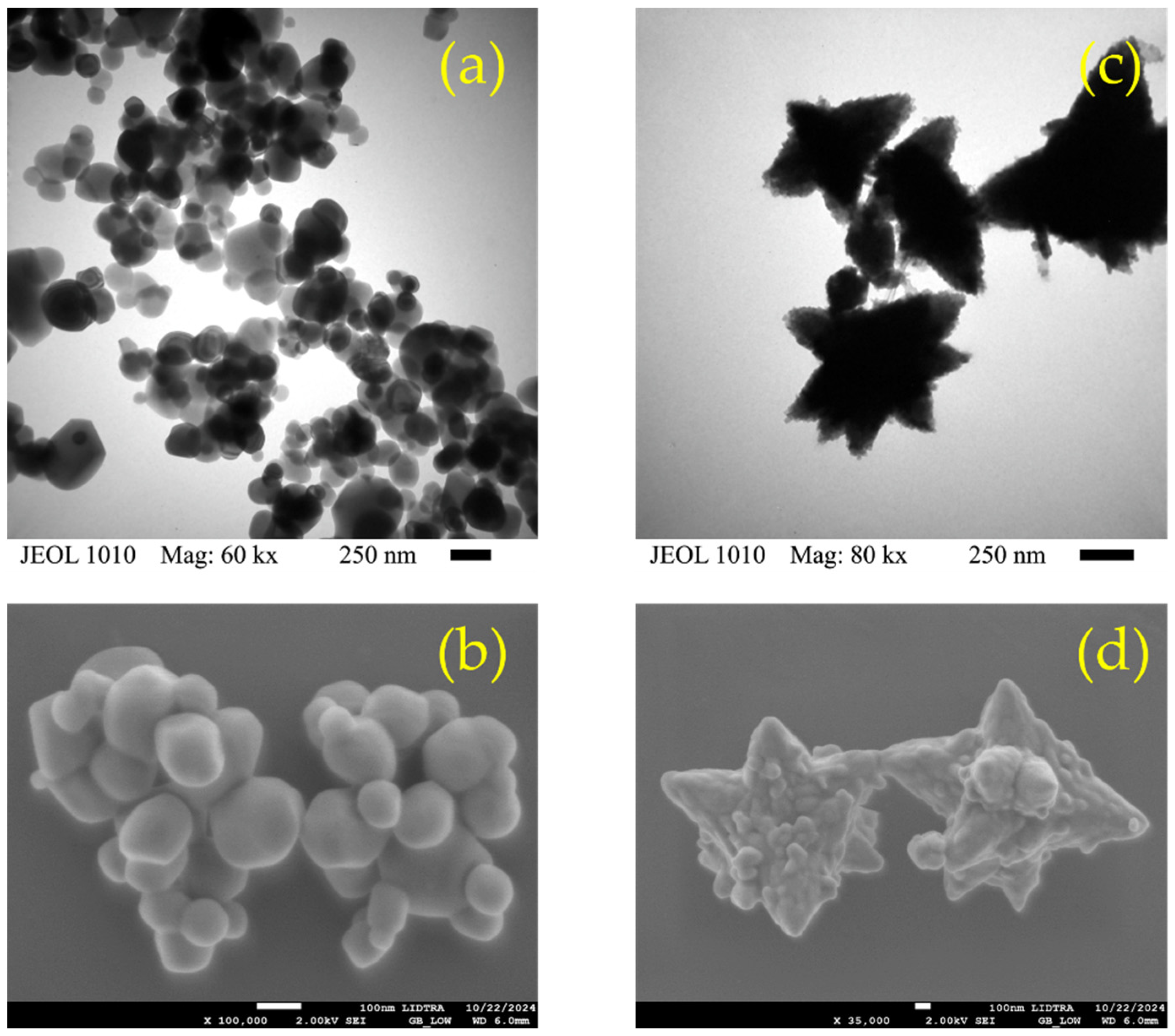
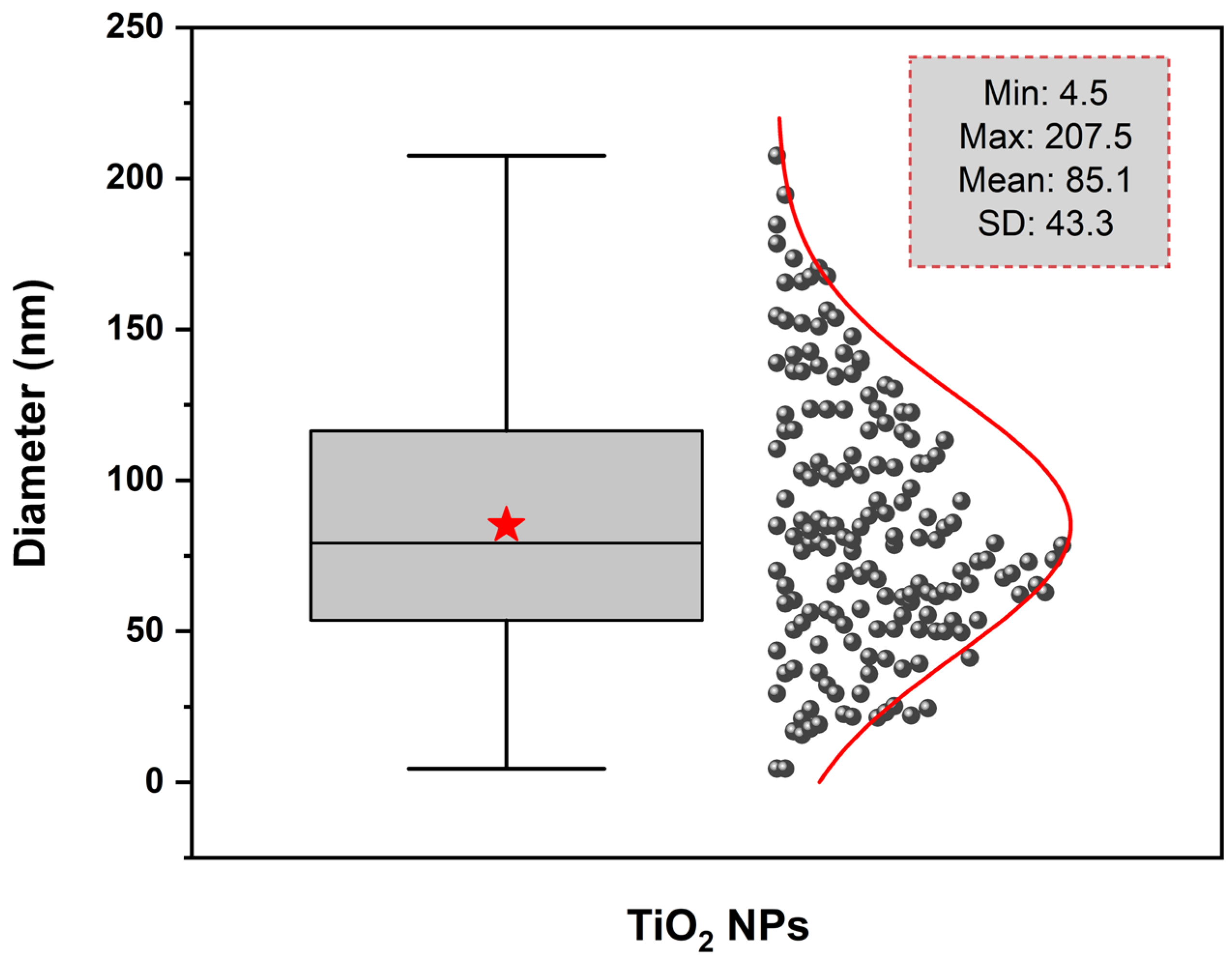
The morphologies of TiO2 NPs and ZnO NPs synthesized via green synthesis were characterized using TEM and SEM, as shown in Figure 9. TEM micrographs revealed that TiO2 NPs (Figure 9a) exhibited predominantly spherical structures and polydisperse primary domains, with evident agglomeration, indicative of consistent nucleation and isotropic growth [57]. In contrast, ZnO NPs (Figure 9c) exhibited sharp-edged, triangular, and star-like morphologies, suggesting non-uniform, directional growth likely influenced by synthesis conditions. The particle size histogram of TiO2 NPs (Figure 10) reveals a broad size distribution ranging from 4.5 to 207.5 nm, with an average particle diameter of 85.1 nm. The majority of TiO2 NPs are concentrated within the 50–100 nm interval, while the frequency progressively decreases toward larger sizes, with relatively few particles exceeding 150 nm. Additionally, a small fraction of TiO2 NPs with diameters below 20 nm was observed, indicating a polydisperse population centered around the mean size.
In contrast, in Figure 9, ZnO NPs exhibited a markedly different morphology, forming flower-like structures with an average length of approximately 677 nm. The thickness (petal width) of these nanoflower structures was also measured, showing a mean value of 240 nm.
SEM images further confirmed these findings: TiO2 NPs (Figure 9b) formed compact, smooth-surfaced clusters, while ZnO NPs (Figure 9d) presented hierarchical, flower-like assemblies with rough textures and increased surface complexity. These structures indicate a directional growth mechanism, likely promoted by the alkaline conditions used during synthesis (pH 12). At this high pH, the supersaturation and deprotonation of zinc species favor the formation of anisotropic crystal faces, driving the development of complex, multi-faceted ZnO morphologies [58,59]. All panels were exported at native aspect ratio with instrument-calibrated scale bars. Throughout this work, “nanoscale” refers to the characteristic dimensions of the subunits discernible in TEM/SEM, rather than to aggregate dimensions. As illustrated in Figure 9, nanoscale subunits assemble into larger clusters (compact for TiO2; flower-like for ZnO). Accordingly, we treat TEM/SEM images as qualitative morphological data and report image-based subunit measurements only when boundaries are resolvable.
Compared with NPs synthesized from various Vaccinium species, as shown in Table 1, these results are consistent with broader morphological trends observed in green-synthesized metallic NPs. Most reported systems yielded spherical or near-spherical particles, typically in the 1.4–25 nm range, with exceptions such as Se NPs reaching ~50 nm. Ag NPs derived from V. macrocarpon were among the smallest (1.4–8.6 nm), whereas copper and zinc oxide NPs from V. corymbosum commonly fell within 3–12 nm and ~12 nm, respectively. These findings suggest that controlled synthesis methods can reliably produce NPs with uniform morphology and narrow size distributions, regardless of the specific metallic element involved.
The spherical morphology of TiO2 NPs offers advantages such as structural stability, reduced agglomeration, and enhanced processability, which are particularly beneficial for applications in coatings, photocatalysis, and biomedical platforms that require predictable dispersion and interaction [60]. Conversely, the star-like and flower-like structures observed in ZnO NPs provide increased surface area and complex architecture, traits that are particularly useful in applications involving surface interactions, such as antimicrobial action, catalysis, or material adhesion [42,61].

3.7. Dynamic Light Scattering

Dynamic light scattering analysis (Table 3) showed that green synthesis significantly decreased the hydrodynamic diameter of TiO2 NPs (249.9 ± 39.9 nm) compared to the food-grade precursor (412.6 ± 69.9 nm). This aligns with the size reduction observed for Vaccinium corymbosum-mediated TiO2 synthesis [62]. ZnO NPs had the smallest hydrodynamic diameter (164.6 ± 55.9 nm), although it was not statistically different from TiO2 NPs (p < 0.05). Importantly, DLS-measured sizes were much larger than XRD crystallite dimensions (TiO2 NPs: ~49.98 nm; ZnO NPs: subunit scale), due to soft agglomeration and the formation of a biomolecular corona from Vaccinium corymbosum phytochemicals on particle surfaces [63,64,65]. For ZnO NPs, the TEM images revealed anisotropic, flower-like structures formed under alkaline conditions (pH 12), which promote supersaturation and deprotonation of zinc species, thereby further increasing the hydrodynamic size. This is consistent with Ramadhania et al. [66], who reported a DLS size of 676.65 nm for flower-shaped ZnO NPs, despite XRD sizes of only 21.89 nm.
The polydispersity indices (PDIs) for TiO2 NPs (0.745 ± 0.04) and ZnO NPs (0.749 ± 0.17) were not statistically different (p > 0.05), indicating broad, heterogeneous size distributions typical of biologically mediated synthesis. This contrasts with narrower PDI values (ranging from 0.237 to 0.401) reported for other plant-extract systems [63,65,66]. The food-grade TiO2 precursor exhibited a slightly lower PDI of 0.713 ± 0.09 (p < 0.05), consistent with its commercial milling. Zeta potential measurements showed significant differences (p < 0.05) among the three materials: TiO2 NPs (+24.0 ± 3.50 mV) > ZnO NPs (+17.8 ± 1.54 mV) > food-grade TiO2 (+12.5 ± 1.45 mV). All these values are below the ±30 mV electrostatic stability threshold, indicating only marginal colloidal stability and a tendency to aggregate [64]. In comparison, Neamah and Albukhaty reported ζ = −44.76 mV for ZnO NPs derived from Capparis spinosa, which provides strong electrostatic stabilization [64]. The moderate zeta potentials observed here suggest that phytochemical capping from V. corymbosum offers some steric stabilization but not enough electrostatic repulsion to prevent agglomeration, consistent with the compact TiO2 clusters and flower-like ZnO structures seen in TEM images.

3.8. UV-Vis Spectra

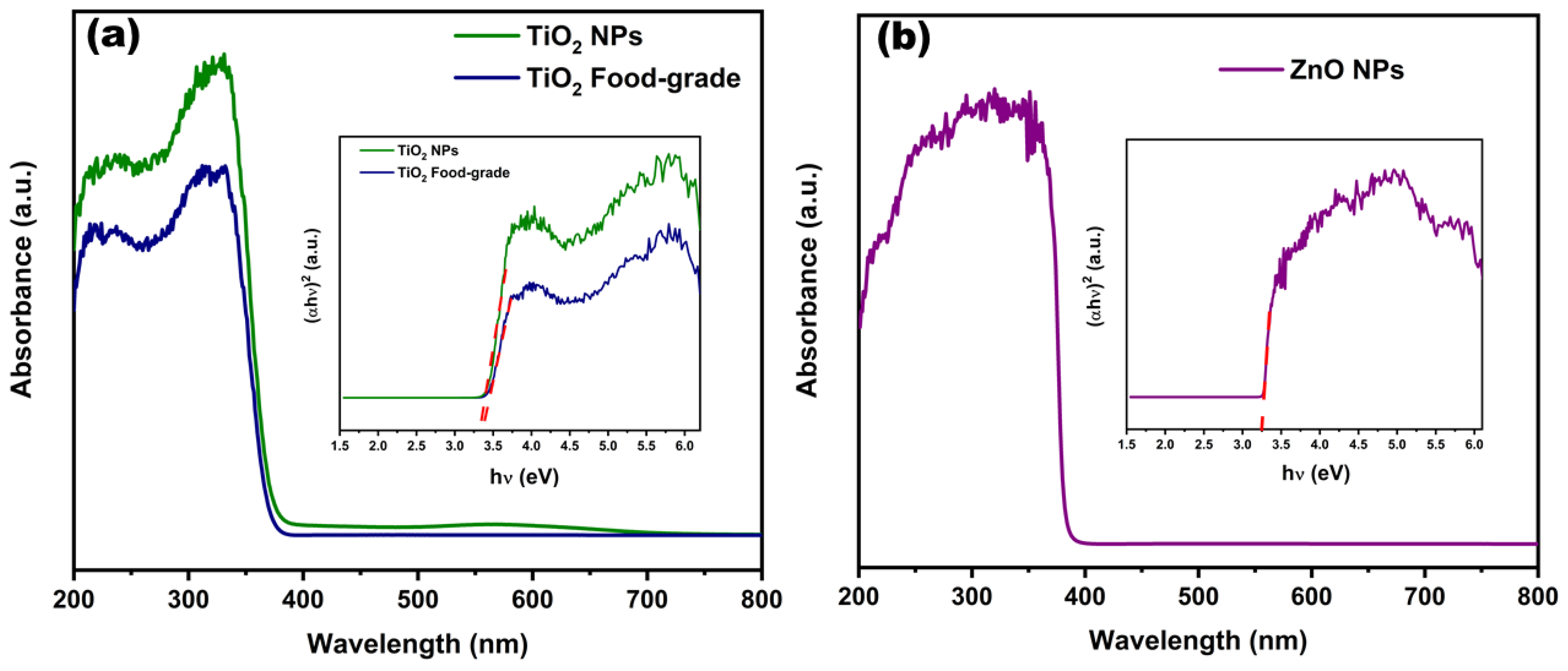
Figure 11a shows the UV–Vis absorption spectra of the TiO2 samples, together with the corresponding Tauc plots ((αhν)2 vs. hν) shown as insets. Both the synthesized TiO2 NPs and the commercial TiO2 exhibit strong absorption in the ultraviolet region (200–350 nm). The absorption edge for both samples is located around ~370–390 nm. Notably, the TiO2 NPs exhibit higher absorbance across the UV region than the commercial counterpart, which can be attributed to their smaller particle size and increased surface area, thereby enhancing light–matter interaction. Additionally, a slight redshift of the absorption edge is observed for the TiO2 NPs, suggesting the presence of structural defects, such as oxygen vacancies, or size-induced electronic effects that promote bandgap narrowing. The optical band gap energies were estimated from the Tauc plots by extrapolating the linear region of (αhν)2 vs. photon energy (hν) to the energy axis. The results indicate that the TiO2 NPs possess a band gap energy of 3.29 eV compared to the commercial TiO2 of 3.37 eV. This reduction is consistent with defect-induced states within the band structure. The UV–Vis absorption spectrum of the ZnO sample was also obtained along with the corresponding Tauc plot ((αhν)2 vs. hν) presented in the inset (Figure 11b). The spectrum exhibits strong absorption in the ultraviolet region, particularly between 200 and ~370 nm, attributed to intrinsic electronic transitions from the valence band to the conduction band of ZnO. The sharp absorption edge observed around ~370–380 nm is consistent with the wide band gap of ZnO. The high absorbance in the UV region indicates efficient photon absorption, typically associated with good crystallinity and a high density of electronic states that contribute to band-to-band transitions. The optical band gap energy was also estimated from the Tauc plot. The obtained band gap was approximately 3.25 eV, in good agreement with the reported direct band gap of ZnO [62,67].

3.9. Antimicrobial Activity

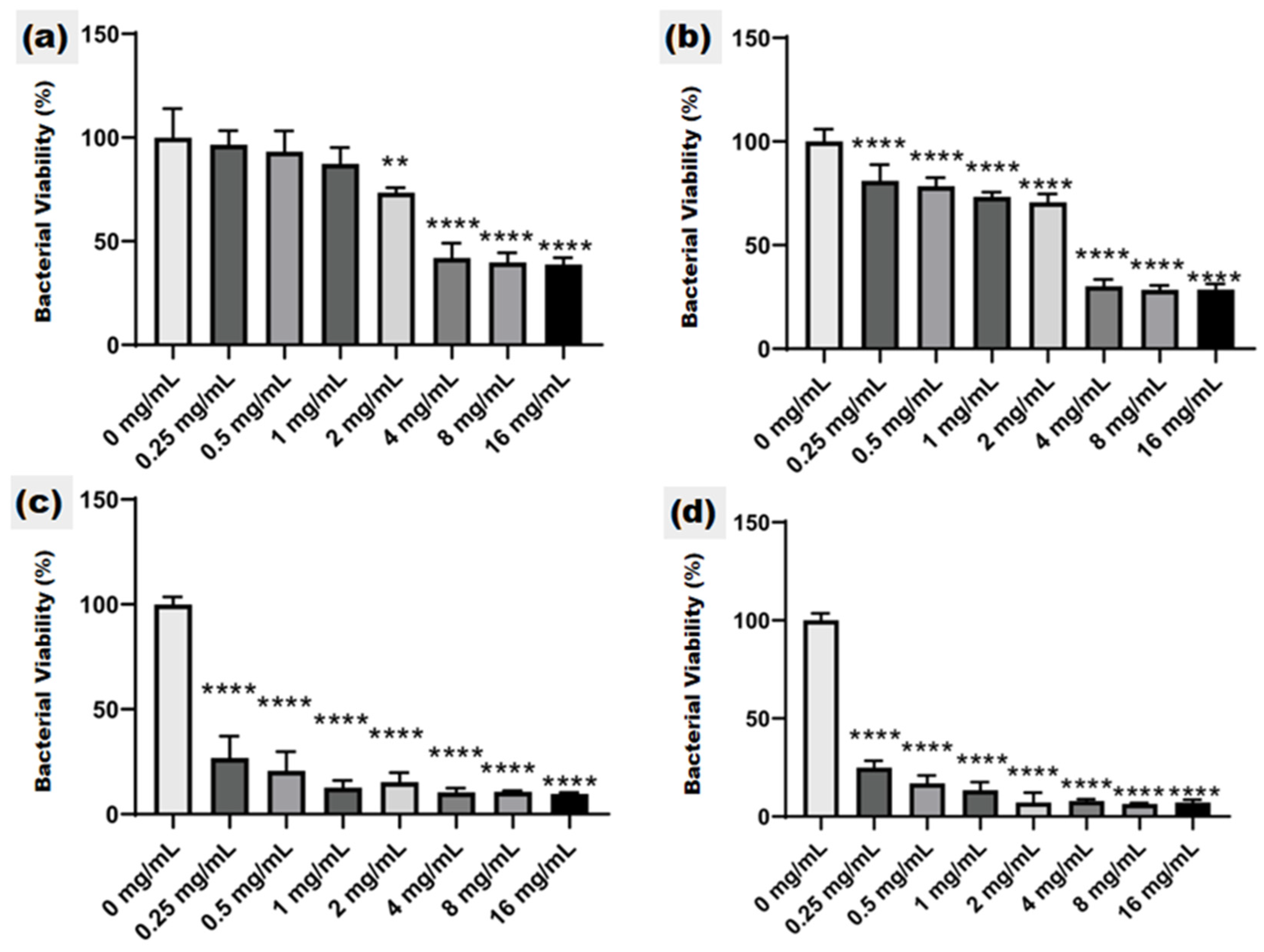
The results show a significant reduction in growth for the two bacterial strains tested with the two different types of NPs; the uropathogenic E. coli exhibits a 27% reduction in growth at a concentration of 2 mg/mL of TiO2 NPs (p < 0.01), more than 50% reduction was achieved at a concentration of 4 mg/mL and was maintained with higher concentrations (p < 0.00001) (Figure 12a). For S. Typhimurium, the result was similar. However, inhibition by the TiO2 NPs was significant (p < 0.00001), and all evaluated concentrations exhibited a dose-dependent profile. Inhibition at concentrations ranging from 0.25 mg/mL to 2 mg/mL was 19% to 30%, while higher concentrations of 4 mg/mL to 16 mg/mL achieved 70% to 72% inhibition, respectively (Figure 12b). At the same time, the ZnO NPs had a better effect on the two bacterial strains. The E. coli strain showed a significant reduction relative to the lowest concentration of 0.25 mg/mL, achieving 74% reduction at this concentration. The most significant reduction was observed at 16 mg/mL, with a 91% reduction (p < 0.00001) (Figure 12c). In contrast, the Salmonella strain treated with different concentrations of ZnO NPs showed 76% inhibition at 16 mg/mL, achieving a maximum of 93% inhibition at 2 mg/mL (p < 0.00001) (Figure 12d).
Dose–response profiles are shown in Table 4, where probit-derived LD50 values indicate that ZnO NPs are roughly 1542 times more potent than TiO2 NPs against E. coli (0.003 vs. 5.067 mg/mL) and about 243 times more effective against S. Typhimurium (0.012 vs. 2.918 mg/mL). These results align with Naddafi et al. [68], who reported 24 h EC50 values of 5.47 mg/L for ZnO compared to 5.36 mg/L for TiO2 against E. coli, and with Dasari et al. [69], who identified ZnO as the most bacteriotoxic metal oxide under dark conditions, outperforming TiO2, CuO, and Co3O4. The MIC values listed in Table 4 further support this: ZnO NPs inhibited growth at 2 mg/mL (E. coli) and 1 mg/mL (S. Typhimurium), whereas TiO2 NPs required 8 and 4 mg/mL, respectively, representing a 4–8-fold difference in inhibitory concentration.
An interesting observation is that susceptibility rankings vary by NPs type, exhibiting strain-specific reversals. For TiO2 NPs, S. Typhimurium was more vulnerable than E. coli (MIC 4 vs. 8 mg/mL; LD50 2.918 vs. 5.067 mg/mL). Conversely, with ZnO NPs, E. coli proved more susceptible than S. Typhimurium (MIC 2 vs. 1 mg/mL; LD50 0.003 vs. 0.012 mg/mL). This reversal based on NPs type suggests that the two bacteria have different susceptibilities to various toxicity mechanisms, likely due to differences in LPS composition, outer membrane proteins, and metal efflux pump expression. Abd El-Aziz et al. [70] also observed species-dependent variations in susceptibility to ZnO and TiO2 in food matrix studies, highlighting that strain-level physiological differences consistently influence NPs antibacterial effectiveness.
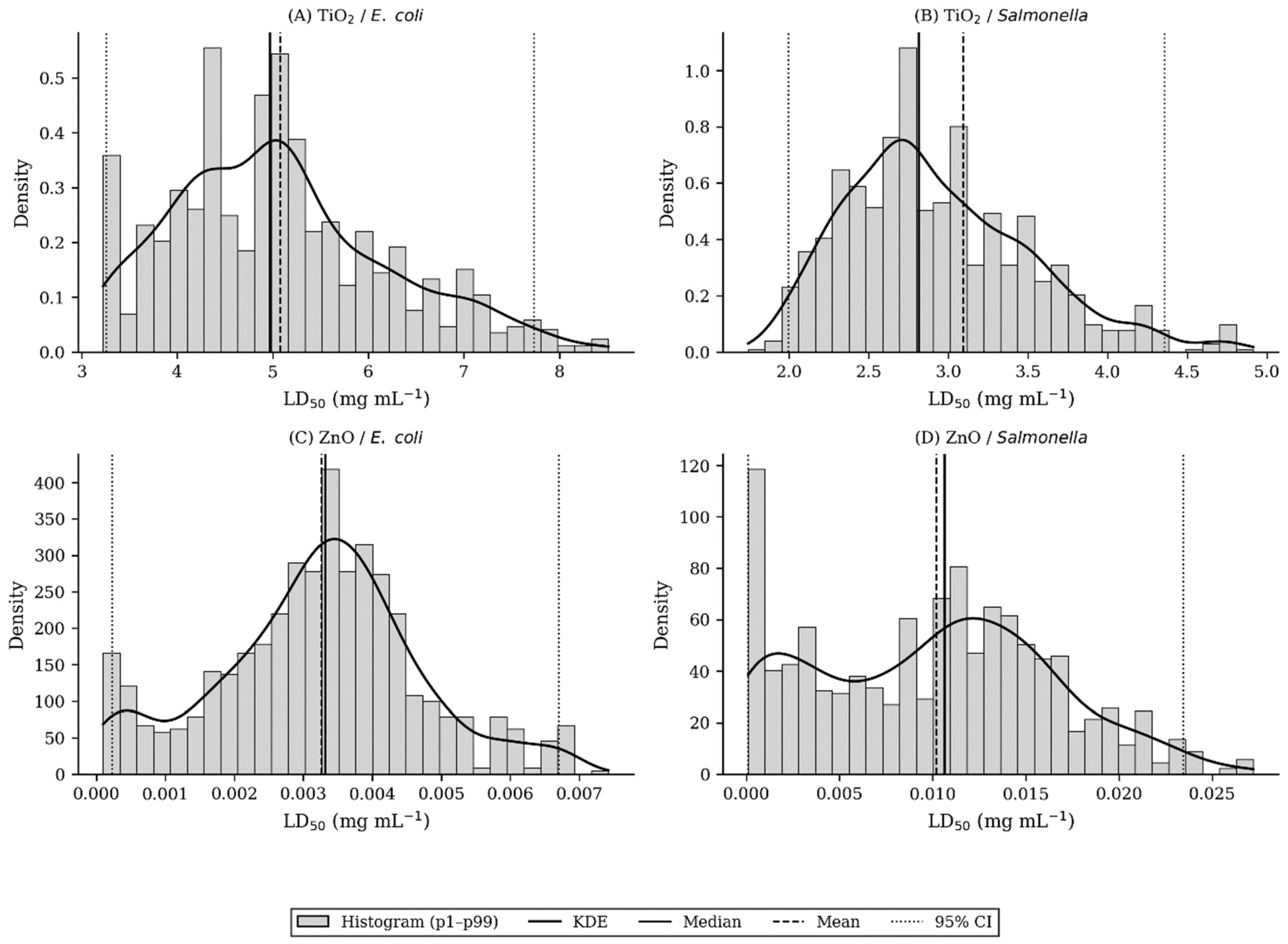
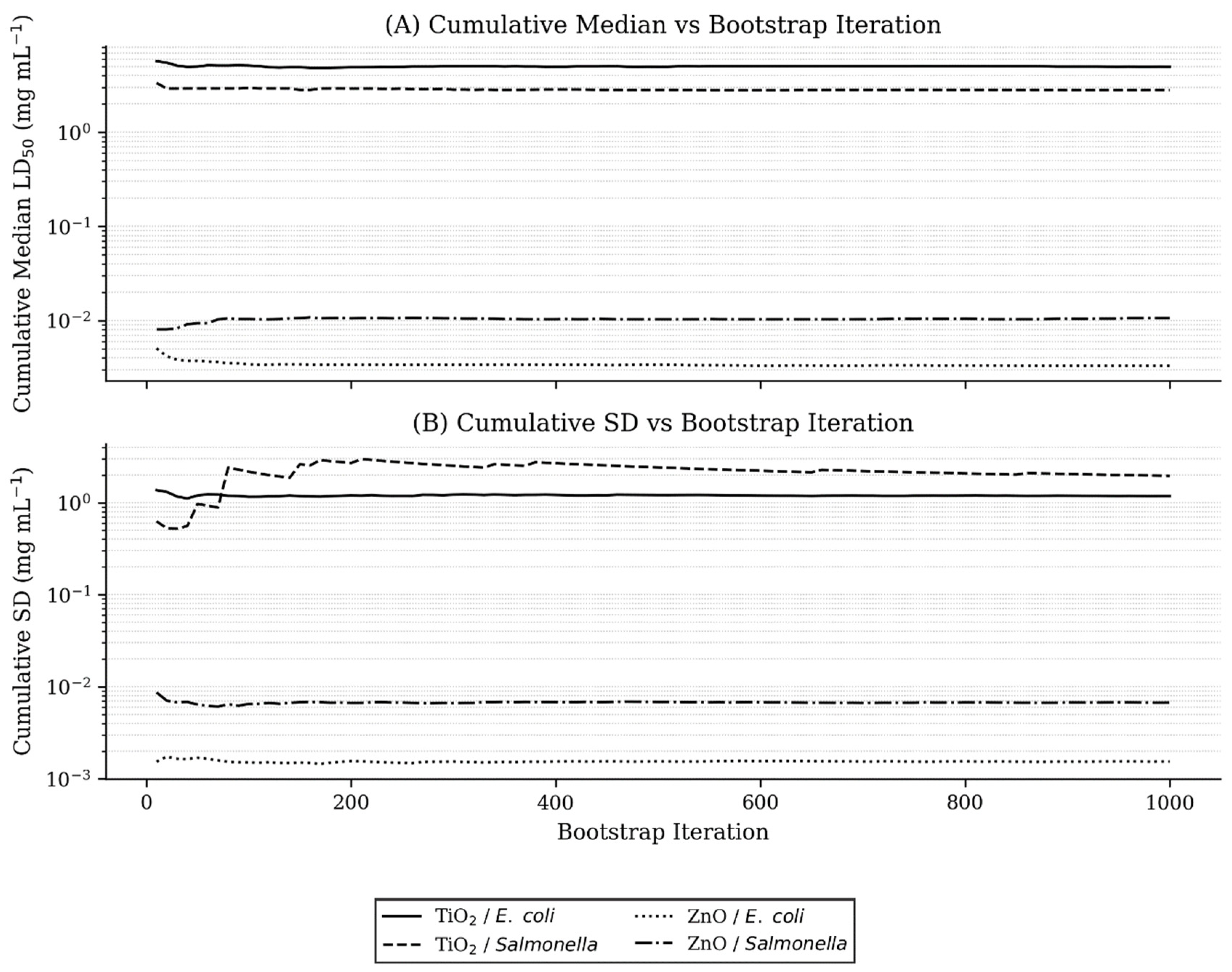
The bootstrap resampling analysis (with 994 iterations and a 99.4% success rate) offered a thorough assessment of uncertainty in LD50 estimates, revealing notable differences in distributional properties across treatments (Table 4; Figure 13 and Figure 14). The coefficient of variation varied from 23.45% for TiO2/E. coli—which had the most precise estimate, a narrow 95% CI of 3.280–7.835 mg/mL, and minimal bias of −2.64%—to 65.25% for TiO2/S. Typhimurium, which had the broadest confidence interval (2.009–4.774 mg/mL) and the highest skewness (7.98) and kurtosis (70.80) (Table 4). As shown in Figure 13, the frequency distributions illustrate this asymmetry: TiO2/E. coli and ZnO/E. coli (skewness 0.70 and 0.29) display nearly symmetric histograms, while TiO2/S. Typhimurium’s distribution is heavily right-skewed, with 35 high-LD50 outliers reaching 26.24 mg/mL, indicating heterogeneity in response—likely due to persister cells or stochastic activation of stress responses. Conversely, ZnO/S. Typhimurium exhibited a near-symmetric distribution (skewness 0.22, kurtosis −0.59), with only 2 outliers, suggesting a more uniform and reproducible bacteriostatic effect. The stability analysis in Figure 14 shows that the bootstrap medians stabilized around iterations 400–500, and the standard deviations stabilized thereafter, confirming that 994 iterations provided reliable estimates. The bootstrap bias was negligible for TiO2/E. coli (−2.64%) and ZnO/E. coli (+0.42%) but was −8.47% for ZnO/S. Typhimurium, indicating a potential underestimation of the probit LD50, possibly due to boundary effects near detection limits. Probit R2 values ranged from 0.909 to 0.978 (Table 4), demonstrating excellent model fit and supporting the validity of the probit-derived LD50 as reliable reference points.
A key observation across all four treatment combinations is that the minimum bactericidal concentrations (MBCs) exceeded 16 mg/mL—the highest tested level—despite 70–93% growth inhibition at lower concentrations (Table 4). This suggests that both types of NPs primarily acted as bacteriostatic agents under these conditions, consistent with existing research on metal oxide NPs at sub-lethal concentrations [71]. The fact that the MIC-to-MBC ratio was more than 8 times across all treatments indicates that achieving a full bactericidal effect requires concentrations much higher than, or not agglomerated with, those needed to inhibit growth. This likely reflects a threshold phenomenon related to the buildup of lethal cellular damage. In food safety and biomedical contexts, this is a vital distinction: bacteriostatic levels can control bacterial growth during processing or storage, but any surviving bacteria could potentially regrow if NPs concentrations decrease through leaching or dilution.
TiO2 and ZnO NPs are widely investigated as antimicrobial agents due to their unique properties, derived from their small size, which enables them to interact more efficiently with microorganisms than conventional compounds. These NPs act through various mechanisms, including altering the membranes of bacteria, viruses, and fungi, thereby disrupting these organisms and releasing their cellular contents, ultimately leading to their death. Additionally, many NPs generate ROS, which damages essential cellular components, including proteins, lipids, and DNA. They can also interfere with protein and nucleic acid synthesis by affecting the cellular molecular machinery, inhibiting replication and survival. Finally, the small size of NPs allows them to penetrate cells, causing physical stress that compromises their viability [2,3,4,5].
TiO2 NPs and ZnO NPs are highly effective antimicrobial agents due to their physicochemical properties, which enable them to interact efficiently with microorganisms. When exposed to UV light, TiO2 NPs act as photocatalysts, generating ROS such as OH and H2O2. These ROS damage essential components of the microbial cell (lipid membranes, proteins, and DNA), disrupting their integrity and function, culminating in cell death. In addition, TiO2 NPs can adhere to cell membranes, causing physical disruption and leakage of intracellular contents, thereby contributing to the elimination of the microorganism [6,7,8,9,10]. For their part, ZnO NPs are also effective at generating ROS and interacting directly with cell membranes, altering their structure, causing membrane rupture, and releasing intracellular material. This damage is exacerbated by the release of zinc ions (Zn2+), which are toxic to microbial cells because they interfere with the function of proteins and enzymes essential to their survival. In addition, ZnO NPs exhibit a photocatalytic effect similar to that of TiO2, enabling them to generate additional ROS upon light exposure, thereby enhancing their ability to destroy bacterial cell walls or break down organic contaminants [3,11,12,13,14]. Both TiO2 NPs and ZnO NPs combine multifaceted mechanisms of action, including ROS generation, disruption of cell membranes, and release of toxic metal ions, making them powerful tools for combating various microbial infections.
The antimicrobial differences observed between ZnO NPs and TiO2 NPs may be partly related to their size and morphology [1,2,3]. Smaller particles and anisotropic shapes are often associated with higher surface-to-volume ratios, thereby increasing the number of reactive sites available for interaction with bacterial cells. In our case, the flower-like ZnO NPs, with sharp edges and complex surface structures, likely provided a larger active surface that favored ROS generation, Zn2+ ion release, and membrane disruption [20]. By contrast, the more spherical and smoother TiO2 NPs may have exhibited lower surface reactivity, which could help explain their comparatively reduced antimicrobial performance but greater biocompatibility [18]. These observations suggest that the size and shape of NPs can influence antimicrobial activity, although other factors, such as crystallinity, surface chemistry, and synthesis conditions, may also play important roles.

3.10. Toxicity Assessment

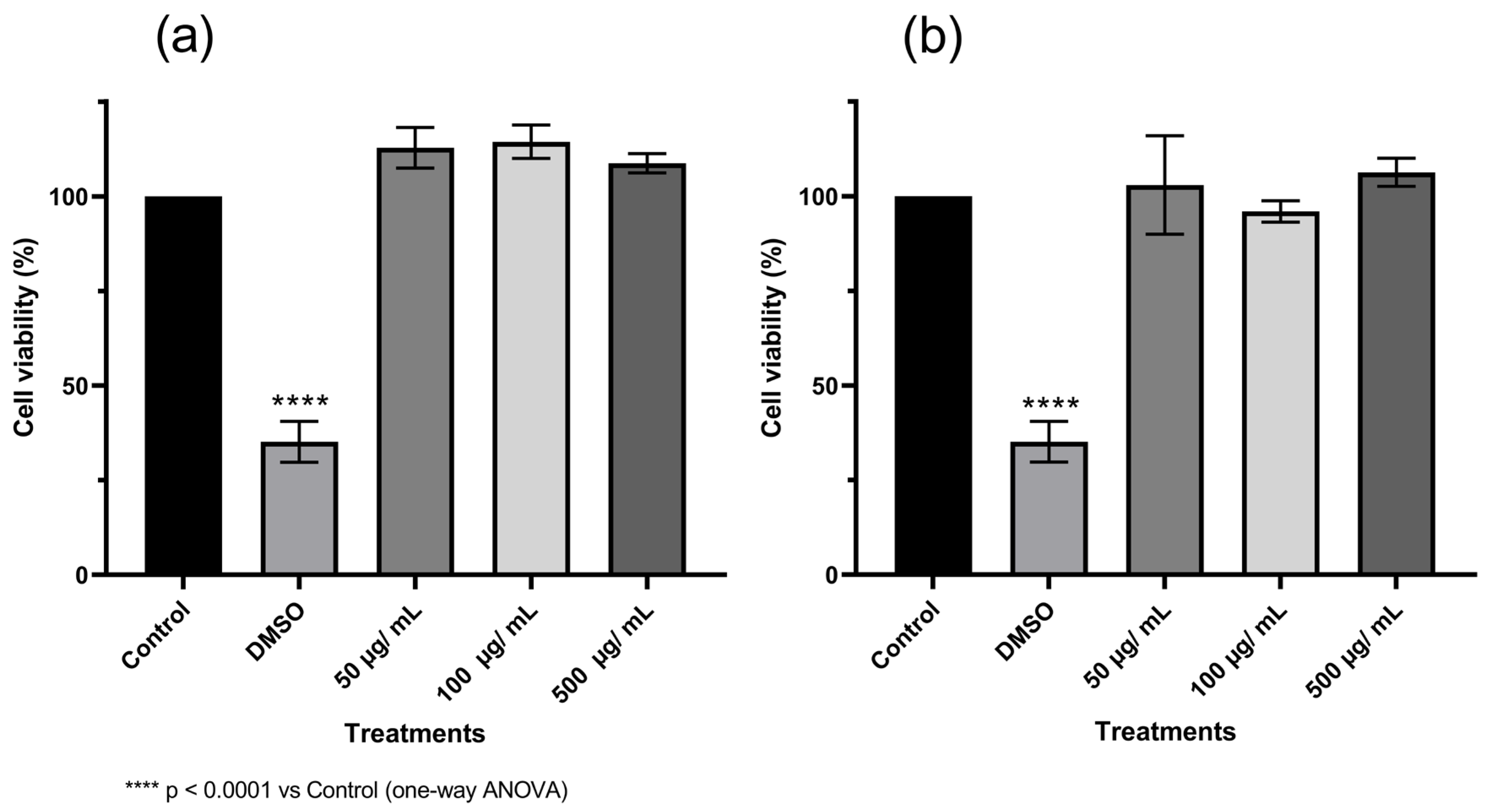
The cytocompatibility of the TiO2 and ZnO NPs was assessed using leukocytes from laying hens, with cell viability measured after exposure to different concentrations of the NPs (50, 100, and 500 µg/mL). The results are shown in Figure 15. For TiO2 NPs, cell viability stayed above 90% at all tested concentrations, indicating their biocompatibility. The lack of significant cytotoxicity at higher concentrations highlights the stability and inert nature of the spherical TiO2 NP morphology, which minimizes potential interactions with leukocytes on the membrane (p < 0.01). This stability makes TiO2 NPs promising candidates for applications where biocompatibility is critical, such as antimicrobial coatings and biomedical materials [43]. The TiO2 NPs exhibit low cytotoxicity toward various normal cell types, even at high concentrations. TiO2 NPs synthesized using Achillea wilhelmsii extract preserved 78.8% viability in human skin fibroblasts after 48 h of exposure across the 6.25–100 µg/mL range. Hemolysis assays using horse red blood cells showed that these NPs caused only 0.6–0.8% hemolysis at concentrations between 31.25 and 250 µg/mL, and a maximum of 1.96% at 500 µg/mL, indicating minimal erythrocyte membrane damage [44]. Similarly, in MCF10A epithelial cells, Coleus aromaticus-based TiO2 NPs maintained full viability at 100 µg/mL and caused only a mild reduction to 83% at 250 µg/mL. Across these models, TiO2 NPs derived from plant extracts demonstrated consistent cellular compatibility up to 100 µg/mL and only minor effects at 250–500 µg/mL, confirming their safety for potential biomedical applications [45].
In contrast, ZnO NPs showed a moderate reduction in cell viability at 50 µg/mL (~70%), followed by recovery to near 100% viability at 100 and 500 µg/mL. This trend suggests a concentration-dependent response, likely influenced by the star-like morphology of ZnO NPs, which provides a higher surface area for cell interaction, but the bioorganic surface coating likely mitigates cytotoxicity at higher concentrations. At lower concentrations, the bioactivity of ZnO NPs may induce mild oxidative stress in laying hens’ leukocytes, leading to reduced viability. However, at higher concentrations, the biocompatible stabilizing agents used during green synthesis could mitigate these effects, ensuring the compatibility of ZnO NPs with biological systems. These findings align with the literature, which indicates that phytochemical-rich ZnO NPs exhibit reduced zinc ion leaching and ROS generation [11,48]. Further evidence of this behavior comes from a recent study [72] comparing green-synthesized versus chemically synthesized ZnO NPs: the green-synthesized particles exhibited substantially reduced hemolytic and cytotoxic effects at intermediate concentrations (50–100 µg/mL), a phenomenon the authors attributed to organic capping ligands limiting surface reactivity and Zn2+ release.
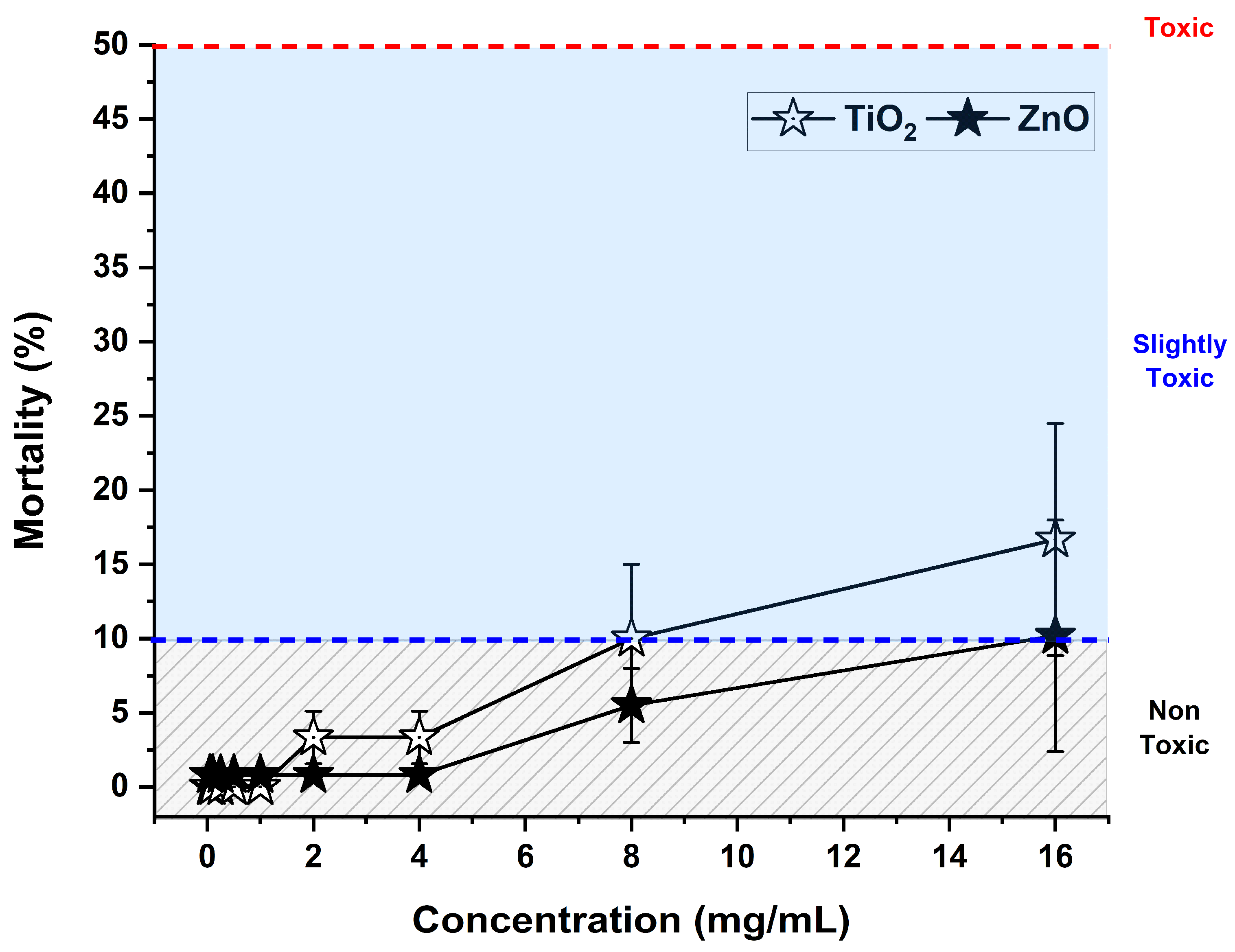
Figure 16 shows the mortality rate (%) of Artemia salina nauplii compared to increasing concentrations (0–16 mg/mL) of blueberry (Vaccinium corymbosum)-mediated TiO2 and ZnO NPs. These are categorized into three toxicity zones: non-toxic (<10%), slightly toxic (10–50%), and toxic (>50%), based on criteria from Meyer et al. [73] that are common in nanotoxicology brine shrimp assays. Both NPs types displayed a clear, concentration-dependent rise in nauplii mortality, with TiO2 NPs showing a stronger effect: mortality was under 5% at 0–4 mg/mL, about 10% at 8 mg/mL, and around 16.5% at 16 mg/mL. ZnO NPs showed a less steep increase (no significant differences at p > 0.05), remaining below 5% up to 4 mg/mL and reaching about 10% only at the highest tested concentration. Importantly, neither type exceeded the 50% toxicity threshold (p < 0.05) and remained within the “slightly toxic” or “non-toxic” categories across all tested concentrations, indicating a safe ecotoxicological profile for both green-synthesized nanomaterials.
These findings align with recent studies showing low acute toxicity of phytosynthesized metal oxide NPs in A. salina bioassays. Narayanan et al. [74] found about 13% Artemia mortality from TiO2 NPs synthesized from Cymodocea serrulata at 100 µg/mL, while Shaba et al. [75] reported an LC50 of 99.81 µg/mL for ZnO nanoflakes directed by Tridax procumbens, and Soni et al. [76] recorded an LC50 of 78.41 µg/mL for bioinspired ZnO NPs from marine Streptomyces plicatus. All these values are higher than those in the current study. Conversely, some phytosynthesized ZnO preparations have shown much lower LC50 (as low as 11.15 µg/mL with Nostoc sp.) [77], highlighting how synthesis methods and capping agents influence nanotoxicity. Polyphenols in blueberry extract—mainly anthocyanins, flavonoids, and hydroxycinnamic acids—act as surface stabilizers and caps that can reduce ion leaching (especially Zn2+) and decrease reactive oxygen species (ROS) formation, both of which are key factors in NPs toxicity in aquatic life [78,79]. The lower mortality from ZnO compared to TiO2 at around 8 mg/mL might be due to more effective phytochemical passivation of ZnO NPs, whereas TiO2 NPs, even without photocatalytic activation, can produce reactive oxidative species, causing mild cellular stress [74]. Overall, the A. salina bioassay indicates that blueberries enable green synthesis of TiO2 NPs and ZnO NPs with low ecotoxicity, supporting their safe use in biomedical and environmental applications.
The absence of cytotoxic effects, even at the highest concentrations tested, underscores the stabilizing role of bioactive compounds from V. corymbosum, particularly flavonoids and phenolic acids. These phytochemicals likely act as natural capping agents, reducing NPs surface reactivity, limiting oxidative stress, and maintaining cellular membrane integrity. Unlike conventional metal oxide NPs, which are often linked to ROS production, mitochondrial dysfunction, DNA fragmentation, and activation of apoptotic pathways, TiO2 and ZnO NPs showed no dose-dependent toxicity. This favorable biocompatibility profile highlights their potential for safe use in biomedical applications, such as antimicrobial coatings, wound-healing systems, and drug-delivery platforms. However, further studies are needed to investigate long-term exposure effects, NPs uptake mechanisms, and potential immune responses in more complex in vitro and in vivo models.
The balance between high antimicrobial activity and acceptable cytocompatibility suggests that the synthesis approach itself plays a decisive role, warranting comparison with conventional methods. Compared with conventional chemical and physical methods, TiO2 and ZnO NPs prepared using V. corymbosum extract are safer, more sustainable, and cost-effective. Chemical syntheses often require toxic reducing agents and generate hazardous waste, while physical and thermal routes demand high energy input and costly equipment. In contrast, plant-derived metabolites act simultaneously as reducing and stabilizing agents under mild conditions, producing phase-pure NPs with controlled morphology and surface functionalization. This not only enhances antimicrobial activity but also reduces cytotoxicity, stressing the advantage of this eco-friendly strategy over conventional synthesis methods.

3.11. In Silico Assays

3.11.1. Molecular Docking

Escherichia coli
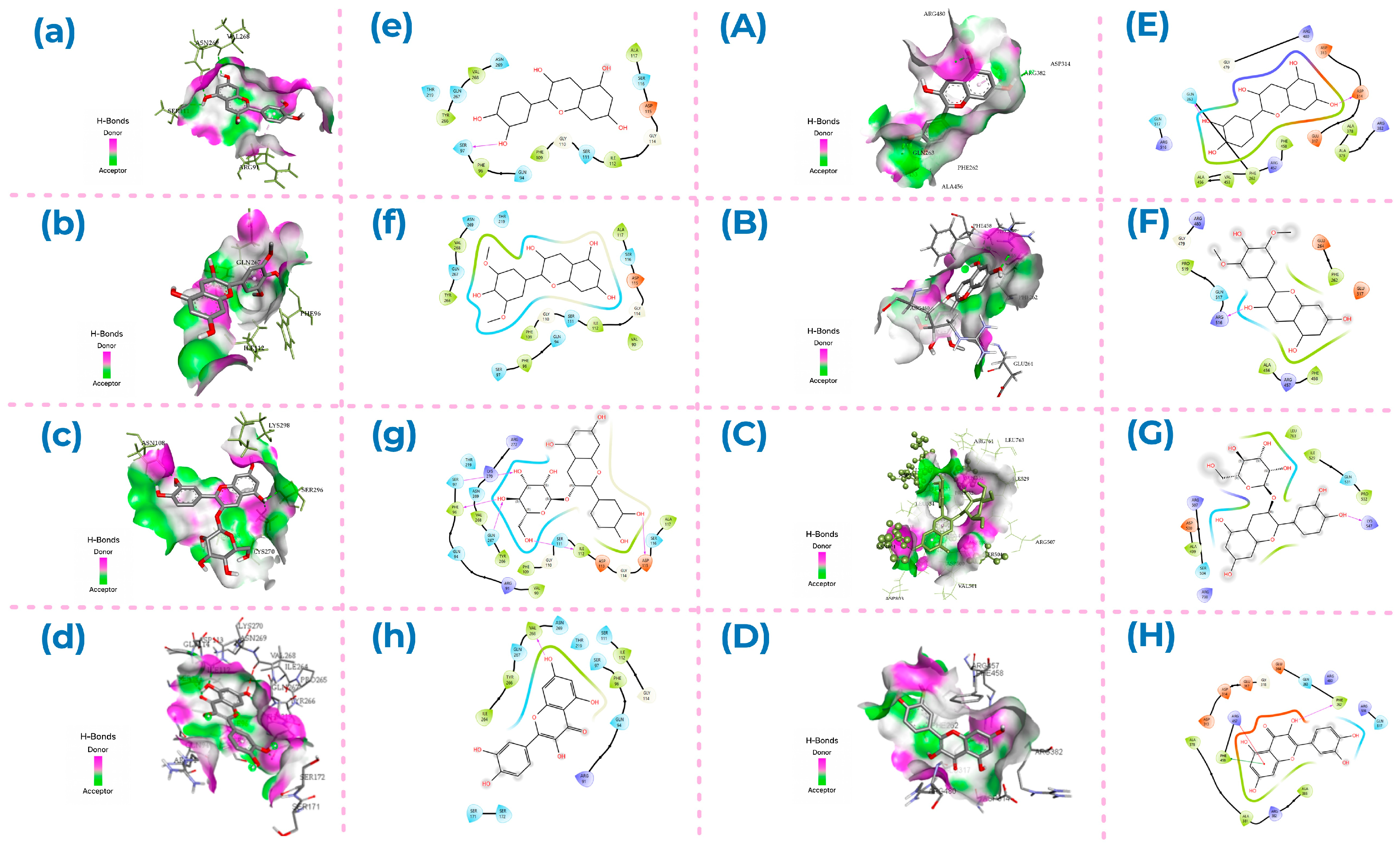
The molecular docking analysis of the interaction between polyphenols and the DNA gyrase subunit A of E. coli (Figure 17, lowercase letters) highlights their potential as inhibitors of this essential bacterial enzyme, a key therapeutic target for the development of novel antimicrobial agents. Among the analyzed compounds, cyanidin (Figure 17a,e) exhibited a binding energy of −6.99 kcal/mol and showed 59.26% correspondence with the key residues of the control inhibitor (simocyclinone, [80]), particularly emphasizing its interaction with residues such as Gln267 and Tyr266, which are relevant for enzyme activity [28]. Malvidin (Figure 17b,f) demonstrated a slightly higher binding affinity (−7.52 kcal/mol), possibly attributed to its glycoside group, although its correspondence with the control residues was 51.85%. Finally, quercetin (Figure 17d,h) displayed a binding energy of −7.0 kcal/mol and a lower correspondence (37.04%), suggesting potential binding to an alternative site. Overall, the residues Gln267, Tyr266, Ser111, and Phe96 were crucial for interactions between polyphenols and DNA gyrase, highlighting their relevance to the design of novel inhibitors (PMC4962306). However, comparison with simocyclinone indicates that these compounds may require structural modifications to achieve higher affinity and specificity.
Salmonella Typhimurium
The molecular docking analysis of polyphenol interactions with DNA gyrase subunits A and B in S. Typhimurium (Figure 17, uppercase letters) demonstrates that, while the evaluated polyphenols do not exhibit significant interactions with subunit A (GyrA) and its key active site residues, some compounds show promising binding affinities towards subunit B (GyrB) [81]. Among the evaluated polyphenols, cyanidin-3-glucoside (Figure 17C,G) and quercetin (Figure 17D,H) stood out, with binding energies of −8.5 kcal/mol, indicating a favorable affinity towards GyrB. In the case of quercetin, it was observed to interact with residues outside the active site, such as Arg480, Phe262, and Asp313, suggesting potential activity through an allosteric mechanism that indirectly modulates enzyme activity. Conversely, cyanidin (Figure 17A,E) and malvidin (Figure 17B,F) showed no significant affinity for either subunit, limiting their potential as DNA gyrase inhibitors in S. Typhimurium. The possibility that quercetin acts through an allosteric mechanism offers new opportunities for designing innovative inhibitors effective against antibiotic-resistant bacteria.

3.12. In Silico Toxicity and Drug-Likeness

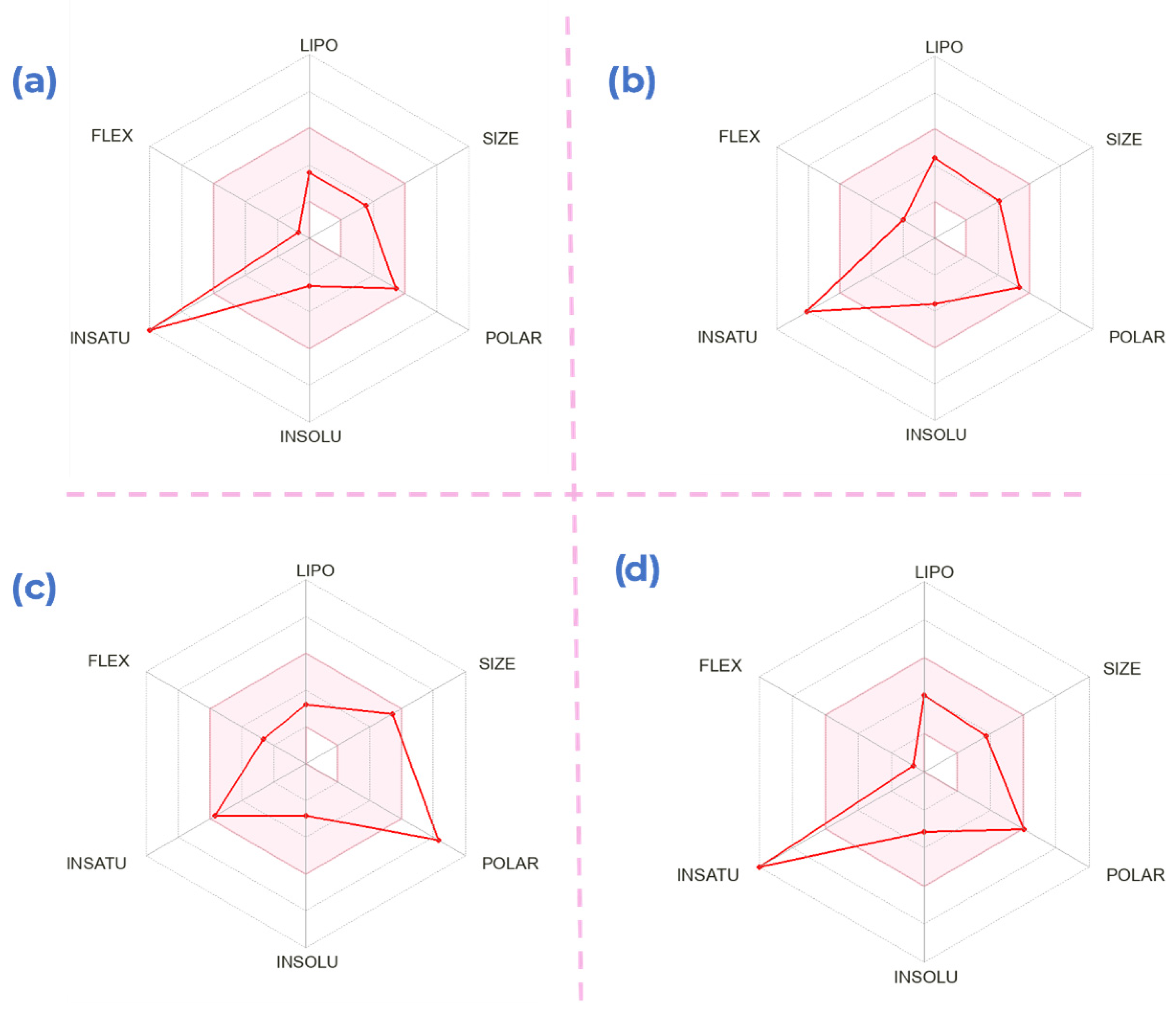
Figure 18 examines six physicochemical properties related to the bioavailability of four polyphenols: C3G, cyanidin, malvidin, and quercetin. These properties include lipophilicity (LIPO), molecular size (SIZE), polarity (POLAR), insolubility (INSOLU), unsaturation (INSATU), and structural flexibility (FLEX). The pink-shaded area indicates the ideal range for a compound to be considered “drug-like”. The results show that all polyphenols have limitations regarding lipophilicity and insolubility, which could hinder their absorption and cellular permeability. Quercetin has the most favorable profile, with values near the ideal range for polarity, molecular size, and flexibility, suggesting greater bioactive potential. However, its insolubility remains a challenge. Conversely, cyanidin-3-glucoside, cyanidin, and malvidin exhibit more limited profiles, with reduced flexibility and lipophilicity, thereby limiting their bioavailability.
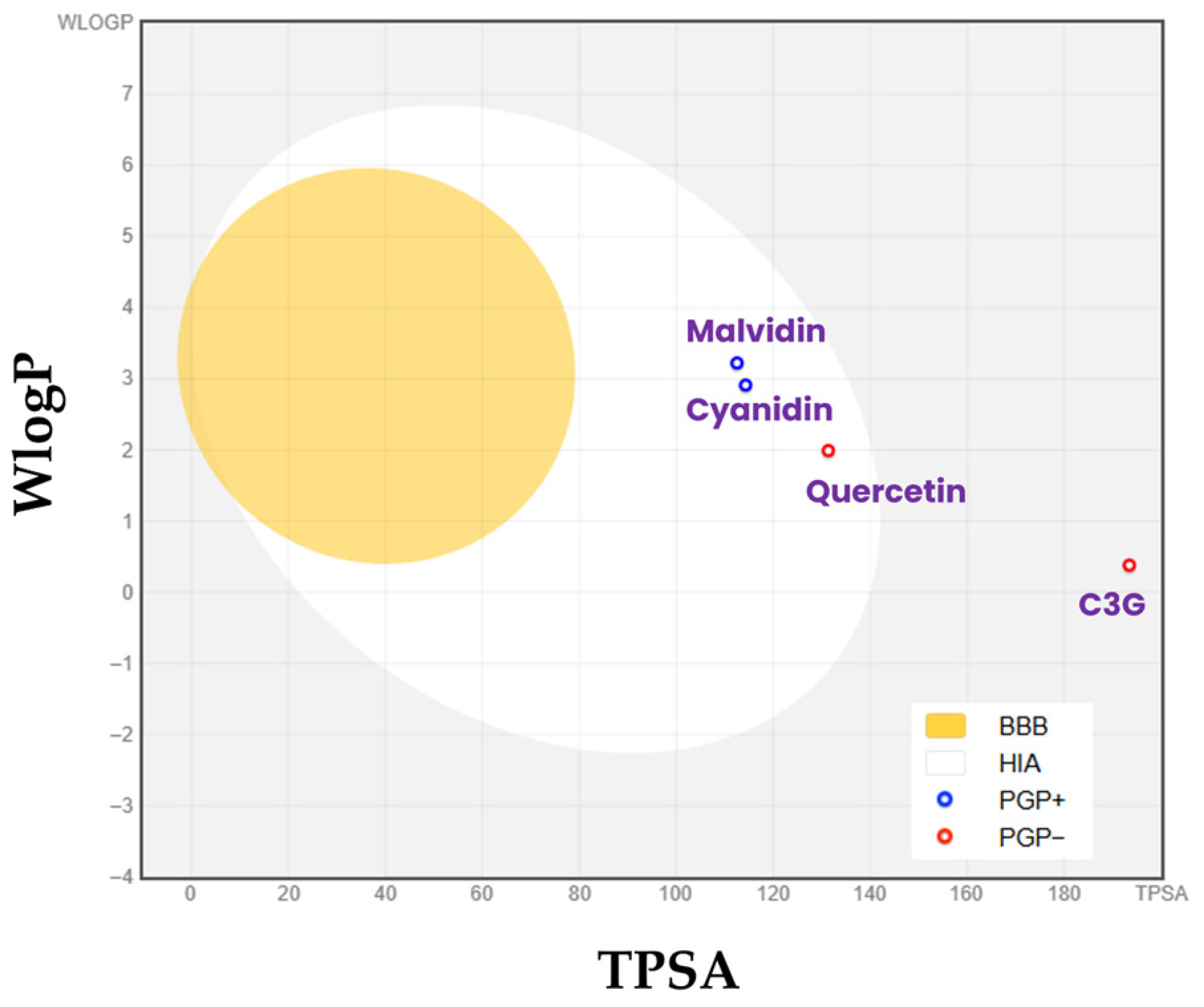
The “boiled egg plot” (Figure 19) shows the water partition coefficient (WlogP) in relation to the topological polar surface area (TPSA) for the polyphenols malvidin, cyanidin, quercetin, and C3G. This graph helps assess their ability to cross biological barriers, such as the blood–brain barrier (BBB, yellow zone) and the intestinal barrier (HIA, white zone). Results reveal that malvidin and cyanidin fall within the yellow zone, indicating they can likely cross the BBB, although their high TPSA may reduce intestinal absorption. Quercetin, near the yellow zone, has high TPSA, which may hinder both absorption and bioavailability. C3G, with an excessively high TPSA, lies outside the favorable zone, suggesting it may encounter substantial obstacles in crossing biological barriers.
In summary, malvidin and cyanidin are notable for their ability to cross the blood–brain barrier, while quercetin has an intermediate profile. In contrast, C3G exhibits significant bioavailability limitations. The compounds are also categorized based on their interaction with P-glycoprotein (P-gp), a transporter that can limit drug bioavailability. In the visualization, blue dots (cyanidin and malvidin) indicate compounds that are P-gp substrates (PGP+), meaning they can be expelled from the central nervous system (CNS) and the gastrointestinal lumen. Red dots (C3G and quercetin) indicate compounds that are not P-gp substrates (PGP−), suggesting they have a higher potential for CNS absorption and retention [82,83].
Table 5 presents an in silico evaluation of the toxicological properties of blueberry extract compounds, focusing on four compounds: C3G, cyanidin, malvidin, and quercetin. Regarding overall toxicity, C3G, Cyanidin, and Malvidin each have an LD50 of 5000 mg/kg, indicating very low toxicity and categorizing them as Class 5, which means they are practically non-toxic. Conversely, quercetin has an LD50 of 154 mg/kg, placing it in Class 3, which reflects a higher toxicity risk.
All compounds are inactive with respect to cytotoxicity, mutagenicity, and carcinogenicity, indicating they do not pose significant risks of cell damage, genetic mutations, or cancer. They also do not show hepatotoxicity, implying they are safe for the liver. However, C3G displays nephrotoxicity, and malvidin shows cardiotoxicity. The remaining compounds are inactive in these areas.
The molecular docking analysis presented in this study serves a dual mechanistic purpose: (i) to identify potential direct antibacterial contributions of blueberry-derived polyphenols, and (ii) to establish a computational framework for understanding how phytochemical surface ligands may complement the intrinsic antimicrobial properties of metal oxide NPs.
DNA gyrase subunit B (GyrB) was chosen as the docking target because it is a validated antibacterial target conserved across Gram-negative bacteria, including E. coli and Salmonella Typhimurium [72]. GyrB facilitates ATP-dependent DNA supercoiling, and its inhibition results in bacterial cell death [56]. Notably, the GyrB ATP-binding pocket can bind various chemical scaffolds, including natural polyphenolic compounds [81], making it a feasible target for blueberry-derived substances. Docking results showed favorable binding energies for quercetin (−8.4 kcal/mol), cyanidin-3-glucoside (−7.8 kcal/mol), malvidin (−7.1 kcal/mol), and cyanidin (−6.2 kcal/mol) at the GyrB active site. These energies indicate affinities in the micromolar to low millimolar range, reflecting moderate to weak enzyme inhibition [82]. These simulations focus on free polyphenols in solution, not those attached to NPs surfaces. This approach is mechanistically justified because: (a) Dynamic ligand exchange occurs, where surface-bound polyphenols on metal oxide NPs are in equilibrium with free molecules in solution, especially under physiological conditions where competing ligands like proteins and metabolites can displace weakly bound species [31]. HPLC analysis of post-synthesis supernatants confirmed residual free polyphenols (Figure 2), indicating incomplete surface saturation. (b) During NPs-bacteria contact, the acidic microenvironment produced by bacterial metabolism (pH 5.5–6.5 near cell surfaces) [83] may cause desorption of polyphenols from metal oxide surfaces, leading to a localized high concentration at the site of action. This has been documented in pH-responsive drug delivery systems [84], (c) The antimicrobial activity likely results from a possible synergistic mechanism involving: (i) ROS production via surface hydroxyl groups and Zn2+ ion release, causing oxidative stress and membrane disruption [60]; (ii) enzyme inhibition by polyphenols (e.g., GyrB) and membrane perturbation through lipid interactions [28]; (iii) increased bacterial uptake of NPs facilitated by polyphenol-induced membrane permeabilization [5]. The docking results suggest that blueberry polyphenols have inherent antibacterial properties that could enhance NPs-based actions. This combined analysis links experimental antimicrobial findings with computational forecasts, providing a more comprehensive view of the system’s bioactivity.

4. Conclusions

This study shows that blueberry extract can be effectively used as a sustainable platform for the synthesis and modification of TiO2 NPs and ZnO NPs with distinct biological behaviors. ZnO NPs displayed higher antimicrobial activity, while TiO2 NPs showed better cytocompatibility, highlighting a clear balance between performance and safety depending on the oxide system.
An important outcome of this work is that the same phytochemical source can influence NPs formation and function in different ways. By combining chromatographic analysis with structural and biological evaluation, the results suggest that plant-derived compounds play a key role in shaping surface properties and, consequently, biological responses. While this study provides a detailed qualitative profile of the extract, the absence of quantitative data for individual phenolic compounds remains a limitation for fully correlating specific concentrations with the observed effects. Nonetheless, this type of integrated approach remains relatively limited in Vaccinium-based systems.
Rather than acting solely as reducing agents, the phytochemicals appear to interact mainly at the NP interface, contributing to stabilization and influencing activity, together with the intrinsic properties of the metal oxide. This provides a useful perspective for designing bioassisted nanomaterials with tailored functionality. In practical terms, the NPs obtained in this study appear more suitable for antimicrobial coatings or contact-active surfaces.
Future research should focus on several key areas: (i) studying photocatalytic activation with UV and visible light to assess ROS-enhanced antimicrobial effects at concentrations below cytotoxic levels; (ii) analyzing the release kinetics of NPs–polyphenol surfaces under physiological and infection-mimicking pH conditions; (iii) employing advanced computational models, combining coarse-grained and atomistic approaches, to understand Ps –protein interactions; (iv) testing synergistic effects of these NPs with traditional antibiotics to leverage complementary mechanisms; and (v) exploring scalability to evaluate the potential of blueberry agro-industrial byproducts as affordable precursors for antimicrobial nanomaterials. These research directions are vital to overcoming the concentration–selectivity gap highlighted in this study and to advancing Vaccinium-derived NPs for use in antimicrobial coatings, biomedical interfaces, and sustainable food safety solutions technologies.

Author Contributions

Conceptualization, I.B.-L., J.M.S.-J. and M.Á.L.-Á.; methodology, I.B.-L., M.Á.L.-Á., J.M.S.-J., M.Z.-R., I.V., M.R.-B., O.F.-S. and A.H.-G.; software, I.B.-L., M.Z.-R., J.M.S.-J. and M.Á.L.-Á.; validation, J.M.S.-J., L.M.A.-E. and M.Á.L.-Á.; formal analysis, C.A.V.-C., I.V., C.R.C.-Á. and L.M.A.-E.; investigation, I.B.-L. and J.M.S.-J.; resources, J.M.S.-J. and M.Á.L.-Á.; data curation, I.B.-L. and C.R.C.-Á.; writing—original draft preparation, I.B.-L. and J.M.S.-J.; writing—review and editing, C.A.V.-C., C.R.C.-Á. and L.M.A.-E.; visualization, J.M.S.-J.; supervision, J.M.S.-J. and M.Á.L.-Á.; project administration, I.B.-L., J.M.S.-J., M.R.-B., L.M.A.-E., O.F.-S., C.A.V.-C., M.Á.L.-Á. and A.H.-G.; funding acquisition, J.M.S.-J. and M.Á.L.-Á. All authors have read and agreed to the published version of the manuscript.

Funding

This work was supported by Centro Universitario de Ciencias Exactas e Ingenierías (CUCEI), and Centro Universitario de Tlaquepaque (CUTlaquepaque), Universidad de Guadalajara, Mexico, and Secretaría de Ciencia, Humanidades, Tecnología e Innovación (SECIHTI) for author’s postdoctoral scholarship, CVU 588976.

Institutional Review Board Statement

All animal experiments were conducted following approval from the Research Ethics Committee of the Centro de Investigaciones Biológicas del Noroeste, S.C. (CIBNOR) under the ethical authorization code CIBNOR-CEI-2024-07. The procedures adhered to the Mexican standards NOM-062-ZOO-1999 for the care and use of laboratory animals and NOM-087-ECOL-SSA1-2002 regarding the handling of biological hazardous waste.

Data Availability Statement

The original contributions presented in this study are included in the article. Further inquiries can be directed to the corresponding authors.

Acknowledgments

This work was supported by Centro Universitario de Ciencias Exactas e Ingenierías (CUCEI), and Centro Universitario de Tlaquepaque (CUTlaquepaque), Laboratorio de Investigación y Desarrollo Farmacéutico (LIDF), and Laboratorio de Microbiología Sanitaria Investigación from Universidad de Guadalajara, México, and Secretaría de Ciencia, Humanidades, Tecnología e Innovación (SECIHTI). During the preparation of this manuscript, the first author used ChatGPT to improve readability and to assist in the design of Figure 3. The authors have reviewed and edited the output and take full responsibility for the content of this publication.

Conflicts of Interest

The authors declare no conflicts of interest.

References

  1. Achudhan, D.; Vijayakumar, S.; Malaikozhundan, B.; Divya, M.; Jothirajan, M.; Subbian, K.; González-Sánchez, Z.I.; Mahboob, S.; Al-Ghanim, K.A.; Vaseeharan, B. The Antibacterial, Antibiofilm, Antifogging and Mosquitocidal Activities of Titanium Dioxide (TiO2) Nanoparticles Green-Synthesized Using Multiple Plants Extracts. J. Environ. Chem. Eng. 2020, 8, 104521. [Google Scholar] [CrossRef]
  2. Younis, A.B.; Haddad, Y.; Kosaristanova, L.; Smerkova, K. Titanium Dioxide Nanoparticles: Recent Progress in Antimicrobial Applications. WIREs Nanomed. Nanobiotechnology 2023, 15, e1860. [Google Scholar] [CrossRef] [PubMed]
  3. Luo, L.; Huang, W.; Zhang, J.; Yu, Y.; Sun, T. Metal-Based Nanoparticles as Antimicrobial Agents: A Review. ACS Appl. Nano Mater. 2024, 7, 2529–2545. [Google Scholar] [CrossRef]
  4. Verma, V.; Al-Dossari, M.; Singh, J.; Rawat, M.; Kordy, M.G.M.; Shaban, M. A Review on Green Synthesis of TiO2 NPs: Photocatalysis and Antimicrobial Applications. Polymers 2022, 14, 1444. [Google Scholar] [CrossRef] [PubMed]
  5. Lallo da Silva, B.; Abuçafy, M.P.; Berbel Manaia, E.; Oshiro Junior, J.A.; Chiari-Andréo, B.G.; Pietro, R.C.L.R.; Chiavacci, L.A. Relationship Between Structure And Antimicrobial Activity Of Zinc Oxide Nanoparticles: An Overview. Int. J. Nanomed. 2019, 14, 9395–9410. [Google Scholar] [CrossRef] [PubMed]
  6. Singh, S. Zinc Oxide Nanoparticles Impacts: Cytotoxicity, Genotoxicity, Developmental Toxicity, and Neurotoxicity. Toxicol. Mech. Methods 2019, 29, 300–311. [Google Scholar] [CrossRef]
  7. Vanga, S.; Satla, S.R. A Review on Green Synthesis, Characterization and Applications of Plant Mediated Metal Nanoparticles. Next Res. 2025, 2, 100356. [Google Scholar] [CrossRef]
  8. Gour, A.; Jain, N.K. Advances in Green Synthesis of Nanoparticles. Artif. Cells Nanomed. Biotechnol. 2019, 47, 844–851. [Google Scholar] [CrossRef]
  9. Rodríguez-Rojas, M.P.; Bustos-Terrones, V.; Díaz-Cárdenas, M.Y.; Vázquez-Vélez, E.; Martínez, H. Life Cycle Assessment of Green Synthesis of TiO2 Nanoparticles vs. Chemical Synthesis. Sustainability 2024, 16, 7751. [Google Scholar] [CrossRef]
  10. Shah, P.J.; Malik, R. Green Synthesis of Silver Nanoparticles Using Aqueous Cranberry Fruit Extract and Its Antibacterial Activity. J. Drug Deliv. Ther. 2019, 9, 991–995. [Google Scholar] [CrossRef]
  11. Rizwana, H.; Khan, M.; Aldehaish, H.A.; Adil, S.F.; Shaik, M.R.; Assal, M.E.; Hatshan, M.R.; Siddiqui, M.R.H. Green Biosynthesis of Silver Nanoparticles Using Vaccinium oxycoccos (Cranberry) Extract and Evaluation of Their Biomedical Potential. Crystals 2023, 13, 294. [Google Scholar] [CrossRef]
  12. Ildız, N.; Korkmaz, F.; Yusufbeyoğlu, S.; Kiliç, A.; Ocsoy, I. Silver Nanoparticles Biosynthesized from Vaccinium myrtillus L. against Multiple Antibiotic Resistance and Biofilm Forming Escherichia coli and Pseudomonas aeruginosa. Indian J. Pharm. Educ. Res. 2021, 55, S220. [Google Scholar] [CrossRef]
  13. Asmat-Campos, D.; Abreu, A.C.; Romero-Cano, M.S.; Urquiaga-Zavaleta, J.; Contreras-Cáceres, R.; Delfín-Narciso, D.; Juárez-Cortijo, L.; Nazario-Naveda, R.; Rengifo-Penadillos, R.; Fernández, I. Unraveling the Active Biomolecules Responsible for the Sustainable Synthesis of Nanoscale Silver Particles through Nuclear Magnetic Resonance Metabolomics. ACS Sustain. Chem. Eng. 2020, 8, 17816–17827. [Google Scholar] [CrossRef]
  14. Ashour, A.A.; Raafat, D.; El-Gowelli, H.M.; El-Kamel, A.H. Green Synthesis of Silver Nanoparticles Using Cranberry Powder Aqueous Extract: Characterization and Antimicrobial Properties. Int. J. Nanomed. 2015, 10, 7207–7221. [Google Scholar] [CrossRef]
  15. Humphreys Salas, Z.; Martínez Ávila, A.F.; Hernández Orozco, M.M.; Elizalde Peña, E.A.; Palma Tirado, L.; Baldenegro Pérez, L.A.; Padilla Vaca, F.; Luna-Bárcenas, G.; España Sánchez, B.L. Green Synthesis of Copper Nanoparticles and Their Formulation into Face Masks: An Antibacterial Study. Polym. Compos. 2023, 44, 907–916. [Google Scholar] [CrossRef]
  16. Benassai, E.; Del Bubba, M.; Ancillotti, C.; Colzi, I.; Gonnelli, C.; Calisi, N.; Salvatici, M.C.; Casalone, E.; Ristori, S. Green and Cost-Effective Synthesis of Copper Nanoparticles by Extracts of Non-Edible and Waste Plant Materials from Vaccinium Species: Characterization and Antimicrobial Activity. Mater. Sci. Eng. C 2021, 119, 111453. [Google Scholar] [CrossRef]
  17. Khudier, M.A.A.; Hammadi, H.A.; Atyia, H.T.; Al-Karagoly, H.; Albukhaty, S.; Sulaiman, G.M.; Dewir, Y.H.; Mahood, H.B. Antibacterial Activity of Green Synthesized Selenium Nanoparticles Using Vaccinium arctostaphylos (L.) Fruit Extract. Cogent Food Agric. 2023, 9, 2245612. [Google Scholar] [CrossRef]
  18. Mohammadi-Aloucheh, R.; Habibi-Yangjeh, A.; Bayrami, A.; Latifi-Navid, S.; Asadi, A. Enhanced Anti-Bacterial Activities of ZnO Nanoparticles and ZnO/CuO Nanocomposites Synthesized Using Vaccinium arctostaphylos L. Fruit Extract. Artif. Cells Nanomed. Biotechnol. 2018, 46, 1200–1209. [Google Scholar] [CrossRef]
  19. Islam, M.R.; Moulick, S.P.; Bhuiyan, I.H.; Hossain, M.S.; Dey, S.S.; Chhanda, S.A.; Ahmed, F.; Ahmed, M.F.; Muslim, T. Eco-Friendly Synthesis of Zinc Oxide Nanoparticles Using Dillenia indica Leaf Extract: Characterization and Evaluation of Biological Properties. Hybrid Adv. 2026, 12, 100623. [Google Scholar] [CrossRef]
  20. Chastain, J.; King, R.C., Jr. Handbook of X-Ray Photoelectron Spectroscopy; Perkin-Elmer Corp.: Eden Prairie, MN, USA, 1992; Volume 40, p. 25. [Google Scholar]
  21. Thandapani, K.; Kathiravan, M.; Namasivayam, E.; Padiksan, I.A.; Natesan, G.; Tiwari, M.; Giovanni, B.; Perumal, V. Enhanced Larvicidal, Antibacterial, and Photocatalytic Efficacy of TiO2 Nanohybrids Green Synthesized Using the Aqueous Leaf Extract of Parthenium hysterophorus. Environ. Sci. Pollut. Res. 2018, 25, 10328–10339. [Google Scholar] [CrossRef] [PubMed]
  22. Ansari, A.; Siddiqui, V.U.; Rehman, W.U.; Akram, M.K.; Siddiqi, W.A.; Alosaimi, A.M.; Hussein, M.A.; Rafatullah, M. Green Synthesis of TiO2 Nanoparticles Using Acorus calamus Leaf Extract and Evaluating Its Photocatalytic and In Vitro Antimicrobial Activity. Catalysts 2022, 12, 181. [Google Scholar] [CrossRef]
  23. Vega-Hernández, L.C.; Serrano-Niño, J.C.; Velázquez-Carriles, C.A.; Martínez-Preciado, A.H.; Cavazos-Garduño, A.; Silva-Jara, J.M. Improving Foodborne Pathogen Control Using Green Nanosized Emulsions of Plectranthus hadiensis Phytochemicals. Colloids Interfaces 2023, 8, 3. [Google Scholar] [CrossRef]
  24. Abbott, W.S. A method of computing the effectiveness of an insecticide. J. Econ. Entomol. 1925, 18, 265–267. [Google Scholar] [CrossRef]
  25. Tibshirani, R.J.; Efron, B. An introduction to the bootstrap. Monogr. Stat. Appl. Probab. 1993, 57, 1–436. [Google Scholar] [CrossRef]
  26. Riss, T.L.; Moravec, R.A.; Niles, A.L.; Duellman, S.; Benink, H.A.; Worzella, T.J.; Minor, L. Cell Viability Assays. In Assay Guidance Manual; Eli Lilly & Company: Indianapolis, Indiana; The National Center for Advancing Translational Sciences: Bethesda, MD, USA, 2004. [Google Scholar]
  27. Romero-García, D.M.; Velázquez-Carriles, C.A.; Gomez, C.; Velázquez-Juárez, G.; Silva-Jara, J.M. Tannic acid-layered hydroxide salt hybrid: Assessment of antibiofilm formation and foodborne pathogen growth inhibition. J. Food Sci. Technol. 2023, 60, 2659–2669. [Google Scholar] [CrossRef] [PubMed]
  28. Umar, H.I.; Siraj, B.; Ajayi, A.; Jimoh, T.O.; Chukwuemeka, P.O. Molecular Docking Studies of Some Selected Gallic Acid Derivatives against Five Non-Structural Proteins of Novel Coronavirus. J. Genet. Eng. Biotechnol. 2021, 19, 16. [Google Scholar] [CrossRef]
  29. Nadagouda, M.N.; Iyanna, N.; Lalley, J.; Han, C.; Dionysiou, D.D.; Varma, R.S. Synthesis of Silver and Gold Nanoparticles Using Antioxidants from Blackberry, Blueberry, Pomegranate, and Turmeric Extracts. ACS Sustain. Chem. Eng. 2014, 2, 1717–1723. [Google Scholar] [CrossRef]
  30. Zyoud, A.H.; Saleh, F.; Helal, M.H.; Shawahna, R.; Hilal, H.S. Anthocyanin-Sensitized TiO2 Nanoparticles for Phenazopyridine Photodegradation under Solar Simulated Light. J. Nanomater. 2018, 2018, 2789616. [Google Scholar] [CrossRef]
  31. Savić, T.D.; Janković, I.A.; Šaponjić, Z.V.; Čomor, M.I.; Veljković, D.Ž.; Zarić, S.D.; Nedeljković, J.M. Surface Modification of Anatase Nanoparticles with Fused Ring Catecholate Type Ligands: A Combined DFT and Experimental Study of Optical Properties. Nanoscale 2012, 4, 1612–1619. [Google Scholar] [CrossRef] [PubMed]
  32. Bužančić Milosavljević, M.; Mravak, A.; Perić Bakulić, M.; Bonačić-Koutecký, V. Model Systems for Dye-Sensitized Solar Cells: Cyanidin-Silver Nanocluster Hybrids at TiO2 Support. RSC Adv. 2023, 13, 6010–6016. [Google Scholar] [CrossRef]
  33. Madkour, L.H. Ecofriendly Green Biosynthesized of Metallic Nanoparticles: Bio-Reduction Mechanism, Characterization and Pharmaceutical Applications in Biotechnology Industry. Drugs Ther. 2018, 3, 1–11. [Google Scholar] [CrossRef]
  34. Khodadadi, B.; Bordbar, M.; Yeganeh-Faal, A.; Nasrollahzadeh, M. Green Synthesis of Ag Nanoparticles/Clinoptilolite Using Vaccinium Macrocarpon Fruit Extract and Its Excellent Catalytic Activity for Reduction of Organic Dyes. J. Alloys Compd. 2017, 719, 82–88. [Google Scholar] [CrossRef]
  35. Gharbavi, M.; Mousavi, M.; Pour-Karim, M.; Tavakolizadeh, M.; Sharafi, A. Biogenic and Facile Synthesis of Selenium Nanoparticles Using Vaccinium arctostaphylos L. Fruit Extract and Anticancer Activity against in Vitro Model of Breast Cancer. Cell Biol. Int. 2022, 46, 1612–1624. [Google Scholar] [CrossRef] [PubMed]
  36. Aminuzzaman, M.; Ying, L.P.; Goh, W.-S.; Watanabe, A. Green Synthesis of Zinc Oxide Nanoparticles Using Aqueous Extract of Garcinia Mangostana Fruit Pericarp and Their Photocatalytic Activity. Bull. Mater. Sci. 2018, 41, 50. [Google Scholar] [CrossRef]
  37. Alharthi, F.A.; Alghamdi, A.A.; Alothman, A.A.; Almarhoon, Z.M.; Alsulaiman, M.F.; Al-Zaqri, N. Green Synthesis of ZnO Nanostructures Using Salvadora persica Leaf Extract: Applications for Photocatalytic Degradation of Methylene Blue Dye. Crystals 2020, 10, 441. [Google Scholar] [CrossRef]
  38. Khan, M.; Ware, P.; Shimpi, N. Synthesis of ZnO Nanoparticles Using Peels of Passiflora foetida and Study of Its Activity as an Efficient Catalyst for the Degradation of Hazardous Organic Dye. SN Appl. Sci. 2021, 3, 528. [Google Scholar] [CrossRef]
  39. Abegunde, S.M.; Adebayo, M.A.; Olasehinde, E.F. Green Synthesis of ZnO Nanoparticles and Its Application for Methyl Green Dye Adsorption. Green Energy Resour. 2024, 2, 100073. [Google Scholar] [CrossRef]
  40. Eddy, D.R.; Rahmawati, D.; Permana, M.D.; Takei, T.; Solihudin; Suryana; Noviyanti, A.R.; Rahayu, I. A Review of Recent Developments in Green Synthesis of TiO2 Nanoparticles Using Plant Extract: Synthesis, Characterization and Photocatalytic Activity. Inorg. Chem. Commun. 2024, 165, 112531. [Google Scholar] [CrossRef]
  41. Ong, C.B.; Ng, L.Y.; Mohammad, A.W. A Review of ZnO Nanoparticles as Solar Photocatalysts: Synthesis, Mechanisms and Applications. Renew. Sustain. Energy Rev. 2018, 81, 536–551. [Google Scholar] [CrossRef]
  42. Bi, X.; Du, G.; Kalam, A.; Sun, D.; Yu, Y.; Su, Q.; Xu, B.; Al-Sehemi, A.G. Tuning Oxygen Vacancy Content in TiO2 Nanoparticles to Enhance the Photocatalytic Performance. Chem. Eng. Sci. 2021, 234, 116440. [Google Scholar] [CrossRef]
  43. Manuja, A.; Kumar, B.; Kumar, R.; Chhabra, D.; Ghosh, M.; Manuja, M.; Brar, B.; Pal, Y.; Tripathi, B.N.; Prasad, M. Metal/Metal Oxide Nanoparticles: Toxicity Concerns Associated with Their Physical State and Remediation for Biomedical Applications. Toxicol. Rep. 2021, 8, 1970–1978. [Google Scholar] [CrossRef] [PubMed]
  44. Leanderson, P.; Sahle, W. Formation of Hydroxyl Radicals and Toxicity of Tungsten Oxide Fibres. Toxicol. Vitr. 1995, 9, 175–183. [Google Scholar] [CrossRef] [PubMed]
  45. Yitagesu, G.B.; Leku, D.T.; Workneh, G.A. Green Synthesis of TiO2 Using Impatiens Rothii Hook. F. Leaf Extract for Efficient Removal of Methylene Blue Dye. ACS Omega 2023, 8, 43999–44012. [Google Scholar] [CrossRef]
  46. Gao, X.; Zhang, X.; Wang, Y.; Fan, C. Effects of morphology and surface hydroxyl on the toxicity of BiOCl in human HaCaT cells. Chemosphere 2016, 163, 438–445. [Google Scholar] [CrossRef]
  47. Que, D.E.; Hou, W.C.; Ang, M.B.M.Y.; Lin, C.C. Toxic effects of hydroxyl-and amine-functionalized silica nanoparticles (SiO2 and NH2-SiO2 NPs) on Caenorhabditis elegans. Aerosol Air Qual. Res. 2020, 20, 1987–2002. [Google Scholar] [CrossRef]
  48. Rodríguez-Jiménez, R.-A.; Panecatl-Bernal, Y.; Carrillo-López, J.; Méndez-Rojas, M.-Á.; Romero-López, A.; Pacio-Castillo, M.; Vivaldo, I.; Morales-Sánchez, A.; Arce, R.D.; Caram, J.; et al. Influence of Ethanolic Plant Extracts on Morphology and Size Distribution of Sol-Gel Prepared TiO2 Nanoparticles. ChemistrySelect 2021, 6, 3958–3968. [Google Scholar] [CrossRef]
  49. Muhammad; Sofyan, N.; Yuwono, A.H.; Dhaneswara, D. A Review on Green Synthesis of TiO2 Nanoparticles: Enhancing DSSC Performance and Exploring Future Opportunities. Mater. Sci. Energy Technol. 2025, 8, 188–199. [Google Scholar] [CrossRef]
  50. Golubović, A.; Šćepanović, M.; Kremenović, A.; Aškrabić, S.; Berec, V.; Dohčević-Mitrović, Z.; Popović, Z. V Raman Study of the Variation in Anatase Structure of TiO2 Nanopowders Due to the Changes of Sol–Gel Synthesis Conditions. J. Sol-Gel Sci. Technol. 2009, 49, 311–319. [Google Scholar] [CrossRef]
  51. Ouerghi, O.; Geesi, M.H.; Riadi, Y.; Ibnouf, E.O. Limon-Citrus Extract as a Capping/Reducing Agent for the Synthesis of Titanium Dioxide Nanoparticles: Characterization and Antibacterial Activity. Green. Chem. Lett. Rev. 2022, 15, 483–490. [Google Scholar] [CrossRef]
  52. Alim, K.A.; Fonoberov, V.A.; Shamsa, M.; Balandin, A.A. Micro-Raman Investigation of Optical Phonons in ZnO Nanocrystals. J. Appl. Phys. 2005, 97, 124313. [Google Scholar] [CrossRef]
  53. Šćepanović, M.J.; Grujić-Brojin, M.; Vojisavljević, K.; Bernik, S.; Srećković, T. Raman Study of Structural Disorder in ZnO Nanopowders. J. Raman Spectrosc. 2010, 41, 914–921. [Google Scholar] [CrossRef]
  54. Russo, V.; Ghidelli, M.; Gondoni, P.; Casari, C.S.; Li Bassi, A. Multi-Wavelength Raman Scattering of Nanostructured Al-Doped Zinc Oxide. J. Appl. Phys. 2014, 115, 073508. [Google Scholar] [CrossRef]
  55. Calizo, I.G.; Alim, K.A.; Fonoberov, V.A.; Krishnakumar, S.K.M.; Shamsa, M.; Balandin, A.A.; Kurtz, R.M. Micro-Raman Spectroscopic Characterization of ZnO Quantum Dots, Nanocrystals, and Nanowires. In Quantum Dots, Particles, and Nanoclusters IV; SPIE: San Jose, CA, USA, 2007; pp. 96–103. [Google Scholar] [CrossRef]
  56. Aravind, M.; Amalanathan, M.; Mary, M.S.M. Synthesis of TiO2 Nanoparticles by Chemical and Green Synthesis Methods and Their Multifaceted Properties. SN Appl. Sci. 2021, 3, 409. [Google Scholar] [CrossRef]
  57. Surendra, B.S.; Mallikarjunaswamy, C.; Pramila, S.; Rekha, N.D. Bio-Mediated Synthesis of ZnO Nanoparticles Using Lantana camara Flower Extract: Its Characterizations, Photocatalytic, Electrochemical and Anti-Inflammatory Applications. Environ. Nanotechnol. Monit. Manag. 2021, 15, 100442. [Google Scholar] [CrossRef]
  58. Nguyen, D.T.C.; Le, H.T.N.; Nguyen, T.T.; Nguyen, T.T.T.; Bach, L.G.; Nguyen, T.D.; Tran, T. Van Multifunctional ZnO Nanoparticles Bio-Fabricated from Canna indica L. Flowers for Seed Germination, Adsorption, and Photocatalytic Degradation of Organic Dyes. J. Hazard. Mater. 2021, 420, 126586. [Google Scholar] [CrossRef] [PubMed]
  59. Suresh, D.; Nethravathi, P.C.; Udayabhanu; Pavan Kumar, M.A.; Raja Naika, H.; Nagabhushana, H.; Sharma, S.C. Chironji Mediated Facile Green Synthesis of ZnO Nanoparticles and Their Photoluminescence, Photodegradative, Antimicrobial and Antioxidant Activities. Mater. Sci. Semicond. Process. 2015, 40, 759–765. [Google Scholar] [CrossRef]
  60. Sirelkhatim, A.; Mahmud, S.; Seeni, A.; Kaus, N.H.M.; Ann, L.C.; Bakhori, S.K.M.; Hasan, H.; Mohamad, D. Review on Zinc Oxide Nanoparticles: Antibacterial Activity and Toxicity Mechanism. Nano-Micro Lett. 2015, 7, 219–242. [Google Scholar] [CrossRef]
  61. Mohammadi, A.; Hashemi, N.; Ghassabzadeh, M.; Sharafi, A.; Yazdinezhad, A.; Danafar, H. Green Synthesis and Toxicological Evaluation of Zinc Oxide Nanoparticles Utilizing Punica granatum Fruit Peel Extract: An Eco-Friendly Approach. Sci. Rep. 2025, 15, 20853. [Google Scholar] [CrossRef] [PubMed]
  62. Balderas-León, I.; Silva-Jara, J.M.; López-Álvarez, M.Á.; Ortega-Gudiño, P.; Barrera-Rodríguez, A.; Neri-Cortés, C. Degradation of malachite green dye by solar irradiation assisted by TiO2 biogenic nanoparticles using Vaccinium corymbosum extract. Sustainability 2024, 16, 7638. [Google Scholar] [CrossRef]
  63. Ahmad, M.Z.; Alasiri, A.S.; Ahmad, J.; Alqahtani, A.A.; Abdullah, M.M.; Abdel-Wahab, B.A.; Pathak, K.; Saikia, R.; Das, A.; Alzahrani, S.A. Green synthesis of titanium dioxide nanoparticles using ocimum sanctum leaf extract: In vitro characterization and its healing efficacy in diabetic wounds. Molecules 2022, 27, 7712. [Google Scholar] [CrossRef]
  64. Neamah, S.A.; Albukhaty, S.; Falih, I.Q.; Dewir, Y.H.; Mahood, H.B. Biosynthesis of zinc oxide nanoparticles using Capparis spinosa L. fruit extract: Characterization, biocompatibility, and antioxidant activity. Appl. Sci. 2023, 13, 6604. [Google Scholar] [CrossRef]
  65. Abegunde, S.M.; Olasehinde, E.F.; Adebayo, M.A. Exploring the potential of Nauclea latifolia for sustainable synthesis of ZnO nanoparticles: Characterization and antibacterial assessment. Appl. Biol. Chem. 2024, 67, 50. [Google Scholar] [CrossRef]
  66. Ramadhania, Z.M.; Nahar, J.; Ahn, J.C.; Yang, D.U.; Kim, J.H.; Lee, D.W.; Kong, B.M.; Mahtiyalagan, R.; Rupa, E.J.; Akter, R.; et al. Terminalia ferdinandiana (kakadu plum)-mediated bio-synthesized ZnO nanoparticles for enhancement of anti-lung cancer and anti-inflammatory activities. Appl. Sci. 2022, 12, 3081. [Google Scholar] [CrossRef]
  67. Padilla-Hernández, C.I.; Silva-Jara, J.M.; Reyes-Becerril, M.; Fonseca-García, A.; Anaya-Esparza, L.M.; Orozco-Sánchez, P.R.; Rivera-Valdés, J.J.; López-Orozco, M.; Velázquez-Carriles, C.A.; Macías-Rodríguez, M.E. Green synthesis of Zinc oxide nanoparticles with Psidium cattleianum leaves extracts as reducing agent: Influence of extraction method on physicochemical and biological activities. Physchem 2025, 5, 17. [Google Scholar] [CrossRef]
  68. Naddafi, K.; Zare, M.R.; Younesian, M.; Rastkari, N.; Alimohammadi, M.; Mousavi, N. Bioassay for toxicity assessment of zinc oxide and titanium oxide to Escherichia coli ATCC 35218 and staphylococcus aureus ATCC 25923 bacteria. Iran. J. Health Environ. 2011, 4, 171–180. [Google Scholar]
  69. Dasari, T.P.; Pathakoti, K.; Hwang, H.M. Determination of the mechanism of photoinduced toxicity of selected metal oxide nanoparticles (ZnO, CuO, Co3O4 and TiO2) to E. coli bacteria. J. Environ. Sci. 2013, 25, 882–888. [Google Scholar] [CrossRef] [PubMed]
  70. Abd El-Aziz, M.A.; Ibrahim, H.M.; El-Roos, N.A.; Anis, B.; Elsabagh, R. Antibacterial efficacy of zinc oxide and titanium dioxide nanoparticles against Escherichia coli in minced meat. World’s Vet. J. 2020, 10, 267–275. [Google Scholar] [CrossRef]
  71. Alizadeh-Sani, M.; Hamishehkar, H.; Khezerlou, A.; Maleki, M.; Azizi-Lalabadi, M.; Bagheri, V.; Safaei, P.; Azimi, T.; Hashemi, M.; Ehsani, A. Kinetics analysis and susceptibility coefficient of the pathogenic bacteria by titanium dioxide and zinc oxide nanoparticles. Adv. Pharm. Bull. 2019, 10, 56. [Google Scholar] [CrossRef] [PubMed]
  72. Sissi, C.; Vazquez, E.; Chemello, A.; Mitchenall, L.A.; Maxwell, A.; Palumbo, M. Mapping Simocyclinone D8 Interaction with DNA Gyrase: Evidence for a New Binding Site on GyrB. Antimicrob. Agents Chemother. 2010, 54, 213–220. [Google Scholar] [CrossRef][Green Version]
  73. Meyer, B.N.; Ferrigni, N.R.; Putnam, J.E.; Jacobsen, L.B.; Nichols, D.E.J.; McLaughlin, J.L. Brine shrimp: A convenient general bioassay for active plant constituents. Planta Med. 1982, 45, 31–34. [Google Scholar] [CrossRef]
  74. Narayanan, M.; Srinivasan, S.; Gnanasekaran, C.; Ramachandran, G.; Chelliah, C.K.; Rajivgandhi, G.; Maruthupandy, M.; Quero, F.; Li, W.J.; Hayder, G.; et al. Synthesis and characterization of marine seagrass (Cymodocea serrulata) mediated titanium dioxide nanoparticles for antibacterial, antibiofilm and antioxidant properties. Microb. Pathog. 2024, 189, 106595. [Google Scholar] [CrossRef]
  75. Shaba, E.Y.; Tijani, J.O.; Mathew, J.T.; Abel, I.; Abdulkareem, A.S.; Saba, J.J.; Mamman, E.; Mohammed, S.L.; Isaac, D.P. Green Synthesis of ZnO Nanoflake Using Tridax procumbens as a Structural Directing Agent for Enhanced Antibacterial Activity. Chem. Biodiv. 2025, 22, e02563. [Google Scholar] [CrossRef]
  76. Soni, J.; Revathi, D.; Dhanraj, G.; Ramasubburayan, R. Bioinspired green synthesis of ZnO nanoparticles by marine-derived Streptomyces plicatus and its multifaceted biomedicinal properties. Microb. Pathog. 2024, 193, 106758. [Google Scholar] [CrossRef]
  77. Minhas, L.A.; Mumtaz, A.S.; Kaleem, M.; Farraj, D.A.; Kamal, K.; Minhas, M.A.H.; Wagar, R.; Mahmoud, R.M. Green synthesis of zinc oxide nanoparticles using Nostoc sp. and their multiple biomedical properties. Catalysts 2023, 13, 549. [Google Scholar] [CrossRef]
  78. Felgus-Lavefve, L.; Howard, L.; Adams, S.H.; Baum, J.I. The effects of blueberry phytochemicals on cell models of inflammation and oxidative stress. Adv. Nutr. 2022, 13, 1279–1309. [Google Scholar] [CrossRef]
  79. Meer, B.; Andleeb, A.; Iqbal, J.; Ashraf, H.; Meer, K.; Ali, J.S.; Drouet, S.; Anjum, S.; Mehmood, A.; Khan, T.; et al. Bio-assisted synthesis and characterization of zinc oxide nanoparticles from Lepidium sativum and their potent antioxidant, antibacterial and anticancer activities. Biomolecules 2022, 12, 855. [Google Scholar] [CrossRef]
  80. Weidlich, D.; Klostermeier, D. Functional Interactions between Gyrase Subunits Are Optimized in a Species-Specific Manner. J. Biol. Chem. 2020, 295, 2299–2312. [Google Scholar] [CrossRef]
  81. Sumontri, S.; Eiamart, W.; Tadtong, S.; Samee, W. Utilizing ADMET Analysis and Molecular Docking to Elucidate the Neuroprotective Mechanisms of a Cannabis-Containing Herbal Remedy (Suk-Saiyasna) in Inhibiting Acetylcholinesterase. Int. J. Mol. Sci. 2025, 26, 3189. [Google Scholar] [CrossRef]
  82. Majid, M.; Farhan, A.; Baig, M.W.; Khan, M.T.; Kamal, Y.; Hassan, S.S.; Bungau, S.; Haq, I. Ameliorative Effect of Structurally Divergent Oleanane Triterpenoid, 3-Epifriedelinol from Ipomoea Batatas against BPA-Induced Gonadotoxicity by Targeting PARP and NF-ΚB Signaling in Rats. Molecules 2023, 28, 290. [Google Scholar] [CrossRef]
  83. Wilks, J.C.; Slonczewski, J.L. pH of the cytoplasm and periplasm of Escherichia coli: Rapid measurement by green fluorescent protein fluorimetry. J. Bacteriol. 2007, 189, 5601–5607. [Google Scholar] [CrossRef]
  84. Gao, W.; Chan, J.M.; Farokhzad, O.C. pH-responsive nanoparticles for drug delivery. Mol. Pharm. 2010, 7, 1913–1920. [Google Scholar] [CrossRef] [PubMed]
Figure 1. Schematic representation of eco-friendly synthesis protocol for TiO2 NPs and ZnO NPs, respectively, using blueberry (Vaccinium corymbosum) extract.
Chemistry 08 00061 g001
Figure 2. HPLC chromatograms of (a) blueberry extract, (b) extract after TiO2 NPs obtention, and (c) extract after ZnO NPs green synthesis. Notable peak reductions indicate compositional changes associated with NPs formation.
Chemistry 08 00061 g002
Figure 3. Schematic illustration of the role of blueberry phytochemicals in TiO2 NPs and ZnO NPs formation. The “+” symbol in anthocyanin structures denotes the flavylium cation form.
Chemistry 08 00061 g003
Figure 4. FTIR spectra of (a) blueberry extract, TiO2 precursor powder, and ZnO NPs synthesized using blueberry extract, and (b) blueberry extract and surface-modified TiO2 NPs.
Chemistry 08 00061 g004
Figure 5. XRD patterns of (a) TiO2 NPs powders (referenced by JCPDS card No. 21-1272), and (b) ZnO NPs synthesized using blueberry (Vaccinium corymbosum) extract (referenced by JCPDS card No. 36-1451).
Chemistry 08 00061 g005
Figure 6. XPS survey scan spectra of (a) TiO2 NPs and (b) ZnO NPs.
Chemistry 08 00061 g006
Figure 7. XPS spectra of (a) Ti 2p, (b) O 1s of TiO2, (c) Zn 2p, and (d) O 1s of ZnO.
Chemistry 08 00061 g007
Figure 8. Raman spectrum for the (a) TiO2 NPs, and (b) ZnO NPs.
Chemistry 08 00061 g008
Figure 9. Micrographs of TiO2 NPs: near-spherical primary domains forming compact, poly-disperse agglomerates; images are presented for morphology rather than particle sizing, (a) TEM, (b) SEM. Micrographs of ZnO NP: anisotropic, flower-like assemblies composed of faceted subunits. Scale bars are instrument-calibrated; native aspect ratio is preserved, (c) TEM, (d) SEM.
Chemistry 08 00061 g009
Figure 10. Box plot of particle size distribution of TiO2 NPs.
Chemistry 08 00061 g010
Figure 11. UV-Vis spectra and band gap (inset figures) of: (a) TiO2 NPs and (b) ZnO NPs.
Chemistry 08 00061 g011
Figure 12. Antimicrobial activity of: (a) TiO2 NPs against uropathogenic E. coli, (b) TiO2 NPs against Salmonella Typhimurium, (c) ZnO NPs against uropathogenic E. coli, and (d) ZnO NPs against Salmonella Typhimurium. Bars represent at least three independent experiments and are plotted as mean ± SD. Significant differences are depicted by ** p < 0.01 and **** p < 0.00001).
Chemistry 08 00061 g012
Figure 13. Histograms showing frequency distributions of bootstrap LD50 values with optimized bin widths. Distributions are truncated at p1–p99 for visualization clarity; full ranges, including outliers, are: (A) TiO2/E. coli, LD50 range: 3.28–7.84 mg/mL, (B) TiO2/Salmonella, LD50 range: 2.01–26.24 mg/mL (35 outliers beyond p99), (C) ZnO/E. coli, LD50 range: 0.0003–0.0067 mg/mL, and (D) ZnO/Salmonella, LD50 range: 0.0001–0.0235 mg/mL. General notation: solid vertical line: bootstrap median; dashed line: bootstrap mean; dotted lines: 95% CI bounds. KDE: kernel density estimation with a Gaussian kernel.
Chemistry 08 00061 g013
Figure 14. Stability analysis showing the evolution of the cumulative median and the cumulative standard deviation.
Chemistry 08 00061 g014
Figure 15. Cytocompatibility of (a) TiO2 NPs and (b) ZnO NPs. Bars represent at least three independent experiments and are plotted as mean ± SD. Significant differences are depicted by ****, indicating p < 0.0001.
Chemistry 08 00061 g015
Figure 16. Artemia salina bioassay of TiO2 NPs and ZnO NPs. Bars represent at least three independent experiments and are plotted as mean ± SD.
Chemistry 08 00061 g016
Figure 17. 3D and 2D figures of ligand interactions with DNA gyrase from Escherichia coli (lowercase letters) and Salmonella Typhimurium (uppercase letters). (a,e) and (A,E): Cyanidin, (b,f) and (B,F): Malvidin, (c,g) and (C,G): C3G, and (d,h) and (D,H): Quercetin. The illustration employs a distinct palette to distinguish the chemical characteristics of protein residues and their interactions with ligands. Residues carrying a negative charge are marked in orange, while those with a positive charge are shown in blue. Glycine is depicted in white, hydrophobic residues in light green, and metals in gray. Polar residues are highlighted in cyan, unspecified ones in dark gray, and water molecules in a lighter shade of gray. Hydration sites are rendered in white, with red crosses indicating where hydration sites have been displaced. The diagram also distinguishes between interaction types: green dashed lines represent van der Waals interactions, magenta arrows indicate hydrogen bonds, and yellow arrows denote halogen bonds. Metal coordination is illustrated with gray lines, π–π stacking with double green arrows, π-cation interactions with red lines, and salt bridges with blue lines. Regions exposed to solvent are accentuated with a semi-transparent gray overlay.
Chemistry 08 00061 g017
Figure 18. A radar plot depicting bioavailability includes six physicochemical properties: LIPO (lipophilicity), SIZE (size), POLAR (polarity), INSOLU (insolubility), INSATU (unsaturation), and FLEX (flexibility). (a) Cyanidin, (b) Malvidin, (c) C3G, and (d) Quercetin. The pink area signifies the physicochemical range that the radar plot of the target compound must entirely cover to qualify as drug-like.
Chemistry 08 00061 g018
Figure 19. The boiled egg plot shows the water partition coefficient (WlogP) versus the topological polar surface area (TPSA) of the ligands.
Chemistry 08 00061 g019
Table 1. Vaccinium berry-derived nanoparticles: structure characterization and antimicrobial potential.
Berry FruitNPs
Synthesized
CharacterizationShape/SizeActivityReference
Cranberry
(Vaccinium macrocarpon)
Ag NPsUV-Vis
FEG-SEM
Spherical/
15–25 nm
Antimicrobial against: Salmonella Typhi, E. coli, S. aureus, Vibrio cholerae, Salmonella Paratyphi A and B, Shigella spp., and Bacillus cereus. Average zone of inhibition 25.7 ± 5.6 mm[10]
Cranberry
(Vaccinium oxycoccos)
UV-Vis
FTIR
XRD
SEM
TEM
EDX
Spherical/
5–25 nm
Significant mycelial growth inhibition against pathogenic fungi: Fusarium solani, Fusarium oxysporum, Cladosporium herbarum and Pestalotiopsis mangiferae[11]
Mirtilo
(Vaccinium myrtillus)
UV-Vis
SEM
SphericalAntimicrobial and antibiofilm potential against multidrug-resistant, biofilm-forming Pseudomonas aeruginosa and E. coli clinical strains.[12]
Blueberry
(Vaccinium corymbosum)
UV-Vis
DLS
XRD
XPS
SEM
TEM
EDX
Spherical/
7.5–25 nm
Antimicrobial against Streptococcus pyogenes and S. Typhi[13]
Cranberry
(Vaccinium macrocarpon)
UV-Vis
DLS
XRD
TEM
Spherical/
1.4–8.6 nm
Antimicrobial against S. aureus (methicillin-resistant strains) and P. aeruginosa.
In vivo, it promotes rapid wound healing in rats (95.4% closure by day 8), enhances tissue integrity and collagen deposition, and effectively clears infections
[14]
Blueberry
(Vaccinium corymbosum)
Cu NPsUV-Vis
XRD
TEM
Semispherical/
3–12 nm
Antimicrobial against high-virulence S. aureus and P. aeruginosa. After, the Cu NPs were incorporated into face masks. These modified masks effectively inhibited the growth of E. coli and airborne S. aureus after a 24 h exposure[15]
Mirtilo
(Vaccinium myrtillus)
and non-edible “false Bilberry” (Vaccinium uliginosum subsp. gaultherioides)
UV-Vis
TEM
XPS
Globular/
2–10 nm
Antimicrobial against:
E. coli, S. aureus, Saccharomyces cerevisiae, and Candida albicans
[16]
Caucasian whortleberry
(Vaccinium arctostaphylos)
Se NPsUV-Vis
FTIR
FESEM
DLS
ZP
Spherical/
50 ± 1.23 nm
Efficient antimicrobial agent against S. aureus, E. coli, and Corynebacterium diphtheriae[17]
Caucasian whortleberry
(Vaccinium arctostaphylos)
ZnO NPsUV-Vis
XRD
EDX
FESEM
TEM
TGA
FTIR
DRS
BET
12 nmAntimicrobial activities against E. coli and S. aureus, through disruption of the bacterial membranes during the inactivation process[18]
ZnO/
CuO
nanocomposite
8 nm
UV-Vis: Ultraviolet–visible spectroscopy, XRD: X-ray diffraction, EDX: Energy dispersive X-ray spectroscopy, FESEM: Field emission scanning electron microscopy, DLS; Dynamic light scattering, ZP: Zeta potential, TEM: Transmission Electron Microscopy, TGA: Thermogravimetric Analysis, FTIR: Fourier-transform infrared spectroscopy, DRS: Diffuse reflectance spectroscopy, and BET: Brunauer–Emmett–Teller surface area analysis.
Table 2. Percentage of crystallinity and crystallite size of TiO2 powders.
TiO2 PowdersCrystallinity (%)Crystallite Size (nm)
Commercial food-grade77.07~54.12
TiO2 NPs 88.01~49.98
Table 3. Characterization parameters determined by DLS for food-grade TiO2, TiO2 NPs, and ZnO NPs.
MaterialParticle Size (nm)PDIζ (mV)
TiO2 food grade412.6 ± 69.9 a0.713 ± 0.09 b12.5 ± 1.45 c
TiO2 NPs249.9 ± 39.9 b0.745 ± 0.04 a24.0 ± 3.50 a
ZnO NPs164.6 ± 55.9 b0.749 ± 0.17 a17.8 ± 1.54 b
PDI = Polydispersity Index; ζ = Zeta potential. Values are presented as mean ± standard deviation, with a sample size of n = 3. Different letters within a column denote significant differences according to Tukey’s test (p < 0.05).
Table 4. MIC and MBC values and bootstrap summary statistics for LD50 estimates of TiO2 and ZnO nanoparticles against E. coli and S. Typhimurium (n = 994 Bootstrap Iterations).
Parameter/StatisticTiO2
E. coli
TiO2
S. Typhimurium
ZnO
E. coli
ZnO
S. Typhimurium
MIC (mg/mL)8421
MBC (mg/mL)>16>16>16>16
Probit LD50 (mg/mL)5.0672.9180.0030.012
Probit R20.9230.9090.9780.944
Bootstrap median (mg/mL)4.9332.8770.0030.011
Bootstrap mean (mg/mL)5.0653.1950.0030.0105
SD (mg/mL)1.1872.0840.0010.007
CV (%)23.4565.2547.5563.68
Bootstrap 95% CI3.280–7.8352.009–4.7740.0003–0.00670.0001–0.0235
IQR (mg/mL)1.5220.8550.0020.0045
Range (mg/mL)3.103–8.5321.668–26.2370.0001–0.00810.0001–0.0316
Skewness0.707.980.290.22
Kurtosis0.0970.800.28−0.59
Outliers (n)1635192
Outliers range (mg/mL)8.15–8.534.69–26.240.0068–0.00810.0316–0.0316
Bias (%)−2.64−1.42+0.42−8.47
MIC = minimum inhibitory concentration; MBC = minimum bactericidal concentration; LD50 = median lethal dose; CI = confidence interval; IQR = interquartile range. Bias (%) = [(Bootstrap Median − Probit LD50)/Probit LD50] × 100. Outliers identified using the 1.5 × IQR criterion. Bootstrap convergence rate = 99.4% (994/1000 iterations).
Table 5. In silico toxicological properties of ligands used in this study.
LigandLD50 (mg/kg)Toxicity Class *CytotoxcityMutagenicityCarcinogenicityHepatotoxicityNephrotoxicityCardiotoxicity
C3G50005InactiveInactiveInactiveInactiveActiveInactive
Cyanidine50005InactiveInactiveInactiveInactiveInactiveInactive
Malvidin50005InactiveInactiveInactiveInactiveInactiveActive
Quercetin1543InactiveInactiveInactiveInactiveInactiveInactive
* Toxicity is in the classification form 1–6. Class 1 is the most toxic and lethal, and class 6 is non–toxic.
Disclaimer/Publisher’s Note: The statements, opinions and data contained in all publications are solely those of the individual author(s) and contributor(s) and not of MDPI and/or the editor(s). MDPI and/or the editor(s) disclaim responsibility for any injury to people or property resulting from any ideas, methods, instructions or products referred to in the content.