Author Contributions
H.O.R.P.M.: conceptualization, data curation, formal analysis, investigation, methodology, writing—review & editing. A.L.L.F.: data curation, formal analysis, investigation. M.C.H.C.: conceptualization, data curation, formal analysis, investigation, writing—review & editing. G.A.V.M.: conceptualization, formal analysis, investigation, methodology, writing-original draft, writing—review & editing. S.C.L.D.: conceptualization, funding acquisition, investigation, methodology, project administration, writing—review & editing. J.A.D.: conceptualization, funding acquisition, investigation, methodology, project administration, writing—original draft, writing—review & editing. All authors have read and agreed to the published version of the manuscript.
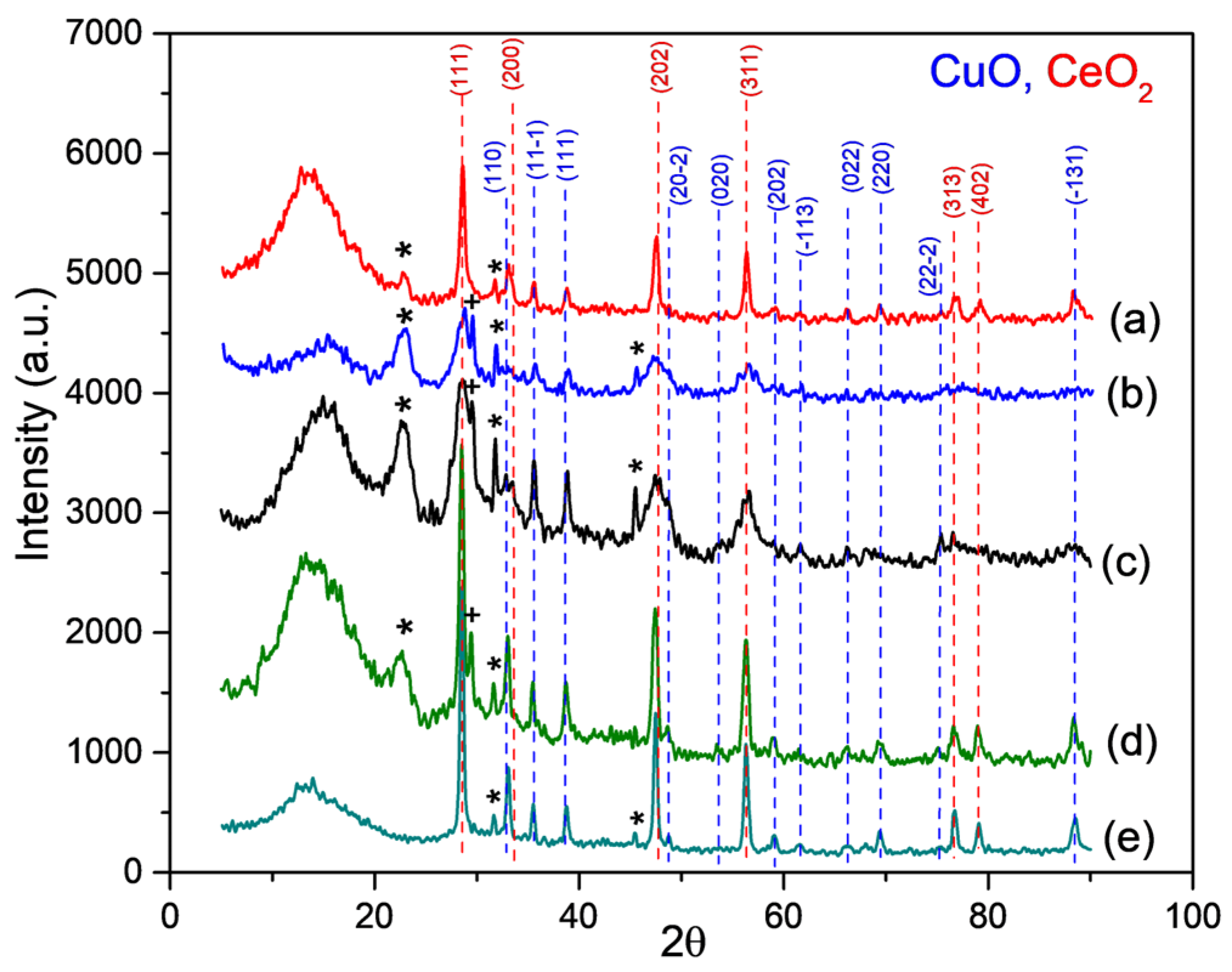
Figure 1.
XRD patterns of the CeO2–CuO catalysts calcined at 700 °C with: (a) 10 mol %, (b) 20 mol %, (c) 30 mol %, (d) 50 mol %, and (e) 80 mol % CuO. Marked peaks (+) are for Cu2O and (*) are for CuOH species, respectively.
Figure 1.
XRD patterns of the CeO2–CuO catalysts calcined at 700 °C with: (a) 10 mol %, (b) 20 mol %, (c) 30 mol %, (d) 50 mol %, and (e) 80 mol % CuO. Marked peaks (+) are for Cu2O and (*) are for CuOH species, respectively.
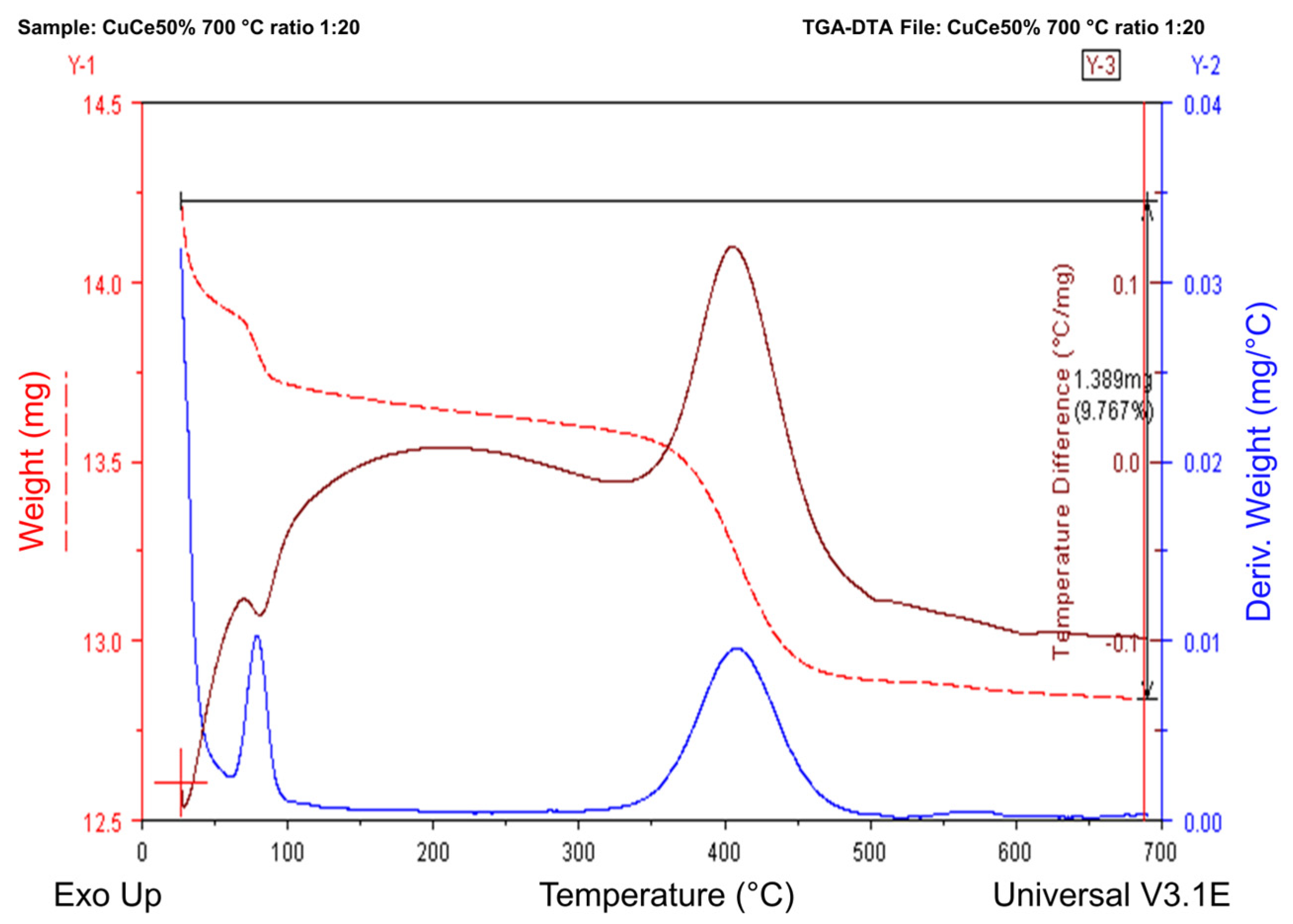
Figure 2.
TG/DTG/DTA profiles of Printex oxidation at a Printex-to-catalyst ratio of 1:20, using the Ce–Cu–50 catalyst, calcined at 700 °C.
Figure 2.
TG/DTG/DTA profiles of Printex oxidation at a Printex-to-catalyst ratio of 1:20, using the Ce–Cu–50 catalyst, calcined at 700 °C.
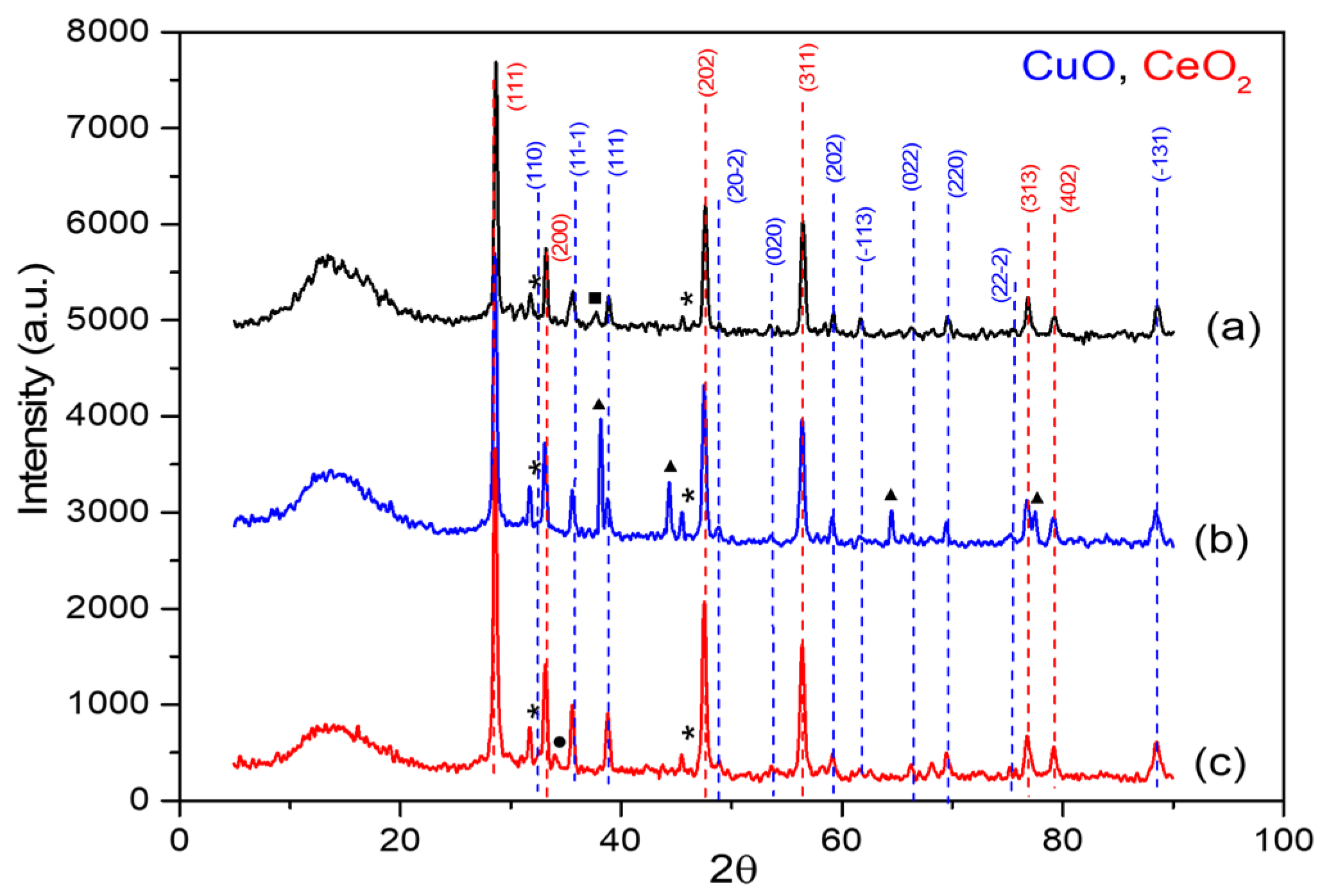
Figure 3.
XRD patterns of the CeO2–CuO–50 catalyst promoted with 10 wt.% of (a) Cr2O3, (b) Ag2O, and (c) Fe2O3. All catalysts were calcined at 700 °C. Marked peaks (*) are for CuOH species, whereas Cr2O3 (marked as ■) Ag2O (marked as ▲), and Fe2O3 (marked as ●)are from the promoters.
Figure 3.
XRD patterns of the CeO2–CuO–50 catalyst promoted with 10 wt.% of (a) Cr2O3, (b) Ag2O, and (c) Fe2O3. All catalysts were calcined at 700 °C. Marked peaks (*) are for CuOH species, whereas Cr2O3 (marked as ■) Ag2O (marked as ▲), and Fe2O3 (marked as ●)are from the promoters.
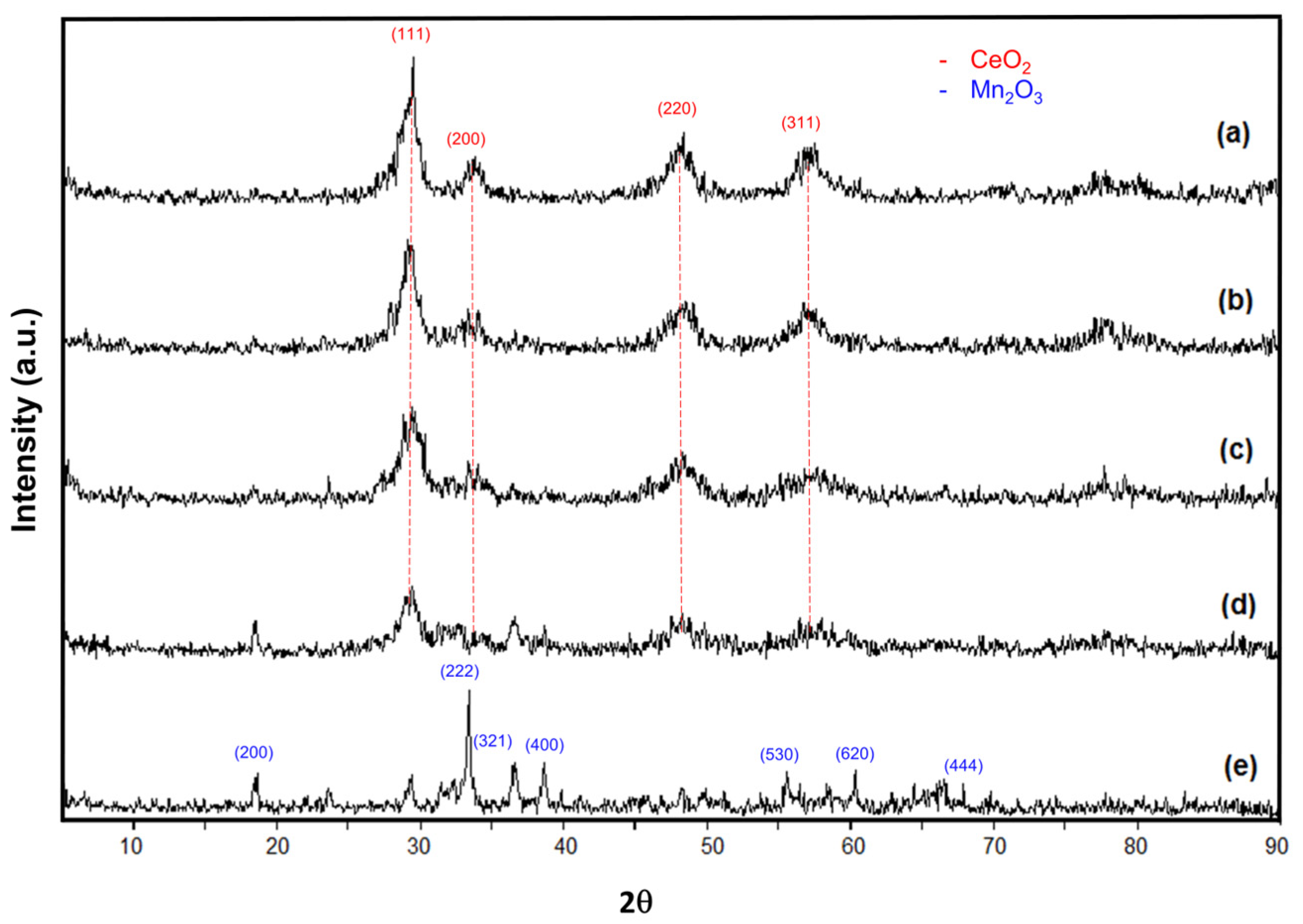
Figure 4.
XRD patterns of the CeO2–Mn2O3 catalysts calcined at 600 °C with: (a) 20 mol % Mn2O3, (b) 35 mol %Mn2O3, (c) 50 mol % Mn2O3, (d) 75 mol % Mn2O3, and (e) 100% Mn2O3.
Figure 4.
XRD patterns of the CeO2–Mn2O3 catalysts calcined at 600 °C with: (a) 20 mol % Mn2O3, (b) 35 mol %Mn2O3, (c) 50 mol % Mn2O3, (d) 75 mol % Mn2O3, and (e) 100% Mn2O3.
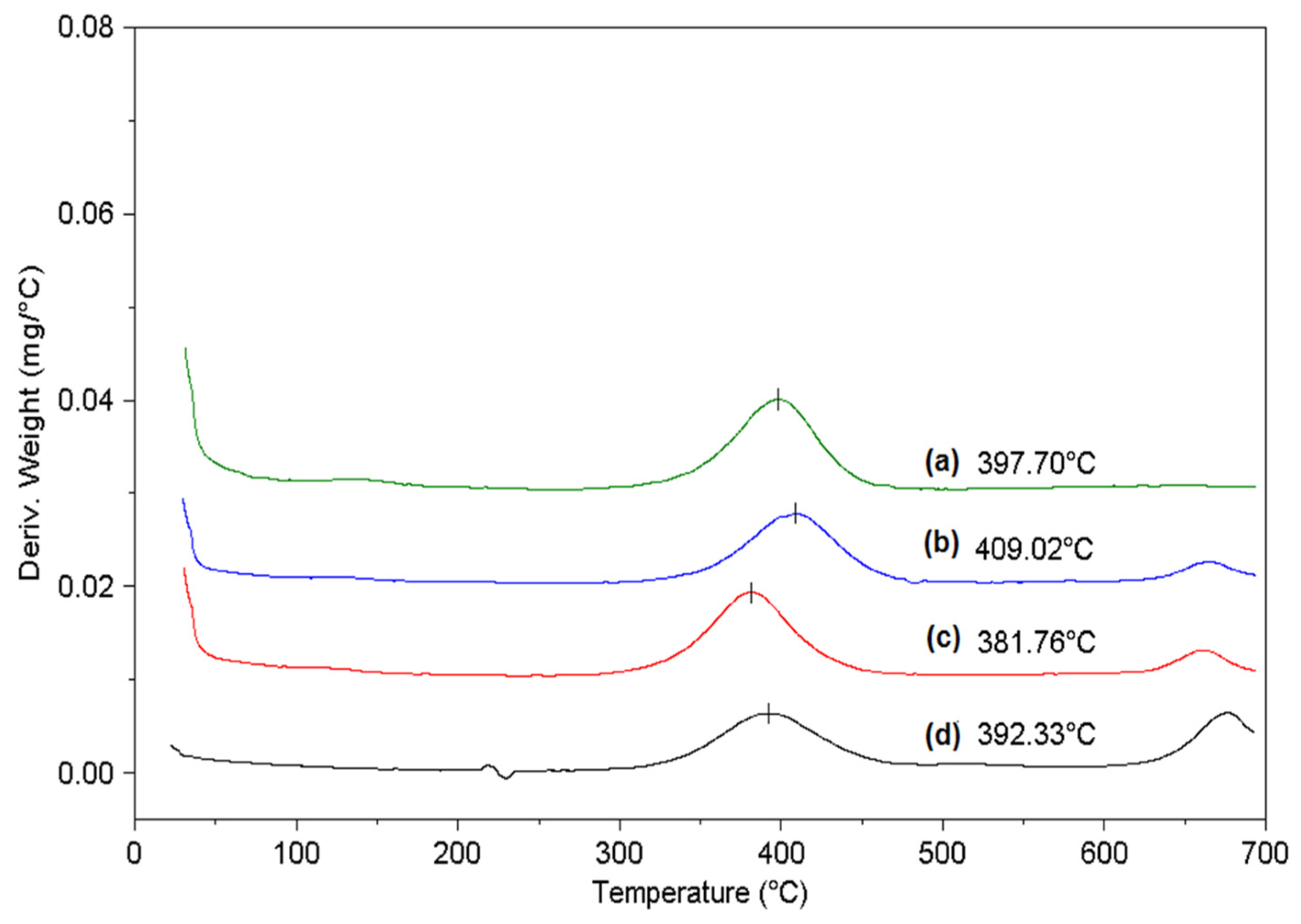
Figure 5.
DTG profiles of the Ce–Mn mixed oxide catalysts mixed with Printex, tested at a Printex-to-catalyst ratio of 1:20 under synthetic air: (a) Ce–Mn–20; (b) Ce–Mn–35; (c) Ce–Mn–50; and (d) Ce–Mn–75. All catalysts were calcined at 600 °C.
Figure 5.
DTG profiles of the Ce–Mn mixed oxide catalysts mixed with Printex, tested at a Printex-to-catalyst ratio of 1:20 under synthetic air: (a) Ce–Mn–20; (b) Ce–Mn–35; (c) Ce–Mn–50; and (d) Ce–Mn–75. All catalysts were calcined at 600 °C.
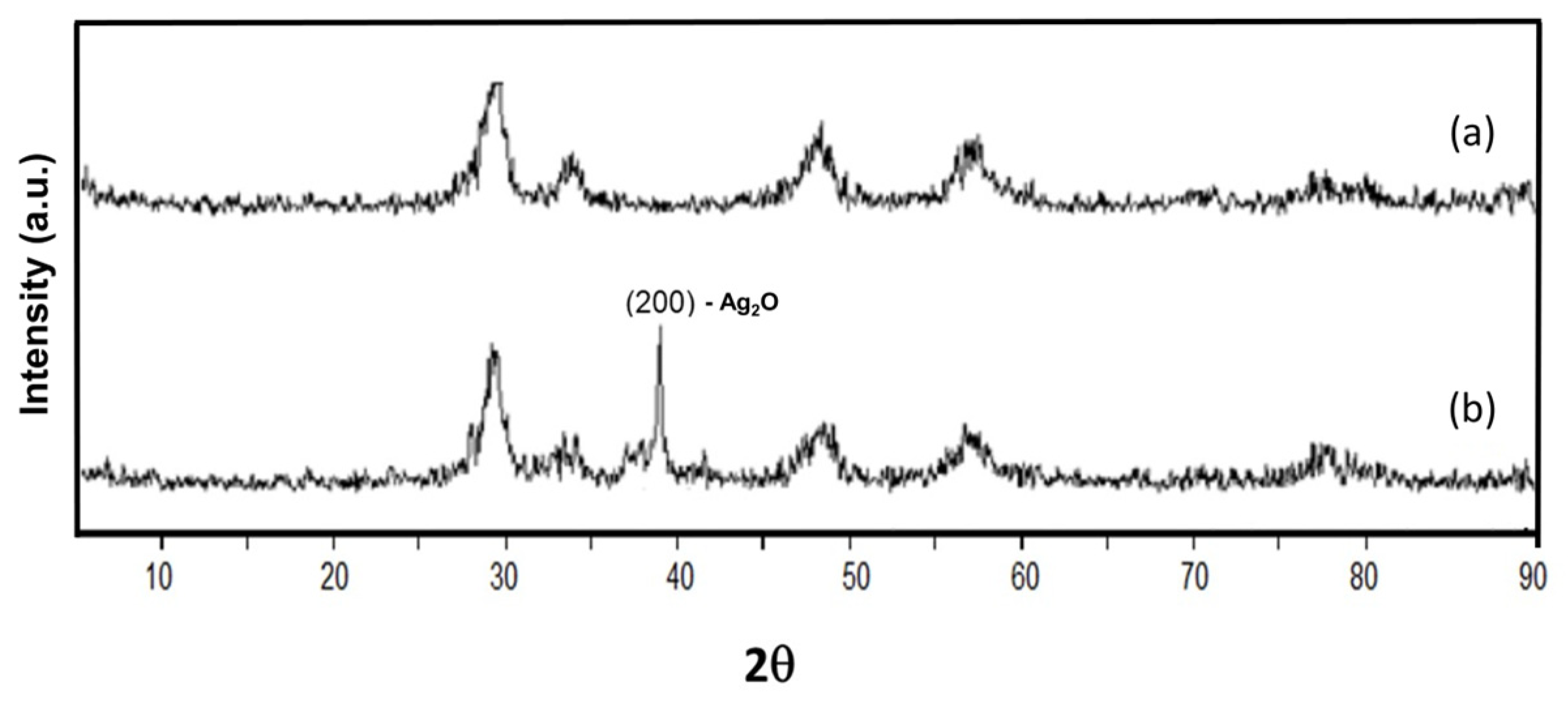
Figure 6.
XRD patterns of the Ce–Mn mixed oxide for (a) Ce–Mn–50 and (b) 10 wt.% Ag2O/Ce–Mn–50, showing the plane (200) of Ag2O.
Figure 6.
XRD patterns of the Ce–Mn mixed oxide for (a) Ce–Mn–50 and (b) 10 wt.% Ag2O/Ce–Mn–50, showing the plane (200) of Ag2O.
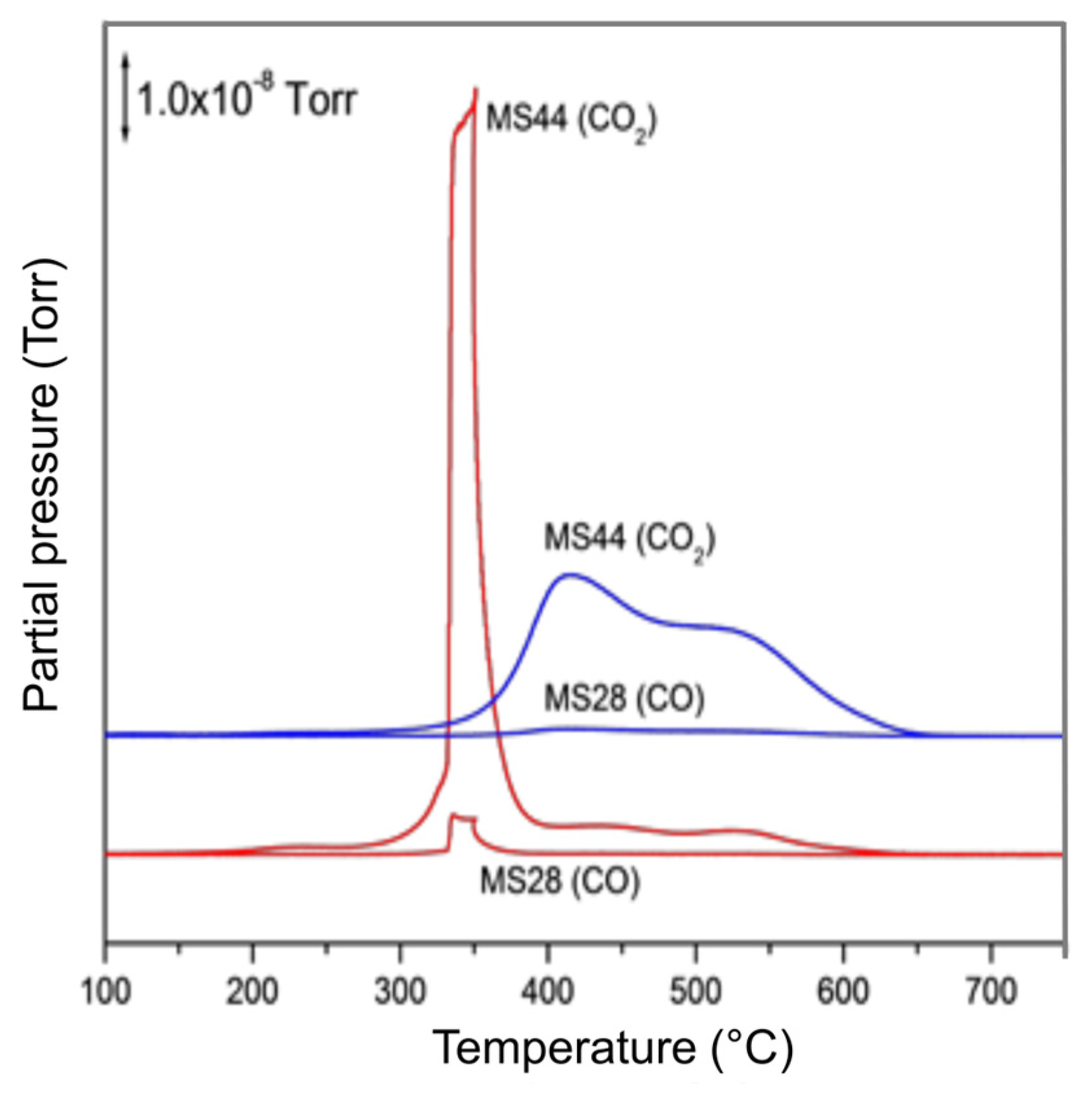
Figure 7.
TPO/MS profiles for the catalysts in tight contact with Printex: 10 wt.% Ag2O/Ce–Mn–50 (red) and Ce–Mn–50 (blue).
Figure 7.
TPO/MS profiles for the catalysts in tight contact with Printex: 10 wt.% Ag2O/Ce–Mn–50 (red) and Ce–Mn–50 (blue).
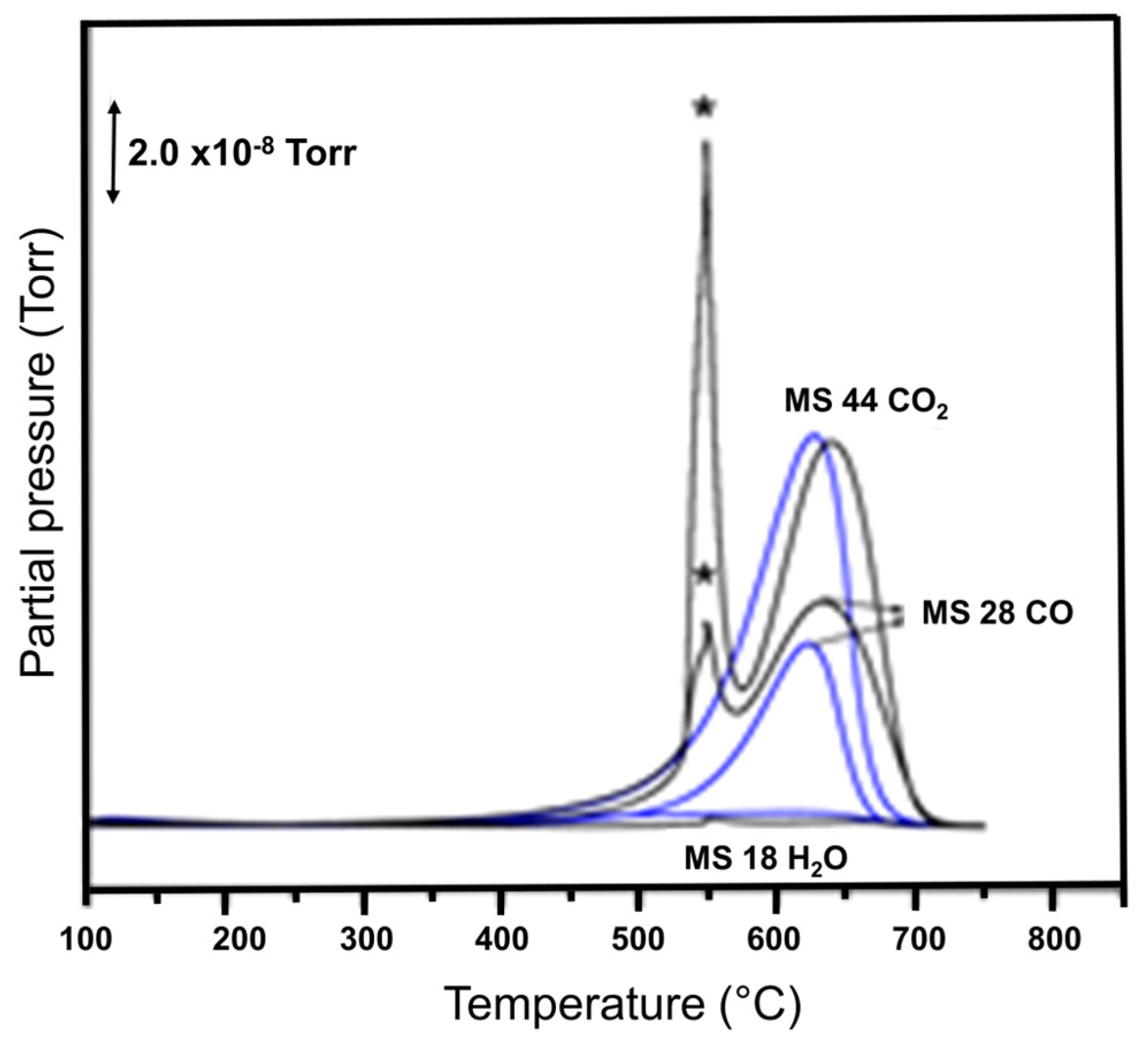
Figure 8.
TPO/MS profiles of pure Printex (black) and Printex mixed with silica (blue). 🟊 lowest temperatre of oxidation of the most volatile compounds of Printex.
Figure 8.
TPO/MS profiles of pure Printex (black) and Printex mixed with silica (blue). 🟊 lowest temperatre of oxidation of the most volatile compounds of Printex.
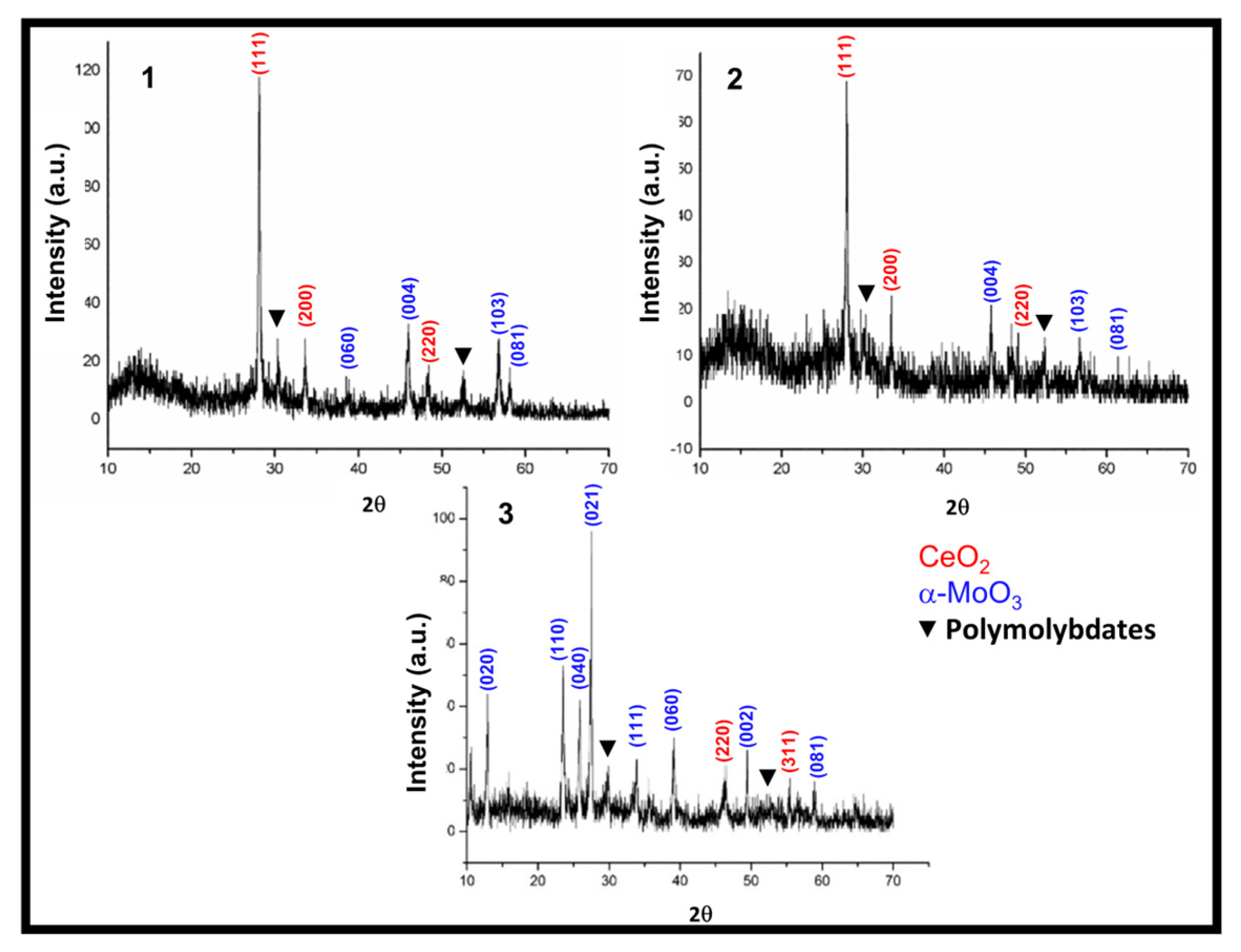
Figure 9.
XRD patterns of the Ce–Mo–50 mixed oxide synthesized using different methods: (1) coprecipitation with the cerium precursor added first; (2) co-precipitation with the molybdenum precursor added first; and (3) solid-state synthesis from the precursors.
Figure 9.
XRD patterns of the Ce–Mo–50 mixed oxide synthesized using different methods: (1) coprecipitation with the cerium precursor added first; (2) co-precipitation with the molybdenum precursor added first; and (3) solid-state synthesis from the precursors.
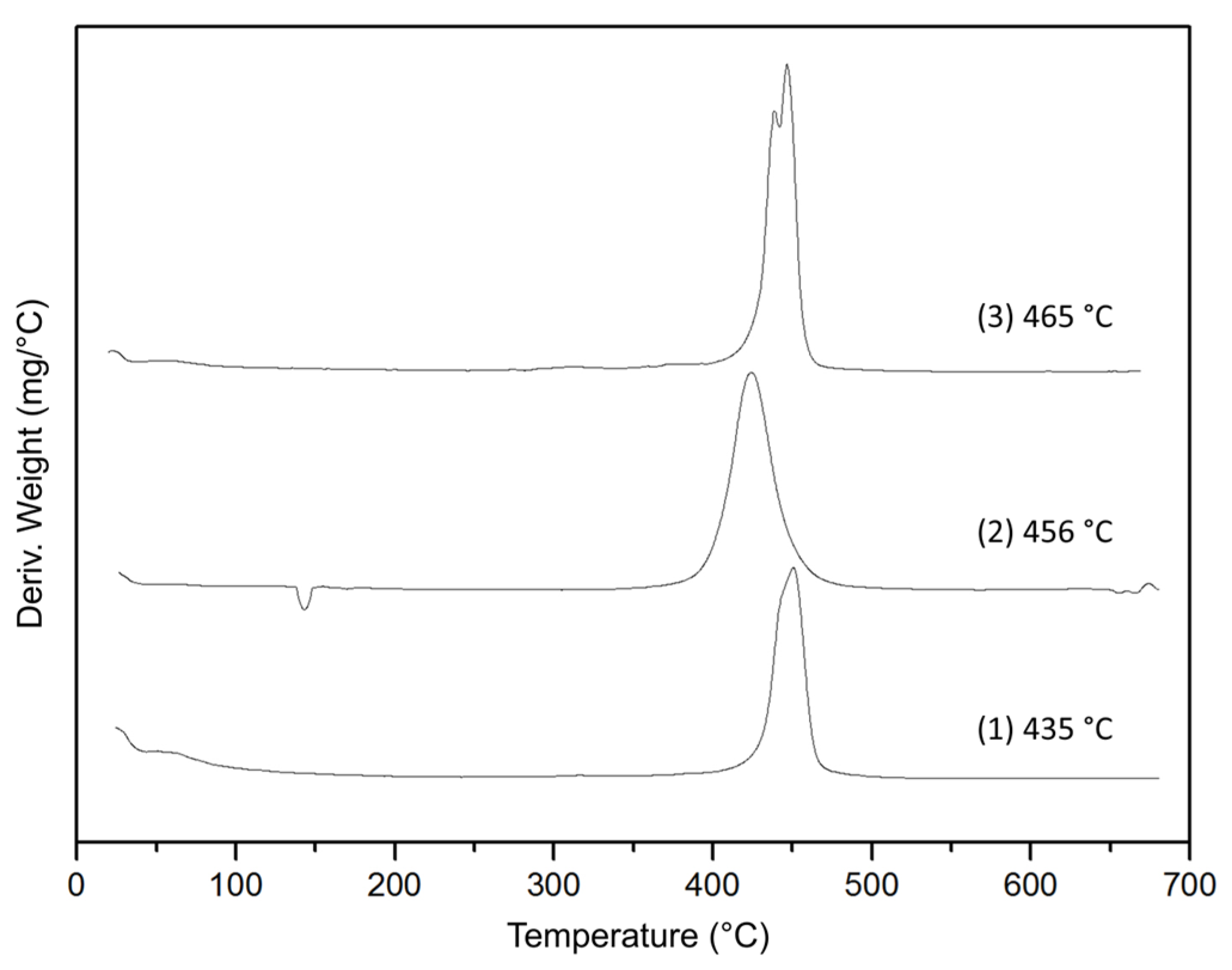
Figure 10.
DTG profiles of the Ce–Mo–50 mixed oxide synthesized using different methods: (1) coprecipitation with the cerium precursor added first; (2) co-precipitation with the molybdenum precursor added first; and (3) solid-state synthesis from the precursors.
Figure 10.
DTG profiles of the Ce–Mo–50 mixed oxide synthesized using different methods: (1) coprecipitation with the cerium precursor added first; (2) co-precipitation with the molybdenum precursor added first; and (3) solid-state synthesis from the precursors.
Figure 11.
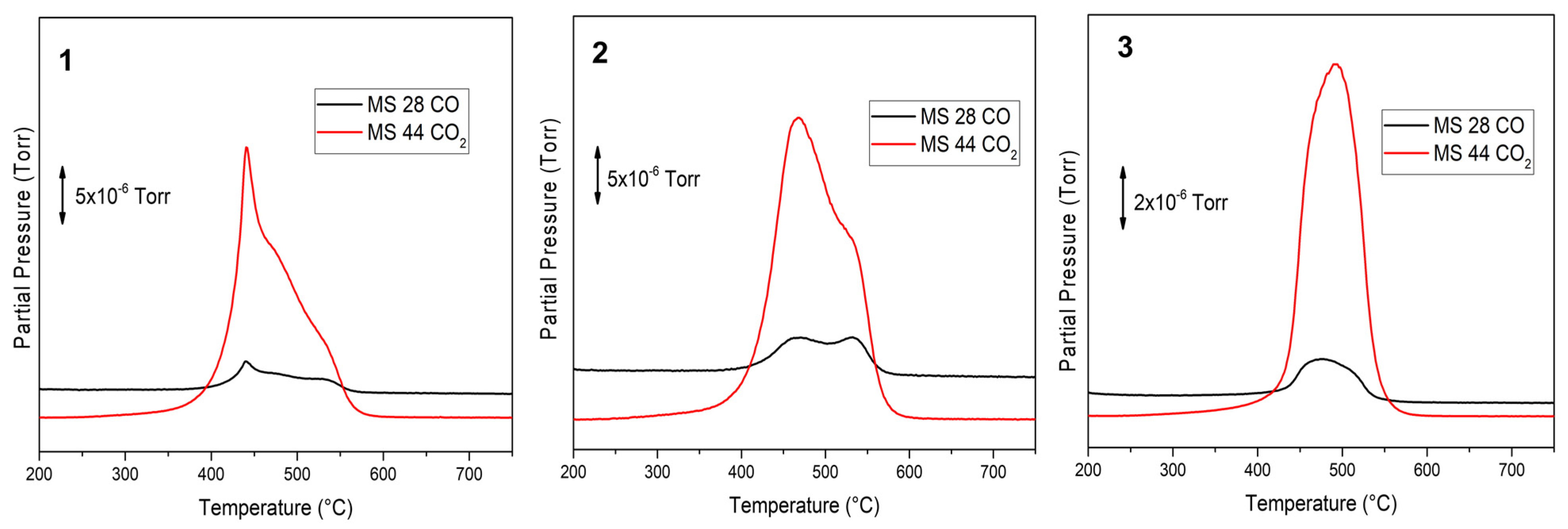
TPO/MS profiles of the Ce–Mo–50 mixed oxide synthesized using different methods: (1) co-precipitation with the cerium precursor added first; (2) co-precipitation with the molybdenum precursor added first; and (3) solid-state synthesis from the precursors. The products were assigned as: (m/e = 28, CO, black line), and (m/e = 44, CO2, red line).
Figure 11.
TPO/MS profiles of the Ce–Mo–50 mixed oxide synthesized using different methods: (1) co-precipitation with the cerium precursor added first; (2) co-precipitation with the molybdenum precursor added first; and (3) solid-state synthesis from the precursors. The products were assigned as: (m/e = 28, CO, black line), and (m/e = 44, CO2, red line).
Table 1.
Elemental analysis of Cu and Ce by EDXRF, showing theoretical (T) and experimental (E) values. The metals were considered in the form of their oxides. All catalysts were calcined at 700 °C.
Table 1.
Elemental analysis of Cu and Ce by EDXRF, showing theoretical (T) and experimental (E) values. The metals were considered in the form of their oxides. All catalysts were calcined at 700 °C.
| Catalyst | CuO—T (%) | CuO—E (%) | CeO2—T (%) | CeO2—E (%) |
|---|
| Ce–Cu–10 | 10 | 9.2 | 90 | 90.8 |
| Ce–Cu–20 | 20 | 22.1 | 80 | 77.9 |
| Ce–Cu–30 | 30 | 32.1 | 80 | 67.9 |
| Ce–Cu–50 | 50 | 51.3 | 50 | 48.7 |
| Ce–Cu–80 | 80 | 79.4 | 20 | 20.6 |
Table 2.
Maximum oxidation temperature (TMAX) of soot over the catalysts (all calcined at 500 °C) and tested at a Printex-to-catalyst ratio of 1:20.
Table 2.
Maximum oxidation temperature (TMAX) of soot over the catalysts (all calcined at 500 °C) and tested at a Printex-to-catalyst ratio of 1:20.
| Catalyst | TMAX (°C) |
|---|
| Ce–Cu–10 | 452 |
| Ce–Cu–20 | 445 |
| Ce–Cu–30 | 438 |
| Ce–Cu–50 | 431 |
| Ce–Cu–80 | 435 |
Table 3.
Maximum oxidation temperature (TMAX) of soot over the Ce–Cu–50 catalyst (50 mol % Cu) at different calcination temperatures, evaluated at a Printex-to-catalyst ratio of 1:20.
Table 3.
Maximum oxidation temperature (TMAX) of soot over the Ce–Cu–50 catalyst (50 mol % Cu) at different calcination temperatures, evaluated at a Printex-to-catalyst ratio of 1:20.
| Temperature (°C) | 300 | 400 | 500 | 600 | 700 |
| TMAX (°C) | 474 | 440 | 431 | 417 | 409 |
Table 4.
Maximum oxidation temperature (TMAX) of soot over the Ce–Cu–50 catalyst (calcined at 700 °C) as a function of the Printex-to-catalyst ratio.
Table 4.
Maximum oxidation temperature (TMAX) of soot over the Ce–Cu–50 catalyst (calcined at 700 °C) as a function of the Printex-to-catalyst ratio.
| Calcination Temperature (°C) | Ratio Printex: Catalyst | TMAX (°C) |
|---|
| 700 | 1:5 | 426 |
| 700 | 1:10 | 428 |
| 700 | 1:20 | 409 |
Table 5.
Maximum oxidation temperature (TMAX) values for catalysts calcined at 700 °C and tested at a Printex-to-catalyst ratio of 1:20, containing different promoters (10 wt.% of Cr2O3, Ag2O, and Fe2O3) in the Ce–Cu–50 system, together with the actual content of each promoter (P) determined by EDXRF analysis.
Table 5.
Maximum oxidation temperature (TMAX) values for catalysts calcined at 700 °C and tested at a Printex-to-catalyst ratio of 1:20, containing different promoters (10 wt.% of Cr2O3, Ag2O, and Fe2O3) in the Ce–Cu–50 system, together with the actual content of each promoter (P) determined by EDXRF analysis.
| Promoter/Catalyst | TMAX (°C) | P (%) |
|---|
| Ce–Cu–50 | 409 | 0 |
| Cr2O3/Ce–Cu–50 | 400 | 9.8 |
| Ag2O/Ce–Cu–50 | 390 | 8.9 |
| Fe2O3/Ce–Cu–50 | 398 | 9.5 |
Table 6.
Elemental analysis of Mn and Ce by EDXRF, showing theoretical (T) and experimental (E) values. The metals were considered in the form of their oxides. All catalysts were calcined at 600 °C.
Table 6.
Elemental analysis of Mn and Ce by EDXRF, showing theoretical (T) and experimental (E) values. The metals were considered in the form of their oxides. All catalysts were calcined at 600 °C.
| Catalyst | Mn2O3—T (%) | Mn2O3—E (%) | CeO2—T (%) | CeO2—E (%) |
|---|
| Ce–Mn–20 | 20 | 20.2 | 80 | 79.8 |
| Ce–Mn–35 | 35 | 36.8 | 65 | 63.2 |
| Ce–Mn–50 | 50 | 53.3 | 50 | 46.7 |
| Ce–Mn–75 | 75 | 75.9 | 25 | 24.1 |
Table 7.
Total specific surface area (SBET, calculated by BET method), total pore volume (Vp, obtained at P/P0 = 0.98), average crystalline domain size (D, calculated using the Scherrer equation), and average pore diameter (PD, calculated by BJH method) of the CeO2–Mn2O3 catalysts.
Table 7.
Total specific surface area (SBET, calculated by BET method), total pore volume (Vp, obtained at P/P0 = 0.98), average crystalline domain size (D, calculated using the Scherrer equation), and average pore diameter (PD, calculated by BJH method) of the CeO2–Mn2O3 catalysts.
| Catalyst | SBET (m2/g) | Vp (cm3/g) | D (nm) | PD (nm) |
|---|
| CeO2 | 30.2 | 0.14 | 19.6 | 19.8 |
| Ce–Mn–20 | 12.7 | 0.24 | 58.9 | 17.0 |
| Ce–Mn–35 | 50.0 | 0.26 | 55.2 | 16.5 |
| Ce–Mn–50 | 53.3 | 0.30 | 40.4 | 18.2 |
| Ce–Mn–75 | 29.0 | 0.16 | 44.8 | 17.3 |
| Mn2O3 | 6.1 | 0.03 | 228.8 | 11.4 |
Table 8.
Maximum oxidation temperature (TMAX) of soot obtained from TG/DTG profiles for the Ce–Mn–50 mixed oxide with different promoters (10 wt.%), and the corresponding actual promoter content (P) determined by EDXRF analysis.
Table 8.
Maximum oxidation temperature (TMAX) of soot obtained from TG/DTG profiles for the Ce–Mn–50 mixed oxide with different promoters (10 wt.%), and the corresponding actual promoter content (P) determined by EDXRF analysis.
| Promoter/Catalyst | TMAX (°C) | P (%) |
|---|
| Ce–Mn–50 | 382 | 0 |
| K2O/Ce–Mn–50 | 467 | 11.1 |
| Cs2O/Ce–Mn–50 | 493 | 10.4 |
| CuO/Ce–Mn–50 | 387 | 10.5 |
| Fe2O3/Ce–Mn–50 | 445 | 9.7 |
| Cr2O3/Ce–Mn–50 | 469 | 9.9 |
| Ag2O/Ce–Mn–50 | 376 | 9.3 |
Table 9.
Elemental analysis of Mo and Ce by EDXRF, showing theoretical (T) and experimental (E) values, for Ce–Mo–50, prepared using three different methods: (1) co-precipitation with the Ce precursor added first, followed by the Mo precursor; (2) co-precipitation with the Mo precursor added first, followed by the Ce precursor; and (3) solid-state synthesis. The metals were considered in the form of their oxides. All catalysts were calcined at 400 °C.
Table 9.
Elemental analysis of Mo and Ce by EDXRF, showing theoretical (T) and experimental (E) values, for Ce–Mo–50, prepared using three different methods: (1) co-precipitation with the Ce precursor added first, followed by the Mo precursor; (2) co-precipitation with the Mo precursor added first, followed by the Ce precursor; and (3) solid-state synthesis. The metals were considered in the form of their oxides. All catalysts were calcined at 400 °C.
| Method (X)/Catalyst | MoO3—T (%) | MoO3—E (%) | CeO2—T (%) | CeO2—E (%) |
|---|
| (1)/Ce–Mo–50 | 50 | 50.7 | 50 | 49.3 |
| (2)/Ce–Mo–50 | 50 | 51.2 | 50 | 48.8 |
| (3)/Ce–Mo–50 | 50 | 54.1 | 50 | 45.9 |
Table 10.
Total specific surface area (SBET, by BET method), total pore volume (Vp, obtained at P/P0 = 0.98), average pore size (Ps, BJH desorption average pore width, 4V/A), and average crystalline domain size (D, calculated using the Scherrer equation). – not available datum.
Table 10.
Total specific surface area (SBET, by BET method), total pore volume (Vp, obtained at P/P0 = 0.98), average pore size (Ps, BJH desorption average pore width, 4V/A), and average crystalline domain size (D, calculated using the Scherrer equation). – not available datum.
| Method (X)/Catalyst | SBET (m2/g) | Vp (cm3/g) | Ps (nm) | D (nm) |
|---|
| CeO2 | 30.2 | – | – | – |
| (1)/Ce–Mo–50 | 9.9 | 0.13 | 30.5 | 55 |
| (2)/Ce–Mo–50 | 10.4 | 0.12 | 35.1 | 56 |
| (3)/Ce–Mo–50 | 12.7 | 0.11 | 38.3 | 55 |
| Ag2O/(1)/Ce–Mo–50 | 20.1 | 0.10 | 18.2 | 57 |
| MoO3 | 27.6 | – | – | – |
Table 11.
Comparative TMAX and TRECY (temperature of the third reutilization cycle), crystalline domain size (D), and oxygen storage capacity (OSC) of the best catalysts for Printex oxidation.
Table 11.
Comparative TMAX and TRECY (temperature of the third reutilization cycle), crystalline domain size (D), and oxygen storage capacity (OSC) of the best catalysts for Printex oxidation.
| Catalyst | TMAX (°C) | TRECY (°C) | D (nm) | OSC (µmol/g) |
|---|
| Ce–Cu–50 | 409 | 480 | 58 | 215 |
| Ag2O/Ce–Cu–50 | 390 | 468 | 60 | 245 |
| Ce–Mn–50 | 382 | 432 | 40 | 326 |
| Ag2O/Ce–Mn–50 | 376 | 418 | 41 | 351 |
| (1)/Ce–Mo–50 | 425 | 468 | 55 | 197 |
| Ag2O/(1)/Ce–Mo–50 | 410 | 463 | 57 | 212 |




 ,
,