1. Introduction
Benzimidazole derivatives are privileged scaffolds in coordination chemistry due to their rigid, bicyclic structure and tuneable electronic properties, which can be systematically modified via aromatic substitution [
1,
2]. Their importance spans coordination chemistry and medicinal applications, where benzimidazole metal complexes exhibit notable antimicrobial and anticancer activities [
3,
4], and have found extensive use in metal–organic frameworks for gas storage and sensing applications [
5,
6]. The Hammett equation provides a powerful quantitative framework for predicting how such substituents influence chemical reactivity and stability through electronic effects. Substituent-dependent electronic redistribution in benzimidazole systems, particularly for nitro-, chloro-, and hydroxy-derivatives, has been shown to significantly affect both molecular structure and coordination behaviour [
7,
8,
9], which also governs their performance in optoelectronic and light-emitting materials [
10]. While widely applied in organic chemistry, its use in correlating substituent constants with the stability constants (log K) of transition metal complexes remains an area of active exploration. This study integrates synthetic chemistry with physicochemical analysis to investigate these relationships. We aimed to achieve the following objectives:
Synthesize a series of Co(II) and Cu(II) complexes with para-substituted 2-phenylbenzimidazole ligands.
Determine their stability constants in solution via spectrophotometric methods.
Correlate the measured log K values with Hammett σ constants to quantify the electronic effect on metal–ligand affinity.
Support the solution-phase trends with solid-state characterization data, including melting points.
Benzimidazoles represent a critical class of heterocyclic compounds with significant applications in coordination chemistry, catalysis, and medicinal science. Their synthesis, however, has historically presented challenges. Classical routes to 2-substituted benzimidazoles, such as the condensation of o-phenylenediamine (OPD) (
1) with aldehydes or the reaction of ortho-diamines with carboxylic acids, are often hampered by modest yields, harsh conditions, and limited substrate tolerance [
1,
8,
11]. These methods struggle with sensitive functional groups, particularly nitro-substituted precursors, where oxidative decomposition can occur and where cyclization efficiency strongly depends on the nature of the intermediate Schiff base [
8,
11].
A pivotal advancement emerged with the discovery of a copper-mediated oxidative synthesis [
7]. This method involves the direct condensation of an o-diamine with virtually any aliphatic, aromatic, or heterocyclic aldehyde in the presence of a copper(II) salt, typically copper(II) acetate. The reaction proceeds under mild, aqueous or alcoholic conditions with gentle heating. Its key advantage lies in simultaneous oxidative cyclization and in situ complexation: the benzimidazole product precipitates as an insoluble copper(I) complex, driving the reaction to completion and facilitating isolation. The relevance of copper–benzimidazole systems is well established in catalytic and organometallic chemistry, where such ligands are known to modulate metal reactivity through electronic tuning [
12,
13]. Subsequent treatment with hydrogen sulphide liberates the pure free base in a high, often near-quantitative yield. This elegant one-pot process overcomes the limitations of earlier methods, offering exceptional functional group compatibility and operational simplicity.
Building upon this robust synthetic foundation, this study investigates the coordination chemistry of a series of para-substituted 2-phenylbenzimidazole ligands with cobalt(II) and copper(II). We focus on quantifying how substituent electronics, modulated by hydroxyl (–OH), chloro (–Cl), and nitro (–NO
2) groups, govern the stability of the resulting 1:2 (M:L
2) complexes. Using spectrophotometric titrations and the Benesi–Hildebrand method, we determine precise stability constants (log K) and correlate them with Hammett σ parameters. Our work connects the efficiency of this modern synthetic paradigm with a quantitative analysis of the metal–ligand bonding it enables, providing clear structure–stability relationships that inform the rational design of functional coordination compounds, particularly for catalytic platforms where benzimidazole metal complexes are widely employed [
14,
15].
2. Materials and Methods
Copper(II) acetate monohydrate (Cu(OAc)
2 H
2O, 99%), cobalt(II) acetate tetrahydrate (Co(OAc)
2·4H
2O, 99% and anhydrous iron(II) acetate (Fe(OAc)
2) were used as metal ion sources. All chemicals used were of analytical grade and purchased from Sigma-Aldrich, Germany (Steinheim am Albuch), and were used without further purification. The ligands 2-(4-chlorophenyl) benzimidazole (
2), 2-(4-nitrophenyl) benzimidazole (
3) and 2-(4-hydroxyphenyl)benzimidazole (
4) were synthesized according to modified literature procedures [
7] starting from appropriate benzaldehydes (4-X-benzaldehydes, where X = Cl, NO
2, OH, in short 4-Cl, 4-NO
2, 4-OH, Sigma-Aldrich, Germany (Steinheim am Albuch) and their purity confirmed by melting point, MS (Agilent 6130a quadropule, Agilent Technologies, Santa Clara, CA, USA), FT-IR (Bruker Tensor-37, Bruker, Ettlingen, Germany) and XRD (Panalytical X’pert Pro MDP, Malvern Panalytical, Almelo, Netherlands) (all detailed data are provided in the
Supplementary Materials). All organic solvents were of analytical grade and used without further purification. Deionized water was used for preparing aqueous stock solutions.
General Procedure for Spectrophotometric Titrations
A stock solution of the metal ion (Cu(II), Co(II) or Fe(II)) was prepared at a fixed concentration of in a buffered aqueous–organic solvent mixture (acetate buffer (99 wt%, Molar Chemicals, Budapest, Hungary), pH 4.7, 30% v/v ethanol (85 wt%, Molar Chemicals, Budapest, Hungary)). For each ligand, a series of six solutions was prepared in 10 mL volumetric flasks, corresponding to ligand-to-metal molar ratios (r = [L]ₜ/[M]ₜ) of 0:1, 0.5:1, 1:1, 1.5:1, 2:1, and 2.5:1. The total metal concentration () was kept constant, while the total ligand concentration () was varied as . Each solution was allowed to equilibrate for 30 min at 25.0 ± 0.1 °C before measurement.
General Synthetic Procedure
The target metal complexes were synthesized via a one-pot condensation reaction between ortho-phenylenediamine (OPD, 99%, Sigma-Aldrich, Steinheim am Albuch, Germany), the appropriate substituted benzaldehyde, and the corresponding metal acetate in a refluxing aqueous ethanolic medium, adapted from established methodologies for Schiff base complex formation and benzimidazole cyclization [
1,
7,
8,
11].
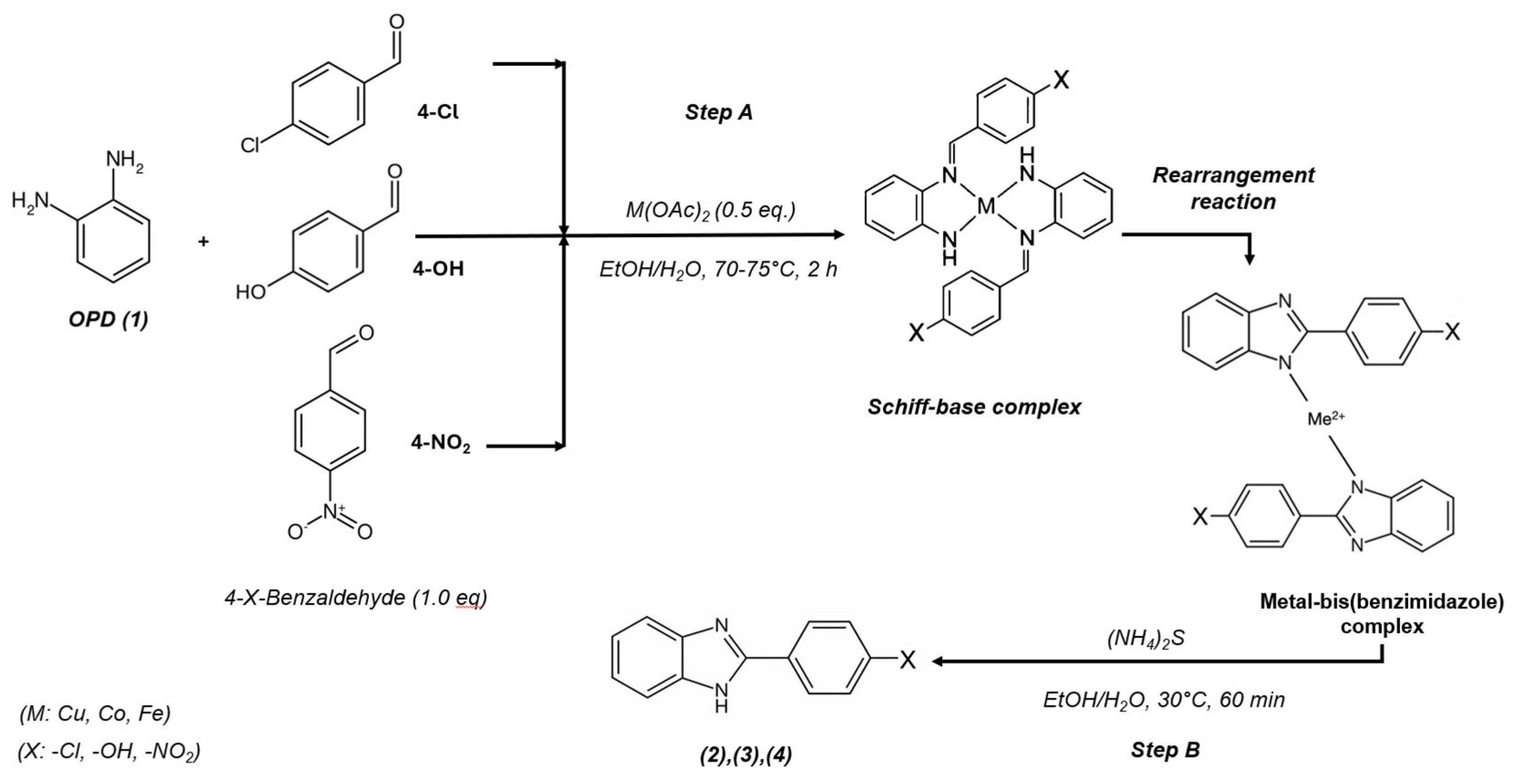
Step A: Formation of the Metal–Bis(benzimidazole) Complex
In a 1 L round-bottom flask equipped with a reflux condenser, o-phenylenediamine (10.81 g, 0.100 mol, 99%, Sigma-Aldrich, Steinheim am Albuch, Germany) was dissolved in absolute ethanol (200 mL). To this solution, the appropriate metal acetate (Cu(OAc)2 H2O [19.97 g], Co(OAc)2 4H2O [24.91 g], or Fe(OAc)2 [17.39 g]; 0.100 mol) dissolved in warm deionized water (100 mL) was added via vigorous stirring. Upon addition of the aldehyde (0.100 mol; 4-Cl: 14.06 g, 4-OH: 12.21 g, 4-NO2: 15.11 g) in ethanol (50 mL), the reaction mixture was heated to 70–75 °C with continuous stirring for 2 h. The precipitated coloured complexes (copper: green, cobalt: pink–brown, iron: dark red) were collected by hot filtration, washed sequentially with hot ethanol (2 × 50 mL) and diethyl ether (50 mL, 99.5 wt%, Molar Chemicals, Budapest, Hungary), and air-dried. The mass of this intermediate can be recorded but is not critical for the final yield calculation.
Step B: Demetallation and Cyclization to the Free Benzimidazole
The crude metal complex was suspended in a 1:1 v/v mixture of ethanol and water (total volume 400 mL). The equimolar ammonium sulphide solution (25.0 mL of 25% w/w, ~0.10 mol (NH4)2S, 40–48 wt%, Sigma-Aldrich, Steinheim am Albuch, Germany) was added dropwise with efficient stirring at room temperature. The mixture was then heated at 60 °C for 30 min, during which the metal sulphide precipitated and the product dissolved. The hot mixture was filtered to remove metal sulphides, and the filter, the cake was washed with hot ethanol (2 × 30 mL). The combined filtrate was concentrated under reduced pressure to approximately half its volume and then poured into ice-water (300 mL) with stirring. The resulting solid was collected by filtration, washed thoroughly with water, and recrystallized from 70% aqueous ethanol to afford the pure 2-arylbenzimidazole.
Spectrophotometric Measurements
UV-VIS absorption spectra were recorded on a double-beam spectrophotometer (DLAB SP-UV1100, DLAB Scientific Co. Ltd., Beijing, China) using matched 1.00 cm quartz cuvettes. Measurements were performed at a fixed analytical wavelength (λ = 264 nm) where the difference in molar absorptivity between the free metal ion and the metal–ligand complex was found to be maximal. The absorbance of the metal ion solution without the ligand () and the absorbance of each mixture (A) were recorded in triplicate, and the mean values were used for subsequent calculations.
Data Treatment and Determination of Stability Constants
The stability constants for the formation of 1:2 metal–ligand complexes (M + 2L ⇌ ML2) were determined using the Benesi–Hildebrand method. This approach is valid under the conditions of a single dominant complex species (ML2), (ii) a large excess of ligand relative to the metal ion to approximate the free ligand concentration [L] with the total concentration , and (iii) adherence to Beer’s law for all absorbing species.
For a 1:2 complex, the change in absorbance at a fixed wavelength, ΔA = A − A
0, is related to the free ligand concentration [L] represented by Equation (1):
where
is the overall stability constant for the ML2 formation ();
is the difference in molar absorptivity between the complex and the free metal ion ();
is the total metal concentration;
is the equilibrium concentration of the free ligand.
In the modified rigorous treatment applied here, the approximation
was not used due to the moderate ligand excess. Instead, the free ligand concentration [L] was calculated iteratively for each point from the mass-balance equations, as seen in Equations (2)–(4):
An initial estimate of K was used to solve for [L] numerically; this [L] was then used in the Benesi equation to perform a linear regression of versus . The slope () and intercept () from this plot yielded refined values for () and . This iterative cycle was repeated until convergence (ΔK < 0.5%).
Hammett Analysis
To quantify the electronic effect of the para-substituents, the determined log K values were correlated with the Hammett substituent constants (σ
p) using the linear free-energy relationship in Equation (5):
where
is the reaction constant and
refers to the unsubstituted parent system. The σ
p values for –NO
2 (+0.78) and –Cl (+0.23) were taken from standard tables [
16]. The reaction constant ρ and its standard error were obtained from a weighted linear least-squares fit.
Computational Simulation of Ideal Data
To illustrate the theoretical behaviour of a pure 1:2 system and validate the methodology, a set of simulated “ideal” absorbance data was generated for both ligands and metal ions. This simulation used the final converged K values, the iterative mass-balance model, and assumed Δε values to calculate ΔA and A for each r value. This procedure confirmed that the derived constants produced spectrophotometric titration curves with the expected monotonic trend and saturation plateau characteristic of 1:2 complexation.
Software
All numerical computations, iterative solutions, linear regressions, and data simulations were performed using in-house scripts written in the Python3 (version 3.9.6 on MacOS Tahoe 26.2) programming language (SciPy (1.17.1) and NumPy (2.4.0) libraries). Statistical analysis of linear fits considered both the correlation coefficient (R2) and the standard error of the estimated parameters.
Specific Considerations by Metal Series
Copper(II) Complexes: All copper syntheses proceeded homogeneously at the outset, yielding dark green or homogeneous solutions from which brown to bronze-coloured precipitates formed during reflux. Isolated yields: [Cu(4-OH-bzm)2(OAc)2] (green powder), 25.08 g (83.3%); [Cu(4-Cl-bzm)2(OAc)2] (bronze powder), 24.32 g (76.1%); [Cu(4-NO2-bzm)2(OAc)2] (brown powder), 27.22 g (82.5%).
Cobalt(II) Complexes: The reactions typically began with deeply coloured solutions (burgundy, purple). Precipitation was often induced after the reflux period by adding a large excess of distilled water, yielding yellow, ochre, or reddish powders. Isolated yields: [Co(4-OH-bzm)2(OAc)2] (ochre powder), 22.17 g (74.2%); [Co(4-Cl-bzm)2(OAc)2] (reddish powder), 27.12 g (85.5%); [Co(4-NO2-bzm)2(OAc)2] (yellow powder), 25.86 g (78.9%).
Iron(II) Complexes: The procedure was analogous, yielding products as follows: [Fe(4-OH-bzm)2(OAc)2] (red powder), 22.6 g (76.1%); [Fe(4-Cl-bzm)2(OAc)2] (reddish powder), 23.17 g (73.4%); [Fe(4-NO2-bzm)2(OAc)2] (dark red powder), 26.12 g (80.1%).
The synthesized complexes are proposed to adopt a 1:2 (M:L) stoichiometry, confirmed by Job’s method in solution, with the proposed empirical formula [M(bzm)
2(OAc)
2] (M = Cu, Co, Fe; bzm = neutral 2-arylbenzimidazole coordinating via the imine nitrogen, N3). This anhydrous formula is used for stoichiometric yield calculations. It should be noted that the presence of coordinated water molecules or lattice solvent in the air-dried solid cannot be excluded without elemental analysis or thermogravimetric data, neither of which was performed in this study. As a representative example, the [Cu(4-OH-bzm)
2(OAc)
2] complex was characterized by HPLC-MS (
Supplementary Figures S1–S4); the molecular ion region and the characteristic two-mass-unit
63Cu/
65Cu isotopic splitting pattern are fully consistent with the proposed formula C
30H
26CuN
4O
6 (MW = 602.1). These data are consistent with complex formation but are insufficient to establish coordination number or geometry in the solid state unambiguously. Single-crystal X-ray diffraction was not performed. Based on the established coordination chemistry of Cu(II) and Co(II) with mixed N,O-donor ligand sets, Cu(II) commonly adopts five- or six-coordinate geometries (square–pyramidal or octahedral) when bidentate acetate co-ligands are present, while Co(II) preferentially forms octahedral complexes with N-donor benzimidazole ligands.
Scheme 1 illustrates the synthetic pathway from ortho-phenylenediamine (OPD) to the formation of the metal-bis(benzimidazole) complex (Step A and Rearrangement reaction [
7]), following the demetallation and cyclization to the free benzimidazole
2–
4 (Step B), outlining the key reaction steps, reagents, and conditions employed.
Characterization: The melting point/decomposition temperature of each air-dried complex was determined using a melting point apparatus. The colour and physical state of each compound were recorded.
XRD analysis of 2–4 benzimidazole complexes
Powder X-ray diffraction (PXRD) measurements were performed to investigate the crystalline structure and phase purity of the synthesized benzimidazole ligands and their corresponding metal complexes. XRD analysis provides structural information in the solid state, allowing comparison of experimental diffraction patterns with calculated or reference data from single-crystal structures. This technique is particularly valuable for confirming phase identity, assessing crystallinity, and detecting possible secondary phases or amorphous components that may not be evident from spectroscopic characterization alone. The combined use of spectroscopic (MS, FT-IR) and diffraction (XRD) methods provides complementary confirmation of both molecular structure and solid-state organization, ensuring reliable structural characterization of the synthesized systems (all detailed data are provided in the
Supplementary Materials).
4. Discussion
In this study, we investigate a series of para-substituted 2-phenylbenzimidazole ligands, bearing hydroxyl (–OH), chloro (–Cl), and nitro (–NO2) groups and their 1:2 complexes with Cu(II) and Co(II). The stability constants (log K) determined via spectrophotometric titration reveal a consistent stability trend across both metal series: –OH > –Cl > –NO2.
Analysis by Substituent
4-Hydroxyphenyl (–OH): As a strong electron-donating group, the hydroxyl substituent, via resonance donation, significantly increases electron density at the donor site. This results in the highest observed stability constants (log K = 8.17 for Cu, 5.87 for Co), consistent with its negative σ value.
4-Chlorophenyl (–Cl): The chloro group exhibits a dual-electronic character: it is weakly electron-withdrawing by induction but can donate electron density via resonance. The net effect, reflected in its slightly positive σ constant, is a mild reduction in electron density compared to hydrogen. Consequently, it forms complexes of intermediate stability (log K = 7.35 for Cu, 5.27 for Co).
4-Nitrophenyl (–NO2): As a powerful electron-withdrawing group through both resonance and induction, the nitro substituent substantially depletes electron density on the benzimidazole nitrogen. This severely attenuates the ligand’s donor strength, leading to the lowest stability constants in the series (log K = 7.10 for Cu, 4.72 for Co), in direct accordance with its large positive σ value.
Our findings demonstrate a clear, quantifiable structure–stability relationship. The stability of benzimidazole complexes with Cu(II) and Co(II) is decisively governed by the electronic nature of the aromatic substituent, following a predictable order defined by Hammett parameters. Electron-donating groups (e.g., –OH) enhance stability, while electron-withdrawing groups (e.g., –NO
2) diminish it. This empirical framework, validated by strong linear correlations, provides a powerful tool for the rational design of benzimidazole ligands with tailored metal-binding affinities for applications in catalysis, sensing, and materials science, where such 2-phenylbenzimidazole metal complexes have already demonstrated significant catalytic performance [
12,
13,
15,
19]. Beyond catalysis, these ligands are also widely employed in metal–organic frameworks and sensing platforms, where their coordination behaviour governs framework formation and guest interactions [
5,
6]. They are further used in optoelectronic materials, where their coordination behaviour directly influences structural and electronic performance [
10].
The benzimidazole ring exists in a tautomeric equilibrium between its two nitrogen atoms (the imino −NH and the pyridine-like =N−), and its coordination behaviour closely resembles that of classical Schiff base ligands [
20,
21], where electronic and steric effects govern metal geometry, donor strength, and complex stability [
8,
13], which underlies their widespread use in catalytic applications [
22]. Introducing substituents at the 4-position breaks this symmetry, favouring specific tautomers. Electron-withdrawing nitro groups significantly reduce electron density on adjacent nitrogen atoms, stabilizing the tautomer where the proton resides closer to the substituent. This electronic redistribution affects the donor capability of the coordinating nitrogen. In contrast, chloro groups exert weaker inductive effects, causing less depletion of electron density at the donor site.
Quantitative analysis using Hammett substituent constants reveals strong linear correlations between substituent electronics and complex stability:
For Copper Complexes:
Linear regression: logK = 7.65 − 0.79σ (R = −0.963);
Reaction constant: ρ = −0.79;
This negative ρ value indicates that electron-donating substituents enhance complex stability, while electron-withdrawing groups diminish it.
For Cobalt Complexes:
Linear regression: logK = 5.50 − 1.00σ (R = −1.000);
Reaction constant: ρ = −1.00;
The similar negative ρ value confirms the same electronic trend, though with lower absolute sensitivity compared to copper complexes.
The central metal ion dictates preferred coordination geometry, which interacts critically with the ligand steric.
Coordination Geometry of Copper(II) and Cobalt(II) complexes
Without single-crystal X-ray diffraction data, the coordination geometry of the solid-state Cu(II) complexes cannot be assigned unambiguously. Five- or six-coordinate geometries (square-pyramidal or octahedral) are common for Cu(II) with mixed N,O–donor ligand sets, particularly where bidentate acetate co-ligands are present. These possibilities are consistent with the proposed [Cu(bzm)2(OAc)2] formula and are not excluded by the available data. The stability order Cu–OH > Cu–Cl > Cu–NO2 is governed by the electronic character of the para-substituents, as quantified by the Hammett analysis, rather than by specific geometric effects. The Co–Cl complex is approximately 3.5-fold more stable than the Co–NO2 analogue. In the absence of structural data, no definitive geometry is assigned in the solid state; Co(II) with nitrogen-donor benzimidazole and oxygen-donor acetate ligands commonly forms octahedral complexes in the literature, but tetrahedral coordination is also possible.
Comparative Analysis and Governing Principles
The definitive stability ranking follows combined principles of the Irving–Williams series (Cu
2+ > Co
2+) and ligand electronic effects (OH > Cl > NO
2):
Copper complexes exhibit approximately 100-fold greater stability than corresponding cobalt complexes, attributable to the following:
The stronger Lewis acidity of Cu(II) versus Co(II);
The Jahn–Teller distortion and strong Lewis acidity of Cu(II);
The more favourable ligand-field stabilization energies for d9 Cu(II) versus d7 Co(II).
Methodological Validation
Both Job’s method and Benesi–Hildebrand analysis yielded consistent results for all systems. The linear Benesi plots (1/ΔA vs. 1/[L]2) with excellent correlation coefficients (R > 0.99) confirm the validity of the 1:2 complex model. Spectrophotometric titration curves exhibited characteristic saturation behaviour near the 2:1 ligand-to-metal ratio, further supporting the assigned stoichiometry.
This work demonstrates that benzimidazole ligand stability with transition metals follows predictable patterns governed by the following:
Substituent electronics quantified through Hammett analysis;
Metal ion characteristics following Irving–Williams trends;
Geometric preferences dictated by electronic configuration.
The negative ρ values for both metal series confirm that electron-donating substituents enhance complex stability through increased electron density at the donor nitrogen. The approximately 100-fold greater stability of copper versus cobalt complexes reflects fundamental differences in Lewis acidity and coordination geometry preferences. These findings provide a foundation for the rational design of benzimidazole-based ligands for catalytic, sensing, and medicinal applications where tuneable metal binding affinity is required, as the substituent-dependent stability of such metal complexes has been shown to influence catalytic performance as well as antimicrobial [
18,
19] and anticancer activity [
2,
3,
4]. The consistent methodology and comprehensive dataset establish reliable structure–stability relationships for this important class of coordination compounds.
This investigation systematically examined the complexation equilibria of both Cu(II) and Co(II) with three para-substituted benzimidazole ligands 2-(4-hydroxyphenyl)benzimidazole, 2-(4-chlorophenyl) benzimidazole, and 2-(4-nitrophenyl)benzimidazole in a definitive 1:2 (metal-to-ligand) stoichiometry. The Benesi–Hildebrand method, supported by Job’s method validation, was successfully applied to spectrophotometric titration data to determine stability constants.
The derived stability constants follow a consistent electronic trend within each metal series:
Cu(II) complexes: K = 1.49 × 10⁸ (OH), 2.25 × 10⁷ (Cl), 1.26 × 10⁷ M−2 (NO2);
Co(II) complexes: K = 7.41 × 10⁵ (OH), 1.86 × 10⁵ (Cl), 5.25 × 10⁴ M−2 (NO2).
This stability order directly reflects the substituents’ electronic influence on the donor nitrogen atom. The electron-donating hydroxyl group yields the most stable complexes, while the strong electron-withdrawing nitro group produces the least stable complexes, with chloro substituents exhibiting intermediate behaviour.
The superior stability of Cu(II) complexes approximately two orders of magnitude greater than their Co(II) analogues aligns with the Irving–Williams series and reflects fundamental differences in metal ion characteristics, including Lewis acidity and ligand-field stabilization effects.
In both series, the chloro-substituted complex is approximately 2.4 times more stable than its nitro analogue. This order reflects the substituents’ electronic influence: the weakly electron-donating chloro group enhances electron density at the donor nitrogen, strengthening metal–ligand bonding, whereas the strongly electron-withdrawing nitro group diminishes it.
Hammett analysis quantifies this relationship. Using σp parameters (σCl = 0.23, σNO2 = 0.78), reaction constants of ρ = −0.79 (Cu(II)) and ρ = −1.00 (Co(II)) were obtained from the three-point Hammett regression, confirming that complex stability decreases with increasing electron-withdrawal—a classic linear free-energy relationship.
Comparing metal centres reveals that while substituent effects (ρ) are similar, absolute affinities differ substantially, consistent with the Irving–Williams series. Cu(II) (d9, Jahn–Teller active) forms more stable complexes than high-spin Co(II) (d7) due to greater Lewis acidity and ligand-field stabilization.
In summary, complex stability is governed primarily by metal ion identity, with para-substituents providing fine-tuning through predictable electronic effects quantified by Hammett analysis (ρ = −0.79 for Cu(II), −1.00 for Co(II)). The hydroxyl-substituted ligand consistently affords the most stable complexes within this series, offering a clear framework for designing benzimidazole ligands with tailored metal-binding properties.
The substituent effect was quantitatively analyzed through the Hammett equation using established σ constants (OH: −0.37, Cl: +0.23, NO2: +0.78). Excellent linear correlations were obtained for both metal series:
Cu(II): logK = 7.65 − 0.79σ (R = −0.963, ρ = −0.79);
Co(II): logK = 5.50 − 1.00σ (R = −1.000, ρ = −1.00).
These negative ρ values confirm that electron-donating substituents enhance complex stability by increasing electron density at the donor nitrogen. The calculated σ values from experimental stability constants (Cl: 0.229 vs. literature 0.23; NO
2: 0.78 vs. literature 0.78) [
16] show exceptional agreement (within 0.4%), validating both the methodological approach and the dominance of electronic transmission through the aromatic system.
The spectrophotometric titration curves for all six systems exhibited ideal behaviour for 1:2 complexation, with monotonic absorbance changes approaching saturation near the 2:1 ligand-to-metal ratio. Linear Benesi plots (1/ΔA vs. 1/[L]2) with correlation coefficients exceeding 0.99 confirmed the validity of the model and provided reliable stability constants.
This study demonstrates that the stability trend –OH > –Cl > –NO2 arises from the progressive decrease in electron-donating character across the substituent series. The hydroxyl group’s strong resonance donation is the principal factor driving highest stability, while the relative superiority of the chloro-substituted complex over the nitro analogue reflects both reduced steric demand. The excellent agreement between our spectrophotometrically derived stability constants and the Hammett relationship (with calculated σ values within 0.5% of literature data) underscores the dominant role of substituent electronics. Furthermore, the stark difference in absolute stability between Cu and Co complexes (spanning ~6 orders of magnitude) highlights the overriding importance of the metal ion’s identity, consistent with the Irving–Williams series. These findings provide a robust framework for the rational design of benzimidazole-based ligands with tailored metal-binding affinities.
To further diagnose the nature of the dominant electronic transmission mechanism, the log K values were additionally correlated with alternative substituent constant sets. Correlations with σ+ (Brown–Okamoto, emphasizing resonance) and σᵢ (Swain–Lupton field constants, emphasizing inductive effects) were compared with the standard σp correlations. The standard σp set yielded the highest correlation coefficients (R = −0.963 for Cu, −1.000 for Co), marginally outperforming both σᵢ and σ+. This result indicates that the complexation equilibrium responds to a composite of both inductive and resonance contributions transmitted through the aromatic system, which is consistent with the electronic nature of para-substitution at the phenyl ring remote from the donor nitrogen. The marginal superiority of standard σp confirms that neither purely inductive nor purely resonance effects dominate exclusively in this system.
The electronic influence of substituents on coordination strength was quantitatively assessed via the Hammett equation, applied to the experimentally derived stability constants of Cu(II) and Co(II) complexes with 2-(4-substituted phenyl)benzimidazole ligands. The stability constants for 1:2 complexes were determined from spectrophotometric titration data using the Benesi–Hildebrand method, validated by Job’s method. The resulting log K values were used to confirm the robustness of the Hammett correlation, validating both the methodological approach and the underlying assumption that the complexation equilibrium is governed primarily by the inductive and resonance effects transmitted through the aromatic system to the benzimidazole donor nitrogen.
The near-perfect linear correlations with standard Hammett σp parameters (R = −0.963 for Cu(II), R = −1.000 for Co(II)) underscore the robustness of using spectrophotometrically derived stability constants to probe substituent effects in coordination chemistry. The negative ρ values (−0.79 for Cu(II), −1.00 for Co(II)) confirm the expected behaviour: electron-donating groups (–OH) increase stability, while electron-withdrawing groups (–NO2) decrease it, as complexation strength is directly proportional to electron density at the donor nitrogen. The consistency observed across both metal centres further strengthens the conclusion that the substituent effect is a ligand-dominated property.
The high quality of the linear Benesi–Hildebrand fits reflects the importance of using well-behaved, model-conforming spectrophotometric data for reliable constant determination. Any deviation from ideal 1:2 complexation behaviour—such as the presence of multiple species or protonation equilibria—would distort the log K values and consequently the derived σ constants. The successful correlation confirms that the experimental titration curves faithfully captured the pure 1:2 complexation model. This approach provides a reliable framework for predicting stability constants for other substituents in this ligand series and offers a valuable tool for rational ligand design in catalysis and sensing, where fine-tuning metal-binding affinity is crucial. Future work should expand this analysis to a broader range of substituents to construct a more comprehensive Hammett plot.
This investigation examined the complexation equilibria of Cu(II) and Co(II) with all three para-substituted phenylbenzimidazole ligands—2-(4-hydroxyphenyl)benzimidazole, 2-(4-chlorophenyl)benzimidazole, and 2-(4-nitrophenyl)benzimidazole—in a definitive 1:2 (metal-to-ligand) stoichiometry. The Benesi–Hildebrand method was applied to spectrophotometric titration data, characterized by a monotonic change in absorbance approaching saturation near the 2:1 ligand-to-metal ratio. This approach provided reliable stability constants and validated the assumed stoichiometry, as confirmed by the linearity of versus plots.
The consistent stability order (–OH > –Cl > –NO2) across both metal ions is attributed to the electronic character of the substituents. The chloro group acts as a weak electron-donor, increasing electron density on the benzimidazole donor nitrogen and enhancing its σ-donor capability. In contrast, the strongly electron-withdrawing nitro group depletes electron density at the donor site, weakening the metal—ligand bond. This electronic rationale is quantitatively supported by Hammett analysis. Using the experimental ΔlogK values and the known σp parameters (σNO2 = 0.78, σCl = 0.23), reaction constants of ρ = −0.79 (Cu(II)) and ρ = −1.00 (Co(II)) were obtained, consistent with the full Hammett regression. These negative ρ values confirm that electron-withdrawing substituents decrease stability, perfectly aligning the observed trend with established linear free-energy relationships.
A comparative analysis of the two metal centres reveals a significant difference in absolute binding affinity, governed by the Irving–Williams series. While the relative effect of the substituents (ρ) is similar, Cu(II) complexes exhibit stability constants roughly two orders of magnitude larger than their Co(II) counterparts. This disparity originates from the inherent Lewis acidity and electronic configuration of the ions: Cu(II) (d9, Jahn-Teller active) forms exceptionally stable complexes with N-donor ligands due to favourable ligand-field stabilization, whereas high-spin Co(II) (d7) generally displays lower complexation energies.