Review

From Words to Frameworks: Transformer Models for Metal–Organic Framework Design in Nanotheranostics


by
Cristian F. Rodríguez
1,*,†,
Paula Guzmán-Sastoque
1,*,†,
Juan Esteban Rodríguez
2,
Wilman Sanchez-Hernandez
1 and
Juan C. Cruz
1,*
1
Department of Biomedical Engineering, Universidad de los Andes, Bogotá 111711, Colombia
2
Department of Systems and Computing Engineering, Universidad de los Andes, Bogotá 111711, Colombia
*
Authors to whom correspondence should be addressed.
These authors contributed equally to this work.
J. Nanotheranostics 2026, 7(1), 3; https://doi.org/10.3390/jnt7010003
Submission received: 27 November 2025 / Revised: 22 January 2026 / Accepted: 3 February 2026 / Published: 6 February 2026

Abstract

Metal–organic frameworks (MOFs) are among the most structurally diverse classes of crystalline nanomaterials, offering exceptional tunability, porosity, and chemical modularity. These characteristics have positioned MOFs as promising platforms for nanomedicine, bioimaging, and integrated nanotheranostic applications. However, the rational design of MOFs that satisfy stringent biomedical requirements, including high drug loading capacity, controlled and stimuli responsive release, selective targeting, physiological stability, biodegradability, and multimodal imaging capability, remains challenging due to the vast combinatorial design space and the complex interplay between physicochemical properties and biological responses. The objective of this review is to critically examine recent advances in artificial intelligence approaches based on Transformer architectures for the design and optimization of MOFs aimed at next-generation nanotheranostics. In contrast to prior reviews that broadly survey machine learning methods for MOF research, this article focuses specifically on Transformer-based models and their ability to capture long-range, hierarchical, and multiscale relationships governing MOF structure, chemistry, and functional behavior. We review state-of-the-art models, including MOFormer, MOFNet, MOFTransformer, and Uni MOF, and discuss graph-based and sequence-based representations used to encode MOF topology and composition. This review highlights how Transformer-based models enable predictive assessment of properties directly relevant to nanotheranostic performance, such as adsorption energetics, framework stability, diffusion pathways, pore accessibility, and surface functionality. By explicitly linking these predictive capabilities to drug delivery efficiency, imaging performance, targeted therapeutic action, and combined diagnostic and therapeutic applications, this work delineates the specific contribution of Transformer-based artificial intelligence to biomedical translation. Finally, we discuss emerging opportunities and remaining challenges, including generative Transformer models for inverse MOF design, self-supervised learning on hybrid experimental and computational datasets, and integration with autonomous synthesis and screening workflows. By defining the scope, novelty, and contribution of Transformer-based design strategies, this review provides a focused roadmap for accelerating the development of MOF-based platforms for next-generation nanotheranostics.

1. Introduction

Today’s most pressing global challenges, from engineering intelligent drug delivery systems and responsive nanocarriers to advancing energy-efficient gas separation, sustainable catalysis, and environmental sensing, highlight the urgent need for materials that offer exceptional tunability, multifunctionality, and structural sophistication [1,2,3,4,5,6,7]. Addressing this broad spectrum of needs, metal–organic frameworks (MOFs) have emerged as uniquely versatile candidates, offering modular architectures, vast chemical diversity, and record-breaking porosity [8,9,10]. MOFs consist of metal ions or clusters coordinated with organic ligands, commonly called linkers [11,12]. These linkers are typically multidentate organic molecules that bridge metal centers, creating extended one-, two-, or three-dimensional network structures [12,13,14]. The coordination bonds between metal nodes and organic linkers result in rigid frameworks characterized by exceptionally high porosity and large surface areas, properties that are among the most significant of any known materials, often exceeding 1000 square meters per gram [11,15,16]. These structural features underpin their integration into various applications, including gas storage [17,18], catalysis [19,20], sensing [21,22], and drug delivery [23,24]. In the biomedical domain, these same structural attributes enable MOFs to act as high-capacity drug reservoirs, contrast-enhancing imaging agents, and versatile platforms for combined diagnostic–therapeutic (theranostic) interventions [25,26,27].
Nanotheranostics, an emerging paradigm that integrates targeted therapy with diagnostic imaging within a single nanoscale platform, has further intensified interest in developing smart and stimuli-responsive nanomaterials capable of performing coordinated biological functions [28,29,30,31]. In recent years, the growing demand for precision nanotheranostics has further highlighted the need for computational models capable of capturing the complex, multiscale behaviors of functional nanomaterials [32,33,34]. Metal–organic frameworks designed for biomedical applications, such as drug loading, controlled release, targeted delivery, and multimodal imaging, display intricate structure–property relationships that depend simultaneously on metal–ligand coordination, pore topology, surface chemistry, and dynamic host–guest interactions [25,35,36]. Traditional machine-learning approaches often struggle to represent these hierarchical dependencies; in contrast, Transformer architectures offer a powerful advantage by employing self-attention mechanisms that identify long-range correlations across atomic, molecular, and crystallographic dimensions [37]. This capability enables Transformers to model adsorption energetics, framework flexibility, diffusion pathways, and functional group interactions with unprecedented fidelity, supporting the rational design of MOFs for applications in drug delivery, biosensing, and integrated diagnostic–therapeutic modalities [38,39].
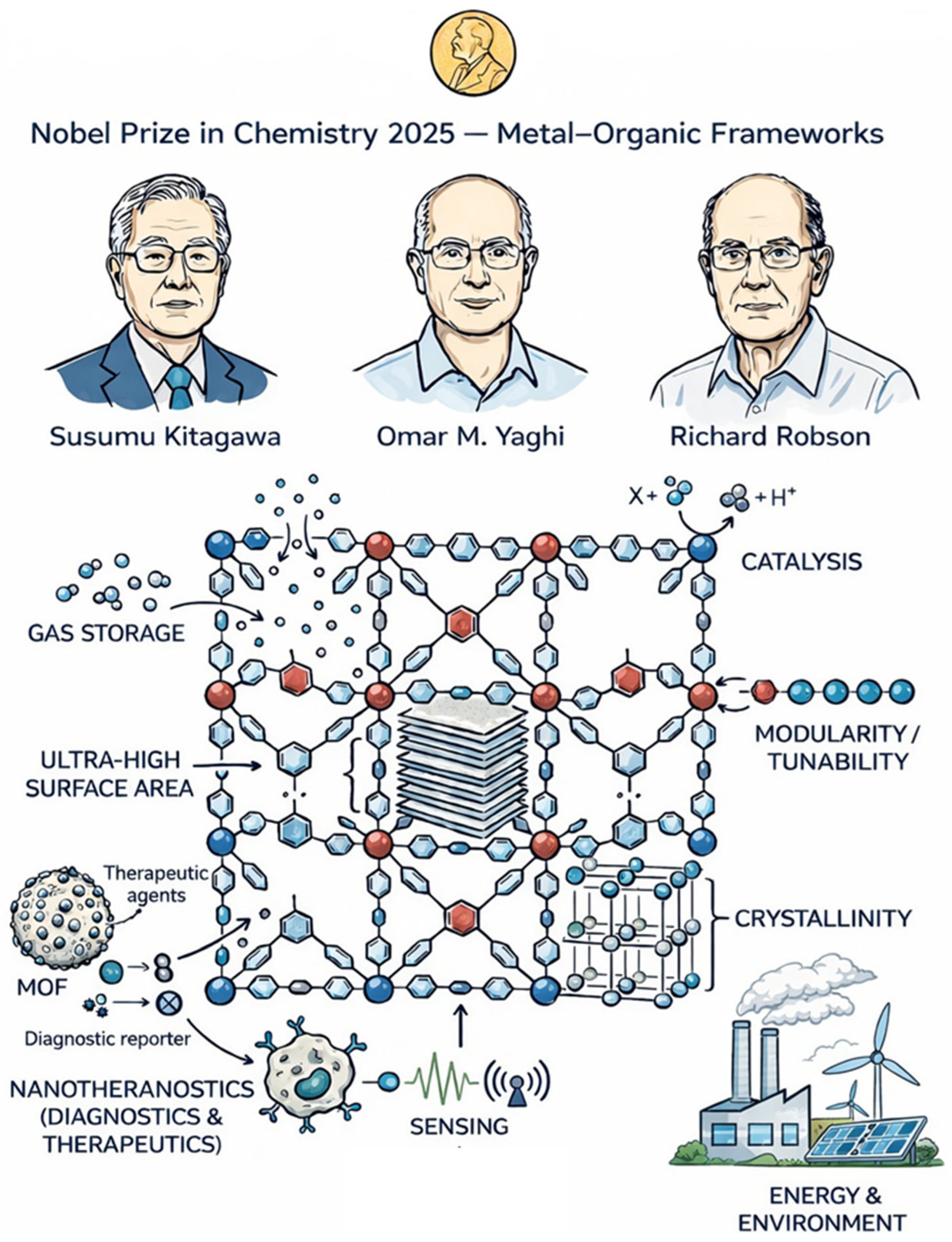
The development of MOFs as a distinct class of materials is primarily attributed to the pioneering work of Professor Omar M. Yaghi and his research team in the mid-1990s [40,41,42]. In 1995, they published seminal papers in Nature and the Journal of the American Chemical Society, demonstrating the ability of MOFs to adsorb and remove guest molecules within their porous structures selectively and detailing the synthesis of MOFs with large, well-defined channels [43,44]. These publications are considered foundational in the field, marking significant milestones in developing MOFs and opening up new avenues for research into their synthesis, characterization, and applications [45,46,47]. In 2025, the Nobel Prize in Chemistry was awarded jointly to Yaghi, Susumu Kitagawa and Richard Robson for the development of metal–organic frameworks (MOFs), recognizing Yaghi’s modular framework construction and high-porosity design, Kitagawa’s demonstration of gas flow, flexibility and functionality in MOFs, and Robson’s early establishment of infinite polymeric frameworks that underpinned the modern MOF architecture (Figure 1).
Compared to other classes of porous materials, most notably zeolites and covalent organic frameworks (COFs), MOFs exhibit a distinctive combination of structural robustness and chemical tunability, making them particularly attractive for predictive modeling and rational design [48]. Zeolites, composed of tetrahedrally coordinated inorganic atoms (typically Si, Al, and O), are renowned for their exceptional thermal stability and well-defined pore topologies [48]. However, their chemical diversity is inherently constrained by the limited range of framework compositions and functionalizations achievable within purely inorganic lattices [48]. Conversely, COFs, formed entirely from light elements via dynamic covalent chemistry, provide high structural regularity and modular organic design yet often lack the mechanical and hydrolytic stability required for demanding applications [49]. MOFs bridge these extremes by integrating metal nodes, endowing rigidity and coordination-driven order, with organic linkers that offer a vast design space for functional modification. This dual character enables unprecedented control over physicochemical properties, including pore geometry, surface functionality, and framework flexibility. Consequently, MOFs surpass the representational complexity of both zeolites and COFs, posing greater challenges for conventional modeling approaches but offering richer opportunities for deep learning frameworks, particularly those based on Transformer architectures, to capture structure–property relationships across multiple scales.
One of the most remarkable features of MOFs is their tunable nature [50,51]. The modular assembly of metal ions and organic linkers enables virtually limitless combinations, allowing for the synthesis of a vast array of MOFs with tailored physical and chemical properties [52,53,54]. Researchers can influence properties such as thermal stability, magnetic behavior, and coordination geometry by varying the metal ions while keeping the organic linker constant [55,56,57]. Conversely, altering the organic linker with the same metal ion can modify the framework’s chemical functionality, pore size, and overall topology [58,59,60].
Furthermore, the particle size of MOFs can be controlled during synthesis, ranging from nanometers to micrometers, influencing their behavior and suitability for specific applications [57,58]. Nanoscale metal–organic frameworks (nano-MOFs) are particularly promising for applications that require high surface reactivity and diffusion rates, such as catalysis, sensing, and biomedical delivery systems [59,60,61,62,63,64,65,66,67,68,69,70]. Meanwhile, larger MOF crystals are often employed in industrial-scale gas storage [71,72], membrane separation [73,74], and heterogeneous catalysis [75,76], due to their robust mechanical stability and ease of processing. For biomedical and theranostic applications, these tunable features must also be carefully balanced with considerations of biocompatibility, physiological stability, biodegradation pathways, and in vivo transport, all of which critically influence clinical translation [25,77,78,79].
Despite their versatility, the rational design of MOFs remains a grand challenge. The vast combinatorial space of metal–ligand permutations and the complexity of guest–host interactions make predictive MOF development exceedingly challenging [80,81,82]. While insightful, traditional methods, including trial-and-error synthesis [83,84,85] and high-level computational techniques like density functional theory (DFT) [86,87,88] or molecular dynamics simulations [89,90,91], are often limited by computational cost and scalability.
To overcome these limitations, artificial intelligence (AI) and machine learning (ML) have emerged as powerful tools for accelerating MOF discovery [92,93]. ML models enable high-throughput screening by leveraging large datasets to predict key properties, such as structural stability, adsorption capacity, and biocompatibility. AI-driven approaches further optimize synthesis conditions, functionalization strategies, and drug-loading profiles, streamlining MOF design for applications in catalysis and biomedicine.
Recent advancements in deep learning have significantly transformed AI-driven materials discovery, with the Transformer architecture emerging as a breakthrough approach [94,95]. Initially developed for NLP, Transformers have redefined computational methodologies in materials science by leveraging self-attention mechanisms to process structured and sequential data efficiently [96,97]. This mechanism allows the model to dynamically weigh the importance of structural features, such as specific metal–ligand interactions or pore connectivity, in a manner similar to how attention mechanisms in language models focus on contextually relevant words in a sentence. Unlike conventional machine learning models, which rely on predefined feature extraction, Transformers dynamically capture complex hierarchical relationships within molecular and crystalline structures, enabling a more nuanced understanding of material properties [98,99,100].
The adaptability of Transformer models to MOF property prediction is a key feature that reassures researchers about the applicability of this technology in their work [98,101]. By treating MOF structures as structured sequences, similar to those in NLP, Transformers can discern intricate atomic interactions, including metal–ligand coordination environments, pore connectivity, and adsorption sites [98,102,103]. This approach enhances predictive accuracy by enabling the model to recognize long-range dependencies and multi-scale interactions within the framework [95,104]. As a result, Transformer-based models have demonstrated exceptional potential in accelerating the rational design of MOFs for diverse applications, ranging from gas separation and catalysis to targeted drug delivery and biosensing [105,106].
This review explores the recent integration of Transformer-based models into MOF property prediction and design, with particular attention paid to their relevance in nanomedicine and theranostic applications. We introduce the core components of Transformer architectures and their advantages over traditional sequence-processing models. We then discuss representation strategies tailored for MOFs, including graph embeddings, energy grids, and sequence-based encodings. Next, we examine state-of-the-art models, such as MOFNet, MOFTransformer, and MOFormer, and highlight their performance across diverse prediction tasks. Finally, we analyze the emergence of generative models and AI-driven design agents, emphasizing their potential to accelerate the discovery of MOFs optimized for drug delivery, multimodal imaging, biosensing, and integrated diagnostic–therapeutic platforms. By framing these computational advances within a biomedical context, this review aims to support researchers in nanotheranostics seeking to leverage AI for the rational design of next-generation MOF-based innovative nanomaterials.

2. Transformer Architecture

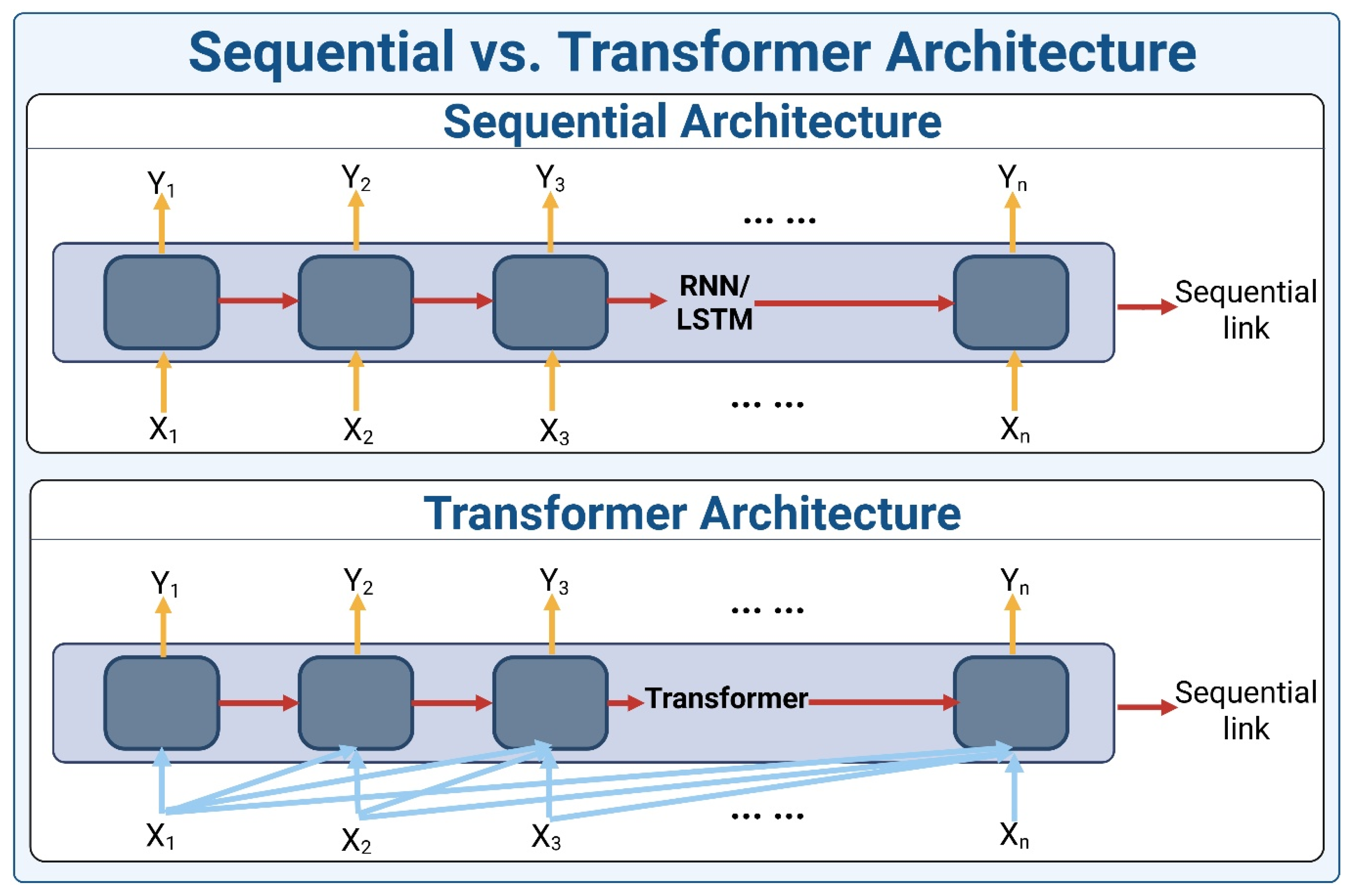
“Attention Is All You Need”, the groundbreaking paper by Vaswani et al. (2017), introduced transformer architecture and marked a turning point in the evolution of artificial intelligence [107]. By replacing the inherently sequential processing of recurrent neural networks with a parallelizable self-attention mechanism, the transformer enabled models to capture long-range dependencies in data efficiently, a significant breakthrough for NLP tasks such as machine translation [108,109]. Figure 2 illustrates the fundamental difference between the sequential processing of RNN/LSTM models and the parallel, attention-driven structure of Transformer architectures. Its encoder–decoder framework, initially designed to convert sentences from one language to another, soon proved remarkably versatile and scalable, rapidly becoming a foundational model across NLP [110,111]. More recently, the principles behind the Transformer have inspired significant advances beyond language, including in the physical sciences. In materials science, for instance, its ability to model complex hierarchical relationships has opened up new possibilities for representing and predicting the behavior of intricate systems, such as MOFs [98,101,103]. By encoding MOF structures as sequences, graphs, or energy grids, Transformer-based models can extract chemically relevant features and facilitate property prediction, thereby accelerating the rational design of functional materials [101,103].

2.1. Encoder

The encoder transforms an input sequence into a contextualized representation that captures local and global dependencies [112,113]. The process begins with tokenization, in which the input sequence is divided into discrete tokens, each mapped to a corresponding embedding vector [112,114,115]. Since the transformer does not inherently recognize word order, positional encoding is added to these embeddings to introduce a sequential structure [115,116].
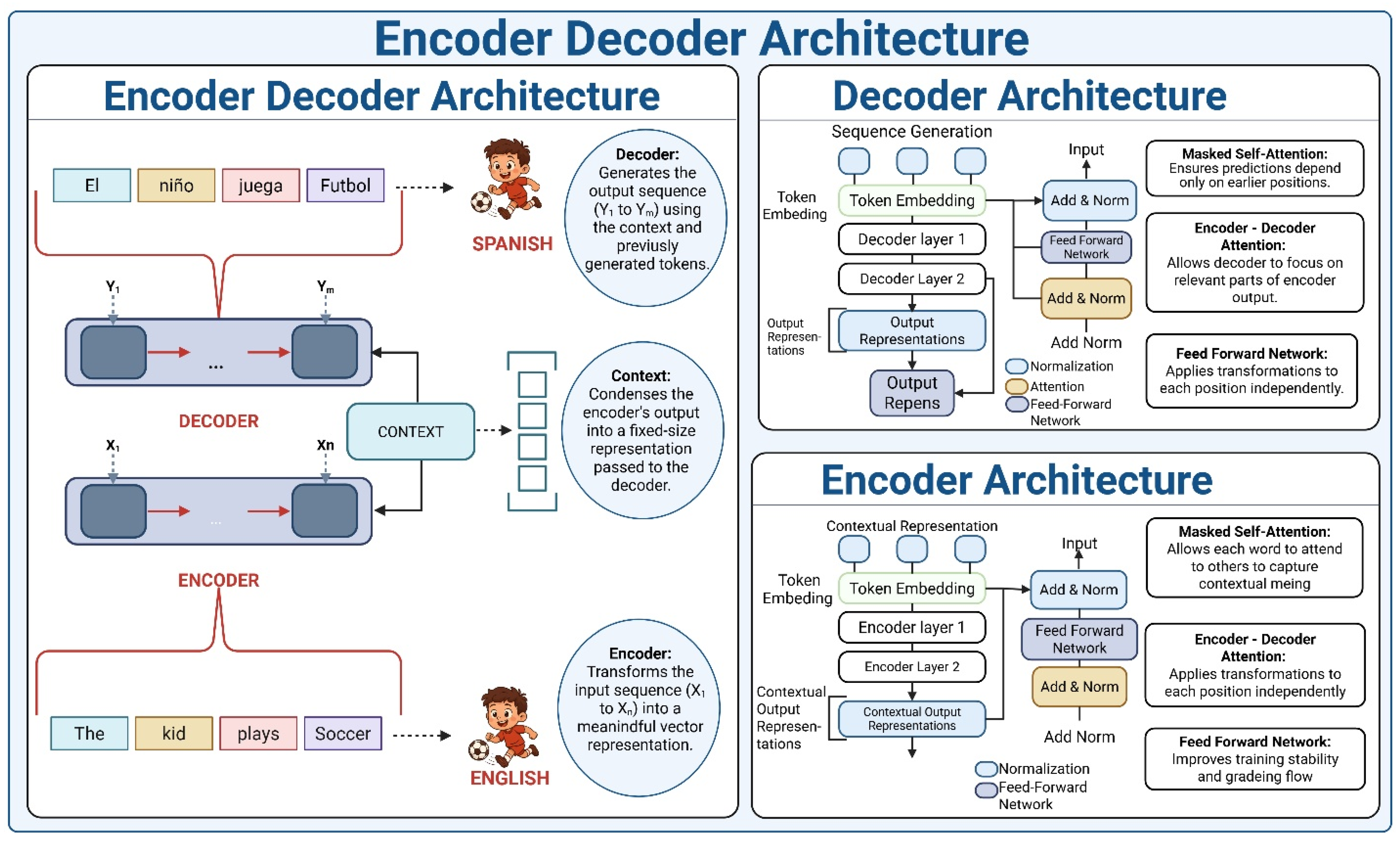
Once encoded, the input passes through multiple identical layers, each containing a multi-head self-attention mechanism and a feed-forward network [112,115]. Unlike recurrent architectures that process inputs sequentially, self-attention enables the Transformer to evaluate all tokens in parallel, significantly enhancing efficiency [108,109,115]. This mechanism assigns varying levels of importance to different parts of the sequence, allowing the model to capture long-range dependencies effectively [109,115]. After self-attention, each token representation passes through a feed-forward network, which introduces non-linearity and enhances the model’s capacity to learn complex relationships [112,115]. Layer normalization and residual connections are applied within each encoder layer to ensure stability and improve gradient flow, facilitating efficient learning in deep architectures. Figure 3 illustrates a visual overview of the encoder–decoder pipeline, including token embedding, self-attention mechanisms, and feed-forward layers.

2.2. Decoder

The decoder generates the output sequence by leveraging both the encoder’s representations and previously generated outputs [112,117]. Like the encoder, it consists of multiple identical layers, each integrating three key mechanisms: masked multi-head self-attention, encoder–decoder attention, and feed-forward networks [118,119,120]. The masked multi-head self-attention mechanism prevents the decoder from attending to future tokens during training, ensuring predictions are generated sequentially and accurately [119,121]. The encoder–decoder attention mechanism lets the decoder focus on relevant portions of the encoded input sequence, thereby aligning the input and output representations for high-quality predictions [108,119]. Finally, the decoder applies a feed-forward network to refine token representations before generating the final output [118,122]. The decoder’s output is then processed through a softmax activation function, which computes a probability distribution over the vocabulary [118,121]. The most probable next token is selected iteratively until an end-of-sequence (EOS) token is reached or a predefined length is met [118,123].

2.3. Variations in the Transformer Architecture

Since its introduction, the Transformer has been adapted into different configurations tailored for specific applications. Encoder-only models, such as BERT and RoBERTa, focus on deep contextual understanding, making them well-suited for tasks like text classification and named entity recognition [124,125,126,127]. These models utilize bidirectional self-attention, allowing tokens to be influenced by both preceding and succeeding words. In contrast, decoder-only models, such as GPT, employ autoregressive attention, where each token is generated based solely on its preceding context, making them particularly effective for text generation tasks, including language modeling and conversational AI [128,129,130]. The encoder–decoder structure is preserved in models such as T5 and BART, which excel in sequence-to-sequence tasks, including translation, summarization, and question answering [131,132,133].

2.4. Attention Mechanism in Transformers

The attention mechanism is a fundamental component of Transformer models, enabling them to focus on different parts of the input sequence selectively [112,134]. Unlike traditional sequence-processing models, such as recurrent neural networks (RNNs) and long short-term memory (LSTM) networks, which process tokens sequentially, Transformers utilize self-attention to evaluate all input elements simultaneously [112,132,135]. This approach significantly enhances computational efficiency, enabling the model to capture short- and long-range dependencies effectively [132,135]. The ability to dynamically adjust attention to relevant tokens makes Transformers highly effective for NLP, machine translation, and molecular modeling in materials science [136,137].
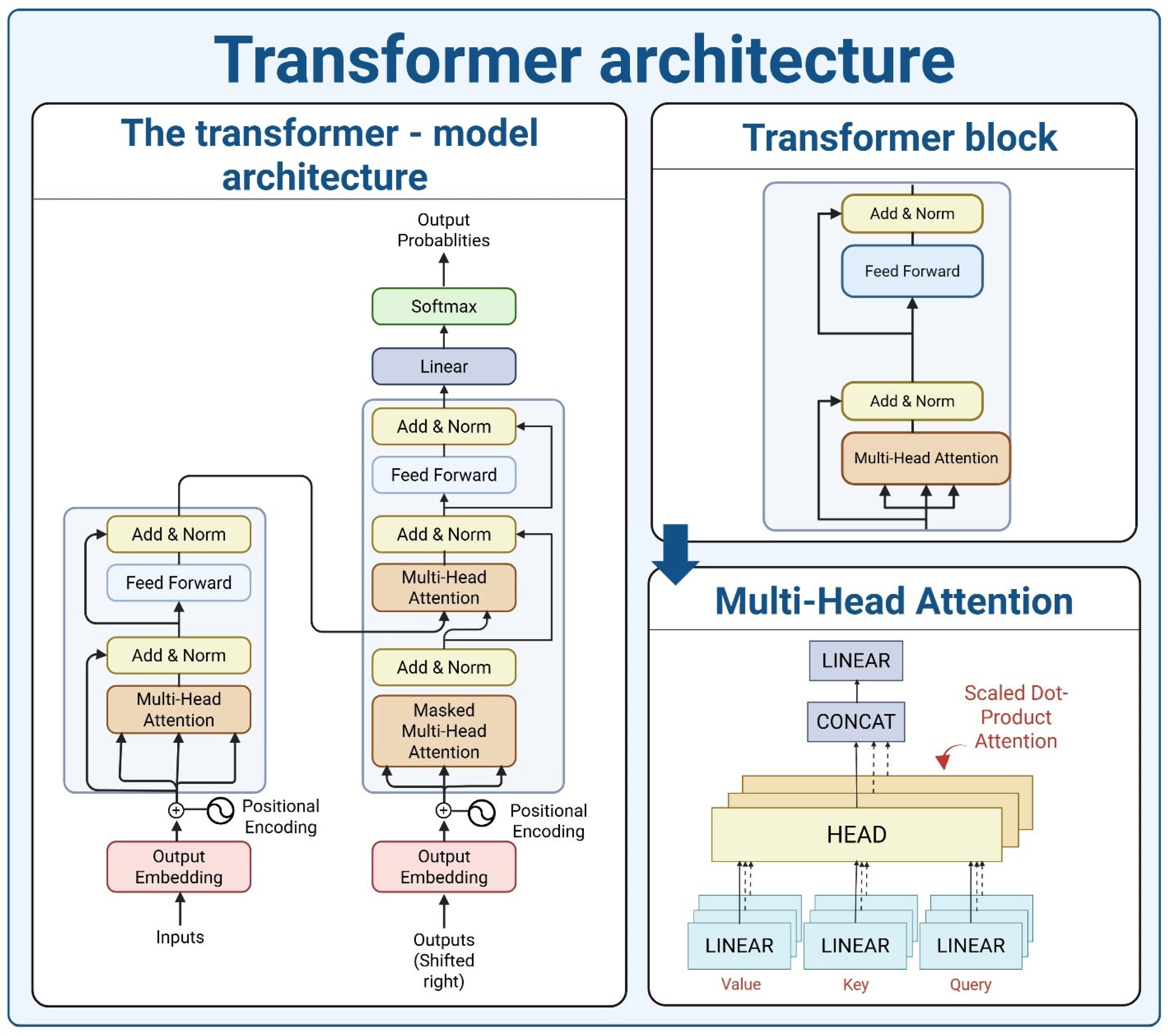
Self-attention, also known as scaled dot-product attention, is the core mechanism that enables the Transformer to process sequences in parallel [108,123]. It computes the relationships between different elements of an input sequence using three key matrices: query (Q), which represents the current token being processed; key (K), which represents all tokens in the input sequence; and value (V), which contains the corresponding information associated with each token [112,127,134]. The attention scores between tokens are computed using the following formula [123,133]:
Attention Q , K , V = softmax Q K T d k V
where the scaling factor stabilizes gradient updates. The softmax function normalizes the attention scores, allowing the model to assign higher weights to more relevant tokens while diminishing the influence of less relevant ones [108,123,133]. This enables the Transformer to capture contextual dependencies dynamically across an entire sequence.
Figure 4 provides a detailed overview of the complete Transformer architecture, including the encoder and decoder blocks, attention layers, and the multi-head attention structure.
A key innovation within the Transformer model is multi-head attention, which extends self-attention by applying multiple parallel attention mechanisms [112,135]. Each attention head independently learns a unique representation of the input sequence, enabling the model to extract diverse contextual features [112,127]. After computing self-attention across multiple heads, the outputs are concatenated and transformed using a linear projection to create a richer input representation [112,135]. This mechanism offers several advantages, including enhanced feature extraction, improved generalization, and better performance in complex tasks [112,127]. By allowing multiple attention heads to focus on different aspects of the input, multi-head attention enhances the ability of Transformers to identify intricate relationships in data, making them particularly valuable for applications such as molecular property predictions and material informatics [110,138].
Before the Transformer, attention mechanisms were used in RNN-based models, such as the Bahdanau and Luong attention mechanisms [139,140,141]. While these earlier methods improved sequence modeling by allowing the model to focus on specific parts of the input, they were still constrained by the sequential nature of RNNs [142,143]. The self-attention mechanism in Transformers eliminates recurrence, enabling fully parallelized computation, significantly reducing training time, and improving scalability [139,140,144]. This fundamental shift enables models to process long sequences more effectively, capturing dependencies that would be difficult to model using traditional architectures [144,145].

2.5. Advantages of Transformers over Traditional Models

To understand why transformers are increasingly favored in MOF design, comparing them to traditional sequence-processing models, such as RNNs, is helpful [101,103]. RNNs rely on recurrence mechanisms, where information is propagated sequentially through time [142,143]. While this approach preserves temporal dependencies, it introduces significant computational inefficiencies. Because RNNs process inputs one step at a time, they cannot leverage parallelization, resulting in longer training times and higher memory consumption, particularly for long sequences [142,144]. Additionally, recurrent architectures suffer from the vanishing gradient problem, making capturing long-range dependencies challenging [143,144]. This limitation significantly reduces their effectiveness in tasks requiring extensive contextual awareness.
In contrast, the transformer architecture employs self-attention mechanisms that enable simultaneous processing of all elements in an input sequence [143,144]. This eliminates the need for sequential computation, allowing the model to efficiently capture local and global dependencies [142,144]. By removing recurrence, Transformers significantly enhance computational efficiency [140,142,144]. Empirical studies have shown that Transformers reduce training time by an order of magnitude compared to RNN-based models while achieving superior performance in tasks that require long-range dependencies, such as machine translation, protein sequence modeling, and MOF structure prediction. Benchmark evaluations on natural language processing datasets confirm that Transformer-based models consistently outperform architectures such as extended short-term memory networks (LSTMs) and gated recurrent units (GRUs) in both short- and long-range dependency tasks, making them highly effective for complex pattern recognition applications in materials science [101,140,146].
Machine learning has accelerated materials modeling, yet existing models for crystalline materials and metal–organic frameworks remain limited by how they represent structure–property relationships. Descriptor-based approaches rely on predefined chemistry and physics descriptors, while graph neural network models learn directly from graph representations and can encode one body, two body, three body and four body interactions through graph convolutions. Examples include CGCNN, SchNet, MEGNet, ALIGNN, GemNet and ALIGNND. Despite these advances, graph neural network models have been reported to be biased toward local structural characteristics and to struggle with representing global crystallographic context, periodicity and long-range correlations, with performance depending strongly on data volume, feature selection and transfer learning strategies [138]. These limitations have motivated the adoption of transformer models for metal–organic frameworks. Since 2022, several models including MOFnet, MOFormer, MOFTransformer and Uni MOF have incorporated attention mechanisms to jointly learn from local chemistry and global structural features. These models have been used for tasks such as prediction of pore limiting diameter, largest cavity diameter, density, accessible surface area, void fraction and pore volume, and in some cases, they directly ingest CIF structural files to accelerate multi property prediction [147,148].
Beyond property prediction, transformer models have supported multitask modeling, universal transfer learning and adsorption performance modeling. Hydrogen adsorption isotherms have been predicted using an incremental training strategy based on a pretrained transformer model, and interpretability analyses have been performed through moiety masking, permutation importance and attention map visualization [148]. Attention mechanisms have also been shown to improve predictions that depend on global structural awareness, such as carbon dioxide adsorption, by allowing the model to learn from both local chemistry and long-range structural features including pore size distributions [147]. At the same time, transformer models can require substantial preprocessing or auxiliary descriptors, can fail for small pore structures or complex compositions, and fine-tuned performance can be outperformed by classical machine learning models with carefully selected input features. Cases in which standard models remain competitive, along with the need for expertise in preparing transformer inputs, indicate that further development is required before such models can serve as broadly accessible foundation models for metal–organic frameworks [147,148]. These considerations explain the growing interest in transformer architectures as a framework for modeling properties of metal–organic frameworks and motivate the analysis of transformer-based models in the following section.

3. Why Do MOFs Benefit from Transformer Architectures?

Capturing the complexity of MOFs to predict their properties accurately has historically been a challenge for computational models [104,149]. However, the advent of transformer architecture, initially developed for NLP, has opened up new avenues for understanding and modeling these materials [150,151]. With their ability to discern context and meaning in complex data, transformers employ techniques such as self-attention, enabling them to identify key structural elements and relationships within MOFs [152,153]. This adaptation provides a novel, linguistically inspired approach to modeling and predicting material properties.
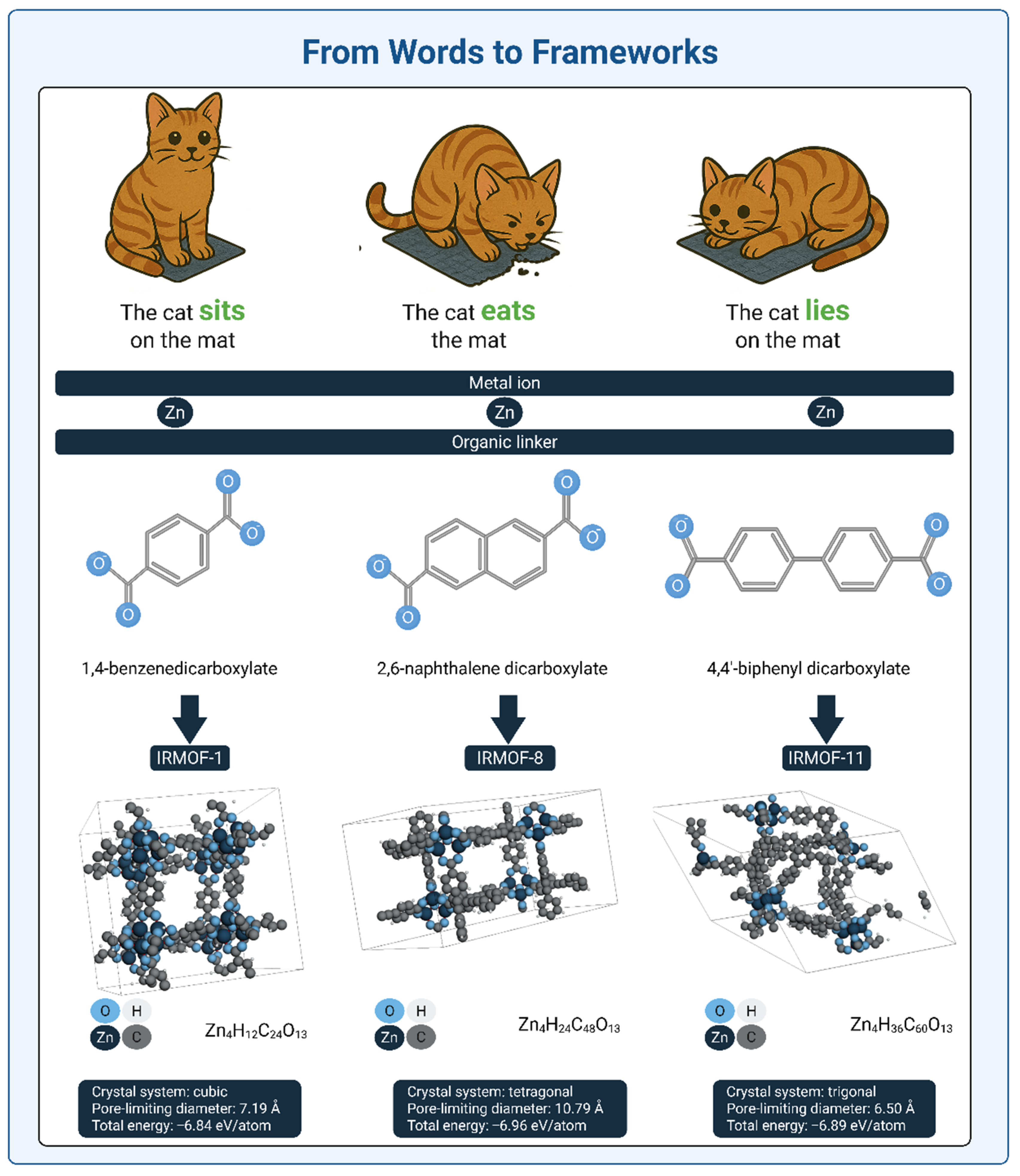
Drawing an analogy between MOFs and human language provides valuable insight into why transformer models excel in predicting MOF properties. In language, the meaning of a sentence arises not from individual words alone but from their interactions within a structured context. For example, consider the sentences: “The cat sits on the mat,” “The cat eats the mat,” and “The cat lies on the mat.” While they share the same core elements—“cat,” “mat,” and a verb—the rearrangement or substitution of just one word significantly alters their meaning (Figure 5(top panel)) [154]. A similar principle applies in the design of metal–organic frameworks (MOFs), where small structural changes can significantly alter material properties, much as substituting a word in a sentence alters its meaning. As illustrated in Figure 5(bottom panel), IRMOF-1, IRMOF-8, and IRMOF-11 all contain the same metal ion (Zn2+) but differ by a single organic linker: 1,4-benzenedicarboxylate, 2,6-naphthalene dicarboxylate, and 4,4′-biphenyl dicarboxylate, respectively. These seemingly minor substitutions—analogous to replacing the verb in a sentence—result in distinct structural and functional outcomes. For example, IRMOF-1 forms a cubic crystal system with a pore-limiting diameter of 7.19 Å and a total energy of −6.84 eV/atom [155,156,157]. IRMOF-8 adopts a tetragonal structure with a larger pore diameter of 10.79 Å and slightly lower energy [155,156,157]. In contrast, IRMOF-11 crystallizes in a trigonal system with a reduced pore size of 6.50 Å and a total energy of −6.89 eV/atom [155,156,157].
These variations are not merely geometric; they reflect more profound changes in physicochemical behavior. Linkers such as terephthalic acid (used in IRMOF-1) are relatively hydrophilic and can enhance interactions with polar molecules, improving gas adsorption selectivity for polar species [158,159]. On the other hand, introducing more hydrophobic, π-conjugated linkers like naphthalene or biphenyl derivatives (as in IRMOF-8 and IRMOF-11) can improve water stability and resistance in humid environments [160,161]. For instance, incorporating hydrophobic linkers enhances the MOF’s chemical and thermal stability, making it more suitable for aqueous or humid conditions [162,163]. Conversely, frameworks with hydrophilic functionalities have shown improved affinity toward polar gases, increasing selectivity and adsorption efficiency [164,165]. Just as changing a single word alters a sentence’s meaning, these chemical modifications shape the MOF’s overall performance, enabling applications such as gas storage, selective adsorption, catalysis, or drug delivery [166,167].

3.1. Capturing Higher-Order Context: Metal Center + Organic Linker + Synthesis Conditions

The design of MOFs is rooted in modular chemistry: a metal center, an organic linker, and synthesis conditions are combined to produce highly tunable materials with diverse properties [12,168]. Yet this apparent modularity masks deeper complexity. The performance and behavior of a MOF are rarely determined by its components in isolation. Rather, they emerge from the context-dependent interactions among those components; how the linker’s chemistry complements the metal’s coordination environment, how synthesis conditions modulate crystal packing or defect formation, and how the entire system encodes structural and functional meaning [59,169,170].
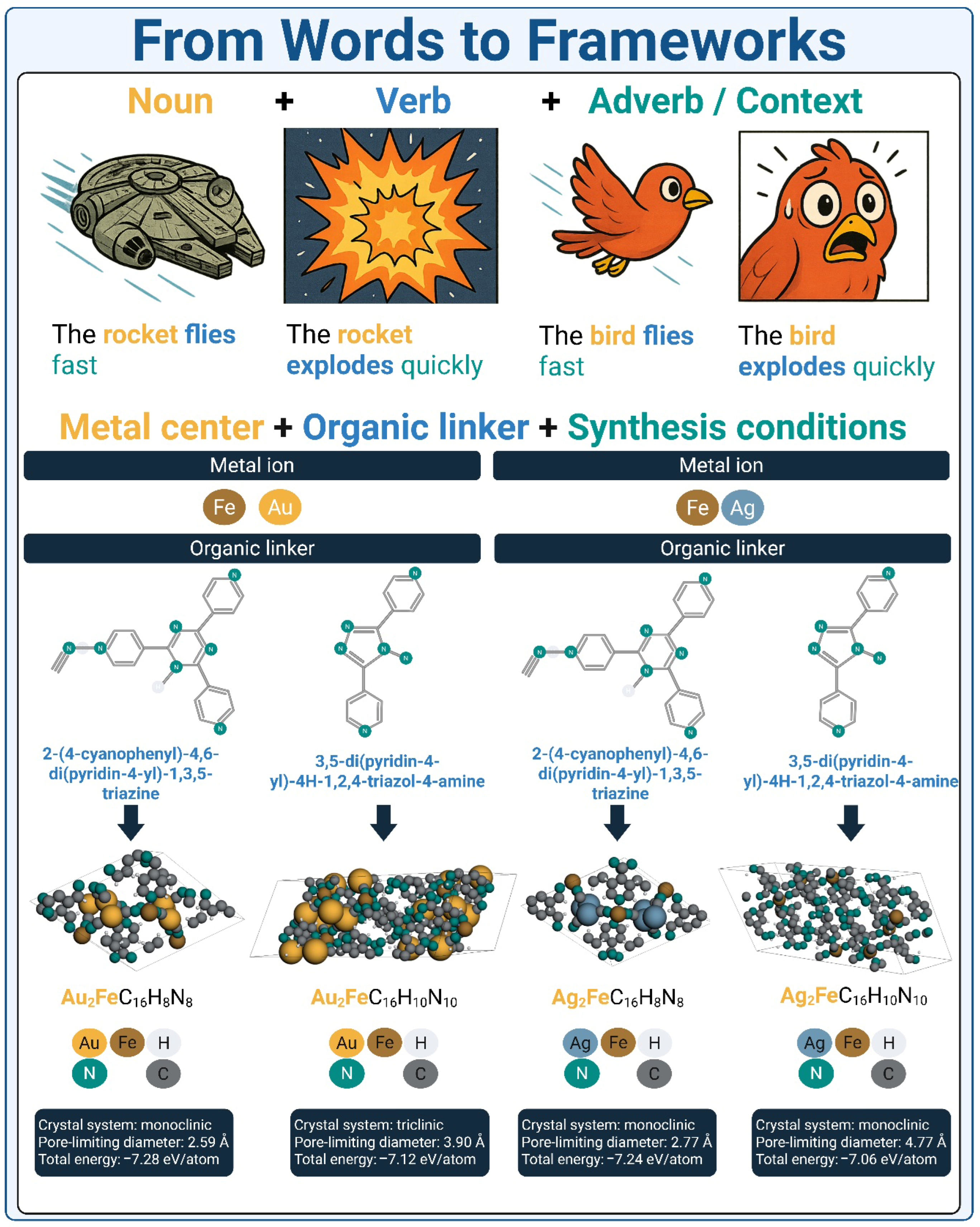
This interplay is not unlike what occurs in natural language. In language, a sentence’s meaning is not the sum of its words, but the result of how those words relate to one another in grammatical and semantic context. For example, “The rocket flies fast” and “The rocket explodes quickly” share structural elements but differ drastically in meaning because of a shift in the verb and adverb. Similarly, in MOFs, changing the organic linker or altering the metal center, even slightly, can result in a completely different material with respect to porosity, stability, or adsorption profile. Thus, the analogy between MOF construction and sentence formation is more than a metaphor; it reflects a shared structural logic grounded in combinatorial rules and contextual dependencies.
This analogy is powerfully illustrated in Figure 6, which depicts four MOFs generated through systematic combinations of two chemically distinct tritopic nitrogen-rich linkers and two bimetallic systems: Au2Fe and Ag2Fe. The linkers—2-(4-cyanophenyl)-4,6-di(pyridin-4-yl)-1,3,5-triazine and 3,5-di(pyridin-4-yl)-4H-1,2,4-triazol-4-amine—are carefully chosen to reflect syntactic variability: they are topologically similar but electronically divergent. The former features a planar, π-deficient structure with a cyano (–CN) group, introducing rigidity and electron-withdrawing character [171,172]. The latter contains an amino (–NH2) group, introducing local polarity, hydrogen bonding capability, and increased structural flexibility [59].
Each combination leads to markedly different outcomes. The Au2Fe–triazine framework crystallizes in a compact monoclinic structure with a narrow pore-limiting diameter (2.59 Å) and low formation energy (−7.28 eV/atom), reflecting strong packing and high stability [173]. Substituting the linker with triazol-amine under the same metal context opens the structure (3.90 Å) and slightly increases the energy (−7.12 eV/atom), indicating a looser packing network [174]. A similar transformation occurs when the metal system is changed to Ag2Fe. The Ag2Fe–triazine framework retains a narrow pore (2.77 Å), but its counterpart with the triazol-amine linker expands significantly to 4.77 Å, reflecting both the softer coordination nature of silver and the linker’s enhanced flexibility.
These examples capture the essence of combinatorial semantics in MOF design. Just as the meaning in a sentence is altered by the interrelation of noun, verb, and adverb, the properties of a MOF are defined by the way the metal, linker, and synthesis context interact, not merely by their individual identities [56,169,170]. The crystal system, pore size, and energy landscape are the “meaning” that emerges from the framework’s internal grammar.
However, this combinatorial complexity poses a significant modeling challenge [168,175]. Traditional machine learning approaches often rely on hand-crafted descriptors or simplified graphs that fail to fully account for non-linear, non-local interactions. These models struggle to predict emergent properties that depend on long-range correlations or second-order effects, precisely the relationships governing real-world MOF behavior [105,176].
Transformer architectures, by contrast, were designed to understand context. Initially developed for NLP, transformers use self-attention mechanisms to evaluate how every component in a sequence relates to every other component [103,105]. In a sentence, this allows the model to distinguish the subtle differences in tone or meaning between “He barely passed the exam” and “He passed the exam, barely.” In a MOF, this architecture enables the model to learn how an electron-donating group on a linker might influence pore accessibility only when paired with a particular metal node, or how a specific synthesis route might stabilize a metastable phase under certain functional group configurations [105].
Transformers are uniquely suited to MOF modeling because they can internalize this grammar of materials design. They offer a way to encode and learn not only the local chemistry of atoms and bonds but also the higher-order context in which those features appear [101,177]. By treating MOF architectures as structured sequences or graphs with embedded meaning, analogous to linguistic constructs, transformers can predict structure–property relationships with unprecedented fidelity and generalizability.
In this light, linguistic analogy is not just a pedagogical tool but an epistemological shift. It suggests that we should approach materials design the way we approach language: as a system governed by rules, enriched by variation, and understood through context. This perspective opens up the door to data-driven materials generation, where transformer models are not only predictors but also generative agents, capable of suggesting new combinations of metals, linkers, and synthesis conditions that are chemically meaningful and functionally novel.

3.2. Functional Group Introduction as a Design Switch: From Structural Equivalence to Functional Divergence

This subtopic illustrates how seemingly minor linker-level substitutions in metal–organic frameworks introduce higher-order contextual effects that alter functional behavior and explains why such chemically subtle modifications constitute a relevant modeling target for transformer architectures.
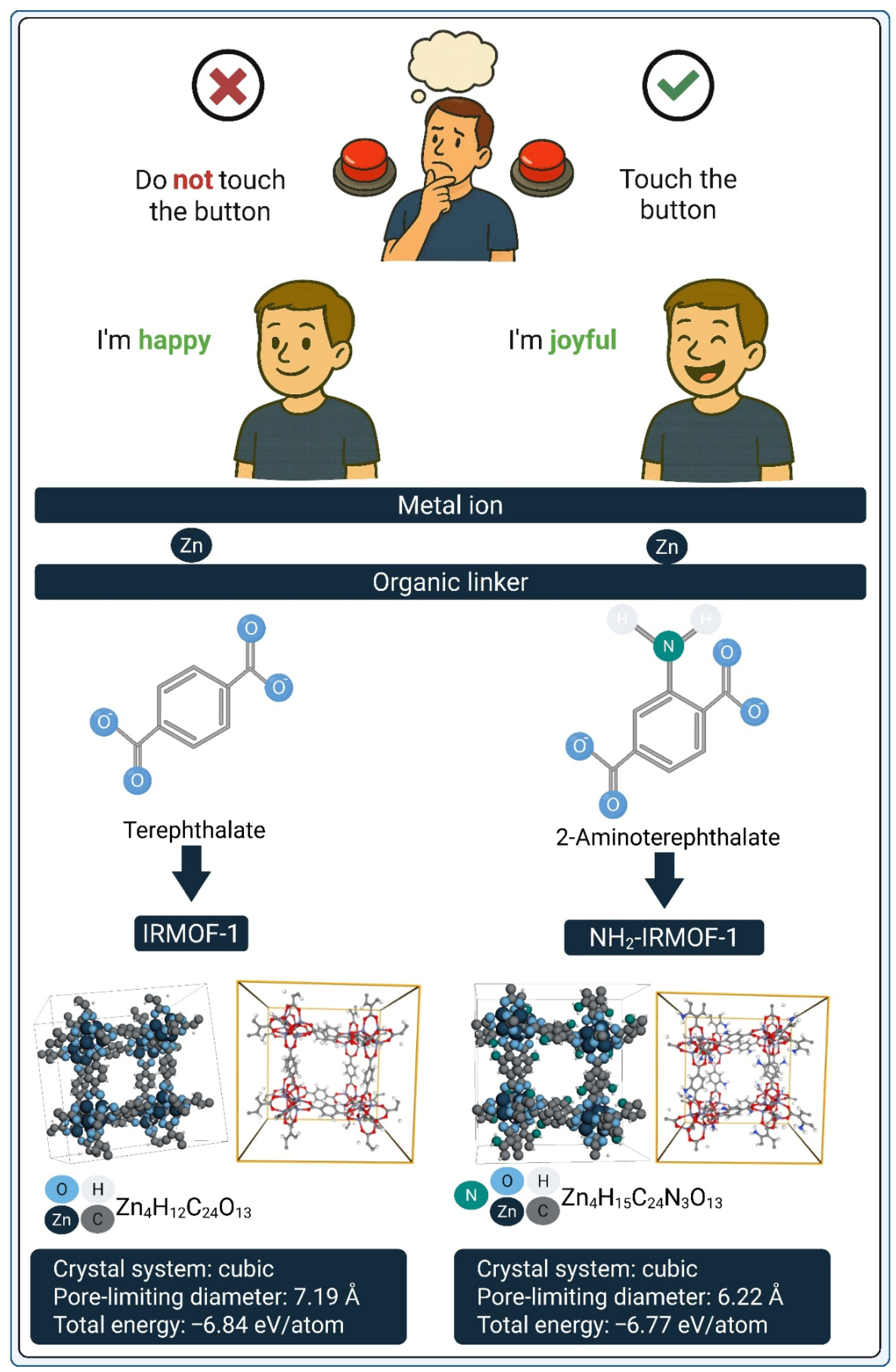
In the rational design of MOFs, one of the most compelling examples of how minor molecular changes can yield major functional consequences is the substitution of linkers bearing distinct functional groups. A representative case is the replacement of terephthalic acid with its amino-functionalized counterpart, 2-aminoterephthalic acid, in Zn-based frameworks such as IRMOF-1 and NH2-IRMOF-1 [12,178,179]. Structurally, this substitution maintains the overall cubic topology of the framework but introduces a primary amine group (–NH2) at the para position. This small modification initiates a cascade of subtle yet meaningful changes across the material’s properties [12,178,179,180].
From a structural perspective, the addition of the –NH2 group slightly reduces the pore-limiting diameter (from 7.19 Å in IRMOF-1 to 6.22 Å in NH2-IRMOF-1) and marginally increases the total energy per atom (−6.84 vs. −6.77 eV/atom) [174]. These variations reflect changes in the electronic environment, hydrogen-bonding potential, and overall packing density. Despite these adjustments, the long-range order and symmetry of the framework remain intact, underscoring how a localized modification can preserve structural equivalence while embedding new chemical functionality.
What transforms this molecular tweak into a functional breakthrough is the amine group’s role as a chemically addressable handle. The –NH2 moiety enables post-synthetic modifications via established coupling chemistries, such as Schiff base formation using glutaraldehyde or amide bond formation through EDC/NHS activation [181,182]. Through these reactions, the MOF can be functionalized with a wide variety of bioactive molecules, including drugs, targeting ligands, peptides, or fluorophores—enhancing its value in applications ranging from targeted drug delivery to biosensing and theranostics.
The functional impact of the –NH2 group is highly context-dependent. Its significance hinges on the specific application. In scenarios where selective molecular recognition, covalent conjugation, or environmental responsiveness, such as pH sensitivity, are essential, the –NH2 group becomes indispensable [181]. Thus, omitting the –NH2 group in MOF design does more than limit structural elaboration; it eliminates the entire functional layer of the material. Without this chemical handle, there is no conjugation, no targeted delivery, and no responsiveness to biological environments. With it, the MOF becomes a platform programmable, adaptable, and therapeutically relevant [183].
This loss of functionality is akin to removing the word “not” from the instruction “Do not touch the red button.” While the sentence’s grammatical structure remains intact, its intended meaning is reversed, transforming a warning into a command. Similarly, a MOF lacking the amine group may appear visually and topologically equivalent to its functionalized counterpart, but it is effectively silenced in terms of chemical reactivity.
Conversely, in applications where such specificity is not required, such as inert gas storage under neutral pH conditions, the effect of the amine may be far more modest. Here, the presence of the –NH2 group may slightly alter adsorption affinity or framework polarity, but without drastically changing the function [181,184]. This more nuanced shift resembles substituting “happy” for “joyful” in a sentence: the grammatical structure and general meaning are preserved, but the tone and emotional nuance shift subtly. Likewise, the MOF’s framework remains intact, but its surface chemistry becomes more expressive, modifiable, and responsive (Figure 7).
This duality, where a change can act either as a binary switch or a tuning knob, is central to how transformer-based models interpret MOF structures [103,185]. These models do not treat all modifications equally; instead, through self-attention mechanisms, they assign differential importance to each modification based on its contextual relevance. They learn when a functional group redefines the material’s behavior, and when it merely refines it [103].
The duality between switches that invert function and modifiers that refine tone aligns with the way transformer models learn to assign contextual importance [186] through token-based representations, in which functional motifs may be encoded as tokens or attributes whose significance is evaluated relative to their structural environment. In this setting, functional motifs act as chemically meaningful tokens whose semantic relationships can be learned rather than treated as independent one-hot entities, as demonstrated in recent QNLP works [187] proposing functional group descriptors such as carboxylate, imidazole, and sulfonate to encode richer chemical context for property-guided MOF design.
Recent transformer models developed for MOFs, including MOFnet, MOFormer, MOF transformer, and Uni-MOF, have similarly shown that attention mechanisms can enhance or attenuate structurally distributed features such as atom or bond encodings in ways not restricted by spatial proximity, enabling the model to jointly exploit local chemical information and long-range structural organization for downstream prediction tasks [147]. These studies provide concrete evidence that higher-order contextual relationships are relevant for predicting properties such as void fraction, adsorption behavior, and topology, and that such relationships can be transferred to new downstream tasks through fine-tuning or transfer learning [147]. Recent transformer-based and QNLP studies also highlight practical trade-offs, since encoding richer chemical or topological descriptors increases computational resource requirements and model complexity, particularly on current hardware [187].
In this light, the substitution of a single functional group becomes more than a synthetic detail—it is a design decision with system-level implications. It is both the “not” that inverts a command and the “joyful” that refines an expression. Transformer architectures are uniquely equipped to capture and model this dual nature. By distinguishing between context-sensitive and context-neutral features, they enable purposeful material innovation, transforming static structural representations into dynamic functional predictions.
This perspective highlights that functional modifications must be expressed through representational formats that capture semantic nuance and contextual relationships, which motivates the next section on how MOFs are encoded for transformer models.

3.3. Representing MOFs for Transformer Models

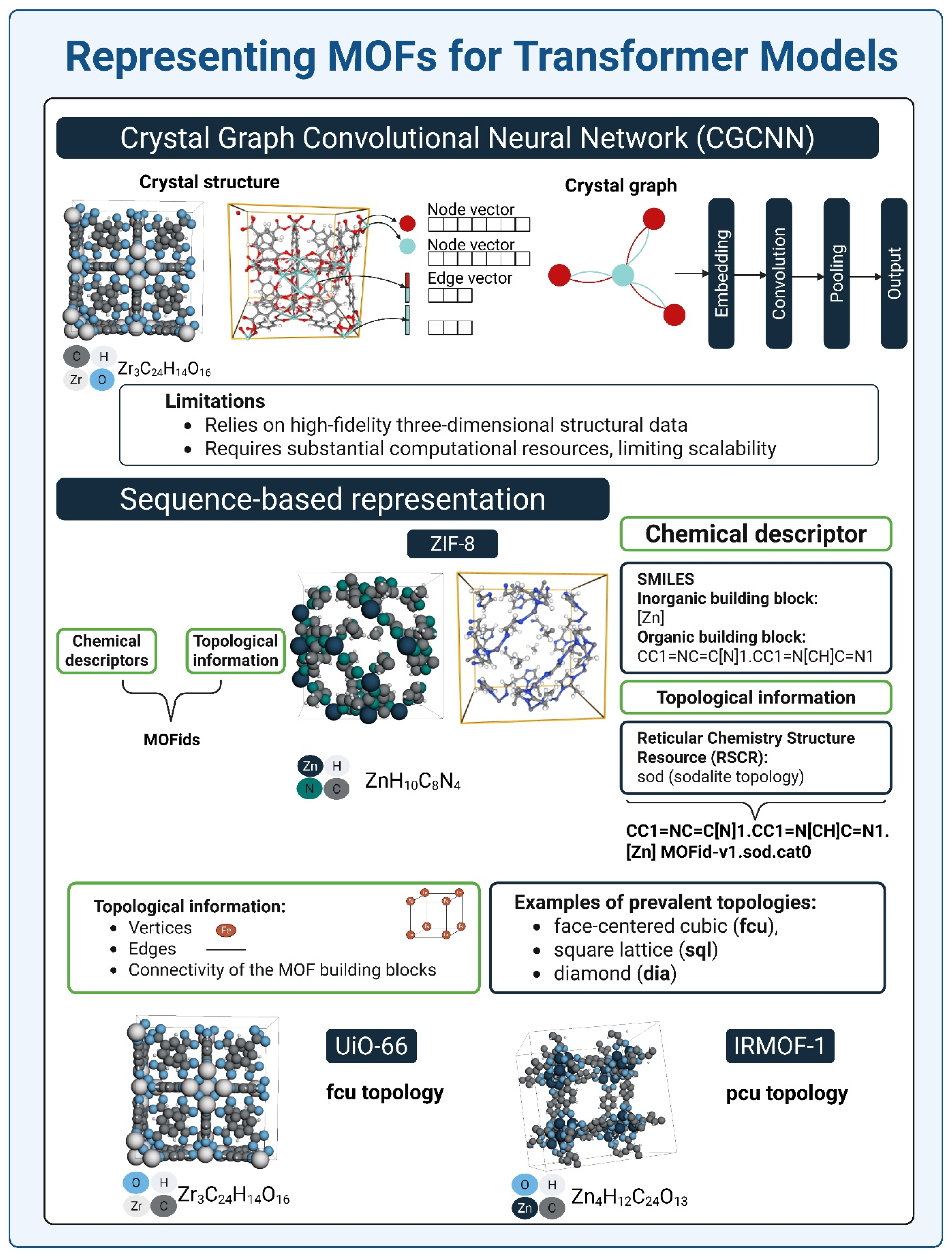
Accurate representation of MOFs is foundational in applying artificial intelligence to materials discovery. Early computational strategies relied on handcrafted geometric descriptors, such as pore size, void fraction, and energy histograms, which provided only limited predictive power [188,189]. While these approaches offered preliminary insights into bulk behavior, they could not capture the complex interplay between local chemical environments and global structural features. This limitation hindered their applicability to advanced AI frameworks, which require representations capable of encoding nuanced, multi-scale relationships within the material’s structure [190,191]. As illustrated in Figure 8, current state-of-the-art MOF representations fall into two complementary paradigms, graph-based and sequence-based, each tailored to the attention mechanisms of Transformer architectures.
To address these limitations, graph-based representations have been widely adopted. In this paradigm, MOFs are represented as graphs, where atoms serve as nodes and chemical bonds are represented by edges [192,193,194]. This abstraction allows graph neural networks (GNNs) to model both local coordination chemistry and extended framework connectivity [195,196]. Notably, the Crystal Graph Convolutional Neural Network (CGCNN) introduced periodic boundary conditions to improve property prediction across crystalline systems [197,198]. However, these methods often rely on high-fidelity, three-dimensional structural data, thereby imposing substantial computational demands and limiting their scalability, particularly in the context of large or hypothetical MOF libraries [199,200,201]. When applied to MOFs designed for biomedical or theranostic use, graph-based representations also enable the extraction of biologically relevant features, such as drug-accessible cavities, surface functional groups for ligand attachment, and coordination motifs associated with biodegradation, which are critical for predicting therapeutic loading, targeting specificity, and in vivo stability [202,203].
The advent of Transformer architecture, initially developed in the field of NLP, has introduced a powerful alternative. To harness the full potential of these models, researchers have devised sequence-based, graph-based, and multimodal representations of MOFs that align with the attention mechanisms underpinning Transformers. These representations aim to capture both atomistic detail and global structural context in formats amenable to deep learning.
Among the most advanced strategies is the dual representation framework, which integrates atom-based graph embeddings and energy-grid embeddings. The graph embeddings capture fine-grained local features, such as element type, coordination number, and bond length, and are typically generated using GNNs like CGCNN [204,205,206]. These embeddings are then adapted for Transformer inputs using appropriate encoding schemes. The complementary energy-grid embeddings encode three-dimensional potential energy fields, commonly derived using probe molecules such as methane [100,207]. To render them compatible with Transformer inputs, these 3D fields are discretized into voxel-based grids and flattened into one-dimensional patches with positional encodings, preserving spatial relationships [208,209]. This dual-modality approach enables the simultaneous processing of chemical detail and pore-level geometric features [210,211]. In the context of nanomedicine, energy-grid embeddings are especially valuable because they capture diffusion barriers, biomolecule pore accessibility, and host–guest energetic profiles that directly govern drug encapsulation, controlled release, and the spatial distribution of imaging agents within MOF nanocarriers [212].
In parallel, sequence-based representations such as MOFids offer a more scalable and geometry-agnostic solution. MOFids concatenate chemical descriptors (e.g., SMILES) and topological information (e.g., RCSR identifiers) into structured sequences, which are then tokenized and encoded in a manner similar to natural language text [213,214,215,216]. This strategy eliminates the reliance on a complete 3D structure, making it particularly advantageous for pretraining on large datasets where geometry is either unavailable or computationally expensive to generate [217,218]. For theranostic MOFs, these sequence-based representations facilitate the discovery of linkers with enhanced biocompatibility, coordination environments that promote biodegradation, and chemical motifs associated with drug loading efficiency or contrast-agent performance [219,220].
These representational innovations have enabled Transformer-based models, such as MOFormer [103] and MOFTransformer [101], to achieve state-of-the-art performance across diverse MOF property prediction tasks. MOFormer aligns textual MOFid representations with graph-based CGCNN embeddings through cross-modal self-supervised learning, enhancing data efficiency and accuracy even in data-scarce scenarios [103]. MOFTransformer, by contrast, processes atom-graph and energy-grid modalities in parallel, using multi-head self-attention to integrate information across different scales and domains [97]. By incorporating biomedical and nanotheranostic descriptors into these architectures, Transformer models can be adapted to capture biologically meaningful features. Such descriptors include charge distribution, which plays a central role in governing cellular uptake and intracellular trafficking [25,221]. They also include pore-size regimes that determine whether therapeutic proteins, peptides, or small-molecule drugs can diffuse efficiently through the MOF structure [222]. Additionally, functional surface patterns, such as coordination motifs, linker functionalization, or external coatings, strongly influence immunological interactions, including protein corona formation, opsonization, and immune recognition [221]. When these biologically relevant descriptors are incorporated, Transformer models become increasingly capable of predicting MOF performance in physiological environments [182,203]. Ultimately, such models can guide the rational design of clinically relevant MOF-based therapeutics and imaging platforms tailored for nanomedicine and theranostic applications.
Despite the impressive progress, challenges remain. The flattening of 3D energy grids into 1D sequences can result in a partial loss of spatial fidelity [223]. Additionally, the dependency on large, labeled datasets limits the applicability of MOF chemistries in underexplored areas. To address these constraints, researchers are exploring hybrid representations, transfer learning, and self-supervised learning paradigms to augment training data and improve generalization [224,225]. For example, aligning sequence-based and graph-based embeddings within a unified learning task has demonstrated promise in mitigating representation gaps [226].
By framing MOF design as a context-dependent, grammar-like process, this section provides a conceptual framework for understanding why Transformer architectures may be particularly effective in modeling the emergent behavior of metal–organic frameworks. This viewpoint emphasizes how small chemical or structural variations can influence functional outcomes in non-linear ways, which are often difficult to capture using traditional descriptor-based approaches. Nonetheless, important challenges remain in translating learned representations into physically interpretable and experimentally actionable design principles.

4. Addressing Data Limitations in MOF Prediction Models: Strategies and Advances

Training predictive models for metal–organic frameworks (MOFs) presents distinct challenges compared to other material classes. A central limitation is the relatively modest number of experimentally characterized MOFs available for supervised learning [83]. This constraint is mainly due to the field’s recent emergence; unlike traditional materials that have been studied extensively over decades, MOFs remain a comparatively new class, with systematic synthesis and characterization gaining traction only in the last two decades [227]. Consequently, the scarcity of labeled data poses a fundamental bottleneck for the development of accurate and generalizable AI models.
Nevertheless, significant strides have been made in recent years. The number of characterized metal–organic frameworks (MOFs) has grown steadily, driven by advancements in high-throughput experimental platforms, computational screening methods, and collaborative data-sharing initiatives. Several publicly accessible datasets, such as CoRE MOF [155], QMOF-DB [82], ARC-MOF [228], and DigiMOF [229], now provide valuable structural and physicochemical data that underpin AI-driven modeling. Table 1 summarizes the scope, accessibility, and distinguishing features of these databases, serving as a practical resource for researchers entering the field of MOF property prediction.
To mitigate the limitations of small training sets, several data-centric strategies have been employed. Data augmentation through the generation of hypothetical MOFs using simulation-based design has emerged as a prevalent solution [230]. Although these structures lack experimental validation, they diversify the training domain and expand the representational capacity of AI models. Transfer learning offers another effective avenue: by pretraining models on larger, more general chemical or materials datasets, such as SMILES strings, molecular graphs, or crystal structures, researchers can transfer learned features to MOF-specific prediction tasks, thereby reducing dependence on task-specific labeled data [146,231].
In parallel, self-supervised learning has proven particularly powerful in addressing data scarcity. These methods rely on pretraining models using unlabeled data, with tasks such as masked token prediction in MOFids or energy grid reconstruction from partial inputs [232,233]. Such approaches enable Transformer models to learn latent structural relationships within MOFs, which can subsequently be fine-tuned for downstream tasks using relatively small, labeled datasets. Pretraining objectives, such as topology recognition and graph reconstruction, have already demonstrated improvements in accuracy, generalization, and data efficiency across MOF-specific applications [101,234].
Despite these advancements, several critical challenges persist. The extraordinary chemical and topological diversity of MOFs necessitate models that can simultaneously capture fine-grained local interactions, such as coordination geometry and functional group chemistry, as well as global features, including pore topology and symmetry [235,236,237]. To this end, multi-modal learning approaches have been developed, combining graph-based, sequence-based, and energy grid representations [101]. These hybrid frameworks enable AI models to integrate complementary structural information, producing more robust predictions across a broader range of properties.
Moreover, as the field matures, there is a pressing need for standardized benchmarks, transparent evaluation protocols, and curated reference tasks [238,239]. These efforts are crucial for assessing model robustness, ensuring reproducibility, and guiding future developments in MOF informatics.
While MOF data was once nascent, posing a significant barrier to the application of AI models, recent innovations in data generation, pretraining paradigms, and representational learning have substantially advanced the field. With the continued growth of high-quality datasets and the adoption of sophisticated training techniques, AI-driven MOF property prediction is becoming increasingly scalable, accurate, and impactful, laying the groundwork for accelerated materials discovery in energy, catalysis, separations, and biomedical applications.
Data scarcity remains one of the most significant barriers to the widespread deployment of Transformer-based models in MOF research. Although recent databases and self-supervised learning strategies have partially mitigated this limitation, the imbalance between computationally generated data and experimentally validated, biologically relevant measurements persists. Addressing this gap will require coordinated efforts in standardized benchmarking, high-throughput experimentation, and the integration of experimental uncertainty into model training.
Table 1. Comparison of prominent databases for Metal–Organic Frameworks (MOFs) and related porous materials. The table summarizes the scope, content, and access policies of key datasets used to train and validate machine learning models for materials discovery. It highlights the volume of structures, the type of data provided (e.g., experimental vs. hypothetical), and key properties. The ‘x’ symbol indicates that the feature is available, while ‘-’ signifies that it is not.
12345678
NameCoRE MOF MOFX-DBCoRE COF CSD QMOF-DB DigiMOF ARC-MOF Boyd&Woo
Source[240][241][242][243][82,229][229][228][244]
Data volume25,000+ MOFs 168,000+ MOFs 187 COFs88,000+ MOFs 20,000+ MOFs 52,000280,000+ MOFs 324,426 MOFs
Information3D Structures xxx x x x x x
Physical Properties xx- x x x x x
Chemical Properties xx- x x x x x
Synthetic Data x-x x - - - -
Hypothetical MOFs xx- - x x x x
Physical Interactions xx- - x - x -
Code available --- x - - - -
Other Properties xxx x x x x x
Access TypeOpen Open Open Restricted Open Open Open Open
Date last version2024 2022 2024 2024 2024 2023 2024 2019
TypeReal and generated data Real and generated data Experimental data Experimental data Real and generated data Generated data Real and generated data Real and generated data
Downloads31K - - - - - 9K -

5. Recent Breakthroughs in Transformer-Based Approaches

In recent years, several studies have adopted and optimized transformer models for predicting MOF properties, yielding notable improvements over traditional machine learning and deep learning methods. These advances are increasingly relevant for nanomedicine, where accurate prediction of adsorption energetics, diffusion behavior, electronic structure, and surface chemistry directly informs drug loading, controlled-release profiles, imaging contrast, and targeting efficiency.

5.1. MOFNet—Graph Transformer for Isotherms

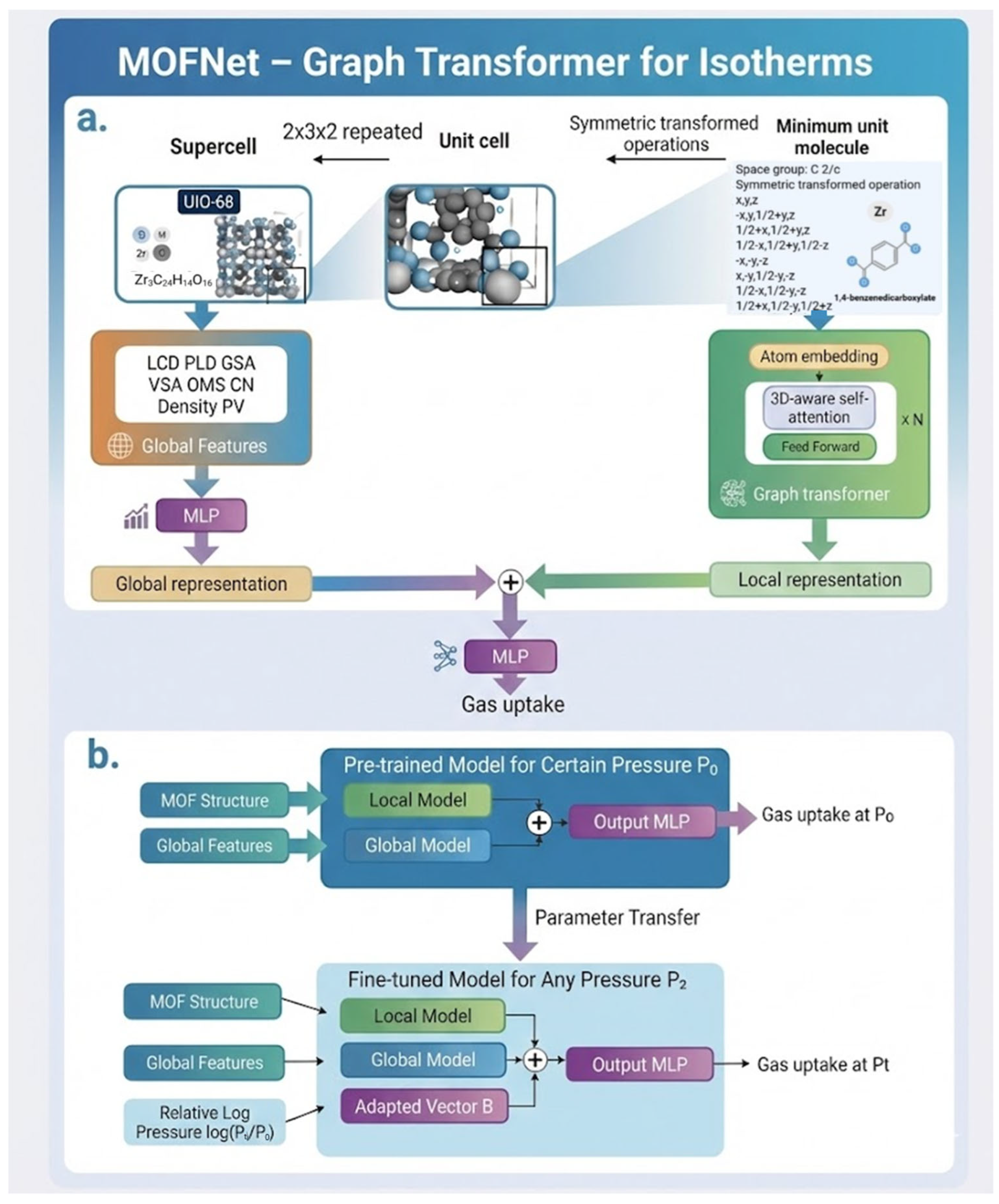
In 2022, Chen et al. introduced MOFNet, a hierarchical graph transformer network designed to predict full gas adsorption isotherms for MOFs, capturing uptake behavior as a continuous function of pressure across both low- and high-pressure regimes (Figure 9) [245]. The model leverages a multiscale representation of the MOF structure, hierarchical encoding crystal structures to reflect pore architecture and local chemical environments. A graph transformer network operating on this hierarchical representation enables atomic-level learning. One of MOFNet’s key innovations is a pressure-adaptive mechanism that facilitates interpolation and extrapolation across pressure ranges through transfer learning. The model was trained and tested on computational and experimental datasets, including challenging benchmarks involving gases such as CO2 and CH4. MOFNet outperformed traditional descriptor-based methods and prior deep learning models, including other graph neural networks, achieving high fidelity even on experimentally observed isotherms. Including self-attention layers further enhanced model interpretability, enabling the identification of atoms and functional groups most influential in determining adsorption behavior.
These predictive capabilities are directly relevant for nanotheranostic applications, as adsorption isotherms strongly correlate with drug loading efficiency, encapsulation capacity, and guest–host affinity—key determinants of MOF-mediated therapeutic delivery.

5.2. MOFormer: Self-Supervised Transformer Model

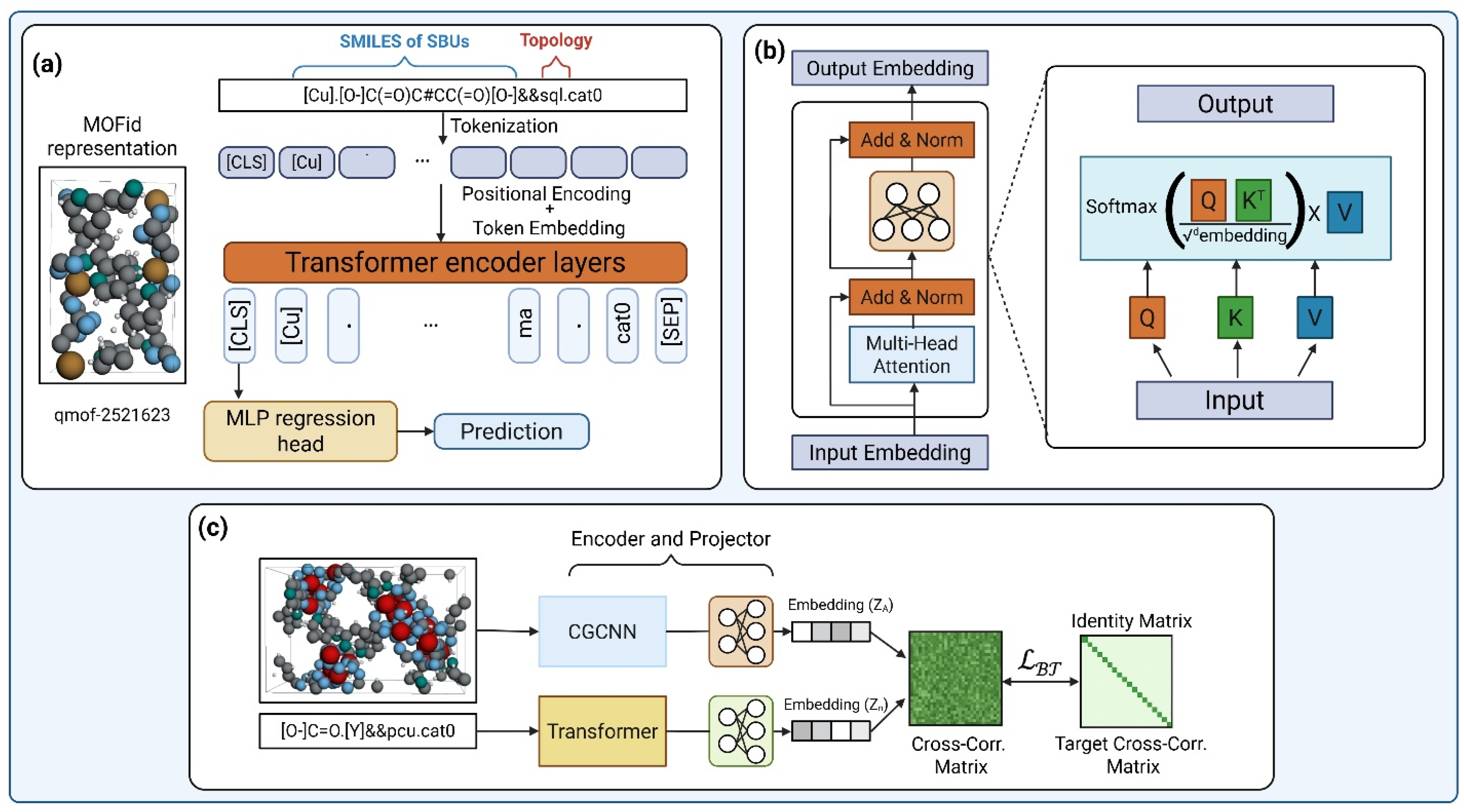
Cao et al. proposed MOFormer in 2023 as a structure-agnostic transformer model for predicting metal–organic framework (MOF) properties (Figure 10) [103]. Distinct from prior approaches that require 3D structural inputs, MOFormer employs a textual representation of MOFs, termed “MOFid,” which is aligned with crystal graph convolutional networks (CGCNN) via a cross-modal self-supervised learning scheme. Specifically, the model was pre-trained to learn MOF embeddings by aligning text-based representations with CGCNN-derived structural embeddings for the same MOFs, enabling it to capture rich structure–property relationships without direct access to geometric data. The pretraining was conducted on a large corpus of over 400,000 MOF entries and followed by fine-tuning on downstream tasks such as gas adsorption and electronic property prediction, including band gap estimation. MOFormer achieved state-of-the-art accuracy among structure-agnostic models, outperforming traditional machine learning approaches based on stoichiometric features or revised autocorrelation descriptors by up to 48% in property prediction accuracy. Moreover, it exhibited enhanced data efficiency, requiring substantially fewer training data than CGCNNs to attain comparable or superior predictive performance for quantum-chemical properties.
These sequence-based Transformer predictions are valuable in biomedical contexts because band gaps influence optical and photo responsive behaviors relevant to imaging, while adsorption predictions inform drug encapsulation and controlled release. Moreover, encoded chemical motifs can reveal biocompatible linkers and degradation-prone coordination environments important for in vivo clearance.

5.3. MOFTransformer—Multi-Modal Transformer

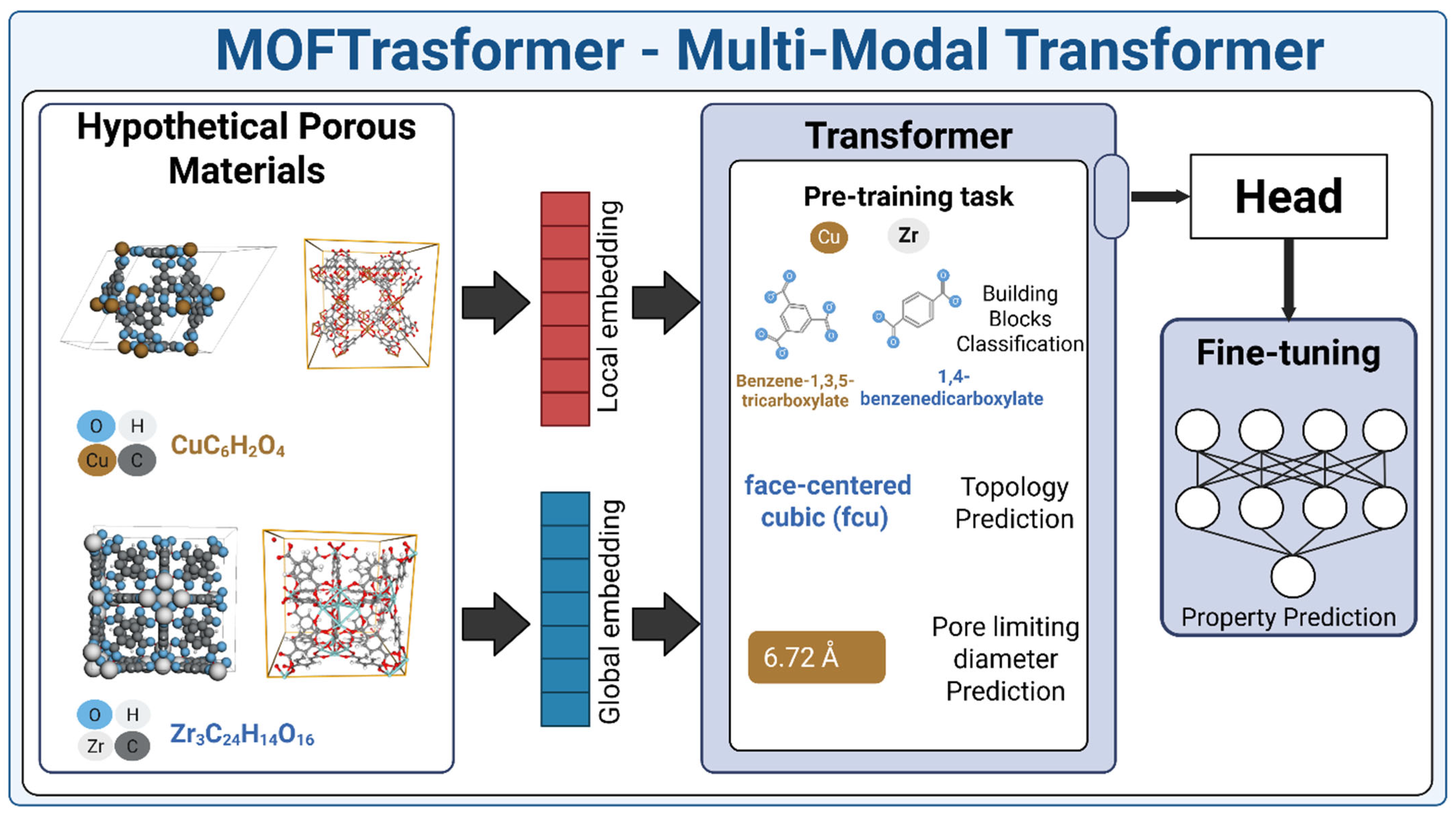
Later in 2023, Kang et al. introduced MOFTransformer, a universal multi-modal transformer architecture designed to predict diverse MOF properties spanning gas adsorption, transport, and electronic structure (Figure 11) [101]. Specifically, the model was fine-tuned to predict hydrogen uptake capacity, H2 self-diffusivity, and electronic band gaps, showcasing its ability to address properties influenced by local chemistry and global pore geometry. MOFTransformer was pre-trained on a large dataset of 1 million hypothetical MOFs, using structural representations to generate pre-training labels for topology type, void fraction, and metal and linker classification. The architecture processes two distinct inputs: an atom-bond graph that captures local chemical interactions and a 3D geometric or energy grid that encodes the pore structure. These modalities are integrated within a unified transformer framework, featuring attention layers that span both local and global representations. Through this design, MOFTransformer outperformed prior models, including graph neural networks and single-modality transformers, on benchmarks for H2 adsorption, diffusivity, and band gap prediction. The study highlighted the power of transfer learning by demonstrating that pre-training on general structural features can enhance performance across a wide range of downstream tasks. Nonetheless, the approach entails substantial computational cost due to the scale of pretraining, and fine-tuning remains necessary for each specific property, indicating room for further innovation toward universal, task-agnostic models.
This multimodal design is particularly advantageous for nanotheranostics, as energy-grid embeddings capture pore accessibility and diffusion barriers that are relevant to drug-release kinetics. In contrast, graph embeddings encode surface functionalization patterns that modulate targeting ligand attachment, protein corona formation, and cellular internalization.
The ability to jointly learn pore-level geometry and chemical specificity enables predictions directly related to therapeutic loading, imaging signal stability, and in vivo biodegradation pathways.

5.4. Uni-MOF Universal Gas Predictor

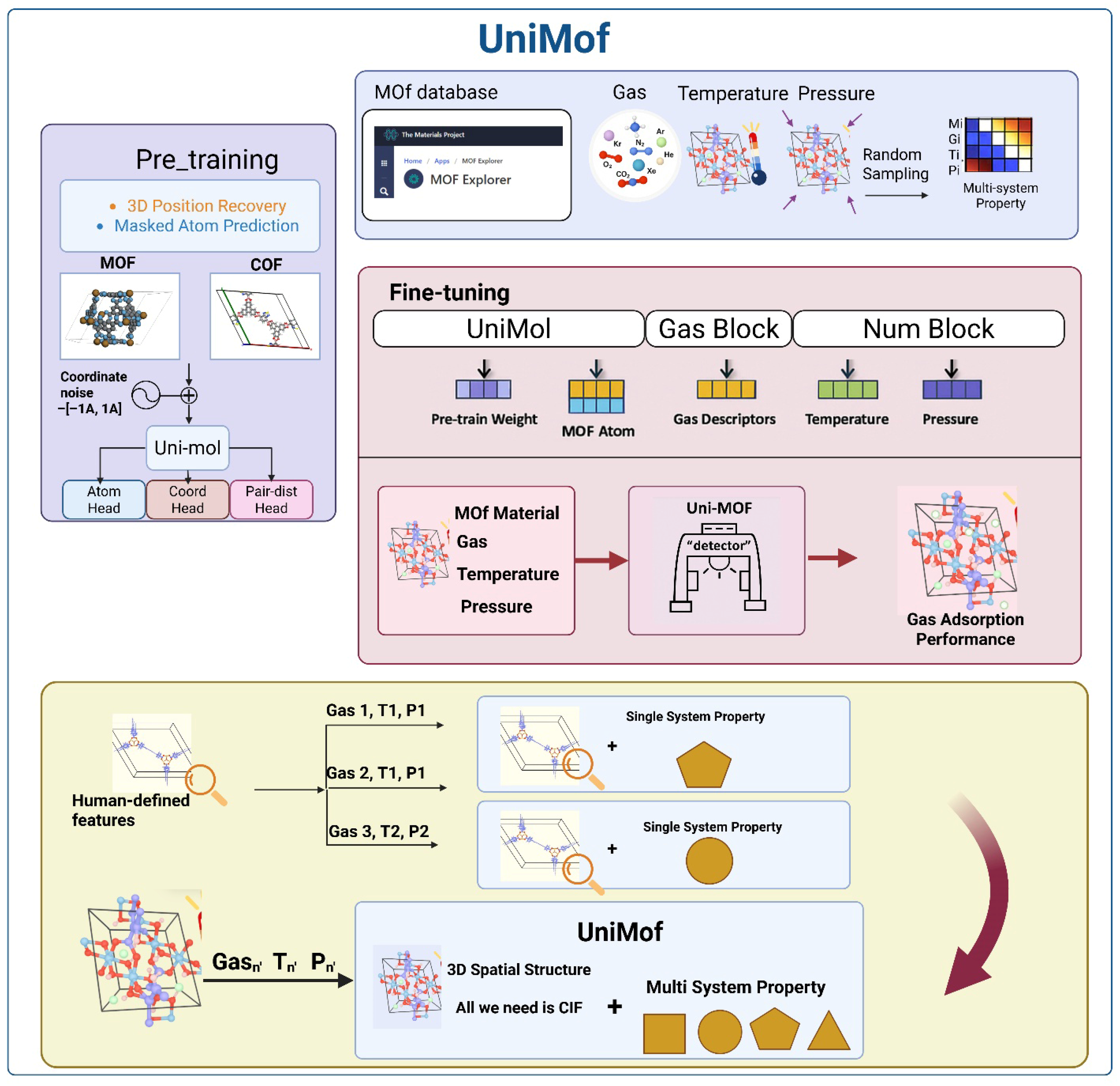
In 2024, Wang et al. introduced Uni-MOF, a universal adsorption predictor designed to estimate gas uptake across a broad range of conditions using a single model (Figure 12) [98]. It was fine-tuned and evaluated on diverse gas systems, including CO2 at 298 K, CH4 at 298 K, Kr and Xe at 273 K, N2 at 77 K, and Ar at 87 K, enabling predictions at both ambient and cryogenic conditions. The model was trained on an expansive dataset of over 631,000 MOF and COF structures derived from both hypothetical and experimental sources. These structures were paired with gas adsorption data generated via high-throughput GCMC simulations across multiple temperature and pressure conditions and assembled into datasets such as hMOF_MOFX_DB, CoRE_MOFX_DB, and CoRE_MAP_DB. For pretraining, Uni-MOF used a 3D geometry-based transformer with self-supervised learning, including atom masking and coordinate denoising tasks, to extract chemically meaningful spatial representations. Architecture employs a hybrid point cloud and graph attention mechanism, enabling it to encode continuous 3D geometric features. During fine-tuning, gas identity, temperature, and pressure were treated as contextual input, allowing the model to generalize across different adsorption scenarios. The model delivered high accuracy across gas types, with R2 values ranging from 0.83 to 0.98, and retained strong performance even for less commonly studied gases like Kr (R2 ≈ 0.85). Furthermore, comparisons with experimental isotherms confirmed the model’s ability to generalize beyond simulation data. Uni-MOF thus serves as a milestone in creating general-purpose, transformer-based models for predicting MOF adsorption. Nevertheless, its development required extensive simulation data, and its current form is limited to pure-component gas adsorption. Extension to other tasks, such as gas mixtures or drug loading, would necessitate additional datasets and retraining. Despite the computational demands of training, the pre-trained model provides a powerful tool for scalable, versatile MOF screening.
Although initially developed for gas adsorption, Uni-MOF’s architecture has clear potential for biomedical applications: diffusion and adsorption predictions translate into drug–MOF affinity, cargo mobility within pores, and eventual release profiles under physiological conditions. Extension to biomolecular diffusion or drug partitioning would provide a powerful platform for theranostic MOF screening.

5.5. Agents for MOF Design

Agent-based systems powered by artificial intelligence have been increasingly adopted across diverse industries to streamline complex processes and improve accessibility [246,247,248]. These agents, often built upon Large Language Models (LLMs), interpret user inputs, execute specific tasks, and provide context-aware responses, significantly reducing the need for specialized technical knowledge [249,250,251]. Such systems are widely applied in customer service, healthcare, finance, and, more recently, scientific research.
In materials science, LLMs have demonstrated transformative potential due to their ability to process and generate human language with high accuracy and contextual understanding [252,253,254]. Based on transformer architectures, these models are trained on vast and diverse textual datasets, enabling them to generalize across multiple scientific disciplines, including natural language processing (NLP) [255,256], computational chemistry [150,257], and materials discovery [110,258].
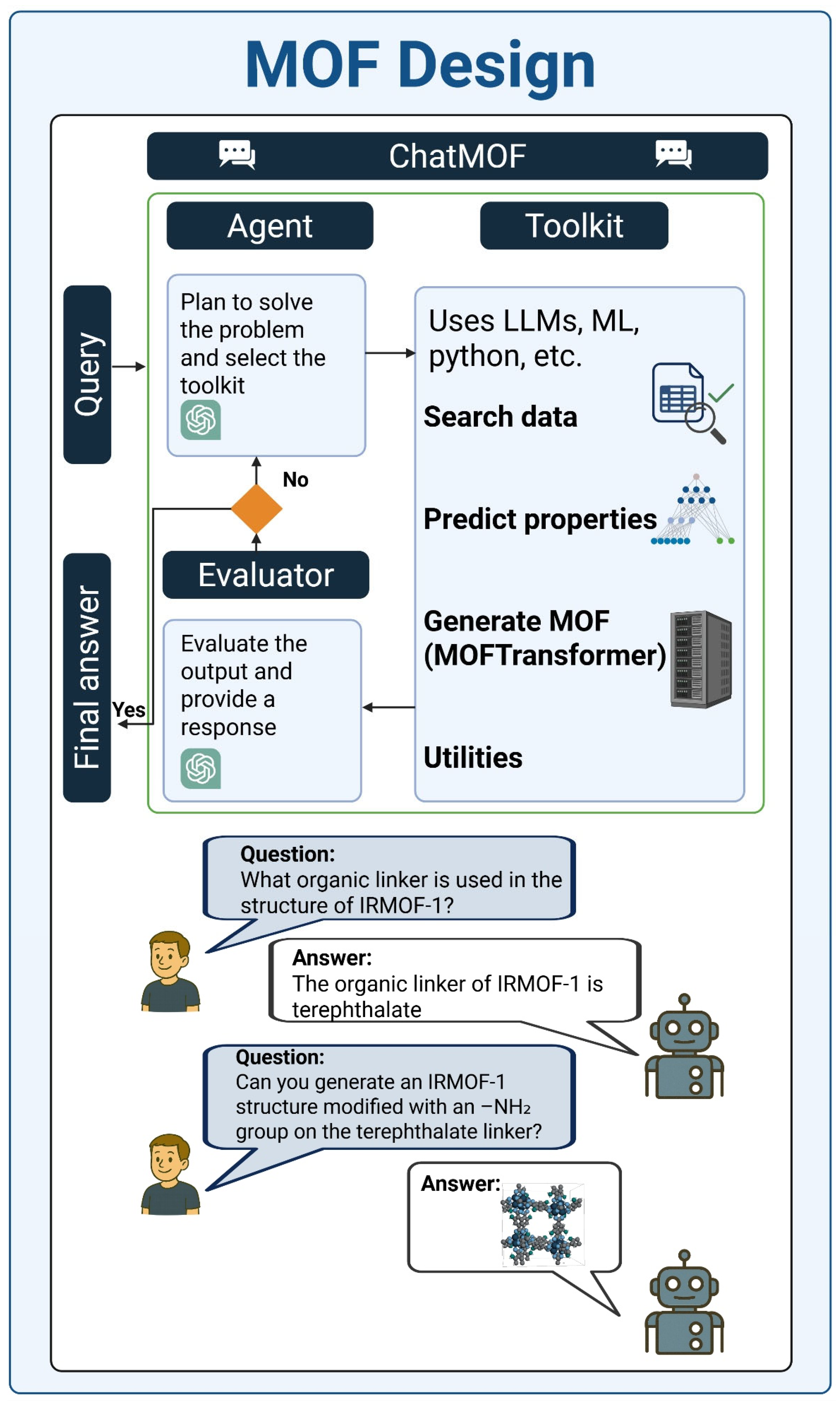
A notable example of the application of LLM-driven agents in materials science is ChatMOF (Figure 13) [259], developed by Kang et al., which integrates large-scale language model (GPT-4, GPT-3.5-turbo, and GPT-3.5-turbo-16k)to support the design and analysis of metal–organic frameworks (MOFs). Traditional approaches to MOF development, such as high-throughput screening or experimental synthesis, are often resource-intensive and require specialized expertise. ChatMOF addresses these limitations by offering an intuitive, automated platform that consolidates key computational tasks into a streamlined workflow.
The system comprises three main components: the Agent, the Toolkit, and the Evaluator. Together, they allow users to perform tasks such as property prediction, data retrieval, and structure generation with minimal manual intervention.
The Agent acts as the system’s core, interpreting user queries and breaking them into executable steps using strategies such as Reasoning and Acting (ReAct) and Modular Reasoning, Knowledge, and Language (MRKL). These techniques enable the agent to manage both structured and unstructured queries effectively.
The Toolkit comprises databases and models that facilitate various computational functions. It includes access to CoRE MOF and QMOF databases for structural data and predictive models, such as MOFTransformer, for estimating properties like hydrogen storage capacity and surface area. Additionally, structure generation is achieved using LLM-guided genetic algorithms, enabling optimization based on user-specified criteria. Supplementary tools also aid in visualization, unit conversion, and file handling, enhancing overall usability.
The Evaluator plays a crucial role in ensuring reliability. It verifies intermediate outcomes, refines results, and guarantees that outputs align with the user’s objectives. This step adds a layer of quality control essential for scientific applications.
A typical interaction with ChatMOF begins with user input, which the Agent translates into a computational plan. The Toolkit then performs the necessary actions, such as querying databases or predicting properties, while the Evaluator ensures that the final output meets the required specifications. This integrated approach simplifies complex research processes and significantly reduces the time and expertise needed to design new MOFs. ChatMOF has demonstrated strong performance, achieving 96.9% accuracy in data retrieval, 95.7% in property prediction, and 87.5% in structure generation. These results confirm the system’s reliability and highlight the effectiveness of LLM-based agents in scientific applications.
Nonetheless, certain limitations remain. The token constraints inherent to LLMs can hinder the processing of large datasets or complex tasks, leading to truncated outputs. Additionally, inaccuracies in task execution may occur in multi-step reasoning scenarios. Addressing these issues will require improved token management strategies and more robust validation mechanisms.
Although GPT-4 has improved reasoning and planning capabilities, experimental validation remains a critical missing component. Bridging the gap between computational predictions and practical implementation will require integration with automated synthesis and testing workflows.
In comparison to traditional MOF design methodologies, which are often labor-intensive and require domain-specific expertise, ChatMOF offers a highly accessible and automated alternative. Its integration of LLMs, specialized databases, and machine learning models simplifies the process, enabling broader participation in advanced materials research.
Future expansions of ChatMOF could include support for other porous materials, such as covalent organic frameworks (COFs) and zeolites. Additionally, improving its scalability and establishing connections with experimental workflows would further enhance its practical value.
ChatMOF illustrates how AI-powered agents can democratize access to advanced scientific tools. By transforming traditionally complex computational workflows into intuitive, efficient processes, ChatMOF exemplifies the potential of LLM-based systems to accelerate innovation and broaden participation in materials science research.
From a nanotheranostic perspective, such agents enable rapid exploration of MOF variants for improved biocompatibility, tailored pore environments for specific drugs, optimized linkers for imaging probes, and fast screening of degradation pathways—all essential for clinical translation.
Collectively, recent Transformer-based approaches—including MOFNet, MOFormer, MOFTransformer, Uni-MOF, and emerging agent-driven frameworks—illustrate the rapid evolution of attention-based models for MOF property prediction and design. These methods highlight how hierarchical, multimodal, and self-supervised Transformer architectures can capture both local chemical environments and global pore-level features, enabling accurate prediction of adsorption, transport, and electronic properties relevant to nanotheranostic performance.
Despite these advances, several bottlenecks remain. Many current models require extensive computational resources for pretraining, rely heavily on simulated data, and focus primarily on gas adsorption rather than biologically validated endpoints. In addition, most architectures remain task-specific, necessitating repeated fine-tuning for each target property, while experimental validation and integration with synthesis workflows are still limited. Addressing these challenges will be critical for transitioning Transformer-based MOF models from high-performance predictors toward robust, interpretable, and experimentally actionable tools capable of supporting clinically relevant nanotheranostic design.

6. Conclusions and Future Perspectives

Metal–organic frameworks (MOFs), with their exceptional porosity, vast surface areas, and unparalleled tunability via modular metal–ligand assembly, present immense opportunities in gas storage, catalysis, sensing, and biomedicine [16,260,261]. Despite this promise, rationally navigating the vast combinatorial landscape of possible MOF structures to design materials with targeted properties remains a central challenge. Traditional experimental and early computational approaches often fall short due to limited scalability, high cost, and restricted capacity to capture complex structure–property relationships.
In this context, the advent of artificial intelligence, particularly Transformer architectures originally developed for natural language processing (NLP), marks a paradigm shift in MOF research. As highlighted throughout this review, the defining strength of Transformers lies in their self-attention mechanisms, which effectively capture complex, long-range, and context-dependent relationships. These capabilities are exceptionally well suited to deciphering the MOF structure–property landscape, where subtle changes in linkers, metal nodes, or topology, analogous to modifying words in a sentence, can lead to dramatic variations in performance. By overcoming the inherent limitations of sequential models such as recurrent neural networks and eliminating the need for handcrafted feature engineering, Transformers learn chemically and structurally relevant representations directly from data.
Significant progress has been achieved through innovative MOF representations tailored for Transformers. Sequence-based encodings (e.g., MOFids in MOFormer) and multimodal architectures (e.g., graph and energy-grid embeddings in MOFTransformer) have enabled state-of-the-art predictive accuracy [101,103]. These models leverage extensive datasets, including hypothetical MOFs, and apply transfer learning and self-supervised techniques to mitigate the issue of data scarcity, a long-standing bottleneck in this young field. Breakthroughs such as MOFNet, MOFormer, MOFTransformer, and Uni-MOF showcase the power and versatility of these architectures in predicting a wide range of complex properties—from full adsorption isotherms to electronic band gaps—with strong generalization and interpretability [98,101,103,177,245]. Moreover, AI-driven agents like ChatMOF demonstrate the potential to democratize MOF design, making powerful modeling tools accessible to non-experts through intuitive interfaces and automated workflows [259].
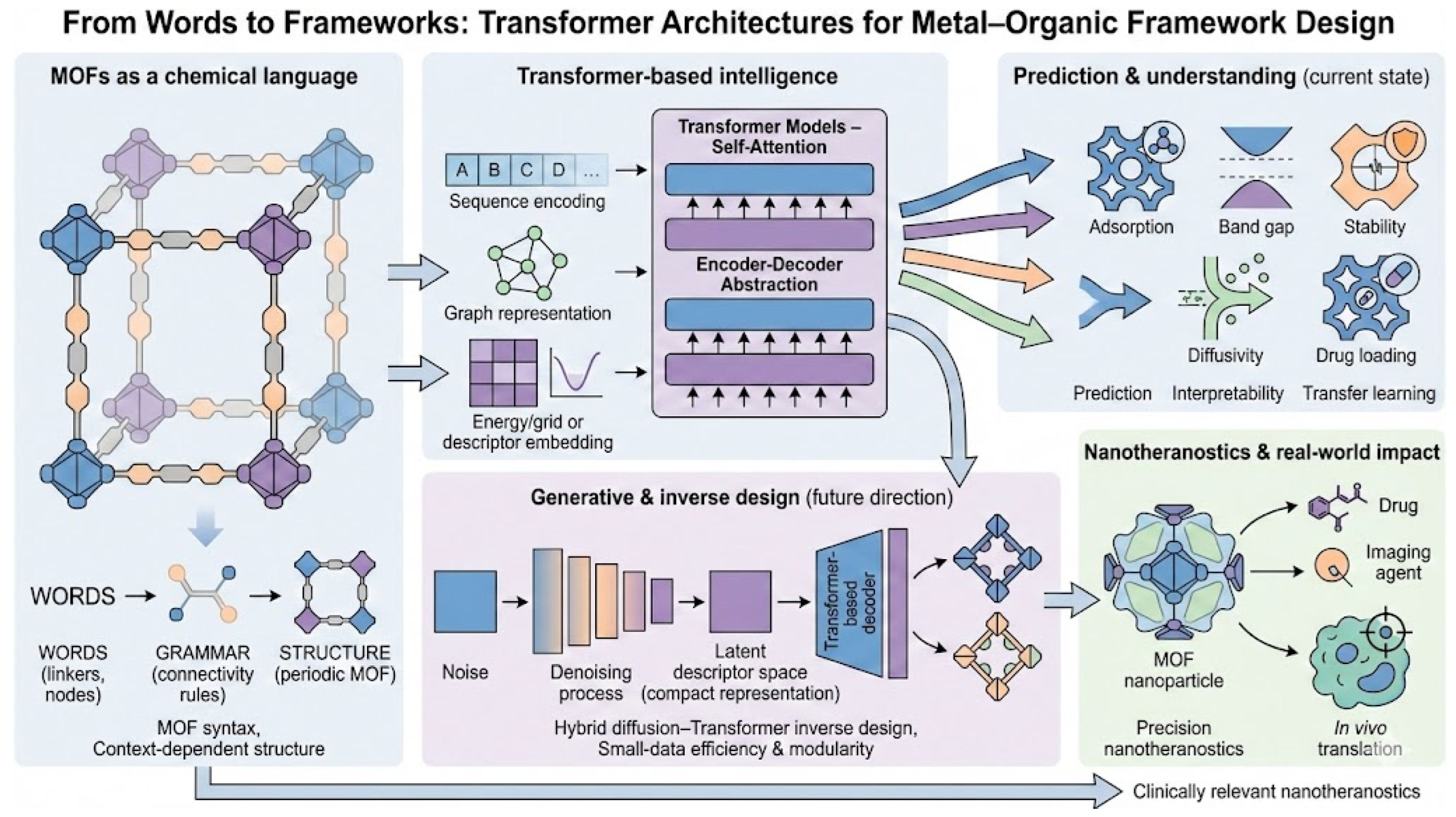
The central contribution of this review is the reframing of MOF design as a context-dependent, grammar-like process and the systematic positioning of Transformer architectures as uniquely capable of capturing this emergent behavior. Unlike prior reviews that broadly survey machine learning approaches for MOFs, this work provides a focused synthesis of Transformer-based models, explicitly linking architectural principles, such as self-attention, multimodal integration, and self-supervised learning, to physicochemical and biological performance metrics relevant to nanotheranostics. In doing so, it establishes a coherent conceptual and methodological bridge between material informatics and translational nanomedicine. This conceptual framework, which connects MOFs as structured chemical languages to Transformer-based prediction and design, is schematically summarized in Figure 14.
Despite this rapid progress, several critical directions remain. Continued data enhancement and standardization are foundational, more significant, and diverse, and high-quality experimental datasets are essential for robust model generalization. Establishing benchmarks and evaluation protocols across models and tasks is equally important for ensuring reproducibility and measurable progress. Integrating high-throughput synthesis and characterization with advanced data augmentation and pretraining techniques will be vital to further improving model performance.
At the same time, bridging laboratory-scale advances with industrial and translational deployment remains a critical bottleneck for Transformer-driven MOF design. Although current models demonstrate remarkable predictive and generative capabilities under controlled laboratory conditions, their extension toward industrially relevant workflows is constrained by the limited availability of standardized experimental data, variability in synthesis and characterization protocols, and the mismatch between idealized, simulation-ready MOF structures and real materials affected by defects, framework flexibility, and batch-to-batch variability. In addition, the computational cost and data requirements associated with large-scale pretraining pose challenges for widespread adoption beyond academic settings. Addressing these limitations will require tighter integration between Transformer-based models and scalable experimental pipelines, including high-throughput synthesis, standardized characterization, and closed-loop validation strategies. Such efforts are essential to enable the reliable translation of AI-guided MOF discovery from laboratory proof-of-concept studies toward industrially and clinically relevant applications.
Simultaneously, advances in representation strategies and architectural innovation are required. Many current approaches rely on flattened or simplified representations of inherently three-dimensional and dynamic frameworks, leading to potential information loss. Hybrid or novel formats that preserve 3D spatial and dynamic behavior without prohibitive computational cost represent a key frontier. Incorporating domain knowledge, such as chemical constraints and physical laws, directly into Transformer architectures may enhance interpretability and reliability, moving beyond black-box predictions toward deeper scientific understanding. Improving training efficiency, particularly for large-scale pretraining, and developing interpretability tools beyond attention visualization will also be essential.
From a nanotheranostic perspective, integrating Transformer-based modeling into MOF design holds considerable promise for accelerating the development of safer, more effective, and clinically relevant nanoplatforms. AI-guided optimization of stability, biodegradability, drug loading and release kinetics, targeting efficiency, and multimodal imaging performance can help bridge the persistent gap between in vitro promise and in vivo translation. As biomedical MOFs increasingly demand precise control over host–guest interactions, stimuli-responsive behavior, and biological interfaces, Transformer architectures offer a powerful computational route to engineer MOFs tailored for precision diagnostics and therapy. Ultimately, coupling these models with experimental validation and automated synthesis pipelines may enable MOF-based nanotheranostics suitable for real clinical deployment.
Notably, the field is poised to transition from property prediction toward truly generative and inverse design (Figure 14). Beyond forecasting the behavior of known or hypothetical MOFs, the emerging objective is to generate de novo frameworks optimized for target performance under realistic data constraints. While Transformer-based generative models are uniquely positioned for this shift due to their ability to learn discrete chemical “grammars” and decode chemically valid structural representations, diffusion models are rapidly emerging as a complementary paradigm for property-conditioned generation, enabling smooth exploration of latent chemical spaces and more stable optimization under constraints. A particularly promising direction is the hybrid diffusion–Transformer design paradigm, in which diffusion models operate in a compact intermediate representation while Transformers perform chemically constrained structure decoding. For example, the EGMOF framework introduces a modular inverse-design workflow in which a one-dimensional diffusion model (Prop2Desc) generates chemically meaningful descriptors conditioned on target properties, followed by a Transformer-based module (Desc2MOF) that reconstructs MOF structures from these descriptors [262]. This modular strategy substantially reduces retraining overhead across different target properties and enables robust performance in small-data regimes, while maintaining high validity and hit rates in conditional generation.
Another frontier is expanding the scope and realism of predictions. Many current models are trained on rigid, idealized MOFs. Extending them to capture framework flexibility, defects, guest-induced transformations, and long-term operational stability will be critical for real-world deployment. Modeling complex environments, such as mixed gas systems, catalytic reaction networks, and in vivo drug release, also represents a vital and largely unexplored challenge. Applying these models to other porous materials, including COFs, zeolites, and porous polymers, is a natural extension.
Ultimately, developing more capable and trustworthy AI agents will be instrumental. Enhancing reasoning, multi-step planning, and reliability in LLM-driven systems, such as ChatMOF, is essential for managing increasingly complex scientific tasks. Ensuring that these tools are accessible, explainable, and seamlessly integrated into research pipelines will determine their adoption and impact.
The journey from words to frameworks detailed in this review highlights the transformative potential of adapting Transformer models to materials science. Architectures originally conceived to understand human language now illuminate the structural “syntax” of MOFs, translating complexity into predictive and actionable insights. This is more than a technical achievement—it is a paradigm shift. As these models evolve to support inverse design, integration with automation, and broader generalization, they will accelerate the rational development of next-generation porous materials. Ultimately, this promises to unlock MOF solutions tailored to address pressing global challenges in energy, environmental remediation, and human health.

Author Contributions

C.F.R., P.G.-S., J.E.R. and W.S.-H. wrote the original draft. C.F.R., P.G.-S. and J.C.C. reviewed and edited the manuscript. All authors have read and agreed to the published version of the manuscript.

Funding

This research received no external funding.

Data Availability Statement

No new data were created or analyzed in this study. Data sharing is not applicable to this article.

Acknowledgments

The authors acknowledge the Department of Biomedical Engineering and the Department of Systems and Computer Engineering at Universidad de Los Andes for their support in the development of this review. During the preparation of this manuscript, the authors used an AI-powered tool (ChatGPT, powered by OpenAI’s GPT-5.2 model) to improve clarity and readability and to ensure the logical flow of ideas. The authors reviewed and edited all AI-generated content and take full responsibility for the content of this publication.

Conflicts of Interest

The authors declare that this research was conducted in the absence of any commercial or financial relationships that could be construed as potential conflicts of interest.

References

  1. Mondal, I.; Haick, H. Smart Dust for Chemical Mapping. Adv. Mater. 2025, 37, 2419052. [Google Scholar] [CrossRef]
  2. Iyer, G.M.; Ku, C.-E.; Zhang, C. Hyperselective Carbon Membranes for Precise High-Temperature H2 and CO2 Separation. Sci. Adv. 2025, 11, eadt7512. [Google Scholar] [CrossRef]
  3. Koppe, J.; Yakimov, A.V.; Gioffrè, D.; Usteri, M.-E.; Vosegaard, T.; Pintacuda, G.; Lesage, A.; Pell, A.J.; Mitchell, S.; Pérez-Ramírez, J.; et al. Coordination Environments of Pt Single-Atom Catalysts from NMR Signatures. Nature 2025, 642, 613–619. [Google Scholar] [CrossRef] [PubMed]
  4. Chen, W.; Bao, M.; Meng, F.; Ma, B.; Feng, L.; Zhang, X.; Qiu, Z.; Gao, S.; Zhong, R.; Xi, S.; et al. Designer Topological-Single-Atom Catalysts with Site-Specific Selectivity. Nat. Commun. 2025, 16, 574. [Google Scholar] [CrossRef] [PubMed]
  5. Yang, Z.; Shen, J. A Review: Metal and Metal Oxide Nanoparticles for Environmental Applications. Nanoscale 2025, 17, 15068–15085. [Google Scholar] [CrossRef] [PubMed]
  6. Rodríguez, C.F.; Quezada, V.; Guzmán-Sastoque, P.; Orozco, J.C.; Reyes, L.H.; Osma, J.F.; Muñoz-Camargo, C.; Cruz, J.C. A Mathematical Phase Field Model Predicts Superparamagnetic Nanoparticle Accelerated Fusion of HeLa Spheroids for Field Guided Biofabrication. Sci. Rep. 2025, 15, 19765. [Google Scholar] [CrossRef]
  7. Rodríguez, C.F.; Guzmán-Sastoque, P.; Santacruz-Belalcazar, A.; Rodriguez, C.; Villamarin, P.; Reyes, L.H.; Cruz, J.C. Magnetoliposomes for Nanomedicine: Synthesis, Characterization, and Applications in Drug, Gene, and Peptide Delivery. Expert Opin. Drug Deliv. 2025, 22, 1069–1098. [Google Scholar] [CrossRef]
  8. Zhang, Q.; Yan, S.; Yan, X.; Lv, Y. Recent Advances in Metal-Organic Frameworks: Synthesis, Application and Toxicity. Sci. Total Environ. 2023, 902, 165944. [Google Scholar] [CrossRef]
  9. Li, D.; Yadav, A.; Zhou, H.; Roy, K.; Thanasekaran, P.; Lee, C. Advances and Applications of Metal-Organic Frameworks (MOFs) in Emerging Technologies: A Comprehensive Review. Glob. Chall. 2024, 8, 2300244. [Google Scholar] [CrossRef]
  10. Liang, F.; Li, J.; Feng, Y.; Zhou, Y.; Cao, L.; Omoding, D.; Jayswal, M.R.; Kumar, A.; Song, Z.; Wang, J.; et al. Advances and Prospects in Alzheimer’s Disease Diagnosis and Treatment Using MOFs and COFs: Mechanism and AI-Assisted Strategies. React. Funct. Polym. 2026, 219, 106601. [Google Scholar] [CrossRef]
  11. Wang, L.; Huang, J.; Li, Z.; Han, Z.; Fan, J. Review of Synthesis and Separation Application of Metal-Organic Framework-Based Mixed-Matrix Membranes. Polymers 2023, 15, 1950. [Google Scholar] [CrossRef]
  12. Yusuf, V.F.; Malek, N.I.; Kailasa, S.K. Review on Metal–Organic Framework Classification, Synthetic Approaches, and Influencing Factors: Applications in Energy, Drug Delivery, and Wastewater Treatment. ACS Omega 2022, 7, 44507–44531. [Google Scholar] [CrossRef]
  13. Huang, Y.-B.; Liang, J.; Wang, X.-S.; Cao, R. Multifunctional Metal–Organic Framework Catalysts: Synergistic Catalysis and Tandem Reactions. Chem. Soc. Rev. 2017, 46, 126–157. [Google Scholar] [CrossRef]
  14. Raptopoulou, C.P. Metal-Organic Frameworks: Synthetic Methods and Potential Applications. Materials 2021, 14, 310. [Google Scholar] [CrossRef]
  15. Xu, W.; Hanikel, N.; Lomachenko, K.A.; Atzori, C.; Lund, A.; Lyu, H.; Zhou, Z.; Angell, C.A.; Yaghi, O.M. High-Porosity Metal-Organic Framework Glasses. Angew. Chem. 2023, 135, e202300003. [Google Scholar] [CrossRef]
  16. Laeim, H.; Molahalli, V.; Prajongthat, P.; Pattanaporkratana, A.; Pathak, G.; Phettong, B.; Hongkarnjanakul, N.; Chattham, N. Porosity Tunable Metal-Organic Framework (MOF)-Based Composites for Energy Storage Applications: Recent Progress. Polymers 2025, 17, 130. [Google Scholar] [CrossRef]
  17. Fan, W.; Zhang, X.; Kang, Z.; Liu, X.; Sun, D. Isoreticular Chemistry within Metal–Organic Frameworks for Gas Storage and Separation. Coord. Chem. Rev. 2021, 443, 213968. [Google Scholar] [CrossRef]
  18. Jia, T.; Gu, Y.; Li, F. Progress and Potential of Metal-Organic Frameworks (MOFs) for Gas Storage and Separation: A Review. J. Environ. Chem. Eng. 2022, 10, 108300. [Google Scholar] [CrossRef]
  19. Jiao, L.; Wang, J.; Jiang, H.-L. Microenvironment Modulation in Metal–Organic Framework-Based Catalysis. Acc. Mater. Res. 2021, 2, 327–339. [Google Scholar] [CrossRef]
  20. Shen, Y.; Pan, T.; Wang, L.; Ren, Z.; Zhang, W.; Huo, F. Programmable Logic in Metal–Organic Frameworks for Catalysis. Adv. Mater. 2021, 33, 2007442. [Google Scholar] [CrossRef]
  21. Sohrabi, H.; Ghasemzadeh, S.; Ghoreishi, Z.; Majidi, M.R.; Yoon, Y.; Dizge, N.; Khataee, A. Metal-Organic Frameworks (MOF)-Based Sensors for Detection of Toxic Gases: A Review of Current Status and Future Prospects. Mater. Chem. Phys. 2023, 299, 127512. [Google Scholar] [CrossRef]
  22. Cheng, W.; Tang, X.; Zhang, Y.; Wu, D.; Yang, W. Applications of Metal-Organic Framework (MOF)-Based Sensors for Food Safety: Enhancing Mechanisms and Recent Advances. Trends Food Sci. Technol. 2021, 112, 268–282. [Google Scholar] [CrossRef]
  23. Nguyen, N.T.T.; Nguyen, T.T.T.; Ge, S.; Liew, R.K.; Nguyen, D.T.C.; Tran, T. Van Recent Progress and Challenges of MOF-Based Nanocomposites in Bioimaging, Biosensing and Biocarriers for Drug Delivery. Nanoscale Adv. 2024, 6, 1800–1821. [Google Scholar] [CrossRef]
  24. Lawson, H.D.; Walton, S.P.; Chan, C. Metal–Organic Frameworks for Drug Delivery: A Design Perspective. ACS Appl. Mater. Interfaces 2021, 13, 7004–7020. [Google Scholar] [CrossRef] [PubMed]
  25. Khafaga, D.S.R.; El-Morsy, M.T.; Faried, H.; Diab, A.H.; Shehab, S.; Saleh, A.M.; Ali, G.A.M. Metal–Organic Frameworks in Drug Delivery: Engineering Versatile Platforms for Therapeutic Applications. RSC Adv. 2024, 14, 30201–30229. [Google Scholar] [CrossRef] [PubMed]
  26. Khulood, M.T.; Jijith, U.S.; Naseef, P.P.; Kallungal, S.M.; Geetha, V.S.; Pramod, K. Advances in Metal-Organic Framework-Based Drug Delivery Systems. Int. J. Pharm. 2025, 673, 125380. [Google Scholar] [CrossRef]
  27. Ma, D.; Liang, T.; Zheng, J.; Chen, G.; Ye, Y.; Nezamzadeh-Ejhieh, A.; Lu, L.; Song, Z.; Huang, Y. MOF-Based Platforms on Diabetic Disease: Advanced and Prospect of Effective Diagnosing and Therapy. React. Funct. Polym. 2026, 218, 106520. [Google Scholar] [CrossRef]
  28. Salgueiro, M.J.; Zubillaga, M. Theranostic Nanoplatforms in Nuclear Medicine: Current Advances, Emerging Trends, and Perspectives for Personalized Oncology. J. Nanotheranostics 2025, 6, 27. [Google Scholar] [CrossRef]
  29. Fahmy, H.M.; Bayoumi, L.; Helal, N.F.; Mohamed, N.R.A.; Emarh, Y.; Ahmed, A.M. Emerging Trends in NanoTheranostics: Integrating Imaging and Therapy for Precision Health Care. Int. J. Pharm. 2025, 683, 126057. [Google Scholar] [CrossRef]
  30. Altinbasak, I.; Alp, Y.; Sanyal, R.; Sanyal, A. Theranostic Nanogels: Multifunctional Agents for Simultaneous Therapeutic Delivery and Diagnostic Imaging. Nanoscale 2024, 16, 14033–14056. [Google Scholar] [CrossRef]
  31. Guzmán-Sastoque, P.; Rodríguez, C.F.; Monsalve, M.C.; Castellanos, S.; Manrique-Moreno, A.; Reyes, L.H.; Cruz, J.C. Nanotheranostics Revolutionizing Gene Therapy: Emerging Applications in Gene Delivery Enhancement. J. Nanotheranostics 2025, 6, 10. [Google Scholar] [CrossRef]
  32. Ma, H.; Cong, C. Insights and Advances of Theranostic Nanoscale Metal-Organic Frameworks. Microchim. Acta 2025, 192, 809. [Google Scholar] [CrossRef]
  33. Zhang, J.; Li, M.; Liu, M.; Yu, Q.; Ge, D.; Zhang, J. Metal–Organic Framework Nanomaterials as a Medicine for Catalytic Tumor Therapy: Recent Advances. Nanomaterials 2024, 14, 797. [Google Scholar] [CrossRef]
  34. Mehata, A.K.; Vikas; Viswanadh, M.K.; Muthu, M.S. Theranostics of Metal–Organic Frameworks: Image-Guided Nanomedicine for Clinical Translation. Nanomedicine 2023, 18, 695–703. [Google Scholar] [CrossRef]
  35. Zou, Y.; Zhang, Q.; Chen, J.; Wang, W.; Zheng, X. Metal-Organic Frameworks-Loaded Indocyanine Green for Enhanced Phototherapy: A Comprehensive Review. Front. Bioeng. Biotechnol. 2025, 13, 1601476. [Google Scholar] [CrossRef] [PubMed]
  36. Pantwalawalkar, J.; Mhettar, P.; Nangare, S.; Mali, R.; Ghule, A.; Patil, P.; Mohite, S.; More, H.; Jadhav, N. Stimuli-Responsive Design of Metal–Organic Frameworks for Cancer Theranostics: Current Challenges and Future Perspective. ACS Biomater. Sci. Eng. 2023, 9, 4497–4526. [Google Scholar] [CrossRef] [PubMed]
  37. Song, Y.; Li, J.; Chi, D.; Xu, Z.; Liu, J.; Chen, M.; Wang, Z. AI-Driven Advances in Metal–Organic Frameworks: From Data to Design and Applications. Chem. Commun. 2025, 61, 15972–16001. [Google Scholar] [CrossRef]
  38. Badrinarayanan, S.; Magar, R.; Antony, A.; Meda, R.S.; Barati Farimani, A. MOFGPT: Generative Design of Metal–Organic Frameworks Using Language Models. J. Chem. Inf. Model. 2025, 65, 9049–9060. [Google Scholar] [CrossRef]
  39. He, Y.; Chen, R.; Yang, S.; Qian, J.; Chen, Z.; Zhong, M.; Zheng, B.; Pan, Y.; Liu, J. Advances and Challenges of ZIF-Based Nanocomposites in Immunotherapy and Anti-Inflammatory Therapy. J. Mater. Chem. B 2026, 14, 841–870. [Google Scholar] [CrossRef]
  40. Robson, R. The Historical Development of the Concepts Underlying the Design and Construction of Targeted Coordination Polymers/MOFs: A Personal Account. Chem. Rec. 2024, 24, e202400038. [Google Scholar] [CrossRef] [PubMed]
  41. Yifu, C. Metal-Organic Frameworks: Current Trends, Challenges, and Future Prospects. In Metal Organic Frameworks; Elsevier: Amsterdam, The Netherlands, 2024; pp. 3–23. [Google Scholar]
  42. Fatima, S.F.; Sabouni, R.; Garg, R.; Gomaa, H. Recent Advances in Metal-Organic Frameworks as Nanocarriers for Triggered Release of Anticancer Drugs: Brief History, Biomedical Applications, Challenges and Future Perspective. Colloids Surf. B Biointerfaces 2023, 225, 113266. [Google Scholar] [CrossRef]
  43. Yaghi, O.M.; Li, G.; Li, H. Selective Binding and Removal of Guests in a Microporous Metal–Organic Framework. Nature 1995, 378, 703–706. [Google Scholar] [CrossRef]
  44. Yaghi, O.M.; Li, H. Hydrothermal Synthesis of a Metal-Organic Framework Containing Large Rectangular Channels. J. Am. Chem. Soc. 1995, 117, 10401–10402. [Google Scholar] [CrossRef]
  45. Marghade, D.; Shelare, S.; Prakash, C.; Soudagar, M.E.M.; Yunus Khan, T.M.; Kalam, M.A. Innovations in Metal-Organic Frameworks (MOFs): Pioneering Adsorption Approaches for Persistent Organic Pollutant (POP) Removal. Environ. Res. 2024, 258, 119404. [Google Scholar] [CrossRef] [PubMed]
  46. Cheng, Y.; Datta, S.J.; Zhou, S.; Jia, J.; Shekhah, O.; Eddaoudi, M. Advances in Metal–Organic Framework-Based Membranes. Chem. Soc. Rev. 2022, 51, 8300–8350. [Google Scholar] [CrossRef] [PubMed]
  47. Recent Progress in Strategies for Preparation of Metal-Organic Frameworks and Their Hybrids with Different Dimensions. Chem. Synth. 2022, 3, 1. [CrossRef]
  48. Rangnekar, N.; Mittal, N.; Elyassi, B.; Caro, J.; Tsapatsis, M. Zeolite Membranes—A Review and Comparison with MOFs. Chem. Soc. Rev. 2015, 44, 7128–7154. [Google Scholar] [CrossRef]
  49. Teffu, D.M.; Makgopa, K.; Somo, T.R.; Ratsoma, M.S.; Honey, S.; Makhado, E.; Modibane, K.D. Metal and Covalent Organic Frameworks (MOFs and COFs): A Comprehensive Overview of Their Synthesis, Characterization and Enhanced Supercapacitor Performance. Coord. Chem. Rev. 2025, 540, 216798. [Google Scholar] [CrossRef]
  50. Zhang, W.; Taheri-Ledari, R.; Saeidirad, M.; Qazi, F.S.; Kashtiaray, A.; Ganjali, F.; Tian, Y.; Maleki, A. Regulation of Porosity in MOFs: A Review on Tunable Scaffolds and Related Effects and Advances in Different Applications. J. Environ. Chem. Eng. 2022, 10, 108836. [Google Scholar] [CrossRef]
  51. Kim, M.; Xin, R.; Earnshaw, J.; Tang, J.; Hill, J.P.; Ashok, A.; Nanjundan, A.K.; Kim, J.; Young, C.; Sugahara, Y.; et al. MOF-Derived Nanoporous Carbons with Diverse Tunable Nanoarchitectures. Nat. Protoc. 2022, 17, 2990–3027. [Google Scholar] [CrossRef]
  52. Bi, W.; Han, L.; Liu, Y.; Li, L. The Key to MOF Membrane Fabrication and Application: The Trade-off between Crystallization and Film Formation. Chem.—Eur. J. 2024, 30, e202401868. [Google Scholar] [CrossRef]
  53. Zorlu, T.; Hetey, D.; Reithofer, M.R.; Chin, J.M. Physicochemical Methods for the Structuring and Assembly of MOF Crystals. Acc. Chem. Res. 2024, 57, 2105–2116. [Google Scholar] [CrossRef]
  54. He, Q.; Bai, J.; Wang, H.; Liu, S.; Jun, S.C.; Yamauchi, Y.; Chen, L. Emerging Pristine MOF-Based Heterostructured Nanoarchitectures: Advances in Structure Evolution, Controlled Synthesis, and Future Perspectives. Small 2023, 19, 2303884. [Google Scholar] [CrossRef]
  55. Panahi-Sarmad, M.; Samsami, S.; Ghaffarkhah, A.; Hashemi, S.A.; Ghasemi, S.; Amini, M.; Wuttke, S.; Rojas, O.; Tam, K.C.; Jiang, F.; et al. MOF-Based Electromagnetic Shields Multiscale Design: Nanoscale Chemistry, Microscale Assembly, and Macroscale Manufacturing. Adv. Funct. Mater. 2024, 34, 2304473. [Google Scholar] [CrossRef]
  56. Kirlikovali, K.O.; Hanna, S.L.; Son, F.A.; Farha, O.K. Back to the Basics: Developing Advanced Metal–Organic Frameworks Using Fundamental Chemistry Concepts. ACS Nanosci. Au 2023, 3, 37–45. [Google Scholar] [CrossRef] [PubMed]
  57. Yang, D.; Gates, B.C. Analyzing Stabilities of Metal–Organic Frameworks: Correlation of Stability with Node Coordination to Linkers and Degree of Node Metal Hydrolysis. J. Phys. Chem. C 2024, 128, 8551–8559. [Google Scholar] [CrossRef]
  58. Du, R.; Wu, Y.; Yang, Y.; Zhai, T.; Zhou, T.; Shang, Q.; Zhu, L.; Shang, C.; Guo, Z. Porosity Engineering of MOF-Based Materials for Electrochemical Energy Storage. Adv. Energy Mater. 2021, 11, 2100154. [Google Scholar] [CrossRef]
  59. Torbina, V.V.; Belik, Y.A.; Vodyankina, O.V. Effect of Organic Linker Substituents on Properties of Metal–Organic Frameworks: A Review. React. Chem. Eng. 2025, 10, 1197–1215. [Google Scholar] [CrossRef]
  60. Oliver, M.C.; Huang, L. Advances in Metal–Organic Frameworks for the Removal of Chemical Warfare Agents: Insights into Hydrolysis and Oxidation Reaction Mechanisms. Nanomaterials 2023, 13, 2178. [Google Scholar] [CrossRef] [PubMed]
  61. Wiśniewska, P.; Haponiuk, J.; Saeb, M.R.; Rabiee, N.; Bencherif, S.A. Mitigating Metal-Organic Framework (MOF) Toxicity for Biomedical Applications. Chem. Eng. J. 2023, 471, 144400. [Google Scholar] [CrossRef]
  62. Ahmadi, M.; Ayyoubzadeh, S.M.; Ghorbani-Bidkorbeh, F.; Shahhosseini, S.; Dadashzadeh, S.; Asadian, E.; Mosayebnia, M.; Siavashy, S. An Investigation of Affecting Factors on MOF Characteristics for Biomedical Applications: A Systematic Review. Heliyon 2021, 7, e06914. [Google Scholar] [CrossRef]
  63. Bavykina, A.; Kolobov, N.; Khan, I.S.; Bau, J.A.; Ramirez, A.; Gascon, J. Metal–Organic Frameworks in Heterogeneous Catalysis: Recent Progress, New Trends, and Future Perspectives. Chem. Rev. 2020, 120, 8468–8535. [Google Scholar] [CrossRef]
  64. Zhang, X.; Han, J.; Guo, J.; Tang, Z. Engineering Nanoscale Metal-Organic Frameworks for Heterogeneous Catalysis. Small Struct. 2021, 2, 2000141. [Google Scholar] [CrossRef]
  65. Li, L.; Lv, X.; Jin, L.; Du, K.; Jiang, J.; Zhao, X.; Liang, H.; Guo, Y.; Wang, X. Facile Synthesis of Sn-Doped MOF-5 Catalysts for Efficient Photocatalytic Nitrogen Fixation. Appl. Catal. B 2024, 344, 123586. [Google Scholar] [CrossRef]
  66. Bai, X.-J.; Yang, C.; Tang, Z. Enabling Long-Distance Hydrogen Spillover in Nonreducible Metal-Organic Frameworks for Catalytic Reaction. Nat. Commun. 2024, 15, 6263. [Google Scholar] [CrossRef]
  67. Yan, S.; Song, H.; Huang, Z.; Su, Y.; Lv, Y. Multisignals Sensing Platform for Highly Sensitive, Accurate, and Rapid Detection of p -Aminophenol Based on Adsorption and Oxidation Effects Induced by Defective NH2-Ag-NMOFs. Anal. Chem. 2024, 96, 3137–3144. [Google Scholar] [CrossRef]
  68. Xu, J.; Ma, J.; Peng, Y.; Cao, S.; Zhang, S.; Pang, H. Applications of Metal Nanoparticles/Metal-Organic Frameworks Composites in Sensing Field. Chin. Chem. Lett. 2023, 34, 107527. [Google Scholar] [CrossRef]
  69. Hu, C.; Chen, J.; Zhang, H.; Wu, L.; Yang, P.; Hou, X. Nanoscale Metal Organic Frameworks and Their Applications in Disease Diagnosis and Therapy. Microchem. J. 2022, 180, 107595. [Google Scholar] [CrossRef]
  70. Zhao, D.; Zhang, W.; Wu, Z.-H.; Xu, H. Nanoscale Metal−Organic Frameworks and Their Nanomedicine Applications. Front. Chem. 2022, 9, 834171. [Google Scholar] [CrossRef]
  71. Li, Z.; Wang, Y.; Zhang, J.; Cheng, S.; Sun, Y. A Short Review of Advances in MOF Glass Membranes for Gas Adsorption and Separation. Membranes 2024, 14, 99. [Google Scholar] [CrossRef]
  72. Suresh, K.; Aulakh, D.; Purewal, J.; Siegel, D.J.; Veenstra, M.; Matzger, A.J. Optimizing Hydrogen Storage in MOFs through Engineering of Crystal Morphology and Control of Crystal Size. J. Am. Chem. Soc. 2021, 143, 10727–10734. [Google Scholar] [CrossRef]
  73. Xia, H.; Jin, H.; Zhang, Y.; Song, H.; Hu, J.; Huang, Y.; Li, Y. A Long-Lasting TIF-4 MOF Glass Membrane for Selective CO2 Separation. J. Memb. Sci. 2022, 655, 120611. [Google Scholar] [CrossRef]
  74. Feng, Y.; Yan, W.; Kang, Z.; Zou, X.; Fan, W.; Jiang, Y.; Fan, L.; Wang, R.; Sun, D. Thermal Treatment Optimization of Porous MOF Glass and Polymer for Improving Gas Permeability and Selectivity of Mixed Matrix Membranes. Chem. Eng. J. 2023, 465, 142873. [Google Scholar] [CrossRef]
  75. Song, Y.; Ren, Y.; Cheng, H.; Jiao, Y.; Shi, S.; Gao, L.; Xie, H.; Gao, J.; Sun, L.; Hou, J. Metal-Organic Framework Glass Catalysts from Melting Glass-Forming Cobalt-Based Zeolitic Imidazolate Framework for Boosting Photoelectrochemical Water Oxidation. Angew. Chem. Int. Ed. 2023, 62, e202306420. [Google Scholar] [CrossRef] [PubMed]
  76. Rao, Y.; Kou, Z.; Zhang, X.; Lu, P. Metal Organic Framework Glasses: A New Platform for Electrocatalysis? Chem. Rec. 2023, 23, e202200251. [Google Scholar] [CrossRef]
  77. Nasri, N.; Azad, M.; Mehrabi, Z.; Dini, G.; Marandi, A. Metal–Organic Frameworks for Biomedical Applications: Bridging Materials Science and Regenerative Medicine. RSC Adv. 2025, 15, 34481–34509. [Google Scholar] [CrossRef] [PubMed]
  78. Zhang, T.; Yu, Y.; Lu, Y.; Tang, H.; Chen, K.; Shi, J.; Ren, Z.; Wu, S.; Xia, D.; Zheng, Y. Bridging Biodegradable Metals and Biodegradable Polymers: A Comprehensive Review of Biodegradable Metal–Organic Frameworks for Biomedical Application. Prog. Mater. Sci. 2026, 155, 101526. [Google Scholar] [CrossRef]
  79. Kidanemariam, A.; Cho, S. Recent Advancements in Metal–Organic Framework-Based Microfluidic Chips for Biomedical Applications. Micromachines 2025, 16, 736. [Google Scholar] [CrossRef]
  80. Demir, H.; Daglar, H.; Gulbalkan, H.C.; Aksu, G.O.; Keskin, S. Recent Advances in Computational Modeling of MOFs: From Molecular Simulations to Machine Learning. Coord. Chem. Rev. 2023, 484, 215112. [Google Scholar] [CrossRef]
  81. Barsoum, M.L.; Fahy, K.M.; Morris, W.; Dravid, V.P.; Hernandez, B.; Farha, O.K. The Road Ahead for Metal–Organic Frameworks: Current Landscape, Challenges and Future Prospects. ACS Nano 2025, 19, 13–20. [Google Scholar] [CrossRef]
  82. Rosen, A.S.; Fung, V.; Huck, P.; O’Donnell, C.T.; Horton, M.K.; Truhlar, D.G.; Persson, K.A.; Notestein, J.M.; Snurr, R.Q. High-Throughput Predictions of Metal–Organic Framework Electronic Properties: Theoretical Challenges, Graph Neural Networks, and Data Exploration. npj Comput. Mater. 2022, 8, 112. [Google Scholar] [CrossRef]
  83. Achenbach, B.; Yurdusen, A.; Stock, N.; Maurin, G.; Serre, C. Synthetic Aspects and Characterization Needs in MOF Chemistry—From Discovery to Applications. Adv. Mater. 2025, 37, 2411359. [Google Scholar] [CrossRef]
  84. Du, Y.; Du, D. Bayesian Optimization Enhanced Neural Networks for Predicting Metal-Organic Framework Morphology: A ZIF-8 Synthesis Case Study. Mater. Lett. 2025, 380, 137738. [Google Scholar] [CrossRef]
  85. Park, H.; Kang, Y.; Choe, W.; Kim, J. Mining Insights on Metal–Organic Framework Synthesis from Scientific Literature Texts. J. Chem. Inf. Model. 2022, 62, 1190–1198. [Google Scholar] [CrossRef]
  86. Zhai, Z.; Yan, W.; Dong, L.; Deng, S.; Wilkinson, D.P.; Wang, X.; Zhang, L.; Zhang, J. Catalytically Active Sites of MOF-Derived Electrocatalysts: Synthesis, Characterization, Theoretical Calculations, and Functional Mechanisms. J. Mater. Chem. A Mater. 2021, 9, 20320–20344. [Google Scholar] [CrossRef]
  87. Kharissova, O.V.; Kharisov, B.I.; González, L.T. Recent Trends on Density Functional Theory–Assisted Calculations of Structures and Properties of Metal–Organic Frameworks and Metal–Organic Frameworks-Derived Nanocarbons. J. Mater. Res. 2020, 35, 1424–1438. [Google Scholar] [CrossRef]
  88. Yao, C.; Wang, Q.; Peng, C.; Wang, R.; Liu, J.; Tsidaeva, N.; Wang, W. MOF-Derived CoS2/WS2 Electrocatalysts with Sulfurized Interface for High-Efficiency Hydrogen Evolution Reaction: Synthesis, Characterization and DFT Calculations. Chem. Eng. J. 2024, 479, 147924. [Google Scholar] [CrossRef]
  89. Ghanbari, T.; Fazly Abdul Patah, M.; Hoong Wong, Y.; Abnisa, F.; Daud, W.M.A.W. Probing the Capability of the MOF-74(Ni)@GrO Composite for CO2 Adsorption and CO2/N2 Separation: A Combination of Experimental and Molecular Dynamic Simulation Studies. Fuel 2024, 372, 131837. [Google Scholar] [CrossRef]
  90. Ayman.FM, F.; Taha, M.; Farghali, A.A.; Abdelhameed, R.M. Synthesis and Applications of Porphyrin-Based MOFs in Removal of Pesticide from Wastewater: Molecular Simulations and Experimental Studies. CrystEngComm 2023, 25, 6697–6709. [Google Scholar] [CrossRef]
  91. Boroushaki, T.; Dekamin, M.G.; Hashemianzadeh, S.M.; Naimi-Jamal, M.R.; Ganjali Koli, M. A Molecular Dynamic Simulation Study of Anticancer Agents and UiO-66 as a Carrier in Drug Delivery Systems. J. Mol. Graph. Model. 2022, 113, 108147. [Google Scholar] [CrossRef] [PubMed]
  92. Wang, Y.; Jiang, Z.-J.; Wang, D.-R.; Lu, W.; Li, D. Machine Learning-Assisted Discovery of Propane-Selective Metal–Organic Frameworks. J. Am. Chem. Soc. 2024, 146, 6955–6961. [Google Scholar] [CrossRef]
  93. Park, H.; Yan, X.; Zhu, R.; Huerta, E.A.; Chaudhuri, S.; Cooper, D.; Foster, I.; Tajkhorshid, E. A Generative Artificial Intelligence Framework Based on a Molecular Diffusion Model for the Design of Metal-Organic Frameworks for Carbon Capture. Commun. Chem. 2024, 7, 21. [Google Scholar] [CrossRef]
  94. Chen, Z.; Xie, Y.; Wu, Y.; Lin, Y.; Tomiya, S.; Lin, J. An Interpretable and Transferrable Vision Transformer Model for Rapid Materials Spectra Classification. Digit. Discov. 2024, 3, 369–380. [Google Scholar] [CrossRef]
  95. Zhao, Y.; Zhao, Y.; Wang, J.; Wang, Z. Artificial Intelligence Meets Laboratory Automation in Discovery and Synthesis of Metal–Organic Frameworks: A Review. Ind. Eng. Chem. Res. 2025, 64, 4637–4668. [Google Scholar] [CrossRef]
  96. Choudhary, K. AtomGPT: Atomistic Generative Pretrained Transformer for Forward and Inverse Materials Design. J. Phys. Chem. Lett. 2024, 15, 6909–6917. [Google Scholar] [CrossRef] [PubMed]
  97. Pirnay, J.; Rittig, J.G.; Wolf, A.B.; Grohe, M.; Burger, J.; Mitsos, A.; Grimm, D.G. GraphXForm: Graph Transformer for Computer-Aided Molecular Design. Digit. Discov. 2025, 4, 1052–1065. [Google Scholar] [CrossRef]
  98. Wang, J.; Liu, J.; Wang, H.; Zhou, M.; Ke, G.; Zhang, L.; Wu, J.; Gao, Z.; Lu, D. A Comprehensive Transformer-Based Approach for High-Accuracy Gas Adsorption Predictions in Metal-Organic Frameworks. Nat. Commun. 2024, 15, 1904. [Google Scholar] [CrossRef]
  99. Zhu, J.; Ren, Y.; Zhou, W.; Xu, J.; Niu, Z.; Zhan, S.; Ma, W. LLM-Mambaformer: Integrating Mamba and Transformer for Crystalline Solids Properties Prediction. Mater. Today Commun. 2025, 44, 112029. [Google Scholar] [CrossRef]
  100. Jin, L.; Du, Z.; Shu, L.; Cen, Y.; Xu, Y.; Mei, Y.; Zhang, H. Transformer-Generated Atomic Embeddings to Enhance Prediction Accuracy of Crystal Properties with Machine Learning. Nat. Commun. 2025, 16, 1210. [Google Scholar] [CrossRef] [PubMed]
  101. Kang, Y.; Park, H.; Smit, B.; Kim, J. A Multi-Modal Pre-Training Transformer for Universal Transfer Learning in Metal–Organic Frameworks. Nat. Mach. Intell. 2023, 5, 309–318. [Google Scholar] [CrossRef]
  102. Kang, Y.; Lee, W.; Bae, T.; Han, S.; Jang, H.; Kim, J. Harnessing Large Language Models to Collect and Analyze Metal–Organic Framework Property Data Set. J. Am. Chem. Soc. 2025, 147, 3943–3958. [Google Scholar] [CrossRef]
  103. Cao, Z.; Magar, R.; Wang, Y.; Barati Farimani, A. MOFormer: Self-Supervised Transformer Model for Metal–Organic Framework Property Prediction. J. Am. Chem. Soc. 2023, 145, 2958–2967. [Google Scholar] [CrossRef]
  104. Liu, Y.; Dong, Y.; Wu, H. Comprehensive Overview of Machine Learning Applications in MOFs: From Modeling Processes to Latest Applications and Design Classifications. J. Mater. Chem. A Mater. 2025, 13, 2403–2440. [Google Scholar] [CrossRef]
  105. Park, J.; Kim, H.; Kang, Y.; Lim, Y.; Kim, J. From Data to Discovery: Recent Trends of Machine Learning in Metal–Organic Frameworks. JACS Au 2024, 4, 3727–3743. [Google Scholar] [CrossRef] [PubMed]
  106. Neikha, K.; Puzari, A. Metal–Organic Frameworks through the Lens of Artificial Intelligence: A Comprehensive Review. Langmuir 2024, 40, 21957–21975. [Google Scholar] [CrossRef]
  107. Vaswani, A.; Shazeer, N.; Parmar, N.; Uszkoreit, J.; Jones, L.; Gomez, A.N.; Kaiser, Ł.; Polosukhin, I. Attention Is All You Need. Adv. Neural Inf. Process. Syst. 2017, 30, 5998–6008. [Google Scholar] [CrossRef]
  108. Naveen, P.; Trojovský, P. Overview and Challenges of Machine Translation for Contextually Appropriate Translations. iScience 2024, 27, 110878. [Google Scholar] [CrossRef]
  109. Zhu, X.; Ruan, Q.; Qian, S.; Zhang, M. A Hybrid Model Based on Transformer and Mamba for Enhanced Sequence Modeling. Sci. Rep. 2025, 15, 11428. [Google Scholar] [CrossRef]
  110. Jiang, J.; Chen, L.; Ke, L.; Dou, B.; Zhang, C.; Feng, H.; Zhu, Y.; Qiu, H.; Zhang, B.; Wei, G. A Review of Transformers in Drug Discovery and Beyond. J. Pharm. Anal. 2024, 15, 101081. [Google Scholar] [CrossRef]
  111. Jumper, J.; Evans, R.; Pritzel, A.; Green, T.; Figurnov, M.; Ronneberger, O.; Tunyasuvunakool, K.; Bates, R.; Žídek, A.; Potapenko, A.; et al. Highly Accurate Protein Structure Prediction with AlphaFold. Nature 2021, 596, 583–589. [Google Scholar] [CrossRef]
  112. Lin, T.; Wang, Y.; Liu, X.; Qiu, X. A Survey of Transformers. AI Open 2022, 3, 111–132. [Google Scholar] [CrossRef]
  113. Anggrainingsih, R.; Hassan, G.M.; Datta, A. Transformer-Based Models for Combating Rumours on Microblogging Platforms: A Review. Artif. Intell. Rev. 2024, 57, 212. [Google Scholar] [CrossRef]
  114. Lakehal, A.; Alti, A.; Annane, B. CORES: Context-Aware Emotion-Driven Recommendation System-Based LLM to Improve Virtual Shopping Experiences. Future Internet 2025, 17, 94. [Google Scholar] [CrossRef]
  115. Zhang, E.Y.; Cheok, A.D.; Pan, Z.; Cai, J.; Yan, Y. From Turing to Transformers: A Comprehensive Review and Tutorial on the Evolution and Applications of Generative Transformer Models. Sci 2023, 5, 46. [Google Scholar] [CrossRef]
  116. Zhou, X.; Ren, Z.; Zhou, S.; Jiang, Z.; Yu, T.; Luo, H. Rethinking Position Embedding Methods in the Transformer Architecture. Neural Process. Lett. 2024, 56, 41. [Google Scholar] [CrossRef]
  117. Kim, J.; Choo, H.; Jeong, J. Self-Attention (SA)-ConvLSTM Encoder–Decoder Structure-Based Video Prediction for Dynamic Motion Estimation. Appl. Sci. 2024, 14, 11315. [Google Scholar] [CrossRef]
  118. Chen, H.; Vogt, M.; Bajorath, J. DeepAC—Conditional Transformer-Based Chemical Language Model for the Prediction of Activity Cliffs Formed by Bioactive Compounds. Digit. Discov. 2022, 1, 898–909. [Google Scholar] [CrossRef]
  119. Abdal Hafeth, D.; Kollias, S. Insights into Object Semantics: Leveraging Transformer Networks for Advanced Image Captioning. Sensors 2024, 24, 1796. [Google Scholar] [CrossRef]
  120. Liu, Y.; Yu, H.; Duan, X.; Zhang, X.; Cheng, T.; Jiang, F.; Tang, H.; Ruan, Y.; Zhang, M.; Zhang, H.; et al. TransGEM: A Molecule Generation Model Based on Transformer with Gene Expression Data. Bioinformatics 2024, 40, btae189. [Google Scholar] [CrossRef]
  121. Tanksale, V. Transformers for Network Traffic Prediction. In 2023 Congress in Computer Science, Computer Engineering, & Applied Computing (CSCE), Las Vegas, NV, USA, 24 July 2023; IEEE: Piscataway, NJ, USA; pp. 236–240.
  122. Sajun, A.R.; Zualkernan, I.; Sankalpa, D. A Historical Survey of Advances in Transformer Architectures. Appl. Sci. 2024, 14, 4316. [Google Scholar] [CrossRef]
  123. Vogel, G.; Schulze Balhorn, L.; Schweidtmann, A.M. Learning from Flowsheets: A Generative Transformer Model for Autocompletion of Flowsheets. Comput. Chem. Eng. 2023, 171, 108162. [Google Scholar] [CrossRef]
  124. Lv, S.; Dong, J.; Wang, C.; Wang, X.; Bao, Z. RB-GAT: A Text Classification Model Based on RoBERTa-BiGRU with Graph ATtention Network. Sensors 2024, 24, 3365. [Google Scholar] [CrossRef]
  125. Tato, F.R.; Ibrahim, I.M. State-Of-The-Art Named Entity Recognition and Related Extraction: A Review. Eng. Technol. J. 2025, 10, 4315–4325. [Google Scholar] [CrossRef]
  126. Minaee, S.; Kalchbrenner, N.; Cambria, E.; Nikzad, N.; Chenaghlu, M.; Gao, J. Deep Learning-Based Text Classification. ACM Comput. Surv. 2022, 54, 1–40. [Google Scholar] [CrossRef]
  127. Qiu, X.; Sun, T.; Xu, Y.; Shao, Y.; Dai, N.; Huang, X. Pre-Trained Models for Natural Language Processing: A Survey. Sci. China Technol. Sci. 2020, 63, 1872–1897. [Google Scholar] [CrossRef]
  128. Sezgin, E.; Sirrianni, J.; Linwood, S.L. Operationalizing and Implementing Pretrained, Large Artificial Intelligence Linguistic Models in the US Health Care System: Outlook of Generative Pretrained Transformer 3 (GPT-3) as a Service Model. JMIR Med. Inform. 2022, 10, e32875. [Google Scholar] [CrossRef]
  129. Floridi, L.; Chiriatti, M. GPT-3: Its Nature, Scope, Limits, and Consequences. Minds Mach. 2020, 30, 681–694. [Google Scholar] [CrossRef]
  130. Ray, P.P. ChatGPT: A Comprehensive Review on Background, Applications, Key Challenges, Bias, Ethics, Limitations and Future Scope. Internet Things Cyber-Phys. Syst. 2023, 3, 121–154. [Google Scholar] [CrossRef]
  131. Kumar, S.; Solanki, A. Improving ROUGE-1 by 6%: A Novel Multilingual Transformer for Abstractive News Summarization. Concurr. Comput. 2024, 36, e8199. [Google Scholar] [CrossRef]
  132. Zayyanu, Z.M. Revolutionising Translation Technology: A Comparative Study of Variant Transformer Models—BERT, GPT, and T5. Comput. Sci. Eng. Int. J. 2024, 14, 15–27. [Google Scholar] [CrossRef]
  133. Raffel, C.; Shazeer, N.; Roberts, A.; Lee, K.; Narang, S.; Matena, M.; Zhou, Y.; Li, W.; Liu, P.J. Exploring the Limits of Transfer Learning with a Unified Text-to-Text Transformer. J. Mach. Learn. Res. 2019, 21, 1–67. [Google Scholar]
  134. Komninos, P.; Verraest, A.E.C.; Eleftheroglou, N.; Zarouchas, D. Intelligent Fatigue Damage Tracking and Prognostics of Composite Structures Utilizing Raw Images via Interpretable Deep Learning. Compos. B Eng. 2024, 287, 111863. [Google Scholar] [CrossRef]
  135. Khan, S.; Naseer, M.; Hayat, M.; Zamir, S.W.; Khan, F.S.; Shah, M. Transformers in Vision: A Survey. ACM Comput. Surv. 2022, 54, 1–41. [Google Scholar] [CrossRef]
  136. Jiang, J.; Ke, L.; Chen, L.; Dou, B.; Zhu, Y.; Liu, J.; Zhang, B.; Zhou, T.; Wei, G. Transformer Technology in Molecular Science. WIREs Comput. Mol. Sci. 2024, 14, e1725. [Google Scholar] [CrossRef] [PubMed]
  137. Wandelt, S.; Zheng, C.; Wang, S.; Liu, Y.; Sun, X. Large Language Models for Intelligent Transportation: A Review of the State of the Art and Challenges. Appl. Sci. 2024, 14, 7455. [Google Scholar] [CrossRef]
  138. Madani, M.; Lacivita, V.; Shin, Y.; Tarakanova, A. Accelerating Materials Property Prediction via a Hybrid Transformer Graph Framework That Leverages Four Body Interactions. npj Comput. Mater. 2025, 11, 15. [Google Scholar] [CrossRef]
  139. Brauwers, G.; Frasincar, F. A General Survey on Attention Mechanisms in Deep Learning. IEEE Trans. Knowl. Data Eng. 2023, 35, 3279–3298. [Google Scholar] [CrossRef]
  140. de Santana Correia, A.; Colombini, E.L. Attention, Please! A Survey of Neural Attention Models in Deep Learning. Artif. Intell. Rev. 2022, 55, 6037–6124. [Google Scholar] [CrossRef]
  141. Niu, Z.; Zhong, G.; Yu, H. A Review on the Attention Mechanism of Deep Learning. Neurocomputing 2021, 452, 48–62. [Google Scholar] [CrossRef]
  142. Stan, M.-I.; Rhodes, O. Learning Long Sequences in Spiking Neural Networks. Sci. Rep. 2024, 14, 21957. [Google Scholar] [CrossRef]
  143. Mienye, I.D.; Swart, T.G.; Obaido, G. Recurrent Neural Networks: A Comprehensive Review of Architectures, Variants, and Applications. Information 2024, 15, 517. [Google Scholar] [CrossRef]
  144. Choi, S.R.; Lee, M. Transformer Architecture and Attention Mechanisms in Genome Data Analysis: A Comprehensive Review. Biology 2023, 12, 1033. [Google Scholar] [CrossRef]
  145. Li, L.; Jiang, Y.; Huang, B. Long-Term Prediction for Temporal Propagation of Seasonal Influenza Using Transformer-Based Model. J. Biomed. Inform. 2021, 122, 103894. [Google Scholar] [CrossRef]
  146. Pan, J. Transfer Learning for Metal–Organic Frameworks. Nat. Comput. Sci. 2023, 3, 280. [Google Scholar] [CrossRef]
  147. Gómez-Gualdrón, D.A.; de Vilas, T.G.; Ardila, K.; Fajardo-Rojas, F.; Pak, A.J. Machine Learning to Design Metal–Organic Frameworks: Progress and Challenges from a Data Efficiency Perspective. Mater. Horiz. 2026. [Google Scholar] [CrossRef] [PubMed]
  148. Situ, Y.; Chen, Y.; Li, W.; Qiao, Z.; Ding, L.; Yang, Q. Efficient and Explainable Transformer-Based Language Models for Property Prediction in Metal-Organic Frameworks. Chem. Eng. J. 2025, 524, 169314. [Google Scholar] [CrossRef]
  149. Altintas, C.; Altundal, O.F.; Keskin, S.; Yildirim, R. Machine Learning Meets with Metal Organic Frameworks for Gas Storage and Separation. J. Chem. Inf. Model. 2021, 61, 2131–2146. [Google Scholar] [CrossRef]
  150. Luong, K.-D.; Singh, A. Application of Transformers in Cheminformatics. J. Chem. Inf. Model. 2024, 64, 4392–4409. [Google Scholar] [CrossRef] [PubMed]
  151. Tang, H.; Duan, L.; Jiang, J. Leveraging Machine Learning for Metal–Organic Frameworks: A Perspective. Langmuir 2023, 39, 15849–15863. [Google Scholar] [CrossRef]
  152. Mashhadimoslem, H.; Abdol, M.A.; Karimi, P.; Zanganeh, K.; Shafeen, A.; Elkamel, A.; Kamkar, M. Computational and Machine Learning Methods for CO2 Capture Using Metal–Organic Frameworks. ACS Nano 2024, 18, 23842–23875. [Google Scholar] [CrossRef] [PubMed]
  153. Li, C.; Bao, L.; Ji, Y.; Tian, Z.; Cui, M.; Shi, Y.; Zhao, Z.; Wang, X. Combining Machine Learning and Metal–Organic Frameworks Research: Novel Modeling, Performance Prediction, and Materials Discovery. Coord. Chem. Rev. 2024, 514, 215888. [Google Scholar] [CrossRef]
  154. Ding, Z.; Srinivasan, A.; Macneil, S.; Chan, J. Fluid Transformers and Creative Analogies: Exploring Large Language Models’ Capacity for Augmenting Cross-Domain Analogical Creativity. In C&C ’23: Proceedings of the Creativity and Cognition, Virtual Event, 19–23 June 2023; ACM: New York, NY, USA, 2023; pp. 489–505. [Google Scholar]
  155. Chung, Y.G.; Haldoupis, E.; Bucior, B.J.; Haranczyk, M.; Lee, S.; Zhang, H.; Vogiatzis, K.D.; Milisavljevic, M.; Ling, S.; Camp, J.S.; et al. Advances, Updates, and Analytics for the Computation-Ready, Experimental Metal–Organic Framework Database: CoRE MOF 2019. J. Chem. Eng. Data 2019, 64, 5985–5998. [Google Scholar] [CrossRef]
  156. Rosen, A.S.; Iyer, S.M.; Ray, D.; Yao, Z.; Aspuru-Guzik, A.; Gagliardi, L.; Notestein, J.M.; Snurr, R.Q. Machine Learning the Quantum-Chemical Properties of Metal–Organic Frameworks for Accelerated Materials Discovery. Matter 2021, 4, 1578–1597. [Google Scholar] [CrossRef]
  157. Feldblyum, J.I.; Wong-Foy, A.G.; Matzger, A.J. Non-Interpenetrated IRMOF-8: Synthesis, Activation, and Gas Sorption. Chem. Commun. 2012, 48, 9828. [Google Scholar] [CrossRef] [PubMed]
  158. Kim, M.; Lee, H.-S.; Seo, D.-H.; Cho, S.J.; Jeon, E.; Moon, H.R. Melt-Quenched Carboxylate Metal–Organic Framework Glasses. Nat. Commun. 2024, 15, 1174. [Google Scholar] [CrossRef]
  159. Yang, D.; Chen, Y.; Su, Z.; Zhang, X.; Zhang, W.; Srinivas, K. Organic Carboxylate-Based MOFs and Derivatives for Electrocatalytic Water Oxidation. Coord. Chem. Rev. 2021, 428, 213619. [Google Scholar] [CrossRef]
  160. Zhou, Y.; Han, L. Recent Advances in Naphthalenediimide-Based Metal-Organic Frameworks: Structures and Applications. Coord. Chem. Rev. 2021, 430, 213665. [Google Scholar] [CrossRef]
  161. Zhang, Y.-Z.; Zhang, X.-D.; Zhang, Y.-K.; Wang, F.-T.; Geng, L.; Hu, H.; Li, Z.; Zhang, D.-S.; Huang, H.; Zhang, X. Linker Engineering in Mixed-Ligand Metal–Organic Frameworks for Simultaneously Enhanced Benzene Adsorption and Benzene/Cyclohexane Separation. Inorg. Chem. Front. 2024, 11, 8101–8109. [Google Scholar] [CrossRef]
  162. Lal, S.; Singh, P.; Singhal, A.; Kumar, S.; Singh Gahlot, A.P.; Gandhi, N.; Kumari, P. Advances in Metal–Organic Frameworks for Water Remediation Applications. RSC Adv. 2024, 14, 3413–3446. [Google Scholar] [CrossRef]
  163. Xiao, C.; Tian, J.; Chen, Q.; Hong, M. Water-Stable Metal–Organic Frameworks (MOFs): Rational Construction and Carbon Dioxide Capture. Chem. Sci. 2024, 15, 1570–1610. [Google Scholar] [CrossRef] [PubMed]
  164. Truong, B.N.; Borges, D.D.; Park, J.; Lee, J.S.; Jo, D.; Chang, J.; Cho, S.J.; Maurin, G.; Cho, K.H.; Lee, U. Tuning Hydrophilicity of Aluminum MOFs by a Mixed-Linker Strategy for Enhanced Performance in Water Adsorption-Driven Heat Allocation Application. Adv. Sci. 2023, 10, 2301311. [Google Scholar] [CrossRef]
  165. Giappa, R.M.; Papadopoulos, A.G.; Klontzas, E.; Tylianakis, E.; Froudakis, G.E. Linker Functionalization Strategy for Water Adsorption in Metal–Organic Frameworks. Molecules 2022, 27, 2614. [Google Scholar] [CrossRef] [PubMed]
  166. Hong, D.H.; Shim, H.S.; Ha, J.; Moon, H.R. MOF-on-MOF Architectures: Applications in Separation, Catalysis, and Sensing. Bull. Korean Chem. Soc. 2021, 42, 956–969. [Google Scholar] [CrossRef]
  167. Deng, Y.; Guo, M.; Zhou, L.; Huang, Y.; Srivastava, S.; Kumar, A.; Liu, J.-Q. Prospects, Advances and Biological Applications of MOF-Based Platform for the Treatment of Lung Cancer. Biomater. Sci. 2024, 12, 3725–3744. [Google Scholar] [CrossRef] [PubMed]
  168. Han, Z.; Wang, K.-Y.; Liang, R.-R.; Guo, Y.; Yang, Y.; Wang, M.; Mao, Y.; Huo, J.; Shi, W.; Zhou, H.-C. Modular Construction of Multivariate Metal–Organic Frameworks for Luminescent Sensing. J. Am. Chem. Soc. 2025, 147, 3866–3873. [Google Scholar] [CrossRef]
  169. McKinstry, C.; Cussen, E.J.; Fletcher, A.J.; Patwardhan, S.V.; Sefcik, J. Effect of Synthesis Conditions on Formation Pathways of Metal Organic Framework (MOF-5) Crystals. Cryst. Growth Des. 2013, 13, 5481–5486. [Google Scholar] [CrossRef]
  170. Abdelkareem, M.A.; Abbas, Q.; Mouselly, M.; Alawadhi, H.; Olabi, A.G. High-Performance Effective Metal–Organic Frameworks for Electrochemical Applications. J. Sci. Adv. Mater. Devices 2022, 7, 100465. [Google Scholar] [CrossRef]
  171. Mahajan, S.; Lahtinen, M. 3D Zinc–Organic Frameworks Based on Mixed Thiophene Dicarboxylate and 4-Amino-3,5-Bis(4-Pyridyl)-1,2,4-Triazole Linkers: Syntheses, Structural Diversity, and Single-Crystal-to-Single-Crystal Transformations. Cryst. Growth Des. 2024, 24, 747–762. [Google Scholar] [CrossRef]
  172. Klemenčič, K.; Krajnc, A.; Puškarić, A.; Huš, M.; Marinič, D.; Likozar, B.; Logar, N.Z.; Mazaj, M. Amine-Functionalized Triazolate-Based Metal–Organic Frameworks for Enhanced Diluted CO2 Capture Performance. Angew. Chem. Int. Ed. 2025, 64, e202424747. [Google Scholar] [CrossRef]
  173. Piñeiro-López, L.; Arcís-Castillo, Z.; Muñoz, M.C.; Real, J.A. Clathration of Five-Membered Aromatic Rings in the Bimetallic Spin Crossover Metal–Organic Framework [Fe(TPT)2/3{MI(CN)2}2]·G (MI = Ag, Au). Cryst. Growth Des. 2014, 14, 6311–6319. [Google Scholar] [CrossRef]
  174. Meneses-Sánchez, M.; Turo-Cortés, R.; Bartual-Murgui, C.; da Silva, I.; Muñoz, M.C.; Real, J.A. Enhanced Interplay between Host–Guest and Spin-Crossover Properties through the Introduction of an N Heteroatom in 2D Hofmann Clathrates. Inorg. Chem. 2021, 60, 11866–11877. [Google Scholar] [CrossRef]
  175. Runowski, M.; Marcinkowski, D.; Soler-Carracedo, K.; Gorczyński, A.; Ewert, E.; Woźny, P.; Martín, I.R. Noncentrosymmetric Lanthanide-Based MOF Materials Exhibiting Strong SHG Activity and NIR Luminescence of Er3+: Application in Nonlinear Optical Thermometry. ACS Appl. Mater. Interfaces 2023, 15, 3244–3252. [Google Scholar] [CrossRef]
  176. Pouyanfar, N.; Ahmadi, M.; Ayyoubzadeh, S.M.; Ghorbani-Bidkorpeh, F. Drug Delivery System Tailoring via Metal-Organic Framework Property Prediction Using Machine Learning: A Disregarded Approach. Mater. Today Commun. 2024, 38, 107938. [Google Scholar] [CrossRef]
  177. Wang, J.; Liu, J.; Wang, H.; Ke, G.; Zhang, L.; Wu, J.; Gao, Z.; Lu, D. Metal-Organic Frameworks Meet Uni-MOF: A Transformer-Based Gas Adsorption Detector. ChemRxiv 2023. [Google Scholar] [CrossRef]
  178. Mai, Z.; Liu, D. Synthesis and Applications of Isoreticular Metal–Organic Frameworks IRMOFs- n (n = 1, 3, 6, 8). Cryst. Growth Des. 2019, 19, 7439–7462. [Google Scholar] [CrossRef]
  179. Ning, H.; Lu, L. Isoreticular Metal-Organic Framework-3 (IRMOF-3): From Experimental Preparation, Functionalized Modification to Practical Applications. Polymers 2024, 16, 2134. [Google Scholar] [CrossRef]
  180. Anderson, R.; Gómez-Gualdrón, D.A. Large-Scale Free Energy Calculations on a Computational Metal–Organic Frameworks Database: Toward Synthetic Likelihood Predictions. Chem. Mater. 2020, 32, 8106–8119. [Google Scholar] [CrossRef]
  181. Yoo, Y.; Jeong, H.-K. Generation of Covalently Functionalized Hierarchical IRMOF-3 by Post-Synthetic Modification. Chem. Eng. J. 2012, 181–182, 740–745. [Google Scholar] [CrossRef]
  182. Chen, X.; Argandona, S.M.; Melle, F.; Rampal, N.; Fairen-Jimenez, D. Advances in Surface Functionalization of Next-Generation Metal-Organic Frameworks for Biomedical Applications: Design, Strategies, and Prospects. Chem 2024, 10, 504–543. [Google Scholar] [CrossRef]
  183. Mohammadzadeh, A.; Javanbakht, S.; Mohammadi, R. Encapsulation of NH2-MIL-101(Fe) with Dialdehyde Starch through Schiff-Base Imine: A Development of a PH-Responsive Core-Shell Fluorescent Nanocarrier for Doxorubicin Delivery. Carbohydr. Polym. Technol. Appl. 2025, 10, 100794. [Google Scholar] [CrossRef]
  184. Yang, Y.; Tu, C.; Guo, L.; Wang, L.; Cheng, F.; Luo, F. Metal-Organic Frameworks for Xenon and Krypton Separation. Cell Rep. Phys. Sci. 2023, 4, 101694. [Google Scholar] [CrossRef]
  185. Ozcan, A.; Coudert, F.-X.; Rogge, S.M.J.; Heydenrych, G.; Fan, D.; Sarikas, A.P.; Keskin, S.; Maurin, G.; Froudakis, G.E.; Wuttke, S.; et al. Artificial Intelligence Paradigms for Next-Generation Metal–Organic Framework Research. J. Am. Chem. Soc. 2025, 147, 23367–23380. [Google Scholar] [CrossRef] [PubMed]
  186. Latif, S.; Islam, N.U.; Uddin, Z.; Cheema, K.M.; Ahmed, S.S.; Khan, M.F. Deep Ensemble Learning with Transformer Models for Enhanced Alzheimer’s Disease Detection. Sci. Rep. 2025, 15, 24720. [Google Scholar] [CrossRef] [PubMed]
  187. Kang, S.; Kim, J. Property-Guided Inverse Design of Metal-Organic Frameworks Using Quantum Natural Language Processing. npj Comput. Mater. 2025, 11, 321. [Google Scholar] [CrossRef]
  188. Pilania, G. Machine Learning in Materials Science: From Explainable Predictions to Autonomous Design. Comput. Mater. Sci. 2021, 193, 110360. [Google Scholar] [CrossRef]
  189. Sha, W.; Guo, Y.; Yuan, Q.; Tang, S.; Zhang, X.; Lu, S.; Guo, X.; Cao, Y.-C.; Cheng, S. Artificial Intelligence to Power the Future of Materials Science and Engineering. Adv. Intell. Syst. 2020, 2, 1900143. [Google Scholar] [CrossRef]
  190. Chan, C.H.; Sun, M.; Huang, B. Application of Machine Learning for Advanced Material Prediction and Design. EcoMat 2022, 4, e12194. [Google Scholar] [CrossRef]
  191. Fu, Z.; Liu, W.; Huang, C.; Mei, T. A Review of Performance Prediction Based on Machine Learning in Materials Science. Nanomaterials 2022, 12, 2957. [Google Scholar] [CrossRef]
  192. Kalaam, A.R.A.; Greeni, A.B.; Arockiaraj, M. Modified Reverse Degree Descriptors for Combined Topological and Entropy Characterizations of 2D Metal Organic Frameworks: Applications in Graph Energy Prediction. Front. Chem. 2024, 12, 1470231. [Google Scholar] [CrossRef]
  193. Zhang, Z. Automated Graph Neural Networks Accelerate the Screening of Optoelectronic Properties of Metal–Organic Frameworks. J. Phys. Chem. Lett. 2023, 14, 1239–1245. [Google Scholar] [CrossRef]
  194. An, Y.; Greenberg, J.; Zhao, X.; Hu, X.; McCLellan, S.; Kalinowski, A.; Uribe-Romo, F.J.; Langlois, K.; Furst, J.; Gómez-Gualdrón, D.A.; et al. Building Open Knowledge Graph for Metal-Organic Frameworks (MOF-KG): Challenges and Case Studies. arXiv 2022, arXiv:2207.04502. [Google Scholar]
  195. Choudhary, K.; Yildirim, T.; Siderius, D.W.; Kusne, A.G.; McDannald, A.; Ortiz-Montalvo, D.L. Graph Neural Network Predictions of Metal Organic Framework CO2 Adsorption Properties. Comput. Mater. Sci. 2022, 210, 111388. [Google Scholar] [CrossRef]
  196. Li, L.; Yu, H.; Wang, Z. Attention-Based Interpretable Multiscale Graph Neural Network for MOFs. J. Chem. Theory Comput. 2025, 21, 1369–1381. [Google Scholar] [CrossRef]
  197. Park, C.W.; Wolverton, C. Developing an Improved Crystal Graph Convolutional Neural Network Framework for Accelerated Materials Discovery. Phys. Rev. Mater. 2020, 4, 063801. [Google Scholar] [CrossRef]
  198. Xie, T.; Grossman, J.C. Crystal Graph Convolutional Neural Networks for an Accurate and Interpretable Prediction of Material Properties. Phys. Rev. Lett. 2018, 120, 145301. [Google Scholar] [CrossRef]
  199. Thaler, S.; Mayr, F.; Thomas, S.; Gagliardi, A.; Zavadlav, J. Active Learning Graph Neural Networks for Partial Charge Prediction of Metal-Organic Frameworks via Dropout Monte Carlo. npj Comput. Mater. 2024, 10, 86. [Google Scholar] [CrossRef]
  200. Omee, S.S.; Louis, S.-Y.; Fu, N.; Wei, L.; Dey, S.; Dong, R.; Li, Q.; Hu, J. Scalable Deeper Graph Neural Networks for High-Performance Materials Property Prediction. Patterns 2022, 3, 100491. [Google Scholar] [CrossRef]
  201. Zhao, X.; Wang, B.; Zhou, K.; Wu, J.; Song, K. High-Throughput Prediction of Metal-Embedded Complex Properties with a New GNN-Based Metal Attention Framework. J. Chem. Inf. Model. 2025, 65, 2350–2360. [Google Scholar] [CrossRef] [PubMed]
  202. Ullah Khan, M.; Alissa, M.; Inam, M.; Alsuwat, M.A.; Abdulaziz, O.; Mostafa, Y.S.; Hussain, T.; ur Rehman, K.; Zaman, U.; Khan, D. Comprehensive Overview of Utilizing Metal-Organic Frameworks (MOFs) for Precise Cancer Drug Delivery. Microchem. J. 2024, 204, 111056. [Google Scholar] [CrossRef]
  203. Oh, J.Y.; Sim, Y.; Yang, G.; Park, M.-H.; Kim, K.; Ryu, J.-H. Surface Functionalization of Metal–Organic Framework Nanoparticle for Overcoming Biological Barrier in Cancer Therapy. Inorg. Chem. Front. 2024, 11, 3119–3135. [Google Scholar] [CrossRef]
  204. Shi, X.; Zhou, L.; Huang, Y.; Wu, Y.; Hong, Z. A Review on the Applications of Graph Neural Networks in Materials Science at the Atomic Scale. Mater. Genome Eng. Adv. 2024, 2, e50. [Google Scholar] [CrossRef]
  205. Aouichaoui, A.R.N.; Fan, F.; Abildskov, J.; Sin, G. Application of Interpretable Group-Embedded Graph Neural Networks for Pure Compound Properties. Comput. Chem. Eng. 2023, 176, 108291. [Google Scholar] [CrossRef]
  206. Reiser, P.; Neubert, M.; Eberhard, A.; Torresi, L.; Zhou, C.; Shao, C.; Metni, H.; van Hoesel, C.; Schopmans, H.; Sommer, T.; et al. Graph Neural Networks for Materials Science and Chemistry. Commun. Mater. 2022, 3, 93. [Google Scholar] [CrossRef]
  207. Asiedu, K.K.; Achenie, L.E.K.; Asamoah, T.; Arthur, E.K.; Asiedu, N.Y. Incorporating Mechanistic Insights into Structure–Property Modeling of Metal–Organic Frameworks for H2 and CH4 Adsorption: A CGCNN Approach. Ind. Eng. Chem. Res. 2025, 64, 3764–3784. [Google Scholar] [CrossRef]
  208. Son, H.; He, J.; Park, S.-I.; Min, Y.; Zhang, Y.; Yoo, B. SparseVoxFormer: Sparse Voxel-Based Transformer for Multi-Modal 3D Object Detection. arXiv 2025, arXiv:2503.08092. [Google Scholar]
  209. Mo, S.; Xie, E.; Chu, R.; Yao, L.; Hong, L.; Nießner, M.; Li, Z. DiT-3D: Exploring Plain Diffusion Transformers for 3D Shape Generation. Adv. Neural Inf. Process. Syst. 2023, 36, 67960–67971. [Google Scholar]
  210. Krishnapriyan, A.S.; Haranczyk, M.; Morozov, D. Topological Descriptors Help Predict Guest Adsorption in Nanoporous Materials. J. Phys. Chem. C 2020, 124, 9360–9368. [Google Scholar] [CrossRef]
  211. Krishnapriyan, A.S.; Montoya, J.; Haranczyk, M.; Hummelshøj, J.; Morozov, D. Machine Learning with Persistent Homology and Chemical Word Embeddings Improves Prediction Accuracy and Interpretability in Metal-Organic Frameworks. Nature 2020, 11, 8888. [Google Scholar] [CrossRef]
  212. Zhou, Z.; Vázquez-González, M.; Willner, I. Stimuli-Responsive Metal–Organic Framework Nanoparticles for Controlled Drug Delivery and Medical Applications. Chem. Soc. Rev. 2021, 50, 4541–4563. [Google Scholar] [CrossRef]
  213. Mswahili, M.E.; Jeong, Y.-S. Transformer-Based Models for Chemical SMILES Representation: A Comprehensive Literature Review. Heliyon 2024, 10, e39038. [Google Scholar] [CrossRef]
  214. Oktavian, R.; Schireman, R.; Glasby, L.T.; Huang, G.; Zanca, F.; Fairen-Jimenez, D.; Ruggiero, M.T.; Moghadam, P.Z. Computational Characterization of Zr-Oxide MOFs for Adsorption Applications. ACS Appl. Mater. Interfaces 2022, 14, 56938–56947. [Google Scholar] [CrossRef]
  215. O’Keeffe, M.; Peskov, M.A.; Ramsden, S.J.; Yaghi, O.M. The Reticular Chemistry Structure Resource (RCSR) Database of, and Symbols for, Crystal Nets. Acc. Chem. Res. 2008, 41, 1782–1789. [Google Scholar] [CrossRef]
  216. Campos, D.; Ji, H. IMG2SMI: Translating Molecular Structure Images to Simplified Molecular-Input Line-Entry System. arXiv 2021, arXiv:2109.04202. [Google Scholar]
  217. Langer, M.F.; Goeßmann, A.; Rupp, M. Representations of Molecules and Materials for Interpolation of Quantum-Mechanical Simulations via Machine Learning. npj Comput. Mater. 2022, 8, 41. [Google Scholar] [CrossRef]
  218. Qiu, H.; Sun, Z.-Y. Is BigSMILES the Friend of Polymer Machine Learning? ChemRxiv 2025. [Google Scholar] [CrossRef]
  219. Rojas, S.; Arenas-Vivo, A.; Horcajada, P. Metal-Organic Frameworks: A Novel Platform for Combined Advanced Therapies. Coord. Chem. Rev. 2019, 388, 202–226. [Google Scholar] [CrossRef]
  220. Horcajada, P.; Gref, R.; Baati, T.; Allan, P.K.; Maurin, G.; Couvreur, P.; Férey, G.; Morris, R.E.; Serre, C. Metal–Organic Frameworks in Biomedicine. Chem. Rev. 2012, 112, 1232–1268. [Google Scholar] [CrossRef] [PubMed]
  221. Sun, Y.; Zheng, L.; Yang, Y.; Qian, X.; Fu, T.; Li, X.; Yang, Z.; Yan, H.; Cui, C.; Tan, W. Metal–Organic Framework Nanocarriers for Drug Delivery in Biomedical Applications. Nanomicro Lett. 2020, 12, 103. [Google Scholar] [CrossRef] [PubMed]
  222. Yue, Z.-G.; Wei, W.; Lv, P.-P.; Yue, H.; Wang, L.-Y.; Su, Z.-G.; Ma, G.-H. Surface Charge Affects Cellular Uptake and Intracellular Trafficking of Chitosan-Based Nanoparticles. Biomacromolecules 2011, 12, 2440–2446. [Google Scholar] [CrossRef]
  223. Memmolo, P.; Pirone, D.; Sirico, D.G.; Miccio, L.; Bianco, V.; Ayoub, A.B.; Psaltis, D.; Ferraro, P. Loss Minimized Data Reduction in Single-Cell Tomographic Phase Microscopy Using 3D Zernike Descriptors. Intell. Comput. 2023, 2, 0010. [Google Scholar] [CrossRef]
  224. Moghadam, P.Z.; Chung, Y.G.; Snurr, R.Q. Progress toward the Computational Discovery of New Metal–Organic Framework Adsorbents for Energy Applications. Nat. Energy 2024, 9, 121–133. [Google Scholar] [CrossRef]
  225. Noda, K.; Wakiuchi, A.; Hayashi, Y.; Yoshida, R. Advancing Extrapolative Predictions of Material Properties through Learning to Learn Using Extrapolative Episodic Training. Commun. Mater. 2025, 6, 36. [Google Scholar] [CrossRef]
  226. He, Y.; Sui, Y.; He, X.; Liu, Y.; Sun, Y.; Hooi, B. UniGraph2: Learning a Unified Embedding Space to Bind Multimodal Graphs. In WWW ’25: Proceedings of the ACM on Web Conference 2025; ACM: New York, NY, USA, 2025. [Google Scholar]
  227. Rogacka, J.; Labus, K. Metal–Organic Frameworks as Highly Effective Platforms for Enzyme Immobilization–Current Developments and Future Perspectives. Braz. J. Chem. Eng. 2024, 4, 1273–1301. [Google Scholar] [CrossRef]
  228. Burner, J.; Luo, J.; White, A.; Mirmiran, A.; Kwon, O.; Boyd, P.G.; Maley, S.; Gibaldi, M.; Simrod, S.; Ogden, V.; et al. ARC–MOF: A Diverse Database of Metal-Organic Frameworks with DFT-Derived Partial Atomic Charges and Descriptors for Machine Learning. Chem. Mater. 2023, 35, 900–916. [Google Scholar] [CrossRef]
  229. Glasby, L.T.; Gubsch, K.; Bence, R.; Oktavian, R.; Isoko, K.; Moosavi, S.M.; Cordiner, J.L.; Cole, J.C.; Moghadam, P.Z. DigiMOF: A Database of Metal–Organic Framework Synthesis Information Generated via Text Mining. Chem. Mater. 2023, 35, 4510–4524. [Google Scholar] [CrossRef]
  230. Lin, J.; Liu, Z.; Guo, Y.; Wang, S.; Tao, Z.; Xue, X.; Li, R.; Feng, S.; Wang, L.; Liu, J.; et al. Machine Learning Accelerates the Investigation of Targeted MOFs: Performance Prediction, Rational Design and Intelligent Synthesis. Nano Today 2023, 49, 101802. [Google Scholar] [CrossRef]
  231. Wan, H.; Fang, Y.; Hu, M.; Guo, S.; Sui, Z.; Huang, X.; Liu, Z.; Zhao, Y.; Liang, H.; Wu, Y.; et al. Interpretable Machine-Learning and Big Data Mining to Predict the CO2 Separation in Polymer-MOF Mixed Matrix Membranes. Adv. Sci. 2025, 12, 2405905. [Google Scholar] [CrossRef]
  232. Li, W.; Situ, Y.; Ding, L.; Chen, Y.; Yang, Q. MOF-GRU: A MOFid-Aided Deep Learning Model for Predicting the Gas Separation Performance of Metal–Organic Frameworks. ACS Appl. Mater. Interfaces 2023, 15, 59887–59894. [Google Scholar] [CrossRef]
  233. Khan, S.T.; Moosavi, S.M. Connecting Metal-Organic Framework Synthesis to Applications with a Self-Supervised Multimodal Model. ChemRxiv 2024. [Google Scholar] [CrossRef]
  234. Zheng, Z.; Zhang, O.; Borgs, C.; Chayes, J.T.; Yaghi, O.M. ChatGPT Chemistry Assistant for Text Mining and the Prediction of MOF Synthesis. J. Am. Chem. Soc. 2023, 145, 18048–18062. [Google Scholar] [CrossRef]
  235. Wu, Y.; Li, X.; Guo, R.; Xu, R.; Ju, M.-G.; Wang, J. How to Accelerate the Inorganic Materials Synthesis: From Computational Guidelines to Data-Driven Method? Natl. Sci. Rev. 2025, 12, nwaf081. [Google Scholar] [CrossRef]
  236. Sun, T.; Wang, Z.; Zeng, L.; Feng, G. Identifying MOFs for Electrochemical Energy Storage via Density Functional Theory and Machine Learning. npj Comput. Mater. 2025, 11, 90. [Google Scholar] [CrossRef]
  237. Demir, H.; Keskin, S. A New Era of Modeling MOF-Based Membranes: Cooperation of Theory and Data Science. Macromol. Mater. Eng. 2024, 309, 2300225. [Google Scholar] [CrossRef]
  238. Wang, X.; Breunig, H.M.; Peng, P. Broad Range Material-to-System Screening of Metal–Organic Frameworks for Hydrogen Storage Using Machine Learning. Appl. Energy 2025, 383, 125346. [Google Scholar] [CrossRef]
  239. Yin, X.; Gounaris, C.E. Computational Discovery of Metal–Organic Frameworks for Sustainable Energy Systems: Open Challenges. Comput. Chem. Eng. 2022, 167, 108022. [Google Scholar] [CrossRef]
  240. Chung, Y.G.; Haldoupis, E.; Bucior, B.J.; Haranczyk, M.; Lee, S.; Vogiatzis, K.D.; Ling, S.; Milisavljevic, M.; Zhang, H.; Camp, J.S. Computation-Ready Experimental Metal-Organic Framework (CoRE MOF) 2019 Dataset; Zenodo: Geneva, Switzerland, 2019; Volume 3528250. [Google Scholar] [CrossRef]
  241. Bobbitt, N.S.; Shi, K.; Bucior, B.J.; Chen, H.; Tracy-Amoroso, N.; Li, Z.; Sun, Y.; Merlin, J.H.; Siepmann, J.I.; Siderius, D.W.; et al. MOFX-DB: An Online Database of Computational Adsorption Data for Nanoporous Materials. J. Chem. Eng. Data 2023, 68, 483–498. [Google Scholar] [CrossRef]
  242. Tong, M.; Lan, Y.; Yang, Q.; Zhong, C. Exploring the Structure-Property Relationships of Covalent Organic Frameworks for Noble Gas Separations. Chem. Eng. Sci. 2017, 168, 456–464. [Google Scholar] [CrossRef]
  243. Moghadam, P.Z.; Li, A.; Wiggin, S.B.; Tao, A.; Maloney, A.G.P.; Wood, P.A.; Ward, S.C.; Fairen-Jimenez, D. Development of a Cambridge Structural Database Subset: A Collection of Metal–Organic Frameworks for Past, Present, and Future. Chem. Mater. 2017, 29, 2618–2625. [Google Scholar] [CrossRef]
  244. Boyd, P.G.; Chidambaram, A.; García-Díez, E.; Ireland, C.P.; Daff, T.D.; Bounds, R.; Gładysiak, A.; Schouwink, P.; Moosavi, S.M.; Maroto-Valer, M.M.; et al. Data-Driven Design of Metal–Organic Frameworks for Wet Flue Gas CO2 Capture. Nature 2019, 576, 253–256. [Google Scholar] [CrossRef]
  245. Chen, P.; Jiao, R.; Liu, J.; Liu, Y.; Lu, Y. Interpretable Graph Transformer Network for Predicting Adsorption Isotherms of Metal–Organic Frameworks. J. Chem. Inf. Model. 2022, 62, 5446–5456. [Google Scholar] [CrossRef]
  246. Jan, Z.; Ahamed, F.; Mayer, W.; Patel, N.; Grossmann, G.; Stumptner, M.; Kuusk, A. Artificial Intelligence for Industry 4.0: Systematic Review of Applications, Challenges, and Opportunities. Expert Syst. Appl. 2023, 216, 119456. [Google Scholar] [CrossRef]
  247. Malik, S.; Muhammad, K.; Waheed, Y. Artificial Intelligence and Industrial Applications-A Revolution in Modern Industries. Ain Shams Eng. J. 2024, 15, 102886. [Google Scholar] [CrossRef]
  248. Rashid, A.B.; Kausik, M.A.K. AI Revolutionizing Industries Worldwide: A Comprehensive Overview of Its Diverse Applications. Hybrid Adv. 2024, 7, 100277. [Google Scholar] [CrossRef]
  249. Zhang, Y.; Wang, C.; Qi, J.; Peng, Y. Leave It to Large Language Models! Correction and Planning with Memory Integration. Cyborg Bionic Syst. 2024, 5, 0087. [Google Scholar] [CrossRef] [PubMed]
  250. Luan, Z.; Lai, Y.; Huang, R.; Bai, S.; Zhang, Y.; Zhang, H.; Wang, Q. Enhancing Robot Task Planning and Execution through Multi-Layer Large Language Models. Sensors 2024, 24, 1687. [Google Scholar] [CrossRef]
  251. Shen, Y.; Song, K.; Tan, X.; Zhang, W.; Ren, K.; Yuan, S.; Lu, W.; Li, D.; Zhuang, Y. TaskBench: Benchmarking Large Language Models for Task Automation. Adv. Neural Inf. Process. Syst. 2023, 37, 4540–4574. [Google Scholar]
  252. Choudhary, K.; DeCost, B.; Chen, C.; Jain, A.; Tavazza, F.; Cohn, R.; Park, C.W.; Choudhary, A.; Agrawal, A.; Billinge, S.J.L.; et al. Recent Advances and Applications of Deep Learning Methods in Materials Science. npj Comput. Mater. 2022, 8, 59. [Google Scholar] [CrossRef]
  253. Liu, Y.; Yang, Z.; Yu, Z.; Liu, Z.; Liu, D.; Lin, H.; Li, M.; Ma, S.; Avdeev, M.; Shi, S. Generative Artificial Intelligence and Its Applications in Materials Science: Current Situation and Future Perspectives. J. Mater. 2023, 9, 798–816. [Google Scholar] [CrossRef]
  254. Jablonka, K.M.; Ai, Q.; Al-Feghali, A.; Badhwar, S.; Bocarsly, J.D.; Bran, A.M.; Bringuier, S.; Brinson, L.C.; Choudhary, K.; Circi, D.; et al. 14 Examples of How LLMs Can Transform Materials Science and Chemistry: A Reflection on a Large Language Model Hackathon. Digit. Discov. 2023, 2, 1233–1250. [Google Scholar] [CrossRef]
  255. Patwardhan, N.; Marrone, S.; Sansone, C. Transformers in the Real World: A Survey on NLP Applications. Information 2023, 14, 242. [Google Scholar] [CrossRef]
  256. Gorenstein, L.; Konen, E.; Green, M.; Klang, E. Bidirectional Encoder Representations from Transformers in Radiology: A Systematic Review of Natural Language Processing Applications. J. Am. Coll. Radiol. 2024, 21, 914–941. [Google Scholar] [CrossRef]
  257. Wang, R.; Ji, Y.; Li, Y.; Lee, S.-T. Applications of Transformers in Computational Chemistry: Recent Progress and Prospects. J. Phys. Chem. Lett. 2025, 16, 421–434. [Google Scholar] [CrossRef]
  258. Huang, G.; Guo, Y.; Chen, Y.; Nie, Z. Application of Machine Learning in Material Synthesis and Property Prediction. Materials 2023, 16, 5977. [Google Scholar] [CrossRef]
  259. Kang, Y.; Kim, J. ChatMOF: An Artificial Intelligence System for Predicting and Generating Metal-Organic Frameworks Using Large Language Models. Nat. Commun. 2024, 15, 4705. [Google Scholar] [CrossRef] [PubMed]
  260. Wang, J.-H.; Kong, F.; Liu, B.-F.; Ren, N.-Q.; Ren, H.-Y. Preparation Strategies of Waste-Derived MOF and Their Applications in Water Remediation: A Systematic Review. Coord. Chem. Rev. 2025, 533, 216534. [Google Scholar] [CrossRef]
  261. Doan, T.D.; Vu, N.-N.; Hoang, T.L.G.; Nguyen-Tri, P. Metal-Organic Framework (MOF)-Based Materials for Photocatalytic Antibacterial Applications. Coord. Chem. Rev. 2025, 523, 216298. [Google Scholar] [CrossRef]
  262. Han, S.; Kang, Y.; Bae, T.; Bernales, V.; Aspuru-Guzik, A.; Kim, J. EGMOF: Efficient Generation of Metal-Organic Frameworks Using a Hybrid Diffusion-Transformer Architecture. arXiv 2025, arXiv:2511.03122. [Google Scholar]
Figure 1. Schematic overview of metal–organic frameworks (MOFs) and their transformative impact on chemistry. The illustration highlights the foundational contributions of Susumu Kitagawa, Omar M. Yaghi, and Richard Robson, whose work established the principles of reticular chemistry and MOF design, and who were awarded the 2025 Nobel Prize in Chemistry for these contributions.
Jnt 07 00003 g001
Figure 2. Comparison between sequential and Transformer architectures. In sequential models (top), such as RNNs or LSTMs, inputs are processed one at a time, with information propagated step by step, which limits parallelism and the modeling of long-range dependencies. In contrast, Transformer architectures (bottom) use self-attention to model relationships among all tokens in the input sequence simultaneously. This enables efficient parallel computation and superior performance in capturing global contextual dependencies.
Jnt 07 00003 g002
Figure 3. Encoder–decoder architecture of the Transformer model, illustrated through a machine translation example (English to Spanish). The encoder processes the input sequence (“The kid plays soccer”) into contextualized vector representations. These are passed to the decoder, which uses them and previously generated tokens to produce the translated output (“El niño juega fútbol”). The diagram illustrates the flow of information, including token embeddings, self-attention, encoder–decoder attention, and feed-forward networks, within both the encoder and decoder stacks. Subcomponents, such as layer normalization and residual connections, are shown to reflect their role in stabilizing training and enhancing model capacity.
Jnt 07 00003 g003
Figure 4. Schematic representation of the Transformer architecture, highlighting the encoder and decoder stacks, Transformer block composition, and multi-head attention mechanism. The architecture includes positional encoding, feed-forward layers, and self-attention units. The multi-head attention module (bottom right) demonstrates the parallel computation of scaled dot-product attention across multiple heads, which are then concatenated and linearly projected to form a comprehensive contextual representation.
Jnt 07 00003 g004
Figure 5. Illustration of the analogy between sentence construction and MOF design. In the top panel, three simple English sentences (“The cat sits/eats/lies on the mat”) differ by a single verb, leading to significant changes in meaning. Analogously, in the bottom panel, three MOFs—IRMOF-1, IRMOF-8, and IRMOF-11—share the same metal node (Zn2+) but incorporate different organic linkers: 1,4-benzenedicarboxylate, 2,6-naphthalene dicarboxylate, and 4,4′-biphenyl dicarboxylate, respectively. These substitutions lead to significant changes in crystal symmetry, pore size, and total energy, underscoring how minor variations in linker chemistry can have a drastic influence on MOF properties.
Jnt 07 00003 g005
Figure 6. “From Words to Frameworks”: grammatical analogy linking sentence construction to MOF assembly. A grammatical analogy for MOF design. The figure illustrates how the principles of language context apply to MOF assembly. Top: Swapping linguistic elements (e.g., nouns, verbs) within a sentence structure drastically changes its meaning. Bottom: Analogously, substituting chemical components—the metal center (“noun”) or organic linker (“verb”)—within a consistent synthetic context (“adverb”) produces four distinct MOFs with sharply divergent properties, including porosity and stability. The pronounced shifts induced by single substitutions underscore the need for context-aware models, such as Transformers, to predict material properties.
Jnt 07 00003 g006
Figure 7. Analogy between language modification and functional group introduction in MOFs. Top: Linguistic examples illustrate how the inclusion or omission of critical words (“not” in “Do not touch the button,” or replacing “happy” with “joyful”) can either fundamentally invert meaning or subtly alter nuance. Bottom: Structural comparison of IRMOF-1 and NH2-IRMOF-1, both based on Zn nodes and differing by the presence of an amino group on the linker. Introduction of the –NH2 group preserves the cubic crystal system but reduces the pore-limiting diameter (7.19 Å → 6.22 Å) and slightly increases the total energy (−6.84 → −6.77 eV/atom). The –NH2 group enables covalent functionalization (e.g., via glutaraldehyde or EDC/NHS chemistry) and confers pH-responsive behavior, crucial for applications such as targeted drug delivery and environmental sensing.
Jnt 07 00003 g007
Figure 8. Encoding metal–organic frameworks (MOFs) for Transformer-based models. Graph-based route (Crystal Graph Convolutional Neural Network, CGCNN): The periodic crystal structure is transformed into a crystal graph in which atoms are nodes and bonds are edges; successive graph-convolution layers generate node and edge embeddings that are pooled into a global fingerprint. This approach captures local coordination chemistry and long-range connectivity, but it depends on high-fidelity 3-D coordinates and incurs a significant computational cost. Sequence-based route (MOFid): Using ZIF-8 as an example, chemical descriptors (SMILES strings for inorganic and organic building blocks) are concatenated with topological information from the Reticular Chemistry Structure Resource (RCSR) to yield a token sequence that can be processed like natural-language text. Representative frameworks with distinct topologies—UiO-66 (fcu) and IRMOF-1 (pcu)—illustrate the versatility of this geometry-agnostic strategy. Together, graph- and sequence-based representations underpin recent multimodal architectures (e.g., MOFTransformer, MOFormer) that integrate atomistic detail and pore-level geometry to advance data-driven MOF discovery.
Jnt 07 00003 g008
Figure 9. Architecture of MOFNet, a graph transformer model for predicting gas adsorption isotherms in MOFs. (a) Schematic of hierarchical feature extraction from MOF structures, where a supercell is reduced to unit cells and minimum unit molecules via symmetry operations. Global features (e.g., largest cavity diameter (LCD), pore-limiting diameter (PLD), surface area (GSA), density, and pore volume) are combined with atom-level embeddings processed through 3D-aware self-attention in a graph transformer, yielding global and local representations. (b) Workflow of MOFNet prediction. A pre-trained model predicts gas uptake at a specific pressure P 0 ,   integrating both local and global features. Fine-tune the prediction of gas uptake at arbitrary pressures P t by introducing an adapted vector β corresponding to the relative log-pressure, log P t P 0 , which facilitates accurate and transferable isotherm modeling. Adapted from MOFNet [245].
Jnt 07 00003 g009
Figure 10. Schematic representation of MOFormer architecture for MOF property prediction. (a) MOF structures are encoded as MOFid strings comprising SMILES representations of secondary building units (SBUs) and topological descriptors, which are tokenized and processed through positional encoding before being input into transformer encoder layers. A multi-layer perceptron (MLP) regression head generates property predictions. (b) Details of the transformer’s multi-head self-attention mechanism, where input embeddings are transformed into query (Q), key (K), and value (V) vectors, and attention weights are computed to aggregate contextual information. (c) Contrastive learning framework integrating graph convolutional neural networks (GCNN) and transformer-based embeddings, aligning structural and text-based representations via a cross-correlation loss to enhance learned features for downstream property prediction. Adapted from MOFormer [103].
Jnt 07 00003 g010
Figure 11. Schematic overview of MOFTransformer, a multi-modal transformer architecture for predicting properties of metal–organic frameworks (MOFs). Hypothetical porous materials, exemplified by CuC6H2O4 and Zr3C24H14O16, are encoded through both local and global embeddings capturing atomic-level and structural features. The transformer network undergoes pre-training on tasks including building block classification, topology prediction (e.g., face-centered cubic, fcu), and pore-limiting diameter prediction (e.g., 6.72 Å). Fine-tuning of the model enables accurate prediction of MOF properties by leveraging the learned representations across multiple modalities. Adapted from MOFTransformer [101].
Jnt 07 00003 g011
Figure 12. Schematic of UniMOF, an integrated framework for predicting gas adsorption in MOFs. The model begins with pre-training tasks, including 3D position recovery and masked atom prediction, using coordinate-noised structures of MOFs and COFs. Fine-tuning incorporates multiple blocks to capture information from MOF atomic features, gas descriptors, temperature, and pressure, enabling the prediction of gas adsorption performance. Unlike traditional approaches that rely on human-defined features, UniMOF processes 3D spatial structures directly from CIF files and can predict both single- and multi-system adsorption properties across diverse gas, temperature, and pressure conditions. Adapted from UniMOF [98].
Jnt 07 00003 g012
Figure 13. Workflow of ChatMOF for MOF design. A user query is processed by the Agent, which devises a solution strategy and selects appropriate tools. The Toolkit layer integrates large language models (LLMs), machine learning algorithms, Python scripts (Python 3.9), and specialized utilities for tasks such as data search, property prediction, and MOF generation (e.g., via MOFTransformer). Outputs are evaluated for correctness before being returned to the user. The conversational examples illustrate ChatMOF’s ability to answer structural questions and to propose structural modifications, such as generating an IRMOF-1 variant functionalized with an –NH2 group on the terephthalate linker. Adapted from ChatMOF [259].
Jnt 07 00003 g013
Figure 14. From words to frameworks: Transformer-driven prediction and generative design of metal–organic frameworks for nanotheranostics. Conceptual schematic summarizing the core themes and future perspectives of this review. MOFs are framed as context-dependent chemical “languages,” while Transformer architectures leverage self-attention and multimodal representations to enable property prediction and interpretation. The figure highlights the transition toward generative and inverse design through hybrid diffusion–Transformer paradigms, linking material informatics to clinically relevant MOF-based nanotheranostics.
Jnt 07 00003 g014
Disclaimer/Publisher’s Note: The statements, opinions and data contained in all publications are solely those of the individual author(s) and contributor(s) and not of MDPI and/or the editor(s). MDPI and/or the editor(s) disclaim responsibility for any injury to people or property resulting from any ideas, methods, instructions or products referred to in the content.