

Intrusion Detection on the Internet of Things: A Comprehensive Review and Gap Analysis Toward Real-Time, Lightweight, Adaptive, and Autonomous Security


Abstract
1. Introduction
2. Positioning Against Existing Surveys
3. Materials and Methods
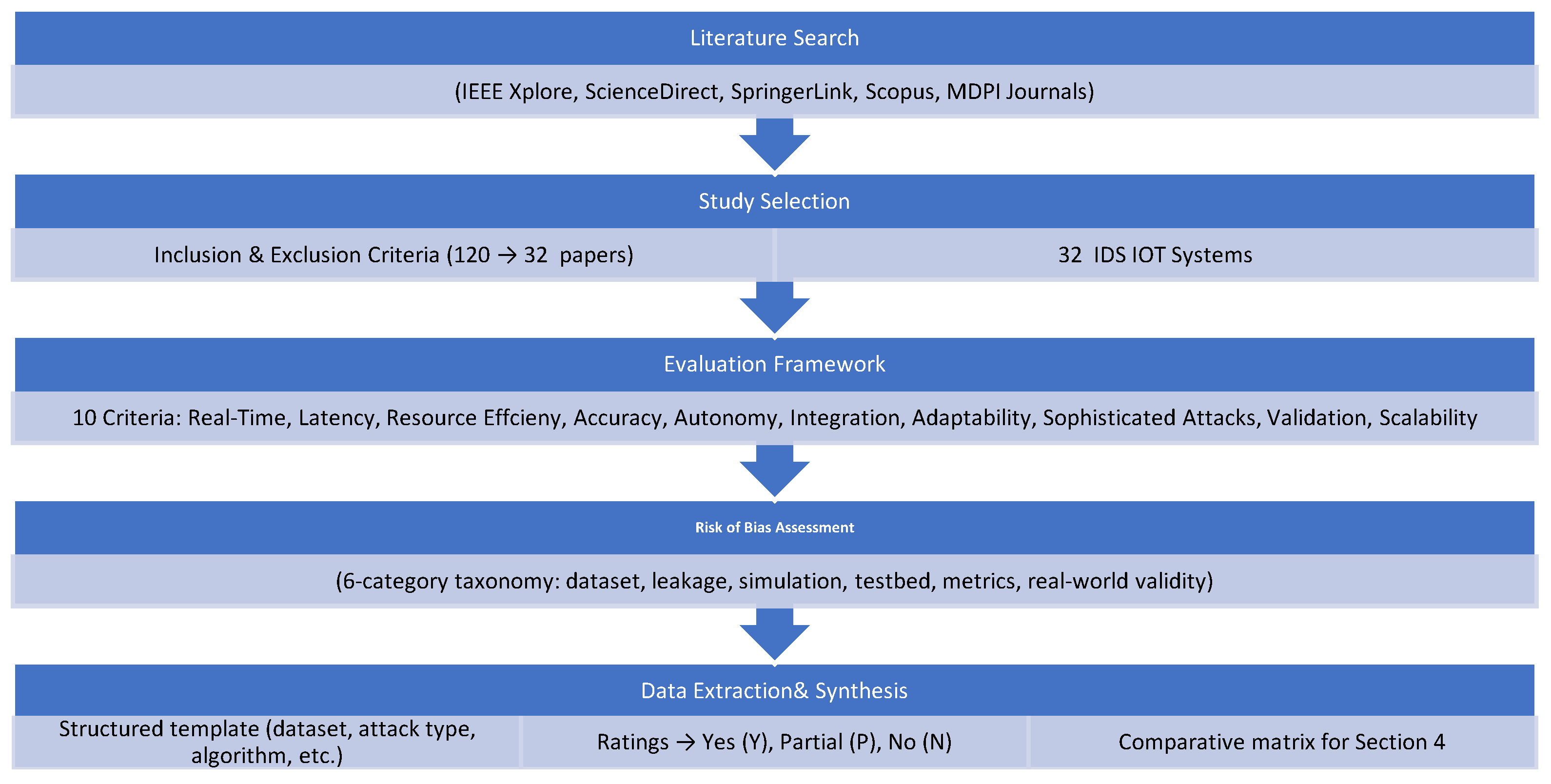
3.1. Search Strategy and Selection
3.2. Key Evaluation Criteria
3.3. Risk of Bias and Evaluation Limitations
4. Results
4.1. Conventional IDS Models
4.2. Machine Learning IDS Models
4.3. Deep Learning IDS Models
4.4. Hybrid IDS Approaches
5. Discussion
5.1. Thematic Gap Analysis
- (a)
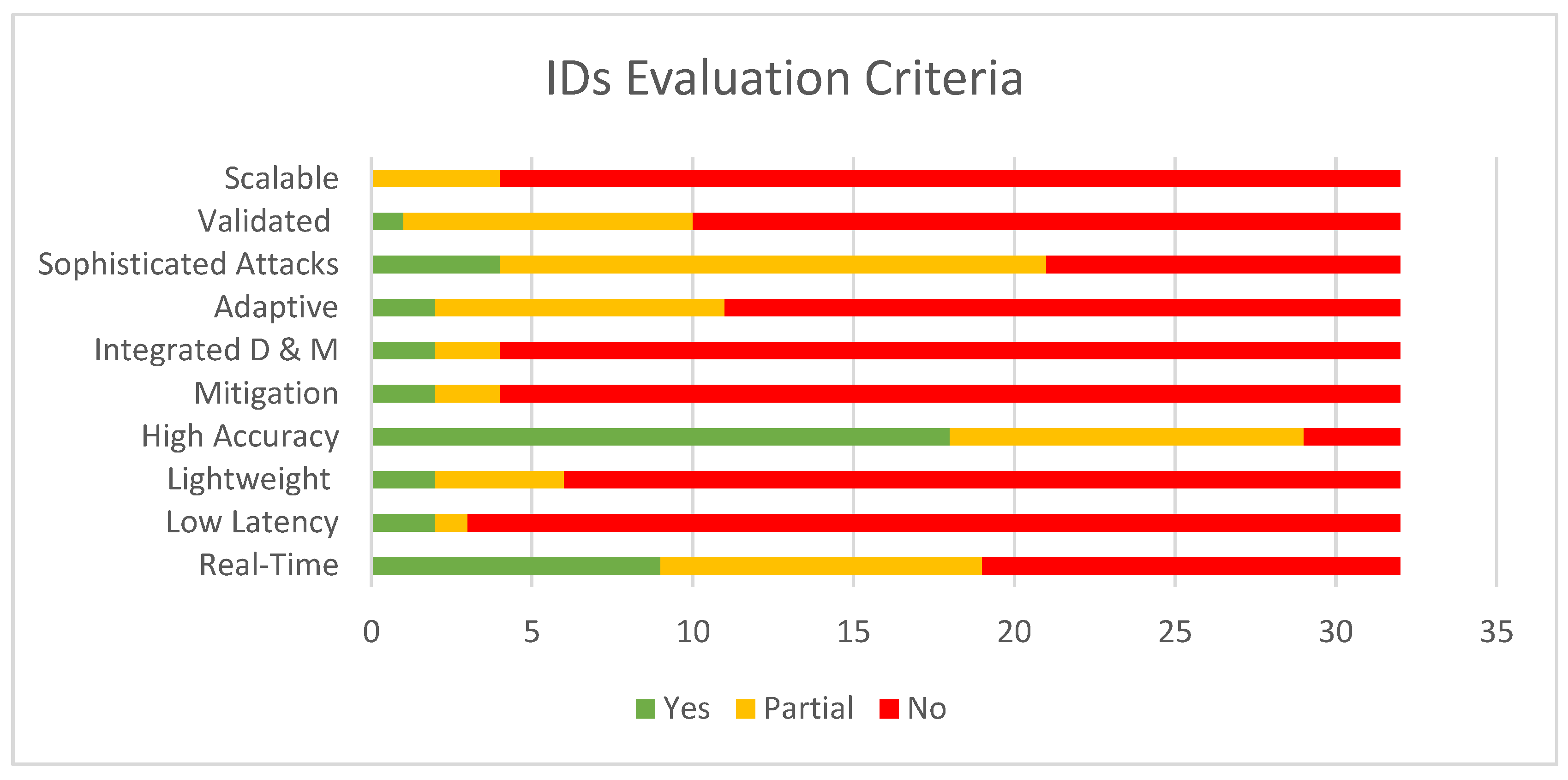
- Real-time and Latency: Real-time intrusion detection remains one of the weakest dimensions across all studies. Only a minority meet IoT latency thresholds (≤3 of 32; see Table 2), and quantitative reporting remains uncommon. Even when latency is reported, values vary widely, reflecting poor runtime optimization.
- (b)
- Lightweight constraints: Lightweight operation is essential for constrained devices; however, few systems include resource profiling or hardware-aware design (≤6 of 32; see Table 2). Many proposals rely on computationally demanding models that cannot operate on MCU-class or battery-powered devices.
- (c)
- Real-world validation: Validation is predominantly dataset-based (>20 of 32; Table 2). This limits generalizability and can disguise performance degradation under real-world conditions.
- (d)
- Mitigation: Mitigation remains largely unaddressed, with the vast majority focusing solely on detection (>28 of 32; Table 2). Without response capabilities, IDSs cannot contain active threats or support rapid recovery after an intrusion.
- (e)
- Adaptability: Only a few systems demonstrate adaptive learning (≤11 of 32; Table 2). Most remain static after deployment, making them susceptible to concept drift and evolving attack behaviors.
- (f)
- Scalability: This criterion is the most deficient across all 10 categories because it has the fewest “Yes” ratings (0/32) and the highest combined number of “No” or unreported outcomes (28/32) (Table 2), indicating both limited achievement and systematic under-reporting. Most evaluations rely on small-scale or tightly controlled setups that do not reflect realistic multi-device or high-traffic IoT environments.
5.2. Structural Causes of Recurrent Gaps in IoT IDS Research
5.3. Areas for Future Research
- (a)
- Scalable Distributed IDS Architecture: Scalability is the most deficient criterion across all evaluated dimensions, with 0/32 studies receiving a “Yes” rating and 28/32 either failing to demonstrate scalability or not evaluating it at all (Table 2). In most cases, scalability was not evaluated, but rather empirically disproven, due to reliance on small simulations, single gateways, or tightly controlled testbeds. None of the reviewed studies demonstrated stable operation under large-scale, multi-node, or high-throughput IoT conditions representative of real deployments. Future research should therefore prioritize distributed IDS architectures that explicitly assess synchronization overhead, communication costs, fault tolerance, and throughput stability under large-scale conditions, with evaluation protocols that move beyond single-testbed validation.
- (b)
- Real-time Optimization: Real-time responsiveness is only weakly supported in the literature. Only 1/32 studies satisfy node-level latency constraints (≤10 ms), and only 5/32 report any numerical latency measurements (Table 2 and Table 5). In many cases, real-time capability is claimed but not demonstrated, with latency either unreported or measured only in offline or batch settings. Closing this gap requires architectural redesign rather than incremental classifier tuning, including optimization of feature extraction, buffering, inference, and decision pipelines. End-to-end latency must be evaluated under sustained streaming conditions to close the real-time gap identified in Section 5.1(a).
- (c)
- Lightweight, Energy-Aware Design: Resource efficiency is critical for MCU- and SBC-class devices, yet 27/32 studies report no hardware-level metrics such as RAM usage, model size, FLOPs, or energy per inference (Table 2). In most cases, lightweight suitability is asserted rather than empirically verified. Future IDS designs should treat lightweight operation as a primary design constraint, supported by explicit hardware-aware profiling and co-optimization of model architecture, feature pipelines, and deployment targets.
- (d)
- Robust Validation and Reproducibility: Validation practices remain heavily dataset-centric. Approximately 90% of the reviewed IDSs rely exclusively on offline datasets, with no physical testbed deployment, long-duration evaluation, or drift-aware testing (Table 2). This reflects a validation gap largely due to non-evaluation rather than documented failure in real-world settings. Stronger validation through physical testbeds, long-running experiments, and concept-drift-sensitive evaluation is therefore required to assess stability, reliability, and lifecycle robustness and to close the observed validation gap affecting the majority of studies.
- (e)
- Integrated Detection-Mitigation Pipelines: Only 2/32 studies implement any form of automated mitigation, and even fewer integrate mitigation into a closed-loop detection–response workflow (Table 2). In most cases, mitigation is not implemented, but rather unsuccessfully demonstrated, and is limited to alerts, external firewalls, or future-work statements. Future research should focus on policy-bounded, closed-loop mitigation pipelines with rollback mechanisms, particularly for mission-critical IoT environments where passive detection alone is insufficient.
- (f)
- Adaptive and Continual Learning: Adaptability remains limited across the surveyed literature. 30/32 systems remain static after training, with no support for online learning, concept drift detection, or continual adaptation (Table 2). While several studies conceptually reference adaptability, few demonstrate adaptive behavior empirically. Long-lived IoT IDS deployments therefore require integration of streaming learners, drift detection, adversarial robustness, and safe model update mechanisms to maintain effectiveness under evolving threat conditions.
- (g)
- Hardware-Software Co-Design: Comparison across IDS proposals is hindered by inconsistent evaluation practices across MCU-class, SBC-class, and cloud environments, with thresholds and metrics often undefined or incomparable. This limitation reflects systematic under-reporting rather than negative results. Future IDS research should adopt hardware–software co-design principles and standardized, tier-aware evaluation practices to ensure that reported performance is meaningful and transferable across deployment contexts.
5.4. Broader Impact and Significance
- (a)
- Hardware-Tiered Benchmark Suite for IoT IDS Evaluation: Our review reveals broad inconsistencies in latency reporting, with only 5 studies quantifying inference time and even fewer quantifying hardware usage. A unified benchmark suite is essential for enabling consistent, comparable evaluation across diverse IoT platforms. Such a suite should define: (i) MCU-class benchmarks (e.g., ≤10 ms inference, ≤100 KB RAM, ≤1 mJ energy), (ii) SBC/edge benchmarks (e.g., ≤50 ms inference, ≤500 MB working memory, moderate energy profiles), (iii) Cloud benchmarks emphasizing throughput, long-horizon analytics, and multi-tenant scalability. Each benchmark tier should include standardized workloads, datasets, device profiles, and latency/energy reporting requirements to enable transparent, repeatable, and comparable evaluation across studies. These thresholds serve as reference envelopes rather than fixed standards. They should be adjusted based on the application context (e.g., control-loop criticality, device duty cycle, network topology) using representative hardware benchmarks and deployment constraints.
- (b)
- Composite Scoring Rubric for Deployment Readiness: A deployment-readiness score would allow objective comparison of competing IDS approaches. Such a rubric is needed because accuracy metrics alone can obscure substantial weakness in real-time capability, mitigation, and scalability. Detection accuracy and minority-class performance, Real-time latency, Lightweight resource usage (CPU, RAM, model size, FLOPs, energy), Adaptability to drift and evolving threats, Autonomous mitigation capability, Real-world validation fidelity, and Scalability under load. Such a rubric would allow researchers to compare system-level performance rather than relying solely on accuracy. A single deployment-readiness score derived from these components would enable objective comparison between IDS designs. Weighting can depend on context, such as prioritizing latency and energy in MCU-class deployments or focusing on scalability and mitigation in infrastructure-scale settings, using transparent, normalized scoring rather than opaque composite optimization.
- (c)
- Governance and Safety Principles for Autonomous Mitigation: Autonomous mitigation must remain bounded by safety, policy compliance, and human oversight. As mitigation actions become automated, incorrect or overly aggressive responses may introduce operational risk, especially since most IDSs today lack robust handling of false positives. These safeguards are critical in safety-critical domains such as healthcare, industrial IoT, and smart mobility systems. Given the operational risks associated with autonomous mitigation, especially in the presence of false positives, transparent human-in-the-loop governance remains essential.
- (d)
- Public Reproducibility Artifacts for Transparent Evaluation: None of the reviewed studies provided complete replication packages, and only a minority released preprocessing code. Reproducibility is essential for scientific trust and practical adoption. To combat fragmentation and improve reproducibility, future IDS research should release: Open-source evaluation scripts, Standardized preprocessing pipelines, Lightweight deployable models (e.g., TFLite, ONNX, Edge-optimized binaries), Testbed configuration files, and network emulation scenarios. Such artifacts would support cross-laboratory validation and accelerate the maturation of IoT IDS research. A shared repository would also support continual updates as new datasets, device types, and attack patterns emerge.
- (e)
- Ethical, Privacy, and Adversarial Considerations: Complementing the governance safeguards outlined in (c), large-scale IDS deployment introduces additional ethical and adversarial risks beyond just mitigation control. These include: Privacy concerns in monitoring device behavior and network flows; Exposure to adversarial examples or poisoning attacks that exploit model vulnerabilities; Fairness and bias across heterogeneous device classes; and Potential harm from false-positive-driven automated actions. Addressing these concerns is essential to ensuring trustworthy and responsible adoption of IDS, particularly in safety-critical environments such as healthcare, industrial IoT, and smart cities.
6. Conclusions
Supplementary Materials
Author Contributions
Funding
Data Availability Statement
Acknowledgments
Conflicts of Interest
Abbreviations
| AE | Autoencoder | IRS | Intrusion Response System |
| AI | Artificial Intelligence | KNN | K-Nearest Neighbors |
| APT | Advanced Persistent Threat | LSTM | Long Short-Term Memory Network |
| BA | Bat Algorithm | LR | Logistic Regression |
| CBAM | Convolutional Block Attention Module | MACs | Multiply-Accumulate Operations |
| CEP | Complex Event Processing | MCU | Microcontroller Unit |
| CNN | Convolutional Neural Network | ML | Machine Learning |
| DDoS | Distributed Denial of Service | MLP | Multilayer Perceptron |
| DL | Deep Learning | MQTT | Message Queuing Telemetry Transport |
| DNN | Deep Neural Network | NFV | Network Function Virtualization |
| DoS | Denial of Service | NIDS | Network Intrusion Detection System |
| DT | Decision Tree | OS-ELM | Online Sequential Extreme Learning Machine |
| SBC | Single-Board Computer (Edge-Level Device) | R2L | Remote-to-Local Attack Category |
| EPL | Event Processing Language | RF | Random Forest |
| FedAvg | Federated Averaging Algorithm | RNN | Recurrent Neural Network |
| FL | Federated Learning | RPL | Routing Protocol for Low-Power and Lossy Networks |
| FLOPs | Floating-Point Operations | SD-IoT | Software-Defined Internet of Things |
| FPR | False Positive Rate | SDN | Software-Defined Networking |
| FWO | Fireworks Optimization | SOHO | Small Office/Home Office Network |
| GAN | Generative Adversarial Network | SVM | Support Vector Machine |
| HIDS | Host-Based Intrusion Detection System | TFLite | TensorFlow Lite |
| IDS | Intrusion Detection System | TPR | True Positive Rate |
| IDPS | Intrusion Detection and Prevention System | U2R | User-to-Root Attack Category |
| IoMT | Internet of Medical Things | UN | Unify Net (DL model component) |
| IoT | Internet of Things | VM | Virtual Machine |
| IOLTS | Input-Output Labeled Transition System | WSN | Wireless Sensor Network |
References
- Atzori, L.; Iera, A.; Morabito, G. The Internet of Things: A survey. Comput. Netw. 2010, 54, 2787–2805. [Google Scholar] [CrossRef]
- Gubbi, J.; Buyya, R.; Marusic, S.; Palaniswami, M. Internet of Things (IoT): A vision, architectural elements, and future directions. Future Gener. Comput. Syst. 2013, 29, 1645–1660. [Google Scholar] [CrossRef]
- Rejeb, A.; Rejeb, K.; Appolloni, A.; Jagtap, S.; Iranmanesh, M.; Alghamdi, S.; Alhasawi, Y.; Kayikci, Y. Unleashing the power of internet of things and blockchain: A comprehensive analysis and future directions. Internet Things Cyber-Phys. Syst. 2024, 4, 1–18. [Google Scholar] [CrossRef]
- Allioui, H.; Mourdi, Y. Exploring the Full Potentials of IoT for Better Financial Growth and Stability: A Comprehensive Survey. Sensors 2023, 23, 8015. [Google Scholar] [CrossRef]
- H.J., F.B.; S., S. A Survey on IoT Security: Attacks, Challenges and Countermeasures. Webology 2022, 19, 3741–3763. [Google Scholar] [CrossRef]
- Hassija, V.; Chamola, V.; Saxena, V.; Jain, D.; Goyal, P.; Sikdar, B. A Survey on IoT Security: Application Areas, Security Threats, and Solution Architectures. IEEE Access 2019, 7, 82721–82743. [Google Scholar] [CrossRef]
- Baldini, G.; Botterman, M.; Neisse, R.; Tallacchini, M. Ethical Design in the Internet of Things. Sci. Eng. Ethics 2018, 24, 905–925. [Google Scholar] [CrossRef]
- Callebaut, G.; Leenders, G.; Van Mulders, J.; Ottoy, G.; De Strycker, L.; Van der Perre, L. The art of designing remote iot devices—Technologies and strategies for a long battery life. Sensors 2021, 21, 913. [Google Scholar] [CrossRef]
- Dritsas, E.; Trigka, M. A Survey on Cybersecurity in IoT. Future Internet 2025, 17, 30. [Google Scholar] [CrossRef]
- Sam, M.F.M.; Ismail, A.F.M.F.; Bakar, K.A.; Ahamat, A.; Qureshi, M.I. The Effectiveness of IoT Based Wearable Devices and Potential Cybersecurity Risks: A Systematic Literature Review from the Last Decade. Int. J. Online Biomed. Eng. 2022, 18, 56–73. [Google Scholar] [CrossRef]
- Madanian, S.; Chinbat, T.; Subasinghage, M.; Airehrour, D.; Hassandoust, F.; Yongchareon, S. Health IoT Threats: Survey of Risks and Vulnerabilities. Future Internet 2024, 16, 389. [Google Scholar] [CrossRef]
- Oliha, J.S.; Biu, P.W.; Obi, O.C. Securing the smart city: A review of cybersecurity challenges and strategies. Open Access Res. J. Multidiscip. Stud. 2024, 7, 94–101. [Google Scholar] [CrossRef]
- Gharaibeh, A.; Salahuddin, M.A.; Hussini, S.J.; Khreishah, A.; Khalil, I.; Guizani, M.; Al-Fuqaha, A. Smart Cities: A Survey on Data Management, Security, and Enabling Technologies. IEEE Commun. Surv. Tutor. 2017, 19, 2456–2501. [Google Scholar] [CrossRef]
- Alotaibi, B. A Survey on Industrial Internet of Things Security: Requirements, Attacks, AI-Based Solutions, and Edge Computing Opportunities. Sensors 2023, 23, 7470. [Google Scholar] [CrossRef]
- Vardakis, G.; Hatzivasilis, G.; Koutsaki, E.; Papadakis, N. Review of Smart-Home Security Using the Internet of Things. Electronics 2024, 13, 3343. [Google Scholar] [CrossRef]
- Khan, R.; Maynard, P.; McLaughlin, K.; Laverty, D.; Sezer, S. Threat Analysis of BlackEnergy Malware for Synchrophasor Based Real-Time Control and Monitoring in Smart Grid; BCS Learning & Development Ltd.: Swindon, UK, 2016. [Google Scholar]
- Martin, G.; Martin, P.; Hankin, C.; Darzi, A.; Kinross, J. Cybersecurity and healthcare: How safe are we? BMJ 2017, 358, j3179. [Google Scholar] [CrossRef]
- Anagnostopoulos, M.; Spathoulas, G.; Viaño, B.; Augusto-Gonzalez, J. Tracing your smart-home devices conversations: A real world iot traffic data-set. Sensors 2020, 20, 6600. [Google Scholar] [CrossRef]
- Maghrabi, L.A.; Shabanah, S.; Althaqafi, T.; Alsalman, D.; Algarni, S.; Al-Ghamdi, A.A.-M.; Ragab, M. Enhancing Cybersecurity in the Internet of Things Environment Using Bald Eagle Search Optimization With Hybrid Deep Learning. IEEE Access 2024, 12, 8337–8345. [Google Scholar] [CrossRef]
- Heidari, A.; Jamali, M.A.J. Internet of Things intrusion detection systems: A comprehensive review and future directions. Clust. Comput 2023, 26, 3753–3780. [Google Scholar] [CrossRef]
- Mishra, N.; Pandya, S. Internet of Things Applications, Security Challenges, Attacks, Intrusion Detection, and Future Visions: A Systematic Review. IEEE Access 2021, 9, 59353–59377. [Google Scholar] [CrossRef]
- Arshad, J.; Azad, M.A.; Abdeltaif, M.M.; Salah, K. An intrusion detection framework for energy constrained IoT devices. Mech. Syst. Signal Process. 2020, 136, 106436. [Google Scholar] [CrossRef]
- Al-Garadi, M.A.; Mohamed, A.; Al-Ali, A.K.; Du, X.; Ali, I.; Guizani, M. A Survey of Machine and Deep Learning Methods for Internet of Things (IoT) Security. IEEE Commun. Surv. Tutor. 2020, 22, 1646–1685. [Google Scholar] [CrossRef]
- Kaur, B.; Dadkhah, S.; Shoeleh, F.; Neto, E.C.P.; Xiong, P.; Iqbal, S.; Lamontagne, P.; Ray, S.; Ghorbani, A.A. Internet of Things (IoT) security dataset evolution: Challenges and future directions. Internet Things 2023, 22, 100780. [Google Scholar] [CrossRef]
- Tawalbeh, L.; Muheidat, F.; Tawalbeh, M.; Quwaider, M. IoT privacy and security: Challenges and solutions. Appl. Sci. 2020, 10, 4102. [Google Scholar] [CrossRef]
- Benkhelifa, E.; Welsh, T.; Hamouda, W. A critical review of practices and challenges in intrusion detection systems for IoT: Toward universal and resilient systems. IEEE Commun. Surv. Tutor. 2018, 20, 3496–3509. [Google Scholar] [CrossRef]
- Khraisat, A.; Alazab, A. A critical review of intrusion detection systems in the internet of things: Techniques, deployment strategy, validation strategy, attacks, public datasets and challenges. Cybersecurity 2021, 4, 18. [Google Scholar] [CrossRef]
- Esmaeili, M.; Rahimi, M.; Pishdast, H.; Farahmandazad, D.; Khajavi, M.; Saray, H.J. Machine Learning-Assisted Intrusion Detection for Enhancing Internet of Things Security. arXiv 2024. [Google Scholar] [CrossRef]
- Vitorino, J.; Andrade, R.; Praça, I.; Sousa, O.; Maia, E. A Comparative Analysis of Machine Learning Techniques for IoT Intrusion Detection; Springer: Cham, Switzerland, 2022. [Google Scholar] [CrossRef]
- Paul, E.C.; Amrita. A Review of Intrusion Detection for Internet of Things Using Machine Learning. In Proceedings of the 2024 International Conference on Cybernation and Computation, CYBERCOM 2024, Dehradun, India, 15–16 November 2024; Institute of Electrical and Electronics Engineers Inc.: New York, NY, USA, 2024; pp. 781–785. [Google Scholar] [CrossRef]
- Al-Haija, Q.A.; Droos, A. A comprehensive survey on deep learning-based intrusion detection systems in Internet of Things (IoT). Expert Syst. 2025, 42, e13726. [Google Scholar] [CrossRef]
- Almowsawi, A.P.A.A.H.D. Deep Guard-IoT: A Systematic Review of AI-Based Anomaly Detection Frameworks for Next-Generation IoT Security (2020–2024). Wasit J. Pure Sci. 2024, 3, 70–77. [Google Scholar] [CrossRef]
- Rajesh, L.T.; Das, T.; Shukla, R.M.; Sengupta, S. Give and Take: Federated Transfer Learning for Industrial IoT Network Intrusion Detection. arXiv 2023. [Google Scholar] [CrossRef]
- Zarpelão, B.B.; Miani, R.S.; Kawakani, C.T.; de Alvarenga, S.C. A survey of intrusion detection in Internet of Things. J. Netw. Comput. Appl. 2017, 84, 25–37. [Google Scholar] [CrossRef]
- Elrawy, M.F.; Awad, A.I.; Hamed, H.F.A. Intrusion detection systems for IoT-based smart environments: A survey. J. Cloud Comput. 2018, 7, 21. [Google Scholar] [CrossRef]
- Hajiheidari, S.; Wakil, K.; Badri, M.; Navimipour, N.J. Intrusion detection systems in the Internet of things: A comprehensive investigation. Comput. Netw. 2019, 160, 165–191. [Google Scholar] [CrossRef]
- Chaabouni, N.; Mosbah, M.; Zemmari, A.; Sauvignac, C.; Faruki, P. Network Intrusion Detection for IoT Security Based on Learning Techniques. IEEE Commun. Surv. Tutor. 2019, 21, 2671–2701. [Google Scholar] [CrossRef]
- da Costa, K.A.P.; Papa, J.P.; Lisboa, C.O.; Munoz, R.; de Albuquerque, V.H.C. Internet of Things: A survey on machine learning-based intrusion detection approaches. Comput. Netw. 2019, 151, 147–157. [Google Scholar] [CrossRef]
- Naithani, K. AI-based Intrusion Detection System for Internet of Things (IoT) Networks. Turk. J. Comput. Math. Educ. (TURCOMAT) 2019, 10, 1095–1100. [Google Scholar] [CrossRef]
- Hussain, F.; Hussain, R.; Hassan, S.A.; Hossain, E. Machine Learning in IoT Security: Current Solutions and Future Challenges. IEEE Commun. Surv. Tutor. 2020, 22, 1686–1721. [Google Scholar] [CrossRef]
- Kamaldeep; Dutta, M.; Granjal, J. Towards a Secure Internet of Things: A Comprehensive Study of Second Line Defense Mechanisms. IEEE Access 2020, 8, 127272–127312. [Google Scholar] [CrossRef]
- Mazhar, N.; Salleh, R.; Hossain, M.A.; Zeeshan, M. SDN based Intrusion Detection and Prevention Systems using Manufacturer Usage Description: A Survey. Int. J. Adv. Comput. Sci. Appl. 2020, 11, 717–737. [Google Scholar] [CrossRef]
- Albulayhi, K.; Smadi, A.A.; Sheldon, F.T.; Abercrombie, R.K. Iot intrusion detection taxonomy, reference architecture, and analyses. Sensors 2021, 21, 6432. [Google Scholar] [CrossRef]
- Alsoufi, M.A.; Razak, S.; Siraj, M.M.; Nafea, I.; Ghaleb, F.A.; Saeed, F.; Nasser, M. Anomaly-based intrusion detection systems in iot using deep learning: A systematic literature review. Appl. Sci. 2021, 11, 8383. [Google Scholar] [CrossRef]
- Inayat, U.; Zia, M.F.; Mahmood, S.; Khalid, H.M.; Benbouzid, M. Learning-Based Methods for Cyber Attacks Detection in IoT Systems: A Survey on Methods, Analysis, and Future Prospects. Electronics 2022, 11, 1502. [Google Scholar] [CrossRef]
- Kumar, S.V.N.S.; Selvi, M.; Kannan, A. A Comprehensive Survey on Machine Learning-Based Intrusion Detection Systems for Secure Communication in Internet of Things. Comput. Intell. Neurosci. 2023, 2023, 8981988. [Google Scholar] [CrossRef]
- Aldhaheri, A.; Alwahedi, F.; Ferrag, M.A.; Battah, A. Deep learning for cyber threat detection in IoT networks: A review. Internet Things Cyber-Phys. Syst. 2024, 4, 110–128. [Google Scholar] [CrossRef]
- Meziane, H.; Ouerdi, N. A survey on performance evaluation of artificial intelligence algorithms for improving IoT security systems. Sci. Rep. 2023, 13, 21255. [Google Scholar] [CrossRef]
- Kumari, P.; Mangat, V.; Singh, A. Comparative Analysis of State-of-the-Art Attack Detection Models. In Proceedings of the 2023 14th International Conference on Computing Communication and Networking Technologies, ICCCNT 2023, Delhi, India, 6–8 July 2023; Institute of Electrical and Electronics Engineers Inc.: New York, NY, USA, 2023. [Google Scholar] [CrossRef]
- Rafique, S.H.; Abdallah, A.; Musa, N.S.; Murugan, T. Machine Learning and Deep Learning Techniques for Internet of Things Network Anomaly Detection—Current Research Trends. Sensors 2024, 24, 1968. [Google Scholar] [CrossRef]
- Isma’ila, U.A.; Danyaro, K.U.; Muazu, A.A.; Maiwada, U.D. Corrections to “Review on Approaches of Federated Modeling in Anomaly-Based Intrusion Detection for IoT Devices”. IEEE Access 2024, 12, 30941–30961. [Google Scholar] [CrossRef]
- Hassan, H.A.A.; Zolfy, M. Exploring Lightweight Deep Learning Techniques for Intrusion Detection Systems in IoT Networks: A Survey. J. Electr. Syst. 2024, 20, 1944–1958. [Google Scholar] [CrossRef]
- Blali, A.; Dargaoui, S.; Azrour, M.; Guezzaz, A.; Amounas, F.; Alabdulatif, A. Analysis of deep learning-based intrusion detection systems in IoT environments. EDP Audit Control Secur. Newsl. 2025, 70, 18–52. [Google Scholar] [CrossRef]
- Fatima, M.; Rehman, O.; Rahman, I.M.H.; Ajmal, A.; Park, S.J. Towards Ensemble Feature Selection for Lightweight Intrusion Detection in Resource-Constrained IoT Devices. Future Internet 2024, 16, 368. [Google Scholar] [CrossRef]
- Sarhan, M.; Layeghy, S.; Portmann, M. Feature Analysis for Machine Learning-based IoT Intrusion Detection. arXiv 2022. [Google Scholar] [CrossRef]
- Ge, M.; Syed, N.F.; Fu, X.; Baig, Z.; Robles-Kelly, A. Toward a Deep Learning-Driven Intrusion Detection Approach for Internet of Things. arXiv 2020. [Google Scholar] [CrossRef]
- Raza, S.; Wallgren, L.; Voigt, T. SVELTE: Real-time intrusion detection in the Internet of Things. Ad. Hoc. Netw. 2013, 11, 2661–2674. [Google Scholar] [CrossRef]
- Yin, S.-N.; Kang, H.-S.; Kim, S.-R. Complex Event Processing for Object Tracking and Intrusion Detection in Internet of Things Environments. Res. Briefs Inf. Commun. Technol. Evol. 2016, 2, 74–81. [Google Scholar] [CrossRef]
- Fu, Y.; Yan, Z.; Cao, J.; Koné, O.; Cao, X. An Automata Based Intrusion Detection Method for Internet of Things. Mob. Inf. Syst. 2017, 2017, 1750637. [Google Scholar] [CrossRef]
- Haripriya, A.P.; Kulothungan, K. Secure-MQTT: An efficient fuzzy logic-based approach to detect DoS attack in MQTT protocol for internet of things. EURASIP J. Wirel. Commun. Netw. 2019, 2019, 90. [Google Scholar] [CrossRef]
- Prabavathy, S.; Sundarakantham, K.; Shalinie, S.M. Design of cognitive fog computing for intrusion detection in Internet of Things. J. Commun. Netw. 2018, 20, 291–298. [Google Scholar] [CrossRef]
- Li, J.; Zhao, Z.; Li, R.; Zhang, H. AI-based two-stage intrusion detection for software defined IoT networks. IEEE Internet Things J. 2019, 6, 2093–2102. [Google Scholar] [CrossRef]
- Zachos, G.; Essop, I.; Mantas, G.; Porfyrakis, K.; Ribeiro, J.C.; Rodriguez, J. An anomaly-based intrusion detection system for internet of medical things networks. Electronics 2021, 10, 2562. [Google Scholar] [CrossRef]
- Zachos, G.; Mantas, G.; Essop, I.; Porfyrakis, K.; Ribeiro, J.C.; Rodriguez, J. Prototyping an Anomaly-Based Intrusion Detection System for Internet of Medical Things Networks. In Proceedings of the IEEE International Workshop on Computer Aided Modeling and Design of Communication Links and Networks, CAMAD, Paris, France, 2–4 November 2022; Institute of Electrical and Electronics Engineers Inc.: New York, NY, USA, 2022; pp. 179–183. [Google Scholar] [CrossRef]
- Vishwakarma, M.; Kesswani, N. A new two-phase intrusion detection system with Naïve Bayes machine learning for data classification and elliptic envelop method for anomaly detection. Decis. Anal. J. 2023, 7, 100233. [Google Scholar] [CrossRef]
- Alosaimi, S.; Almutairi, S.M. An Intrusion Detection System Using BoT-IoT. Appl. Sci. 2023, 13, 5427. [Google Scholar] [CrossRef]
- Fadhilla, C.A.; Alfikri, M.D.; Kaliski, R. Lightweight Meta-Learning BotNet Attack Detection. IEEE Internet Things J. 2023, 10, 8455–8466. [Google Scholar] [CrossRef]
- Tahir, U.; Abid, M.K.; Fuzail, M.; Aslam, N. Enhancing IoT Security through Machine Learning-Driven Anomaly Detection. VFAST Trans. Softw. Eng. 2024, 12, 1–13. [Google Scholar] [CrossRef]
- Diro, A.A.; Chilamkurti, N. Distributed attack detection scheme using deep learning approach for Internet of Things. Future Gener. Comput. Syst. 2018, 82, 761–768. [Google Scholar] [CrossRef]
- Saba, T.; Rehman, A.; Sadad, T.; Kolivand, H.; Bahaj, S.A. Anomaly-based intrusion detection system for IoT networks through deep learning model. Comput. Electr. Eng. 2022, 99, 107810. [Google Scholar] [CrossRef]
- Vishwakarma, M.; Kesswani, N. DIDS: A Deep Neural Network based real-time Intrusion detection system for IoT. Decis. Anal. J. 2022, 5, 100142. [Google Scholar] [CrossRef]
- Khan, A.R.; Yasin, A.; Usman, S.M.; Hussain, S.; Khalid, S.; Ullah, S.S. Exploring Lightweight Deep Learning Solution for Malware Detection in IoT Constraint Environment. Electronics 2022, 11, 4147. [Google Scholar] [CrossRef]
- Idrissi, I.; Azizi, M.; Moussaoui, O. A Lightweight Optimized Deep Learning-based Host-Intrusion Detection System Deployed on the Edge for IoT. Int. J. Comput. Digit. Syst. 2022, 11, 209–216. [Google Scholar] [CrossRef]
- Fang, Z.; Liu, Y.; Yuan, S.; Ye, T. A lightweight network intrusion detection model based on convolution and attention mechanisms. In Proceedings of the Third International Conference on Electronic Information Engineering, Big Data, and Computer Technology (EIBDCT 2024), Beijing, China, 26–28 January 2024; SPIE-The International Society for Optical Engineering: Bellingham, WA, USA, 2024; p. 32. [Google Scholar] [CrossRef]
- Binbusayyis, A. Innovative Defense: Deep Learning-Powered Intrusion Detection for IoT Networks. IEEE Access 2025, 13, 31105–31120. [Google Scholar] [CrossRef]
- Sedjelmaci, H.; Senouci, S.M.; Taleb, T. An accurate security game for low-resource iot devices. IEEE Trans. Veh. Technol. 2017, 66, 9381–9393. [Google Scholar] [CrossRef]
- Sedjelmaci, H.; Senouci, S.M.; Al-Bahri, M. A lightweight anomaly detection technique for low-resource IoT devices: A game-theoretic methodology. In Proceedings of the 2016 IEEE International Conference on Communications (ICC), Kuala Lumpur, Malaysia, 23–27 May 2016; IEEE: New York, NY, USA, 2016; pp. 1–6. [Google Scholar] [CrossRef]
- Mudgerikar, A.; Sharma, P.; Bertino, E. Edge-Based Intrusion Detection for IoT devices. ACM Trans. Manag. Inf. Syst. 2020, 11, 1–21. [Google Scholar] [CrossRef]
- Holubenko, V.; Silva, P. An Intelligent Mechanism for Monitoring and Detecting Intrusions in IoT Devices. In Proceedings of the 2023 IEEE 24th International Symposium on a World of Wireless, Mobile and Multimedia Networks, WoWMoM 2023, Boston, MA, USA, 12–15 June 2023; Institute of Electrical and Electronics Engineers Inc.: New York, NY, USA, 2023; pp. 470–479. [Google Scholar] [CrossRef]
- Talpini, J.; Sartori, F.; Savi, M. A Clustering Strategy for Enhanced FL-Based Intrusion Detection in IoT Networks. In Proceedings of the International Conference on Agents and Artificial Intelligence, Lisbon, Portugal, 22–24 February 2023; Science and Technology Publications, Lda: Setúbal, Portugal, 2023; pp. 152–160. [Google Scholar] [CrossRef]
- Grigoriadou, S.; Radoglou-Grammatikis, P.; Sarigiannidis, P.; Makris, I.; Lagkas, T.; Argyriou, V.; Lytos, A.; Fountoukidis, E. Hunting IoT Cyberattacks with AI—Powered Intrusion Detection. In Proceedings of the 2023 IEEE International Conference on Cyber Security and Resilience, CSR 2023, Venice, Italy, 31 July–2 August 2023; Institute of Electrical and Electronics Engineers Inc.: New York, NY, USA, 2023; pp. 142–147. [Google Scholar] [CrossRef]
- Fenanir, S.; Semchedine, F. Smart Intrusion Detection in IoT Edge Computing Using Federated Learning. Rev. D’intelligence Artif. 2023, 37, 1133–1145. [Google Scholar] [CrossRef]
- Majjaru, C.; Senthilkumar, K. Strengthening IoT Intrusion Detection through the HOPNET Model. J. Wirel. Mob. Netw. Ubiquitous Comput. Dependable Appl. 2023, 14, 89–102. [Google Scholar] [CrossRef]
- Abusitta, A.; de Carvalho, G.H.S.; Wahab, O.A.; Halabi, T.; Fung, B.C.M.; Al Mamoori, S. Deep learning-enabled anomaly detection for IoT systems. Internet Things 2023, 21, 100656. [Google Scholar] [CrossRef]
- Alalhareth, M.; Hong, S.C. Enhancing the Internet of Medical Things (IoMT) Security with Meta-Learning: A Performance-Driven Approach for Ensemble Intrusion Detection Systems. Sensors 2024, 24, 3519. [Google Scholar] [CrossRef]
- Deng, Y. Design of Industrial IoT Intrusion Security Detection System Based on LightGBM Feature Algorithm and Multi-layer Perception Network. J. Cyber Secur. Mobil. 2024, 13, 327–348. [Google Scholar] [CrossRef]
- Thiruvenkatasamy, S.; Sivaraj, R.; Vijayakumar, M. Blockchain Assisted Fireworks Optimization with Machine Learning based Intrusion Detection System (IDS). Teh. Vjesn. 2024, 31, 596–603. [Google Scholar] [CrossRef]
- Adekunle, T.S.; Alabi, O.O.; Lawrence, M.O.; Adeleke, T.A.; Afolabi, O.S.; Ebong, G.N.; Egbedokun, G.O.; Bamisaye, T.A. An Intrusion System for Internet of Things Security Breaches Using Machine Learning Techniques. Artif. Intell. Appl. 2024, 2, 165–171. [Google Scholar] [CrossRef]



| Survey (Year) | General IoT IDS | ML/DL-Based IDS | Edge/Fog/Cloud & FL | Protocol/SDN/NFV | Datasets & Evaluation | Lightweight DL |
|---|---|---|---|---|---|---|
| Zarpelo et al., 2017 [34] | ✓ | ✓* | — | — | ✓* | — |
| Elrawy et al., 2018 [35] | ✓ | ✓* | — | — | ✓* | — |
| Benkhelifa et al., 2018 [26] | ✓ | ✓* | — | ✓* | ✓* | — |
| Hajiheidari et al., 2019 [36] | ✓ | ✓* | — | — | ✓* | — |
| Chaabouni et al., 2019 [37] | ✓* | ✓ | — | — | ✓* | — |
| Costa et al., 2019 [38] | ✓* | ✓ | — | — | ✓* | — |
| Naithani, 2019 [39] | — | ✓* | — | — | ✓* | ✓ |
| Al-Garadi et al., 2020 [23] | ✓* | ✓ | — | — | ✓ | ✓* |
| Hussain et al., 2020 [40] | ✓* | ✓ | — | — | ✓* | — |
| Kamaldeep et al., 2020 [41] | ✓* | ✓* | — | ✓ | ✓* | — |
| Mazhar et al., 2020 [42] | — | ✓* | — | ✓ | ✓* | — |
| Albulayhi et al., 2021 [43] | ✓* | ✓ | — | — | ✓ | — |
| Alsoufi et al., 2021 [44] | — | ✓ | — | — | ✓* | — |
| Inayat et al., 2022 [45] | ✓* | ✓ | — | — | ✓* | — |
| Santhosh Kumar et al., 2023 [46] | ✓* | ✓ | — | — | ✓* | — |
| Aldhaheri et al., 2023 [47] | — | ✓ | — | — | ✓* | — |
| Meziane et al., 2023 [48] | — | ✓ | — | — | ✓ | — |
| Kumari et al., 2023 [49] | — | ✓* | — | — | ✓ | — |
| Rafique et al., 2024 [50] | ✓* | ✓ | — | — | ✓ | — |
| Isma’ila et al., 2024 [51] | — | ✓* | ✓ | — | ✓* | — |
| Ali abdul Hassan et al., 2024 [52] | — | ✓* | — | — | ✓* | ✓ |
| Blali et al., 2025 [53] | — | ✓ | — | — | ✓* | — |
| This Review 2025 | ✓ | ✓ | ✓ | ✓* | ✓ | ✓ |
| Ref. | Real-Time | Low Latency | Lightweight | High Accuracy | Mitigation | Integ. D & M | Adaptive | Soph. Attacks | Validated | Scalable |
|---|---|---|---|---|---|---|---|---|---|---|
| [57] | P | N | P | P | P | Y | N | P | P | N |
| [58] | Y | N | N | N | N | N | N | N | N | N |
| [59] | P | N | N | N | N | N | N | N | P | N |
| [60] | Y | N | N | P | Y | P | P | N | N | P |
| [61] | Y | N | N | Y | N | N | Y | P | N | N |
| [62] | N | N | N | Y | N | N | P | P | N | N |
| [63] | P | N | N | Y | N | N | N | P | N | N |
| [64] | P | N | N | N | N | N | N | N | P | N |
| [65] | N | N | N | P | N | N | N | N | P | N |
| [66] | Y | N | N | Y | P | P | P | Y | N | N |
| [67] | Y | P | N | Y | N | N | N | Y | P | N |
| [68] | N | N | N | P | N | N | P | P | N | N |
| [69] | N | N | N | Y | N | N | N | P | N | P |
| [70] | N | N | N | P | N | N | N | P | N | N |
| [71] | Y | N | N | Y | N | N | N | P | Y | N |
| [72] | N | N | P | Y | N | N | N | N | N | N |
| [73] | P | Y | Y | P | N | N | N | N | P | N |
| [74] | N | N | P | Y | N | N | N | P | N | N |
| [75] | N | N | N | Y | N | N | N | P | P | N |
| [76] | P | N | N | Y | N | N | P | N | N | P |
| [77] | P | N | N | Y | N | N | P | N | N | P |
| [59] | P | N | N | N | N | N | N | N | P | N |
| [69] | N | N | N | Y | N | N | N | P | N | P |
| [61] | Y | N | N | Y | N | N | Y | P | N | N |
| [62] | N | N | N | Y | N | N | P | P | N | N |
| [60] | Y | N | N | P | Y | P | P | N | N | P |
| [78] | P | N | P | Y | N | N | P | Y | P | N |
| [63] | P | N | N | Y | N | N | N | P | N | N |
| [64] | P | N | N | N | N | N | N | N | P | N |
| [70] | N | N | N | P | N | N | N | P | N | N |
| [71] | Y | N | N | Y | N | N | N | P | Y | N |
| [72] | N | N | P | Y | N | N | N | N | N | N |
| [73] | P | Y | Y | P | N | N | N | N | P | N |
| [65] | N | N | N | P | N | N | N | N | P | N |
| [79] | Y | N | N | Y | N | N | P | P | P | N |
| [80] | P | N | N | P | N | N | N | P | N | N |
| [81] | Y | N | N | P | Y | Y | N | N | N | N |
| [82] | N | N | N | Y | N | N | N | P | N | N |
| [83] | Y | N | N | Y | N | N | P | Y | N | N |
| [66] | Y | N | N | Y | P | P | P | Y | N | N |
| [67] | Y | P | N | Y | N | N | N | Y | P | N |
| [84] | N | N | N | P | N | N | N | P | N | N |
| [85] | P | Y | Y | P | N | N | Y | P | N | N |
| [68] | N | N | N | P | N | N | P | P | N | N |
| [74] | N | N | P | Y | N | N | N | P | N | N |
| [86] | N | N | N | Y | N | N | N | N | N | N |
| [87] | N | N | N | Y | N | N | N | P | N | N |
| [88] | N | N | N | Y | N | N | N | P | N | N |
| [75] | N | N | N | Y | N | N | N | P | P | N |
| Paradigm | Real-Time | Low Latency | Lightweight | High Accuracy | Mitigation | Integrated D & M | Adaptive | Sophisticated Attacks | Validated | Scalable | ||||||||||||||||||||
|---|---|---|---|---|---|---|---|---|---|---|---|---|---|---|---|---|---|---|---|---|---|---|---|---|---|---|---|---|---|---|
| Y | P | N | Y | P | N | Y | P | N | Y | P | N | Y | P | N | Y | P | N | Y | P | N | Y | P | N | Y | P | N | Y | P | N | |
| Convent. | 2 | 2 | 0 | 0 | 0 | 4 | 0 | 1 | 3 | 0 | 2 | 2 | 1 | 1 | 2 | 1 | 1 | 2 | 0 | 1 | 3 | 0 | 1 | 3 | 0 | 2 | 2 | 0 | 1 | 3 |
| ML | 3 | 2 | 3 | 0 | 1 | 7 | 0 | 0 | 8 | 5 | 2 | 1 | 0 | 1 | 7 | 0 | 1 | 7 | 1 | 3 | 4 | 2 | 4 | 2 | 0 | 3 | 5 | 0 | 0 | 8 |
| DL | 1 | 1 | 5 | 1 | 0 | 6 | 1 | 2 | 4 | 5 | 2 | 0 | 0 | 0 | 7 | 0 | 0 | 7 | 0 | 0 | 7 | 0 | 5 | 2 | 1 | 2 | 4 | 0 | 1 | 6 |
| Hybrid | 3 | 5 | 5 | 1 | 0 | 12 | 1 | 1 | 11 | 8 | 5 | 0 | 1 | 0 | 12 | 1 | 0 | 12 | 1 | 5 | 7 | 2 | 7 | 4 | 0 | 2 | 11 | 0 | 2 | 11 |
| Deployment Layer | Real-Time | Low Latency | Lightweight | High Accuracy | Mitigation | Integrated D & M | Adaptive | Sophisticated Attacks | Validated | Scalable | ||||||||||||||||||||
|---|---|---|---|---|---|---|---|---|---|---|---|---|---|---|---|---|---|---|---|---|---|---|---|---|---|---|---|---|---|---|
| Y | P | N | Y | P | N | Y | P | N | Y | P | N | Y | P | N | Y | P | N | Y | P | N | Y | P | N | Y | P | N | Y | P | N | |
| Device | 1 | 2 | 2 | 0 | 0 | 5 | 0 | 2 | 3 | 4 | 1 | 0 | 0 | 0 | 5 | 0 | 0 | 5 | 0 | 2 | 3 | 0 | 2 | 3 | 1 | 0 | 4 | 0 | 2 | 3 |
| Edge/Fog | 6 | 3 | 6 | 2 | 1 | 12 | 2 | 1 | 12 | 9 | 6 | 0 | 2 | 1 | 12 | 1 | 2 | 12 | 2 | 5 | 8 | 4 | 7 | 4 | 0 | 5 | 10 | 0 | 2 | 13 |
| Cloud | 0 | 0 | 2 | 0 | 0 | 2 | 0 | 0 | 2 | 1 | 1 | 0 | 0 | 0 | 2 | 0 | 0 | 2 | 0 | 0 | 2 | 0 | 2 | 0 | 0 | 0 | 2 | 0 | 0 | 2 |
| Hybrid | 2 | 5 | 3 | 0 | 0 | 10 | 0 | 1 | 9 | 4 | 3 | 3 | 0 | 1 | 9 | 1 | 0 | 9 | 0 | 2 | 8 | 0 | 6 | 4 | 0 | 4 | 6 | 0 | 0 | 10 |
Disclaimer/Publisher’s Note: The statements, opinions and data contained in all publications are solely those of the individual author(s) and contributor(s) and not of MDPI and/or the editor(s). MDPI and/or the editor(s) disclaim responsibility for any injury to people or property resulting from any ideas, methods, instructions or products referred to in the content. |
© 2026 by the authors. Licensee MDPI, Basel, Switzerland. This article is an open access article distributed under the terms and conditions of the Creative Commons Attribution (CC BY) license.
Share and Cite
Sallam, S.; El Barachi, M.; Li, N. Intrusion Detection on the Internet of Things: A Comprehensive Review and Gap Analysis Toward Real-Time, Lightweight, Adaptive, and Autonomous Security. IoT 2026, 7, 16. https://doi.org/10.3390/iot7010016
Sallam S, El Barachi M, Li N. Intrusion Detection on the Internet of Things: A Comprehensive Review and Gap Analysis Toward Real-Time, Lightweight, Adaptive, and Autonomous Security. IoT. 2026; 7(1):16. https://doi.org/10.3390/iot7010016
Chicago/Turabian StyleSallam, Suzan, May El Barachi, and Nan Li. 2026. "Intrusion Detection on the Internet of Things: A Comprehensive Review and Gap Analysis Toward Real-Time, Lightweight, Adaptive, and Autonomous Security" IoT 7, no. 1: 16. https://doi.org/10.3390/iot7010016
APA StyleSallam, S., El Barachi, M., & Li, N. (2026). Intrusion Detection on the Internet of Things: A Comprehensive Review and Gap Analysis Toward Real-Time, Lightweight, Adaptive, and Autonomous Security. IoT, 7(1), 16. https://doi.org/10.3390/iot7010016