


Abstract
Seismically triggered landslides represent a major secondary hazard of earthquakes, often causing widespread damage over large areas. Rapid and reliable mapping of such phenomena is therefore essential, particularly in emergency contexts. While numerous studies have addressed landslide detection in vegetated regions using optical remote sensing, arid and desert environments remain relatively underexplored due to the limited spectral contrast between stable and failed slopes. In this study, we evaluate the potential of an automatic pixel-based method for the rapid detection of seismic landslides in arid settings, using high-resolution optical imagery. The analysis focuses on the Mw 5.5 earthquake that struck the Northern Red Sea Region of Eritrea on 26 December 2022. A detailed inventory of 1393 coseismic landslides was manually mapped from pre- and post-event PlanetScope multispectral images and used both for geomorphological and macroseismic analyses and as training data for a threshold-based classification approach. Landslide detection was based on changes in the Redness Soil Index (RSI) and its differential (ΔRSI), combined with a One-Class Asymmetric Robust Gaussian classifier. Results show a good capability to delineate landslide-affected areas, although commission errors remain significant. Despite these limitations, the proposed approach, still in need of a more trained implementation in the future, proves its potential effectiveness for rapid mapping purposes, owing to its simplicity and minimal computational requirements. These results open the possibility to implement a fully automatic methodology in the future, when more landslides will be mapped and a model trained on different and normalized datasets will be implemented. The results demonstrate that pixel-based optical methods, particularly those relying on red-band spectral changes, represent a valuable tool for the preliminary assessment of earthquake-induced landslides in arid environments and may support emergency response and first-order hazard evaluation.
1. Introduction
Landslides represent a pervasive natural hazard that frequently results in significant economic losses for the affected regions. For instance, it is estimated that the annual damages in the United States, Japan, Italy, and India reach approximately $1 billion [1]. A substantial underestimation of actual costs at a global level is due to a lack of comprehensive data in geographical areas commonly affected by numerous landslide events (e.g., South America, Indonesia, Nepal). Furthermore, landslides resulted in more than 30,000 recorded casualties between 2004 and 2010, across 2620 fatal incidents [2].
In this context, earthquake-triggered landslides are a primary source of hazard in scenarios of cascading effects [3] both due to the high spatial density of events of landslides over huge areas [4] and to the massive amount of remobilized sediments from the slopes [5]. The significant consequences that may arise following landslide events underscore the need to develop methodologies for rapid mapping following a significant triggering event, thereby facilitating an accurate assessment of potential damage. Remote sensing techniques are essential for achieving this objective. Numerous studies over the years have demonstrated the efficacy of automatic and semi-automatic classification methods for categorizing land use [6] and land use change [7,8]. This capability has been harnessed to develop landslide datasets in various regions across the globe. However, many of these datasets are concentrated in areas characterized by vegetation, which facilitates landslide identification through parameters such as the NDVI (e.g., [9,10]). In contrast, arid and desert regions, where limited vegetation poses mapping challenges, remain relatively underexplored, despite current climate change contributing to the expansion of arid regions worldwide [11,12].
This study is positioned within this context, aiming to evaluate the feasibility of employing rapid and predominantly automated pixel-based image analysis methods for landslide mapping in the specified regions, employing optical images.
We analyze the spatial distribution of landslides induced by a moderate earthquake that hit Eritrea (26 December 2022; Mw 5.5) [13] and compare it with geological and geomorphological predisposing factors and with strong motion triggers. We manually digitized the landslides on high-resolution optical images and then compared our interpretation with an automatic pixel-based classification method, with the aim to explore the possibility of a rapid mapping tool suitable for arid regions.
1.1. Study Area
The Area of Interest (AOI; Figure 1) is located in the southeastern portion of the Eastern Escarpment region, in the transition zone with the Danakil arid and semi-arid zone. The sparse vegetation is primarily found along the walls of the numerous canyons or at the bottoms, where water flows in non-permanent rivers following rainfall.
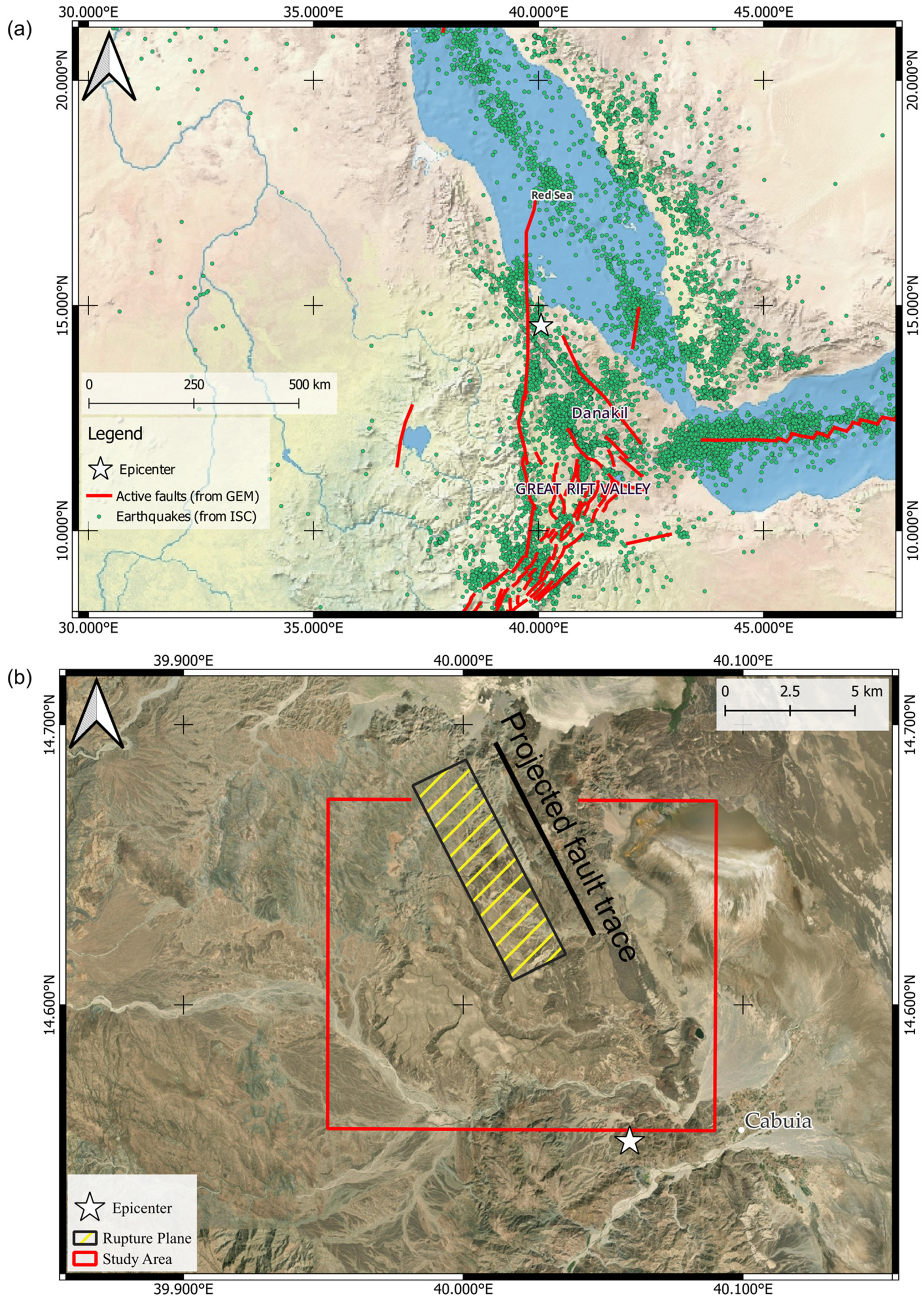
The AOI encompasses ca. 190 km2, situated to the northwest of the village of Cabuia and a few kilometers north of the Ragali (or Awra) River, which serves as the boundary with Ethiopia, to the south (Figure 1a).
1.1.1. Geological Framework of Eritrea
From the geodynamic and seismotectonic point of view, Eritrea’s geology is mainly characterized by the presence of the East African Rift System: an active continental rift zone that separates the Nubian and the Somali Plate and presently spreading at a rate of about 6–7 mm per year [14].
The East African Rift System is characterized by extensional basins, plateaus, and volcanic formations [15]. On the surface, it manifests as a succession of aligned tectonic basins extending several thousand kilometers, each controlled by normal faults that form subsiding grabens or troughs. This rift system can be subdivided into two branches [16]:
- -
- the eastern branch, a volcanic-rich system comprising the Kenya and Ethiopian Rifts [17], extends from the Afar Triangle in the north to the North Tanzanian Divergence in the south, covering a total distance of approximately 2200 km;
- -
- the western branch stretches from Lake Albert in the north to Lake Malawi in the south [18], spanning approximately 2100 km.Figure 1. (a) Epicenters of earthquakes in the region from 1994 to 2023 collected from the International Seismological Center [19] and active faults from GEM Global Active Faults Database [20]: background and labels from Natural Earth (public domain) [21]; (b) the AOI with the epicenter of the 26 December 2022 Mw 5.5 earthquake [19], and the rupture plane (source: USGS [13]); background satellite imagery is sourced from ESRI (Redlands, CA, USA).
The eastern branch of the rift system was likely initiated during the early Miocene; however, there is also evidence of earlier Paleogene rift activity in northern Kenya and Ethiopia. In contrast, the western branch appears to have been initiated later than the eastern branch, during the late Miocene [22].
The Afar Triple Junction, located at the northern tip of the rift, plays a crucial role as it is where the divergence of the Nubian, Somali, and Arabian plates generates significant tectonic and volcanic activity. This activity is exemplified by the active basaltic shield volcano Erta Ale, located in the Danakil Depression. Mantle upwelling beneath the rift leads to lithospheric thinning, resulting in volcanic activity that forms extensive basaltic plateaus, such as those observed in Ethiopia and Kenya. The western branch of the geological formation initiated volcanic activity in the late Miocene [22], while the eastern branch experienced similar activity during the Oligocene, and presently, extensive outcrops of volcanic rocks are prevalent in this region. Furthermore, in the eastern branch, the rifting process was either accompanied by or preceded by significant eruptions of basalts, trachytes, and phonolites [23,24] which were subsequently followed in certain areas by the emergence of rhyolites.
The geology of Eritrea is underlain by Precambrian basement rocks, all of which have been involved in the Pan-African orogeny [25]. This area is part of the Arabian–Nubian Shield, which extends across the northeastern portion of the African continent and into the Arabian Peninsula. It primarily comprises Neoproterozoic rocks that were formed, accreted, and deformed during the period approximately between 900 and 550 Ma; most of the Shield represents juvenile arc development within an oceanic environment [26].
A bimodal volcanic suite, composed of primitive andesitic basalts, later evolved dacites and ignimbrites indicates early submarine arc development and subsequent emergent volcanism [27].
Mesozoic limestone deposits can be located east of the Danakil depression, particularly in the Danakil Alps. Furthermore, substantial reserves of Neogene evaporites are present in the Dallol depression, while Quaternary gypsum deposits occur along the coast [25]. During the major Pleistocene phase of uplift and rifting, the so-called Aden Series basalts (currently found on the floors or rims of river canyons) were likely extruded.
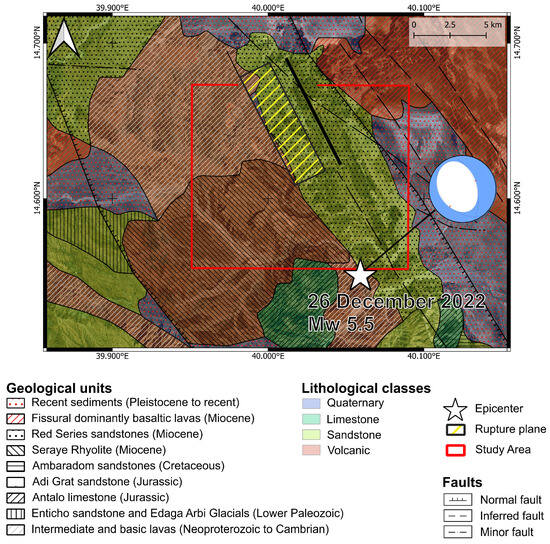
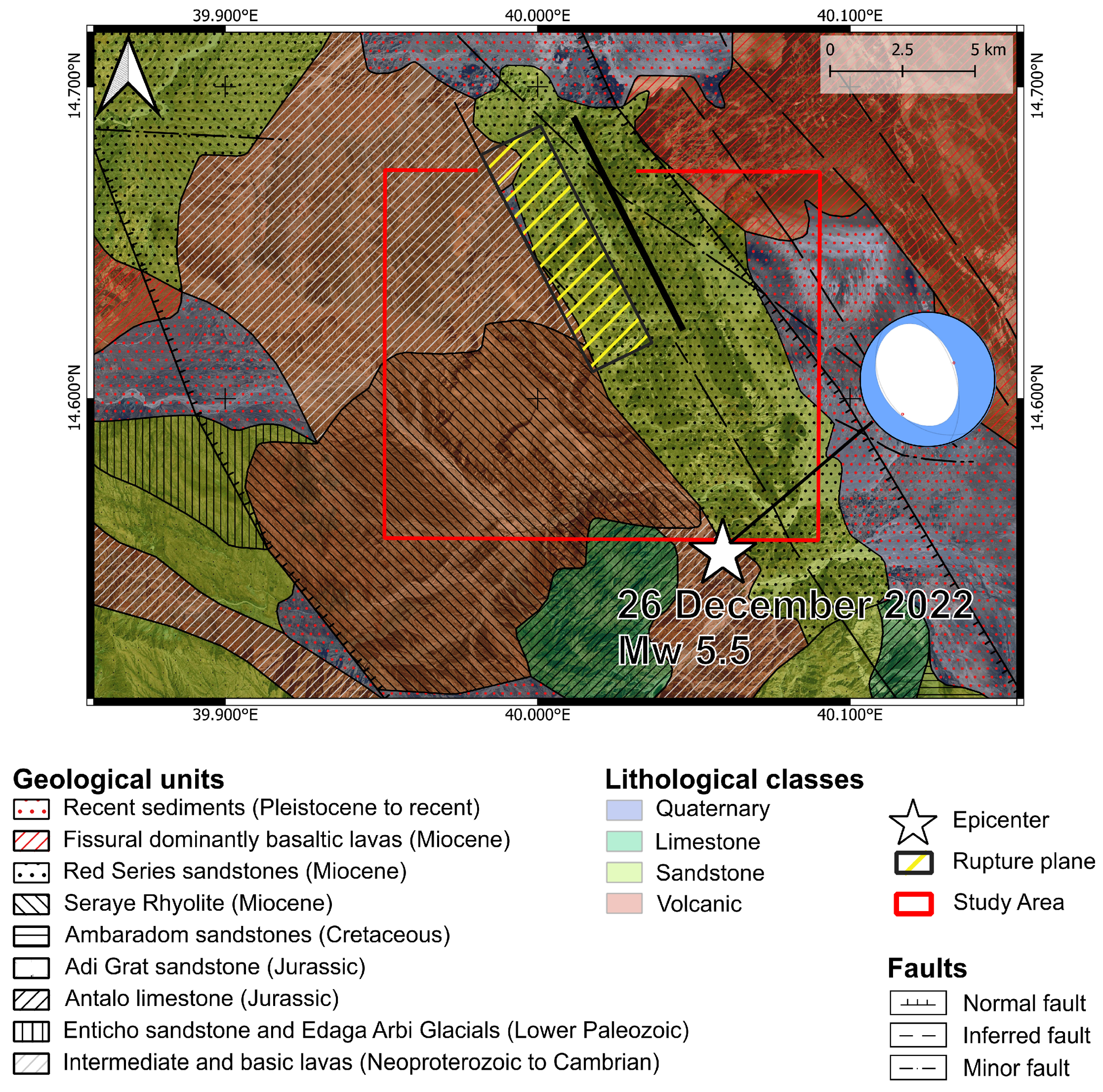
The AOI is situated at the northern terminus of the Afar Triple Junction, indicating that observed seismic activity is intrinsically linked to the geological processes occurring in this region. An examination of the geological map (Figure 2 [28]) reveals a dominant presence of three distinct lithologies within the study area. Specifically, basic and intermediate lavas are prominent in the northwest, while Rhyolite is located in the southwest. Additionally, red or variegated sandstones are found extending from the northern to the southeastern portions of the AOI.
Figure 2.
Geological map of Eritrea, redrawn after [28]. Rupture plane and moment tensor solution from USGS [13]; earthquake epicenter from the International Seismological Center [19]. The black line is the fault projection at surface. Background image from ESRI.
1.1.2. The 26 December 2022 Eritrea Earthquake
Seismic data about the seismic sequence that occurred in the Northern Red Sea Region of Eritrea, starting from 26 December 2022, at 12:21:07.723 UTC, are available on the official website of the United States Geological Survey (USGS) and of the International Seismological Center (ISC) [13,19]. The mainshock magnitude is Mw 5.5 ± 0.1, and the corresponding depth is 10.0 ± 1.9 km. Moment tensor solution for the earthquake (Figure 2) indicates a normal kinematics for the earthquake, along a NW-SE striking fault. The main shock was followed by a second mb 4.6 earthquake on the same day, and by a mb 4.9 event on 28 December 2022. Inversion of geodetic data [29] demonstrated that a system of conjugate faults ruptured with an estimated displacement of 26 cm at depth and without a contribution from magma movements.
2. Materials and Methods
For landslide mapping we used the Planet Labs PBC (San Francisco, CA, USA) imagery products (Table 1). In particular, the analysis utilized products of the “PlanetScope Ortho Analytic 8B SR” type, which are orthorectified, scaled surface reflectance image products comprising eight spectral bands (Table 2). These are characterized by scene-based framing and projected onto a cartographic projection. Additionally, they have high spatial resolution (3.9 m of GSD for this product) and a short revisit time (1 day at those latitudes). Products with the lowest possible cloud cover were selected, ensuring that as much as possible of the landslides-affected area was covered by a single image. Concerning the position of the sun relative to the horizon, the azimuth and elevation angles were recorded as follows:
Table 1.
Satellite product information.
Table 2.
Band number, name, and wavelength range of the Planet PSB.SD products; data from Planet Labs [30].
- for the image taken on 22 December, the azimuth was 144.4°, and the sun elevation was 43.3°;
- for the image captured on 5 January, the azimuth was 142°, and the sun elevation was 43.2°.
Therefore, the two images are considered comparable.
The images were captured by the newest PSB.SD instrument equipped with a 47-megapixel sensor.
The areas affected by the landslides were thoroughly analyzed to identify clusters of pixels exhibiting an increase in brightness in the post-earthquake images, which were subsequently delineated. The entire manual landslide identification process was conducted with a fixed image scale of 1:5000 to ensure uniformity among the mapped polygons. We manually digitized all the landslides in the AOI based on the changes in radiance between the two images, as detailed in the following sections. The positional accuracy of the mapped landslides is estimated to be a few meters, given the spatial resolution of PlanetScope images.
2.1. Analysis of Landslides’ Occurrence
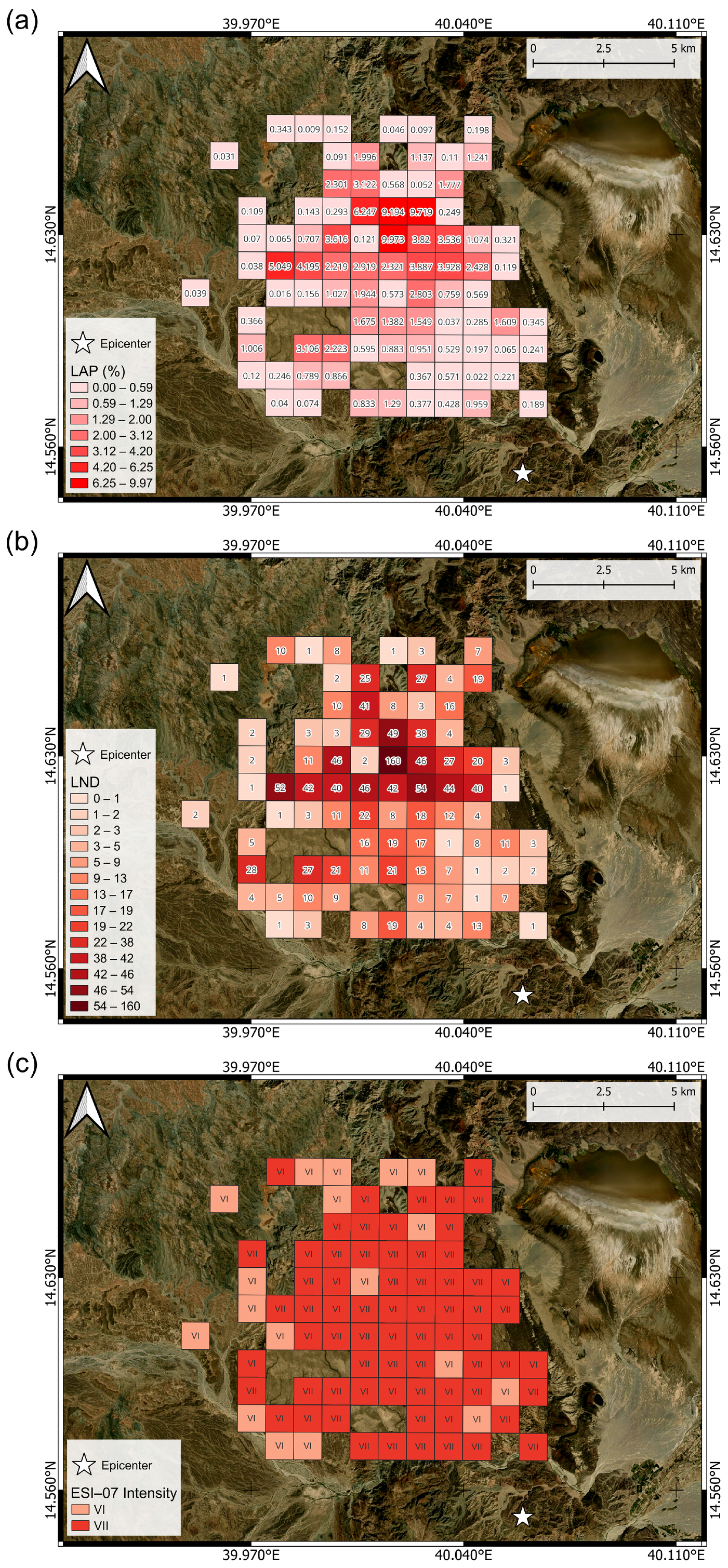
To proceed with the analysis of the created dataset, a grid was established with 1 km2 cells, encompassing only the areas impacted by landslides. Subsequently, the calculation of three parameters was performed:
- Landslides Area Percentage (LAP):
LAP quantifies the percentage of landslide surface area within a grid cell relative to the total area of that cell. To compute this metric, it is imperative first to decompose landslides that span multiple cells into segments that correspond to individual cells. This enabled the calculation of LAP through the application of Equation (1):
- Landslides Number Density (LND):
LND denotes the number of landslides that occurred within each grid cell. To compute this metric, the centroids of the landslides were utilized.
- ESI-07 Intensity:
The Environmental Seismic Intensity Scale 2007 (ESI-07) is a macroseismic scale that is exclusively based on Earthquake Environmental Effects (EEEs), allowing intensity assessments also where there are no buildings present [31,32,33]. It also facilitates the comparison of seismic events across different geographical regions, owing to its independence from human-made structures, whose construction quality can positively or negatively influence the intensity assessment [34].
This scale comprises twelve degrees, similarly to most intensity scales, and its values have been calibrated to ensure comparability with the Modified Mercalli [35] and Medvedev–Sponheuer–Karnik [36] scales.
In addition to the primary effects of an earthquake (i.e., surface faulting and tectonic uplift/subsidence), the ESI-07 scale facilitates the assessment of the intensity of secondary effects [32].
Of particular interest in this study is the classification of slope movements, for which the assessment of intensity is primarily based on volume. Table 3 presents the landslide volumes utilized for assigning ESI-07 intensities, as outlined in the original description of the intensity scale [31]. It is important to note that landslide dimensions saturate at ESI-07 X, rendering it impossible to define degrees greater than X based on individual landslides. Additionally, in the ESI-07 guidelines, degrees VII and VIII are characterized by comparable volumes. Consequently, for this study, the values presented in Table 4 have been employed for calculation.
Table 3.
Typical landslide volume for each ESI-07 degree.
Table 4.
Landslide volumes used in this study to assign ESI-07 local intensities.
Calculating intensity ESI-07 necessitates the assessment of the volume of landslides, which was computed using a scaling relation (Equation (2)):
Some of the usable values of α and γ, as reported in the literature [37,38,39,40], are listed in Table 5. Given the absence of specific values about landslides in environments analogous to the one under investigation, the decision was made to compute the volume of the landslides using each pair of parameters. Subsequently, the median of these calculated volumes was determined and employed to assign the ESI-07 intensity grade.
Table 5.
Landslide area–volume scaling relations considered in this study.
- Relationship between landslides and lithology:
The lithologies, obtained from the geological map published in 2007 by the Ministry of Energy and Mines of Eritrea [28], were categorized into four different classes to facilitate a more generalized evaluation (Table 6). The calculation of landslide density per square kilometer for each class was performed to achieve normalization.
Table 6.
Lithology and related adopted classes.
2.2. Landslide Detection Methods for Rapid Mapping
Images have been preliminary explored in natural and false color combinations. It results that most of the landslides are rockfalls that occurred along rock cliffs and characterized by changes in brightness in the visible region and, specifically, with changes in the Red band.
We adopted the Redness Soil Index (RSI) (Equation (3)) as a normalized proxy for measuring the proportion of the red fraction of the visible radiance in respect to the total one:
The differential index (ΔRSI) is calculated as a simple pixel-based difference between the two images (Equation (4)):
The use of a normalized index is ensuring that systematic differences in the values due to topographic effects are not affecting the signal. The resulting map was generated in QGIS 3.44 “Solothurn” (QGIS Association, Orbe, Switzerland) and the high-resolution GeoTIFF is available as Supplementary Material.
In order to develop an automatic pixel-based method for the rapid mapping of landslides we have tested a One-Class Asymmetric Robust Gaussian Classification (AGC hereafter) by using the manually mapped landslides as training fields. The classification algorithm was implemented in MATLAB (MathWorks, Natick, MA, USA) version R2025a; the script is available as Supplementary Material.
Pixel are classified as landslides if falling within a specific interval of a Gaussian probability density function, defined by an upper (k+) and a lower bound (k−) of standard deviations (σ).
In the Robust version of the Gaussian distributions, the median substitutes the mean and bounds are defined by the Median Absolute Deviations (MAD), scaled to be consistent with a Gaussian σ, in order reduce the weight of possible outliers.
The choice of the k− and k+ values have been operated with a grid search approach, by testing k values ranging between 0 and 5 with 0.1 increments and choosing the combination that maximizes the statistical F1 score (Equation (5)):
where
and
F1 is the harmonic mean of precision (Equation (6)) and recall (Equation (7)). It balances the two metrics into a single number, making it especially useful when precision and recall are in trade-off.
Results will be presented by analyzing the resulting confusion matrix and by presenting the validation maps.
3. Results
3.1. Spatial Distribution of the Triggered Landslides
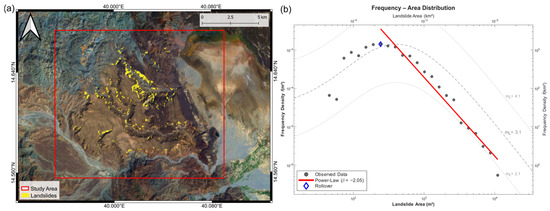
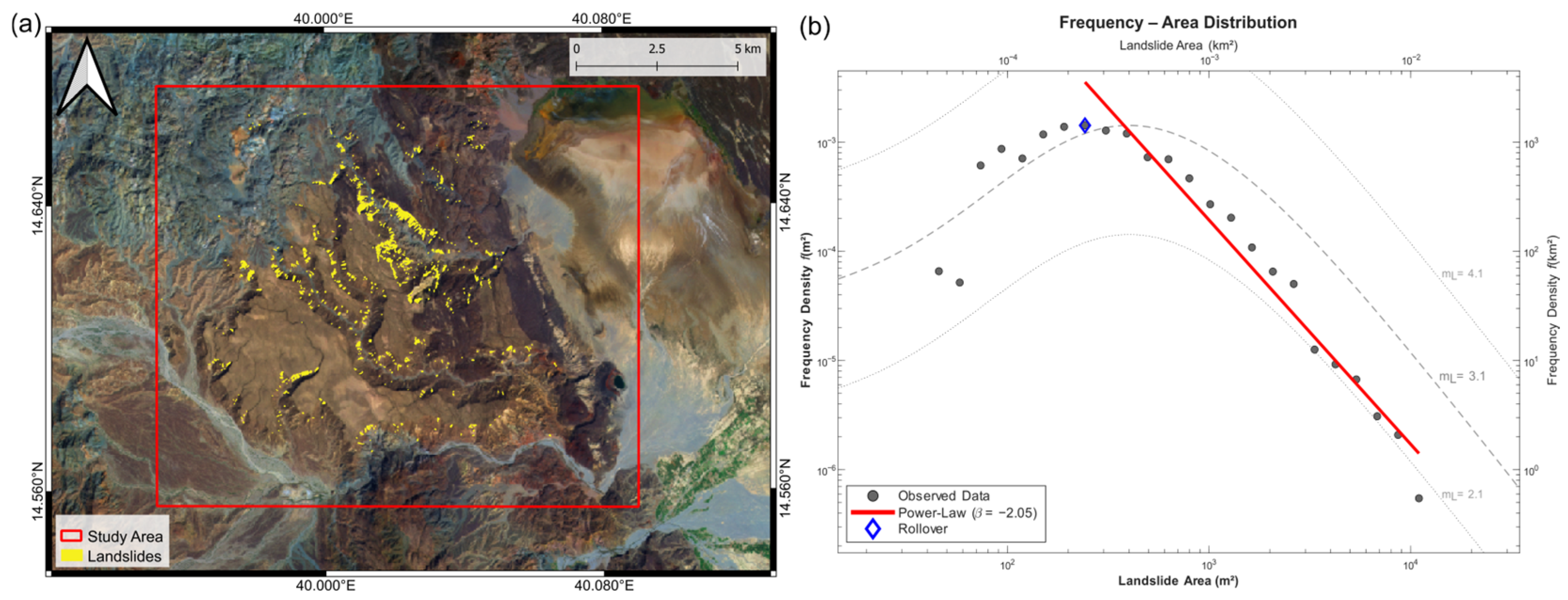
Upon completing the manual mapping process, 1393 landslides were identified (Figure 3a), predominantly located on the walls of the numerous canyons in the study area. The statistical analysis of the inventory involved the calculation of the Landslide Frequency–Area Distribution (Figure 3b), which represents the frequency density as a function of landslide area on a bi-logarithmic scale, in accordance with the methodology proposed by [41]. The position of the rollover, i.e., ca 300 m2, provides an estimate of the catalog’s completeness. An initial analysis of the mapped landslides enables the extrapolation of preliminary area characteristics (Table 7).
Figure 3.
(a) Landslide distribution. The canyons sculpted by river erosion are distinctly observable, and an examination of the distribution of the polygons indicates that their walls are particularly susceptible to landslide phenomena. Background image from Planet Labs is the post-earthquake one. (b) Landslide frequency distribution in relation to area. The reference lines denote the Landslide Magnitude (mL), a logarithmic parameter that quantifies the total number of landslides recorded in a catalog.
Table 7.
Landslide area analysis, referring to the manually mapped inventory.
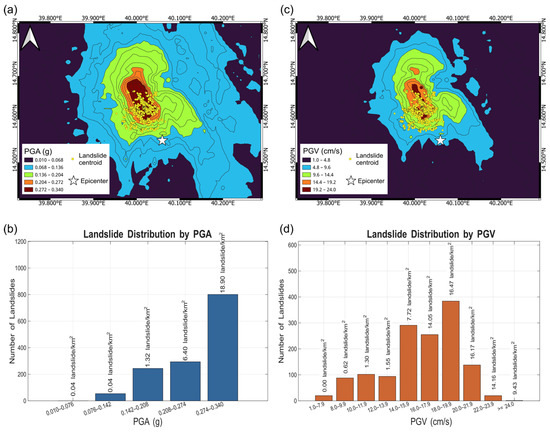
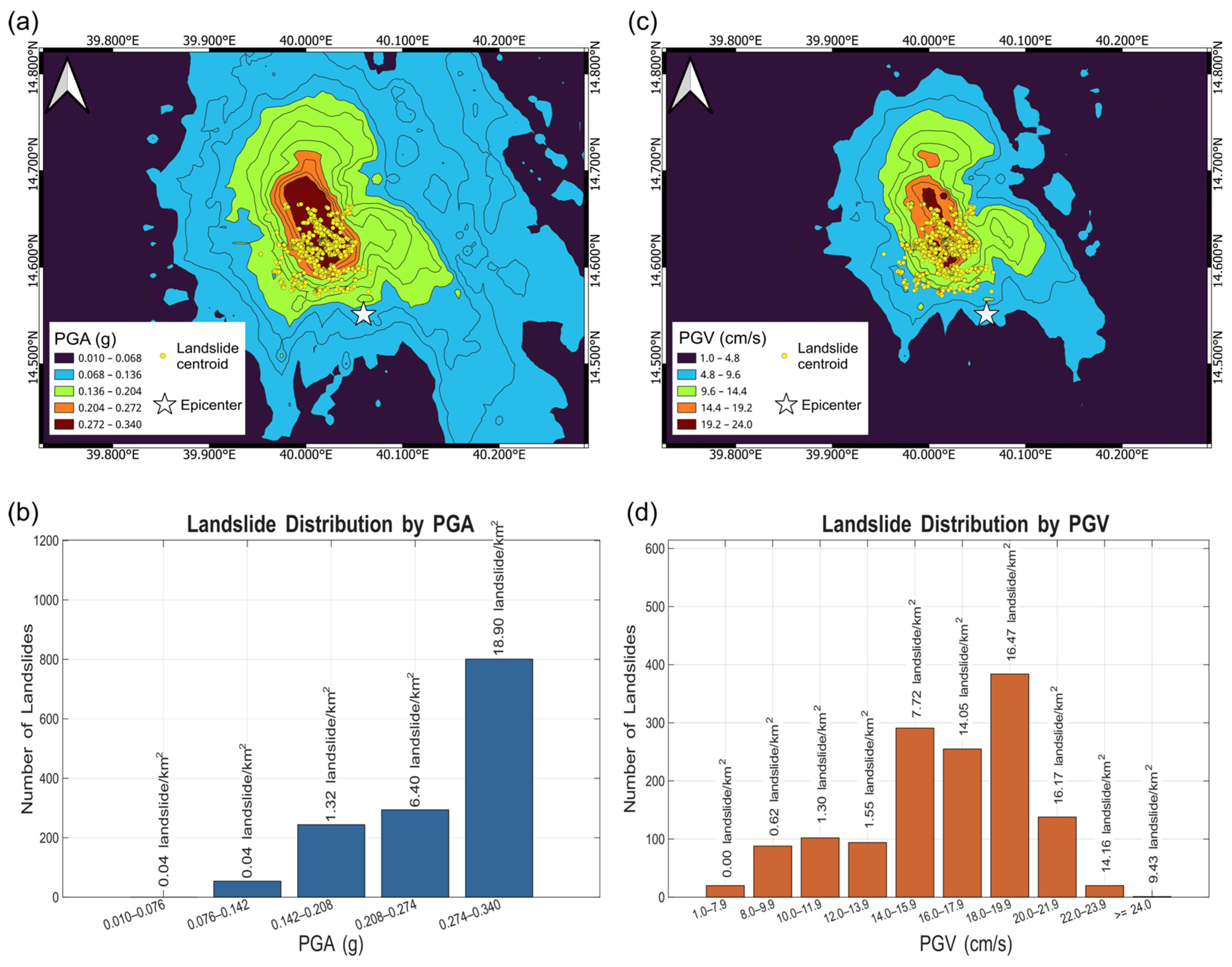
It is also feasible to represent the distribution of landslides in relation to PGA and PGV (Figure 4). Most landslides occur with PGA values higher than 0.22 g, particularly between 0.27 g and 0.32 g. For PGV, most landslides occur with values higher than 14 cm/s. A peak is observed at PGV between 15 and 17 cm/s. However, once this peak is surpassed, a subsequent decline in landslides is noted as the PGV values increase.
Figure 4.
(a) Landslides distribution in relation to PGA ShakeMap. (b) Histogram of the number of landslides based on the PGA value. (c) Landslides distribution in relation to PGV ShakeMap. (d) Histogram of the number of landslides based on the PGV value. ShakeMaps and relative values from USGS [13].
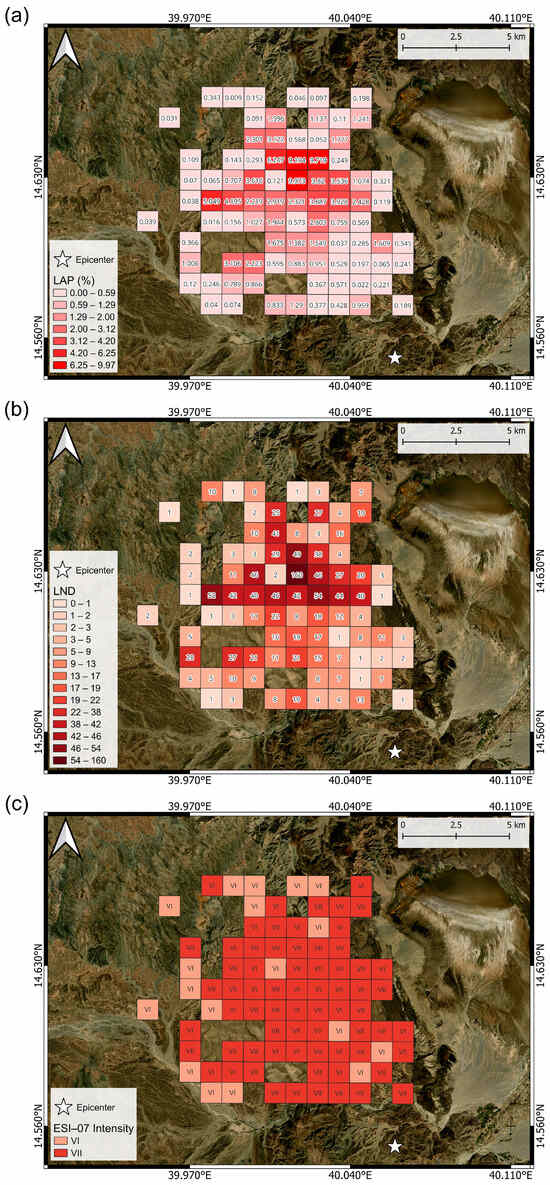
The values for LAP, LND and ESI-07 (Figure 5) were also computed. LAP reaches a maximum of 9.97%, while LND reaches a maximum of 160 landslide/km2. In both cases, highest values are observed in the central region of the study area and diminish toward the peripheral areas.
Figure 5.
(a) LAP map. (b) LND map. (c) ESI-07 Intensity distribution. Background image sourced from ESRI.
The macroseismic assessment using the ESI-07 scale reaches a maximum value of ESI-07 VII, which is quite homogeneously distributed throughout the study area.
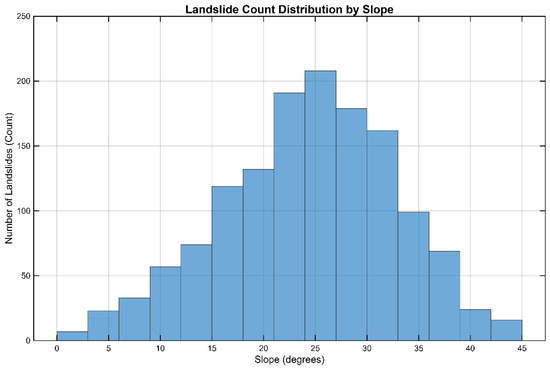
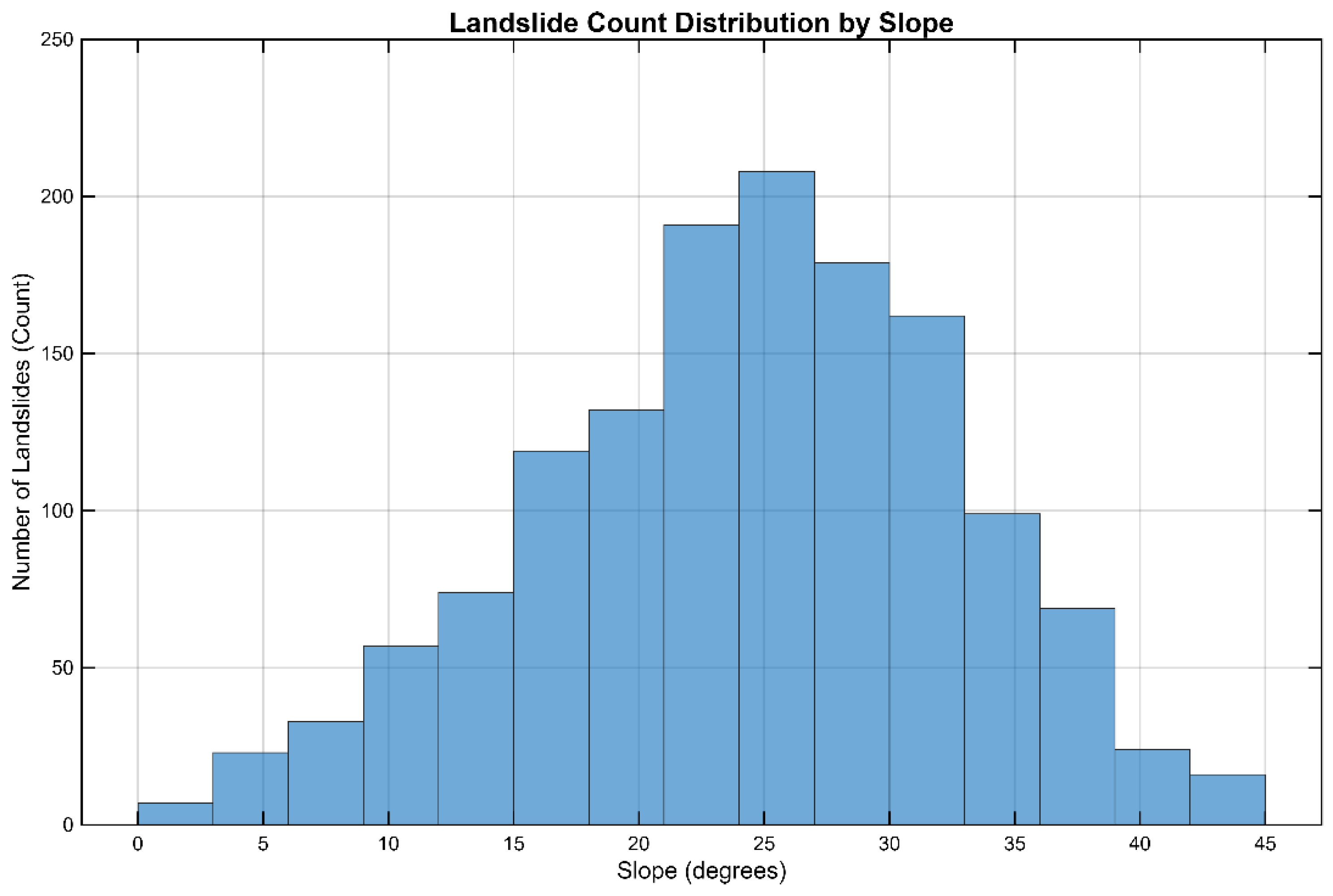
An analysis of the relationship between landslides and slope (Figure 6) reveals that most landslide occurrences are concentrated within the slope range of 4° to 42°. Concerning the relationship between lithologies and the frequency of landslides, Table 8 indicates that sandstone lithology is the most affected, exhibiting 831 landslide events, followed by the volcanic one with 561 occurrences. Conversely, there is an almost total absence of landslides in the Quaternary formation, with only one recorded event, and a complete absence in the limestone lithology.
Figure 6.
Distribution of landslides in relation to the slope gradient.
Table 8.
Relationship between the lithological category, number of landslides, and landslide density. The density is calculated with reference to the surfaces of the lithologies encompassed within the Study Area (Figure 2).
3.2. Rapid Mapping
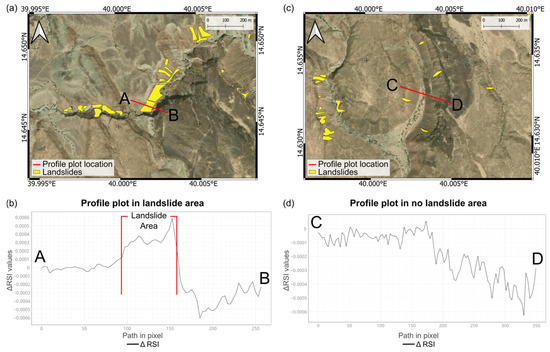
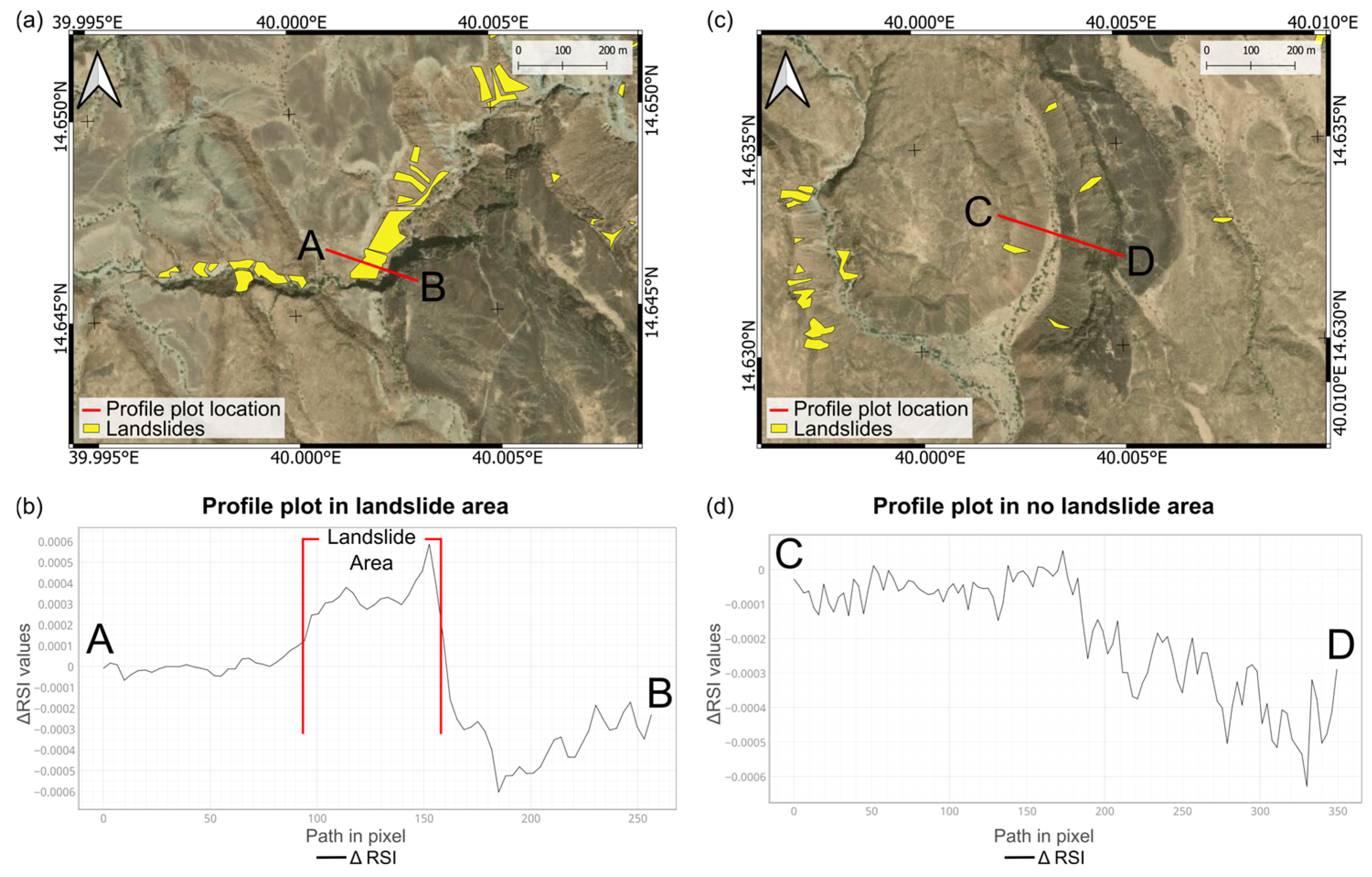
The areas where landslides occurred are marked by a significant change in the ΔRSI value. This is due to a shift in the spectral signature from weathered reddish rocks and regolith to unweathered whitish to grayish fresh rock fragments and newly exposed facets. The profile plot in Figure 7 clearly exhibits a marked positive change in the area affected by a landslide, whereas unaffected areas systematically show values close to zero or trending toward negative ones.
Figure 7.
(a) Location of profile AB across a landslide area; (b) changes in DRSI along the AB profile: the peak of positive values associated with the landslide area is noticeable; (c) location of profile CD across a non-landslide area; (d) changes in DRSI along the CD profile.
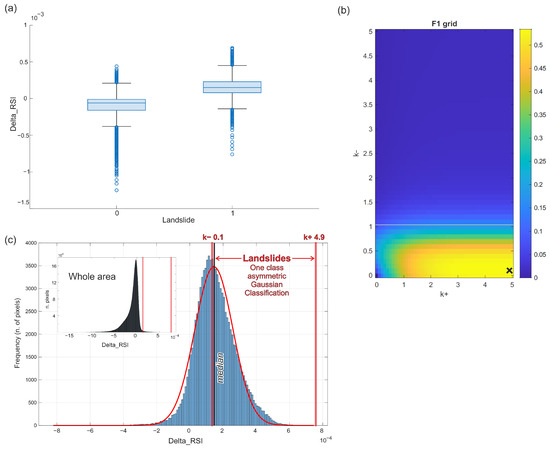
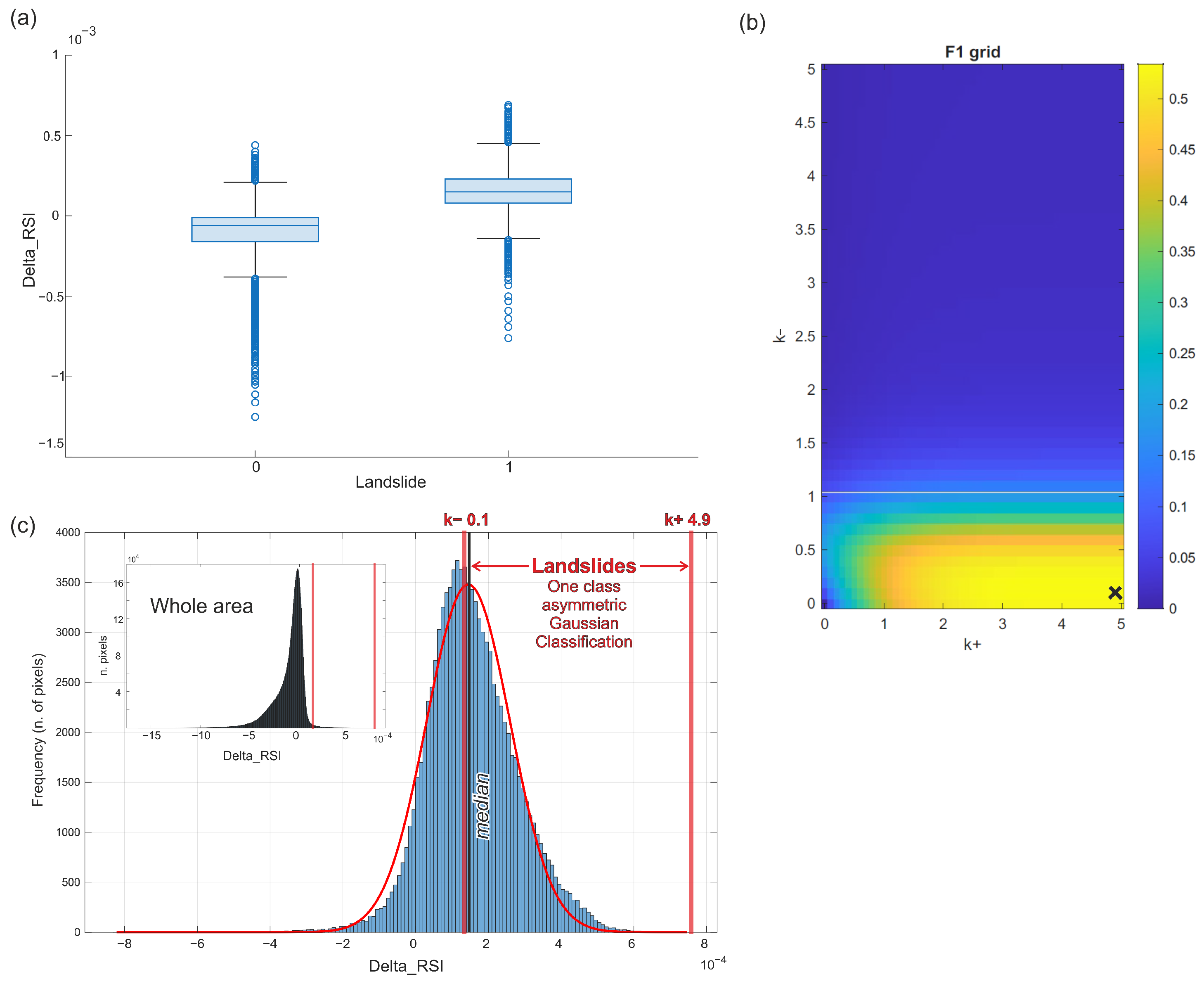
The frequency plots of ΔRSI (Figure 8a) highlight the same distributions for positive and negative landslide pixels, with landslide areas clustered in positive changes in the index and with a left tail of the distribution only partially overlapping with non-landslide areas.
Figure 8.
Frequency distributions: (a) boxplots of the ΔRSI in the landslide and non-landslide areas; (b) grid search on the k+ and k− values bounding the landslide class: the black cross points to the best combination, according to the F1 score; (c) histogram of the ΔRSI in the landslide area fitted with a Gaussian distribution: the calculated intervals for landslide classification are reported as red bars (in the inset, that one of the whole AOI—the same bars are reported as reference).
The grid search for the k values to be adopted in the AGC, consistently, converged to very asymmetric bounds in the interval to be adopted for a positive classification, with k− = 0.1 (i.e., very close to the median) and k+ = 4.9 (i.e., including almost all the right tail of the distribution up to the maximum value; Figure 8b,c).
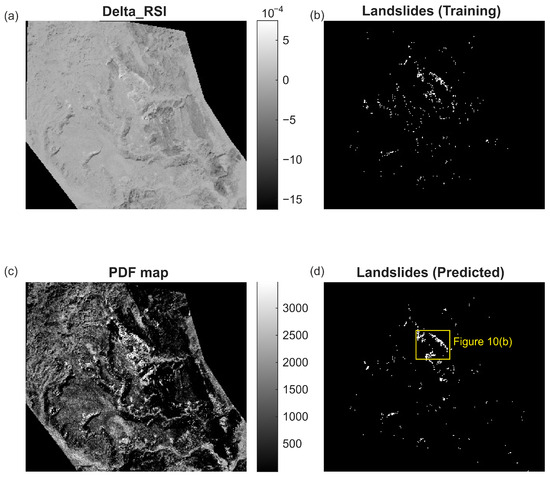
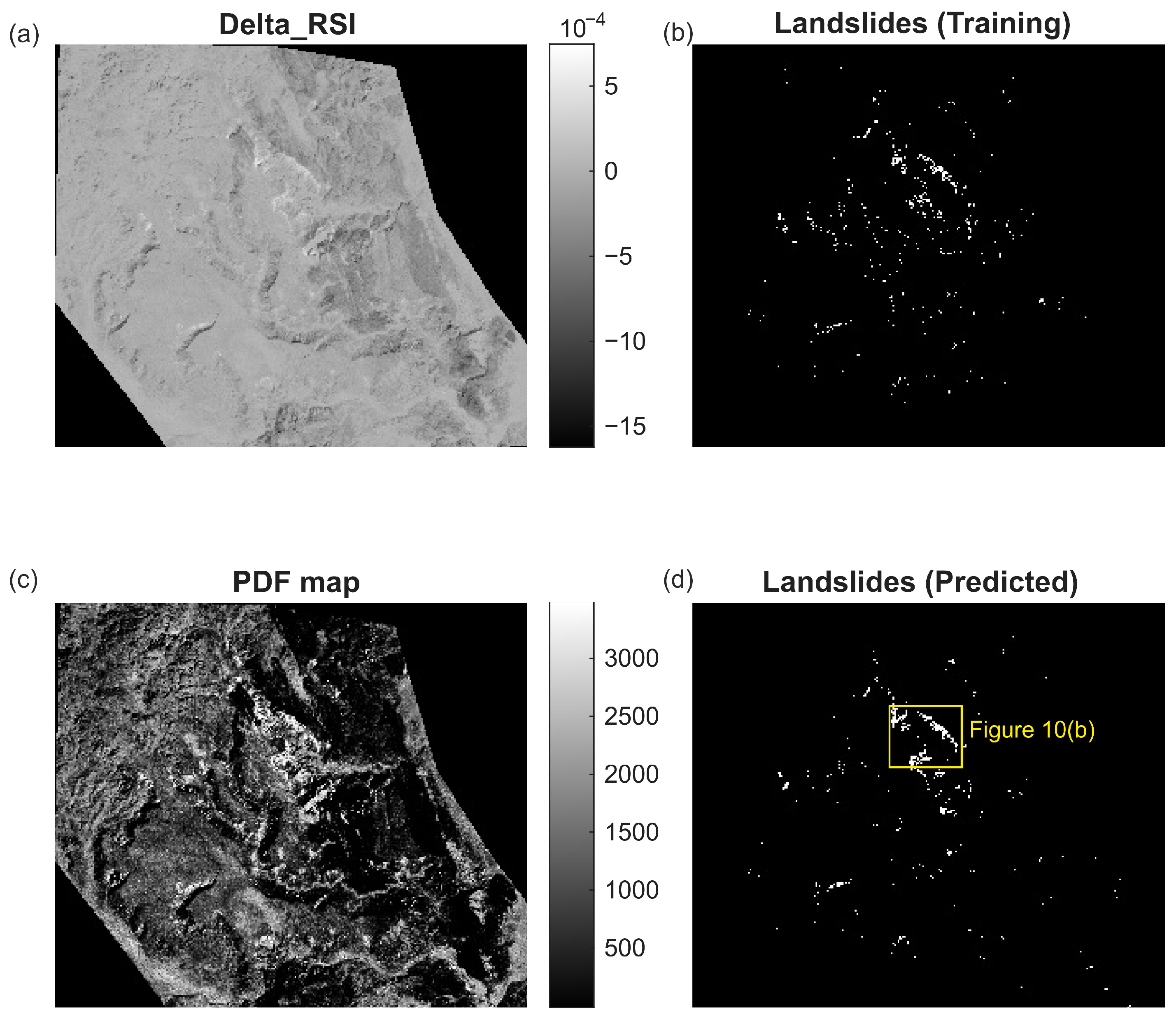
Outputs reveal a good spatial coherence between real and the predicted landslide pixels (Figure 9).
Figure 9.
Classification output: (a) map of the optical index ΔRSI and (b) mapped landslides (training class); (c) calculated probability density function from the training class; (d) predicted landslides.
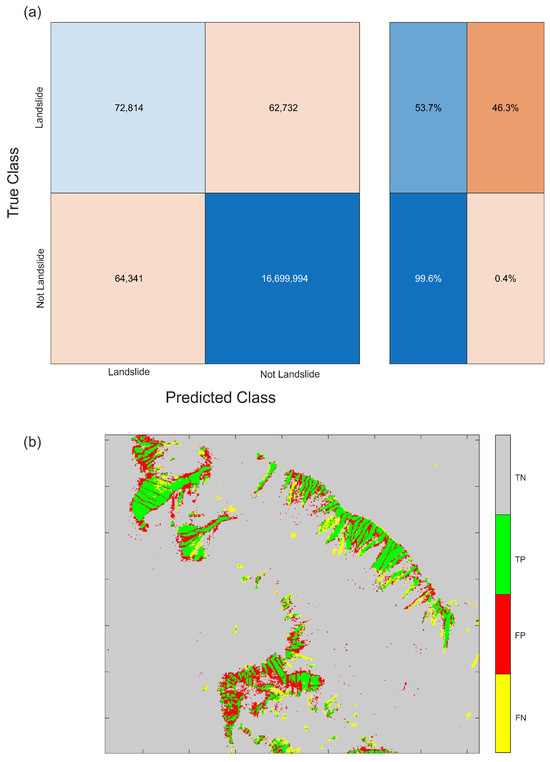
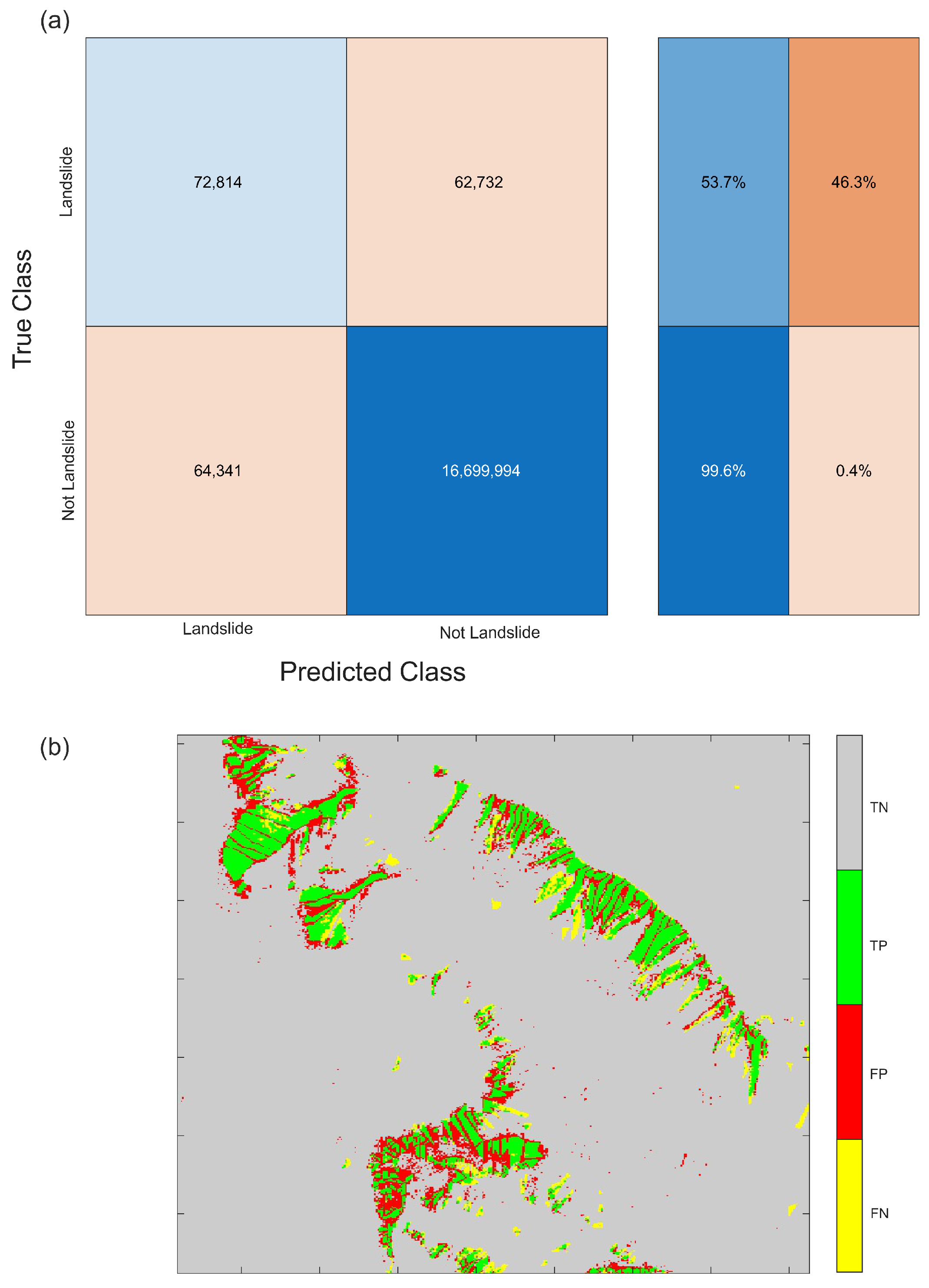
Errors (Figure 10a and Table 9) are considerably affecting the performance of the classifier with performance scores that are only moderate to low in quality. We also performed a spatial block cross-validation test, in order to obtain robust metrics of the classifier performance (Table 9). Most of the errors are spatially clustered around True Positive areas (Figure 10b) and reflect the randomness of the edge regions around the landslides and the low signal to noise ratio in those regions. Nonetheless, there is still a good spatial correlation between real and predicted landslides, ensuring that such a tool is correctly locating the possible landslide areas and thus can be considered effective in the line of a rapid mapping procedure.
Figure 10.
(a) confusion matrix and row-normalized errors from the classification results; (b) validation map.
Table 9.
Performance statistics of the classification method.
4. Discussion
The mapping of the seismic landslides resulting from the earthquake on 26 December 2022, in the Northern Red Sea region of Eritrea has facilitated the creation of a dataset comprising 1393 individual landslide movements (Figure 3). The inventory has been mapped by the same individual, thus minimizing the uncertainty attributed to the operator’s sensitivity during the mapping process. Indeed, classifying a cluster of pixels exhibiting an increase in brightness in the post-earthquake imagery into one or multiple landslide movements is inherently linked to the operator.
Regarding the Landslide Frequency–Area Distribution (Figure 3b), it is evident that the calculated Power-Law exponent (β) value aligns with the values reported by [42] in his analysis of various inventories of seismic-induced landslides.
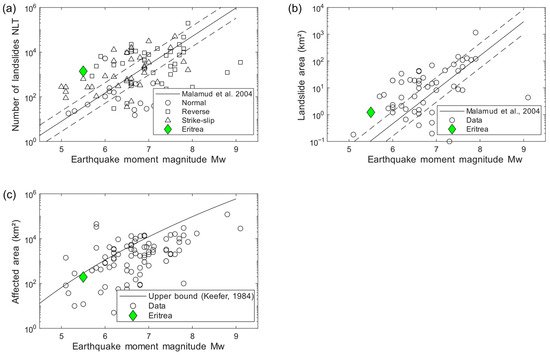
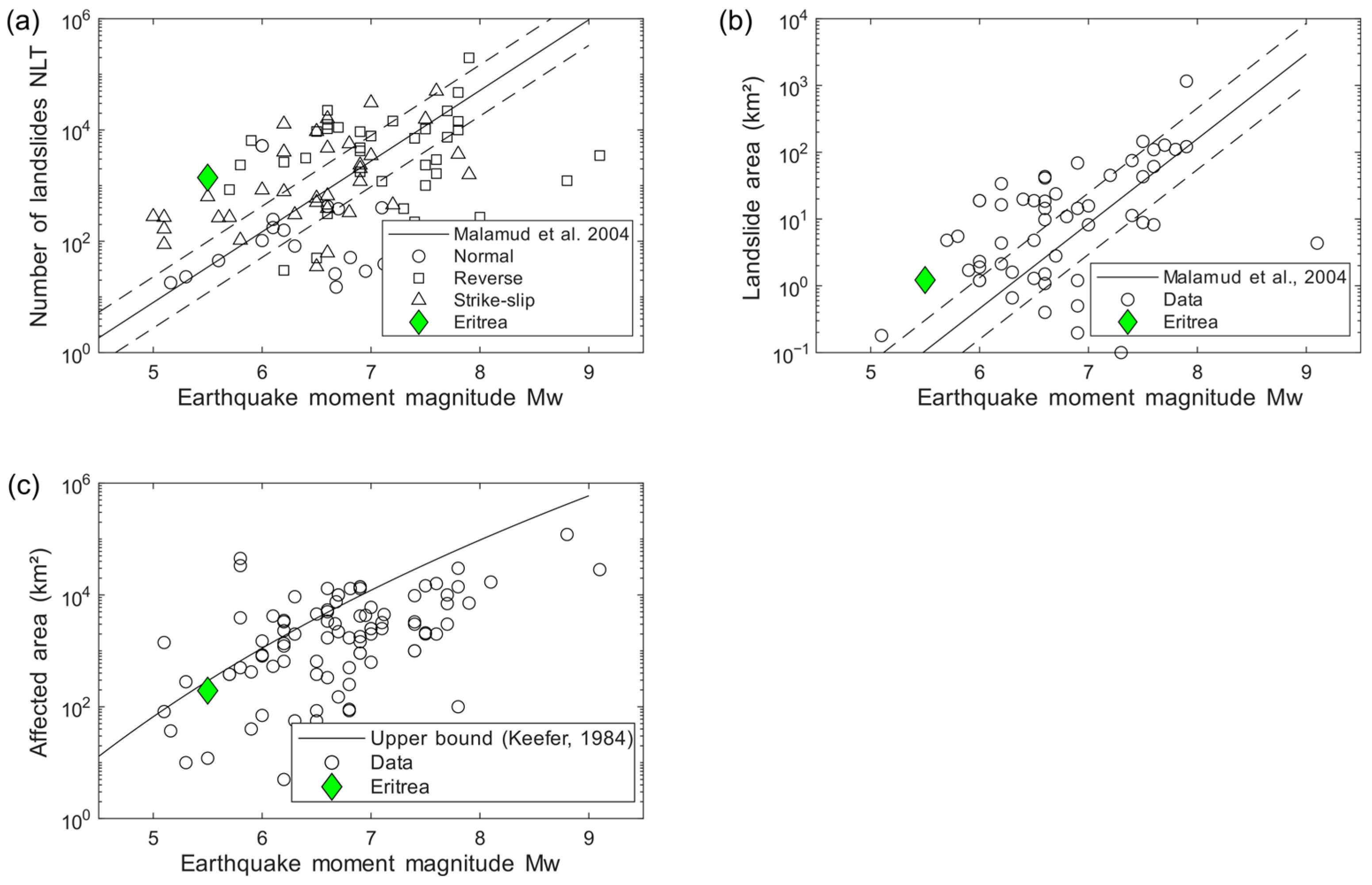
Many inventories of earthquake-triggered landslides are available at a global scale; however, the inventory of the 2022 Eritrea earthquake is one of the few located in arid regions. In Figure 11, we compare the Eritrea event with a catalog of about 100 coseismic landslide inventories on a global scale. We consider the number of landslides, the landslide area (i.e., sum of the area of the landslide polygons) and affected area (i.e., dimension of the territory where the landslides are located). All these parameters are plotted as a function of the earthquake moment magnitude. The Eritrea earthquake was particularly efficient in triggering slope movements, both in terms of number and dimension of the landslides. Figure 11a shows that the Eritrea event triggered more landslides than other earthquakes with a similar magnitude. Even though Figure 11a is affected by the spatial resolution of the images used to delineate the inventories, we observe that normal-faulting earthquakes usually generate a reduced number of landslides with respect to other kinematics. When considering the landslide area, depicted in Figure 11b, the Eritrea earthquake lies above the confidence bounds of the empirical relations proposed by [41]; it must be noted that those relations were originally obtained on a dataset of about 20 earthquake-triggered landslide inventories. Today a much wider dataset is available, comprising almost 100 inventories in terms of landslide number and over 50 in terms of landslide area; the data points plotted in Figure 11 are available on the Zenodo repository (see Data Availability statement). Finally, Figure 11c shows the relation between affected area and earthquake magnitude; the Eritrea event lies just below the upper bound proposed by [43].
Figure 11.
Comparison of the landslide inventory derived in this study with global studies; (a) number of landslides vs. moment magnitude Mw, regression and confidence bounds after [41]; (b) landslide area vs. moment magnitude; (c) affected area vs. moment magnitude, upper bound after [43].
The tested method for landslide rapid mapping is successful in identifying the areas where landslides occurred with moderate performance both in recall and precision. Nonetheless, the results here obtained, supervised by means of a detailed manual interpretation, revealed that simple thresholding could be applied to changes in the RSI, as a tool for automatic rapid mapping.
In this study, a supervised approach was adopted to determine the optimal threshold values of ΔRSI for landslide classification. The pronounced asymmetry of the optimized k parameters, which are concentrated in the right tail of the ΔRSI distribution, suggests that a simplified threshold-based procedure could be effective for rapid mapping applications. However, as the analysis is currently limited to a single case study, we deliberately refrain from directly deriving generalized threshold values, due to the potential risk of overfitting. Instead, this work should be regarded as a pilot investigation that highlights the feasibility of the proposed approach. It also provides a foundation for future developments aimed at implementing a fully automated methodology, once a larger inventory of landslides becomes available and the model can be trained on more diverse and normalized datasets.
A significant advantage in respect to other methods proposed in the literature for arid areas [44,45], including deep learning-assisted supervised classification [46], or algorithm-integrating precipitation data [47] is that, once a well-trained threshold model is implemented, no training or other external datasets are required.
It is important to note that the proposed method is pixel-based; therefore, the data presented pertains to the comparison between the prediction raster and the raster containing the test fields. Consequently, the analysis does not encompass the classifiers’ ability to identify individual landslide events and their respective sizes. This method, like other ones presently adopted in the literature, presents a considerable amalgamation effect [48] that, in any case, is not affecting the overall accuracy in locating the slopes involved, but rather influences the metrics on landslides numbers and area of individual polygons.
Other studies primarily utilize object-based image analysis approaches [49,50]; however, it has been demonstrated that object-oriented methods are notably time-intensive and necessitate substantial manual intervention while remaining highly susceptible to significant commission and omission errors, with kappa values ranging from 0.32 to 0.43 and F1 scores approximately 0.36–0.45 [51].
In other cases, pixel-based image analysis methods, such as the one employed in this study, demonstrated superior outcomes; however, achieving those results necessitated the application of statistical techniques, such as the Taguchi method, to optimize the results [52]. Deep learning methodologies have, in recent years, demonstrated a systematic and measurable improvement over both traditional (shallow) machine learning and unsupervised approaches in landslide mapping applications based on remote sensing data, especially in forested areas. In particular, convolutional neural networks (CNNs) and related architectures consistently achieve superior classification performance, with reported kappa coefficients typically ranging between 0.75 and 0.95 and F1-scores generally exceeding 0.75, reflecting a more balanced trade-off between precision and recall [53,54]. These improvements are primarily attributable to the intrinsic capability of deep learning models to hierarchically learn spatially distributed and context-dependent features directly from raw or minimally processed data, thereby enhancing the detection of landslide patterns that are not readily captured by hand-crafted predictors. This advantage is especially evident in terms of recall, where deep learning methods substantially reduce omission errors by effectively identifying spatially heterogeneous or spectrally ambiguous failure areas.
By contrast, conventional supervised machine learning approaches—such as random forest, support vector machines, and logistic regression—generally exhibit more limited predictive performance, with F1-scores commonly in the range of 0.50–0.75 and kappa values typically not exceeding ~0.85, largely due to their dependence on predefined features and their reduced capacity to model complex spatial interactions [55]. Furthermore, unsupervised methods, including clustering and threshold-based techniques, tend to show the lowest levels of classification accuracy (e.g., κ ≈ 0.40–0.70 and F1 ≈ 0.50–0.70), particularly in environments characterized by high spectral variability or dense vegetation cover, where class separability is inherently limited [56,57,58]. A direct comparison between the Image Differencing approach (like the one employed in this study) and three alternative methodologies (Object-Oriented Classification, Maximum Likelihood, and Deep Learning) revealed that the Image Differencing method performed second only to Deep Learning, achieving kappa scores of 0.55–0.59 (compared to 0.65–0.71) and F1 scores of 0.56–0.61 (compared to 0.67–0.73) [51]. A key distinction between the Image Differencing approach utilized in the aforementioned comparison and our own implementation resides in the methodology for threshold value selection: while the Otsu 1979 method [59] yields effective and computationally efficient results, it does not guarantee F1 score maximization, a characteristic ensured by the grid search utilized in our study. Furthermore, it may exhibit limitations when confronted with highly imbalanced classes, a common scenario in applications such as landslide detection where the positive class is significantly smaller than the background territory and thus leading to a threshold that tends to underestimate the minority class. A significant limitation of image differential methods pertains to atmospheric conditions and seasonal variations in agricultural land [51]. This latter specific challenge, however, does not impact arid regions, particularly those relevant to our proposed methodology. Conversely, a persistent limitation of deep learning approaches is specifically associated with exposed soil, a characteristic often predominant in arid and desert environments [51].
It must also be acknowledged that the superiority of deep learning approaches is conditional upon data availability, representativeness, and model configuration. In scenarios involving limited training samples or well-engineered feature spaces, high-performing classical methods—particularly ensemble models such as random forest—may achieve results comparable to those of deep neural networks, often with significantly lower computational cost and greater interpretability [55]. Furthermore, despite the advancements made, the generalization and transferability of deep learning models to areas beyond their training domain continue to pose a significant challenge [60], highlighting the necessity for the inclusion of more events within the training dataset [61]. Consequently, while deep learning currently represents the most robust and versatile framework for landslide mapping in complex settings, the selection of an appropriate modeling approach should remain contingent upon both data characteristics and the specific objectives of the analysis.
The integration of other datasets, especially from SAR imagery, is possibly a promising way to enhance the predictive capabilities of the method. In particular, SAR amplitude variations (e.g., [62] or interferometric loss of coherence [63]) could be readily integrated to complement optical remote sensing observations. Whereas optical data primarily reflect changes in surface composition and exposure, SAR measurements are sensitive to the structural characteristics of surface targets, including surface roughness and geometry. In this work, the objective was to promptly identify landslide subjected areas; from this perspective, the proposed method appears to be effective in identifying the affected slopes. In this context, it becomes evident that the remarkable simplicity of applying the ΔRSI does not necessitate preparatory calculations or machine learning processes, and results in virtually negligible processing time. Despite this, it can deliver an immediate estimation of landslide positioning, thereby facilitating the identification of the most affected areas. This capability presents significant potential for application in emergency situations, to develop operational rapid-response systems, or as a preliminary investigation preceding more detailed studies. The proposed method is simple and computationally efficient and thus could be used to gain a near real-time estimate of the areas more affected by landsliding. This information, in turn, may support response strategies and help authorities in taking informed decisions.
Given the initial considerations about the landslide inventory created, also the data about the area and volume of the landslides utilized to assign the ESI-07 are similarly affected by the same uncertainty. Nonetheless, the inherent uncertainties in the volume computation procedure do not seem to impact the intensity assessment substantially. Based on the results of the ESI-07 classification (Figure 5), it is evident that most landslides possess a volume ranging between 103 and 104 m3, with some exhibiting volumes below 103 m3, while none exceed a volume of 104 m3. Within this interval, the equation by [39] systematically provides higher volume estimates, while the equation by [38] (all type) provides the lowest estimates. We ran a sensitivity analysis to evaluate how the selection of a given area-volume relation influences the outputs in terms of ESI-07 intensity. Given the width of the ESI classes in terms of volumes (Table 4) generally less than 5% of the landslides would have changed ESI-07 intensity degree if we opted for a single equation rather than our approach (median value among 6 equations); higher differences are found for the relationships by [38,39] (all type and soil).
Recently, some empirical relations have been proposed to link ESI-07 values with the LAP and LND metrics [64], developed on a dataset of 40 earthquake-induced landslide inventories with global coverage. The relation between LAP and ESI-07 has been found to be more reliable; in the present study, we obtained values quite in agreement with the global dataset. However, no ESI-07 intensity higher than VII was assigned for the Eritrea earthquake, even though LAP values reached almost 10%. This can be possibly ascribed to the fact that coseismic landslides in arid regions are characterized by a small individual dimension. Another consideration worth mentioning is that the description of the ESI-07 intensity degrees VII and VIII is similar in terms of volume estimation (see Table 3), while we adopted the thresholds listed in Table 4, which clearly differentiate the degrees VII and VIII. The dimension of the total area affected by Earthquake Environmental Effects is another indicator that can be used to assess the ESI-07 intensity. Although we focus exclusively on slope movements, which are only one of the coseismic effects, we can obtain a rough estimate of epicentral intensity. According to [32], for ESI-07 VII the total affected area is in the order of 10 km2, while for ESI-07 VIII it is of 100 km2. The Eritrea earthquake is consistent with the latter value, since we mapped slope movements over a ca. 200 km2 area.
Regarding the relationship between Peak Ground Acceleration (PGA) and Peak Ground Velocity (PGV), the existence of a correlation is corroborated, as already extensively documented in the literature [65,66,67]. However, a notable decrease in the number of landslides with PGV exceeding 19 cm/s is observed (Figure 4d). When these data is weighed using a ratio of the landslide area to areas exhibiting the same PGV value (Table 10) to achieve normalization, the observed decrease is diminished but persists, particularly for PGV values greater than 24 cm/s. This decrease can be attributed partly to the reduced area affected by these values and partly to a general expansion of high PGV values further north of the region most impacted by landslides. This pattern is also evident for PGA values (Figure 4a) and may be related to the degree of uncertainty associated with the reconstruction of the shake maps, which were developed directly by the USGS due to the absence of measuring instruments in the surrounding areas. Consequently, this uncertainty may also influence the location of the epicenter, which is displaced relative to the rupture plane (Figure 1b). Another hypothesis regarding the behavior of PGV values involves lithological influence; however, an examination of the geological map (Figure 2) reveals no significant lithological changes in the northern segment of the rupture plane. It is therefore more plausible that the observed decrease in landslides is associated with a diminished susceptibility to landslide events in those regions, where the recorded PGA and PGV values were insufficient to serve as triggering mechanisms.
Table 10.
Ratio of the landslide area to areas exhibiting the same PGV value. The highest percentage is observed within the PGV range of 18.0.9 to 19 cm/s.
Transitioning to the relationship between lithology and landslides (Table 8), the results indicate that sandstones are the most susceptible lithology. This finding is consistent with the observations made by David K. Keefer in his analysis of other datasets related to seismic-induced landslides [43].
5. Conclusions
The establishment of a comprehensive dataset consisting of 1393 manually mapped landslides resulting from the Mw 5.5 26 December 2022, Northern Red Sea Region Earthquake (Eritrea) facilitated several significant analyses:
- The examination of the dataset through various parameters, including LAP, LND, and ESI-07, allowed us to identify correlations between PGA, PGV, and landslides, as well as the lithological influence on the landslides.
- Enabling the creation of training fields for a Gaussian one-class classifier based on the DRSI, which exhibited accuracy rates (F1 score) above 50% and with a strong spatial correlation of the classified landsliding areas with the manually mapped ones.
This exhibits considerable potential due to its rapid processing capabilities; however, the elevated omission error renders it inadequate for detailed identification of all areas impacted by landslides. The ease and immediacy of its acquisition, without the necessity of employing machine learning algorithms, make it a compelling subject for emergency situations and preliminary investigations, thereby warranting further research aimed at establishing generalized threshold values applicable globally in arid environments.
Supplementary Materials
The following supporting information can be downloaded at: https://www.mdpi.com/article/10.3390/geohazards7020066/s1, Archive containing the MATLAB classification script, the Delta_RSI GeoTIFF map, and the explanatory README file.
Author Contributions
Conceptualization, L.M. and F.A.L.; methodology, L.M. and F.A.L.; validation, L.M. and F.A.L.; formal analysis, L.M., F.A.L. and M.F.F.; writing—original draft preparation, L.M. and F.A.L.; writing—review and editing, L.M., F.A.L. and M.F.F.; visualization, L.M.; All authors have read and agreed to the published version of the manuscript.
Funding
This research received no external funding.
Data Availability Statement
The original contributions presented in this study are included in the article/Supplementary Material. Further inquiries can be directed to the corresponding author.
Acknowledgments
PlanetScope Images were accessed thanks to a Planet Labs PBC Education and Research License.
Conflicts of Interest
The authors declare no conflicts of interest.
References
- Schuster, R.L.; Fleming, R.W. Economic Losses and Fatalities Due to Landslides. Environ. Eng. Geosci. 1986, xxiii, 11–28. [Google Scholar] [CrossRef] [Scilit]
- Petley, D. Global Patterns of Loss of Life from Landslides. Geology 2012, 40, 927–930. [Google Scholar] [CrossRef] [Scilit]
- Budimir, M.E.A.; Atkinson, P.M.; Lewis, H.G. Earthquake-and-Landslide Events Are Associated with More Fatalities than Earthquakes Alone. Nat. Hazards 2014, 72, 895–914. [Google Scholar] [CrossRef] [Scilit]
- Dai, F.C.; Xu, C.; Yao, X.; Xu, L.; Tu, X.B.; Gong, Q.M. Spatial Distribution of Landslides Triggered by the 2008 Ms 8.0 Wenchuan Earthquake, China. J. Asian Earth Sci. 2011, 40, 883–895. [Google Scholar] [CrossRef] [Scilit]
- Robinson, T.R.; Davies, T.R.H.; Wilson, T.M.; Orchiston, C. Coseismic Landsliding Estimates for an Alpine Fault Earthquake and the Consequences for Erosion of the Southern Alps, New Zealand. Geomorphology 2016, 263, 71–86. [Google Scholar] [CrossRef] [Scilit]
- Hu, S.; Wang, L. Automated Urban Land-Use Classification with Remote Sensing. Int. J. Remote Sens. 2013, 34, 790–803. [Google Scholar] [CrossRef] [Scilit]
- Rogan, J.; Chen, D. Remote Sensing Technology for Mapping and Monitoring Land-Cover and Land-Use Change. Prog. Plan. 2004, 61, 301–325. [Google Scholar] [CrossRef] [Scilit]
- Jaiswal, R.K.; Saxena, R.; Mukherjee, S. Application of Remote Sensing Technology for Land Use/Land Cover Change Analysis. J. Indian Soc. Remote Sens. 1999, 27, 123–128. [Google Scholar] [CrossRef] [Scilit]
- Fiorucci, F.; Ardizzone, F.; Mondini, A.C.; Viero, A.; Guzzetti, F. Visual Interpretation of Stereoscopic NDVI Satellite Images to Map Rainfall-Induced Landslides. Landslides 2019, 16, 165–174. [Google Scholar] [CrossRef] [Scilit]
- Yang, W.; Wang, M.; Shi, P. Using MODIS NDVI Time Series to Identify Geographic Patterns of Landslides in Vegetated Regions. IEEE Geosci. Remote Sens. Lett. 2013, 10, 707–710. [Google Scholar] [CrossRef] [Scilit]
- Koutroulis, A.G. Dryland Changes under Different Levels of Global Warming. Sci. Total Environ. 2019, 655, 482–511. [Google Scholar] [CrossRef] [Scilit]
- Huang, J.; Yu, H.; Guan, X.; Wang, G.; Guo, R. Accelerated Dryland Expansion under Climate Change. Nat. Clim. Change 2016, 6, 166–171. [Google Scholar] [CrossRef] [Scilit]
- U.S. Geological Survey, 2024, Earthquake Hazards Program. Available online: https://earthquake.usgs.gov/earthquakes/eventpage/us6000jbsk/executive (accessed on 6 November 2025).
- Fernandes, R.M.S.; Ambrosius, B.A.C.; Noomen, R.; Bastos, L.; Combrinck, L.; Miranda, J.M.; Spakman, W. Angular Velocities of Nubia and Somalia from Continuous GPS Data: Implications on Present-Day Relative Kinematics. Earth Planet. Sci. Lett. 2004, 222, 197–208. [Google Scholar] [CrossRef] [Scilit]
- Michon, L.; Famin, V.; Quidelleur, X. Evolution of the East African Rift System from Trap-Scale to Plate-Scale Rifting. Earth Sci. Rev. 2022, 231, 104089. [Google Scholar] [CrossRef] [Scilit]
- Chorowicz, J. The East African Rift System. J. Afr. Earth Sci. 2005, 43, 379–410. [Google Scholar] [CrossRef] [Scilit]
- Braile, L.W.; Keller, G.R.; Wendlandt, R.F.; Morgan, P.; Khan, M.A. Chapter 5 The East African Rift System. In Continental Rifts: Evolution, Structure, Tectonics; Olsen, K.H., Ed.; Elsevier Science: Amsterdam, The Netherlands, 1995; pp. 213–231+I–III. [Google Scholar]
- Davies, T.C. Environmental Health Impacts of East African Rift Volcanism. Environ. Geochem. Health 2008, 30, 325–338. [Google Scholar] [CrossRef] [Scilit]
- International Seismological Centre. ISC On-Line Bulletin. Available online: https://www.isc.ac.uk/cgi-bin/web-db-run?event_id=642152344&out_format=ISF2&request=COMPREHENSIVE (accessed on 6 November 2025).
- Styron, R.; Pagani, M. The GEM Global Active Faults Database. Earthq. Spectra 2020, 36, 160–180. [Google Scholar] [CrossRef] [Scilit]
- Natural Earth. Natural Earth Vector Map Data. Available online: https://www.naturalearthdata.com (accessed on 30 December 2025).
- Ebinger, C.J. Geometric and Kinematic Development of Border Faults and Accommodation Zones, Kivu-Rusizi Rift, Africa. Tectonics 1989, 8, 117–133. [Google Scholar] [CrossRef] [Scilit]
- Baker, B.H.; Mohr, P.A.; Williams, L.A.J. Geology of the Eastern Rift System of Africa. In GSA Special Papers; Geological Society of America: Boulder, CO, USA, 1972; pp. 1–68. [Google Scholar]
- Justin-Visentin, E.; Nicoletti, M.; Tolomeo, L.; Zanettin, B. Miocene and Pliocene Volcanic Rocks of the Addis Ababa-Debra Berhan Area (Ethiopia). Geo-Petrographic and Radiometric Study. Bull. Volcanol. 1974, 38, 237–253. [Google Scholar] [CrossRef] [Scilit]
- Schlüter, T. Geological Atlas of Africa; Springer: Berlin/Heidelberg, Germany, 2006. [Google Scholar]
- Stern, R.J. ARC ASSEMBLY AND CONTINENTAL COLLISION IN THE NEOPROTEROZOIC EAST AFRICAN OROGEN: Implications for the Consolidation of Gondwanaland. Annu. Rev. Earth Planet. Sci. 1994, 22, 319–351. [Google Scholar] [CrossRef]
- De Souza Filho, C.R.; Drury, S.A. A Neoproterozoic Supra-Subduction Terrane in Northern Eritrea, NE Africa. J. Geol. Soc. 1998, 155, 551–566. [Google Scholar] [CrossRef] [Scilit]
- Ministry of Energy and Mines. Geology of Eritrea [1:1,000,000]; Ministry of Energy and Mines: Asmara, Eritrea, 2007.
- La Rosa, A.; Raggiunti, M.; Pagli, C.; Keir, D.; Wang, H.; Ayele, A. Extensional Earthquakes in the Absence of Magma in Northern Afar: Insights from InSAR. Geophys. Res. Lett. 2023, 50, e2023GL102826. [Google Scholar] [CrossRef] [Scilit]
- Planet Labs PlanetScope. Available online: https://docs.planet.com/data/imagery/planetscope/ (accessed on 19 December 2025).
- Michetti, A.; Esposito, E.; Mohammadioun, B.; Mohammadioun, J.; Gurpinar, A.; Porfido, S.; Rogozhin, E.; Serva, L.; Tatevossian, R.; Vittori, E. The INQUA Scale: An Innovative Approach for Assessing Earthquake Intensities Based on Seismically-Induced Ground Effects in the Environment. In Proceedings of the XVI Inqua Congress, Reno, NV, USA, 23–30 July 2003. [Google Scholar]
- Michetti, A.M.; Guerrieri, L.; Vittori, E. Intensity Scale ESI 2007 Memorie Descrittive Della Carta Geologica d’Italia, Vol. LXXIV; APAT: Roma, Italy, 2007. [Google Scholar]
- Serva, L.; Vittori, E.; Comerci, V.; Esposito, E.; Guerrieri, L.; Michetti, A.M.; Mohammadioun, B.; Mohammadioun, G.C.; Porfido, S.; Tatevossian, R.E. Earthquake Hazard and the Environmental Seismic Intensity (ESI) Scale. Pure Appl. Geophys. 2016, 173, 1479–1515. [Google Scholar] [CrossRef] [Scilit]
- Ferrario, M.F.; Livio, F.; Michetti, A.M. Fifteen Years of Environmental Seismic Intensity (ESI-07) Scale: Dataset Compilation and Insights from Empirical Regressions. Quat. Int. 2022, 625, 107–119. [Google Scholar] [CrossRef] [Scilit]
- Wood, H.O.; Neumann, F. Modified Mercalli Intensity Scale of 1931. Bull. Seismol. Soc. Am. 1931, 21, 277–283. [Google Scholar] [CrossRef] [Scilit]
- Medvedev, S.V.; Sponheuer, W.; Kárník, V. Neue seismische Skala (New Seismic Scale). In Veröffentlichungen des Instituts für Bodendynamik und Erdbebenforschung in Jena; Deutsche Akademie der Wissenschaften zu Berlin: Berlin, Germany, 1964; Volume 77, pp. 69–76. [Google Scholar]
- Guzzetti, F.; Ardizzone, F.; Cardinali, M.; Rossi, M.; Valigi, D. Landslide Volumes and Landslide Mobilization Rates in Umbria, Central Italy. Earth Planet. Sci. Lett. 2009, 279, 222–229. [Google Scholar] [CrossRef] [Scilit]
- Larsen, I.J.; Montgomery, D.R.; Korup, O. Landslide Erosion Controlled by Hillslope Material. Nat. Geosci. 2010, 3, 247–251. [Google Scholar] [CrossRef] [Scilit]
- Xu, C.; Xu, X.; Shen, L.; Yao, Q.; Tan, X.; Kang, W.; Ma, S.; Wu, X.; Cai, J.; Gao, M.; et al. Optimized Volume Models of Earthquake-Triggered Landslides. Sci. Rep. 2016, 6, 29797. [Google Scholar] [CrossRef] [Scilit] [PubMed]
- Massey, C.I.; Townsend, D.; Jones, K.; Lukovic, B.; Rhoades, D.; Morgenstern, R.; Rosser, B.; Ries, W.; Howarth, J.; Hamling, I.; et al. Volume Characteristics of Landslides Triggered by the Mw 7.8 2016 Kaikōura Earthquake, New Zealand, Derived from Digital Surface Difference Modeling. J. Geophys. Res. Earth Surf. 2020, 125, e2019JF005163. [Google Scholar] [CrossRef] [Scilit]
- Malamud, B.D.; Turcotte, D.L.; Guzzetti, F.; Reichenbach, P. Landslides, Earthquakes, and Erosion. Earth Planet. Sci. Lett. 2004, 229, 45–59. [Google Scholar] [CrossRef] [Scilit]
- Tanyaş, H.; Allstadt, K.E.; van Westen, C.J. An Updated Method for Estimating Landslide-Event Magnitude. Earth Surf. Process. Landf. 2018, 43, 1836–1847. [Google Scholar] [CrossRef] [Scilit]
- Keefer, D.K. Landslides Caused by Earthquakes. Geol. Soc. Am. Bull. 1984, 95, 406. [Google Scholar] [CrossRef] [Scilit]
- Othman, A.A.; Gloaguen, R. Automatic Extraction and Size Distribution of Landslides in Kurdistan Region, NE Iraq. Remote Sens. 2013, 5, 2389–2410. [Google Scholar] [CrossRef] [Scilit]
- Hervás, J.; Rosin, P.L. Landslide Mapping by Textural Analysis of ATM Data. In Proceedings of the Thematic Conference on Geologic Remote Sensing; Environmental Research Institute of Michigan: Ann Arbor, MI, USA, 1996; Volume 2, pp. II-394–II-402. [Google Scholar]
- Kariminejad, N.; Shahabi, H.; Ghorbanzadeh, O.; Shafaie, V.; Hosseinalizadeh, M.; Homayouni, S.; Pourghasemi, H.R. Evaluation of Various Deep Learning Algorithms for Landslide and Sinkhole Detection from UAV Imagery in a Semi-Arid Environment. Earth Syst. Environ. 2024, 8, 1387–1398. [Google Scholar] [CrossRef] [Scilit]
- Fayne, J.V.; Ahamed, A.; Roberts-Pierel, J.; Rumsey, A.C.; Kirschbaum, D.; Fayne, J.V.; Ahamed, A.; Roberts-Pierel, J.; Rumsey, A.C.; Kirschbaum, D. Automated Satellite-Based Landslide Identification Product for Nepal. Earth Interact. 2019, 23, 1–21. [Google Scholar] [CrossRef] [Scilit]
- Marc, O.; Hovius, N. Amalgamation in Landslide Maps: Effects and Automatic Detection. Nat. Hazards Earth Syst. Sci. 2015, 15, 723–733. [Google Scholar] [CrossRef] [Scilit]
- Martha, T.R.; Kerle, N.; Jetten, V.; van Westen, C.J.; Kumar, K.V. Characterising Spectral, Spatial and Morphometric Properties of Landslides for Semi-Automatic Detection Using Object-Oriented Methods. Geomorphology 2010, 116, 24–36. [Google Scholar] [CrossRef] [Scilit]
- Aksoy, B.; Ercanoglu, M. Landslide Identification and Classification by Object-Based Image Analysis and Fuzzy Logic: An Example from the Azdavay Region (Kastamonu, Turkey). Comput. Geosci. 2012, 38, 87–98. [Google Scholar] [CrossRef] [Scilit]
- Xu, C.; Zhang, P.; Ma, S.; Shao, X.; Gong, X.; Zhou, Q. Balancing Speed and Accuracy: Deep Learning for Rapid Coseismic Landslide Mapping in Large Earthquake-Affected Areas. Nat. Hazards Res. 2026; in press. [CrossRef] [Scilit]
- Moosavi, V.; Talebi, A.; Shirmohammadi, B. Producing a Landslide Inventory Map Using Pixel-Based and Object-Oriented Approaches Optimized by Taguchi Method. Geomorphology 2014, 204, 646–656. [Google Scholar] [CrossRef] [Scilit]
- Cai, H.; Chen, T.; Niu, R.; Plaza, A. Landslide Detection Using Densely Connected Convolutional Networks and Environmental Conditions. IEEE J. Sel. Top. Appl. Earth Obs. Remote Sens. 2021, 14, 5235–5247. [Google Scholar] [CrossRef] [Scilit]
- Oak, O.; Nazre, R.; Naigaonkar, S.; Sawant, S.; Vaidya, H. A Comparative Analysis of CNN-Based Deep Learning Models for Landslide Detection. In Proceedings of the 2024 Asian Conference on Intelligent Technologies, ACOIT 2024, Kolar, India, 6–7 September 2024. [Google Scholar] [CrossRef] [Scilit]
- Xu, S.; Song, Y.; Hao, X. A Comparative Study of Shallow Machine Learning Models and Deep Learning Models for Landslide Susceptibility Assessment Based on Imbalanced Data. Forests 2022, 13, 1908. [Google Scholar] [CrossRef] [Scilit]
- Chen, L.; Xiang, X.; Wen, H.; Xiao, J.; Song, C.; Zhou, X.; Yu, J. Improve Unsupervised Learning-Based Landslides Detection by Band Ratio Processing of RGB Optical Images: A Case Study on Rainfall-Induced Landslide Clusters. Geomat. Nat. Hazards Risk 2024, 15, 2363406. [Google Scholar] [CrossRef] [Scilit]
- Shahabi, H.; Rahimzad, M.; Piralilou, S.T.; Ghorbanzadeh, O.; Homayouni, S.; Blaschke, T.; Lim, S.; Ghamisi, P. Unsupervised Deep Learning for Landslide Detection from Multispectral Sentinel-2 Imagery. Remote Sens. 2021, 13, 4698. [Google Scholar] [CrossRef] [Scilit]
- Yang, J.; Ding, M.; Huang, W.; Xue, Q.; Dong, Y.; Chen, B.; Peng, L.; Zhang, F.; Li, Z. Cross-Domain Landslide Mapping in Remote Sensing Images Based on Unsupervised Domain Adaptation Framework. Remote Sens. 2026, 18, 286. [Google Scholar] [CrossRef] [Scilit]
- Otsu, N. A Threshold Selection Method from Gray-Level Histograms. IEEE Trans. Syst. Man Cybern. 1979, 9, 62–66. [Google Scholar] [CrossRef] [Scilit]
- Ghorbanzadeh, O.; Meena, S.R.; Blaschke, T.; Aryal, J. UAV-Based Slope Failure Detection Using Deep-Learning Convolutional Neural Networks. Remote Sens. 2019, 11, 2046. [Google Scholar] [CrossRef] [Scilit]
- Shao, X.; Ma, S.; Xu, C. Distribution and Characteristics of Shallow Landslides Triggered by the 2018 Mw 7.5 Palu Earthquake, Indonesia. Landslides 2022, 20, 157–175. [Google Scholar] [CrossRef] [Scilit]
- Mondini, A.C.; Santangelo, M.; Rocchetti, M.; Rossetto, E.; Manconi, A.; Monserrat, O. Sentinel-1 SAR Amplitude Imagery for Rapid Landslide Detection. Remote Sens. 2019, 11, 760. [Google Scholar] [CrossRef] [Scilit]
- Tzouvaras, M.; Danezis, C.; Hadjimitsis, D.G. Small Scale Landslide Detection Using Sentinel-1 Interferometric SAR Coherence. Remote Sens. 2020, 12, 1560. [Google Scholar] [CrossRef] [Scilit]
- Muccignato, E.; Ferrario, M.F. Exploiting Earthquake-Induced Landslide Inventories for Macroseismic Assessment Using the Environmental Seismic Intensity (ESI-07) Scale. Front. Earth Sci. 2025, 13, 1468787. [Google Scholar] [CrossRef] [Scilit]
- Meunier, P.; Hovius, N.; Haines, A.J. Regional Patterns of Earthquake-triggered Landslides and Their Relation to Ground Motion. Geophys. Res. Lett. 2007, 34, L20408. [Google Scholar] [CrossRef] [Scilit]
- Wang, X.; Nie, G.; Wang, D. Relationships between Ground Motion Parameters and Landslides Induced by Wenchuan Earthquake. Earthq. Sci. 2010, 23, 233–242. [Google Scholar] [CrossRef] [Scilit]
- Nakamura, S.; Wakai, A.; Umemura, J.; Sugimoto, H.; Takeshi, T. Earthquake-Induced Landslides: Distribution, Motion and Mechanisms. Soils Found. 2014, 54, 544–559. [Google Scholar] [CrossRef] [Scilit]

Disclaimer/Publisher’s Note: The statements, opinions and data contained in all publications are solely those of the individual author(s) and contributor(s) and not of MDPI and/or the editor(s). MDPI and/or the editor(s) disclaim responsibility for any injury to people or property resulting from any ideas, methods, instructions or products referred to in the content. |
© 2026 by the authors. Licensee MDPI, Basel, Switzerland. This article is an open access article distributed under the terms and conditions of the Creative Commons Attribution (CC BY) license.