


Abstract
The Santorini volcano in the South Aegean Volcanic Arc is of great scientific importance. Knowledge of historical eruptions is valuable for better understanding the volcanic cycle and for improved hazard assessments. One of the little-known historical eruptions occurred either in 1570 or in 1573 or from 1570 to 1573 CE. We bring to light a very little-known but reliable Greek manuscript dated in 1588 CE which improves our knowledge about this eruption. The manuscript documents that the eruption occurred in 1572 and took place within the sea caldera between Santorini and Palaia Kameni. It makes it clear that “fire, smoke, and stones” were coming out between the two islands and a new volcanic island named Mikri Kameni was born. This landscape has been verified by independent maps of the 17th and 18th centuries. The floating pumice was transported by the sea as far as to Thessaloniki and Constantinople. Also, we learn a lot about the consequences of the eruption: (1) smoke and heat destroyed the vineyards and the planting season on Santorini, i.e., spring–summer, (2) it is likely that sulfurous gases were released, and (3) the residents of Santorini were forced to move to nearby islands. The duration of the eruption was ~1 year, but the fire and smoke disappeared suddenly. The Volcanic Explosivity Index of the eruption was estimated to be as high as 3.
1. Introduction
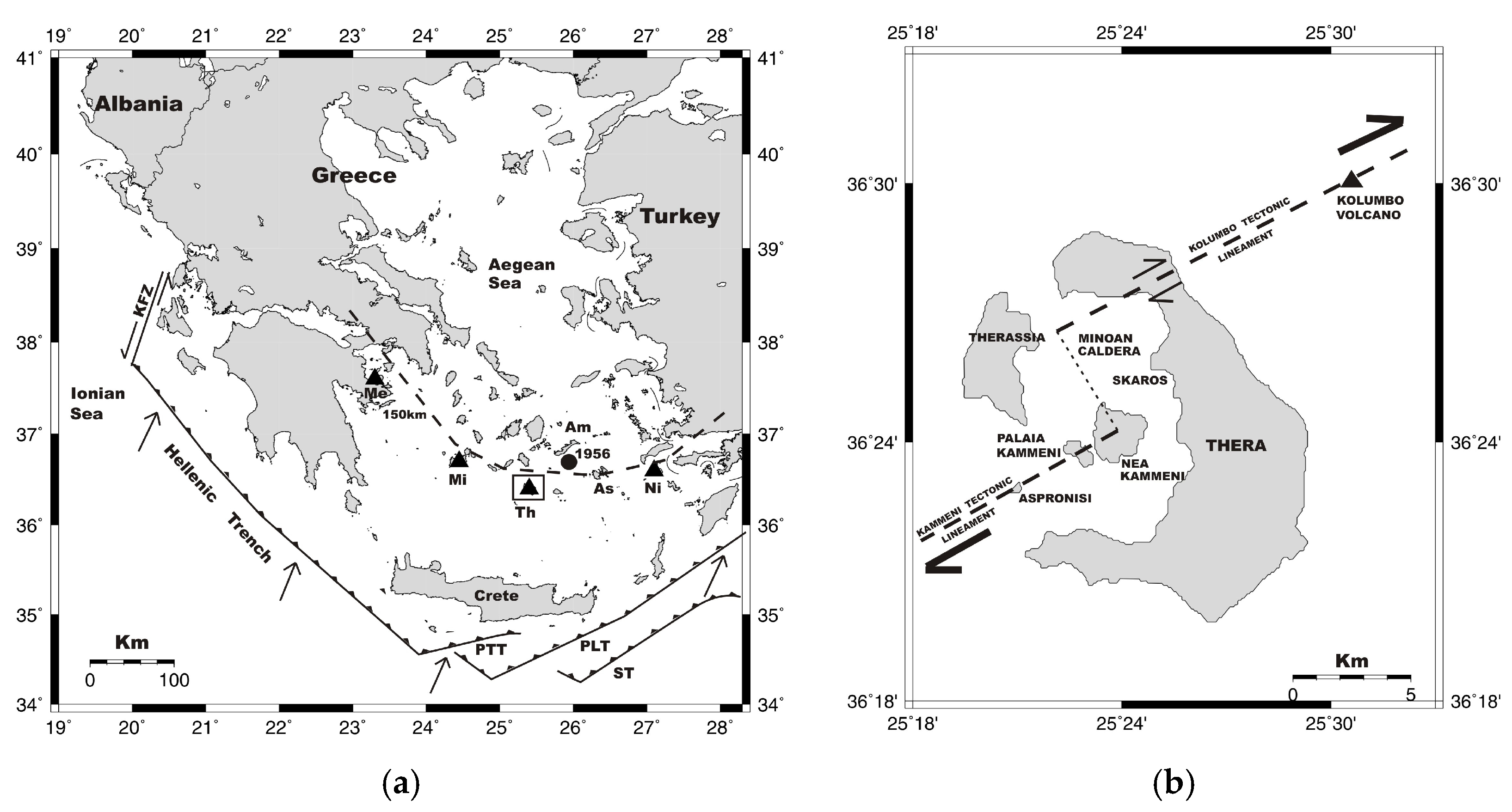
The volcano of Thera (Santorini) in the South Aegean Volcanic Arc, Greece (Figure 1a), attracts great scientific interest, which was renewed after the intense seismicity cluster recorded in the area during 2024 and 2025 [1,2,3,4,5]. After the Plinian Late Bronze Age (LBA) or Minoan (~1613 BCE) caldera-forming eruption, e.g., [6,7], the volcano activated repeatedly with intra-caldera eruption episodes historically documented in 197 BCE, 19 CE, 46, 726, 1457–1458 (?), 1570 or 1573, 1707–1711, 1866–1870, 1925–1926, 1928, 1939–1941 and 1950 [6,8]. A well-documented powerful extra-caldera eruption took place in 1650 CE in the Kolumbo submarine volcano, which is situated about 7 km off northeastern Santorini, and constitutes a source of important future hazards [9].
Regarding the impact of the previous eruptions, from archaeological observations, it is inferred that the LBA eruption was catastrophic, e.g., [8]. It has been historically documented (see review in [9]) that the 1650 CE eruption and its associated phenomena, like earthquakes and tsunamis, caused serious damage and human victims. No human victims were reported because of the rest of the historical eruptions. The estimated probability for an eruption to occur in the next 20 or 50 years, starting from 2003, is as high as ~0.25 or ~0.55, respectively [10].
Today, the Santorini Island complex consists of Santorini, Therasia and Aspronisi, which are the three islands that remained after the great Minoan eruption (Figure 1b). They surround as a ring the submarine caldera, the diameter of which is 11 km in the N–S direction and 7.5 km in the W–E direction [8]. Lavas erupted within the caldera during historical times and formed the islands of Palaia (Old) Kameni (the Burned) and Nea (New) Kameni (Figure 1b).
Knowledge of historical eruptions is valuable for better understanding the volcano evolution as well as for the volcanic hazard assessment and forecasting. In this context, of particular interest is the eruption that reportedly occurred in 1570 or in 1573. Our knowledge about this eruption, however, remains limited since only a brief historical account is available, thus making doubtful even the year of occurrence. In the present brief report, a little-known manuscript, written about 18 years after the eruption, is presented and examined critically. The information contained in the manuscript enriches our knowledge about the eruption and the evolution of the volcano.
Figure 1.
(a) Geodynamic setting of the broad Aegean Sea region. The Mediterranean or Nubian lithosphere moves from about SW to NE and subducts beneath the Aegean Sea at the southern Eurasian plate margin along the Hellenic Trench system, e.g., [11]; PTT, PLT and ST represent the Ptolemy, Pliny and Strabo trenches, respectively. Arrows show the directions of lithospheric plate motions. There are five main volcanic centers (triangles) situated along the South Aegean Volcanic Arc above the sesmic isodepth of ~150 km: Methana (Me), Milos (Mi), Thera or Santorini (Th), Nisyros (Ni) and Kolumbo (for the last, see the position in Figure 1b). Box illustrates the study area shown in (b). To the northeast of Santorini, the 9 July 1956 large tectonic earthquake of Mw = 7.7 ruptured the submarine trough between the islands of Amorgos (Am) and Astypalaea (As). (b) Volcanotectonic sketch map in the area of Santorini volcano (modified from [12]).
2. Historical Materials and Research Methods
2.1. Earlier Reports on the 1570 or 1573 Eruption
Father Richard (1657) [13], a missionary who was in Santorini during the 1650 CE Kolumbo eruption, says: There is good number of old men on the island who claim that they saw with their own eyes an island neighboring ours formed by fire in the middle of the sea in year 1573 and for that it is called Mikri Kameni, i.e., the small burnt island, to distinguish it from the large Kameni, which is another island a little further away and which has three different times received the mediocre size that it now has. Kircher (1665) [14] recalled that Father Richard, during their meeting in Rome, narrated what he heard from old people in Santorini: The second island [Mikri Kameni], which is close to the other [Palea Kameni], was formed in 1570, with no less terror to Santorini [population], when it lasted for one year, as the Elders testify, who saw it with their eyes. In the middle of this small island, which was one slightly shaped, a large and deep pit is seen to this day. The previous accounts are similar, but the first placed the eruption in the year 1573 CE, while the second placed it in 1570 CE. Information about the eruption was repeated by several subsequent authors, e.g., [15,16,17,18]. In modern scientific reviews of the historical eruptions in Santorini, one may find the information that an eruption occurred either in 1570 or in 1573 CE [8,18] or from 1570 CE to 1573 CE [6].
All the previous authors derived information about the eruption from the local tradition. The same tradition is also included in a lengthy but valuable manuscript found in the nearby Naxos Island by the medical doctor J. Vouros. Part of the manuscript consists of a metrical description of the 1650 CE eruption written in Greek by a Santorinian eyewitness. The anonymous local author narrated the volcanic episode of 1650 CE up to its very end in December 1650 CE. This implies that the manuscript perhaps was written during the ongoing eruptive phenomena but very likely was completed after 1650 CE. The fragment of the manuscript reads as follows: In their time [of elder people] an island was born called Kameni; it is said that 80 years have passed since. Our parents experienced the events but neglected to write about them… This part of the manuscript published by Assopios [19] has so far been the only known documentary source regarding the local memory for an eruption that occurred about 80 years before 1650 CE. Comparing this fragment with the narration by Father Richard [13], one may observe that the latter added a little more information, which very likely was recollected from the memory of the local people.
2.2. A Little-Known Greek Manuscript of the 16th Century
The local tradition, however, has not been verified by other independent sources and, therefore, some critical issues are raised. Is the account reliable? What was the year of the eruption occurrence, 1570 CE, 1573 CE or other? How long did the eruption last? Is it possible to determine the main characteristics of the eruptive episode? Such questions cannot be answered on the basis of a brief account of local memory. Fortunately, our knowledge about this eruptive episode can be improved thanks to another Greek manuscript which we bring to light for consideration by the geoscientific community. The manuscript was found, copied, and published by Papageorgiou [20]. However, it has been neglected so far from the Greek volcanological literature.
The manuscript was found in the library of Tübingen, Germany, in the summer of 1879. In the relevant article [20], it is noted that in the margin of the manuscript, one may read: All these were handwritten in front of me by Mr Iakovos Miloitis from Patmos Isl. in Tübingen on 16 January 1588…The marginal note was written by Martin Crusius, who was a noted German hellenist. The author of the article publishing the manuscript [20] commented on the reliability of the manuscript and underlined that although no additional information is known about the manuscript’s author I. Miloitis, it seems that in general, he was an ignorant person. On the other hand, it was judged [20] that I. Miloitis was ingenious and observational, as one may conclude from his travelogue. The profession of I. Miloitis remains unknown, but there is no doubt that he traveled in Greece, in Middle East and in European countries. We may assume that he kept a diary during his travels. At all indications, the author of the manuscript visited the Santorini Island complex soon after the eruption, which implies that his account should be considered as trustworthy.
The passage of the travelogue, which is relevant to the Santorini eruption, reads as follows with short comments inserted as [comment] by me: In the Archipelago there was an island named Santorini, which had three castles with only Greek population. In that time, in year 1572, the Turks were fighting against Venetia [it refers to the fourth Ottoman–Venetian War, 1570–1573]. Near Santorini there was another small island [Palaia Kameni]. Between the large island [Santorini] and the small one, fire, smoke and stones were coming out from the sea, and that was rising. There was unpleasant smell [sulfurous gases?] because of the smoke, and excessive heat due to the fire. Because of the heat all the vineyards and the sowing in the island were destroyed. The people left the island and went to Naxos Isl. and in other islands. Stones were floating on the sea, and the waves brought them as far as to Thessaloniki and Constantinople and in other localities. After all these [events] the fire and smoke disappeared suddenly. From the [rising] stones a small island was built [Mikri Kameni] close to the other small island; it is visible until today. In this new island the people tie the ropes of their boats.
2.3. Volcanic Landscape After the 1572 Eruption
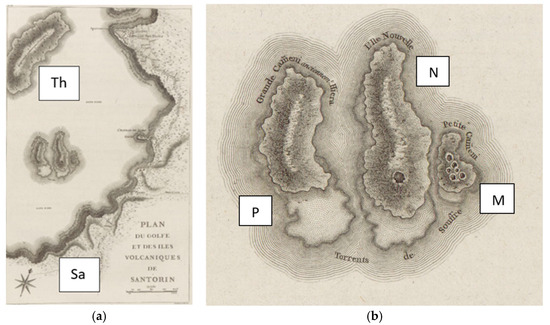
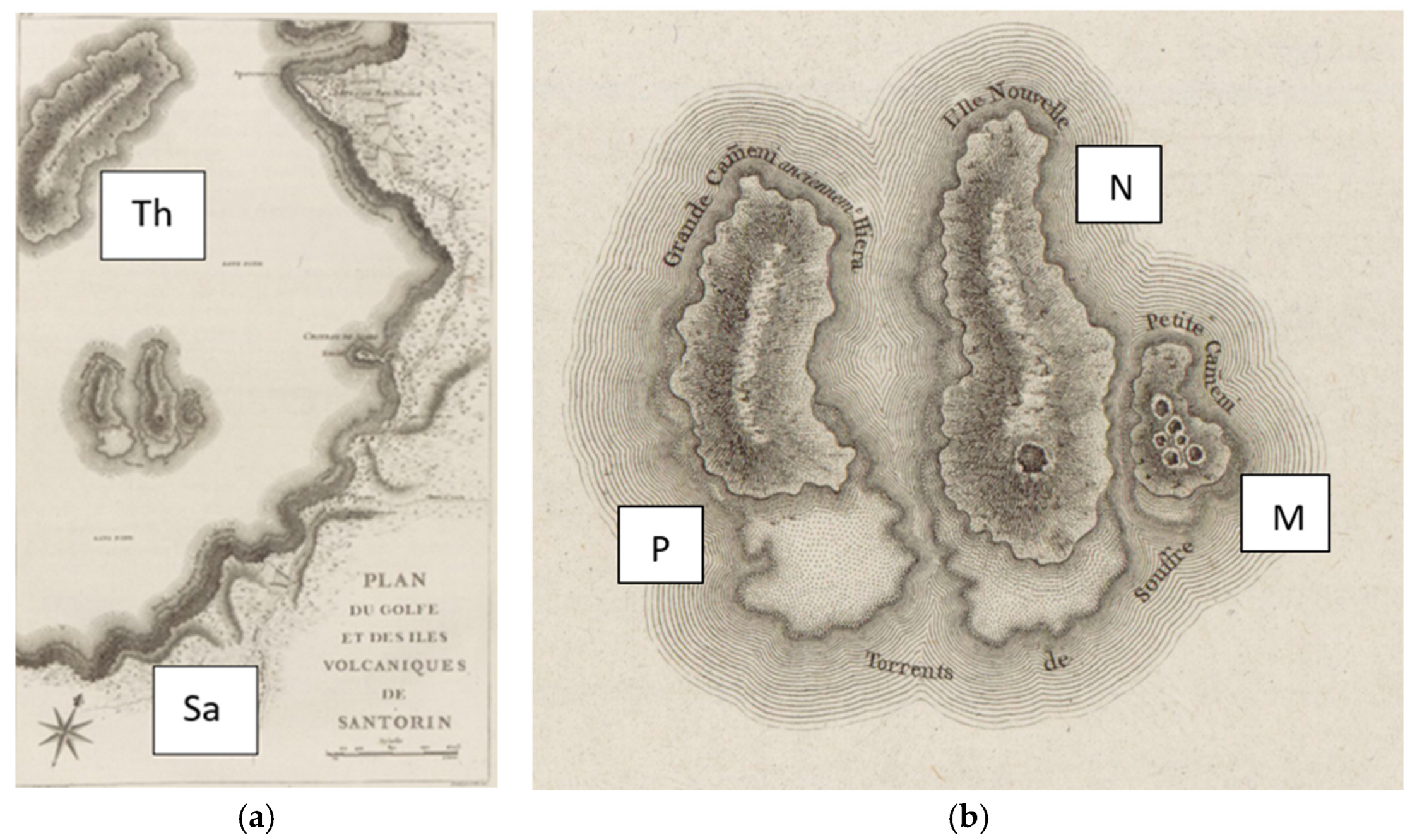
To better document the volcanic landscape configuration after the 1572 eruption, we investigated maps showing the Santorini Island complex in the late 16th and the 17th centuries. Several maps can be found in relevant collections, e.g., [21]. However, many are inaccurate and/or not detailed enough. A map satisfying the needs of our investigation is the one published in 1782 by Comte de Choisel-Gouffier [22], a French diplomat who travelled in the Greek islands. In the authority of Father Richard [13], that author dated the eruption in 1573 CE. The map in Figure 2a illustrates part of the caldera enclosed by the islands of Santorini to east side and of Therasia to the west. In the middle, within the caldera, there is a group of smaller islands, the Large (or Palaia) Kameni, the Nea Kameni, as it was shaped after the 1707–1711 eruptive phase, and the Mikri Kameni, which was born with the 1572 eruption (Figure 2b). As noted by Comte de Choisel-Gouffier [22], Mikri Kameni was built by volcanic material coming out from six craters as illustrated in Figure 2b. Mikri Kameni was of ~600 m in length and of ~250 m in width in the N–S and E–W directions, respectively. The landscape illustrated in Figure 2a,b is consistent with the description in the Greek manuscript that the 1572 eruption took place between Santorini and Palaia Kameni. It is noteworthy that Nea Kameni was not existent in 1572.
Figure 2.
(a) Landscape in the central part of Santorini caldera as illustrated in 1782 by [22]. The landscape is dominated by the islands of Santorini (Sa) and Therasia (Th) situated at the east and west sides, respectively. In between, three smaller islands are shown. (b) The three islands are illustrated in detail. At the west side, the large (or Palaea, P) Kameni is shown, while at the east, the small Mikri (M) Kameni, born by the 1572 eruption, is situated. Six craters are clearly seen on that island. Between the two, the Nea (N) Kameni is shown, which was born after subsequent eruptions starting in 1707 CE.
3. Results
From the Greek manuscript published by Papageorgiou [20], we learn many details about the eruption.
3.1. Date of the Eruption
Because of doubt in dating, some authors considered that the eruption took place in 1570 CE or in 1573 CE [8,22] or from 1570 CE to 1573 CE [6]. However, the 16th century manuscript makes clear that the eruption occurred during the year 1572 CE. The duration of the eruption remains uncertain; possibly it was ~1 year [14]. Although there is no relevant information in the Greek manuscript, we may suggest that the eruption was not short, e.g., of only a few days. This is since the eruption affected the local cultivations, like vineyards and sowing, and forced people to leave Santorini, going to Naxos and other islands. That the eruption affected vineyards and sowing should allow the timing of the event to be narrowed down to the spring–summer season. On the other hand, abrupt termination of the eruption is noted in the Greek manuscript.
3.2. Place of the Eruption
According to the manuscript, the volcanic center activated with the 1572 eruption was situated within the caldera between the main island of Santorini and Palaia Kameni. Mikri Kameni, i.e., the small volcanic island born by that eruption, was placed to the east of Palaia Kameni. Between the two, the Nea Kameni was formed by subsequent eruptions from 1707 onwards. The Mikri Kameni and Nea Kameni united during the eruptive episode of 1925–1926 [8].
3.3. Volcanic Features
Τhe 1572 eruption was violent enough, as we may conclude that fire, smoke and stones came out during the episode as well as from the formation of the new island of Mikri Kameni, which implies lava ejection. The Greek manuscript says also that there was an unpleasant smell because of the smoke, which is an indication of sulfurous gases. A detailed enough map, published by another author [22] in the late 18th century, clearly shows a cluster of six craters existing on Mikri Kameni (Figure 2b). The description of floating stones drifted away by the sea at large distances as far as Thessaloniki and Constantinople leaves no doubt that the volcanic material was pumice like previous Santorini eruptions, e.g., 726 CE. From the little information available before the study of the Greek manuscript presented here, the Volcanic Explosivity Index (VEI) of the eruption was tentatively estimated at 3 [10]. The information which is provided by the manuscript supports the estimation (VEI 3).
4. Conclusions
The Greek manuscript by the traveler Ioannis Miloitis dated 1588 is a valuable document, since it is the only written source which provides plenty of information about the eruption. From that document, we learn that the eruption occurred in 1572 CE within the caldera between the islands of Santorini and Palaia Kameni. Fire, smoke and stones came out from six craters. The ejected lava gave birth to the small island of Mikri Kameni very close to the place the New Kameni was formed after 1707 CE. The 1572 eruption caused destruction to cultivated lands in Santorini and forced the local people to move to other islands. Pumice and possibly ash drifted away by the sea waves at large distances.
Funding
This research received no external funding.
Data Availability Statement
The original contributions presented in this study are included in the article. Further inquiries can be directed to the corresponding author.
Acknowledgments
Figure 1 was constructed with the use of GMT v.5 software [23].
Conflicts of Interest
The author declares no conflicts of interest.
References
- Triantafyllou, I.; Papadopoulos, G.A.; Siettos, C.; Spiliotis, K. Real-Time Foreshock–Aftershock–Swarm Discrimination During the 2025 Seismic Crisis near Santorini Volcano, Greece: Earthquake Statistics and Complex Networks. Geosciences 2025, 15, 300. [Google Scholar] [CrossRef] [Scilit]
- Briole, P.; Ganas, A.; Serpetsidaki, A.; Beauducel, F.; Sakkas, V.; Tsironi, V.; Elias, P. Volcano-tectonic interaction at Santorini. The crisis of February 2025. Constraints from geodesy. Geophys. J. Internat. 2025, 242, ggaf262. [Google Scholar] [CrossRef] [Scilit]
- Papazachos, C.; Foumelis, M.; Bitharis, S.; Pikridas, C.; Trasatti, E.; Papageorgiou, E.; Ventouzi, C.; Kkallas, C.; Vougioukalakis, G.; Vaselli, O. The Santorini 2024–2025 volcano-tectonic sequence: Constraining the initial phase of the intra-caldera unrest. Geophys. Res. Lett. 2025, 52, e2025GL115856. [Google Scholar] [CrossRef] [Scilit]
- Fountoulakis, I.; Evangelidis, C.P. The 2024–2025 seismic sequence in the Santorini-Amorgos region: Insights into volcano-tectonic activity through high-resolution seismic monitoring. Seismica 2025, 4, 1–9. [Google Scholar] [CrossRef] [Scilit]
- Isken, M.P.; Karstens, J.; Nomikou, P.; Parks, M.M.; Drouin, V.; Rivalta, E.; Crutchley, G.J.; Haghighi, M.H.; Hooft, E.E.E.; Cesca, S.; et al. Volcanic crisis reveals coupled magma system at Santorini and Kolumbo. Nature 2025, 645, 939–945. [Google Scholar] [CrossRef] [Scilit] [PubMed]
- Friedrich, W.L. Fire in the Sea; Cambridge University Press: Cambridge, UK, 2000; p. 258. [Google Scholar]
- McCoy, F.W.; Heiken, G. The Late-Bronze Age explosive eruption of Thera (Santorini), Greece: Regional and local effects. In Volcanic Hazards and Disasters in Human Antiquity; McCoy, F.W., Heiken, G., Eds.; Geological Society of America: Boulder, CO, USA, 2000. [Google Scholar] [CrossRef] [Scilit]
- Georgalas, G.C. Catalogue of the Active Volcanoes of the World Including Solfatara Fields; Part XII-Greece; International Volcanological Association: Rome, Italy, 1962; pp. 1–40. [Google Scholar]
- Tadini, A.; Cerminara, M.; Paris, R.; Neri, A.; Sparks, R.S.J.; Vougioukalakis, G.; Koutroulli, A.; Calusi, B. Scenario-based tsunami hazard assessment at Kolumbo submarine volcano. Bull. Volcanol. 2025, 87, 52. [Google Scholar] [CrossRef] [Scilit]
- Papadopoulos, G.A.; Orfanogiannaki, K. Long-term prediction of the next eruption in Thera Volcano from conditional probability estimates. In Developments in Volcanology; Fytikas, M., Vougioukalakis, G.E., Eds.; The South Aegean Active Volcanic Arc: Present Knowledge and Future Perspectives, Elsevier Book Series; Elsevier: Amsterdam, The Netherlands, 2005; Volume 7, pp. 211–216. [Google Scholar]
- Bocchini, G.M.; Brüstle, A.; Becker, D.; Meier, T.; van Keken, P.E.; Ruscic, M.; Papadopoulos, G.A.; Rische, M.; Friederich, W. Tearing, segmentation, and backstepping subduction in the Aegean: New insights from seismicity. Tectonophysics 2018, 734–735, 96–118. [Google Scholar] [CrossRef] [Scilit]
- McKoy, F.W. The eruption within the debate about the date. In Time’s Up! Dating the Minoan Eruption of Santorini-Acts of the Minoan eruption Workshop, Sandbjerg, November 2007, Initiated by J. Heinemeier & W.L. Friedrich; Warburton, D.A., Ed.; Monographs of the Danish Institute: Athens, Greece, 2009; Volume 10, pp. 73–90. [Google Scholar]
- Richard, F. Relation de ce qui s’est passé de plus remarquable a Sant-Erini isle de l’Archipel, Depuis l’établissement des Peres de la Compagnie de Jesus en icelle. Avec la declaration de plusieurs choses memorables touchant le rit et la creance des Grecs de ce temps, et touchant les feux sous-terrains qui sortirent du fond de la mer l’an 1650 avec plusieurs prodigies. 1657, Paris, XXVI, 408–426. Available online: https://anemi.lib.uoc.gr/metadata/0/f/8/metadata-168-0000007.tkl (accessed on 1 August 2025).
- Kircher, A. Mundus Subterraneus; Jansson, J., Weyerstraet, E., Eds.; J. Jansson & E. Weyerstraet: Amsterdam, The Netherlands, 1665. [Google Scholar]
- Ross, L. Reisen auf den Griechischen Inseln des Ägäiachen Meeres; JG Cotta: Stuttgart, Germany, 1840; Volume 1. [Google Scholar]
- Pègues, M. Histoire et Phénomènes du Volcan et des Iles Volcaniques de Santorin; L’ Imprimerie Royale: Paris, France, 1842; p. 667. [Google Scholar]
- Fouqué, F. Santorin et Ses Éruptions; Masson & Cie: Paris, France, 1879. [Google Scholar]
- Ambraseys, N.N. Earthquakes in the Mediterranean and Middle East, A Multidisciplinary Study of Seismicity up to 1900; Cambridge University Press: Cambridge, UK, 2009; p. 947. [Google Scholar]
- Assopios, E. Το peri Santorinis Chirografon (A manuscript about Santorini). Attik. Imerologion 1879, 13, 130–172. (In Greek) [Google Scholar]
- Papageorgiou, S.K. Odiporikon Iakovou Miloiti (Travelogue by Iakovos Miloitis). Parnassos 1882, 6, 632–642. (In Greek) [Google Scholar]
- Sphyroeras, V.; Avramea, A.; Asdahas, S. Maps and Map-Makers of the Aegean; Olkos Ltd.: Athens, Greece, 1985; p. 263. [Google Scholar]
- Comte de Choisel-Gouffier, M. Voyage Pittoresque de la Grèce; Paris J.J. Blaise: Paris, France, 1782; Volume 1. [Google Scholar]
- Wessel, P.; Smith, W.H.F.; Scharroo, R.; Luis, J.; Wobbe, F. GMT 5: Generic Mapping Tools: Improved Version Released. EOS Trans. Am. Geophys. Union 2013, 94, 409–410. [Google Scholar] [CrossRef] [Scilit]
Disclaimer/Publisher’s Note: The statements, opinions and data contained in all publications are solely those of the individual author(s) and contributor(s) and not of MDPI and/or the editor(s). MDPI and/or the editor(s) disclaim responsibility for any injury to people or property resulting from any ideas, methods, instructions or products referred to in the content. |
© 2025 by the author. Licensee MDPI, Basel, Switzerland. This article is an open access article distributed under the terms and conditions of the Creative Commons Attribution (CC BY) license (https://creativecommons.org/licenses/by/4.0/).