


Abstract
The mechanization of wheat harvesting in Egypt is a critical step towards enhancing food security. This study evaluated the operational performance, grain loss, and economic viability of four wheat harvesting systems for the ‘Sakha 95’ variety in the Nile Delta. To evaluate and rank the different systems based on multiple criteria, the Technique for Order of Preference by Similarity to Ideal Solution (TOPSIS) was employed. A Randomized Complete Block Design (RCBD) with three replicates was used to test three self-propelled combine harvesters (Claas [4.2 m], Field-King [2.0 m], Daedong [1.4 m]) alongside one semi-mechanized system (reaper–binder + stationary thresher). The TOPSIS analysis identified the Field King combine as the most recommended system (Rank 1), providing the optimal balance between operational efficiency and cost. It achieved the lowest direct harvesting cost (3386.66 EGP ha−1) with a minimal grain loss of only 0.05%. The Claas combine secured Rank 2. While it reached the highest effective field capacity (1.18 ha h−1) and near-total grain recovery (0.005% loss), its ranking was influenced by its high initial purchase price and fuel consumption. The reaper–binder system (Rank 3) and Daedong combine (Rank 4) followed. Despite having the highest operational cost (7371.42 EGP ha−1) and higher grain losses (0.72%), the reaper–binder remains a scientifically justified choice for integrated crop-livestock systems, as its ability to produce ready-to-use “soft straw” provides a net economic advantage for smallholders. The study concludes that while large combines are ideal for the “New Lands,” mid-sized units like the Field King are best suited for scaling through cooperatives in fragmented landscapes.
1. Introduction
Wheat (Triticum aestivum L.) is the most important grain crop in Egypt, and grains are, in turn, the most important crop group. Wheat represents almost 10% of the total value of agricultural production and accounts for about 20% of all agricultural imports. Egypt is also the world’s biggest wheat importer, and the General Authority for Supply Commodities (GASC) of the Ministry of Supply and Internal Trade of Egypt (MoSIT) alone is the world’s biggest wheat purchaser. It is thus understandable that wheat is a product of paramount importance to Egypt and wheat policy is a priority for the government. This perennial supply-demand gap, exacerbated by rapid population growth and global market volatility, underscores the critical need to maximize domestic output while minimizing harvest and post-harvest losses [1,2].
Based on 2023 published data [3], Egypt ranks first globally for wheat productivity under irrigated, spring wheat conditions, with a potential yield exceeding 7.5 t ha−1. However, despite this potential and the significant scale of its agricultural efforts, with a total cultivated area of 1.5 million hectares, Egypt faces a critical supply-demand imbalance [4]. The country’s total wheat production recently reached approximately 10.0 × 10⁶ t; however, this is critically overshadowed by a substantial total consumption estimated at 20.6 × 10⁶ t. This disparity results in a remarkable wheat gap of 10.6 × 10⁶ t, solidifying Egypt’s dependence on global markets to meet its national food security needs and creating a persistent supply-demand gap.
To sustainably narrow such a gap, efforts must focus on both maximizing output and minimizing losses. A critical strategy is the enhanced adoption of agricultural mechanization [5], which is vital for two reasons: yield gap closure and loss reduction. While modern, efficient machinery for operations like land preparation and precision planting is scientifically proven to optimize resource use and help farmers bridge such a considerable yield gap [5] even though it fosters dependence on fossil fuel consumption [6], mechanization is equally crucial for reducing post-harvest losses, which are estimated to be as high as 20.6% of the total supply along the entire value chain. The use of modern, high-efficiency combine harvesters and updated handling systems reduces physical grain loss and secures a greater volume of the harvested crop [7].
Agricultural mechanization has a clear positive impact on agricultural development. Farmers’ use of mechanization demonstrates their decision to develop agriculture; besides that, agricultural mechanization improves the quality and variety of agricultural products [8,9]. However, although mechanization aligns with prevailing agricultural trends, specialized machinery is not always immediately available for new crops or systems owing to underdeveloped value chains. Developing such dedicated technology demands substantial incentives and entails high costs, often requiring adaptations of existing mechanical solutions to novel agronomic practices [10,11].
The adoption of agricultural mechanization services has significantly boosted production. Moreover, as agricultural modernization accelerates, examining the effects of these services on production technology efficiency has emerged as a critical issue for enhancing productivity and fostering sustainable development. For instance, targeted mechanization strategies can shorten crop cycles, thereby enabling double-cropping systems and bolstering the overall resilience of production systems [12]. Furthermore, implementing specific mechanization strategies can effectively reduce the crop cycle length, thereby offering new opportunities for double-cropping systems and increasing the overall resilience of the production system [13].
There is an urgent need to establish standards and foundations for defining agricultural machinery and a pathway for delivering Sustainable Agricultural Mechanization (SAM) technologies to smallholder families. This gap justifies the study’s aim to analyze and propose criteria for AM selection through the linkage of farm scale, machine size, farming system, and productivity [14]. At the same time, the wheat harvesting stage represents one of the most critical points in the Egyptian wheat value chain, where mechanization is widely used but still affected by major inefficiencies. The current harvesting landscape relies on a heterogeneous mix of equipment—from high-capacity combines to decentralized reaper–thresher systems—resulting in inconsistent performance, elevated grain losses, and difficulties in standardizing operations. These challenges are exacerbated by the predominance of small, fragmented landholdings, which hinder machinery allocation, lower field efficiency, and limit the economic feasibility of large-scale equipment. Maximizing recovery from the field is no longer just an economic issue for the farmer but a strategic imperative for the state. Thus, the central mechanization problems that require urgent solutions include (i) the lack of clear criteria for selecting appropriate harvesting machinery, (ii) the mismatch between machine capacity and field size, (iii) high operating and ownership costs, and (iv) the absence of performance benchmarks for different harvesting systems. The process of full mechanization in Egyptian agriculture has been uneven, and the wheat harvesting process is a prime example. Field operations are characterized by a multiplicity of disparate mechanical systems (from fully integrated combines to decentralized reaper-thresher combinations), which presents a major challenge in standardization and efficiency. Furthermore, the inherent structure of Egyptian agriculture, dominated by small landholdings and highly fragmented farms, adds complexity to machinery management decisions [15]. The main factors for the wrong and unsuitable choice of tractors and farm machinery are the shortage of basic information about them and the agricultural farms. The key to the basic information depends on the requirements of power per feddan, machine size and finally the machinery costs [16].
While existing literature has extensively documented the individual technical parameters of various harvesters, there is a significant lack of integrated decision-making frameworks that simultaneously evaluate technical, economic, and socio-economic factors—such as straw recovery for livestock—within the specific context of fragmented Nile Delta smallholdings [17]. Most studies focus on a single performance metric (e.g., grain loss), failing to provide a holistic ‘optimal selection’ model for farmers and policymakers [18].
Achieving an efficient, cost-effective harvest is therefore a decision of great consequence, as the chosen method directly impacts profitability, resource utilization, and national output metrics. The decision of machinery selection falls under the discipline of Farm Machinery Management, a systematic approach aimed at optimizing equipment size, type, and operation to ensure timely completion of tasks at the lowest possible total cost [19]. This optimization process hinges on two primary evaluation criteria: economic feasibility and technical performance. The economic viability of any mechanized system is determined by its total operating cost, which comprises both fixed (ownership) costs and variable (operating) costs. Fixed costs (depreciation, interest, insurance, housing) are incurred regardless of machine use, while variable costs (fuel, oil, repairs, labor) fluctuate directly with the intensity of use. In the context of the Egyptian market, fluctuating fuel subsidies and the high initial capital outlay for imported machinery make the depreciation and repair and maintenance components the most important factors influencing total cost [20]. In this context, the present study is designed as a comparative conceptual analysis of four wheat harvesting systems, focusing on their typical technical characteristics, operational performance, and cost structures rather than on a full characterization of real farm conditions or mechanization-transition dynamics. This conceptual framing allows for a standardized, system-level comparison that isolates the intrinsic performance of each harvesting approach, independent of broader farm-level variability.
The original contribution of this study lies in its shift from traditional, single-metric evaluations—which often focus exclusively on grain loss—toward a holistic, multidimensional decision-making framework. Conducted within the framework of the EU-KAFI Project, this research applies the Technique for Order of Preference by Similarity to Ideal Solution (TOPSIS) to rank harvesting systems based on their total value proposition. By simultaneously weighing technical performance, operational costs, and socio-economic factors such as straw recovery for livestock, this approach reconciles the high-capacity efficiency of industrial machinery with the survival strategies of small-scale, integrated crop-livestock systems. Ultimately, this study provides a scientifically grounded and replicable model for Sustainable Agricultural Mechanization (SAM) in developing economies characterized by fragmented landholdings.
2. Materials and Methods
2.1. Experimental Field
The field experiment was conducted during the 2024/2025 agricultural season at the Farm of the Rice Mechanization Center (RMC) in Meet Diba, Kafr El-Sheikh Governorate, Egypt (31°06′47″ N, 30°50′44″ E), located in the Nile Delta.
The trials focused on the bread wheat crop (Triticum aestivum L., var. Sakha 95) that had been managed according to standard regional practices. Table 1 presents the physicochemical characteristics of the Sakha 95 variety at harvest.
Table 1.
Characteristics of the Sakha 95 wheat variety at harvest.
2.2. Tested Harvesting System
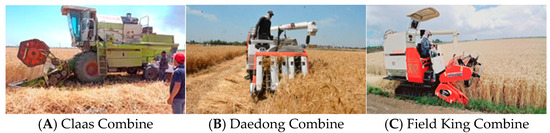
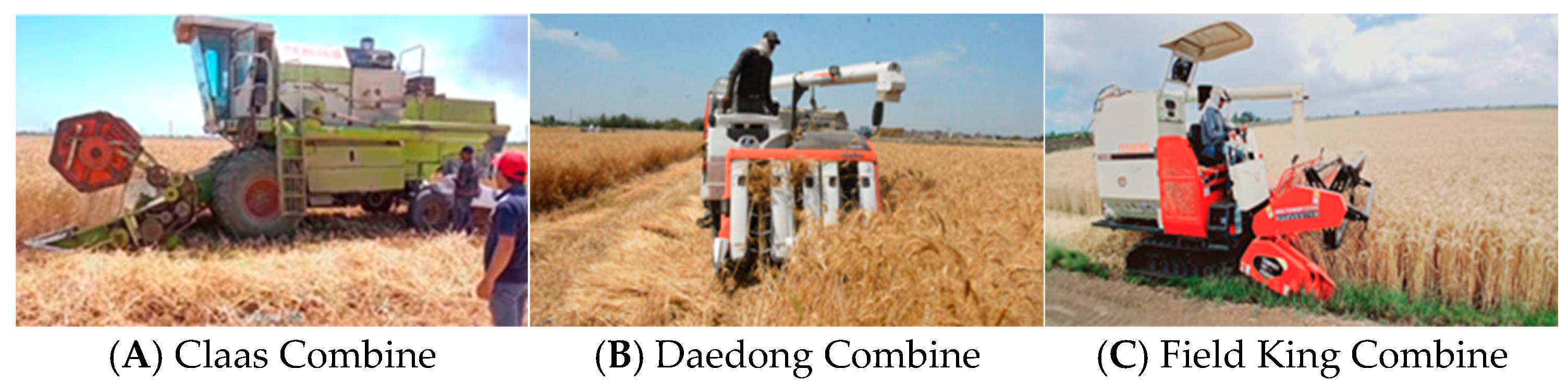
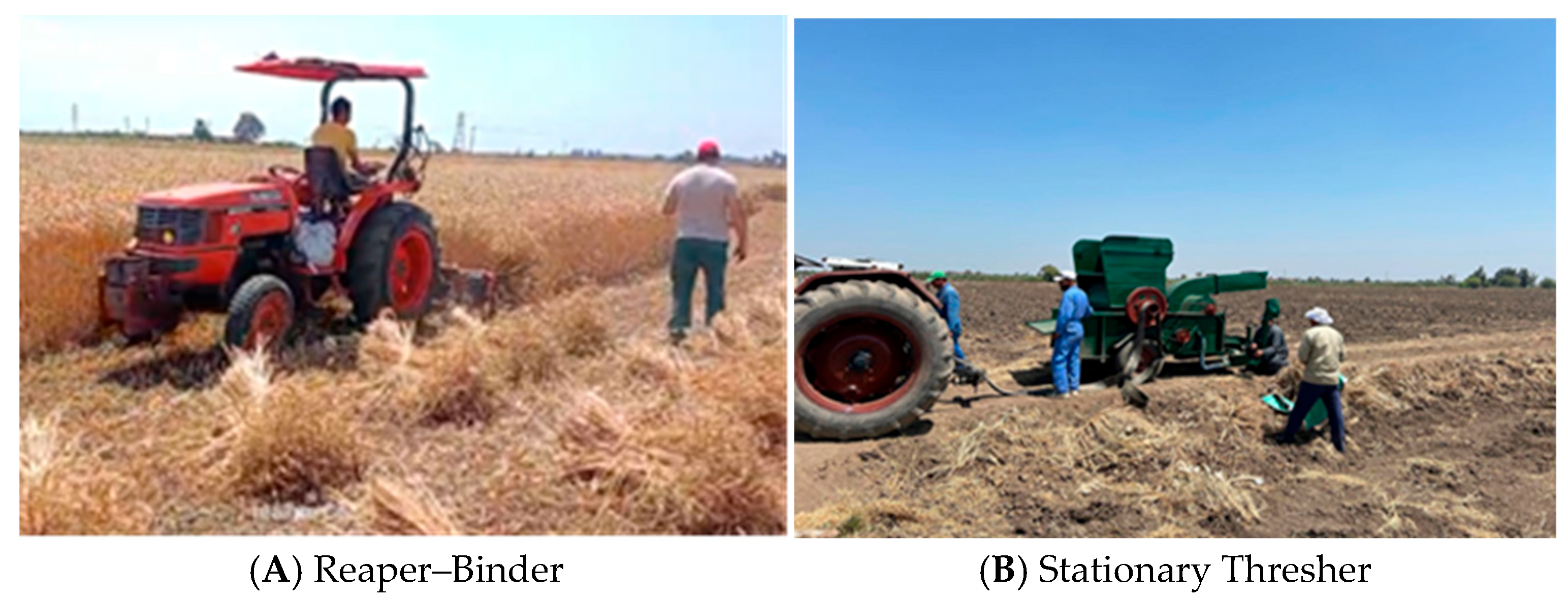
A system-level approach was applied to compare four harvesting configurations, illustrated in Figure 1 and Figure 2, each representing a distinct level of mechanization commonly used in Egypt. The evaluation encompassed three fully mechanized systems and one semi-mechanized system, assessing their operational efficiency and associated costs:
Figure 1.
First, second and third wheat harvesting systems: (A) Claas combine, (B) Daedong combine and (C) Field-King combine.
Figure 2.
The semi-mechanized system: (A) reaper–binder and (B) stationary thresher.
- Claas (CLAAS KGaA mbH, Harsewinkel, Germany) combine: A high-capacity conventional combine harvester equipped with a 92 kW engine and a 4.2 m cutting header. Such a system is designed for high-capacity field operations and is suitable for handling substantial biomass volumes under varying field conditions.
- Daedong combine (DAEDONG CORPORATION, Daegu, South Korea): A small-scale, compact harvester with a 53.7 kW engine and a 1.4 m cutting header, originally designed for rice cultivation. Such a small-scale machine features compact dimensions and high maneuverability, making it suitable for operations in narrow or spatially constrained environments.
- Field King Combine (BERI UDYOG PVT. LTD., Karnal, India): A medium-scale machine with a 73 kW engine and a 2.0 m cutting header. This medium-scale machine offers an intermediate solution between small, highly maneuverable combines and large, high-capacity units. Its cutting width and power output make it suitable for wheat harvesting in field conditions where moderate throughput is required without sacrificing operational flexibility.
- Semi-mechanized system: A two-stage harvesting system consisting of a tractor-mounted reaper–binder (MX5000, 37.3 kW, Kubota Corporation, Osaka 556-8601, Japan) followed by a stationary thresher (El-Kamal). In the first stage, the reaper–binder cut the wheat and simultaneously formed tied bundles, allowing efficient harvesting in conditions where full-scale combines may be impractical. The bundles were then manually collected and transported to the stationary thresher, where grain separation was performed. This configuration represents an intermediate mechanization level, combining mechanized cutting with manual handling and stationary processing.
2.3. Experimental Design and Pre-Harvest Test
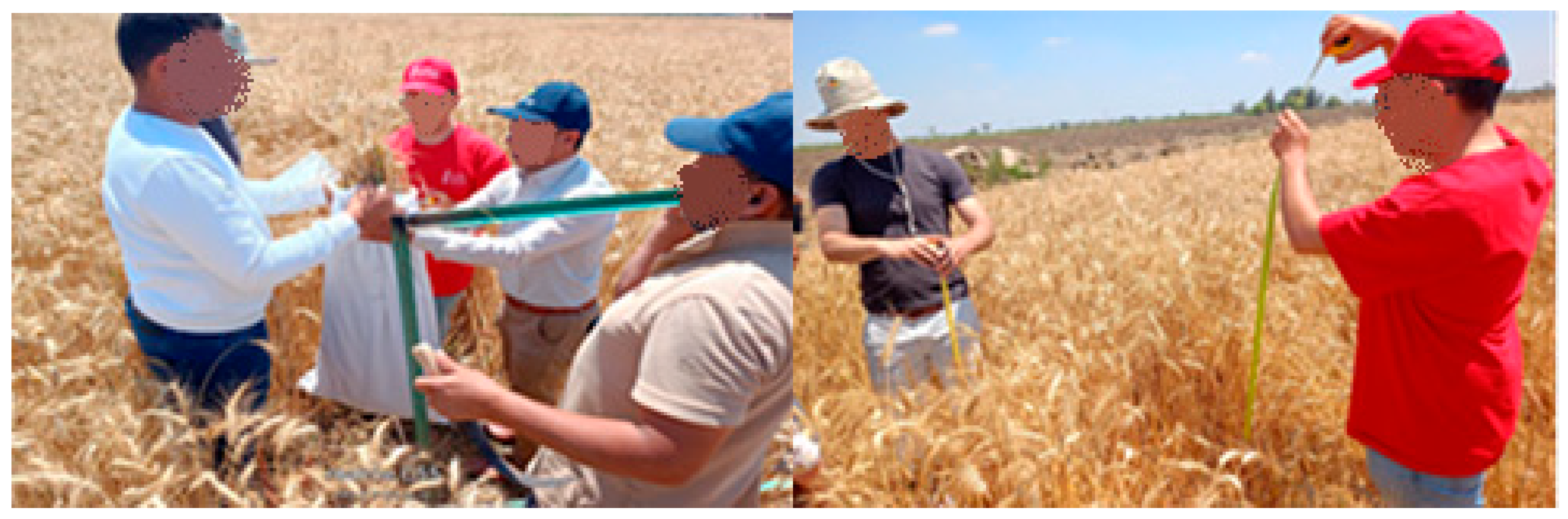
The experiment was structured as a Randomized Complete Block Design (RCBD) with three replications (n = 3) per system. To establish the Potential Seed Yield (PSY) and account for initial field variability, three 1 m2 square quadrats (Figure 3) were randomly placed within each experimental plot prior to harvesting. These quadrats were used to assess overall aerial biomass, plant density (plants m−2), and moisture content. This sampling intensity was chosen to balance the need for representativeness with the need to minimize the impact of destructive sampling on the remaining plot area designated for final yield determination. All plants from each plot were harvested, closed in sealed bags and transferred to the laboratory of the Rice Mechanization Center (RMC) for the assessments. Specifically, dry weight and moisture content were estimated according to EN ISO 18134-2:2017 [21], while PSY was measured by hand threshing.
Figure 3.
Selecting sampling quadrats during pre-harvest procedures.
2.4. Evaluation of the Harvesting Performance
Harvesting performance and cost analysis of the different crops under evaluation were assessed using the parameters and methodology suggested by Reith et al. (2017) and Pari et al. (2013) [22,23], namely: theoretical and effective field capacity, field efficiency and fuel consumption. In particular, theoretical and effective field capacity (ha h−1) and field efficiency (%) were calculated according to ASABE Standards [24] (Equations (1)–(3)).
Theoretical Field Capacity (Th.FC, ha h−1): Represents the maximal possible field capacity achieved at the set field speed when using the full operating width of the machine. It was calculated as follows in Equation (1):
where W is the effective working width (m) and F is the forward speed (km h−1) of the machine.
Effective Field Capacity (EF.FC, ha h−1): Measured using the refill method, which involves topping up the fuel tank before and after harvesting a known area. It was calculated based on the effective working width of the machine and the time required to harvest the measured area, including turning and minor adjustments, as shown in Equation (2):
where A is the area harvested (ha) and Teff is the effective time (h).
Field Efficiency (FEff, %): Defined as the ratio of effective to theoretical field capacity (Equation (3)):
Fuel Consumption (L ha−1): Measured using the refill method, which involves topping up the fuel tank before and after harvesting a known area.
2.5. Crop Yield and Seed Losses Evaluation
Crop yield was assessed by weighing all the total harvested seed mass per treatment plot. Total Harvesting Losses (%) were quantified as the sum of pre-harvest, header, and machine (threshing/separating) losses following the method outlined by Hassan et al. [12] (Equations (4) and (5)).
Pre-harvest Losses (LP, %): Pre-harvest losses (grains shattered and dropped before harvesting) were determined by weighing grains collected from ten random 1 m2 plots in the standing crop before harvesting and were calculated using Equation (4):
Header Losses (LH, %): The losses attributed solely to the header mechanism were then calculated by subtracting the LP from the measured cutter-bar losses (LC), as per Equation (5).
The LC (i.e., the weight of the grains left on the ground immediately after the machine passed, including kernels and uncut materials) resulted from sub-sampling three 1 m2 zones inside the harvested area for each harvesting treatment and referring it to the total yield.
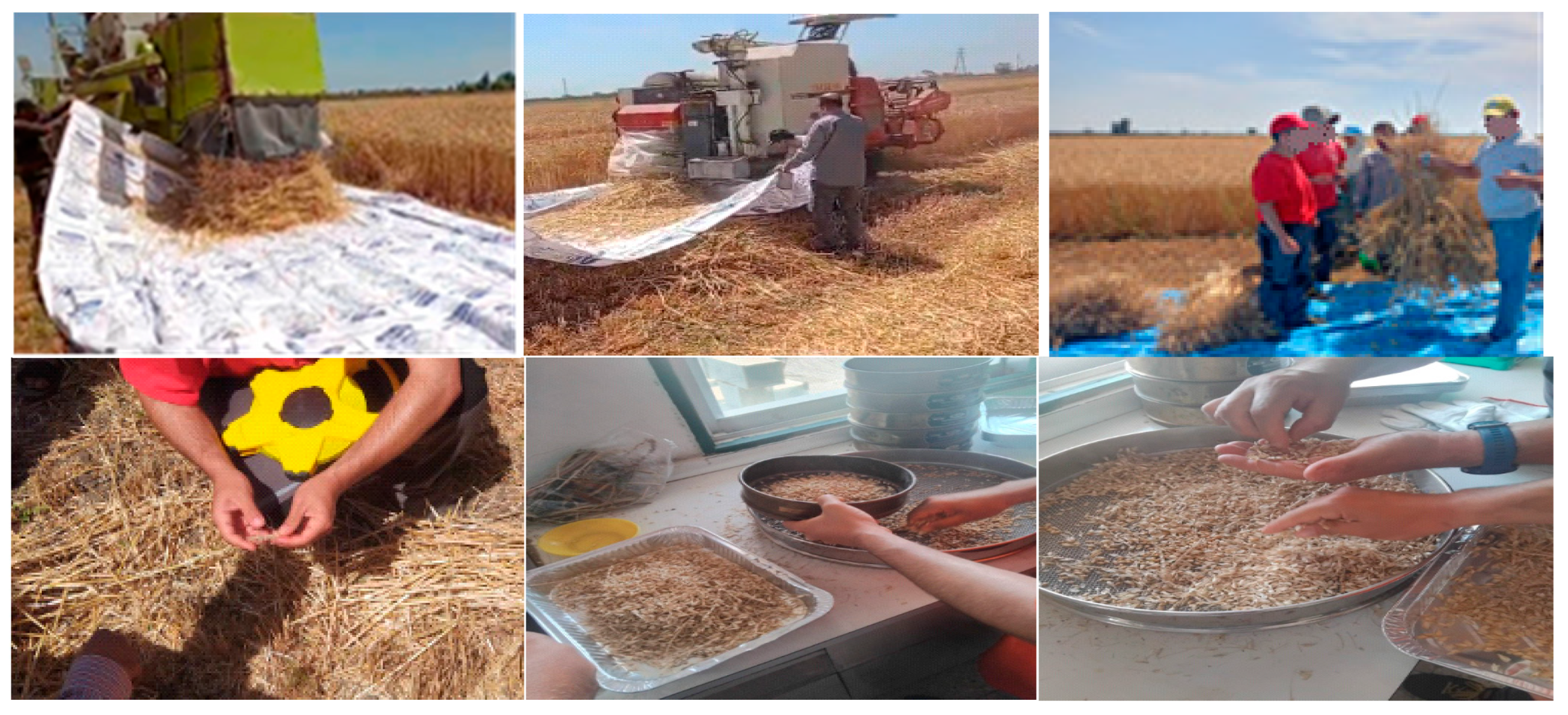
Machine Losses (LM, %): Machine losses (threshing and separating loss) refer to the grains discharged with the straw and chaff. Its assessment foresaw the attachment of a tarpaulin to the rear of all the systems studied to capture all material expelled by the sieves and straw walkers within a 10 m advance. The seeds were separated, weighed, and normalized by the harvested area (Header Width × 10 m). The main phases of the seed loss determination process are depicted in Figure 4.
Figure 4.
Overview of the Seed Loss Measurement Process.
2.6. Economic Analysis
The total operating cost (EGP ha−1) for each system was calculated as the sum of fixed and variable costs, following established agricultural engineering principles according to ASABE Standards [24]. Fixed costs included depreciation (straight-line method, 10% salvage value) and taxes, housing, insurance, and interest (THII, 15% of average annual investment). Variable costs included fuel, labor, and repair and maintenance (R&M, 50% of depreciation). The input parameters for the cost analysis are summarized in Table 2. Purchase cost of the machinery and labor wage were obtained by interviewing the contractor, while the values of economic life and working hours per year were taken from technical specifications. Values of effective field capacity and fuel consumption were obtained through the field tests. The total cost per hectare was derived by dividing the total machine cost per hour by the effective field capacity. To facilitate international comparison, the costs (EGP ha−1) can be converted using the average May 2025 exchange rate (1 EGP = 0.0199 USD) from the Central Bank of Egypt [25], providing a dollar value per hectare.
Table 2.
Parameters used for the economic cost analysis of the four harvesting systems. Parameters (2) and (3) rely on technical specifications of the machinery, whereas the remaining parameters are derived from case-specific calculations, as outlined in ASABE Standards [24], or by interviewing the contractor.
2.7. Data Processing and TOPSIS Analysis
All collected data were subjected to a one-way Analysis of Variance (ANOVA) using the JMP statistical software package standard version n° 7 (SAS Institute, Cary, NC, USA). Mean separation was performed using Tukey’s Honest Significant Difference (HSD) test at a 5% level of significance (α = 0.05) to identify the statistically significant differences among the four harvesting systems.
Furthermore, to synthesize the complex trade-offs between economic viability, operational performance, and agronomic efficiency, the Technique for Order of Preference by Similarity to Ideal Solution (TOPSIS) was also employed [26,27]. TOPSIS is a Multi-Criteria Decision Analysis (MCDA) method that ranks alternatives by identifying the solution closest to the Positive Ideal Solution (V+) and farthest from the Negative Ideal Solution (V−).
The analysis utilized 13 variables, categorized into Benefit Criteria (where higher values are desirable) and Cost Criteria (where lower values are desirable). This distinction is critical for accurate Euclidean distance calculation, ensuring that the “Ideal Best” solution minimizes waste and expenditure while maximizing throughput and efficiency (Table 3).
Table 3.
Categorization of variables for TOPSIS analysis based on objective directionality.
The selection of appropriate weights for each variable was performed using a Subjective Weighting Method (Expert Judgment), a standard approach in multi-criteria decision-making for agricultural machinery selection [28,29], This method was grounded in the outcomes of technical missions conducted within the EU-KAFI Project framework.
The expert panel consisted of the study’s nine co-authors, representing a multidisciplinary collaboration between the Agricultural Engineering Research Institute (Egypt) and CREA (Italy). The weight assignment was determined through a consensus-based approach, synthesizing data from field inspections and stakeholder consultations (farmers and Harvesting Service Station managers) across the Nile Delta [30].
These technical visits highlighted two primary drivers that defined the consensus:
- (a)
- The economic dependence of smallholders on wheat straw for livestock feed (prioritizing the ‘reaper–binder’ characteristics).
- (b)
- The operational constraints of fragmented ‘Old Lands’ (prioritizing maneuverability and low operational costs).
Consequently, the panel agreed upon the importance scores (scale 0–100) presented in Table 4, identifying ‘Seed Losses’ and ‘Total Cost’ as the dominant criteria for sustainable adoption.
Table 4.
Variable/criteria weights and contextual rationale used for TOPSIS analysis.
The weighting scheme translates qualitative stakeholder feedback into quantitative model inputs:
- −
- Critical Factors (wi ≥ 95): ‘Seed Losses’ and ‘Total Cost’ were assigned the highest values, reflecting the primary mission findings that food security and economic accessibility are the non-negotiable constraints for Egyptian smallholders.
- −
- High Importance Factors (wi ≈ 80–85): ‘Effective Field Capacity’ and ‘Field Efficiency’ were weighted heavily to address the operational bottlenecks observed during field tests in the Nile Delta.
- −
- Moderate/Low Factors: Technical specifications such as ‘Cutting Height’ were assigned lower weights (wi = 25) as they were deemed less critical to the immediate economic viability of the system.
To verify the robustness of these expert-assigned weights and ensure the reliability of the final ranking, the model was subsequently subjected to a sensitivity analysis, as detailed in Section 2.8.
2.8. Sensitivity Analysis and Model Stability
To evaluate the stability of the system rankings and mitigate the potential bias inherent in subjective weighting, a sensitivity analysis was performed. This involved testing the model’s responsiveness across four distinct weighting scenarios:
- (1)
- Baseline Scenario: Utilizing the original context-based weights of Table 4. It prioritizes reducing grain losses (wi = 100) and total operational costs (wi = 95) as the primary drivers of enhancing national food security and promoting mechanization among smallholder farmers.
- (2)
- Equal Weights Scenario: To eliminate the influence of subjective priorities, an “Equal Weights” model was implemented, assigning every variable a weight of 50. This scenario tests whether the superiority of the top-ranked alternative is due to the specific weighting scheme or is inherent to the machine’s underlying technical and economic data profile.
- (3)
- Economic-Centric Scenario (Cost-Constrained): This scenario simulates a decision-maker under extreme financial pressure. The weights for the primary financial barriers (i.e., purchase price and total cost) were set to 100, while the weights for all performance-related criteria (e.g., field capacity, efficiency, and speed) were reduced by 50% from their baseline values. This determines which system remains most viable when minimizing capital and operational expenditure is the absolute priority.
- (4)
- Technical-Centric Scenario (Technological Optimization): Unlike the economic focus, this scenario prioritizes maximum output and resource efficiency. The weights for Effective Field Capacity and Seed Losses were set to the maximum (w = 100), while the weights for financial criteria were halved. This scenario identifies the optimal system for large-scale contractors or state-led agricultural projects in the “New Lands,” where technical throughput and grain recovery are prioritized over initial investment costs.
The final output of the TOPSIS method was a Relative Closeness () score, recalculated for each sensitivity scenario to assess the performance of the alternatives under varying priorities. This index aggregates the Euclidean distances of each ith system from both the positive ideal solution (Si+) and the negative ideal solution (Si−) according to the following equation:
The values range from 0 to 1, where a score closer to 1 indicates that the alternative is closer to the ideal best solution and farther from the ideal worst solution, representing the most robust recommendation for the studied conditions. The overall stability of the model was evaluated by comparing the scores and the resulting rankings across all tested scenarios. In this context, a ranking is considered “robust” if the top-performing alternative remains consistent across logical shifts in the weight distribution, thereby validating the reliability and practical applicability of the final recommendation.
3. Results
3.1. Pre-Harvesting
The pre-harvest tests established the baseline characteristics and variability of the crop prior to mechanical harvesting. The primary goal of this activity was to determine if the observed differences in standing crop performance among treatments were genuine by statistically accounting for the initial variability caused by uncontrolled biotic and abiotic factors before the trial began. The main results obtained during the pre-harvesting operation are reported in Table 5.
Table 5.
Plant characteristics from pre-harvest assessment (n = 3).
The table shows that the crop exhibited high uniformity in critical structural parameters, confirming a consistent and successful crop stand across the experimental plots. Specifically, plant height (97.3 ± 1.7 cm) and plant density 355.0 ± 18.0 plants m−2) both demonstrated very low variability (CV ≤ 5%). Seed weight (608.6 ± 122.6 g f.w.) was found to be moderately consistent (CV = 20%), allowing the mean to be a reliable estimate of the average potential yield. This seed weight constitutes a significant portion of the total aerial biomass alongside the straw (866.7 g f.w.) and husk (321.1 g f.w.). The low seed moisture (11.2%) confirms the crop was at or near physiological maturity and ready for long-term storage, while the straw moisture was 28.3%. Conversely, the study’s major statistical challenge was the extreme heterogeneity of the weed presence. While the average number of weeds (57.7 plants m−2) was relatively low compared to that of the main plants (355.0 plants m−2), both the count and the weed weight displayed considerably high coefficients of variation. Such a remarkable variability indicates a patchy distribution of weeds and if, on the one hand, it renders the average weed biomass statistically unreliable, on the other, the significant weed weight and their moderately consistent and high moisture content, typical of actively growing green material, confirm that they contributed substantially to the total non-crop biomass, posing a localized challenge to the efficient operation and threshing quality of the mechanical harvesting systems.
3.2. Harvesting Performance and Economic Analysis
A detailed harvesting performance and economic analysis for different wheat harvesting systems typically involves evaluating the efficiency and economic viability of different methods. Table 6 shows the results of the operational performance of the different machines used for harvesting wheat and a cost analysis.
Table 6.
Evaluation of the working performance and associated costs of the different machines involved in wheat harvesting (mean ± SD). Values within the same row followed by a different letter are statistically different at the level of p ≤ 0.05 according to Tukey’s HSD test.
The comparative evaluation of four harvesting systems reveals critical trade-offs among operational capacity, performance, and cost. Operationally, the Claas combine (4.2 m working width) demonstrated superior capacity, with an effective field capacity (1.18 ha h−1) significantly higher than all the other systems (i.e., more than double that of the Field King combine, 0.60 ha h−1, and nearly triple that of the reaper–binder and Daedong combine, ~0.43 ha h−1). All systems operated with high field efficiency (>80%), showing no statistically significant differences.
Concerning harvesting efficiency, a stark gradient in harvesting quality was observed. The Claas and Field King combines exhibited the most remarkable grain recovery, albeit significantly different from each other, with minimal seed losses of 0.005% and 0.05%, respectively. In contrast, the Daedong combine and the reaper–binder showed significantly higher losses of 1.11% and 0.72% (group “c”), respectively. This represents a significant difference in potential harvestable yield. Furthermore, cutting height varied systematically: the reaper–binder cut at the lowest height (4.4 cm) to maximize straw capture for animal feed, while the larger machines, particularly the Claas combine (13 cm), left higher stubble.
The economic analysis, when integrated with the qualitative outputs, reveals the most critical insights. The Field King combine had the lowest direct harvesting cost (3386.66 EGP ha−1), making it the most cost-efficient system for grain production alone. The reaper–binder was the costliest (7371.42 EGP ha−1), primarily due to its low capacity and labor-intensive requirement.
3.3. TOPSIS Analysis
Table 7 presents the final results of a TOPSIS analysis conducted on the four different wheat harvesting systems. The output ranks the alternatives based on their relative closeness () to the ideal solutions, which result from their Euclidean distances from the Positive Ideal Solution (Si+) and the Negative Ideal Solution (Si−). The ranking reflects how well each system satisfies the specific “Old Lands” constraints—minimizing seed losses and costs while maintaining acceptable efficiency—quantified by the expert panel.
Table 7.
Results of the TOPSIS analysis performed on the different harvesting systems.
The Field King combine achieved the highest score (0.726), securing the first rank (indicating it is the most highly recommended system overall). It exhibits the smallest separation from the ideal best solution (Si+ = 0.051). This high ranking is directly attributable to its balanced performance in the two most heavily weighted categories: “Seed Losses” (wi = 100) and “Total Cost” (wi = 95). By delivering near-zero grain loss (0.05%) at the lowest operational cost (3386.66 EGP ha−1), it proved to be the system that best aligns with the dual priorities of food security and economic accessibility identified during the field missions.
The Claas combine secured the second ranking (0.599). While this system represents the technical peak in terms of effective field capacity and throughput (1.18 ha h−1), its overall score is tempered by its high initial purchase price and fuel consumption. It remains a strong second choice, particularly suitable for scenarios where high operational speed is prioritized over capital expenditure.
The reaper–binder/thresher system ranked third (0.457). This system’s performance profile is intermediate; while it offers the lowest entry cost (purchase price), its lower field capacity and higher labor requirements make it less optimal than the top two candidates when considering the full suite of economic and technical criteria.
The Daedong combine ranked last (0.345). This system showed the largest separation from the ideal best solution (Si+ = 0.132) and the smallest separation from the ideal worst solution. Its lower score suggests it does not provide the same level of economic or technical advantage as the other systems, primarily because it combines moderate costs and relatively higher seed losses compared to the top-ranked alternatives.
Sensitivity Analysis and Model Stability
To evaluate the robustness of the system rankings and address the uncertainty associated with subjective weight assignment, a sensitivity analysis was conducted across four distinct scenarios (Table 8). This analysis demonstrates how the preference for a specific harvesting system fluctuates when the decision-making priority shifts between economic constraints and technical performance.
Table 8.
Summary of system rankings and scores (between brackets) across the different sensitivity scenarios.
The analysis reveals a high degree of stability for the top-recommended solution. The Field King combine maintained the first rank in three out of the four scenarios (Baseline, Equal Weights, and Economic Focus). Notably, its dominance in the “Economic Focus” scenario ( = 0.806) reinforces the validity of the baseline model, confirming that for resource-constrained environments (typical of the Nile Delta), the Field King is the mathematically optimal choice. Furthermore, regarding the scenario-dependent suitability, the ranking flip observed in the “Technical Focus” scenario, where the Claas combine rose to first place ( = 0.750), provides a critical insight. It demonstrates that the Claas system is indeed the superior machine in absolute technical terms (throughput and speed). However, its drop to second place in the Baseline scenario confirms that its application is limited not by performance, but by the economic and spatial constraints of the “Old Lands”. Lastly, regarding the validation of project priorities, the similarity between the “Baseline” and “Economic Focus” rankings confirms that the expert panel’s consensus weights correctly captured the financial sensitivity of Egyptian smallholders.
Based on these results, the sensitivity analysis validates the Field King as the most resilient recommendation for general adoption in fragmented lands, while highlighting the Claas combine as a specialized solution for large-scale, capital-rich operations.
4. Discussion
The challenge of securing adequate food supplies has emerged as a critical constraint on Egypt’s economic and social development. This issue has significant dimensions, impacting the national agricultural sector and exerting widespread influence on the overall Egyptian economy. Notwithstanding verifiable increases in domestic agricultural production, Egypt faces a sustained and concerning food deficit across a spectrum of strategic commodities. This deficit is most acutely evident in staple items such as wheat, which fundamentally jeopardizes the nation’s long-term food security [31]. Moreover, Egypt is among the most affected net food importing countries due to export restrictions exacerbated by the Russia-Ukraine war [32]. The findings of this study go beyond traditional performance comparisons of harvesting machinery by establishing an integrated decision-making framework for fragmented agricultural systems. By synthesizing technical, economic, and socio-economic variables through the TOPSIS method, this research provides a conceptual tool for understanding the “smallholder paradox”: the conflict between industrial efficiency and the essential recovery of secondary byproducts (straw) for livestock.
4.1. Agronomic Context of Harvest: Field Variability and Wheat Loss Mitigation
The crop stand demonstrated high uniformity (plant density CV ≤ 5%), confirming the establishment of a successful, high-yielding crop, consistent with the known capacity of Egyptian wheat varieties to achieve high yields under optimal management. However, the field presented two considerable challenges for mechanical harvesting: extreme weed heterogeneity and its high moisture content. While the crop was uniform, the weed biomass was characterized by substantial spatial variability (CV > 130%). This patchy weed pressure, combined with high moisture content (53.9%), increased the quantity of non-grain material entering the harvester. This influx negatively impacts mechanical performance by increasing the torque required for the cutting bar and saturating the cleaning shoes, thereby reducing threshing and separation efficiency. This confirms that in the Nile Delta, field heterogeneity is a primary driver of mechanical inefficiency, requiring harvesters with high-torque capacity or adaptive operator control to maintain grain recovery standards. Such a relationship between foreign material, crop moisture, and rising separation losses aligns with existing mechanization studies, which report that poor crop conditions strongly affect harvesting performance [33,34].
Reducing grain loss is crucial for food security. A recent study by [35] highlighted that wheat suffers particularly severe losses (up to 67%) throughout the entire agricultural supply chain, from production to consumption. This high percentage loss makes wheat the commodity with the highest reported wastage. Therefore, both [35,36] conclude that elevating the standards of agricultural management and trading logistics, including the use of modern cultivation methods (e.g., laser leveling and deep plowing) and automatic combine harvesters, are prerequisites for reducing quantitative losses and ensuring superior product quality. National-level value-chain analysis estimates that Egypt loses 20.62% of its total wheat supply across field losses, postharvest operations, transport, marketing, and consumption [7]. The socioeconomic impact of these losses is substantial, amounting to an estimated 8.3 million workdays and 7.48 million work hours annually spent producing food that is ultimately lost [7].
In this study, the near-zero losses recorded for the Claas (0.005%) and Field King (0.05%) combine falls are below the globally recognized threshold of approximately 3% considered acceptable for small-grain harvesting machinery [37]. These findings conceptually illustrate the potential of combine technology to reduce postharvest losses frequently observed at the beginning of the supply chain.
Conversely, the Daedong combine and the reaper–binder system showed higher losses (1.11% and 0.72%), performing worse than the high-end combines, although their values are comparable to regional averages, reported to be around 2% in similar agroecological zones [38]. Since the most efficient combines in this study reduced machine-specific losses to virtually zero, it is highly likely that a substantial portion of the estimated national harvest-stage losses stem from traditional methods (e.g., manual cutting followed by stationary threshing), outdated equipment, or sub-optimal machine maintenance. As indicated by [39], reducing crop losses across different production stages can increase agricultural productivity by up to 10%. Therefore, the results conceptually support the idea that transitioning to modern, precise harvesting techniques may contribute to reducing losses in comparable contexts.
4.2. Operational Efficiency and Regional Comparison
The operational performance data are consistent with established agricultural engineering principles, which define EF.FC as a function of working width, travel speed, and field efficiency [33]. Specifically, the Claas combine achieved an EF.FC of 1.18 ha h−1, which aligns with the performance typically observed for large combine harvesters internationally. The mid-sized machines, including the Field King (0.60 ha h−1) and the smaller Daedong combine (0.44 ha h−1), demonstrate capacities that fall within the expected range for their respective classes, comparable to those reported for harvesting wheat and rice in fragmented field conditions [40,41]. Crucially, the consistently high field efficiency (≥80%) recorded across all tested systems suggests effective management of non-productive operational time (e.g., turning, adjustments, minor interruptions). Therefore, the comparatively reduced capacity of the smaller combines in the study conditions is attributed primarily to their inherent physical design constraints, such as limited header width, rather than factors related to operator performance or field management practices.
Furthermore, the high weed heterogeneity (CV > 130%) discussed in Section 4.1 significantly influences these operational metrics. The “patchy” nature of the weeds forces frequent adjustments in travel speed to prevent clogging, suggesting that for the Egyptian “Old Lands,” the optimal machine is one that balances maneuverability with resilience to variable material flow.
4.3. Economic Analysis and the Value Chain Trade-Off
The technical efficiencies observed in the field translate directly into divergent economic outcomes, highlighting the cost barriers that are central to the EU-KAFI Project. While operational capacity favors larger units, the economic viability of a system is dictated by its total value proposition within the local supply chain. The Field King combine’s lowest direct cost (3386.66 EGP ha−1) positions it as the most economically viable tool for widespread mechanization in grain-oriented small and medium farms. Furthermore, national analyses indicate that mechanical harvesting reduces overall waste compared to manual practices, both in the field and during postharvest handling [7]. The present study’s loss measurements provide a mechanistic explanation for this observed reduction.
The reaper–binder system’s higher cost (7371.42 EGP ha−1) must be considered in light of its functional role within mixed farming systems. While it is less efficient in grain recovery, it produces a ready-to-use feed material, reducing the need for baling, chopping, or transporting long straw residues. In Egypt’s mixed crop–livestock systems, where feed shortages are frequent, this byproduct advantage may outweigh the higher direct harvesting cost. Such trade-offs between grain and straw value have been documented in mechanization studies evaluating wheat-harvesting systems [40]. While the Field King combine shows the lowest direct harvesting cost, it produces long, scattered straw that requires additional operations—raking, baling, and mechanical chopping—before it can be used as “soft straw” for livestock. In the Egyptian context, raking and baling typically add about 2000 EGP ha−1 to the total cost. Mechanical chopping to achieve the soft-straw quality adds a further 2000 EGP ha−1. When these hidden costs are included, the total cost of direct combining rises to 7386.66 EGP ha−1 for the Field King, 10,425.84 EGP ha−1 for the Claas, and 11,019.31 EGP ha−1 for the Daedong, illustrating how different systems may be favored depending on the conceptual priorities of mixed farming contexts.
By accounting for the value-added “soft straw” product, the reaper–binder system shifts from being the most expensive option to becoming a highly competitive, integrated solution for mixed crop–livestock farms. This “integrated service” model generates a net economic advantage of approximately 4000 EGP ha−1 compared with the Claas system when straw utilization is the primary objective, making it a justified choice despite its higher grain losses. This “integrated service” model generates a net economic advantage for smallholders who prioritize livestock, making it a scientifically justified choice despite higher field grain losses. This transition from purely technical efficiency to system-wide economic optimization provides the necessary foundation for the multi-criteria ranking that follows.
4.4. Multi-Criteria Decision Analysis and System Ranking
The multi-criteria decision analysis using the TOPSIS method synthesized the complex trade-offs between economic viability, operational performance, and agronomic efficiency by assigning weights to 13 variables. Unlike single-metric evaluations that prioritize either grain loss or cost, this model reconciles conflicting objectives (e.g., while the Claas system dominates in technical throughput, the model penalizes it for its high resource intensity and lack of straw integration, which are critical constraints for the 1.5 million hectares of fragmented land in Egypt). This approach is essential because the suitability of the four harvesting systems varies critically with farm size, which is the primary factor dictating maneuverability, utilization hours, and the economic feasibility of machinery ownership in Egypt. The scientific value of this ranking lies in its ability to quantify the ‘optimal trade-off’ for different farming systems (Old Lands vs. New Lands), providing a conceptual basis for understanding machinery suitability across diverse contexts, without implying prescriptive policy recommendations.
The assessment identifies the Field King combine (Rank 1) as the most highly recommended system for the broader Egyptian agricultural context. The model acknowledges that for a mechanization strategy to be sustainable, it must optimize the ratio between direct costs and grain recovery. The Field King offers an optimal “middle ground,” combining low capital investment with near-perfect grain recovery and high field efficiency. This makes it an ideal candidate for scaling through agricultural cooperatives or small-scale service providers who must remain profitable while serving fragmented landholdings.
The Claas combine (Rank 2), while representing the technical peak in terms of effective field capacity and throughput, is positioned as the second-most favorable option overall. Its high capital cost and resource intensity (fuel and maintenance) restrict its practical application primarily to large-scale operations in the New Lands. In these vast arable areas, its high capacity can be fully leveraged to maximize output; however, its lower suitability for the average Egyptian smallholder is reflected in its second-place ranking when economic burdens are properly weighted as cost factors.
The reaper–binder/thresher (Rank 3) remains a significant alternative, particularly for mixed crop-livestock farmers. Although it is less technically efficient and requires more labor than the self-propelled combines, its lower entry cost and the quality of straw it produces for animal feed justify its continued presence in the national portfolio.
Finally, the Daedong combine (Rank 4) was found to be the least optimal system in this balanced assessment. While it provides a moderate level of mechanization, its performance profile across the combined weighted criteria—specifically its higher grain losses relative to its cost—makes it less competitive than the other systems evaluated.
In synthesis, the TOPSIS ranking and sensitivity analysis jointly validate a differentiated mechanization strategy, confirming that there is no single ‘perfect’ machine but rather a context-dependent hierarchy: the Field King emerges as the most resilient recommendation for the grain-focused majority on fragmented lands, while the reaper–binder supports the livestock-integrated niche and the Claas serves as a specialized solution for industrial, capital-rich operations.
The government plays an essential role in supporting farmers, including providing free seeds, promoting the use of new technologies and machinery, and expanding seed coverage. However, it is also necessary to continue supporting farmers through education and technical recommendations [42]. In particular, in consideration of agricultural mechanization as an indicator of agricultural development [43].
5. Conclusions
This study addressed Egypt’s critical wheat deficit by establishing a multi-criteria decision framework (TOPSIS) to evaluate harvesting systems against the specific constraints of the Nile Delta. The analysis reveals that there is no single “perfect” machine; rather, mechanization suitability is strictly dependent on farm scale and economic priorities. The Field King combine emerged as the most resilient solution for the fragmented “Old Lands,” offering the optimal balance between high grain recovery (near-zero losses) and low operational costs. Conversely, the Claas combine was confirmed as the superior technical choice for the large-scale “New Lands,” where capital investment is less constraining, while the reaper–binder remains a rational choice for mixed crop–livestock systems where straw recovery is an economic imperative.
These findings demonstrate that reducing national wheat losses requires a differentiated mechanization strategy rather than a uniform technological transfer. Successful adoption hinges on policy interventions that align machinery distribution with these specific agro-economic zones, supporting mid-sized technologies for cooperatives in the Delta and high-capacity units for reclamation areas.
Looking forward, sustainable mechanization will likely evolve through the integration of renewable energy platforms and digital diagnostics. However, the immediate pathway to strengthening Egypt’s food security lies in optimizing the current fleet composition to resolve the smallholders’ need to maximize technical efficiency without compromising the economic viability of fragmented farms.
Author Contributions
Conceptualization, G.A., H.M., S.B., L.C., M.B.; methodology, G.A., H.M., S.B., L.C., M.B.; validation, G.A., H.M., S.B., L.C., M.B.; formal analysis, G.A., H.M., S.B., L.C., M.B.; investigation, G.A., H.M., S.B., L.C., M.B.; resources, L.P., Y.S.; data curation, G.A., H.M., S.B., L.C., M.B.; writing—original draft preparation, G.A., H.M., S.B., L.C., M.B.; writing—review and editing, G.A., H.M., S.B., L.C., M.B.; supervision, L.P., F.G.C., A.F.E., Y.S.; project administration, L.P., F.G.C., A.F.E., Y.S.; funding acquisition, L.P., F.G.C., A.F.E., Y.S. All authors have read and agreed to the published version of the manuscript.
Funding
This research was carried out within the programme EU KAFI—EU Support to Improve Cereal Crops Production in Egypt fully funded from the European Union under Grant Agreement No. NDICI-GEO-NEAR/2023/442-279 and implemented by AICS—Italian Agency for Development Cooperation—Cairo.
Institutional Review Board Statement
Not applicable.
Informed Consent Statement
Not applicable.
Data Availability Statement
The data presented in this study are available on request from the corresponding author.
Acknowledgments
All the authors would like to thank AEnRI personnel for the valuable help provided during field tests in data collection and processing and HSS personnel for providing the tested machinery.
Conflicts of Interest
The authors declare no conflicts of interest. The Brands cited by the authors are solely to provide specific information and do not imply recommendation or endorsement.
References
- FAO. Wheat Sector Review; Food and Agriculture Organization of the United Nations: Rome, Italy, 2015; Available online: https://www.fao.org/ (accessed on 15 July 2025).
- Abd El-Fatah, W.S.; Soliman, M.; Abd El-Aziz, M.O. An Economic Study of the Determinants of Egypt’s Wheat Imports. Egypt. Sci. Mag. 2025, 12, 32–45. [Google Scholar] [CrossRef] [Scilit]
- African Development Bank Group. Egypt: Country Food and Agriculture Delivery Compact; African Development Bank Group: Abidjan, Côte d’Ivoire, 2023; Available online: https://www.afdb.org/en/documents/egypt-country-food-and-agriculture-delivery-compact (accessed on 20 August 2025).
- USDA Foreign Agricultural Service (FAS). Egypt: Wheat Area, Yield and Production; United States Department of Agriculture: Washington, DC, USA, 2024. Available online: https://fas.usda.gov/ (accessed on 10 September 2025).
- Refai, M.K.; Hassan, A.A.; Qutub, D.A.; Majrashi, A.A.; Jadeed, O.A.; Alqurashi, Y.A.; Moustafa, E.S. Application of Machine Learning to Study the Agricultural Mechanization of Wheat Farms in Egypt. Agriculture 2023, 13, 70. [Google Scholar] [CrossRef] [Scilit]
- El-Hendawy, S.; Al-Suhaibani, N.; Al-Gaadi, K.; Hassan, W.; Ur Rehman, S. Modeling the Short- and Long-Term Impacts of Climate Change on Wheat Production in Egypt Using Autoregressive Distributed Lag Approach. Land 2025, 14, 1962. [Google Scholar] [CrossRef] [Scilit]
- Halila, Y.A.; Albarakati, A.M.; Alsharif, M.M.; El-Sabagh, I.; Ghoneim, W.M.; Abd-Allah, N.A.; Ali, E.A.; Sayed, S.R.; Hassan, H. Food Losses and Wastage along the Wheat Value Chain in Egypt and Their Implications on Food and Energy Security, Natural Resources, and the Environment. Sustainability 2021, 13, 10011. [Google Scholar] [CrossRef] [Scilit]
- Ma, Y.; Li, D.; Ni, C.; Guo, P.; Yang, J.; He, Z.; Li, B.; Mo, Z. Research Progress on the Wear Resistance of Key Components in Agricultural Machinery. Materials 2023, 16, 7646. [Google Scholar] [CrossRef] [Scilit]
- Liu, J.; Zhang, Z.; Ding, Y. Impact of Agricultural Mechanization on Agricultural Production, Income, and Mechanism: Evidence From Hubei Province, China. Front. Environ. Sci. 2022, 10, 838686. [Google Scholar] [CrossRef] [Scilit]
- Cozzolino, L.; Bergonzoli, S.; Baldi, G.M.; Falce, M.; Pari, L. Advancing Intercropping of Drought-Resistant Oilseed Crops: Mechanized Harvesting. AgriEngineering 2025, 7, 100330. [Google Scholar] [CrossRef] [Scilit]
- Pari, L.; Bergonzoli, S.; Cozzolino, L.; Baldi, G.M.; Falce, M.; Alexopoulou, E. Mechanical Harvesting of Marginal Land and Agroforestry Field: New Insights from Safflower for Bio-Product Production. Agronomy 2024, 14, 2268. [Google Scholar] [CrossRef] [Scilit]
- Yang, Y.; Wang, G.; Ding, H.; Liu, J.; Qi, Z. The Effect of Agricultural Mechanization Services on the Technical Efficiency of Cotton Production. Agriculture 2025, 15, 1233. [Google Scholar] [CrossRef] [Scilit]
- Pari, L.; Cozzolino, L.; Marsac, S.; Hermet, L.; Bergonzoli, S. Effect of Swathing or Direct Combining on Yield, Seed Losses and Costs of Camelina. Agronomy 2024, 14, 325. [Google Scholar] [CrossRef] [Scilit]
- Korohou, H.A.; Hassan, A.; Qutub, D.; Omar, A.; Tola, E. Selection of Appropriate Mechanization to Achieve Sustainability for Smallholder Farms: A Review. Al-Azhar J. Agric. Eng. 2022, 2, 52–60. [Google Scholar] [CrossRef] [Scilit]
- Rihan, J.I. Unveiling Solutions: Overcoming Socio-Economic Challenges from Agricultural Land Fragmentation in Egypt. Medicon Agric. Environ. Sci. 2024, 7, 24–32. [Google Scholar]
- Embaby, Z.E.; Ismail, M.M.; Ahmed, S. Economic Evaluation and Selection of Farm Machinery. Misr J. Agric. Eng. 2009, 26, 1667–1681. [Google Scholar] [CrossRef] [Scilit]
- Elagouz, M.H.; Abou-Shleel, S.M.; Belal, A.A.; El-Mohandes, M.A.O. Detection of Land Use/Cover Change in Egyptian Nile Delta Using Remote Sensing. Egypt. J. Remote Sens. Space Sci. 2020, 23, 57–62. [Google Scholar] [CrossRef] [Scilit]
- Lalghorbani, H.; Jahan, A. Selection of a Wheat Harvester According to Qualitative and Quantitative Criteria. Sustainability 2022, 14, 1313. [Google Scholar] [CrossRef] [Scilit]
- Edwards, W. Machinery Cost Estimates; Iowa State University Extension and Outreach: Ames, IA, USA, 2009. [Google Scholar]
- Morgan, H.A.; Badawy, M.E.; Abdelmotaleb, I.A. Analysis of the Operating Costs of Some Harvesting Systems in Egypt. Misr J. Agric. Eng. 2019, 36, 427–444. [Google Scholar] [CrossRef] [Scilit]
- ISO 18134-2:2017; Solid Biofuels—Determination of Moisture Content—Oven Dry Method—Part 2: Total Moisture—Simplified Method. International Organization for Standardization: Geneva, Switzerland, 2017.
- Reith, S.; Jaeger, F.; Wustmans, B. Revision of the Working Time Classification to Optimize Work Processes in Modern Agriculture. Chem. Eng. Trans. 2017, 58, 121–126. [Google Scholar]
- Pari, L.; Assirelli, A.; Suardi, A.; Civitarese, V.; Del Giudice, A.; Santangelo, E. Seed Losses during the Harvesting of Oilseed Rape (Brassica napus L.) at on-Farm Scale. J. Agric. Eng. 2013, 44, 368. [Google Scholar] [CrossRef]
- ASABE D497.7; Agricultural Machinery Management Data. American Society of Agricultural and Biological Engineers: St. Joseph, MI, USA, 2011. Available online: https://elibrary.asabe.org (accessed on 5 November 2025).
- Central Bank of Egypt. Exchange Rates. Available online: https://www.cbe.org.eg/ (accessed on 28 November 2025).
- Yoon, K.; Hwang, C.-L. Methods for Multiple Attribute Decision Making. In Multiple Attribute Decision Making: Methods and Applications; Lecture Notes in Economics and Mathematical Systems; Springer: Berlin/Heidelberg, Germany, 1981; Volume 186, pp. 58–191. [Google Scholar]
- Tasiou, S.C.; Mateos, M. A Robust TOPSIS Method for Decision Making Problems with Hierarchical and Non-Monotonic Criteria. Expert Syst. Appl. 2022, 214, 119045. [Google Scholar] [CrossRef] [Scilit]
- Odu, G.O. Weighting methods in multi-criteria decision making technique: A review. J. Appl. Sci. Environ. Manag. 2019, 23, 1449–1457. [Google Scholar] [CrossRef] [Scilit]
- Durmuş, A.; İskender, A. Multi-Criteria Decision-Making for Tractor Selection in Agricultural Mechanization. KSU J. Agric. Nat. 2026, 29, 732–755. [Google Scholar] [CrossRef] [Scilit]
- Shih, H.S.; Shyur, H.J.; Lee, E.S. Extension of TOPSIS for group decision making. Math. Comput. Model. 2007, 45, 801–813. [Google Scholar] [CrossRef] [Scilit]
- Khalil, K.A.; Youssef, M. An Econometric Study to Predict the Nutritional Gap of Wheat in Egypt for the Period (2025–2030). Sci. J. Commer. Res. (Menoufia Univ.) 2024, 31, 1–15. [Google Scholar] [CrossRef] [Scilit]
- Glauber, J.; Laborde, D.; Mamun, A. From Bad to Worse: How Russia-Ukraine War-Related Export Restrictions Exacerbate Global Food Insecurity; IFPRI Blog: Washington, DC, USA, 2022; Available online: https://www.ifpri.org/ (accessed on 12 July 2025).
- Patel, S.K.; Singh, K.; Singh, A. Modeling of Wheat Crop Harvesting Losses. Agric. Eng. Int. CIGR J. 2014, 16, 71–77. [Google Scholar]
- Naithani, P.; Pandey, A.; Singh, B.K.; Punetha, P. Comparative Evaluation of Wheat Harvesting Technologies for Smallholder Farms in West Champaran, Bihar: Economic and Field Performance Assessment. Int. J. Adv. Biochem. Res. 2025, 9, 541–545. [Google Scholar] [CrossRef] [Scilit]
- Shalaby, M.A.; Ibrahim, I.I.; Ibrahim, S. Measuring the Impact of Loss from Trading Some Agricultural Commodities on the Egyptian Economy from 2001–2023. J. Product. Dev. 2025, 30, 245–265. [Google Scholar] [CrossRef] [Scilit]
- Khalifa, A.; Shaban, A.; Mahmoud, A. The Effect of Using Technology on Wheat Production in Sharkia Governorate. Egypt. J. Agric. Econ. 2019, 29, 873–886. [Google Scholar] [CrossRef] [Scilit]
- Humburg, D. IGrow Wheat: Best Management Practices for Wheat Production; South Dakota State University, SDSU Extension: Brookings, SD, USA, 2012; Available online: https://extension.sdstate.edu/sites/default/files/2020-03/S-0005-28-Wheat.pdf (accessed on 25 October 2025).
- El-Naga, S.F.A.; Badr, M.E.; Bo, M.H.A. Comparison Between the Most Common Mechanical Methods and Rice Combine Modified for Harvesting Wheat Crop in the Egyptian Fields. Egypt. J. Agric. Res. 2014, 92, 675–692. [Google Scholar] [CrossRef] [Scilit]
- Ragab, K.R.; Rashwan, R. Sustaining Wheat in a Changing Climate: Policy Recommendations for Egypt’s Agricultural Sector. Cogniz. J. Multidiscip. Stud. 2024, 4, 68–76. [Google Scholar] [CrossRef] [Scilit]
- İnce, A.; Marakoğlu, S.S.; Kızılaslan, H.; Boz, E. Comparison of Different Harvesting Systems in Wheat Harvesting. J. Agric. Mach. Sci. 2011, 7, 89–93. [Google Scholar]
- Alizadeh, M.R.; Bagheri, I.; Payman, M.H. Evaluation of a Rice Reaper Used for Rapeseed Harvesting. Am.-Eurasian J. Agric. Environ. Sci. 2007, 2, 388–394. [Google Scholar]
- Boubaker, D. Strengthening Egypt’s Cereal Sector: Policies for Food Security and Sustainable Development; MELSpace; ICARDA: Cairo, Egypt, 2025; Available online: https://repo.mel.cgiar.org/ (accessed on 11 November 2025).
- Gürdil, H.D.A.; Gaygy, N.A.; Kardaş, G.A. Evaluation of Agricultural Mechanization as an Indicator of Agricultural Development: A Comparative Study for Türkiye and Egypt. Black Sea J. Agric. 2024, 7, 257–265. [Google Scholar] [CrossRef] [Scilit]

Disclaimer/Publisher’s Note: The statements, opinions and data contained in all publications are solely those of the individual author(s) and contributor(s) and not of MDPI and/or the editor(s). MDPI and/or the editor(s) disclaim responsibility for any injury to people or property resulting from any ideas, methods, instructions or products referred to in the content. |
© 2026 by the authors. Licensee MDPI, Basel, Switzerland. This article is an open access article distributed under the terms and conditions of the Creative Commons Attribution (CC BY) license.