1. Introduction
Modern design and optimization of agricultural implements, in particular tillage machines, require a deep understanding of the complex processes of interaction between working bodies and the soil environment. Soil, as a typical discrete medium, has anisotropic rheological and mechanical properties, which often make traditional approaches based on the continuous medium hypothesis insufficiently adequate. In this context, the discrete element method (DEM), which describes the medium as a set of interacting particles, is a powerful alternative tool for detailed study of soil deformation and crumbling mechanisms.
The theoretical basis of the discrete element method (DEM) is Newton’s equations for the linear and angular motion of each particle, the solution of which allows determining its trajectory under the action of contact forces, moments, and friction forces. To date, a wide range of contact models have been developed to describe normal (elastic and damping), tangential (friction), and adhesive (friction) interactions between particles, but there is no unified methodology for selecting the optimal combinations of models for specific soil cultivation conditions.
The linear spring–dashpot contact model in the Discrete Element Method (DEM) was first proposed by Peter Cundall and Otto Strack in their seminal 1979 work [
1]. Validation of this method, carried out by H. Kiyama et al. [
2] through a comparison of force vector diagrams obtained numerically with the results of photoelastic analysis, demonstrated highly consistent outcomes. This confirmed that the Discrete Element Method is suitable for investigating the behavior of granular media.
The linear spring contact model is widely used to simulate soil-working body interactions [
3,
4,
5] due to its computational efficiency and ease of parameterization. However, this model has significant limitations: it does not allow for the nonlinearity of loading-unloading cycles, plastic deformation of the soil, or the adhesive and cohesive properties of soil particles. The accuracy of the model is significantly reduced when modeling particles with multiple contacts, which is typical for dense soil environments. In addition, the model does not take into account the dependence of stiffness on particle size and cannot adequately describe soil compaction processes.
The hysteretic spring contact model, based on the theory of Walton and Brown, was first introduced in studies published in 1986 [
6]. The hysteretic spring contact model, based on Walton-Brown theory [
7,
8,
9], allows for the behavior of plastic deformation to be taken into account. However, its main drawback is the complexity of calibrating plastic deformation parameters for different soil types [
10]. The model also does not take into account soil relaxation time and may give overestimated residual deformation values. When modeling long-term processes, an accumulation of errors is observed, leading to unphysical behavior of the soil environment.
The Hertz–Mindlin contact model is based on Hertz’s theory (1882) and was extended by the works of Mindlin and Deresiewicz (1949–1953), which introduced tangential forces arising during particle contact [
11]. The foundational studies describing this model in the context of the Discrete Element Method (DEM) include the classical papers of Hertz and Mindlin [
11], as well as modern reviews and applications in DEM simulations of soil–tool interactions [
12,
13,
14,
15,
16,
17,
18]. The Hertz-Mindlin contact model provides a more accurate description of nonlinear elastic contacts, but has a number of limitations. The main drawback is the inability to adequately describe the plastic behavior of soils under large deformations. The model also requires accurate determination of the elastic modulus and Poisson’s ratio for soil particles, which is quite difficult for heterogeneous soil environments. When modeling plowing processes, a systematic underestimation of the vertical component of traction resistance is observed.
Three main models are used to account for the tangential interaction of particles. The linear Coulomb spring limit model suffers from excessive elasticity under cyclic loading. The Coulomb limit model does not take into account micro-sliding in the contact area. The Mindlin-Derevesh model is the most accurate, but requires significant computational resources and is difficult to parameterize for soil materials.
The Linear Cohesion contact model in the Discrete Element Method (DEM) for soil media was first formalized and widely popularized in the Both the EDEM 2018 and the EDEM 2019 software packages, provided by DEM Solutions as a simple extension of the basic models (Hertz–Mindlin or Linear Spring) by adding a constant cohesive force in the normal direction. One of the earliest publications describing and calibrating this model for cohesive materials was presented in the work of Lupo, M. et al. [
19]. The linear cohesion model [
20] is successfully used to model weakly cohesive soil media (Tamas K. and Bernon L. [
21], Tamás K. et al. [
22] and Obermayr M. et al. [
23], Wang X. et al. [
7], El Salem A et al. [
8]), but it has a fundamental limitation: the cohesion force remains constant regardless of contact deformation. This does not allow for adequate modeling of soil aggregate destruction processes, where the strength of the bond depends on the contact area and the degree of deformation.
The parallel bond model [
24] is capable of realistically modeling the formation of clods and soil crumbling (Tamás, K. et al. [
13] and Van der Linde J. [
25]), but requires the determination of a large number of parameters (tensile strength, shear strength, bending strength), which are difficult to determine experimentally for soils. The model also shows unsatisfactory results in predicting the vertical component of traction forces [
20] and poorly describes the behavior of waterlogged soils.
The Johnson-Kendall-Roberts (JKR) cohesion model [
26] is effective for modeling wet materials [
27,
28,
29,
30] but has a high computational cost. The model is sensitive to the accuracy of surface energy determination, which depends significantly on soil moisture [
18,
31,
32]. In addition, the model does not take into account capillary effects, which play an important role in the behavior of unsaturated soils.
Comparative studies [
33] show that even the most advanced models have limitations in their applicability to different soil types and cultivation conditions. The lack of a systematic methodology for selecting optimal model combinations significantly limits the practical application of the discrete element method in agricultural mechanics. The need to take into account moisture, density, particle size distribution, and structural condition of the soil requires the development of a comprehensive approach to the verification and calibration of contact models for specific operating conditions of soil cultivation implements.
In addition, simple tests of the natural slope angle, the force of vertical penetration into the medium of round rods with a tip, or the force of dragging simple symmetrical working bodies through a soil channel are mainly used to select the parameters of contact models by calibration.
It should be noted that even when modeling working bodies with complex configurations, such as plow bodies, the authors, after a comparative analysis of the results of laboratory experiments and DEM simulations, found a significant discrepancy between the nature of particle movement and the actual plowing process. In particular, research by Ucgul et al. [
10,
34] revealed the problem of excessive lateral displacement of spherical particles and their slippage relative to the working surfaces, which does not correspond to the smooth rotation of the layer observed in the experiment with the formation of a characteristic tear crack. This discrepancy indicates that the parameters of the contact models used are insufficiently justified to adequately describe the complex deformation processes in the soil environment.
Our previous research [
35] has shown that 17 combinations of normal, tangential, and friction contact models are available in Rocky DEM for modeling soil processing using the discrete element method. Based on a comprehensive analysis of the natural slope angle for various soil types (sandy loam, light loam, medium loam, and heavy clay), we identified 10 most effective combinations of contact models that provide reliable correspondence for this parameter. However, the results obtained were insufficient for complete verification of the models, since the angle of natural slope does not reflect the full diversity of processes occurring during the interaction of working bodies with the soil environment.
A particular difficulty is the need for a comprehensive selection and verification of suitable contact models for all three components—normal, tangential, and adhesive forces—to ensure correct modeling of the soil cultivation process. The lack of scientifically sound recommendations for selecting such model combinations significantly limits the practical application of the discrete element method in agricultural mechanics.
Previous studies have shown that even when contact models demonstrate agreement with the angle of repose, this is not sufficient for full verification, as this test characterizes only static equilibrium and does not reflect the dynamic processes that arise during the active interaction of tillage tools with the soil. The distinctive feature of the present work is that the verification of contact models is carried out using experimental data on the draft resistance of a plow body during its real interaction with the soil medium. This approach makes it possible to simultaneously evaluate the adequacy of all three components of contact interaction—normal forces, tangential forces, and cohesive forces. The verification criterion is based on comparing the force characteristics predicted by the numerical model with the results of full-scale experiments, which ensures a well-grounded selection of optimal combinations of contact models, guaranteeing their applicability not only under static conditions but also for simulating practically significant soil-tillage processes.
In this regard, the aim of this study is to experimentally verify and comparatively analyze promising contact models of the discrete element method. Based on a comparison with data from field experiments on the traction resistance of the plow body, the task is to determine the optimal combination of models that provides the most accurate prediction of force characteristics when interacting with the soil environment.
2. Methodology
2.1. Theoretical Foundations of DEM
The motion of discrete particles due to contact forces in the discrete element method, first proposed by Cundall P.A. and Strack O. [
1], is determined by Newton’s equations for linear
and angular motion
where
mi is the mass of the particle, kg;
xi is the coordinate of the contact point,
Fi is the contact force, N;
g is the acceleration due to gravity, m/s
2;
Ii—moment of inertia of the particle, kg·m
2;
ωi—angular velocity of the particle, s
−1;
Ti—torque caused by the tangential component of the contact force, N·m;
Mr—moment of rolling resistance, N·m.
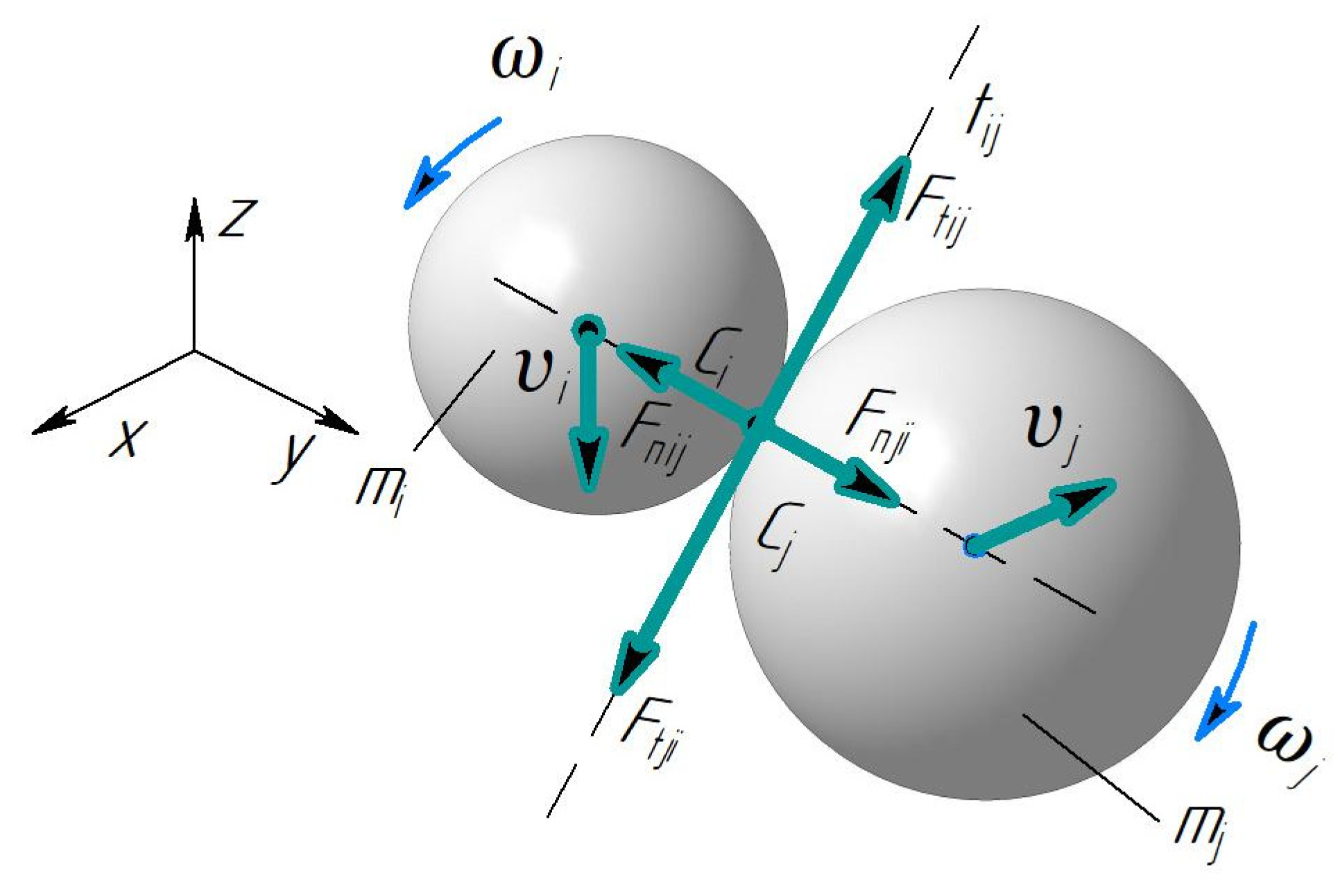
Solving Equations (1) and (2) determines the motion of two spherical particles
i and
j (
Figure 1).
The vector
Fi is defined as the sum of the forces acting on the contacts of the
i-th and
j-th particles (including the force of gravity):
The vector
Mi arises as the moment of forces
Fij relative to the center of the
i-th particle
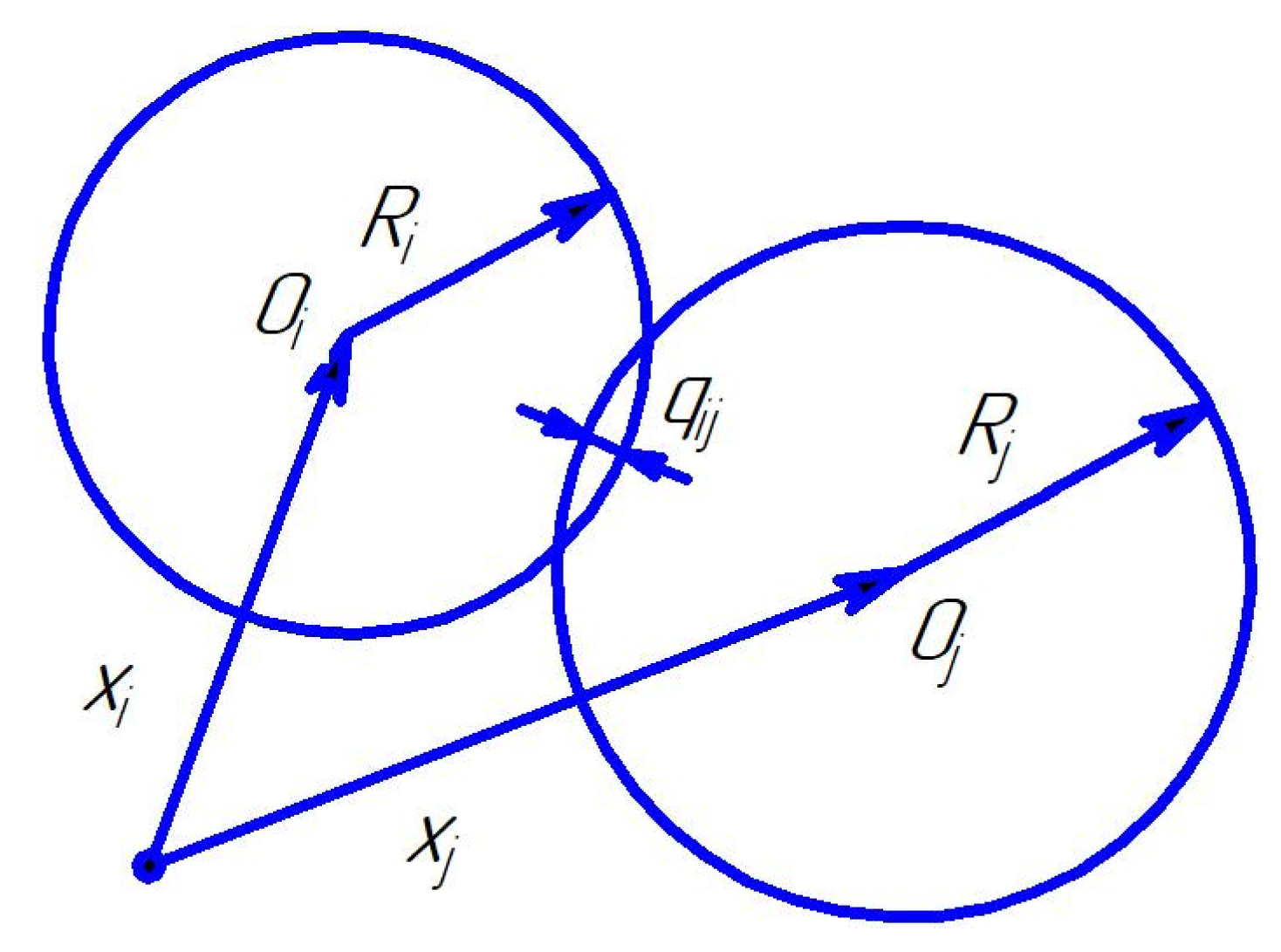
In this case, an array of discrete material is formed from separate
N elastic particles of spherical shape with radius
Ri (
Figure 2). The motion of each
i-th element (particle) is determined by the coordinates of its center of gravity
xi and the angle of rotation
θi around the center of gravity as a whole element (
i = 1, …,
N).
Surface forces
Fij consist of friction forces
Ft,ij and repulsion forces
Fn,ij. The repulsive force arises between particles when there is contact between elements (
δij > 0) (
Figure 2) and is directed along the normal
nij to the center of the
i-th particle (
Figure 1). To determine it, we use a viscoelastic collision model
where
is the elastic component;
is the viscous component.
According to J. Hertz, the elastic part of the force
Fn,ij
where
vi is Poisson’s ratio,
Ei is the elastic modulus of the particle.
In the case of a collision between a particle and a straight boundary, in Formula (6) it is sufficient to assume that one of the radii is infinite.
The viscous component of the repulsive force is determined from the relationship:
where
Mij is the reduced mass of the particles, kg;
υn,ij—projection of the relative velocity of the collision point onto the axis nij,
γn—damping coefficient, which has the main influence on the velocity recovery coefficient after impact.
The friction force
Ft,ij is directed against the motion of the
i-th particle relative to the
j-th particle, and its magnitude is determined by the ratio:
where
υt,ij is the projection of the velocity of contact point
Ci relative to the velocity of point
Cj onto the axis
tij;
φt is the contact friction angle between the particles.
Thus, the system of second-order differential Equations (1) and (2) with respect to the unknowns xi, ωi and the relations (3) and (4) completely determine the motion and collision of a set of elastic particles modeling a discrete medium.
The interaction of discrete particles is described by contact models. The contact model determines the normal and tangential components of the force, as well as the adhesive forces acting on the interacting particles.
2.2. Experimental Setup and Methodology
When modeling, it is necessary to calibrate the physical parameters of the medium, i.e., to determine the values at which they would most closely describe the soil cultivation processes. The traction resistance of the working body and its components along the axes can be taken as estimated output parameters when calibrating the properties of the simulated environment. Since these indicators have been most extensively studied for plows [
36,
37], we will use a plow body to calibrate the parameters of contact models.
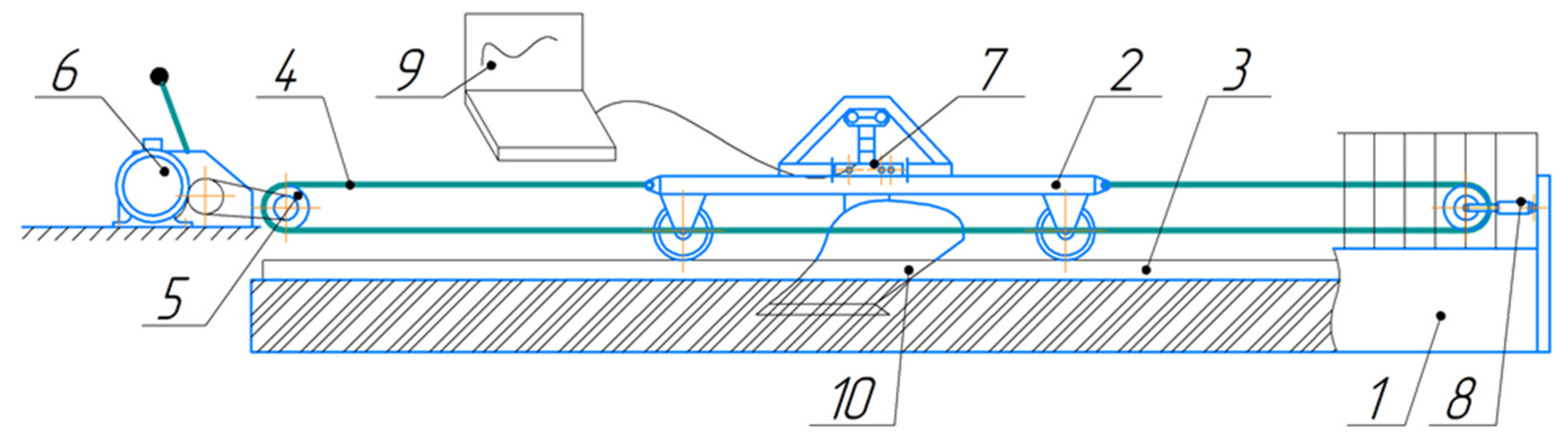
To justify the rheological and physical parameters of the simulated soil environment, we performed calibration based on the results of comparative experiments with plow working bodies identical in design and technological parameters in a digital model of a soil channel developed using the discrete element method and experiments on a laboratory soil channel (
Figure 3). The soil channel is a rectangular box filled with soil (1) measuring 3000 × 15,000 mm. A movable trolley (2) is mounted on rails (3) and equipped with a strain-gauge assembly with orthogonally arranged sensors (7), on which the plow body (10) is installed. The trolley moves along the rails by means of a motor-reducer (6) connected to a cable mechanism (4) with guide wheels (5). When necessary, the tension of the cable (4) is adjusted using a tensioning mechanism (8).
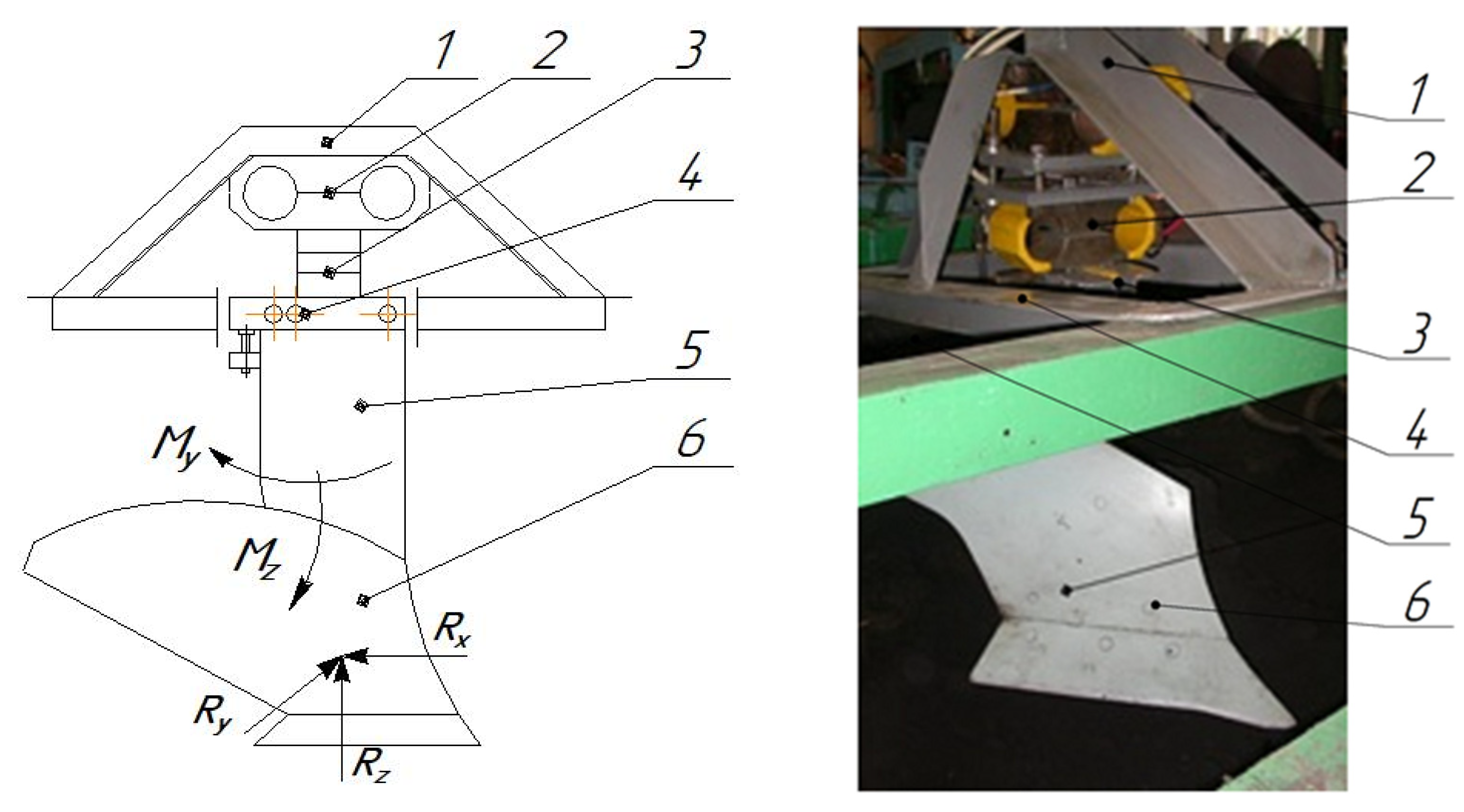
A laboratory setup was created to record the forces acting on the plow body. The setup consists of a spatial frame (
Figure 4) with orthogonal strain gauges installed on it.
Figure 3 shows: 1—frame, 2—strain gauge located along the direction of movement of the setup, 3—strain gauge located across the direction of movement of the setup, 4—bracket for attaching the working body support to the strain gauge, 5—working body support, 6—working body.
The special design of the orthogonal strain gauge and the implemented strain gauge circuit allow simultaneous measurement of forces and moments. The installation of two orthogonal strain gauges perpendicular to each other on the frame allows for the measurement of forces Rx, Ry, Rz along the OX, OY, OZ axes and moments Mx, Mz, and My.
To eliminate the influence of secondary factors on the values of forces and moments, the experiments were conducted on a soil channel with a trolley mounted on rails and driven by a drive station via a rope block system.
The recording equipment was a MIC-400D (Manufacturer’s name: Scientific and Production Enterprise “MERA” LLC, City: Mytishchi, Country of purchase of the equipment: Russia) measuring complex, which allows real-time measurement and processing of the data obtained and has a user-friendly interface.
Data was recorded using the MC-212 module (Scientific and Production Enterprise “MERA” LLC, Mytishchi, Russia). The module is designed to work with bridge strain gauges with a resistance of 100–1000 ohms when performing static and dynamic measurements. The module is based on the AD7730 analog-to-digital converter (Scientific and Production Enterprise “MERA” LLC, Mytishchi, Russia) (Σ − ∆) controlled by the ADSP2186 digital signal processor (Scientific and Production Enterprise “MERA” LLC, Mytishchi, Russia). Calibration was performed using standard methods.
Measurements and recording were performed using the WinRecorder MERA Recorder 2.07a software package developed by the manufacturer of the strain gauge equipment. Data processing was performed using the WinPos 1.3.3 software package, also developed by the manufacturer. The package offers a wide range of operations for processing experimental data.
During the experiments, the following design and technological parameters of the plow body were established: working width 35 cm, working depth 25 cm, speed 0.3–1.0 m/s. A semi-screw type body was used with a plowshare angle to the bottom of the furrow ε = 27° and a plowshare angle to the furrow wall θ0 = 40°. Soil characteristics in the soil channel: soil type—sandy loam chernozem; bulk density—1200 kg/m3; soil moisture—21–23.5% at a depth of 0–25 cm; internal friction angle—10–16°.
2.3. Numerical Modeling Methodology
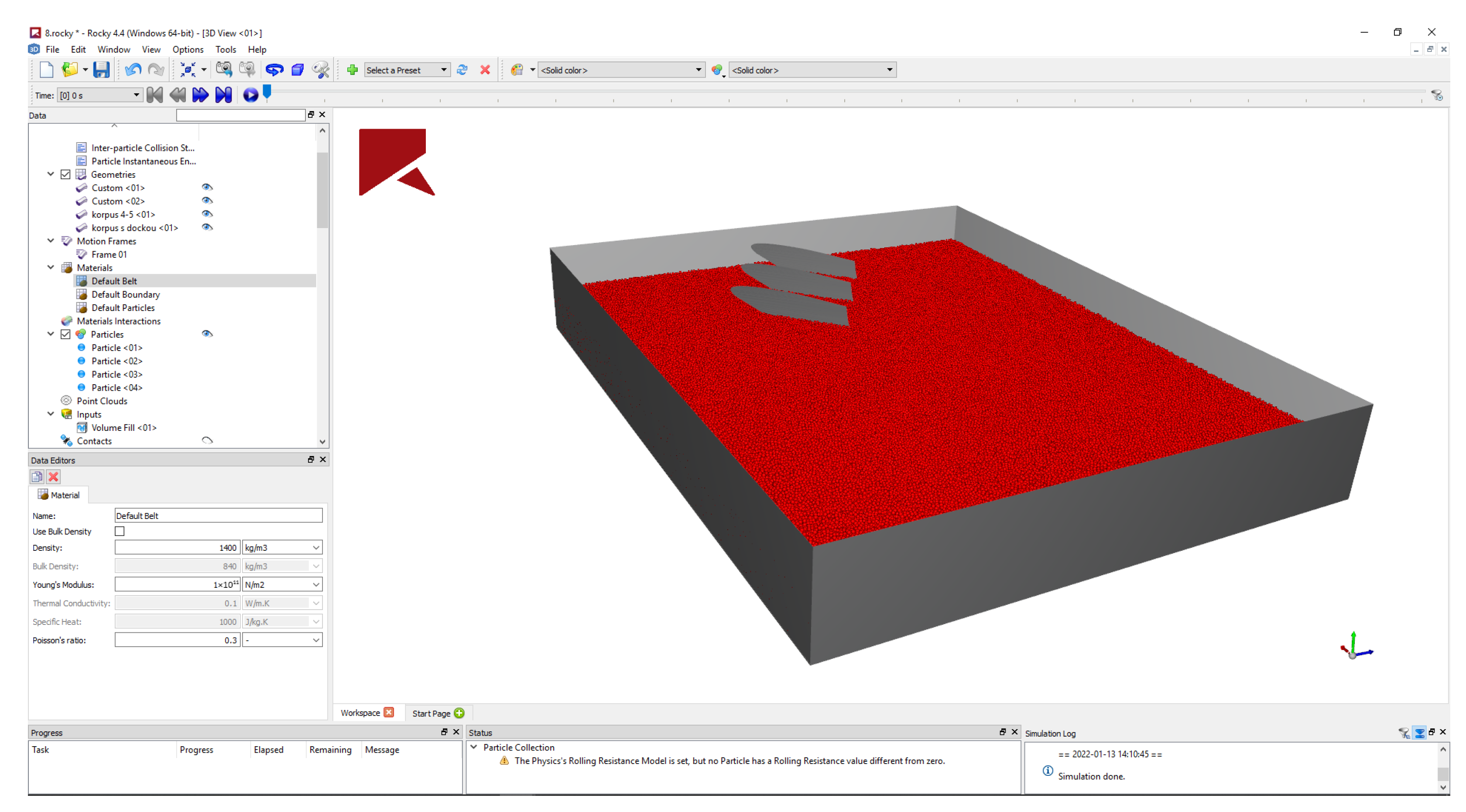
To simulate the interaction between the plow body and the soil using the finite element method, a virtual soil channel is created, with dimensions of 3000, 750 and 1500 mm in width, height, and length, respectively. A three-dimensional model of the soil channel with specified dimensions is created in the KOMPAS 3D three-dimensional design program, which is imported into the RockyDEM program.
A virtual soil channel was filled with spherical particles with a diameter of 10 mm. The contact model parameters presented in
Table 1 were verified in previous studies [
35] and supplemented by data from other authors [
20,
27]. To reduce computation time when modeling the interaction of large working tools, such as a plow body, it was decided to use particles with a diameter of 10 mm, taking into account the results of a previous study [
38], which demonstrated that simulations of the angle of repose corresponded well with field test data when using particle diameters of 5, 7.5, and 10 mm.
The model parameter variations were selected based on a detailed analysis of domestic and international literature and refined for soils typical of our zone using our own experiments. Multivariate experiments were conducted to identify the most significant parameters, which were then used to refine the model. The contact model was selected based on an analysis of the angle of repose and refined by comparing the traction resistance of tillage equipment, such as a plow body.
The channel is filled with particles in a single step by creating layers of particles around a given central starting point until they reach a specified mass or certain limits—the channel walls. To completely fill this channel with spherical particles with a density of 1400 kg/m3, 2,120,500 particles were required.
Computational resources of the PC: Intel(R) Xeon(R) CPU E5-2680 v4, 2.4 GHz, with 32 GB of installed memory. The duration of the process modeling ranged from 3 to 9 days.
At the beginning of the soil channel, a three-dimensional model of a three-body plow 1, designed according to specified design and technological parameters, is installed at a specified plowing depth (
Figure 5). The modeling used a body type that corresponded in design parameters to the plow body used in laboratory experiments on the soil channel. The technological parameters—plowing depth and working speed—also corresponded to the laboratory experiments. To start the model of the plowing process, the plow body is set to move along the channel at a speed corresponding to the working speed, tillage depth was 27 cm.
Boundary conditions—including soil–wall friction in the soil channel and soil–tool friction on the plow body components—were specified in the software prior to the start of the simulation using parameters such as the static friction coefficient, dynamic friction coefficient, and coefficient of restitution. The plow body was inserted to the required depth, corresponding to the depth used in the full-scale experiments.
The forces and moments acting on the plow body model were recorded in Rocky DEM for the penultimate (second in our case) body, as is customary in plow body tests. This is because the first and last plow bodies operate in a semi-blocked mode, and their operating mode is not typical for the other plow bodies. The averaged steady-state values of the forces along the three axes (Rx, Ry, Rz) were used for subsequent comparison with experimental data.
2.4. Criteria for Model Evaluation and Verification
For an objective assessment of the adequacy of contact models, a set of verification criteria has been developed that takes into account the significant variability of the components of traction resistance. Changes in the values of Rx, Ry, and Rz of plow bodies depend on many factors: soil type and condition, its moisture characteristics, and the design parameters of the working parts. This multifactorial nature of interaction requires the use of a system of criteria that allows evaluating not the absolute values of forces, but their spatial relationships.
Dimensionless ratios and angles of direction of the components of resistance forces are taken as the main evaluation parameters. This approach allows analyzing the spatial picture of force interaction independently of the absolute values of resistance. The system of criteria includes direction angles characterizing the orientation of the resulting force vector in space and dimensionless coefficients determining the ratio between the components of resistance.
These ratios are estimated by the following direction angles of the drag resistance components:
and coefficients
The direction angles are calculated based on three components of drag resistance. The angle υ = arctan Ry/Rx characterizes the ratio between the transverse and longitudinal components. The angle ψ = arctan Rz/Rx shows the relationship between the vertical and longitudinal components. The angle ξ = arctan Rz/Ry determines the spatial orientation in the transverse plane.
The dimensionless coefficients include two main parameters. The coefficient m = Rz/Rx characterizes the proportion of the vertical component relative to the longitudinal resistance. The coefficient n = Ry/Rx shows the ratio between the transverse and longitudinal components of resistance. These coefficients are important indicators of the balance of force interaction.
The adequacy of MDE contact models is assessed using a complex criterion that requires all calculated parameters to simultaneously correspond to experimentally established ranges. Verification is based on three sources of data: our own laboratory experiments on a soil channel, the results of field studies from scientific literature, and the analysis of the spatial distribution of force characteristics.
The advantage of the proposed system of criteria is its invariance to the absolute values of resistance forces. This allows us to level out the influence of scale factors and focus on assessing the physical reliability of the models.
3. Results and Discussion
3.1. Experimental Data on Traction Resistance
During the experiments on a soil channel with a plow body mounted on a strain gauge frame, the values of its traction resistance components were obtained, the results of which are presented in
Table 2. During the experiments conducted in the soil channel, the soil moisture content was controlled throughout the entire depth of the cultivated layer. Within the working depth, the moisture content varied in the range of 21–23.5%, which corresponds to the conditions of physical ripeness for the studied soil type and ensures sufficient representativeness of the traction resistance measurements. According to the measurement series, the weighted average moisture content of the soil layer was 22.5%. Therefore, further analysis of the experimental results and calibration of the model parameters were carried out for this moisture level, as it is considered characteristic of the performed tests.
The experimental data demonstrate a significant predominance of the longitudinal component of traction resistance Rx = 612.71 N, which fully corresponds to the physical meaning of the plowing process. It is this component that determines the main energy costs for moving the implement in the soil and is the main parameter for evaluating traction characteristics.
The transverse Ry = 182.075 N and vertical Rz = 125.78 N components are comparable in magnitude, but significantly smaller than the longitudinal component. Their presence and values confirm the complex, three-component nature of the force interaction between the plow and the soil, which includes not only resistance to movement, but also lateral pressure, as well as forces associated with lifting and turning the soil layer.
Statistical analysis shows satisfactory reproducibility of the results. The smallest data dispersion is observed for the transverse force Ry (coefficient of variation 6.4%), while for the vertical force Rz the variation reaches 10.4%, which may indicate a more complex and unstable nature of the vertical interaction of the soil with the working surfaces of the body.
The calculated angles of force direction objectively characterize the spatial orientation of the resulting resistance vector. The angle υ = 16.56° between Ry and Rx confirms significant lateral pressure on the hull, while the angle ψ = 11.61° between Rz and Rx indicates a noticeable vertical force. The angle ξ = 34.65° in the transverse plane details this spatial picture.
The dimensionless coefficients m = 0.21 and n = 0.30 quantitatively determine the relationship between the resistance components. The fact that the vertical component is about 1/5 of the longitudinal component (m = 0.21) and the lateral component is almost 1/3 (n = 0.30) is an important characteristic for this type of body and machining conditions.
According to industry experimental data [
36,
37] obtained under various soil conditions, the orientation angles of the components of the resistance force acting on the plow bodies vary within the following ranges:
υ = 10–28°,
ψ = ±12°, and
ξ = ±45°. The experimental values and calculated parameters obtained are fully consistent with the ranges known from the literature for plow bodies. This confirms the representativeness of the data and allows them to be used as a reliable reference for subsequent verification of mathematical and computer models.
3.2. Comparative Analysis of Simulation Results
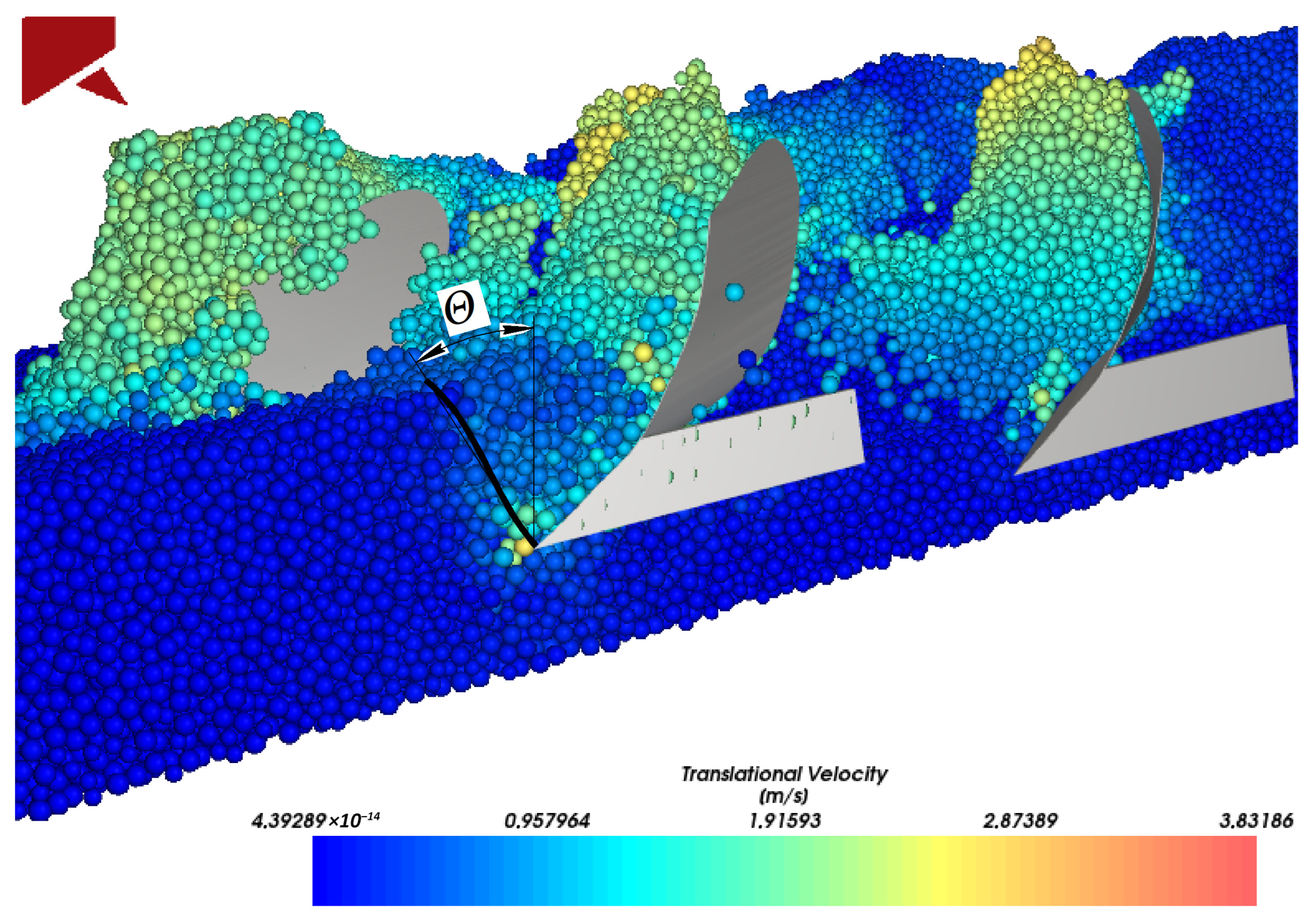
Figure 6 shows the results of modeling the interaction of the plow body with the soil environment in a virtual soil channel, performed in the Rocky DEM software package. Visual analysis demonstrates the realism of the processes taking place, which confirms the adequacy of the selected combination of contact models.
The simulation reliably reproduces the key phases of the working process:
formation and development of a leading crack at a characteristic angle Θ;
layer-by-layer separation of the soil layer from the massif;
gradual deformation and uplift of the layer along the dump surface;
complete rotation and laying of the layer in the furrow.
Particular attention should be paid to the process of forming a leading crack at an angle of
Θ = 40–45°, which fully corresponds to the classical theoretical ideas about the operation of plow bodies [
36,
37]. The trajectories of individual particles confirm the formation of a cyclic movement of soil aggregates, characteristic of the real plowing process.
The resulting picture of soil deformation visually corresponds to the classical schemes of plow body operation [
36,
37], which indicates that the physics of the process has been correctly reproduced. The observed movement and rotation of soil particles adequately reflect the real mechanism of soil layer formation and its placement in the furrow.
The visualization results confirm that the selected combination of contact models adequately reproduces the kinematics of the soil layer at all stages of the technological process. Correct modeling of the process of crack formation and development is particularly important, as it is critical for predicting the quality of crumbling and the energy costs of plowing.
Table 3 presents the results of the energy assessment of the plow body in terms of traction resistance, obtained as a result of implementing models on a virtual soil channel using the discrete element method, as well as the indicators of the direction angles
υ,
ψ,
ξ and the coefficients
m and
n of the traction resistance components.
The parameters of the contact models used in the simulation experiments were selected based on the data presented in
Table 1. Calibration of the contact model parameters was initially performed using a simple test to determine the angle of repose for soils of different types and mechanical compositions, and was further refined through comparative evaluation of the draft resistance of the plow body using tests under simple translational shear.
The draft resistance of the plow bodies was obtained through strain-gauge measurements of individual bodies, i.e., by simulating the operation of a single plow body. In this case, the plow body operates in a blocked mode. The experiments were performed in triplicate. The coefficient of variation did not exceed 15%, since the properties of the virtual soil channel remain uniform regardless of the length of the plow body’s pass, and the technological parameters—such as working depth and travel speed—were constant. The accuracy of predicting the draft resistance of the plow body during modeling for the studied soils at moisture levels ranging from 18 to 25% was between 80 and 95%. Minor variations were observed due to the stochastic nature of soil formation from spherical particles.
The traction resistance of the plow bodies was determined by strain-gauge measurements of individual bodies, that is, under conditions simulating the operation of a single plow body. In this case, the plow body operated in a constrained (blocked) mode. The experiments were carried out in triplicate. The coefficient of variation in the conducted experiments did not exceed 0.15%, since the properties of the virtual soil channel remain identical regardless of the travel length of the plow body, and the technological parameters, such as working depth and forward speed, were kept constant. A minor variation was observed due to the stochastic nature of soil formation from discrete particles.
Under real conditions, depending on soil properties and working body parameters, according to our experiments on a soil channel (
Table 2) and data from other researchers [
38], the angle
υ between
Ry and
Rx varies from 10° to 28°, the angle
ψ between
Rz and
Rx is within +12°, and in the transverse plane, the traction force
R is directed at an angle
ξ +45–55°, the coefficient
n = +0.2, and
m~0.33. The experimental data on the parameters of the force-angle ratio
υ,
ψ,
ξ, and coefficients
m and
n obtained on the soil channel are within these limits.
The calculated values of the lines of action of the resistance and traction forces show close agreement with the experimental data. When simulating the motion of the plow body in a virtual soil channel filled with discrete elements (DEM), the formation of lateral reactions from the landside and the furrow wall is observed. These reactions, similar to the processes occurring under real field conditions, ensure stabilization and the return of the plow body to a stable position. However, due to the more stable rheological characteristics of the virtual soil specified in the model, the amplitude of oscillations of the angular vectors of these forces remains within a limited range.
Analysis of the simulation results (
Table 3) showed that different combinations of contact models describe the force interaction in significantly different ways. The combinations based on Hertz normal force (HSD) and hysteretic linear spring (HLS) models showed the greatest correspondence to the experimentally established parameter ranges (highlighted in gray in
Table 3).
The Linear Spring (LSP) model, despite matching the angles, significantly underestimates the absolute value of the longitudinal force Rx (516.3 N versus the experimental 612.71 N), which indicates its insufficient accuracy for predicting energy expenditure.
Combinations based on the HLS model (lines 2.1.2 and 2.2.2) show good angular correspondence υ, but demonstrate extremely underestimated values of transverse force Rz (12.5 N and 69.5 N) and overestimated values of Rx (more than 2150 N). This indicates that this model, while adequately describing normal elastic-plastic deformations, may not work correctly in combination with the simplest tangential models for this type of problem.
Combinations based on the Hertz model (HSD) generally showed the best results. Particularly noteworthy is the combination HSD + Mindlin − Deresiewicz + JKR (line 3.3.3), in which all parameters (υ, ψ, ξ, m, n) are within acceptable ranges, and the absolute values of the forces are closest to the experimental ones. The use of the JKR model for adhesion naturally leads to an increase in all components of the resistance force compared to the linear adhesion model, which better corresponds to the behavior of cohesive soil. At the same time, additional full-scale and simulation experiments are required to identify correlations.
Thus, the description of the soil tillage process with a moldboard plow depends on the specific soil medium being modeled. For representing this process, the Hertz model is most suitable for normal forces, the Mindlin–Deresiewicz model for tangential forces, and the JKR model for accounting for cohesive forces (soil moisture).
In addition, in the JKR model, during the implementation of the calibration test for the angle of natural slope using the discrete element method in the previous work [
35], it was noted that a change in the values of surface energy
J, J/m
2 affects the angle of the cone when discrete particles are scattered, as does moisture on the angle of natural slope of the soil. Therefore, it can be assumed that a change in surface energy
J will allow predicting a change in soil moisture. However, for the accurate prediction of soil moisture variations through the adjustment of the surface energy parameter in discrete element models, separate calibration experiments are required for each investigated soil type. Based on the results of such experiments, approximating relationships should be obtained to ensure high accuracy in selecting the appropriate range of surface energy values as a function of soil moisture.