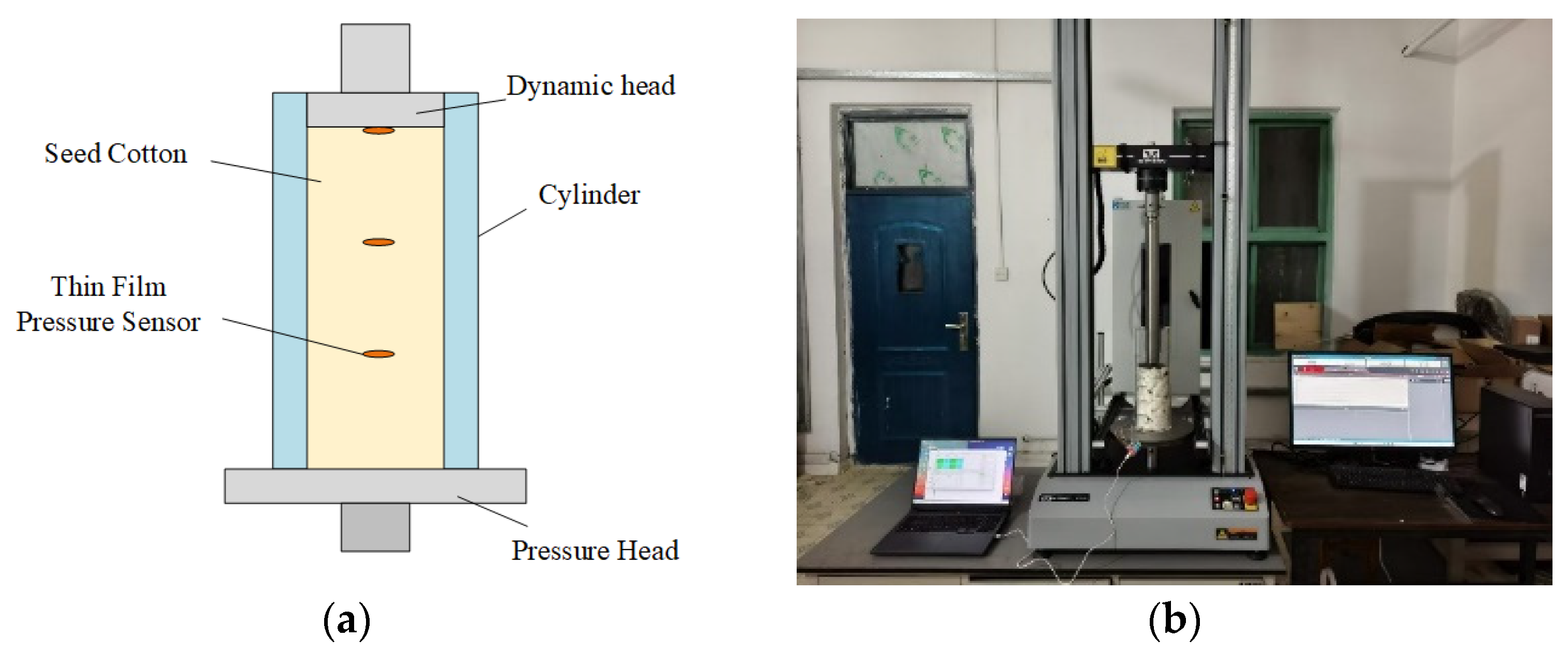
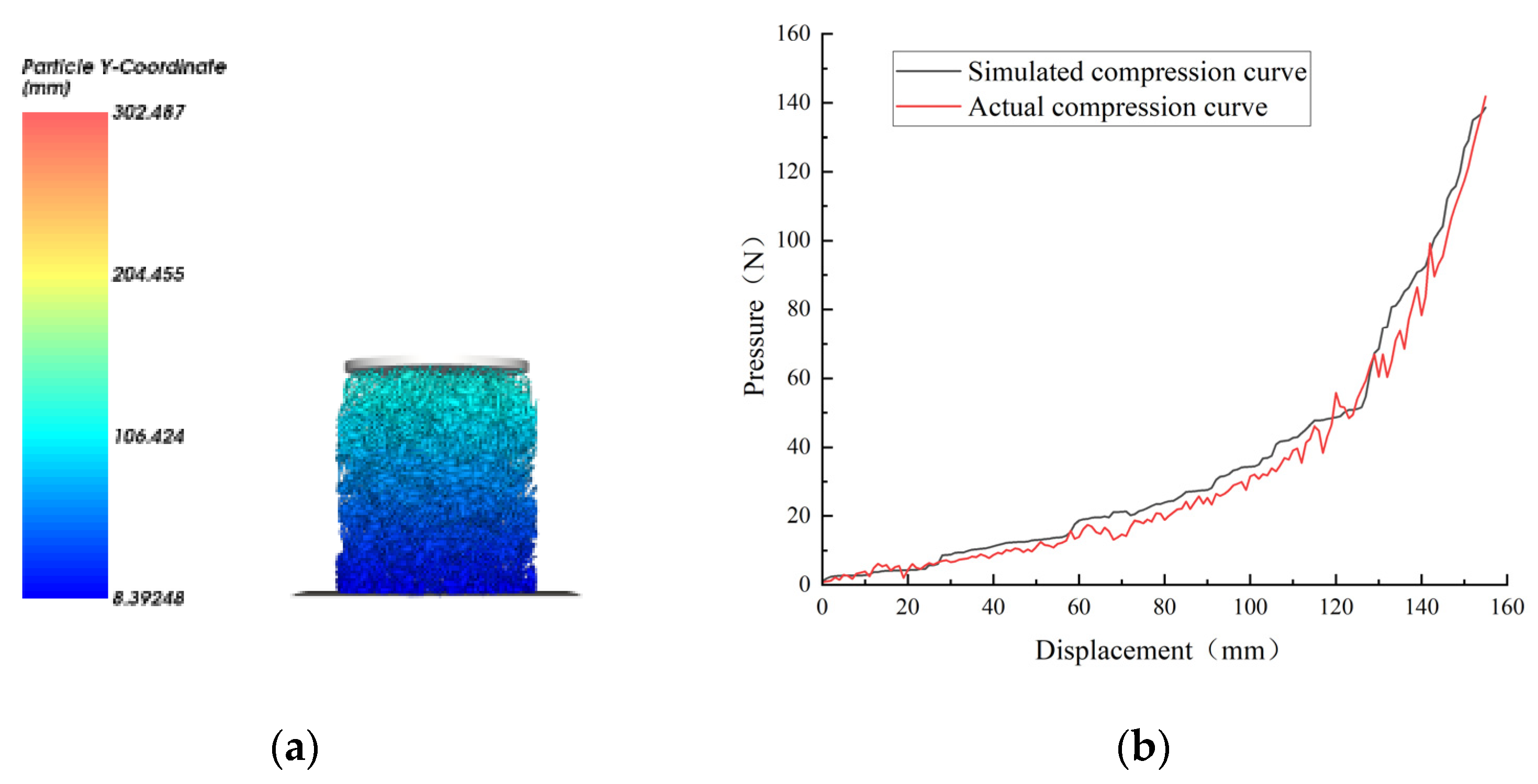
The collection of machine picking seed cotton axial load data for processing is achieved by means of a compression fixture. The utilisation of Origin to draw the load transfer curve is demonstrated in
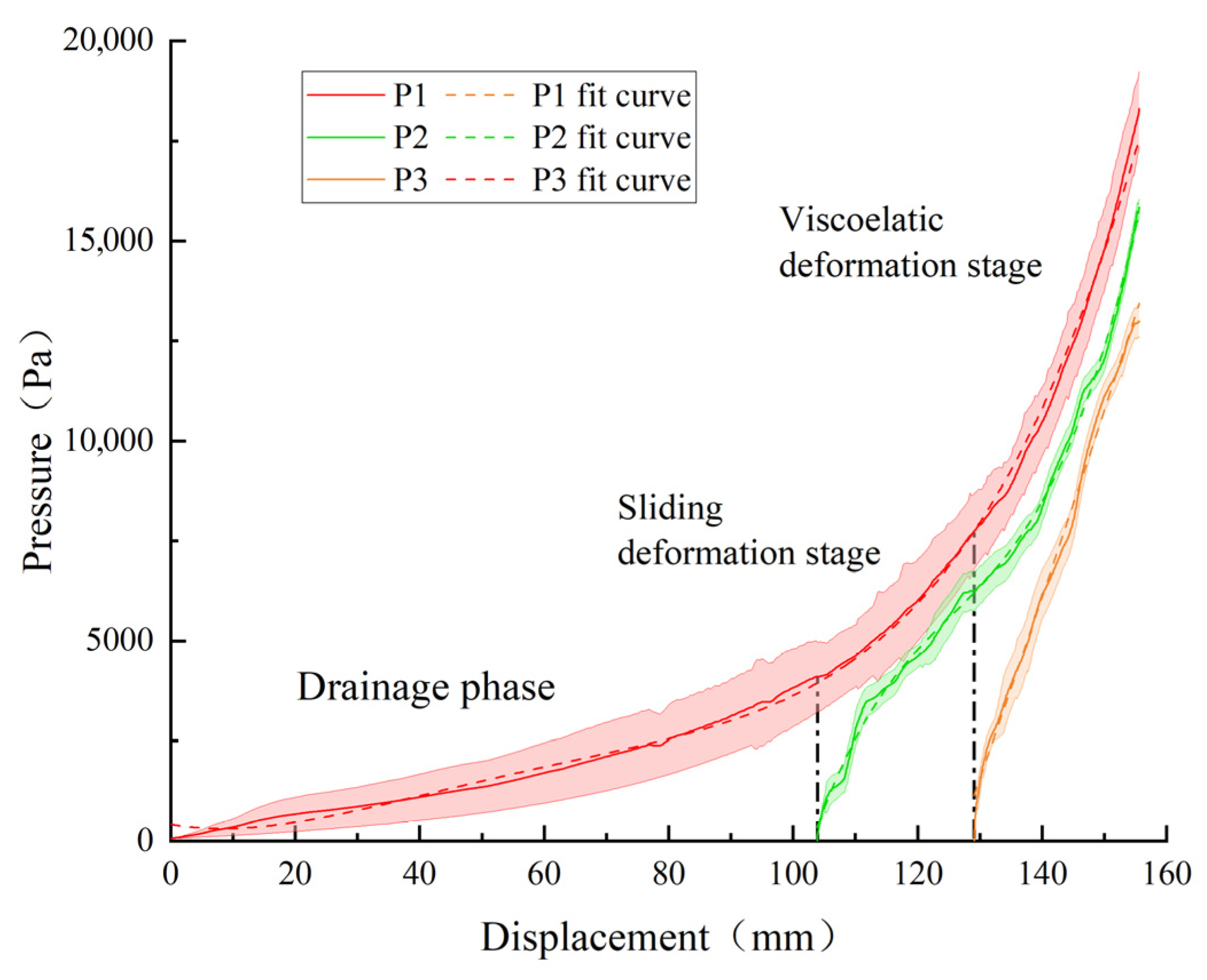
Figure 5. As is apparent from the figure, with the increase in strain during the compression process of seed cotton, the pressure measured by the sensors exhibited an upward trend. Concurrently, the pressure data collected from various locations by the sensors exhibited a downward trend, with a gradual decrease from the top to the bottom.
In previous research, the compression process of seed cotton was often divided into three stages [
28]: the emptying stage, the slip deformation stage, and the viscoelastic plastic deformation stage. In this paper, the compression process is further investigated by placing sensors at different locations inside the seed cotton. As demonstrated in
Figure 6, when the compression displacement is less than 104 mm, only the P1 sensor generates data, and the slope of the curve is relatively flat and stable, which corresponds to the emptying stage. The compression force is derived from the elastic deformation of the cotton fibre bending and viscosity of the internal friction. Upon reaching a displacement of 104 mm, the P2 sensor commences data generation, concurrently with a substantial rise in the slope of the P1 sensor curve, indicative of the slip deformation stage. The compression force is thereby transferred to the seed, a process facilitated by the elastic deformation of the cotton fibre. It is evident that upon the attainment of a displacement measuring 124 mm, the P2 sensor initiates the process of data generation. Concurrently, the slope of the P1 sensor curve experiences a substantial rise, which is indicative of the slip deformation stage. This stage corresponds to the pressure exerted by the cotton fibre on the cotton seed. The randomness inherent in the arrangement of the cotton seed results in the cotton fibre being interspersed with the pressure and the slip. It is evident that as the displacement attains a magnitude of 129 mm, the P3 sensor commences the generation of data. Concurrently, the slope of the P1 sensor curve exhibits an augmentation and attains a relatively stable state. This phenomenon corresponds to the visco-elastic deformation stage. The fibre arrangement of seed cotton is observed to be in close proximity, and the cotton fibre undergoes a process of pressurisation accompanied by a degree of plastic deformation. Concurrently, the seed undergoes an elastic deformation.
The fitting of the pressure–displacement curves for each sensor was performed in Origin, with the fitting results shown in
Table 3. The fitted curves are all fitted with polynomial functions, and R
2 > 0.99, which indicates that the polynomial functions can more accurately describe the change of pressure with displacement at different positions during the compression process of seed cotton. In the fitting equations, it is demonstrated that the proximity of the sensor to the dynamic head is directly proportional to the magnitude of the corresponding polynomial number. This indicates that with the compression of seed cotton, the rate of change in pressure is greater in closer proximity to the compression side of the sensor. Consequently, the position of the seed cotton compression is also accelerated. It is therefore evident that seed cotton is a strain-sensitive material, and that the deformation of cotton fibre in compression is the cause of its strain sensitivity [
29].
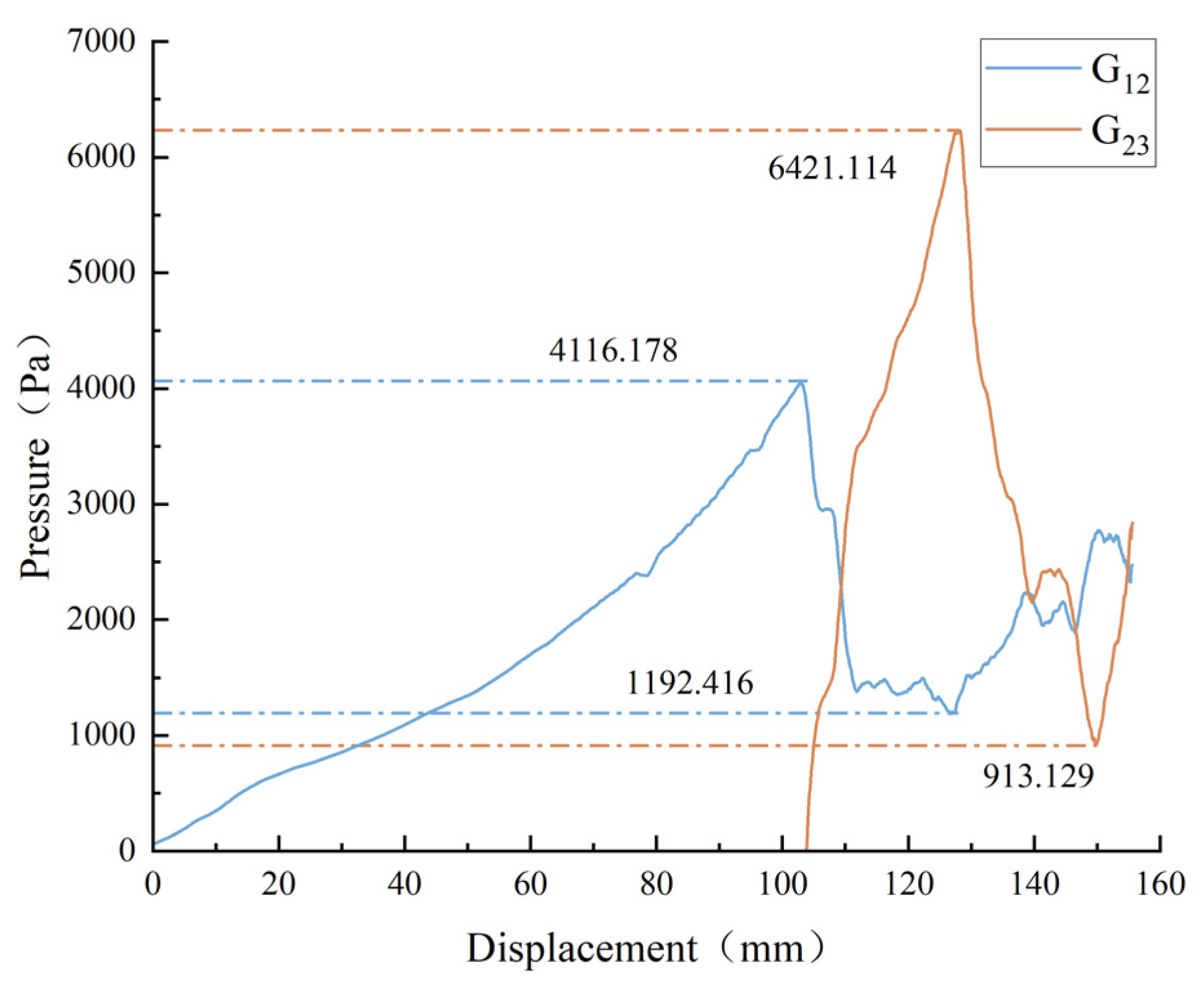
The differential pressure–displacement curves of the neighbouring sensors of seed cotton are illustrated in
Figure 6, in which G
12 and G
23 denote the differential pressure between neighbouring sensors P1 and P2 and P2 and P3, respectively. As illustrated in
Figure 7, the sensor differential pressure curves demonstrate a trend of firstly increasing and then decreasing, ultimately reaching a state of smoothness. This observation indicates the presence of hysteresis in the axial load transfer process during the compression of seed cotton. The maximum values of the seed cotton differential pressure–displacement curves demonstrate significant variation, while the minimum values approximate 1000 Pa. When the seed cotton is compressed to 220 kg·m
−3, similar differential pressures are observed in G
12 and G
23, suggesting that the density formed between the layers of the seed cotton may be different due to the dissipation of compression energy during the compression process.
It is evident that the pressure transfer within the seed cotton is subject to a certain degree of latency, which consequently gives rise to variations in displacement and density of the seed cotton in each layer. As demonstrated by Fang Liang et al. [
30], the relationship between axial pressure and the density of the seed cotton is established. Utilising this relationship, the density of the seed cotton corresponding to the pressure of each sensor can be calculated by Equation (3) when the seed cotton is compressed to 220 kg·m
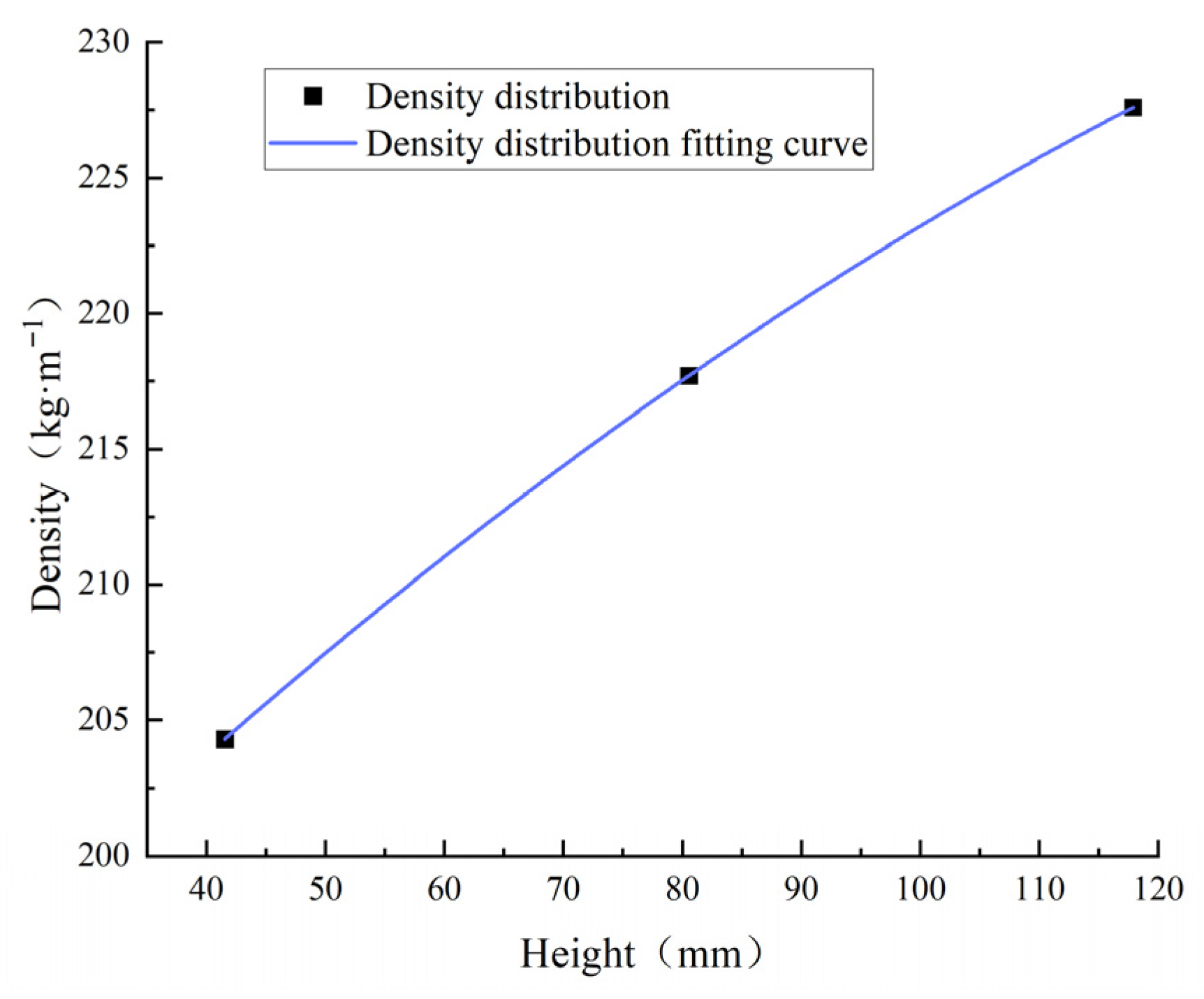
−3. It is important to note that the internal density distribution of seed cotton is not uniform when the compression is completed. Therefore, the density of seed cotton in each layer is calculated by the following Equations (4) and (5). At this time, the density of seed cotton in the upper layer is 227.6 kg·m
−3, corresponding to the height of sensor P1, which is 117.88 mm; the density of seed cotton in the middle layer is 217.7 kg·m
−3, corresponding to the height of sensor P2, which is 80 mm. The dimensions of the specimen are as follows: the diameter of the bottom layer of seed cotton is 57 mm; the density of the bottom layer of seed cotton is 204.3 kg·m
−3; the diameter of the middle layer of seed cotton is 217.7 kg·m
−3; the height of sensor P2 is 80.57 mm; the diameter of the bottom layer of seed cotton is 204.3 kg·m
−3, which corresponds to the height of sensor P3 being 41.56 mm. The calculation results demonstrate that the compression density of seed cotton in the bale is not uniformly distributed, but is significantly correlated with its own compression position. As demonstrated in
Figure 8, the correlation between the density of seed cotton and the height of the change curve and fit is evident. The seed cotton density data obtained, together with the height change curve, can be described more accurately by employing a polynomial function regression fitting. However, it is essential to first ascertain the compression of the seed cotton internal density with height change rule.
where
xj is the pressure of each sensor, kg;
yj is the density corresponding to the pressure of each sensor, kg·m
−3;
a is the density correction coefficient, 0.93;
ρj is the density of each layer of seed cotton, kg·m
−3;
vj is the volume of seed cotton compressed by each sensor, m
3.