Article

Methodological Advancement in Resistive-Based, Real-Time Spray Deposition Assessment with Multiplexed Acquisition


1
Faculty of Agricultural, Environmental and Food Sciences, Free University of Bozen-Bolzano (unibz), Piazza Università 1, 39100 Bozen-Bolzano, Italy
2
Competence Centre for Plant Health, Free University of Bozen-Bolzano, Piazza Università 1, 39100 Bozen-Bolzano, Italy
*
Authors to whom correspondence should be addressed.
AgriEngineering 2026, 8(1), 3; https://doi.org/10.3390/agriengineering8010003 (registering DOI)

Submission received: 4 October 2025 / Revised: 5 December 2025 / Accepted: 9 December 2025 / Published: 1 January 2026

Abstract

The use of agrochemicals remains indispensable for ensuring fruit production; however, their excessive or inefficient application poses significant environmental and health concerns. Rapid detection of spray deposition is crucial for assessing sprayer performance, improving precision application, and reducing drift and chemical waste. In this context, real-time monitoring technologies represent a promising tool to promote sustainable and efficient crop protection practices. This study refines previous experiences with an array of resistive sensors to quickly measure spray deposition. First, a multi-point calibration curve is introduced to improve the sensors’ accuracy. Furthermore, a multiplexed acquisition system (Sciospec ISX-5) is employed to enable time-resolved measurements of the whole sensor array. The method is validated by spectrophotometry and weight measurements. Wind tunnel trials with fluorescein (FLU) and fluorescein + potassium chloride (FLU + KCl) tracing solutions were conducted. The conductivity of the latter was higher than the former, without biasing the measurement. Both tracers showed good correlation between deposition and conductivity (R2 = 0.997 for FLU and 0.995 for FLU + KCl), and the maximum deviation from the spectrophotometric estimates was <10%. Time-resolved measurement showed the build-up of deposition over time, potentially indicating the dimensional composition of the sprayed cloud. The improved workflow provides array-wide, sequential deposition measurements, enabling faster on-site acquisition and efficient analysis. The results demonstrate strong potential for scaling the method to field applications, supporting its further development into real-time deposition mapping tools that could guide precision spraying, optimize agrochemical use, and reduce environmental drift.

1. Introduction

Application of plant protection products is essential to control pests and their related diseases, and to improve crop yield [1]. According to [2], about 2 million tonnes of pesticides are used each year globally, with the United States accounting for 24% and Europe for 45%, while the remaining share is attributed to the rest of the world [3]. However, despite their widespread use, almost half of the pesticides applied to crops enter the environment through contaminated soil, water, and air from the site of application or field [4]. Therefore, reducing spray drift is essential for improving application efficiency and minimising off-site contamination [5]. The fundamental objective of the 2009/128/EC European Directive on Sustainable Use of Pesticides is to improve the efficiency of pesticide application and reduce spray drift [6]. In this context, the assessment of spray deposition on target canopies and in the surrounding environment is key to evaluating the quality of the treatment, both in terms of efficacy and reduction in losses to the environment. This enables us to also verify the impact of different regulatory settings on sprayers, especially given the relevance that automated systems such as unmanned or remotely piloted aerial systems are gaining [7,8,9,10].
Spray drift and deposition assessment can be done by direct (in-field) and indirect methods (under controlled conditions, usually in a laboratory setting). The most common indirect methods rely on test benches [11], analysis of drop size distributions (DSDs) from spray nozzles [12], and wind tunnel evaluations [13,14,15,16]. Conventionally, tracers added to the spray solution are widely used to evaluate spray deposition and off-target drift both in the field and on artificial collectors [8,17]. Appropriate methods for quantitative analysis of the deposited material include fluorometry [18,19]; colorimetry [20,21]; spectrophotometry [11,22,23,24,25]; and, in some studies, atomic spectrophotometry [26,27]. However, these methods are not real-time, labor-intensive, time-consuming, and costly; they also typically involve handling and transferring large samples and require trained personnel for analysis [28,29]. These limitations have prompted the development of electrical sensors capable of real-time assessment of spray drift and deposition, which can also support adaptive adjustment of sprayers equipped with variable-rate technology (VRT), a key component of precision agriculture aimed at reducing agrochemical overuse [30].
As part of the broader domain of ground-based proximal sensing, the developed resistive sensor system provides near-field, spatially resolved measurements of spray deposition along the trajectory of the sprayed cloud, with collectors positioned at multiple distances to quantify settled deposition. Such real-time proximal sensing technologies are increasingly recognized as enablers of sustainable pesticide application, providing high-resolution data to evaluate sprayer performance and optimize chemical input [31,32]. While this study focuses on laboratory-scale validation, the proposed sensing approach represents a step toward future feedback-based spray control, aligning with the principles of Integrated Pest Management (IPM) and the EU Sustainable Use Directive [6]. By generating real-time, spatially resolved deposition data, this method contributes to the advancement of digital agroecology and supports the transition toward sustainable and regenerative food systems.
In our previous work, we introduced a resistive (conductivity-based) method using screen-printed electrodes integrated into Petri collectors, implemented alongside a standard tracer-based spectrophotometric assay. Gravimetry served as a benchmark reference. Both methods showed a systematic deviation from gravimetric estimates. The proposed methodology was validated, supporting quantitative conductivity-to-mass conversion [33].
Nevertheless, some methodological and experimental limitations were encountered. The conductivity-to-deposition estimation relied on a two-point calibration, sensitive to noise, potentially adding biases to the estimated deposit. Acquisition was rapid but relied on a single-channel portable impedance analyzer, which had to be manually connected to one collector at a time, preventing systematic, time-resolved measurements during spraying. For method comparison, the setup used parallel collectors, one dedicated to the electrical readout and a separate, adjacent collector for spectrophotometric analysis, therefore not allowing for a direct comparison of the methods. Only a fluorescent tracer was tested, with no analysis of sensor response to solutions of higher or differing conductivity.
This paper addresses those issues through methodological and experimental improvements while preserving the electrode geometry and the underlying methodology. First, a multi-point calibration was carried out to stabilize the conductivity-to-deposition mapping, addressing bias from earlier fits. Secondly, a Sciospec ISX-5 impedance analyzer (Sciospec Scientific Instruments GmbH, Bennewitz, Germany) equipped with a MUX32 multiplexer module was used, connecting all Petri collectors to separate channels for multiplexed acquisition. The channels are addressed sequentially within a defined acquisition cycle, enabling cycle-resolved estimations during spraying. Following the acquisition of electrical measurements, the same Petri collectors were subjected to spectrophotometric analysis and weight measurement, enabling a direct, same-collector comparison across methods. The spectrophotometric analysis was the main method used for both calibration and comparison of the electrical readout, while gravimetry was used only as a supplementary check. Furthermore, to investigate the effect of the ionic strength, without altering the optical compatibility, two tracer solutions were evaluated under identical operating conditions: fluorescein and fluorescein + potassium chloride (KCl)
The aims of this work are to (a) establish a direct comparison between the measurement methods, (b) quantify the improvement from multi-point calibration, (c) resolve spatial (12 positions) and temporal (cycle-resolved) deposition trends, and (d) assess the effect of the tracer chemistry on sensor response.

2. Materials and Methods

2.1. Preparation of Tracer Solutions

Two tracer solutions were used in this study. To prepare fluorescein tracer (FLU), uranine (Trotec GmbH, Heinsberg, Germany) was dissolved in tap water to obtain a final concentration of 20 mg L−1 [34]. A second tracer solution (FLU + KCl) was prepared by dissolving potassium chloride (EMSURE®, Supelco/Merck KGaA, Darmstadt, Germany; supplied by VWR International) in a second batch of fluorescein solution, also prepared in tap water at 20 mg L−1, to obtain a final KCl concentration of 0.684 g L−1. Both solutions were mixed thoroughly and protected from light until use. The conductivity of the solutions was measured using a conductivity meter (Hanna Edge H12002, Hanna Instruments Ltd., Leighton Buzzard, UK). Electrical conductivity of both tracer solutions was 350 µS cm−1 for FLU solution and 1660 µS cm−1 for FLU + KCl solution. Importantly, our previous study reported that the spectrophotometer absorbance and the electrical properties of both tracer solutions did not interfere with each other during measurement [33]. Thus, adding KCl increases ionic strength (and thus electrical sensitivity) without affecting spectrophotometric quantification of fluorescein (UV–Vis absorbance).

2.2. Collectors, Electrodes, and Electrical Measurement Principle

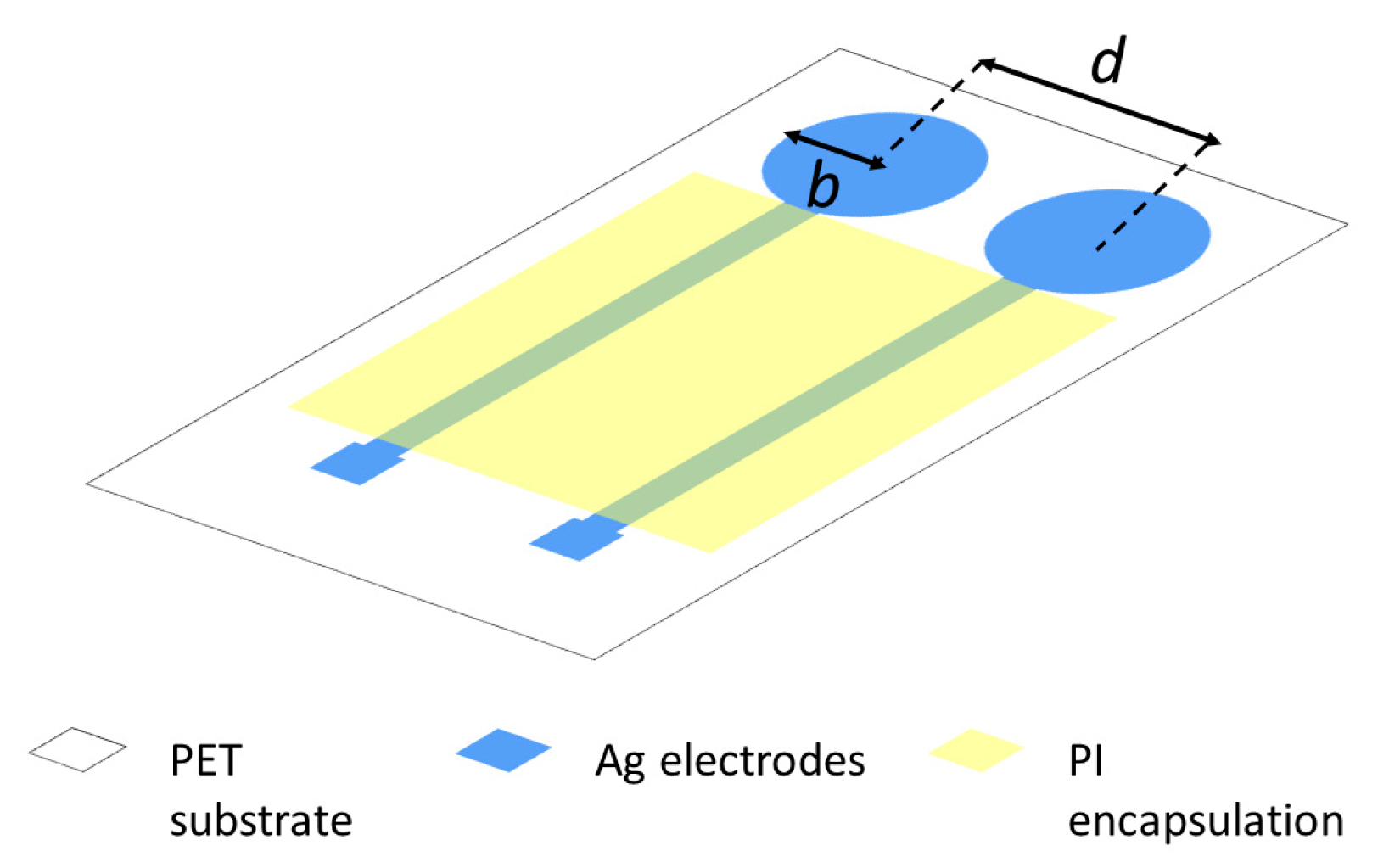
To perform electrical measurement, two planar screen-printed silver electrodes were integrated into the 14 cm Petri dishes that served as material collectors during the spray deposition process (exactly as in our previous study). The electrodes were screen printed on polyethylene terephthalate (PET) substrate, encapsulated with polyimide tape (PI, Kapton; Tesa SE, Norderstedt, Germany), and adhered to the Petri dish using biadhesive tape, leaving the electrodes and measurement device pads exposed (Figure 1) [33].
The resistivity was computed using the resistance value recorded at 3 kHz, where the electrode polarization was found to be negligible [33,35]. Electrical resistivity was calculated as follows:
ρ = K   R
where ρ is resistivity (Ω·m), R is resistance (Ω), and K is the geometric factor (m). For the coplanar circular electrodes used in this study, K was computed analytically following the formula reported in our previous work [33]:
K = 2 π b π 2 arctan 1 / η 1
η 1 = d / b 2 1
where b is the electrode radius, d is the spacing between electrodes, and η1 is the geometric correction factor. The resulting geometric factor (K = 0.01084 m) was inserted into Equation (1) to compute resistivity. Conductivity was then calculated as the inverse of resistivity [33]. However, to enable the real-time measurement, each collector was prefilled with 30 mL of deionized (DI) water before spraying, ensuring continuous wetting of the electrodes and providing a stable low-conductivity baseline (4.3 µS cm−1). All conductivity readings were corrected by subtracting the background conductivity of the DI water used to prefill the collectors (4.3 µS cm−1). As the deposited tracer mixed with the prefilled volume, the resulting change in electrolyte concentration produced a proportional increase in conductivity. Conductivity values were subsequently converted to the deposited amount using linear calibration against the reference method.

2.3. Test Facility and Experimental Design

All trials were conducted in the open-circuit wind channel of the Agroforestry Innovations Laboratory, Free University of Bozen-Bolzano. The internal test section is 30 m long, 10 m high, and 6 m wide [36]. For the present study, the tunnel was used as a confined, still-air environment (set point airspeed ≈ 0 m s−1). The open-circuit design prevents the build-up of residual aerosol and enables rapid air replacement between runs [37].
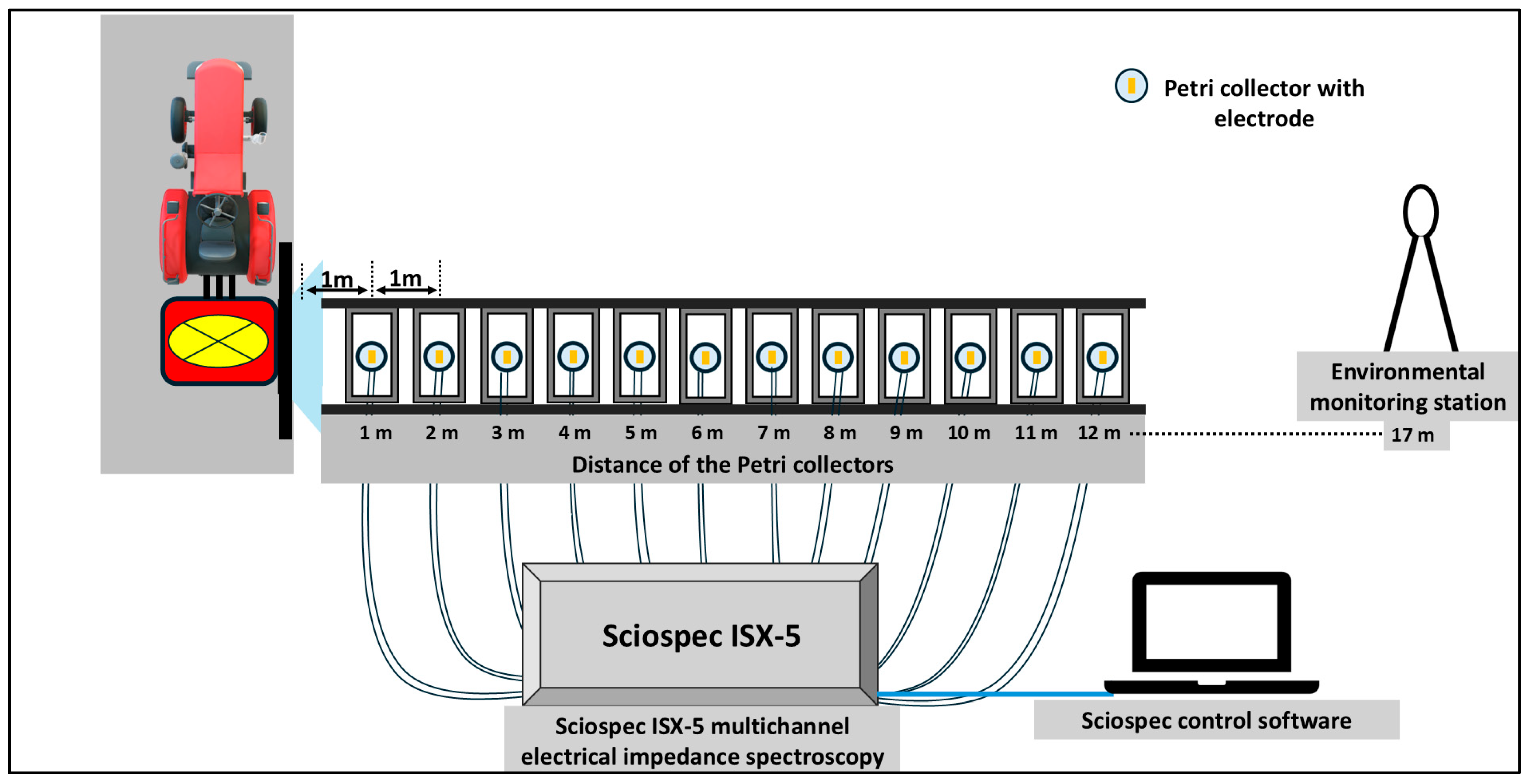
A test bench was placed perpendicular to the stationary sprayer and provided with slots for the placement of the collectors at 0.3 m above the floor. Twelve Petri dish collectors, each integrating coplanar screen-printed electrodes, were placed along the bench at 1 m spacing. The first collector was located at 1 m from the outer nozzle of the sprayer; positions are referenced from 1 to 12, from near to far (layout in Figure 2).
An orchard airblast sprayer (10 81 VV-HS by Mitterer Professional Sprayers, Terlan (BZ), Italy) equipped with air inclusion nozzles (CVI 80 025, Albuz Spray, Evreux Cedex, France) was used for spraying both tracers. The spraying pressure was set to 1 MPa, regulated using the sprayer’s onboard manometer; the fan was operated at high speed to provide the intended air assist. Operational parameters for each run are summarized in Table 1.
Two tracers, fluorescein (FLU) and fluorescein + KCl (FLU + KCl), were sprayed for 120 s. For each tracer, three independent runs were performed. Across the three repetitions performed for each tracer, the nozzle and sprayer settings were kept constant to ensure comparability.

2.4. Nozzle Characterization

Prior to testing, the mounted nozzle’s (CVI 80 025) droplet-size metrics (dV10, dV50, dV90) were characterized on a dedicated test bench using particle/droplet image analysis (PDIA) by a VisiSize N60V system (Oxford Lasers, Didcot, Oxfordshire, UK), running VisiSize 6.5.44 software. According to the methodology detailed in [38], about 60,000 droplets were sampled to determine volume-percentile diameters dV10, dV50 (volume median diameter, VMD), dV90, i.e., the droplet diameters below which 10%, 50%, and 90% of spray volume lie, respectively. The relative span (S) was calculated as follows:
S =   d V 90 d V 10 d V 50

2.5. Monitoring of Environmental Conditions

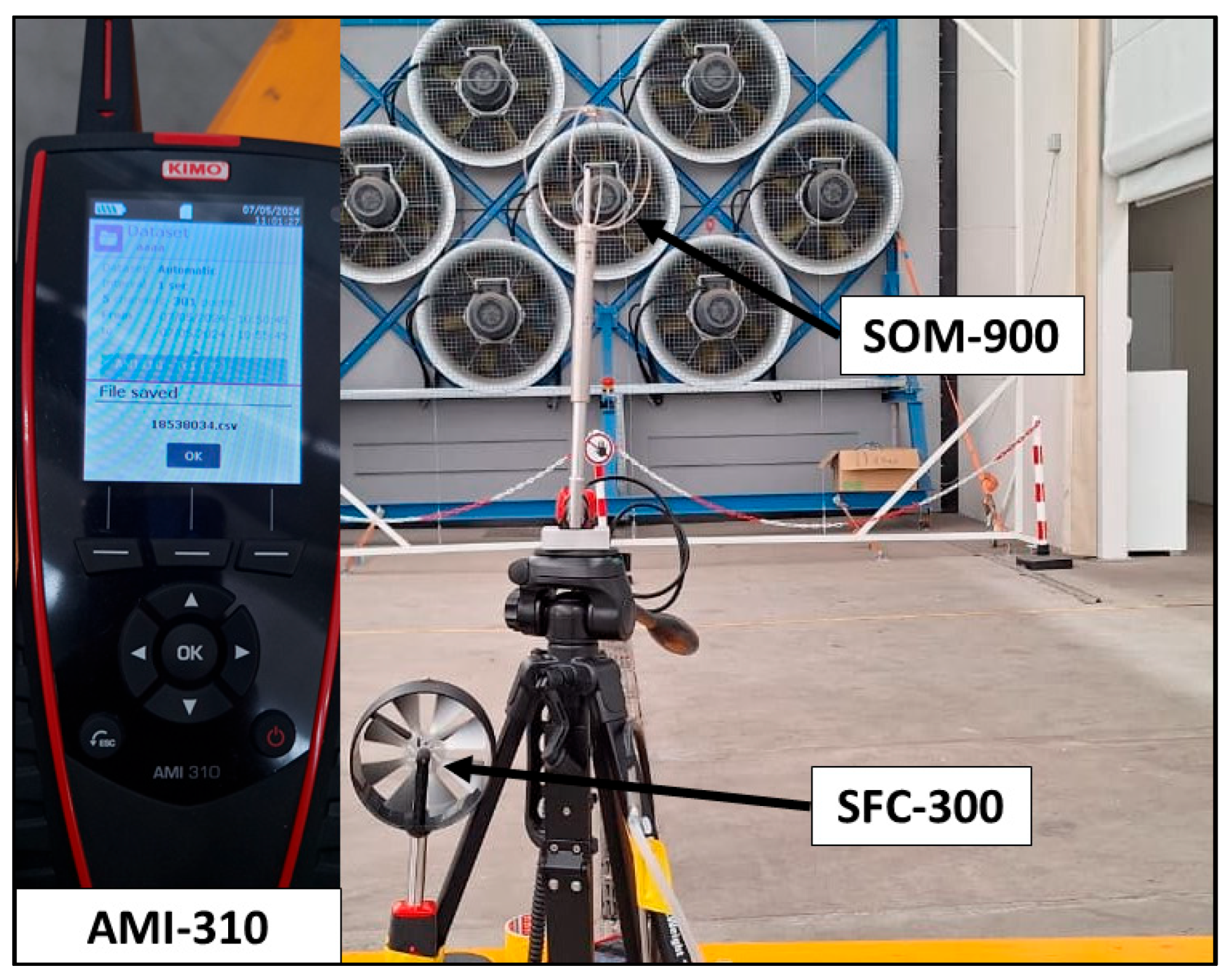
A multifunction environmental meter (AMI-310, KIMO Instruments, Sauermann Group, Chevilly-Larue, France) was used to record environmental variables during each run. A SOM-900 omnidirectional probe (KIMO Instruments) was mounted 1 m above the floor and provided air velocity, temperature, and relative humidity (RH). Moreover, a vane anemometer probe (SFC-300, KIMO Instruments) was installed at ~0.7 m above the floor and used to verify airspeed during the trials. Weather probes are shown in Figure 3. Data from both probes, placed along the collector line approximately 17 m from the sprayer, were logged automatically at a sampling frequency of 1 Hz over an acquisition period of approximately 5 min for each experimental run. The mean, minimum, and maximum values of temperature, RH, and airspeed for each run are given in Table 2.
The air temperature remained reasonably constant throughout the trials, with replicate means ranging from 19.2 to 21.2 °C. Across replicates, the mean relative humidity (RH) varied between 52.5% and 70.6% (overall min–max 52.3–79.4%). Wind speed conditions were predominantly calm, with mean velocities of 0.01–0.68 m·s−1 and instantaneous velocity reached ≈2.0 m·s−1; tunnel airflow was 0 m·s−1, only influenced by the sprayer’s fan during application (Table 2).

2.6. Electrical Instrumentation and Multiplexed Acquisition

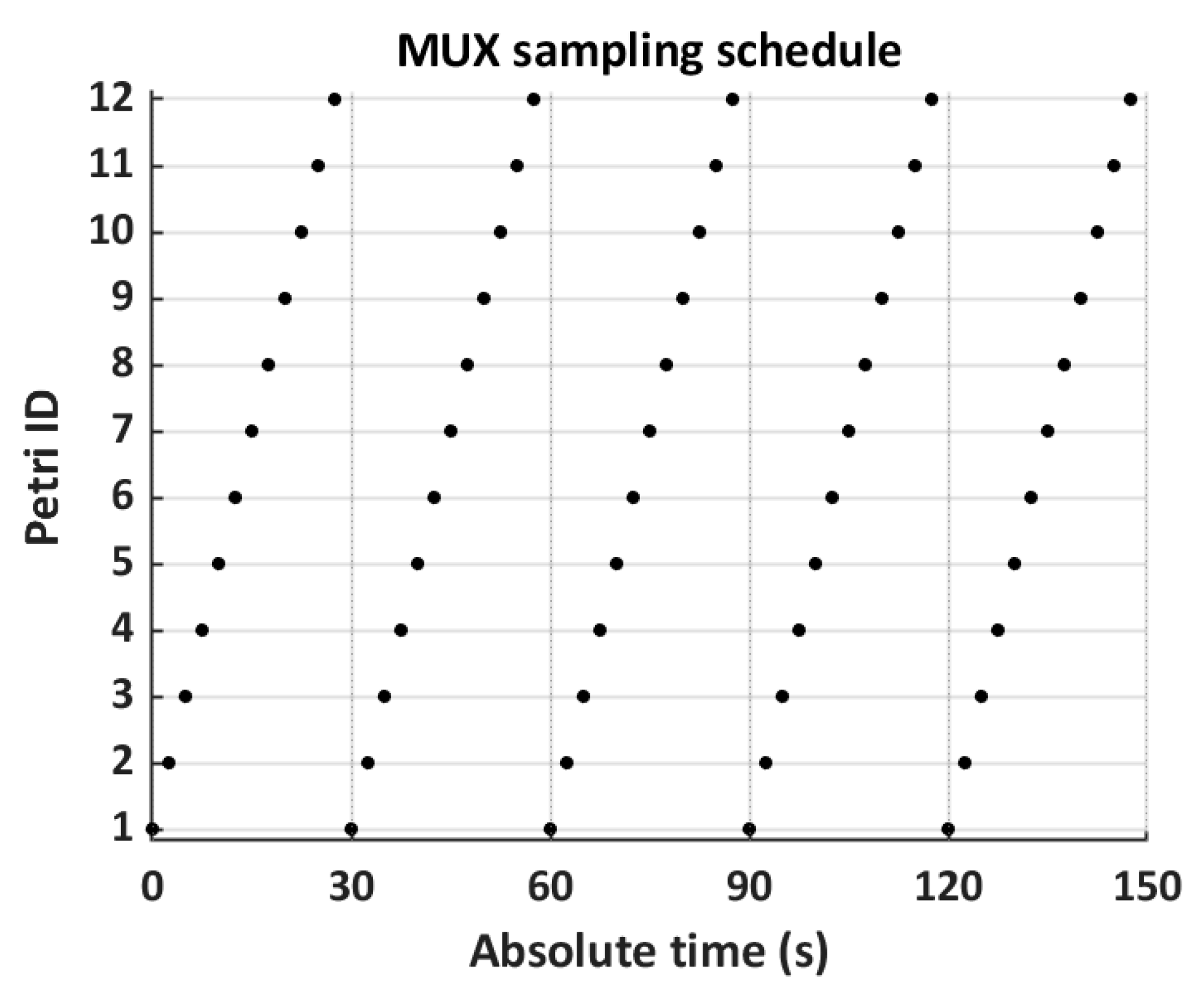
Electrical measurement was performed with a Sciospec ISX-5 electrical impedance analyzer (Sciospec Scientific Instruments GmbH, Bennewitz, Germany) controlled using Sciospec ISX-3 software (version 2.0.0). Channel routing employed a Sciospec MUX32 module connected through the multichannel cable, allowing all 12 collectors to be linked simultaneously and addressed sequentially. The multiplexer electronically switched between the collector channels, with each switching step requiring approximately 2.5 s, resulting in a total acquisition time of ≈30 s per complete measurement cycle. Five acquisition cycles were recorded from the start of spraying (Cycles 1–5, covering 0–150 s). Spraying and acquisition were initiated simultaneously; spraying stopped at 120 s, while acquisition continued until the end of the fifth cycle to allow suspended fine droplets to settle onto the collectors. Sampling time was summarized by acquisition cycle, as shown in Figure 4.

2.7. Determination of the Tracer Deposit by Spectrophotometric Techniques

Immediately after the last electrical cycle, each Petri collector was placed in an oven at 60 °C for 12 h to evaporate the water. The dried Petri dishes were transported to the spectrophotometry laboratory in a dark box, and the residues were redissolved in a fixed volume of DI water. Before each test, a sample of the sprayed liquid was collected from the nozzles to determine its exact concentration. The tracer concentration was quantified using a Cary 60 UV-Vis spectrophotometer (Agilent Technologies, Inc., Santa Clara, CA, USA), set at a wavelength of 492 nm, corresponding to peak absorption of the uranine dye. The deposition Di (µL cm−2) on a single Petri collector was quantified in accordance with ISO 22401:2015 as follows [39]:
D i = A s A b   V dil A r   A col
where As is the absorbance value of the sample, Ab is the absorbance value of the blanks, Vdil is the volume used for the dilution in µL, Ar is the absorbance value of the tank mix, and Acol is the area of the Petri collector in cm2.

2.8. Gravimetric Measurement

Deposition was also quantified by weighing the Petri collector integrated with electrodes and prefilled with DI water, both before and after spraying, on an analytical balance with a readability of 0.01 g. Mass was converted to volume, assuming a solution density of 1 g mL−1, and normalized by the collection area (area of the Petri collector). The gravimetric measurement was used only as a complementary check and further used for comparison.

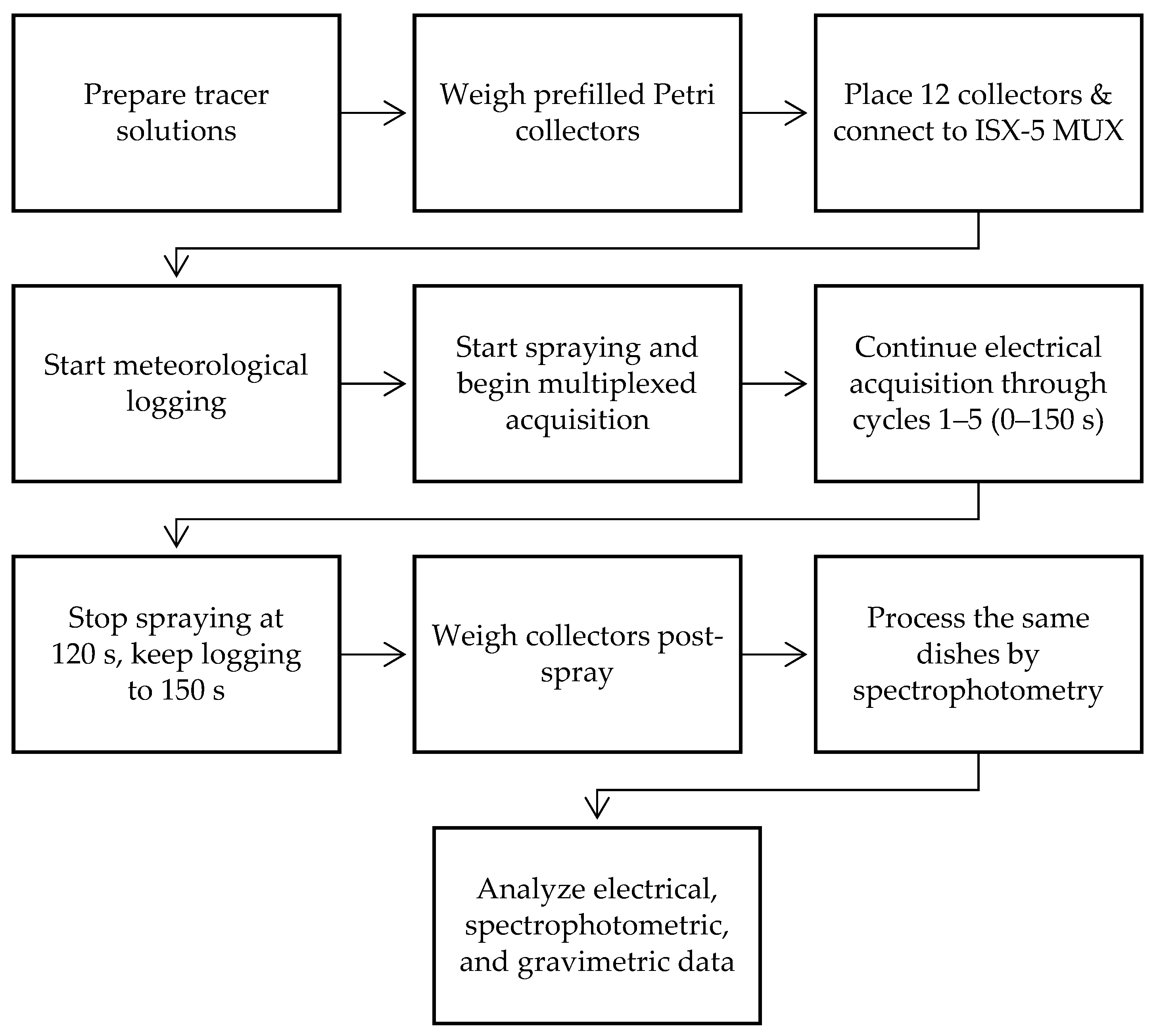
2.9. Sequence of Operations

The sequence of the experiment is shown in Figure 5. To put it briefly, collectors were prefilled with 30 mL DI water and pre-weighed, connected to the electrical instrument. After meteorological logging was initiated and spraying started, five acquisition cycles (≈30 s each; spray off at 120 s, logging to 150 s) were then recorded. The Petri collectors were weighed post-spraying, and the amount of the tracer was quantified using spectrophotometric analysis. Results from electrical, gravimetric, and spectrophotometric measurements were exported for further data analysis.

2.10. Data Processing and Statistics

The data obtained from the experiment were analyzed using MATLAB R2023b (The MathWorks, Inc., Natick, MA, USA). For each tracer, a linear calibration model was fitted between the deposition measured by the spectrophotometric reference method and the corresponding final conductivity value from the fifth acquisition cycle (Cycle 5). Cycle 5 was selected because spraying had already ceased and the spray plume had settled, providing stable conductivity measurements that reflect the total deposited volume. The resulting linear calibration was applied to convert electrical data to deposition for all analyses. In order to analyze the significance of the fitted model, an ANOVA F-test was applied.
For the time-resolved analysis, the tracer-specific calibration equations were applied to conductivity values at each acquisition cycle (1–5) to obtain deposition vs time profiles per collector; curves are shown as mean ± SD over the three runs. To assess the accuracy, deposition values obtained using the electrical method and the gravimetric method were compared with the spectrophotometric reference values. Absolute percentage error (APE) quantifies the deviation of the proposed method from the reference spectrophotometric method as follows:
A P E ( % ) = 100 × D method D ref D ref
where Dmethod is the deposition estimated using the electrical or gravimetric method, and Dref is the deposition measured by the spectrophotometric reference method. For each distance, APE values are reported as mean ± standard deviation across all replicates. Furthermore, cumulative deposition curves indicating spatial distribution were obtained by computing cumulative deposition along the distance. All the results are explained in detail in the section below.

3. Results and Discussion

3.1. Nozzle Characterization

The main droplet-size metrics (dV10, dV50, dV90, and S), derived from the droplet-size distribution measured with PDIA, are reported in Table 3. The droplets can be considered coarse, with about 9.2% having a diameter below 100 µm. This suggests a contained drift generation. The relative span > 1 indicates a wide spectrum of droplet sizes.

3.2. Multipoint Calibration Curves

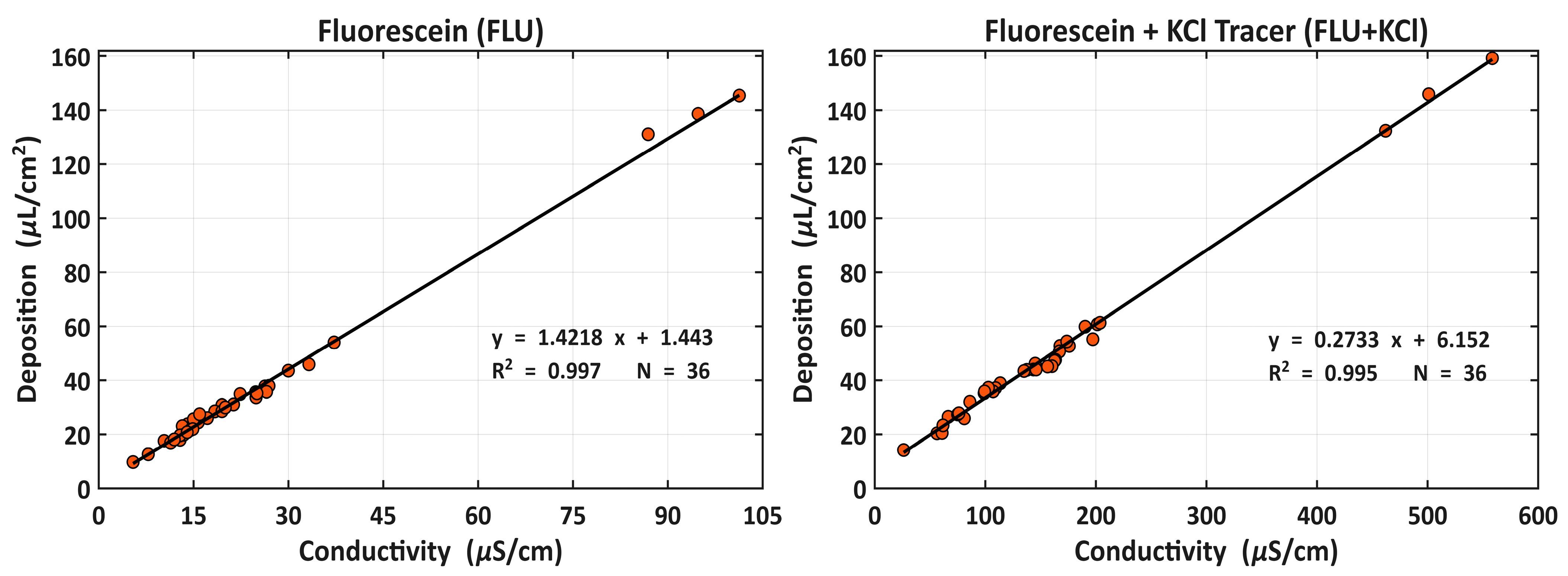
Figure 6 shows a linear correlation between the conductivity and the deposition measured by the spectrophotometric method for both tracers, with coefficients of determination (R2) greater than 0.994. The significance of the regression models was tested using the F test at the 1% significance level (α = 0.01, 99% confidence), to reaffirm the linear correlation between the conductivity and the spray deposition. Both calibrations were significant at α = 0.01 (F ≫ Fcrit; p ≪ 0.01), indicating that a simple linear model is sufficient to convert the resistive signal into spectrophotometric-equivalent deposition over the tested range.
Both tracer solutions yielded distinct calibration slopes, reflecting their different ionic strengths and conductivities. The addition of KCl to the fluorescein solution significantly increased the ionic strength and ion mobility, thereby producing higher conductivity values for a given deposited volume. This is consistent with the much higher conductivity of the FLU + KCl solution (1660 µS cm−1) compared with the fluorescein solution (350 µS cm−1). Despite the different slopes, both models showed strong linear correlations between conductivity and deposition.
Comparable linear behavior has been reported for other drift and deposition assessment sensors, although they rely on different sensing principles. Dai et al. [1] reported R2 values above 0.90 for the linear relationship between leaf-wetness sensor voltage increments and deposited spray. Similarly, capacitive sensors showed linear responses between capacitance change and deposited volume, with calibration slopes affected by spray formulation and droplet size as reported by [28,29]. In contrast, the slope variation observed in our resistive sensor is governed primarily by ionic strength rather than droplet size. Therefore, while a linear model is sufficient, formulation-specific calibration remains essential because solution chemistry directly influences sensor sensitivity.

3.3. Time-Resolved Deposition

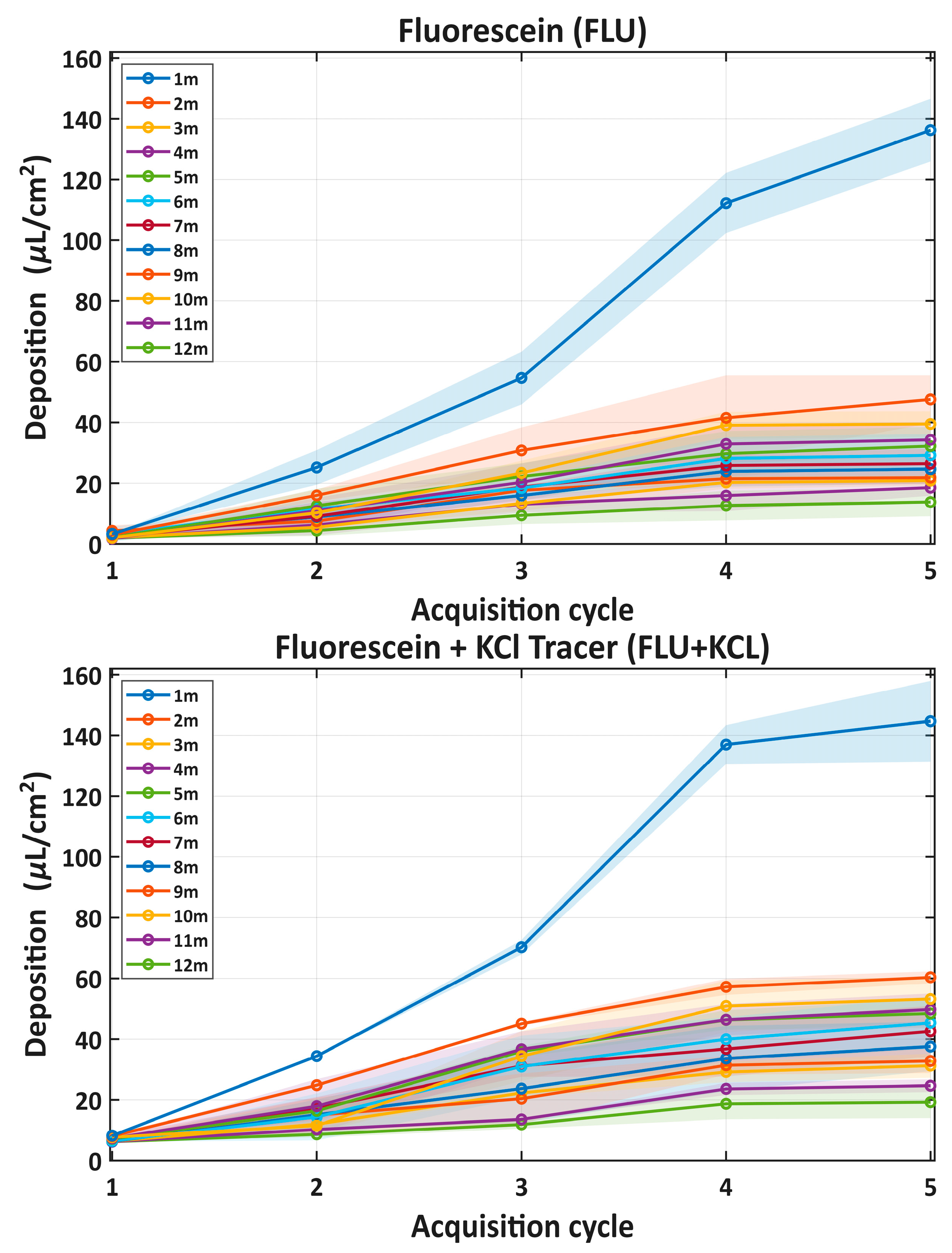
Using the multiplexer (30 s acquisition cycles across 12 Petri collectors), the tracer deposited on collectors positioned along the test bench at increasing distances from the sprayer was tracked. Deposition rose monotonically at all distances and was steepest during the 0–120 s spray window (cycles 1–4), especially at the nearest collector (~1 m). After shut-off, curves exhibited only a small increment from cycle 4 to 5, reflecting the short settling tail of residual airborne droplets, and then plateaued. However, the decline in final total deposition at the farther distance from sprayer is consistent with the behavior of an air inclusion nozzle producing a coarse spray [15,40,41], as confirmed by the DSD of the CVI 80 025 (dV50 = 227.3 µm, dV90 = 469.4 µm; S = 1.6), whereby the relatively large droplets settle more rapidly than those from conventional nozzles. At each cycle, the value reported in each Petri collector is the total amount of tracer accumulated on that Petri collector from the start of the test, thus always showing increases (Figure 7).
The multiplexer introduces a constant within-cycle time offset that shifts measurement order but leaves the accumulated amount on any Petri collector unchanged because it reads channels sequentially in a predetermined order. As a result, cycle-synchronized plots accurately depict the increase in deposition over time.
Previous studies have demonstrated real-time monitoring of spray deposition, but most relied on single-point measurements or lacked spatial resolution. Sun et al. [42] used a conductivity-based system to track cumulative deposition in real time, while early work [43] also aimed at rapid deposition measurement, though without sensor arrays. Notably, Dai et al. [1] deployed multiple LWS sensors wirelessly in field conditions, effectively measuring deposition at several points concurrently. In this context, our system extends previous efforts by providing simultaneous, multi-point time-resolved deposition curves.

3.4. Method Comparison

To validate the accuracy and robustness of the electrical method, we compared the final deposition derived from the electrical method with deposition measured by the spectrophotometric and gravimetric methods at every Petri collector placed at a defined distance from the sprayer.
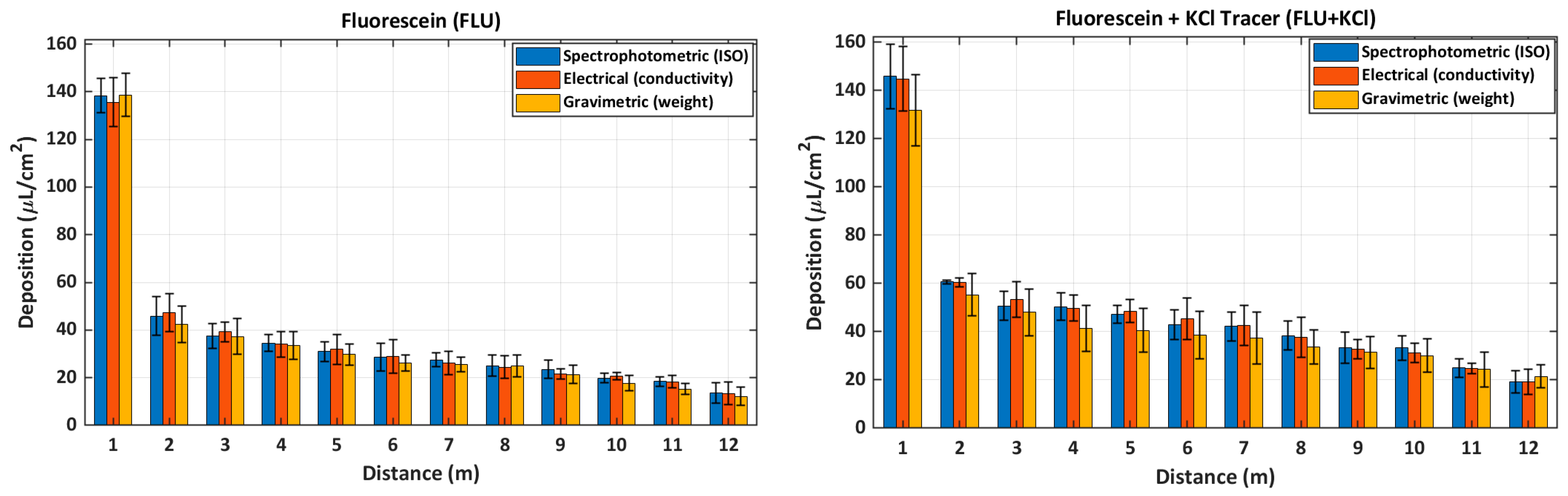
Figure 8 illustrates the deposition (mean ± SD, n = 3) obtained using the three measurement methods. Data supporting Figure 8 are provided in the Supplementary Materials. The results indicate that all the methods exhibited a consistent trend across the distance from the sprayer for both tracers, with the highest deposition at the nearest collectors and a steady decrease with distance. The deposition predicted by the electrical method essentially overlaps spectrophotometric values at every distance, indicating close agreement, while the gravimetric tends to be slightly lower at some points but preserves the deposition trend across the distance.
The observed variation between replicates, even under wind tunnel control conditions, primarily reflects the inherent variability of spraying (stochastic plume structure, micro-differences in droplet loading and timing) and does not suggest instability of the electrical method. Table 4 reports the mean absolute percentage error (APE) at each collector distance and for both tracer solutions, comparing electrical and gravimetric estimates with the spectrophotometric reference. The electrical method performed optimally, as the mean percentage deviation from the standard spectrophotometric method was less than 10% for FLU and 8% FLU + KCl. However, deposition predicted by the gravimetric method showed a larger deviation that goes up to 19%, which is expected given potential handling variability and a lower signal-to-noise ratio at small deposits.
Comparable levels of agreement have been reported for other sensors. Li et al. [44] achieved <10% deviation using a capacitive system, while Dai et al. [1] found a strong correlation between LWS signals and reference coverage. These findings suggested that our <10% deviation is consistent with state-of-the-art performance. Once calibrated with the spectrophotometric method and checked periodically, the electrical method provides a reliable way to map spray deposition in real time.

3.5. Spatial Distribution

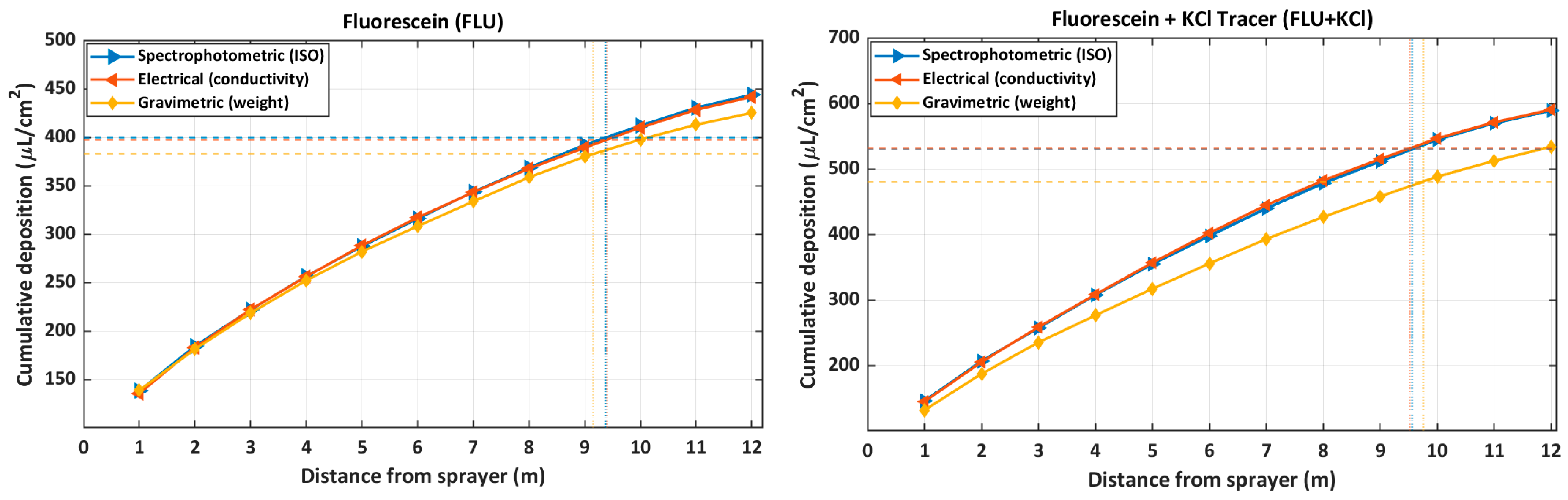
To assess the spatial distribution of the spray, a cumulative deposition curve was established for each tracer solution by summing the deposition in incremental order across the distance. Figure 9 shows the cumulative deposition curves predicted by three methods. The cumulative deposition curve reads D90 as the distance at which the cumulative deposition reached 90% of the total measured deposition. For fluorescein, 90% of the total deposition was 397.50 µL cm−2 (electrical), 399.50 µL cm−2 (spectrophotometric), and 382.60 µL cm−2 (gravimetric), reaching the distances of 9.40 m, 9.37 m, and 9.15 m, respectively. The cumulative deposition curve for FLU + KCl indicated that 90% of the total deposition was 531.29 µL cm−2 (electrical), 530.02 µL cm−2 (spectrophotometric), and 480.39 µL cm−2 (gravimetric). The corresponding D90 distances were 9.56 m (spectrophotometric), 9.52 m (electrical), and 9.75 m (weight). Supporting data for the cumulative deposition curves shown in Figure 9 are provided in the Supplementary Materials.
Across both tracers, the electrical curves closely overlap the spectrophotometric reference in both magnitude (total and 90% target) and spatial footprint (D90). Deposition is highest near the sprayer and decreases with distance, with cumulative curves leveling off at approximately 10 m. These results can be compared with previous drift studies that describe how far the spray extends under different conditions. Ellis et al. [13] showed that drift-reducing nozzles markedly reduced the airborne spray cloud within 5 m downwind, achieving up to 90% drift reduction at 3–5 m compared with standard nozzles. Our D90 of ~9.5 m indicates that under calm conditions, nearly all spray settled by 10 m, aligning qualitatively with observations that drift from coarse nozzles becomes minimal beyond a few meters. All three methods showed consistent spatial patterns. The sensor’s ability to capture the same D90 as the reference confirms its utility for spatial mapping. The electrical method successfully replicated the spectrophotometric reference in both deposition level and reach (D90), confirming its utility for real-time spatial mapping.

4. Conclusions

This study addresses the key methodological limitations of our earlier resistive-based approach. Using multi-point calibration stabilized the conductivity-to-deposition mapping; a multichannel measurement enables the time-resolved acquisition and measurement of deposition kinetics across all Petri collectors during spraying, and same-collector measurements enabled direct comparison with the standard spectrophotometric method, with gravimetry serving as a complementary verification only. Three repetitions were performed for both tracers, keeping nozzles and spraying parameters constant across all the runs. The meteorological data were also logged to monitor the meteorological conditions during each trial.
The addition of the KCl modified the sensor response through its effect on ionic strength, yet it did not affect measurement accuracy; the resistive method showed an optimal correlation between deposition and conductivity with R2 of 0.997 for FLU and 0.995 for FLU + KCl. In addition, the cycle-resolved curve showed the increase in the deposition over time during spraying and flattening of the curve post-spray. Across the methods, spatial distribution curves show that cumulative deposition estimated by the electrical method matched closely with the spectrophotometric deposition, while gravimetry was slightly conservative. However, all the methods predicted the same trend (high deposition near the sprayer and a decrease in deposition far from the sprayer).
The improved methodology with a better acquisition system exhibited very good performance comparable to the standard spectrophotometric analysis, enabling faster and real-time detection. The overall deviation of the deposition measured by the electrical method from the spectrophotometer was less than 10% for both tracer solutions. The resulting workflow improves accuracy, repeatability, and interpretability, supporting the application of the proposed improved methodology and sensing system for the estimation of the spray deposition in real time, enabling faster on-site data acquisition and more efficient data analysis.
The potential next steps could include assembling a tracer/formulation calibration library and validating the method across nozzle types, operating pressures, and wind conditions, both in the wind tunnel and in the field. Acceleration of the acquisition system and evaluation of field robustness are also required. Looking ahead, the proposed sensing approach could provide a robust foundation for the future development of real-time, feedback-loop-assisted spraying systems. In such systems, integration of sensor data with control algorithms could enable deposition-based adjustment of sprayer parameters such as flow rate, pressure, or nozzle activation, according to environmental and operational conditions. Establishing this type of feedback loop between sensing and actuation would, in the future, support precision spraying, reduce agrochemical losses, and promote more sustainable and efficient pesticide applications.

Supplementary Materials

The following supporting information can be downloaded at: https://www.mdpi.com/article/10.3390/agriengineering8010003/s1, Table S1: Electrical data; Table S2: Deposition data for Figure 8; Table S3: Time-resolved deposition data for Figure 7; Table S4: Cumulative deposition data for Figure 9; Table S5: Absolute percentage error (APE) data.

Author Contributions

Conceptualization, A.A., L.B., F.M. and A.G.; methodology, L.B., A.A. and F.M.; software, A.A.; validation, L.B. and A.A.; formal analysis, A.A. and L.B.; investigation, A.A. and L.B.; resources, F.M., L.B. and A.A.; data curation, A.A.; writing—original draft preparation, A.A.; writing—review and editing, A.A. and L.B.; visualization, A.A.; supervision, F.M. and A.G.; funding acquisition, F.M. All authors have read and agreed to the published version of the manuscript.

Funding

This study was carried out within the AGRITECH National Research Center and received funding from the European Union Next-GenerationEU, under the Piano Nazionale di Ripresa e Resilienza (PNRR)—Missione 4 Componente 2, Investimento 1.4—D.D. 1032 17/06/2022, CN00000022. This manuscript reflects only the authors’ views and opinions; neither the European Union nor the European Commission can be considered responsible for them.

Institutional Review Board Statement

Not applicable.

Informed Consent Statement

Not applicable.

Data Availability Statement

The original contributions presented in this study are included in the article and provided as Supplementary Material. Further inquiries can be directed to the corresponding authors upon request.

Acknowledgments

The authors would like to thank Mitterer Professional Sprayers for the provision of the sprayer. Finally, the authors would like to thank the Laboratory Technicians of unibz G. Folino, D. Klammer, M. Malavasi, and J. Zelger, for their technical support during the experiment.

Conflicts of Interest

The authors declare no conflicts of interest.

References

  1. Dai, S.; Wang, M.; Ou, M.; Zhou, H.; Jia, W.; Gao, R.; Wang, C.; Wang, G.; Li, Z.; Chen, H. Development and Experiment of an Online Measuring System for Spray Deposition. Agriculture 2022, 12, 1195. [Google Scholar] [CrossRef]
  2. Sarkar, S.; Gil, J.D.B.; Keeley, J.; Jansen, K. The Use of Pesticides in Developing Countries and Their Impact on Health and the Right to Food; European Parliament, Policy Department for External Relations: Brussels, Belgium, 2021. [Google Scholar]
  3. Singh, P.; Singh, V.K.; Singh, R.; Borthakur, A.; Madhav, S.; Ahamad, A.; Kumar, A.; Pal, D.B.; Tiwary, D.; Mishra, P.K. Bioremediation: A Sustainable Approach for Management of Environmental Contaminants. In Abatement of Environmental Pollutants; Elsevier: Amsterdam, The Netherlands, 2020; pp. 1–23. [Google Scholar]
  4. Popp, J.; Pető, K.; Nagy, J. Pesticide Productivity and Food Security. A Review. Agron. Sustain. Dev. 2013, 33, 243–255. [Google Scholar] [CrossRef]
  5. Lipiński, S.; Kaliniewicz, Z.; Markowski, P.; Szczyglak, P. Evaluation of Air-Assisted Spraying Technology for Pesticide Drift Reduction. Sustainability 2025, 17, 5036. [Google Scholar] [CrossRef]
  6. European Community (EC) Official Journal of the European Union. Directive 2009/128/EC of the European Parliament and the Council of 21 October 2009 Establishing a Framework for Community Action to Achieve the Sustainable Use of Pesticides. 2009. Available online: https://eur-lex.europa.eu/LexUriServ/LexUriServ.do?uri=OJ:L:2009:309:0071:0086:en:PDF (accessed on 2 September 2024).
  7. Palma, R.P.; Cunha, J.P.A.R.D. Multivariate Analysis Applied to the Ground Application of Pesticides in the Corn Crop. AgriEngineering 2023, 5, 829–839. [Google Scholar] [CrossRef]
  8. Cunha, J.P.A.R.D.; Lopes, L.D.L.; Alves, C.O.R.; Alvarenga, C.B.D. Spray Deposition and Losses to Soil from a Remotely Piloted Aircraft and Airblast Sprayer on Coffee. AgriEngineering 2024, 6, 2385–2394. [Google Scholar] [CrossRef]
  9. Pagliai, A.; Sarri, D.; Pinheiro Amantea, R.; Perna, C.; Rimbotti, N.; Lisci, R.; Vieri, M. On-Field Spray Downwash Characterization of a Commercial Unmanned Aerial Vehicle for Spray Application. In Biosystems Engineering Promoting Resilience to Climate Change—AIIA 2024—Mid-Term Conference; Sartori, L., Tarolli, P., Guerrini, L., Zuecco, G., Pezzuolo, A., Eds.; Lecture Notes in Civil Engineering; Springer Nature: Cham, Switzerland, 2025; Volume 586, pp. 715–722. ISBN 978-3-031-84211-5. [Google Scholar]
  10. Roma, E.; Orlando, S.; Carella, A.; Lo Bianco, R.; Massenti, R.; Catania, P. Fraction Cover Estimation Using Drone-Based Multispectral Images in Six Olive Cultivars and Different Planting Systems: A Case Study in Sicily. Smart Agric. Technol. 2025, 12, 101323. [Google Scholar] [CrossRef]
  11. Grella, M.; Marucco, P.; Balsari, P. Toward a New Method to Classify the Airblast Sprayers According to Their Potential Drift Reduction: Comparison of Direct and New Indirect Measurement Methods. Pest Manag. Sci. 2019, 75, 2219–2235. [Google Scholar] [CrossRef]
  12. Nuyttens, D.; Sonck, B.; De Schampheleire, M.; Steurbaut, W.; Baetens, K.; Verboven, P.; Nicolai, B.; Ramon, H. A PDPA Laser-Based Measuring Set-up for the Characterisation of Spray Nozzles. Commun. Agric. Appl. Biol. Sci. 2005, 70, 1023. [Google Scholar]
  13. Ellis, M.C.B.; Lane, A.G.; O’Sullivan, C.M.; Jones, S. Wind Tunnel Investigation of the Ability of Drift-Reducing Nozzles to Provide Mitigation Measures for Bystander Exposure to Pesticides. Biosyst. Eng. 2021, 202, 152–164. [Google Scholar] [CrossRef]
  14. ISO 22856:2008(E); Equipment for Crop Protection—Methods for the Laboratory Measurement of Spray Drift—Wind Tunnels. International Organization for Standardization (ISO): Geneva, Switzerland, 2008.
  15. Jomantas, T.; Lekavičienė, K.; Steponavičius, D.; Andriušis, A.; Zaleckas, E.; Zinkevičius, R.; Popescu, C.V.; Salceanu, C.; Ignatavičius, J.; Kemzūraitė, A. The Influence of Newly Developed Spray Drift Reduction Agents on Drift Mitigation by Means of Wind Tunnel and Field Evaluation Methods. Agriculture 2023, 13, 349. [Google Scholar] [CrossRef]
  16. Wang, G.; Zhang, T.; Song, C.; Yu, X.; Shan, C.; Gu, H.; Lan, Y. Evaluation of Spray Drift of Plant Protection Drone Nozzles Based on Wind Tunnel Test. Agriculture 2023, 13, 628. [Google Scholar] [CrossRef]
  17. Wang, C.; He, X.; Wang, X.; Wang, Z.; Wang, S.; Li, L.; Jane, B.; Andreas, H.; Wang, Z.; Mei, S. Distribution Characteristics of Pesticide Application Droplets Deposition of Unmanned Aerial Vehicle Based on Testing Method of Deposition Quality Balance. Trans. Chin. Soc. Agric. Eng. 2016, 32, 89–97. [Google Scholar]
  18. Wen, Y.; Zhang, R.; Chen, L.; Huang, Y.; Yi, T.; Xu, G.; Li, L.; Hewitt, A.J. A New Spray Deposition Pattern Measurement System Based on Spectral Analysis of a Fluorescent Tracer. Comput. Electron. Agric. 2019, 160, 14–22. [Google Scholar] [CrossRef]
  19. Kwak, D.-B.; Kim, S.C.; Kuehn, T.H.; Pui, D.Y.H. Quantitative Analysis of Droplet Deposition Produced by an Electrostatic Sprayer on a Classroom Table by Using Fluorescent Tracer. Build. Environ. 2021, 205, 108254. [Google Scholar] [CrossRef] [PubMed]
  20. Hoffmann, W.C.; Salyani, M. Spray Deposition on Citrus Canopies under Different Meteorological Conditions. Trans. ASAE 1996, 39, 17–22. [Google Scholar] [CrossRef]
  21. Sánchez-Hermosilla, J.; Rincón, V.J.; Páez, F.C.; Pérez-Alonso, J.; Callejón-Ferre, Á.-J. Evaluation of the Effect of Different Hand-Held Sprayer Types on a Greenhouse Pepper Crop. Agriculture 2021, 11, 532. [Google Scholar] [CrossRef]
  22. Grella, M.; Gallart, M.; Marucco, P.; Balsari, P.; Gil, E. Ground Deposition and Airborne Spray Drift Assessment in Vineyard and Orchard: The Influence of Environmental Variables and Sprayer Settings. Sustainability 2017, 9, 728. [Google Scholar] [CrossRef]
  23. Gil, E.; Balsari, P.; Gallart, M.; Llorens, J.; Marucco, P.; Andersen, P.G.; Fàbregas, X.; Llop, J. Determination of Drift Potential of Different Flat Fan Nozzles on a Boom Sprayer Using a Test Bench. Crop Prot. 2014, 56, 58–68. [Google Scholar] [CrossRef]
  24. Grella, M.; Gil, E.; Balsari, P.; Marucco, P.; Gallart, M. Advances in Developing a New Test Method to Assess Spray Drift Potential from Air Blast Sprayers. Span. J. Agric. Res. 2017, 15, e0207. [Google Scholar] [CrossRef]
  25. Grella, M.; Marucco, P.; Balafoutis, A.T.; Balsari, P. Spray Drift Generated in Vineyard during Under-Row Weed Control and Suckering: Evaluation of Direct and Indirect Drift-Reducing Techniques. Sustainability 2020, 12, 5068. [Google Scholar] [CrossRef]
  26. Derksen, R.C.; Gray, R.L. Gray Deposition and Air Speed Patterns of Air-Carrier Apple Orchard Sprayers. Trans. ASAE 1995, 38, 5–11. [Google Scholar] [CrossRef]
  27. Pergher, G. Recovery Rate of Tracer Dyes Used for Spray Deposit Assessment. Trans. ASAE 2001, 44, 787. [Google Scholar] [CrossRef]
  28. Yan, T.; Zhang, Z.; Shou, J. Development of a Capacitive Sensor for Spray Deposition and Drift Measurements. Smart Agric. Technol. 2025, 12, 101164. [Google Scholar] [CrossRef]
  29. Palleja, T.; Tresanchez, M.; Llorens, J.; Saiz-Vela, A. Design and Characterization of a Real-Time Capacitive System to Estimate Pesticides Spray Deposition and Drift. Comput. Electron. Agric. 2023, 207, 107720. [Google Scholar] [CrossRef]
  30. Pagliai, A.; Sarri, D.; Perna, C.; Vieri, M. Can a Variable-Rate Sprayer Be Efficient and Economic? Testing and Economic Analysis in Viticulture. In AIIA 2022: Biosystems Engineering Towards the Green Deal; Ferro, V., Giordano, G., Orlando, S., Vallone, M., Cascone, G., Porto, S.M.C., Eds.; Lecture Notes in Civil Engineering; Springer International Publishing: Cham, Switzerland, 2023; Volume 337, pp. 805–815. ISBN 978-3-031-30328-9. [Google Scholar]
  31. Abbas, I.; Liu, J.; Faheem, M.; Noor, R.S.; Shaikh, S.A.; Solangi, K.A.; Raza, S.M. Different Sensor Based Intelligent Spraying Systems in Agriculture. Sens. Actuators A Phys. 2020, 316, 112265. [Google Scholar] [CrossRef]
  32. Wei, Z.; Xue, X.; Salcedo, R.; Zhang, Z.; Gil, E.; Sun, Y.; Li, Q.; Shen, J.; He, Q.; Dou, Q.; et al. Key Technologies for an Orchard Variable-Rate Sprayer: Current Status and Future Prospects. Agronomy 2022, 13, 59. [Google Scholar] [CrossRef]
  33. Ali, A.; Altana, A.; Becce, L.; Amin, S.; Lugli, P.; Petti, L.; Mazzetto, F. Advancements in the Development of Resistive-Based Method Applied to Optical Tracers for Real-Time Estimation of Spray Drift Deposition. IEEE Trans. AgriFood Electron. 2024, 3, 18–25. [Google Scholar] [CrossRef]
  34. Altana, A.; Becce, L.; Avancini, E.; Lugli, P.; Petti, L.; Mazzetto, F. Cost-Effective Tracing Techniques for the Rapid Characterization of Spray Deposition and Drift through Electrical Conductivity and Fluorescence. In Proceedings of the 2022 IEEE Workshop on Metrology for Agriculture and Forestry (MetroAgriFor), Perugia, Italy, 3–5 November 2022; IEEE: New York, NY, USA, 2022; pp. 164–168. [Google Scholar]
  35. Tan, Y.-L.; Chong, C.-E. Resistivity Measurement of a Small-Volume Sample Using Two Planar Disc Electrodes and a New Geometric Factor. IEEE Sens. J. 2008, 8, 516–521. [Google Scholar] [CrossRef]
  36. Becce, L.; Carabin, G.; Mazzetto, F. Agroforestry Innovations Lab Activities on Sprayer Performance and Certification. In AIIA 2022: Biosystems Engineering Towards the Green Deal; Ferro, V., Giordano, G., Orlando, S., Vallone, M., Cascone, G., Porto, S.M.C., Eds.; Lecture Notes in Civil Engineering; Springer International Publishing: Cham, Switzerland, 2023; Volume 337, pp. 305–313. ISBN 978-3-031-30328-9. [Google Scholar]
  37. Becce, L.; Mazzi, G.; Ali, A.; Bortolini, M.; Gregoris, E.; Feltracco, M.; Barbaro, E.; Contini, D.; Mazzetto, F.; Gambaro, A. Wind Tunnel Evaluation of Plant Protection Products Drift Using an Integrated Chemical–Physical Approach. Atmosphere 2024, 15, 656. [Google Scholar] [CrossRef]
  38. Mazzi, G.; Becce, L.; Ali, A.; Bortolini, M.; Gregoris, E.; Feltracco, M.; Barbaro, E.; Gronauer, A.; Gambaro, A.; Mazzetto, F. Methodological Advancements in Testing Agricultural Nozzles and Handling of Drop Size Distribution Data. AgriEngineering 2025, 7, 139. [Google Scholar] [CrossRef]
  39. ISO 22401:2015; Equipment for Crop Protection—Method for Measurement of Potential Spray Drift from Horizontal Boom Sprayers by the Use of a Test Bench. International Organization for Standardization (ISO): Geneva, Switzerland, 2015.
  40. Martin, D.E.; Perine, J.W.; Grant, S.; Abi-Akar, F.; Henry, J.L.; Latheef, M.A. Spray Deposition and Drift as Influenced by Wind Speed and Spray Nozzles from a Remotely Piloted Aerial Application System. Drones 2025, 9, 66. [Google Scholar] [CrossRef]
  41. De Cauwer, B.; De Meuter, I.; De Ryck, S.; Dekeyser, D.; Zwertvaegher, I.; Nuyttens, D. Performance of Drift-Reducing Nozzles in Controlling Small Weed Seedlings with Contact Herbicides. Agronomy 2023, 13, 1342. [Google Scholar] [CrossRef]
  42. Sun, C.; Qiu, W.; Ding, W.; Gu, J. Design and Experiment of a Real-Time Droplet Accumulating Mass Measurement System. Trans. ASABE 2017, 60, 615–624. [Google Scholar] [CrossRef]
  43. Salyani, M.; Serdynski, J. Development of a sensor for spray deposition assessment. Trans. ASAE 1990, 33, 1464. [Google Scholar] [CrossRef]
  44. Li, L.; Zhang, R.; Chen, L.; Yi, T.; Xu, G.; Xue, D.; Tang, Q.; Zhang, L.; John Hewitt, A.; An, Y.; et al. Development of Sensor System for Real-Time Measurement of Droplet Deposition of Agricultural Sprayers. Int. J. Agric. Biol. Eng. 2021, 14, 19–26. [Google Scholar] [CrossRef]
Figure 1. Diagrams of the silver electrodes printed on a PET substrate and encapsulated with PI, with the electrode radius (b = 4 mm) and center-to-center distance (d = 10 mm). From [33].
Agriengineering 08 00003 g001
Figure 2. Experimental setup showing the sprayer, collector array, and impedance-based data acquisition system.
Agriengineering 08 00003 g002
Figure 3. Environmental monitoring setup for the wind tunnel trials. A KIMO AMI-310 instrument recorded measurements from SOM-900 and SFC-300 probes mounted on a tripod.
Agriengineering 08 00003 g003
Figure 4. Multiplexer (MUX) sampling schedule (1 to 5 cycles, 30 s per cycle; 2.5 s for each Petri collector).
Agriengineering 08 00003 g004
Figure 5. Workflow for electrical, spectrophotometric, and gravimetric measurements.
Agriengineering 08 00003 g005
Figure 6. Linear calibration curve between spectrophotometric deposition and conductivity for FLU (left) and FLU + KCl (right).
Agriengineering 08 00003 g006
Figure 7. Time-resolved deposition for (top) FLU and (bottom) FLU + KCl measured at different distances from the sprayer along the test bench.
Agriengineering 08 00003 g007
Figure 8. Deposition profiles for fluorescein (left) and fluorescein + KCl (right), measured by the spectrophotometric, electrical, and gravimetric methods across collectors placed at increasing distances from the sprayer (mean ± SD, n = 3).
Agriengineering 08 00003 g008
Figure 9. Cumulative deposition and D90 distances for fluorescein (left) and fluorescein + KCl (right), measured by the spectrophotometric, electrical, and gravimetric methods. The horizontal dashed line marks 90% of total deposition, and the vertical line indicates the corresponding D90 distance.
Agriengineering 08 00003 g009
Table 1. Operational parameters used in the wind tunnel trials.
ParametersDescription
Nozzle ModelAlbuz CVI 80 025 Lilac
No of nozzles8
Pressure1 MPa
Measured flow rate1.6 L/min
Spraying time120 s
Fan speedHigh
Table 2. Weather data across six replications during the trials.
TracersRepetitionTemperature (°C)Relative Humidity (%)Wind Speed (m s−1)
MeanStdMeanMinmaxMeanMinMax
FLU121.00.6552.652.453.00.0700.293
220.60.1352.552.353.10.2301.765
321.20.2959.753.664.10.6802.025
FLU + KCl119.50.3267.665.469.90.0100.705
219.20.1170.669.573.00.0200.949
319.40.1769.563.479.40.1001.846
Table 3. Droplet-size metrics of the CVI 80 025 nozzle operated at 1 MPa.
MetricValue
dV10 (µm)105.4
dV50 (µm)227.3
dV90 (µm)469.4
S1.6
Table 4. Absolute percentage error (APE, %) of electrical (CON) and gravimetric (GRA) deposition measurements relative to the spectrophotometric reference for FLU and FLU + KCl tracers (mean ± SD, n = 3).
Distance (m)FLU FLU + KCl
APECON (%)APEGRA (%)APECON (%)APEGRA (%)
12.16 ± 2.303.56 ± 2.020.73 ± 1.039.70 ± 4.20
23.19 ± 2.717.31 ± 3.721.47 ± 1.219.33 ± 13.93
34.60 ± 4.314.50 ± 3.584.89 ± 3.3010.07 ± 5.26
45.02 ± 0.524.86 ± 6.241.03 ± 0.7318.67 ± 10.52
54.94 ± 4.134.00 ± 2.853.43 ± 3.3917.52 ± 11.82
62.75 ± 2.307.26 ± 6.506.14 ± 4.7013.76 ± 8.63
77.01 ± 4.477.29 ± 2.904.99 ± 3.8314.97 ± 11.55
84.09 ± 5.094.35 ± 3.485.47 ± 1.6912.67 ± 6.37
99.27 ± 5.189.19 ± 3.056.66 ± 3.166.45 ± 2.49
104.21 ± 4.7417.95 ± 9.055.63 ± 2.4910.33 ± 8.51
114.92 ± 2.7817.28 ± 7.437.54 ± 3.9411.62 ± 7.36
122.77 ± 3.169.40 ± 4.294.65 ± 2.7511.50 ± 3.71
APECON (%) = deviation of conductivity-based deposition from spectrophotometric deposition; APEGRA (%) = deviation of gravimetric-based deposition from spectrophotometric deposition.
Disclaimer/Publisher’s Note: The statements, opinions and data contained in all publications are solely those of the individual author(s) and contributor(s) and not of MDPI and/or the editor(s). MDPI and/or the editor(s) disclaim responsibility for any injury to people or property resulting from any ideas, methods, instructions or products referred to in the content.