
Next Article in Journal
A Stochastic Optimization Model for Electric Freight Operations on Predefined Long-Haul Routes with Partial Recharging and Heterogeneous Fleets
Previous Article in Journal
BDNet: A Lightweight YOLOv12-Based Vehicle Detection Framework for Smart Urban Traffic Monitoring
 
 
Due to scheduled maintenance work on our servers, there may be short service disruptions on this website between 11:00 and 12:00 CEST on March 28th.
Article

Time-Dependent Green Location-Routing Problem with the Consideration of Spatio-Temporal Variations

School of Traffic and Transportation, Beijing Jiaotong University, Beijing 100044, China
*
Author to whom correspondence should be addressed.
Smart Cities 2026, 9(2), 34; https://doi.org/10.3390/smartcities9020034
Submission received: 7 July 2025 / Revised: 28 January 2026 / Accepted: 31 January 2026 / Published: 14 February 2026

Highlights

What are the main findings?
  • Proposes a spatio-temporal dynamic carbon emission calculation method integrating real-time traffic dynamics and electric logistics vehicle energy consumption, enabling precise emission quantification for urban logistics.
  • Develops a Two-Stage Interactive Optimization Algorithm (TSI-LR-IACO) combining Lagrangian Relaxation and Improved Ant Colony Optimization, effectively solving the NP-hard TDGLRP-STV with 5% carbon reduction and minimal cost increase by 0.01%.
What are the implications of the main findings?
  • Provides a scalable decision-making framework for logistics operators to achieve carbon-emission-aware facility location and routing under dynamic urban conditions, balancing economic and environmental goals.
  • Validates that carbon pricing mechanism policies (e.g., carbon pricing mechanism) significantly steer logistics optimization toward low-carbon solutions, helping enterprises adapt to future regulatory changes.

Abstract

Urban logistics systems are under mounting pressure to decarbonize while meeting growing freight demand. This study addresses this dual challenge by formulating a novel Time-Dependent Green Location-Routing Problem with Spatio-Temporal Variations (TDGLRP-STV). Our proposed framework integrates a dynamic carbon emission calculation method that explicitly links real-time traffic dynamics with the energy consumption patterns of electric logistics vehicles (ELVs), enabling precise, spatio-temporally resolved emission quantification. To tackle the NP-hard complexity arising from the coupling of emission objectives with location-routing decisions, we devise a Two-Stage Interactive Optimization Algorithm (TSI-LR-IACO). This algorithm synergizes Lagrangian Relaxation (LR) and an Improved Ant Colony Optimization (IACO) through a bidirectional feedback mechanism, effectively coordinating strategic facility location with tactical vehicle routing. Numerical experiments based on real-world metropolitan road network data from Beijing demonstrate the efficacy of our approach. The TSI-LR-IACO achieves a 5% reduction in total carbon emissions with a merely 0.01% increase in total system cost, validating its ability to balance environmental and economic objectives. This research provides a scalable and scientifically robust decision-support framework for advancing low-carbon urban logistics.

1. Introduction

With the rapid pace of urbanization and the booming growth of e-commerce, the demand for urban logistics has surged exponentially. This has elevated the Location-Routing Problem (LRP), which focuses on optimizing the placement of logistics distribution centers and vehicle routing, to a pivotal role in ensuring the efficient functioning of logistics systems [1]. However, this dramatic increase in logistics activities brings with it significant environmental consequences [2]. A particularly pressing issue is the carbon emissions generated during transportation. According to data from the US Environmental Protection Agency [3,4], transportation accounts for 27% of the United States’ total greenhouse gas emissions. Meanwhile, the global push toward sustainability is evident in policies such as the EU’s “Green Deal”, the US Clean Energy Act, and Canada’s Clean Fuel Standard, which signal a transition from voluntary advocacy to enforceable low-carbon mandates. In this context, a growing conflict emerges between the escalating demand for urban logistics and the urgent need to precisely manage transportation-related carbon emissions. Traditional LRP models, which fail to incorporate carbon emission constraints, are increasingly incompatible with sustainable development goals. Thus, embedding carbon emissions into the LRP decision-making framework is not only a technical requirement for enhancing logistics efficiency but also an indispensable pathway toward achieving environmental sustainability.
Existing research has explored the integration of sustainability objectives and electric logistics vehicle routing into the LRP framework [5,6,7,8]. However, several studies addressing carbon emissions overlook the influence of real-time traffic networks, assuming constant travel speeds. This simplification introduces biases in practical applications, as vehicle carbon emissions are closely tied to travel speed, particularly in urban settings with variable traffic congestion. Such models fail to accurately compute emissions based on dynamic speeds, limiting their real-world utility [9,10,11]. Other studies incorporate real-time traffic data but still simplify travel speeds as fixed constants when calculating carbon emissions [12], neglecting the time-varying nature of traffic conditions. A few approaches link real-time speeds to path entry times but apply uniform speed adjustments across all paths, failing to account for the distinct characteristics of individual routes [13,14]. These simplifications hinder the models’ ability to accurately reflect vehicle operations in complex urban networks, resulting in outcomes that diverge from practical scenarios.
Compared to traditional LRP, the Time-Dependent Green Location-Routing Problem with Spatio-Temporal Variations (TDGLRP-STV), which integrates carbon emission constraints and dynamic spatio-temporal traffic networks, presents three primary challenges. First, spatio-temporal heterogeneity causes significant fluctuations in vehicle energy consumption and carbon emissions. Static models, unable to capture these dynamic characteristics, introduce systematic biases. Second, the joint location-routing decision already suffers from a “combinatorial explosion” problem. Incorporating carbon emission objectives exponentially increases computational complexity, making it difficult for existing algorithms to balance solution accuracy and computational efficiency. Third, the high-frequency updates of dynamic traffic data and the need for real-time carbon emission calculations demand models with robust real-time responsiveness. Traditional modeling approaches, however, are limited by insufficient spatio-temporal resolution. These bottlenecks necessitate synergistic advancements in modeling methodologies and algorithm design to achieve effective breakthroughs.
To overcome these challenges, we construct a spatio-temporal state network that decomposes travel into dynamic computational units, enabling the integrated, real-time optimization of location, routing, and emission objectives [15,16]. The core of our solution is a Two-Stage Interactive Optimization Algorithm that combines Lagrangian Relaxation (LR) with an Improved Ant Colony Optimization (IACO), termed TSI-LR-IACO. This algorithm features a bidirectional feedback mechanism that ensures coordinated decision-making between the strategic (location) and tactical (routing) stages.
The principal contributions of this work are threefold:
An Integrated Spatio-Temporal Optimization Framework: We propose the comprehensive TDGLRP-STV model, incorporating a novel dynamic carbon emission calculation method. By leveraging a spatio-temporal state network to capture real-time traffic dynamics, this framework bridges a critical methodological gap, enabling an accurate representation of the interplay between logistics decisions and the evolving urban environment.
A Novel Two-Stage Interactive Algorithm: We develop the TSI-LR-IACO algorithm, which decomposes the complex problem via Lagrangian Relaxation and solves the routing subproblem with an enhanced Ant Colony Optimization. Its innovative bidirectional feedback mechanism, mediated by aggregated customer nodes and adaptive Lagrangian multipliers, ensures globally coordinated optimization while effectively balancing computational tractability and solution quality.
Empirical Validation and Policy Insights: We validate the proposed model and algorithm through a real-world case study based on Beijing’s road network. The results demonstrate significant carbon emission reductions with a negligible economic penalty. Furthermore, the analysis provides actionable insights into how carbon pricing mechanisms can steer logistics systems toward low-carbon outcomes, aiding enterprises in adapting to future regulatory changes.
The remainder of this paper is organized as follows. Section 2 reviews the related literature. Section 3 details the problem description and the formulation of the TDGLRP-STV model. Section 4 presents the TSI-LR-IACO algorithm. Section 5 provides the case study and discussion. Section 6 concludes the paper and suggests directions for future research.

2. Related Work

2.1. The Evolution of LRP Models

The Location-Routing Problem (LRP) is a classic combinatorial optimization problem that integrates strategic facility location decisions with tactical vehicle routing planning, holding a central position in modern logistics systems. From a modeling perspective, the evolution of LRP exhibits three key trends: the expansion from single to multi-dimensional objectives, the progression from static to dynamic and constrained scenarios, and the increasing integration of methodologies.
The first major evolution involved incorporating sustainability objectives alongside traditional economic costs. Early studies focused primarily on cost minimization. Later works, such as that of Eliana et al. [17], considered dual objectives of operational cost and environmental impact. This shift reflects a growing emphasis on balancing economic performance with ecological responsibility in logistics decision-making. Concurrently, the constraint systems of LRP models have expanded from basic, static conditions to complex scenarios encompassing dynamic environments and energy management [17,18,19,20].
A parallel and crucial development is the accurate modeling of environmental impact, particularly for electric vehicles (EVs). Reliable assessment within the LRP framework requires precise models of energy consumption and emissions, particularly for electric vehicles (EVs) due to the inherent uncertainties in their energy use patterns [21]. For instance, Zuo et al. [22] conducted extensive energy consumption simulations for urban electric commercial vehicles, highlighting the impact of multi-factor modeling on total cost. Similarly, Zhang et al. [23] developed an emission analysis model based on mixed traffic flow, providing a granular framework for understanding the environmental impact of evolving vehicle fleets. These studies underscore the importance of capturing spatio-temporal variations in energy and emission patterns.
The second major evolution is the incorporation of dynamic and time-dependent factors. Traditional LRP models often rely on static travel speeds and network conditions, which can introduce significant inaccuracies when applied to real-world urban traffic characterized by substantial temporal and spatial variability. Static models fail to capture dynamic congestion patterns and road-specific speed profiles, leading to flawed estimates of travel time, energy use, and emissions. While recent research has begun to integrate time-dependent travel times, many efforts oversimplify by applying uniform temporal dynamics across all road types, thereby neglecting the true spatio-temporal heterogeneity of congestion [15,24].
It is critical to recognize that LRP is inherently an NP-Hard problem. Its complexity stems from the tight coupling of strategic and tactical decisions, as well as the interplay of multiple, often competing, objectives and constraints. This very complexity, however, underscores the practical value of LRP research. A systematic optimization of the logistics network can achieve significant reductions in system-wide costs and precise control over carbon emissions, avoiding the suboptimal outcomes that may result from decoupling location and routing decisions. The escalating complexity of modern LRP models, especially with the integration of sustainability and dynamic constraints, has driven corresponding advancements in solution methodologies.

2.2. Synthesis on Green and Dynamic LRP

2.2.1. Green LRP

As global emphasis on environmental protection has intensified, Green LRP has emerged as a framework to balance economic and ecological objectives. Research in this stream often incorporates carbon emissions as a cost or constraint. For example, Das et al. [8] proposed a multi-objective model using Type-2 neutrosophic sets for a green two-stage logistics system. Li et al. [9] and Wang et al. [11] examined LRPs with heterogeneous fleets, integrating carbon emissions to reduce transportation-related environmental impact. Liu and Zhang [10] focused on cold chain logistics under carbon constraints, a theme further explored in studies integrating carbon footprint optimization [25] and carbon transaction mechanisms [26] into location-routing decisions for cold chains. Beyond traditional routing, collaborative models have been explored; Foumani et al. [27] developed a framework integrating trucks with robotic vehicles to optimize energy use.
A significant and common limitation across much of this Green LRP literature is the reliance on static road network data. By overlooking real-time factors like traffic congestion, these models restrict the accuracy of carbon emission calculations and prevent routing optimization from dynamically avoiding high-emission road segments.

2.2.2. Time-Dependent LRP

To enhance realism, research has expanded to model time-varying road networks. Song et al. [15] tackled charging station placement by developing a space-time-state network, proposing a Lagrangian relaxation-based decomposition scheme to optimize the alignment of charging infrastructure with electric logistics vehicle (ELV) charging needs, thereby improving coverage efficiency and user accessibility. Mancini et al. [28] introduced a continuously differentiable time-dependent function, classifying roads into congestion-prone major routes and unaffected secondary roads. Luping et al. [29] employed distributed wave theory to categorize vehicle states under downstream signal control, enabling predictions of travel time and reliability. Zhu and Wen [30] proposed a green logistics location-routing model using an improved genetic algorithm (GA), which considers carbon trading mechanisms, product deterioration, and time windows to minimize total distribution costs while addressing low-carbon and environmental objectives.
However, early work in this stream often focused on travel time and reliability, failing to integrate environmental objectives into the dynamic routing context.

2.2.3. Time-Dependent Green LRP

The most recent evolution combines the concerns of the two previous streams, integrating real-time road networks with carbon emission considerations. Advanced studies in this area explicitly address the dual variability of traffic in time and space. Huang et al. [31] introduced the concept of path flexibility within geographical graphs for dynamic path selection. Wang et al. [32] proposed a Route Spatiotemporal Decomposition (RSD) method to capture emission differences across fine-grained traffic states. These studies highlight the necessity of coupled spatio-temporal modeling for precise emission estimation.
Building on this, research has formulated bi-objective models for green vehicle routing with mixed fleets Amiri et al. [12] and employed metaheuristics like Adaptive Large Neighborhood Search (ALNS) to optimize energy use and emissions, Yu et al. [33]. On the algorithmic front, exact methods such as branch-cut-and-price have been developed for time-dependent green VRPs with time windows [34]. In terms of modeling, studies have explicitly incorporated time-dependent speeds to reflect congestion effects on emissions [14], introduced speed variables to minimize total emissions [16], or addressed specific constraints like varying speed profiles for fuel efficiency [35]. Recent explorations also consider strategic infrastructure use; Wu et al. [36] proposed a depot-sharing strategy to shorten trips and reduce emissions, while Innis and Chen [37] investigated the integration of mobile charging trailers to support electric delivery vehicle operations within routing problems.
Despite these advancements, a notable gap persists. Many Time-Dependent Green LRP studies neglect spatial heterogeneity (e.g., route-specific attributes) or apply uniform temporal dynamics across different roads. This simplification limits their ability to capture true spatio-temporal variations in congestion and, consequently, to achieve precise real-time emission modeling.

2.2.4. Research Gap and Our Positioning

In summary, research on location-routing problems has evolved progressively from static Green LRP to Time-Dependent LRP. In summary, LRP research has progressively evolved from static economic models to static Green LRP, then to Time-Dependent LRP, and finally to Time-Dependent Green LRP. While attention to sustainability and dynamics has grown, critical gaps remain in developing a fully integrated optimization framework.
Existing studies often fail to simultaneously incorporate four core characteristics: (1) carbon emission objectives, (2) time-dependent traffic, (3) dynamic emission calculation, and (4) genuine spatio-temporal variation. Many neglect spatial heterogeneity or simplify emission calculations as static—an approach known to yield inaccurate results in real-world driving conditions [38]. Furthermore, the coupling of these elements with location-routing decisions creates severe computational complexity, which traditional algorithms struggle to manage due to a lack of effective interaction mechanisms between decision stages. Finally, few studies incorporate the dynamic energy consumption patterns of electric logistics vehicles in a spatially and temporally resolved manner, limiting their practical utility for real-world low-carbon logistics.
To bridge these gaps, this study proposes the Time-Dependent Green Location-Routing Problem with Spatio-Temporal Variations (TDGLRP-STV), which fully integrates the four core characteristics. It is complemented by the Two-Stage Interactive Optimization Algorithm (TSI-LR-IACO), which combines Lagrangian Relaxation and Improved Ant Colony Optimization. This algorithm is specifically designed to address the computational bottleneck of coupled decisions while ensuring solution accuracy. As summarized in Table 1, this work is among the first to comprehensively address all four characteristics within a single LRP framework and to employ a two-stage interactive algorithmic architecture, bridging the gap between dynamic spatio-temporal modeling and the efficient, integrated optimization of low-carbon logistics networks.

2.3. The Evolution of Solution Methodologies

The escalating complexity of LRP models—driven by multi-objective optimization, dynamic constraints, and high-dimensional decisions—has necessitated parallel advancements in solution techniques. Algorithms effective for static, single-objective LRPs often prove inadequate for handling the intricate interdependencies in dynamic, environmentally constrained settings. The evolution of solution methodologies can be categorized into three distinct classes, each with its own strengths and weaknesses in addressing the location-routing duality.

2.3.1. Integrated Algorithms (IA)

Integrated Algorithms encode both location and routing decisions into a single solution representation, tackled simultaneously by a unified metaheuristic (e.g., Genetic Algorithm, Particle Swarm Optimization). Their main strength is a strong global search capability across the entire solution space. For instance, Moradi et al. [6] used a hybrid metaheuristic with unified encoding for ELV routing, and Luo et al. [14] developed a sophisticated Branch-Price-and-Cut algorithm for the time-dependent GVRP. Other examples include the Hybrid Volleyball Premier League Algorithm (HVPL) combining ALNS and IACO [39], and improved multi-objective artificial bee colony algorithms [40], which optimize location and routing variables concurrently through operations like crossover and mutation.
However, the IA approach faces inherent challenges. The LRP combines two distinct optimization paradigms: discrete location search and combinatorial routing. This duality can lead to slow convergence or entrapment in local optima as the algorithm struggles to navigate disparate solution spaces efficiently. Furthermore, the absence of an explicit feedback mechanism between location and routing variables limits the algorithm’s adaptability in complex, constrained scenarios.

2.3.2. Hierarchical Optimization Algorithms (HOA)

Hierarchical Optimization Algorithms adopt a sequential, two-stage approach: determining facility locations first, then solving the vehicle routing problem based on those fixed locations. This decomposition significantly reduces immediate problem complexity and improves computational efficiency. Examples include Wang and Li [9], who used clustering followed by route optimization, and Wang et al. [11], who employed a set partitioning model relaxed from routing constraints. Liu and Zhang [10] utilized a fuzzy analytic hierarchy process for location selection before routing optimization, and Li et al. [41] developed a tailored multi-objective evolutionary algorithm for biomass waste collection, applying different algorithms (GA for location, ACO for routing) to each hierarchical stage.
The primary drawback of HOA is the potential loss of solution quality due to the lack of bidirectional feedback. The routing stage cannot refine the location decisions made in the first stage, which may have been based on simplified cost assumptions. This decoupling can lead to solutions that are substantially suboptimal globally, as the location choice may preclude more efficient routing patterns.

2.3.3. Two-Stage Interactive Optimization Algorithms (TSIOA)

Two-Stage Interactive Optimization Algorithms represent a more advanced class that retains a staged structure but introduces a feedback loop. Using mathematical decomposition techniques (e.g., Benders Decomposition, Lagrangian Relaxation), the problem is partitioned into a master problem (location) and subproblems (routing). Solutions are refined iteratively, with information from the routing subproblems feeding back to guide the master problem. Song et al. [15] applied Lagrangian Relaxation to a charging station location problem, using multipliers to enforce spatio-temporal constraints. Shen et al. [42] developed a hybrid two-stage approach with PSO and Tabu Search for emergency logistics.
The key advantage of TSIOA is its strong theoretical foundation and its ability to approximate the global optimum through iterative feedback. The main challenge is computational overhead, as the algorithm requires repeatedly solving subproblems to convergence within each master iteration, which can lead to high computational costs for large-scale instances.
A comparative summary of these three algorithm classes is provided in Table 2, highlighting their respective suitability for different scenarios, complexities, and trade-offs between solution quality and computational effort.

3. Problem Description and Model Formulation

3.1. Model Assumptions and Scope

To formulate a tractable yet comprehensive optimization model for the Time-Dependent Green Location-Routing Problem with Spatio-Temporal Variations (TDGLRP-STV), we introduce several necessary and reasonable assumptions. These assumptions serve to isolate and elucidate the core trade-offs between strategic location, tactical routing, and dynamic carbon emissions—the primary focus of this work—while explicitly delineating the scope of the current study and providing a clear pathway for future extensions.
Charging Infrastructure Availability: We assume that electric logistics vehicles (ELVs) have sufficient access to charging opportunities to complete their assigned routes without energy shortage. This includes guaranteed overnight slow charging at open depots and the availability of fast-charging stations near customer locations without queuing delays. This simplification allows the model to concentrate on the integrated optimization of location and routing under carbon constraints, rather than on the stochastic scheduling of charging resources. In practice, factors such as limited station capacity, queuing, and partial charging strategies represent important operational considerations for future model extensions.
Vehicle Energy Consumption Model: The energy consumption of ELVs is calculated using established physical models from the literature, which capture the dominant factors of speed, load, and road grade. Peripheral factors—including regenerative braking efficiency, variance in auxiliary system load (e.g., heating/cooling), and battery degradation over time—are not explicitly modeled. This parsimonious approach maintains model clarity and generalizability for strategic planning across different vehicle types and terrains. The proposed framework, however, is designed to be compatible with more detailed energy sub-models should specific parameters become available.
Representation of Traffic Dynamics: Time-dependent travel speeds are derived from road-grade-specific design speeds, dynamically adjusted by a ring-road-stratified Travel Time Index (TTI). This formulation effectively captures city-scale, recurrent congestion patterns (e.g., morning and evening peaks). Non-recurrent, unpredictable disruptions—such as accidents, temporary road closures, or dynamic traffic control measures—are not modeled within this deterministic framework. Consequently, the model is suited for planning and policy analysis under typical or forecasted conditions. Integration with real-time traffic management systems represents a logical future step for operational routing applications.
Carbon Emission Accounting: A fixed, regional-average carbon emission factor for the electricity grid is employed to convert energy consumption into carbon emissions. This facilitates a clear and focused analysis of how routing and location decisions directly influence emissions, independent of hourly grid carbon intensity fluctuations. We acknowledge that in reality, the carbon intensity of electricity varies temporally and spatially. The structure of our model can readily accommodate time-varying or locational marginal emission factors as such high-resolution data becomes more accessible for logistics planning.
These assumptions collectively define the scope of the present investigation, enabling a rigorous examination of the integrated spatio-temporal optimization problem. We note their associated limitations: (1) charging queue times may be non-negligible during peak hours; (2) regenerative braking could reduce energy consumption by 5–15% in urban stop-and-go traffic; and (3) real-time incidents may cause speed deviations of 20–30% from TTI-based estimates. These factors present valuable avenues for future work.

3.2. Problem Description

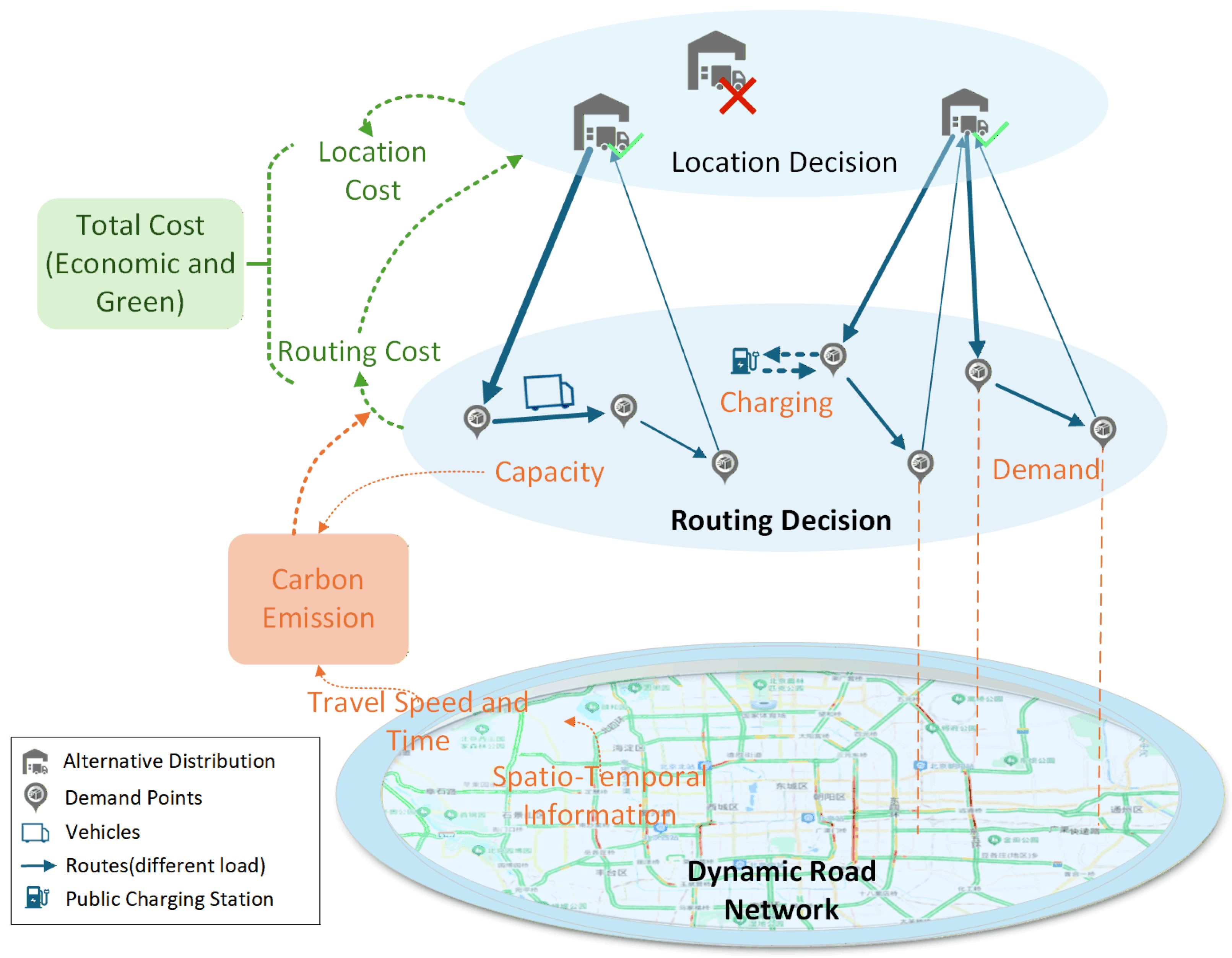
Confronted with escalating global climate challenges, urban logistics systems must address the dual pressures of rising freight demand and stringent carbon emission reduction targets. This study addresses the Time-Dependent Green Location-Routing Problem (TDGLRP-STV), which integrates spatio-temporal variations and carbon emission considerations into a unified optimization framework (conceptualized in Figure 1). Unlike traditional LRPs that rely on static distance-based parameters, our approach incorporates dynamic factors—such as time-varying traffic conditions and the energy consumption of electric logistics vehicles (ELVs)—to enhance real-world applicability. The primary objective is to minimize total system costs, encompassing both operational expenses and carbon emission costs, while simultaneously determining efficient distribution center locations and vehicle routes.
The problem is defined on a directed graph G = N , A where the node set N = I J comprises candidate distribution centers I and customer nodes J , and A represents arcs. The distribution center is equipped with a fleet of homogeneous electric logistics vehicles, denoted as K , dedicated to delivery tasks. Each vehicle is assigned to a single delivery route, serving multiple customers, and each customer is visited by exactly one vehicle. Vehicles depart from their assigned distribution center fully charged, execute their delivery sequence, and return to the same center upon completion. Energy consumption during transit depends on factors including vehicle load, travel speed, and road conditions, while energy consumed during unloading at customer sites is considered negligible. Furthermore, we assume all customer locations have access to nearby fast-charging facilities with sufficient capacity, eliminating the need to model charging queues. The complete notation is summarized in Table 3.
A key departure from prior studies is our use of a time-dependent road network that accounts for speed variations based on both the time of day and road classification. Vehicle travel speed is determined by the departure time and the classification of each traversed road segment, with instantaneous speed transitions assumed at segment boundaries. This approach more accurately captures the effects of real-time traffic conditions and road attributes on travel time, energy consumption, and, consequently, carbon emissions. The detailed construction of this dynamic network and the associated carbon calculation are elaborated in Section 3.3.

3.3. Carbon Emissions in a Spatio-Temporal Varying Road Network

3.3.1. Spatio-Temporal Varying Road Network

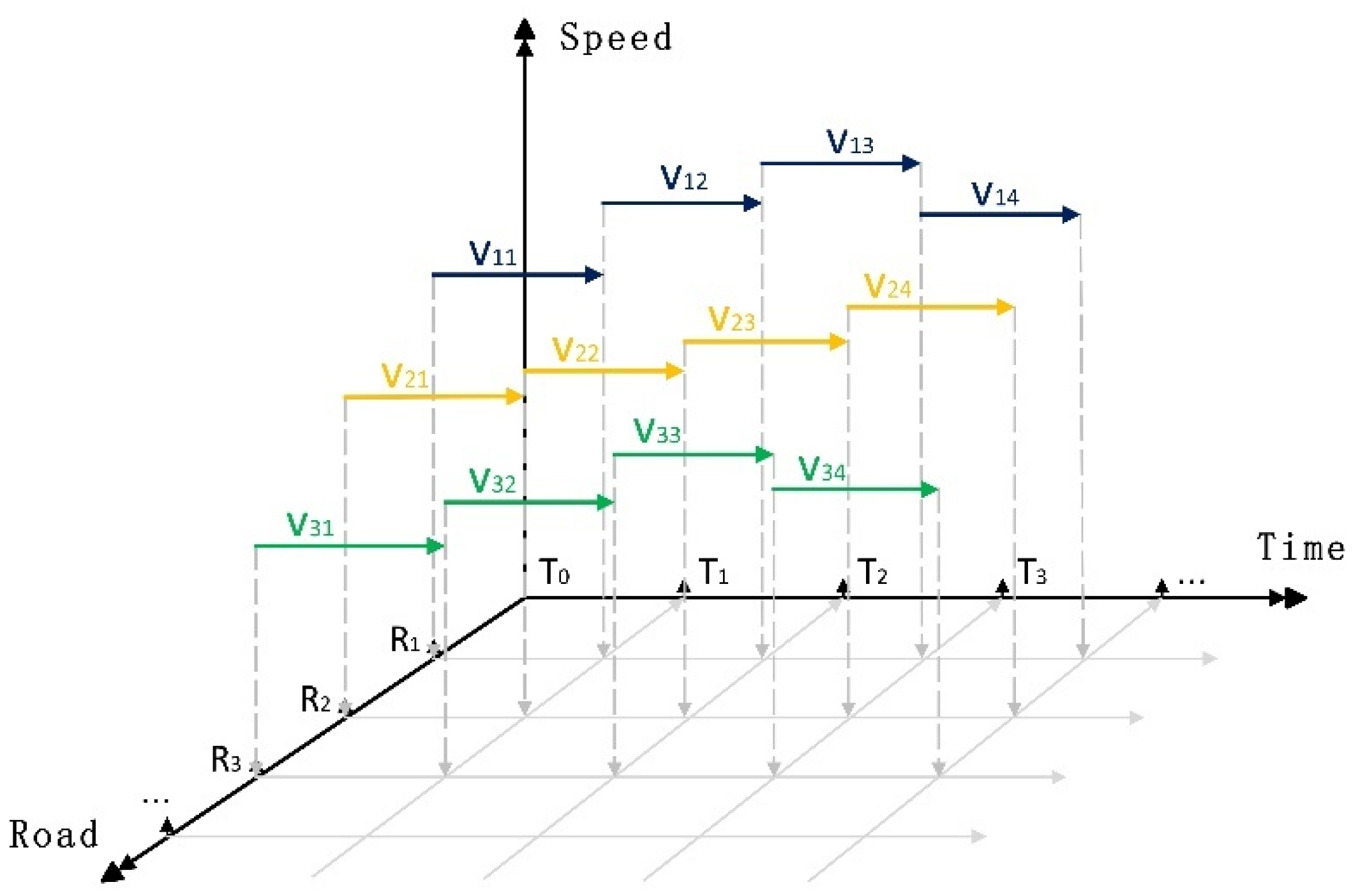
Urban traffic exhibits significant temporal and spatial variability, which directly impacts travel times and energy use. To enhance the precision of carbon emission cost estimation, the road network is modeled as a spatio-temporally dynamic system. Figure 2 illustrates the core concept: travel speed is characterized by both temporal (time period) and spatial (road grade) dimensions. Formally, we construct a vehicle travel speed matrix:
V = v 11 v 1 n v m 1 v m n
where v m n represents the speed of a vehicle on a grade m road during the time period n .
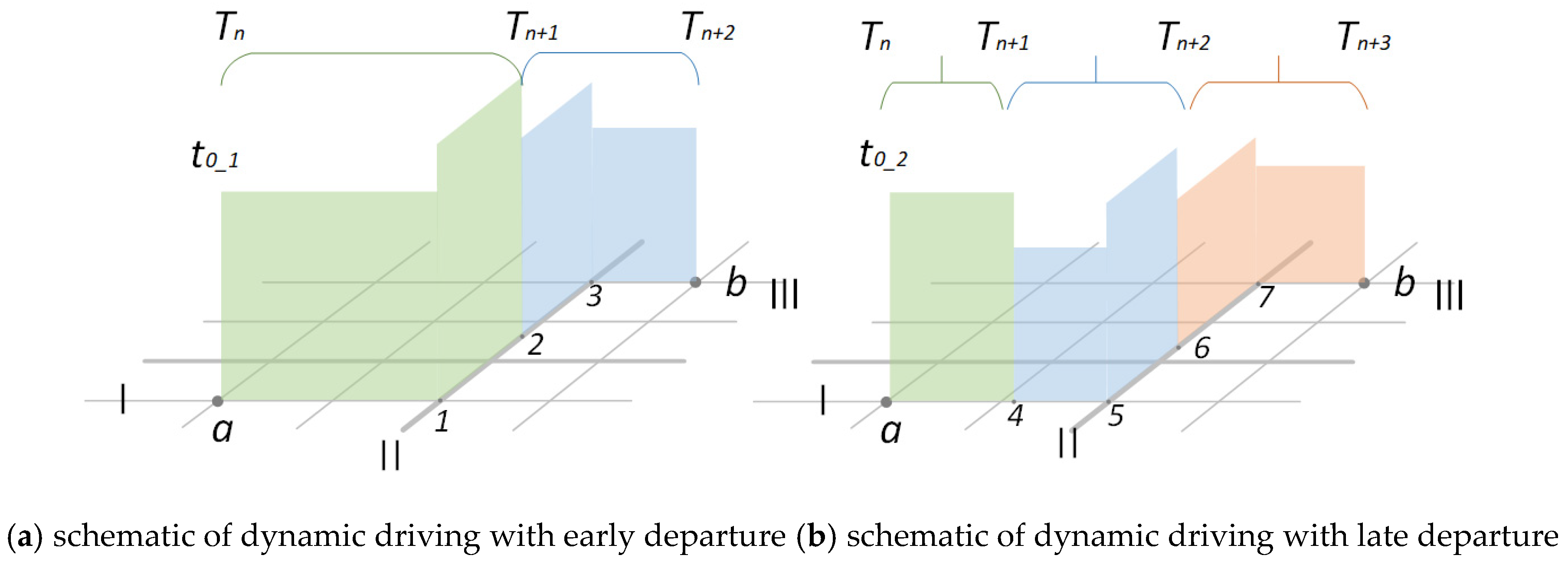
The spatiotemporal road network significantly influences vehicle transportation, as the same route experiences varying traffic conditions depending on departure times, resulting in differences in speed, travel time, and energy consumption. As illustrated in Figure 3, gray solid lines represent roads of varying classifications, with thicker lines denoting higher-grade roads associated with higher average speeds. The heights of colored rectangles indicate speed ranges across different time periods. In Figure 3a, a vehicle departing from a to b at t 0 _ 1 begins in the T n period on road I (first stage). Upon reaching point 1, it transitions to a higher-grade road II, entering the second stage with increased speed. At point 2, the road remains unchanged, but a new time period reduces the speed, still within the second stage. At point 3, the vehicle moves to a lower-grade road III, further reducing speed, and reaches b in the third stage. In Figure 3b, a vehicle departing later at t 0 _ 2 during the T n period starts on road I (first stage). At point 4, still on road I, a time period shift lowers the speed, marking the second stage. At point 5, the vehicle transitions to higher-grade road II, increasing speed in the third stage. At point 6, entering the T3 period reduces speed again, initiating the fourth stage. Finally, at point 7, the vehicle moves to road III, further decreasing speed, and arrives at b, concluding the fourth stage.
As departure time t 0 _ 2 is later than t 0 _ 1 , the journey encounters more low-speed periods, as shown by the rectangle heights indicating lower average speeds, leading to longer travel times and variations in energy consumption. Furthermore, by accounting for road-specific speed variations, the spatiotemporal road network results in more frequent speed changes than time period shifts, enhancing the accuracy of speed calculations compared to time-varying road networks that only consider temporal changes. Consequently, this modeling approach, leveraging the spatiotemporal dynamics of the road network, enables more precise energy consumption and carbon emission calculations for the TDGLRP-STV in urban logistics distribution.

3.3.2. Dynamic Carbon Emission Calculation

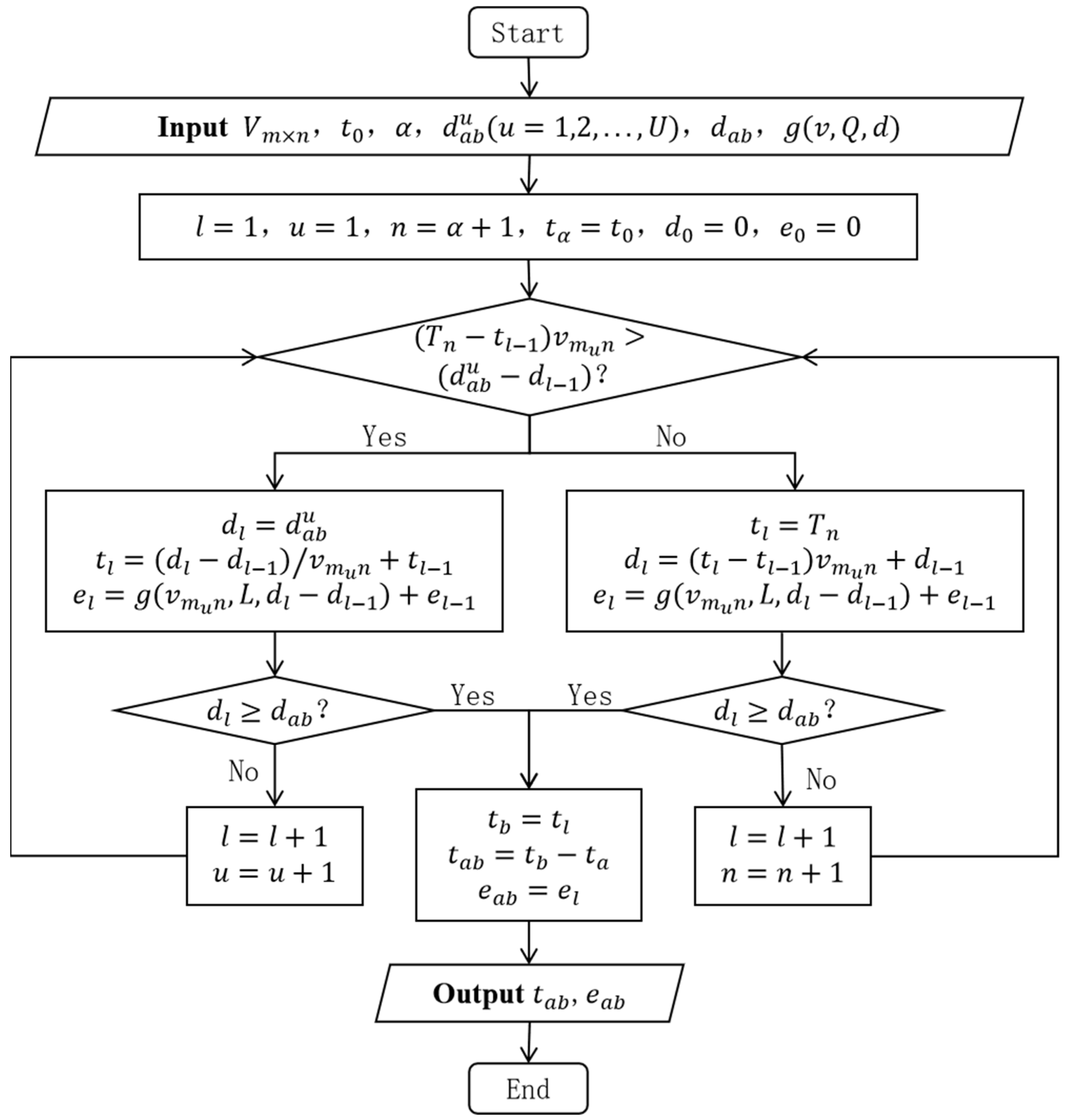
Carbon emissions are calculated dynamically based on the energy consumption of electric logistics vehicles, which varies with traffic conditions. As shown in Figure 4, this section enhances the accuracy of static models by incorporating spatiotemporal traffic dynamics and presents a dynamic method for calculating carbon emissions using a spatiotemporal road network.
Typically, pure electric logistics vehicles draw external electricity, store it in onboard batteries, and convert it into kinetic energy via the drive system. Drawing on the energy consumption calculation method proposed by Goeke et al. [43] and an analysis of factors influencing electricity consumption, the electricity consumption model in this study is formulated as follows:
e a b t = 1 η 1 2 c d ρ S v 2 + M g μ cos θ + δ sin θ + M a · d a b + P o d a b v
where η is the conversion efficiency of the vehicle’s electric motor, c d is the drag coefficient, ρ is air density, S is the frontal area of the vehicle, M is the total vehicle weight, defined as the sum of curb weight and current load, μ is the rolling friction coefficient, g is the gravitational acceleration, θ is the road gradient, δ is the mass conversion factor, a is the vehicle travel acceleration, P o is the power consumption of the vehicle’s auxiliary systems, d a b is the vehicle travel distance, and v is the vehicle travel speed.
It should be clarified that e a b t defined by Formula (2), refers to the instantaneous energy consumption of a vehicle traveling on a single arc a , b , and it serves as the basic unit for constructing the energy consumption of an entire route. The total electric energy consumption E e of vehicle k to complete its entire delivery route is the sum of the energy consumption across all arcs along its travel path, namely: E e = e a b t . In the subsequent optimization model, the parameters directly related to cost calculation are the total route energy consumption E e and its corresponding total carbon emissions.
Regional variations in the energy mix for power generation lead to differences in carbon emission factors for electricity. Denoting the carbon emission factor for electricity as λ , the carbon emissions ( C e l e c ) resulting from the electric logistics vehicle’s electricity consumption ( E e ) are calculated as given in Equation (3):
C e l e c = λ · E e
The dynamic computation of carbon emissions relies on tracking temporal and road segment variations in real time for a vehicle departing at a given time, segmenting the journey into multiple calculation units, specifically road segment-time period combinations. Upon entering a new calculation unit, the vehicle’s current speed is retrieved for accurate computation. The time and energy consumption of each unit along the path are then aggregated to yield precise values for the journey, based on the departure time.
Specifically, a delivery vehicle travels from node a to node b at time t 0 , where t 0 T α , T α + 1 , and the path a , b comprises U road segments, with the road grade of the u segment denoted as m u . The total distance from a to b is denoted as d a b , and the distance from the end of the u segment to node a is represented by d a b u . The energy consumption, expressed as g v , L , d , is a function of speed v , load L , and travel distance d , as given in Equation (2).
The process for calculating vehicle travel time and energy consumption is illustrated in Figure 4, with the steps outlined as follows:
Step 1: Assess whether a road segment change occurs during the time period by comparing the travel distance in the period with the distance of the first road segment.
T α + 1 t 0 · v m 1 ( α + 1 ) > d a b 1
Two outcomes are possible:
(1)
If the travel distance exceeds the first road segment’s distance, indicating a road segment change, the journey is segmented at the road segment transition point. The distance from the end of this stage to the origin (point O ) equals the first road segment’s distance. The travel time for this stage is calculated to determine a new time point, and the energy consumption for this stage is computed.
d 1 = d a b 1
t 1 = d 1 v m 1 ( α + 1 ) + t 0
e 1 = g v m 1 ( α + 1 ) , L , d 1
(2)
If the travel distance is less than or equal to the first road segment’s distance, indicating no road segment change, the journey is segmented at the time period’s endpoint. The end time of this stage corresponds to the period’s end, and the cumulative distance and energy consumption from the origin to the stage’s end point are calculated.
t 1 = T α + 1
d 1 = t 1 t 0 · v m 1 ( α + 1 )
e 1 = g v m 1 ( α + 1 ) , L , d 1
Step 2: Check if the travel distance is d a b : If so, the calculation concludes, yielding the path travel time t a b = t b t a and energy consumption e a b . Otherwise, update the relevant variables and proceed with the calculation.
Step 3: Analogous to Step 1, the condition for the stage l is defined as follows:
T n t l 1 · v m u n > d a b u d l 1
(1)
If the condition holds, segment the stage at the road segment transition, compute the travel time to determine a new time point, and calculate the energy consumption for this stage.
d l = d a b u
t l = d l d l 1 v m u n + t l 1
e l = g ( v m u n , L , d l d l 1 ) + e l 1
(2)
Otherwise, segment the stage at the time period’s endpoint, and compute the cumulative distance and energy consumption from the origin (point i ) to the stage’s end point.
t l = T n
d l = t l t l 1 · v m u n + d l 1
e l = g ( v m u n , L , d l d l 1 ) + e l 1
Step 4: Repeat Step 2 until the calculation is completed.
Using the energy consumption e a b of the node pair a , b and the carbon emission factor λ e c , the carbon emissions C a r b a b for the node pair a , b are given by Equation (18).
C a r b a b = λ e c · e a b
Through the dynamic calculation of vehicle travel time and energy consumption between nodes, this section converts static parameters in traditional path cost models into dynamic parameters based on real-time driving conditions, such as speed and load. This approach enables a more accurate spatiotemporal carbon emission model for real-time road networks.

3.4. TDGLRP-STV Optimization Model

The mathematical model of the TDGLRP-STV can be described as follows. The objectives are to minimize the following costs:
The fixed cost of a distribution center represents the one-time investment for its construction or leasing, including costs for land acquisition, building construction, equipment purchase, or long-term leasing, as given in Equation (19).
C F = i I f i · x i
The operating cost of the distribution center comprises daily expenses tied to the total stored cargo volume, which depends on the demand of the customer points served, as given in Equation (20).
C S = i I j J f s i · x i · y i j · q j
The carbon emission cost of the distribution center encompasses emissions from non-vehicle facility fuel consumption and indirect emissions from electricity use, including fixed energy consumption for lighting, air conditioning, and automated equipment, as well as electricity use for sorting and packaging processes. This study represents each distribution center’s carbon emission cost with an average value, as given in Equation (21).
C C L = f c · i I d c i · x i
The vehicle fixed cost, denoted as C K , is the expenditure per vehicle, solely dependent on whether the vehicle is dispatched for delivery tasks, independent of route selection, mileage, or delivery time, as given in Equation (22).
C K = f k · k K i I j J z i j k
The vehicle operating cost includes expenses directly related to mileage or time, such as maintenance, tolls, temporary repairs, and driver labor costs, as given in Equation (23).
C T = f t · a A b A \ { a } k K t a b k · z a b k
The charging cost covers the electricity expenses for charging electric logistics vehicles, encompassing slow charging at the distribution center outside working hours and fast charging at nearby stations during delivery, as given in Equation (24).
C P = f e l o w · k K i J j I e max e j k i n · x i j k + f e s p e e d · k K j J e j k p o w e r · r j k
The carbon emission cost of the transportation process reflects the carbon pricing mechanism or trading cost associated with vehicle emissions during travel, as given in Equation (25).
C C R = f c · a A b A \ { a } k K C a r b a b · z a b k
Thus, the objective function of the carbon-constrained location-routing optimization model is presented in Equation (26).
min C = C F + C S + C C L + C K + C T + C P + C C R
Constraints on locations:
1 i I x i I
i I y i j = 1 , j J
y i j x i 0 , i I , j J
j J q j · y i j x i · Q i , i I
Equation (27) ensures that at least one distribution center is opened, with the number of selected centers not exceeding the cardinality of the candidate location set I , denoted as I . Equation (28) specifies that each customer is assigned to exactly one distribution center. Equation (29) stipulates that only selected distribution centers provide services to customers. Equation (30) guarantees that the total demand of customers served by a selected distribution center is within its capacity.
Constraints on routes:
i I j J k K z i j k K
i I j J z i j k 1 , k K
n J z i n k + n A \ { j } z n j k 1 + y i j , i I , j J , k K
b A \ { a } z a b k = b A \ { a } z b a k , a A , k K
a R b R k K z a b k R 1
Equation (31) represents the vehicle number constraint, ensuring that the number of vehicles assigned to delivery tasks does not exceed the vehicle fleet size K . Equation (32) specifies the vehicle usage constraint, ensuring that each vehicle dispatched from a distribution center is used at most once. Equation (33) defines the customer visit constraint, requiring that a customer served by a distribution center is visited exactly once by a vehicle from that center. Equation (34) enforces the route continuity constraint, ensuring that a vehicle continues after visiting each customer and returns to its originating distribution center upon task completion. Equation (35) implements the subtour elimination constraint, preventing subtours excluding the distribution center, where R denotes any subset of the set of demand points, and R is its cardinality.
Constraints on freight:
a A \ { j } j J q j · z a j k 0.8 · L max , k K
L j k i n q j = L j k o u t , j J , k K
L a k o u t γ · 1 z a b k L b k i n , a , b A , k K
L a k o u t + γ · 1 z a b k L b k i n , a , b A , k K
Equation (36) ensures that the total demand of customers served by a vehicle is at most 80% of its maximum capacity. Equation (37) defines the load continuity constraint at nodes, ensuring that a vehicle’s load upon leaving a customer equals the arrival load minus the customer’s demand. Equations (38) and (39) specify the load continuity constraints between nodes, ensuring that if vehicle k serves the node pair ( i , j ) , the load upon arriving at node j equals the load leaving node i , where γ is a large positive constant.
Constraints on energy:
e i k o u t = e max , i I , k K
e a k o u t e a b k · z a b k + γ · 1 z a b k e b k i n , a , b A , k K e i k o u t
e a k o u t e a b k · z a b k γ · 1 z a b k e b k i n , a , b A , k K
γ · r j k b A e j b k · z j b k e j k i n , j J , k K
e j k p o w e r = r j k · min a B b B \ { a } e a b max · z z b k , e max e j k i n , j J , k K
e j k i n + e j k p o w e r · r j k = e j k o u t , j J , k K
Equation (40) specifies the initial state of charge constraint, ensuring that vehicles departing from each distribution center have their full battery capacity. Equations (41) and (42) define the state of charge continuity constraints, ensuring that if vehicle k serves path ( i , j ) ( z i j k = 1 ), the remaining state of charge at node j ( e j k i n ) equals the state of charge leaving node i ( e i k o u t ) minus the energy consumption on path ( i , j ) ( e i j k ). Equation (43) represents the charging constraint, stipulating that if the remaining state of charge at node j ( e j k i n ) is less than the energy consumption on path ( j , j ) ( e j j k ), the vehicle performs fast charging at the nearest charging station, setting r j k = 1 ; otherwise, r j k = 0 . Equation (44) defines the charge quantity constraint, stating that if charging occurs at node j ( r j k = 1 ), the charge amount ( e j k p o w e r ) is the minimum of the total energy required for subsequent delivery tasks and the vehicle’s current energy shortfall. Equation (45) enforces the state of charge continuity constraint at nodes, ensuring that if no charging occurs at node j ( r j k = 0 ), the state of charge leaving node j ( e j k o u t ) equals the state of charge at node j ( e j k i n ); otherwise, it is augmented by the charge amount ( e j k p o w e r ).
Constraints on time:
t a k o u t + t a b k · z a b k + γ · 1 z a b k t b k i n , a , b A , k K
t a k o u t + t a b k · z a b k γ · 1 z a b k t b k i n , a , b A , k K
t j k o u t = t j k i n + t j k s + r j k · t p o w e r + e j k p o w e r P s p e e d , j J , k K
t a k o u t T l a t e s t , a A , k K
Equations (46) and (47) specify the time continuity constraints, ensuring that if vehicle k serves path ( i , j ) ( z i j k = 1 ), the arrival time at node j ( t j k i n ) equals the departure time from node i ( t i k o u t ) plus the travel time on path ( i , j ) ( t i j k ). Equation (48) defines the time continuity constraint at nodes, ensuring that if no charging occurs at node j ( r j k = 0 ), the departure time from node j ( t j k o u t ) equals the arrival time at j ( t j k i n ) plus the service time at j ( t j k s ); otherwise, it includes the round-trip time to the nearest charging station ( t p o w e r ) and the charging time ( e j k p o w e r / P s p e e d ). Equation (49) enforces the work schedule constraint, ensuring that vehicles complete all customer visits and return to the distribution center before the maximum allowable working time.

4. Methodology

4.1. Overview of the TSI-LR-IACO Algorithm

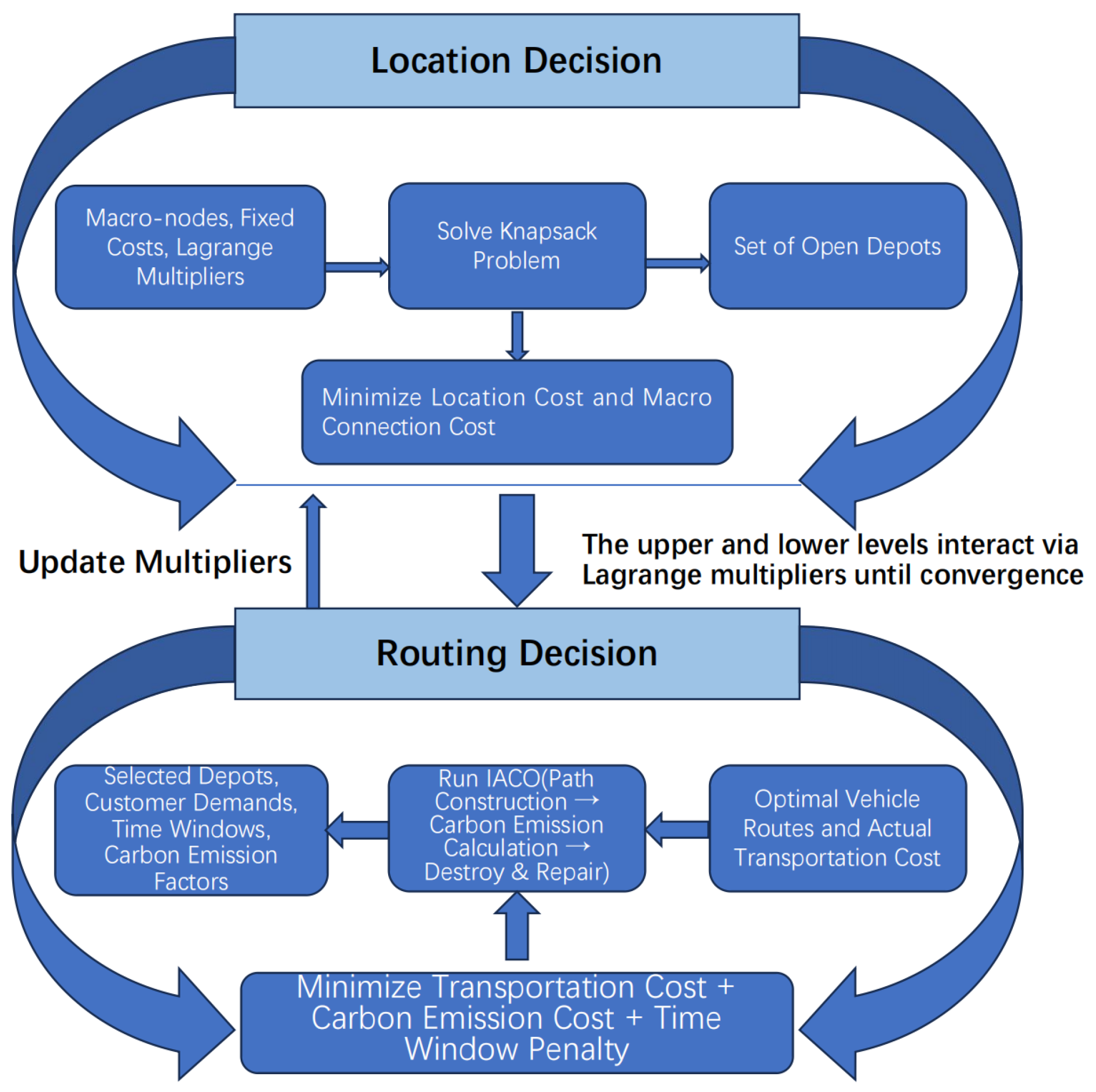
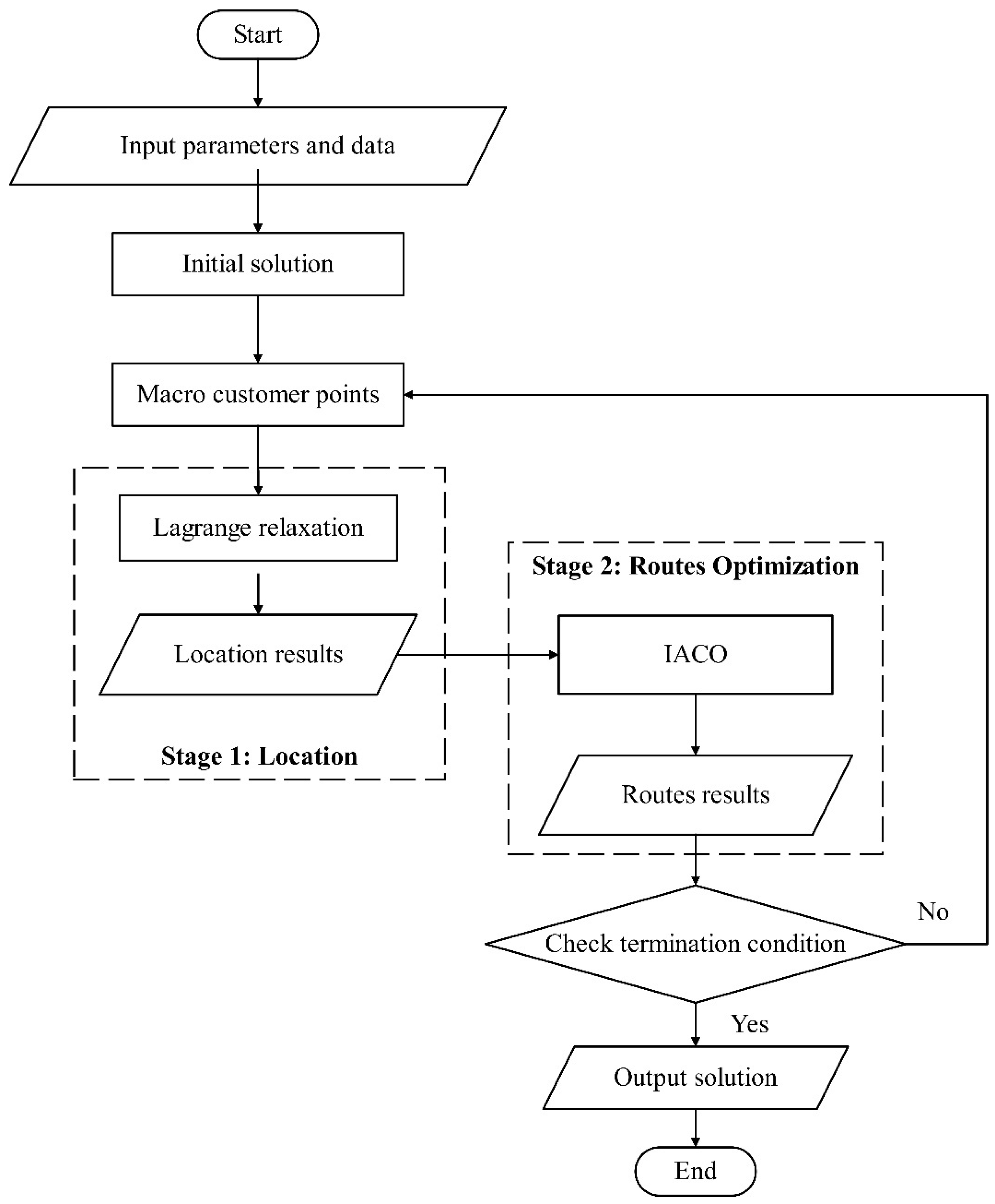
The TDGLRP-STV presents a formidable optimization challenge due to its integration of strategic location decisions, tactical routing, time-dependent travel times, and carbon emission objectives. To address this complexity, we propose a Two-Stage Interactive Optimization Algorithm combining Lagrangian Relaxation and Improved Ant Colony Optimization (TSI-LR-IACO). As illustrated in Figure 5, this hybrid metaheuristic framework decomposes the problem into two interdependent yet coordinated stages: a Location Decision Stage and a Routing Optimization Stage. The overarching architecture and interactive workflow are visualized in Figure 6, which summarizes the process from input data to final solution, highlighting the critical feedback loop.
The algorithm’s efficacy hinges on a bidirectional feedback mechanism. In the first stage, Lagrangian Relaxation (LR) is employed to solve a relaxed version of the location subproblem. The resulting set of opened distribution centers is then passed to the second stage, where an Improved Ant Colony Optimization (IACO) tackles the time-dependent, carbon-aware vehicle routing subproblem. Crucially, the actual routing costs and carbon emission data computed in the second stage are fed back to the first stage. This feedback updates the Lagrangian multipliers and the definition of “aggregated customer nodes” (macro-nodes), enabling iterative refinement. This closed-loop interaction ensures that location and routing decisions are dynamically coordinated, allowing the algorithm to converge toward a near-optimal global solution under dynamic traffic and carbon constraints.
This decomposition aligns with the problem’s inherent structure. Location decisions involve discrete binary variables and facility capacity constraints, making direct solution computationally intensive. Lagrangian Relaxation mitigates this by relaxing coupling constraints, decomposing the problem into more tractable subproblems, and iteratively approaching feasibility via multiplier updates—thus enhancing computational efficiency. Routing optimization, an NP-hard problem in itself, is well-suited for the population-based, constructive search of Ant Colony Optimization. The IACO is particularly adept at handling the dynamic cost landscape and complex constraints of the routing subproblem, outperforming simpler heuristics.
The core procedural steps of the TSI-LR-IACO are outlined as follows:
Form aggregated customer nodes: To incorporate routing feedback into location selection efficiently, customer points serviced by the same vehicle in a routing solution are clustered into aggregated macro-nodes. This reduces problem dimensionality and stabilizes location decisions against minor fluctuations in individual customer assignments.
Location stage: Apply the Lagrangian Relaxation method to the location subproblem defined over the aggregated nodes. Solve the relaxed subproblems and use a heuristic repair procedure to generate a feasible location solution (a set of opened distribution centers).
Routes optimization stage: Using the opened distribution centers from Stage 1, execute the Improved Ant Colony Optimization algorithm to solve the detailed, time-dependent vehicle routing problem, minimizing a cost function that includes carbon emissions.
Evaluate convergence: Check the termination criteria (e.g., iteration limit, bound convergence). If not met, use the new routing solution to rebuild aggregated customer nodes, update Lagrangian multipliers, and return to Step 2. This iterative process continues until a satisfactory solution is obtained.

4.2. Interaction Mechanism

The core innovation of the TSI-LR-IACO lies in its two-stage interactive framework, which enables dynamic coordination through a bidirectional feedback mechanism based on “Aggregated Customer Nodes” (ACNs). This mechanism directly addresses the isolation of traditional hierarchical algorithms and the inefficiency of monolithic integrated algorithms.

4.2.1. Feedback Mechanism for Approaching Global Optimum: Theoretical Logic

The feedback mechanism is theoretically grounded in two pillars that ensure it guides the search toward the global optimum rather than being a mere heuristic.
Macro customer point bidirectional feedback loop: The use of ACNs reduce the decision variables in the location model, preventing over-sensitivity to individual customer demand changes. The “coarse-grained location optimization + fine-grained routing adjustment” paradigm (illustrated in Figure 7 and Figure 8) balances efficiency and precision. Each iteration updates the ACNs based on the latest routing results, and the updated location scheme guides the subsequent routing optimization, creating a closed loop that pushes both stages toward global optimality.
Bound convergence guarantee of Lagrangian Relaxation: The LR method provides a mathematical guarantee for approaching the optimum. It follows a “relax constraints for a lower bound → repair for a feasible upper bound” logic. The weak duality theorem ensures the lower bound is valid, while the subgradient method updates the multipliers to close the gap between the upper and lower bounds. Convergence is achieved when this gap falls below a predefined threshold.
The aggregation strategy inherently ensures geographical compactness by grouping sequentially visited customers and respects vehicle capacity to maintain demand balance, formally ensuring max intra-group distance < δ and total group demand ≤ vehicle capacity.

4.2.2. Basic Framework of Macro Customer Point Interaction

The interactive mechanism links the location and routing phases via a feedback loop, which is essential for solving large-scale Location-Routing Problems (LRP). Through this mechanism, location decisions influence route feasibility, while routing optimization refines location decisions, ensuring solution consistency.
In each iteration, the algorithm forms aggregated customer nodes by clustering customer nodes along the same route based on route optimization outcomes (using an initial feasible solution in the first iteration), providing feedback to the location decision phase. Upon completing location optimization, these aggregated customer nodes are disaggregated using location outcomes for the routing optimization phase, establishing an interactive mechanism. This abstraction reduces computational complexity while preserving essential spatial relationships.
To ensure the rationality of the aggregation process, a step crucial for providing effective feedback to the location stage, we consider two primary factors when grouping customer points from the same vehicle route.
Geographic Compactness: Customers are merged only if they are served sequentially on the same route, implying their proximity within the current routing solution. This inherently leverages the routing algorithm’s outcome, which already organizes nearby customers together to minimize travel distance and time.
Demand Balance: While not enforced as a strict constraint, the aggregation naturally results in a balanced load among aggregated nodes due to the inherent vehicle capacity limits applied to each original route. The total demand of an aggregated node, which is the sum of its constituent customers, is therefore bound by the capacity of a single vehicle.
This strategy transforms the complex routing network into a simplified but representative set of aggregated nodes for the location model. It focuses the location decision on the macro-level assignment of service areas, represented by routes, to distribution centers, rather than on individual customer details. Consequently, it reduces the solution space dimensionality and computational complexity for the location subproblem.
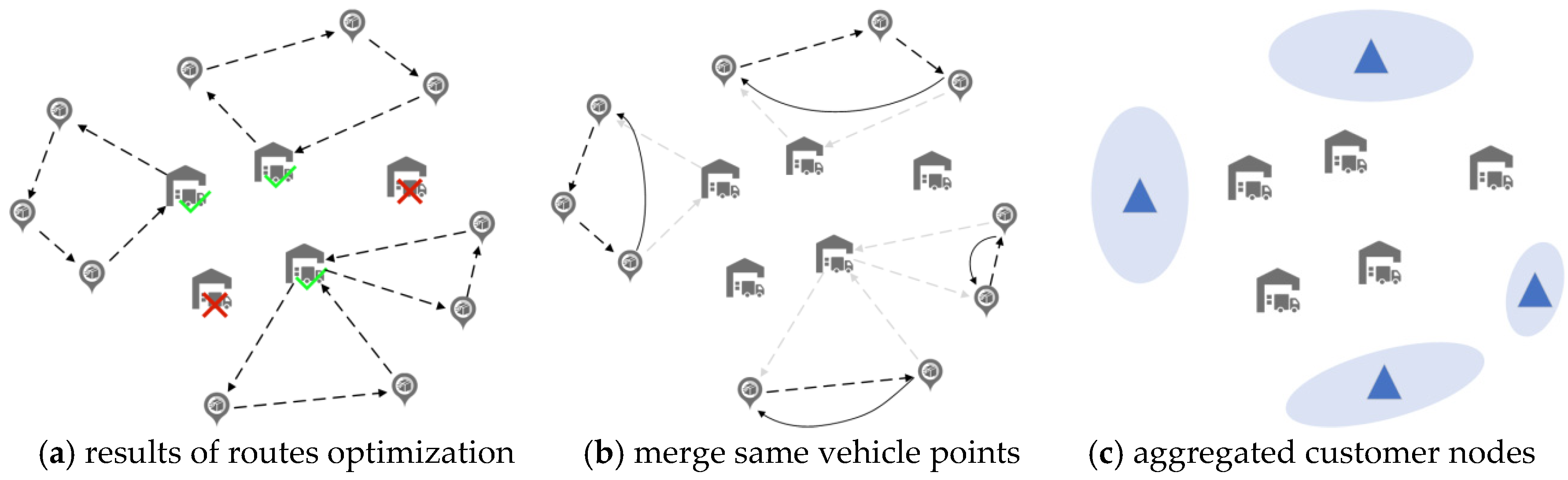
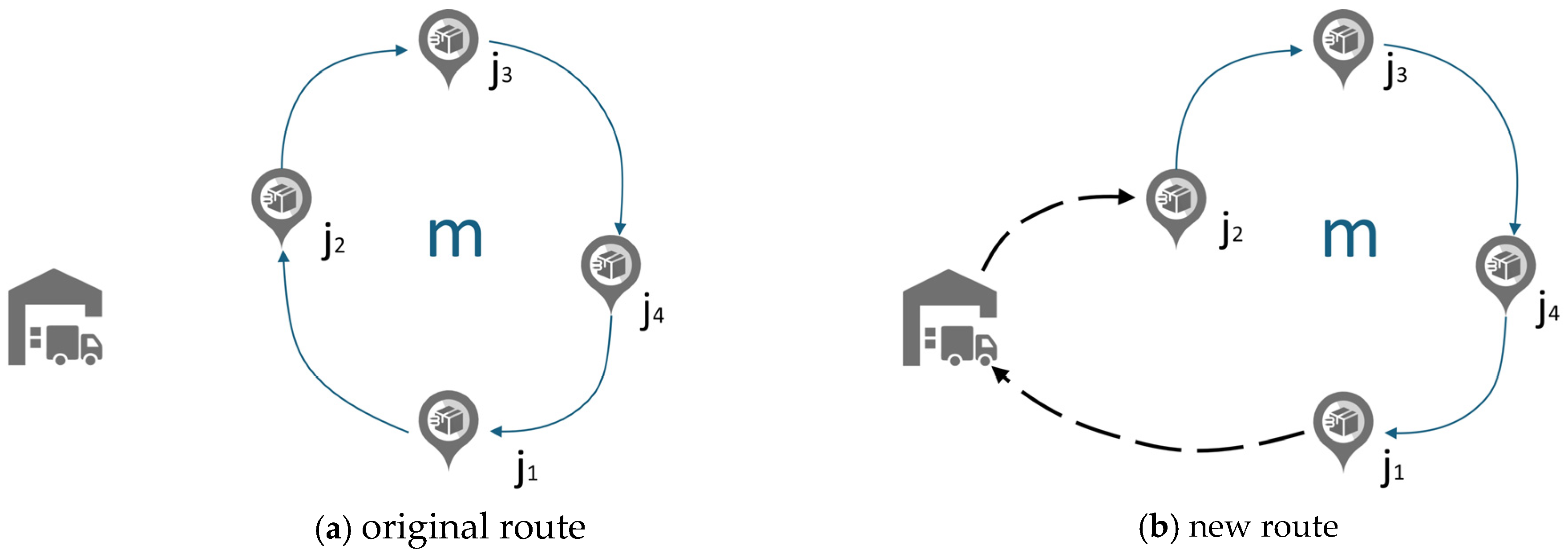
The construction process for aggregated customer nodes is illustrated in Figure 7, and the disaggregation process in Figure 8. Initially, based on the current routing outcomes in Figure 7a, customer points along the same route are grouped, with links to the distribution center (gray lines in Figure 7b) removed, and the two customer points connected to the distribution center are joined by a black solid line in Figure 7b. Next, the customer group forming a closed path is represented as an aggregated customer point in Figure 7c. Designed to simplify calculations in subsequent location decisions, this point lacks physical attributes like location, with its practical meaning derived from its constituent customer points. Its demand is the sum of the demands of these constituent customer points.
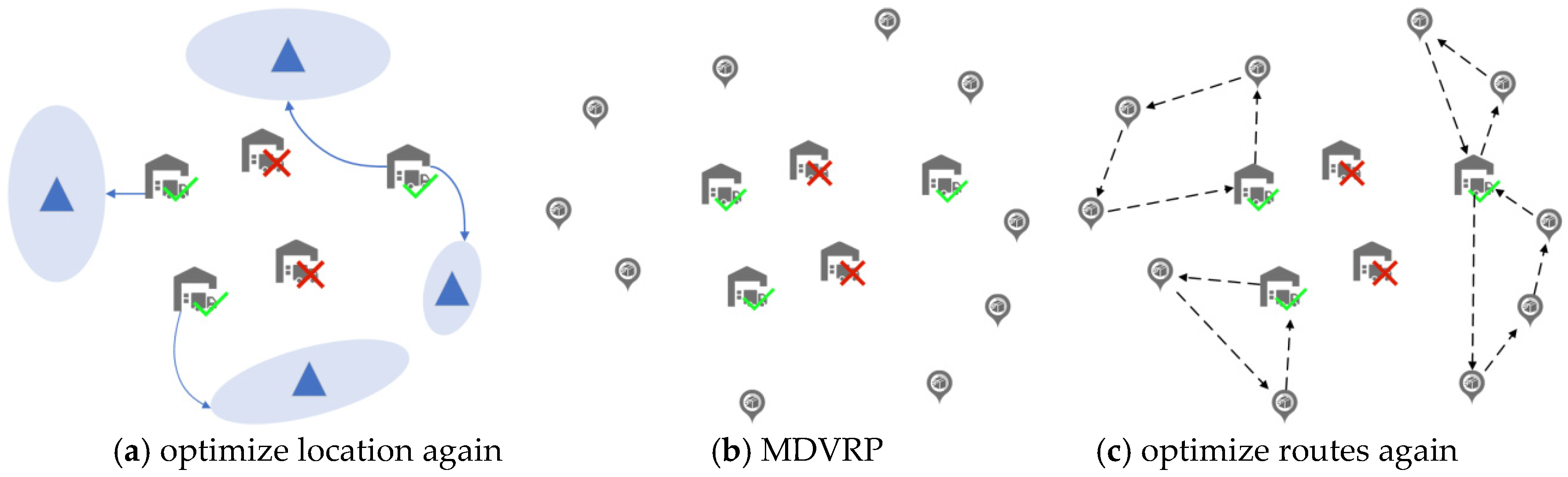
After forming aggregated customer nodes, the complex TDGLRP-STV is transformed into a reduced-scale location-allocation problem, which is solved using Lagrange Relaxation, as illustrated in Figure 8a. Next, the aggregated customer nodes are disaggregated, converting the problem into a multi-depot vehicle routing problem (VRP) comprising a logistics center, distribution centers, and customer points, as shown in Figure 8b. Finally, the routing problem is solved using enhanced ant colony optimization, as depicted in Figure 8c, with the routing outcomes informing the formation of aggregated customer nodes in the next iteration.
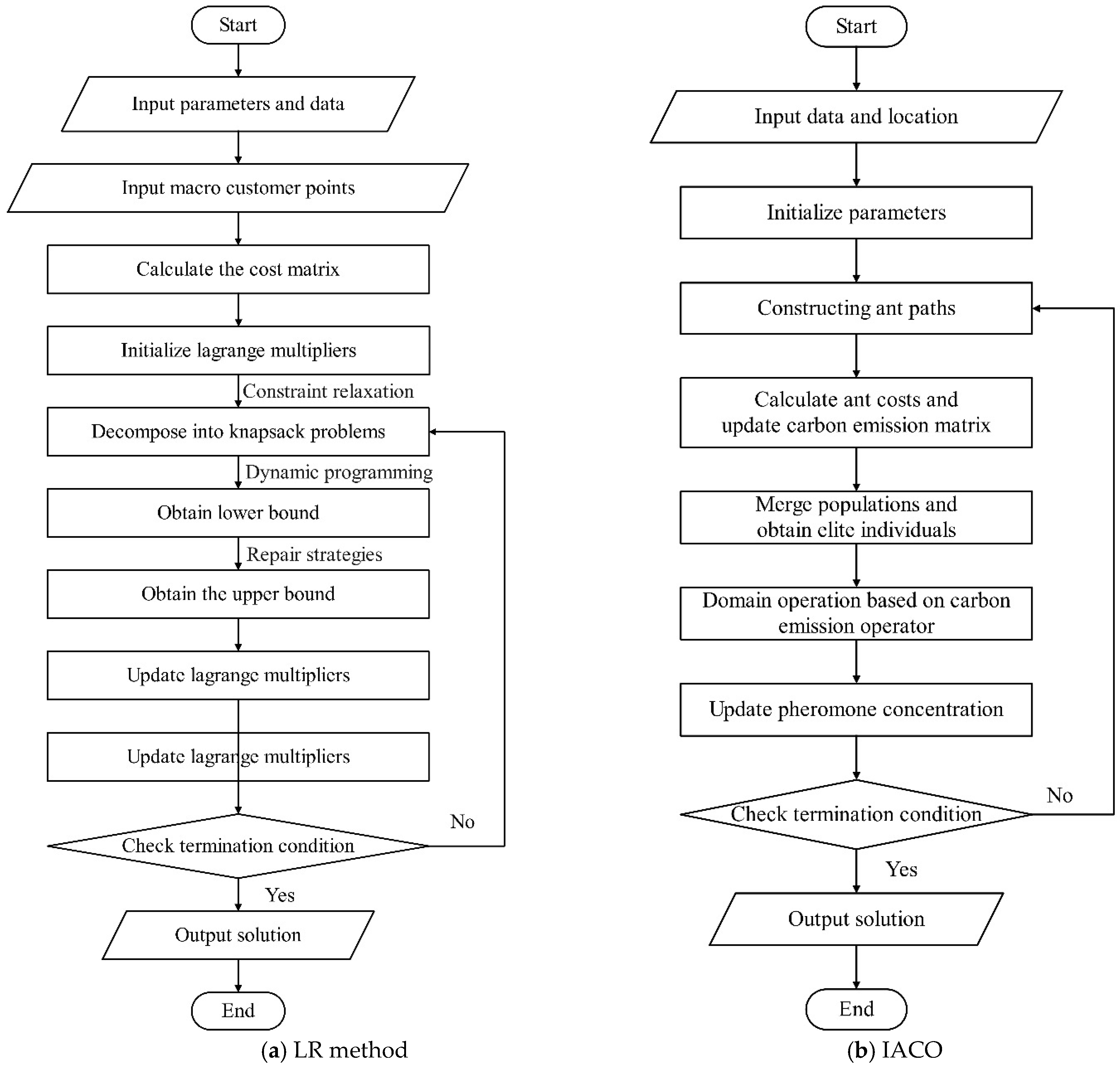
Figure 9 presents the flowcharts of the Lagrange Relaxation (LR) method and the Improved Ant Colony Optimization (IACO), which are the core algorithms of the two stages in the TSI-LR-IACO framework. The LR method (Figure 9a) focuses on solving the location subproblem, while the IACO (Figure 9b) is dedicated to optimizing the routing subproblem, and the two algorithms interact iteratively through the feedback mechanism.

4.3. Stage 1: Location Selection Algorithm Based on Lagrange Relaxation

The location decision phase seeks to identify the optimal distribution centers to select from set I , minimizing facility setup costs and routing costs. TDGLRP-STV incorporates constraints integrating location and routing decisions, e.g., ensuring each route starts and ends at an open distribution center. Due to these interdependencies, solving the full problem directly is computationally intensive. Thus, Lagrange Relaxation is applied, relaxing the location problem by dualizing capacity constraints to yield a lower bound. The relaxed model is solved iteratively, with adjustments to Lagrange multipliers to tighten the bound. Subsequently, a heuristic adjustment constructs a feasible solution, using aggregated customer point feedback to ensure route feasibility. The algorithm’s process is depicted in Figure 10a, with key steps outlined below:
Step 1: Initialize parameters and data, setting Lagrange multipliers to the minimum assignment cost between distribution centers and aggregated customer nodes.
Step 2: Relax complex constraints and integrate them into the objective function, yielding and solving multiple subproblems to derive the lower bound.
Step 3: Check if the results meet the previously relaxed constraints, adjust infeasible solutions to generate a feasible solution, and derive the upper bound from it.
Step 4: Update Lagrange multipliers via the subgradient method.
Step 5: Evaluate if termination criteria are satisfied; if so, output the optimal solution; otherwise, return to Step 2. The termination criteria comprise four conditions: maximum iterations, maximum computation time, step size threshold, and convergence of upper and lower bounds.

4.3.1. Transformation of the Location Selection Model

In the location decision phase, connections between distribution centers and aggregated customer nodes are first defined. Given the reasonably effective visit sequence for aggregated customer nodes, and the potential for fully loaded vehicles visiting the closest customer points first to reduce carbon emissions and operating costs to a degree, the nearest neighbor insertion heuristic is adopted to effectively lower computational complexity for large-scale instances. The steps are outlined below:
Step 1: Establish the visit sequence within the aggregated customer point m .
j 1 j 1 * j * j + 1 * j n j 1
Step 2: Find the customer point j * within the aggregated customer point m with the smallest dynamic cost relative to the distribution center i .
j * = arg min j r m f c · D E E n i , j r + f t · D E T n i , j r
Step 3: Insert distribution center i immediately before j * , creating a closed route.
i j * j + 1 * j n j 1 j 1 * i
For example, if the visit sequence within the aggregated customer point m is j 1 j 2 j 3 j 4 j 1 , as illustrated in Figure 10a, and the customer point j 2 is nearest to i , the resulting route is i j 2 j 3 j 4 j 1 i , as depicted in Figure 10b.
This study defines the assignment cost for the distribution center i serving aggregated customer point m as the dynamic cost of the new route resulting from inserting i into M ’s original route.
C i m = k = 1 m C O S T j k j k + 1 n C O S T j 1 * j * n + C O S T j 1 * i n + C O S T i j * n
Here, m denotes the number of customer points within aggregated customer point m , j 1 * represents the customer point preceding the nearest customer point j * in the original route, and j + 1 * represents the following customer point.
The location problem is formulated as follows: each aggregated customer point is served by exactly one distribution center, with the objective of minimizing the sum of the setup and operating costs of the distribution centers and their assignment costs to aggregated customer nodes, subject to constraints, including capacity limits. The location model is presented below:
min C n e w = C F + i I , m M C i m · Y i m
Subject to:
i I Y i m = 1 , m M
m M q m · Y i m Q i · x i , i I
Y i m 0 , 1 , i I , m M
x i 0 , 1 , i I
Equation (54) defines the objective function for the location model. Equation (55) specifies the customer assignment constraint. Equation (56) enforces the capacity constraint. Equations (57) and (58) define the decision variable constraints.

4.3.2. Relaxed Constraints for Lower Bound Calculation

In Lagrange Relaxation, relaxing constraints significantly impacts algorithm efficiency. This study relaxes customer assignment constraint Equation (59) based on constraint properties, yielding the relaxed model presented below:
min L R λ = C F + i I , m M C i m · Y i m + m M λ m · 1 i I Y i m
Subject to: Equations (56)–(58).
The relaxed model is decomposed into multiple subproblems for each distribution center. For each subproblem, the constraints are retained, and the objective function is defined as:
min L R i λ = f i · x i + m M C i m λ m · Y i m
When x i = 1 , Equation (60) is analogous to a knapsack problem, where the distribution center capacity Q i represents the knapsack capacity, and the number of aggregated customer nodes M and their demands q m correspond to the number of items and their volumes, respectively.
The optimization objective is not only to select the point with the smallest assignment cost but also to choose points with relatively low assignment costs and less restrictive constraints. Thus, item value is determined by the joint effect of assignment cost ( C i m ) and constraints (captured by Lagrange multipliers), with the value v m defined as follows:
v m = 1 C i m λ m max ( C i m ) min ( C i m ) + ε
where ε is a small positive constant to prevent division by zero, ensuring all v m lie in 0 , 1 .
The knapsack problem is expressed as:
max v m · Y i m
This study employs a dynamic programming algorithm to solve the knapsack problem. The state transition equation is central to the solution. Let D P m , Q denote the maximum value achievable using the first m 1 items with a knapsack capacity of Q 1 , initialized to 0. The state transition equation is given by:
D P m , Q = max D P m 1 , Q , D P m 1 , Q q m + v m

4.3.3. Repairing the Lower Bound to Obtain the Upper Bound

After deriving the lower bound, distribution centers are in one of two states: selected or not selected. Accordingly, the assignment of aggregated customer nodes to distribution centers exhibits three scenarios:
(1)
Single-center allocation, which satisfies the original assignment constraints, with the corresponding distribution center directly included in the initial set of selected distribution centers.
(2)
Multiple-center allocation, which violates the original assignment constraints, assigning the point to the selected distribution center with the smallest assignment cost; if no such center exists, selecting the distribution center serving the most aggregated customer nodes.
(3)
Unallocated scenario, which violates the original assignment constraints, assigning unallocated aggregated customer nodes to selected distribution centers by minimizing assignment costs, ensuring capacity constraints are not exceeded; if selected centers cannot satisfy all demands, opening the not yet selected distribution center with the smallest assignment cost to meet remaining demands.

4.4. Stage 2: Route Optimization Algorithm Based on Improved Ant Colony Optimization

To effectively solve the routing subproblem within the TDGLRP-STV framework, which incorporates time-dependent costs and carbon emission objectives, we developed an Improved Ant Colony Optimization algorithm. The IACO extends the classical ACO in three key aspects to address the specific challenges of our problem:
Carbon-Emission-Guided Heuristic and Search: Unlike classical ACO, which often uses simple reciprocal distance as heuristic information, the IACO integrates a Dynamic Empirical Emission (DEE) operator. This operator provides a heuristic estimate that reflects both travel time and carbon emission costs, directly steering the search toward low-carbon routes. Furthermore, the neighborhood search strategy (Section 4.4.2) incorporates a destruction operator weighted by carbon emission intensity, ensuring the local search explicitly targets and repairs high-emission route segments.
Enhanced Local Search with Problem-Specific Operators: Classical ACO can be prone to premature convergence. The IACO hybridizes the constructive search of ACO with an Adaptive Large Neighborhood Search-inspired local search phase. This phase employs problem-specific destruction and repair operators designed for vehicle routing with time and capacity constraints, significantly improving the algorithm’s ability to escape local optima and refine solution quality, especially concerning the complex carbon-and-time-dependent cost landscape.
Dual-Objective Pheromone Update Strategy: While classical ACO typically reinforces only the best-found path, the IACO adopts a best–worst collaborative pheromone update strategy (Equation XX). It not only strengthens the trails of the global best solution but also penalizes the trails of the global worst solution. This differential update accelerates convergence towards high-quality regions of the solution space while promoting diversity in the earlier search stages.
Given the distribution centers from the location decision phase, the routing optimization phase determines optimal vehicle delivery routes to minimize total routing costs, including time-dependent travel costs and carbon emissions. This study employs an IACO algorithm, incorporating carbon emission factors to improve heuristic guidance and implementing low-carbon-focused local search operations to enhance search efficiency, adapting traditional ACO to address the specific constraints of the TDGLRP-STV. The IACO algorithm is depicted in Figure 9b, with key steps outlined below:
Step 1: Initialize data, location decisions, pheromone matrix, and related parameters.
Step 2: Construct ant paths using encoding rules, selection probabilities, and problem constraints.
Step 3: Once all ant paths are constructed, compute each ant’s total cost as described in Section 3.3.2; combine new and existing ant populations, sort by individual ant costs in ascending order, retain the top 50%, and generate a new ant population.
Step 4: Preserve the top 10% of ants by cost as elite individuals.
Step 5: Apply carbon-focused local search operations to each elite individual sequentially, accepting solutions using the Metropolis criterion.
Step 6: Update the pheromone matrix based on optimized elite individual information.
Step 7: Evaluate if termination criteria are satisfied; if so, output the optimal path solution; otherwise, return to Step 2.

4.4.1. Ant Paths Construction

In the ant colony algorithm, route encoding takes the form of an integer sequence, where the distribution center ID represents the vehicle’s starting point, customer IDs denote the nodes to be served, and the value 0 indicates fast charging locations within the route. The encoding length is dynamic, based on the number of vehicles, providing a framework for multi-depot optimization.
The steps for constructing ant paths are outlined below:
Step 1: Initialize the vehicle set for the ant and the customer set to visit.
Step 2: Randomly select an available vehicle from the vehicle set.
Step 3: Initialize the vehicle’s load, departure time, and energy level.
Step 4: Considering the current load, time, and energy level, check each customer in the customer set to visit for compliance with vehicle load constraints, distribution center capacity constraints, time constraints, and energy constraints, including those meeting all four constraints in the candidate set.
Step 5: If the candidate set is non-empty, proceed to the next step; otherwise, return to Step 2.
Step 6: Using selection probabilities, apply roulette wheel selection to choose the next customer to visit from unvisited customers. The transition probability, given by Equation (64), depends on pheromone levels and heuristic information.
p i j k t = [ τ i j ( t ) ] α × [ η i j ( t ) ] β r N [ τ i r ( t ) ] α × [ η i r ( t ) ] β j N 0 e l s e
η i j n ( t ) = 1 f c D E E n i , j + f t D E T n i , j
where N is the set of nodes yet to be visited by an individual ant, τ i j t and η i j t are the pheromone concentration on route i , j at time t , defined as the reciprocal of the dynamic empirical cost between nodes, calculated as shown in Equation (65), α and β are the relative weight.
Step 7: Update the ant’s route, the vehicle’s residual load, current time, and cumulative energy consumption.
Step 8: If the customer set to visit is non-empty, return to Step 4; otherwise, the ant’s route construction is finished, and move to the next ant.

4.4.2. Neighborhood Search Strategy

This study incorporates concepts from Adaptive Large Neighborhood Search (ALNS) to enhance Ant Colony Optimization (ACO), improving its ability to avoid local optima and significantly reducing path-related carbon emission costs.
(1)
Destruction Stage
Carbon emission intensity is introduced as the destruction operator for customer node pairs, given by Equation (66).
D e s n i , j = D E E n i , j d i j
Destruction strength, denoted by κ , decays exponentially with iterations to accelerate convergence, as given by Equation (67).
κ = κ max exp η κ i t e r 1
where κ max is the initial destruction intensity, representing the starting level of disruption in the neighborhood search, η κ is the decay coefficient for destruction intensity, controlling the rate at which destruction intensity decreases, i t e r is the current iteration number, indicating the current step in the iterative process.
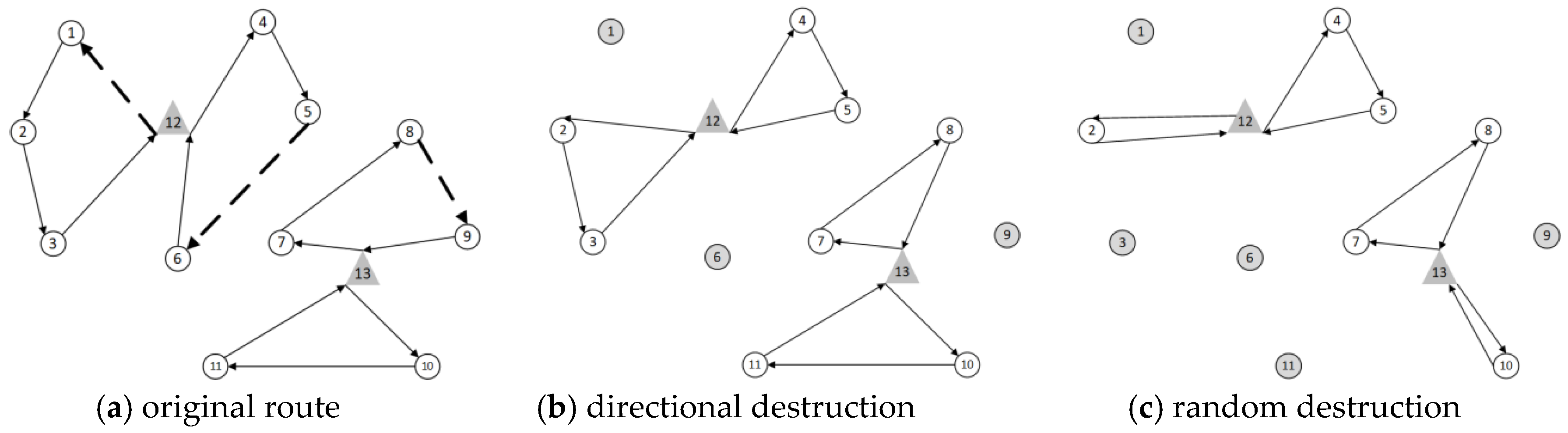
Finally, this study proposes a hybrid destruction strategy integrating targeted and random destruction. Targeted destruction ranks all node pairs in each ant’s route by dynamic carbon emissions in descending order, selects the top κ · χ · N high-emission node pairs, and removes the second node of each pair, as illustrated in Figure 11b. Random destruction selects κ · 1 χ · N nodes at random from the remaining customers for removal, as shown in Figure 11c. The targeted destruction proportion χ increases linearly with iterations to balance exploration and convergence.
(2)
Repair Stage
The repair cost for inserting customer r e p into node pair i , j in a route is defined as the difference in dynamic carbon emissions between the new and original routes, given by Equation (68).
C r e p a i r = D E E n ( i , r e p ) + D E E n ( r e p , j ) D E E n ( i , j )
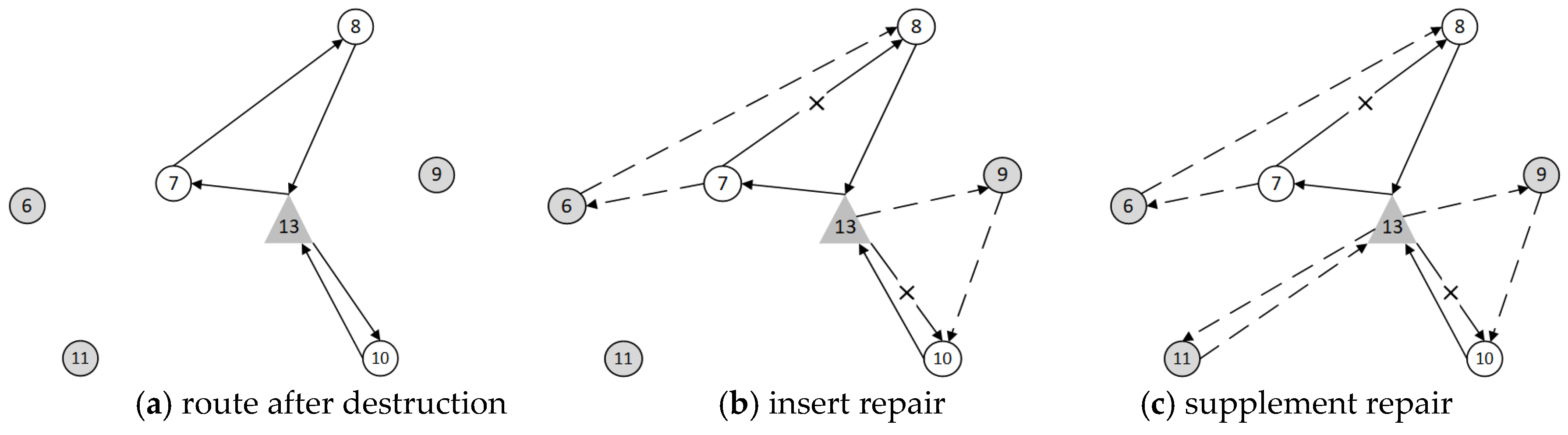
The repair process employs a greedy heuristic. For each customer to be reinserted, begin with the insertion position that minimizes repair cost and verify if the resulting route meets applicable constraints. If insertion into an existing route breaches constraints, select an alternative position with the next smallest repair cost, as illustrated in Figure 12b. If no existing route can accommodate the customer, assign it to a different distribution center. The repair cost then becomes the dynamic carbon emissions from distribution center i to the customer, given by Equation (69).
C r e p a i r = D E E n ( i , r e p )
Finally, select the distribution center that minimizes repair cost while meeting capacity constraints, construct a new vehicle route, and add it to the overall route set, as shown in Figure 12c.

4.4.3. Pheromone Concentration Update Strategy

During route construction, pheromones evaporate over time, and the dynamic pheromone update mechanism is critical for the algorithm’s rapid convergence. The core pheromone update calculation is given by Equation (70).
τ i j t + 1 = 1 ρ · τ i j t + Δ τ i j t
where ρ is the pheromone evaporation coefficient, controlling the rate of pheromone decay, Δ τ i j t is the pheromone increment in the current iteration, calculated based on the quality of the ant’s route.
This study proposes a best–worst collaborative update strategy, as presented in Equation (71).
Δ τ i j t = Q b e s t C L b e s t + Q w o r s t C L w o r s t
where Q b e s t is the enhancement intensity for the global best route, strengthening the pheromone on the optimal route, Q w o r s t is the penalty intensity for the global worst route, reducing the pheromone on the least favorable route, C L b e s t is the cost of the global best route, representing the total cost of the optimal route found, C L w o r s t is the cost of the global worst route, representing the total cost of the least favorable route found.

4.5. Dynamic Empirical Emission Operator

During location decision and dynamic routing, precise carbon emission characterization is critical for low-carbon objectives. However, frequent access to complex dynamic factors for carbon emission cost calculations results in prohibitively high computational complexity. To balance accuracy and efficiency, this study proposes dynamic operators, namely Dynamic Empirical Emission (DEE) and Dynamic Empirical Time (DET), leveraging cached historical data and dynamic weighting to minimize real-time computations while maintaining solution quality.
D E E n ( i , j ) σ · D E E n 1 ( i , j ) + ( 1 σ ) · c a r b i j n
where c a r b i j n is the carbon emissions for the route between node pair i , j in the current iteration, calculated as described in Section 3.3.2. σ is the weight coefficient, controlling the contribution of current carbon emission data to the overall adjusted value, dynamically adjusted with iterations as shown in Equation (73).
σ i t e r = σ min + σ max σ min i t e r i t e r max
The DEE matrix stores dynamic carbon emissions for all directed edges in the logistics network. Initially, it is based on carbon emission values at a fixed departure time and load, with primary factors influencing DEE values being distance and road attributes.
Similarly, DET follows the same initialization as DEE, with dynamic updates given by Equation (74).
D E T n ( i , j ) σ · D E T n 1 ( i , j ) + ( 1 σ ) · t i m e i j n
where t i m e i j n is the travel time for the route between node pair i , j in the current iteration, calculated as described in Section 3.3.2.
The dynamic cost for node pairs is defined by Equation (75).
C O S T i j n = f c D E E n ( i , j ) + f t D E T n ( i , j )
The dynamic empirical cost replaces the distance-based cost used in traditional LRP algorithms. This approach not only ensures strong alignment with the proposed TDGLRP-STV model but also mitigates substantial computational overhead from real-time carbon cost computations during assignment cost calculations in the location decision phase, ant route construction, and local search in the routing optimization phase.
To present the overall workflow and key steps of the TSI-LR-IACO algorithm more clearly, the overall workflow and key steps of the TSI-LR-IACO algorithm are formally summarized in Algorithm 1 (see Section 4.5). This pseudocode integrates the multiplier update mechanism of Lagrangian Relaxation with the path search strategy of the Improved Ant Colony Optimization, embodying the interactive optimization framework proposed in this study.
Algorithm 1 Two-Stage Iteration-Lagrange Relaxation-Improved Ant Colony Optimization Algorithm
1:INPUT:
2:        Network G = (V, E),
3:        Demand D,
4:        Time Windows [ET_i, LT_i],
5:        Traffic Data v_ij(t),
6:        Parameters α, β, ρ, Q, λ_init
7:OUTPUT:
8:        Best Location-Routing Scheme S *,
9:        Min Cost Z *
10:
11:---------------------------------------------------------------------
12:1. INITIALIZATION:
13:      Lagrangian multipliers π_it = 0,
14:      step size θ = 2,
15:      Upper Bound UB = +∞,
16:      Lower Bound LB = −∞,
17:      Pheromone τ_ij = τ0;
18:      Generate initial feasible solution S0 and update UB = Cost(S0);
19:
20:2. OUTER LOOP (until termination criteria met):
21:      -----------------------------------------------------------------
22:      2.1 STAGE 1: LR for Lower Bound Generation
23:              Update time-dependent travel time t_ij based on current traffic speed v_ij(t);
24:              Calculate Lagrangian cost c’_ij = c_ij − π_i;
25:              Solve Relaxed Sub-problem (e.g., Knapsack Heuristic) to obtain current lower bound LB_curr;
26:
27:              // Dual Update (Lagrangian Multiplier Adjustment)
28:              Calculate subgradient vector d_k: d_i = 1 − Σ_j x_ij;
29:              Update step size: θ = λ × (UB − LB_curr)/||d_k||2;
30:              Update multipliers: π_i^(k + 1) = max(0, π_i^k + θ · d_i);
31:              Update Global LB = max(LB, LB_curr);
32:
33:      2.2 STAGE 2: IACO for Upper Bound Optimization
34:              FOR EACH ant k = 1 to M:
35:                      Select start node (DC) based on probability derived from LR solution;
36:                      WHILE Solution construction not complete:
37:                              Calculate transition probability P_ij^k using τ_ij, η_ij, and dual variable influence π_j (Feedback);
38:                              Select next node j and update vehicle load/time;
39:                      Apply Local Search (2-opt/Exchange) to improve route;
40:                      Calculate cost Z_k (including Carbon Emission);
41:              Update UB = min(UB, min_k Z_k);
42:
43:      2.3 FEEDBACK & PHEROMONE UPDATE
44:              Calculate Gap: γ = (UB − LB)/LB;
45:              Global Pheromone Update: τ_ij = (1 − ρ)τ_ij + ρ × Δτ_ij^best;
46:              Dynamically adjust heuristic factor β based on γ convergence;
47:      -----------------------------------------------------------------
48:
49:3. RETURN:
50:      Best Location-Routing Scheme S *, Min Cost Z *;

4.6. The TSI-LR-IACO Algorithm: Pseudocode and Workflow

Based on the aforementioned components and interaction mechanisms, the complete workflow of the TSI-LR-IACO algorithm is summarized in the following pseudocode.
Algorithm TSI-LR-IACO achieves synergistic optimization of facility location and vehicle routing through the iterative updating of Lagrangian multipliers and the pheromone matrix. Its core strengths lie in the enhanced coordination between the two decision stages, facilitated by multipliers that relay real-time information on carbon emissions and traffic conditions. Furthermore, it boosts search efficiency by integrating heuristic local search operators with a global pheromone update strategy. Crucially, the algorithm supports dynamic carbon emission calculation and accommodates real-time road network updates, making it particularly suitable for practical urban logistics applications with spatio-temporal variability.

5. Case Analysis

5.1. Dataset Description and Preprocess

To validate the TDGLRP-STV model and the TSI-LR-IACO algorithm, a real-world case study based on the urban logistics profile of Beijing, China, is conducted. The region features complex logistics networks and traffic patterns, providing a suitable testbed for our spatio-temporal dynamic model.

5.1.1. Data Description

The case instance is constructed using real geospatial and operational data. We selected 15 logistics nodes performing standardized warehousing and regional distribution functions as candidate distribution centers (I), and 70 large- and medium-sized supermarkets as customer points (J). The geographical coordinates of all nodes are obtained via the AMap (Gaode) Open Platform API. Key operational parameters—including center capacities and fixed costs, as well as customer demands—are synthesized with reference to industry benchmarks, enterprise data, and relevant literature to ensure representativeness. The complete datasets are provided in Appendix A (Table A1 and Table A2). The spatial distribution of these nodes is depicted in Figure 13. Key parameters for the homogeneous fleet of electric delivery vehicles are listed in Table 4, with reference values drawn from typical logistics fleet specifications and prior research [44,45]. The parameters governing the TSI-LR-IACO algorithm (Table 5) were calibrated through preliminary computational experiments to optimize performance.

5.1.2. Data Preprocess

To characterize the time-varying characteristics of road network speeds, the Travel Time Index (TTI) data employed in this study are sourced from the traffic congestion evaluation system established for Beijing in the relevant research [46]. This system constructed a time-series TTI dataset covering weekdays, weekends, and various ring roads, based on large-scale real-time data collected by citywide microwave detectors. Focusing on the primary active period for urban logistics distribution, namely weekday daytime, this research extracts typical TTI values from 6:00 to 16:00, as presented in Table 6, to characterize the congestion fluctuations within the road network during distribution hours.
To account for spatial variation in vehicle speed, roads are categorized into six levels according to Chinese road characteristics and national standards, detailed in Table 7. Constructing the space-time speed matrix requires establishing a reference free-flow speed for each road category. The cited Beijing traffic congestion evaluation framework uses the posted speed limit of road segments as the free-flow speed in its TTI calculation. Given the practical challenges in obtaining comprehensive, real-time, and precise speed limit data across the entire network, this study adopts a methodologically sound and common approximation by using the road design speed as a proxy for this reference free-flow speed. This approach is justified by the strong correlation between the two metrics, with design speed more directly reflecting the inherent physical attributes and traffic capacity tier of a roadway.
Consequently, the actual travel speed for a vehicle on a specific road segment during a given time period is dynamically calculated by dividing this reference design speed by the corresponding TTI value, which is stratified by both time period and ring road. This yields the operational formula: actual speed equals the reference design speed divided by TTI. This methodology enables the model to capture the spatial heterogeneity of the network through design speed classification while simultaneously incorporating the temporal dynamics of traffic conditions via the ring-road-specific TTI data. The resulting speed matrix for the road network is presented in Table 8.
Actual path data between nodes were processed using the AMAP Open Platform API, retrieving segment lengths and road grades for the recommended routes based on the shortest distance criterion. The number of segments and the total travel distance for each node pair were computed, resulting in a total of 7225 (85 × 85) unique path records.

5.2. Results and Analysis

Using the Two-Stage Interactive Location-Routing with Improved Ant Colony Optimization (TSI-LR-IACO) algorithm, the optimal solution is presented in Table 9, with detailed location decisions and routing results in Table 10, and cost components in Table 11. As shown in Figure 14, we visualize the optimal location and routing plan, with red nodes as candidate distribution centers, blue nodes as customer points, and colored lines representing vehicle routes.
The results indicate that distribution center-related costs (fixed, operating, and non-vehicle carbon emissions) constitute 72.33% of total costs, highlighting the significant impact of location decisions on cost control.
The location results yield a layout with two distribution centers. In the delivery plan, vehicle fixed costs represent a significant share, while operating and charging costs are comparable. Each electric logistics vehicle serves ten customer points on average, with minimal recharging needed near route endpoints. Vehicle loads are below maximum capacity, leaving a service margin. Analysis shows that high loads increase charging costs beyond the cost of adding a vehicle. Thus, the plan optimizes task allocation to reduce individual vehicle loads, lowering charging costs and time losses from stops, maximizing electric logistics vehicle range utilization, and enhancing delivery efficiency.
To avoid excessive computation from frequent dynamic parameter calls, this study proposes a dynamic empirical carbon emission operator (DEE). By weighing historical and real-time data, it adjusts carbon emission estimates for location and routing decisions, ensuring accuracy while reducing overhead. The initial DEE matrix heatmap, depicted in Figure 15, shows estimated carbon emissions between node pairs under average conditions. It supports assignment cost calculations in the location phase, selection probabilities in ant route construction, and destruction–repair in local search during the first iteration, with dynamic updates in subsequent iterations via precise data weighting.

5.3. Comparison Results and Analysis

To rigorously evaluate TSI-LR-IACO, its performance is compared against two benchmark algorithms: a standalone Improved Ant Colony Optimization (IACO) and a basic Lagrange Relaxation with Ant Colony Optimization (LR-ACO). IACO uses the same carbon-guided local search but lacks the two-stage interactive framework. LR-ACO employs Lagrangian Relaxation but uses a standard ACO without the DEE operator or enhanced local search. The comparative results from five independent runs are summarized in Table 12.

5.3.1. Comparison Result of TSI-LR-IACO and IACO

TSI-LR-IACO consistently outperforms IACO. While IACO occasionally deviates from the optimal location combination (centers 6 and 10), TSI-LR-IACO converges to it uniformly, demonstrating the Lagrangian Relaxation’s superior handling of global constraints. More importantly, TSI-LR-IACO’s routing costs are, on average, 7.46% lower than IACO’s. This stems from the iterative feedback mechanism, which allows routing information to progressively refine location decisions and vice versa. Although TSI-LR-IACO requires greater computation time, the substantial improvement in solution quality—particularly in total cost and carbon emissions—justifies this trade-off for strategic planning.

5.3.2. Comparison Result of TSI-LR-IACO and LR-ACO

This study proposes two enhancements to ACO for routing problems: incorporating a carbon-guided local search strategy to boost search capability and developing a Dynamic Empirical Emission (DEE) operator to characterize inter-node costs, improving efficiency while preserving accuracy. Using the case study with LR-ACO for five trials, results are compared against TSI-LR-IACO, as presented in Table 12.
Results show that both algorithms perform similarly in location decisions, reflecting consistent impacts from Lagrange Relaxation and the two-stage interactive framework. However, in routing, standard ACO in LR-ACO underperforms, with routing costs approximately 2% higher than TSI-LR-IACO’s, leading to suboptimal overall solutions. Analysis of LR-ACO’s results shows uncontrolled vehicle operating costs and carbon emissions, with emissions differences being particularly pronounced, indicating limited exploration of the solution space and a deficient route construction mechanism. In contrast, TSI-LR-IACO’s DEE operator, alongside vehicle operating costs, shapes heuristic information during route construction. Coupled with a carbon-guided local search strategy, it steers the search toward low-carbon, high-efficiency routes, exhibiting superior global optimization capabilities.
Statistical Significance Test
To verify the statistical significance of the TSI-LR-IACO’s advantages, two-tailed paired t-tests (with 4 degrees of freedom, n = 5) were conducted based on the results from five repeated experimental runs. The test results are presented in Table 13. For total cost, the comparison between TSI-LR-IACO and IACO shows a mean difference of 166.66 RMB, with a t-statistic of 12.87 (p < 0.001), indicating an extremely significant cost advantage. For carbon emissions, the comparison between TSI-LR-IACO and LR-ACO yields a mean difference of 21.65 kg, with a t-statistic of 8.34 (p < 0.01), proving a significant low-carbon effect. The strong statistical significance (p < 0.01) of these differences robustly confirms that the observed performance advantages of the TSI-LR-IACO algorithm are systematic and not due to random variation.
Feedback Mechanism Stability Verification
The feedback mechanism’s stability is reflected in two aspects: First, location result consistency—In five repeated experiments, the location results were completely consistent (both distribution centers 6 and 10) with no fluctuations. Second, routing cost convergence—The standard deviation of TSI-LR-IACO’s total cost is only 7.39 RMB (accounting for 0.09% of the average total cost), and the standard deviation of carbon emissions is 4.12 kg (1.2% of the average emissions). The iterative convergence curve (Figure 16) further shows that the algorithm converges to the optimal solution within 100 iterations in each experiment, with a consistent convergence trend. This stability verifies that the feedback mechanism effectively suppresses solution space fluctuations, guiding the algorithm to stably approach the global optimum instead of falling into local optima.
Combined with the comparative results and stability analysis, the empirical evidence fully validates that the feedback mechanism of TSI-LR-IACO can effectively guide the algorithm to approach the global optimum.

5.4. Analysis and Discussion of Carbon Emission

5.4.1. Impact of Considering Carbon Emission Costs

To assess the impact of incorporating carbon emission costs, a comparative analysis is performed. Without carbon emissions, the model omits carbon emission costs for distribution centers and vehicles, and the algorithm excludes carbon-related factors from assignment costs in location decisions, heuristic information, and local search. Thus, solutions without carbon emissions are presented in Table 14, with optimal solutions for both scenarios compared in Table 15. Results show that including carbon emission costs significantly reduces transportation emissions while controlling total costs, underscoring the substantial practical value of the TDGLRP-STV model. As indicated in Table 15, when carbon emissions are excluded from the objective function and constraints, ACO ant routes conventionally prioritize shortest paths, neglecting energy consumption profiles. This increases overall energy use and charging costs.
Consequently, economic cost reductions (excluding carbon) are marginal and achieved at environmental expense. Conversely, the model incorporating carbon emission costs prioritizes closer nodes for delivery in initial trip phases with heavier loads, even if later detours increase travel distance and time, resulting in lower carbon emissions. When carbon emissions are excluded from the objective function and constraints, ACO constructs the conventionally shortest routes, disregarding energy consumption profiles. This increases overall energy use and charging costs. Consequently, economic cost reductions (excluding carbon) are marginal and achieved at the cost of environmental impact. Conversely, the carbon-inclusive model favors delivering to closer nodes early in trips when loads are heavier, even if detours arise later, leading to longer distances and times but lower emissions.
Cost-wise, the carbon-inclusive strategy achieves a balanced optimal solution without significantly raising total costs. In the long term, this aligns with low-carbon trends and supports enterprises in adapting to stricter carbon policies and market shifts.

5.4.2. Impact of Different Carbon Policies

Global carbon pricing mechanisms mainly comprise carbon pricing mechanisms and Emissions Trading Systems (ETS). The EU ETS price exceeds 100 euros/t, Sweden’s carbon pricing mechanism stands at 137 euros/t, while the case study region’s carbon price (50–120 RMB/t) remains low. The Intergovernmental Panel on Climate Change (IPCC) states that carbon prices must reach 135–5500 dollars/t by 2030 to meet the 1.5 °C target. Carbon prices directly influence logistics optimization: lower prices prioritize economic costs, while higher prices favor low-carbon solutions. Analyzing logistics optimization under varying carbon prices equips enterprises to adapt to future carbon policy shifts.
Using current global carbon policy trends and projected developments, the case study is analyzed against three scenarios with carbon prices of 1000 RMB/t, 10,000 RMB/t, and 20,000 RMB/t, with results presented in Table 16.
Results show that increasing carbon prices profoundly influence logistics decisions. At 20,000 RMB/t, the share of carbon costs rises from baseline levels to 64.59%, steering solutions toward low-carbon outcomes. While non-carbon costs remain stable, emissions are further reduced. This reflects the carbon pricing mechanism’s market-based regulation: at lower prices, the algorithm minimizes distance and travel time; at higher prices, it avoids high-carbon routes. Beyond 10,000 RMB/t, route structures significantly shift to integrated green-economic optimization, driving enterprises from purely economic goals to low-carbon development. Incorporating carbon emissions into decision-making allows enterprises to adapt operational strategies to stricter future carbon policies, enhancing competitiveness and sustainability.

5.4.3. Sensitivity Analysis of Spatio-Temporal Variability

To thoroughly validate the responsiveness and robustness of the proposed TDGLRP-STV model under dynamic urban conditions, this subsection presents a sensitivity analysis on the key parameter representing traffic variability: the congestion factor γ . This factor modulates the base Travel Time Index (TTI) values, simulating scenarios ranging from free-flow conditions ( γ = 0.8 ) to severe congestion ( γ = 1.6 ). The impact of varying γ on the primary optimization objectives—Total System Cost and Total Carbon Emissions—is analyzed and visualized in Figure 17.
Figure 17 illustrates the sensitivity of the optimization results to varying levels of traffic congestion. As anticipated, the total cost exhibits a clear, monotonically increasing trend, rising by approximately 5.5% from 6782 RMB (γ = 0.8) to 7155 RMB (γ = 1.5). This increase is directly driven by time-dependent operational costs, as prolonged travel times under congestion escalate expenses related to vehicle usage and driver wages. In contrast, the trend for carbon emissions reveals a more nuanced, non-linear relationship. Emissions initially decreased from 17.29 kg to 16.79 kg as γ increased from 0.8 to 1.2, before rising to 17.55 kg at γ = 1.5. This counterintuitive initial decline can be attributed to the energy consumption characteristics of electric logistics vehicles; under moderate congestion (γ ≈ 1.2), vehicle speeds are often reduced to a range that minimizes aerodynamic drag and aligns with the motor’s higher efficiency zone, offsetting the negative effects of stop-and-go traffic. However, under severe congestion (γ = 1.5), the detrimental effects of drastically reduced average speeds, frequent acceleration/deceleration, and extended auxiliary system operation dominate, leading to a net increase in energy consumption and emissions. This complex interplay demonstrates that the proposed dynamic model successfully captures non-obvious spatio-temporal trade-offs. For logistics managers, this analysis quantifies the “cost of congestion” and highlights that moderate traffic variability might not harm environmental performance, whereas severe congestion deteriorates both economic and environmental outcomes. For policymakers, it underscores the compound benefits of mitigating extreme congestion, which can simultaneously enhance logistics efficiency and support urban decarbonization goals, validating the critical importance of incorporating high-fidelity spatio-temporal dynamics into sustainable logistics planning frameworks.

5.5. Algorithm Scalability Analysis

To comprehensively evaluate the scalability and stability of the proposed TSI-LR-IACO algorithm, as suggested by the reviewer, we conducted extended experiments on problem instances of varying scales. Based on the original real-world dataset with 70 customer nodes, we generated synthetic instances with 20, 50, 100, and 150 customer nodes using a randomized mapping and perturbation mechanism to simulate different urban logistics scales while maintaining realistic spatial distribution patterns.
The computational results across all tested scales are summarized in Table 17. As the problem size increases, both computational requirements and total system costs demonstrate predictable growth patterns. For small-scale instances with 20 customer nodes, the algorithm converges in approximately 2.7 min with a total cost of 2627.50 CNY. As the scale increases to 150 customer nodes, the computational time extends to approximately 49 min (2942.70 s) with a corresponding total cost of 17,469.00 CNY.
These scalability trends are visually presented in Figure 18, which illustrates the dual-axis relationship between problem scale, computational time, and total cost. The left axis represents CPU time (in seconds), showing a near-linear increase with problem size, while the right axis represents total cost (in CNY), demonstrating a corresponding growth trend. This visualization clearly demonstrates that the proposed algorithm maintains reasonable computational requirements even as problem complexity increases significantly.
The observed performance characteristics validate the effectiveness of the two-stage interactive optimization framework. The combination of Lagrangian Relaxation for facility location decisions and Improved Ant Colony Optimization for routing planning successfully manages the combinatorial complexity inherent in large-scale location-routing problems. The algorithm’s ability to solve instances with up to 150 customer nodes within practical timeframes confirms its applicability to diverse urban logistics scenarios, addressing the reviewer’s concern regarding scalability evaluation beyond the baseline case study.

6. Conclusions

6.1. Theoretical Contributions

This study introduces the Time-Dependent Green Location-Routing Problem with Spatio-Temporal Variations (TDGLRP-STV) to address the critical challenge of decarbonizing urban logistics. By developing an integrated optimization framework, we successfully reconcile the dual objectives of minimizing carbon emissions and maintaining operational efficiency. Our work delivers three key contributions, rigorously validated through empirical analysis:
A Dynamic Spatio-Temporal Carbon Emission Model: We propose a novel method for calculating carbon emissions dynamically by integrating the energy consumption patterns of electric logistics vehicles with real-time, road-grade-specific traffic dynamics. This approach significantly improves upon conventional static models, offering markedly enhanced precision for emission estimation under realistic urban conditions.
An Integrated Location-Routing Optimization Framework: The TDGLRP-STV model holistically integrates strategic facility location and tactical vehicle routing decisions to minimize total system costs under carbon constraints. By explicitly embedding dynamic factors such as time-varying electricity consumption and travel times, the model demonstrates strong applicability to real-world logistics scenarios characterized by variability and uncertainty.
An Efficient Two-Stage Interactive Algorithm: To solve the complex, NP-hard TDGLRP-STV, we devised the TSI-LR-IACO algorithm. By synergistically combining Lagrangian Relaxation and an Improved Ant Colony Optimization within a bidirectional feedback mechanism, the algorithm effectively manages the severe computational complexity of the problem. It achieves an effective balance between solution quality and computational efficiency, particularly for large-scale instances, as evidenced by the case study results.

6.2. Managerial Implications

The findings offer actionable insights for both logistics practitioners and urban policymakers:
For Logistics Operators: The TDGLRP-STV model and the TSI-LR-IACO algorithm provide a practical framework for low-carbon, cost-effective decision-making. The system can be integrated as an optimization module within existing Transportation Management Systems (TMS). A practical implementation would involve establishing a data pipeline to feed real-time vehicle telematics and traffic information into the Dynamic Empirical Emission (DEE) operator. Operators can adopt a rolling-horizon planning approach: executing the full location-routing optimization offline using forecasted data for strategic plans, while leveraging the efficient routing algorithm for dynamic daily adjustments.
For City Authorities and Policymakers: This research offers a quantifiable policy-simulation tool. The model can be deployed at a municipal scale to assess the system-wide impact of low-carbon policies, such as carbon pricing or low-emission zone designs. By aggregating city-wide traffic data, authorities could generate and disseminate standardized dynamic speed matrices, lowering data acquisition barriers for individual enterprises and fostering a more efficient, collaborative logistics ecosystem. The sensitivity analysis on carbon price provides clear evidence of how market-based mechanisms can steer corporate strategy toward sustainable outcomes.

6.3. Limitations and Future Directions

Despite its contributions, this study has limitations that point to productive avenues for future research, some of which stem from the necessary simplifying assumptions outlined in Section 3.1.
Enhancing Model Realism and Robustness: Future work should incorporate real-world uncertainties currently abstracted, such as stochastic charging station availability with queuing, dynamic traffic incidents, and fluctuating grid carbon intensity. Integrating robust or stochastic optimization techniques would increase the model’s operational fidelity and decision-making reliability under uncertainty.
Algorithmic Advancements for Scale and Speed: While TSI-LR-IACO is efficient, its computational performance for city-wide or real-time deployment on ultra-large-scale networks can be further enhanced. Investigating parallel computing architectures, distributed optimization schemes, or leveraging machine learning for solution prediction and heuristic generation are promising directions.
Extended Multi-Objective and Policy Analysis: Developing a Pareto-based multi-objective framework to explicitly trade-off carbon emissions, economic costs, and service reliability (e.g., time window adherence) would provide decision-makers with a spectrum of tailored solutions. Furthermore, the model can be extended to evaluate a wider range of policy instruments, such as road pricing, fleet renewal subsidies, or the optimal siting of public charging infrastructure in conjunction with logistics networks.
In conclusion, this research establishes a solid foundation for the environmental optimization of urban logistics systems. By addressing the current limitations and pursuing the outlined future directions, the TDGLRP-STV framework can evolve to meet the growing demands for intelligent, sustainable, and resilient urban mobility.

Author Contributions

Conceptualization, J.C. and Z.W.; Data curation, X.T.; Formal analysis, J.C.; Funding acquisition, Z.W.; Investigation, J.C. and B.H.; Methodology, J.C.; Project administration, Z.W.; Resources, T.W.; Software, B.H.; Supervision, Z.W.; Visualization, J.C. and X.T.; Writing—original draft, J.C.; Writing—review and editing, Z.W., Z.J. and T.W. All authors have read and agreed to the published version of the manuscript.

Funding

This research was funded by the Fundamental Research Funds for the Central Universities, grant number 2024YJS107, and the National Key Research and Development Program of China, grant number 2023YFB4301901. The APC was funded by the Fundamental Research Funds for the Central Universities.

Data Availability Statement

The original contributions presented in this study are included in the article. Further inquiries can be directed to the corresponding authors.

Acknowledgments

During the preparation of this work, the authors utilized DeepSeek (Version V3-0324) for preliminary grammar checks and proofreading. After using this tool, we reviewed and edited the content as needed, and we take full responsibility for the content of the publication.

Conflicts of Interest

The authors declare no conflict of interest.

Appendix A. Dataset

Table A1. The dataset of distribution alternate points.
IDXYCapacity/kgFixed Cost/RMB Per DayAverage Carbon Emission Cost/RMB Per Day
1116.37452839.8066268600154012
2116.41883939.83969158009807.5
3116.41792139.8413718600160011
4116.22960239.8835878000144010
5116.28184139.834155580010007.5
6116.29522539.8249588000140010
7116.28228939.87780254009506
8116.37838839.786769830085011
9116.26044339.85022860092012
10116.51411439.8346559000160012
11116.35266139.84013950008606
12116.25369639.8590128300150011
13116.51222739.885101800086012
14116.24641639.92922550008505.5
15116.53479939.8683398300146012
Table A2. The dataset of demand points.
IDXYDemand/kgService Time/hIDXYDemand/kgService Time/h
1116.35833339.9083912530.25 36116.42486439.7855212530.25
2116.34515439.9078382350.24 37116.41718839.8176152130.21
3116.36156339.9156192180.22 38116.47569539.8385032340.23
4116.29357539.8691232190.22 39116.44160239.854052550.26
5116.34568539.8767342510.25 40116.46206539.8618862850.29
6116.43407939.9129092310.23 41116.35926839.8076672030.20
7116.45580539.8842362130.21 42116.36925939.8329692300.23
8116.39273339.8870212720.27 43116.44195939.8877612120.21
9116.4679739.8750652080.21 44116.39695739.8497212290.23
10116.44199839.8960832340.23 45116.50245939.8498572230.22
11116.31729339.8465572140.21 46116.25467139.9068842090.21
12116.3337739.823072310.23 47116.4675339.8802732120.21
13116.42802539.8434452290.23 48116.36484939.8718412330.23
14116.43939939.8581261980.20 49116.32865139.9006052270.23
15116.37213339.8760042230.22 50116.3035639.9160322140.21
16116.36528539.7939092210.22 51116.46055439.912252120.21
17116.35138739.8458692110.21 52116.439739.9437032280.23
18116.32563539.8772892220.22 53116.29683739.9105772110.21
19116.28234739.922612280.23 54116.40302539.9356741970.20
20116.27903639.901482100.21 55116.36262339.951782110.21
21116.37504139.8936012160.22 56116.45434439.9348822220.22
22116.41761439.8974522230.22 57116.37247939.9108722210.22
23116.37011239.8466942090.21 58116.2775539.913242130.21
24116.28277739.8543952110.21 59116.34387539.9255792280.23
25116.42346639.8030852110.21 60116.37282639.9317482060.21
26116.29417739.8452482430.24 61116.4088139.9289112130.21
27116.39240239.8617642200.22 62116.46727839.9076862290.23
28116.40635539.8577022050.21 63116.27727239.9320492120.21
29116.332139.7995452510.25 64116.40889239.9132992210.22
30116.40473939.8097952230.22 65116.32186939.9328972320.23
31116.29895639.8289522310.23 66116.43330839.9211192810.28
32116.44316839.8054142130.21 67116.33409939.8661482240.22
33116.24047839.8347072250.23 68116.3025239.8132322210.22
34116.23736139.8629912230.22 69116.256439.8946132240.22
35116.33574339.774652330.23 70116.30365939.9365892350.24

References

  1. Çakmak, E.; Önden, İ.; Acar, Z.A.; Eldemir, F. Analyzing the location of city logistics centers in Istanbul by integrating Geographic Information Systems with Binary Particle Swarm Optimization algorithm. Case Stud. Transp. Policy 2021, 9, 59–67. [Google Scholar] [CrossRef]
  2. Chen, Y.; Li, D.; Zhang, Z.; Wahab, M.I.M.; Jiang, Y. Solving the battery swap station location-routing problem with a mixed fleet of electric and conventional vehicles using a heuristic branch-and-price algorithm with an adaptive selection scheme. Expert Syst. Appl. 2021, 186, 115683. [Google Scholar] [CrossRef]
  3. U.S. Environmental Protection Agency (EPA). Sources of Greenhouse Gas Emissions; EPA: Washington, DC, USA, 2023. Available online: https://www.epa.gov/ghgemissions/sources-greenhouse-gas-emissions (accessed on 15 January 2026).
  4. U.S. Environmental Protection Agency (EPA). Inventory of U.S. Greenhouse Gas Emissions and Sinks: 1990–2022; EPA 430-R-24-004; EPA: Washington, DC, USA, 2024. [Google Scholar]
  5. Lin, C.; Choy, K.L.; Ho, G.T.S.; Chung, S.H.; Lam, H.Y. Survey of Green Vehicle Routing Problem: Past and future trends. Expert Syst. Appl. 2014, 41, 1118–1138. [Google Scholar] [CrossRef]
  6. Moradi, N.; Boroujeni, N.M. Prize-collecting Electric Vehicle routing model for parcel delivery problem. Expert Syst. Appl. 2025, 259, 125183. [Google Scholar] [CrossRef]
  7. Kancharla, S.R.; Ramadurai, G. Electric vehicle routing problem with non-linear charging and load-dependent discharging. Expert Syst. Appl. 2020, 160, 113714. [Google Scholar] [CrossRef]
  8. Das, S.K.; Yu, V.F.; Roy, S.K.; Weber, G.W. Location–allocation problem for green efficient two-stage vehicle-based logistics system: A type-2 neutrosophic multi-objective modeling approach. Expert Syst. Appl. 2024, 238, 122174. [Google Scholar] [CrossRef]
  9. Wang, X.; Li, X. Carbon reduction in the location routing problem with heterogeneous fleet, simultaneous pickup-delivery and time windows. Procedia Comput. Sci. 2017, 112, 1131–1140. [Google Scholar] [CrossRef]
  10. Liu, D.; Zhang, Y. Research on Location and Routing for Cold Chain Logistics in Health Resorts Considering Carbon Emissions. Sustainability 2024, 16, 6362. [Google Scholar] [CrossRef]
  11. Wang, S.; Sun, W.; Baldacci, R.; Elomri, A. Exact solution of location–routing problems with heterogeneous fleet and weight-based carbon emissions. Transp. Res. Part E Logist. Transp. Rev. 2025, 193, 103862. [Google Scholar] [CrossRef]
  12. Amiri, A.; Amin, S.H.; Zolfagharinia, H. A bi-objective green vehicle routing problem with a mixed fleet of conventional and electric trucks: Considering charging power and density of stations. Expert Syst. Appl. 2023, 213, 119228. [Google Scholar] [CrossRef]
  13. Qiu, R.; Xu, J.; Ke, R.; Zeng, Z.; Wang, Y. Carbon pricing initiatives-based bi-level pollution routing problem. Eur. J. Oper. Res. 2020, 286, 203–217. [Google Scholar]
  14. Luo, H.; Dridi, M.; Grunder, O. A branch-price-and-cut algorithm for a time-dependent green vehicle routing problem with the consideration of traffic congestion. Comput. Ind. Eng. 2023, 177, 109093. [Google Scholar]
  15. Song, M.; Cheng, L.; Du, M.; Sun, C.; Ma, J.; Ge, H. Charging station location problem for maximizing the space-time-electricity accessibility: A Lagrangian relaxation-based decomposition scheme. Expert Syst. Appl. 2023, 222, 119801. [Google Scholar]
  16. Cai, L.; Lv, W.; Xiao, L.; Xu, Z. Total carbon emissions minimization in connected and automated vehicle routing problem with speed variables. Expert Syst. Appl. 2021, 165, 113910. [Google Scholar] [CrossRef]
  17. Toro, M.E.; Franco, F.J.; Echeverri, G.M.; Guimarães, F.G. Green open location-routing problem considering economic and environmental costs. Int. J. Ind. Eng. Comput. 2016, 8, 203–216. [Google Scholar] [CrossRef]
  18. Paz, C.J.; Granada-Echeverri, M.; Escobar, W.J. The multi-depot electric vehicle location routing problem with time windows. Int. J. Ind. Eng. Comput. 2018, 9, 123–136. [Google Scholar] [CrossRef]
  19. Zhou, L.; Lin, Y.; Wang, X.; Zhou, F. Model and algorithm for bilevel multisized terminal location-routing problem for the last mile delivery. Int. Trans. Oper. Res. 2019, 26, 131–156. [Google Scholar] [CrossRef]
  20. Yazdani, M.; Chatterjee, P.; Pamucar, D.; Chakraborty, S. Development of an integrated decision making model for location selection of logistics centers in the Spanish autonomous communities. Expert Syst. Appl. 2020, 148, 113208. [Google Scholar] [CrossRef]
  21. Pelletier, S.; Jabali, O.; Laporte, G. The electric vehicle routing problem with energy consumption uncertainty. Trans. Res. Part B Methodol. 2019, 126, 225–255. [Google Scholar]
  22. Zuo, T.; Wang, Y.; Chen, Z.; Fu, L. Energy consumption simulation and economic benefit analysis for urban electric commercial-vehicles. Transp. Res. Part D Transp. Environ. 2021, 89, 102609. [Google Scholar]
  23. Zhang, S.; Zhao, P.; Wu, Y.; Fu, L.; He, K. Emission Analysis Based on Mixed Traffic Flow and License Plate Recognition Models. Transp. Res. Part D Transp. Environ. 2024, 126, 104012. [Google Scholar]
  24. Yang, Z.; Zheng, R.; Wang, G.; Zhou, K. A Dynamic Road Network Model for Coupling Simulation of Highway Infrastructure Performance and Traffic State. Sustainability 2022, 14, 11521. [Google Scholar] [CrossRef]
  25. Wang, S.; Tao, F.; Shi, Y. Optimization of Location–Routing Problem for Cold Chain Logistics Considering Carbon Footprint. Int. J. Environ. Res. Public Health 2018, 15, 86. [Google Scholar] [CrossRef]
  26. Kang, L.; Dan, L.; Daqing, W. Carbon Transaction-Based Location-Routing- Inventory Optimization for Cold Chain Logistics. Alex. Eng. J. 2022, 61, 7979–7986. [Google Scholar]
  27. Foumani, M. Adaptation of a Collaborative Truck and Robotic Vehicle for Sustainable Supply Chain Operations. In Robot Intelligence Technology and Applications 8; Abdul Majeed, A.P.P., Yap, E.H., Liu, P., Huang, X., Nguyen, A., Chen, W., Kim, U.-H., Eds.; Lecture Notes in Networks and Systems; Springer Nature: Cham, Switzerland, 2024; Volume 1133, pp. 289–301. [Google Scholar] [CrossRef]
  28. Mancini, S. Time Dependent Travel Speed Vehicle Routing and Scheduling on a Real Road Network: The Case of Torino. Transp. Res. Procedia 2014, 3, 433–441. [Google Scholar] [CrossRef]
  29. Zhi, L.; Zhou, X.; Zhao, J. Vehicle Routing for Dynamic Road Network Based on Travel Time Reliability. IEEE Access 2020, 8, 190596–190604. [Google Scholar] [CrossRef]
  30. Anqing, Z.; Youyun, W. Green Logistics Location-Routing Optimization Solution Based on Improved GA A1gorithm considering Low-Carbon and Environmental Protection. J. Math. 2021, 2021, 1–16. [Google Scholar]
  31. Huang, Y.; Zhao, L.; Van Woensel, T.; Gross, J.P. Time-dependent vehicle routing problem with path flexibility. Transp. Res. Part B Methodol. 2017, 95, 169–195. [Google Scholar] [CrossRef]
  32. Wang, Y.; Wei, Z.; Luo, S.; Zhou, J.; Zhen, L. Collaboration and resource sharing in the multidepot time-dependent vehicle routing problem with time windows. Transp. Res. Part E Logist. Transp. Rev. 2024, 192, 103798. [Google Scholar] [CrossRef]
  33. Yu, V.F.; Jodiawan, P.; Gunawan, A. An Adaptive Large Neighborhood Search for the green mixed fleet vehicle routing problem with realistic energy consumption and partial recharges. Appl. Soft Comput. 2021, 105, 107251. [Google Scholar] [CrossRef]
  34. Liu, Y.; Yu, Y.; Zhang, Y.; Baldacci, R.; Tang, J.; Luo, X.; Sun, W. Branch-cut-and-price for the time-dependent green vehicle routing problem with time windows. Inf. J. Comput. 2023, 35, 14–30. [Google Scholar] [CrossRef]
  35. Poonthalir, G.; Nadarajan, R. A Fuel Efficient Green Vehicle Routing Problem with varying speed constraint (F-GVRP). Expert Syst. Appl. 2018, 100, 131–144. [Google Scholar] [CrossRef]
  36. Wu, Z.; Lou, P.; Hu, J.; Zeng, Y.; Fan, C. An Adaptive Large Neighborhood Search for a Green Vehicle Routing Problem with Depot Sharing. Mathematics 2025, 13, 214. [Google Scholar] [CrossRef]
  37. Innis, C.; Chen, P. Location-Routing Problem for Electric Delivery Vehicles with Mobile Charging Trailers. In Proceedings of the 2024 American Control Conference (ACC), Toronto, ON, Canada, 10–12 July 2024; pp. 3007–3012. [Google Scholar]
  38. Turkensteen, M. The accuracy of carbon emission and fuel consumption computations in green vehicle routing. Eur. J. Oper. Res. 2017, 262, 647–659. [Google Scholar] [CrossRef]
  39. Sun, S.; Ma, L.; Liu, Y.; Shang, C. Volleyball premier league algorithm with ACO and ALNS for simultaneous pickup–delivery location routing problem. Appl. Soft Comput. 2023, 149, 111004. [Google Scholar] [CrossRef]
  40. Tan, D.; Liu, X.; Zhou, R.; Fu, X.; Li, Z. A novel multi-objective artificial bee colony algorithm for solving the two-echelon load-dependent location-routing problem with pick-up and delivery. Eng. Appl. Artif. Intell. 2025, 139, 109636. [Google Scholar] [CrossRef]
  41. Li, Y.; Zhao, Q.; Yang, S.; Guo, Y. Tailoring evolutionary algorithms to solve the multiobjective location-routing problem for biomass waste collection. IEEE Trans. Evolut. Comput. 2023, 28, 489–500. [Google Scholar] [CrossRef]
  42. Shen, L.; Tao, F.; Shi, Y.; Qin, R. Optimization of Location-Routing Problem in Emergency Logistics Considering Carbon Emission. Int. J. Environ. Res. Public Health 2019, 16, 2982. [Google Scholar] [CrossRef]
  43. Goeke, D.; Schneider, M. Routing a mixed fleet of electric and conventional vehicles. Eur. J. Oper. Res. 2015, 245, 81–99. [Google Scholar] [CrossRef]
  44. Liu, C.; Li, J.; Zhao, S.; Zhou, X.; Fan, L. Electric Vehicle Routing Problem with Electricity Transmission Based on Vehicle-to-Grid Technology. J. Syst. Sci. Math. Sci. 2025, 45, 1116–1139. [Google Scholar] [CrossRef]
  45. Du, C. Research on Path Optimization of Pure Electric Logistics Vehicles Under Multi-Distribution Center Collaborative Distribution. Master’s Thesis, Chang’an University, Xi’an, China, 2023. [Google Scholar]
  46. Wang, Y.; Hang, Y. Index System of Traffic Congestion Evaluation in Beijing Based on Big Data. J. Transp. Syst. Eng. Inf. Technol. 2016, 16, 231–240. [Google Scholar]
Figure 1. Conceptual framework of the TDGLRP-STV.
Smartcities 09 00034 g001
Figure 2. Time-dependent speed matrix across road grades.
Smartcities 09 00034 g002
Figure 3. Travel stage segmentation under different departure times.
Smartcities 09 00034 g003
Figure 4. Dynamic calculation flowchart for link travel time and energy consumption.
Smartcities 09 00034 g004
Figure 5. Model Structure Schematic.
Smartcities 09 00034 g005
Figure 6. Architecture of the two-stage interactive TSI-LR-IACO algorithm.
Smartcities 09 00034 g006
Figure 7. Method of constructing aggregated customer nodes.
Smartcities 09 00034 g007
Figure 8. Method of decomposing aggregated customer nodes.
Smartcities 09 00034 g008
Figure 9. Flowchart of LR method and IACO.
Smartcities 09 00034 g009
Figure 10. Diagram of the connection between distribution center and the macro customer point.
Smartcities 09 00034 g010
Figure 11. Examples of destruction process in neighborhood search.
Smartcities 09 00034 g011
Figure 12. Examples of repair processes in neighborhood search.
Smartcities 09 00034 g012
Figure 13. Logistics node.
Smartcities 09 00034 g013
Figure 14. Optimized location-routing solution for the Beijing case.
Smartcities 09 00034 g014
Figure 15. Initial dynamic empirical emission (DEE) matrix between nodes.
Smartcities 09 00034 g015
Figure 16. Iterative convergence curves of TSI-LR-IACO.
Smartcities 09 00034 g016
Figure 17. Impact of Traffic Congestion Levels (γ) on Operational Costs and Carbon Emissions.
Smartcities 09 00034 g017
Figure 18. Algorithm performance trends under different problem scales (CPU Time and Total Cost).
Smartcities 09 00034 g018
Table 1. Literature comparison on spatio-temporal considerations in green LRP.
LiteratureConsidered CharacteristicsSolution Technique
Carbon EmissionsTime-DependentDynamic Emissions CalculationSpatio-Temporal VariationsTypeInteraction Mechanism
Wang and Li [9] (2017) HOA
Liu and Zhang [10] (2024) HOA
Song et al. [15] (2023) TSIOALagrange multipliers
Yang et al. [24] (2022) HOA
Luo et al. [14] (2023) IA
Cai et al. [16] (2021) IA
Amiri et al. [12] (2023) IA
Yu et al. [33] (2021) IA
Huang et al. [31] (2017)IAPath selection integration
Wang et al. [32] (2024)IACustomer reassigning + TRS
This researchTSIOAAggregated customer nodes
Table 2. Performance comparison of three LRP algorithm classes.
IAHOATSIOA
ScenariosSmall-scale problems or scenarios with relaxed solution quality requirements.Medium-scale problems or scenarios with constrained computational resources.Large-scale problems or scenarios demanding high solution quality.
ComplexityHigh: Simultaneous search across dual solution spaces.Low: Staged approach reduces problem size.Medium to high: Dependent on subproblem solving efficiency.
Advantages1. Strong global search capability.
2. No explicit problem decomposition required.
1. High computational efficiency.
2. Ease of implementation.
1. Strong theoretical foundations.
2. Feedback mechanism enables approximation of the global optimum.
Disadvantages1. Search mechanism may not effectively handle both discrete and combinatorial spaces.
2. Absence of feedback limits adaptability.
1. Lack of bidirectional feedback can yield suboptimal solutions.
2. Solution quality is contingent on the initial location stage.
1. High computational complexity.
2. Multiple iterations lead to slow convergence.
InteractionNo.No.Yes.
Solution QualityProne to local optima.Generally suboptimal.Approaches global optimum.
Table 3. Notations for the TDGLRP-STV.
NotationsExplanation
x i Equals 1 if distribution center i is selected, otherwise, its value is 0
y i j Equals 1 if distribution center i serves customer j , otherwise, its value is 0
z a b k Equals 1 if vehicle k travels from node a to node b , otherwise, its value is 0
r j k Equals 1 if vehicle k charges at a charging station at node j , otherwise, its value is 0
T n Start time of the n time period
R m Road with grade m
v m n Speed based on time period T n and road grade R m
t 0 Departure time
d a b u Distance from the end of the u -th segment to node a for node pair ( a , b )
g Gravitational acceleration constant ( 9.8   m / s 2 )
d l Travel distance in the l stage
e l Energy consumption for travel in the l stage
t l Travel time in the l stage
L Vehicle load for node pair ( a , b ) at departure time t 0
e a b t Energy consumption for node pair ( a , b ) at departure time t 0
C a r b a b t Carbon emissions for node pair ( a , b ) at departure time t 0
M Total vehicle mass at time t  W c u r b + L
f i Fixed cost of distribution center i , i I
f s i Operating cost per unit of cargo at distribution center i , i I
d c i Average carbon emissions of distribution center i , i I
f k Fixed usage cost per vehicle dispatched from a distribution center
f t Vehicle operating cost per unit time traveled between nodes
f e l o w Electricity cost per unit of energy for low-power slow charging at a distribution center during non-working hours
f e s p e e d Electricity cost per unit of energy for medium- to high-power fast charging at nearby stations during delivery routes
f c Carbon tax or carbon trading price
Q i Maximum capacity of distribution center i , i I
q j Demand quantity of customer point j , j J
d a b Actual distance from node a to node b, a , b A
L max Maximum load capacity per vehicle
L b k i n Load of vehicle k upon arrival at node b , b A , k K
L a k o u t Load of vehicle k upon departure from node a , a A , k K
t b k i n Arrival time of vehicle k at node b , b A , k K
t a k o u t Departure time of vehicle k from node a , a A , k K
t a b k Transportation time of vehicle k on route a , b , a , b A , k K
t j k s Service time of vehicle k at node j , j J , k K
t j k p o w e r Charging time of vehicle k at node j , j J , k K
t t r a v e l Average time spent traveling to the nearest charging station
T l a t e s t Latest permissible working time for vehicles
e max Rated battery capacity of a vehicle
e b k i n Remaining battery level of vehicle k upon arrival at node b , b A , k K
e a k o u t Remaining battery level of vehicle k upon departure from node a , a A , k K
e a b k Energy consumption of vehicle k on route a , b , a , b A , k K
e j k p o w e r Charged energy amount of vehicle k at node j , j J , k K
e a b max Maximum energy consumption on route a , b , a , b A
P s p e e d Power rating for fast charging at nearby stations during delivery routes
λ e c Carbon emission factor, defined as the carbon emissions per unit of energy consumed
Table 4. Parameters value of truck.
ParameterValue
Conversion efficiency η 0.9
Drag coefficient c d 0.7
Air density ρ 1.29
Frontal area S 6.71
Gravitational acceleration g 9.8
Vehicle acceleration a 0
Average carbon dioxide emission factor for electricity0.558
Market price of carbon dioxide50 RMB/t
Fixed usage cost of a vehicle f k 200 RMB
Operating cost per unit time for a vehicle f t 50 RMB/h
Rated battery capacity of a vehicle e max 105
Curb weight of a vehicle m 4.5 t
Maximum load capacity of a vehicle L max 3 t
Rolling friction coefficient μ 0.1
Mass conversion factor δ 1
Road gradient θ 0
Power consumption of auxiliary systems P 0 1.2 kW
Fast charging power at charging stations P s p e e d 60 kW
Time spent traveling to a charging station t p o w e r 10 min
Cost of slow charging at night0.7 RMB/kWh
Cost of fast charging during the day1.6 RMB/kWh
Table 5. Parameters value for algorithm.
ParameterExplanationValue
λ k Multiplier constant update for the subgradient method1.5
M a n t Number of ants in the IACO algorithm50
α Importance factor for pheromone concentration3
β Importance factor for heuristic information concentration5
ρ Pheromone evaporation factor0.5
Q Pheromone concentration update constant4000
σ max Maximum proportion of historical data in DEE0.8
σ min Minimum proportion of historical data in DEE0.2
κ Initial destruction intensity for neighborhood search0.8
η κ Decay coefficient for destruction intensity0.08
χ min Minimum proportion of directed destruction (initial value)0.2
χ max Maximum proportion of directed destruction0.8
T Initial system temperature8000
v T System cooling rate0.99
Table 6. TTI pattern in Beijing.
Time Instant6:007:008:009:0010:0011:0012:0013:0014:0015:0016:00
TTI1.21.41.51.41.351.251.251.351.41.41.8
Table 7. Road level and corresponding design speedometer.
Road GradeCorresponding Chinese Road ClassificationDesign Speed (km/h)
1Expressway100~120
2Arterial Road60~100
3Primary Road I, II50~60
4Primary Road III40~50
5Secondary Road30~50
6Branch Road20~30
Table 8. Velocity matrix table (km/h).
Road Level123456
Time Period
6:00–7:00926750423325
7:00–8:00795743362921
8:00–9:00735340332720
9:00–10:00795743362921
10:00–11:00815944373022
11:00–12:00886448403224
12:00–13:00886448403224
13:00–14:00815944373022
14:00–15:00765541342821
15:00–16:00765541342821
Table 9. Key results of the optimal TDGLRP-STV solution.
Total Cost/RMBLocation CostRouting CostLocationKCarbon/kgRun Time/min
8527.986168.202359.786, 107342.4278.65
Table 10. Details of location and routes.
LocationRoutesLChargeK
66-46-41-83-27-56-31-50-44-32-63-62278\3
6-26-82-20-17-74-80-85-78-34-73-62272\
6-48-49-84-61-35-68-65-64-33-19-39-62395\
1010-55-77-66-71-67-81-21-79-42-52-0-102342524
10-29-43-23-36-72-16-18-30-28-54-102290\
10-60-24-62-58-37-69-70-75-76-25-22-102352\
10-47-51-40-45-59-38-57-53-101802\
Table 11. Cost structure breakdown of the optimal solution.
StageParameterCost/RMB/day
Location StageTotal cost8527.98
Total location cost6168.20
Fixed cost of distribution centers3000
Operating cost of distribution centers3146.20
Average carbon emission cost of distribution centers22
Routing StageTotal routing cost2359.78
Fixed cost of vehicles1400
Operating cost of vehicles513.10
Charging cost429.56
Transportation carbon emission cost17.12
Table 12. Comparison results of TSI-LR-IACO with IACO and LR-ACO.
Total CostLocation CostRouting CostLocation K CarbonRun Time
TSI-LR-IACO Best8527.986168.202359.786, 107342.4278.65
IACO Best8694.036168.202525.836, 107399.197.34
LR-ACO Best8567.626168.202399.426, 107368.0474.20
TSI-LR-IACO Mean8535.796168.202367.596, 107344.5678.40
IACO Mean8702.456144.002558.45\7418.136.92
LR-ACO Mean8579.876168.202411.676, 107366.2173.26
Table 13. Paired t-test results of algorithm comparison.
Run
Number
Total
Cost
(CNY)
Location Cost
(CNY)
Path Cost
(CNY)
Location ResultNumber of VehiclesTransport Duration
(h)
Carbon
Emissions (kg)
Runtime
(min)
18528.036168.22359.836, 10710.3340.9979.12
28537.956168.22369.756, 10710.4344.9378.44
38543.696168.22375.496, 10710.34351.4877.63
48527.986168.22359.786, 10710.26342.4278.65
58541.296168.22373.096, 10710.5134378.14
Average8535.796168.22367.59--10.36344.5678.4
Standard Deviation7.3907.39--0.14.120.56
Table 14. The optimal solution without considering the carbon emission cost.
LocationRoutes
66-46-48-49-84-61-73-34-65-68-35-39-6
6-41-32-38-57-56-31-50-44-27-83-6
6-26-82-20-18-16-17-74-80-85-78-6
1010-29-43-42-63-30-36-72-75-70-69-76-10
10-60-24-62-77-66-71-67-81-21-58-10
10-22-25-37-79-23-64-33-19-59-28-10
10-47-51-40-45-52-54-55-53-10
Table 15. Impact of incorporating carbon costs on emissions and economic costs.
ScenarioTotal CostTotal Cost Excluding Carbon EmissionsCarbon Emissions
Ignoring carbon emission8488.078488.07360.46
Considering carbon emission8527.988488.86342.42
\0.01%−5.00%
Table 16. Analysis table of different carbon policy cost results.
Carbon PriceTotal CostExcluding Carbon Emission CostsCarbon Emission CostCarbon Emissions
508527.988488.8617.12342.42
10009291.298508.80782.49342.49
10,00016,301.648509.037792.62339.26
20,00024,048.608514.6215,533.97336.70
Table 17. Computational results on instances with varying scales.
Problem Scale (Nodes)Average CPU Time (s)Best Total Cost (CNY)
20159.812627.50
50511.426370.50
70851.388318.40
1001609.0011,709.00
1502942.7017,469.00
Disclaimer/Publisher’s Note: The statements, opinions and data contained in all publications are solely those of the individual author(s) and contributor(s) and not of MDPI and/or the editor(s). MDPI and/or the editor(s) disclaim responsibility for any injury to people or property resulting from any ideas, methods, instructions or products referred to in the content.