
Article

Wearable Sensors to Estimate Outdoor Air Quality of the City of Turin (NW Italy) in an IoT Context: A GIS-Mapped Representation of Diffused Data Recorded over One Year of Monitoring

by
Jessica Maria Chicco
1,*,
Enrico Prenesti
1,
Valerio Morando
1,
Francesco Fiermonte
2 and
Giuseppe Mandrone
1
1
Interuniversity Department of Regional and Urban Studies and Planning, Università di Torino, Viale P. A. Mattioli, 39, 10125 Torino, Italy
2
Interuniversity Department of Regional and Urban Studies and Planning, Politecnico di Torino, Viale P. A. Mattioli, 39, 10125 Torino, Italy
*
Author to whom correspondence should be addressed.
Smart Cities 2026, 9(1), 7; https://doi.org/10.3390/smartcities9010007 (registering DOI)
Submission received: 14 November 2025 / Revised: 19 December 2025 / Accepted: 25 December 2025 / Published: 30 December 2025

Highlights

What are the main findings?
  • The use of wearable sensors at human height helps to obtain a picture of urban air pollution that can be used to define environmental scenarios and guide changes to improve liveability.
  • Seasonal variations in measured air pollutants observed in the city of Turin (NW Italy) identified the north-western zone and the urban centre as the most polluted areas.
What are the implications of the main findings?
  • The use of light and affordable instrumentation allows citizens to acquire the concentrations of five air pollutants in real time directly on their own smartphone.
  • The use of wearable sensors that continuously monitor air quality will help to define targeted decisions to shape the development of smart cities.

Abstract

Air pollution is a growing environmental issue in densely populated urban areas worldwide. Rapid population growth and the consequent increase in energy demand, emissions from industrial activities and vehicular traffic, and the reduction in vegetation cover have in recent years led to increasing concerns about quality of life, especially due to serious health problems associated with respiratory diseases. This study focuses on air quality in the city of Turin in north-western Italy. Continuous one-year monitoring, which collected approximately two million georeferenced data points, was possible using specific devices—palm-sized, wearable, and commercially available sensors—in different parts of the city. This enabled the assessment of the geographical and seasonal distributions of the most commonly studied air pollutants, namely particulate matter (PM) of three size fractions, nitrogen dioxide (NO2), and total volatile organic compounds (TVOCs). The results highlight that the north-western zone and the urban centre are the most polluted areas. In particular, seasonal variations suggest that space heating and cooling systems, together with industrial activities, are the main contributors, more so than vehicular traffic. In this context, handheld devices in an IoT context can provide a reliable description of the spatial and temporal distribution of common air pollutants.

1. Introduction

Air pollution is one of the most harmful yet often overlooked dangers worldwide. According to the World Health Organization (WHO) estimates [1], around seven million people across the globe died prematurely in 2012 due to prolonged exposure to polluted air, both indoor and outdoor. The WHO also reported that poor air quality was responsible for 4.2 million deaths in 2016 [2]. Studies on air pollutants in urban environments are becoming increasingly common due to the growing number of health problems caused by the high levels of pollution in cities, as frequently reported by leading environmental agencies worldwide. In this regard, in June 2024, the European Environment Agency (EEA) stated that air pollution emissions have decreased over the past two decades but, despite this progress, confirmed that air pollution remains the greatest environmental health risk in Europe [3]. Although Europe’s air quality continues to improve, pollution levels are still unsafe in many cities, making it one of the most serious environmental threats. The agency also reported clear evidence that prolonged exposure to specific air pollutants, such as fine particulate matter and nitrogen dioxide, beyond WHO recommended limits can cause hundreds of deaths per year linked to asthma, heart disease, and stroke. In particular, older adults, children, and individuals with pre-existing health conditions are the most susceptible [4]. Another worrying finding concerns people under 18 years of age, for whom air pollution is estimated to cause over 1200 deaths per year across Europe [4].
Beyond the well-established analytical methods that involve air sampling and laboratory determination of air pollutant concentrations using sophisticated, expensive, and time-consuming separation techniques, a common approach to evaluating air quality in urban areas is based on analytical data recorded by fixed measuring stations. By applying a diffusion model of pollutants to these punctual data, a representation of outdoor air pollution can be obtained (within the limits of the measured parameters and the related measurement accuracy). The first fixed air quality monitoring stations—capable of measuring the concentrations of SO2, NO2, NO, CO, total oxidants, total hydrocarbons, and O3—appeared as early as 1963 [5]. Another approach to obtain analytical data on air quality is offered by portable sensors, such as those used in this survey. With this shift, data acquisition moves from point-based to spatially distributed. Portable (including wearable) sensors are real-time monitoring devices that are, of course, less accurate than those used in environmental analytical laboratories; nevertheless, they provide data of sufficient quality to define air pollution profiles and geolocated trends of common urban airborne pollutants. Many low-cost portable air quality screening devices perform with satisfactory accuracy and are capable of measuring air-related parameters, both indoors and outdoors, in real time. Beyond laboratory-based air sampling methods, the two approaches described can provide complementary perspectives on the investigated scenario and can be interpreted as different yet integrable sources of information on urban air quality. The fixed-station measurement network is managed by the local governmental environmental agency (56 fixed monitoring stations are installed in Piedmont, the administrative region of which Turin is the capital), whereas this survey was designed to provide a continuous field campaign aimed at diversifying and enriching the informational framework for subsequent assessments. Until recently, cities have relied on networks of fixed monitoring stations to monitor air quality across large urban or regional areas. However, these systems offer little information to citizens, as pollution levels can vary significantly from block to block due to the influence of vegetation, traffic patterns, local polluting activities, and building height and distribution. Furthermore, wearable meters circumvent the delicate phase of air sampling (unavoidable in laboratory measurements) and ensure the acquisition of data that are largely representative of individual exposure, particularly since measurements are taken approximately at human height. As fixed stations usually measure several metres above the ground level (commonly 4 m, according to Directive 2008/50/EC), it is evident that a direct comparison between data from portable sensors and data from fixed stations is nearly senseless (the type of dataset obtained from the two apparatuses is not superimposable, but different information can be obtained from the two surveys, thus enhancing both).
In this work, a contribution to the smart cities development is given by way of an approach to the characterisation of urban air pollution using gas- and aerosol-sensitive wearable sensors. These devices also allow the geographical localisation of the detected quantities. The data are georeferenced thanks to the connection of each portable measuring device to a GIS within an IoT (Internet of Things) context. The handheld device operates through a free mobile application that creates pollution maps in much the same way that smartphone apps now display traffic congestion [6]. The suitability of wearable sensors for monitoring indoor and outdoor air quality has been discussed in several reviews comparing various types of devices equipped with different kinds of detectors [7,8,9,10].
High sensitivity, good stability, and rapid response are key performance parameters of the high-end wearable devices used in this survey. Based on this experimental design, a measurement campaign was carried out in the city of Turin (approximately 850,000 inhabitants, NW Italy) involving a team of fifteen volunteers equipped with palm-sized wearable instruments containing sensors capable of determining parameters useful to acquire an estimation of the air quality with a detection density unachievable by other methods. A significant portion of the urban area of interest was covered through measurements collected while walking throughout the city over the course of one year, making real-time mapping of urban air quality possible. Volunteers walked around the city of Turin during daylight hours, conducting numerous high-frequency measurement sessions. Night-time hours were excluded from the investigation because they are hours of very low vehicular traffic and, in general, of a drastic reduction in the most of human-related activities. Approximately two million geospatial data points were collected during the year-long survey to monitor the outdoor (tropospheric) air quality of Turin at human height. The quantities related to common airborne pollutants considered as air quality indicators included the following: (i) TVOCs (total volatile organic compounds, see below for details); (ii) NO2 (nitrogen dioxide); (iii) PM10 (particulate matter with a diameter of 10 μm or less); (iv) PM2.5 (particulate matter with a diameter of 2.5 μm or less); and (v) PM1 (particulate matter with a diameter of 1 μm or less). A large set of georeferenced data was obtained and subsequently subjected to spatial analysis in order to identify significant territorial patterns of pollution. The five quantities measured as air quality markers provided five raw datasets, which represent the starting point for further numerical and graphical analyses.
With respect to the atmospheric pollutants considered, NO2 and VOCs (single volatile organic compounds) are classified as primary pollutants, that is, substances directly emitted into the atmosphere from various sources. By contrast, particulate matter (PM), which varies in size and composition, is generally classified as a secondary pollutant, although primary PM sources—derived from chemical reactions of gases in the atmosphere—are also identified. Nitrogen dioxide is a well-defined chemical species, whereas TVOCs and PM are operationally defined parameters widely used in air quality assessments worldwide. Specifically, TVOCs represent the total concentration of multiple VOCs present simultaneously in the measured air. The acronym TVOCs denotes a sum index [11] encompassing a heterogeneous group of low-molecular-mass organic chemicals, including benzene and its chlorinated derivatives, toluene, xylenes, aliphatic hydrocarbons, alcohols, glycols, esters, aldehydes, ketones, chloroform, trichloroethylene, and tetrachloroethylene, which are commonly relevant outdoor toxic species. These compounds are in the gaseous state at room temperature, exhibiting high vapour pressure and low boiling points, and they contribute significantly to air pollution in the lower troposphere. As previously noted, TVOCs are a sum index based on the simultaneous detection of non-reactive VOCs. Although this index is essential for expressing the results of portable gas sensors, it is not yet standardised, and the expression of analytical results is not harmonised [12]. Elevated VOC levels are considered harmful to human health, as some VOCs, such as vinyl chloride and benzene, can have serious toxic effects, including carcinogenicity. For urban monitoring aimed at defining a general air quality profile, identifying single VOCs can be costly and often unnecessary, given the extensive list of indoor and outdoor VOCs and their various subcategories. In contrast, a sum index of TVOCs provides a quick overview of temporal variations and may help identify correlations with specific conditions, such as seasonal changes or particular climatic events. Importantly, the cumulative concentration should not be interpreted as an indicator of potential hazard, which must be based on accurately measured individual substances using appropriate separation techniques. TVOCs values are therefore best used comparatively to identify temporal and/or spatial trends in air quality with screening purposes. Significant increases of TVOCs in a given area over long-term monitoring can trigger more detailed measurements, including air sampling followed by identification and quantification using separation techniques, typically gas chromatography–mass spectrometry (GC-MS).
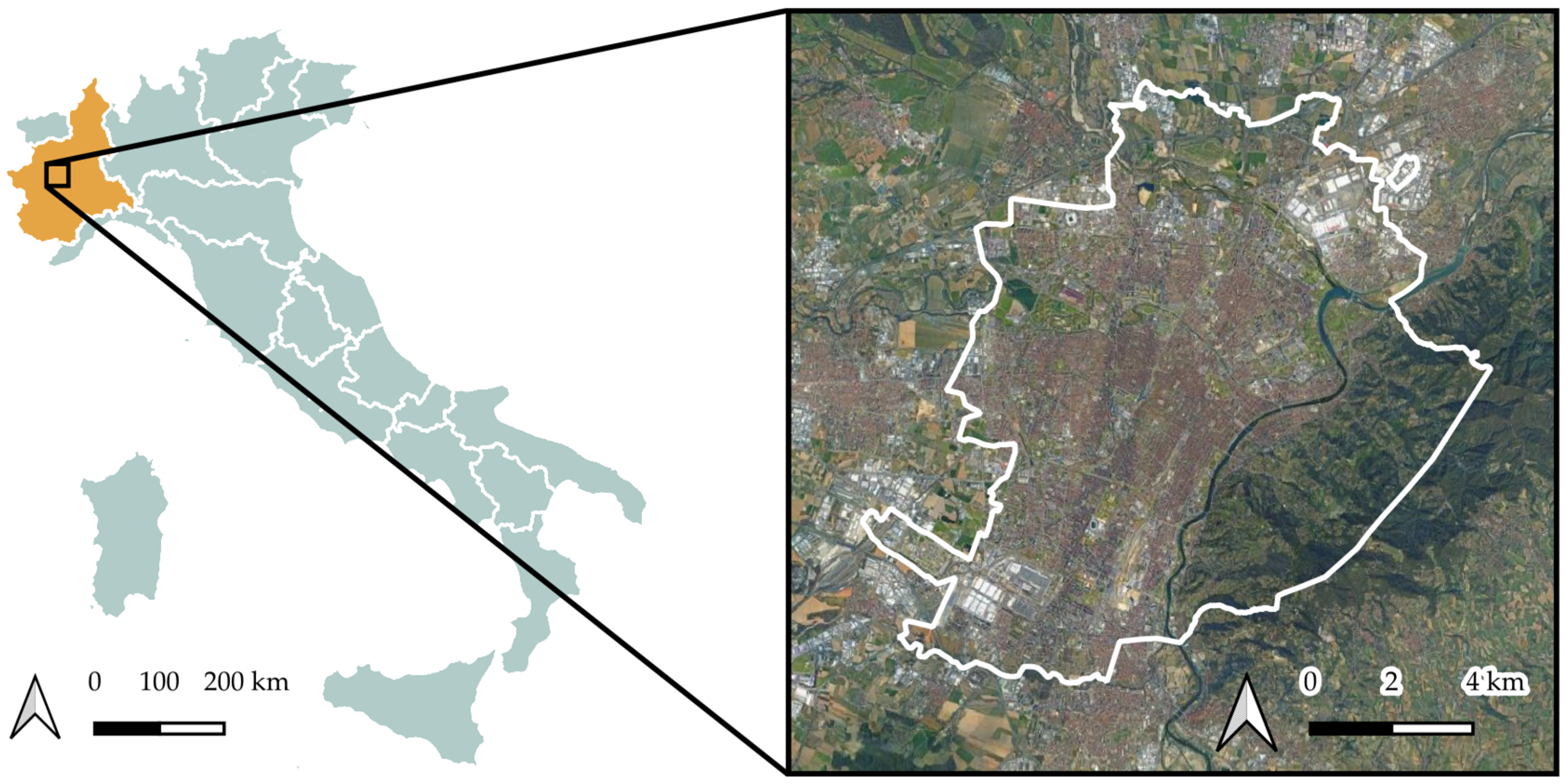
The literature on air pollution in the city of Turin (NW Italy, Figure 1) has primarily focused on health impacts related to pollution, relying on data collected mainly by Public Health Offices and Public Health Laboratories [13,14], the local Environmental Protection Agency [15,16], and existing fixed monitoring stations in the southern [17] or in different parts of the city [18], but also by an open-air laboratory specifically measuring the different PM concentrations in the central part of Turin [19]. In recent years, some studies have investigated pollution as a consequence of the COVID-19 lockdown, primarily based on the significant reduction in road traffic [20]; similar studies examined the use of electric vehicles [21] or the extent to which car-sharing initiatives can reduce air pollutants in Turin [22]. Another work aimed at experimenting some low-cost interventions, acting on the citizens’ behaviours [23]. Furthermore, a more recent study examined how to apply a network of anti-smog cannons (ASC) in the city of Turin to protect the sensitive receptors from severe air pollution episodes through the application of water sprinkling [24].
Current studies of air quality in Turin are based on analytical data obtained from fixed monitoring stations. Differently from the state of the art described by previous studies, the main aim of our work was the use of wearable sensors measuring in continuous the annual concentrations of outdoor air pollutant in Turin.
The sensor employed was the Flow 2 from Plume Labs, whose characteristics have been described previously by a few authors [25,26].
The use of this methodology allowed obtaining a detailed evaluation of how each considered outdoor air pollutants can impact different areas of the city, enabling to localise the most polluted areas as well as to analyse the concentration of different kinds of air pollutants not only of PMs like in several previous works.
The results provided an overview of the main air pollutants over one year of monitoring, allowing for new insights into their relationships with seasonal variations.

2. Materials and Methods

2.1. Low-Cost Sensors

A palm-sized, commercially available wearable sensor was employed for this study. The device (Flow 2, Plume Labs, Paris, France [27]) features openings in its central portion that allow air pollutants to enter via a small electric fan housed inside the sensor.
The investigation was conducted over one year by a team of users who wore the sensors at shoulder height, attaching them to their backpacks during daily walks around the city of Turin. A wide area of the urban environment was covered, measuring the concentrations of selected air pollutants to better evaluate their spatial distribution and impact on the city.
Each sensor is capable of measuring the concentration of the following pollutants: PM1, PM2.5, PM10, NO2, and TVOCs. The device self-calibrates using advanced machine-learning algorithms integrated into the proprietary firmware [28]. According to the manufacturer statement, the device “is at 90 to 95% correlation with static reference monitors in benchmark tests for the core pollutants we measure” [28].
The PM module of the sensor is a laser particle counter based on the physical principle of laser scattering. Such sensors are well-suited for outdoor applications and provide real-time air quality data. Quantitative results are expressed in μg/m3, representing mass per unit volume.
The NO2 module, like the TVOCs module, is based on heated metal oxide technology (a semiconductor metal oxide gas sensor). NO2 concentrations are reported in ppm (parts per million). The TVOCs detector provides a quantitative response to the compound used for calibration, which is not disclosed by the manufacturer. TVOCs results are expressed in ppb (parts per billion, μg/m3) relative to an unspecified reference VOC, likely due to proprietary considerations. As a conventional sum index, TVOCs can be considered a method-dependent parameter in line with analytical chemistry principles.

2.2. Data Analysis

Each measured parameter was recorded at one-minute intervals over the course of one year, and the variation in air pollutant concentrations across the four seasons was subsequently analysed to assess the influence of weather conditions. Data were downloaded as CSV files (originally intended for visualisation via smartphone apps) and processed using a tool developed by an IT consultant. Specifically, the tool—Unicsv 2.0 [29]—is a software application designed to merge measurement data with their corresponding geographic coordinates. It associates the environmental readings collected by the sensing device with the GPS positions generated by a paired smartphone and processes them using a C-language programme to produce a unified CSV output. This preliminary data treatment was necessary to establish an unequivocal link between the recorded concentration of each air pollutant and its corresponding geographic location. Unfortunately, this alignment is not provided by the sensors, representing a significant limitation in the data processing. Once georeferenced, the data could be used to generate specific GIS-based representations for each measured air pollutant.
To achieve this, the open-source software QGIS [30] was employed to process and visualise georeferenced point measurements collected during the monitoring campaign. Each sampling point, associated with precise geographic coordinates, was imported into QGIS as a CSV layer. These data were then used to generate thematic maps representing the concentration levels of each pollutant. The layer was subsequently converted into a shapefile to enable more advanced spatial processing and analysis.
From the georeferenced point data, a regular hexagonal grid (fishnet) with cells measuring 300 m × 300 m was created to cover the urban area of Turin. Pollutant concentration values recorded at the sampling points were spatially associated with the corresponding grid cells using an interpolation method. All spatial operations were conducted using the WGS 84/UTM zone 32 N coordinate reference system. The resulting maps provided a clear and intuitive visualisation of the spatial distribution of atmospheric pollutants across the monitored area, allowing for the analysis of temporal variations on both annual and seasonal scales.
The aim of this work is descriptive and strictly based on the use of GIS and therefore excludes the search for soft modelling-based correlations. The individualised collection of disseminated data, rather than the localised data provided by fixed stations, allows the dissemination of knowledge about the potential for autonomous access for people traveling with their smartphones in an IoT-enabled context.

3. Results

Results of the air pollutants concentrations recording over one-year measuring activities highlight a quite common situation for cities of approximately 850,000 inhabitants such as Turin city, in which the greatest levels are recorded in the most densely populated and trafficked areas.
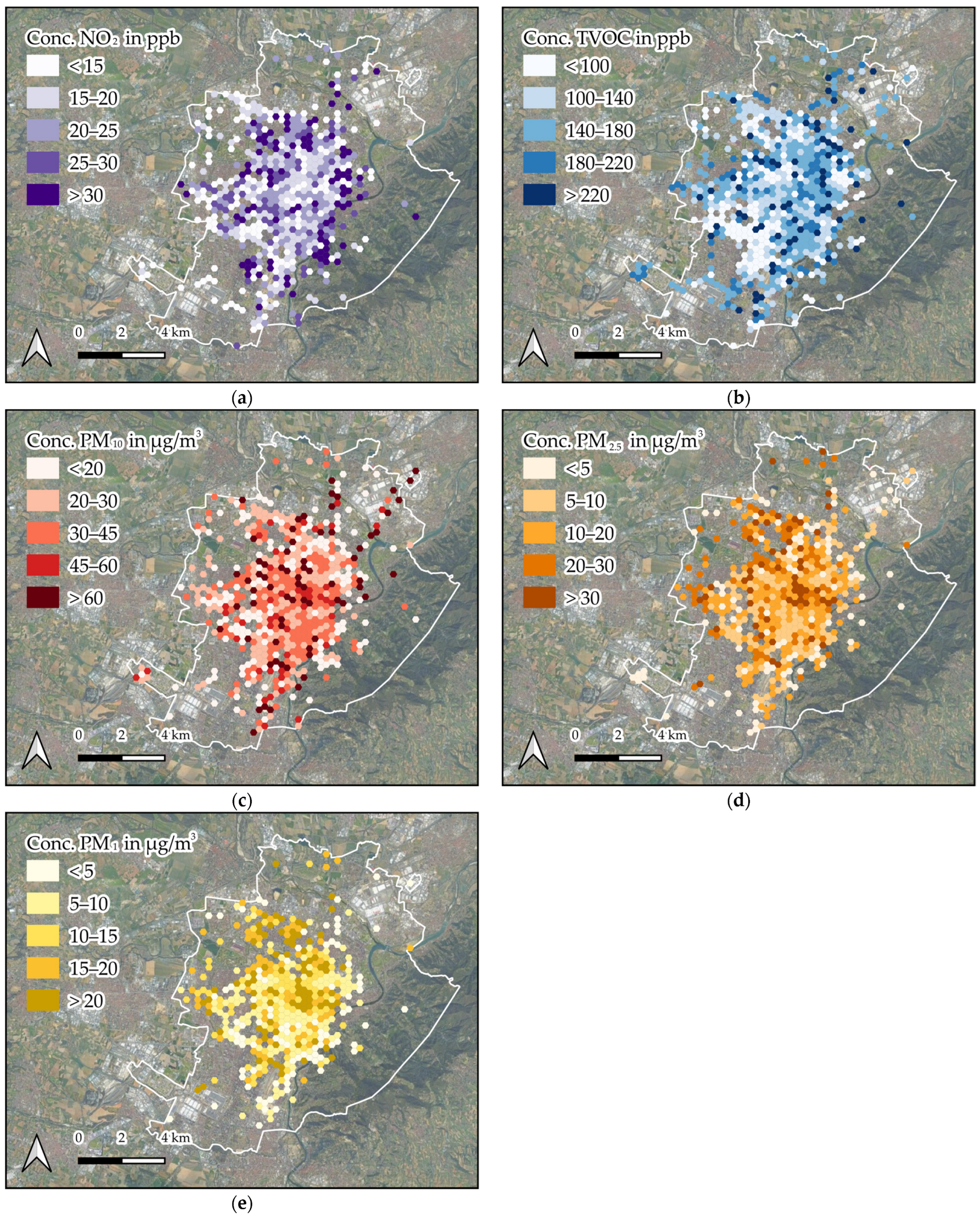
Graphical representation of the concentrations of each air pollutant considered was divided for each month and geolocalised as a first outcome obtained from raw data of this quantitative urban survey. For a more comprehensive visualisation, monthly data were merged to highlight the average annual distribution for each air pollutant (Figure 2).
As shown in Figure 2, PM1 (with values mostly ranging from 15 to >20 μg/m3; Figure 2c) and PM2.5 (with values form 20 to >30 μg/m3; Figure 2d) behave in a similar way with higher concentrations in the centre of the city of Turin and in its N-NW portion. PM10 (Figure 2e) shows a more homogenised distribution of medium to high concentrations ranging from 30 to >60 μg/m3.
A more uneven distribution is instead recorded for NO2, with the highest values (between 25 to >30 ppb; Figure 2a) localised in different parts of the city, especially in the NW and SE sectors. A similar trend is also depicted for TVOCs (Figure 2b), although a well-defined zone in the north-eastern and eastern side of the city centre records medium to high values ranging from 140 to >220 ppb.
Annual trends, as represented in Figure 2, allow for a more general overview of the air pollutant distribution and concentration aimed at understanding what subzones should be monitored more carefully. However, knowing possible seasonal variations can also be of interest to understand what air pollutant, among those investigated, could have the greatest impact in the urban pollution. In this regard, seasonal trends from each investigated air pollutant were also analysed as shown in Figure 3, Figure 4, Figure 5, Figure 6 and Figure 7. These kinds of data visualisation allow observing the contribution of each pollutant to the air pollution and also their different geographical distribution over seasons.
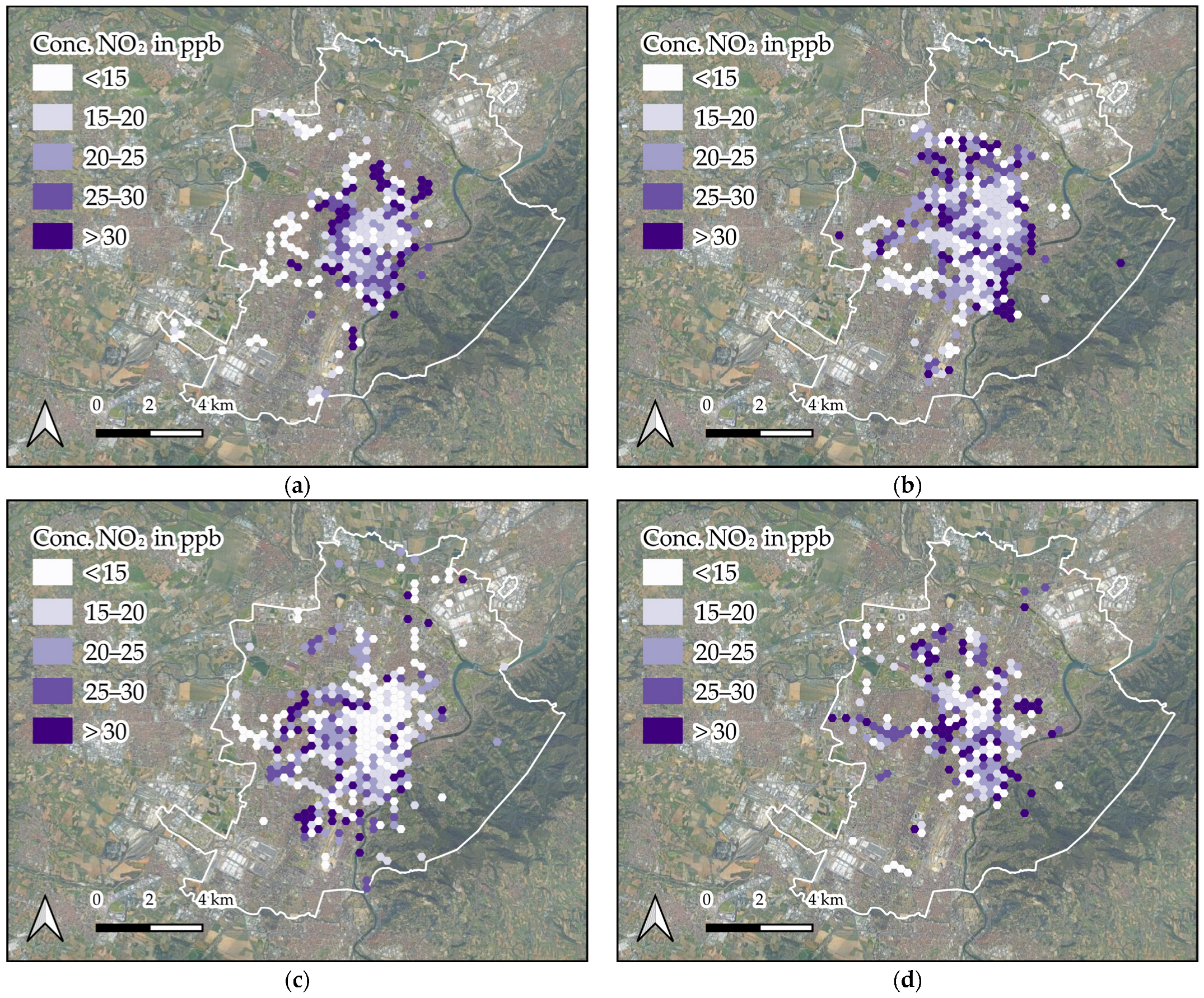
On the whole, looking at the seasonal variations, NO2 (Figure 3) records very different concentrations if compared with the other air pollutants. This is particularly evident in autumn (Figure 3c), which shows the lowest concentrations (<15 ppb), than in other seasons, especially in the north and in the central zones of the city. However, in this case, an uneven distribution is recorded for each season.
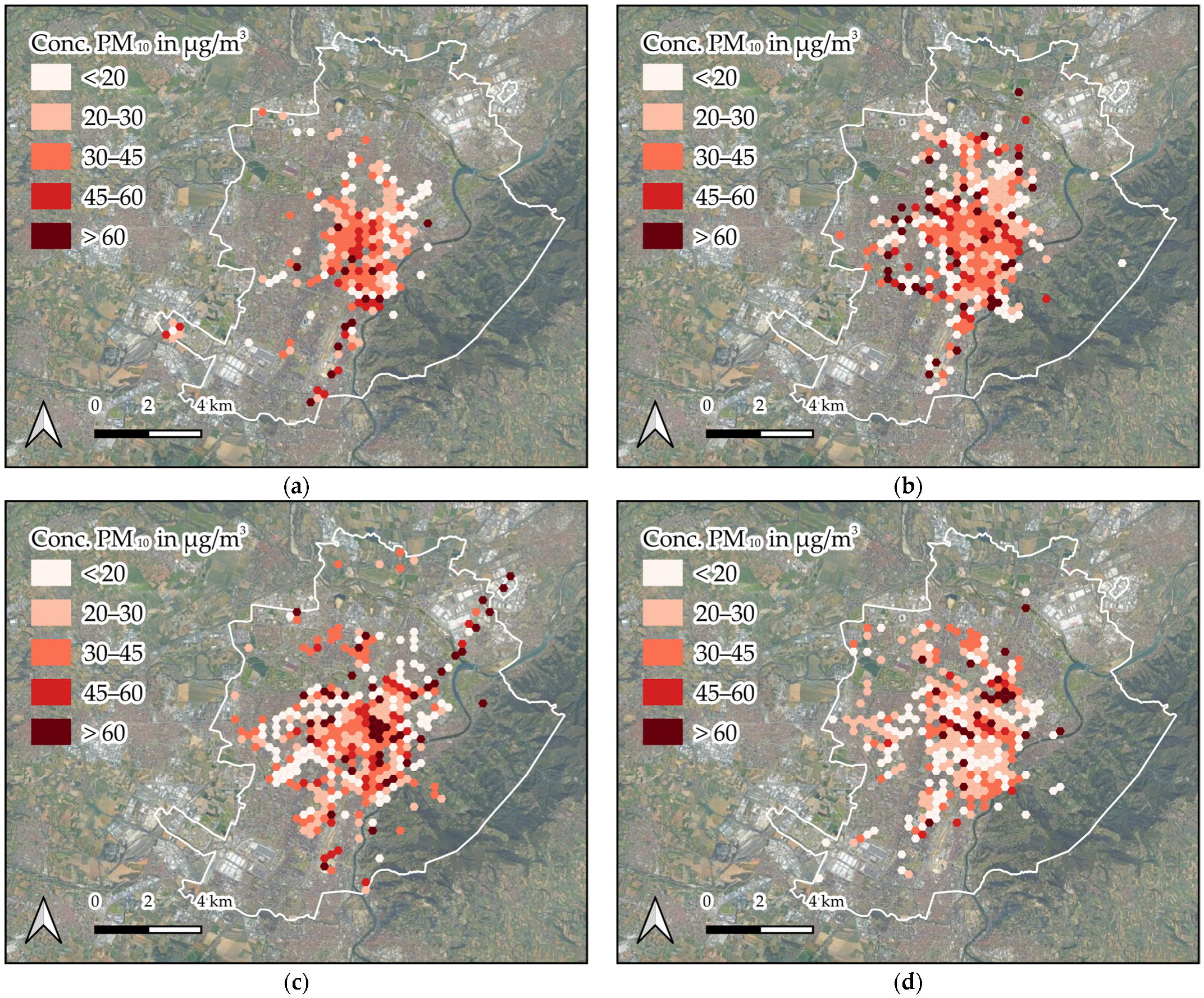
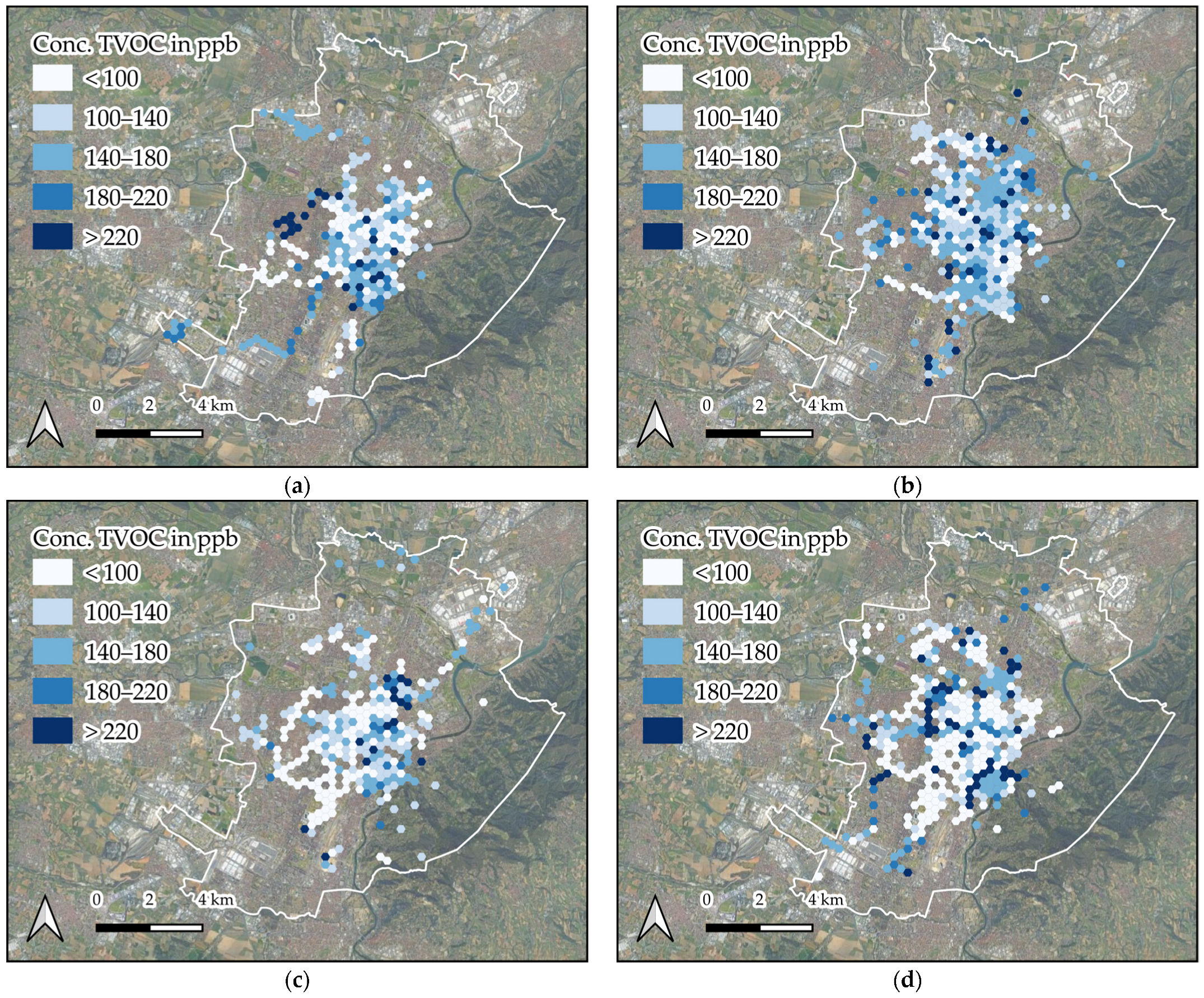
A more homogeneous distribution is represented for TVOCs in Figure 4. In this regard, a greater concentration (in particular, in the range from 140 to 180 ppb) in the summer season is clearly visible. In addition, PM10 displays a uniform distribution, recording higher concentrations (from 30 to >60 μg/m3) in spring, summer, and autumn (Figure 5a–c, respectively) than in winter (Figure 5d).
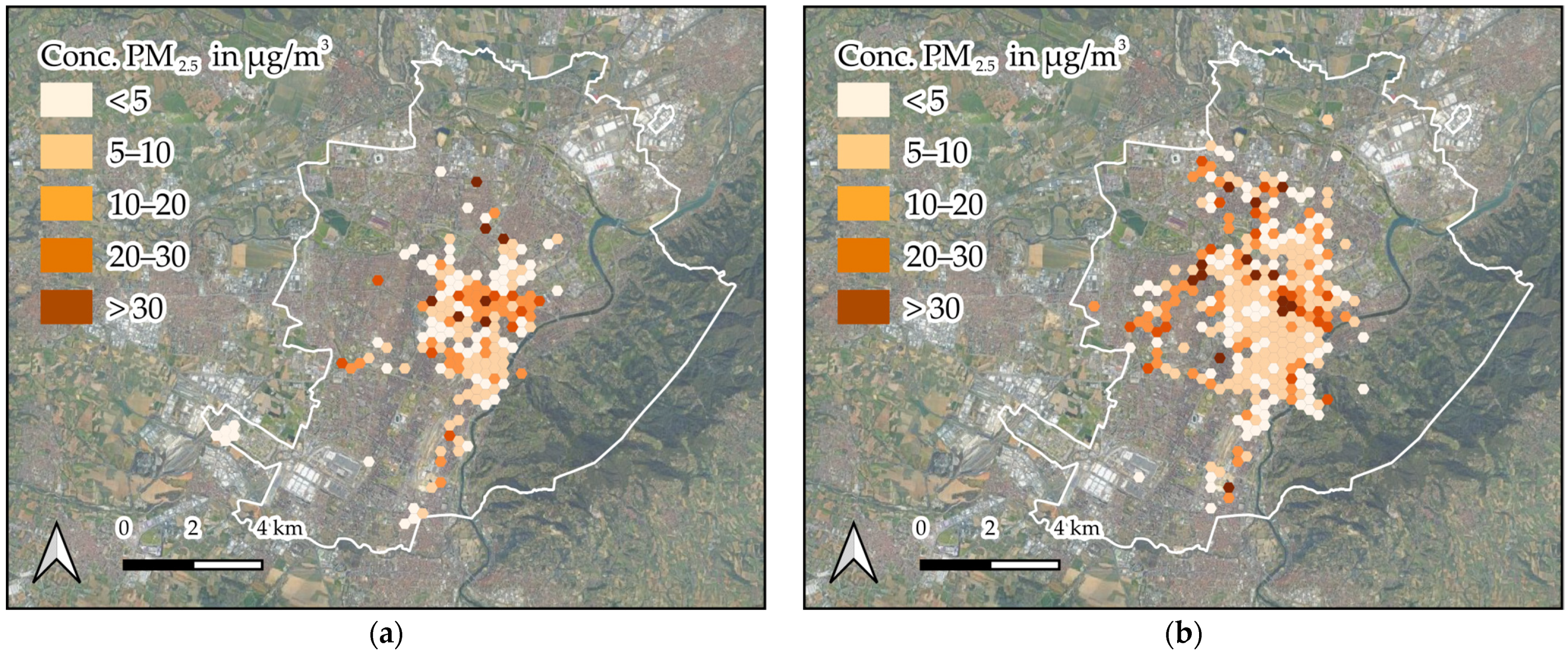
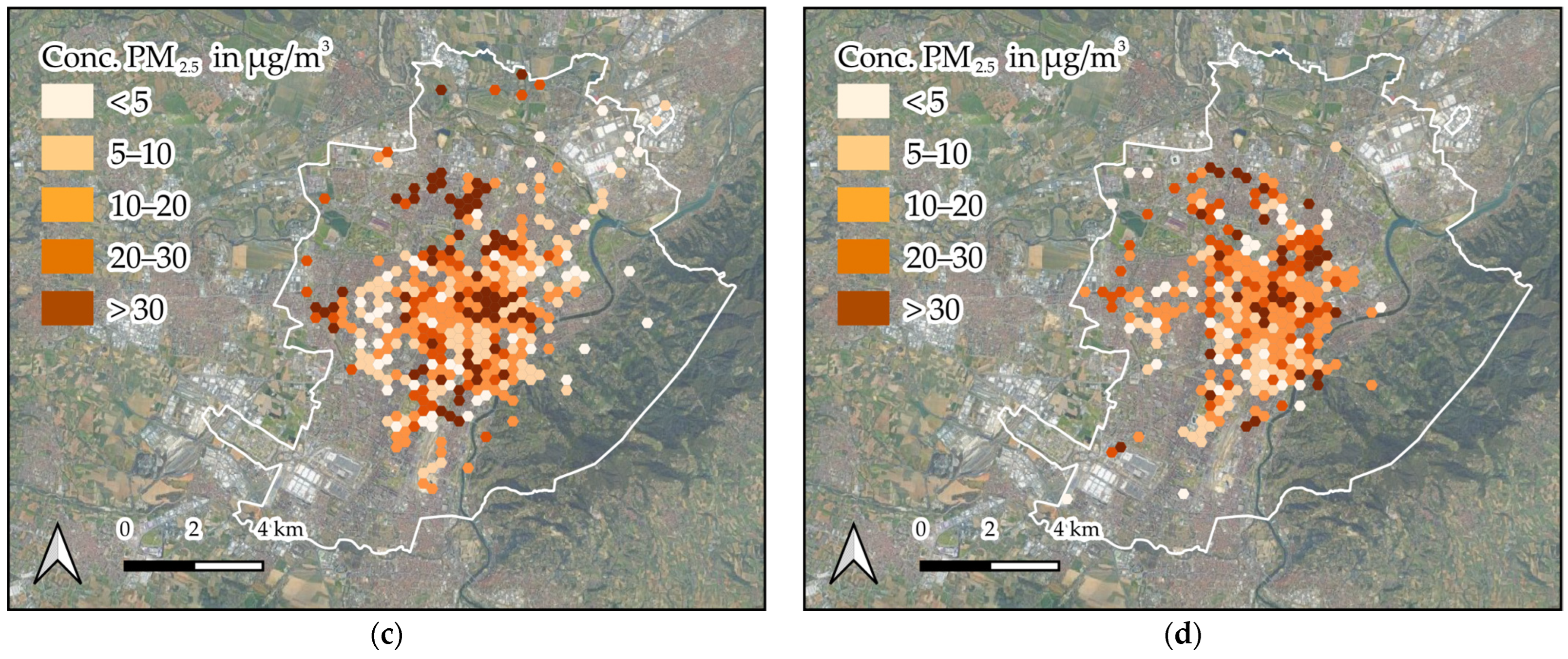
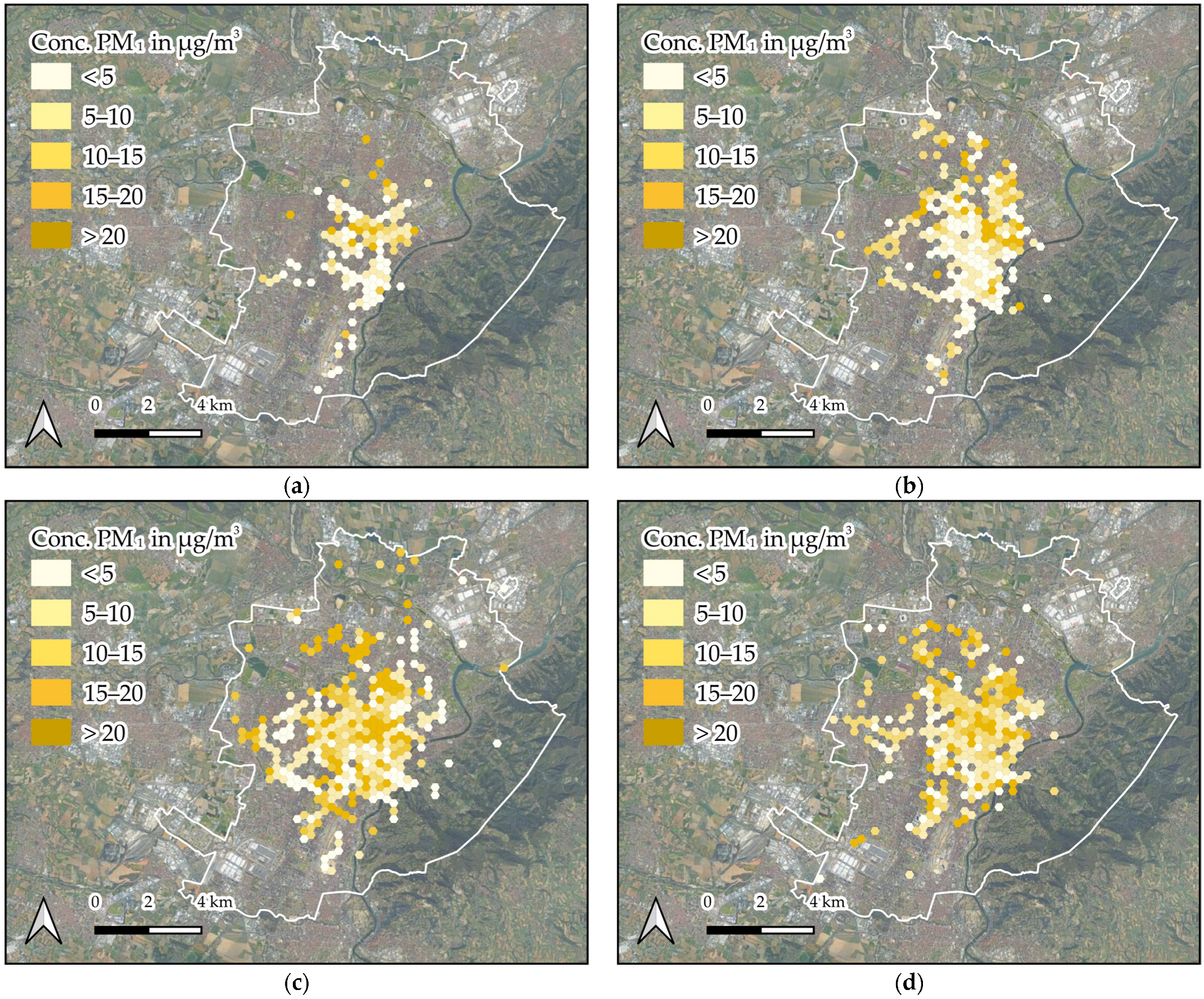
On the other hand, PM2.5 (Figure 6) and PM1 (Figure 7) record similar trends over the four seasons. Both air pollutants show higher values in autumn (Figure 6c and Figure 7c) and in winter (Figure 6d and Figure 7d). These greater concentrations range from 20 to >30 μg/m3 for PM2.5 and from 10 to >20 μg/m3 for PM1.

4. Discussion

The trend of population growth in large cities leads to further expansion of urban centres and associated activities, including the use of heating and cooling systems (both private and industrial) as well as increased vehicular traffic. Specifically, estimates indicate that thermal energy production accounts for approximately half of the world’s total energy consumption, significantly exceeding electricity (20%) and transportation (30%) [31,32,33]. As highlighted by a recent JRC study [34], heating and cooling systems are considered one of the major sources of air pollution. In addition to vehicular traffic, industrial sites can also contribute significantly to air pollution. As reported by the EEA [35], industrial activities release pollutants into the atmosphere, including greenhouse gases (GHGs) and acidifying compounds. Although recent EU regulations have contributed to reduce these emissions, further improvements at multiple levels remain necessary.
Analysis of the annual variations in air pollutant concentrations in the city of Turin, as shown in Figure 2, allows the identification of areas particularly prone to pollutant accumulation. The pattern varies depending on the type of pollutant considered; however, in general, the north-west zone and the urban centre emerge as the most polluted areas. Additionally, the western and south-eastern zones are also characterised by relatively high concentrations of air pollutants. Except for the city centre—where pollution is mainly caused by intense vehicular traffic and numerous space heating and cooling systems due to the presence of many private and public buildings such as schools, universities, administrative offices, banks, hospitals, and shops—other areas require specific considerations. The southern and northern parts of the city show elevated pollutant concentrations due to the presence of various industrial sites. In contrast, the eastern area of the city struggles to disperse pollutants because of a natural barrier formed by a fairly large hill. In any case, except for certain periods and wind directions generally towards the mountain range bordering France, Turin is a poorly ventilated city, and the dispersion of pollutants by atmospheric winds is generally ineffective. This is consistent with the results reported in [36], which show that in poorly ventilated cities, especially those with a roughly squared shape like Turin, air pollutants can remain at pedestrian height for extended periods. This explains why pollutants can be effectively detected by wearable sensors such as those used in this study. According to several studies [37,38,39,40], this approach demonstrates that using sensors equipped with GPS to collect spatio-temporal data during movement provides a more representative overview of actual pollution levels compared with fixed recording stations located at specific sites. Real-time monitoring offers a more reliable acquisition of air pollutant data across the city than single measurements from fixed stations. These observations are also in line with [41], which emphasises the value of wearable sensors in overcoming some limitations of fixed stations, including the inability to account for differences between indoor and outdoor pollution.
Referring to the dataset measured during the city surveys, Table 1 reports the descriptive statistics of the five measured quantities, divided by the four seasons. None of the data populations were normally distributed, so a nonparametric statistical approach was used. MAD is the index that accounts for the environmental variability of the median (expressed in Table 1 as MAD and percentage variability) during each season (net of the contribution to the variability due to measurement uncertainty).
Season- and city-specific trends of pollutant concentrations are observed in many studies, commonly due to local meteorological and orographic conditions, specific impacts of industrial activities (if any), vehicular traffic trends, and heating/cooling needs. Seasonal variability in the various measured parameters is moderate, tending to have a minimum in summer, which is more pronounced for PM2.5 and different for TVOCs.
Concentrations of NO2 are generally high, frequently exceeding the WHO annual threshold of 20 ppb [42]. Road traffic is commonly considered one of the main outdoor sources of NO2 [43,44]. The NO2 concentrations detected in this study also tend to be higher than those recorded by fixed stations in Turin [45,46]. This difference can be explained by the greater density of NO2 relative to air and the fact that fixed stations measure at a higher elevation than wearable sensors, highlighting the added value of the data obtained in this work.
Regarding TVOCs, concentrations in Turin are generally low. However, certain instances show levels exceeding 220 ppb, with higher values typically recorded in spring and summer. In fact, the trend for TVOCs shows a peak in summer, albeit with slight variations (and a low seasonal MAD as deductible from Table 1). In [42], the authors note that meteorological conditions can significantly influence VOCs emissions. Moreover, rising temperatures in recent years may enhance the release of VOCs from materials, while increased sunlight intensity can promote photochemical reactions that generate more ozone and other volatile compounds. In particular, VOCs are caused by both human activities and environmental processes, and the latter (providing biogenic VOCs) can produce more VOCs than those produced by humans. During warm periods, VOC release from plants is intense [47]. The most significant anthropogenic sources of VOCs are low-temperature combustion processes, such as those in vehicle internal combustion engines. In addition, there are industrial activities that use solvents for plant production and/or maintenance. Although a worldwide recognised guideline for the class of VOCs is not yet established, concentrations below 300 ppb are considered low, 300–500 ppb are deemed acceptable, and levels above 500 ppb are regarded as a high concern at a toxicological level.
PM is a typical feature of cities of Turin’s size [19], with its characteristic heating and cooling systems, vehicular traffic, and industrial sites. Specifically, PM2.5 and PM1 (Table 1 and Figure 6 and Figure 7, respectively) show higher concentrations in the autumn and winter seasons, with increases mainly concentrated in the northern and north-western parts of the city, and to a lesser extent in the southern area. This is likely due to the presence of more industrial and agricultural activities in the surrounding countryside, including biomass combustion, as well as domestic heating during the autumn and winter seasons [48,49]. As shown in Table 1, PM10 follows an analogous seasonal trend with respect to PM2.5 and PM1. At a spatio-temporal level (Figure 5), a tendency to exhibit low concentrations of PM10 than expected in winter is observed [49,50]. This might be due to a combination of factors related to weather conditions and human activities. Rising temperatures in spring and summer can promote the formation of ozone and photochemical smog, which contribute to increases in PM concentrations, particularly under conditions of high solar radiation and atmospheric pressure. As also reported in [51], PM10 is positively correlated with high surface temperatures, which can dry out the ground and lift dust particles such as PM10.
Table 2 shows meteorological data related to the city of Turin from 2022 [52,53,54].
The German Federal Environment Agency specifies a daily limit value of 50 μg/m3 for PM10 (coarse particles), which may only be exceeded on 35 days per year [55]. In general, a maximum annual mean value of 40 μg/m3 applies. For the smaller PM2.5 particles, only non-binding target values of 25 μg/m3 are set by the European Union [56] and the WHO [42]. For even smaller particles—although significantly more hazardous—no limit values are currently established. When comparing the data obtained from wearable sensors with those from fixed monitoring stations, it is important to consider that the density of particulate matter depends on its chemical composition; however, in general, PM is denser than air. Based on these physico-chemical characteristics, it is not surprising that, particularly for heavier PMs, higher concentrations are often measured using wearable devices compared to fixed stations [45,46].

5. Conclusions

Effective pollution monitoring requires a holistic approach, considering all environmental compartments—lithosphere, atmosphere, biosphere, and hydrosphere—to ensure better protection of living organisms and more sustainable management of natural resources and waste. Technological advancements have revolutionised the monitoring and management of urban environments, enabling actions aimed at achieving a greener, healthier, and more sustainable future—a challenging but essential goal. Both indoor (homes, workplaces, schools, hospitals, etc.) and outdoor analyses, conducted using evolving and diverse approaches, are fundamental for designing domestic and industrial systems with lower environmental impact. The advent of portable, reliable, and low-cost analytical techniques, made possible by advanced measuring devices, allows the construction of accurate pollution profiles in urban air, thereby supporting research and policies aimed at improving quality of life in cities.
Reliable data on the main pollutants and their sources are the first step in tackling air pollution. Fixed-monitoring stations, often distributed across big cities and surrounding areas, measure air pollutants concentration at specific heights (according to the Directive 2008/50/EC on ambient air quality for Europe, the sampling inlet for fixed-monitoring stations should generally be placed between 1.5 m—the breathing zone—and 4 m above ground; 8 m high is also foreseen in exceptional circumstances, e.g., when the fixed station represents a large area). However, this technology is often costly and requires trained personnel for maintenance and calibration, limiting its accessibility—particularly in disadvantaged communities, which are frequently exposed to the highest pollution levels. The availability of reliable air quality data enables communities and policymakers to develop informed strategies for mitigating pollution. In this context, commercially available, low-cost handheld devices can provide valuable information on the spatial and temporal distribution of key air pollutants. In particular, consumer-grade monitors, as those used in this study, are intended as reliable detectors of pollution variations and peaks. From a personal health perspective, consistent, dependable, and real-time detection of air chemical composition suddenly changing thresholds is on the very top of the priority list.
The findings of this work contribute to understanding how the IoT network gives people the ability to experience cities with an individualised approach, involving the ability to make certain decisions based on the availability of georeferenced data acquired in real-time from wearable sensors on a smartphone app. In particular, these types of studies are unavailable for the city of Turin. Moreover, the obtained results figured out how the use of wearable sensors can provide more realistic outdoor air pollutant concentrations than fixed stations. In fact, they detect values at human height, where the density of the pollutant is different than that at higher heights, such as that measured by fixed stations. In addition, this study demonstrated that the real-time monitoring provided by wearable sensors offers a more reliable situation than single measurements from fixed stations, even if they show the inability to account for differences between indoor and outdoor pollution.
These results are particularly important considering that the aforementioned EU Directive will be replaced by EU Directive 2024/2881 in 2030. With a view to further improvements in air quality, the new EU Directive provides for the lowering of the reference limits. In particular, for PM2.5 and NO2, the limits will go from 25 μg/m3 to 10 μg/m3 and from 40 μg/m3 to 20 μg/m3, respectively. The new EU Directive also introduces new indicators aimed at protecting human health such as the daily limit for both PM2.5 and NO2, complementing the reference to compliance with the annual limit only. This new legislative framework clearly highlights the opportunity and need to measure real-time diffused data at human height using wearable sensors.
A growing research movement seeks to fundamentally revise industrial production processes to align them with the principles of green chemistry [57]. The rational use of environmental resources can promote a more sustainable production paradigm, replacing exploitative approaches of the past. Quantitative determination of atmospheric pollutants, such as those monitored in this study, serves as an important marker of ongoing processes and commonly used products, highlighting areas where reflection and intervention are urgent. In many cases, healthier alternatives already exist, even if they are not yet economically accessible to all markets.

Author Contributions

Conceptualization: J.M.C., E.P. and G.M. Methodology: J.M.C., E.P., V.M., F.F. and G.M. Data curation: J.M.C., V.M. and F.F. Writing—original draft preparation: J.M.C. and E.P. Writing—review and editing: J.M.C., E.P. and V.M. Supervision: E.P. and G.M. Funding acquisition: J.M.C. and G.M. All authors have read and agreed to the published version of the manuscript.

Funding

This research was funded by the Interuniversity Department of Regional and Urban Studies and Planning (Politecnico di Torino and University of Turin), with an internal call named “Bando per l’attribuzione di finanziamenti per l’attività di ricerca nel Dipartimento (Deliberazione del Consiglio di Dipartimento del 29 March 2023)”. Name of the funded project: “Hydrosphere and atmosphere glocal changes”.

Data Availability Statement

The data presented in this study are available on request from the corresponding author due to privacy.

Acknowledgments

The authors thank Alfonso Carlone for his helpful contribution during the preliminary data treatment phase.

Conflicts of Interest

The authors declare no conflicts of interest.

Abbreviations

The following abbreviations are used in this manuscript:
PMParticulate Matter
PMsParticulate Matters
VOCVolatile Organic Compound
TVOCsTotal Volatile Organic Compounds
GISGeographic Information System
WGSWorld Geodetic System
UTMUniversal Transverse Mercator
CSVComma-Separated Values
JRCJoint Research Centre
GHGsGreenhouse Gases
GPSGlobal Positioning System
WHOWorld Health Organization
EEAEuropean Environment Agency
IoTInternet of Things

References

  1. World Health Organization. Available online: https://www.who.int/news/item/25-03-2014-7-million-premature-deaths-annually-linked-to-air-pollution (accessed on 25 September 2025).
  2. World Health Organization. Available online: https://cdn.who.int/media/docs/default-source/air-pollution-documents/air-quality-and-health/aap_bod_results_may2018_final.pdf (accessed on 25 September 2025).
  3. European Environment Agency. Available online: https://www.eea.europa.eu/en/analysis/publications/harm-to-human-health-from-air-pollution-2024 (accessed on 25 September 2025).
  4. European Environment Agency. Available online: https://www.eea.europa.eu/en/newsroom/news/air-pollution-levels-across-europe (accessed on 25 September 2025).
  5. Jutze, G.A.; Tabor, E.C. The Continuous Air Monitoring Program. J. Air Pollut. Control Assoc. 1963, 13, 278–280. [Google Scholar] [CrossRef] [PubMed]
  6. Haddad, H.; de Nazelle, A. The role of personal air pollution sensors and smartphone technology in changing travel behaviour. J. Transp. Health 2018, 11, 230–243. [Google Scholar] [CrossRef]
  7. Karagulian, F.; Gerboles, M.; Barbiere, M.; Kotsev, A.; Lagler, F.; Borowiak, A. Review of Sensors for Air Quality Monitoring; EUR 29826; Publications Office of the European Union: Luxembourg, 2019. [Google Scholar]
  8. Spinelle, L.; Gerboles, M.; Kok, G.; Persijn, S.; Sauerwald, T. Review of Portable and Low-Cost Sensors for the Ambient Air Monitoring of Benzene and Other Volatile Organic Compounds. Sensors 2017, 17, 1520. [Google Scholar] [CrossRef] [PubMed]
  9. Zhang, H.; Srinivasan, R. A Systematic Review of Air Quality Sensors, Guidelines, and Measurement Studies for Indoor Air Quality Management. Sustainability 2020, 12, 9045. [Google Scholar] [CrossRef]
  10. D’Arco, A.; Mancini, T.; Paolozzi, M.C.; Macis, S.; Marcelli, A.; Petrarca, M.; Radica, F.; Tranfo, G.; Lupi, S.; Della Ventura, G. High Sensitivity real-time VOCs monitoring in air through FTIR Spectroscopy using a Multipass Gas Cell Setup. Sensors 2022, 22, 5624. [Google Scholar] [CrossRef]
  11. Salthammer, T. TVOC—Revisited. Environ. Int. 2022, 167, 107440. [Google Scholar] [CrossRef] [PubMed]
  12. Mølhave, L.; Nielsen, G.D. Interpretation and Limitations of the Concept “Total Volatile Organic Compounds” (TVOC) as an Indicator of Human Responses to Exposures of Volatile Organic Compounds (VOC). Indoor Air 1992, 2, 65–77. [Google Scholar] [CrossRef]
  13. Migliaretti, G.; Cadum, E.; Migliore, E.; Cavallo, F. Traffic air pollution and hospital admission for asthma: A case-control approach in a Turin (Italy) population. Int. Arch. Occup. Environ. Health 2005, 78, 164–169. [Google Scholar] [CrossRef]
  14. Marchetti, P.; Miotti, J.; Locatelli, F.; Antonicelli, L.; Baldacci, S.; Battaglia, S.; Bono, R.; Corsico, A.; Gariazzo, C.; Maio, S.; et al. Long-term residential exposure to air pollution and risk of chronic respiratory diseases in Italy: The BIGEPI study. Sci. Total Environ. 2023, 884, 163802. [Google Scholar] [CrossRef]
  15. Bono, R.; Romanazzi, V.; Bellisario, V.; Tassinari, R.; Trucco, G.; Urbino, A.; Cassardo, C.; Siniscalco, C.; Marchetti, P.; Marcon, A. Air pollution, aeroallergenes and admissions to pediatric emergency room for respiratory reasons in Turin, northwestern Italy. BMC Public Health 2016, 16, 722. [Google Scholar] [CrossRef]
  16. Migliaretti, G.; Dalmasso, P.; Gregori, D. Air pollution effects on the respiratory health of the resident adult population in Turin, Italy. Int. J. Environ. Health Res. 2007, 17, 369–379. [Google Scholar] [CrossRef]
  17. Ravina, M.; Caramitti, G.; Panepinto, D.; Zanetti, M. Air quality and photochemical reactions: Analysis of NOx and NO2 concentrations in the urban area of Turin, Italy. Air Qual. Atmos. Health 2022, 15, 541–558. [Google Scholar] [CrossRef]
  18. Mecca, D.; Boanini, C.; Vaccaro, V.; Gallione, D.; Mastomattero, N.; Clerico, M. Spatial variation, temporal evolution, and source direction apportionment of PM1, PM2.5, and PM10: 3-year assessment in Turin (Po Valley). Environ. Monit. Assess. 2024, 196, 1251. [Google Scholar] [CrossRef]
  19. Gallione, D.; Mastromatteo, N.; Clerico, M. Analysis of PM Concentrations in Turin: Annual Trend and Monthly and Daily Mean Concentration. Int. J. Environ. Pollut. Remediat. 2025, 13, 29–35. [Google Scholar] [CrossRef]
  20. Ravina, M.; Esfandabadi, Z.S.; Panepinto, D.; Zanetti, M. Traffic-induced atmospheric pollution during the COVID-19 lockdown: Dispersion modeling based on traffic flow monitoring in Turin, Italy. J. Clean. Prod. 2021, 317, 128425. [Google Scholar] [CrossRef]
  21. Rizza, V.; Torre, M.; Tratzi, P.; Fazzini, P.; Tomassetti, L.; Cozza, V.; Naso, F.; Marcozzi, D.; Petracchini, F. Effects of deployment of electric vehicles on air quality in the urban area of Turin (Italy). J. Environ. Manag. 2021, 297, 113416. [Google Scholar] [CrossRef] [PubMed]
  22. Chicco, A.; Diana, M. Air emissions impacts of modal diversion patterns induced by one-way car sharing: A case study from the city of Turin. Transp. Res. Part D Transp. Environ. 2021, 91, 102685. [Google Scholar] [CrossRef]
  23. Forni, E.; Negro, E.; Carlucci, C.; Nasso, A.; Struppek, M. Actions against air pollution in Turin for a healthy and playable city. Cities Health 2019, 3, 53–58. [Google Scholar] [CrossRef]
  24. Robotto, A.; Bargero, C.; Racca, E.; Brizio, E. Key Elements to Project and Realize a Network of Anti-Smog Cannons (ASC) to Protect Sensitive Receptors from Severe Air Pollution Episodes in Urban Environment. Air 2025, 3, 32. [Google Scholar] [CrossRef]
  25. Crnosija, N.; Zamora, M.L.; Rule, A.M.; Payne-Sturges, D. Laboratory Chamber Evaluation of Flow Air Quality Sensor PM2.5 and PM10 Measurements. Int. J. Environ. Res. Public Health 2022, 19, 7340. [Google Scholar] [CrossRef]
  26. Kattan, I.A.; Al Iftaihat, Y.; El Farag, M.S. The integrity of air pollution data measurements and their legal implications, a case study in Qatar on air pollution of the French company plume labs. Edelweiss Appl. Sci. Technol. 2024, 8, 8892–8906. [Google Scholar] [CrossRef]
  27. Plume Labs. Available online: https://plumelabs.zendesk.com/hc/en-us (accessed on 15 December 2025).
  28. Plume Labs. How Accurate Is Flow? Available online: https://plumelabs.zendesk.com/hc/en-us/articles/360025092554-How-Accurate-is-Flow (accessed on 15 December 2025).
  29. Unicsv 2.0. Available online: https://unicsv20.altervista.org/ (accessed on 12 December 2025).
  30. QGIS Development Team. QGIS Geographic Information System, version 3.40.2; Open Source Geospatial Foundation Project; QGIS Development Team: Zurich, Switzerland, 2025; Available online: https://qgis.org/ (accessed on 25 September 2025).
  31. IEA. Renewables 2020; International Energy Agency: Paris, France, 2020; Available online: https://www.iea.org/reports/renewables-2020/renewable-heat (accessed on 25 September 2025).
  32. IEA. Renewables 2022; International Energy Agency: Paris, France, 2022; Available online: https://www.iea.org/reports/renewables-2022 (accessed on 25 September 2025).
  33. Keiner, D.; Barbosa, L.; Bogdanov, D.; Aghahosseini, A.; Gulagi, A.; Oyewo, S.; Child, M.; Khalili, S.; Breyer, C. Global-Local Heat Demand Development for the Energy Transition Time Frame Up to 2050. Energies 2021, 14, 3814. [Google Scholar] [CrossRef]
  34. Banja, M.; Carlsson, J.; Roca Reina, J.C.; Toleikyte, A.; Monforti-Ferraio, F.; Crippa, M.; Pisoni, E. Air pollution Trends in the Heating and Cooling Sector in the EU-27: A Forward Look to 2030; Publications Office of the European Union: Luxembourg, 2024. [Google Scholar]
  35. EEA. Industrial Pollutant Releases to Air in Europe; European Environment Agency: Copenhagen, Denmark, 2025; Available online: https://www.eea.europa.eu/en/analysis/indicators/industrial-pollutant-releases-to-air (accessed on 25 September 2025).
  36. Zhang, Y.; Fan, Y.; Ge, J. Influences of urban shape on city-scale heat and pollutants dispersion under calm and moderate background wind condition. Build. Environ. 2025, 270, 112530. [Google Scholar] [CrossRef]
  37. Dimitri, G.M.; Parri, L.; Vitanza, E.; Pozzebon, A.; Fort, A.; Mocenni, C. WeAIR: Wearable Swarm Sensors for Air Quality Monitoring to Foster Citizens’ Awareness of Climate Change. Comput. Stand. Interfaces 2025, 94, 104004. [Google Scholar] [CrossRef]
  38. Motlagh, N.H.; Zaidan, M.A.; Fung, P.L.; Lagerspetz, E.; Aula, K.; Varjonen, S.; Siekkinen, M.; Robeiro-Hargrave, A.; Petaja, T.; Matsumi, Y.; et al. Transit pollution exposure monitoring using low-cost wearable sensors. Transp. Res. Part D Transp. Environ. 2021, 98, 102981. [Google Scholar] [CrossRef]
  39. Atzeni, M.; Cappon, G.; Vettoretti, M. Assessing Personal Exposure to Airborne Particulate Matter with Wearable Sensors and Ventilation Rate Models. In Proceedings of the 8th National Congress of Bioengineering, GNB 2023, Padova, Italy, 21–23 June 2023. [Google Scholar]
  40. Wako, W.G.; Clemens, T.; Ogletree, S.; Williams, A.J.; Jepson, R. Validity, reliability and acceptability of wearable sensor devices to monitor personal exposure to air pollution and pollen: A systematic review of mobility based exposure studies. Build. Environ. 2025, 277, 112931. [Google Scholar] [CrossRef]
  41. Cureau, R.J.; Pigliautile, I.; Pisello, A.L. A New Wearable System for Sensing Outdoor Environmental Conditions for Monitoring Hyper-Microclimate. Sensors 2022, 22, 502. [Google Scholar] [CrossRef]
  42. World Health Organization. WHO Global Air Quality Guidelines. Particulate Matter (PM2.5 and PM10), Ozone, Nitrogen Dioxide, Sulfur Dioxide and Carbon Monoxide; WHO European Centre for Environment and Health: Bonn, Germany, 2021. [Google Scholar]
  43. Jarvis, D.J.; Adamkiewicz, G.; Heroux, M.E.; Rapp, R.; Kelly, F.J. Nitrogen dioxide. In WHO Guidelines for Indoor Air Quality: Selected Pollutants; World Health Organization Regional Office for Europe: Copenhagen, Denmark, 2010; pp. 201–248. [Google Scholar]
  44. Anttila, P.; Tuovinen, J.P.; Niemi, J.V. Primary NO2 emissions and their role in the development of NO2 concentrations in a traffic environment. Atmos. Environ. 2011, 45, 986–992. [Google Scholar] [CrossRef]
  45. Regione Piemonte. Aria—Qualità Dell’aria Piemonte [Internet]; Regione Piemonte: Piemonte, Italy; Available online: https://aria.ambiente.piemonte.it/ (accessed on 3 November 2025).
  46. Città di Torino. Qualità Dell’aria a Torino [Internet]; Città di Torino: Torino, Italy; Available online: https://www.comune.torino.it/ambiente/aria/aria_torino/index.shtml (accessed on 3 November 2025).
  47. Bergam, M.; Huang, X.; Baudino, S.; Caissard, J.C.; Dudareva, N. Plant volatile organic compounds: Emission and perception in a changing world. Curr. Opin. Plant Biol. 2025, 85, 102706. [Google Scholar] [CrossRef] [PubMed]
  48. Shi, H.; Cheng, X.; Wang, J.; Li, Z.; Huang, Y. Characteristics and Source Analysis of PM1 in a Typical Steel-Industry City, Southwest China. Atmosphere 2022, 13, 1304. [Google Scholar] [CrossRef]
  49. Das, S.; Roy, A.; Masiwal, R.; Mandal, M.; Popek, R.; Chakraborty, M.; Prasad, D.; Chylinski, F.; Awasthi, A.; Sarkar, A. Comprehensive Analysis of PM1 Composition in the Eastern Indo-Gangetic Basin: A Three-Year Urban Study. Sustainability 2023, 15, 14894. [Google Scholar] [CrossRef]
  50. Chauhan, P.K.; Kumar, A.; Pratap, V.; Singh, A.K. Seasonal characteristics of PM1, PM2.5, and PM10 over Varanasi during 2019–2020. Front. Sustain. Cities 2022, 4, 909351. [Google Scholar] [CrossRef]
  51. Zeb, B.; Ditta, A.; Alam, K.; Sorooshian, A.; Din, B.U.; Iqbal, R.; Rahman, M.H.; Raza, A.; Alwahibi, M.S.; Elshikh, M.S. Wintertime investigation of PM10 concentrations, sources, and relationship with different meteorological parameters. Sci. Rep. 2024, 14, 154. [Google Scholar] [CrossRef] [PubMed]
  52. ARPA Piemonte. Il Clima in Piemonte 2022; ARPA Piemonte Department of Natural and Environmental Risks: Turin, Italy, 2023; Available online: https://www.arpa.piemonte.it/sites/default/files/media/2023-11/anno_2022_solare.pdf (accessed on 21 October 2025).
  53. iLMeteo. Historical Weather Archive [Internet]. Available online: https://www.ilmeteo.it/portale/archivio-meteo (accessed on 21 October 2025).
  54. University of Turin. Meteorological Observatory of the University of Turin, Department of Physics [Internet]. Available online: https://www.meteo.dfg.unito.it/anno-2022# (accessed on 22 October 2025).
  55. Umweltbundesamt. Annual Tabulation—Air Data: PM10 Limit Values; German Federal Environment Agency: Dessau-Roßlau, Germany, 2023; Available online: https://www.umweltbundesamt.de/en/data/air/air-data/annual-tabulation (accessed on 25 September 2025).
  56. European Parliament and Council. Directive 2008/50/EC of the European Parliament and of the Council of 21 May 2008 on Ambient Air Quality and Cleaner Air for Europe; Official Journal of the European Union: Brussels, Belgium, 2008; Available online: https://eur-lex.europa.eu/legal-content/EN/TXT/?uri=CELEX%3A32008L0050 (accessed on 25 September 2025).
  57. Ivanković, A.; Dronjić, A.; Martinović Bevanda, A.; Talić, S. Review of 12 Principles of Green Chemistry in Practice. Int. J. Sustain. Green Energy 2017, 6, 39–48. [Google Scholar] [CrossRef]
Figure 1. Spatial framework of the study area. The location of the city of Turin (in yellow Piedmont region, NW Italy) is shown within the national context. The inset highlights the urban boundaries of Turin. Basemap source: Google Satellite (2025).
Smartcities 09 00007 g001
Figure 2. Georeferenced annual concentration of each air pollutant: (a) NO2 concentration in ppb; (b) TVOC concentration in ppb; (c) PM10 concentration in μg/m3; (d) PM2.5 concentration in μg/m3; (e) PM1 concentration in μg/m3.
Smartcities 09 00007 g002
Figure 3. Seasonal trend of NO2 concentration (expressed in ppb): (a) Spring, (b) Summer, (c) Autumn, (d) Winter.
Smartcities 09 00007 g003
Figure 4. Seasonal trend of TVOC concentration (expressed in ppb): (a) Spring, (b) Summer, (c) Autumn, (d) Winter.
Smartcities 09 00007 g004
Figure 5. Seasonal trend of PM10 concentration (expressed in μg/m3): (a) Spring, (b) Summer, (c) Autumn, (d) Winter.
Smartcities 09 00007 g005
Figure 6. Seasonal trend of PM2.5 concentration (expressed in μg/m3): (a) Spring, (b) Summer, (c) Autumn, (d) Winter.
Smartcities 09 00007 g006aSmartcities 09 00007 g006b
Figure 7. Seasonal trend of PM1 concentration (expressed in μg/m3): (a) Spring, (b) Summer, (c) Autumn, (d) Winter.
Smartcities 09 00007 g007
Table 1. Median values and median absolute deviations (MADs) of NO2 (ppb), TVOCs (ppb), PM10 (μg/m3), PM2.5 (μg/m3), and PM1 (μg/m3) concentrations calculated for spring, summer, autumn, and winter.
PollutantStatistical IndexesSpringSummerAutumnWinter
NO2Median18.017.018.019.0
MAD8.0 (44.4%) (a)7.0 (41.0%)8.0 (44.4%)9.0 (47.4%)
TVOCsMedian163.0167.0158.0159.0
MAD37.0 (22.7%)26.0 (15.6%)41.0 (25.9%)25.0 (15.7%)
PM10Median28.727.834.736.0
MAD17.1 (59.6%)17.6 (61.3%)19.2 (55.3%)18.9 (52.5%)
PM2.5Median19.611.522.230.3
MAD16.2 (82.6%)8.7 (75.6%)17.9 (80.6%)18.4 (60.7%)
PM1Median22.020.021.023.0
MAD13.0 (59.1%)14.0 (70.0%)13.0 (61.9%)13.0 (56.5%)
(a) Percentage variability.
Table 2. Monthly average values of temperature, relative humidity, wind speed, and precipitation (a).
JanFebMarAprMayJunJulAugSepOctNovDec
Temperature [°C]3.26.68.413.019.724.427.125.119.517.09.13.8
Humidity [%]69.360.254.158.067.561.054.859.263.779.976.086.7
Wind speed [km/h]5.97.06.38.67.38.37.97.87.25.25.65.1
Precipitation (b) [mm]1.21.69.610.450.615.036.062.431.045.033.548.3
(a) Data refer to the city of Turin from 2022 [52,53,54]. (b) Monthly cumulative precipitation value.
Disclaimer/Publisher’s Note: The statements, opinions and data contained in all publications are solely those of the individual author(s) and contributor(s) and not of MDPI and/or the editor(s). MDPI and/or the editor(s) disclaim responsibility for any injury to people or property resulting from any ideas, methods, instructions or products referred to in the content.