
Article

Comparative Experimental Performance of an Ayanz Screw-Blade Wind Turbine and a Conventional Three-Blade Turbine Under Urban Gusty Wind Conditions

1
Computer and Electronics Department, Mondragon University, 20500 Mondragon, Spain
2
Mechanics and Industrial Production Department, Mondragon University, 20500 Mondragon, Spain
*
Author to whom correspondence should be addressed.
Smart Cities 2026, 9(1), 11; https://doi.org/10.3390/smartcities9010011
Submission received: 23 October 2025 / Revised: 5 January 2026 / Accepted: 6 January 2026 / Published: 9 January 2026

Highlights

What are the main findings?
  • An effective experiment-driven method is introduced to characterize small wind turbines under wind gust conditions, using specific plots that enable a quantitative yet practical assessment of transient performance and adaptability.
  • Comparative analysis goes beyond a single ideal curve by examining the breadth and stability of the performance plateau across operating conditions, providing a more realistic picture for urban and variable winds.
  • Applying the method suggests that the Ayanz turbine maintains steadier performance over a broader range of operating states and responds more progressively to gusts. In contrast, the three-blade turbine shows higher efficiency when conditions are close to its optimal point.
What is the implication of the main finding?
  • The proposed approach enables a more precise and realistic evaluation of potential energy yield for turbines operating in small-scale, gust-dominated urban environments.
  • Site selection and technology matching can be refined: Ayanz-type rotors are promising for locations with low and fluctuating winds, whereas three-blade rotors suit steadier, less-obstructed sites where operation near the aerodynamic optimum is more frequent.

Abstract

To address the scientific gap concerning optimal urban wind turbine morphology, this work presents an experimental performance comparison between two small-scale wind turbine designs: a conventional three-blade horizontal-axis wind turbine (HAWT) and a duct-equipped Ayanz-inspired screw-blade turbine. Both configurations were tested in a controlled wind tunnel under steady and transient wind conditions, including synthetic gusts designed to emulate urban wind patterns. The analysis focuses on power output, aerodynamic efficiency (via the power coefficient C P ), dynamic responsiveness, and integration suitability. A key novelty of this study lies in the full-scale experimental comparison between a non-conventional Ayanz screw-blade turbine and a standard three-blade turbine, since experimental data contrasting these two geometries under both steady and gusty urban wind conditions are extremely scarce in the literature. Results show that while the three-blade turbine achieves a higher C P   peak and greater efficiency near its optimal operating point, the Ayanz turbine exhibits a broader performance plateau and better self-starting behavior under low and fluctuating wind conditions. The Ayanz model also demonstrated smoother power build-up and higher energy capture under specific gust scenarios, especially when wind speed offsets were low. Furthermore, a methodological contribution is made by comparing the C P   vs. tip speed ratio λ curves at multiple wind speeds, providing a novel framework (plateau width analysis) for realistically assessing turbine adaptability and robustness to off-design conditions. These findings provide practical insights for selecting turbine types in variable or urban wind environments and contribute to the design of robust small wind energy systems for deployments in cities.

1. Introduction

The increasing global concern about climate change has led to significant attention toward clean energy systems, especially on the local scale. In 2007, CO2 emissions from the worldwide electricity sector were estimated to be 10 billion tons annually, with electricity generation accounting for 33% of total emissions in countries such as the United States in 2018 [1,2]. The building sector accounts for more than 35% of global energy consumption and almost 38% of CO2 emissions if we consider embodied energy [3]. In Europe, according to the EU2050 roadmap, the actual goal is to be neutral about polluting emissions [4] and to reduce by 80% of all the greenhouse gas (GHG) emissions [5] by 2050, driving the need for distributed renewable solutions [6].
While solar photovoltaics have seen massive adoption [7], small wind power systems offer a complementary, continuous generation source—especially valuable during night or cloudy conditions [8]. In fact, wind and solar energy present complementary generation profiles at both daily and seasonal scales, making them ideal for hybridization in distributed energy systems [9].
Wind and solar power technologies remain at the forefront of the global renewable energy transition [10]. In 2020, global wind capacity additions reached 114 GW—over 90% more than the previous year—while solar PV installations increased by approximately 45% compared to the 2017–2019 average [11]. This sustained growth underscores the ongoing need for innovation in both technologies, including the development of compact and efficient wind turbine systems for small-scale or urban applications.
Small wind turbines (SWTs)—defined by IEC 61400 [12]—are increasingly studied for integration in rural microgrids and urban rooftops due to their independence from prevailing wind direction and mechanical simplicity [13]. Recent research in SWT design has explored not only new morphologies, but also historical concepts that could offer viable alternatives. Notably, the screw-blade wind turbines patented in 1606 by Jerónimo de Ayanz y Beaumont have been revisited and experimentally evaluated in recent years [14,15]. These designs included both vertical- and horizontal-axis turbines, with some versions incorporating wind-channeling enclosures to increase efficiency.
The horizontal-axis Ayanz turbine—adapted using modern Archimedes screw blades—is a scientifically relevant geometry that has been extensively studied [16,17,18]. Crucially, this design is characterized as a horizontal-axis drag-type wind turbine, meaning its performance cannot be accurately analyzed by conventional aerodynamic theories like the Blade Element Momentum (BEM) method [19]. This necessity has driven dedicated experimental work, and its performance has been validated through computational fluid dynamics (CFD) simulations and field tests [19,20]. When implemented, optionally enclosed within a cylindrical duct, it demonstrated increased aerodynamic efficiency (up to 90% [21]), improved safety, and a reduced visual and acoustic profile—qualities desirable in urban or low-consistency wind environments [22]. The Ayanz-inspired geometry has been previously identified as a promising turbine topology for locations with low and intermittent wind intensity [14]. Its performance was also evaluated in urban wind scenarios using both simulation and wind tunnel experiments, revealing good adaptability and energy capture capabilities under fluctuating wind inputs [23]. However, research is still underway to determine which small wind turbine morphology will be the best for deployment in urbanized areas [24,25].
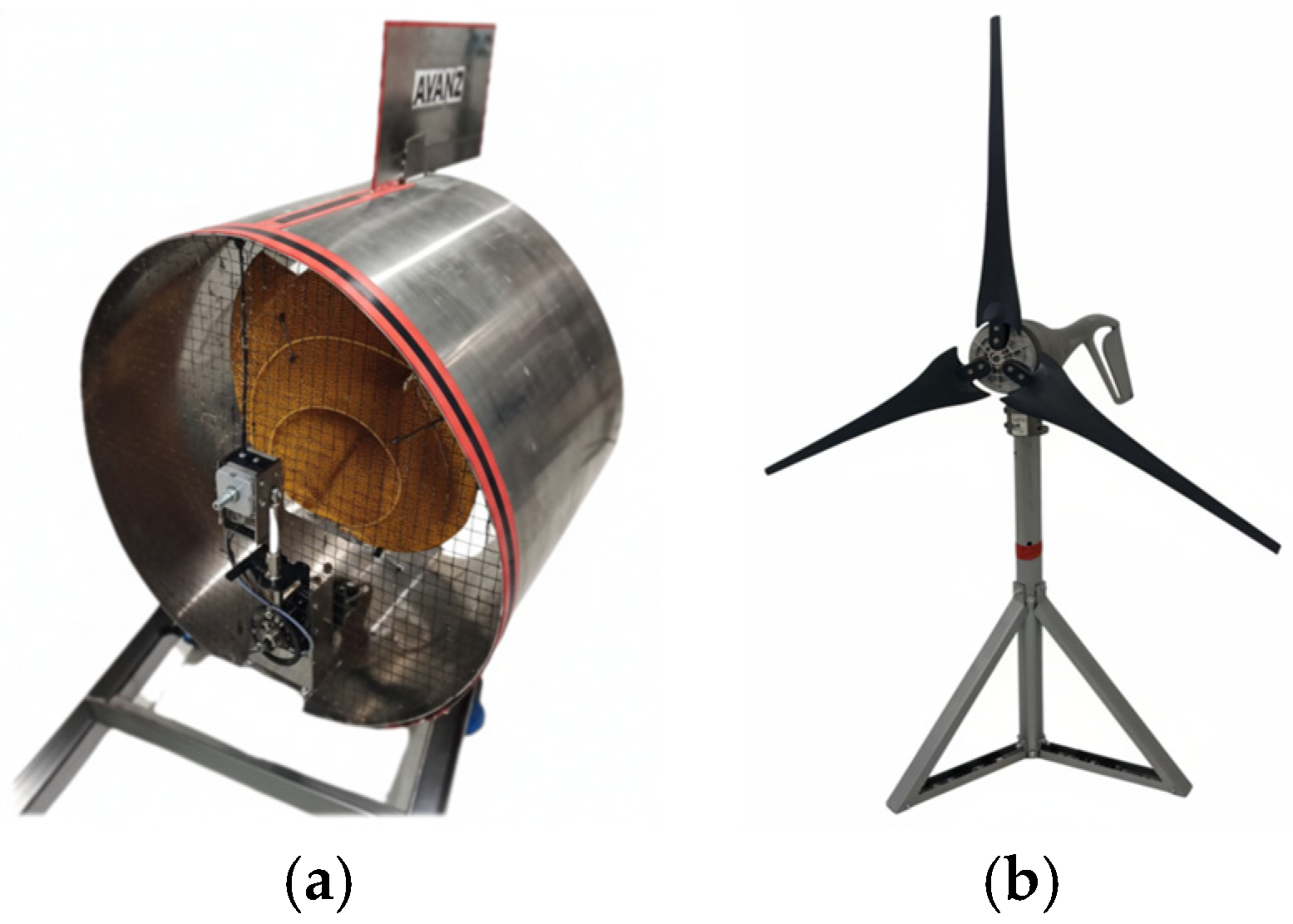
Building upon these insights, the present study conducts an experimental comparison (small-size commercial prototypes) between a conventional three-blade horizontal-axis SWT (Three-blade SWT from here) and an Ayanz-inspired screw-blade turbine (Ayanz SWT from here). Given the challenges of replicating the original historical design with adequate mechanical robustness for experimental testing, the Ayanz SWT model used in this study is based on the commercial Liam F1 AMW-750D-150W [26], combined with a cylindrical enclosure previously evaluated in [21,23]. These configurations (see Figure 1) are tested under both steady-state and transient wind profiles in a controlled wind tunnel environment.
This study aims to experimentally assess the performance of both turbines under steady wind profiles as well as under transient conditions that emulate urban wind gusts—wind bursts characterized by varying amplitude, duration, and initial rotor velocity (offset). The dynamic response of wind turbines to turbulent wind fluctuations has been a core topic in wind energy research for decades [27]. The experimental design allows assessing how each of these factors influences total energy captured during a gust. Furthermore, the study explores whether the turbines can reach or exceed their steady-state power levels during such transients, and how their mechanical inertia affects this ability. The need for this dedicated transient analysis is driven by our own prior work, which highlighted the critical role of rotor inertia in maximizing energy capture under the typical gusty wind profiles found in urban settings [21]. Moreover, despite the growing interest in SWTs, few studies have extensively analyzed their performance in real urban wind conditions [28], particularly concerning their transient aerodynamic response.
The Ayanz-inspired turbine, with its lower moment of inertia and distinct blade geometry, is expected to perform better under short-duration gusts, potentially offering advantages in low and intermittent wind conditions often found in urban environments. Conversely, the Three-blade SWT, characterized by a higher moment of inertia, is anticipated to be more efficient in well-developed wind regimes, but may show reduced responsiveness in brief or rapidly changing gust scenarios.
A key methodological contribution of this work is the detailed analysis of the power coefficient vs. tip speed ratio ( C P   v s .   λ ) curves at multiple wind speeds for each turbine. The wind speed profiles used in this study are inspired by the turbulence and speed characteristics documented in urban wind analyses [29], providing justification for the tested wind speed range. While manufacturers typically provide a single, idealized performance curve, real operating conditions—especially in small-scale systems—can lead to significant variations. The comparative characterization of the plateau width, introduced in Section 3.5, provides a theoretical framework for evaluating each turbine’s sensitivity to deviations from optimal operating points. This analysis serves as a foundation for assessing their real-world performance in variable wind environments.
To validate these hypotheses, the following sections provide a thorough performance assessment of both turbines under controlled steady-state and dynamic wind profiles, followed by a discussion of the implications for small-scale urban deployment. A distinctive contribution of this work is the direct, full-scale comparison between a conventional three-blade SWT and a non-conventional Ayanz screw-blade turbine under identical steady and transient wind profiles, an experimental dataset that is scarcely available in the literature.

2. Wind Tunnel Characterization

The experimental work in this study was conducted under controlled wind conditions created in a controlled wind tunnel facility designed for testing small commercial wind turbines at full scale. Therefore, this section begins with the characterization of the wind source used for turbine testing, following the procedure in [16].

2.1. Internal Structure and Test Configuration of the Wind Tunnel

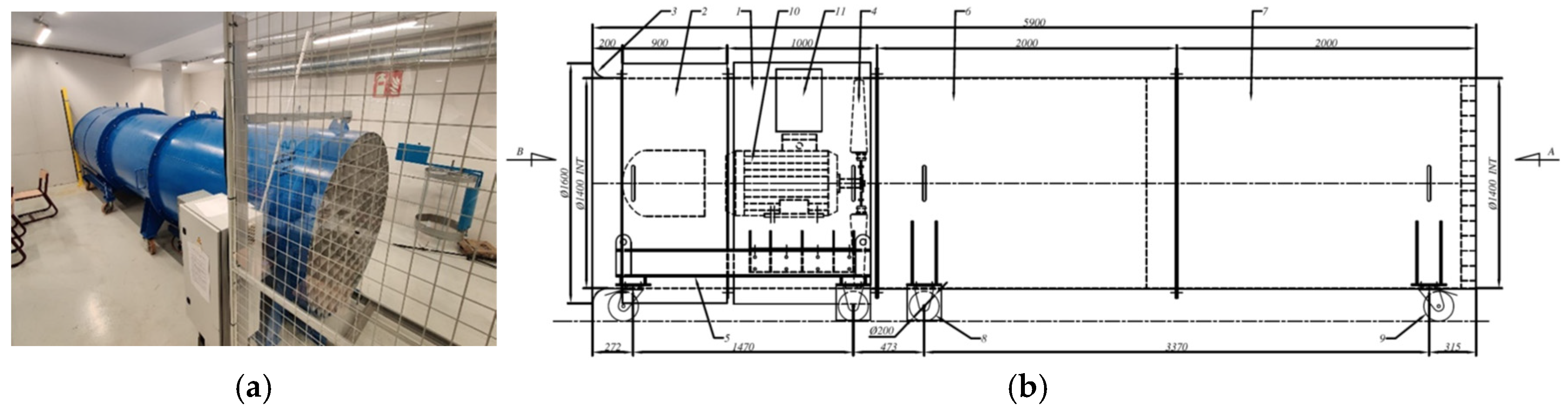
The wind tunnel is equipped with a VPA 1400SP axial fan, manufactured by NLH Industrie (Jouars Pontchartrain, France), and installed at Mondragon Unibertsitatea (see Figure 2). The system includes a single fan directly connected to a 30 kW, 400 V, 50 Hz, four-pole induction motor, controlled via a commercial ABB ACS550 frequency drive (ABB, Zurich, Switzerland). At nominal speed, the system delivers approximately 100,000 m3/h of airflow.
By adjusting the motor speed through the frequency converter, the airflow—and thus the wind speed V w at the tunnel outlet—can be precisely controlled. The wind tunnel also includes a silencer placed immediately downstream of the fan and a metal mesh screen at the outlet to homogenize the airflow and reduce turbulence intensity.
According to the manufacturer, the wind distribution at the tunnel outlet is non-uniform. Specifically, V w is higher and the flow is more laminar near the edges, while lower speeds and increased turbulence occur at the center. Since the tunnel is controlled via frequency input, V w measurements were performed to establish the frequency–velocity relationship.
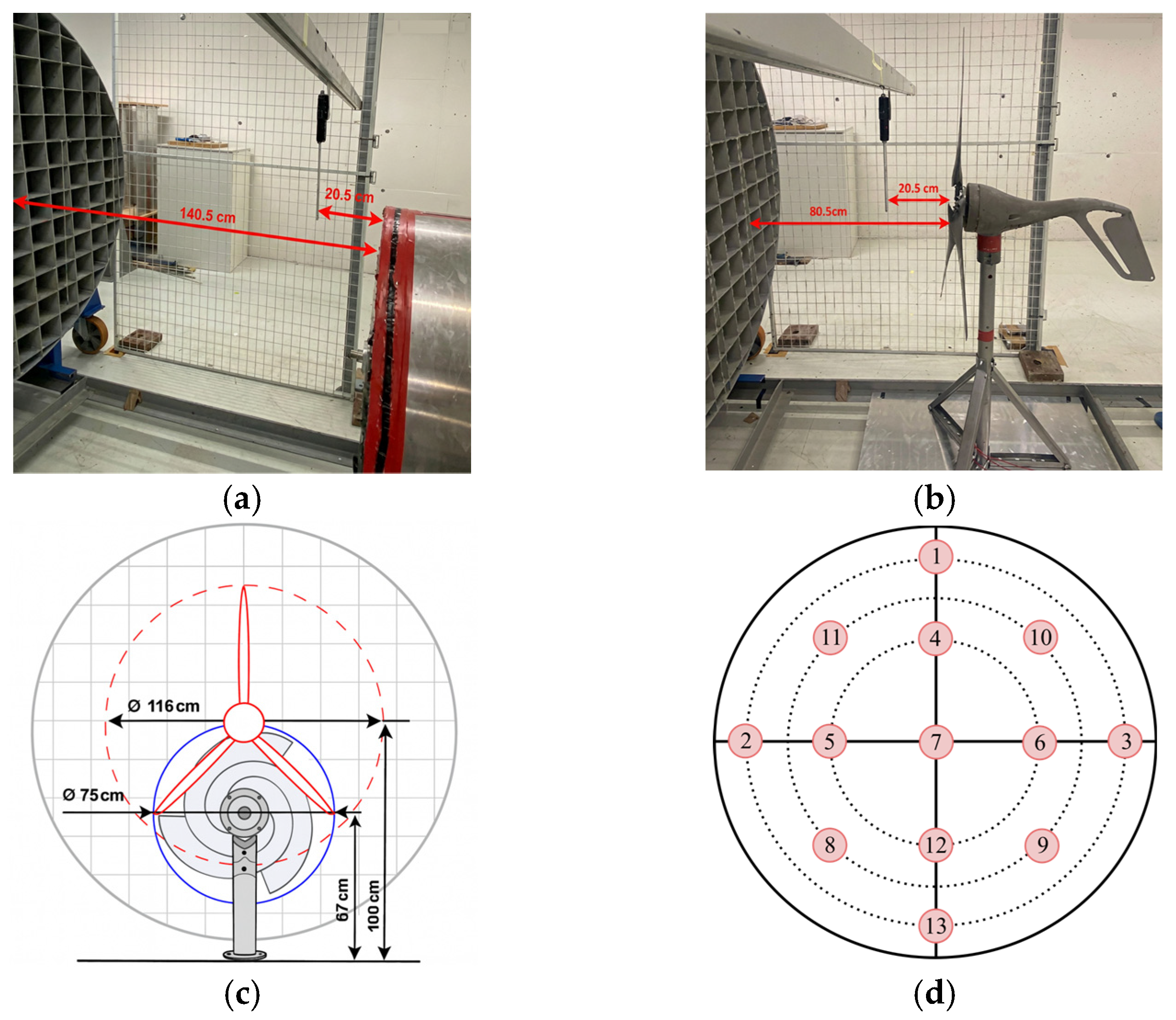
The wind turbines tested in this article are full scale versions of commercially available small-wind turbines. Both devices are prepared to generate electric energy directly from the wind, after a safe and proper location in an urban area for instance. Thus, the testing procedure has been designed for a 1:1 geometrical scaling at the wind tunnel. Hence, the wind turbines are positioned at varying distances from the tunnel outlet based on their specific structural designs. The Ayanz SWT is placed farther away (140.5 cm) than the Three-blade SWT (80.5 cm) (see Figure 3a,b). Additionally, their different rotor radio causes them to be positioned at different vertical heights, relative to the wind tunnel’s center, as shown in Figure 3c. These differences in axial and vertical placement required individual wind profile characterization for each turbine.
V w measurements were taken using a Lufft XA1000 hot-wire anemometer (Lufft, Fellbach, Germany), with an accuracy of ±0.2 m/s and a measurement range up to 20 m/s. The sensor was positioned 20.5 cm from the rotor in both cases, as shown in Figure 3a,b. This means that, for the Three-blade SWT, the sensor was placed closer to the wind tunnel outlet, theoretically measuring a higher V w than in the Ayanz case for the same drive-frequency setpoint. However, due to its more centered axial position, the Three-blade SWT is expected to experience lower mean velocity and higher turbulence intensity.
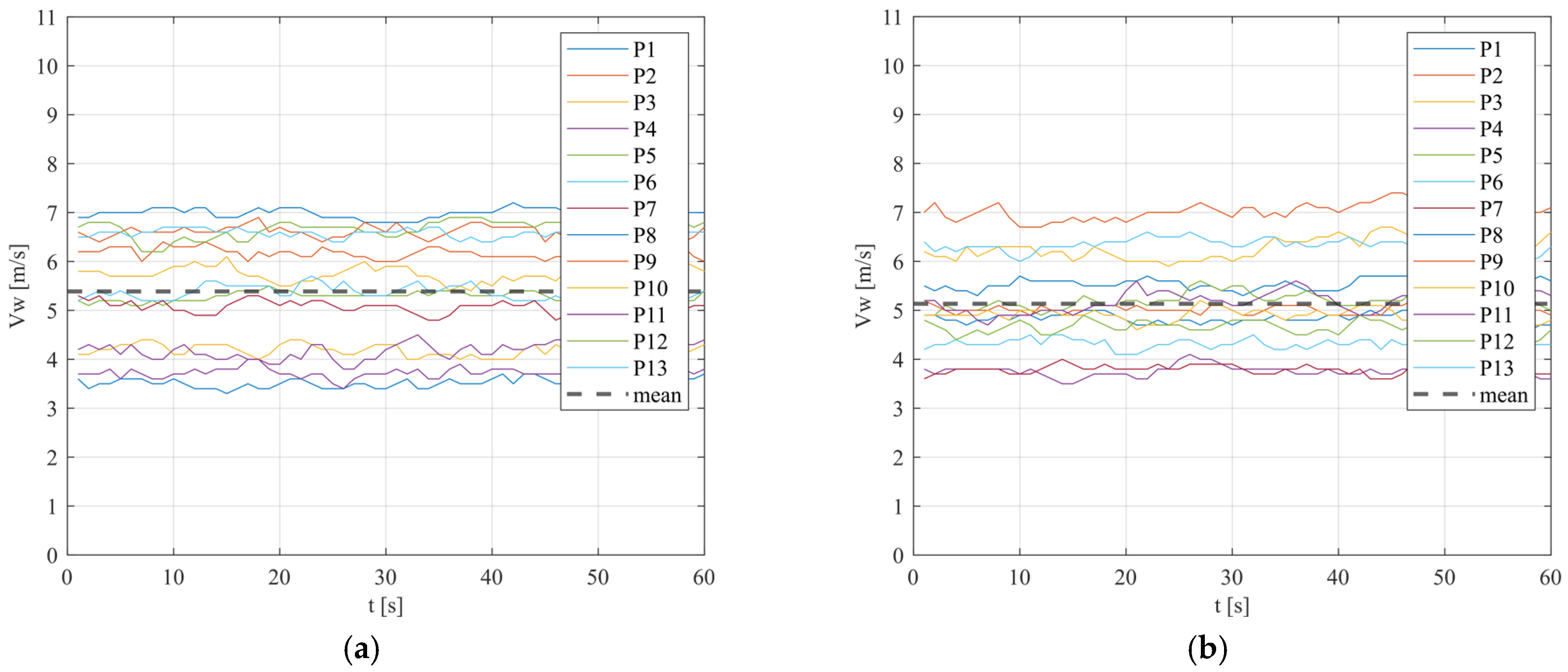
To estimate the actual V w incident on each turbine, measurements were taken at multiple symmetric points across each rotor’s swept area, as depicted in Figure 3d. This enabled calculating a turbine-specific average wind speed V w , m e a n , correlated with each drive frequency setpoint, as the arithmetic mean of all n measurement points across the rotor area (see Figure 3d):
V w , m e a n = 1 n i = 1 n V w ,   i
where V w , i denotes the V w measured at point i . At each measurement location and frequency, V w was sampled every second over a 60 s interval.

2.2. Real Urban Wind Conditions: Justification of the Selected Wind Speeds

To ensure that the wind speed range used in the experimental characterization reflects realistic operating conditions, it is essential to relate the laboratory wind speeds to those typically found in urban environments. Small-scale wind turbines, particularly the ones intended for rooftop installation, are predominantly exposed to low and highly variable wind conditions, especially due to the aerodynamic disturbances introduced by buildings.
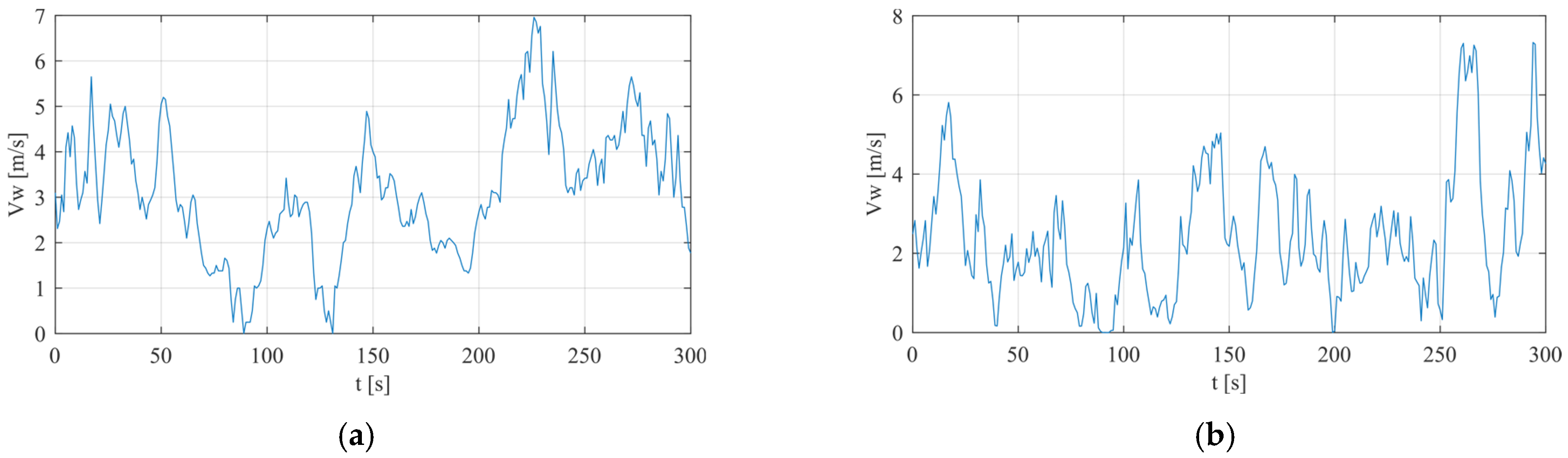
To verify the typical wind levels present in urban environments, many wind measurements were conducted at Mondragon Unibertsitatea using the Lufft XA1000 hot-wire anemometer (Lufft, Fellbach, Germany) installed at the top of the main building. Figure 4 show some representative data of these wind measurements on two different days.
These measurements show that urban wind speeds rarely exceed 5–7 m/s, with frequent periods where values remain in the 2–4 m/s range. Measures were taken on moderate wind days, so higher wind speeds, above 7 m/s, could be observed under certain meteorological conditions.
Based on the measurements, a wind speed range of 4–8 m/s was selected for testing the small-scale turbines, consistently with typical urban winds. The lower limit of 4 m/s corresponds to the turbine’s cut-in speeds, while the upper limit reflects relatively strong gusts. On the next step, the relationship between the tunnel fan frequency and the resulting wind speed was established.

2.3. Experimental Wind Tunnel Characterization

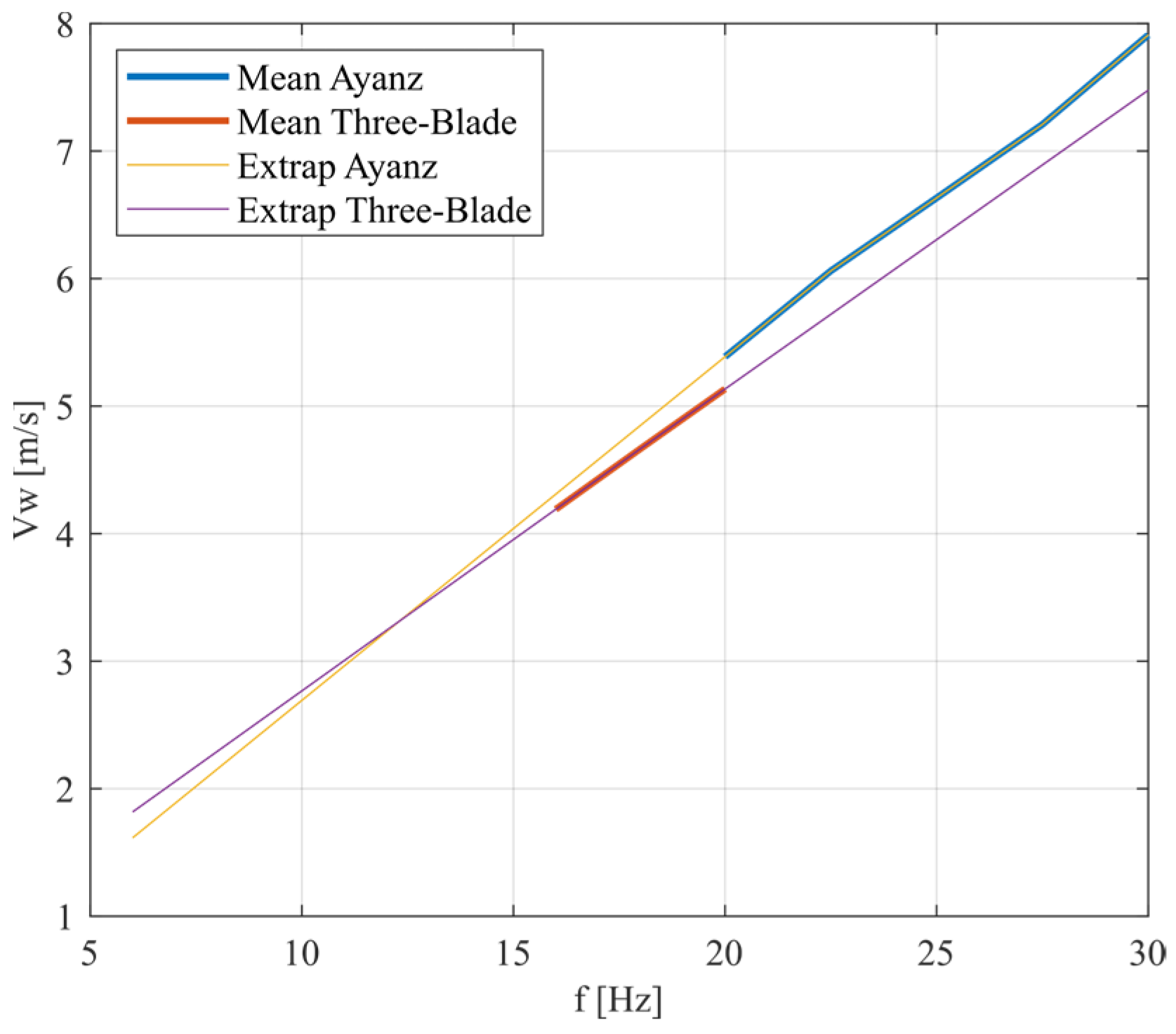
Since the operating points of the two turbines differ (as justified in Chapter 3), V w measurements were conducted at different wind-tunnel fan frequencies specific to each case. To enable direct comparison, however, a common frequency of 20 Hz was applied to both setups. As shown in Figure 5, the V w , m e a n at 20 Hz was 5.3871 m/s for the Ayanz SWT and 5.1341 m/s for the Three-blade SWT, confirming that both turbines experience different wind conditions even at the same fan setting.
Additional measurements were performed at 16 Hz and 18 Hz for the Three-blade SWT, and at 22.5 Hz, 25 Hz, 27.5 Hz, and 30 Hz for the Ayanz SWT. These values were used to establish a frequency– V w relationship for each case. As illustrated in Figure 6, extrapolation of the data confirmed that, for the same frequency values, the Ayanz SWT consistently yields higher values of V w . Detailed results are presented in Table 1.
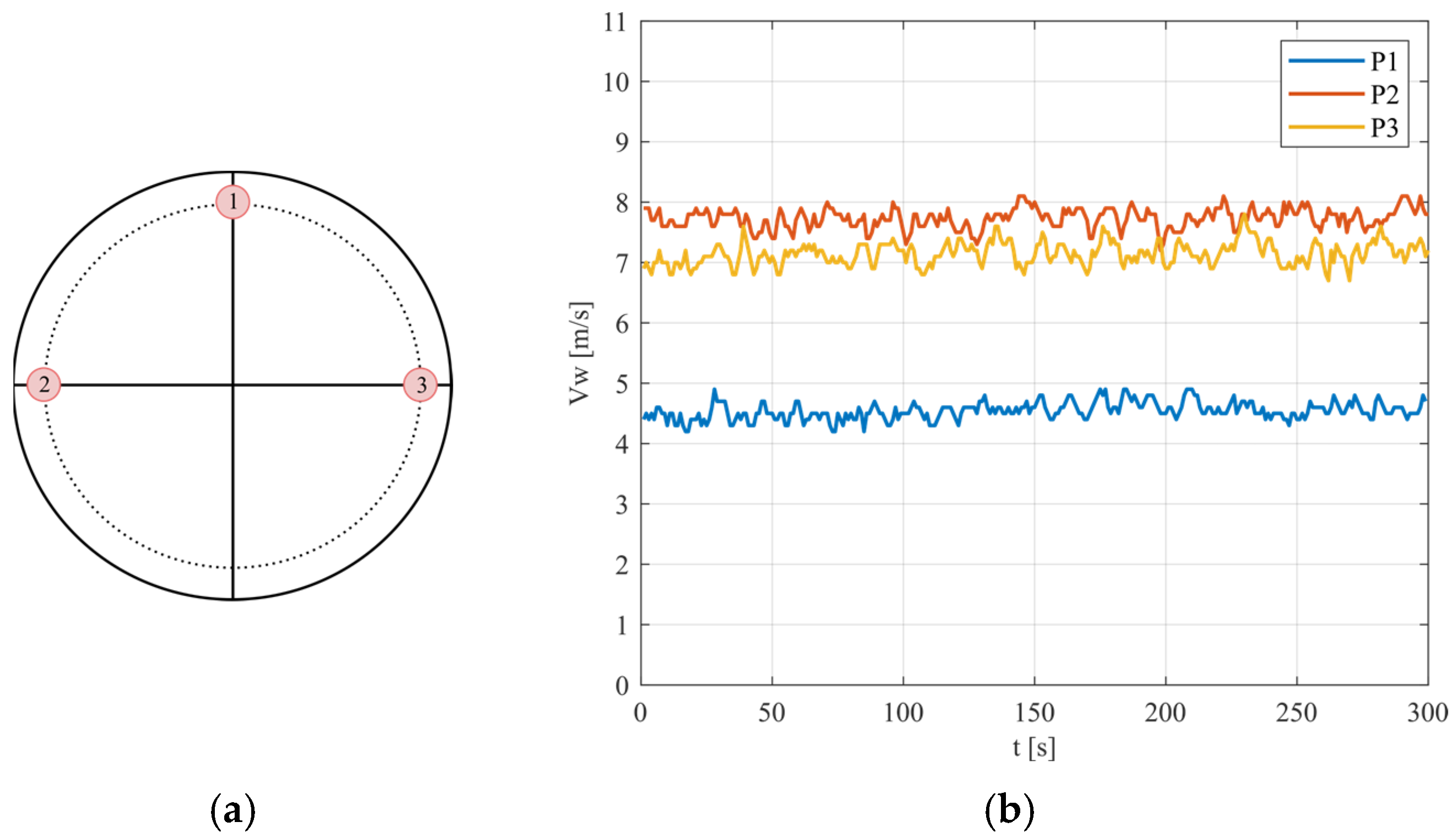
To ensure there are no low-frequency oscillations in turbulent zones, 5 min measurements were taken at three points along the Ayanz configuration. Only high-frequency components were observed, as shown in Figure 7.

3. Wind Turbine Characterization at Constant Wind Speed

This section focuses on the detailed characterization of both the Ayanz SWT and the Three-blade SWT prototypes operating under steady wind conditions. The goal is to quantify the “flatness” or “sharpness” of the peak region in the C P curve, as this feature strongly influences energy production under variable wind, to be analyzed in the following section. Specifically, the aim is to determine which turbine exhibits a broader plateau in its C P curve under static conditions, since a wider plateau is expected to produce higher energy output in fluctuating wind scenarios.

3.1. Electrical Power Circuit and Data Obtaining Process

To accurately assess the steady-state performance of wind turbines, a reliable and consistent electrical measurement setup is essential. This subsection details the power circuit used during testing and describes the procedure for collecting the relevant electrical data.
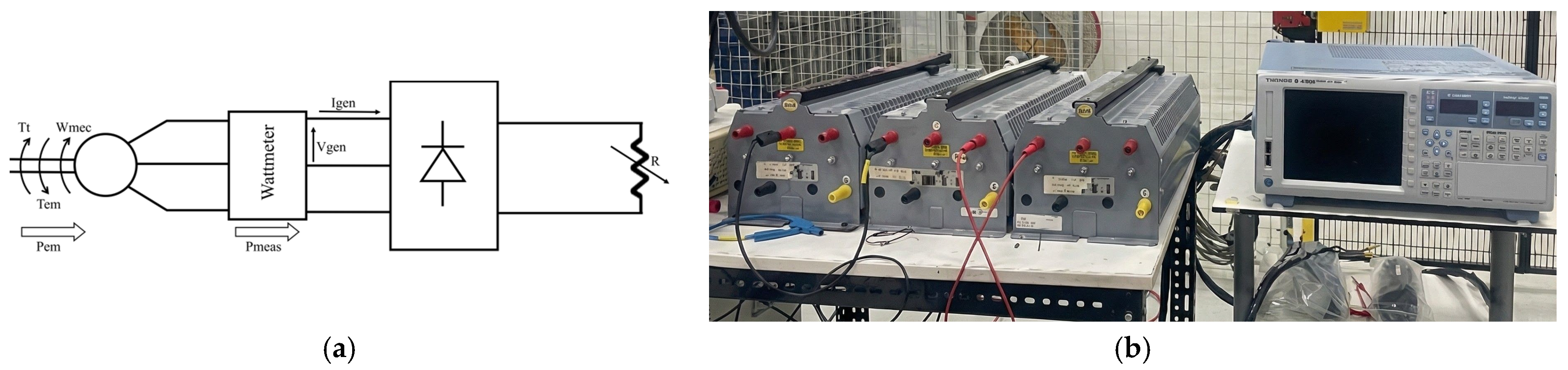
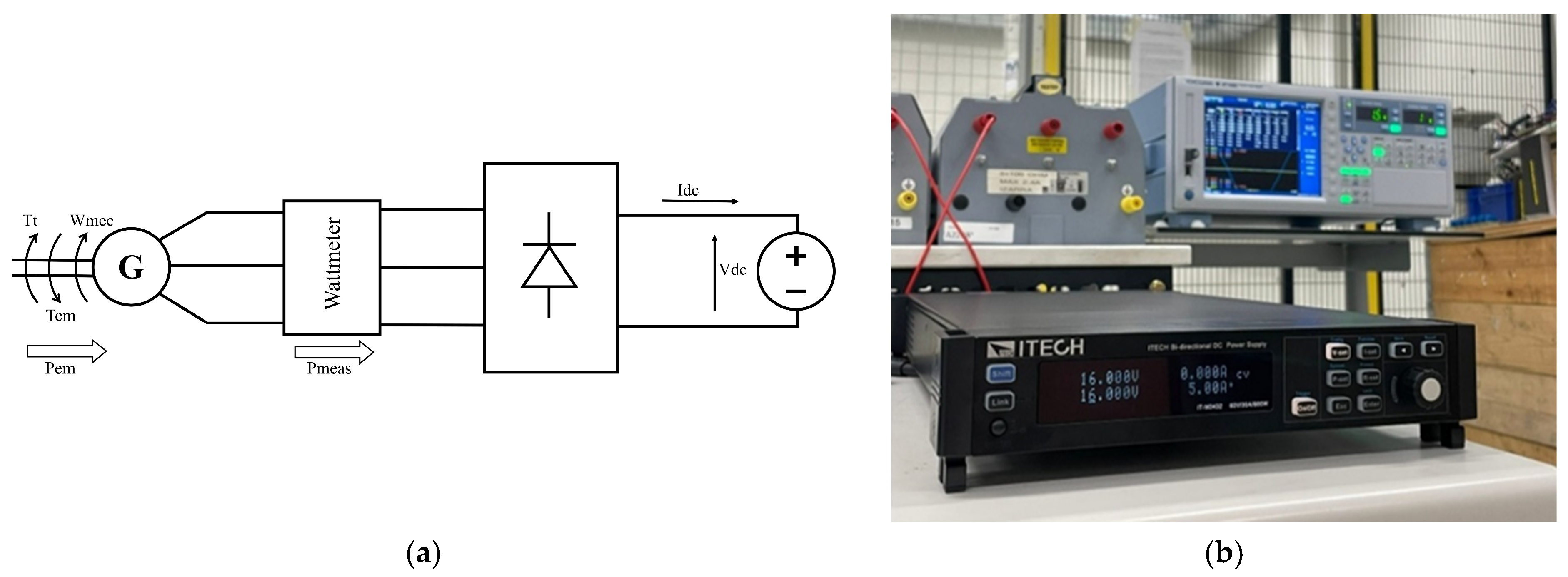
In the experimental setup, the SWT generators produce three-phase AC power, which is rectified using a diode-based bridge (see Figure 8a). A variable resistive load is connected on the DC side to control the torque and, consequently, adjust the turbine’s rotational speed, enabling characterization over a wide range of operating points. To accurately measure the generated power, a Yokogawa WT1806E (Yokogawa, Tokio, Japan) (see Figure 8b) precision power analyzer is connected on the AC side, directly at the generator output. Although the load operates in DC, measuring before rectification eliminates the need to estimate rectification losses, thereby improving the accuracy of the performance data.
Measurements were taken at several fixed V w values, collecting a wide set of data points by adjusting the turbine’s rotational speed. Since both generators are Permanent Magnet Synchronous Machines (PMSMs), the turbine’s mechanical speed ω m e c was derived from the measured electrical frequency f using:
ω m e c = 2 π · f p
where p is the number of pole pairs.
In this study, the mechanical power P m e c is considered equal to the electromagnetic power P e m , as iron and friction losses are neglected. To estimate P e m , Joule losses in the stator windings P l o s s were calculated using the measured current I R M S and known stator resistance R s , and added to the measured electrical power P m e a s as follows:
P l o s s = 3 · R s · I R M S 2
P e m = P m e a s + P l o s s
Finally, the C P and the λ were calculated from:
λ = R · ω m e c V w
C P = P e m 1 2 · ρ · A · V w 3

3.2. Electrical Characterization

To characterize the electrical properties of the wind turbine generators, two key parameters were measured: R s and p .
The R s was measured using a Chauvin Arnoux CA6250 precision micro-ohmmeter (Chauvin Arnoux, Paris, France) to minimize the influence of lead and contact resistances, ensuring accurate results. Measurements were taken at ambient temperature and repeated to confirm repeatability. Resistance was measured between two phases and then divided by two to obtain the per-phase value. This parameter is essential for modeling electrical losses and evaluating generator efficiency under load. The measured R s values and their average are shown in Table 2.
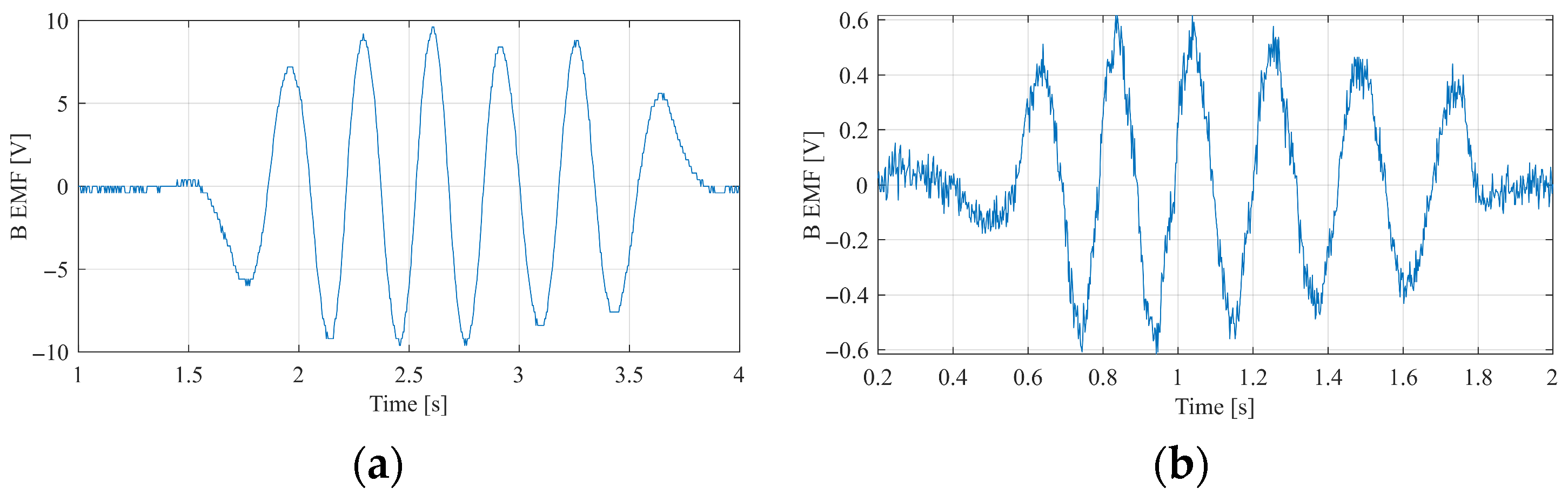
To determine the number of p , a mechanical–electrical correlation method was used. A complete mechanical revolution of the turbine rotor was performed manually, while the open-circuit back-EMF waveform of one output phase was observed on an oscilloscope. The test was performed with the generator unloaded to minimize waveform distortion.
The number of sinusoidal cycles in the back-EMF waveform during one mechanical revolution corresponds to the number of electrical cycles, i.e., the number of magnetic p . As shown in Figure 9, six full-voltage cycles were observed, indicating that both generators have 6 p (12 poles in total).
The stator phase inductance L s is not used in modelling, but, as it is a crucial machine parameter, it is worth knowing. Therefore, it has been measured using a Fluke PM6304 (Fluke, Everett, WA, USA).

3.3. Ayanz SWT Characterization

The experimental analysis started with the characterization of the Ayanz wind turbine. Table 3 summarizes its key geometrical and electrical parameters.
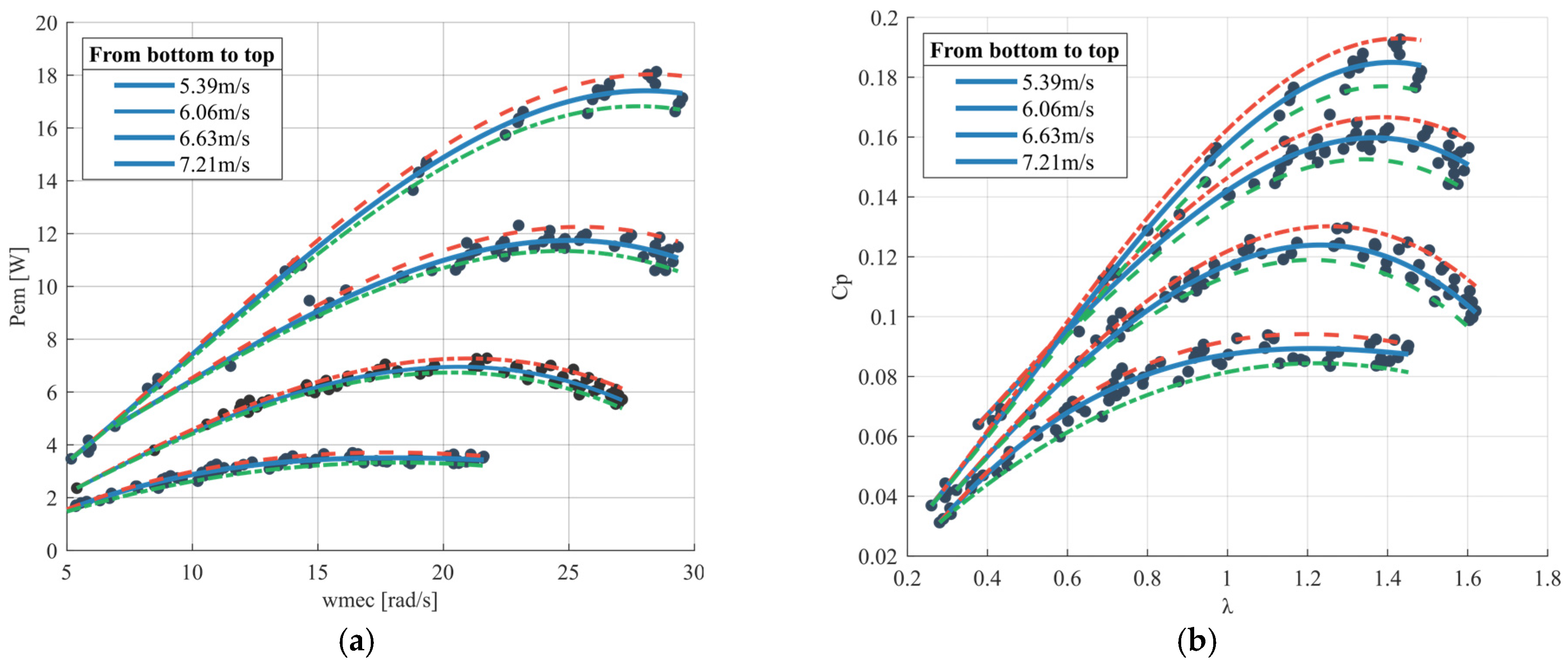
To evaluate its performance under different operating conditions, the turbine was tested at four V w : 5.39 m/s, 6.06 m/s, 6.63 m/s, and 7.21 m/s, to construct its P e m   v s .   ω m e c curves as the basis for calculating the C P   v s .   λ performance. Two main conclusions were drawn from the analysis. First, above approximately 6.6 m/s, the generator reached its voltage saturation point, limiting the rotational speed to around 29 rad/s and the voltage to approximately 70 VDC (or 49.5 VAC rms). Therefore, the tested V w were chosen to remain below this electrical limit while ensuring sufficient output power at the lower end.
Second, a noticeable dispersion was observed in the experimental data (explained in Appendix A), resulting in a cloud-like spread in the P e m   v s .   ω m e c and C P   v s . λ graphs. To represent this variability, three fitted curves were generated: one for the average (blue) and two for the upper (red) and lower (green) bounds, as shown in Figure 10.
Finally, Table 4 presents the maximum C P values obtained from the fitted curves for each tested V w .

3.4. Three-Blade SWT Characterization

Continuing with the Three-blade wind turbine, its main electrical and mechanical parameters are summarized in Table 5.
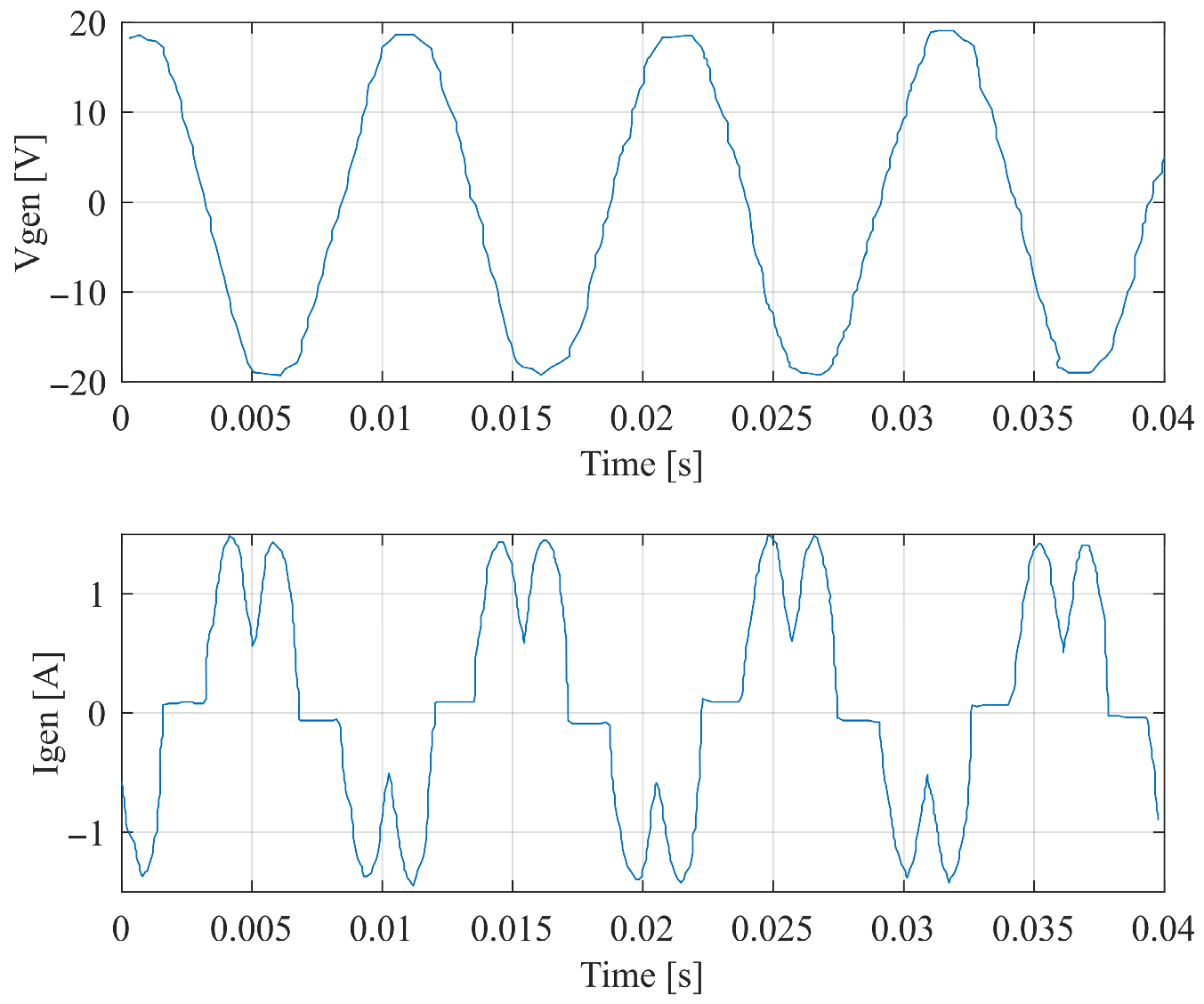
As a preliminary step, voltage and current waveforms were recorded at a steady operating point to evaluate the turbine’s performance and the system’s power quality, as this turbine had not been previously tested. The results are shown in Figure 11.
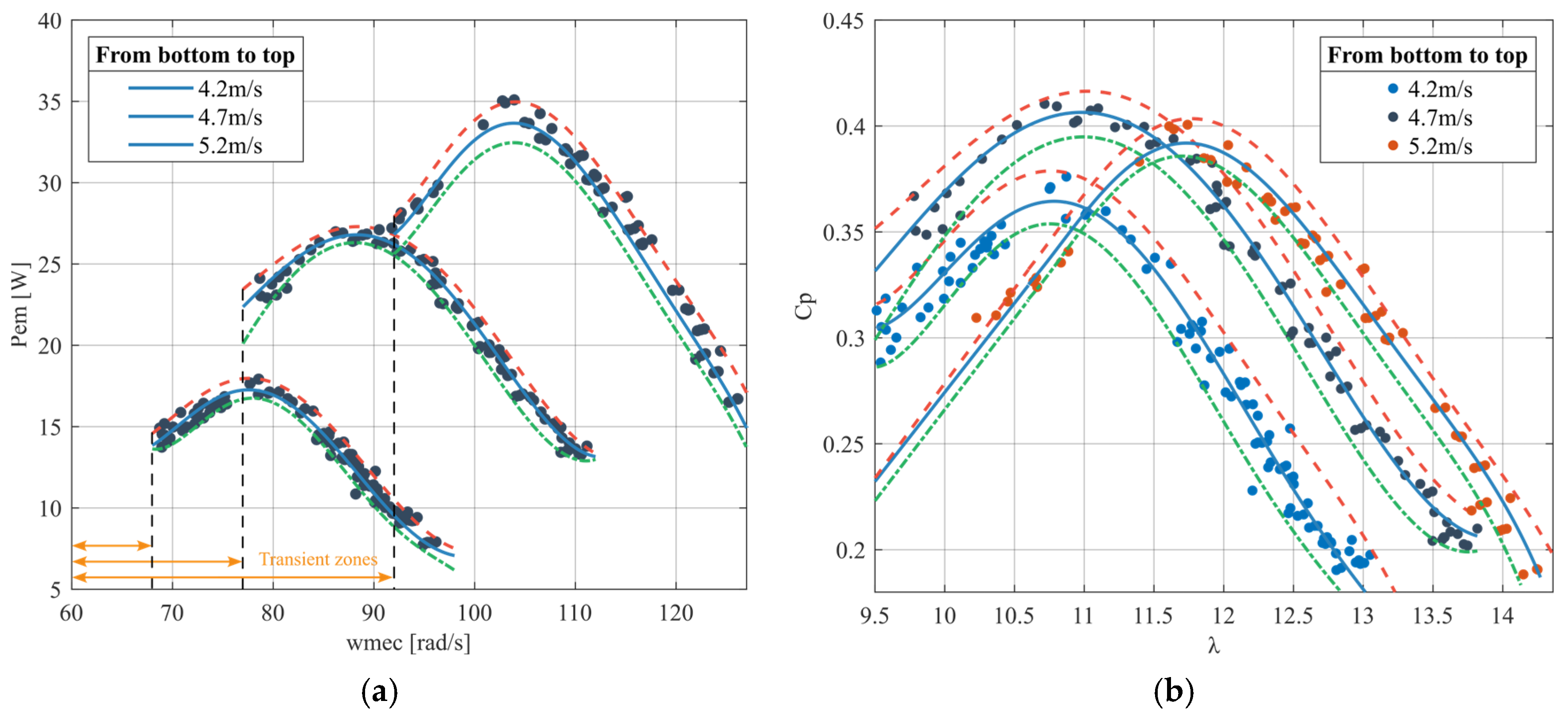
In this case, the turbine’s operating range differs from that of the Ayanz model. Measurements were conducted at three V w . The minimum speed was set to the lowest value at which the turbine reaches its optimal rotational speed (approximately 70 rad/s), while the maximum speed was limited by mechanical safety, as excessively high speeds were observed during initial tests. To avoid damage, the upper limit was conservatively set between 4.2 m/s and 5.15 m/s.
Despite showing lower data dispersion than the Ayanz SWT (see Appendix A), a transient region was observed at each V w , below a certain rotational threshold, where the system does not reach steady-state operation. Consequently, the performance curves start abruptly at that point. To mitigate this, tests were conducted from higher to lower speeds, confirming that measurements below the threshold reflect the system’s transient response. The resulting P e m   v s .   ω m e c and C P   v s .   λ curves are presented in Figure 12.
In the C P   v s .   λ curves, the transient effect is less pronounced, and the behavior remains consistent. Only the curve corresponding to the highest V w has been slightly extrapolated to illustrate the performance trend better.
The maximum C P values obtained for each V w are listed in Table 6.

3.5. C P   v s .   λ Plateau Comparison

Manufacturers typically provide a single, idealized C P   v s .   λ curve to represent turbine performance. However, experimental characterization at different values of V w reveals that this behavior is not fixed. In real conditions, especially in small-scale turbines, the aerodynamic response varies significantly with V w .
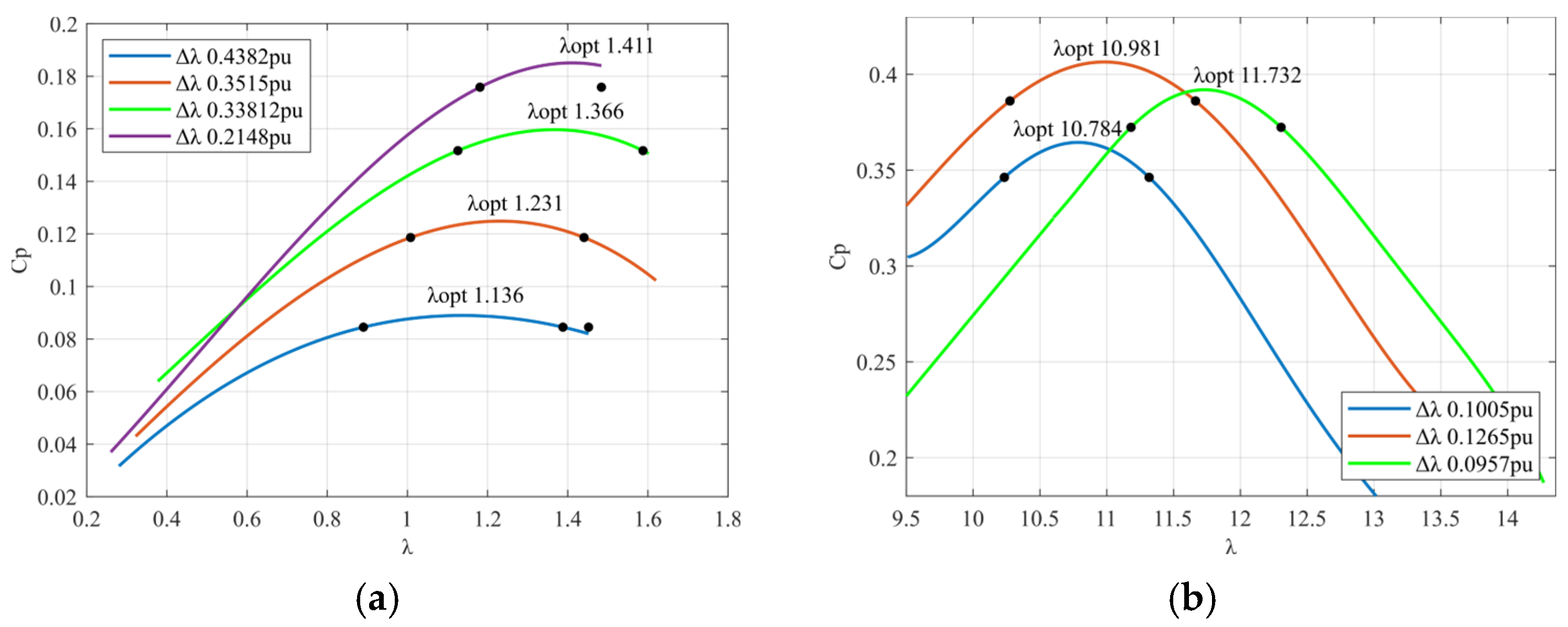
For the Ayanz SWT (see Figure 13a), the experimental data showed a clear divergence among C P curves at different V w , with a relative variation of 51.71% in peak value. All comparisons were made using the mean C P curves.
In contrast, the Three-blade SWT (see Figure 13b) exhibited more consistent behavior, with a relative variation of only 10.3%, indicating more uniform performance across different V w values.
Beyond peak values, a plateau-width analysis was conducted to evaluate each turbine’s theoretical robustness to operating variations, such as gusts. For each V w , the plateau was defined as the range of λ where C P remains within 5% of its maximum. To ensure comparability, the resulting Δ λ values were normalized by the corresponding λ o p t defined as the λ value at which C P reaches its maximum.
This analysis showed that the Ayanz SWT exhibits a broader normalized plateau, meaning its output remains closer to the maximum power P m a x under rotational speed fluctuations. In gusty conditions, this indicates a greater capacity to extract energy across varying λ . In contrast, the Three-blade SWT would likely need faster Maximum Power Point Tracker (MPPT) adjustment or remain near its optimal point.
In the following section, the performance of both turbines under gusty wind conditions is evaluated to test these hypotheses and determine whether the observed plateau characteristics result in better actual energy capture.

4. Wind Gust Performance Characterization

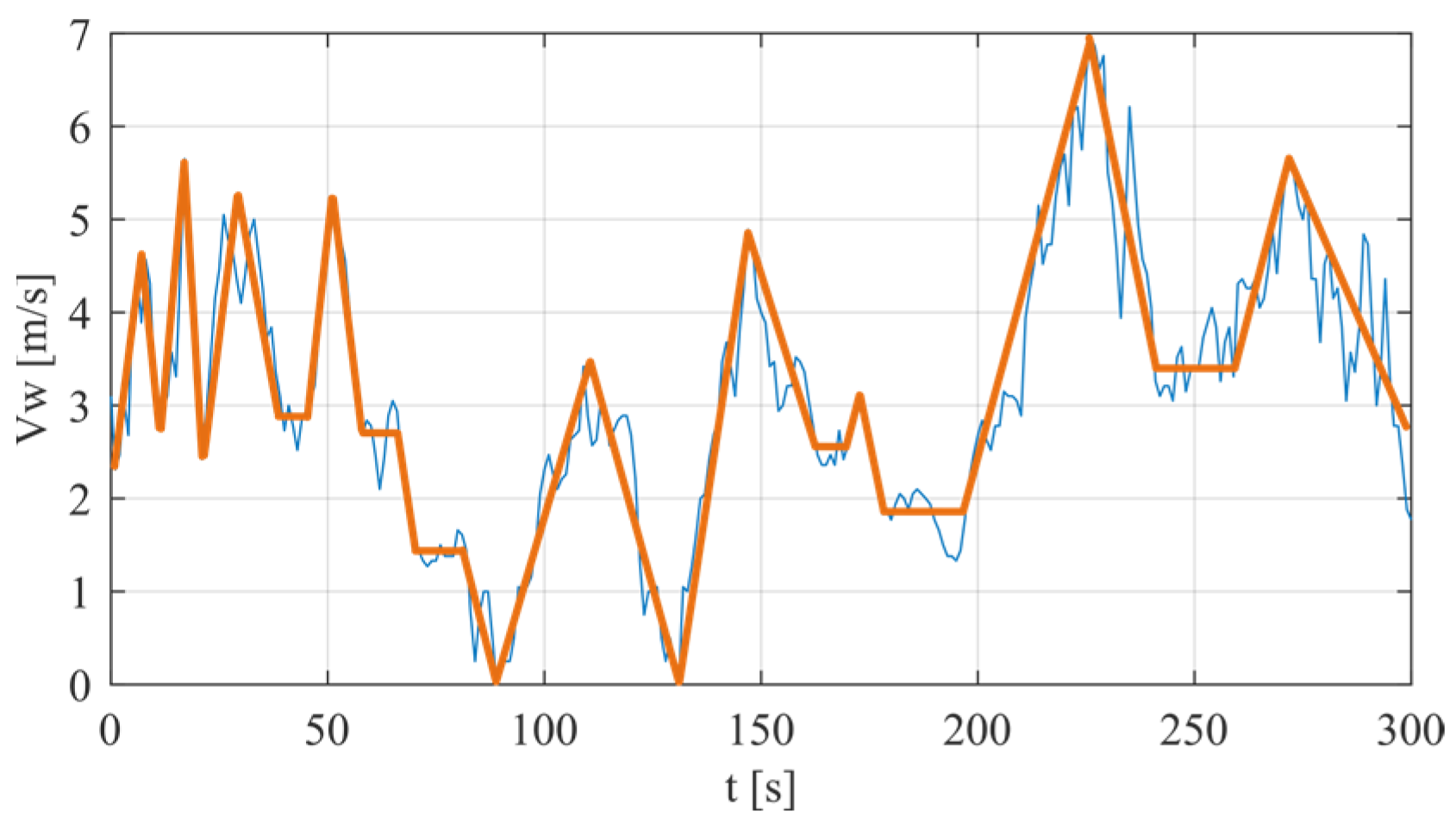
In this section, different wind gust patterns have been applied to both the Ayanz and the Three-blade SWT, to analyze their performance under variable urban wind conditions. The gust profiles were designed based on real-world data typical of city environments, where wind behavior is irregular and often unpredictable, as seen in Figure 4.
Due to the inherent inertia of small-scale wind turbines, they are unable to respond effectively to the fastest fluctuations observed in real-world V w measurements. Moreover, the dynamic response limitations of the wind tunnel used in the laboratory prevent it from accurately reproducing such rapid variations. Therefore, only ramp-based gust profiles will be implemented in the tests, omitting high-frequency components. This simplification, shown in Figure 14, allows for more consistent and reproducible experimental validation while maintaining a representative approximation of typical urban wind behavior.
By subjecting both systems to a range of fluctuating wind intensities, it has been possible to identify the specific gust patterns that yield the highest energy output for each design. This comparative analysis not only highlights the operational differences between the two turbine types but also helps determine their efficiency and suitability for deployment in urban contexts. The resulting data provides valuable insights into how each system responds to variable wind inputs, ultimately allowing us to establish optimal operating conditions and potential applications for both technologies.

4.1. Control Approach for Power Extraction

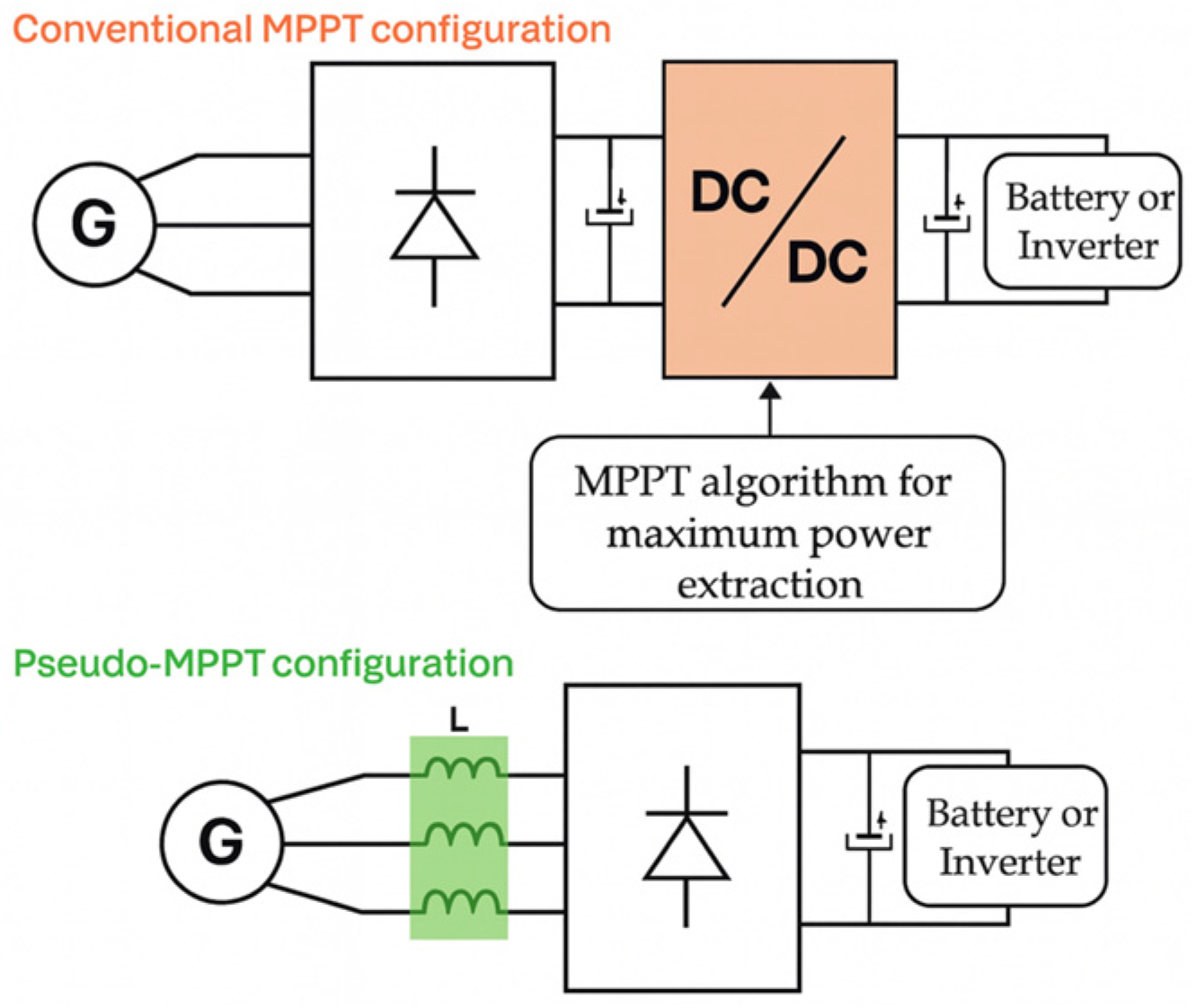
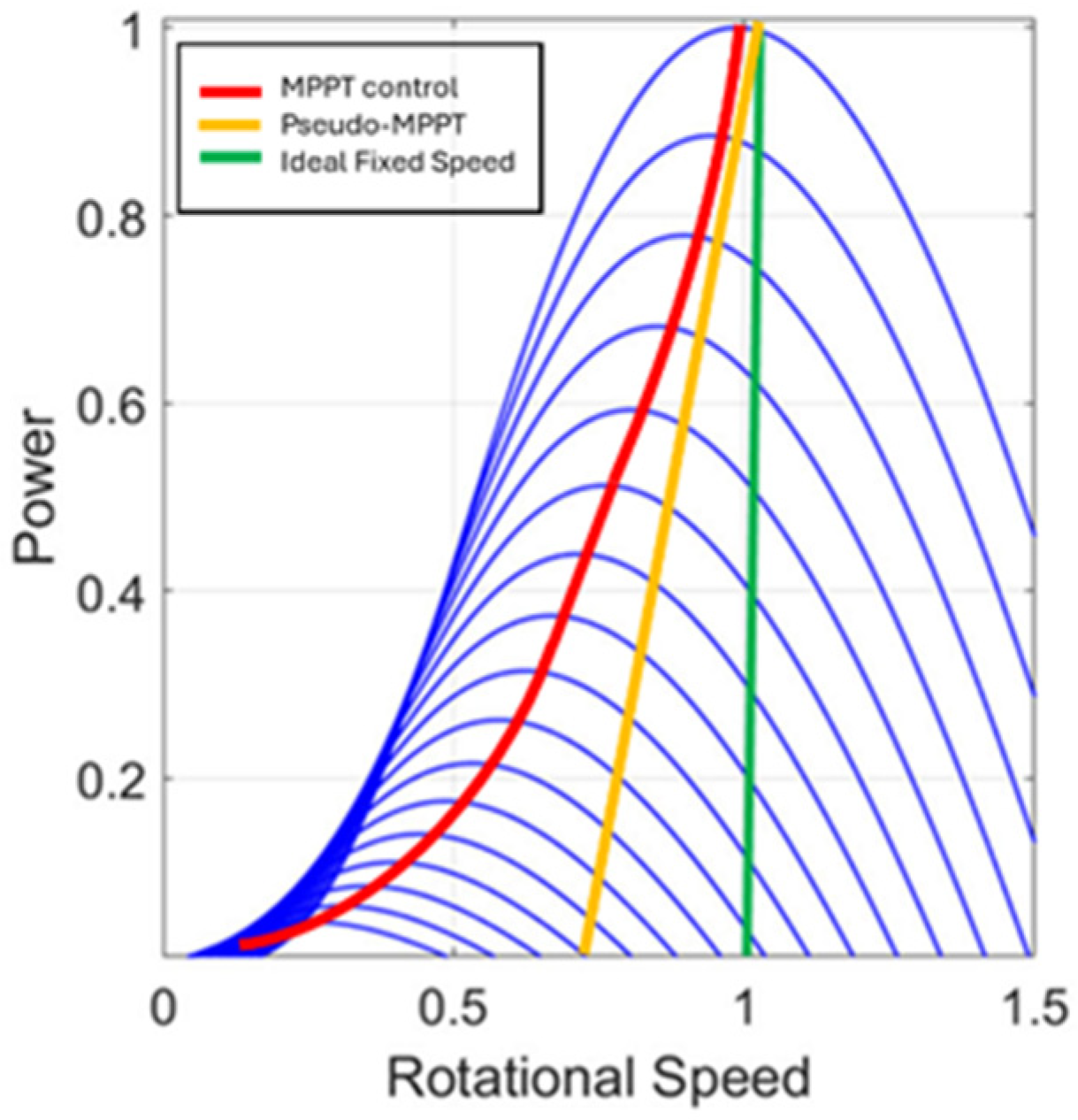
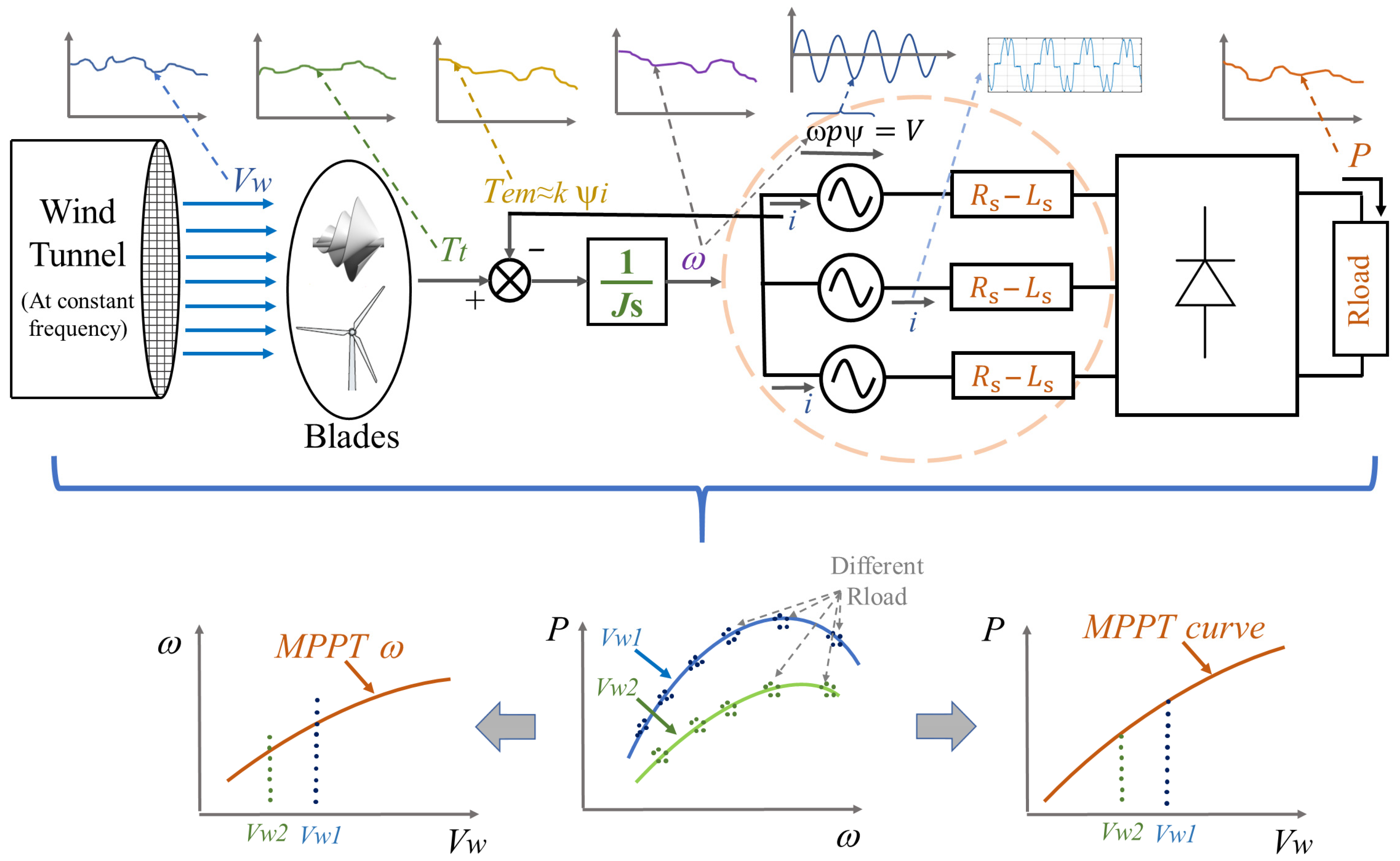
Conventional MPPT implementations require a controlled power converter and a dedicated control strategy, which inevitably introduce delays and increase the overall system complexity. In this work, a simplified approach has been adopted by setting a fixed DC voltage on the load side, eliminating the need for an active MPPT control stage. This voltage reference indirectly maintains the turbine’s rotational speed at each operating point. However, due to the inductive nature of the generator and power system, the speed does not stay strictly constant. Instead, a slight deviation from the imposed point occurs, resulting in Pseudo-MPPT behavior. Both configurations are shown in Figure 15.
Furthermore, conventional MPPT has been excluded from the analysis, as its performance is highly dependent on tuning parameters and system-specific control implementation, which would complicate a direct comparison between turbines. As discussed in [16,18], the pseudo-MPPT approach allows for the inclusion of external inductances in the setup to modify the slope of the power curve, thereby influencing the operating point. However, in this study, no additional components have been introduced to maintain the objectivity and consistency of the comparison, and both generators already exhibit parasitic inductance as shown before.
The theoretical response of this method, compared with a conventional MPPT strategy, is illustrated in Figure 16 to clarify the operational principle of the chosen approach.

4.2. Electrical Power Circuit and Data Obtaining Process

To investigate the dynamic response of wind turbines under wind gust conditions, the experimental power circuit has been modified to maintain a constant-voltage load. In this configuration (see Figure 17), the previously used variable resistive load was replaced with a variable DC voltage source from ITECH IT-M3432 (ITECH Electronic, Nanjing, China). This setup has been designed to maintain an almost constant electrical speed at the wind turbine, emulating a constant battery DC voltage in a real scenario.
As in the steady-state tests, the turbines generate three-phase AC power, which is converted into DC using a diode-based rectifier. The Yokogawa WT1806E (Yokogawa, Tokio, Japan) precision power analyzer is again used to measure electrical power directly at the output.
Unlike the steady-state analysis, which evaluated performance across a range of operating points, the gust experiments focus on capturing the time-dependent behavior of power generation. Wind gusts have been introduced, and electrical power has been recorded as a time series.
To quantify the energy contribution of each gust, the instantaneous mechanical power generation has been integrated over time. The resulting energy increments and power profiles provide insights into the turbines’ capability to exploit short-term wind variability.
To define an appropriate operating point for the wind gust experiments, it was necessary to determine a suitable DC voltage that would set the rotational speed of each wind turbine at a representative, efficient working condition. From the steady-state tests, both the line-to-line voltage and frequency at various operating points were measured using the AC-side power analyzer and verified with oscilloscope readings on the DC side. These measurements enabled the construction of voltage–frequency profiles for each turbine under different loads.
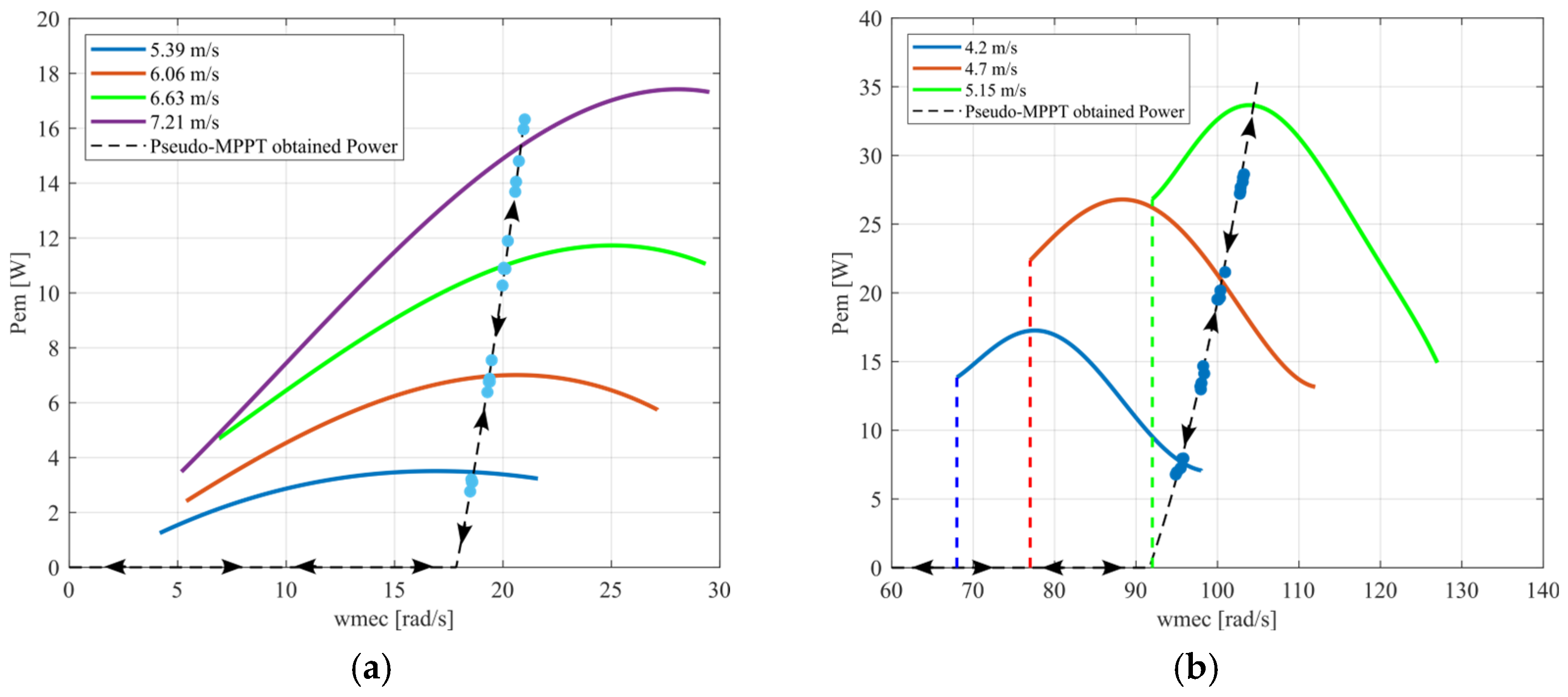
For the Ayanz SWT, a fixed voltage of 48Vdc has been chosen. This value is commonly used in commercial battery systems, making it a practical and standardized option for direct energy storage. Moreover, as shown in Figure 18, the 48Vdc operating line intersects the turbine’s power curves near their peak points for V w values around 6.06 m/s and 6.63 m/s, and it is also far enough from the saturation zone. This indicates that the system operates close to its MPPT under typical variable urban wind conditions, achieving high efficiency without requiring advanced power-tracking mechanisms. This voltage has been tested at different constant V w and the results are shown against the power curves in Figure 18, so the system’s performance can be seen.
In contrast, the Three-blade SWT was tested with a fixed voltage of 16Vdc, a non-standard value in battery storage systems. However, this voltage was selected for experimental purposes, as it intersects the turbine’s power curves near their optimal regions, particularly at V w around 5.15 m/s, maintaining the working point above the oscillating zone. This choice allows for a clear assessment of the turbine’s behavior under constant voltage conditions, even if further adjustments would be needed in a practical application to match standard storage voltages.

4.3. Wind Gust Generation

This section analyzes how both wind turbines respond to transient wind gusts under various initial conditions. First, gusts starting from zero V w were applied, simulating a sudden onset of wind. Second, gusts were introduced while the turbine was already operating at a steady V w . Within this second condition, two scenarios were examined: one in which the turbine was operating at its optimal point and generating measurable power, and another in which, despite steady wind, the turbine was not producing maximum power. The design of these gusts was based on the urban wind behavior seen in Figure 14, as different starting offsets and gust durations can be seen, the aim has been to replicate actual urban wind scenarios as closely as possible.
This approach allows us to examine both the turbine’s start-up behavior and its dynamic response during operation. By comparing these scenarios, we gain insights into the system’s ability to adapt to real-world urban wind profiles, where wind conditions can shift rapidly and unpredictably.
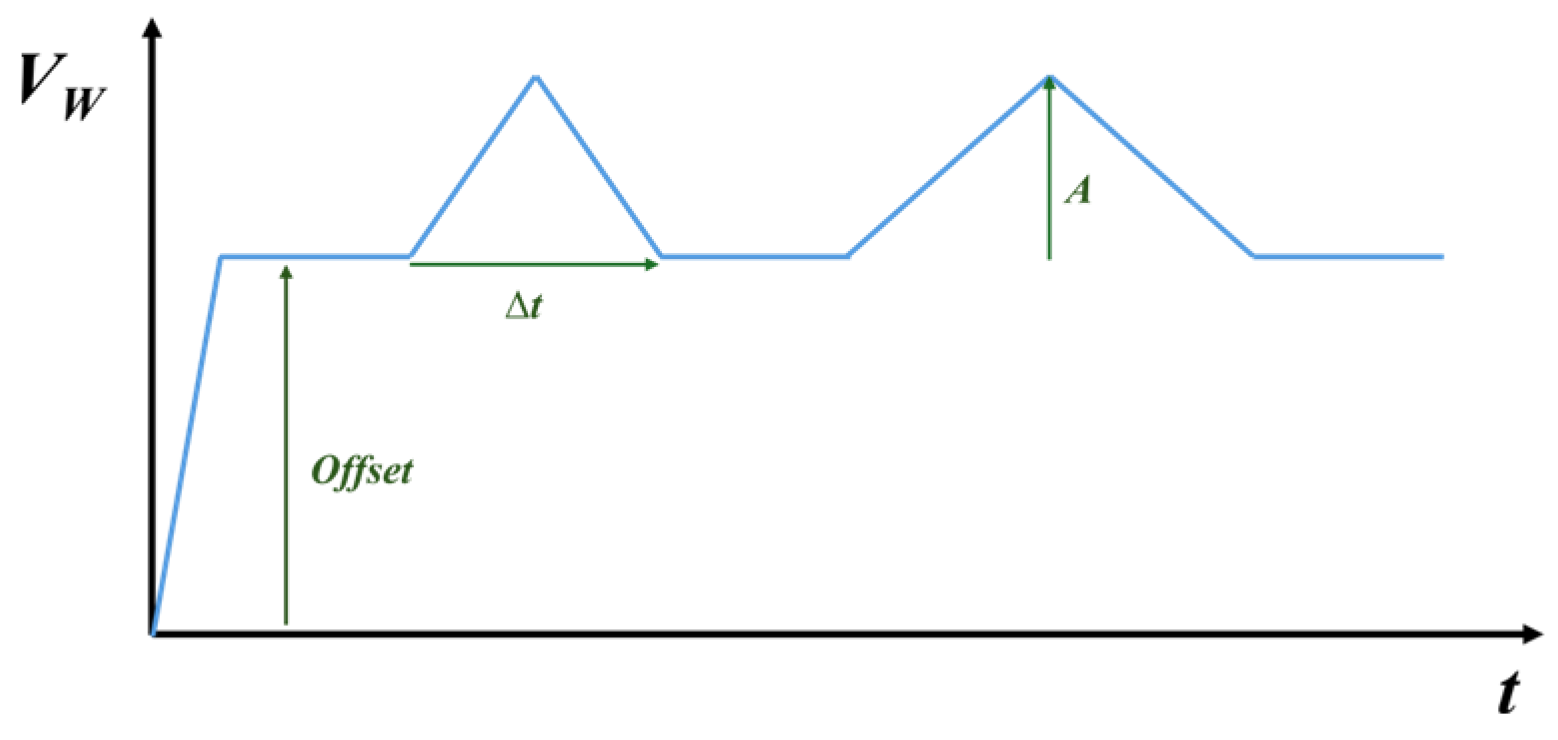
The design of the wind gusts applied in the simulations is based on the triangular behavior observed in experimental wind profiles, as shown in Figure 14. Accordingly, Figure 19 shows the design of the wind gusts applied in the simulations. Three main parameters are highlighted: the offset, which represents the constant base V w ; A, the amplitude of the transient gust; and Δt, the duration of the gust event.
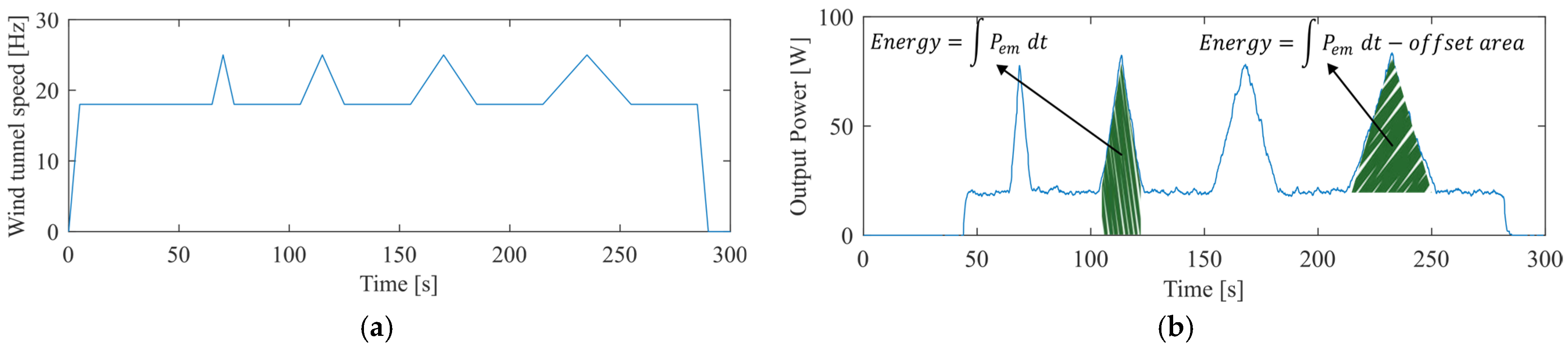
In the following Figure 20, a real wind gust profile applied in the wind tunnel through simulation is presented, along with the corresponding mechanical power output during the gust event.
Output energy has been calculated over the span in which the sudden increase in V w has generated any power. This energy has been evaluated for different gust durations. Two approaches were used for energy calculation: the first considers both the gust amplitude and offset, effectively representing the total energy delivered during the event. The second approach integrates only the amplitude component, isolating the intrinsic contribution of the transient itself with respect to each base V w . This distinction allows for a more detailed analysis of the Impact of gust amplitude Independently of the background wind condition.
To analyze gusts of different durations in each turbine, in both cases, the resulting energy values were normalized by dividing them by the swept area of the wind turbine, defined by the blade radius. The final metric used for analysis was therefore the energy-to-area ratio (Energy/Area), providing a consistent basis for assessing the turbine’s efficiency in responding to different transient wind profiles.

4.4. Wind Gusts for Ayanz SWT

The gust configuration applied to the Ayanz SWT is detailed in Table 7, which includes the offset velocity, the gust amplitude, and their respective durations. Each gust amplitude corresponds to a specific peak V w , and the durations ranged from short bursts to extended gusts, allowing evaluation of the system’s energy response over varying time scales.
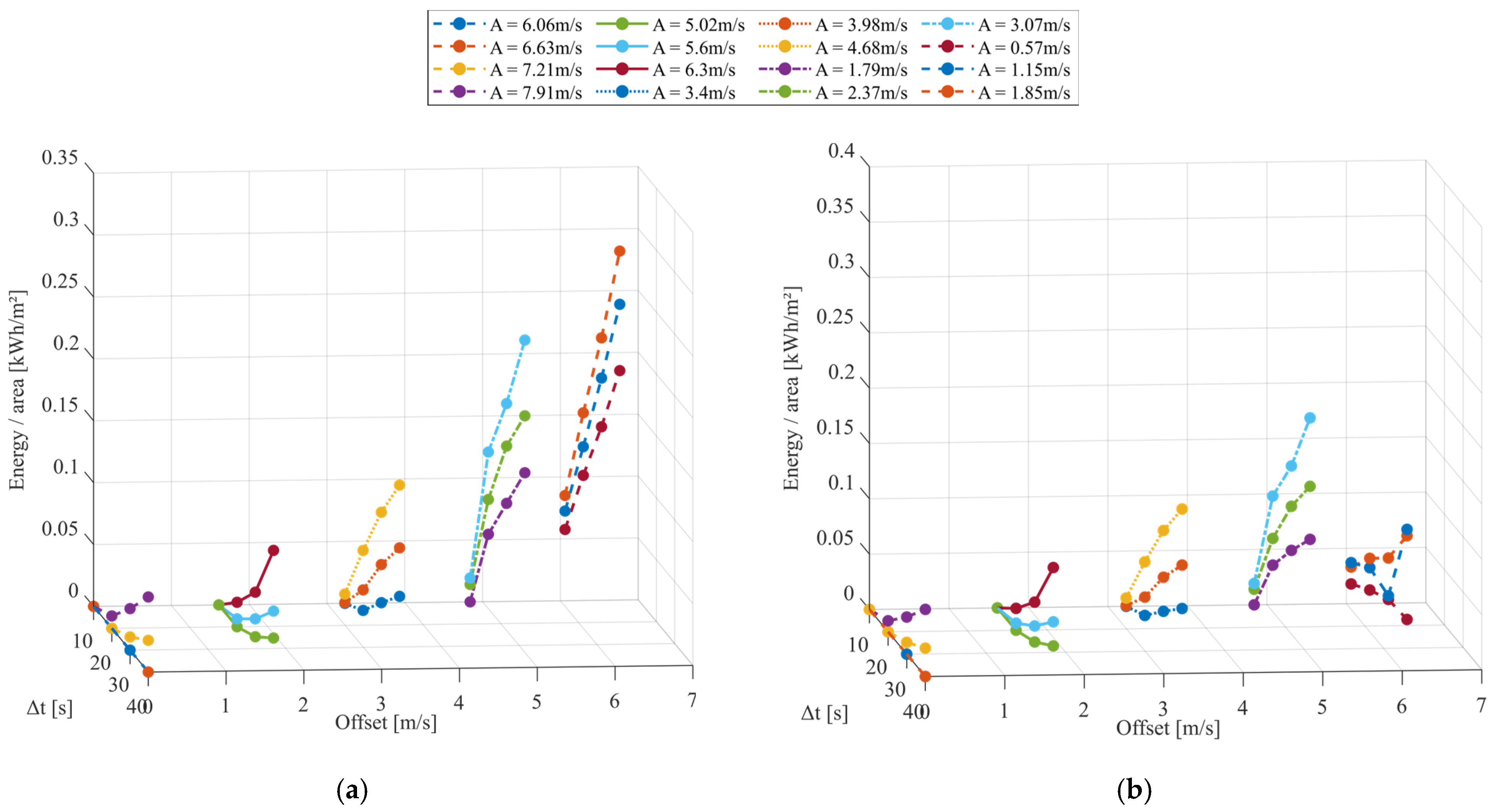
Ayanz SWT’s response to different transient wind scenarios, in terms of energy per unit area, is shown in Figure 21.
The results in Figure 21a reveal a clear difference in energy generation between the Ayanz SWT when initially at rest and when already operating. When wind gusts are applied from a standstill (0 m/s offset curves), the energy generated remains significantly lower across all gust amplitudes and durations. Even with high V w values (e.g., 7.91 m/s) and extended gust durations (up to 40 s), the turbine struggles to overcome the initial static torque, resulting in minimal energy conversion. This highlights the Ayanz SWT’s limited self-starting capability under sudden wind conditions.
On the other hand, when an initial offset V w of 6.06 m/s is applied, the turbine demonstrates a markedly improved energy response. In this scenario, energy output increases nearly linearly with gust duration, and higher gust amplitudes produce proportionally higher energy-per-area values. The best performance is observed for the 7.91 m/s gust, reaching values over 0.33 kWh/m2, confirming the Ayanz SWT’s intense sensitivity to dynamic wind increases once in motion.
Furthermore, the results in Figure 21b, which consider only the energy contribution from the gust amplitude, show that the previously observed upward trend becomes less pronounced. For low offset values, there is no difference between the total and amplitude-only energy calculations, as no energy is produced in the absence of the gust. However, for higher offset values, where the turbine is already spinning near its optimal point, removing the energy contribution from the V w offset reveals that lower gust amplitudes result in lower energy generation, reinforcing the expected physical behavior.

4.5. Wind Gusts for Three-Blade SWT

Table 8 shows the wind gust configuration values used for the three-bladed WT.
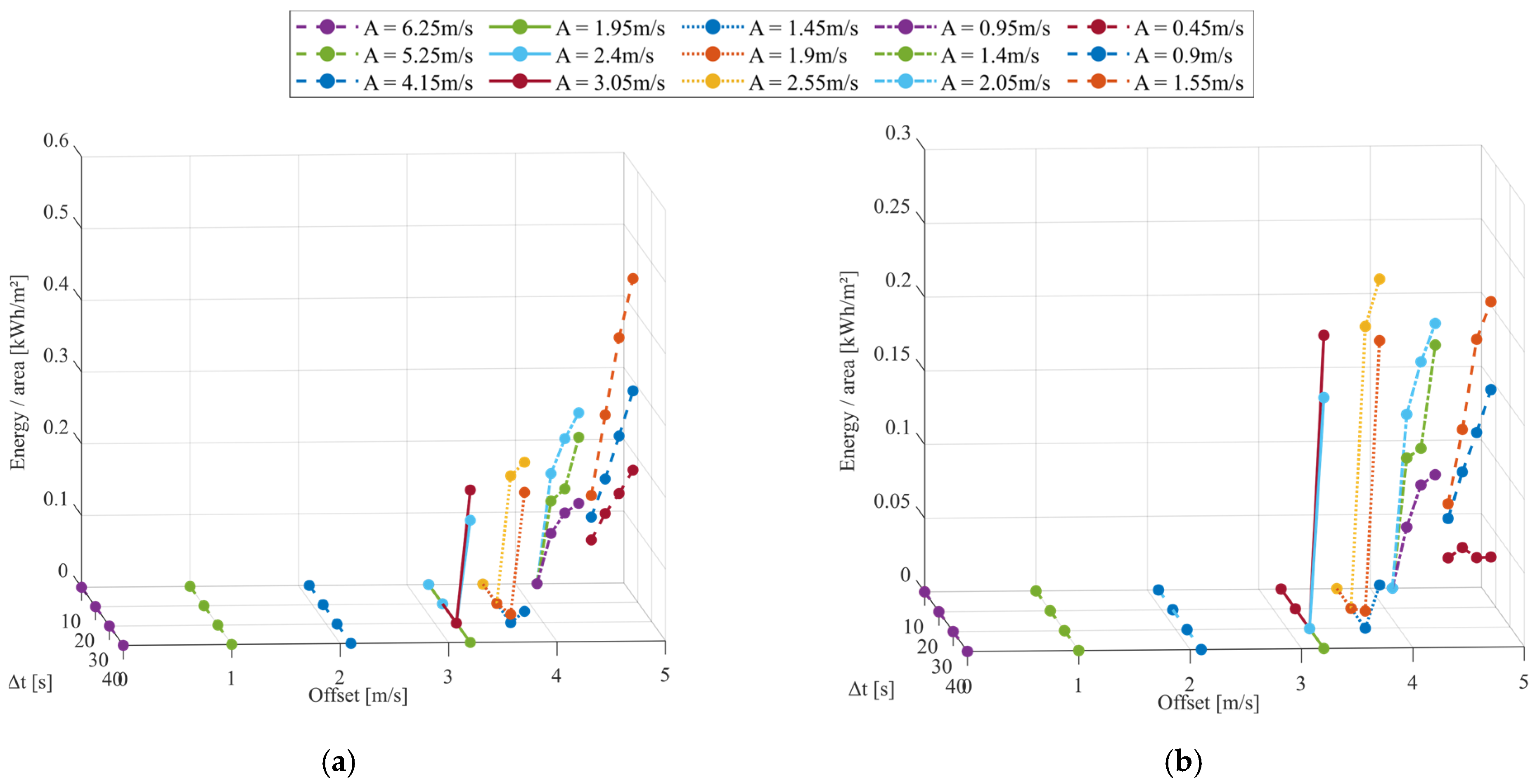
Figure 22a,b present the energy generated per swept area by the Three-blade SWT as a function of the gust duration and the wind offset.
The results reveal an explicit dependency between the energy output and the offset V w prior to the gust:
When no wind offset is applied, the turbine cannot produce any energy, regardless of gust intensity or duration. This indicates that, under such conditions, the turbine does not initiate rotation, likely due to insufficient aerodynamic torque to overcome mechanical inertia and static friction.
In contrast, higher wind offsets (4.2 m/s and 4.7 m/s) enable energy generation, and the turbine response improves consistently as the offset increases.
At offsets of 3.2 m/s and 3.7 m/s, the energy output remains relatively low and irregular, suggesting that the turbine is operating near its starting threshold. As the offset rises to 4.2 m/s and 4.7 m/s, the response becomes more stable and significant, forming clearly ascending surfaces in the 3D plot.
Furthermore, for each offset, longer gust durations result in more energy production, as the turbine has more time to capture the additional wind energy. This is especially true at higher offsets, where the link between Δt and energy becomes nearly linear. These findings show that once the turbine is running, it effectively converts brief wind increases into usable energy.
To further investigate this turbine’s behavior, in Figure 22b, excluding the offset component provides a clearer view of the turbine’s intrinsic response to transient wind events, particularly during start-up. As previously discussed, intermediate offset cases (3.2 m/s and 3.7 m/s) correspond to situations in which the turbine is rotating but not yet within its optimal speed range. In the resulting plot, it is observed that the energy generated during the start-up and the transient to optimal speed are comparable to the energy produced when the gust is applied while the turbine is already operating at its optimal point.
This indicates that the acceleration phase itself plays a significant role in energy output. In fact, a closer look at the power traces shows that the turbine has sharp power spikes during transient acceleration, which are much higher than the steady-state power levels described earlier. These results suggest that, unlike the Ayanz SWT, which displays smoother, amplitude-dependent behavior, this turbine operates more like a switch, either producing a lot of energy or none at all.

5. Discussion of Results

5.1. Steady-State Performance: Efficiency vs. Robustness

The steady-state performance of both turbines reveals a trade-off between peak aerodynamic efficiency and robustness to operating variations. As shown in Table 4 and Table 6, the Three-blade SWT reaches a higher maximum power coefficient, with C P , m a x 0.4035 , compared to the Ayanz SWT’s C P , m a x 0.192961 .
However, a closer look at the shapes of the C P   v s .   λ curves highlights a key difference. The Ayanz SWT exhibits a broader plateau around its optimal λ , as quantified in Figure 13, indicating a more stable performance across a wider operating range. This feature is particularly advantageous in variable wind conditions where the operating point often deviates from the optimum, i.e., in city locations.
Additionally, experimental data dispersion—especially in the Ayanz measurements—has been observed and is addressed in Appendix A.
To reflect this variability, upper, lower, and average envelopes were used in the curve-fitting process (see Figure 10 and Figure 12), providing a more realistic representation of each turbine’s behavior in cities.

5.2. Electrical Integration and Practical Deployment

Beyond aerodynamic performance, the electrical characteristics of each system influence its practical deployment. The pseudo-MPPT results (see Figure 18) show that the Ayanz SWT reaches peak power at a DC voltage of approximately 48 V, while the Three-blade SWT does so at only 16 V.
This difference is significant for system integration. The Ayanz SWT can interface more directly with standard battery systems or DC bus architecture without requiring step-up conversion (even having the possibility to make the curve wider by adding inductances), potentially reducing system complexity and losses. In contrast, the Three-blade SWT would likely require additional power electronics to reach usable voltage levels. It could also be possible to include a different generator design with varying voltage characteristics.

5.3. Dynamic Response Under Gusts

The turbines’ response to real and synthetic wind gusts provides additional insights into their behavior under transient conditions. As shown in Figure 21, the Ayanz SWT displays a more progressive response, with smoother acceleration and power build-up, even from standstill conditions, demonstrating a superior self-starting capability.
In contrast, the Three-blade SWT exhibits a more binary behavior. When the gust amplitude is insufficient to overcome inertia and reach optimal speed, the turbine produces negligible power, highlighting its limited self-starting capability under zero-wind conditions. However, when starting from a favorable initial speed, it responds quickly and efficiently, often surpassing its own steady-state power level (see Figure 22a).
These contrasting profiles suggest that the Ayanz design may be better suited for highly variable winds. At the same time, the three-blade configuration requires either more consistent wind or rapid speed control.
Further insight was gained by analyzing the energy contribution solely from the gust amplitude, excluding the base wind offset. In the case of the Ayanz, this analysis shows that low offsets produce minimal energy, often close to zero, since the turbine relies entirely on the gust to overcome inertia. At higher offsets, however, energy generation aligns more closely with physical principles: it increases with amplitude and duration, as expected. In the three-bladed turbine, this amplitude-only perspective on energy output makes the start-up dynamics even clearer: intermediate offsets demonstrate that accelerating toward the optimal speed during a gust significantly adds to the total energy.
These contrasting behaviors are synthesized in Table 9, which qualitatively compares key performance indicators of both turbines under gusty wind conditions representative of urban environments. This comparative view highlights the importance of selecting a turbine configuration that aligns with the prevailing wind characteristics at the deployment site, whether favoring responsiveness to transients or maximizing efficiency under steady flow.
The reasons of this behavior in these two turbines during start-up and transient conditions, can be explained as follows. On the one hand, the blades of the Ayanz wind turbine behave like aerodynamic drag surfaces. At low values of λ (i.e., w · R V w ), the relative velocity experienced by the blade is approximately equal to the wind speed V w (in the velocity triangle, the tangential term’s contribution w · R is not significant) and, therefore, the tangential force is:
F θ     1 2   ·   ρ   ·   C D   · A b l a d e   ·   V w 2
being C D the resistance coefficient that depends on the geometry of the blade (polar aerodynamics) and the Reynolds number and A b l a d e is the effective area of the blade. Then, the torque provided by the turbine is obtained simply multiplying the tangential force by the radius:
T T     1 2   ·   ρ   ·   C D   ·   A b l a d e · R   ·   V w 2
This general expression for the torque, at the start-up moment, when the rotational speed is near cero ω     0 is different from cero and takes a value proportional to V w 2 . Or said in other words, since this turbine is based on the drag forces experimented by the blades, it is able of produce torque in all its speed range, including the vicinity of zero speed ω .
On the one hand, the blades of the tri-blade wind turbine operate under the lift-force principle. Thus, the tangential force at the blades is originated by the lift force:
F θ     1 2 ·   ρ   ·   c   ·   C L ( α )   ·   V r e l 2   ·   s i n   φ
Being c the blade chord, C L ( α ) is the lift coefficient that depends on α which is the airfoil angle of attack, V r e l   is the velocity relative to the blade (or the velocity seen by the blade at the leading edge) and   φ is the projection angle with respect to the zero-lift line. The triangle of velocities is composed by the input wind velocity that is assumed to be axial, then the tangential rotating velocity ( ω · R ) and then the resultant of both, i.e., V r e l . In reality, the anatomy of the previous expression is not particularly important. Rather, what matters is that, at low values of rotational speed or λ ω     0 as before, which means that the relative velocity aligns with the chord, the angle of attack becomes practically zero, and according to typical aerodynamic polars, this implies a zero-lift coefficient, i.e., α     0     C L     0 . Consequently, the torque produced by the turbine which is obtained by multiplying the force by the radius is:
T T   w     0   0
What means that the torque of the three-blade turbine at the start-up is nearly zero, in contrast to the Ayanz turbine start-up torque that is proportional to V w 2 . Therefore, for the three-blade wind turbine, it is necessary to overpass a certain rotational speed ω , to generate a significant torque greater than zero, which is associated with a minimum wind speed which is known as the cut-in wind speed in conventional wind turbines. Below wind speeds to the cut-in wind speed, the three-blade wind turbine often is not able to even start-up due to its very low producing torque.
Hence, knowing this, it is now necessary to analyze the dynamic response of the turbines by means of their first order mechanical differential equation that relates the rotational speed with the torques:
T T ω ( t ) , V W t T e m ω ( t ) = J · d ω ( t ) d t
Being J the total inertia of the system, T T the torque produced by the turbine as discussed above and T e m is the torque of the generator. Note that the mechanical losses at the shaft have been neglected for simplicity. In order to produce and increase in rotational speed ω , it is necessary an acceleration that can be approximated from previous expression to:
Δ ω     Δ T J ·   Δ t
With Δ T the accelerating torque, which is the difference of the turbine’s torque and the electromagnetic torque. Hence, at the start-up, when the turbine is at stand-still and the wind gust starts affecting the blades, the rotating speed ω will increase if Δ T , the accelerating torque is big enough (the turbine’s torque is bigger than the electromagnetic torque during the acceleration obviously). In order to maximize the generated energy during the gust, the rotating speed ω should accelerate as near as possible to the optimum speed (optimum λ at Figure 10b and Figure 12b) trying to follow to the varying wind speed V W during the gust (see Figure 14), maximizing the accelerating torque and therefore the generated power too. However, as shown before in Equations (8) and (10), the three-blade wind turbine presents poor start-up torque, what means that the accelerating torque Δ T is small in Equation (12), requiring in general more time, Δ t in Equation (12), to reach the optimum speed ω, i.e., optimum λ, than the Ayanz turbine. Hence, in wind gusts of short duration and of small amplitude, the three-blade wind turbine’s rotating speed ω, is not able to follow the optimum ω required by the wind speed variation V W , due to its poor start-up torque characteristics [16,20,27].
Note that in general, as reported in [23], Ayanz wind turbines naturally present bigger inertias J than three-blade wind turbines, at equal areas and material of the blades. However, at start-ups and under wind gusts of small amplitude and duration, even having less inertia, three blade turbines due to their poor start-up torque, present slower acceleration ratios than Ayanz wind turbines, producing smaller energy generation ratios.
On the contrary, under wind gusts of longer duration and higher amplitude, or even at constant wind speeds, both wind turbines can operate at the optimum speed ω, i.e., optimum λ, being in this case the three-blade wind turbine able to generate more energy, due to its higher C p value at steady-state (Figure 10b and Figure 12b).

6. Conclusions

This work has presented an experimental performance assessment of two small-scale horizontal-axis wind turbines under both steady and transient wind conditions typical of city environments. The analysis included a conventional three-blade turbine and an Ayanz-inspired screw-blade turbine, tested in a controlled wind tunnel environment. Several conclusions can be drawn from the results:

6.1. Steady-State Performance

The Three-blade SWT achieved a higher peak C P , indicating greater aerodynamic efficiency near its optimal operating point. However, the Ayanz SWT exhibited a broader plateau in its C P   v s .   λ curve, suggesting more stable performance across a wider range of operating conditions—an essential feature for wind scenarios with high variability.

6.2. Wind Gust Response

Under synthetic and real gust profiles, the Ayanz demonstrated a more progressive and consistent energy response. Its ability to accelerate rapidly, owing to higher starting torque, allowed it to respond more effectively to short-duration gusts and variable input speeds, confirming the expected behavior. Conversely, the Three-blade showed a more binary response: negligible power at low initial speeds and high efficiency at favorable initial speeds, highlighting its dependence on initial conditions.

6.3. Energy Capture Under Transients

The Ayanz generated measurable energy even under short or moderate gusts without prior rotor motion, confirming its suitability for low-consistency wind environments. Meanwhile, the Three-blade exceeded its steady-state power levels under certain transient conditions, but only when the gust amplitude and initial speed aligned favorably.

6.4. Practical Integration Considerations

The electrical testing showed that the Ayanz works best at about 48 V, while the Three-blade does so near 16 V. This difference affects how they can be used in common battery systems and power electronics. The Ayanz setup allows for easier direct connection to standard storage units without needing step-up conversion, which could be useful in low-power urban or off-grid setups.

6.5. Methodological Contribution

The comparative analysis of the C P plateau width across multiple V w values represents a novel contribution, offering a more realistic framework for evaluating turbine adaptability. This analysis goes beyond the single idealized performance curve typically provided by manufacturers. It better reflects the behavior of SWTs under non-ideal wind conditions, including those normally encountered in urban environments.

6.6. Urban Integration and Visual and Acoustic Impact

From the perspective of deployment in real urban environments, the Ayanz SWT and the Three-blade SWT show notable differences that go beyond their aerodynamic performance. Under the tested conditions, the three-bladed turbine attains a higher average power coefficient than the Ayanz turbine. However, the helical rotor enclosed in a tube of the Ayanz SWT design remains competitive. It offers specific advantages for urban integration, such as reduced acoustic and visual impacts, limited direct visibility of the rotating blades, and enhanced safety against bird strikes and potential blade impacts.

6.7. Installation and Maintenance Cost Analysis

Regarding installation costs (CAPEX), the Ayanz turbine needs a tubular shroud, an extra supporting structure, and protective mesh elements. This setup uses more materials and involves more customized manufacturing, which likely increases the device’s unit cost. However, the smaller effective rotor radius and compact layout may make rooftop installation easier, reducing the need for tall towers and decreasing some civil works costs. In contrast, the Three-blade SWT features a simpler, more standardized design with common components and well-established assembly processes, which generally lower the initial cost per installed kilowatt. Nevertheless, taller support structures and larger safety clearances are often necessary due to visual and safety considerations.
In terms of operation and maintenance costs (OPEX), the enclosure of the Ayanz turbine and the external mesh reduce the risk of damage from foreign objects, birds, or vandalism, potentially leading to fewer blade replacements and a longer structural lifetime. On the other hand, access to internal components is less direct, and some interventions may become more time-consuming and therefore more labour-intensive. The three-bladed turbine, by contrast, allows for rapid visual inspection and easy access to the blades and hub, resulting in shorter routine maintenance operations and relatively inexpensive spare parts, but at the expense of higher exposure to adverse environmental conditions and possible impacts, which could increase the frequency of repairs in urban sites.
In summary, while the Three-blade SWT remains superior in aerodynamic efficiency under steady conditions, the Ayanz SWT demonstrates greater adaptability, better low-wind responsiveness, and more favorable integration characteristics for variable and urban wind environments. The choice between the two technologies for urban applications should be based not only on their energy performance, but also on the trade-offs among audio-visual footprint, installation and maintenance costs, and the specific safety constraints of each location. These findings support the continued investigation—and practical deployment—of non-conventional turbine morphologies in small-scale, distributed renewable energy systems, particularly in urban or wind-inconsistent environments.

7. Future Paths

Building on the findings of this study, future research will focus on enhancing the energy conversion performance and real-world applicability of SWTs. A key direction involves the integration of advanced power electronics and adaptive control strategies. Specifically, the design and testing of tailored MPPT algorithms for each turbine type will be explored, enabling optimized energy harvesting under unsteady, rapidly varying wind conditions. This includes evaluating real-time control techniques and converter topologies capable of dynamically matching the electrical load to the rotor behavior.
Complementarily, experimental validation in real outdoor conditions is planned to use measured urban wind profiles from diverse geographic settings. These field tests will assess the robustness and adaptability of each turbine under turbulence, multidirectional flow, and low-consistency wind conditions typical of urban environments, conditions that are often not fully replicable in laboratory wind tunnels.
In addition, the current wind gust framework will be extended by testing a broader range of wind offset levels and gust durations. This will allow for a more comprehensive dynamic characterization of each turbine, particularly in response to non-ideal, short-duration transients. Such analysis is expected to yield more profound insights into inertia-dependent behavior and real-world energy output variability.
Together, these future efforts aim to advance the development of resilient, efficient, and easily integrable SWT systems, with particular focus on city-scale and distributed energy applications.

Author Contributions

Conceptualization, G.A., D.C., A.A., U.N., F.R. and I.R.; methodology, A.A., U.N., F.R., I.R. and A.Z.; software, A.A., U.N., F.R. and I.R.; validation, A.A., U.N., F.R. and I.R.; formal analysis, A.A., U.N., F.R., I.R., G.A., D.C. and A.Z.; data curation, A.A., U.N., F.R. and I.R.; writing—original draft preparation, A.A., U.N., F.R. and I.R.; writing—review and editing, A.Z., G.A. and D.C.; supervision, A.Z., G.A. and D.C.; project administration, G.A., D.C., A.A., U.N., F.R. and I.R.; funding acquisition, G.A. and D.C. All authors have read and agreed to the published version of the manuscript.

Funding

This research received no external funding.

Data Availability Statement

No new data were created or analyzed in this study. Data sharing is not applicable to this article.

Acknowledgments

During the preparation of this manuscript, the authors used ChatGPT-5.2 for the purposes of text editing (grammar, structure, and spelling). The authors have reviewed and edited the output and take full responsibility for the content of this publication.

Conflicts of Interest

The authors declare no conflict of interest.

Appendix A

Appendix A.1. Uncertainty Quantification of the Obtained Curves

This appendix explores the potential sources of errors in data measurement accomplished when obtaining the power and wind speed curves. The theoretical framework adopted for quantification of the uncertainties is the European Standard IEC 61400-12-1, focused on power performance measurements of electricity producing wind turbines [12]. By following its defined method, first the uncertainty of the measured power u P , i is quantified at each power measured point, which depends on the quadratic sum of 4 individual uncertainties:
u P , i = u P 1 , i 2 + u P 2 , i 2 + u P 3 , i 2 + u d P , i 2
Being u P 1 , i the uncertainty of the current sensors at point i, u P 2 , i the uncertainty of the voltage sensors at point i, u P 3 , i the uncertainty of the power transducer at point i and u d P , i the uncertainty of the acquisition system for the power channel at point i. At the performed experimental tests, the WT1806E Series Power Analyzer (Yokogawa, Tokio, Japan) has been used from Yokogawa manufacturer. The current and voltage sensors, as well as the power transducer and the acquisition system employed are the ones provided by the Yokogawa’s Power Analyzer itself. Thus, considering the manufacturers’ guides and recommendations for performing the measurements as well as the range specifications, the uncertainties considered according to the IEC 61400-12-1 standard are as follows:
u P 1 , i = 1.5 100 · 1 3 · P i ( W )
Being ±1.5% the current sensor uncertainty limit (quite conservative as recommended by the standard IEC 60044-1 and adopted by the IEC 61400-12-1) and P i the power point measured in Watts. By following the same standard’s method, the voltage uncertainty is quantified as:
u P 2 , i = 0.5 100 · 1 3 · P i ( W )
Being ±0.5% the voltage sensor uncertainty limit. Then, the power transducer uncertainty limit is considered as ±1% of the rated power measured (35 W) and assumed to be uniformly rectangular (recommended by the standard IEC 60688 and adopted by the IEC 61400-12-1), which means that the uncertainty is quantified as an absolute value:
u P 3 , i = 1 100 · 35   W 3
Finally, the uncertainty of the acquisition system for the power channel is considered as ±0.1% of the range of power (2.5 · 35 W):
u d P , i = 0.1 100 · 2.5 · 35   W
Then, the rotating speed measurements are performed by employing the same power analyzer WT1806E. Despite the fact that the Standard IEC 61400-12-1 does not consider the rotation speed measurements, the authors will follow the same methodology for uncertainty quantification. Hence, analogously as for the power measurements, the uncertainty u ω , i   of the rotating speed measurements are:
u ω , i = u ω 2 , i 2 + u ω 3 , i 2 + u d ω , i 2
Being u ω 2 , i the uncertainty of the voltage sensors at point i, u ω 3 , i the uncertainty of the frequency transducer at point i and u d ω , i the uncertainty of the acquisition system for the power channel at point i. Note that the rotating speed is obtained as shown in Equation (2), from the frequency of the voltage measurements of the Power Analyzer, what means that this measurement does not depend on the currents sensor. Consequently, the voltage uncertainty is quantified as before:
u ω 2 , i = 0.5 100 · ω i   ( r d / s )
Then, the frequency transducer uncertainty (an internal estimation algorithm that is based on voltage measurements) is considered as:
u ω 3 , i = 1 100 · 130   r d / s
Being ±1% the frequency transducer uncertainty limit considered and 130 rd/s, the maximum rotating speed measured at the tests, which corresponds to a maximum electrical frequency measured of 124.14 Hz (note that both electric generators of both wind turbines present 6 pole pairs when applying Equation (2), so it enables uniformity between both generators in this uncertainty).
Finally, the uncertainty of the acquisition system for the frequency channel is considered as ±0.1% of the range of frequency and rad/s (2.5 · 130   r d / s ):
u d ω , i = 0.1 100 · 2.5 · 130   r d / s
On the other hand, the uncertainty quantifications of the wind speed measurements, are accomplished again as specified by the Standard IEC 61400-12-1. Again as before, the uncertainty of the measured wind u V , i is quantified at each measured point, which depends on the quadratic sum of several individual uncertainties:
u V , i = u V 1 , i 2 + u V 2 , i 2 + u V 3 , i 2 + u d V , i 2
Being u V 1 , i the uncertainty of the wind sensors at point i, u V 2 , i the uncertainty due to the operational characteristics of the anemometer at point i, u V 3 , i the uncertainty due to the mounting effects at point i and u d V , i the uncertainty of the acquisition system for the wind speed channel at point i. The Standard IEC 61400-12-1 also considers other uncertainties due to the terrain characteristics and other factors, but since the tests presented at this paper are performed at the laboratory does not apply. Hence, at the performed experimental tests, the Lufft XA1000 hot-wire anemometer (Lufft, Fellbach, Germany) is used with an accuracy of ±0.2 m/s and a measurement range up to 20 m/s. Thus, considering again the manufacturers’ guides and recommendations for performing the measurements, the uncertainties are as follows:
u V 1 , i = 0.2   m / s
The uncertainty due to the operational characteristics of the anemometer is supposed that adopts a rectangular distribution of class 1.2 A, with a standard uncertainty of:
u V 2 , i = 0.034   m s + 0.0034   · V i ( m / s )
Then, since recommendations of the standard are followed for installation of the anemometer, such as separation from obstacles and wind turbine, perpendicular installation avoiding inclination and configuration of the tube where the anemometer is installed, the uncertainty due to the mounting effects is considered as 2% of the measured speed:
u V 3 , i = 2 100 · V i   ( m / s )
Finally, the uncertainty of the acquisition system for the wind speed channel, assuming a wind speed range between 0 m/s and 8 m/s, is considered:
u d V , i = 0.1 100 · 2.5 · 8   m / s  
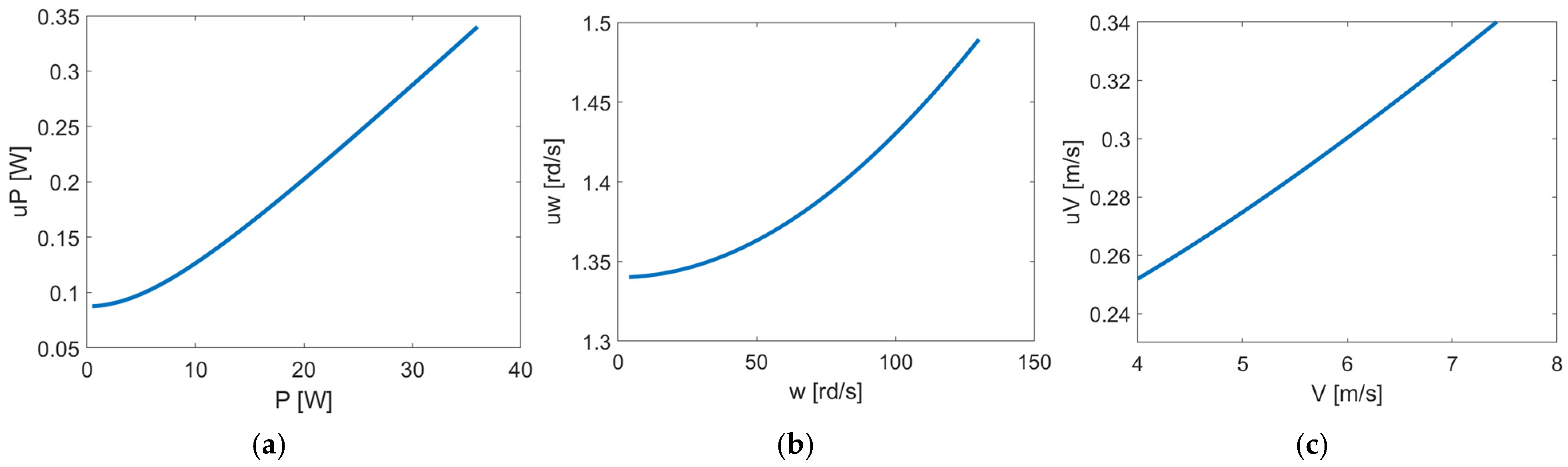
Consequently, by applying the equations from Equation (A1) to Equation (A14) at the measured data, the uncertainties of the powers rotating speed and wind speed measurements are calculated in all the operating range of the tests and graphically illustrated in next Figure A1. Note that this uncertainty quantification applies to all steady-state data of Figure 10 and Figure 12 and also to data of Figure 21 and Figure 22 devoted to transient behaviors.
Figure A1. Uncertainty quantification of the measured data in absolute units according to the Standard IEC 61400-12-1. (a) Uncertainty at measured powers, (b) Uncertainty at measured rotating speeds, (c) Uncertainty at measured wind speeds.
Smartcities 09 00011 g0a1
On the other hand, the power measurements P i   and   speed   measurements   ω i of Figure 10a and Figure 12a, are accomplished, by stablishing a constant frequency at the wind tunnel and therefore, a ‘nearly constant’ wind speed is faced by the tested wind turbine as shown in Figure 6 and Figure 7. After that, the load resistance value is set (see power circuit of Figure 8) and 3 min is waited until the generated power is stabilized. After that, a capture of power P i is performed. The power capture P i consists of the averaged power of a measured power window of 1 s of duration with a sample time of 0.5 μs (2 MS/s resolution of the WT1806E Series Power Analyzer). Then, at the same load resistance value, 5 different power captures P i are performed and all are collected as data in Figure 10a and Figure 12a. Once the 5 points are verified to be correct, the load resistance is changed and the process is repeated again: Wait 3 min for stabilization, capture 5 averaged power windows of 1 s and record as data at the curves. All the measured power data points at a constant frequency at the wind tunnel (‘nearly constant’ wind speed) are captured at a time without stopping the experiment.
On the contrary, the dynamic power measurements performed for wind gust analysis of Figure 20, Figure 21 and Figure 22, are performed in a slightly different way as before, due to the transient nature of the experiment. In this case, the Power Analyzer captures again data at its 2 MS/s resolution and the averaged power measurements are recorded at windows of 50 msec duration. The averaged powers of 50 ms are recorded in time windows of 10, 20, 30 and 40 s of duration, depending on the wind gust duration (see Figure 21 and Figure 22). From these several seconds power windows, by integrating at 50 msec of sample time, the energy is calculated in a post-processing step that is performed afterwards in the computer. Each wind gust profile has been repeated 3 times and an error of less than 5% of energy variation has been observed in all the cases.

Appendix A.2. Data Cloud Theoretical Explanation

The cloud-like dispersion observed in the experimental data stems from inherent fluctuations in the power measurements carried out in both wind turbines. When a constant frequency at the wind tunnel is stablished, a ‘nearly constant’ wind speed is faced at the wind turbines as shown in Figure 6 and Figure 7. Under these conditions, while the turbines were set at a constant load, the power measured by the wattmeter did not remain strictly constant over the time, mainly due to the fact that the wind speed faced by the wind turbine is not strictly constant. This fact can be understood by analyzing the previously presented mechanical Equation (11) and here shown again for an easier understanding:
T T ω ( t ) , V W t T e m ω ( t ) = J · d ω ( t ) d t
As can be noticed, since the wind speed V W t seen by the blades of the turbine experiments small oscillations of very small frequencies, the torque T T ( t ) generated by the blades also oscillates. Since the load connected to the generator is a constant resistive load, the generator’s electromagnetic torque T e m ω ( t ) in opposition to the turbine’s torque T T t , is not able to establish a constant rotating speed ω ( t ) and therefore, an accelerating (or decelerating) torque J · d ω ( t ) d t appears permanently. Under this situation of shortly fluctuating V W t , a small but permanent fluctuating behavior is reached at all the mechanical and electric variables of the turbine: i.e., fluctuations occur at T T ( t ) , at ω ( t ) , at T e m ω ( t ) and at P(t). Note that this fluctuating performance obtained with the employed wind tunnel, somehow also occurs in wind turbines located outdoors, since wind speed faced by wind turbines never is strictly constant.
Consequently, since the rotating speed ω ( t ) does not reach a strict constant value, the term J · d ω ( t ) d t never is made zero and therefore, the electromagnetic torque and the turbine’s torque never match, producing cloud-like curves is P   v s .   ω and C p   v s .   λ . Therefore, in order to better reflect the actual operational behavior of the turbines, as commented before, multiple measurements have been taken at each operating point. This repeated sampling approach enables a more realistic representation of the system’s performance and naturally results in a dispersion of data points around a central trend, forming the observed cloud. This methodology allows not only the identification or average behavior but also the estimation of variability margins, which are crucial for a realistic characterization of the turbines’ performance. Note also that regardless of the duration of the time window used to measure the data, the power fluctuations will always appear, since the rotational speed ω ( t ) always fluctuates without a repetitive pattern and the acceleration term J · d ω ( t ) d t will always appear (non-exact match between T T t   and T e m t ). This will cause always the power to fluctuate and will result in data like-cloud dispersion, as schematically represented in next Figure A2. Note also that in general, with larger durations of time windows of measured data, smaller dispersion of the data will be obtained. However, a certain minimum dispersion is unavoidable. At the results that have been performed and shown in the article, the time window of 1 s has been set, trying to find a compromise between the amplitude of the dispersion and the time needed to perform all the experimental tests (quite a lot of hours).
Figure A2. Data cloud explanation through a schematical representation of the non-repetitive fluctuations that occur at the mechanical and electrical magnitudes of the wind turbine systems, when the wind tunnel is set to a constant frequency.
Smartcities 09 00011 g0a2
Finally, it has to be highlighted that this oscillatory inherent behavior at constant frequency of the wind tunnel, could be perhaps mitigated by artificially increasing the inertia J of the tested wind turbines. If done so, with same wind speed V w t   and torque T T t fluctuations, the rotating speed ω ( t ) fluctuations would become smaller and therefore, also smaller fluctuations at measured power would be obtained. However, since the artificial alteration of the inertia would be complex and would affect the normal behavior during gust operation, the turbines have been maintained as commercially available provided by the manufacturers.

References

  1. Center for Global Development. Carbon Dioxide Emissions from Power Plants Rated Worldwide. 2007. Available online: https://www.sciencedaily.com/releases/2007/11/071114163448.htm (accessed on 7 July 2025).
  2. U.S. Energy Information Administration. Electricity and the Environment. 2024. Available online: https://www.eia.gov/energyexplained/electricity/electricity-and-the-environment.php (accessed on 7 July 2025).
  3. Gavaldà-Torrellas, O.; Monsalvete, P.; Ranjbar, S.; Eicker, U. The Urban Building Energy Retrofitting Tool: An Open-Source Framework to Help Foster Building Retrofitting Using a Life Cycle Costing Perspective—First Results for Montréal. Smart Cities 2025, 8, 17. [Google Scholar] [CrossRef]
  4. Lazaroiu, A.C.; Roscia, M.; Lazaroiu, G.C.; Siano, P. Review of Energy Communities: Definitions, Regulations, Topologies, and Technologies. Smart Cities 2025, 8, 8. [Google Scholar] [CrossRef]
  5. Europe in Figures—Eurostat Yearbook. Available online: https://ec.europa.eu/eurostat/statistics-explained/index.php/Archive:Europe_in_figures_-_Eurostat_yearbook (accessed on 10 July 2025).
  6. Mehrabanifar, K.; Shayeghi, H.; Younesi, A.; Siano, P. Enhancing Modern Distribution System Resilience: A Comprehensive Two-Stage Approach for Mitigating Climate Change Impact. Smart Cities 2025, 8, 76. [Google Scholar] [CrossRef]
  7. Nazer, A.; Isabella, O.; Manganiello, P. A Comprehensive Classification of State-of-the-Art Distributed Maximum Power Point Tracking Architectures for Photovoltaic Systems. IEEE Open J. Ind. Electron. Soc. 2025, 6, 738–763. [Google Scholar] [CrossRef]
  8. Cuenca, J.J.; Jamil, E.; Hayes, B. State of the Art in Energy Communities and Sharing Economy Concepts in the Electricity Sector. IEEE Trans. Ind. Appl. 2021, 57, 5737–5746. [Google Scholar] [CrossRef]
  9. Roy, P.; He, J.; Zhao, T.; Singh, Y.V. Recent Advances of Wind-Solar Hybrid Renewable Energy Systems for Power Generation: A Review. IEEE Open J. Ind. Electron. Soc. 2022, 3, 81–104. [Google Scholar] [CrossRef]
  10. Buticchi, G.; Lam, C.S.; Xinbo, R.; Liserre, M.; Barater, D.; Benbouzid, M.; Gomis-Bellmunt, O.; Ramos-Paja, C.A.; Kumar, C.; Zhu, R. The Role of Renewable Energy System in Reshaping the Electrical Grid Scenario. IEEE Open J. Ind. Electron. Soc. 2021, 2, 451–468. [Google Scholar] [CrossRef]
  11. Renewable Energy Market Update—Outlook for 2021 and 2022. Paris, 2021. Available online: https://www.iea.org/reports/renewable-energy-market-update-2021 (accessed on 9 July 2025).
  12. IEC 61400-1:2022; Wind Energy Generation Systems—Power Performance Measurements of Electricity Producing Wind Turbine. IEC: Geneve, Switzerland, 2022.
  13. Mittal, R.; Sandhu, K.S.; Jain, D.K. An Overview of Some Important Issues Related to Wind Energy Conversion System (WECS). Int. J. Environ. Sci. Dev. 2010, 1, 351–363. [Google Scholar] [CrossRef]
  14. Abad, G.; Penalba, M.; Zarketa-Astigarraga, A. Molinos de Viento Patentados por Jerónimo de Ayanz y Beaumont en el año 1606: Un análisis Conceptual Desde una Perspectiva Ingenieril del año 2021; Mondragon Unibertsitatea: Gipuzkoa, Spain, 2021. [Google Scholar] [CrossRef]
  15. Tapia, N.G. Jerónimo de Ayanz y Beaumont. Un Inventor Navarro (1553–1613); Universidad Pública de Navarra: Pamplona, Spain, 2010. [Google Scholar]
  16. Jang, H.; Kim, D.; Hwang, Y.; Paek, I.; Kim, S.; Baek, J. Analysis of Archimedes Spiral Wind Turbine Performance by Simulation and Field Test. Energies 2019, 12, 4624. [Google Scholar] [CrossRef]
  17. Refaie, A.G.; Hameed, H.A.; Nawar, M.A.; Attai, Y.A.; Mohamed, M.H. Qualitative and quantitative assessments of an Archimedes Spiral Wind Turbine performance augmented by a concentrator. Energy 2021, 231, 121128. [Google Scholar] [CrossRef]
  18. Timmer, W.A.; Toet, S. Verslag van de Metingen aan de Archimedes in de Lage-Snelheids Windtunnel van DNW; TU Delft: Delft, The Netherlands, 2009. [Google Scholar]
  19. Kim, K.; Ji, K.; Kim, H.Y.; Lu, Q.; Baek, J. Experimental and Numerical Study of the Aerodynamic Characteristics of an Archimedes Spiral Wind Turbine Blade. Energies 2014, 7, 7893–7914. [Google Scholar] [CrossRef]
  20. Labib, A.M.; Abdel, A.; Melad, G.M. Effect of Aspect Ratio on Aerodynamic Performance of Archimedes Spiral Wind Turbine. Egypt. Int. J. Eng. Sci. Technol. 2021, 32, 66–72. [Google Scholar] [CrossRef]
  21. Arzuaga, A.; Estivariz, A.; Fernández, O.; Gubía, K.; Plaza, A.; Abad, G.; Cabezuelo Romero, D. Low-Cost Maximum Power Point Tracking Strategy and Protection Circuit Applied to an Ayanz Wind Turbine with Screw Blades. Energies 2023, 16, 6204. [Google Scholar] [CrossRef]
  22. Sakamoto, L.; Fukui, T.; Morinishi, K. Blade Dimension Optimization and Performance Analysis of the 2-D Ugrinsky Wind Turbine. Energies 2022, 15, 2478. [Google Scholar] [CrossRef]
  23. Abad, G.; Plaza, A.; Kerejeta, G. Performance Evaluation of Small Wind Turbines Under Variable Winds of Cities: Case Study Applied to an Ayanz Wind Turbine with Screw Blades. Smart Cities 2024, 7, 3241–3288. [Google Scholar] [CrossRef]
  24. Maldar, N.R.; Ng, C.Y.; Oguz, E. A review of the optimization studies for Savonius turbine considering hydrokinetic applications. Energy Convers. Manag. 2020, 226, 113495. [Google Scholar] [CrossRef]
  25. Tummala, A.; Velamati, R.K.; Sinha, D.K.; Indraja, V.; Krishna, V.H. A review on small scale wind turbines. Renew. Sustain. Energy Rev. 2016, 56, 1351–1371. [Google Scholar] [CrossRef]
  26. Liam F1 Archimedes AWM-750D-150W Datasheet. Available online: https://thearchimedes.com/ (accessed on 11 July 2025).
  27. Thresher, R.W.; Holley, W.E.; Jafarey, N. Wind Response Characteristics of Horizontal Axis Wind Turbines; Oregon State University: Corvallis, OR, USA; NASA: Washington, DC, USA, 1981. [Google Scholar]
  28. Corbalán, P.A.; Chiang, L.E. Fast Power Coefficient vs. Tip–Speed Ratio Curves for SmallWind Turbines with Single-Variable Measurements following a Single Test Run. Energies 2024, 17, 1199. [Google Scholar] [CrossRef]
  29. Micallef, D.; Van Bussel, G. A Review of Urban Wind Energy Research: Aerodynamics and Other Challenges. Energies 2018, 11, 2204. [Google Scholar] [CrossRef]
Figure 1. (a) The Ayanz SWT; (b) Three-blade SWT used.
Smartcities 09 00011 g001
Figure 2. (a) Wind tunnel fan VPA 1400SP of the manufacturer NLH Industrie (Jouars Pontchartrain, France) (b) geometrical characteristics of the wind tunnel.
Smartcities 09 00011 g002
Figure 3. Wind tunnel setup and turbine positioning: (a) lateral placement of the Ayanz SWT; (b) lateral placement of the Three-blade SWT; (c) frontal placement of SWTs relative to the wind tunnel (Ayanz in blue and Three-blade SWT in red); (d) V w measurement points at the tunnel outlet.
Smartcities 09 00011 g003
Figure 4. Representative wind measurements at Mondragon Unibertsitatea (a) day one (b) day two.
Smartcities 09 00011 g004
Figure 5. V w at 20 Hz for the (a) Ayanz SWT and the (b) Three-blade SWT.
Smartcities 09 00011 g005
Figure 6. V w vs. wind tunnel fan frequency with extrapolation.
Smartcities 09 00011 g006
Figure 7. (a) data points measured on the wind tunnel; (b) constant V w at 25 Hz for 5 min.
Smartcities 09 00011 g007
Figure 8. Experimental setup for constant V w characterization: (a) power electronics circuit; (b) Yokogawa wattmeter (Yokogawa, Tokio, Japan) and 100 Ω variable resistors.
Smartcities 09 00011 g008
Figure 9. Back-EMF measurements in one mechanical turn for (a) the Ayanz SWT; (b) the Three-blade SWT.
Smartcities 09 00011 g009
Figure 10. Curve fitting results for the Ayanz SWT under steady wind conditions: (a) P e m   v s .   ω m e c (b) C P   v s .   λ (Check Appendix A, for uncertainty quantification of the measured data). Black dots for measured data, red dash lines for maximum fitted curves, green dash lines for minimum fitted curves and blue lines for mean fitted curves.
Smartcities 09 00011 g010
Figure 11. Three-blade SWT voltage and current waveforms.
Smartcities 09 00011 g011
Figure 12. Curve fitting results for the Three-blade SWT under steady wind conditions: (a) P e m   v s .   ω m e c (b) C P   v s .   λ (Check Appendix A, for uncertainty quantification of the measured data). Red dash lines for maximum fitted curves, green dash lines for minimum fitted curves and blue lines for mean fitted curves. Black dots for measured data in (a) and different colored dots for measured data in (b) to distinguish between V w measurements as they overlap.
Smartcities 09 00011 g012
Figure 13. Comparison of plateau width for each turbine, defined as the range where C P remains within 5% of its maximum (defined by black dots): (a) Ayanz SWT; (b) Three-blade SWT.
Smartcities 09 00011 g013
Figure 14. V w profile measured with a Lufft XA1000 anemometer (Lufft, Fellbach, Germany) during a moderately windy day (day one) at Mondragon Unibertsitatea (in blue) with simplified wind pattern (in orange) for experimental replication.
Smartcities 09 00011 g014
Figure 15. Different SWT control method configurations [16,18]. MPPT (Maximum Power Point Tracker).
Smartcities 09 00011 g015
Figure 16. Simulated performance curves for different wind turbine control approaches over the P e m   v s .   ω m e c curves (in blue).
Smartcities 09 00011 g016
Figure 17. Experimental setup for wind gust characterization: (a) power electronics circuit; (b) Yokogawa wattmeter and ITECH bidirectional power supply (front).
Smartcities 09 00011 g017
Figure 18. Power curves obtained using pseudo-MPPT strategy under fixed voltage conditions: (a) Ayanz SWT at 48 V; (b) Three-blade SWT at 16 V. Blue points are measured real points, dashed lines are extrapolated points (non-measured points) and arrows indicate the direction in which the working region moves in pseudo-MPPT operation.
Smartcities 09 00011 g018
Figure 19. Wind gust scheme.
Smartcities 09 00011 g019
Figure 20. Response of the Three-blade wind turbine under real wind gust conditions: (a) applied wind gust profile, and (b) resulting power output.
Smartcities 09 00011 g020
Figure 21. Energy generation of the Ayanz SWT normalized by rotor swept area: (a) total energy per swept area, (b) amplitude-based energy per swept area. (Check Appendix A, for uncertainty quantification of the measured data).
Smartcities 09 00011 g021
Figure 22. Energy generation of the Three-blade SWT normalized by rotor swept area: (a) total energy per swept area, (b) amplitude-based energy per swept area (Check Appendix A, for uncertainty quantification of the measured data).
Smartcities 09 00011 g022
Table 1. V w measurements at different frequencies for both SWT.
Ayanz SWTThree-Blade SWT
Wind Tunnel Fan Freq. (Hz) V w , m e a n (m/s)Wind Tunnel Fan Freq. (Hz) V w , m e a n (m/s)
205.39164.2
22.56.06184.7
256.63205.15
27.57.21
307.91
Table 2. R s measurement for both SWT.
Ayanz SWTThree-Blade SWT
Measurement R s (Ω) R s (Ω)
First9.54 0.31
Second9.56 0.31
Third9.58 0.29
Mean 9.56 0.3
Table 3. Ayanz SWT’s main parameters.
Geometrical ParametersUnitElectrical ParametersUnit
Blades3 R s 9.56 Ω
Radius37.5 cm L s 16.96 mH
Area0.412 m2 p 6
Longitude60 cm V n (VAC rms)48 V
Table 4. Min, max and mean C P values for the Ayanz SWT.
V w (m/s)Cp MinCp MaxCp Mean
5.390.0844130.0941440.089337
6.060.1189630.1301840.123928
6.630.1525750.1666420.159761
7.210.1769630.1929610.184969
Table 5. Three-blade SWT’s main parameters.
Geometrical ParametersUnitElectrical ParametersUnit
Blades3 R s 0.3 Ω
Radius58 cm L s 0.207 mH
Area1.057 m2 p 6
Longitude67.5 cm V n (VAC rms)24 V
Table 6. Min, max and mean C P values for the Three-blade SWT.
V w (m/s)Cp MinCp MaxCp Mean
4.20.35380.37880.3645
4.70.39490.41640.4064
5.150.38580.40350.3919
Table 7. Ayanz’s wind gust configuration.
Offset (m/s)Amplitude of the Gust [A] (m/s)Maximum Amplitude Points of the Gust (m/s)Duration of the Gust [Δt] (s)
06.066.0610–20–
30–40
6.636.63
7.217.21
7.917.91
1.615.026.63
5.67.21
6.37.91
3.233.46.63
3.987.21
4.687.91
4.841.796.63
2.377.21
3.077.91
6.060.576.63
1.157.21
1.857.91
Table 8. Three-Blade SWT’s wind gust configuration.
Offset (m/s)Amplitude of the Gust [A] (m/s)Maximum Amplitude Points of the Gust (m/s)Duration of the Gust [Δt] (s)
04.74.710–20–
30–40
5.155.15
5.65.6
6.256.25
14.155.15
4.65.6
5.256.25
2.13.055.15
3.55.6
4.156.25
3.21.955.15
2.45.6
3.056.25
3.71.455.15
1.95.6
2.556.25
4.20.955.15
1.45.6
2.056.25
4.70.455.15
0.95.6
1.556.25
Table 9. Qualitative comparison of Ayanz and Three-blade SWTs under gusty wind conditions. Very high (++), high (+) and low( ).
Ayanz SWTThree-Blade SWT
Maximize energy production in cities with gusty winds
(Considering the following indicators)
+++
High   C P , m a x characteristic ++
Non-peaked   C P   v s .   λ curve++
Maximize the generated energy at low-speed winds (good start-up at low offset)++
Maximize the generated energy at the gust when not at the optimum speed
(favorable start-up transient characteristic)
+++
Maximize the generated energy at the gust when in optimum speed (high offset)+++
Maximize the energy generated in ΔTUndetermined, dependent on the offset
Maximize the energy generated in AUndetermined, dependent on the offset + ΔT
Disclaimer/Publisher’s Note: The statements, opinions and data contained in all publications are solely those of the individual author(s) and contributor(s) and not of MDPI and/or the editor(s). MDPI and/or the editor(s) disclaim responsibility for any injury to people or property resulting from any ideas, methods, instructions or products referred to in the content.