

Perceptions of Quality of Life Among Various Groups of Residents in Cities Aspiring to Be Smart in a Developing Economy


Highlights
- The assessment of the quality of life in cities varies due to demographic, social, and geographical characteristics and cannot be generalized (the differences may be ambiguous and multidirectional).
- At the regional level, despite similar socioeconomic conditions, there are significant differences in the residents’ quality of life, creating a risk of imbalance and exclusion of some cities from further regional development.
- The perspective of the quality of life varies in different groups of residents; however, the identified differences do not always correspond to the generally accepted direction of exclusion.
- The quality of life is moderately positively correlated with the economic conditions of cities, but this is not the only condition for a higher quality of life and a city’s aspiration to be smart.
- Theoretically, the analysis provides new knowledge on the diversity of quality-of-life assessments in cities depending on the demographic and social characteristics of residents and the regional location of cities.
- In practical terms, the study provides information on the assessment of quality of life from the perspective of residents (very rarely found in the literature) of large cities located in a developing economy.
- In terms of recommendations, the results of the study indicate directions for improving living conditions in cities and the Silesian province, which can also be used in other geographical locations.
Abstract
1. Introduction
- the need to assess the quality of life in cities aspiring to smart status within emerging economies;
- the necessity of evaluating quality of life disparities based on sociodemographic characteristics (age, gender, education, economic status) that signal potential exclusion risks;
- and the need to expand knowledge regarding residential location impacts on quality of life on the regional scale.
- Which social groups assess the quality of life in the city as worse and are potentially at risk of exclusion?
- In which cities in the region do residents live in worse circumstances, and are these cities at risk of pauperization, depopulation, and rapid aging of the local community?
- It presents empirical research results on implementing the smart city concept, providing a valuable practical perspective in a field dominated by theoretical considerations.
- It presents conclusions from residents’ perspectives, offering a grassroots analysis rarely found in the literature.
- It uses statistical research on a large representative regional sample, unlike the popular case studies of individual cities.
- It analyzes smart city implementation in cities from developing economies that aspire to become “smart”.
- It describes social exclusion from the perspective of different groups—by gender, age, education, and household size.
- It discusses regional exclusion of cities—a topic rarely addressed in the literature.
- It identifies real (not theoretical) gaps in urban quality of life and helps develop remedial actions for sustainable city management.
2. Literature Review
2.1. Quality of Life in the City in the Light of the Literature Analysis
2.2. Quality of Life in the City and Social Exclusion
- Gender;
- Age;
- Education;
- Economic status.
2.3. Identification of a Research Gap and Formulation of Research Hypotheses
- Quality of life is most often assessed indirectly—through the impact of various factors on satisfaction with urban life.
- Numerous studies, including direct ones, focus on the determinants of quality of life, without paying attention to the assessment itself and its diversity.
- Literature does not provide a comparative analysis of quality of life, whether local, regional, national, or international, which could have important implications for urban management.
3. Materials and Methods
3.1. Research Assumptions
3.2. Survey Questionnaire
3.3. Characteristics of the Cities Studied
3.4. Methods of Analyzing the Survey Data
- Identifying average trends and variability in the quality of life in individual cities, as well as the skewness and concentration of the distribution;
- Determining the relationship between the quality of life and the economic situation of cities;
- Testing the hypotheses regarding the relationship between the quality of life, sociodemographic characteristics of the residents, and city location.
4. Results
4.1. Assessment of the Quality of Life in the Surveyed Silesian Cities
4.2. Sociodemographic Differences in the Assessment of Quality of Life in Silesian Cities
4.3. Geographical Differences in Quality-of-Life Assessments in the Silesian Province
5. Discussion
5.1. Comparison of the Research Results with Previous Analyses and Observations
5.2. Implications for the Smart City Concept
5.3. Management Recommendations in the Context of Shaping and Monitoring the Quality of Life in the City
- Consultations with municipal authorities aimed at developing effective measures to improve the economic situation;
- Inclusion of cities at risk of regional exclusion in joint regional development initiatives;
- Introduction of exchanges of good inter-city neighborhood practices for use and implementation in less developed units;
- Provision of substantive and economic support in the financial restructuring process;
- Initiation of and assistance with the development of activities supporting entrepreneurship and attracting investors;
- Promotion of cities in the region and the country with a focus on showcasing their strengths and distinctive features.
- Identifying the reasons for the lower satisfaction with the quality of life among women, the youngest residents, and people with primary education or a bachelor’s degree;
- Taking measures to improve the quality of life of working-age residents (who are least satisfied with life in cities) in order to prevent their migration (this could certainly include improving housing conditions and the availability of housing);
- Continuing good senior citizen policies resulting in high quality-of-life ratings among the oldest residents of Silesian cities;
- Enabling further vocational training for people with basic education and improving the professional skills of residents with a bachelor’s degree;
- Continuing and strengthening economic transformation in connection with progressive decarbonization, including, above all, seeking and supporting investors representing industries with high growth potential.
6. Conclusions
6.1. Key Research Findings and Observations
- The overall assessment of the quality of urban life in Silesia is higher than good (average, median, and dominant values of approximately 7/10) and is characterized by moderate diversity, although there are extremely dissatisfied with their lives in Silesia;
- Women rate the quality of life in Silesian cities slightly lower than men, which may suggest a sense of exclusion of this group, and implies the need for remedial measures aimed at identifying women’s needs and expectations for urban life;
- The quality of life is rated worst by young city dwellers in the 18–40 age group, which may result from unfulfilled expectations regarding living conditions, including housing and employment needs;
- Satisfaction with life in the cities surveyed increases with age, which indicates that there is no risk of exclusion for seniors and testifies to the effectiveness of senior citizen policies in the analyzed area;
- Quality of life is also linked to the education of residents, with those with primary education and a bachelor’s degree rating it lowest, while those with vocational and secondary education rate it the highest;
- The assessment of quality of life is not related to the number of people in a household, but couples and families of more than five people live best.
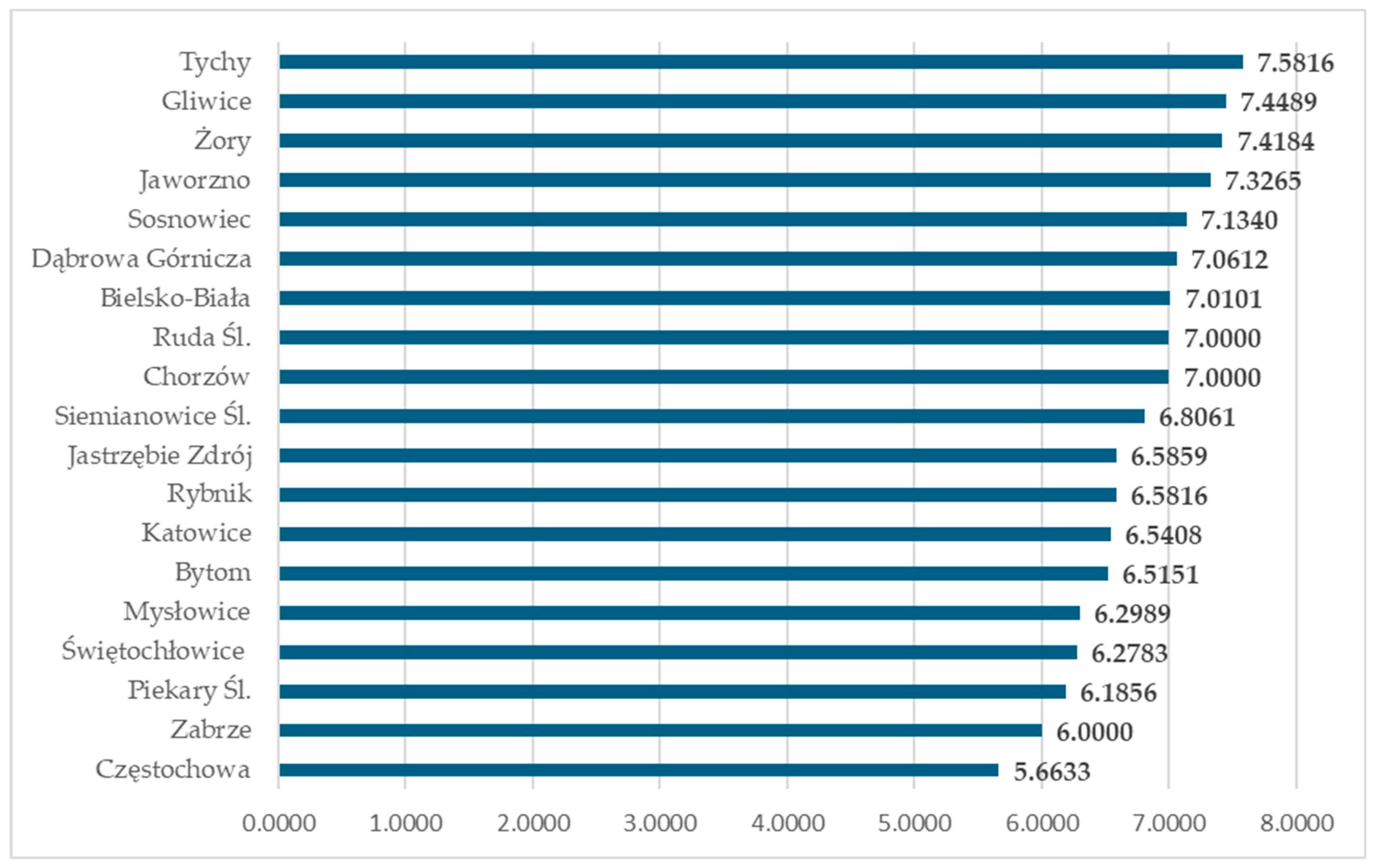
- The best quality of life is in Tychy, Gliwice, and Żory, which is most likely due to the high level of industrialization in these areas, the successful post-industrial transformation, and the activities of the Katowice Special Economic Zone (cities in Upper Silesia);
- The quality of urban life is rated lowest by the inhabitants of Częstochowa, Zabrze, and Piekary Śląskie, which may be the result of weak industrialization and the low effectiveness of the transformation of post-mining regions;
- The diversity of the quality-of-life assessments in the surveyed cities is moderate, with the lowest in Gliwice and the highest in the cities with the lowest ratings, which indicates a high polarization of opinions in these cities;
- In all the cities surveyed, the distributions of quality-of-life assessments are skewed to the left, which means that there are many very low ratings among the responses, which negatively affects the arithmetic mean;
- Most of the distributions of quality-of-life assessments are leptokurtic, with extreme values appearing more frequently than in a normal distribution (therefore, the respondents include residents who are extremely dissatisfied with life in the city);
- There is a statistically significant positive and moderate relationship between the city’s income, which expresses its wealth, and the assessment of the quality of life.
6.2. Conclusions for Cities Aspiring to Become Smart
6.3. Research Limitations and Directions for Further Research
- There is a lack of in-depth cause-and-effect analyses;
- Only a general assessment of quality of life was carried out, without taking into account specific areas of development of modern smart cities;
- The study was limited to cities located in one province, without national or international comparative analyses.
6.4. The Contribution of This Research to the Development of the Smart City Concept
Funding
Data Availability Statement
Acknowledgments
Conflicts of Interest
References
- Gracias, J.S.; Parnell, G.S.; Specking, E.; Pohl, E.A.; Buchanan, R. Smart cities—A structured literature review. Smart Cities 2023, 6, 1719–1743. [Google Scholar] [CrossRef]
- Keshavarzi, G.; Yildirim, Y.; Arefi, M. Does scale matter? An overview of the “smart cities” literature. Sustain. Cities Soc. 2021, 74, 103151. [Google Scholar] [CrossRef]
- Zhao, F.; Fashola, O.I.; Olarewaju, T.I.; Onwumere, I. Smart city research: A holistic and state-of-the-art literature review. Cities 2021, 119, 103406. [Google Scholar] [CrossRef]
- Thao, N.D.L. Attracting investments for the development of smart city Phu Quoc–Kien Giang Province. Int. J. Adv. Econ. 2022, 4, 63–77. [Google Scholar] [CrossRef]
- Toh, C.K. Smart city indexes, criteria, indicators and rankings: An in-depth investigation and analysis. IET Smart Cities 2022, 4, 211–228. [Google Scholar] [CrossRef]
- Yin, J.; Song, H. Does the perception of smart governance enhance commercial investments? Evidence from Beijing, Shanghai, Guangzhou, and Hangzhou. Heliyon 2023, 9, e19024. [Google Scholar] [CrossRef]
- Zhu, H.; Shen, L.; Ren, Y. How can smart city shape a happier life? The mechanism for developing a Happiness Driven Smart City. Sustain. Cities Soc. 2022, 80, 103791. [Google Scholar] [CrossRef]
- Manfreda, A.; Mijač, T. Highlighting gaps in technology acceptance research: A call for integrating happiness and well-being into smart city development. J. Innov. Knowl. 2024, 9, 100585. [Google Scholar] [CrossRef]
- Wang, C.H.; Steinfeld, E.; Maisel, J.L.; Kang, B. Is your smart city inclusive? Evaluating proposals from the US Department of Transportation’s Smart City Challenge. Sustain. Cities Soc. 2021, 74, 103148. [Google Scholar] [CrossRef]
- Van Twist, A.; Ruijer, E.; Meijer, A. Smart cities & citizen discontent: A systematic review of the literature. Gov. Inf. Q. 2023, 40, 101799. [Google Scholar] [CrossRef]
- Bandauko, E.; Nutifafa Arku, R. A critical analysis of ‘smart cities’ as an urban development strategy in Africa. Int. Plan. Stud. 2023, 28, 69–86. [Google Scholar] [CrossRef]
- Kim, K. Exclusion and cooperation of the urban poor outside the institutional framework of the smart city: A case of Seoul. Sustainability 2022, 14, 13159. [Google Scholar] [CrossRef]
- Akpınar, M.T. Smart city applications in digital age: State-of-art review and critique. J. Inf. Syst. Manag. Res. 2019, 1, 37–42. [Google Scholar]
- Colding, J.; Barthel, S. An urban ecology critique on the “Smart City” model. J. Clean. Prod. 2017, 164, 95–101. [Google Scholar] [CrossRef]
- Shelton, T.; Zook, M.; Wiig, A. The ‘actually existing smart city’. Camb. J. Reg. Econ. Soc. 2015, 8, 13–25. [Google Scholar] [CrossRef]
- Yang, C. Historicizing the smart cities: Genealogy as a method of critique for smart urbanism. Telemat. Inform. 2020, 55, 101438. [Google Scholar] [CrossRef]
- Browne, N.J. Regarding smart cities in China, the North and emerging economies—One size does not fit all. Smart Cities 2020, 3, 11. [Google Scholar] [CrossRef]
- Fromhold-Eisebith, M.; Eisebith, G. What can Smart City policies in emerging economies actually achieve? Conceptual considerations and empirical insights from India. World Dev. 2019, 123, 104614. [Google Scholar] [CrossRef]
- Chatterjee, S.; Kar, A.K. Readiness of Smart City: Emerging Economy Perspective. In Emerging Markets from a Multidisciplinary Perspective. Advances in Theory and Practice of Emerging Markets; Dwivedi, Y.K., Rana, N.P., Slade, E.L., Shareef, M.A., Clement, M., Simintiras, A.C., Lal, B., Eds.; Springer: Cham, Switzerland, 2018. [Google Scholar] [CrossRef]
- Raghuvanshi, R.; Sharma, T. Smart Cities in Emerging Economies: Opportunities, Challenges and Policy Implications. In Proceedings of the Third International Conference on Information Management and Machine Intelligence. Algorithms for Intelligent Systems; Goyal, D., Kumar, A., Piuri, V., Paprzycki, M., Eds.; Springer: Singapore, 2023; pp. 319–329. [Google Scholar] [CrossRef]
- ISO 37120:2018; Sustainable Cities and Communities—Indicators for City Services and Quality of Life. ISO (International Organization for Standardization): Geneva, Switzerland, 2018.
- Ligarski, M.J.; Wolny, M. Quality of Life Surveys as a Method of Obtaining Data for Sustainable City Development—Results of Empirical Research. Energies 2021, 14, 7592. [Google Scholar] [CrossRef]
- Basu, K. Achievements, capabilities and the concept of well-being: A review of Commodities and Capabilities by Amartya Sen. Soc. Choice Welf. 1987, 4, 69–76. [Google Scholar] [CrossRef]
- Sen, A. Freedom of choice: Concept and content. Eur. Econ. Rev. 1988, 32, 269–294. [Google Scholar] [CrossRef]
- Sen, A. Behaviour and the Concept of Preference. Economica 1973, 40, 241–259. [Google Scholar] [CrossRef]
- Available online: https://www.who.int/tools/whoqol (accessed on 7 July 2025).
- Diener, E.; Lucas, R.E.; Oishi, S. Subjective well-being. the science of happiness and life satisfaction. In Handbook of Positive Psychology; Snyder, C.R., lopez, S.J., Eds.; Oxford University Press: New York, NY, USA, 2002; pp. 187–194. [Google Scholar] [CrossRef]
- Seligman, P. Positive psychology, positive prevention, and positive therapy. In Handbook of Positive Psychology; Snyder, C.R., Lopez, S.J., Eds.; Oxford University Press: New York, NY, USA, 2002; pp. 3–7. [Google Scholar] [CrossRef]
- Seligman, P. Authentic Happiness; Free Press: New York, NY, USA, 2002. [Google Scholar] [CrossRef]
- Karaś, D. Pojęcia i koncepcje dobrostanu: Przegląd i próba uporządkowania. Stud. Psychol. Theor. Et Prax. 2019, 19, 5–23. [Google Scholar] [CrossRef]
- Chang, S.; Smith, M.K. Residents’ Quality of Life in Smart Cities: A Systematic Literature Review. Land 2023, 12, 876. [Google Scholar] [CrossRef]
- De Guimarães, J.C.F.; Severo, E.A.; Júnior, L.A.F.; Da Costa, W.P.L.B.; Salmoria, F.T. Governance and quality of life in smart cities: Towards sustainable development goals. J. Clean. Prod. 2020, 253, 119926. [Google Scholar] [CrossRef]
- Hartley, K. Public perceptions about smart cities: Governance and quality-of-life in Hong Kong. Soc. Indic. Res. 2023, 166, 731–753. [Google Scholar] [CrossRef]
- Attar, R.W.; Habes, M.; Almusharraf, A.; Alhazmi, A.H.; Attar, R.W. Exploring the Impact of Smart cities on improving the quality of life for people with disabilities in Saudi Arabia. Front. Built Environ. 2024, 10, 1398425. [Google Scholar] [CrossRef]
- Padrón Nápoles, V.M.; Gachet Páez, D.; Esteban Penelas, J.L.; García Pérez, O.; Martín de Pablos, F.; Muñoz Gil, R. Social Inclusion in Smart Cities. In Handbook of Smart Cities; Augusto, J.C., Ed.; Springer: Cham, Switzerland, 2021; pp. 469–514. [Google Scholar] [CrossRef]
- Macke, J.; Casagrande, R.M.; Sarate, J.A.R.; Silva, K.A. Smart city and quality of life: Citizens’ perception in a Brazilian case study. J. Clean. Prod. 2018, 182, 717–726. [Google Scholar] [CrossRef]
- Miklian, J.; Hoelscher, K. Smart cities, mobile technologies and social cohesion in India. Indian J. Hum. Dev. 2017, 11, 1–16. [Google Scholar] [CrossRef]
- Smékalová, L.; Kučera, F. Smart city projects in the small-sized municipalities: Contribution of the cohesion policy. Sci. Pap. Univ. Pardubic. 2020, 28, 1067. [Google Scholar] [CrossRef]
- Šulyová, D.; Kubina, M. Quality of life in the concept of strategic management for Smart Cities. Forum Sci. Oeconomia 2022, 10, 9–24. [Google Scholar]
- Karelis, C.; Lachana, Z.; Gorelova, I.; Alexopoulos, C.; Lavdaria, N.; Bellini, F.; Charalabidis, Y. Digital Inclusion and Social Cohesion in Smart Cities: Overcoming Barriers in the Digital Age. In Proceedings of the Annual International Conference on Digital Government Research, Porto Alegre, Brazil, 9–12 June 2025; Volume 26. [Google Scholar] [CrossRef]
- Oke, A.E.; Aigbavboa, C.O.; Cane, T.K. Relationship between smart city drivers and socially cohesive societies. In Proceedings of the Mediterranean Symposium on Smart City Applications, Tangier, Morocco, 15–27 October 2017; Springer International Publishing: Cham, Switzerland, 2017; pp. 453–462. [Google Scholar] [CrossRef]
- Chen, T.; Ramon Gil-Garcia, J.; Gasco-Hernandez, M. Understanding social sustainability for smart cities: The importance of inclusion, equity, and citizen participation as both inputs and long-term outcomes. J. Smart Cities Soc. 2022, 1, 135–148. [Google Scholar] [CrossRef]
- Dewalska–Opitek, A. Smart city concept–the citizens’ perspective. In Proceedings of the International Conference on Transport Systems Telematics, Katowice-Ustroń, Poland, 27 October 2014; Springer: Berlin/Heidelberg, Germany, 2014; pp. 331–340. [Google Scholar]
- Pangestu, R.P.A.G.; Sudibyo, D.P.; Nugroho, R.A. Evaluation of Surabaya Smart City implementation in realizing smart government, smart economy, smart environment, smart living, smart people, and smart mobility. In Proceedings of the 1st International Conference Of Education, Social and Humanities, INCESH, Ponorogo, Indonesia, 3 June 2021; pp. 320–327. [Google Scholar]
- Vázquez, J.L.; Lanero, A.; Gutiérrez, P.; Sahelices, C. The contribution of smart cities to quality of life from the view of citizens. In Entrepreneurial, Innovative and Sustainable Ecosystems: Best Practices and Implications for Quality-of-Life; Springer International Publishing: Cham, Switzerland, 2018; pp. 55–66. [Google Scholar] [CrossRef]
- Wang, M.; Zhou, T. Does smart city implementation improve the subjective quality of life? Evidence from China. Technol. Soc. 2023, 72, 102161. [Google Scholar] [CrossRef]
- Serrano, W. Digital systems in smart city and infrastructure: Digital as a service. Smart Cities 2018, 1, 134–154. [Google Scholar] [CrossRef]
- Mazzetto, S. A review of urban digital twins integration, challenges, and future directions in smart city development. Sustainability 2024, 16, 8337. [Google Scholar] [CrossRef]
- Shin, S.Y.; Kim, D.; Chun, S.A. Digital divide in advanced smart city innovations. Sustainability 2021, 13, 4076. [Google Scholar] [CrossRef]
- Oliveira, Á.; Campolargo, M. From smart cities to human smart cities. In Proceedings of the 2015 48th Hawaii International Conference on System Sciences, Kauai, HI, USA, 5–8 January 2015; pp. 2336–2344. [Google Scholar] [CrossRef]
- Streitz, N.A. From smart-only cities towards humane and cooperative hybrid cities. Technol. Archit. Des. 2021, 5, 127–133. [Google Scholar] [CrossRef]
- de Oliveira, À.D. The human smart cities manifesto: A global perspective. In Human Smart Cities: Rethinking the Interplay Between Design and Planning; Springer International Publishing: Cham, Switzerland, 2016; pp. 197–202. [Google Scholar] [CrossRef]
- Dameri, R.P. Smart City and ICT. Shaping Urban Space for Better Quality of Life. In Information and Communication Technologies in Organizations and Society. Lecture Notes in Information Systems and Organisation; Ricciardi, F., Harfouche, A., Eds.; Springer: Cham, Switzerland, 2016; Volume 15, pp. 85–98. [Google Scholar] [CrossRef]
- Persaud, T.; Amadi, U.; Duane, A.; Youhana, B.; Mehta, K. Smart city innovations to improve quality of life in urban settings. In Proceedings of the 2020 IEEE Global Humanitarian Technology Conference, (GHTC), Villanova, PA, USA, 23–26 October 2024; pp. 1–8. [Google Scholar] [CrossRef]
- Tjønndal, A.; Nilssen, M. Innovative sport and leisure approaches to quality of life in the smart city. World Leis. J. 2019, 61, 228–240. [Google Scholar] [CrossRef]
- Wolniak, R.; Jonek-Kowalska, I. The level of the quality of life in the city and its monitoring. Innov. Eur. J. Soc. Sci. Res. 2021, 34, 376–398. [Google Scholar] [CrossRef]
- Calvi, A. Gender, data protection & the smart city: Exploring the role of DPIA in achieving equality goals. Eur. J. Spat. Dev. 2022, 19, 24–47. [Google Scholar] [CrossRef]
- Elanda, Y.; Wahyudi, R.; Alie, A. Implementasi smart city di indonesia dalam perspektif gender. J. Ris. Sosiol. Progresif Aktual 2022, 4, 140–162. [Google Scholar] [CrossRef]
- Singh, Y.J. Is smart mobility also gender-smart? J. Gend. Stud. 2019, 29, 832–846. [Google Scholar] [CrossRef]
- Li, M.; Woolrych, R. Exploring the disconnection between smart city policy and practice and social inclusion amongst older people. AMPS Proc. Ser. 2020, 21, 311–319. [Google Scholar]
- Jonek-Kowalska, I.; Wolny, M. Age Sustainability in Smart City: Seniors as Urban Stakeholders in the Light of Literature Studies. Sustainability 2025, 17, 6333. [Google Scholar] [CrossRef]
- Buffel, T.; Rémillard-Boilard, S.; Walsh, K.; McDonald, B.; Smetcoren, A.S.; De Donder, L. Age-friendly approaches and old-age exclusion: A cross-city analysis. Int. J. Ageing Later Life 2020, 14, 89–117. [Google Scholar] [CrossRef]
- Olsson, T.; Samuelsson, U.; Viscovi, D. At risk of exclusion? Degrees of ICT access and literacy among senior citizens. Inf. Commun. Soc. 2017, 22, 55–72. [Google Scholar] [CrossRef]
- Albuquerque, C.M.P. Cities Really Smart and Inclusive: Possibilities and Limits for Social Inclusion and Participation. In Handbook of Research on Entrepreneurial Development and Innovation Within Smart Cities; IGI Global Scientific Publishing: Hershey, PA, USA, 2017; pp. 229–247. [Google Scholar] [CrossRef]
- Greene, S.; Pendall, R.; Scott, M.M.; Lei, S. Open Cities: From Economic Exclusion to Urban Inclusion; Urban Institute: Washington, DC, USA, 2016; Available online: https://www.urban.org/sites/default/files/publication/80166/2000770-open-cities-from-economic-exclusion-to-urban-inclusion_0.pdf (accessed on 11 August 2025).
- Monfaredzadeh, T.; Krueger, R. Investigating social factors of sustainability in a smart city. Procedia Eng. 2015, 118, 1112–1118. [Google Scholar] [CrossRef]
- Freestone, R.; Favaro, P. The social sustainability of smart cities: A conceptual framework. City Cult. Soc. 2022, 29, 100460. [Google Scholar] [CrossRef]
- Danilina, N.; Majorzadehzahiri, A. Social factors of sustainability for a smart city development. IOP Conf. Ser. Mater. Sci. Eng. 2020, 869, 022027. [Google Scholar] [CrossRef]
- Sarkar, S. A mission to converge for inclusion? The smart city and the women of Seelampur. Media Cult. Soc. 2019, 41, 278–293. [Google Scholar] [CrossRef]
- Burns, R.; Andrucki, M. Smart cities: Who cares? Environ. Plan. A Econ. Space 2021, 53, 12–30. [Google Scholar] [CrossRef]
- Chang, J.I.; Choi, J.; An, H.; Chung, H.Y. Gendering the smart city: A case study of Sejong City, Korea. Cities 2022, 120, 103422. [Google Scholar] [CrossRef]
- Jonek-Kowalska, I.; Wolniak, R. Exclusion in Smart Cities: Assessment and Strategy for Strengthening Resilience; Taylor & Francis: Abingdon, UK, 2025. [Google Scholar]
- Kolotouchkina, O.; Ripoll González, L.; Belabas, W. Smart cities, digital inequalities, and the challenge of inclusion. Smart Cities 2024, 7, 3355–3370. [Google Scholar] [CrossRef]
- Rosol, M.; Blue, G. From the smart city to urban justice in a digital age. City 2022, 26, 684–705. [Google Scholar] [CrossRef]
- Fernanda Medina Macaya, J.; Ben Dhaou, S.; Cunha, M.A. Gendering the Smart Cities: Addressing gender inequalities in urban spaces. In Proceedings of the 14th International Conference on Theory and Practice of Electronic Governance, Athens, Greece, 6–8 October 2021; pp. 398–405. [Google Scholar] [CrossRef]
- Clavijo, D. Older people and the smart city–Developing inclusive practices to protect and serve a vulnerable population. Internet Policy Rev. 2023, 12, 45. [Google Scholar] [CrossRef]
- Chib, A.; Alvarez, K.; Todorovic, T. Critical perspectives on the smart city: Efficiency objectives vs inclusion ideals. J. Urban Technol. 2022, 29, 83–99. [Google Scholar] [CrossRef]
- Poli, S.; Palumbo, M.; Operto, S. How to Improve Social Participation of Senior Citizens Thorough ICTs: A Techno-Demographic Challenge for an Effective Smart City. In Managing Smart Cities; Visvizi, A., Troisi, O., Eds.; Springer: Cham, Switzerland, 2022; pp. 199–212. [Google Scholar] [CrossRef]
- Li, M.; Woolrych, R. Experiences of older people and social inclusion in relation to smart “age-friendly” cities: A case study of Chongqing, China. Front. Public Health 2021, 9, 779913. [Google Scholar] [CrossRef] [PubMed]
- Bokolo, A.J. Inclusive and safe mobility needs of senior citizens: Implications for age-friendly cities and communities. Urban Sci. 2023, 7, 103. [Google Scholar] [CrossRef]
- Skouby, K.E.; Kivimäki, A.; Haukiputo, L.; Lynggaard, P.; Windekilde, I.M. Smart cities and the ageing population. In Proceedings of the 32nd Meeting of WWRF, Marrakech, Morocco, 20–22 May 2014; pp. 1–12. [Google Scholar]
- Shayan, S.; Kim, K.P. Understanding correlations between social risks and sociodemographic factors in smart city development. Sustain. Cities Soc. 2023, 89, 104320. [Google Scholar] [CrossRef]
- Molnar, A. Smart cities education: An insight into existing drawbacks. Telemat. Inform. 2021, 57, 101509. [Google Scholar] [CrossRef]
- Marciniak, K.I.; Owoc, M.L. Exclusion services in smart city knowledge portal. Inform. Ekon. 2015, 2, 19–33. [Google Scholar] [CrossRef]
- Kruhlov, V.; Dvorak, J. Social Inclusivity in the Smart City Governance: Overcoming the Digital Divide. Sustainability 2025, 17, 5735. [Google Scholar] [CrossRef]
- Adiego, J.; Martín-Cruz, N. Training competences in smart cities: An online program for higher education students. Int. J. Sustain. High. Educ. 2021, 22, 1630–1645. [Google Scholar] [CrossRef]
- Balfaqih, M.; Alharbi, S.A. Associated information and communication technologies challenges of smart city development. Sustainability 2022, 14, 16240. [Google Scholar] [CrossRef]
- Lister, P. Smart Learning in the Community: Supporting Citizen Digital Skills and Literacies. In Distributed, Ambient and Pervasive Interactions HCII 2020. Lecture Notes in Computer Science; Streitz, N., Konomi, S., Eds.; Springer: Cham, Switzerland, 2020; p. 12203. [Google Scholar] [CrossRef]
- Pangsy-Kania, S.; Kania, K. Key Dimensions in Smart Cities’ Rankings-Towards Enhancing the Quality of Life for Smart Cities’ Inhabitants. Ekon. I Prawo. Econ. Law 2024, 23, 493–518. [Google Scholar] [CrossRef]
- Sheykhi, M.T. Smart city vs quality of life with a focus on Asia: A sociological appraisal. Middle East J. Bus. 2021, 16, 12–19. [Google Scholar]
- Wijayasinghe, S.; Sachitra, V. Smart city development and improvement of quality of life in urban cities of Sri Lanka: Citizen-centric approach. J. Glob. Responsib. 2025, 16, 431–450. [Google Scholar] [CrossRef]
- Lim, Y.; Edelenbos, J.; Gianoli, A. What is the impact of smart city development? Empirical evidence from a Smart City Impact Index. Urban Gov. 2024, 4, 47–55. [Google Scholar] [CrossRef]
- Rodríguez Bolívar, M.P. Analyzing the Influence of the Smart Dimensions on the Citizens’ Quality of Life in the European Smart Cities’ Context. In Smart Cities and Smart Governance. Public Administration and Information Technology; Estevez, E., Pardo, T.A., Scholl, H.J., Eds.; Springer: Cham, Switzerland, 2021; Volume 37, pp. 239–256. [Google Scholar] [CrossRef]
- Ligarski, M.J.; Owczarek, T. How Cities Study Quality of Life and Use This Information: Results of an Empirical Study. Sustainability 2023, 15, 8221. [Google Scholar] [CrossRef]
- Ligarski, M.J. Difficulties in obtaining data for the quality of life survey process. In Scientific Papers of Silesian University of Technology. Organization & Management/Zeszyty Naukowe Politechniki Śląskiej. Seria Organizacja i Zarządzanie; Silesian University of Technology Publishing House: Gliwice, Poland, 2025; Volume 215, pp. 269–282. [Google Scholar] [CrossRef]
- Ligarski, M.J.; Owczarek, T. Preparing Quality of Life Surveys Versus Using Information for Sustainable Development: The Example of Polish Cities. Soc. Indic. Res. 2024, 173, 765–782. [Google Scholar] [CrossRef]
- McNeil, K. Directional and Non-directional Hypothesis Testing: A Survey of SIG Members, Journals, and Textbooks. In Proceedings of the Annual Meeting of the American Educational Research Association, Chicago, IL, USA, 24–28 March 1997; pp. 1–12. [Google Scholar]
- Toledo, A.H.; Flikkema, R.; Toledo-Pereyra, L.H. Developing the research hypothesis. J. Investig. Surg. 2011, 24, 191–194. [Google Scholar] [CrossRef]
- Wierzbiński, J.; Kuźmińska, A.O.; Król, G. Konsekwencje wyboru typu skali odpowiedzi w badaniach ankietowych. Probl. Zarządzania 2014, 1, 113–136. [Google Scholar] [CrossRef]
- Available online: https://bdl.stat.gov.pl/bdl/start (accessed on 15 August 2025).
- Szewczenko, A.; Lach, E.; Bursiewicz, N.; Chuchnowska, I.; Widzisz-Pronobis, S.; Sanigórska, M.; Elsner, K.; Bal, D.; Sutor, M.; Włodarz, J.; et al. Urban Therapy—Urban Health Path as an Innovative Urban Function to Strengthen the Psycho-Physical Condition of the Elderly. Int. J. Environ. Res. Public Health 2023, 20, 6081. [Google Scholar] [CrossRef]
- Gajdzik, B.; Tobór-Osadnik, K.; Wolniak, R.; Grebski, W.W. European Climate Policy in the Context of the Problem of Methane Emissions from Coal Mines in Poland. Energies 2024, 17, 2396. [Google Scholar] [CrossRef]
- Sobczyk, M. Statystyka I Ekonometria; PWN: Warszawa, Poland, 2012. [Google Scholar]
- Rykała, P. Wpływ instytucji otoczenia biznesu na rozwój gospodarczy miast województwa śląskiego. Acta Univ. Lodziensis. Folia Oeconomica 2024, 1, 62–83. [Google Scholar] [CrossRef]
- Staszewska, A. Zrównoważony rozwój a zagospodarowanie obszarów poprzemysłowych na przykładzie Województwa śląskiego. Zesz. Nauk. Akad. Górnośląskiej 2023, 6, 133–140. [Google Scholar]
- Białas, P.; Pypłacz, S. Sprawiedliwa transformacja województwa śląskiego. Hist. I wyzwania. Zaranie Śląskie 2024, 10, 31–47. [Google Scholar] [CrossRef]
- Sygut, E. Skutki procesu dekarbonizacji dla gmin województwa śląskiego w zakresie dochodów z opłaty eksploatacyjnej. Optimum. Econ. Stud. 2024, 4, 180–193. [Google Scholar] [CrossRef]
- Lendvai-Bainton, N.; Szelewa, D. Governing new authoritarianism: Populism, nationalism and radical welfare reforms in Hungary and Poland. Soc. Policy Adm. 2021, 55, 559–572. [Google Scholar] [CrossRef]
- Wichowska, A. Economic aspects of shrinking cities in Poland in the context of regional sustainable development. Sustainability 2021, 13, 3104. [Google Scholar] [CrossRef]
- Wiśniewska, E. Wybrane symptomy mentalności współczesnego człowieka jako zagrożenia dla wychowania młodego pokolenia. Społeczeństwo. Edukacja. Język 2022, 16, 7–22. [Google Scholar]
- Krzemińska, K. Zarządzanie różnorodnością pokoleniową–kontekst rynku pracy. Manag. Qual./Zarządzanie I Jakość 2021, 3, 24–33. [Google Scholar]
- Papka, K.; Kubicki, D. Dwadzieścia lat obecności Polski w Unii Europejskiej. Analiza ekonomiczna rozwoju gospodarczego na tle gospodarki niemieckiej. Przegląd Prawno-Ekon. 2024, 4, 57–76. [Google Scholar] [CrossRef]
- Domański, B. Sprawiedliwość społeczna a przestrzenne zróżnicowanie rozwoju społeczno-gospodarczego Polski–kilka refleksji dyskusyjnych. Stud. Reg. I Lokal. 2021, 23, 109–116. [Google Scholar]
- Kisiel, R.; Zielińska-Szczepkowska, J.; Dzieżyk, K. Potrzeby mieszkaniowe a prowadzona polityka mieszkaniowa w Polsce–wyniki badań ankietowych. Stud. Prawno-Ekon. 2021, 118, 227–247. [Google Scholar]
- Rudzka, I. Skala i skutki alienacji młodych Polaków na rynku mieszkaniowym. E-Mentor 2021, 91, 73–84. [Google Scholar] [CrossRef]
- Szelągowska, A. Wyzwania współczesnej polskiej polityki mieszkaniowej. Stud. BAS 2021, 2, 9–33. [Google Scholar] [CrossRef]
- Available online: https://metropoliagzm.pl/seniorzy-w-metropolii/ (accessed on 12 June 2025).
- Sobczak, A. Zjawisko przeedukowania społeczeństwa i inflacji dyplomu akademickiego. Młodzież 2018, 49, 431–444. [Google Scholar] [CrossRef]
- Barszczowska, B.; Skibski, M. Obraz sektora górnictwa węgla kamiennego po ośmiu miesiącach 2024 roku. Bull. Miner. Energy Econ. Res. Inst. Pol. Acad. Sci./Zesz. Nauk. Inst. Gospod. Surowcami Miner. Pol. Akad. Nauk. 2025, 113, 157–166. [Google Scholar]
- Szpringer, Z. Problemy polskiego górnictwa w świetle polityki klimatycznej UE. Infos Zagadnienia Społeczno-Gospod. 2024, 8, 1–4. [Google Scholar]
- Zalega, T. Typologia miejskich srebrnych singli w wybranych miastach w Polsce. Stud. I Mater. 2024, 40, 56–89. [Google Scholar] [CrossRef]
- Laskowska, I.; Żółtaszek, A. Analizy I Prognozy Polskiego Rynku Pracy. Przekrój Powiatowy; Wydawnictwo Uniwersytetu Łódzkiego: Łódź, Poland, 2021. [Google Scholar]
- Żabiński, M.; Mazur, S.; Bober, J. Dryf populacyjny polskich miast–perspektywa przywództwa miejskiego. Stud. Iurid. 2023, 92, 197–214. [Google Scholar] [CrossRef]
- Jonek-Kowalska, I.; Turek, M. The economic situation of polish cities in post-mining regionsLong-term analysis on the example of the Upper Silesian Coal Basin. Energies 2022, 15, 3302. [Google Scholar] [CrossRef]
- Faraji, S.J. The role of quantum management in promoting the smart governance of urban culture in local governments. State Stud. 2022, 8, 63–96. [Google Scholar] [CrossRef]
- Yigitcanlar, T.; Hossain, S.T.; Shaamala, A.; Li, W. Quantum-Enabled Smart Cities: Rethinking Sustainable Urban Futures Through Spatio-Temporal Intelligence. Available online: https://papers.ssrn.com/sol3/papers.cfm?abstract_id=5340157 (accessed on 24 October 2025).
- Tran Thi Hoang, G.; Dupont, L.; Camargo, M. Application of Decision-Making Methods in Smart City Projects: A Systematic Literature Review. Smart Cities 2019, 2, 433–452. [Google Scholar] [CrossRef]
- Xiao, X.; Xie, C. Rational planning and urban governance based on smart cities and big data. Environ. Technol. Innov. 2021, 21, 101381. [Google Scholar] [CrossRef]
- Ober, J. Open Innovation in the ICT Industry: Substantiation from Poland. J. Open Innov. Technol. Mark. Complex. 2022, 8, 158. [Google Scholar] [CrossRef]
- Heezen, M.; Pesch, U.; Correlje, A.; Van Zoonen, L.; Ten Kate, J. Adapting to changing values: A framework for responsible decision-making in smart city development. J. Responsible Innov. 2023, 10, 2204680. [Google Scholar] [CrossRef]
- Ober, J.; Karwot, J. The Effect of Publicly Available COVID-19 Information on the Functioning of Society, Businesses, Government and Local Institutions: A Case Study from Poland. Int. J. Environ. Res. Public Health 2023, 20, 2719. [Google Scholar] [CrossRef] [PubMed]
- Ma, M.; Preum, S.M.; Ahmed, M.Y.; Tärneberg, W.; Hendawi, A.; Stankovic, J.A. Data sets, modeling, and decision making in smart cities: A survey. ACM Trans. Cyber-Phys. Syst. 2019, 4, 14. [Google Scholar] [CrossRef]
- Moroni, S.; Chiffi, D. Uncertainty and planning: Cities, technologies and public decision-making. Perspect. Sci. 2022, 30, 237–259. [Google Scholar] [CrossRef]


| Characteristics | Description |
|---|---|
| Gender | women; men |
| Age | 18–30; 31–40; 41–50; 51–60; 61 and over |
| Education | primary; vocational; secondary; post-secondary; higher education with a Bachelor’s degree; higher education with a Master’s degree |
| Number of persons per household | 1; 2; 3; 4; 5 and over |
| City | Number of Citizens [in Thousands] | Yearly Change in Population per 1000 Citizens | Index g (Municipal Income in PLN) | Unemployment Rate in % | Number of Respondents (Representative Sample for a City) |
|---|---|---|---|---|---|
| Bielsko-Biała | 164 | −8.7 | 3 472 PLN | 2.2% | 99 |
| Bytom | 146 | −9.9 | 2 060 PLN | 3.9% | 99 |
| Chorzów | 99 | −11.7 | 2 776 PLN | 2.3% | 99 |
| Częstochowa | 203 | −11.4 | 2 775 PLN | 3.2% | 98 |
| Dąbrowa Górnicza | 112 | −9.3 | 4 154 PLN | 3.4% | 98 |
| Gliwice | 168 | −9.8 | 3 655 PLN | 2.4% | 98 |
| Jastrzębie-Zdrój | 81 | −11.7 | 2 472 PLN | 2.2.% | 99 |
| Jaworzno | 86 | −8.5 | 3 664 PLN | 2.4% | 98 |
| Katowice | 277 | −1.1 | 4 215 PLN | 1.3% | 98 |
| Mysłowice | 71 | −7.6 | 2 733 PLN | 2.5% | 97 |
| Piekary Śl. | 51 | −6.5 | 2 199 PLN | 3.8% | 97 |
| Ruda Śl. | 129 | −11.6 | 2 422 PLN | 1.6% | 99 |
| Rybnik | 130 | −8.2 | 2 830 PLN | 1.8% | 98 |
| Siemianowice Śl. | 63 | −9.2 | 2 349 PLN | 2.3% | 98 |
| Sosnowiec | 185 | −11.4 | 2 630 PLN | 3.7% | 97 |
| Świętochłowice | 45 | −9.1 | 2 043 PLN | 2.1% | 97 |
| Tychy | 121 | −8.1 | 3 631 PLN | 1.6% | 98 |
| Zabrze | 152 | −9.0 | 2 329 PLN | 2.4% | 98 |
| Żory | 62 | 2.4 | 2 668 PLN | 2.2% | 98 |
| City | Characteristics |
|---|---|
| Bielsko-Biała | Strengths: attractive tourist location, proximity to international borders and routes, high human capital, IT companies; wide range of business services; rich cultural offerings. Weaknesses: migration of residents to more industrialized locations; aging population; loss of provincial capital status; high housing prices and rents; unattractive job opportunities. |
| Bytom | Strengths: long mining tradition; large number of small businesses; attractive real estate prices. Weaknesses: ineffective post-mining transformation; high unemployment and poverty; unattractive image of the city; migration; aging population; widespread mining damage. |
| Chorzów | Strengths: tourist and sports attractions; excellent regional transport links; rich cultural, service, and educational offerings. Weaknesses: low industrialization; poor quality of housing; air pollution; underinvestment. |
| Częstochowa | Strengths: tourist attractions—a city of religious worship; low cost of living; attractive green areas; commercial services. Weaknesses: low industrialization; air pollution; limited cultural and entertainment offerings; population migration; aging society. |
| Dąbrowa Górnicza | Strengths: proximity to the airport; attractive green areas; low cost of living; presence of the metallurgical industry. Weaknesses: depopulation; poor quality of housing; dependence on traditional industries. |
| Gliwice | Strengths: location in the Katowice Special Economic Zone; development of the automotive industry; rich cultural, entertainment, and service offerings; very good local and regional transport links. Weaknesses: high property purchase and rental prices; heavy traffic and noise. |
| Jastrzębie-Zdrój | Strengths: the activity of JSW SA, the largest producer of coking coal and coke in Europe; status as a health resort; railway lines; proximity to large green areas. Weaknesses: dependence on traditional industry; slow economic development; poor cultural and educational offerings. |
| Jaworzno | Strengths: development of the energy sector and the resulting fairly good job market; proximity to large green areas; well-developed logistics. Weaknesses: poor educational and commercial offerings; depopulation; poor cultural and entertainment offerings. |
| Katowice | Strengths: provincial capital; center for business services; presence of large universities; rich cultural and entertainment offerings. Weaknesses: high cost of living; socioeconomic diversity of individual districts; noise and air pollution. |
| Mysłowice | Strengths: located near the region’s main attractions; low cost of living; peaceful surroundings; long mining traditions. Weaknesses: dependence on other towns in the region due to the poor labor market and lack of cultural and entertainment options; migration to larger cities. |
| Piekary Śl. | Strengths: tourist attractions—place of religious worship; long mining traditions; low cost of living. Weaknesses: ineffective post-mining transformation; low industrialization; poor job market; mining damage; poor cultural and entertainment offerings. |
| Ruda Śl. | Strengths: good location; numerous districts; ample housing opportunities; mining industry; good transport links. Weaknesses: mining damage; dependence on traditional industry; poor condition of some housing stock. |
| Rybnik | Strengths: mining and energy industries and, therefore, fairly good job opportunities; proximity to large green areas; good housing, medical, and sports infrastructure. Weaknesses: poor transportation links with other towns in the region; dependence on traditional industry; depopulation. |
| Siemianowice Śl. | Strengths: good transport links; access to green areas; wide range of services; low living costs. Weaknesses: low level of industrialization; poor job market; poor housing stock; depopulation. |
| Sosnowiec | Strengths: wide range of services; good location; low cost of living; development of trade. Weaknesses: depopulation; low industrialization; environmental pollution; poor quality of housing stock. |
| Świętochłowice | Strengths: good location; low costs of maintenance and living. Weaknesses: high municipal debt and poor financial situation; mining damage; very poor quality of housing stock. |
| Tychy | Strengths: location in the Katowice Special Economic Zone; development of the automotive and brewing industries; good quality housing infrastructure; rich cultural and entertainment offerings. Weaknesses: high living costs; excessive traffic congestion. |
| Zabrze | Strengths: development of post-industrial tourism; good sports infrastructure; good location—center of the region; low cost of living. Weaknesses: ineffective post-mining transformation; low industrialization; poor job market; mining damage. |
| Żory | Strengths: location in the Katowice Special Economic Zone; development of the automotive industry; quiet neighborhood rich in green areas; very good location. Weaknesses: poor cultural and entertainment offerings; underdeveloped commercial offerings. |
| Stage | Method | Description |
|---|---|---|
| (1) Identifying average trends and variability in the quality of life in individual cities, as well as the skewness and concentration of the distribution | arithmetic mean | assessment of the average quality of life |
| median | the median value of quality-of-life scores arranged in ascending order | |
| mode | the most common quality-of-life assessment (on a scale of 0 to 10) | |
| upper and lower quartiles | the lower quartile (first quartile, Q1) is the value below which 25% of quality-of-life assessments are located, while the upper quartile (third quartile, Q3) is the value above which 25% of quality-of-life assessments are located | |
| standard deviation | the dispersion of the values of individual quality-of-life assessments around their arithmetic mean | |
| coefficient of variation | relative dispersion of quality-of-life scores around their arithmetic mean | |
| kurtosis | the shape of the distribution of quality-of-life scores, including the occurrence of extreme values (value 0 for a normal distribution) | |
| skewness | the left or right skewness of the distribution of quality-of-life scores (value 0 for a normal distribution) | |
| (2) Determining the relationship between the quality of life and the economic situation of cities | Pearson correlation coefficient | the strength and direction of the linear relationship between quality of life and economic variables: g index, depopulation, unemployment (values from −1 to 1; level of significance p < 0.05) |
| (3) Testing the hypotheses regarding the relationship between quality of life, sociodemographic characteristics of residents, and city location | Mann–Whitney U test | nonparametric test used to compare two independent groups (in this study, it concerns differences based on gender; significance level p < 0.001) |
| Kruskal–Wallis test | nonparametric test used to compare more than two independent groups (in this study, it concerns differences due to age, education, and city of residence; significance level p < 0.001) |
| Statistics | Value |
|---|---|
| Frequency (n) | 1863 |
| Arithmetic mean (M) | 6.7606 |
| Median (Me) | 7 |
| Dominant (D) | 7 |
| Frequency of dominant (nD) | 485 |
| Skewness (Skew) | −0.9015 |
| Kurtosis (Kurt) | 1.2606 |
| Parameter | Pearson’s Correlation Coefficient |
|---|---|
| Yearly change in the population per 1000 citizens | 0.1524 |
| Index g (municipal income in PLN) | 0.4771 * |
| Unemployment rate in % | −0.2531 |
| Test Statistics | Value | |||||
|---|---|---|---|---|---|---|
| U | 381,227 | |||||
| Z | 3.0242 | |||||
| p (two-tailed) | 0.0025 * | |||||
| Cohen’s d | 0.1404 | |||||
| Gender | n | Me | M | Q1 | Q3 | Rank sum |
| Women | 1126 | 7 | 6.6740 | 6 | 8 | 1,015,728 |
| Men | 737 | 7 | 6.8928 | 6 | 8 | 720,588 |
| Test Statistics | Value | ||||
|---|---|---|---|---|---|
| H statistics | 31.7712 | ||||
| Df | 4 | ||||
| p | 0.000002 ** | ||||
| Age | n | Median | M | Q1 | Q3 |
| 18–30 years | 431 | 7 | 6.6674 | 6 | 8 |
| 31–40 years | 431 | 7 | 6.5104 | 5 | 8 |
| 41–50 years | 353 | 7 | 6.6997 | 6 | 8 |
| 51–60 years | 199 | 7 | 6.8291 | 6 | 8 |
| 61 and over | 449 | 7 | 7.0979 | 6 | 8 |
| Test Statistics | Value | ||||
|---|---|---|---|---|---|
| H statistics | 22.3186 | ||||
| Df | 5 | ||||
| p | 0.0005 ** | ||||
| Education | n | Median | M | Q1 | Q3 |
| Primary | 68 | 6.5 | 6.1911 | 5 | 8 |
| Vocational | 217 | 7 | 6.8755 | 6 | 8 |
| Secondary | 682 | 7 | 6.9765 | 6 | 8 |
| Post-secondary | 223 | 7 | 6.6502 | 5 | 8 |
| Higher: Bachelor’s | 184 | 7 | 6.3532 | 5 | 8 |
| Higher: Master’s | 489 | 7 | 6.7321 | 6 | 8 |
| Test Statistics | Value | ||||
|---|---|---|---|---|---|
| H statistics | 4.4880 | ||||
| Df | 4 | ||||
| p | 0.3440 | ||||
| Number of people | n | Median | M | Q1 | Q3 |
| 1 | 226 | 7 | 6.6194 | 5 | 8 |
| 2 | 610 | 7 | 6.8409 | 6 | 8 |
| 3 | 490 | 7 | 6.7367 | 5.25 | 8 |
| 4 | 394 | 7 | 6.7106 | 6 | 8 |
| 5 and over | 143 | 7 | 6.8601 | 6 | 8 |
| City | Rating | ||||||||||
|---|---|---|---|---|---|---|---|---|---|---|---|
| 0 | 1 | 2 | 3 | 4 | 5 | 6 | 7 | 8 | 9 | 10 | |
| Bielsko-Biała | 1.01% | 2.02% | 0.00% | 0.00% | 13.13% | 13.13% | 22.22% | 32.32% | 6.06% | 7.07% | 1.01% |
| Bytom | 1.01% | 3.03% | 0.00% | 5.05% | 3.03% | 14.14% | 10.10% | 32.32% | 22.22% | 5.05% | 4.04% |
| Chorzów | 0.00% | 1.01% | 1.01% | 2.02% | 3.03% | 11.11% | 16.16% | 20.20% | 31.31% | 7.07% | 7.07% |
| Częstochowa | 3.06% | 1.02% | 4.08% | 14.29% | 3.06% | 16.33% | 15.31% | 20.41% | 18.37% | 2.04% | 2.04% |
| Dąbrowa Górnicza | 2.04% | 0.00% | 0.00% | 0.00% | 4.08% | 10.20% | 10.20% | 32.65% | 24.49% | 10.20% | 6.12% |
| Gliwice | 0.00% | 0.00% | 0.00% | 0.00% | 0.00% | 8.16% | 11.22% | 32.65% | 27.55% | 16.33% | 4.08% |
| Jastrzębie-Zdrój | 0.00% | 0.00% | 3.03% | 3.03% | 7.07% | 17.17% | 15.15% | 22.22% | 17.17% | 6.06% | 9.09% |
| Jaworzno | 0.00% | 0.00% | 0.00% | 2.04% | 2.04% | 8.16% | 12.24% | 28.57% | 26.53% | 12.24% | 8.16% |
| Katowice | 1.02% | 4.08% | 1.02% | 4.08% | 2.04% | 13.27% | 17.35% | 18.37% | 25.51% | 8.16% | 5.10% |
| Mysłowice | 4.12% | 1.03% | 0.00% | 2.06% | 4.12% | 17.53% | 17.53% | 29.90% | 15.46% | 2.06% | 6.19% |
| Piekary Śl. | 0.00% | 3.09% | 5.15% | 6.19% | 5.15% | 15.46% | 15.46% | 16.49% | 22.68% | 4.12% | 6.19% |
| Ruda Śl. | 0.00% | 0.00% | 1.01% | 1.01% | 4.04% | 14.14% | 6.06% | 33.33% | 29.29% | 7.07% | 4.04% |
| Rybnik | 0.00% | 0.00% | 2.04% | 5.10% | 3.06% | 18.37% | 10.20% | 29.59% | 19.39% | 11.22% | 1.02% |
| Siemianowice Śl. | 0.00% | 1.02% | 1.02% | 2.04% | 2.04% | 13.27% | 16.33% | 26.53% | 28.57% | 7.14% | 2.04% |
| Sosnowiec | 1.03% | 0.00% | 2.06% | 0.00% | 4.12% | 8.25% | 13.40% | 27.84% | 20.62% | 15.46% | 7.22% |
| Świętochłowice | 4.12% | 0.00% | 1.03% | 4.12% | 6.19% | 8.25% | 21.65% | 32.99% | 12.37% | 5.15% | 4.12% |
| Tychy | 1.02% | 1.02% | 0.00% | 1.02% | 1.02% | 8.16% | 4.08% | 22.45% | 33.67% | 17.35% | 10.20% |
| Zabrze | 3.06% | 1.02% | 6.12% | 2.04% | 9.18% | 18.37% | 12.24% | 21.43% | 16.33% | 4.08% | 6.12% |
| Żory | 0.00% | 0.00% | 1.02% | 1.02% | 2.04% | 8.16% | 11.22% | 24.49% | 30.61% | 10.20% | 11.22% |
| City | n | M | Me | D | nD | min | max | Q1 | Q3 | S | CV | Skew | Kurt |
|---|---|---|---|---|---|---|---|---|---|---|---|---|---|
| Bielsko-Biała | 99 | 7.0101 | 7 | 8.0000 | 32 | 1 | 10 | 6 | 8 | 1.74083 | 24.8332 | −0.7975 | 1.3014 |
| Bytom | 99 | 6.5151 | 7 | 7.0000 | 32 | 0 | 10 | 5 | 8 | 1.9814 | 30.4115 | −1.0351 | 1.4281 |
| Chorzów | 99 | 7.0000 | 7 | 8.0000 | 31 | 1 | 10 | 6 | 8 | 1.7555 | 25.0779 | −0.7277 | 0.99330 |
| Częstochowa | 98 | 5.6633 | 6 | 7.0000 | 20 | 0 | 10 | 4 | 7 | 2.2288 | 39.3568 | −0.5801 | −0.1774 |
| Dąbrowa Górnicza | 98 | 7.0612 | 7 | 7.0000 | 32 | 0 | 10 | 6 | 8 | 1.7634 | 24.9739 | −1.2924 | 3.8507 |
| Gliwice | 98 | 7.4489 | 7 | 7.0000 | 32 | 5 | 10 | 7 | 8 | 1.2445 | 16.7074 | −0.1268 | −0.3429 |
| Jastrzębie-Zdrój | 99 | 6.5859 | 7 | 7.0000 | 22 | 2 | 10 | 5 | 8 | 1.9535 | 29.6634 | −0.1777 | −0.3083 |
| Jaworzno | 98 | 7.3265 | 7 | 7.0000 | 28 | 3 | 10 | 7 | 8 | 1.5383 | 20.9969 | −0.4286 | 0.2843 |
| Katowice | 98 | 6.5408 | 7 | 8.0000 | 25 | 0 | 10 | 5 | 8 | 2.1548 | 32.9420 | −0.9564 | 0.9424 |
| Mysłowice | 97 | 6.2989 | 7 | 7.0000 | 29 | 0 | 10 | 5 | 7 | 2.0774 | 32.9813 | −1.0429 | 2.1706 |
| Piekary Śl. | 97 | 6.1856 | 6 | 8.0000 | 22 | 1 | 10 | 5 | 8 | 2.2282 | 36.0237 | −0.4748 | −0.2930 |
| Ruda Śl. | 99 | 7.0000 | 7 | 7.0000 | 33 | 2 | 10 | 6 | 8 | 1.5386 | 21.9802 | −0.6347 | 0.5837 |
| Rybnik | 98 | 6.5816 | 7 | 7.0000 | 29 | 2 | 10 | 5 | 8 | 1.7405 | 26.4448 | −0.5888 | −0.0575 |
| Siemianowice Śl. | 98 | 6.8061 | 7 | 8.0000 | 28 | 1 | 10 | 6 | 8 | 1.6032 | 23.5553 | −0.9175 | 1.5300 |
| Sosnowiec | 97 | 7.1340 | 7 | 7.0000 | 27 | 0 | 10 | 6 | 8 | 1.8293 | 25.6422 | −1.0049 | 2.0710 |
| Świętochłowice | 97 | 6.2783 | 7 | 7.0000 | 32 | 0 | 10 | 6 | 7 | 2.0652 | 32.8955 | −1.1071 | 1.9935 |
| Tychy | 98 | 7.5816 | 8 | 8.0000 | 33 | 0 | 10 | 7 | 9 | 1.7698 | 23.3441 | −1.5726 | 4.2600 |
| Zabrze | 98 | 6.0000 | 6 | 7.0000 | 21 | 0 | 10 | 5 | 8 | 2.3108 | 38.5148 | −0.5628 | 0.1776 |
| Żory | 98 | 7.4184 | 8 | 8.0000 | 30 | 2 | 10 | 7 | 8 | 1.6177 | 21.8067 | −0.5886 | 0.7316 |
| Features | Adaptive Model | Rational Model | Bounded Rationality Model |
|---|---|---|---|
| Access to information | dynamic information | full access to information | limited access to information |
| Goal of decision-making | adaptation | optimization | satisfaction |
| Environmental conditions | dynamic environment | stable environment | relatively stable environment |
| Decision-making approach | experimental | analytical | heuristic |
| Participation | full | limited | selective |
| Collecting data | continuous | single | selective |
| Character of the decision made | evolving solution | optimal solution | sufficient solution |
Disclaimer/Publisher’s Note: The statements, opinions and data contained in all publications are solely those of the individual author(s) and contributor(s) and not of MDPI and/or the editor(s). MDPI and/or the editor(s) disclaim responsibility for any injury to people or property resulting from any ideas, methods, instructions or products referred to in the content. |
© 2025 by the author. Licensee MDPI, Basel, Switzerland. This article is an open access article distributed under the terms and conditions of the Creative Commons Attribution (CC BY) license (https://creativecommons.org/licenses/by/4.0/).
Share and Cite
Jonek-Kowalska, I. Perceptions of Quality of Life Among Various Groups of Residents in Cities Aspiring to Be Smart in a Developing Economy. Smart Cities 2025, 8, 189. https://doi.org/10.3390/smartcities8060189
Jonek-Kowalska I. Perceptions of Quality of Life Among Various Groups of Residents in Cities Aspiring to Be Smart in a Developing Economy. Smart Cities. 2025; 8(6):189. https://doi.org/10.3390/smartcities8060189
Chicago/Turabian StyleJonek-Kowalska, Izabela. 2025. "Perceptions of Quality of Life Among Various Groups of Residents in Cities Aspiring to Be Smart in a Developing Economy" Smart Cities 8, no. 6: 189. https://doi.org/10.3390/smartcities8060189
APA StyleJonek-Kowalska, I. (2025). Perceptions of Quality of Life Among Various Groups of Residents in Cities Aspiring to Be Smart in a Developing Economy. Smart Cities, 8(6), 189. https://doi.org/10.3390/smartcities8060189