
Article

Mapping the Institutional and Socio-Political Barriers to Smart Mobility Adoption: A TISM-MICMAC Approach

1
Department of Transport and Supply Chain Management, University of Johannesburg, Johannesburg 2006, South Africa
2
Centre for Augmented Intelligence and Data Science (CAIDS), College of Science, Engineering and Technology, University of South Africa (UNISA), Preller Street, Nieuw Muckleneuk, Pretoria 0002, South Africa
*
Author to whom correspondence should be addressed.
Smart Cities 2025, 8(6), 182; https://doi.org/10.3390/smartcities8060182
Submission received: 1 September 2025 / Revised: 20 October 2025 / Accepted: 29 October 2025 / Published: 1 November 2025

Highlights

Despite extensive research on barriers to smart mobility, prior studies have largely treated them in isolation, overlooking their systemic interconnections and root causes. This study employs Total Interpretive Structural Modelling (TISM) and Matrice d’Impacts Croisés Multiplication Appliquée à un Classement (MICMAC) analysis, underpinned by Critical Urban Theory, to structurally map and interpret the interrelationships among the barriers.
What are the main findings?
  • Legacy paradigms in conventional transport planning, fragmented mandates, and outdated regulations emerge as root causes of resistance to smart mobility.
  • User-related issues such as affordability, spatial coverage, and cultural attachment to cars are dependent barriers, shaped by upstream institutional and governance failures.
What is the implication of the main finding?
  • Tackling smart mobility challenges requires structural reforms that dismantle entrenched planning logics and improve cross-institutional coordination.
  • Policymakers and planners, particularly in the Global South, should prioritize high-driving-power barriers to unlock cascading benefits across the mobility system.

Abstract

Smart mobility is widely promoted as a solution to urban congestion, pollution, and inefficiency. Yet, its adoption remains inconsistent, particularly in developing and small cities. While prior research has examined technological enablers, the structural and systemic barriers that constrain adoption are less understood. This study identifies and analyzes the institutional, political, technological, and socio-cultural barriers that collectively inhibit smart mobility transitions. Using Total Interpretive Structural Modelling (TISM) and MICMAC analysis, the study hierarchically maps 14 interrelated barriers derived from literature and validated through expert consultation. Findings reveal that legacy paradigms in conventional transport planning, fragmented institutional mandates, and regulatory misalignment are the foundational constraints that reinforce downstream challenges such as affordability, limited service coverage, and user resistance. Anchored in Critical Urban Theory, the study reframes smart mobility adoption as a contested and political process shaped by institutional inertia and unequal access to technology. The paper contributes to the literature by offering a theory-informed diagnostic framework for understanding mobility transitions. It also provides practical entry points for policymakers, planners, and mobility innovators seeking to target root cause interventions rather than symptoms, to enable more equitable, scalable, and resilient smart mobility transitions.

1. Introduction

Cities worldwide are under mounting pressure to transform their transport systems in response to rapid urbanization, climate imperatives, and digital innovation. Against this backdrop, smart mobility—the integration of digital technologies, multi-modal transport options, and user-centered services—has emerged as a potential solution to longstanding urban mobility challenges [1,2]. It refers to the intelligent application of technology, data, and connectivity to create transportation systems that are efficient, sustainable, and user-friendly, enhancing accessibility and urban livability [3,4,5,6].
Yet, despite its transformative potential, the adoption of smart mobility is inconsistent, particularly in developing and smaller cities that face persistent structural and institutional constraints alongside limited technical capacity. Existing research has largely focused on enabling factors such as service efficiency, digital infrastructure and perceived usefulness [7,8,9], but offers limited insight into how barriers may impede adoption. Furthermore, studies on barriers have explored them in isolation, overlooking the systemic interactions between institutional inertia, governance fragmentation, regulatory constraints, and social resistance [10,11]. This fragmentation of focus obscures the underlying mechanisms that determine why some cities succeed while others lag in implementing smart mobility.
Informed by the literature, the barriers explored in this study span three broad dimensions: (i) institutional and governance constraints, including fragmented mandates, outdated policies, and legacy planning paradigms; (ii) technological and infrastructural limitations, such as inadequate digital systems, data privacy concerns, and weak multimodal integration; and (iii) behavioral and socio-cultural challenges, including digital literacy gaps, affordability, and attachment to private car ownership [12,13,14].
A central but underexplored barrier lies in the legacy paradigms embedded in conventional transport planning (CTP). These paradigms, rooted in car-centric and rational-comprehensive models, prioritize traffic flow, vehicle throughput and saving time over flexibility, accessibility and multimodal integration [15,16]. Such paradigms are fundamentally misaligned with the adaptive, data-driven, and user-centered logics of smart mobility [17,18,19]. This institutional misfit is further compounded by fragmented mandates across transport agencies, outdated policies, gaps in digital literacy, and uneven infrastructure that create a web of resistance to mobility innovation [19,20]. Collectively, these barriers form a reinforcing system of structural inertia that hinders mobility transitions and undermines the promise of smart mobility in practice.
Moreover, beyond large metropolitan regions, smaller cities and peri-urban communities experience similar but often overlooked challenges, such as insufficient infrastructure, weak institutional coordination, and dependence on traditional mobility modes. These areas also face a shortage of digital and financial resources that make the implementation of smart mobility particularly complex [21,22].
This paper addresses these gaps by moving beyond descriptive or fragmented accounts to provide a systems-level and theory-informed analysis of barriers to smart mobility adoption. Drawing on Critical Urban Theory, the study interrogates the political, economic, and ideological forces shaping mobility transitions, thereby responding to recent calls for more socially attuned mobility research [23]. In doing so, it positions smart mobility adoption not as a neutral technological project, but as a politically contested process embedded within wider struggles over urban governance, equity, and sustainability.
The findings reveal that legacy planning paradigms, fragmented mandates, and regulatory misalignment function as root high-leverage barriers exerting a strong influence across the system. These structural factors shape downstream challenges such as affordability, spatial coverage, and cultural attachment to car ownership. This multi-level relationship underscores that resistance to smart mobility adoption emerges not from isolated technical deficits, but from an interconnected ecosystem of institutional, political, and socio-cultural constraints that define urban governance systems.
By integrating Critical Urban Theory with Total Interpretive Structural Modelling (TISM) and MICMAC analysis, this study contributes to the growing literature on urban mobility transitions in three ways. First, it advances a holistic framework that explains not only what barriers exist but also how they interact and reinforce one another. Second, it reframes adoption challenges as products of institutional and political dynamics, challenging the prevailing technocratic narratives of smart mobility. Third, it offers practical entry points for policymakers to target structural root causes rather than symptoms, offering guidance for cities especially in the Global South to build inclusive, scalable, and resilient smart mobility frameworks.
The remainder of the paper is structured as follows. Section 2 reviews the theoretical and empirical literature on smart mobility barriers. Section 3 outlines the research methodology. Section 4 presents the results of the TISM and MICMAC analyses. Section 5 discusses the implications of the findings, and Section 6 concludes with recommendations for policy, practice, and future research.

2. Theoretical Background: Smart Mobility Adoption Barriers

2.1. Smart Mobility and Urban Sustainability

Smart mobility represents a key dimension of contemporary urban sustainability, promising enhanced efficiency, lower emissions, and improved accessibility through the integration of digital technologies, data analytics, and platform-based transport services. Built on digital platforms, algorithmic optimization, and real-time data exchange, smart mobility solutions such as Mobility-as-a-Service (MaaS), micro-mobility, and autonomous vehicles are framed as transformative tools for sustainable urban transport [24,25].
However, beneath its techno-optimistic promise lie institutional, technological, and social contradictions that complicate adoption at scale. Scholars have increasingly cautioned against “technological solutionism,” where digital systems are treated as ends in themselves, disconnected from underlying political and structural dynamics [26,27,28]. These critiques suggest that the success of smart mobility depends not only on technological readiness but also on how power, access, and equity are configured within urban governance systems [29,30,31].
The transformative potential of smart mobility thus depends on how cities negotiate these multiple layers, namely, technological infrastructure, institutional capacity, governance structures, and citizen participation. Understanding the barriers that hinder this transformation requires situating them within broader socio-technical and political frameworks.

2.2. Barriers to Smart Mobility Adoption

Despite the increasing promotion of smart mobility as a sustainable and efficient alternative to traditional transport systems, its widespread adoption remains uneven across cities, especially in developing urban contexts. The literature has examined various barriers impeding smart mobility adoption, yet most studies tend to address these challenges in isolation. These barriers are summarized and discussed below:
  • Interoperability and Integration Deficits
A lack of interoperability among transport modes and poor integration of payment systems, routing tools, and real-time information weakens the usability of smart mobility systems. Moreover, the absence of common standards and interoperability among different transport services undermines integration and seamless multimodal travel [31,32,33]. Empirical cases show that institutional fragmentation prevents integration of public transport with app-based services. Conversely, open data standards and public–private collaboration have enabled greater interoperability in cities [34,35].
  • Inadequate Digital Infrastructure
The success of smart mobility is contingent on robust digital infrastructure, including high-speed internet, GPS coverage, and IoT-enabled systems [30]. It is equally important to have an elaborate infrastructure to collect, organize, access and control data. In cities or areas where these are lacking or unreliable, deployment is delayed or limited in scope [36]. Smart mobility is predicated on digital access, literacy, and engagement. Yet, significant segments of the population remain digitally excluded due to lack of smartphone access, limited digital literacy, or affordability issues. This digital divide has been found to disproportionately affect low-income, elderly, and marginalized urban residents, signaling that smart mobility could exacerbate mobility injustice rather than alleviate it [37,38,39]. However, targeted investments in digital infrastructure can act as enablers, particularly when aligned with national digital transformation agendas [40].
  • Data Privacy and Security Concerns
Smart mobility systems rely on extensive data collection, processing, and sharing, which raises critical concerns about privacy, surveillance, and data misuse. Weak regulatory frameworks and opaque data practices undermine public trust and discourage adoption, particularly in contexts where governance oversight is limited [41,42,43,44,45]. The increasing involvement of private platform operators has also introduced new forms of data asymmetry, as user data are often monetized or repurposed without informed consent [28,46,47].
From a socio-technical perspective, the perception of surveillance and loss of control over personal information erodes user willingness to engage with digital mobility platforms [48,49]. Building trust thus requires transparent governance, ethical data stewardship, and regulatory frameworks that safeguard user rights while enabling innovation [50]. Evidence from European and Asian cities shows that strong data protection regimes and participatory data governance improve user confidence and platform legitimacy [51].
  • Inclusive Design Deficiencies
Smart mobility systems may fail to meet the needs of persons with disabilities, older adults, and those with caregiving responsibilities [52,53,54]. Poorly designed interfaces or exclusionary algorithms can deepen inequality by prioritizing profitable routes or user segments [55]. For instance, ride-hailing algorithms may prioritize profitable zones over underserved areas, or price surges may penalize those with limited transport alternatives [56]. Digital and physical exclusion result whenever universal design principles are not integrated into mobility innovations. However, from European and Asian cities show that incorporating universal design principles early in development promotes equitable access and widens adoption [57,58,59].
  • Fragmented Institutional Mandates
Urban mobility governance is typically fragmented, involving multiple agencies with overlapping or conflicting roles. This institutional complexity leads to duplication, weak accountability, and policy incoherence [60,61]. Fragmentation hinders smart mobility by stalling integrated planning and the deployment of multimodal systems. On the other hand, governance integration and inter-agency collaboration have been shown to enhance coordination and streamline innovation diffusion [20,62].
  • Unsupportive Regulations and Policies
Outdated or misaligned transport regulations can obstruct smart mobility by failing to accommodate emerging models such as micromobility, shared services, or Mobility-as-a-Service (MaaS) [21]. Likewise, regulatory uncertainty deters private investment and experimentation [63]. Yet, enabling policies such as incentives, open data frameworks, and supportive licensing regimes have demonstrated success in accelerating adoption in cities like Helsinki and Singapore [64].
  • Legacy Paradigms in Conventional Transport Planning (CTP)
Conventional transport planning (CTP), rooted in mid-20th-century car-oriented logics, is a major obstacle to smart mobility adoption. It emphasizes traffic flow, road capacity, and vehicle throughput, prioritizing private car use while marginalizing public, non-motorized, and shared modes of transport [65,66]. These practices reinforce spatial inequities and lock cities into auto-dependent development patterns, particularly in peripheral urban areas.
Institutional inertia and sunk investments in legacy infrastructure perpetuate these paradigms and constrain innovation [67]. CTP relies on predictive traffic models and outdated indicators such as congestion levels and travel times, which do not capture contemporary urban challenges like digitalization, changing travel behavior, and decarbonization goals [68,69,70]. Recent research advocates shifting toward accessibility- and equity-based performance measures that evaluate people’s ability to reach key opportunities rather than focusing on vehicle movement [71,72,73,74].
Notwithstanding, the persistence of CTP reflects a paradigmatic misalignment between legacy governance frameworks and emerging smart mobility models that prioritize adaptability, user-centric design, and integrated data-driven planning [18,22]. Unless planning institutions redefine priorities and adopt inclusive, accessibility-based metrics, smart mobility initiatives risk being constrained by outdated systems ill-suited for sustainable and digitally enabled urban transport transitions [75].
  • Political Resistance
The politics of urban mobility typically reflects entrenched interests and ideologies. Resistance can stem from political actors reluctant to disrupt existing systems, fear of backlash from powerful car lobbies, or lack of political will to promote transformative policies [76]. However, political leadership and narrative framing can play a transformative role, particularly when smart mobility is positioned within broader goals of equity, climate action, and economic resilience [38].
  • Digital Literacy Gaps
Digital literacy determines whether users can engage meaningfully with app-based mobility platforms. Gaps in digital competence especially among older adults and marginalized groups limit participation, even when technological infrastructure exists [77,78]. Certain approaches to address these gaps have been suggested namely user training, multilingual interfaces, and co-design approaches that reflect user diversity [79].
  • Safety Concerns for Pedestrians and Cyclists
Safety remains a persistent challenge for active mobility modes. Poorly designed streets, inadequate lighting, and unsafe intersections discourage walking and cycling, especially among vulnerable populations [80]. Safety improvements not only enable greater uptake of active modes but also increase public confidence in multimodal travel options with empirical evidence showing significant improvement in uptake of non-motorized modes due to dedicated cycling infrastructure and improved lighting [59].
  • Public Transport Appeal
Smart mobility is most effective when integrated with high-quality public transport. However, chronic issues of unreliability, overcrowding, and poor service perception deter users [81,82]. Integrating high-quality transit services with real-time data and digital ticketing can reposition public transport as the core of multimodal systems, as demonstrated in Singapore and Seoul [83].
  • Limited Coverage of Smart Mobility Services
Smart mobility services often concentrate in central urban areas, neglecting peri-urban and low-income zones. This spatial bias perpetuates exclusion and unequal access to opportunities [83]. To bridge this gap, it has been suggested to expand coverage through geographic subsidies, demand-responsive transport and spatial equity policies [16,84].
  • Affordability of Smart Mobility Options
Affordability remains a defining determinant of smart mobility adoption. While shared mobility promises cost efficiency, surge pricing and subscription-based models may exclude lower-income users [85]. Flexible fare structures, subsidies, and bundling services for options like MaaS schemes can make smart mobility more affordable [86].
  • Car as a Status Symbol and Personal Space
Automobile ownership is deeply embedded in cultural and social norms, which to some degree symbolize success, freedom, and identity [87]. This deeply embedded symbolism poses psychological and social barriers to modal shift. However, generational changes, environmental awareness, and urban lifestyle trends are gradually challenging these norms. Policy measures that reframe car-free living as progressive and aspirational can accelerate behavioral transition [15].

2.3. Critical Urban Theory and Smart Urbanism

The rise of smart mobility cannot be fully understood through technological or functionalist lenses alone. Instead, its evolution and adoption must be situated within broader political, institutional, and ideological contexts [23]. Critical Urban Theory, rooted in neo-Marxist and post-structuralist traditions, provides an essential lens for interrogating how power, inequality, and ideology are embedded within the technological transformation of cities [88]. From this perspective, smart urbanism, and by extension, smart mobility, is not a neutral or universally beneficial innovation but a politically charged project that reflects and reproduces dominant interests [28,89].
At its core, critical urban theory challenges the instrumental rationality that underpins many smart city initiatives, including transport innovations. It critiques the “techno-solutionism” embedded in smart mobility discourse; the idea that digital technologies alone can resolve prevailing urban problems such as congestion, pollution, or inequity. Instead, critical theorists argue that such solutions often obscure underlying structural issues and depoliticize urban governance by shifting attention away from social justice, redistribution, and institutional accountability [90].
In the context of smart mobility, this critique is particularly salient. Technologies such as ride-hailing, Mobility-as-a-Service (MaaS), autonomous vehicles, and AI-based traffic systems have been introduced without sufficient attention to who benefits, who governs, and who is excluded. Therefore, smart mobility platforms frequently reproduce spatial, economic, and digital inequalities, privileging affluent users and well-served urban cores while marginalizing peripheral communities [37,46]. Furthermore, the privatization of data infrastructures and the influence of large tech firms in shaping urban transport agendas raise questions about democratic oversight, transparency and citizen agency.
More importantly, critical urban theory foregrounds the role of institutional path dependencies and systemic inertia, which are key concerns in this study. The adoption of smart mobility does not occur in a vacuum; it is filtered through existing urban governance systems, including Conventional Transport Planning (CTP) frameworks, which have long prioritized automobility, infrastructure expansion, and predictive forecasting models. These legacy systems can subtly constrain or redirect smart mobility in ways that reinforce established priorities and resist transformative change. As such, the conflict between CTP and smart mobility is not just technical or procedural, as it reflects a deeper ideological clash between rational comprehensive planning models and more emergent, data-driven, and user-centric logics [19].
Moreover, critical urban theory allows us to see CTP as a site of epistemic power, where certain forms of knowledge (e.g., traffic modeling, vehicle throughput metrics) are privileged over others (e.g., lived experience, community-based mobility practices and quality of life). This epistemic hierarchy contributes to the marginalization of alternative mobility visions, such as feminist, de-colonial, or sustainability-oriented transport paradigms [38].
Through the critical theory lens, this study interrogates not just the visible barriers to smart mobility adoption, such as digital access or institutional silos, but also the invisible logics, inherited paradigms, and institutional configurations that structure how urban mobility is imagined, governed, and enacted. This perspective helps uncover how legacy planning systems may constrain innovation not by design, but by habit, ideology, or governance inertia. By so doing, critical urban theory reframes smart mobility adoption as a contested and political process, shaped by entrenched institutional logics, uneven power relations, and conflicting urban imaginaries [23]. It offers a valuable framework for analyzing how emerging technologies interact with and are constrained by legacy systems like CTP, thereby enriching our understanding of why smart mobility adoption remains partial, uneven, and fraught with contradictions.
The next section presents the TISM methodology employed to reveal the causal layering among the 14 synthesized barriers as well as a MICMAC analysis to classify them by driving and dependence power.

3. Materials and Methods

This study adopts Total Interpretive Structural Modelling (TISM) to identify and analyze the key barriers that hinder smart mobility adoption in urban settings. Specifically, the research combines a mini literature review to establish a list of potential barriers and then examines their interrelationships using expert consultation. The role of experts was to aid in distilling the list of barriers, analyzing the correlation among barriers, and providing the interpretive logic [91]. This approach is particularly suitable due to the dual nature of the study objectives: (i) exploring the range of obstacles to smart mobility uptake and (ii) establishing structured relationships of how these barriers reinforce or interact with one another.

3.1. Research Approach

The research is situated within an interpretivist paradigm, which supports the co-construction of meaning through the subjective interpretation of expert insights and existing literature. Thus, an inductive approach was used that enabled the emergence of key themes from data and structured theory building. An inductive approach enabled the derivation of the list of barriers through literature synthesis and expert validation. Subsequently, relationships among these barriers were mapped and modeled using TISM.

3.2. The Choice of Total Interpretive Structural Modelling (TISM) in This Study

The core objective of this study is twofold: first, to identify the key barriers that hinder the adoption of smart mobility in urban contexts, and second, to analyze how these barriers interact to reinforce or impede adoption. This dual aim, which is both diagnostic and explanatory, requires a methodological approach that can reveal not only the existence of barriers but also their structural interdependencies and relative influence.
Total Interpretive Structural Modelling (TISM) was selected as the principal analytical technique because it is well-suited for theory-building in complex, underexplored domains. Smart mobility adoption, especially in developing urban contexts, is characterized by multilayered challenges spanning technological, institutional, and behavioral dimensions. While the field has seen growing interest in recent years, mass adoption has been hindered due to persistent barriers that limit system scalability [2]. There is a dearth of research that has systematically analysed the barriers using a structured methodology that moves beyond simple identification toward a layered interpretation of how they interconnect and evolve over time.
TISM is an advanced extension of the Interpretive Structural Modelling (ISM) method [92,93,94] enriched by the incorporation of interpretive logic. Unlike ISM that identifies binary relationships between factors, TISM advances this by requiring justifications for why and how specific relationships exist [91,95,96]. This interpretive depth enables researchers to build more meaningful, actionable models relevant for policy makers who need to understand systemic resistance in order to design effective interventions.
Following a literature review and expert consultations, this study identified a preliminary set of barriers operating across three levels: user-related (e.g., behavioral inertia, low digital literacy), technological (e.g., limited interoperability, inadequate infrastructure), and institutional (e.g., regulatory fragmentation, lack of policy coordination). TISM was then employed to model how these barriers interact, resulting in a structured hierarchy that distinguishes between driving barriers (those that initiate or intensify other challenges) and dependent barriers, (which manifest as downstream symptoms of broader systemic issues). This approach allows the study to address the core dimensions of theory development articulated by [97]. By so doing, the model not only identifies which barriers are most critical, but also explains how they reinforce or amplify one another and why they deserve priority attention in policy or planning.
Recent methodological enhancements in TISM, such as the integration of argumentation-based reasoning [98], were integrated in the interpretative logic to further strengthen the model’s validity. This extension allows the relationships between elements to be grounded not just in observation or consensus, but also in stakeholder justification. This is particularly relevant for smart mobility systems, which evolve and require different policy responses at different stages from initiation, scaling, through to stabilization. TISM’s flexibility makes it possible to identify which barriers are most salient at each of these stages, offering a dynamic and context-sensitive roadmap for intervention.

3.3. Justification for TISM over Alternative Methods

To ensure methodological rigor, TISM was evaluated against alternative multi-criteria decision-making and systems modeling techniques, including Interpretive Structural Modelling (ISM), Analytic Hierarchy Process (AHP), and DEMATEL. While ISM is widely used to identify and structure key elements within complex systems [99,100], providing clarity by establishing relationships among these elements [101], it does not allow for interpretive elaboration, fails to include transitive links, and hence limits its explanatory power [102]. On the other hand, AHP, though useful for prioritizing factors, is more suited to quantitative comparisons and lacks the ability to map causal relationships or generate hierarchical models based on qualitative inputs [103]. Similarly, Decision-Making Trial and Evaluation Laboratory (DEMATEL) is effective at identifying cause-and-effect relationships in complex problems but does not yield structured hierarchies of influence [104].
TISM overcomes the aforementioned limitations and uniquely integrates interpretation, hierarchy, and causal logic [91,105,106]. It captures transitive relationships, enhances theoretical development by explicitly addressing the “why,” and transforms complex systems into accessible, well-structured models [107]. Furthermore, TISM enables the creation of a coherent structural model that reveals the layered influence of various barriers, critical for understanding systemic resistance to smart mobility. The method’s ability to incorporate stakeholder reasoning and build consensus around interdependencies enhances its practical relevance for smart mobility.

4. Data Analysis and Results

4.1. Data Collection and Analysis

The data collection and analysis process for this study followed a structured three-phase approach. In the initial phase, a list of 31 potential barriers to the adoption of smart mobility was compiled. This list was informed by a review of relevant literature and expert consultations. These barriers represent a broad range of institutional, technological, and user-level challenges.

4.2. Identification of Barriers

This study began with a literature review to extract potential barriers to the adoption of smart mobility. Drawing from over 10 peer-reviewed articles, policy reports, and systematic reviews, a total of 31 barriers were identified (see Table 1). The original list drew from various interdisciplinary sources across transport planning, urban studies, technology adoption, and public policy [2,8,9]. These barriers captured a wide range of institutional, technological, behavioral, and infrastructural constraints. A summary of the original barriers and their sources is presented in Table 1.
The list reflected a wide range of conceptual overlaps and varying levels of abstraction; thus, it was necessary to streamline the barriers to facilitate effective modeling and interpretation. To make the subsequent structural modelling tractable and meaningful, it was necessary to refine and consolidate the list. First, duplicate or overlapping barriers were merged. For instance, “access to data and internet,” “digital and banking divide,” and “lack of knowledge about smartphones and internet” were conceptually aggregated under broader categories such as digital literacy gaps or inadequate digital infrastructure [123]. Similarly, multiple entries relating to the socio-cultural role of car ownership (e.g., loss of car as status symbol, as personal space, tradition of private vehicles) were consolidated into a unified barrier representing the psychosocial attachment to private cars.
Following this conceptual distillation, a focus group discussion with the six domain experts drawn from Nairobi, Kenya’s commercial and transportation hub. The experts who comprised urban transport planners, policy analysts, and digital mobility practitioners was convened to further validate and streamline the list. This step was necessary to assess the face validity and contextual relevance [124,125]. Drawing on the Delphi method principles [126], the experts were organized into a focus group that engaged in iterative discussions to ensure consistency, contextual relevance, and non-redundancy of the identified barriers [127]. The experts assessed each item based on its systemic influence, relevance to the study objectives, and potential for policy intervention.
In parallel, a theoretical filtering process ensured that the retained barriers aligned with the aims of the study and were analytically suited for the Total Interpretive Structural Modeling (TISM) framework [91]. Barriers that were too broad to allow precise pairwise comparison or lacked sufficient interpretability (e.g., “smart leadership”) were deemed unsuitable for interpretive modeling. Only those barriers that were specific, actionable, and theoretically grounded yet broad enough to capture systemic dynamics were retained. The expert-driven reduction aligns with prior studies that have emphasized the importance of domain-specific filtering in interpretive modelling exercises [91,128]. Finally, the process narrowed the original list down to 14 barriers, which were judged to be the most salient, structurally relevant, and theoretically significant for the study context. These 14 barriers served as the input variables for the Total Interpretive Structural Modelling (TISM) and MICMAC analysis conducted in subsequent sections.

4.3. Expert Consultations

In the second phase, a panel of domain experts with over a decade of professional experience in transport planning and smart mobility was engaged to evaluate the relevance and significance of the identified barriers. Experts were selected through purposive sampling, a strategy well-suited for studies requiring rich, experience-based input. This approach was chosen because it allows flexibility and ensures that participants possess the contextual and technical knowledge necessary to evaluate complex socio-technical systems such as smart mobility [129,130].
In line with recommendations by [131], a pre-screening process was undertaken to ensure that only well-informed participants were included. All selected respondents had professional experience ranging from seven to thirty years across diverse roles. The panel comprised two academic experts in transport planning and smart urban systems, each with over 20 years of teaching and research experience. In addition, the panel drew from three practitioners from the transport sector (two from government agencies and one from a private mobility firm), each with more than twenty-five years of professional experience in transport policy, planning, or digital mobility services. This composition ensured a balanced representation of policy, practice, and research perspectives, consistent with methodological standards for Total Interpretive Structural Modelling (TISM). The final panel of five experts was considered sufficient given that smart mobility remains an emerging and specialized field. Prior studies in similarly nascent domains have successfully applied TISM using small, homogenous panels to capture interpretive depth and causal reasoning [132,133]. The list of experts is presented in Table 2.
Data collection was carried out at mutually convenient times. Each expert received a standardized matrix presenting all 14 identified barriers for pairwise comparison. In each case, the row represented the potential cause and the column represented the effect. Respondents indicated whether a relationship existed between each pair (assigning “1” for a relationship and “0” otherwise) and provided brief rationales for their judgments to enrich interpretive depth.
To enhance the credibility and reliability of expert input, several bias control strategies were implemented:
  • Anonymity and independent elicitation: Experts completed their evaluations independently to minimize social desirability or dominance bias that might arise in group settings.
  • Triangulation across sectors: The inclusion of participants from academia, government, industry, civil society, and regulation ensured diversity of perspectives and mitigated institutional or disciplinary bias.
  • Iterative clarification: Follow-up calls were conducted to verify ambiguous responses and ensure consistent interpretation of causal relationships.
  • Consensus validation: The results were retained only when at least 80% consensus was achieved across expert responses, following best practices in TISM–MICMAC studies [134].
The data collection tool is presented in Appendix A.

4.4. Analysis of the Barriers

To ensure methodological rigor in determining consensus among the experts, the Gage Repeatability and Reproducibility (Gage R&R) technique was employed. This method evaluates the level of agreement among raters in qualitative assessments. Following the benchmark established by [135], a consensus score exceeding 80% was considered indicative of acceptable reproducibility and inter-rater reliability. Based on this criterion, 14 out of the initial 31 barriers met the inclusion threshold and were retained for further analysis using the Total Interpretive Structural Modelling (TISM) methodology. The initial reachability matrix was developed based on the cumulative input of five experts. A consensus rule was applied: if three or more respondents rated a particular relationship as “1,” the corresponding matrix entry was marked as “1”; otherwise, it was marked as “0.” This approach ensured both rigor and reliability in capturing expert agreement and laid the foundation for the subsequent TISM analysis.

4.5. Procedure for Conducting Total Interpretive Structural Modelling (TISM)

The Total Interpretive Structural Modelling (TISM) procedure applied in this study followed a structured and iterative set of steps designed to identify, analyze, and interpret the interrelationships among the most critical barriers to smart mobility adoption.
  • Step 1: Identification of Key Barriers
The process began with an identification of barriers based on a mini literature review, expert consultations. A final list of 14 validated barriers was established for modeling (see Section 4.2).
  • Step 2: Establishing Contextual Relationships
To investigate how the identified barriers interact, a contextual relationship was defined for each pair as follows: “Barrier i influences or enhances Barrier j.” These directional relationships were elicited through a pairwise comparison process, where experts assessed the extent to which one barrier affects another. For each pair (Bi, Bj), experts were asked to indicate their level of agreement with the proposed influence using one of three responses: (1) Agree, (2) Neutral, or (3) Disagree.
Given that 14 barriers were selected for analysis, this yielded a total of 182 pairwise comparisons (14 × 13). To determine whether a relationship exists between two barriers, a consensus threshold was applied: if at least 50% of expert responses indicated agreement, the relationship was considered valid and retained; otherwise, it was discarded as non-significant [96,102,132]. This approach ensured that only those directional links with collective expert support were incorporated into the structural model, thereby enhancing the reliability of the relationship mapping and enabling the identification of causal linkages across the system.
  • Step 3: Construction of the Structural Self-Interaction Matrix (SSIM)
Expert input was used to assess the existence and direction of influence for every possible pair of the 14 barriers. The SSIM was developed based on four possible relationships and presented in Table 3.
  • V: Barrier i influences Barrier j.
  • A: Barrier j influences Barrier i.
  • X: Barriers i and j influence each other.
  • O: No relationship exists between Barriers i and j.
The SSIM, reflecting expert judgments, is presented in Table 3.
  • Step 4: Binary Interpretation of Relationships
Once the valid relationships were established, they were encoded into a binary matrix to construct the initial reachability matrix. This square “n × n” matrix (where n is the number of barriers) captures the direct influence of each barrier on another. Specifically, cell (i, j) represents the influence of Barrier i on Barrier j, and is coded as
  • 1, if a direct influence exists (as agreed upon in Step 2);
  • 0, if no influence is identified.
This binary representation simplifies the analysis of interrelationships and provides a foundation for subsequent hierarchical structuring. By default, all diagonal elements in the matrix (i.e., where i = j) are assigned a value of 1, indicating that each barrier is assumed to influence itself, in line with conventional practice [91,94,102]. The initial reachability matrix is presented in Table 4.
  • Step 5: Development of the Interpretive Logic Knowledge Base
An interpretive knowledge base was created, documenting the logical explanations for each confirmed relationship. Each barrier was compared with all others in a pairwise manner. If a relationship was affirmed (“Yes”), a justification was documented based on expert judgment and literature support.
  • Step 6: Reachability Matrix and Transitivity Check
To ensure logical consistency and completeness of the model, the principle of transitivity was applied. This rule posits that if Barrier A influences Barrier B, and Barrier B influences Barrier C, then Barrier A is assumed to indirectly influence Barrier C. All such inferred transitive relationships were systematically checked and incorporated into the matrix.
The resulting matrix thus reflects both the direct and transitive influences among the barriers, enabling the construction of a hierarchical structure in subsequent steps. The finalized reachability matrix, inclusive of transitive links, is presented in Table 5.
  • Step 7: Level Partitioning
Using the reachability matrix, level partitions were identified by determining the reachability and intersection sets for each barrier. Barriers with matching sets were placed at the same level in the hierarchy. This step was repeated iteratively until all barriers were assigned a hierarchical level. The level partitioning process is illustrated in Table 6.
  • Step 8: Development of the Digraph
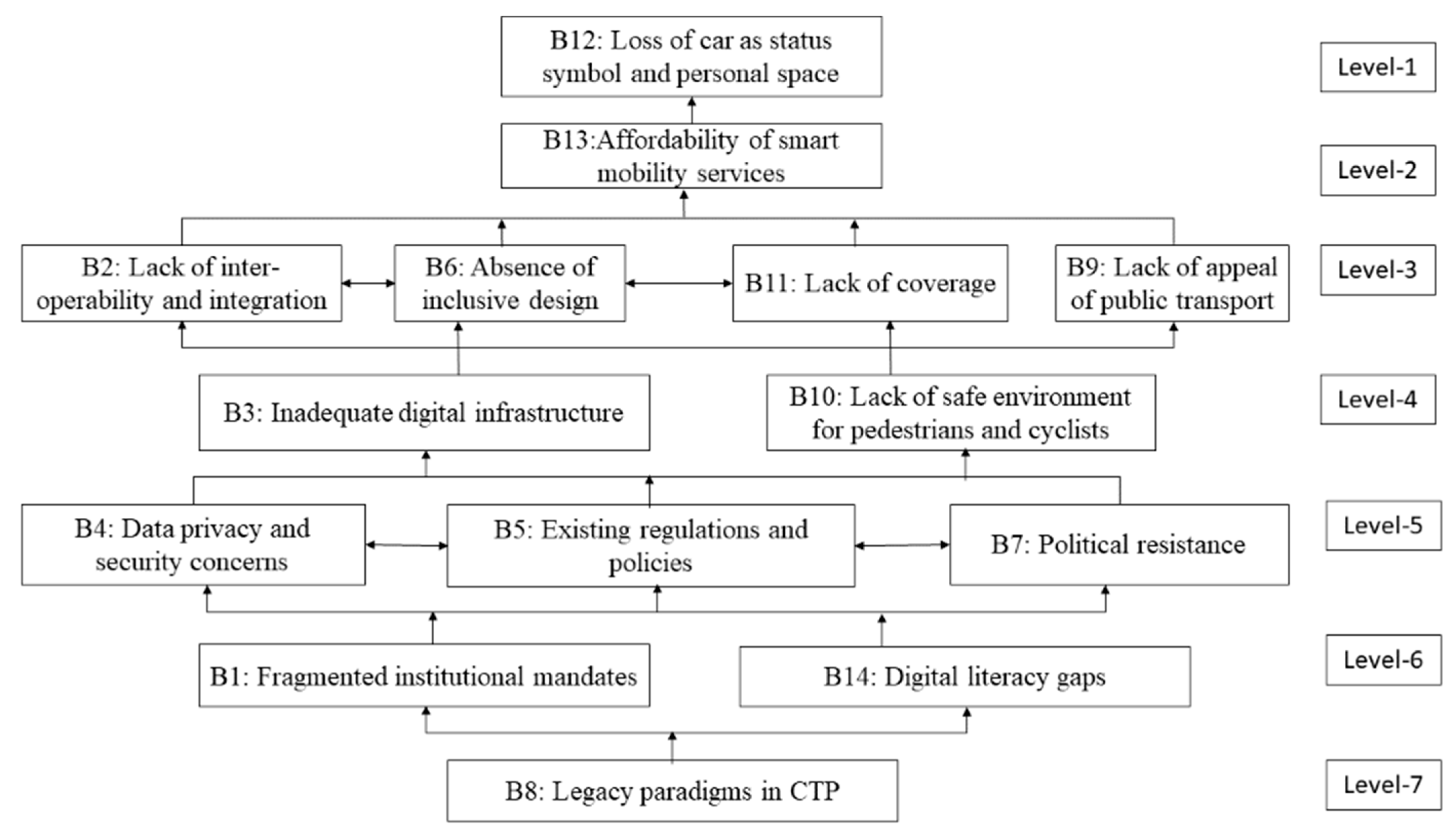
A directed graph (digraph) was constructed to visualize the hierarchical structure and relationships among the barriers. Arrows were used to denote directional influences between elements based on the reachability matrix. This graphical representation is shown in Figure 1.
The level partitioning process arranged the 14 barriers to smart mobility adoption into a seven-level hierarchy based on their driving and dependence relationships (see Table 6). At the base of the hierarchy, B8: Legacy paradigms in conventional transport planning (CTP) was positioned at Level VII, indicating it as the most foundational barrier influencing others but not directly influenced itself. Similarly, B1: Fragmented institutional mandates and B14: Digital literacy gaps occupy Level VI, highlighting their systemic influence across regulatory and user domains.
Mid-level barriers such as B5: Unfavorable regulations, B4: Data privacy concerns, and B7: Political resistance (Level V) act as both influencers and recipients of influence. These barriers typically represent policy-related and governance constraints that both shape and respond to institutional and technological challenges.
The other barriers such as B3: Inadequate digital infrastructure and B10: Lack of safe pedestrian and cyclist environments fall under Level IV, indicating their intermediate structural importance. These are technical and infrastructural issues that are influenced by high-level governance barriers but also shape user-level perceptions.
User-experience-focused barriers like B2: Lack of inter-operability, B6: Absence of inclusive design, B9: Lack of appeal of public transport, and B11: Limited coverage of smart mobility appear in Level III, demonstrating their dependence on upstream technical and regulatory conditions.
At the top of the model, B13: Affordability of smart mobility services (Level II) and B12: Loss of car as a status symbol and personal space (Level I) are positioned as the most dependent barriers. These represent end-user concerns that are largely shaped by upstream system, policy, and infrastructure factors.
  • Step 9: Construction of the Final TISM Model
The final TISM model (Figure 1) was developed by translating the digraph into an interpretive structural framework. This model illustrates both direct and transitive relationships among the barriers and reflects the cumulative insights gathered through literature, expert interpretation, and TISM logic.

4.6. Interpretation of the Hierarchical Model

The TISM model (Figure 1) organizes the fourteen barriers across seven hierarchical levels, providing a structured view of causal dependencies.
  • Level VII—Foundational Drivers:
(B8: Legacy paradigms in conventional transport planning) sits at the base of the hierarchy. It represents deep-seated institutional inertia and car-centric logics that shape all subsequent barriers. This finding aligns with [18,136], who argue that outdated planning paradigms remain the single most persistent obstacle to mobility innovation.
  • Level VI—Structural Governance Barriers:
(B1: Fragmented institutional mandates and B14: Digital literacy gaps) form the next layer. These barriers mediate between institutional structures and user behavior. Fragmented mandates reflect policy incoherence across transport agencies, while literacy gaps shape how users engage with smart platforms. Together, they perpetuate governance fragmentation and inequitable access.
  • Level V—Policy and Regulatory Barriers:
(B5: Unsupportive regulations, B4: Data privacy and security, B7: Political resistance) act as pivotal linkages connecting institutional design with implementation. These barriers embody the “politics of adoption” [63], where power asymmetries, outdated laws, and political inertia jointly constrain innovation diffusion.
  • Level IV—Technical and Infrastructural Barriers:
(B3: Inadequate digital infrastructure and B10: Lack of safety for pedestrians and cyclists) occupy an intermediate position. These are shaped by upstream governance decisions yet directly influence user confidence and system accessibility. Their position underscores that technological deficits are not root causes but reflections of higher-level governance failures.
  • Level III—Service and Design Barriers:
(B2: Interoperability deficits, B6: Absence of inclusive design, B9: Limited public transport appeal, B11: Limited coverage) cluster here, capturing user-facing challenges. They represent the translation of institutional constraints into service design and urban experience, reaffirming that user adoption is structurally mediated.
  • Level II and I—User Perception and Behavioral Barriers:
(B13: Affordability constraints and B12: Car as a status symbol) represent the most dependent barriers. They reflect end-user perceptions and cultural norms, which are products—not causes—of the institutional, infrastructural, and policy environment. This hierarchical positioning reinforces Geels’ (2012) [137] multi-level perspective: behavior change at the micro-level depends on macro-structural transformation.
This layered structure illustrates that smart mobility adoption is inhibited less by technology itself and more by institutional, political, and cultural inertia embedded in planning and governance systems. The model thus supports a systemic interpretation consistent with Critical Urban Theory, which views technological adoption as socially embedded and power-mediated.
Further, based on the explanation of the experts, an interpretive logic was added to each relationship as presented in Table 7.

4.7. MICMAC Analysis

To complement the structural insights generated by the TISM model, a MICMAC analysis (Matrice d’Impacts Croisés Multiplication Appliquée à un Classement) was performed to assess the driving and dependence power of each identified barrier [105]. MICMAC provides a systematic means of mapping causal relationships between elements in a system, revealing how strongly each factor influences others (driving power) and how strongly it is influenced by them (dependence power). This dual perspective allows researchers to classify barriers based on their structural position and strategic importance within the overall system [146,147].

4.7.1. Analytical Process

The analysis proceeded in three main steps.
First, the Final Reachability Matrix (FRM) generated through TISM was used as input. The FRM captures the binary influence (1 = influence exists; 0 = no influence) between all pairs of barriers.
Second, the driving power of each barrier was calculated as the total number of barriers it influences (both directly and indirectly), while the dependence power represented the number of barriers influencing it.
Third, the driving and dependence scores were plotted on a two-dimensional graph to classify the barriers into four categories:
  • Driving barriers—high driving, low dependence;
  • Dependent barriers—low driving, high dependence;
  • Linkage barriers—high driving, high dependence;
  • Autonomous barriers—low driving, low dependence.
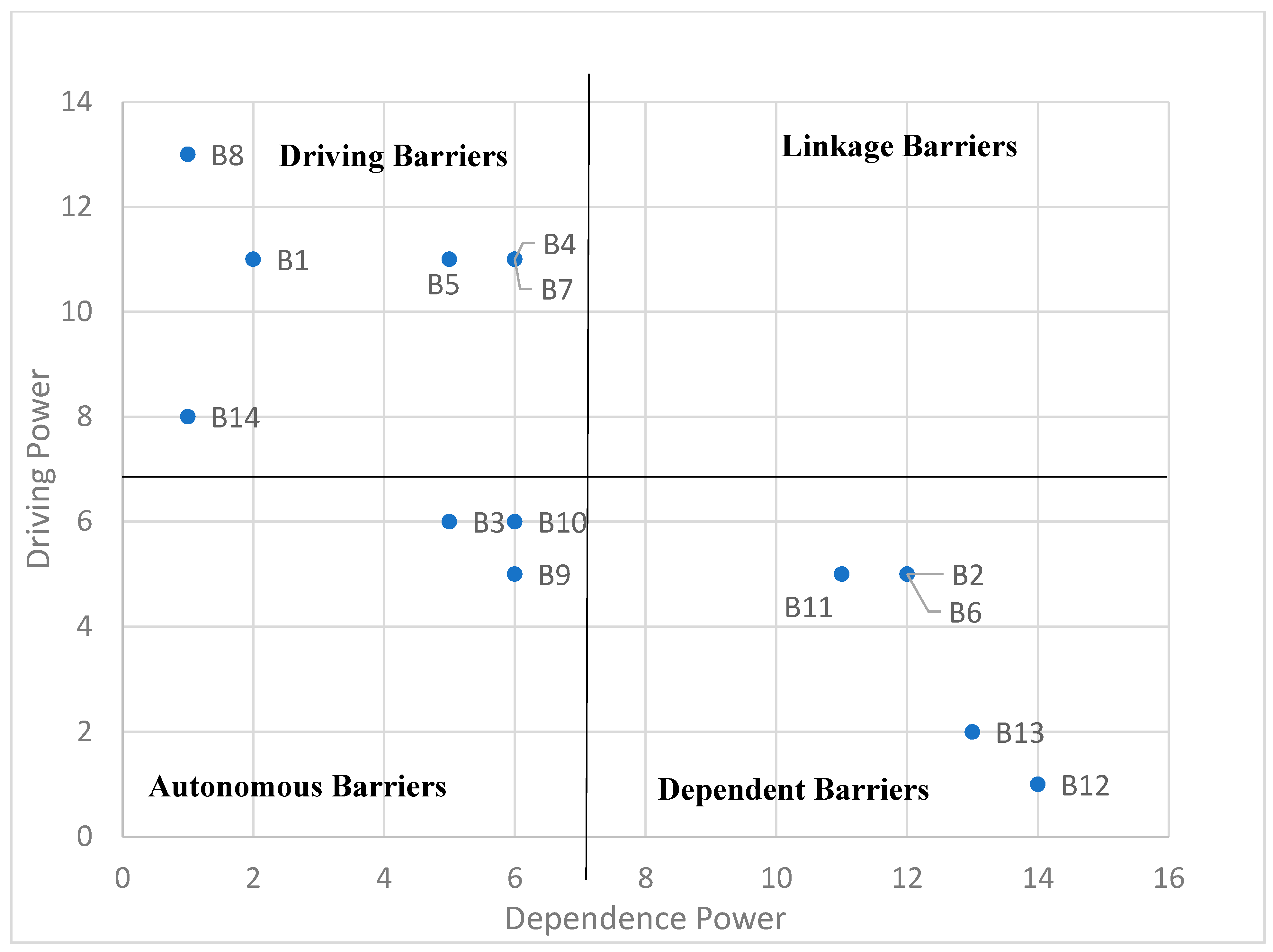
This structure forms the MICMAC map (Figure 2), which enables visualization of systemic leverage points and feedback dynamics across the network of barriers.

4.7.2. Results and Interpretation

The MICMAC results revealed a well-differentiated system with most barriers distributed between the driving and dependent quadrants. This suggests that institutional and policy-related constraints dominate the causal hierarchy, while user-level and infrastructural barriers occupy more reactive positions within the system. The classification of barriers is summarized below.
  • Driving Barriers
These are barriers with high driving power but low dependence. These are foundational barriers that exert influence over many others and thus serve as strategic leverage points for intervention. In this study, six driving barriers fall in this category, namely: legacy paradigms in CTP (B8), fragmented institutional mandates (B1), unfavorable regulations and policies (B5), data privacy and security (B4), political resistance (B7) and digital literacy gaps (B14).
Among these, legacy paradigms in CTP (B8) emerged as the most influential root barrier. Consistent with [20,25], entrenched car-centric planning norms, rigid evaluative models, and path dependencies reinforce outdated infrastructure priorities, impeding the transition toward flexible and user-centric mobility systems. These institutional barriers, in turn, exacerbate fragmented mandates (B1) and regulatory misalignments (B5), as observed in studies of governance inertia in European and African cities [148,149].
Similarly, political resistance (B7) amplifies the institutional rigidity by limiting policy experimentation and regulatory adaptation, while data privacy concerns (B4) and digital literacy gaps (B14) represent critical socio-technical foundations upon which user trust and participation depend. Overall, the driving barriers reflect deeply embedded institutional and cognitive lock-ins that determine the trajectory of smart mobility reform.
  • Dependent Barriers
Dependent barriers possess low driving power but high dependence, meaning they are largely symptomatic of upstream structural conditions. They include limited coverage of smart mobility (B11), lack of inter-operability and multimodal integration (B2), absence of inclusive design (B6), affordability constraints (B13) and loss of car as status symbols or personal space B12). These barriers manifest as the outcomes of broader systemic issues in governance, policy, and digital access. For example, limited service coverage (B11) and interoperability challenges (B2) stem directly from institutional fragmentation and weak regulatory frameworks, echoing findings by [34,64]. Similarly, the cultural attachment to the car (B12)—a persistent symbolic barrier—represents the final behavioral threshold in transitioning toward sustainable mobility, as also noted by [87,150]. The dependent barriers cannot be addressed effectively without first tackling foundational institutional and political impediments.
  • Linkage Barriers
Linkage barriers exhibit both high driving and high dependence power, rendering them dynamically unstable and sensitive to changes elsewhere in the system [95,151]. Such elements often serve as both causes and consequences of systemic transformation, requiring iterative monitoring and adaptive management.
Interestingly, in this study, no barriers were identified within this quadrant. This absence suggests a relatively hierarchical and structured system, where causal relationships are more linear than recursive. This finding may also reflect the expert panel’s consensus, which emphasized institutional over feedback-driven dynamics in the context of emerging smart mobility systems.
  • Autonomous Barriers
Autonomous barriers demonstrate low driving and low dependence power, implying a peripheral role in the systemic hierarchy. Although these factors do not exert major structural influence, they remain important for improving direct user experience and enhancing acceptance of smart mobility innovations. This category includes inadequate digital infrastructure (B3), lack of appeal of public transport (B9) and lack of safe environment for cyclists and pedestrians (B10). While these issues are operational rather than systemic, they play a critical role in shaping public perceptions. For instance, persistent safety risks discourage active modes, reinforcing car dependency [80], while poor-quality public transport undermines the attractiveness of multimodal travel [152]. Autonomous barriers should thus be integrated into long-term strategies that enhance user confidence and experience.
The MICMAC analysis enriches the findings from TISM by identifying high-leverage intervention points. Barriers such as legacy planning paradigms (B8), institutional fragmentation (B1), and regulatory resistance (B5) stand out as the most influential and should be addressed first to trigger cascading improvements across the system [141]. Meanwhile, dependent and autonomous barriers, although less influential, should be integrated into long-term strategies that build public trust, increase access, and encourage behavioral shifts toward smart mobility.

5. Discussion, Implications and Limitations

5.1. Discussion

This study set out to identify and map the interrelationships among key barriers to smart mobility adoption through an integrated TISM and MICMAC analysis. Specifically, it sought to (1) determine the structural hierarchy of barriers influencing adoption, (2) identify the most foundational and dependent barriers within the system and (3) reveal leverage points for strategic policy and governance interventions.
Through a combination of expert-based interpretive modeling and multi-criteria analysis, the study provides a systems-level understanding of why smart mobility, despite its technological promise, is unevenly adopted, particularly in emerging urban contexts.
The hierarchical structure generated through TISM demonstrates that barriers to smart mobility adoption are systemic, extending far beyond technical or behavioral challenges. Legacy paradigms in conventional transport planning (CTP) emerged as the most influential root barrier, reinforcing path-dependent investment patterns and institutional inertia. This finding resonates with [20,153], who argue that traditional planning logics, centered on road expansion, congestion reduction, and predictive modeling have entrenched car-dependence while marginalizing multimodal innovation. The persistence of these paradigms reveals a critical disjuncture between smart mobility’s user-centered ethos and the bureaucratic rationalities that continue to guide urban transport policy. As [25,154] observe, transforming these paradigms requires reframing evaluation metrics away from traffic flow and toward accessibility, equity, and environmental performance.
Closely linked to these structural constraints are fragmented institutional mandates and unsupportive regulatory frameworks, which the MICMAC analysis classified as high-driving barriers. These barriers create a fragmented governance landscape that obstructs inter-agency coordination and discourages private-sector innovation. The findings align with recent studies on Mobility-as-a-Service (MaaS) and shared mobility ecosystems, which highlight how regulatory uncertainty and overlapping mandates can stall platform integration and scalability [155,156,157]. In such fragmented settings, policy experimentation tends to occur in isolation, resulting in pilot projects that fail to scale, and in some cases, exacerbate inequalities in access to smart mobility services or even its adoption. For instance, in Johannesburg, publicly funded and subsidized transport systems such as Gautrain, Metrorail, Rea Vaya, and Putco operate under separate governance and fare structures with minimal interoperability, illustrating how institutional fragmentation undermines multimodal cohesion and weakens the broader smart mobility transition [158,159].
At the mid-levels of the structural hierarchy of the barriers, the analysis identified data privacy, political resistance, and inadequate digital infrastructure as barriers that are both influential and dependent, positioning them as pivotal points of systemic tension. These results echo [8,160], who found that data insecurity and weak governance frameworks undermine public trust in digital mobility platforms, constraining adoption even in technologically advanced cities. In developing urban contexts, where institutional trust and enforcement capacity are limited, these challenges are amplified. The interaction between data governance and political influence observed in this study reflects what [161] terms “algorithmic governance”, where private platforms assume quasi-regulatory roles in the absence of robust state oversight, shifting control of urban mobility from public accountability to market logics.
Toward the upper levels of the hierarchy, user-centered barriers including affordability, inclusivity, and the enduring cultural association of the car with social status emerged as the most dependent. These findings suggest that user adoption outcomes are downstream manifestations of structural and institutional conditions rather than isolated individual preferences. Studies of car-sharing systems (e.g., [162,163,164]) have shown that affordability, convenience, and perceived social prestige decisively shape modal choices. The present analysis extends these insights by demonstrating that such behavioral dynamics are structurally conditioned. Affordability challenges, for instance, are not simply a matter of pricing but stem from limited regulatory incentives and fragmented subsidy frameworks that fail to make shared mobility financially viable for low-income users. This pattern has also been observed in cities such as São Paulo, and Delhi, where weak institutional support and inconsistent fare-integration policies constrain equitable access to shared and on-demand mobility services [165,166,167]. Likewise, the persistence of automobility as a status symbol reflects decades of car-oriented planning and cultural reinforcement—what [168] describes as the “emotive infrastructure” of automobility.
Interestingly, the MICMAC results show an absence of “linkage barriers”, the factors with both high driving and high dependence power. This suggests that systemic and user-level barriers are connected primarily through hierarchical, not feedback, relationships. The structural gap highlights the lack of adaptive mechanisms in smart mobility ecosystems, where user experiences rarely inform policy redesign or platform innovation. The absence of such feedback loops may explain why many smart mobility projects remain technically sound but socially fragile. As ref. [169] argued, effective smart governance depends on multi-level integration—where citizen input, institutional capacity, and technological systems co-evolve. The findings from this study thus reinforce the argument that governance innovation is as critical as technological innovation in achieving sustainable adoption of smart mobility.
Synthesizing the insights from the foregoing results, this study bridges the divide between systemic-institutional and user-behavioral perspectives in smart mobility research. It empirically supports the contention of [170,171] that smart mobility must be conceived as a socio-technical assemblage, in which governance frameworks, infrastructural systems, and social norms co-produce the trajectory of urban transformation. From this perspective, the barriers identified, particularly those related to planning paradigms, institutional coordination, and regulatory adaptation represent leverage points for reconfiguring both the governance and lived experience of urban mobility. Addressing them would not only unlock technological efficiency but also align smart mobility with broader goals of social equity, climate action, and urban resilience.
Overall, integrating Critical Urban Theory with structural modelling approaches (TISM–MICMAC) provides a realistic pathway for unpacking the complex, multi-level barriers to smart mobility adoption. Whereas previous studies have tended to examine institutional, technological, and user-related challenges in isolation, this paper demonstrates their deep interdependence and identifies the institutional and socio-political roots of technical and behavioral constraints. By revealing how governance structures, legacy planning paradigms, and cultural norms interact to shape adoption outcomes, the study advances a systems-oriented and theory-informed understanding of urban mobility transitions. This integrated approach is novel in that it bridges the gap between conceptual and empirical scholarship while offering policymakers a structured roadmap for prioritizing high-leverage interventions capable of catalyzing sustainable, inclusive, and resilient smart mobility systems.

5.2. Implications for Theory and Policy

This study contributes to both theoretical advancement and practical understanding of smart mobility adoption by unpacking how institutional, political, and socio-technical barriers interact to shape urban mobility transitions. The integration of TISM and MICMAC analysis advances existing frameworks by revealing not just what the key barriers are, but how they hierarchically reinforce or constrain one another within complex urban systems.
From a theoretical perspective, the study makes three main contributions.
First, it extends Critical Urban Theory (CUT) by empirically demonstrating how entrenched transport planning paradigms and fragmented governance structures act as root constraints that mediate technology adoption. While much of the literature conceptualizes smart mobility barriers as discrete challenges, namely technological, behavioral, or infrastructural, this study shows that these barriers are systemically coupled through institutional inertia and policy incoherence. In doing so, it positions smart mobility not merely as a technological innovation but as a contested urban transformation process, structured by historical path dependencies and governance asymmetries.
Second, by employing TISM within a critical theoretical frame, this study deepens socio-technical transition theory. Existing frameworks such as the Multi-Level Perspective (MLP) emphasize regime resistance but often under-specify causal hierarchies within the regime itself. The present analysis fills that gap by identifying structural leverage points, notably legacy planning paradigms, regulatory misalignment, and institutional fragmentation, that determine whether smart mobility transitions move beyond experimental enclaves into mainstream urban systems. This theoretical refinement enhances our understanding of how systemic change can be sequenced in complex urban environments.
Third, the study’s hierarchical model contributes to the emerging discourse on data governance and digital trust in smart cities. The positioning of data privacy, digital literacy, and inclusivity barriers within the mid to upper levels of the hierarchy highlights how user trust and equity outcomes are contingent upon upstream institutional reforms. This theoretical linkage bridges the persistent divide between system-level governance and user-level experience, offering a multidimensional understanding of technology adoption in urban mobility.
From a practical perspective, the findings offer actionable insights for policymakers, urban planners, and mobility service providers.
At the governance level, the identification of legacy transport paradigms and institutional fragmentation as foundational barriers underscores the urgency of regulatory and institutional reform. Cities seeking to scale smart mobility must prioritize cross-sector coordination, develop interoperable data standards, and embed mobility integration mandates into statutory planning frameworks. Practical examples including integrated planning of residential with transport and smart mobility solutions might help overcome the barriers in the future. Without such reforms, digital mobility innovations risk being absorbed into outdated, car-centric systems rather than transforming them.
At the operational level, the findings suggest that smart mobility implementation must be sequenced strategically. High-driving barriers such as governance reform, regulatory coherence, and digital infrastructure should be addressed first, as improvements here create enabling conditions for downstream adoption. Only after these systemic enablers are in place can policies targeting affordability, inclusivity, and user engagement achieve sustained impact.
Furthermore, the persistent role of car ownership as a cultural status symbol implies that behavioral interventions must go beyond information campaigns. Instead, policymakers should link pricing, branding, and infrastructure policies to reshape mobility culture, e.g., through incentives for shared mobility, redesign of public space for active modes, and visibility of sustainable transport as a premium urban lifestyle.
For practitioners and mobility platform providers, the results reinforce the importance of inclusive and ethical design. Digital mobility services must account for the realities of low digital literacy and limited smartphone penetration in many developing contexts. Practical steps include simplified user interfaces and multi-channel access models. For instance, Kenya’s Swvl and Little Shuttle initially integrated USSD and call-based booking options alongside mobile apps to reach users without smartphones. Similarly, co-designing solutions with marginalized communities, as seen in Cape Town’s GoMetro initiative, can ensure that service planning reflects users’ lived mobility needs. Transparent data governance frameworks such as those adopted by the EU’s Mobility Data Space or India’s National Data Sharing and Accessibility Policy can also help build public trust and promote responsible data sharing. By embedding such inclusive and context-aware design practices, mobility providers can enhance adoption, equity, and the long-term legitimacy of smart mobility ecosystems.

5.3. Study Limitations and Future Research Directions

While this study advances understanding of the structural barriers to smart mobility adoption, several limitations provide valuable entry points for future research.
First, the scope and composition of the expert panel, though methodologically rigorous, necessarily limited the diversity of perspectives. The purposive sampling approach ensured that all participants possessed deep domain expertise in transport planning, governance, and digital mobility systems. However, it did not directly capture the lived experiences of end-users such as commuters, cyclists, and low-income residents—groups most affected by urban mobility transitions. Future studies could therefore integrate multi-stakeholder perspectives, combining expert elicitation with participatory approaches such as focus groups, citizen juries, or community-based mapping. This would enrich the interpretive depth of the Total Interpretive Structural Modelling (TISM) framework and strengthen the connection between system-level analysis and user-centered realities.
Second, the geographical and contextual focus of the study is anchored in the Global South urban context. While offering novel insights into institutional and governance dynamics, the choice of context may constrain generalizability to other urban regions. Mobility systems in rapidly urbanizing cities often exhibit institutional fluidity, informal transport networks, and infrastructural gaps not typically found in mature economies. Future comparative studies across different urban typologies could test the transferability and robustness of the structural model, identifying which barriers are context-specific and which reflect universal governance constraints in smart mobility adoption.
Third, the study’s reliance on qualitative expert judgment introduces an element of subjectivity inherent in interpretive modeling approaches. Although consensus measures such as the Gage R&R test were used to ensure inter-rater reliability, expert biases rooted in institutional affiliation or disciplinary orientation may still influence the structure of relationships derived. Future research could integrate quantitative validation techniques, such as Structural Equation Modelling (SEM), Bayesian network analysis, or hybrid multi-criteria decision-making frameworks, to test and refine the causal pathways identified through TISM-MICMAC.
Fourth, while the hierarchical model captures the static relationships among barriers, it does not fully reflect the temporal or adaptive dynamics of smart mobility transitions. Urban transport systems evolve through feedback loops, political shifts, and technological disruptions that reshape the relevance and strength of specific barriers over time. Longitudinal or scenario-based modeling could complement this approach, exploring how interventions at high-driving levels such as regulatory reform or institutional realignment cascade through the system in practice.
Finally, although this study was grounded in Critical Urban Theory (CUT), future research could extend the theoretical lens to include complementary perspectives such as transition management, institutional work theory, or co-evolutionary governance frameworks. Such approaches could further illuminate how actors strategically navigate, reproduce, or resist change within entrenched urban regimes, thereby deepening our understanding of the political economy of smart mobility adoption.

6. Conclusions

This study set out to identify and structurally map the interrelationships among barriers to smart mobility adoption using TISM and MICMAC analysis, guided by the lens of Critical Urban Theory. The results show that adoption challenges are systemic rather than isolated, shaped by institutional inertia, fragmented mandates, outdated planning paradigms, and socio-political resistance. Technological and user-level barriers—such as affordability, safety, and digital literacy—are downstream manifestations of these deeper structural issues.
A key contribution of this study lies in demonstrating that legacy transport planning paradigms, institutional fragmentation, and regulatory misalignment function as root barriers with the strongest driving power. In contrast, user-related constraints such as car-dependence, service affordability, and safety perceptions emerge as dependent barriers that can only be resolved when structural reforms are enacted. This systems perspective underscores that achieving sustainable and inclusive smart mobility transitions requires addressing governance and institutional bottlenecks before expecting large-scale behavioral change.
From a policy standpoint, the findings offer several actionable insights. First, governments should embed digital literacy and inclusion programs into transport policy to ensure that marginalized populations are not excluded from emerging smart mobility systems. Second, cross-agency governance frameworks and joint planning units should be established to reduce fragmentation between transport, ICT, and urban development institutions. Third, cities should introduce equity-based performance indicators—such as accessibility gains for low-income users or gender-sensitive safety measures—to monitor progress beyond traditional metrics like congestion reduction. Finally, data governance standards must be strengthened to ensure transparency and user trust in digital platforms.
Looking ahead, these barriers are not static but will evolve alongside emerging technologies. The expansion of mobility-as-a-service (MaaS) platforms, autonomous vehicles, and AI-driven transport management will likely reshape the institutional and ethical landscape of mobility governance. New regulatory and equity challenges may arise as data ownership, algorithmic bias, and automation transform traditional models of mobility provision. Consequently, future research should track how these evolving technologies intersect with political and social dynamics, shaping both new opportunities and new forms of exclusion in smart mobility ecosystems.
In conclusion, this study contributes to the growing body of work that views smart mobility not merely as a technological innovation but as a socio-political transformation project. By identifying root causes and mapping their interdependencies, it provides a foundation for policymakers, planners, and researchers to design interventions that are structurally grounded, socially inclusive, and future-ready.

Author Contributions

Conceptualization, D.M. and R.L.; methodology, J.M.; software, H.T.; validation, J.M., R.L. and H.T.; formal analysis, D.M.; investigation, J.M.; resources, H.T.; data curation, D.M.; writing—original draft preparation, D.M.; writing—review and editing, R.L.; visualization, H.T.; supervision, R.L. All authors have read and agreed to the published version of the manuscript.

Funding

This research received no external funding.

Data Availability Statement

The data used in this study were obtained through interviews conducted with transport experts. Due to ethical considerations and the need to protect participant confidentiality, these datasets are not publicly accessible. However, de-identified data may be made available upon reasonable request to the authors and with approval from the University of Johannesburg.

Conflicts of Interest

The authors declare no conflict of interest.

Appendix A. Data Collection Tool

SectionItem/QuestionResponses Format
A. Background Information1. Please indicate your current role/affiliation (e.g., policymaker, academic, practitioner, private sector).Open-ended
2. How many years of experience do you have in the field of urban mobility, transport planning, or related areas?Number of Years
B. Barrier Validation3. Please rate the relevance of each barrier (list of 31 barriers provided in a separate sheet) to smart mobility adoption in your context.5-point Likert scale (1 = Not Relevant, 5 = Highly Relevant)
4. From your experience, are there barriers not captured in this list? Please specify.Open-ended
C. Barrier Interrelationships (TISM Input)5. Do you believe Barrier X influences Barrier Y? (Pairwise comparisons of 14 barriers presented in matrix form).Response options: V (X influences Y), A (Y influences X), X (Mutual influence), O (No relation).
6. Please provide a brief explanation for your judgment (why/how one barrier influences another).Open-ended

References

  1. Goumiri, S.; Yahiaoui, S.; Djahel, S. Smart Mobility in Smart Cities: Emerging Challenges, Recent Advances and Future Directions. J. Intell. Transp. Syst. Technol. Plan. Oper. 2023, 29, 81–117. [Google Scholar] [CrossRef]
  2. Hensher, D.A.; Nelson, J.D. Do Integrated Mobility Services Have a Future? The Neglected Role of Non-Mobility Service Providers: Challenges, and Opportunities to Extract Sustainable Transport Outcomes. Transp. Policy 2025, 163, 348–357. [Google Scholar] [CrossRef]
  3. Ribeiro, P.; Dias, G.; Pereira, P. Transport Systems and Mobility for Smart Cities. Appl. Syst. Innov. 2021, 4, 61. [Google Scholar] [CrossRef]
  4. Chen, Z.; Chan, I.C.C. Smart Cities and Quality of Life: A Quantitative Analysis of Citizens’ Support for Smart City Development. Inf. Technol. People 2023, 36, 263–285. [Google Scholar] [CrossRef]
  5. Zhao, C.; Wang, K.; Dong, X.; Dong, K. Is Smart Transportation Associated with Reduced Carbon Emissions? The Case of China. Energy Econ. 2022, 105, 105715. [Google Scholar] [CrossRef]
  6. Mitieka, D.; Luke, R.; Twinomurinzi, H.; Mageto, J. Smart Mobility in Urban Areas: A Bibliometric Review and Research Agenda. Sustainability 2023, 15, 6754. [Google Scholar] [CrossRef]
  7. Carpentiere, C.D.; Messeni Petruzzelli, A.; Ardito, L. Success Factors in Smart Mobility: A New Framework and Implications for the EuroMed Context from Case Study of New York, Copenhagen, Singapore, Bari and Barcelona. EuroMed J. Bus. 2024. [Google Scholar] [CrossRef]
  8. Shaheen, S.; Cohen, A. Shared Ride Services in North America: Definitions, Impacts, and the Future of Pooling. Transp. Rev. 2019, 39, 427–442. [Google Scholar] [CrossRef]
  9. Zhang, Y.; Kamargianni, M. A Review on the Factors Influencing the Adoption of New Mobility Technologies and Services: Autonomous Vehicle, Drone, Micromobility and Mobility as a Service. Transp. Rev. 2023, 43, 407–429. [Google Scholar] [CrossRef]
  10. Wolniak, R.; Stecuła, K. Artificial Intelligence in Smart Cities—Applications, Barriers, and Future Directions: A Review. Smart Cities 2024, 7, 1346–1389. [Google Scholar] [CrossRef]
  11. Tarei, P.K.; Chand, P.; Gupta, H. Barriers to the Adoption of Electric Vehicles: Evidence from India. J. Clean. Prod. 2021, 291, 125847. [Google Scholar] [CrossRef]
  12. Xi, H.; Nelson, J.D.; Mulley, C.; Hensher, D.A.; Ho, C.Q.; Balbontin, C. Barriers towards Enhancing Mobility through Integrated Mobility Services in a Regional and Rural Context: Insights from Suppliers and Organisers. Transp. Policy 2025, 171, 282–295. [Google Scholar] [CrossRef]
  13. Delaere, H.; Basu, S.; Macharis, C.; Keseru, I. Barriers and Opportunities for Developing, Implementing and Operating Inclusive Digital Mobility Services. Eur. Transp. Res. Rev. 2024, 16, 67. [Google Scholar] [CrossRef]
  14. Müller-Eie, D. Conceptual Barriers to Integrating Smart and Sustainable Mobility Planning. In A Nordic Smart Sustainable City; Routledge: London, UK, 2025; pp. 94–105. [Google Scholar]
  15. Kent, J.L. Driving to Save Time or Saving Time to Drive? The Enduring Appeal of the Private Car. Transp. Res. Part A Policy Pract. 2014, 65, 103–115. [Google Scholar] [CrossRef]
  16. Qiao, S.; Yeh, A.G.O. Mobility-on-Demand Public Transport toward Spatial Justice: Shared Mobility or Mobility as a Service. Transp. Res. D Transp. Environ. 2023, 123, 103916. [Google Scholar] [CrossRef]
  17. Harrison, G.; Grant-Muller, S.M.; Hodgson, F.C. New and Emerging Data Forms in Transportation Planning and Policy: Opportunities and Challenges for “Track and Trace” Data. Transp. Res. Part C Emerg. Technol. 2020, 117, 102672. [Google Scholar] [CrossRef]
  18. Rye, T.; Lyons, G.; Svensson, T.; Lenferink, S.; Mladenovič, L.; Piras, F.; Witzell, J. Uncertainty and Triple Access Planning in European Sustainable Urban Mobility Plans: A Long Way to Go Yet? Transp. Plan. Technol. 2024, 48, 1330–1352. [Google Scholar] [CrossRef]
  19. Woods, O. Subverting the Logics of “Smartness” in Singapore: Smart Eldercare and Parallel Regimes of Sustainability. Sustain. Cities Soc. 2020, 53, 101940. [Google Scholar] [CrossRef]
  20. Marsden, G.; Reardon, L. Questions of Governance: Rethinking the Study of Transportation Policy. Transp. Res. Part A Policy Pract. 2017, 101, 238–251. [Google Scholar] [CrossRef]
  21. Benevolo, C.; Dameri, R.P.; D’Auria, B. Smart Mobility in Smart City. In Empowering Organizations, Enabling Platforms and Artefacts; Springer: Cham, Switzerland, 2016; pp. 13–28. [Google Scholar]
  22. Lyons, G.; Hammond, P.; Mackay, K. The Importance of User Perspective in the Evolution of MaaS. Transp. Res. Part A Policy Pract. 2019, 121, 22–36. [Google Scholar] [CrossRef]
  23. Kębłowski, W.; Dobruszkes, F.; Boussauw, K. Moving Past Sustainable Transport Studies: Towards a Critical Perspective on Urban Transport. Transp. Res. Part A Policy Pract. 2022, 159, 74–83. [Google Scholar] [CrossRef]
  24. Pangbourne, K.; Mladenović, M.N.; Stead, D.; Milakis, D. Questioning Mobility as a Service: Unanticipated Implications for Society and Governance. Transp. Res. Part A Policy Pract. 2020, 131, 35–49. [Google Scholar] [CrossRef]
  25. Docherty, I.; Marsden, G.; Anable, J. The Governance of Smart Mobility. Transp. Res. Part A Policy Pract. 2018, 115, 114–125. [Google Scholar] [CrossRef]
  26. Turienzo, J.; Cabanelas, P.; Lampón, J.F.; Parkhurst, G. The Transformation of Mobility in Europe: Technological Change and Social Conditionings. Travel. Behav. Soc. 2025, 38, 100907. [Google Scholar] [CrossRef]
  27. Vrščaj, D.; Nyholm, S.; Verbong, G.P.J. Smart Mobility Innovation Policy as Boundary Work: Identifying the Challenges of User Involvement. Transp. Rev. 2021, 41, 210–229. [Google Scholar] [CrossRef]
  28. Kitchin, R. The Real-Time City? Big Data and Smart Urbanism. GeoJournal 2014, 79, 1–14. [Google Scholar] [CrossRef]
  29. Groth, S. Multimodal Divide: Reproduction of Transport Poverty in Smart Mobility Trends. Transp. Res. Part A Policy Pract. 2019, 125, 56–71. [Google Scholar] [CrossRef]
  30. Paiva, S.; Ahad, M.A.; Tripathi, G.; Feroz, N.; Casalino, G. Enabling Technologies for Urban Smart Mobility: Recent Trends, Opportunities and Challenges. Sensors 2021, 21, 2143. [Google Scholar] [CrossRef]
  31. Harris, S.; Mata, É.; Plepys, A.; Katzeff, C. Sharing Is Daring, but Is It Sustainable? An Assessment of Sharing Cars, Electric Tools and Offices in Sweden. Resour. Conserv. Recycl. 2021, 170, 105583. [Google Scholar] [CrossRef]
  32. Hasselwander, M.; Bigotte, J.F. Transport Authorities and Innovation: Understanding Barriers for MaaS Implementation in the Global South. Transp. Res. Procedia 2022, 62, 475–482. [Google Scholar] [CrossRef]
  33. Caiati, V.; Rasouli, S.; Timmermans, H. Bundling, Pricing Schemes and Extra Features Preferences for Mobility as a Service: Sequential Portfolio Choice Experiment. Transp. Res. Part A Policy Pract. 2020, 131, 123–148. [Google Scholar] [CrossRef]
  34. Hardi, R.; Nurmandi, A.; Purwaningsih, T.; Manaf, H.A. Smart City Governance and Interoperability: Enhancing Human Security in Yogyakarta and Makassar, Indonesia. Front. Polit. Sci. 2025, 7, 1553177. [Google Scholar] [CrossRef]
  35. Buchinger, M.; Kuhn, P.; Balta, D. Towards Interoperability of Data Platforms for Smart Cities. In Handbook of Smart Cities; Springer International Publishing: Cham, Switzerland, 2021; pp. 1–22. [Google Scholar]
  36. Kitchin, R. Data-Driven, Networked Urbanism. In Data and the City; Routledge: New York, NY, USA, 2017; pp. 44–56. [Google Scholar]
  37. Vanolo, A. Is There Anybody out There? The Place and Role of Citizens in Tomorrow’s Smart Cities. Futures 2016, 82, 26–36. [Google Scholar] [CrossRef]
  38. Sheller, M. Mobility Justice: The Politics of Movement in an Age of Extremes; Taylor & Francis, LLC: Abingdon, UK, 2018; Volume 8. [Google Scholar]
  39. Golub, A.; Satterfield, V.; Serritella, M.; Singh, J.; Phillips, S. Assessing the Barriers to Equity in Smart Mobility Systems: A Case Study of Portland, Oregon. Case Stud. Transp. Policy 2019, 7, 689–697. [Google Scholar] [CrossRef]
  40. OECD. OECD Economic Outlook; OECD: Paris, France, 2020; ISBN 9789264680135. [Google Scholar]
  41. Yao, Q.; Hu, C.; Zhou, W. The Impact of Customer Privacy Concerns on Service Robot Adoption Intentions: A Credence/Experience Service Typology Perspective. Technol. Forecast. Soc. Change 2024, 198, 122948. [Google Scholar] [CrossRef]
  42. Schuster, F.; Habibipour, A. Users’ Privacy and Security Concerns That Affect IoT Adoption in the Home Domain. Int. J. Hum. Comput. Interact. 2024, 40, 1632–1643. [Google Scholar] [CrossRef]
  43. Pool, J.; Akhlaghpour, S.; Fatehi, F.; Gray, L.C. Data Privacy Concerns and Use of Telehealth in the Aged Care Context: An Integrative Review and Research Agenda. Int. J. Med. Inform. 2022, 160, 104707. [Google Scholar] [CrossRef] [PubMed]
  44. Zhou, T. The Effect of Information Privacy Concern on Users’ Social Shopping Intention. Online Inf. Rev. 2020, 44, 1119–1133. [Google Scholar] [CrossRef]
  45. Martin, N.; Matt, C.; Niebel, C.; Blind, K. How Data Protection Regulation Affects Startup Innovation. Inf. Syst. Front. 2019, 21, 1307–1324. [Google Scholar] [CrossRef]
  46. Sadowski, J.; Maalsen, S. Modes of Making Smart Cities: Or, Practices of Variegated Smart Urbanism. Telemat. Inform. 2020, 55, 101449. [Google Scholar] [CrossRef]
  47. Zuboff, S. Surveillance Capitalism and the Challenge of Collective Action. New Labor. Forum 2019, 28, 10–29. [Google Scholar] [CrossRef]
  48. Shin, D.-H. The Effects of Trust, Security and Privacy in Social Networking: A Security-Based Approach to Understand the Pattern of Adoption. Interact. Comput. 2010, 22, 428–438. [Google Scholar] [CrossRef]
  49. Van Zoonen, L. Data Governance and Citizen Participation in the Digital Welfare State. Data Policy 2020, 2, e10. [Google Scholar] [CrossRef]
  50. Cavoukian, A.; Taylor, S.; Abrams, M.E. Privacy by Design: Essential for Organizational Accountability and Strong Business Practices. Identity Inf. Soc. 2010, 3, 405–413. [Google Scholar] [CrossRef]
  51. Cugurullo, F.; Acheampong, R.A. Fear of AI: An Inquiry into the Adoption of Autonomous Cars in Spite of Fear, and a Theoretical Framework for the Study of Artificial Intelligence Technology Acceptance. AI Soc. 2024, 39, 1569–1584. [Google Scholar] [CrossRef]
  52. Tennakoon, V.; Wiles, J.; Peiris-John, R.; Wickremasinghe, R.; Kool, B.; Ameratunga, S. Transport Equity in Sri Lanka: Experiences Linked to Disability and Older Age. J. Transp. Health 2020, 18, 100913. [Google Scholar] [CrossRef]
  53. Bascom, G.W.; Christensen, K.M. The Impacts of Limited Transportation Access on Persons with Disabilities’ Social Participation. J. Transp. Health 2017, 7, 227–234. [Google Scholar] [CrossRef]
  54. Lucas-Carrasco, R.; Salvador-Carulla, L. Life Satisfaction in Persons with Intellectual Disabilities. Res. Dev. Disabil. 2012, 33, 1103–1109. [Google Scholar] [CrossRef]
  55. Bruzzone, F.; Cavallaro, F.; Nocera, S. The Definition of Equity in Transport. Transp. Res. Procedia 2023, 69, 440–447. [Google Scholar] [CrossRef]
  56. Lim, H.S.M.; Taeihagh, A. Algorithmic Decision-Making in AVs: Understanding Ethical and Technical Concerns for Smart Cities. Sustainability 2019, 11, 5791. [Google Scholar] [CrossRef]
  57. Imrie, R. Universalism, Universal Design and Equitable Access to the Built Environment. Disabil. Rehabil. 2012, 34, 873–882. [Google Scholar] [CrossRef] [PubMed]
  58. Lucas, K. Transport and Social Exclusion: Where Are We Now? Transp. Policy 2012, 20, 105–113. [Google Scholar] [CrossRef]
  59. Aldred, R.; Verlinghieri, E.; Sharkey, M.; Itova, I.; Goodman, A. Equity in New Active Travel Infrastructure: A Spatial Analysis of London’s New Low Traffic Neighbourhoods. J. Transp. Geogr. 2021, 96, 103194. [Google Scholar] [CrossRef]
  60. Meadowcroft, J. Who Is in Charge Here? Governance for Sustainable Development in a Complex World. J. Environ. Policy Plan. 2007, 9, 299–314. [Google Scholar] [CrossRef]
  61. Rode, P.; Floater, G.; Thomopoulos, N.; Docherty, J.; Schwinger, P.; Mahendra, A.; Fang, W. Accessibility in Cities: Transport and Urban Form. In Disrupting Mobility; Springer: Cham, Switzerland, 2017; pp. 239–273. [Google Scholar]
  62. Hölscher, K.; Frantzeskaki, N.; McPhearson, T.; Loorbach, D. Capacities for Urban Transformations Governance and the Case of New York City. Cities 2019, 94, 186–199. [Google Scholar] [CrossRef]
  63. Cohen, B.; Kietzmann, J. Ride On! Mobility Business Models for the Sharing Economy. Organ. Environ. 2014, 27, 279–296. [Google Scholar] [CrossRef]
  64. Kamargianni, M.; Li, W.; Matyas, M.; Schäfer, A. A Critical Review of New Mobility Services for Urban Transport. Transp. Res. Procedia 2016, 14, 3294–3303. [Google Scholar] [CrossRef]
  65. Hensher, D.A. Tackling Road Congestion—What Might It Look like in the Future under a Collaborative and Connected Mobility Model? Transp. Policy 2018, 66, A1–A8. [Google Scholar] [CrossRef]
  66. Hull, A. Policy Integration: What Will It Take to Achieve More Sustainable Transport Solutions in Cities? Transp. Policy 2008, 15, 94–103. [Google Scholar] [CrossRef]
  67. Marsden, G.; Reardon, L. Governance of the Smart Mobility Transition; Emerald Publishing Limited: Leeds, UK, 2018; ISBN 978-1-78754-320-1. [Google Scholar]
  68. Zawieska, J.; Pieriegud, J. Smart City as a Tool for Sustainable Mobility and Transport Decarbonisation. Transp. Policy 2018, 63, 39–50. [Google Scholar] [CrossRef]
  69. Geels, F.W.; Sovacool, B.K.; Schwanen, T.; Sorrell, S. The Socio-Technical Dynamics of Low-Carbon Transitions. Joule 2017, 1, 463–479. [Google Scholar] [CrossRef]
  70. Paddeu, D.; Lyons, G.; Chatterjee, K.; Calvert, T. Practitioner Views on Transport Planning’s Evolution—A Sisyphean Task Still Ahead? Transp. Policy 2024, 156, 89–100. [Google Scholar] [CrossRef]
  71. Levine, K.; Karner, A. Approaching Accessibility: Four Opportunities to Address the Needs of Disabled People in Transportation Planning in the United States. Transp. Policy 2023, 131, 66–74. [Google Scholar] [CrossRef]
  72. Aravind, A.; Venthuruthiyil, S.P.; Mishra, S. Equity and Accessibility Assessment of Fixed Route Transit Systems Integrated with On-Demand Feeder Services. J. Transp. Geogr. 2024, 121, 104028. [Google Scholar] [CrossRef]
  73. Chatziioannou, I.; Nikitas, A.; Tzouras, P.G.; Bakogiannis, E.; Alvarez-Icaza, L.; Chias-Becerril, L.; Karolemeas, C.; Tsigdinos, S.; Wallgren, P.; Rexfelt, O. Ranking Sustainable Urban Mobility Indicators and Their Matching Transport Policies to Support Liveable City Futures: A MICMAC Approach. Transp. Res. Interdiscip. Perspect. 2023, 18, 100788. [Google Scholar] [CrossRef]
  74. Klaever, A.; Roessner, V.; Becker, S.; Scheidler, V. Lived Expertise of the Structurally Disadvantaged: Towards a More Just Participatory Transport Planning Process. Mobilities 2024, 20, 555–572. [Google Scholar] [CrossRef]
  75. Lovelace, R.; Parkin, J.; Cohen, T. Open Access Transport Models: A Leverage Point in Sustainable Transport Planning. Transp. Policy 2020, 97, 47–54. [Google Scholar] [CrossRef]
  76. Schwanen, T. Transport Geography, Climate Change and Space: Opportunity for New Thinking. J. Transp. Geogr. 2019, 81, 102530. [Google Scholar] [CrossRef]
  77. Mullen, C.; Marsden, G. Mobility Justice in Low Carbon Energy Transitions. Energy Res. Soc. Sci. 2016, 18, 109–117. [Google Scholar] [CrossRef]
  78. van Dijk, J.A.G.M. Digital Divide Research, Achievements and Shortcomings. Poetics 2006, 34, 221–235. [Google Scholar] [CrossRef]
  79. Salazar-Miranda, A.; Heine, C.; Duarte, F.; Schechtner, K.; Ratti, C. Measuring the Impact of Slow Zones on Street Life Using Social Media. Cities 2022, 131, 104010. [Google Scholar] [CrossRef]
  80. Pucher, J.; Buehler, R. Walking and Cycling for Healthy Cities. Built Environ. 2010, 36, 391–414. [Google Scholar] [CrossRef]
  81. Litman, T. Evaluating Public Transit Benefits and Costs. 2025. Available online: https://www.vtpi.org/tranben.pdf (accessed on 29 September 2025).
  82. Rasca, S.; Saeed, N. Exploring the Factors Influencing the Use of Public Transport by Commuters Living in Networks of Small Cities and Towns. Travel. Behav. Soc. 2022, 28, 249–263. [Google Scholar] [CrossRef]
  83. Pojani, D.; Stead, D. Sustainable Urban Transport in the Developing World: Beyond Megacities. Sustainability 2015, 7, 7784–7805. [Google Scholar] [CrossRef]
  84. Sharma, G.; Patil, G.R. Urban Spatial Structure and Equity for Urban Services through the Lens of Accessibility. Transp. Policy 2024, 146, 72–90. [Google Scholar] [CrossRef]
  85. Shaheen, S. Shared Mobility: The Potential of Ridehailing and Pooling. In Three Revolutions; Island Press/Center for Resource Economics: Washington, DC, USA, 2018; pp. 55–76. [Google Scholar]
  86. Sochor, J.; Arby, H.; Karlsson, I.C.M.A.; Sarasini, S. A Topological Approach to Mobility as a Service: A Proposed Tool for Understanding Requirements and Effects, and for Aiding the Integration of Societal Goals. Res. Transp. Bus. Manag. 2018, 27, 3–14. [Google Scholar] [CrossRef]
  87. Steg, L. Car Use: Lust and Must. Instrumental, Symbolic and Affective Motives for Car Use. Transp. Res. Part A Policy Pract. 2005, 39, 147–162. [Google Scholar] [CrossRef]
  88. Brenner, N.; Madden, D.J.; Wachsmuth, D. Assemblage Urbanism and the Challenges of Critical Urban Theory. City 2011, 15, 225–240. [Google Scholar] [CrossRef]
  89. Tonnarelli, F.; Mora, L. Smart Urbanism in Africa: When Theories Do Not Fit with Contextual Practices. Reg. Stud. 2024, 58, 1767–1777. [Google Scholar] [CrossRef]
  90. Monstadt, J.; Rutherford, J.; Coutard, O. Infrastructures as Urban Solutions? Critical Perspectives on Transformative Socio-Technical Change. Urban. Stud. 2025, 62, 1709–1730. [Google Scholar] [CrossRef]
  91. Sushil. Modified ISM/TISM Process with Simultaneous Transitivity Checks for Reducing Direct Pair Comparisons. Glob. J. Flex. Syst. Manag. 2017, 18, 331–351. [Google Scholar] [CrossRef]
  92. Warfield, J.N. Toward Interpretation of Complex Structural Models. IEEE Trans. Syst. Man Cybern. 1974, SMC-4, 405–417. [Google Scholar] [CrossRef]
  93. Singh, M.D.; Kant, R. Knowledge Management Barriers: An Interpretive Structural Modeling Approach. Int. J. Manag. Sci. Eng. Manag. 2008, 3, 141–150. [Google Scholar] [CrossRef]
  94. Mathiyazhagan, K.; Govindan, K.; Noorul Haq, A. Pressure Analysis for Green Supply Chain Management Implementation in Indian Industries Using Analytic Hierarchy Process. Int. J. Prod. Res. 2014, 52, 188–202. [Google Scholar] [CrossRef]
  95. Jain, P.; Garg, S.; Kansal, G. A TISM Approach for the Analysis of Enablers in Implementing Mass Customization in Indian Manufacturing Units. Prod. Plan. Control 2023, 34, 173–188. [Google Scholar] [CrossRef]
  96. Singh, A.; Singla, A.R. Modelling and Analysis of Factors for Implementation of Smart Cities: TISM Approach. J. Model. Manag. 2022, 17, 1587–1622. [Google Scholar] [CrossRef]
  97. Whetten, D. Whetten-What-Constitutes-a-Theoretical-Contribution. Acad. Manag. Rev. 1989, 14, 490–495. [Google Scholar] [CrossRef]
  98. Sushil; Dinesh, K.K. Structured Literature Review with TISM Leading to an Argumentation Based Conceptual Model. Glob. J. Flex. Syst. Manag. 2022, 23, 387–407. [Google Scholar] [CrossRef]
  99. Mangla, S.K.; Kumar, P.; Barua, M.K. Risk Analysis in Green Supply Chain Using Fuzzy AHP Approach: A Case Study. Resour. Conserv. Recycl. 2015, 104, 375–390. [Google Scholar] [CrossRef]
  100. Venkatesh, V.G.; Zhang, A.; Deakins, E.; Luthra, S.; Mangla, S. A Fuzzy AHP-TOPSIS Approach to Supply Partner Selection in Continuous Aid Humanitarian Supply Chains. Ann. Oper. Res. 2019, 283, 1517–1550. [Google Scholar] [CrossRef]
  101. Linstone, H.A.; Lendaris, G.G.; Rogers, S.D.; Wakeland, W.; Williams, M. The Use of Structural Modeling for Technology Assessment. Technol. Forecast. Soc. Change 1979, 14, 291–327. [Google Scholar] [CrossRef]
  102. Jena, J.; Sidharth, S.; Thakur, L.S.; Kumar Pathak, D.; Pandey, V.C. Total Interpretive Structural Modeling (TISM): Approach and Application. J. Adv. Manag. Res. 2017, 14, 162–181. [Google Scholar] [CrossRef]
  103. Saaty, R.W. Analytic Hierarchy Process—What It Is and How It Is Used. Math. Model. 1987, 9, 161–176. [Google Scholar] [CrossRef]
  104. Sethi, M.; Sushil; Gupta, M.P. Modelling the Enablers of Organizational Resilience: A Modified Total Interpretive Structural Modeling (m-TISM) Approach. Benchmarking 2024, 2, 1776–1824. [Google Scholar] [CrossRef]
  105. Dubey, R.; Gunasekaran, A.; Papadopoulos, T.; Childe, S.J.; Shibin, K.T.; Wamba, S.F. Sustainable Supply Chain Management: Framework and Further Research Directions. J. Clean. Prod. 2017, 142, 1119–1130. [Google Scholar] [CrossRef]
  106. Dhir, S.; Dhir, S. Modeling of Strategic Thinking Enablers: A Modified Total Interpretive Structural Modeling (TISM) and MICMAC Approach. Int. J. Syst. Assur. Eng. Manag. 2020, 11, 175–188. [Google Scholar] [CrossRef]
  107. Jayalakshmi, B.; Pramod, V.R. Total Interpretive Structural Modeling (TISM) of the Enablers of a Flexible Control System for Industry. Glob. J. Flex. Syst. Manag. 2015, 16, 63–85. [Google Scholar] [CrossRef]
  108. Butler, L.; Yigitcanlar, T.; Paz, A. Barriers and Risks of Mobility-as-a-Service (MaaS) Adoption in Cities: A Systematic Review of the Literature. Cities 2021, 109, 103036. [Google Scholar] [CrossRef]
  109. Pritchard, J. MaaS to Pull Us out of a Car-Centric Orbit: Principles for Sustainable Mobility-as-a-Service in the Context of Unsustainable Car Dependency. Case Stud. Transp. Policy 2022, 10, 1483–1493. [Google Scholar] [CrossRef]
  110. Alonso-González, M.J.; Hoogendoorn-Lanser, S.; van Oort, N.; Cats, O.; Hoogendoorn, S. Drivers and Barriers in Adopting Mobility as a Service (MaaS)—A Latent Class Cluster Analysis of Attitudes. Transp. Res. Part A Policy Pract. 2020, 132, 378–401. [Google Scholar] [CrossRef]
  111. Zhao, C.; Dong, K.; Taghizadeh-Hesary, F. Can Smart Transportation Enhance Green Development Efficiency? Econ. Change Restruct. 2023, 56, 825–857. [Google Scholar] [CrossRef]
  112. Shah, K.J.; Pan, S.-Y.; Lee, I.; Kim, H.; You, Z.; Zheng, J.-M.; Chiang, P.-C. Green Transportation for Sustainability: Review of Current Barriers, Strategies, and Innovative Technologies. J. Clean. Prod. 2021, 326, 129392. [Google Scholar] [CrossRef]
  113. Nieuwenhuijsen, M.J. Urban and Transport Planning Pathways to Carbon Neutral, Liveable and Healthy Cities; A Review of the Current Evidence. Environ. Int. 2020, 140, 105661. [Google Scholar] [CrossRef]
  114. Mahdavian, A.; Shojaei, A.; McCormick, S.; Papandreou, T.; Eluru, N.; Oloufa, A.A. Drivers and Barriers to Implementation of Connected, Automated, Shared, and Electric Vehicles: An Agenda for Future Research. IEEE Access 2021, 9, 22195–22213. [Google Scholar] [CrossRef]
  115. Fagnant, D.J.; Kockelman, K. Preparing a Nation for Autonomous Vehicles: Opportunities, Barriers and Policy Recommendations. Transp. Res. Part A Policy Pract. 2015, 77, 167–181. [Google Scholar] [CrossRef]
  116. Merfeld, K.; Wilhelms, M.P.; Henkel, S.; Kreutzer, K. Carsharing with Shared Autonomous Vehicles: Uncovering Drivers, Barriers and Future Developments—A Four-Stage Delphi Study. Technol. Forecast. Soc. Change 2019, 144, 66–81. [Google Scholar] [CrossRef]
  117. Karlsson, I.C.M.; Mukhtar-Landgren, D.; Smith, G.; Koglin, T.; Kronsell, A.; Lund, E.; Sarasini, S.; Sochor, J. Development and Implementation of Mobility-as-a-Service—A Qualitative Study of Barriers and Enabling Factors. Transp. Res. Part A Policy Pract. 2020, 131, 283–295. [Google Scholar] [CrossRef]
  118. Casadó, R.G.; Golightly, D.; Laing, K.; Palacin, R.; Todd, L. Children, Young People and Mobility as a Service: Opportunities and Barriers for Future Mobility. Transp. Res. Interdiscip. Perspect. 2020, 4, 100107. [Google Scholar] [CrossRef]
  119. Weckström, C.; Mladenović, M.N.; Ullah, W.; Nelson, J.D.; Givoni, M.; Bussman, S. User Perspectives on Emerging Mobility Services: Ex Post Analysis of Kutsuplus Pilot. Res. Transp. Bus. Manag. 2018, 27, 84–97. [Google Scholar] [CrossRef]
  120. Kayikci, Y.; Kabadurmus, O. Barriers to the Adoption of the Mobility-as-a-Service Concept: The Case of Istanbul, a Large Emerging Metropolis. Transp. Policy 2022, 129, 219–236. [Google Scholar] [CrossRef]
  121. Sanders, R.L.; Branion-Calles, M.; Nelson, T.A. To Scoot or Not to Scoot: Findings from a Recent Survey about the Benefits and Barriers of Using E-Scooters for Riders and Non-Riders. Transp. Res. Part A Policy Pract. 2020, 139, 217–227. [Google Scholar] [CrossRef]
  122. Martínez-Buelvas, L.; Rakotonirainy, A.; Grant-Smith, D.; Oviedo-Trespalacios, O. A Transport Justice Approach to Integrating Vulnerable Road Users with Automated Vehicles. Transp. Res. D Transp. Environ. 2022, 113, 103499. [Google Scholar] [CrossRef]
  123. Krueger, R.A. Focus Groups: A Practical Guide for Applied Research; SAGE: Newcastle upon Tyne, UK, 2009; ISBN 1412969476. [Google Scholar]
  124. Morgan, D.L. Focus Groups. Annu. Rev. Sociol. 1996, 22, 129–152. [Google Scholar] [CrossRef]
  125. Bloor, M.; Frankland, J.; Thomas, M.; Robson, K. Focus Groups in Social Research; SAGE Publications Ltd.: London, UK, 2001; ISBN 9780761957423. [Google Scholar]
  126. Okoli, C.; Pawlowski, S.D. The Delphi Method as a Research Tool: An Example, Design Considerations and Applications. Inf. Manag. 2004, 42, 15–29. [Google Scholar] [CrossRef]
  127. Kar, S.; Kar, A.K.; Gupta, M.P. Modeling Drivers and Barriers of Artificial Intelligence Adoption: Insights from a Strategic Management Perspective. Intell. Syst. Account. Financ. Manag. 2021, 28, 217–238. [Google Scholar] [CrossRef]
  128. Yadav, G.; Kumar, A.; Luthra, S.; Garza-Reyes, J.A.; Kumar, V.; Batista, L. A Framework to Achieve Sustainability in Manufacturing Organisations of Developing Economies Using Industry 4.0 Technologies’ Enablers. Comput. Ind. 2020, 122, 103280. [Google Scholar] [CrossRef]
  129. Goel, P.; Kumar, A.; Parayitam, S.; Luthra, S. Understanding Transport Users’ Preferences for Adopting Electric Vehicle Based Mobility for Sustainable City: A Moderated Moderated-Mediation Model. J. Transp. Geogr. 2023, 106, 103520. [Google Scholar] [CrossRef]
  130. Lamond, J.; Everett, G. Sustainable Blue-Green Infrastructure: A Social Practice Approach to Understanding Community Preferences and Stewardship. Landsc. Urban. Plan. 2019, 191, 103639. [Google Scholar] [CrossRef]
  131. Johnstone, D.J. A Listening Guide Analysis of Women’s Experiences of Unacknowledged Rape. Psychol. Women Q. 2016, 40, 275–289. [Google Scholar] [CrossRef]
  132. Baliga, A.J.; Chawla, V.; Sunder M., V.; Kumar, R. Barriers to Service Recovery in B2B Markets: A TISM Approach in the Context of IT-Based Services. J. Bus. Ind. Mark. 2021, 36, 1452–1473. [Google Scholar] [CrossRef]
  133. Mageto, J.; Twinomurinzi, H.; Luke, R.; Mhlongo, S.; Bwalya, K.; Bvuma, S. Building Resilience into Smart Mobility for Urban Cities: An Emerging Economy Perspective. Int. J. Prod. Res. 2024, 62, 5556–5573. [Google Scholar] [CrossRef]
  134. Mandal, A.; Deshmukh, S.G. Vendor Selection Using Interpretive Structural Modelling (ISM). Int. J. Oper. Prod. Manag. 1994, 14, 52–59. [Google Scholar] [CrossRef]
  135. Sunder, V. Rejects Reduction in a Retail Bank Using Lean Six Sigma. Prod. Plan. Control 2016, 27, 1131–1142. [Google Scholar] [CrossRef]
  136. Banister, D. The Sustainable Mobility Paradigm. Transp. Policy 2008, 15, 73–80. [Google Scholar] [CrossRef]
  137. Geels, F.W. A Socio-Technical Analysis of Low-Carbon Transitions: Introducing the Multi-Level Perspective into Transport Studies. J. Transp. Geogr. 2012, 24, 471–482. [Google Scholar] [CrossRef]
  138. Givoni, M.; Banister, D. Mobility, Transport and Carbon. In Moving Towards Low Carbon Mobility; Edward Elgar Publishing: Cheltenham, UK, 2013. [Google Scholar]
  139. Su, W.; Junge, S. Unlocking the Recipe for Organizational Resilience: A Review and Future Research Directions. Eur. Manag. J. 2023, 41, 1086–1105. [Google Scholar] [CrossRef]
  140. Hesselgren, M.; Sjöman, M.; Pernestål, A. Understanding User Practices in Mobility Service Systems: Results from Studying Large Scale Corporate MaaS in Practice. Travel. Behav. Soc. 2020, 21, 318–327. [Google Scholar] [CrossRef]
  141. Raetze, S.; Duchek, S.; Maynard, M.T.; Kirkman, B.L. Resilience in Organizations: An Integrative Multilevel Review and Editorial Introduction. Group. Organ. Manag. 2021, 46, 607–656. [Google Scholar] [CrossRef]
  142. Vassilakopoulou, P.; Hustad, E. Bridging Digital Divides: A Literature Review and Research Agenda for Information Systems Research. Inf. Syst. Front. 2023, 25, 955–969. [Google Scholar] [CrossRef]
  143. Steg, L.; Gifford, R. Sustainable Transportation and Quality of Life. J. Transp. Geogr. 2005, 13, 59–69. [Google Scholar] [CrossRef]
  144. Yeo, V.C.S.; Goh, S.K.; Rezaei, S. Consumer Experiences, Attitude and Behavioral Intention toward Online Food Delivery (OFD) Services. J. Retail. Consum. Serv. 2017, 35, 150–162. [Google Scholar] [CrossRef]
  145. Anable, J. “Complacent Car Addicts”; or “Aspiring Environmentalists”? Identifying Travel Behaviour Segments Using Attitude Theory. Transp. Policy 2005, 12, 65–78. [Google Scholar] [CrossRef]
  146. Sindhwani, R.; Malhotra, V. Modelling and Analysis of Agile Manufacturing System by ISM and MICMAC Analysis. Int. J. Syst. Assur. Eng. Manag. 2017, 8, 253–263. [Google Scholar] [CrossRef]
  147. Bhosale, V.A.; Kant, R. An Integrated ISM Fuzzy MICMAC Approach for Modelling the Supply Chain Knowledge Flow Enablers. Int. J. Prod. Res. 2016, 54, 7374–7399. [Google Scholar] [CrossRef]
  148. Rode, P.; Terrefe, B.; da Cruz, N.F. Cities and the Governance of Transport Interfaces: Ethiopia’s New Rail Systems. Transp. Policy 2020, 91, 76–94. [Google Scholar] [CrossRef]
  149. da Cruz, N.F.; Rode, P. Social Structures of Urban Governance: Strategic Spatial Planning in Addis Ababa. Territ. Politic Gov. 2024, 13, 1260–1282. [Google Scholar] [CrossRef]
  150. Gössling, S. The Psychology of the Car: Automobile Admiration, Attachment, and Addiction; Elsevier: Amsterdam, The Netherlands, 2017. [Google Scholar]
  151. Shukla, M.; Shankar, R. Modeling of Critical Success Factors for Adoption of Smart Manufacturing System in Indian SMEs: An Integrated Approach. Opsearch 2022, 59, 1271–1303. [Google Scholar] [CrossRef]
  152. Litman, T. Why and How to Reduce the Amount of Land Paved for Roads and Parking Facilities. Environ. Pract. 2011, 13, 38–46. [Google Scholar] [CrossRef]
  153. Holden, E.; Gilpin, G.; Banister, D. Sustainable Mobility at Thirty. Sustainability 2019, 11, 1965. [Google Scholar] [CrossRef]
  154. Gössling, S. Integrating E-Scooters in Urban Transportation: Problems, Policies, and the Prospect of System Change. Transp. Res. D Transp. Environ. 2020, 79, 102230. [Google Scholar] [CrossRef]
  155. Ho, C.Q.; Tirachini, A. Mobility-as-a-Service and the Role of Multimodality in the Sustainability of Urban Mobility in Developing and Developed Countries. Transp. Policy 2024, 145, 161–176. [Google Scholar] [CrossRef]
  156. Wong, R.C.P.; Ke, J.; Szeto, W.Y.; Mak, P.L. Multiple Shared Mobility Services under Competition: Empirical Evidence for Public Acceptance and Policy Insights to Sustainable Transport. Int. J. Sustain. Transp. 2024, 18, 562–575. [Google Scholar] [CrossRef]
  157. Smith, G.; Hensher, D.A. Towards a Framework for Mobility-as-a-Service Policies. Transp. Policy 2020, 89, 54–65. [Google Scholar] [CrossRef]
  158. Risimati, B.; Gumbo, T.; Chakwizira, J. Spatial Integration of Non-Motorized Transport and Urban Public Transport Infrastructure: A Case of Johannesburg. Sustainability 2021, 13, 11461. [Google Scholar] [CrossRef]
  159. Risimati, B.; Gumbo, T. Exploring the Applicability of Location-Based Services to Delineate the State Public Transport Routes Integratedness within the City of Johannesburg. Infrastructures 2018, 3, 28. [Google Scholar] [CrossRef]
  160. Machado, I.A.; Costa, C.; Santos, M.Y. Data Mesh: Concepts and Principles of a Paradigm Shift in Data Architectures. Procedia Comput. Sci. 2021, 196, 263–271. [Google Scholar] [CrossRef]
  161. Katzenbach, C.; Ulbricht, L. Algorithmic Governance. Internet Policy Rev. 2019, 8, 1–18. [Google Scholar] [CrossRef]
  162. Kolarova, V.; Cherchi, E. Impact of Trust and Travel Experiences on the Value of Travel Time Savings for Autonomous Driving. Transp. Res. Part C Emerg. Technol. 2021, 131, 103354. [Google Scholar] [CrossRef]
  163. Jorge, D.; Correia, G. Carsharing Systems Demand Estimation and Defined Operations: A Literature Review. EJTIR Issue 2013, 13, 201–220. [Google Scholar] [CrossRef]
  164. Wu, T.; Xu, M. Modeling and Optimization for Carsharing Services: A Literature Review. Multimodal Transp. 2022, 1, 100028. [Google Scholar] [CrossRef]
  165. Azolin, L.G.; Grigolon, A.B.; Rodrigues da Silva, A.N.; Geurs, K.T. Shared Mobility during Public Transport Disruptions: Users’ Perspectives in a Brazilian City. Transp. Res. D Transp. Environ. 2025, 147, 104972. [Google Scholar] [CrossRef]
  166. Beza, A.D.; Demissie, M.G.; Kattan, L. Equity Implications of Emerging Mobility Services and Public Transit Coopetition: A Review. Transp. Res. D Transp. Environ. 2025, 144, 104751. [Google Scholar] [CrossRef]
  167. Tanwar, R.; Agarwal, P.K. Multimodal Integration in India: Opportunities, Challenges, and Strategies for Sustainable Urban Mobility. Multimodal Transp. 2025, 4, 100210. [Google Scholar] [CrossRef]
  168. Sheller, M. Automotive Emotions: Feeling the Car. Theory Cult. Soc. 2004, 21, 221–242. [Google Scholar] [CrossRef]
  169. Meijer, A.; Bolívar, M.P.R. Governing the Smart City: A Review of the Literature on Smart Urban Governance. Int. Rev. Adm. Sci. 2016, 82, 392–408. [Google Scholar] [CrossRef]
  170. Geoghegan, S.; Cugurullo, F. Beyond Dystopian Smart Cities? Unlocking a Progressive Utopian Future in Smart Urbanism. Urban. Geogr. 2025, 46, 1865–1886. [Google Scholar] [CrossRef]
  171. Söderström, O.; Paasche, T.; Klauser, F. Smart Cities as Corporate Storytelling. City 2014, 18, 307–320. [Google Scholar] [CrossRef]
Figure 1. TISM hierarchical Model for Smart Mobility Barriers.
Smartcities 08 00182 g001
Figure 2. MICMAC Analysis. B1 = Fragmented institutional mandates; B2 = Lack of inter-operability and Integration; B3 = Inadequate digital infrastructure; B4 = Data privacy and security; B5 = Existing regulations and policies; B6 = Absence of inclusive design; B7 = Political resistance; B8 = Legacy Paradigms in CTP; B9 = Lack of public transport appeal; B10 = Lack of safe environment for pedestrians and cyclists; B11 = Lack of coverage: B12 = Loss of car as status symbol and personal space; B13 = Affordability; B14 = Digital literacy gaps. Source: Authors’ own creation.
Smartcities 08 00182 g002
Table 1. Original List of Barriers to Smart Mobility Adoption obtained from literature review.
No.BarrierSource
1Infrastructure for sustainable mobility[32,108]
2Openness to Innovation and new technologies in mobility[32,109,110]
3Platform security[32,39]
4Public transport attitude[110,111,112]
5Car-dependency reduction[113]
6Conventional Transport Planning (CTP)[14,18,113]
7App-based (on-demand) mobility services[18]
8Active mobility[18]
9Basic transportation access[39,114]
10Access to data and the internet[39]
11Digital and banking divide[32]
12Low digital literacy and privacy concerns[39,115]
13Perceived security[115,116]
14Conservative mindsets and customer acceptance[112,116]
15Data safety, ethics, and surveillance concerns[11]
16Regulatory and legal uncertainty (liability, insurance)[112,116,117]
17Urban-centric service coverage[116]
18Lobbyism and industry influence[116]
19Loss of car as personal space/status symbol[110,116]
20Public acceptance of shared mobility[112]
21Legislation, taxation, and funding gaps[117]
22Weak business models and market uncertainty[117]
23Lack of cooperation among stakeholders[117]
24Interoperability and multimodal coordination issues[32,118]
25Ticketing/payment system fragmentation[118]
26Weak integration with public transport in underserved areas[119]
27Tradition of private vehicle ownership[108,110]
28Limited platform appeal to older adults and conservative users[108]
29Fragmented vision, collaboration, and data-sharing[108,120]
30Financial/resource constraints[120]
31Unsafe walking/cycling infrastructure and vulnerable road user neglect[121,122]
Table 2. List of Experts.
ExpertSectorRole/TitleExperience Area
E1AcademiaProfessor of Urban TransportSmart mobility policy, urban governance
E2GovernmentSenior Urban Planner (City Transport Dept.)Multi-modal transport planning
E3IndustryHead of Operations, Ride-hailing PlatformPlatform-based mobility service delivery
E4Civil SocietyDirector, Mobility and Access NGOInclusive design and transport justice
E5RegulatorOfficer, National ICT AuthorityData governance, privacy, and digital infrastructure
Table 3. SSIM.
Table 3. SSIM.
BarriersB14B13B12B11B10B9B8B7B6B5B4B3B2B1
B1: Fragmented institutional mandatesOVVVOVAVVVOOVX
B2: Lack of inter-operability and information on multimodal journeys and IntegrationOVOAAAAAVAOAX
B3: Inadequate digital infrastructureOVOVOOAAVAOX
B4: Data privacy and security concernsAVVVOOAVVAX
B5: Existing regulations and policies are not favorable for Smart MobilityOVVVVVAAVX
B6: Absence of inclusive designOVOVAAOAX
B7: Political resistanceOVOVOVAX
B8: Legacy paradigms in CTPOVVVVVX
B9: Lack of appeal of public transportOVVOOX
B10: Lack of safe environment for pedestrians and cyclistsOVVVX
B11: Lack of coverage -smart mobility not extensively coveredOVVX
B12: Loss of car as status symbol and personal space (e.g., flexibility).OAX
B13: Affordability of smart mobility servicesOX
B14: Digital literacy gapsX
Source: Authors’ own creation.
Table 4. Initial Reachability Matrix.
BarriersB1B2B3B4B5B6B7B8B9B10B11B12B13B14
B1: Fragmented institutional mandates11001110101110
B2: Lack of inter-operability and information on multimodal journeys and Integration01000100000010
B3: Inadequate digital infrastructure01100100001010
B4: Data privacy and security concerns01010110001110
B5: Existing regulations and policies are not favorable for Smart Mobility01111100111110
B6: Absence of inclusive design00000100001010
B7: Political resistance01101110101010
B8: Legacy paradigms in CTP11111011111110
B9: Lack of appeal of public transport01000100100110
B10: Lack of safe environment for pedestrians and cyclists01000100011110
B11: Lack of coverage -smart mobility not extensively covered01000000001110
B12: Loss of car as status symbol and personal space (e.g., flexibility).00000000000100
B13: Affordability of smart mobility services00000000000110
B14: Digital literacy gaps00010000000001
Source: Authors’ own creation.
Table 5. Final Reachability Matrix with Transitivities.
BarriersB1B2B3B4B5B6B7B8B9B10B11B12B13B14Driving Power
B1: Fragmented institutional mandates1101111011111011
B2: Lack of inter-operability and information on multimodal journeys and Integration010001000011105
B3: Inadequate digital infrastructure011001000011106
B4: Data privacy and security concerns0111111011111011
B5: Existing regulations and policies are not favorable for Smart Mobility0111111011111011
B6: Absence of inclusive design010001000011105
B7: Political resistance0111111011111011
B8: Legacy paradigms in CTP1111111111111013
B9: Lack of appeal of public transport010001001001105
B10: Lack of safe environment for pedestrians and cyclists010001000111106
B11: Lack of coverage -smart mobility not extensively covered010001000011105
B12: Loss of car as status symbol and personal space (e.g., flexibility).000000000001001
B13: Affordability of smart mobility services000000000001102
B14: Digital literacy gaps010101100011118
Dependency Power2125651261661114131
Table 6. Partition Level Matrix of the Final Reachability Matrix.
Iteration 1
BarrierReachability SetAntecedent SetIntersection SetLevel
B1B1, B2, B4, B5, B6, B7, B9, B10, B11, B12, B13B1, B8B1
B2B2, B6, B11, B12, B13B1, B2, B3, B4, B5, B6, B8, B9, B10, B11, B14B2, B6, B11
B3B2, B3, B6, B11, B12, B13B3, B4, B5, B7, B8B3
B4B2, B3, B4, B5, B6, B7, B9, B10, B11, B12, B13B1, B4, B5, B7, B8, B14B4, B5, B7
B5B2, B3, B4, B5, B6, B7, B9, B10, B11, B12, B13B1, B4, B5, B7, B8B4, B5, B7
B6B2, B6, B11, B12, B13B1, B2, B3, B4, B5, B6, B7, B8, B9, B10, B11, B14B2, B6, B11
B7B2, B3, B4, B5, B6, B7, B9, B10, B11, B12, B13B1, B4, B5, B7, B8, B14B4, B5, B7
B8B1, B2, B3, B4, B5, B6, B7, B8, B9, B10, B11, B12, B13B8B8
B9B2, B6, B9, B12, B13B1, B4, B5, B7, B8, B9B9
B10B2, B6, B10, B11, B12, B13B1, B4, B5, B7, B8, B10B10
B11B2, B6, B11, B12, B13B1, B2, B3, B4, B5, B6, B7, B8, B10, B11, B14B2, B6, B11
B12B12B1, B2, B3, B4, B5, B6, B7, B8, B9, B10, B11, B12, B13, B14B12I
B13B12, B13B1, B2, B3, B4, B5, B6, B7, B8, B9, B10, B11, B13, B14B13
B14B2, B4, B6, B7, B11, B12, B13, B14B14B14
Iteration 2
BarrierReachability SetAntecedent SetIntersection Set
B1B1, B2, B4, B5, B6, B7, B9, B10, B11, B13B1, B8B1
B2B2, B6, B11, B13B1, B2, B3, B4, B5, B6, B8, B9, B10, B11, B14B2, B6, B11
B3B2, B3, B6, B11, B13B3, B4, B5, B7, B8B3
B4B2, B3, B4, B5, B6, B7, B9, B10, B11, B13B1, B4, B5, B7, B8, B14B4, B5, B7
B5B2, B3, B4, B5, B6, B7, B9, B10, B11, B13B1, B4, B5, B7, B8B4, B5, B7
B6B2, B6, B11, B13B1, B2, B3, B4, B5, B6, B7, B8, B9, B10, B11, B14B2, B6, B11
B7B2, B3, B4, B5, B6, B7, B9, B10, B11, B13B1, B4, B5, B7, B8, B14B4, B5, B7
B8B1, B2, B3, B4, B5, B6, B7, B8, B9, B10, B11, B13B8B8
B9B2, B6, B9, B13B1, B4, B5, B7, B8, B9B9
B10B2, B6, B10, B11, B13B1, B4, B5, B7, B8, B10B10
B11B2, B6, B11, B13B1, B2, B3, B4, B5, B6, B7, B8, B10, B11, B14B2, B6, B11
B13B13B1, B2, B3, B4, B5, B6, B7, B8, B9, B10, B11, B13, B14B13II
B14B2, B4, B6, B7, B11, B13, B14B14B14
Iteration 3
BarrierReachability SetAntecedent SetIntersection Set
B1B1, B2, B4, B5, B6, B7, B9, B10, B11B1, B8B1
B2B2, B6, B11B1, B2, B3, B4, B5, B6, B8, B9, B10, B11, B14B2, B6, B11III
B3B2, B3, B6, B11B3, B4, B5, B7, B8B3
B4B2, B3, B4, B5, B6, B7, B9, B10, B11B1, B4, B5, B7, B8, B14B4, B5, B7
B5B2, B3, B4, B5, B6, B7, B9, B10, B11B1, B4, B5, B7, B8B4, B5, B7
B6B2, B6, B11B1, B2, B3, B4, B5, B6, B7, B8, B9, B10, B11, B14B2, B6, B11III
B7B2, B3, B4, B5, B6, B7, B9, B10, B11B1, B4, B5, B7, B8, B14B4, B5, B7
B8B1, B2, B3, B4, B5, B6, B7, B8, B9, B10, B11B8B8
B9B2, B6, B9B1, B4, B5, B7, B8, B9B9III
B10B2, B6, B10, B11B1, B4, B5, B7, B8, B10B10
B11B2, B6, B11B1, B2, B3, B4, B5, B6, B7, B8, B10, B11, B14B2, B6, B11III
B14B2, B4, B6, B7, B11, B14B14B14
Iteration 4
BarrierReachability SetAntecedent SetIntersection Set
B1B1, B4, B5, B7, B10B1, B8B1
B3B3B3, B4, B5, B7, B8B3IV
B4B3, B4, B5, B7, B10B1, B4, B5, B7, B8, B14B4, B5, B7
B5B3, B4, B5, B7, B10B1, B4, B5, B7, B8B4, B5, B7
B7B3, B4, B5, B7, B10B1, B4, B5, B7, B8, B14B4, B5, B7
B8B1, B3, B4, B5, B7, B8, B10B8B8
B10B10B1, B4, B5, B7, B8, B10B10IV
B14B4, B7, B14B14B14
Iteration 5
BarrierReachability SetAntecedent SetIntersection Set
B1B1, B4, B5, B7B1, B8B1
B4B4, B5, B7B1, B4, B5, B7, B8, B14B4, B5, B7V
B5B4, B5, B7B1, B4, B5, B7, B8B4, B5, B7V
B7B4, B5, B7B1, B4, B5, B7, B8, B14B4, B5, B7V
B8B1, B4, B5, B7, B8B8B8
B14B4, B7, B14B14B14
Iteration 6
BarrierReachability SetAntecedent SetIntersection Set
B1B1B1, B8B1VI
B8B1, B8B8B8
B14B14B14B14VI
Iteration 7
BarrierReachability SetAntecedent SetIntersection Set
B8B8B8B8VII
Table 7. The Interpretive Matrix.
From BarrierTo BarrierInterpretation of InfluenceSupporting Literature
B8: Legacy paradigms in CTPB1: Fragmented institutional mandatesOutdated planning practices in conventional transport (e.g., car-centric, siloed approaches) continue to shape institutional mandates, leading to fragmented roles among agencies. This weakens coordination and undermines integrated mobility planning.[20,25]
B8B14: Digital literacy gapsLegacy systems often marginalize digital innovation and public ICT education, contributing to inadequate digital literacy among users and decision-makers.[24]
B1: Fragmented institutional mandatesB4: Data privacy and security concernsFragmented institutional structures lack unified standards or oversight mechanisms for managing mobility data securely, increasing user concerns over privacy and data misuse.[138]
B1B5: Unfavorable regulations and policiesDisjointed mandates lead to inconsistent or outdated policy frameworks that do not support smart mobility innovations such as e-hailing, shared micromobility, or MaaS platforms.[139,140]
B1B7: Political resistanceInstitutional fragmentation dilutes accountability and policy leadership, making it easier for entrenched political interests to resist disruptive mobility reforms.[141]
B14: Digital literacy gapsB4: Data privacy and security concernsUsers with limited digital literacy are more likely to be wary of data privacy issues, leading to reluctance in using app-based smart mobility services.[142]
B14B5: Unfavorable regulations and policiesPoor digital understanding among decision-makers hampers the development of responsive policies that address smart mobility governance and regulation.[143]
B14B7: Political resistancePolitical leaders with low digital fluency may perceive smart mobility initiatives as risky or unmanageable, leading to resistance or policy inertia.[20]
B4, B5, B7B3: Inadequate digital infrastructureData privacy concerns (B4), outdated policies (B5), and political reluctance (B7) delay investment in and deployment of essential digital infrastructure for smart mobility (e.g., sensors, real-time data platforms).[25]
B4, B5, B7B10: Lack of safe environments for cyclists and pedestriansData privacy concerns (B4), outdated policies (B5), and political reluctance (B7) prevent urban redesign that accommodates active mobility and smart infrastructure like connected crossings or bike-tracking apps.[113]
B3, B10B2: Lack of interoperability and integrationPoor digital infrastructure (B3) limits the ability to interconnect transport modes, while unsafe streets (B10) reduce the feasibility of integrating active travel into mobility-as-a-service (MaaS) platforms.[83]
B3, B10B6: Absence of inclusive designLimited infrastructure investment and inadequate safety planning lead to systems that do not account for the needs of vulnerable users (e.g., elderly, disabled and marginalised), undermining inclusivity.[58]
B3, B10B11: Limited coveragePoor infrastructure and unsafe environments constrain the geographic and demographic reach of smart mobility services, particularly in peripheral or underserved areas.[144]
B3, B10B9: Lack of appeal of public transportPoor infrastructure and safety concerns discourage the use of public transport and make it less attractive in comparison to private vehicles.[143]
B2, B6, B9, B11B13: Affordability of smart mobility servicesFragmentation, exclusivity, poor coverage, and unappealing alternatives reduce economies of scale, increase operational costs, and pass affordability burdens to users.[145]
B13B12: Loss of car as a status symbol and personal spaceWhen smart mobility becomes affordable, accessible, and comprehensive, it begins to offer a viable alternative to private car ownership, challenging cultural norms and attachment to personal vehicles.[22,87]
Disclaimer/Publisher’s Note: The statements, opinions and data contained in all publications are solely those of the individual author(s) and contributor(s) and not of MDPI and/or the editor(s). MDPI and/or the editor(s) disclaim responsibility for any injury to people or property resulting from any ideas, methods, instructions or products referred to in the content.