
Mapping the Institutional and Socio-Political Barriers to Smart Mobility Adoption: A TISM-MICMAC Approach



Highlights
- Legacy paradigms in conventional transport planning, fragmented mandates, and outdated regulations emerge as root causes of resistance to smart mobility.
- User-related issues such as affordability, spatial coverage, and cultural attachment to cars are dependent barriers, shaped by upstream institutional and governance failures.
- Tackling smart mobility challenges requires structural reforms that dismantle entrenched planning logics and improve cross-institutional coordination.
- Policymakers and planners, particularly in the Global South, should prioritize high-driving-power barriers to unlock cascading benefits across the mobility system.
Abstract
1. Introduction
2. Theoretical Background: Smart Mobility Adoption Barriers
2.1. Smart Mobility and Urban Sustainability
2.2. Barriers to Smart Mobility Adoption
- Interoperability and Integration Deficits
- Inadequate Digital Infrastructure
- Data Privacy and Security Concerns
- Inclusive Design Deficiencies
- Fragmented Institutional Mandates
- Unsupportive Regulations and Policies
- Legacy Paradigms in Conventional Transport Planning (CTP)
- Political Resistance
- Digital Literacy Gaps
- Safety Concerns for Pedestrians and Cyclists
- Public Transport Appeal
- Limited Coverage of Smart Mobility Services
- Affordability of Smart Mobility Options
- Car as a Status Symbol and Personal Space
2.3. Critical Urban Theory and Smart Urbanism
3. Materials and Methods
3.1. Research Approach
3.2. The Choice of Total Interpretive Structural Modelling (TISM) in This Study
3.3. Justification for TISM over Alternative Methods
4. Data Analysis and Results
4.1. Data Collection and Analysis
4.2. Identification of Barriers
4.3. Expert Consultations
- Anonymity and independent elicitation: Experts completed their evaluations independently to minimize social desirability or dominance bias that might arise in group settings.
- Triangulation across sectors: The inclusion of participants from academia, government, industry, civil society, and regulation ensured diversity of perspectives and mitigated institutional or disciplinary bias.
- Iterative clarification: Follow-up calls were conducted to verify ambiguous responses and ensure consistent interpretation of causal relationships.
- Consensus validation: The results were retained only when at least 80% consensus was achieved across expert responses, following best practices in TISM–MICMAC studies [134].
4.4. Analysis of the Barriers
4.5. Procedure for Conducting Total Interpretive Structural Modelling (TISM)
- Step 1: Identification of Key Barriers
- Step 2: Establishing Contextual Relationships
- Step 3: Construction of the Structural Self-Interaction Matrix (SSIM)
- V: Barrier i influences Barrier j.
- A: Barrier j influences Barrier i.
- X: Barriers i and j influence each other.
- O: No relationship exists between Barriers i and j.
- Step 4: Binary Interpretation of Relationships
- 1, if a direct influence exists (as agreed upon in Step 2);
- 0, if no influence is identified.
- Step 5: Development of the Interpretive Logic Knowledge Base
- Step 6: Reachability Matrix and Transitivity Check
- Step 7: Level Partitioning
- Step 8: Development of the Digraph
- Step 9: Construction of the Final TISM Model
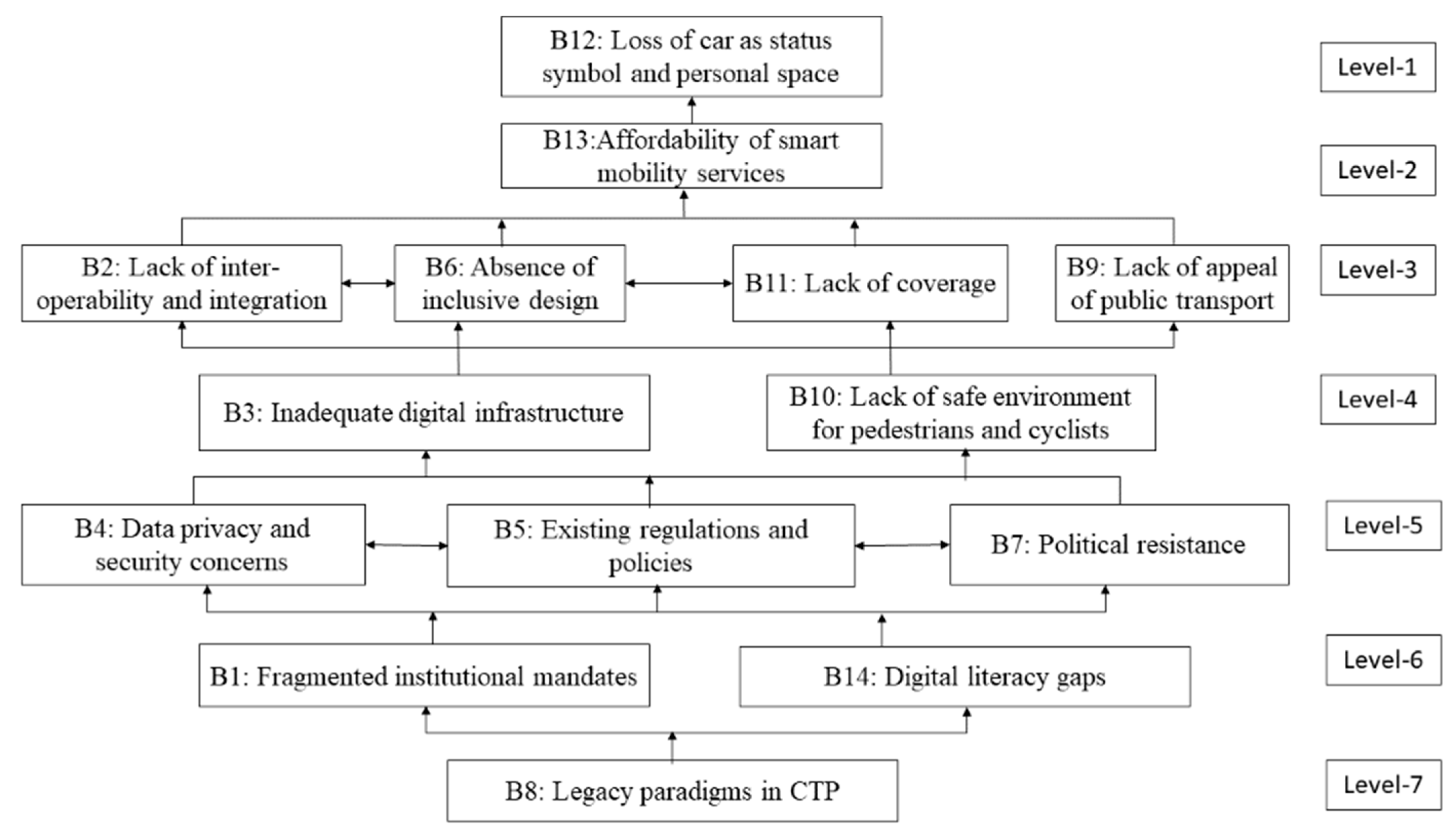
4.6. Interpretation of the Hierarchical Model
- Level VII—Foundational Drivers:
- Level VI—Structural Governance Barriers:
- Level V—Policy and Regulatory Barriers:
- Level IV—Technical and Infrastructural Barriers:
- Level III—Service and Design Barriers:
- Level II and I—User Perception and Behavioral Barriers:
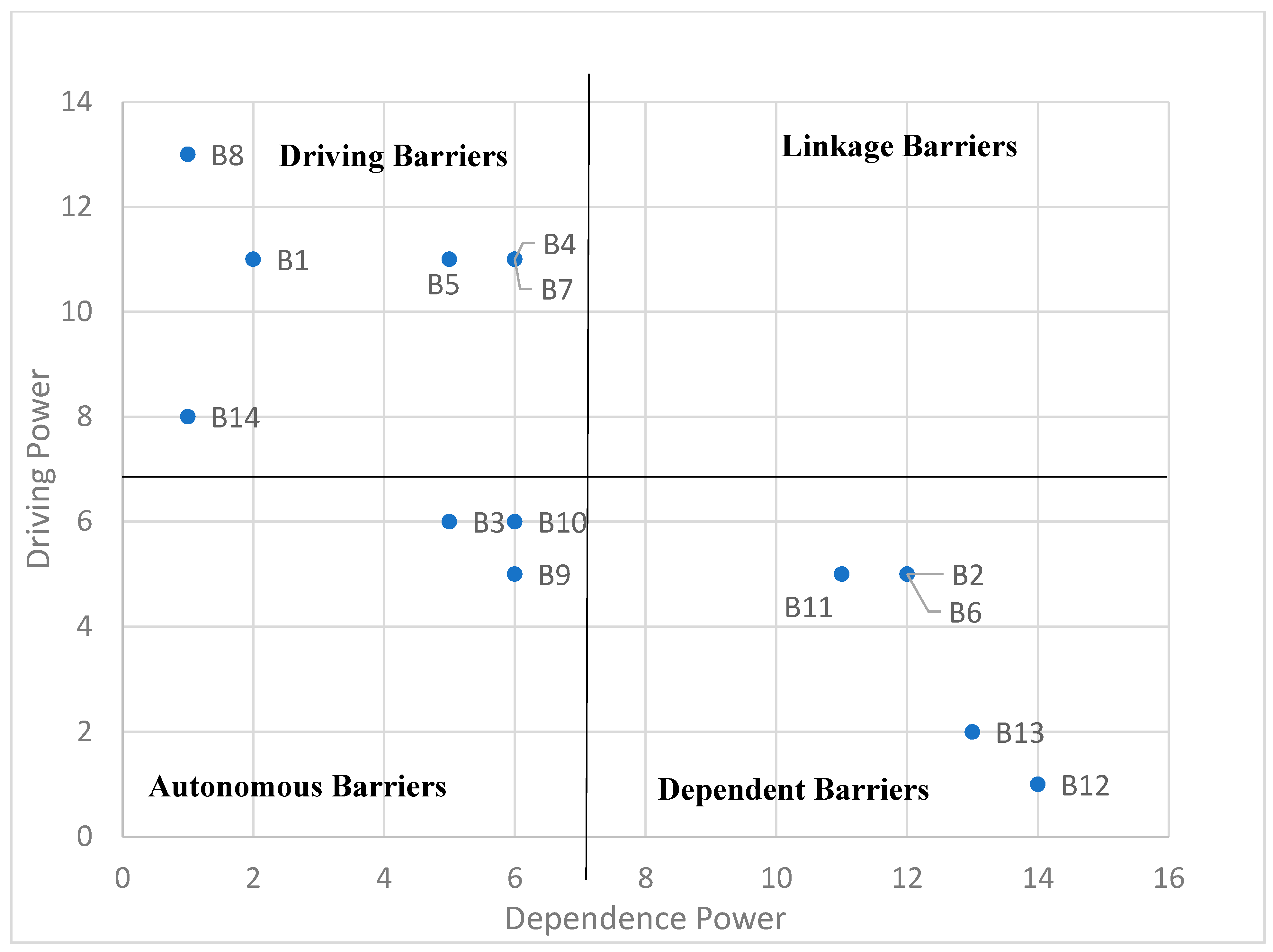
4.7. MICMAC Analysis
4.7.1. Analytical Process
- Driving barriers—high driving, low dependence;
- Dependent barriers—low driving, high dependence;
- Linkage barriers—high driving, high dependence;
- Autonomous barriers—low driving, low dependence.
4.7.2. Results and Interpretation
- Driving Barriers
- Dependent Barriers
- Linkage Barriers
- Autonomous Barriers
5. Discussion, Implications and Limitations
5.1. Discussion
5.2. Implications for Theory and Policy
5.3. Study Limitations and Future Research Directions
6. Conclusions
Author Contributions
Funding
Data Availability Statement
Conflicts of Interest
Appendix A. Data Collection Tool
| Section | Item/Question | Responses Format |
| A. Background Information | 1. Please indicate your current role/affiliation (e.g., policymaker, academic, practitioner, private sector). | Open-ended |
| 2. How many years of experience do you have in the field of urban mobility, transport planning, or related areas? | Number of Years | |
| B. Barrier Validation | 3. Please rate the relevance of each barrier (list of 31 barriers provided in a separate sheet) to smart mobility adoption in your context. | 5-point Likert scale (1 = Not Relevant, 5 = Highly Relevant) |
| 4. From your experience, are there barriers not captured in this list? Please specify. | Open-ended | |
| C. Barrier Interrelationships (TISM Input) | 5. Do you believe Barrier X influences Barrier Y? (Pairwise comparisons of 14 barriers presented in matrix form). | Response options: V (X influences Y), A (Y influences X), X (Mutual influence), O (No relation). |
| 6. Please provide a brief explanation for your judgment (why/how one barrier influences another). | Open-ended |
References
- Goumiri, S.; Yahiaoui, S.; Djahel, S. Smart Mobility in Smart Cities: Emerging Challenges, Recent Advances and Future Directions. J. Intell. Transp. Syst. Technol. Plan. Oper. 2023, 29, 81–117. [Google Scholar] [CrossRef]
- Hensher, D.A.; Nelson, J.D. Do Integrated Mobility Services Have a Future? The Neglected Role of Non-Mobility Service Providers: Challenges, and Opportunities to Extract Sustainable Transport Outcomes. Transp. Policy 2025, 163, 348–357. [Google Scholar] [CrossRef]
- Ribeiro, P.; Dias, G.; Pereira, P. Transport Systems and Mobility for Smart Cities. Appl. Syst. Innov. 2021, 4, 61. [Google Scholar] [CrossRef]
- Chen, Z.; Chan, I.C.C. Smart Cities and Quality of Life: A Quantitative Analysis of Citizens’ Support for Smart City Development. Inf. Technol. People 2023, 36, 263–285. [Google Scholar] [CrossRef]
- Zhao, C.; Wang, K.; Dong, X.; Dong, K. Is Smart Transportation Associated with Reduced Carbon Emissions? The Case of China. Energy Econ. 2022, 105, 105715. [Google Scholar] [CrossRef]
- Mitieka, D.; Luke, R.; Twinomurinzi, H.; Mageto, J. Smart Mobility in Urban Areas: A Bibliometric Review and Research Agenda. Sustainability 2023, 15, 6754. [Google Scholar] [CrossRef]
- Carpentiere, C.D.; Messeni Petruzzelli, A.; Ardito, L. Success Factors in Smart Mobility: A New Framework and Implications for the EuroMed Context from Case Study of New York, Copenhagen, Singapore, Bari and Barcelona. EuroMed J. Bus. 2024. [Google Scholar] [CrossRef]
- Shaheen, S.; Cohen, A. Shared Ride Services in North America: Definitions, Impacts, and the Future of Pooling. Transp. Rev. 2019, 39, 427–442. [Google Scholar] [CrossRef]
- Zhang, Y.; Kamargianni, M. A Review on the Factors Influencing the Adoption of New Mobility Technologies and Services: Autonomous Vehicle, Drone, Micromobility and Mobility as a Service. Transp. Rev. 2023, 43, 407–429. [Google Scholar] [CrossRef]
- Wolniak, R.; Stecuła, K. Artificial Intelligence in Smart Cities—Applications, Barriers, and Future Directions: A Review. Smart Cities 2024, 7, 1346–1389. [Google Scholar] [CrossRef]
- Tarei, P.K.; Chand, P.; Gupta, H. Barriers to the Adoption of Electric Vehicles: Evidence from India. J. Clean. Prod. 2021, 291, 125847. [Google Scholar] [CrossRef]
- Xi, H.; Nelson, J.D.; Mulley, C.; Hensher, D.A.; Ho, C.Q.; Balbontin, C. Barriers towards Enhancing Mobility through Integrated Mobility Services in a Regional and Rural Context: Insights from Suppliers and Organisers. Transp. Policy 2025, 171, 282–295. [Google Scholar] [CrossRef]
- Delaere, H.; Basu, S.; Macharis, C.; Keseru, I. Barriers and Opportunities for Developing, Implementing and Operating Inclusive Digital Mobility Services. Eur. Transp. Res. Rev. 2024, 16, 67. [Google Scholar] [CrossRef]
- Müller-Eie, D. Conceptual Barriers to Integrating Smart and Sustainable Mobility Planning. In A Nordic Smart Sustainable City; Routledge: London, UK, 2025; pp. 94–105. [Google Scholar]
- Kent, J.L. Driving to Save Time or Saving Time to Drive? The Enduring Appeal of the Private Car. Transp. Res. Part A Policy Pract. 2014, 65, 103–115. [Google Scholar] [CrossRef]
- Qiao, S.; Yeh, A.G.O. Mobility-on-Demand Public Transport toward Spatial Justice: Shared Mobility or Mobility as a Service. Transp. Res. D Transp. Environ. 2023, 123, 103916. [Google Scholar] [CrossRef]
- Harrison, G.; Grant-Muller, S.M.; Hodgson, F.C. New and Emerging Data Forms in Transportation Planning and Policy: Opportunities and Challenges for “Track and Trace” Data. Transp. Res. Part C Emerg. Technol. 2020, 117, 102672. [Google Scholar] [CrossRef]
- Rye, T.; Lyons, G.; Svensson, T.; Lenferink, S.; Mladenovič, L.; Piras, F.; Witzell, J. Uncertainty and Triple Access Planning in European Sustainable Urban Mobility Plans: A Long Way to Go Yet? Transp. Plan. Technol. 2024, 48, 1330–1352. [Google Scholar] [CrossRef]
- Woods, O. Subverting the Logics of “Smartness” in Singapore: Smart Eldercare and Parallel Regimes of Sustainability. Sustain. Cities Soc. 2020, 53, 101940. [Google Scholar] [CrossRef]
- Marsden, G.; Reardon, L. Questions of Governance: Rethinking the Study of Transportation Policy. Transp. Res. Part A Policy Pract. 2017, 101, 238–251. [Google Scholar] [CrossRef]
- Benevolo, C.; Dameri, R.P.; D’Auria, B. Smart Mobility in Smart City. In Empowering Organizations, Enabling Platforms and Artefacts; Springer: Cham, Switzerland, 2016; pp. 13–28. [Google Scholar]
- Lyons, G.; Hammond, P.; Mackay, K. The Importance of User Perspective in the Evolution of MaaS. Transp. Res. Part A Policy Pract. 2019, 121, 22–36. [Google Scholar] [CrossRef]
- Kębłowski, W.; Dobruszkes, F.; Boussauw, K. Moving Past Sustainable Transport Studies: Towards a Critical Perspective on Urban Transport. Transp. Res. Part A Policy Pract. 2022, 159, 74–83. [Google Scholar] [CrossRef]
- Pangbourne, K.; Mladenović, M.N.; Stead, D.; Milakis, D. Questioning Mobility as a Service: Unanticipated Implications for Society and Governance. Transp. Res. Part A Policy Pract. 2020, 131, 35–49. [Google Scholar] [CrossRef]
- Docherty, I.; Marsden, G.; Anable, J. The Governance of Smart Mobility. Transp. Res. Part A Policy Pract. 2018, 115, 114–125. [Google Scholar] [CrossRef]
- Turienzo, J.; Cabanelas, P.; Lampón, J.F.; Parkhurst, G. The Transformation of Mobility in Europe: Technological Change and Social Conditionings. Travel. Behav. Soc. 2025, 38, 100907. [Google Scholar] [CrossRef]
- Vrščaj, D.; Nyholm, S.; Verbong, G.P.J. Smart Mobility Innovation Policy as Boundary Work: Identifying the Challenges of User Involvement. Transp. Rev. 2021, 41, 210–229. [Google Scholar] [CrossRef]
- Kitchin, R. The Real-Time City? Big Data and Smart Urbanism. GeoJournal 2014, 79, 1–14. [Google Scholar] [CrossRef]
- Groth, S. Multimodal Divide: Reproduction of Transport Poverty in Smart Mobility Trends. Transp. Res. Part A Policy Pract. 2019, 125, 56–71. [Google Scholar] [CrossRef]
- Paiva, S.; Ahad, M.A.; Tripathi, G.; Feroz, N.; Casalino, G. Enabling Technologies for Urban Smart Mobility: Recent Trends, Opportunities and Challenges. Sensors 2021, 21, 2143. [Google Scholar] [CrossRef]
- Harris, S.; Mata, É.; Plepys, A.; Katzeff, C. Sharing Is Daring, but Is It Sustainable? An Assessment of Sharing Cars, Electric Tools and Offices in Sweden. Resour. Conserv. Recycl. 2021, 170, 105583. [Google Scholar] [CrossRef]
- Hasselwander, M.; Bigotte, J.F. Transport Authorities and Innovation: Understanding Barriers for MaaS Implementation in the Global South. Transp. Res. Procedia 2022, 62, 475–482. [Google Scholar] [CrossRef]
- Caiati, V.; Rasouli, S.; Timmermans, H. Bundling, Pricing Schemes and Extra Features Preferences for Mobility as a Service: Sequential Portfolio Choice Experiment. Transp. Res. Part A Policy Pract. 2020, 131, 123–148. [Google Scholar] [CrossRef]
- Hardi, R.; Nurmandi, A.; Purwaningsih, T.; Manaf, H.A. Smart City Governance and Interoperability: Enhancing Human Security in Yogyakarta and Makassar, Indonesia. Front. Polit. Sci. 2025, 7, 1553177. [Google Scholar] [CrossRef]
- Buchinger, M.; Kuhn, P.; Balta, D. Towards Interoperability of Data Platforms for Smart Cities. In Handbook of Smart Cities; Springer International Publishing: Cham, Switzerland, 2021; pp. 1–22. [Google Scholar]
- Kitchin, R. Data-Driven, Networked Urbanism. In Data and the City; Routledge: New York, NY, USA, 2017; pp. 44–56. [Google Scholar]
- Vanolo, A. Is There Anybody out There? The Place and Role of Citizens in Tomorrow’s Smart Cities. Futures 2016, 82, 26–36. [Google Scholar] [CrossRef]
- Sheller, M. Mobility Justice: The Politics of Movement in an Age of Extremes; Taylor & Francis, LLC: Abingdon, UK, 2018; Volume 8. [Google Scholar]
- Golub, A.; Satterfield, V.; Serritella, M.; Singh, J.; Phillips, S. Assessing the Barriers to Equity in Smart Mobility Systems: A Case Study of Portland, Oregon. Case Stud. Transp. Policy 2019, 7, 689–697. [Google Scholar] [CrossRef]
- OECD. OECD Economic Outlook; OECD: Paris, France, 2020; ISBN 9789264680135. [Google Scholar]
- Yao, Q.; Hu, C.; Zhou, W. The Impact of Customer Privacy Concerns on Service Robot Adoption Intentions: A Credence/Experience Service Typology Perspective. Technol. Forecast. Soc. Change 2024, 198, 122948. [Google Scholar] [CrossRef]
- Schuster, F.; Habibipour, A. Users’ Privacy and Security Concerns That Affect IoT Adoption in the Home Domain. Int. J. Hum. Comput. Interact. 2024, 40, 1632–1643. [Google Scholar] [CrossRef]
- Pool, J.; Akhlaghpour, S.; Fatehi, F.; Gray, L.C. Data Privacy Concerns and Use of Telehealth in the Aged Care Context: An Integrative Review and Research Agenda. Int. J. Med. Inform. 2022, 160, 104707. [Google Scholar] [CrossRef] [PubMed]
- Zhou, T. The Effect of Information Privacy Concern on Users’ Social Shopping Intention. Online Inf. Rev. 2020, 44, 1119–1133. [Google Scholar] [CrossRef]
- Martin, N.; Matt, C.; Niebel, C.; Blind, K. How Data Protection Regulation Affects Startup Innovation. Inf. Syst. Front. 2019, 21, 1307–1324. [Google Scholar] [CrossRef]
- Sadowski, J.; Maalsen, S. Modes of Making Smart Cities: Or, Practices of Variegated Smart Urbanism. Telemat. Inform. 2020, 55, 101449. [Google Scholar] [CrossRef]
- Zuboff, S. Surveillance Capitalism and the Challenge of Collective Action. New Labor. Forum 2019, 28, 10–29. [Google Scholar] [CrossRef]
- Shin, D.-H. The Effects of Trust, Security and Privacy in Social Networking: A Security-Based Approach to Understand the Pattern of Adoption. Interact. Comput. 2010, 22, 428–438. [Google Scholar] [CrossRef]
- Van Zoonen, L. Data Governance and Citizen Participation in the Digital Welfare State. Data Policy 2020, 2, e10. [Google Scholar] [CrossRef]
- Cavoukian, A.; Taylor, S.; Abrams, M.E. Privacy by Design: Essential for Organizational Accountability and Strong Business Practices. Identity Inf. Soc. 2010, 3, 405–413. [Google Scholar] [CrossRef]
- Cugurullo, F.; Acheampong, R.A. Fear of AI: An Inquiry into the Adoption of Autonomous Cars in Spite of Fear, and a Theoretical Framework for the Study of Artificial Intelligence Technology Acceptance. AI Soc. 2024, 39, 1569–1584. [Google Scholar] [CrossRef]
- Tennakoon, V.; Wiles, J.; Peiris-John, R.; Wickremasinghe, R.; Kool, B.; Ameratunga, S. Transport Equity in Sri Lanka: Experiences Linked to Disability and Older Age. J. Transp. Health 2020, 18, 100913. [Google Scholar] [CrossRef]
- Bascom, G.W.; Christensen, K.M. The Impacts of Limited Transportation Access on Persons with Disabilities’ Social Participation. J. Transp. Health 2017, 7, 227–234. [Google Scholar] [CrossRef]
- Lucas-Carrasco, R.; Salvador-Carulla, L. Life Satisfaction in Persons with Intellectual Disabilities. Res. Dev. Disabil. 2012, 33, 1103–1109. [Google Scholar] [CrossRef]
- Bruzzone, F.; Cavallaro, F.; Nocera, S. The Definition of Equity in Transport. Transp. Res. Procedia 2023, 69, 440–447. [Google Scholar] [CrossRef]
- Lim, H.S.M.; Taeihagh, A. Algorithmic Decision-Making in AVs: Understanding Ethical and Technical Concerns for Smart Cities. Sustainability 2019, 11, 5791. [Google Scholar] [CrossRef]
- Imrie, R. Universalism, Universal Design and Equitable Access to the Built Environment. Disabil. Rehabil. 2012, 34, 873–882. [Google Scholar] [CrossRef] [PubMed]
- Lucas, K. Transport and Social Exclusion: Where Are We Now? Transp. Policy 2012, 20, 105–113. [Google Scholar] [CrossRef]
- Aldred, R.; Verlinghieri, E.; Sharkey, M.; Itova, I.; Goodman, A. Equity in New Active Travel Infrastructure: A Spatial Analysis of London’s New Low Traffic Neighbourhoods. J. Transp. Geogr. 2021, 96, 103194. [Google Scholar] [CrossRef]
- Meadowcroft, J. Who Is in Charge Here? Governance for Sustainable Development in a Complex World. J. Environ. Policy Plan. 2007, 9, 299–314. [Google Scholar] [CrossRef]
- Rode, P.; Floater, G.; Thomopoulos, N.; Docherty, J.; Schwinger, P.; Mahendra, A.; Fang, W. Accessibility in Cities: Transport and Urban Form. In Disrupting Mobility; Springer: Cham, Switzerland, 2017; pp. 239–273. [Google Scholar]
- Hölscher, K.; Frantzeskaki, N.; McPhearson, T.; Loorbach, D. Capacities for Urban Transformations Governance and the Case of New York City. Cities 2019, 94, 186–199. [Google Scholar] [CrossRef]
- Cohen, B.; Kietzmann, J. Ride On! Mobility Business Models for the Sharing Economy. Organ. Environ. 2014, 27, 279–296. [Google Scholar] [CrossRef]
- Kamargianni, M.; Li, W.; Matyas, M.; Schäfer, A. A Critical Review of New Mobility Services for Urban Transport. Transp. Res. Procedia 2016, 14, 3294–3303. [Google Scholar] [CrossRef]
- Hensher, D.A. Tackling Road Congestion—What Might It Look like in the Future under a Collaborative and Connected Mobility Model? Transp. Policy 2018, 66, A1–A8. [Google Scholar] [CrossRef]
- Hull, A. Policy Integration: What Will It Take to Achieve More Sustainable Transport Solutions in Cities? Transp. Policy 2008, 15, 94–103. [Google Scholar] [CrossRef]
- Marsden, G.; Reardon, L. Governance of the Smart Mobility Transition; Emerald Publishing Limited: Leeds, UK, 2018; ISBN 978-1-78754-320-1. [Google Scholar]
- Zawieska, J.; Pieriegud, J. Smart City as a Tool for Sustainable Mobility and Transport Decarbonisation. Transp. Policy 2018, 63, 39–50. [Google Scholar] [CrossRef]
- Geels, F.W.; Sovacool, B.K.; Schwanen, T.; Sorrell, S. The Socio-Technical Dynamics of Low-Carbon Transitions. Joule 2017, 1, 463–479. [Google Scholar] [CrossRef]
- Paddeu, D.; Lyons, G.; Chatterjee, K.; Calvert, T. Practitioner Views on Transport Planning’s Evolution—A Sisyphean Task Still Ahead? Transp. Policy 2024, 156, 89–100. [Google Scholar] [CrossRef]
- Levine, K.; Karner, A. Approaching Accessibility: Four Opportunities to Address the Needs of Disabled People in Transportation Planning in the United States. Transp. Policy 2023, 131, 66–74. [Google Scholar] [CrossRef]
- Aravind, A.; Venthuruthiyil, S.P.; Mishra, S. Equity and Accessibility Assessment of Fixed Route Transit Systems Integrated with On-Demand Feeder Services. J. Transp. Geogr. 2024, 121, 104028. [Google Scholar] [CrossRef]
- Chatziioannou, I.; Nikitas, A.; Tzouras, P.G.; Bakogiannis, E.; Alvarez-Icaza, L.; Chias-Becerril, L.; Karolemeas, C.; Tsigdinos, S.; Wallgren, P.; Rexfelt, O. Ranking Sustainable Urban Mobility Indicators and Their Matching Transport Policies to Support Liveable City Futures: A MICMAC Approach. Transp. Res. Interdiscip. Perspect. 2023, 18, 100788. [Google Scholar] [CrossRef]
- Klaever, A.; Roessner, V.; Becker, S.; Scheidler, V. Lived Expertise of the Structurally Disadvantaged: Towards a More Just Participatory Transport Planning Process. Mobilities 2024, 20, 555–572. [Google Scholar] [CrossRef]
- Lovelace, R.; Parkin, J.; Cohen, T. Open Access Transport Models: A Leverage Point in Sustainable Transport Planning. Transp. Policy 2020, 97, 47–54. [Google Scholar] [CrossRef]
- Schwanen, T. Transport Geography, Climate Change and Space: Opportunity for New Thinking. J. Transp. Geogr. 2019, 81, 102530. [Google Scholar] [CrossRef]
- Mullen, C.; Marsden, G. Mobility Justice in Low Carbon Energy Transitions. Energy Res. Soc. Sci. 2016, 18, 109–117. [Google Scholar] [CrossRef]
- van Dijk, J.A.G.M. Digital Divide Research, Achievements and Shortcomings. Poetics 2006, 34, 221–235. [Google Scholar] [CrossRef]
- Salazar-Miranda, A.; Heine, C.; Duarte, F.; Schechtner, K.; Ratti, C. Measuring the Impact of Slow Zones on Street Life Using Social Media. Cities 2022, 131, 104010. [Google Scholar] [CrossRef]
- Pucher, J.; Buehler, R. Walking and Cycling for Healthy Cities. Built Environ. 2010, 36, 391–414. [Google Scholar] [CrossRef]
- Litman, T. Evaluating Public Transit Benefits and Costs. 2025. Available online: https://www.vtpi.org/tranben.pdf (accessed on 29 September 2025).
- Rasca, S.; Saeed, N. Exploring the Factors Influencing the Use of Public Transport by Commuters Living in Networks of Small Cities and Towns. Travel. Behav. Soc. 2022, 28, 249–263. [Google Scholar] [CrossRef]
- Pojani, D.; Stead, D. Sustainable Urban Transport in the Developing World: Beyond Megacities. Sustainability 2015, 7, 7784–7805. [Google Scholar] [CrossRef]
- Sharma, G.; Patil, G.R. Urban Spatial Structure and Equity for Urban Services through the Lens of Accessibility. Transp. Policy 2024, 146, 72–90. [Google Scholar] [CrossRef]
- Shaheen, S. Shared Mobility: The Potential of Ridehailing and Pooling. In Three Revolutions; Island Press/Center for Resource Economics: Washington, DC, USA, 2018; pp. 55–76. [Google Scholar]
- Sochor, J.; Arby, H.; Karlsson, I.C.M.A.; Sarasini, S. A Topological Approach to Mobility as a Service: A Proposed Tool for Understanding Requirements and Effects, and for Aiding the Integration of Societal Goals. Res. Transp. Bus. Manag. 2018, 27, 3–14. [Google Scholar] [CrossRef]
- Steg, L. Car Use: Lust and Must. Instrumental, Symbolic and Affective Motives for Car Use. Transp. Res. Part A Policy Pract. 2005, 39, 147–162. [Google Scholar] [CrossRef]
- Brenner, N.; Madden, D.J.; Wachsmuth, D. Assemblage Urbanism and the Challenges of Critical Urban Theory. City 2011, 15, 225–240. [Google Scholar] [CrossRef]
- Tonnarelli, F.; Mora, L. Smart Urbanism in Africa: When Theories Do Not Fit with Contextual Practices. Reg. Stud. 2024, 58, 1767–1777. [Google Scholar] [CrossRef]
- Monstadt, J.; Rutherford, J.; Coutard, O. Infrastructures as Urban Solutions? Critical Perspectives on Transformative Socio-Technical Change. Urban. Stud. 2025, 62, 1709–1730. [Google Scholar] [CrossRef]
- Sushil. Modified ISM/TISM Process with Simultaneous Transitivity Checks for Reducing Direct Pair Comparisons. Glob. J. Flex. Syst. Manag. 2017, 18, 331–351. [Google Scholar] [CrossRef]
- Warfield, J.N. Toward Interpretation of Complex Structural Models. IEEE Trans. Syst. Man Cybern. 1974, SMC-4, 405–417. [Google Scholar] [CrossRef]
- Singh, M.D.; Kant, R. Knowledge Management Barriers: An Interpretive Structural Modeling Approach. Int. J. Manag. Sci. Eng. Manag. 2008, 3, 141–150. [Google Scholar] [CrossRef]
- Mathiyazhagan, K.; Govindan, K.; Noorul Haq, A. Pressure Analysis for Green Supply Chain Management Implementation in Indian Industries Using Analytic Hierarchy Process. Int. J. Prod. Res. 2014, 52, 188–202. [Google Scholar] [CrossRef]
- Jain, P.; Garg, S.; Kansal, G. A TISM Approach for the Analysis of Enablers in Implementing Mass Customization in Indian Manufacturing Units. Prod. Plan. Control 2023, 34, 173–188. [Google Scholar] [CrossRef]
- Singh, A.; Singla, A.R. Modelling and Analysis of Factors for Implementation of Smart Cities: TISM Approach. J. Model. Manag. 2022, 17, 1587–1622. [Google Scholar] [CrossRef]
- Whetten, D. Whetten-What-Constitutes-a-Theoretical-Contribution. Acad. Manag. Rev. 1989, 14, 490–495. [Google Scholar] [CrossRef]
- Sushil; Dinesh, K.K. Structured Literature Review with TISM Leading to an Argumentation Based Conceptual Model. Glob. J. Flex. Syst. Manag. 2022, 23, 387–407. [Google Scholar] [CrossRef]
- Mangla, S.K.; Kumar, P.; Barua, M.K. Risk Analysis in Green Supply Chain Using Fuzzy AHP Approach: A Case Study. Resour. Conserv. Recycl. 2015, 104, 375–390. [Google Scholar] [CrossRef]
- Venkatesh, V.G.; Zhang, A.; Deakins, E.; Luthra, S.; Mangla, S. A Fuzzy AHP-TOPSIS Approach to Supply Partner Selection in Continuous Aid Humanitarian Supply Chains. Ann. Oper. Res. 2019, 283, 1517–1550. [Google Scholar] [CrossRef]
- Linstone, H.A.; Lendaris, G.G.; Rogers, S.D.; Wakeland, W.; Williams, M. The Use of Structural Modeling for Technology Assessment. Technol. Forecast. Soc. Change 1979, 14, 291–327. [Google Scholar] [CrossRef]
- Jena, J.; Sidharth, S.; Thakur, L.S.; Kumar Pathak, D.; Pandey, V.C. Total Interpretive Structural Modeling (TISM): Approach and Application. J. Adv. Manag. Res. 2017, 14, 162–181. [Google Scholar] [CrossRef]
- Saaty, R.W. Analytic Hierarchy Process—What It Is and How It Is Used. Math. Model. 1987, 9, 161–176. [Google Scholar] [CrossRef]
- Sethi, M.; Sushil; Gupta, M.P. Modelling the Enablers of Organizational Resilience: A Modified Total Interpretive Structural Modeling (m-TISM) Approach. Benchmarking 2024, 2, 1776–1824. [Google Scholar] [CrossRef]
- Dubey, R.; Gunasekaran, A.; Papadopoulos, T.; Childe, S.J.; Shibin, K.T.; Wamba, S.F. Sustainable Supply Chain Management: Framework and Further Research Directions. J. Clean. Prod. 2017, 142, 1119–1130. [Google Scholar] [CrossRef]
- Dhir, S.; Dhir, S. Modeling of Strategic Thinking Enablers: A Modified Total Interpretive Structural Modeling (TISM) and MICMAC Approach. Int. J. Syst. Assur. Eng. Manag. 2020, 11, 175–188. [Google Scholar] [CrossRef]
- Jayalakshmi, B.; Pramod, V.R. Total Interpretive Structural Modeling (TISM) of the Enablers of a Flexible Control System for Industry. Glob. J. Flex. Syst. Manag. 2015, 16, 63–85. [Google Scholar] [CrossRef]
- Butler, L.; Yigitcanlar, T.; Paz, A. Barriers and Risks of Mobility-as-a-Service (MaaS) Adoption in Cities: A Systematic Review of the Literature. Cities 2021, 109, 103036. [Google Scholar] [CrossRef]
- Pritchard, J. MaaS to Pull Us out of a Car-Centric Orbit: Principles for Sustainable Mobility-as-a-Service in the Context of Unsustainable Car Dependency. Case Stud. Transp. Policy 2022, 10, 1483–1493. [Google Scholar] [CrossRef]
- Alonso-González, M.J.; Hoogendoorn-Lanser, S.; van Oort, N.; Cats, O.; Hoogendoorn, S. Drivers and Barriers in Adopting Mobility as a Service (MaaS)—A Latent Class Cluster Analysis of Attitudes. Transp. Res. Part A Policy Pract. 2020, 132, 378–401. [Google Scholar] [CrossRef]
- Zhao, C.; Dong, K.; Taghizadeh-Hesary, F. Can Smart Transportation Enhance Green Development Efficiency? Econ. Change Restruct. 2023, 56, 825–857. [Google Scholar] [CrossRef]
- Shah, K.J.; Pan, S.-Y.; Lee, I.; Kim, H.; You, Z.; Zheng, J.-M.; Chiang, P.-C. Green Transportation for Sustainability: Review of Current Barriers, Strategies, and Innovative Technologies. J. Clean. Prod. 2021, 326, 129392. [Google Scholar] [CrossRef]
- Nieuwenhuijsen, M.J. Urban and Transport Planning Pathways to Carbon Neutral, Liveable and Healthy Cities; A Review of the Current Evidence. Environ. Int. 2020, 140, 105661. [Google Scholar] [CrossRef]
- Mahdavian, A.; Shojaei, A.; McCormick, S.; Papandreou, T.; Eluru, N.; Oloufa, A.A. Drivers and Barriers to Implementation of Connected, Automated, Shared, and Electric Vehicles: An Agenda for Future Research. IEEE Access 2021, 9, 22195–22213. [Google Scholar] [CrossRef]
- Fagnant, D.J.; Kockelman, K. Preparing a Nation for Autonomous Vehicles: Opportunities, Barriers and Policy Recommendations. Transp. Res. Part A Policy Pract. 2015, 77, 167–181. [Google Scholar] [CrossRef]
- Merfeld, K.; Wilhelms, M.P.; Henkel, S.; Kreutzer, K. Carsharing with Shared Autonomous Vehicles: Uncovering Drivers, Barriers and Future Developments—A Four-Stage Delphi Study. Technol. Forecast. Soc. Change 2019, 144, 66–81. [Google Scholar] [CrossRef]
- Karlsson, I.C.M.; Mukhtar-Landgren, D.; Smith, G.; Koglin, T.; Kronsell, A.; Lund, E.; Sarasini, S.; Sochor, J. Development and Implementation of Mobility-as-a-Service—A Qualitative Study of Barriers and Enabling Factors. Transp. Res. Part A Policy Pract. 2020, 131, 283–295. [Google Scholar] [CrossRef]
- Casadó, R.G.; Golightly, D.; Laing, K.; Palacin, R.; Todd, L. Children, Young People and Mobility as a Service: Opportunities and Barriers for Future Mobility. Transp. Res. Interdiscip. Perspect. 2020, 4, 100107. [Google Scholar] [CrossRef]
- Weckström, C.; Mladenović, M.N.; Ullah, W.; Nelson, J.D.; Givoni, M.; Bussman, S. User Perspectives on Emerging Mobility Services: Ex Post Analysis of Kutsuplus Pilot. Res. Transp. Bus. Manag. 2018, 27, 84–97. [Google Scholar] [CrossRef]
- Kayikci, Y.; Kabadurmus, O. Barriers to the Adoption of the Mobility-as-a-Service Concept: The Case of Istanbul, a Large Emerging Metropolis. Transp. Policy 2022, 129, 219–236. [Google Scholar] [CrossRef]
- Sanders, R.L.; Branion-Calles, M.; Nelson, T.A. To Scoot or Not to Scoot: Findings from a Recent Survey about the Benefits and Barriers of Using E-Scooters for Riders and Non-Riders. Transp. Res. Part A Policy Pract. 2020, 139, 217–227. [Google Scholar] [CrossRef]
- Martínez-Buelvas, L.; Rakotonirainy, A.; Grant-Smith, D.; Oviedo-Trespalacios, O. A Transport Justice Approach to Integrating Vulnerable Road Users with Automated Vehicles. Transp. Res. D Transp. Environ. 2022, 113, 103499. [Google Scholar] [CrossRef]
- Krueger, R.A. Focus Groups: A Practical Guide for Applied Research; SAGE: Newcastle upon Tyne, UK, 2009; ISBN 1412969476. [Google Scholar]
- Morgan, D.L. Focus Groups. Annu. Rev. Sociol. 1996, 22, 129–152. [Google Scholar] [CrossRef]
- Bloor, M.; Frankland, J.; Thomas, M.; Robson, K. Focus Groups in Social Research; SAGE Publications Ltd.: London, UK, 2001; ISBN 9780761957423. [Google Scholar]
- Okoli, C.; Pawlowski, S.D. The Delphi Method as a Research Tool: An Example, Design Considerations and Applications. Inf. Manag. 2004, 42, 15–29. [Google Scholar] [CrossRef]
- Kar, S.; Kar, A.K.; Gupta, M.P. Modeling Drivers and Barriers of Artificial Intelligence Adoption: Insights from a Strategic Management Perspective. Intell. Syst. Account. Financ. Manag. 2021, 28, 217–238. [Google Scholar] [CrossRef]
- Yadav, G.; Kumar, A.; Luthra, S.; Garza-Reyes, J.A.; Kumar, V.; Batista, L. A Framework to Achieve Sustainability in Manufacturing Organisations of Developing Economies Using Industry 4.0 Technologies’ Enablers. Comput. Ind. 2020, 122, 103280. [Google Scholar] [CrossRef]
- Goel, P.; Kumar, A.; Parayitam, S.; Luthra, S. Understanding Transport Users’ Preferences for Adopting Electric Vehicle Based Mobility for Sustainable City: A Moderated Moderated-Mediation Model. J. Transp. Geogr. 2023, 106, 103520. [Google Scholar] [CrossRef]
- Lamond, J.; Everett, G. Sustainable Blue-Green Infrastructure: A Social Practice Approach to Understanding Community Preferences and Stewardship. Landsc. Urban. Plan. 2019, 191, 103639. [Google Scholar] [CrossRef]
- Johnstone, D.J. A Listening Guide Analysis of Women’s Experiences of Unacknowledged Rape. Psychol. Women Q. 2016, 40, 275–289. [Google Scholar] [CrossRef]
- Baliga, A.J.; Chawla, V.; Sunder M., V.; Kumar, R. Barriers to Service Recovery in B2B Markets: A TISM Approach in the Context of IT-Based Services. J. Bus. Ind. Mark. 2021, 36, 1452–1473. [Google Scholar] [CrossRef]
- Mageto, J.; Twinomurinzi, H.; Luke, R.; Mhlongo, S.; Bwalya, K.; Bvuma, S. Building Resilience into Smart Mobility for Urban Cities: An Emerging Economy Perspective. Int. J. Prod. Res. 2024, 62, 5556–5573. [Google Scholar] [CrossRef]
- Mandal, A.; Deshmukh, S.G. Vendor Selection Using Interpretive Structural Modelling (ISM). Int. J. Oper. Prod. Manag. 1994, 14, 52–59. [Google Scholar] [CrossRef]
- Sunder, V. Rejects Reduction in a Retail Bank Using Lean Six Sigma. Prod. Plan. Control 2016, 27, 1131–1142. [Google Scholar] [CrossRef]
- Banister, D. The Sustainable Mobility Paradigm. Transp. Policy 2008, 15, 73–80. [Google Scholar] [CrossRef]
- Geels, F.W. A Socio-Technical Analysis of Low-Carbon Transitions: Introducing the Multi-Level Perspective into Transport Studies. J. Transp. Geogr. 2012, 24, 471–482. [Google Scholar] [CrossRef]
- Givoni, M.; Banister, D. Mobility, Transport and Carbon. In Moving Towards Low Carbon Mobility; Edward Elgar Publishing: Cheltenham, UK, 2013. [Google Scholar]
- Su, W.; Junge, S. Unlocking the Recipe for Organizational Resilience: A Review and Future Research Directions. Eur. Manag. J. 2023, 41, 1086–1105. [Google Scholar] [CrossRef]
- Hesselgren, M.; Sjöman, M.; Pernestål, A. Understanding User Practices in Mobility Service Systems: Results from Studying Large Scale Corporate MaaS in Practice. Travel. Behav. Soc. 2020, 21, 318–327. [Google Scholar] [CrossRef]
- Raetze, S.; Duchek, S.; Maynard, M.T.; Kirkman, B.L. Resilience in Organizations: An Integrative Multilevel Review and Editorial Introduction. Group. Organ. Manag. 2021, 46, 607–656. [Google Scholar] [CrossRef]
- Vassilakopoulou, P.; Hustad, E. Bridging Digital Divides: A Literature Review and Research Agenda for Information Systems Research. Inf. Syst. Front. 2023, 25, 955–969. [Google Scholar] [CrossRef]
- Steg, L.; Gifford, R. Sustainable Transportation and Quality of Life. J. Transp. Geogr. 2005, 13, 59–69. [Google Scholar] [CrossRef]
- Yeo, V.C.S.; Goh, S.K.; Rezaei, S. Consumer Experiences, Attitude and Behavioral Intention toward Online Food Delivery (OFD) Services. J. Retail. Consum. Serv. 2017, 35, 150–162. [Google Scholar] [CrossRef]
- Anable, J. “Complacent Car Addicts”; or “Aspiring Environmentalists”? Identifying Travel Behaviour Segments Using Attitude Theory. Transp. Policy 2005, 12, 65–78. [Google Scholar] [CrossRef]
- Sindhwani, R.; Malhotra, V. Modelling and Analysis of Agile Manufacturing System by ISM and MICMAC Analysis. Int. J. Syst. Assur. Eng. Manag. 2017, 8, 253–263. [Google Scholar] [CrossRef]
- Bhosale, V.A.; Kant, R. An Integrated ISM Fuzzy MICMAC Approach for Modelling the Supply Chain Knowledge Flow Enablers. Int. J. Prod. Res. 2016, 54, 7374–7399. [Google Scholar] [CrossRef]
- Rode, P.; Terrefe, B.; da Cruz, N.F. Cities and the Governance of Transport Interfaces: Ethiopia’s New Rail Systems. Transp. Policy 2020, 91, 76–94. [Google Scholar] [CrossRef]
- da Cruz, N.F.; Rode, P. Social Structures of Urban Governance: Strategic Spatial Planning in Addis Ababa. Territ. Politic Gov. 2024, 13, 1260–1282. [Google Scholar] [CrossRef]
- Gössling, S. The Psychology of the Car: Automobile Admiration, Attachment, and Addiction; Elsevier: Amsterdam, The Netherlands, 2017. [Google Scholar]
- Shukla, M.; Shankar, R. Modeling of Critical Success Factors for Adoption of Smart Manufacturing System in Indian SMEs: An Integrated Approach. Opsearch 2022, 59, 1271–1303. [Google Scholar] [CrossRef]
- Litman, T. Why and How to Reduce the Amount of Land Paved for Roads and Parking Facilities. Environ. Pract. 2011, 13, 38–46. [Google Scholar] [CrossRef]
- Holden, E.; Gilpin, G.; Banister, D. Sustainable Mobility at Thirty. Sustainability 2019, 11, 1965. [Google Scholar] [CrossRef]
- Gössling, S. Integrating E-Scooters in Urban Transportation: Problems, Policies, and the Prospect of System Change. Transp. Res. D Transp. Environ. 2020, 79, 102230. [Google Scholar] [CrossRef]
- Ho, C.Q.; Tirachini, A. Mobility-as-a-Service and the Role of Multimodality in the Sustainability of Urban Mobility in Developing and Developed Countries. Transp. Policy 2024, 145, 161–176. [Google Scholar] [CrossRef]
- Wong, R.C.P.; Ke, J.; Szeto, W.Y.; Mak, P.L. Multiple Shared Mobility Services under Competition: Empirical Evidence for Public Acceptance and Policy Insights to Sustainable Transport. Int. J. Sustain. Transp. 2024, 18, 562–575. [Google Scholar] [CrossRef]
- Smith, G.; Hensher, D.A. Towards a Framework for Mobility-as-a-Service Policies. Transp. Policy 2020, 89, 54–65. [Google Scholar] [CrossRef]
- Risimati, B.; Gumbo, T.; Chakwizira, J. Spatial Integration of Non-Motorized Transport and Urban Public Transport Infrastructure: A Case of Johannesburg. Sustainability 2021, 13, 11461. [Google Scholar] [CrossRef]
- Risimati, B.; Gumbo, T. Exploring the Applicability of Location-Based Services to Delineate the State Public Transport Routes Integratedness within the City of Johannesburg. Infrastructures 2018, 3, 28. [Google Scholar] [CrossRef]
- Machado, I.A.; Costa, C.; Santos, M.Y. Data Mesh: Concepts and Principles of a Paradigm Shift in Data Architectures. Procedia Comput. Sci. 2021, 196, 263–271. [Google Scholar] [CrossRef]
- Katzenbach, C.; Ulbricht, L. Algorithmic Governance. Internet Policy Rev. 2019, 8, 1–18. [Google Scholar] [CrossRef]
- Kolarova, V.; Cherchi, E. Impact of Trust and Travel Experiences on the Value of Travel Time Savings for Autonomous Driving. Transp. Res. Part C Emerg. Technol. 2021, 131, 103354. [Google Scholar] [CrossRef]
- Jorge, D.; Correia, G. Carsharing Systems Demand Estimation and Defined Operations: A Literature Review. EJTIR Issue 2013, 13, 201–220. [Google Scholar] [CrossRef]
- Wu, T.; Xu, M. Modeling and Optimization for Carsharing Services: A Literature Review. Multimodal Transp. 2022, 1, 100028. [Google Scholar] [CrossRef]
- Azolin, L.G.; Grigolon, A.B.; Rodrigues da Silva, A.N.; Geurs, K.T. Shared Mobility during Public Transport Disruptions: Users’ Perspectives in a Brazilian City. Transp. Res. D Transp. Environ. 2025, 147, 104972. [Google Scholar] [CrossRef]
- Beza, A.D.; Demissie, M.G.; Kattan, L. Equity Implications of Emerging Mobility Services and Public Transit Coopetition: A Review. Transp. Res. D Transp. Environ. 2025, 144, 104751. [Google Scholar] [CrossRef]
- Tanwar, R.; Agarwal, P.K. Multimodal Integration in India: Opportunities, Challenges, and Strategies for Sustainable Urban Mobility. Multimodal Transp. 2025, 4, 100210. [Google Scholar] [CrossRef]
- Sheller, M. Automotive Emotions: Feeling the Car. Theory Cult. Soc. 2004, 21, 221–242. [Google Scholar] [CrossRef]
- Meijer, A.; Bolívar, M.P.R. Governing the Smart City: A Review of the Literature on Smart Urban Governance. Int. Rev. Adm. Sci. 2016, 82, 392–408. [Google Scholar] [CrossRef]
- Geoghegan, S.; Cugurullo, F. Beyond Dystopian Smart Cities? Unlocking a Progressive Utopian Future in Smart Urbanism. Urban. Geogr. 2025, 46, 1865–1886. [Google Scholar] [CrossRef]
- Söderström, O.; Paasche, T.; Klauser, F. Smart Cities as Corporate Storytelling. City 2014, 18, 307–320. [Google Scholar] [CrossRef]



| No. | Barrier | Source |
|---|---|---|
| 1 | Infrastructure for sustainable mobility | [32,108] |
| 2 | Openness to Innovation and new technologies in mobility | [32,109,110] |
| 3 | Platform security | [32,39] |
| 4 | Public transport attitude | [110,111,112] |
| 5 | Car-dependency reduction | [113] |
| 6 | Conventional Transport Planning (CTP) | [14,18,113] |
| 7 | App-based (on-demand) mobility services | [18] |
| 8 | Active mobility | [18] |
| 9 | Basic transportation access | [39,114] |
| 10 | Access to data and the internet | [39] |
| 11 | Digital and banking divide | [32] |
| 12 | Low digital literacy and privacy concerns | [39,115] |
| 13 | Perceived security | [115,116] |
| 14 | Conservative mindsets and customer acceptance | [112,116] |
| 15 | Data safety, ethics, and surveillance concerns | [11] |
| 16 | Regulatory and legal uncertainty (liability, insurance) | [112,116,117] |
| 17 | Urban-centric service coverage | [116] |
| 18 | Lobbyism and industry influence | [116] |
| 19 | Loss of car as personal space/status symbol | [110,116] |
| 20 | Public acceptance of shared mobility | [112] |
| 21 | Legislation, taxation, and funding gaps | [117] |
| 22 | Weak business models and market uncertainty | [117] |
| 23 | Lack of cooperation among stakeholders | [117] |
| 24 | Interoperability and multimodal coordination issues | [32,118] |
| 25 | Ticketing/payment system fragmentation | [118] |
| 26 | Weak integration with public transport in underserved areas | [119] |
| 27 | Tradition of private vehicle ownership | [108,110] |
| 28 | Limited platform appeal to older adults and conservative users | [108] |
| 29 | Fragmented vision, collaboration, and data-sharing | [108,120] |
| 30 | Financial/resource constraints | [120] |
| 31 | Unsafe walking/cycling infrastructure and vulnerable road user neglect | [121,122] |
| Expert | Sector | Role/Title | Experience Area |
|---|---|---|---|
| E1 | Academia | Professor of Urban Transport | Smart mobility policy, urban governance |
| E2 | Government | Senior Urban Planner (City Transport Dept.) | Multi-modal transport planning |
| E3 | Industry | Head of Operations, Ride-hailing Platform | Platform-based mobility service delivery |
| E4 | Civil Society | Director, Mobility and Access NGO | Inclusive design and transport justice |
| E5 | Regulator | Officer, National ICT Authority | Data governance, privacy, and digital infrastructure |
| Barriers | B14 | B13 | B12 | B11 | B10 | B9 | B8 | B7 | B6 | B5 | B4 | B3 | B2 | B1 |
|---|---|---|---|---|---|---|---|---|---|---|---|---|---|---|
| B1: Fragmented institutional mandates | O | V | V | V | O | V | A | V | V | V | O | O | V | X |
| B2: Lack of inter-operability and information on multimodal journeys and Integration | O | V | O | A | A | A | A | A | V | A | O | A | X | |
| B3: Inadequate digital infrastructure | O | V | O | V | O | O | A | A | V | A | O | X | ||
| B4: Data privacy and security concerns | A | V | V | V | O | O | A | V | V | A | X | |||
| B5: Existing regulations and policies are not favorable for Smart Mobility | O | V | V | V | V | V | A | A | V | X | ||||
| B6: Absence of inclusive design | O | V | O | V | A | A | O | A | X | |||||
| B7: Political resistance | O | V | O | V | O | V | A | X | ||||||
| B8: Legacy paradigms in CTP | O | V | V | V | V | V | X | |||||||
| B9: Lack of appeal of public transport | O | V | V | O | O | X | ||||||||
| B10: Lack of safe environment for pedestrians and cyclists | O | V | V | V | X | |||||||||
| B11: Lack of coverage -smart mobility not extensively covered | O | V | V | X | ||||||||||
| B12: Loss of car as status symbol and personal space (e.g., flexibility). | O | A | X | |||||||||||
| B13: Affordability of smart mobility services | O | X | ||||||||||||
| B14: Digital literacy gaps | X |
| Barriers | B1 | B2 | B3 | B4 | B5 | B6 | B7 | B8 | B9 | B10 | B11 | B12 | B13 | B14 |
|---|---|---|---|---|---|---|---|---|---|---|---|---|---|---|
| B1: Fragmented institutional mandates | 1 | 1 | 0 | 0 | 1 | 1 | 1 | 0 | 1 | 0 | 1 | 1 | 1 | 0 |
| B2: Lack of inter-operability and information on multimodal journeys and Integration | 0 | 1 | 0 | 0 | 0 | 1 | 0 | 0 | 0 | 0 | 0 | 0 | 1 | 0 |
| B3: Inadequate digital infrastructure | 0 | 1 | 1 | 0 | 0 | 1 | 0 | 0 | 0 | 0 | 1 | 0 | 1 | 0 |
| B4: Data privacy and security concerns | 0 | 1 | 0 | 1 | 0 | 1 | 1 | 0 | 0 | 0 | 1 | 1 | 1 | 0 |
| B5: Existing regulations and policies are not favorable for Smart Mobility | 0 | 1 | 1 | 1 | 1 | 1 | 0 | 0 | 1 | 1 | 1 | 1 | 1 | 0 |
| B6: Absence of inclusive design | 0 | 0 | 0 | 0 | 0 | 1 | 0 | 0 | 0 | 0 | 1 | 0 | 1 | 0 |
| B7: Political resistance | 0 | 1 | 1 | 0 | 1 | 1 | 1 | 0 | 1 | 0 | 1 | 0 | 1 | 0 |
| B8: Legacy paradigms in CTP | 1 | 1 | 1 | 1 | 1 | 0 | 1 | 1 | 1 | 1 | 1 | 1 | 1 | 0 |
| B9: Lack of appeal of public transport | 0 | 1 | 0 | 0 | 0 | 1 | 0 | 0 | 1 | 0 | 0 | 1 | 1 | 0 |
| B10: Lack of safe environment for pedestrians and cyclists | 0 | 1 | 0 | 0 | 0 | 1 | 0 | 0 | 0 | 1 | 1 | 1 | 1 | 0 |
| B11: Lack of coverage -smart mobility not extensively covered | 0 | 1 | 0 | 0 | 0 | 0 | 0 | 0 | 0 | 0 | 1 | 1 | 1 | 0 |
| B12: Loss of car as status symbol and personal space (e.g., flexibility). | 0 | 0 | 0 | 0 | 0 | 0 | 0 | 0 | 0 | 0 | 0 | 1 | 0 | 0 |
| B13: Affordability of smart mobility services | 0 | 0 | 0 | 0 | 0 | 0 | 0 | 0 | 0 | 0 | 0 | 1 | 1 | 0 |
| B14: Digital literacy gaps | 0 | 0 | 0 | 1 | 0 | 0 | 0 | 0 | 0 | 0 | 0 | 0 | 0 | 1 |
| Barriers | B1 | B2 | B3 | B4 | B5 | B6 | B7 | B8 | B9 | B10 | B11 | B12 | B13 | B14 | Driving Power |
|---|---|---|---|---|---|---|---|---|---|---|---|---|---|---|---|
| B1: Fragmented institutional mandates | 1 | 1 | 0 | 1 | 1 | 1 | 1 | 0 | 1 | 1 | 1 | 1 | 1 | 0 | 11 |
| B2: Lack of inter-operability and information on multimodal journeys and Integration | 0 | 1 | 0 | 0 | 0 | 1 | 0 | 0 | 0 | 0 | 1 | 1 | 1 | 0 | 5 |
| B3: Inadequate digital infrastructure | 0 | 1 | 1 | 0 | 0 | 1 | 0 | 0 | 0 | 0 | 1 | 1 | 1 | 0 | 6 |
| B4: Data privacy and security concerns | 0 | 1 | 1 | 1 | 1 | 1 | 1 | 0 | 1 | 1 | 1 | 1 | 1 | 0 | 11 |
| B5: Existing regulations and policies are not favorable for Smart Mobility | 0 | 1 | 1 | 1 | 1 | 1 | 1 | 0 | 1 | 1 | 1 | 1 | 1 | 0 | 11 |
| B6: Absence of inclusive design | 0 | 1 | 0 | 0 | 0 | 1 | 0 | 0 | 0 | 0 | 1 | 1 | 1 | 0 | 5 |
| B7: Political resistance | 0 | 1 | 1 | 1 | 1 | 1 | 1 | 0 | 1 | 1 | 1 | 1 | 1 | 0 | 11 |
| B8: Legacy paradigms in CTP | 1 | 1 | 1 | 1 | 1 | 1 | 1 | 1 | 1 | 1 | 1 | 1 | 1 | 0 | 13 |
| B9: Lack of appeal of public transport | 0 | 1 | 0 | 0 | 0 | 1 | 0 | 0 | 1 | 0 | 0 | 1 | 1 | 0 | 5 |
| B10: Lack of safe environment for pedestrians and cyclists | 0 | 1 | 0 | 0 | 0 | 1 | 0 | 0 | 0 | 1 | 1 | 1 | 1 | 0 | 6 |
| B11: Lack of coverage -smart mobility not extensively covered | 0 | 1 | 0 | 0 | 0 | 1 | 0 | 0 | 0 | 0 | 1 | 1 | 1 | 0 | 5 |
| B12: Loss of car as status symbol and personal space (e.g., flexibility). | 0 | 0 | 0 | 0 | 0 | 0 | 0 | 0 | 0 | 0 | 0 | 1 | 0 | 0 | 1 |
| B13: Affordability of smart mobility services | 0 | 0 | 0 | 0 | 0 | 0 | 0 | 0 | 0 | 0 | 0 | 1 | 1 | 0 | 2 |
| B14: Digital literacy gaps | 0 | 1 | 0 | 1 | 0 | 1 | 1 | 0 | 0 | 0 | 1 | 1 | 1 | 1 | 8 |
| Dependency Power | 2 | 12 | 5 | 6 | 5 | 12 | 6 | 1 | 6 | 6 | 11 | 14 | 13 | 1 |
| Iteration 1 | ||||
| Barrier | Reachability Set | Antecedent Set | Intersection Set | Level |
| B1 | B1, B2, B4, B5, B6, B7, B9, B10, B11, B12, B13 | B1, B8 | B1 | |
| B2 | B2, B6, B11, B12, B13 | B1, B2, B3, B4, B5, B6, B8, B9, B10, B11, B14 | B2, B6, B11 | |
| B3 | B2, B3, B6, B11, B12, B13 | B3, B4, B5, B7, B8 | B3 | |
| B4 | B2, B3, B4, B5, B6, B7, B9, B10, B11, B12, B13 | B1, B4, B5, B7, B8, B14 | B4, B5, B7 | |
| B5 | B2, B3, B4, B5, B6, B7, B9, B10, B11, B12, B13 | B1, B4, B5, B7, B8 | B4, B5, B7 | |
| B6 | B2, B6, B11, B12, B13 | B1, B2, B3, B4, B5, B6, B7, B8, B9, B10, B11, B14 | B2, B6, B11 | |
| B7 | B2, B3, B4, B5, B6, B7, B9, B10, B11, B12, B13 | B1, B4, B5, B7, B8, B14 | B4, B5, B7 | |
| B8 | B1, B2, B3, B4, B5, B6, B7, B8, B9, B10, B11, B12, B13 | B8 | B8 | |
| B9 | B2, B6, B9, B12, B13 | B1, B4, B5, B7, B8, B9 | B9 | |
| B10 | B2, B6, B10, B11, B12, B13 | B1, B4, B5, B7, B8, B10 | B10 | |
| B11 | B2, B6, B11, B12, B13 | B1, B2, B3, B4, B5, B6, B7, B8, B10, B11, B14 | B2, B6, B11 | |
| B12 | B12 | B1, B2, B3, B4, B5, B6, B7, B8, B9, B10, B11, B12, B13, B14 | B12 | I |
| B13 | B12, B13 | B1, B2, B3, B4, B5, B6, B7, B8, B9, B10, B11, B13, B14 | B13 | |
| B14 | B2, B4, B6, B7, B11, B12, B13, B14 | B14 | B14 | |
| Iteration 2 | ||||
| Barrier | Reachability Set | Antecedent Set | Intersection Set | |
| B1 | B1, B2, B4, B5, B6, B7, B9, B10, B11, B13 | B1, B8 | B1 | |
| B2 | B2, B6, B11, B13 | B1, B2, B3, B4, B5, B6, B8, B9, B10, B11, B14 | B2, B6, B11 | |
| B3 | B2, B3, B6, B11, B13 | B3, B4, B5, B7, B8 | B3 | |
| B4 | B2, B3, B4, B5, B6, B7, B9, B10, B11, B13 | B1, B4, B5, B7, B8, B14 | B4, B5, B7 | |
| B5 | B2, B3, B4, B5, B6, B7, B9, B10, B11, B13 | B1, B4, B5, B7, B8 | B4, B5, B7 | |
| B6 | B2, B6, B11, B13 | B1, B2, B3, B4, B5, B6, B7, B8, B9, B10, B11, B14 | B2, B6, B11 | |
| B7 | B2, B3, B4, B5, B6, B7, B9, B10, B11, B13 | B1, B4, B5, B7, B8, B14 | B4, B5, B7 | |
| B8 | B1, B2, B3, B4, B5, B6, B7, B8, B9, B10, B11, B13 | B8 | B8 | |
| B9 | B2, B6, B9, B13 | B1, B4, B5, B7, B8, B9 | B9 | |
| B10 | B2, B6, B10, B11, B13 | B1, B4, B5, B7, B8, B10 | B10 | |
| B11 | B2, B6, B11, B13 | B1, B2, B3, B4, B5, B6, B7, B8, B10, B11, B14 | B2, B6, B11 | |
| B13 | B13 | B1, B2, B3, B4, B5, B6, B7, B8, B9, B10, B11, B13, B14 | B13 | II |
| B14 | B2, B4, B6, B7, B11, B13, B14 | B14 | B14 | |
| Iteration 3 | ||||
| Barrier | Reachability Set | Antecedent Set | Intersection Set | |
| B1 | B1, B2, B4, B5, B6, B7, B9, B10, B11 | B1, B8 | B1 | |
| B2 | B2, B6, B11 | B1, B2, B3, B4, B5, B6, B8, B9, B10, B11, B14 | B2, B6, B11 | III |
| B3 | B2, B3, B6, B11 | B3, B4, B5, B7, B8 | B3 | |
| B4 | B2, B3, B4, B5, B6, B7, B9, B10, B11 | B1, B4, B5, B7, B8, B14 | B4, B5, B7 | |
| B5 | B2, B3, B4, B5, B6, B7, B9, B10, B11 | B1, B4, B5, B7, B8 | B4, B5, B7 | |
| B6 | B2, B6, B11 | B1, B2, B3, B4, B5, B6, B7, B8, B9, B10, B11, B14 | B2, B6, B11 | III |
| B7 | B2, B3, B4, B5, B6, B7, B9, B10, B11 | B1, B4, B5, B7, B8, B14 | B4, B5, B7 | |
| B8 | B1, B2, B3, B4, B5, B6, B7, B8, B9, B10, B11 | B8 | B8 | |
| B9 | B2, B6, B9 | B1, B4, B5, B7, B8, B9 | B9 | III |
| B10 | B2, B6, B10, B11 | B1, B4, B5, B7, B8, B10 | B10 | |
| B11 | B2, B6, B11 | B1, B2, B3, B4, B5, B6, B7, B8, B10, B11, B14 | B2, B6, B11 | III |
| B14 | B2, B4, B6, B7, B11, B14 | B14 | B14 | |
| Iteration 4 | ||||
| Barrier | Reachability Set | Antecedent Set | Intersection Set | |
| B1 | B1, B4, B5, B7, B10 | B1, B8 | B1 | |
| B3 | B3 | B3, B4, B5, B7, B8 | B3 | IV |
| B4 | B3, B4, B5, B7, B10 | B1, B4, B5, B7, B8, B14 | B4, B5, B7 | |
| B5 | B3, B4, B5, B7, B10 | B1, B4, B5, B7, B8 | B4, B5, B7 | |
| B7 | B3, B4, B5, B7, B10 | B1, B4, B5, B7, B8, B14 | B4, B5, B7 | |
| B8 | B1, B3, B4, B5, B7, B8, B10 | B8 | B8 | |
| B10 | B10 | B1, B4, B5, B7, B8, B10 | B10 | IV |
| B14 | B4, B7, B14 | B14 | B14 | |
| Iteration 5 | ||||
| Barrier | Reachability Set | Antecedent Set | Intersection Set | |
| B1 | B1, B4, B5, B7 | B1, B8 | B1 | |
| B4 | B4, B5, B7 | B1, B4, B5, B7, B8, B14 | B4, B5, B7 | V |
| B5 | B4, B5, B7 | B1, B4, B5, B7, B8 | B4, B5, B7 | V |
| B7 | B4, B5, B7 | B1, B4, B5, B7, B8, B14 | B4, B5, B7 | V |
| B8 | B1, B4, B5, B7, B8 | B8 | B8 | |
| B14 | B4, B7, B14 | B14 | B14 | |
| Iteration 6 | ||||
| Barrier | Reachability Set | Antecedent Set | Intersection Set | |
| B1 | B1 | B1, B8 | B1 | VI |
| B8 | B1, B8 | B8 | B8 | |
| B14 | B14 | B14 | B14 | VI |
| Iteration 7 | ||||
| Barrier | Reachability Set | Antecedent Set | Intersection Set | |
| B8 | B8 | B8 | B8 | VII |
| From Barrier | To Barrier | Interpretation of Influence | Supporting Literature |
|---|---|---|---|
| B8: Legacy paradigms in CTP | B1: Fragmented institutional mandates | Outdated planning practices in conventional transport (e.g., car-centric, siloed approaches) continue to shape institutional mandates, leading to fragmented roles among agencies. This weakens coordination and undermines integrated mobility planning. | [20,25] |
| B8 | B14: Digital literacy gaps | Legacy systems often marginalize digital innovation and public ICT education, contributing to inadequate digital literacy among users and decision-makers. | [24] |
| B1: Fragmented institutional mandates | B4: Data privacy and security concerns | Fragmented institutional structures lack unified standards or oversight mechanisms for managing mobility data securely, increasing user concerns over privacy and data misuse. | [138] |
| B1 | B5: Unfavorable regulations and policies | Disjointed mandates lead to inconsistent or outdated policy frameworks that do not support smart mobility innovations such as e-hailing, shared micromobility, or MaaS platforms. | [139,140] |
| B1 | B7: Political resistance | Institutional fragmentation dilutes accountability and policy leadership, making it easier for entrenched political interests to resist disruptive mobility reforms. | [141] |
| B14: Digital literacy gaps | B4: Data privacy and security concerns | Users with limited digital literacy are more likely to be wary of data privacy issues, leading to reluctance in using app-based smart mobility services. | [142] |
| B14 | B5: Unfavorable regulations and policies | Poor digital understanding among decision-makers hampers the development of responsive policies that address smart mobility governance and regulation. | [143] |
| B14 | B7: Political resistance | Political leaders with low digital fluency may perceive smart mobility initiatives as risky or unmanageable, leading to resistance or policy inertia. | [20] |
| B4, B5, B7 | B3: Inadequate digital infrastructure | Data privacy concerns (B4), outdated policies (B5), and political reluctance (B7) delay investment in and deployment of essential digital infrastructure for smart mobility (e.g., sensors, real-time data platforms). | [25] |
| B4, B5, B7 | B10: Lack of safe environments for cyclists and pedestrians | Data privacy concerns (B4), outdated policies (B5), and political reluctance (B7) prevent urban redesign that accommodates active mobility and smart infrastructure like connected crossings or bike-tracking apps. | [113] |
| B3, B10 | B2: Lack of interoperability and integration | Poor digital infrastructure (B3) limits the ability to interconnect transport modes, while unsafe streets (B10) reduce the feasibility of integrating active travel into mobility-as-a-service (MaaS) platforms. | [83] |
| B3, B10 | B6: Absence of inclusive design | Limited infrastructure investment and inadequate safety planning lead to systems that do not account for the needs of vulnerable users (e.g., elderly, disabled and marginalised), undermining inclusivity. | [58] |
| B3, B10 | B11: Limited coverage | Poor infrastructure and unsafe environments constrain the geographic and demographic reach of smart mobility services, particularly in peripheral or underserved areas. | [144] |
| B3, B10 | B9: Lack of appeal of public transport | Poor infrastructure and safety concerns discourage the use of public transport and make it less attractive in comparison to private vehicles. | [143] |
| B2, B6, B9, B11 | B13: Affordability of smart mobility services | Fragmentation, exclusivity, poor coverage, and unappealing alternatives reduce economies of scale, increase operational costs, and pass affordability burdens to users. | [145] |
| B13 | B12: Loss of car as a status symbol and personal space | When smart mobility becomes affordable, accessible, and comprehensive, it begins to offer a viable alternative to private car ownership, challenging cultural norms and attachment to personal vehicles. | [22,87] |
Disclaimer/Publisher’s Note: The statements, opinions and data contained in all publications are solely those of the individual author(s) and contributor(s) and not of MDPI and/or the editor(s). MDPI and/or the editor(s) disclaim responsibility for any injury to people or property resulting from any ideas, methods, instructions or products referred to in the content. |
© 2025 by the authors. Licensee MDPI, Basel, Switzerland. This article is an open access article distributed under the terms and conditions of the Creative Commons Attribution (CC BY) license (https://creativecommons.org/licenses/by/4.0/).
Share and Cite
Mitieka, D.; Luke, R.; Twinomurinzi, H.; Mageto, J. Mapping the Institutional and Socio-Political Barriers to Smart Mobility Adoption: A TISM-MICMAC Approach. Smart Cities 2025, 8, 182. https://doi.org/10.3390/smartcities8060182
Mitieka D, Luke R, Twinomurinzi H, Mageto J. Mapping the Institutional and Socio-Political Barriers to Smart Mobility Adoption: A TISM-MICMAC Approach. Smart Cities. 2025; 8(6):182. https://doi.org/10.3390/smartcities8060182
Chicago/Turabian StyleMitieka, Douglas, Rose Luke, Hossana Twinomurinzi, and Joash Mageto. 2025. "Mapping the Institutional and Socio-Political Barriers to Smart Mobility Adoption: A TISM-MICMAC Approach" Smart Cities 8, no. 6: 182. https://doi.org/10.3390/smartcities8060182
APA StyleMitieka, D., Luke, R., Twinomurinzi, H., & Mageto, J. (2025). Mapping the Institutional and Socio-Political Barriers to Smart Mobility Adoption: A TISM-MICMAC Approach. Smart Cities, 8(6), 182. https://doi.org/10.3390/smartcities8060182