

How Well Do Young Male Semi-Professional Soccer Players Sleep During an Afternoon Nap?

 ,
,  ,
,  , and
, and
Abstract
1. Introduction
2. Results
3. Discussion
4. Materials and Methods
5. Conclusions
Author Contributions
Funding
Institutional Review Board Statement
Informed Consent Statement
Data Availability Statement
Conflicts of Interest
Abbreviations
| CI | Confidence interval |
| GEE | Generalized estimating equations |
| IQR | Interquartile range |
| REM | Rapid eye movement |
| SD | Standard deviation |
| SE | Robust standard error |
| WASO | Wake after sleep onset |
References
- Sargent, C.; Lastella, M.; Halson, S.L.; Roach, G.D. The impact of training schedules on the sleep and fatigue of elite athletes. Chronobiol. Int. 2014, 31, 1160–1168. [Google Scholar] [CrossRef] [PubMed]
- Fullagar, H.H.K.; Skorski, S.; Duffield, R.; Julian, R.; Bartlett, J.; Meyer, T. Impaired sleep and recovery after night matches in elite football players. J. Sports Sci. 2016, 34, 1333–1339. [Google Scholar] [CrossRef] [PubMed]
- Nédélec, M.; Halson, S.; Delecroix, B.; Abaidia, A.E.; Ahmaidi, S.; Dupont, G. Sleep hygiene and recovery strategies in elite soccer players. Sports Med. 2015, 45, 1547–1559. [Google Scholar] [CrossRef] [PubMed]
- Sargent, C.; Halson, S.L.; Roach, G.D. Sleep or swim? Early-morning training severely restricts the amount of sleep obtained by elite swimmers. Eur. J. Sport Sci. 2014, 14, S310–S315. [Google Scholar] [CrossRef] [PubMed]
- Tepas, D.I. Shiftworker sleep strategies. J. Hum. Ergol. 1982, 11, 325–336. [Google Scholar]
- Daurat, A.; Foret, J. Sleep strategies of 12-hour shift nurses with emphasis on night sleep episodes. Scand. J. Work. Environ. Health 2004, 30, 299–305. [Google Scholar] [CrossRef] [PubMed]
- Lastella, M.L.; Halson, S.L.; Vitale, J.A.; Memon, A.R.; Vincent, G.E. To nap or not to nap? A systematic review evaluating napping behaviour in athletes and the impact on various measures of athletic performance. Nat. Sci. Sleep 2021, 13, 841–862. [Google Scholar] [CrossRef] [PubMed]
- Pereira, R.; Hartescu, I.; Jackson, R.C.; Morgan, K. Napping behaviour, daytime sleepiness, and arousal in high performance athletes and non-athlete controls. J. Sport Sci. 2023, 41, 1530–1537. [Google Scholar] [CrossRef] [PubMed]
- Blanchfield, A.W.; Lewis-Jones, T.M.; Wignall, J.R.; Roberts, J.B.; Oliver, S.J. The influence of an afternoon nap on the endurance performance of trained runners. Eur. J. Sport Sci. 2018, 18, 1177–1184. [Google Scholar] [CrossRef] [PubMed]
- Boukhris, O.; Abdessalem, R.; Ammar, A.; Hsouna, H.; Trabelsi, K.; Engel, F.A.; Sperlich, B.; Hill, D.W.; Chtourou, H. Nap opportunity during the daytime affects performance and perceived exertion in 5-m shuttle run test. Front. Physiol. 2019, 10, 779. [Google Scholar] [CrossRef] [PubMed]
- Daaloul, H.; Souissi, N.; Davenne, D. Effects of napping on alertness, cognitive, and physical outcomes of Karate athletes. Med. Sci. Sports Exerc. 2019, 51, 338–345. [Google Scholar] [CrossRef] [PubMed]
- Hammouda, O.; Romdhani, M.; Chaabouni, Y.; Mahdouani, K.; Driss, T.; Souissi, B. Diurnal napping after partial sleep deprivation affected hematological and biochemical responses during repeated sprint. Biol. Rhythm Res. 2018, 49, 927–939. [Google Scholar] [CrossRef]
- Hsouna, H.; Boukhris, O.; Abdessalem, R.; Trabelsi, K.; Ammar, C.; Shephard, R.J.; Chtourou, H. Effect of different nap opportunity durations on short-term maximal performance, attention, feelings, muscle soreness, fatigue, stress and sleep. Physiol. Behav. 2019, 211, 112673. [Google Scholar] [CrossRef] [PubMed]
- Keramidas, M.E.; Siebenmann, C.; Norrbrand, L.; Gadefors, M.; Eiken, O. A brief pre-exercise nap may alleviate physical performance impairments induced by short-term operations with partial sleep deprivation—A field-based study. Chronobiol. Int. 2019, 35, 1464–1470. [Google Scholar] [CrossRef]
- Suppiah, H.T.; Yong, L.C.; Choong, G.; Chia, M. Effects of a short daytime nap on shooting and sprint performance in high-level adolescent athletes. Int. J. Sports Physiol. Perform. 2018, 14, 76–82. [Google Scholar] [CrossRef] [PubMed]
- Waterhouse, J.; Atkinson, G.; Edwards, B.; Reilly, T. The role of a short post-lunch nap in improving cognitive, motor, and sprint performance in participants with partial sleep deprivation. J. Sports Sci. 2007, 25, 1557–1566. [Google Scholar] [CrossRef] [PubMed]
- Gupta, L.; Moran, K.; North, C.; Gilchrist, S. Napping in high-performance athletes: Sleepiness or sleepability? Eur. J. Sport Sci. 2020, 21, 321–330. [Google Scholar] [CrossRef] [PubMed]
- Romdhani, M.; Dergaa, I.; Moussa-Chamari, I.; Souissi, N.; Chaabouni, Y.; Mahdouani, K.; Abene, O.; Driss, T.; Chamari, K.; Hammouda, O. The effect of post-lunch napping on mood, reaction time, and antioxidant defense during repeated sprint exercise. Biol. Sport 2021, 38, 629–638. [Google Scholar] [CrossRef] [PubMed]
- Gallagher, C.; Green, C.E.; Kenny, M.L.; Evans, J.R.; McCullagh, G.D.W.; Pullinger, S.A.; Edwards, E.J. Is implementing a post-lunch nap beneficial on evening performance, following two nights partial sleep restriction? Chronobiol. Int. 2023, 40, 1169–1186. [Google Scholar] [CrossRef] [PubMed]
- Davies, D.J.; Graham, K.S.; Chow, C.M. The effect of prior endurance training on nap sleep patterns. Int. J. Sports Physiol. Perform. 2010, 5, 87–97. [Google Scholar] [CrossRef] [PubMed]
- Borbély, A.A. A two-process model of sleep regulation. Hum. Neurobiol. 1982, 1, 195–204. [Google Scholar]
- Sargent, C.; Darwent, D.; Ferguson, S.A.; Kennaway, D.J.; Roach, G.D. Sleep restriction masks the influence of the circadian process on sleep propensity. Chronobiol. Int. 2012, 29, 565–571. [Google Scholar] [CrossRef] [PubMed]
- Lack, L.; Lushington, K. The rhythms of human sleep propensity and core body temperature. J. Sleep Res. 1996, 5, 1–11. [Google Scholar] [CrossRef] [PubMed]
- Romyn, G.; Lastella, M.; Miller, D.J.; Versey, N.G.; Roach, G.D.; Sargent, C. Daytime naps can be used to supplement night-time sleep in athletes. Chronobiol. Int. 2018, 35, 865–868. [Google Scholar] [CrossRef] [PubMed]
- Ohayon, M.M.; Carskadon, M.A.; Guilleminault, C.; Vitiello, M.V. Meta-analysis of quantitative sleep parameters from childhood to old age in healthy individuals: Developing normative sleep values across the human lifespan. Sleep 2004, 27, 1255–1273. [Google Scholar] [CrossRef] [PubMed]
- Feingold, A. Effect sizes for growth-modeling analysis for controlled clinical trials in the same metric as for classical analysis. Psychol. Methods 2009, 14, 43–53. [Google Scholar] [CrossRef] [PubMed]
- O’Donnell, S.; Beaven, C.M.; Driller, M. Sleep/wake behavior prior to and following competition in elite female netball athletes. Sport Sci. Health 2018, 14, 289–295. [Google Scholar] [CrossRef]
- Sargent, C.; Roach, G.D. Sleep duration is reduced in elite athletes following night-time competition. Chronobiol. Int. 2016, 33, 667–670. [Google Scholar] [CrossRef] [PubMed]
- Shearer, D.A.; Jones, R.M.; Kilduff, L.P.; Cook, C.J. Effects of competition on the sleep patterns of elite rugby union players. Eur. J. Sport Sci. 2015, 15, 681–686. [Google Scholar] [CrossRef] [PubMed]
- Carskadon, M.A.; Dement, W.C. Normal human sleep: An overview. In Principles and Practice of Sleep Medicine, 5th ed.; Kryger, M.H., Roth, T., Dement, W.C., Eds.; Elsevier Saunders: St. Louis, MO, USA, 2011; pp. 16–26. [Google Scholar]
- Driver, H.S.; Taylor, S.R. Exercise and sleep. Sleep Med. Rev. 2000, 4, 387–402. [Google Scholar] [CrossRef] [PubMed]
- Mednick, S.; Nakayama, K.; Stickgold, R. Sleep-dependent learning: A nap is as good as a night. Nat. Neurosci. 2003, 6, 697–698. [Google Scholar] [CrossRef] [PubMed]
- Werth, E.; Dikj, D.J.; Achermann, P.; Borbély, A.A. Dynamics of the sleep EEG after an early evening nap: Experimental data and simulations. Am. J. Physiol. 1996, 271, R501–R510. [Google Scholar] [CrossRef] [PubMed]
- Campbell, I.; Feinberg, I. Homeostatic sleep response to naps is similar in normal elderly and young adults. Neurobiol. Aging 2005, 26, 135–144. [Google Scholar] [CrossRef] [PubMed]
- Achermann, P.; Werth, E.; Dijk, D.J.; Borbély, A.A. Time course of sleep inertia after nighttime and daytime sleep episodes. Arch. Ital. Biol. 1995, 134, 109–119. [Google Scholar] [PubMed]
- Romyn, G.; Roach, G.D.; Lastella, M.; Miller, D.J.; Versey, N.G.; Sargent, C. The impact of sleep inertia on physical, cognitive, and subjective performance following a 1- or 2-hour afternoon nap in semi-professional athletes. Int. J. Sports Physiol. Perform. 2022, 17, 1140–1150. [Google Scholar] [CrossRef] [PubMed]
- Caia, J.; Thornton, H.R.; Kelly, V.G.; Scott, T.J.; Halson, S.L.; Cupples, B.; Driller, M.W. Does self-perceived sleep reflect sleep estimated via activity monitors in professional rugby league athletes? J. Sports Sci. 2017, 36, 1492–1496. [Google Scholar] [CrossRef] [PubMed]
- Pitchford, N.W.; Robertson, S.J.; Sargent, C.; Cordy, J.; Bishop, D.J.; Bartlett, J.D. Sleep quality but not quantity altered with a change in training environment in elite Australian Rules football players. Int. J. Sports Physiol. Perform. 2017, 12, 75–80. [Google Scholar] [CrossRef] [PubMed]
- Sargent, C.; Lastella, M.; Halson, S.L.; Roach, G.D. How much sleep does an elite athlete need? Int. J. Sports Physiol. Perform. 2021, 16, 1746–1757. [Google Scholar] [CrossRef] [PubMed]
- Putilov, A.A.; Sveshnikov, D.S.; Bakaeva, Z.B.; Yakunina, E.B.; Starshinov, Y.P.; Torshin, V.I.; Alipov, N.N.; Sergeeva, O.V.; Trutneva, E.A.; Lapkin, M.M.; et al. Differences between male and female university students in sleepiness, weekday sleep loss, and weekend sleep duration. J. Adolesc. 2021, 88, 84–96. [Google Scholar] [CrossRef] [PubMed]
- Dijk, D.J.; Groeger, J.A.; Stanley, N.; Deacon, S. Age-related reduction in daytime sleep propensity and nocturnal slow wave sleep. Sleep 2010, 33, 211–213. [Google Scholar] [CrossRef] [PubMed]
- Iber, C.; Ancoli-Israel, S.; Chesson, A.L.; Quan, S.F. The AASM Manual for the Scoring of Sleep and Associated Events: Rules, Terminology and Technical Specifications, 1st ed.; American Academy of Sleep Medicine: Westchester, IL, USA, 2007; pp. 24–27. [Google Scholar]
- Liang, K.Y.; Zeger, S.L. Longitudinal data analysis using generalized linear models. Biometrika 1986, 73, 13–22. [Google Scholar] [CrossRef]
- Zeger, S.L.; Liang, K.Y.; Albert, P.S. Models for longitudinal data: A generalized estimating equation approach. Biometrics 1988, 44, 1049–1060, Erratum in Biometrics 1989, 45, 347. [Google Scholar] [CrossRef]
- Ballinger, G.A. Using generalized estimating equations for longitudinal data analysis. Organ. Res. Methods 2004, 7, 127–150. [Google Scholar] [CrossRef]
- Matthews, J.N.S.; Henderson, R. Two-period, two-treatment crossover designs subject to non-ignorable missing data. Biostatistics 2013, 14, 626–638. [Google Scholar] [CrossRef] [PubMed]
- Turner, E.L.; Prague, M.; Gallis, J.A.; Li, F.; Murray, D.M. Review of recent methodological developments in group-randomized trials: Part 2—Analysis. Am. J. Public Health 2017, 107, 1078–1086. [Google Scholar] [CrossRef] [PubMed]
- White, H. A heteroskedasticity-consistent covariance matrix estimator and a direct test for heteroskedasticity. Econometrica 1980, 48, 817–838. [Google Scholar] [CrossRef]
- Cohen, J. Statistical Power Analysis for the Behavioral Sciences, 2nd ed.; Routledge: New York, NY, USA, 1988. [Google Scholar]
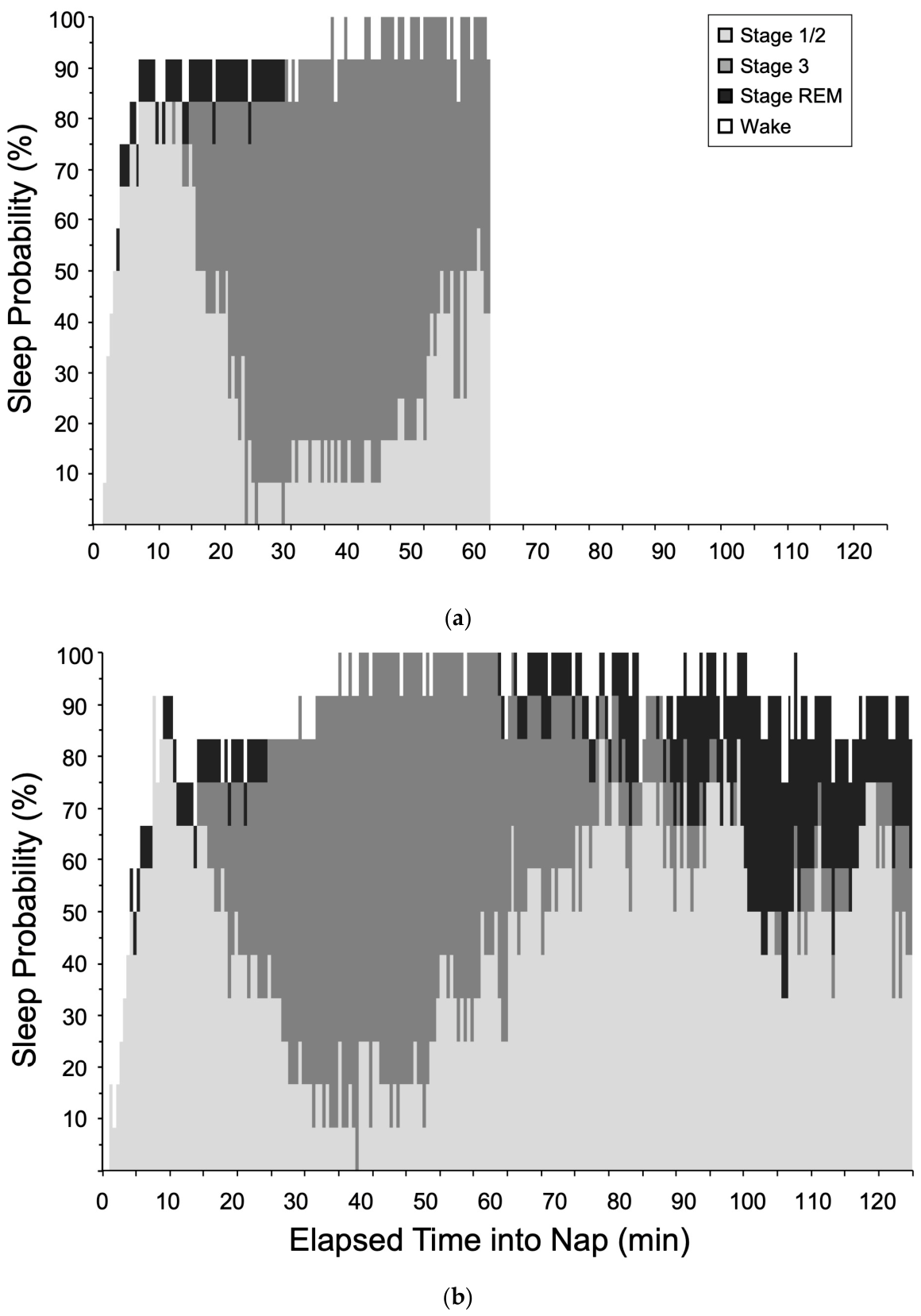

| 1 h Nap | 2 h Nap | |||
|---|---|---|---|---|
| Variable | Mean (SD) | Median (IQR) | Mean (SD) | Median (IQR) |
| Sleep onset latency (min) | 6.5 (10.9) * | 3.2 (4.2) | 7.5 (10.1) * | 4.5 (5.6) |
| Total sleep time (min) | 52.4 (10.7) * | 56.0 (4.0) | 105.0 (15.3) * | 109.2 (11.7) |
| Stage N1 (min) | 4.2 (2.5) | 4.0 (4.9) | 9.0 (5.5) | 8.0 (9.4) |
| Stage N2 (min) | 15.7 (6.1) | 15.5 (7.4) | 46.4 (14.0) | 51.5 (22.5) |
| Stage N3 (min) | 30.4 (12.6) | 32.7 (24.1) | 36.2 (8.6) | 37.2 (11.4) |
| Stage REM (min) | 2.1 (7.2) * | 0.0 (0.0) | 13.4 (15.7) | 7.5 (21.0) |
| WASO (min) | 1.0 (1.4) * | 0.7 (1.4) | 7.4 (12.6) * | 3.0 (5.4) |
| Stage N3 latency (min) | 15.2 (7.2) * | 13.7 (5.7) | 18.2 (7.9) | 16.0 (11.1) |
| Stage REM latency (min) | 55.4 (17.0) * | 60.0 (0.0) | 80.7 (33.4) | 82.2 (51.1) |
| Sleep efficiency (%) | 87.4 (17.9) * | 93.3 (7.3) | 87.5 (12.7) * | 91.0 (9.8) |
| Stage N1 (%) | 8.1 (4.5) | 7.4 (7.6) | 8.9 (6.1) | 6.9 (8.0) |
| Stage N2 (%) | 31.4 (13.1) | 30.0 (24.4) | 43.8 (10.8) | 45.3 (17.5) |
| Stage N3 (%) | 56.7 (18.4) | 58.9 (31.7) | 35.3 (9.9) | 37.3 (15.1) |
| Stage REM (%) | 3.6 (12.7) * | 0.0 (0.0) | 12.0 (13.2) | 8.2 (18.0) |
| Arousals (count/hour) | 5.8 (3.3) | 5.2 (5.2) | 10.0 (3.4) | 9.7 (4.8) |
| Stage shifts (count) | 16.1 (8.3) | 16.5 (15.2) | 36.8 (9.3) | 38.5 (11.7) |
| Awakenings (count) | 1.6 (1.9) * | 1.5 (2.0) | 5.0 (2.3) * | 5.0 (2.2) |
| Sleep quality (units) | 4.7 (1.1) * | 5.0 (0.7) | 5.2 (0.9) | 5.0 (1.7) |
| Adjusted Mean (SE) | Parameter Estimates and Effect Size | |||||||
|---|---|---|---|---|---|---|---|---|
| Variable | 1 h Nap | 2 h Nap | β | SE | 95% CI for β | Wald χ2 | p Value | d |
| Sleep onset latency (min) * | 6.0 (2.8) | 8.1 (3.2) | −2.1 | 0.5 | −3.2 to −1.1 | 15.64 | <0.001 | −0.2 |
| Total sleep time (min) * | 42.9 (2.8) | 114.5 (3.0) | −71.5 | 5.2 | −81.7 to −61.3 | 188.45 | <0.001 | −2.4 |
| Stage N1 (min) | 3.7 (1.0) | 9.5 (1.7) | −5.7 | 1.9 | −9.5 to −2.0 | 9.12 | 0.003 | −1.2 |
| Stage N2 (min) * | 12.2 (1.8) | 49.9 (3.6) | −37.6 | 3.7 | −45.0 to −30.3 | 100.59 | <0.001 | −2.0 |
| Stage N3 (min) | 29.2 (3.2) | 37.4 (3.3) | −8.2 | 5.1 | −18.3 to 1.8 | 2.56 | 0.110 | −0.7 |
| Stage REM (min *) | 0.0 (0.0) † | 16.0 (4.9) | −16.4 | 5.7 | −27.7 to −5.3 | 8.32 | 0.004 | −1.2 |
| WASO (min) | 2.1 (1.8) | 6.3 (2.7) | −4.2 | 3.0 | −10.2 to 1.8 | 1.90 | 0.168 | −0.4 |
| Stage N3 latency (min) | 14.0 (1.9) | 19.3 (2.5) | −5.3 | 2.6 | −10.3 to −0.2 | 4.13 | 0.042 | −0.7 |
| Stage REM latency (min) * | 62.1 (4.1) | 74.1 (10.5) | −12.0 | 10.1 | −31.9 to 7.9 | 1.40 | 0.237 | −0.4 |
| Sleep efficiency (%) * | 75.9 (5.2) | 99.1 (4.2) | −23.2 | 9.1 | −41.0 to −5.4 | 6.53 | 0.011 | −1.5 |
| Stage N1 (%) | 8.3 (1.6) | 8.7 (1.8) | −0.4 | 2.3 | −4.9 to 4.1 | 0.03 | 0.858 | −0.1 |
| Stage N2 (%) | 29.5 (4.3) | 45.8 (3.3) | −16.3 | 5.3 | −26.6 to −5.9 | 9.43 | 0.002 | −1.2 |
| Stage N3 (%) | 59.7 (4.7) | 32.4 (3.2) | 27.2 | 5.4 | 16.6 to 37.8 | 25.40 | <0.001 | 1.5 |
| Stage REM (%) * | 1.1 (2.8) | 14.5 (4.3) | −13.3 | 5.1 | −23.4 to −3.3 | 6.75 | 0.009 | −1.0 |
| Arousals (count/hour) | 5.5 (0.8) | 10.3 (1.3) | −4.8 | 1.6 | −7.9 to −1.6 | 8.60 | 0.003 | −0.3 |
| Stage shifts (count) * | 14.9 (2.1) | 38.0 (2.8) | −23.1 | 2.3 | −27.6 to −18.6 | 100.00 | <0.001 | −1.7 |
| Awakenings (count) | 1.8 (0.5) | 4.7 (0.7) | −2.9 | 0.5 | −4.0 to −1.9 | 30.32 | <0.001 | −1.1 |
| Sleep quality (units) * | 4.9 (0.3) | 5.0 (0.3) | −0.1 | 0.3 | −0.6 to 0.5 | 0.03 | 0.858 | −0.1 |
Disclaimer/Publisher’s Note: The statements, opinions and data contained in all publications are solely those of the individual author(s) and contributor(s) and not of MDPI and/or the editor(s). MDPI and/or the editor(s) disclaim responsibility for any injury to people or property resulting from any ideas, methods, instructions or products referred to in the content. |
© 2026 by the authors. Licensee MDPI, Basel, Switzerland. This article is an open access article distributed under the terms and conditions of the Creative Commons Attribution (CC BY) license.
Share and Cite
Sargent, C.; Romyn, G.; Lastella, M.; Miller, D.J.; Roach, G.D. How Well Do Young Male Semi-Professional Soccer Players Sleep During an Afternoon Nap? Clocks & Sleep 2026, 8, 44. https://doi.org/10.3390/clockssleep8030044
Sargent C, Romyn G, Lastella M, Miller DJ, Roach GD. How Well Do Young Male Semi-Professional Soccer Players Sleep During an Afternoon Nap? Clocks & Sleep. 2026; 8(3):44. https://doi.org/10.3390/clockssleep8030044
Chicago/Turabian StyleSargent, Charli, Georgia Romyn, Michele Lastella, Dean J. Miller, and Gregory D. Roach. 2026. "How Well Do Young Male Semi-Professional Soccer Players Sleep During an Afternoon Nap?" Clocks & Sleep 8, no. 3: 44. https://doi.org/10.3390/clockssleep8030044
APA StyleSargent, C., Romyn, G., Lastella, M., Miller, D. J., & Roach, G. D. (2026). How Well Do Young Male Semi-Professional Soccer Players Sleep During an Afternoon Nap? Clocks & Sleep, 8(3), 44. https://doi.org/10.3390/clockssleep8030044

