
Effects of Heatwaves and Tropical Nights on Sleep in Middle-Aged and Older Adults: A Scoping Review

 ,
,  , , , ,
  ,
,  , , and
Abstract
1. Introduction
2. Materials and Methods
2.1. Protocol and Registration
2.1.1. Eligibility Criteria
- -
- Publication Date: January 2015–February 2026.
- -
- Language: English.
2.1.2. Exclusion Criteria
- -
- Letters, case reports or review articles.
2.1.3. Information Sources
2.1.4. Search Strategy
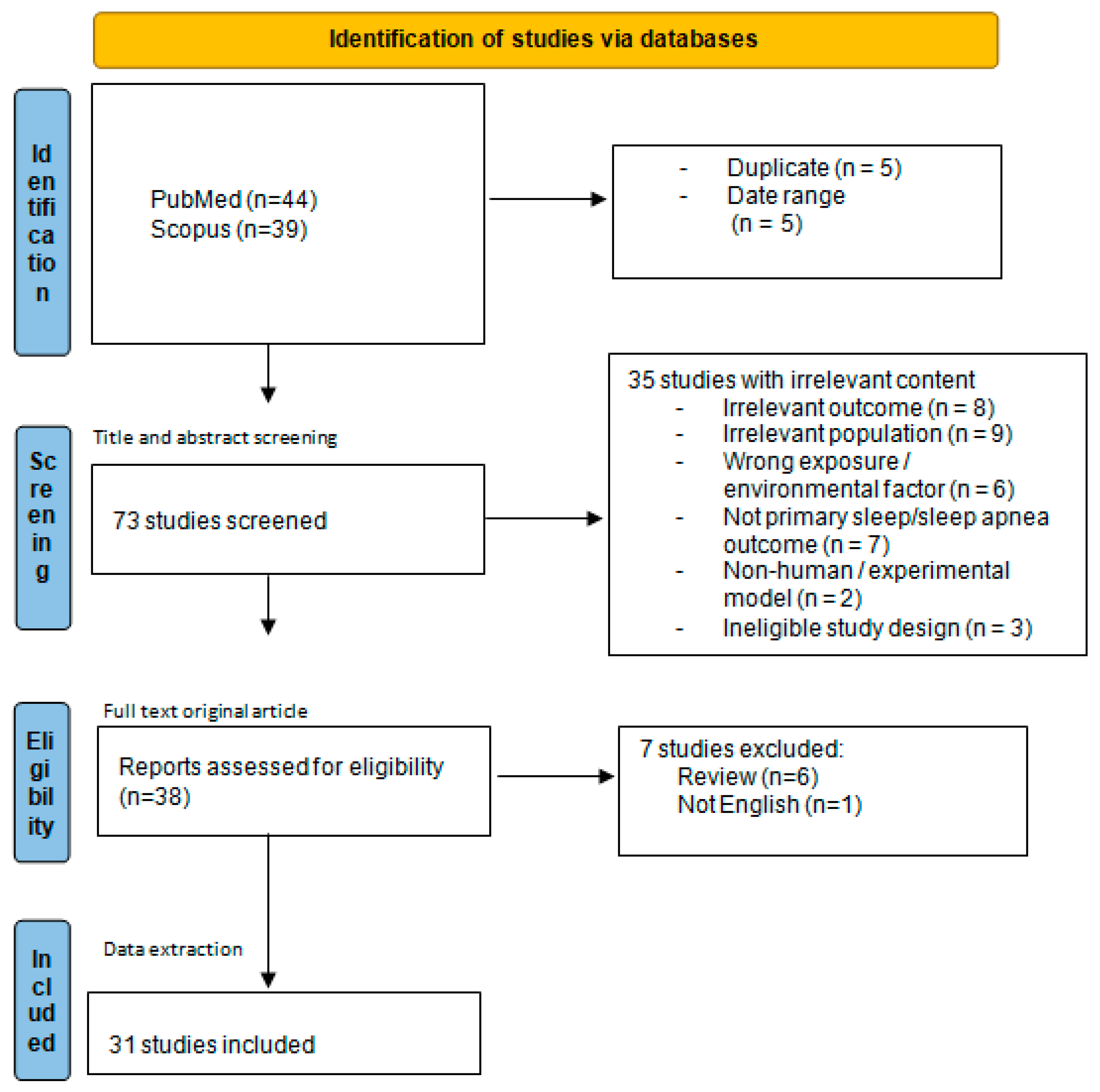
2.1.5. Selection of Sources of Evidence
- Title and abstract screening to identify potentially relevant studies.
- Full-text review to confirm eligibility.
2.1.6. Data Charting Process
2.1.7. Data Items
Variables Extracted Include
Critical Appraisal of Individual Sources of Evidence
2.1.8. Data Synthesis and Quality Context
3. Results and Discussion
3.1. Results
3.1.1. Study Design and Populations

| Author(s), Year | Country/ Region | Study Design/ Intervention | Population Characteristics | Sample Size (n) | Heat Exposure Definition/Duration | Comparator /Control | Sleep Outcomes /Measures | Key Findings |
|---|---|---|---|---|---|---|---|---|
| Ding et al., 2025 [15] | USA (Boston, MA) | Repeated-measure home-based monitoring | Older adults, 67.7% female, 90.3% White, 12 cognitively impaired | 62 | ≥3 consecutive nights of sleep monitoring | Consecutive nights | SleepImage Ring: TST, SE, latency, WASO, REM, deep/light sleep, HR, SpO2 | Seven sleep metrics were relatively stable across nights, while sleep latency showed the greatest variability |
| Zhou et al., 2025 [16] | China, 23 provinces | Longitudinal cohort (CLHLS 2008–2018) | ≥65 yrs, mean 84.2, 51.2% female | 9153 | Heatwave: ≥3 days above 92.5th percentile | Long sleep + heatwave as reference | Self-reported sleep duration/quality | Combined exposure to heatwaves and long sleep duration increased the risk of cognitive impairment in older adults. |
| Zhou et al., 2024 [17] | China | Longitudinal cohort (CHARLS) | ≥60 yrs, mean 67.5, 50.2% female | 7240 | City-level heatwave: ≥2–4 days above 90–97.5th percentile | Non-heatwave periods | Self-reported sleep duration | Heatwave exposure reduced sleep duration, stronger in women/urban/chronic disease |
| Huang et al., 2022 [36] | China, Jiangsu | Intervention study | Rural elderly, 57.9–60.1 yrs | 41 | 90th percentile daily max temp 32 °C | Control vs. education/subsidy/cooling | Wearable smart band: TST and sleep stage indicators | Interventions mitigated sleep reduction, improved DSD/TST |
| Kume et al., 2017 [18] | Japan & Thailand | Prospective seasonal | Community-dwelling older adults in Japan and Thailand | Japan 37, Thailand 44 | Seasonal variation, humid subarctic & tropical savanna | Across seasons/country | Actiwatch 2: TST, latency, SE, awakenings, rest–activity rhythm | Seasonal effects on TST and rhythm; Japanese summer shortest sleep, Thai poor year-round |
| van Loenhout et al., 2016 [19] | Netherlands | Prospective, observational | Community-dwelling ≥ 65 yrs, 51% male | 113 | Indoor temp > 25 °C during summer weeks | Cold reference week | Hourly diary: sleep disturbance | Bedroom temp predicted sleep disturbance; thirst, sweating also high |
| Williams et al., 2019 [20] | USA, Cambridge, MA | Observational multi-day | Low-income older adults ≥ 55 yrs | 51 | Extreme heat event summer 2015, indoor temp means non-AC 25.6 °C | Central AC vs. non-AC | Actigraphy, HR, GSR, self-reported sleep | Higher indoor temp → more sleep disturbance, HR & GSR ↑ |
| Hajdu, 2024 [21] | Hungary | Time-use survey, longitudinal | Adults 18–84 yrs, 61+ 15–20%; subgroup analyses performed | 46,446 | Daily mean temp; heatwave ≥ 3 or ≥5 days > 25 °C | 5–10 °C reference | Sleep diaries: TST, bed/wake times, binary < 6 h | Hot days reduced sleep 5–25 min; stronger in older adults/men |
| Tang et al., 2025 [22] | China | CHARLS cohort | ≥45 yrs, median 57 | 9475 | Heatwave ≥ 92.5–97.5 percentile, cold ≤ 2.5–7.5 percentile, ≥2–4 days | Lower exposure | Self-reported sleep duration (<6 h) | Short sleep duration increased susceptibility to temperature-related multimorbidity among older adults |
| Cepeda et al., 2018 [23] | Netherlands, Rotterdam | Prospective cohort (Rotterdam Study) | ≥50 yrs, 34% 50–64, 39% 65–74, 28% ≥75 | 1166 | Daily avg temp, sunlight, humidity, wind, precipitation | Within-participant seasonal comparison | Actigraphy + sleep diary: TST, time in bed, SE | Nighttime TST highest mid-Jan; elderly no seasonality; temp explained 49.4% of variation in middle-aged |
| Cheong & Gaynanova, 2024 [24] | USA, Houston, TX | Community-based, 2-week measurement | Mean 58.2 yrs, 70% female, 76.7% African American | 30 | Person-specific ambient temp 25–38 °C, wrist accelerometer | Frequent vs. infrequent AC | TST, SE, sedentary time | 1 °C ↑ → SE ↓ 2%, sedentary ↑ 2%; AC use mitigated effects |
| Uriarte-Otazua et al., 2025 [26] | Spain, Basque Country | Mixed-method case study | 72 & 78 yrs, living alone | 2 | Indoor night temps up to 28.7 °C, daytime up to 30 °C | Cooler nights/peri-urban vs. urban | Interviews, thermal monitoring, inferred sleep | Urban dwelling → poor sleep; peri-urban better due to ventilation/mobility |
| Son et al., 2024 [27] | USA, Phoenix, AZ | Cross-sectional, 3 days | ≥54 yrs, independent seniors | 18 | Nighttime bedroom temperature, light exposure | Within-subject | Actigraphy, light tracker: TST, SE, fragmentation | Higher nighttime bedroom temperature → reduced sleep fragmentation, improved sleep efficiency, negative correlation with sleep duration; greater daytime light exposure → longer total sleep time |
| Yan et al., 2022 [28] | Shanghai, China | Laboratory experiment | ≥65 yrs | 16 | 27 °C vs. 30 °C, ventilation vs. no ventilation | 27 °C baseline | TST, SE, REM, deep sleep, time awake (PSG, physiological measures) | 30 °C → TST −26.3 min, SE −5.5%, REM −5.3 min, time awake +27 min; ventilation → deep +10.3 min, REM +3.7 min |
| Baniassadi et al., 2023 [37] | USA (Boston metropolitan area) | Prospective longitudinal observational home-based study (12-month repeated-measure; GAM + causal modeling) | Community-dwelling adults ≥ 65 yrs; cognitively intact; independently living; relatively high SES; non-dementia | 50 (10,903 person-nights) | Nighttime bedroom temperature continuously measured (Netatmo sensors; ~14–32 °C; 15 min intervals; 12 months) | No external control group; within-subject variation (each participant serves as own control) | TST, SE, RSTLS (Oura ring wearable; validated against polysomnography) | Non-linear relationship; optimal sleep at 20–25 °C; >25 °C associated with ↓SE (≈5–10%), ↓TST (~60 min less at 30 °C vs. 22 °C), ↑restlessness; strong inter-individual variability |
| Minor et al., 2022 [29] | Global (68 countries; multi-continental dataset) | Large-scale observational panel study using accelerometry-based sleep tracking; fixed-effect econometric models; climate–sleep linkage analysis (2015–2017) | Adult population (broad global sample; heterogeneous by age, sex, income; includes elderly sub-analyses); users of sleep tracking wearable devices | 7.41 million sleep records (10+ billion sleep observations; repeated daily measures across 68 countries) | Nighttime outdoor minimum temperature matched to geolocated sleep data (meteorological station + gridded climate data; continuous exposure) | Within-individual fixed-effect design (each person serves as their own control; comparison across temperature variation within individuals and regions) | Total sleep time (TST), sleep timing (sleep onset, midsleep, offset), probability of short sleep (<7 h, <6 h, <5 h) from accelerometry-based wristband data | Higher nighttime temperatures reduce sleep duration (~14 min loss > 30 °C), delay sleep onset, advance wake time, and increase probability of short sleep; strongest effects in elderly, females, and low-income regions; no clear adaptation over time; projected climate change may increase annual sleep loss (~44 h/year historically, increasing to ~50–58 h by 2099 under RCP scenarios) |
| Liao J et al., 2025 [30] | United States (All of Us Research Program; nationwide cohort) | Longitudinal observational cohort study; multilevel mixed-effect panel models; climate–sleep linkage + CMIP6 projections | Adults ≥ 18 yrs; predominantly female and White; heterogeneous SES; Fitbit users linked with EHR and survey data; subgroup analyses performed | 14,232 participants, of which 7689 older than 50 years (12.5 million sleep tracking days, of which 7,317,214 for 50+ subgroups) | Daytime (DTA) and nighttime (NTA) temperature anomalies derived from gridMET (~4 km resolution); ZIP-code-linked exposure over 1990–2023 climatology | Within-person longitudinal comparison using mixed-effect models (participant-level random effects; adjustment for time-varying meteorology and fixed covariates) | Total sleep time, sleep efficiency (SE), wake after sleep onset (WASO), sleep onset timing, REM/deep/light sleep (Fitbit wearable data) | Higher nighttime temperature reduces total sleep time (~2.68 min per 10 °C NTA for age group 50–65 and ~2.39 min per 10 °C NTA for age 65+), worsens sleep efficiency, increases WASO, delays sleep onset, and reduces REM/deep/light sleep. Population aged 40–50 years showed decreased total sleep duration 19.6% higher than population less than 40. The older age population (65 yrs+) did not show a significant difference compared to the youngest age group (<40 years) |
| Li, A. et al., 2025 [31] | China (mainland; 336 cities at prefecture level or above) | Nationwide repeated-measure observational study; generalized linear models + linear mixed-effect models; fixed-effect sensitivity analyses; climate projection modeling using SSP scenarios | Adults ≥ 18 years using Huawei wearable devices; mean age 39.2 ± 12.8 years; 36.0% BMI ≥ 25 kg/m2; subgroup analyses performed for age strata younger and older than 45 years (N.B. limitations for interpretation, it included 45–50 years population also) | 214,445 participants; 23,197,045 sleep monitoring days; 30% random sample of eligible users | 24 h mean ambient temperature (ERA5-Land reanalysis, 0.1° resolution) linked to residential location; lag 0 (24 h before awakening); 2021–2023 | Within-individual repeated-measure (random intercept per participant; no external control group) | Sleep insufficiency (<7 h), total sleep duration, light sleep, deep sleep, dream sleep; measured via Huawei wearable (PPG + accelerometer-based sleep staging algorithm) | In age group age ≥ 45, each 10 °C increase associated with +23.0% odds of sleep insufficiency; −10.92 min total sleep; −5.04 min light sleep; −3.61 min deep sleep; −2.31 min dream sleep. The associations of high temperature with sleep insufficiency and sleep duration were consistently stronger in age group ≥ 45 years, women, those with a BMI ≥ 25 kg·m−2, and those simultaneously experiencing high humidity |
| Basner et al., 2023 [34] | USA (Louisville, Kentucky) | Observational longitudinal field study (14-day real-world monitoring with actigraphy + bedroom environmental sensors) | Community-based adult sample (GHP subgroup); age range 25–70 years; individuals with diagnosed sleep disorders excluded | 62 | Continuous bedroom environmental temperature exposure (also PM2.5, CO2, humidity, noise); high-frequency (1 min) measurements across 14 days | Exposure stratified into quintiles (lowest vs. highest exposure categories); within-subject and mixed-effect modeling | Actigraphy-based sleep efficiency (primary outcome), total sleep time (TST), wake after sleep onset (WASO), sleep onset latency; subjective sleep quality and sleepiness | Higher bedroom temperature associated with significantly lower sleep efficiency (≈3.4% reduction in highest vs. lowest quintile). Effects also observed for PM2.5, CO2, and noise. No strong consistent association with total sleep time. Effects appear additive across environmental stressors |
| Guo et al., 2023 [38] | Tibet Autonomous Region, China | Seasonal observational field study (winter vs. summer), 1-week real-world monitoring | Healthy high-altitude adults (≥40 years included within 26–64 age group); no chronic disease; non-smokers; long-term residents | Total: 197 participants (97 summer, 100 winter) | Bedroom microclimate exposure measured continuously for 1 week: temperature (Ta), relative humidity (RH), CO2 (2 min intervals) | Winter vs. summer comparison (between different participant groups; no separate ≥40 subgroup analysis) | Fitbit-based sleep metrics: TST, SE%, WASO, REM, Light, Deep, NOA + GSQS + AHS symptoms | In adults including ≥40 group: sleep becomes more fragmented (↑WASO, ↑NOA), lower deep and REM sleep, higher light sleep. In summer, higher CO2, temperature, and humidity significantly worsen sleep efficiency and deep sleep; CO2 is the strongest predictor. In winter, low humidity (dry air) is the main factor reducing sleep duration and increasing discomfort. Older adults are more sensitive to environmental stressors affecting sleep quality |
| Hailemariam et al., 2023 [35] | Australia | Longitudinal panel data analysis (HILDA 2001–2019), fixed-effect regression + temperature bins | National adult population (household survey; includes adults across all ages, including ≥40 subgroup not separately isolated) | 97,959 observations (≈individuals repeated over waves 1–19) | Daily mean/max/min temperature; binned exposure (<40 °F, 40–50 °F, … >90 °F); monthly aggregation | Reference category: 60–70 °F; within-individual fixed-effect comparison | Self-reported sleep quality (4-point scale; only waves 13 & 17) | Overall findings: inverted U-shaped effect on general health; hot and cold days reduce health; weak/no robust effect on subjective wellbeing; sleep quality does not mediate temperature–health link |
| Lappharat et al., 2018 [39] | Thailand (Bangkok) | Cross-sectional observational study | Adults with diagnosed obstructive sleep apnea (OSA); median age 42 years; 73% male; mean BMI ≈ 26.2 | 63 | Bedroom temperature measured continuously during sleep using data loggers; exposure assessed over 3 consecutive nights in wet and dry seasons (1-year mean calculated) | No explicit control group; comparisons based on variations in environmental exposure (temperature, PM10, humidity) | Polysomnography (AHI, RDI), Pittsburgh Sleep Quality Index (PSQI), sleep latency, duration, efficiency | Higher bedroom temperature associated with poorer subjective sleep quality (OR 1.46, p = 0.044); PM10 associated with increased OSA severity (AHI, RDI); temperature not significantly associated with AHI |
| Li W. et al., 2020 [40] | USA (Greater Boston Area, Massachusetts) | Prospective cohort study with repeated daily measures (actigraphy-based sleep + daily environmental exposure assessment); fixed-effect statistical models | Adults with episodic migraine; predominantly women (88%); mean age ~35 years; generally healthy, no severe sleep apnea or major comorbid exclusions | 98 participants (4406 total sleep nights) | Daily ambient temperature (°F/°C), relative humidity, barometric pressure; exposure assessed daily over ~6 weeks (average follow-up 45 days per participant) | Within-person comparison (each participant serves as their own control across different days); fixed-effect models controlling for day-of-week and seasonal trends | Objective actigraphy: total sleep duration, wake after sleep onset (WASO), sleep efficiency; self-reported sleep latency and sleep quality (daily diary) | Higher temperature → ↑ WASO and ↓ sleep efficiency (modest effects). Higher ozone (O3) → longer sleep duration. No consistent associations for PM2.5 or most pollutants. No strong seasonal differences |
| Liu et al., 2022 [41] | Taiwan | Cross-sectional hospital-based observational study (retrospective PSG + environmental exposure modeling) | Mean 49.5 ± 13.5 years predominantly middle-aged OSA patients | 5204 | Ambient temperature and relative humidity estimated using 1-day, 7-day, 1-month, 6-month, 1-year averages from monitoring stations | Internal comparison across different exposure levels (low vs. high RH/temperature over time) | PSG parameters: AHI, sleep efficiency, WASO, arousal index, sleep stages (N1–REM), oxygen desaturation | Higher long-term temperature → lower sleep efficiency and higher WASO; higher RH → mixed effects (↑AHI, altered sleep stages, ↑arousals); humidity had stronger effect on sleep architecture and oxygen desaturation than temperature |
| Milando et al., 2022 [42] | ABD (Boston, Massachusetts; Chelsea & East Boston) | Mixed-method observational field study using wearable sensors, environmental monitors, and qualitative interviews | Urban residents in low-income, environmentally overburdened communities; predominantly female, Hispanic/Latino, renters in multi-family housing | 24 participants (22 with complete sensor data) | Summer 2020 (6–8 weeks); personal, indoor, and outdoor temperature measured using wearable and fixed sensors | Natural comparison between personal, indoor, and outdoor (weather station) temperature measurements | Sleep duration measured via Fitbit wearable device during nights when participants were at home | Personal heat exposure was ~3.9 °C higher than weather station temperatures; air conditioning did not fully control indoor heat; no statistically significant association between indoor temperature and sleep duration; substantial heterogeneity in heat-related behaviors |
| Obradovich N et al., 2019 [43] | United States | Pooled cross-sectional econometric analysis (fixed-effect regression using BRFSS 2002–2011 + meteorological linkage) | General adult population (BRFSS respondents); subgroup analyses performed for age ≥ 65, income levels | 766,761 (main sample for sleep outcome analysis) | 30-day average nighttime temperature anomalies (deviation from 1981 to 2010 normals) | Relative comparison across temperature anomaly levels (fixed-effect adjusted within-city and time variation) | Self-reported insufficient sleep (BRFSS question: number of days with insufficient sleep in past 30 days) | Higher nighttime temperature anomalies significantly increased insufficient sleep (β ≈ 0.028, p = 0.014). Stronger effects in older adults (≥65: β ≈ 0.041) and low-income groups. Summer effects strongest |
| Tsuzuki K [44] | Japan (Nagoya, 35.17° N, 136.77° E) | Observational longitudinal field study; repeated measures across four seasons (spring, summer, fall, winter); no intervention (naturalistic environmental exposure) | Older adults living independently in public elderly care facilities; screened for chronic disease, insomnia, medication use, hospitalization history, and dementia | 16 initially recruited (8 men, 8 women); 13 participants completed all four seasons (5 men, 8 women) | Continuous indoor environmental exposure (air temperature and relative humidity) measured in bedrooms over 1 week per season (4 seasons); seasonal variation in ambient heat (summer up to ~29 °C at night) | Within-subject seasonal comparisons (spring vs. summer vs. fall vs. winter); sex-based comparison (men vs. women); no external control group | Actigraphy (sleep–wake cycles, sleep efficiency index, total sleep time, sleep latency, wake after sleep onset, activity index); sleep diaries; subjective sleep questionnaires; thermal sensation/comfort scales | Summer indoor temperatures exceeded 28–29 °C at night; elderly men showed worse sleep efficiency and longer wake time than women; sleep parameters showed limited seasonal significance but clear sex differences; higher temperatures associated with altered thermal sensation (often negative correlation with expected direction); adaptive behaviors (fans/open windows) partly used; thermal comfort generally aligned with adaptive comfort model |
| Wang C et al., 2022 [32] | China (162 counties, 25 provinces) | Observational longitudinal study using nationally representative survey data combined with county-level meteorological data; fixed-effect regression (individual, county, time) | Adults ≥ 18 years (nationally representative). Subgroup analyses performed for elderly (≥60 years), rural/urban residents, gender, and education levels | ~30,000 adults per wave (2012 & 2016); total ~45,319 individuals in CFPS waves (sleep module subset used in analysis) | County-level daily temperature matched to respondents over past 7-day recall period. Exposure: average temperature, extreme heat (>28 °C), degree-days (≥16 °C threshold) | Reference temperature: 16–20 °C (optimal sleep range). Within-individual comparison using fixed effects (no separate external control group) | Self-reported sleep experience (CES-D scale item): restless sleep frequency over past week; binary outcome = “poor sleep” (5–7 restless days) | ≥60 subgroup finding: Elderly individuals show stronger sensitivity to high temperature, with significantly higher likelihood of poor sleep compared to younger groups. Heat effects are amplified due to reduced thermoregulation capacity. Overall: heat increases poor sleep risk, especially in rural, low-education, and elderly populations |
| Weinreich G et al., 2015 [45] | Germany (Ruhr area: Essen, Bochum, Mülheim) | Population-based prospective cohort study | Adults aged 45–75 at baseline, follow-up screening at 50–80 years (includes older/elderly subgroup ~60+) | 1773 participants (final analytic sample) | Daily mean temperature (lag 0, 0–2 days moving averages), derived from local meteorological stations; exposure during screening night and short-term periods | Lower temperature days/interquartile range comparison | Sleep-disordered breathing measured via apnea–hypopnea index (AHI) using ApneaLink device | Higher temperature associated with increased AHI; e.g., IQR increase in temperature linked to ~10% increase in AHI; stronger effects in summer |
| Li et al., 2024 [33] | China (313 cities, mainland) | Prospective observational; wearable PPG-based smartwatch monitoring + DLNM statistical model | Adults with moderate-to-severe OSA risk; mean age 45.4 yrs (SD = 11.0); 95.5% male; 69.1% BMI ≥ 24. Note: Age-stratified data reported for ≥45 yrs only; ≥50 yrs subgroup not separately available | n = 51,842 (6,232,056 monitoring days) | 24 h mean ambient temperature (lag 0 d); continuous variable; range −5.2 °C to 31.4 °C; extreme high = 30.3 °C (97.5th percentile) | Referent = minimum temperature (−5.2 °C); within-subject comparison across nights | OSA exacerbation (AHI ≥ 5/h, binary); AHI (events/h); MinSpO2 (%) | In the ≥45 yrs subgroup, high temperature was associated with significantly greater OSA exacerbation compared to <45 yrs (p < 0.05); subgroup-specific numeric estimates not reported. Overall cohort per 10 °C↑: OSA exacerbation OR +8.4% (95% CI 7.6–9.3%); AHI +0.70 events/h (95% CI 0.65–0.76); MinSpO2 −0.18% (95% CI −0.19 to −0.16). Effects present on same day only (lag 0); disappear at lag 1+ |
| Lechat et al., 2025 [25] | Global (41 countries; 29 with significant associations) | Prospective longitudinal observational; FDA-cleared under-mattress nearable sensor (Withings Sleep Analyzer); 3.5-year multi-night monitoring + CMIP6 climate burden modeling | Adults ≥ 18 yrs with OSA; predominantly male (77.3%); middle-aged; median 509 nights/user. Age subgroup analyses performed in 10-year categories; age did not strongly modify the temperature–OSA association | n = 116,620 (~62 million nights) | 24 h average ambient temperature (ERA5); extreme high = 99th percentile (27.3 °C); 4-day lag; real-world nightly exposure | 25th percentile temperature (6.4 °C) | Nightly OSA status (AHI ≥ 15 events/h); nightly severe OSA (AHI ≥ 30 events/h) | High temperatures (99th vs. 25th percentile) associated with 45% higher probability of nightly OSA (RR 1.45, 95% CI 1.44–1.47) and 49% higher for severe OSA (RR 1.49, 95% CI 1.46–1.52). Age did not strongly modify the association. Effect stronger in males and higher BMI. European countries showed strongest effects (~2-fold). Warming-related OSA burden 2023: ~788,198 DALYs lost; $30 billion productivity loss across 29 countries. Scenarios ≥ 1.8 °C above pre-industrial levels projected to double OSA burden by 2100 |
3.1.2. Geographical Regions Included
3.1.3. Measurements of Sleep Outcomes
3.1.4. Heat Exposure Definitions
3.1.5. Key Findings
3.2. Discussion
3.2.1. Objective Evidence Across Aging Populations
3.2.2. Indoor Thermal Environments and Real-World Monitoring
3.2.3. Controlled and Laboratory Evidence
3.2.4. Seasonal, Geographic, and Longitudinal Patterns
3.2.5. Interventions and Protective Factors
3.2.6. Physiological Mechanisms
3.2.7. Disparities and Future Directions
3.2.8. Limitations
4. Conclusions
Author Contributions
Funding
Institutional Review Board Statement
Informed Consent Statement
Data Availability Statement
Conflicts of Interest
References
- Buguet, A.; Radomski, M.W.; Reis, J.; Spencer, P.S. Heatwaves and Human Sleep: Stress Response versus Adaptation. J. Neurol. Sci. 2023, 454, 120862. [Google Scholar] [CrossRef] [Scilit] [PubMed]
- Royé, D. The Effects of Hot Nights on Mortality in Barcelona, Spain. Int. J. Biometeorol. 2017, 61, 2127–2140. [Google Scholar] [CrossRef] [Scilit] [PubMed]
- Correa, J.; Dorta, P.; López-Díez, A.; Díaz-Pacheco, J. Analysis of Tropical Nights in Spain (1970–2023): Minimum Temperatures as an Indicator of Climate Change. Int. J. Climatol. 2024, 44, 3006–3027. [Google Scholar] [CrossRef] [Scilit]
- Chevance, G.; Minor, K.; Vielma, C.; Campi, E.; O’Callaghan-Gordo, C.; Basagaña, X.; Ballester, J.; Bernard, P. A Systematic Review of Ambient Heat and Sleep in a Warming Climate. Sleep Med. Rev. 2024, 75, 101915. [Google Scholar] [CrossRef] [Scilit] [PubMed]
- Refinetti, R. Circadian Rhythmicity of Body Temperature and Metabolism. Temperature 2020, 7, 321–362. [Google Scholar] [CrossRef] [Scilit] [PubMed]
- Minor, K.; Bjerre-Nielsen, A.; Jonasdottir, S.S.; Lehmann, S.; Obradovich, N. Ambient Heat and Human Sleep. arXiv 2020, arXiv:2011.07161. [Google Scholar]
- Millyard, A.; Layden, J.D.; Pyne, D.B.; Edwards, A.M.; Bloxham, S.R. Impairments to Thermoregulation in the Elderly During Heat Exposure Events. Gerontol. Geriatr. Med. 2020, 6, 2333721420932432. [Google Scholar] [CrossRef] [Scilit] [PubMed]
- Kenney, W.L.; Wolf, S.T.; Dillon, G.A.; Berry, C.W.; Alexander, L.M. Temperature Regulation during Exercise in the Heat: Insights for the Aging Athlete. J. Sci. Med. Sport 2021, 24, 739–746. [Google Scholar] [CrossRef] [Scilit] [PubMed]
- Núñez-Rodríguez, S.; Collazo-Riobó, C.; Sedano, J.; Sánchez-Iglesias, A.I.; González-Santos, J. Heat Tolerance in Older Adults: A Systematic Review of Thermoregulation, Vulnerability, Environmental Change, and Health Outcomes. Healthcare 2025, 13, 2785. [Google Scholar] [CrossRef] [Scilit] [PubMed]
- Boateng, G.O.; Dusing, G.J.; Shafiquzzaman, S.; Lartey, S.T.; Agbe, E.; Quansah, R.; Okoye, D. Increasing Ambient Temperature Disrupts Sleep and Impairs Cognitive Function among Older Adults. npj Ment. Health Res. 2024. in review. [Google Scholar] [CrossRef] [Scilit] [PubMed]
- Lee, H.S.; Kim, B.; Park, T. The Association between Sleep Quality and Accelerated Epigenetic Aging with Metabolic Syndrome in Korean Adults. Clin. Epigenet. 2024, 16, 92. [Google Scholar] [CrossRef] [Scilit] [PubMed]
- Zhao, W.; Yu, S.; Xu, Y.; Liao, H.; Chen, D.; Lu, T.; Ren, Z.; Ge, L.; Liu, J.; Sun, J. Sleep Traits Causally Affect Epigenetic Age Acceleration: A Mendelian Randomization Study. Sci. Rep. 2025, 15, 7439. [Google Scholar] [CrossRef] [Scilit] [PubMed]
- Miao, Y.; Wang, J.; Li, X.; Guo, J.; Ekblom, M.M.; Sindi, S.; Zhang, Q.; Dove, A. Poor Sleep Health Is Associated with Older Brain Age: The Role of Systemic Inflammation. eBioMedicine 2025, 120, 105941. [Google Scholar] [CrossRef] [Scilit] [PubMed]
- Tam, J.; Ferri, R.; Mogavero, M.P.; Palomino, M.; DelRosso, L.M. Sex-Specific Changes in Sleep Quality with Aging: Insights from Wearable Device Analysis. J. Sleep Res. 2025, 34, e14413. [Google Scholar] [PubMed]
- Ding, H.; Madan, S.; Searls, E.; McNulty, M.; Low, S.; Li, Z.; Ho, K.; Rahman, S.; Igwe, A.; Popp, Z.; et al. Exploring nightly variability and clinical influences on sleep measures: Insights from a digital brain health platform. Sleep Med. 2025, 131, 106532. [Google Scholar] [CrossRef] [Scilit] [PubMed]
- Zhou, W.; Li, X.; Wang, Q.; Ling, L.; Zhang, H. The combined effects of sleep and extreme heat exposure on cognitive function among older adults. Ecotoxicol. Environ. Saf. 2025, 289, 117683. [Google Scholar] [CrossRef] [Scilit] [PubMed]
- Zhou, W.; Wang, Q.; Li, R.; Zhang, Z.; Kadier, A.; Wang, W.; Zhou, F.; Ling, L. Heatwave exposure in relation to decreased sleep duration in older adults. Environ. Int. 2024, 183, 108348. [Google Scholar] [PubMed]
- Kume, Y.; Makabe, S.; Singha-Dong, N.; Vajamun, P.; Apikomonkon, H.; Griffiths, J. Seasonal effects on the sleep-wake cycle, the rest-activity rhythm and quality of life for Japanese and Thai older people. Chronobiol. Int. 2017, 34, 1377–1387. [Google Scholar] [PubMed]
- van Loenhout, J.A.; le Grand, A.; Duijm, F.; Greven, F.; Vink, N.M.; Hoek, G.; Zuurbier, M. The effect of high indoor temperatures on self-perceived health of elderly persons. Environ. Res. 2016, 146, 27–34. [Google Scholar] [CrossRef] [Scilit] [PubMed]
- Williams, A.A.; Spengler, J.D.; Catalano, P.; Allen, J.G.; Cedeno-Laurent, J.G. Building vulnerability in a changing climate: Indoor temperature exposures and health outcomes in older adults living in public housing during an extreme heat event in Cambridge, MA. Int. J. Environ. Res. Public Health 2019, 16, 2373. [Google Scholar] [CrossRef] [Scilit] [PubMed]
- Hajdu, T. Temperature exposure and sleep duration: Evidence from time use surveys. Econ. Hum. Biol. 2024, 54, 101401. [Google Scholar] [CrossRef] [Scilit] [PubMed]
- Tang, J.; Gu, W.; Wang, M.; Liu, J.; Chen, Y.; Zhang, X. Association between extreme temperature events and multimorbidity among older adults: Evidence from the CHARLS. BMC Med. 2025, 23, 625. [Google Scholar] [CrossRef] [Scilit] [PubMed]
- Cepeda, M.; Koolhaas, C.M.; van Rooij, F.J.A.; Tiemeier, H.; Guxens, M.; Franco, O.H.; Schoufour, J.D. Seasonality of physical activity, sedentary behavior, and sleep in a middle-aged and elderly population: The Rotterdam study. Maturitas 2018, 110, 41–50. [Google Scholar] [CrossRef] [Scilit] [PubMed]
- Cheong, S.M.; Gaynanova, I. Sensing the impact of extreme heat on physical activity and sleep. Digit. Health 2024, 10, 20552076241241509. [Google Scholar] [CrossRef] [Scilit] [PubMed]
- Lechat, B.; Toson, B.; Scott, H.; Nguyen, D.P.; Kaambwa, B.; Reynolds, A.C.; Manners, J.; Adams, R.J.; Pepin, J.-L.; Bailly, S.; et al. How do we sleep while our beds are burning? High ambient temperatures are associated with substantial sleep loss. Sleep 2025, zsaf323. [Google Scholar] [CrossRef] [Scilit] [PubMed]
- Uriarte-Otazua, U.; Azkorra-Larrinaga, Z.; Varela-Alonso, M.; Gomez-Arriaran, I.; Irulegi-Garmendia, O. Impact of heat waves on the well-being and risks of elderly people living alone: Case study in urban and peri-urban dwellings in the Atlantic climate of Spain. Buildings 2025, 15, 2274. [Google Scholar] [CrossRef] [Scilit]
- Son, S.; Sharp, N.; Yeom, D.; Lamp, S. Older adults’ sleep quality: Navigating the impact of daily lighting and thermal conditions in living environments. Sleep 2024, 47, A153–A154. [Google Scholar] [CrossRef] [Scilit]
- Yan, Y.; Zhang, H.; Kang, M.; Lan, L.; Wang, Z.; Lin, Y. Experimental study of the negative effects of raised bedroom temperature and reduced ventilation on the sleep quality of elderly subjects. Indoor Air 2022, 32, e13159. [Google Scholar] [CrossRef] [Scilit] [PubMed]
- Minor, K.; Bjerre-Nielsen, A.; Jonasdottir, S.S.; Lehmann, S.; Obradovich, N. Rising temperatures erode human sleep globally. One Earth 2022, 5, 534–549. [Google Scholar] [CrossRef] [Scilit]
- Liao, J.; Habre, R.; Garcia, E.; Eckel, S.P.; Kossowsky, J.; Herting, M.M.; Chen, W.; Qiu, C.; Yang, Z.; McConnell, R.; et al. Impact of heat exposure on sleep health and its population vulnerability in the United States. Environ. Int. 2025, 206, 109942. [Google Scholar] [CrossRef] [Scilit] [PubMed]
- Li, A.; Luo, H.; Zhu, Y.; Zhang, Z.; Liu, B.; Kan, H.; Jia, H.; Wu, Z.; Guo, Y.; Chen, R. Climate warming may undermine sleep duration and quality in repeated-measure study of 23 million records. Nat. Commun. 2025, 16, 2609. [Google Scholar] [CrossRef] [Scilit] [PubMed]
- Wang, C.; Liu, K.; Wang, H. The effects of temperature on sleep experience: Evidence from China. Appl. Econ. 2022, 55, 4678–4694. [Google Scholar] [CrossRef] [Scilit]
- Li, A.; Zhang, Q.; Yao, Y.; Zhu, X.; Liu, C.; Guo, Y.; Kan, H.; Chen, R. Higher ambient temperatures may worsen obstructive sleep apnea: A nationwide smartwatch-based analysis of 6.2 million person-days. Sci. Bull. 2024, 69, 2114–2121. [Google Scholar] [CrossRef] [Scilit] [PubMed]
- Basner, M.; Smith, M.G.; Jones, C.W.; Ecker, A.J.; Howard, K.; Schneller, V.; Cordoza, M.; Kaizi-Lutu, M.; Park-Chavar, S.; Stahn, A.C.; et al. Associations of bedroom PM2.5, CO2, temperature, humidity, and noise with sleep: An observational actigraphy study. Sleep Health 2023, 9, 253–263. [Google Scholar] [CrossRef] [Scilit] [PubMed]
- Hailemariam, A.; Churchill, S.A.; Appau, S. Temperature, health and wellbeing in Australia. J. Behav. Exp. Econ. 2023, 106, 102065. [Google Scholar] [CrossRef] [Scilit]
- Huang, Y.; Zhang, T.; Lou, J.; Wang, P.; Huang, L. Effective interventions on health effects of Chinese rural elderly under heat exposure. Front. Environ. Sci. Eng. 2022, 16, 66. [Google Scholar] [CrossRef] [Scilit] [PubMed]
- Baniassadi, A.; Manor, B.; Yu, W.; Travison, T.; Lipsitz, L. Nighttime ambient temperature and sleep in community-dwelling older adults. Sci. Total Environ. 2023, 899, 165623. [Google Scholar] [CrossRef] [Scilit] [PubMed]
- Guo, C.; Lan, L.; Zhang, H.; Yan, Y.; Kang, M.; Liu, Y.; Yang, Z.; Jiao, H.; Liu, S. The impact of bedroom environment on sleep quality in winter and summer in the Qinghai-Tibetan plateau. Build. Environ. 2023, 244, 110785. [Google Scholar] [CrossRef] [Scilit]
- Lappharat, S.; Taneepanichskul, N.; Reutrakul, S.; Chirakalwasan, N. Effects of bedroom environmental conditions on the severity of obstructive sleep apnea. J. Clin. Sleep Med. 2018, 14, 565–573. [Google Scholar] [CrossRef] [Scilit] [PubMed]
- Li, W.; Bertisch, S.M.; Mostofsky, E.; Vgontzas, A.; Mittleman, M.A. Associations of daily weather and ambient air pollution with objectively assessed sleep duration and fragmentation: A prospective cohort study. Sleep Med. 2020, 75, 181–187. [Google Scholar] [CrossRef] [Scilit] [PubMed]
- Liu, W.T.; Wang, Y.H.; Chang, L.T.; Wu, C.D.; Wu, D.; Tsai, C.Y.; Lo, C.-C.; Lo, K.; Chung, K.F.; Chang, T.-Y.; et al. The impacts of ambient relative humidity and temperature on supine position-related obstructive sleep apnea in adults. Environ. Sci. Pollut. Res. 2022, 29, 50755–50764. [Google Scholar] [CrossRef] [Scilit] [PubMed]
- Milando, C.W.; Black-Ingersoll, F.; Heidari, L.; López-Hernández, I.; de Lange, J.; Negassa, A.; McIntyre, A.M.; Martinez, M.P.B.; Bongiovanni, R.; Levy, J.I.; et al. Mixed methods assessment of personal heat exposure, sleep, physical activity, and heat adaptation strategies among urban residents in the Boston area, MA. BMC Public Health 2022, 22, 2314. [Google Scholar] [CrossRef] [Scilit] [PubMed]
- Obradovich, N.; Migliorini, R.; Mednick, S.C.; Fowler, J.H. Nighttime temperature and human sleep loss in a changing climate. Sci. Adv. 2017, 3, e1601555. [Google Scholar] [CrossRef] [Scilit] [PubMed]
- Tsuzuki, K.; Mori, I.; Sakoi, T.; Kurokawa, Y. Effects of seasonal illumination and thermal environments on sleep in elderly men. Build. Environ. 2015, 88, 82–88. [Google Scholar] [CrossRef] [Scilit]
- Weinreich, G.; Wessendorf, T.E.; Pundt, N.; Weinmayr, G.; Hennig, F.; Moebus, S.; Möhlenkamp, S.; Erbel, R.; Jöckel, K.-H.; Teschler, H.; et al. Association of short-term ozone and temperature with sleep disordered breathing. Eur. Respir. J. 2015, 46, 1361–1369. [Google Scholar] [CrossRef] [Scilit] [PubMed]
- Rothhaas, R.; Chung, S. Role of the Preoptic Area in Sleep and Thermoregulation. Front. Neurosci. 2021, 15, 664781. [Google Scholar] [CrossRef] [Scilit] [PubMed]
- Chen, B.; Gao, C.; Liu, C.; Guo, T.; Hu, J.; Xue, J.; Tang, K.; Chen, Y.; Yu, T.; Shen, Q.; et al. Heat Acclimation in Mice Requires Preoptic BDNF Neurons and Postsynaptic Potentiation. Cell Res. 2025, 35, 224–227, Erratum in Cell Res. 2025, 35, 228.. [Google Scholar] [CrossRef] [Scilit] [PubMed]
- Morrison, S.F. Central Neural Control of Thermoregulation and Brown Adipose Tissue. Auton. Neurosci. 2016, 196, 14–24. [Google Scholar] [CrossRef] [Scilit] [PubMed]
- Potter, G.D.; Skene, D.J.; Arendt, J.; Cade, J.E.; Grant, P.J.; Hardie, L.J. Circadian Rhythm and Sleep Disruption: Causes, Metabolic Consequences, and Countermeasures. Endocr. Rev. 2016, 37, 584–608. [Google Scholar] [CrossRef] [Scilit] [PubMed]
- Schieber, M.; Chandel, N.S. ROS Function in Redox Signaling and Oxidative Stress. Curr. Biol. 2014, 24, R453–R462. [Google Scholar] [CrossRef] [Scilit] [PubMed]
- Magnone, M.C.; Langmesser, S.; Bezdek, A.C.; Tallone, T.; Rusconi, S.; Albrecht, U. The Mammalian Circadian Clock Gene Per2 Modulates Cell Death in Response to Oxidative Stress. Front. Neurol. 2015, 5, 289. [Google Scholar] [CrossRef] [Scilit] [PubMed]
- Frey, M.M.; Zohoorian, N.; Skauli, N.; Ottersen, O.P.; Amiry-Moghaddam, M. Are Diurnal Variations in Glymphatic Clearance Driven by Circadian Regulation of Aquaporin-4 Expression? Fluids Barriers CNS 2025, 22, 64. [Google Scholar] [CrossRef] [Scilit] [PubMed]
- Shibasaki, M.; Umemoto, Y.; Kinoshita, T.; Kouda, K.; Ito, T.; Nakamura, T.; Crandall, C.G.; Tajima, F. The Role of Cardiac Sympathetic Innervation and Skin Thermoreceptors on Cardiac Responses during Heat Stress. Am. J. Physiol. Heart Circ. Physiol. 2015, 308, H1336–H1342. [Google Scholar] [CrossRef] [Scilit] [PubMed]
- DelRosso, L.M. Global Perspectives on Sleep Health: Definitions, Disparities, and Implications for Public Health. Brain Sci. 2025, 15, 304. [Google Scholar] [CrossRef] [Scilit] [PubMed]

Disclaimer/Publisher’s Note: The statements, opinions and data contained in all publications are solely those of the individual author(s) and contributor(s) and not of MDPI and/or the editor(s). MDPI and/or the editor(s) disclaim responsibility for any injury to people or property resulting from any ideas, methods, instructions or products referred to in the content. |
© 2026 by the authors. Licensee MDPI, Basel, Switzerland. This article is an open access article distributed under the terms and conditions of the Creative Commons Attribution (CC BY) license.
Share and Cite
Krčum, J.; Ezgin, N.; Šutulović, N.; Rajković, N.; Djurić, E.; Mladenović, D.; Vesković, M.; Cetin, A.E.; Rašić-Marković, A.; Stanojlović, O.; et al. Effects of Heatwaves and Tropical Nights on Sleep in Middle-Aged and Older Adults: A Scoping Review. Clocks & Sleep 2026, 8, 37. https://doi.org/10.3390/clockssleep8030037
Krčum J, Ezgin N, Šutulović N, Rajković N, Djurić E, Mladenović D, Vesković M, Cetin AE, Rašić-Marković A, Stanojlović O, et al. Effects of Heatwaves and Tropical Nights on Sleep in Middle-Aged and Older Adults: A Scoping Review. Clocks & Sleep. 2026; 8(3):37. https://doi.org/10.3390/clockssleep8030037
Chicago/Turabian StyleKrčum, Jelena, Neriman Ezgin, Nikola Šutulović, Nemanja Rajković, Emilija Djurić, Dušan Mladenović, Milena Vesković, Arif E. Cetin, Aleksandra Rašić-Marković, Olivera Stanojlović, and et al. 2026. "Effects of Heatwaves and Tropical Nights on Sleep in Middle-Aged and Older Adults: A Scoping Review" Clocks & Sleep 8, no. 3: 37. https://doi.org/10.3390/clockssleep8030037
APA StyleKrčum, J., Ezgin, N., Šutulović, N., Rajković, N., Djurić, E., Mladenović, D., Vesković, M., Cetin, A. E., Rašić-Marković, A., Stanojlović, O., & Hrnčić, D. (2026). Effects of Heatwaves and Tropical Nights on Sleep in Middle-Aged and Older Adults: A Scoping Review. Clocks & Sleep, 8(3), 37. https://doi.org/10.3390/clockssleep8030037