
Implementation of Research Protocols Assessing Sleep and Circadian Rhythms in Challenging Real-Life Settings: A Critical Appraisal of a Study Protocol, Including Researchers’ Reflections and Participants’ Perspectives


Abstract
1. Introduction
2. Results
2.1. Sample General Characteristics
2.2. Participants’ Perspectives
2.3. Compliance with Continuous Measures Data Collection in the Three Study Periods
3. Discussion
4. Materials and Methods
4.1. Study Design and Participants
4.2. Procedures and Data Collection
4.3. Measurements
4.3.1. Questionnaires
Questionnaires Applied Only at Inclusion
- ▪
- General questionnaire to collect demographics, work-related data, and habits: individual characteristics, alcohol, tobacco, and caffeine use, potential exclusion criteria, Navy and submarine service length, and work satisfaction (rated on a scale from 1 to 10, with 10 representing the highest level of satisfaction).
- ▪
- ▪
- ▪
- ▪
Questionnaires Applied Repeatedly at Three Timepoints
- ▪
- Global sleep quality: Jenkins Sleep Scale [52].
- ▪
- ▪
- ▪
Questionnaire Applied Only at the End of the Study
- ▪
- Previous experience in research studies (yes/no);
- ▪
- Global satisfaction with the study (rating from 1 = “very negative” to 5 = “very positive”);
- ▪
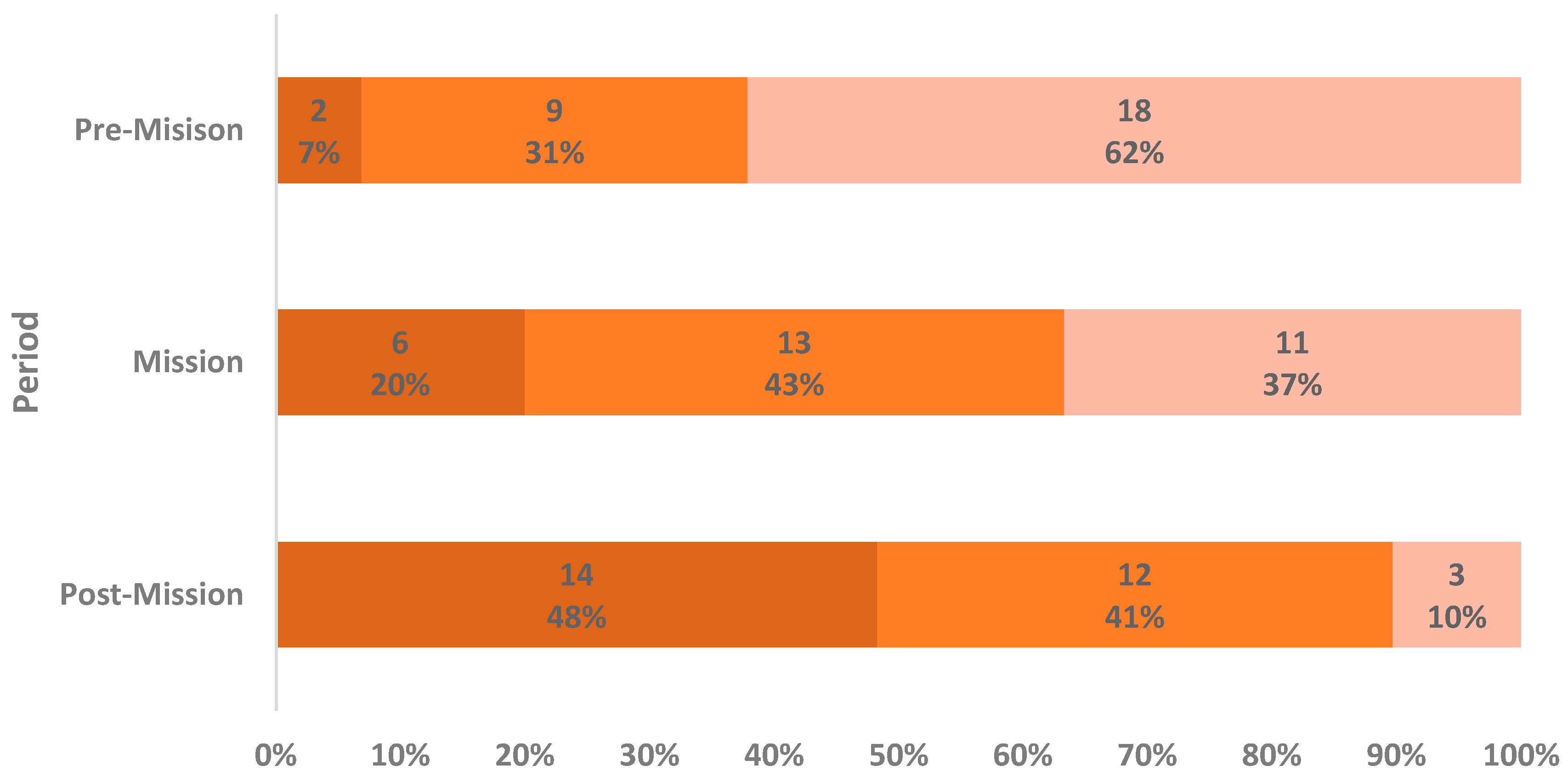
- Ranking study periods (pre-mission, mission, post-mission) from most pleasant/least bothersome to least pleasant/most bothersome for data collection;
- ▪
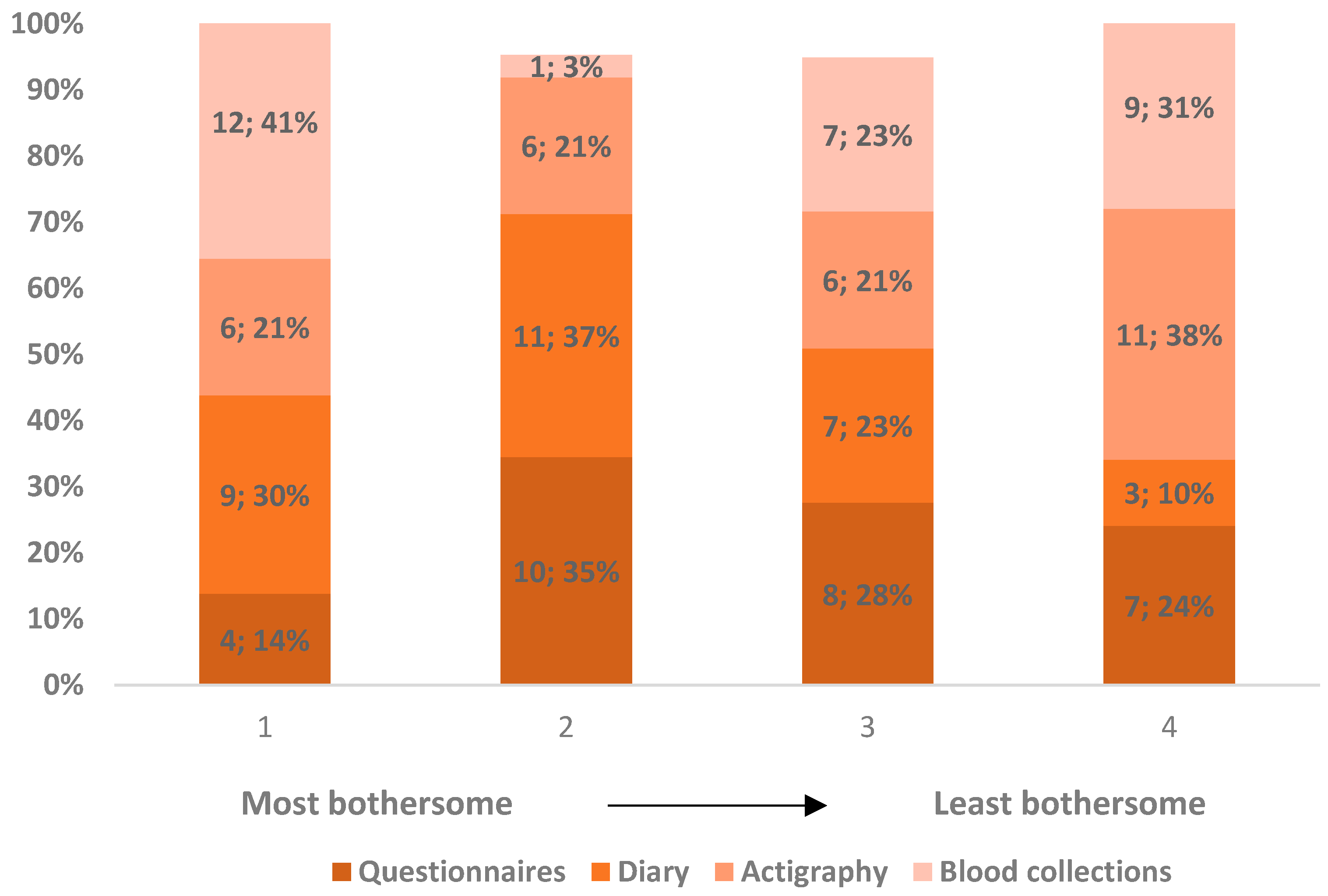
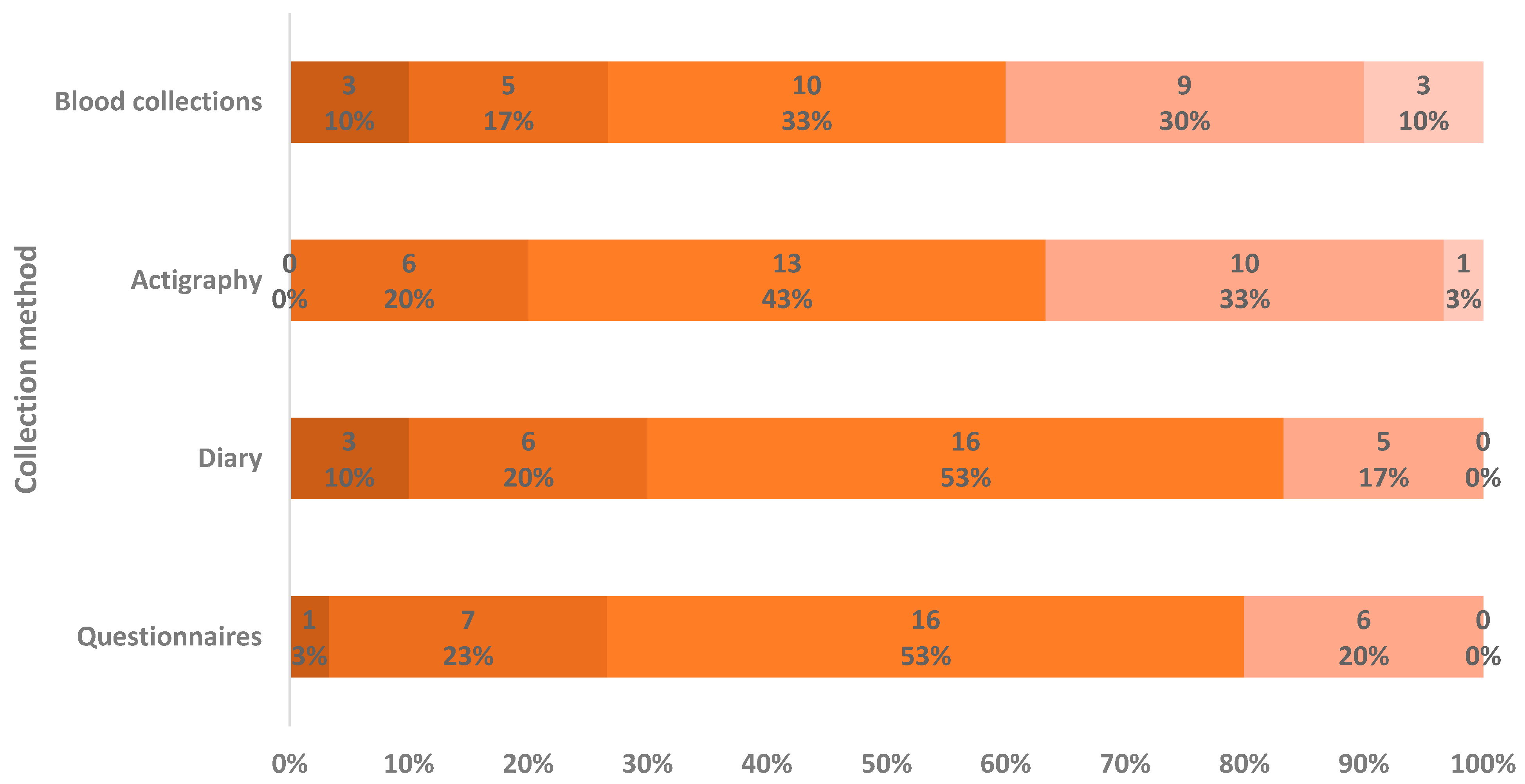
- Ranking study measurements/tasks (questionnaires, diary, actigraphy, and blood collections) from least bothersome to most bothersome (closed question) and why (open question);
- ▪
- Classifying study duration as “too long”, “not too long nor too short”, “too short” (closed question), and indicating which would be the maximal acceptable duration for this kind of study (open question).
- ▪
- Rating the experience from 1 = “very unpleasant” to 5 = “very pleasant”;
- ▪
- Indicating unpleasantness factors by both selecting all the applicable from a provided list (closed question) and describing others (open question) if applicable;
- ▪
- Indicating if diary and actigraphy were more bothersome during the mission, during the base periods, or both (closed question) and why (open question);
- ▪
- For the sleep and activities diary, indicating maximal acceptable filling out time (minutes) per day (open question) and maximal acceptable number of times to fill out per day (open question);
- ▪
- Regarding biological samples, indicating if blood collection were preferred, if collection of other biological products like saliva or urine would be preferred, or if it was indifferent;
- ▪
- Specifically, regarding the diary during the mission, ranking the presented reasons for possible discomfort/disturbance in order of decreasing importance (closed question);
- ▪
- Specifically regarding actigraphy during the mission, ranking the presented reasons for possible discomfort/disturbance in order of decreasing importance (closed question).
4.3.2. Sleep and Activities Diary
4.3.3. Actigraphy
4.3.4. Blood Samples Collection
4.4. Data Analysis
Author Contributions
Funding
Institutional Review Board Statement
Informed Consent Statement
Data Availability Statement
Acknowledgments
Conflicts of Interest
References
- Cajochen, C.; Schmidt, C. The Circadian Brain and Cognition. Annu. Rev. Psychol. 2025, 76, 115–141. [Google Scholar] [CrossRef]
- Zielinski, M.R.; McKenna, J.T.; McCarley, R.W. Functions and Mechanisms of Sleep. AIMS Neurosci. 2016, 3, 67–104. [Google Scholar] [CrossRef]
- Ansu Baidoo, V.; Knutson, K.L. Associations between Circadian Disruption and Cardiometabolic Disease Risk: A Review. Obesity 2023, 31, 615–624. [Google Scholar] [CrossRef]
- Figueiro, M.G.; Pedler, D. Cardiovascular Disease and Lifestyle Choices: Spotlight on Circadian Rhythms and Sleep. Prog. Cardiovasc. Dis. 2023, 77, 70–77. [Google Scholar] [CrossRef]
- Neves, A.R.; Albuquerque, T.; Quintela, T.; Costa, D. Circadian Rhythm and Disease: Relationship, New Insights, and Future Perspectives. J. Cell. Physiol. 2022, 237, 3239–3256. [Google Scholar] [CrossRef]
- Dollish, H.K.; Tsyglakova, M.; McClung, C.A. Circadian Rhythms and Mood Disorders: Time to See the Light. Neuron 2024, 112, 25–40. [Google Scholar] [CrossRef]
- Gehlert, S.; Clanton, M. Shift Work and Breast Cancer. Int. J. Environ. Res. Public Health 2020, 17, 9544. [Google Scholar] [CrossRef]
- Killick, R.; Stranks, L.; Hoyos, C.M. Sleep Deficiency and Cardiometabolic Disease. Sleep Med. Clin. 2024, 19, 653–670. [Google Scholar] [CrossRef]
- Wang, S.; Zheng, X.; Huang, J.; Liu, J.; Li, C.; Shang, H. Sleep Characteristics and Risk of Alzheimer’s Disease: A Systematic Review and Meta-Analysis of Longitudinal Studies. J. Neurol. 2024, 271, 3782–3793. [Google Scholar] [CrossRef]
- Ganesan, S.; Magee, M.; Stone, J.E.; Mulhall, M.D.; Collins, A.; Howard, M.E.; Lockley, S.W.; Rajaratnam, S.M.W.; Sletten, T.L. The Impact of Shift Work on Sleep, Alertness and Performance in Healthcare Workers. Sci. Rep. 2019, 9, 4635. [Google Scholar] [CrossRef]
- Thun, E.; Bjorvatn, B.; Flo, E.; Harris, A.; Pallesen, S. Sleep, Circadian Rhythms, and Athletic Performance. Sleep Med. Rev. 2015, 23, 1–9. [Google Scholar] [CrossRef]
- Piechowski, S.; Kalkoffen, L.J.; Benderoth, S.; Wolf, O.T.; Rittweger, J.; Aeschbach, D.; Mühl, C. Effects of Total Sleep Deprivation on Performance in a Manual Spacecraft Docking Task. NPJ Microgravity 2024, 10, 21. [Google Scholar] [CrossRef]
- Arsintescu, L.; Kato, K.H.; Hilditch, C.J.; Gregory, K.B.; Flynn-Evans, E. Collecting Sleep, Circadian, Fatigue, and Performance Data in Complex Operational Environments. J. Vis. Exp. 2019, 2019, e59851. [Google Scholar] [CrossRef]
- Pilcher, J.J.; Morris, D.M. Sleep and Organizational Behavior: Implications for Workplace Productivity and Safety. Front. Psychol. 2020, 11, 45. [Google Scholar] [CrossRef]
- Rosekind, M.R.; Gregory, K.B.; Mallis, M.M.; Brandt, S.L.; Seal, B.; Lerner, D. The Cost of Poor Sleep: Workplace Productivity Loss and Associated Costs. J. Occup. Environ. Med. 2010, 52, 91–98. [Google Scholar] [CrossRef]
- Wilkes, J.R.; Walter, A.E.; Chang, A.M.; Miller, S.J.; Sebastianelli, W.J.; Seidenberg, P.H.; Slobounov, S. Effects of Sleep Disturbance on Functional and Physiological Outcomes in Collegiate Athletes: A Scoping Review. Sleep Med. 2021, 81, 8–19. [Google Scholar] [CrossRef]
- Boudreau, P.; Lafrance, S.; Boivin, D.B. Alertness and Psychomotor Performance Levels of Marine Pilots on an Irregular Work Roster. Chronobiol. Int. 2018, 35, 773–784. [Google Scholar] [CrossRef]
- Zivi, P.; De Gennaro, L.; Ferlazzo, F. Sleep in Isolated, Confined, and Extreme (ICE): A Review on the Different Factors Affecting Human Sleep in ICE. Front. Neurosci. 2020, 14, 851. [Google Scholar] [CrossRef]
- Haynes, A.; Brennan, S.; Carter, S.; O’Connor, D.; Schneider, C.H.; Turner, T.; Gallego, G. Protocol for the Process Evaluation of a Complex Intervention Designed to Increase the Use of Research in Health Policy and Program Organisations (the SPIRIT Study). Implement. Sci. 2014, 9, 113. [Google Scholar] [CrossRef]
- Makram, A.M.; Elsheikh, R.; Makram, O.M.; Van, N.T.; Nam, N.H.; Quan, N.K.; Duc, N.T.M.; Nguye, N.Q.T.; Javes, G.O.; Elsheikh, S.S.; et al. Tips from an Expert Panel on the Development of a Clinical Research Protocol. BMC Med. Res. Methodol. 2024, 24, 293, Correction in BMC Med. Res. Methodol. 2024, 24, 300. [Google Scholar] [CrossRef]
- Cimino, J.; Braun, C. Design a Clinical Research Protocol: Influence of Real-World Setting. Healthcare 2023, 11, 2254. [Google Scholar] [CrossRef]
- Simpson, K.M.; Porter, K.; McConnell, E.S.; Colón-Emeric, C.; Daily, K.A.; Stalzer, A.; Anderson, R.A. Tool for Evaluating Research Implementation Challenges: A Sense-Making Protocol for Addressing Implementation Challenges in Complex Research Settings. Implement. Sci. 2013, 8, 2. [Google Scholar] [CrossRef]
- Harrison, E.M.; Schmied, E.A.; Yablonsky, A.M.; Glickman, G.L. Implementation of Interventions Designed to Promote Healthy Sleep and Circadian Rhythms in Shiftworkers. Chronobiol. Int. 2021, 38, 467–479. [Google Scholar] [CrossRef]
- Harrison, E.M.; Schmied, E.A.; Hurtado, S.L.; Easterling, A.P.; Glickman, G.L.; Harrison, E.M.; Schmied, E.A.; Hurtado, S.L.; Easterling, A.P.; Glickman, G.L. The Development, Implementation, and Feasibility of a Circadian, Light, and Sleep Skills Program for Shipboard Military Personnel (CLASS-SM). Int. J. Environ. Res. Public Health 2022, 19, 3093. [Google Scholar] [CrossRef]
- Fernandes, C.; Maruta, C.; Marques-Dias, C.M.; Reis, C. Sleep in Military Submariners: Exploring Its Dynamics in Relation to a Submarine Mission and Interaction with Psychological Factors. Behav. Sleep Med. 2025, 23, 526–539. [Google Scholar] [CrossRef]
- Borg, D.J.; Haritopoulou-Sinanidou, M.; Gabrovska, P.; Tseng, H.W.; Honeyman, D.; Schweitzer, D.; Rae, K.M. Barriers and Facilitators for Recruiting and Retaining Male Participants into Longitudinal Health Research: A Systematic Review. BMC Med. Res. Methodol. 2024, 24, 46. [Google Scholar] [CrossRef]
- Synn, A.J.; Menson, K.E.; Carnethon, M.R.; Kalhan, R.; Sugar, E.A.; Washko, G.R.; Wise, R.A.; Eakin, M.N. “It’s a Cause I Believe in”: Factors Motivating Participation and Engagement in Longitudinal, Respiratory-Focused Research Studies. BMC Pulm. Med. 2023, 23, 285. [Google Scholar] [CrossRef]
- Hollada, J.; Marfori, W.; Tognolini, A.; Speier, W.; Ristow, L.; Ruehm, S.G. Successful Patient Recruitment in CT Imaging Clinical Trials. What Factors Influence Patient Participation? Acad. Radiol. 2014, 21, 52–57. [Google Scholar] [CrossRef]
- Baranowski, T.; O’Connor, T.M.; Jimenez-Garcia, J.A.; Radhakrishnan, K.; Arrendondo, E.M.; Thompson, D. Social Marketing and the Challenges of Participant Recruitment. Transl. Behav. Med. 2024, 14, 499–504, Correction in Transl. Behav. Med. 2024, 14, 634. [Google Scholar] [CrossRef]
- Wong, C.A.; Song, W.B.; Jiao, M.; O’Brien, E.; Ubel, P.; Wang, G.; Scales, C.D. Strategies for Research Participant Engagement: A Synthetic Review and Conceptual Framework. Clin. Trials 2021, 18, 457–465. [Google Scholar] [CrossRef]
- Zhang, Y.; Pratap, A.; Folarin, A.A.; Sun, S.; Cummins, N.; Matcham, F.; Vairavan, S.; Dineley, J.; Ranjan, Y.; Rashid, Z.; et al. Long-Term Participant Retention and Engagement Patterns in an App and Wearable-Based Multinational Remote Digital Depression Study. NPJ Digit. Med. 2023, 6, 25. [Google Scholar] [CrossRef]
- Carpenter, C.A.; Eastman, A.; Ross, K.M. Consistency with and Disengagement from Self-Monitoring of Weight, Dietary Intake, and Physical Activity in a Technology-Based Weight Loss Program: Exploratory Study. JMIR Form. Res. 2022, 6, e33603. [Google Scholar] [CrossRef]
- Beal, D.J.; Cohen, R.R.; Burke, M.J.; McLendon, C.L. Cohesion and Performance in Groups: A Meta-Analytic Clarification of Construct Relations. J. Appl. Psychol. 2003, 88, 989–1004. [Google Scholar] [CrossRef]
- Fors Brandebo, M.; Börjesson, M.; Hilmarsson, H. Longitudinal Studies on Cohesion in a Military Context–A Systematic Review. Mil. Psychol. 2022, 34, 732–741. [Google Scholar] [CrossRef]
- Thurman, S.M.; Wasylyshyn, N.; Roy, H.; Lieberman, G.; Garcia, J.O.; Asturias, A.; Okafor, G.N.; Elliott, J.C.; Giesbrecht, B.; Grafton, S.T.; et al. Individual Differences in Compliance and Agreement for Sleep Logs and Wrist Actigraphy: A Longitudinal Study of Naturalistic Sleep in Healthy Adults. PLoS ONE 2018, 13, e0191883. [Google Scholar] [CrossRef]
- Devine, J.K.; Choynowski, J.; Burke, T.; Carlsson, K.; Capaldi, V.F.; McKeon, A.B.; Sowden, W.J. Practice Parameters for the Use of Actigraphy in the Military Operational Context: The Walter Reed Army Institute of Research Operational Research Kit-Actigraphy (WORK-A). Mil. Med. Res. 2020, 7, 31. [Google Scholar] [CrossRef]
- Chabal, S.A.; Markwald, R.R.; Chinoy, E.D. Life Onboard a Submarine: Sleep, Fatigue, and Lifestyle Behaviors of Sailors on a Circadian-Aligned Watchstanding Schedule. Appl. Ergon. 2024, 119, 104321. [Google Scholar] [CrossRef]
- Kristbergsdottir, H.; Schmitz, L.; Arnardottir, E.S.; Islind, A.S. Evaluating User Compliance in Mobile Health Apps: Insights from a 90-Day Study Using a Digital Sleep Diary. Diagnostics 2023, 13, 2883. [Google Scholar] [CrossRef]
- Durmaz Celik, N.; Yaman Kula, A.; Murat, N.; Kuzu Kumcu, M.; Topal, A.; Özkan, S. Evaluation of Compliance and Accuracy in Parkinson’s Disease Motor Symptom Tracking: A Comparative Study of Digital and Traditional Paper Diaries Using a Smartphone Application (MyParkinson’s). Front. Neurol. 2025, 16, 1522721. [Google Scholar] [CrossRef]
- Lingler, J.H.; Schmidt, K.L.; Gentry, A.L.; Hu, L.; Terhorst, L.A. Perceived Research Burden Assessment (PeRBA): Instrument Development and Psychometric Evaluation. J. Empir. Res. Hum. Res. Ethics 2014, 9, 46. [Google Scholar] [CrossRef]
- Keleman, A.A.; Chang, C.H.; Bollinger, R.M.; Lingler, J.H.; Gabel, M.; Stark, S.L. Psychometric Evaluation of the Perceived Research Burden Assessment (PeRBA) in Longitudinal Studies of Alzheimer Disease Using Rasch Analysis. Alzheimer Dis. Assoc. Disord. 2023, 37, 28–34. [Google Scholar] [CrossRef]
- Yessis, J.L.; Kost, R.G.; Lee, L.M.; Coller, B.S.; Henderson, D.K. Development of a Research Participants’ Perception Survey to Improve Clinical Research. Clin. Transl. Sci. 2012, 5, 452–460. [Google Scholar] [CrossRef]
- Roenneberg, T.; Wirz-Justice, A.; Merrow, M. Life between Clocks: Daily Temporal Patterns of Human Chronotypes. J. Biol. Rhythm. 2003, 18, 80–90. [Google Scholar] [CrossRef]
- Reis, C.; Madeira, S.G.; Lopes, L.V.; Paiva, T.; Roenneberg, T. Validation of the Portuguese Variant of the Munich Chronotype Questionnaire (MCTQPT). Front. Physiol. 2020, 11, 795. [Google Scholar] [CrossRef]
- Rammstedt, B.; John, O.P. Measuring Personality in One Minute or Less: A 10-Item Short Version of the Big Five Inventory in English and German. J. Res. Pers. 2007, 41, 203–212. [Google Scholar] [CrossRef]
- Bártolo-Ribeiro, R. The Use of Brief Questionnaires in Academic Context: The Case of BFI-10. In Poster Session Presented at the Meeting of 14th European Conference on Psychological Assessment of European Association of Psychological Assessment (EAPA); ISCTE–Instituto Universitário de Lisboa: Lisbon, Portugal, 2007. [Google Scholar]
- Charles, S. Carver You Want to Measure Coping but Your Protocol’s Too Long: Consider the Brief COPE. Int. J. Behav. Med. 1997, 4, 92–100. [Google Scholar]
- Ribeiro, J.P.; Rodrigues, A.P. Questões Acerca Do Coping: A Propósito Do Estudo de Adaptação Do Brief COPE [Some Questions about Coping: The Study of the Portuguese Adaptation of the Brief COPE]. Psicol. Saúde Doenças 2004, 5, 3–15. [Google Scholar]
- Taylor, S.E.; Stanton, A.L. Coping Resources, Coping Processes, and Mental Health. Annu. Rev. Clin. Psychol. 2007, 3, 377–401. [Google Scholar] [CrossRef]
- Barros, A.M. Expectativas de Controlo Interno-Externo: Revisão Da Literatura e Análise Dos Instrumentos. Psicologia 1989, 7, 261–274. [Google Scholar]
- Rotter, J.B. Generalized Expectancies for Internal versus External Control of Reinforcement. Psychol. Monogr. Gen. Appl. 1996, 80, 1. [Google Scholar] [CrossRef]
- Reis, C. Translation, Cross-Cultural Adaptation and Psychometric Properties of the Jenkins Sleep Scale in a Sample of Portuguese Shift Workers. Laboratório Psicol. 2014, 12, 89–98. [Google Scholar] [CrossRef]
- Johns, M.W. A New Method for Measuring Daytime Sleepiness: The Epworth Sleepiness Scale. Sleep 1991, 14, 540–545. [Google Scholar] [CrossRef]
- Sargento, P.; Perea, V.; Ladera, V.; Lopes, P.; Oliveira, J. The Epworth Sleepiness Scale in Portuguese Adults: From Classical Measurement Theory to Rasch Model Analysis. Sleep Breath. 2015, 19, 693–701. [Google Scholar] [CrossRef]
- Krupp, L.B.; Larocca, N.G.; Muir Nash, J.; Steinberg, A.D. The Fatigue Severity Scale: Application to Patients with Multiple Sclerosis and Systemic Lupus Erythematosus. Arch. Neurol. 1989, 46, 1121–1123. [Google Scholar] [CrossRef]
- Laranjeira, C.A. Translation and Adaptation of the Fatigue Severity Scale for Use in Portugal. Appl. Nurs. Res. 2012, 25, 212–217. [Google Scholar] [CrossRef]
- Bjelland, I.; Dahl, A.A.; Haug, T.T.; Neckelmann, D. The Validity of the Hospital Anxiety and Depression Scale: An Updated Literature Review. J. Psychosom. Res. 2002, 52, 69–77. [Google Scholar] [CrossRef]
- Pais-Ribeiro, J.; Silva, I.; Ferreira, T.; Martins, A.; Meneses, R.; Baltar, M. Validation Study of a Portuguese Version of the Hospital Anxiety and Depression Scale. Psychol. Health Med. 2007, 12, 225–237. [Google Scholar] [CrossRef]
- Kaida, K.; Takahashi, M.; Åkerstedt, T.; Nakata, A.; Otsuka, Y.; Haratani, T.; Fukasawa, K. Validation of the Karolinska Sleepiness Scale against Performance and EEG Variables. Clin. Neurophysiol. 2006, 117, 1574–1581. [Google Scholar] [CrossRef]
- Loock, A.S.; Khan Sullivan, A.; Reis, C.; Paiva, T.; Ghotbi, N.; Pilz, L.K.; Biller, A.M.; Molenda, C.; Vuori-Brodowski, M.T.; Roenneberg, T.; et al. Validation of the Munich Actimetry Sleep Detection Algorithm for Estimating Sleep–Wake Patterns from Activity Recordings. J. Sleep Res. 2021, 30, e13371. [Google Scholar] [CrossRef]



| Task | Justifications |
|---|---|
| Questionnaires | “Too long” |
| Diary | “Having to carry the diary around all the time.” |
| “Paper format.” | |
| “Having the concern of always checking the time of the activities.” | |
| “The care needed for precision of the information registered and concern about possible errors.” | |
| “Prone to forgetfulness.” | |
| “Having to fill out the diary every day is cumbersome due to the duration of the study.” | |
| “Although easy to fill out, with time it becomes boring and easy to forget.” | |
| “Having to dedicate time every day to filling out the diary.” | |
| Actigraphy | “Causes discomfort in some work activities.” |
| “I don’t like to always wear a watch.” | |
| “It is uncomfortable to wear the device during sleep.” | |
| “Having to worry about remembering to always put it on again after removal.” | |
| “Could not wear my watch at the same time.” | |
| “Having to avoid device contact with water.” | |
| Blood collections | “The need for prolonged fasting periods.” |
| “I don’t like to have blood draws.” | |
| “I don’t like needles.” | |
| “Too many blood draws.” | |
| “I get dizzy and feel malaise when having blood draws.” | |
| “My veins are difficult to find, and blood draws are always difficult.” |
| Task | Reason | Frequency (n, %) |
|---|---|---|
| Questionnaires | Nothing in particular | 8 (26.7) |
| Being long | 10 (33.3) | |
| Having to fill out questionnaires several times during the study period | 12 (40.0) | |
| Not understanding the purpose of these questionnaires quite well | 1 (3.3) | |
| Diary | Nothing in particular | 7(23.3) |
| Taking too long to fill out | 3 (10.0) | |
| Having to fill out the diary every day | 17 (56.7) | |
| Being in paper format, I would prefer a digital version | 9 (30.0) | |
| Actigraphy | Nothing in particular | 6 (20.0) |
| The worry of having to wear the device all the time | 8 (26.7) | |
| The use was uncomfortable | 10 (33.3) | |
| Not being able to wear a watch/smartwatch at the same time | 9 (30.0) | |
| Blood collections | Nothing in particular | 19 (63.3) |
| Being painful | 0 (0.0) | |
| Disliking blood draws | 4 (13.3) | |
| Involving repeated samples/draws | 6 (20.0) |
| Task | Reason | Frequency (n, %) |
|---|---|---|
| Diary | Having daily concern about filling it out | 17 (56.7) |
| Difficulty remembering to fill out the diary | 4 6 (20.0) | |
| Worry about losing or damaging the diary | 4 (13.3) | |
| Preference for a digital diary | 3 (10.0) | |
| The information required is too detailed | 1 (3.3) | |
| Taking a lot of time to fill out | 1 (3.3) | |
| Actigraphy | Worrying about not damaging the device | 15 (50.0) |
| Not being able to wear a watch/smartwatch at the same time | 6 (20.0) | |
| Discomfort in daily tasks performance | 3 (10.0) | |
| General discomfort, irrespective of task | 3 (10.0) | |
| Worrying about not removing the device, or always remembering to put it back after removal | 2 (6.7) | |
| Worrying about keeping the device uncovered at all times | 1 (3.3) |
| Diary | Actigraphy | |||||
|---|---|---|---|---|---|---|
| Pre-Mission | Mission | Post-Mission | Pre-Mission | Mission | Post-Mission | |
| Compliance ratio (mean ± SD) | 0.87 ± 0.24 | 0.83 ± 0.26 | 0.78 ± 0.33 | 0.84 ± 0.28 | 0.85 ± 0.31 | 0.57 ± 0.39 |
| χ2 = 1.949; p = 0.377; W = 0.032 | χ2 = 22.415; p < 0.001; W = 0.374 | |||||
| Compliance vs satisfaction | ρ = 0.294 p = 0.115 | ρ = −0.010 p = 0.959 | ρ = −0.039 p = 0.839 | ρ = −0.047 p = 0.805 | ρ = −0.046 p = 0.809 | ρ = −0.045 p = 0.813 |
Disclaimer/Publisher’s Note: The statements, opinions and data contained in all publications are solely those of the individual author(s) and contributor(s) and not of MDPI and/or the editor(s). MDPI and/or the editor(s) disclaim responsibility for any injury to people or property resulting from any ideas, methods, instructions or products referred to in the content. |
© 2026 by the authors. Licensee MDPI, Basel, Switzerland. This article is an open access article distributed under the terms and conditions of the Creative Commons Attribution (CC BY) license.
Share and Cite
Fernandes, C.; Leite, E.; Coelho, J.E.; Reis, C. Implementation of Research Protocols Assessing Sleep and Circadian Rhythms in Challenging Real-Life Settings: A Critical Appraisal of a Study Protocol, Including Researchers’ Reflections and Participants’ Perspectives. Clocks & Sleep 2026, 8, 7. https://doi.org/10.3390/clockssleep8010007
Fernandes C, Leite E, Coelho JE, Reis C. Implementation of Research Protocols Assessing Sleep and Circadian Rhythms in Challenging Real-Life Settings: A Critical Appraisal of a Study Protocol, Including Researchers’ Reflections and Participants’ Perspectives. Clocks & Sleep. 2026; 8(1):7. https://doi.org/10.3390/clockssleep8010007
Chicago/Turabian StyleFernandes, Carina, Ema Leite, Joana E. Coelho, and Cátia Reis. 2026. "Implementation of Research Protocols Assessing Sleep and Circadian Rhythms in Challenging Real-Life Settings: A Critical Appraisal of a Study Protocol, Including Researchers’ Reflections and Participants’ Perspectives" Clocks & Sleep 8, no. 1: 7. https://doi.org/10.3390/clockssleep8010007
APA StyleFernandes, C., Leite, E., Coelho, J. E., & Reis, C. (2026). Implementation of Research Protocols Assessing Sleep and Circadian Rhythms in Challenging Real-Life Settings: A Critical Appraisal of a Study Protocol, Including Researchers’ Reflections and Participants’ Perspectives. Clocks & Sleep, 8(1), 7. https://doi.org/10.3390/clockssleep8010007