Article

Magneto-Photoluminescent Hybrid Materials Based on Cobalt Ferrite Nanoparticles and Poly(terephthalaldehyde-undecan-2-one)


by
Victor Alfonso Ortiz-Vergara
,
Marco Antonio Garza-Navarro
*,
Virgilio Angel González-González
,
Enrique Lopez-Cuellar
and
Azael Martínez-de la Cruz
Facultad de Ingeniería Mecánica y Eléctrica, Universidad Autónoma de Nuevo León, San Nicolás de los Garza 66455, Nuevo León, Mexico
*
Author to whom correspondence should be addressed.
Surfaces 2026, 9(1), 6; https://doi.org/10.3390/surfaces9010006 (registering DOI)
Submission received: 9 October 2025 / Revised: 8 December 2025 / Accepted: 25 December 2025 / Published: 27 December 2025

Abstract

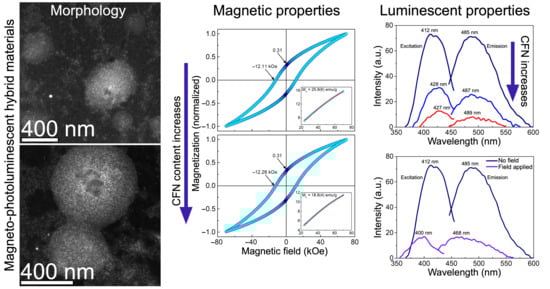
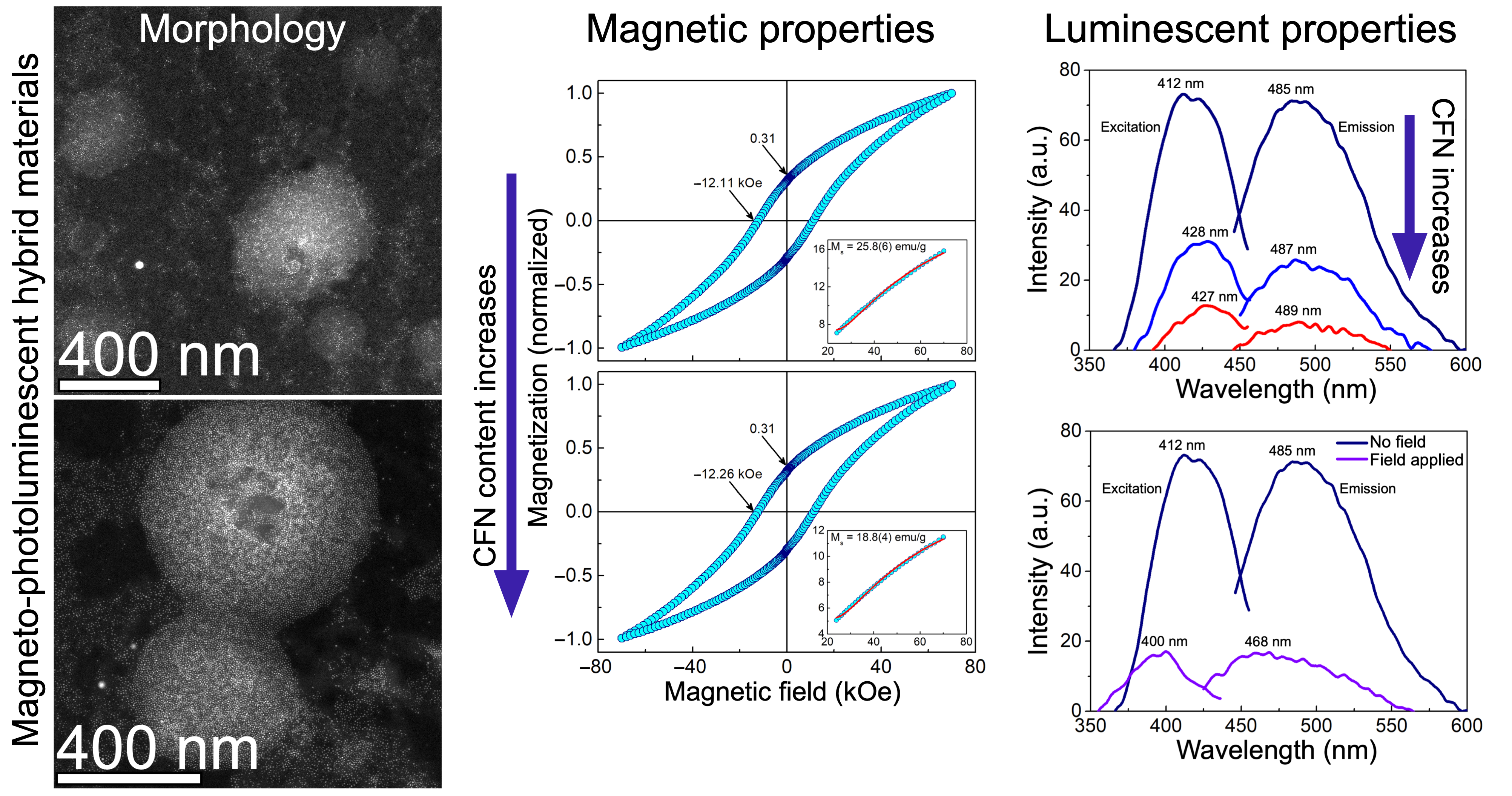
Magneto-photoluminescent hybrid materials (MPHMs) were prepared by incorporating cobalt ferrite nanoparticles (CFNs) into the fluorescent polymer poly(terephthalaldehyde-undecan-2-one) (PT2U). The CFNs, with a mean size of 3.95 nm, formed aggregates within the PT2U matrix (650–1042 nm) due to surface and interfacial interactions, modulating aggregate morphology and interparticle coupling. Magnetization studies revealed non-monotonic variations in saturation magnetization (30.3–16.2 emu/g), mean blocking temperature (39.3–43.1 K) and effective magnetic anisotropy energy density (2.14 × 10⁶–1.31 × 10⁶ erg/cm3) with increasing CFN content, consistent with the presence of canted surface spins and enhanced magnetizing interparticle interactions. Photoluminescence exhibited progressive quenching, dominated by collisional mechanisms at low CFN content and by interfacial CFN–PT2U interactions at higher loadings. Under a magnetic field (800 Oe), additional quenching occurred, attributed to magnetically induced polymer-chain rearrangements that disrupted the molecular stacking required for efficient aggregation-induced emission. These results demonstrate tunable magneto-photoluminescent coupling in MPHMs governed by surface and interfacial phenomena, providing insights for the design of functional and responsive hybrid materials.

Graphical Abstract

1. Introduction

Hybrid materials combining magnetic nanoparticles such as Fe3O4, CoFe2O4 or MnFe2O4 with quantum dots, organic dyes, rare-earth elements or conjugated polymers have led to innovative multifunctional platforms for applications in sensing, optoelectronics and biomedicine [1,2,3,4,5,6]. Magneto-photoluminescent hybrids are particularly attractive because they integrate magnetic and optical functionalities through engineered interfaces, enabling advanced biomedical applications such as bioimaging, targeted therapies, cancer treatment and controlled drug delivery [7]. Their multifunctionality arises from precise control of surface and interfacial interactions between the magnetic and photoluminescent components to achieve simultaneous and tunable responses to magnetic and optical stimuli.
A variety of strategies have been proposed to develop magneto-photoluminescent platforms with tailored functionality. For instance, bifunctional Fe3O4/CdSe core/shell nanocrystals with core and shell thicknesses of 10 and 2 nm, respectively, have been synthesized through controlled sequential chemical reactions [8]. These nanocrystals exhibit superparamagnetic response with high magnetic susceptibility at room temperature and display dual emission bands at 572 nm, attributed to bandgap excitons, and 680 nm, associated with surface states. Similarly, ZnO/Fe3O4 or γ-Fe2O3 core/shell nanostructures have shown tunable magnetic properties and strong room-temperature photoluminescence, the latter being strongly dependent on the thickness of the magnetic shell under 390 nm excitation [9], illustrating how interfacial coupling governs the balance between magnetic and optical behavior.
Magneto-luminescent nanosystems based on Fe3O4 nanoparticles and thermosensitive rhodamine fluorophores have also been reported [10]. Fe3O4 nanoparticles (~25 nm) with diverse morphologies were coated with a copolymer of poly(maleic anhydride-alt-1-octadecene) (PMAO), 5-TAMRA cadaverine and poly(ethylene glycol)-amine (PEG-NH2). These hybrids exhibited high magnetothermal efficiency, especially those with irregularly truncated octahedral morphologies, and a linear, temperature-dependent fluorescence response with excellent sensitivity.
In other approach, composite nanoparticles (PMCP) with core/shell and Janus architectures composed of Fe3O4 and a fluorescent polyurethane (PU-MHHNA) were prepared by a self-assembly mini-emulsion technique [11]. Most Fe3O4 nanoparticles were encapsulated within the PU-MHHNA matrix, achieving complete loading at 30 wt.% Fe3O4. The resulting PMCP combined measurable magnetic properties, distinct photoluminescence and good biocompatibility.
Likewise, Fe3O4 nanoparticles have been incorporated into the fluorescent polymer poly[2,7-(9,9-dioctylfluorene)-alt-4,7-bis(thiophen-2-yl)benzo-2,1,3-thiadiazole] (PFODBT) for cell labeling and magnetic particle imaging (MPI) [12]. The Fe3O4 nanoparticles were obtained via thermal decomposition of iron-oleate in the presence of oleic acid, followed by encapsulation within PFODBT. Surface modification with poly(styrene-co-maleic anhydride) (PSMA) improved aqueous dispersibility and enabled efficient cell labeling and in vivo MPI tracking, particularly when functionalized with tumor-targeting ligands.
These studies demonstrate that surface engineering and interfacial architecture are critical for achieving synergetic magneto-optical behavior. However, controlling the balance between magnetic and photoluminescent properties remains a major challenge. Strong interparticle coupling or interfacial electronic transfer can enhance magnetic response but simultaneously quench fluorescence, whereas excessive passivation of the magnetic phase may reduce its responsivity to external magnetic fields.
Our research group previously developed hybrid materials composed of Fe3O4 nanoparticles (SMON) embedded within the fluorescent polymer poly(terephthalaldehyde-undecan-2-one) (PT2U) [13]. Experimental evidence showed that PT2U exhibited visible-range photoluminescence, with its emission intensity strongly influenced by molecular stacking. The formation of SMON aggregates within PT2U led to a reduction in magnetic anisotropy and to fluorescence quenching of the polymer. This quenching effect intensified upon the application of a magnetic field and was attributed to the movement of SMON aggregates, which disrupted the molecular arrangement of PT2U.
Accordingly, this work investigates surface and interfacial interactions in magneto-photoluminescent hybrid materials (MPHMs) prepared by incorporating CoFe2O4 nanoparticles (CFNs) into the fluorescent polymer PT2U. The structural, morphological and spectroscopic properties of CFNs and MPHMs are analyzed to elucidate correlations underlying magneto-optical coupling. By combining static magnetic measurements and photoluminescence spectroscopy, we explore the role of CFN–PT2U interfacial interactions in determining the physical properties of MPHMs. The results provide relevant insights into the design of functional and responsive hybrid materials.

2. Materials and Methods

2.1. Preparation of Magneto-Photoluminescent Hybrid Materials

For the synthesis of CFNs, Fe(acac)3, Co(acac)2, 1,2-hexadecanediol, oleic acid, oleylamine and benzyl ether were used as the primary reagents, while hexane, ethanol and chloroform served as solvents. All chemicals were sourced from Merck and used without additional purification. The polymer PT2U was synthesized and characterized in our laboratories according to a previously reported protocol [13] and used as obtained for the MPHM preparation.
The CFNs were synthesized via the thermal decomposition method [14,15,16]. In a typical procedure, 1 × 10⁻³ mol of Co(acac)2, 2 × 10⁻³ mol of Fe(acac)3, 10 × 10−3 mol of 1,2-hexadecanediol, 6 × 10⁻³ mol each of oleic acid and oleylamine and 20 mL of benzyl ether were added to the reactor. The reagents were continuously stirred under a nitrogen atmosphere until complete dissolution and homogenization were achieved. Next, the temperature was gradually raised in two stages to 200 °C and 260 °C, holding each for 30 min. After completion, the system was allowed to cool naturally to room temperature. For purification, 40 mL of ethanol was added to the product, followed by centrifugation. This washing step was repeated twice to ensure effective removal of excess reagents. The resulting precipitate was re-dispersed in 20 mL of hexane containing 50 × 10−3 mL each of oleylamine and oleic acid and centrifuged again. The supernatant was washed again with ethanol and dried under vacuum. The CFNs were weighed and dispersed in chloroform at 34.1 mg/mL.
To prepare the MPHMs, a PT2U stock solution in chloroform (24.3 mg/mL) was combined with varying amounts of CFN to achieve PT2U:CFN weight ratios of 10:1, 10:2, 10:3, 10:4, 10:5 and 10:10. In all cases, 10 mg of PT2U was used. The mixtures were sonicated at 35 kHz for 10 min to ensure homogeneous dispersion. The prepared hybrid materials were designated as H1, H2, H3, H4, H5 and H10, corresponding to their respective PT2U:CFN weight ratios. A detailed summary of the composition of each hybrid, including the corresponding CFN content in weight percent (wt.%), is provided in Table 1.

2.2. Characterization of Magneto-Photoluminescent Hybrid Materials

CFNs were characterized by transmission electron microscopy (TEM) using a Titan G2 80-300 microscope (FEI Company, Hillsboro, OR, USA). Bright-field (BF), selected area electron diffraction (SAED) and high-angle annular dark-field scanning transmission electron microscopy (HAADF-STEM) techniques were employed to evaluate crystalline structure, particle morphology and size. CFNs and MPHMs were examined by attenuated total reflectance-Fourier transform infrared spectroscopy (ATR-FTIR) and X-ray photoelectron spectroscopy (XPS). ATR-FTIR spectra were acquired over a spectral range of 4000–500 cm−1 using an IRPrestige-21 spectrometer (Shimadzu Corporation, Kyoto, Japan), whereas Fe2p and Co2p core-level XPS spectra were collected with a K-Alpha spectrometer (Thermo Scientific, Waltham, MA, USA) employing monochromatic Al-Kα radiation. Spectral deconvolution was performed through Gaussian fitting to determine oxidation states. These analyses provide detailed information on the chemical states and bonding at the CFN–PT2U interface, allowing assessment of surface and interfacial effects on the magneto-optical properties of MPHM.
The photoluminescent behavior of the MPHM dispersions was evaluated by luminescence spectroscopy (LS) using an LS 55 instrument (PerkinElmer, Waltham, MA, USA), with excitation and emission spectra collected within the 350–600 nm interval. Measurements were conducted both in the absence and presence of an external magnetic field (800 Oe) generated by permanent magnets to investigate magneto-photoluminescent effects. Magnetic characterization of the hybrid materials was performed on an MPMS3 (SQUID-VSM) magnetometer (Quantum Design, San Diego, CA, USA). The measurements included field-dependent magnetization [M(H)], temperature-dependent magnetization [M(T)], thermoremanence (TRM), isothermal remanent magnetization (IRM) and direct current demagnetization (DCD).

3. Results and Discussion

3.1. Structural, Morphological and Chemical Characterization of CFNs

The structural, morphological and chemical characteristics of the synthesized CFNs are shown in Figure 1. The morphology of the nanoparticles is depicted in Figure 1a, revealing spherical shapes (see inset in Figure 1a). To determine the particle size distribution, a total of 293 particles (N) were measured from several HAADF-STEM images acquired from CFNs. Based on these measurements, a particle size histogram was constructed using Sturges’ method [17]. Accordingly, the optimal bin width (B) was obtained from B = (dmax − dmin)/C, where dmax − dmin defines the range over which the particle size is distributed, and C = 1 + 3.322 log(N) represents the number of bins in the histogram [18]. As shown in Figure 1b, the histogram is well described by a Gaussian distribution function (solid red line), yielding a mean particle size of 3.95(8) nm and a standard deviation of 0.38(12) nm. Uncertainties in parentheses denote the half-width of the 95% confidence interval (CI95) obtained from the non-linear fit. The presentation of significant figures follows conventional rules for uncertainty reporting, in which uncertainties are expressed with one significant figure (two if the first digit is 1), and the corresponding values are rounded to the same decimal place, as suggested in the literature [19]. A high-resolution BF image is presented in Figure 1c, where atomic planes with an interplanar distance of 2.1 Å are clearly resolved. The SAED pattern (Figure 1d) displays Debye–Scherrer rings, with measured spacings of 2.51, 2.15, 1.51 and 1.24 Å. These values are in good agreement with the reported interplanar spacing for the {311}, {400}, {440} and {444} crystallographic planes of cobalt ferrite, according to ICDD card no. 00-022-1086 (formerly JCPDS).
The ATR-FTIR spectrum of CFNs, presented in Figure 1e, exhibits distinct absorption features. A broad band centered at 3362 cm−1 is attributed to O-H stretching vibrations from surface hydroxyl groups. The methylene groups show asymmetric and symmetric C-H stretching at 2921 and 2851 cm−1, respectively. Bands observed at 1551 and 1462 cm−1 correspond to the asymmetric and symmetric stretching vibrations in carboxylate (O-C-O) moieties. Similarly, the band at 1026 cm−1 is assigned to C-O stretching, while the feature at 597 cm−1 arises from metal–oxygen (M-O, where M = Co or Fe) vibrations within the spinel structure. These spectral characteristics are consistent with those previously reported for CoFe2O4 nanoparticles stabilized with oleic acid and oleylamine ligands [20,21].
Figure 1f depicts the Fe2p core-level XPS spectrum, where the Fe2p3/2 and Fe2p1/2 emissions display contributions from Fe3+ cations located at both octahedral (B) and tetrahedral (A) sites, accompanied by shake-up satellite features (sat). The full width at half-maximum (FWHM) values for these components were 3.0 and 4.8 eV for the main and satellite peaks, respectively. Likewise, the Co2p spectrum shown in Figure 1g reveals six distinct signals attributed to Co2+ ions distributed across A and B sites, with comparable FWHM values of 3.0 eV for the main components and 4.8 eV for their respective satellites [22,23]. By integrating the areas under the Fe2p and Co2p signals, the cation distribution was determined to be 34.6% of Fe3+ at A sites and 65.4% at B sites, whereas 27.9% of Co2+ ions were present at A sites and 72.1% at B sites. This cation arrangement corresponds to the formula (Fe0.69Co0.28)A(Fe1.31Co0.72)BO4, in agreement with previous reports [23]. These results confirm the crystalline structure, cation distribution and chemical composition of CFNs, providing a reliable foundation for subsequent interfacial studies in MPHMs.

3.2. Structural, Morphological and Chemical Characterization of MPHMs

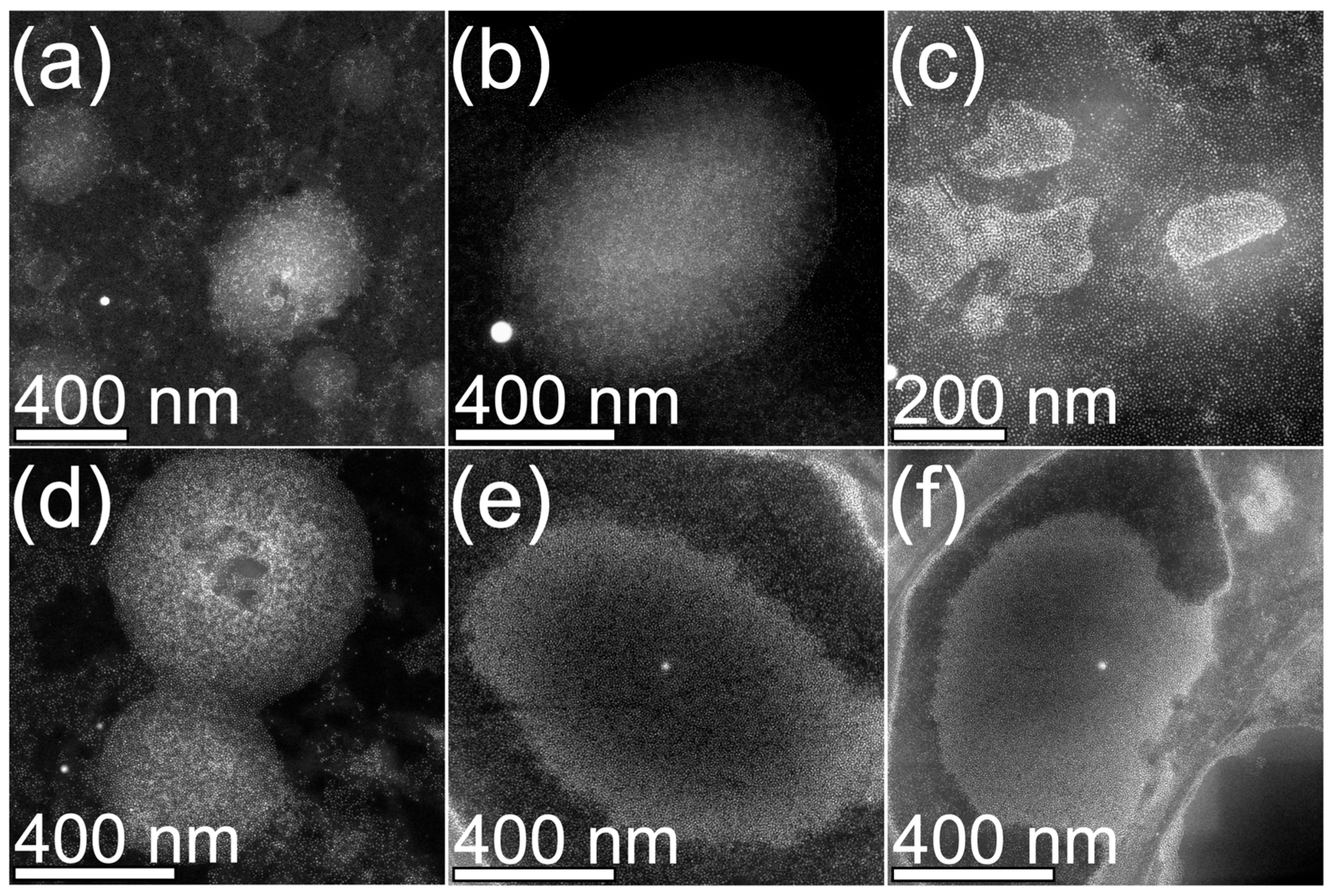
Figure 2 presents the morphology of the MPHM samples. CFNs, visible as bright regions due to their higher average atomic number and mass density, form aggregates within the PT2U matrix, with sizes ranging from 650 to 1042 nm. Bright spots may also appear as a consequence of beam-induced local modification of the organic phase during HAADF-STEM imaging, a common effect in polymer-based materials. The PT2U matrix appears as dimmer regions because it is composed of light elements and has lower mass density, while dark areas correspond to voids or free space. As the CFN content increases (see Table 1), the density of embedded nanoparticles rises. ATR-FTIR and XPS analyses were subsequently performed to investigate the structural and chemical characteristics of these materials.
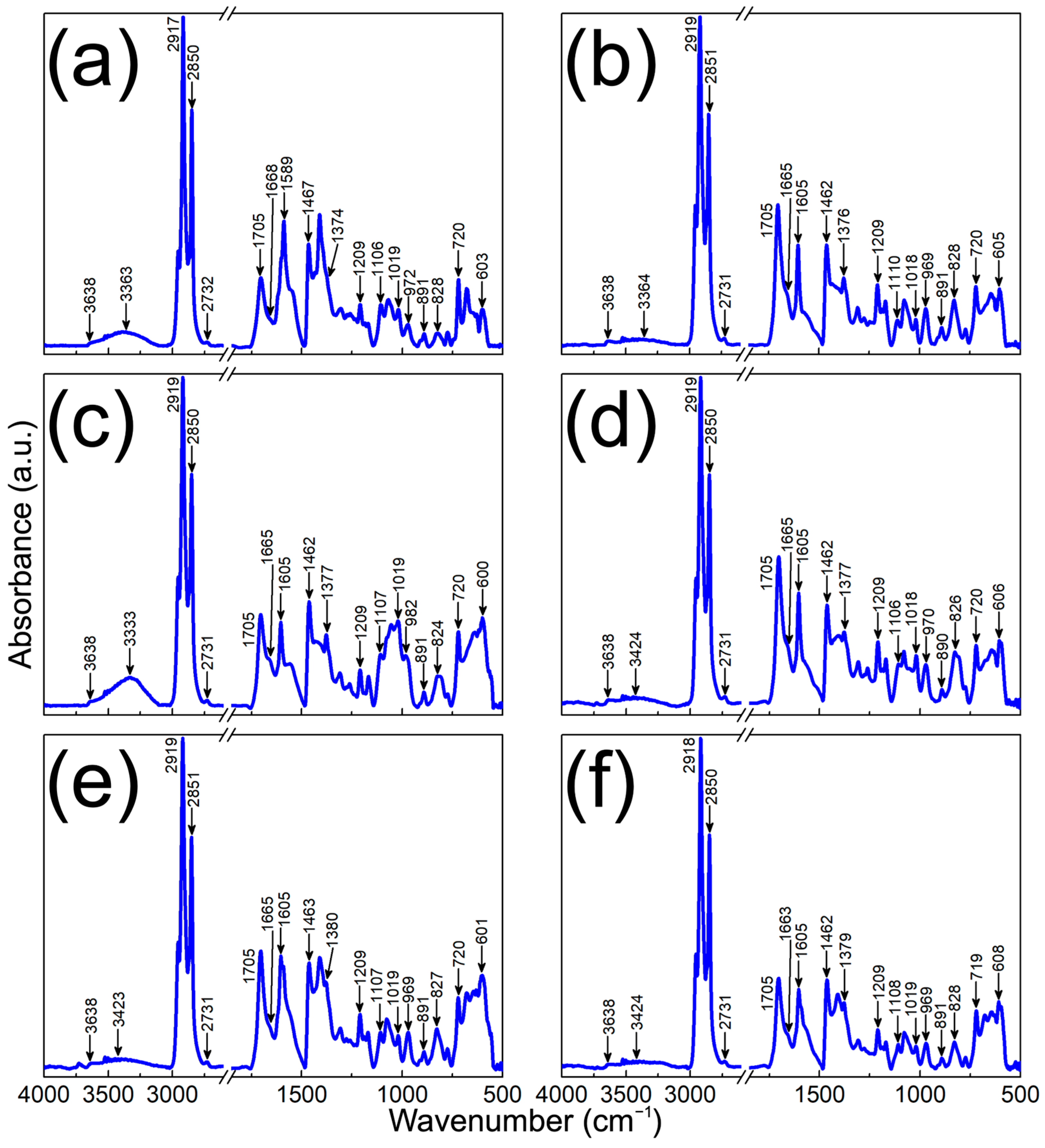
Figure 3 shows the ATR-FTIR spectra of the MPHMs, highlighting the main absorption bands corresponding to the PT2U molecular framework [13,24]. Characteristic vibrations are observed at 3424 cm−1 (O-H stretching related to keto-enol tautomerism in 2-undecanone terminal units), 2919 and 2850 cm−1 (asymmetric and symmetric C-H stretching in aliphatic methylene), 2732 cm−1 (C-H stretching in aldehyde carbonyls) and 1705 cm−1 (C=O stretching in ketonic carbonyls). Additional bands appear at 1668 cm−1 for C=C stretching in di- and tri-substituted double bonds, 1605 cm−1 for C=C stretching in para-disubstituted benzene rings and bending vibrations at 1467 and 1380 cm−1 (asymmetric and symmetric C-H in terminal methyl). Further signals are observed at 1209 cm−1 (C-CO-C stretching in ketones), 1110 and 1019 cm−1 (in-plane C-H bending in para-disubstituted benzene rings), 982 and 891 cm−1 (out-of-plane C=C-H bending in double bonds), 828 cm−1 (out-of-plane C-H bending in para-disubstituted benzene rings) and 720 cm−1 (C-H bending in methylene). Notably, with increasing CFN content, the O-H stretching band exhibits a hypsochromic shift, accompanied by the appearance of a new band at 3638 cm−1. Similarly, the M-O stretching vibration (initially at 597 cm−1 in Figure 1e) also shifts toward higher wavenumbers. These changes reveal a clear influence of CFN incorporation on the vibrational profile of PT2U, suggesting interfacial interactions between the nanoparticles and the polymer matrix. Table 2 summarizes the ATR-FTIR absorption bands and assignments common to all MPHM samples, including the ranges in which spectral shifts were detected.
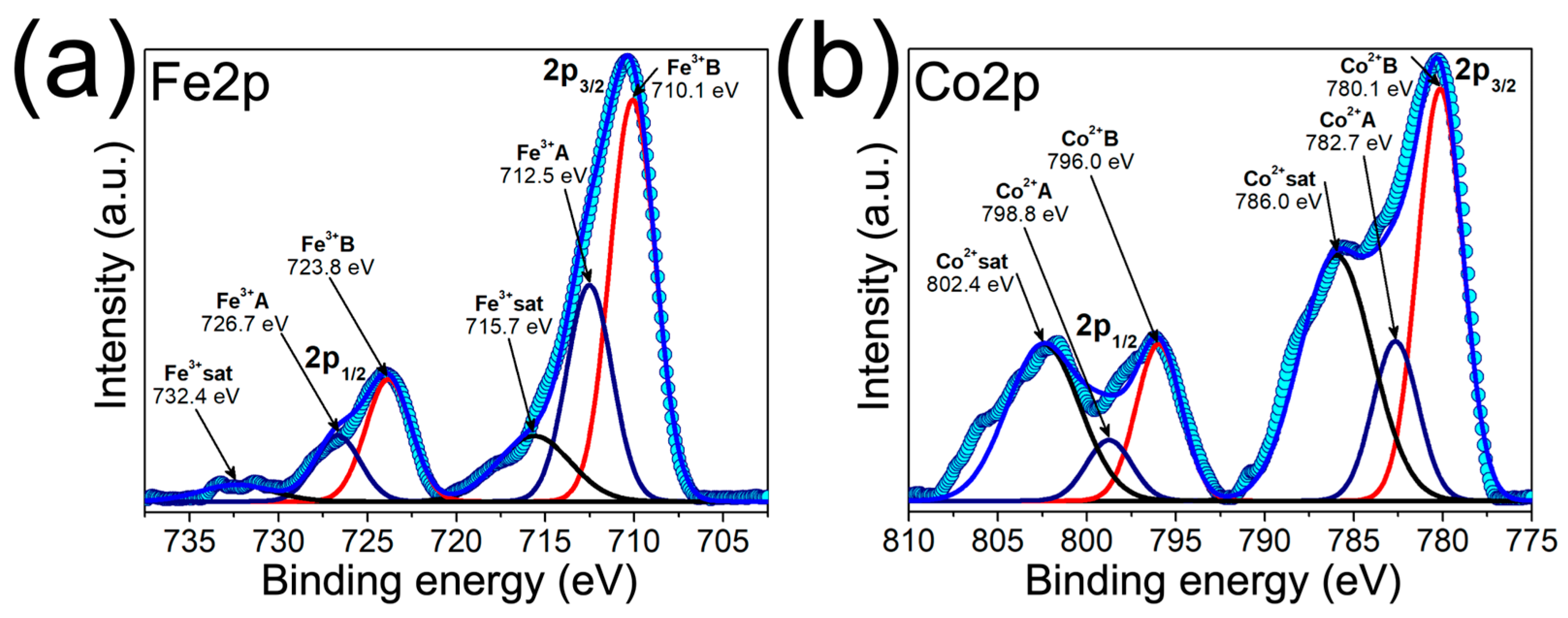
Figure 4 presents the Fe2p and Co2p core-level XPS spectra of the H10 sample, acquired to evaluate potential changes in the chemical composition of CFN following MPHM preparation or possible interactions between CFN and PT2U molecules. Both spectra exhibit peaks attributed to Fe3+ and Co2+ cations occupying both B and A sites within the cobalt ferrite structure, along with their associated satellite (sat) signals. The relative areas of these peaks indicate that 35.0% of iron cations were at A sites and 65.0% at B sites, while 27.9% of cobalt cations were at A sites and 72.1% at B sites, corresponding to the formula (Fe0.70Co0.28)A(Fe1.30Co0.72)BO4. This distribution is consistent with that obtained for the CFNs (see Figure 1f–g), indicating that no significant changes occur in the chemical composition of the nanoparticles after incorporation into the polymer. However, some peaks display binding energy shifts relative to those observed for CFNs, with differences ranging from 0.2 to 1.9 eV. Since the photoelectron binding energy measured by XPS depends on the chemical environment surrounding the emitting atoms, these shifts suggest the formation of coordination bonds between surface cations on CFNs and functional groups in PT2U. This interpretation is further supported by the hypsochromic shifts detected in the ATR-FTIR bands attributed to keto-enol tautomerism in PT2U molecules and to the M-O stretching vibrations (see Figure 3). Consequently, these coordination interactions promote the aggregation of CFNs within the polymer matrix, with variations in aggregate size and density as the CFN content in MPHM changes, consistent with previous observations for other PT2U-based hybrid materials [13].

3.3. Physical Characterization of MPHMs

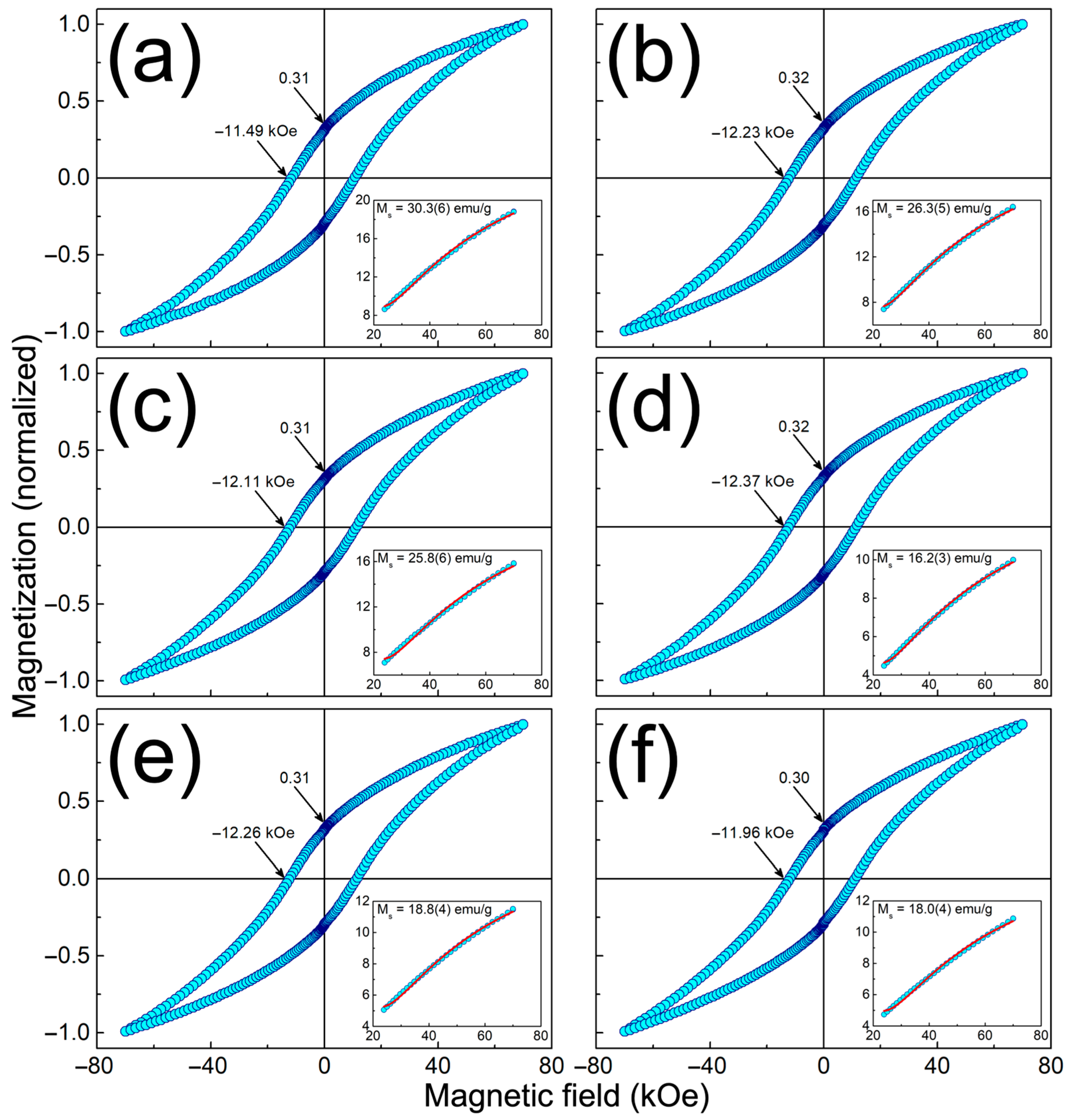
Figure 5 shows the M(H) curves for the MPHM samples measured at 5 K following a zero-field-cooled (ZFC) protocol, with each sample cooled from 300 to 5 K in zero magnetic field prior to measurement. These curves were acquired over a magnetic field range from −70 to 70 kOe. All curves exhibit hysteresis loops characteristic of ferrimagnetic behavior, with evident remanence and coercivity. The overall shape of the loops remains consistent in all samples, indicating the preservation of CFN structure and morphology within the MPHM [10]. Nonetheless, the reduced remanent magnetization (Mr/Mmax) is consistently lower than the values typically reported for CoFe2O4 nanoparticles with uniaxial or cubic anisotropy [25]. The reduction in the expected remanent magnetization of the CFN can be attributed to its high surface-to-volume ratio, resulting from the small particle size (see Figure 1). Consequently, this large surface-to-volume ratio in ferrimagnetic nanoparticles gives rise to surface anisotropy, originating from the exchange between canted spins at the nanoparticle surface and collinearly aligned spins in the core [26,27,28]. As a result, surface spins are not collinearly aligned with those in the core, and their contribution to the overall magnetization is negligible. This behavior is consistent with the observed lack of saturation in the M(H) curves, even at magnetic fields as high as 70 kOe [29,30,31,32].
To estimate the saturation magnetization (Ms), the following empirical relationship was employed to approximate the saturated state of the MPHM samples [33,34,35,36]:
M H = M s 1 a H b H 2
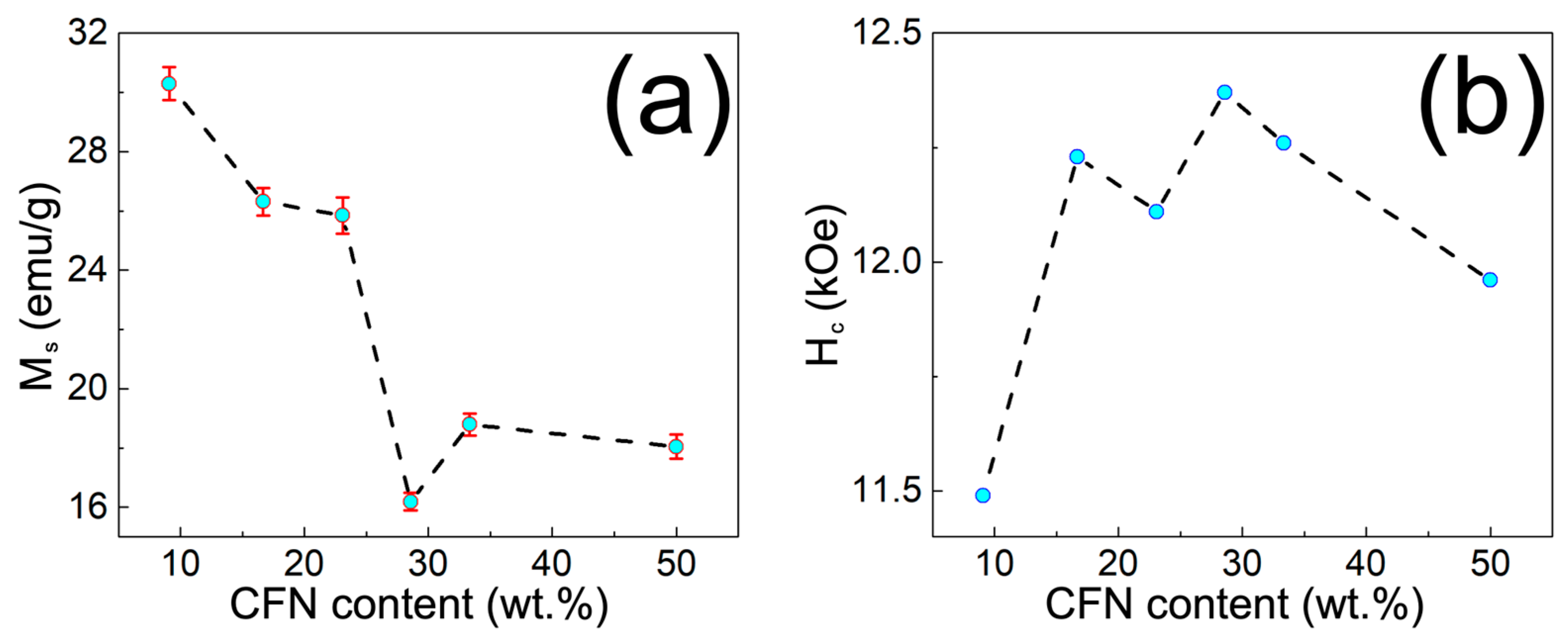
where H is the magnetic field, and a and b are parameters associated with the approximation procedure used to determine Ms [36]. Accordingly, Ms was determined from the analysis of the experimental high-field M(H) isotherms at 5 K for each sample with its respective CFN content. The analysis was performed using Equation (1), as shown in the insets of Figure 5. The resulting values of Ms were 30.3(6), 26.3(5), 25.8(6), 16.2(3), 18.8(4) and 18.0(4) emu/g for H1, H2, H3, H4, H5 and H10, respectively. Values in parentheses indicate the uncertainty in the last digit of Ms and correspond to the half-width of CI95 obtained from non-linear fits, following standard uncertainty and rounding conventions [19]. Statistical analysis of Ms was performed using the CI95 obtained from the fits, and differences between samples were assessed using Welch’s t-test as an approximate method. The results showed that H1 exhibited the highest Ms, which was significantly greater than those of all other samples, as evidenced by non-overlapping CI95 and t-values indicating p << 0.05. Comparisons between H2 and H3 showed no statistically significant difference (p > 0.05), whereas H5 and H10 differed significantly (p < 0.05), consistent with the CI95 of the differences excluding zero. In general, these findings reveal that Ms decreases as the CFN content increases in the MPHM. Although the overall trend is downward from H1 to H10, the dependence is not strictly monotonic, as indicated by the local increase from H4 to H5 (see Figure 6a). This outcome can be rationalized by the combined effect of enhanced surface spin canting and possibly interparticle coupling as CFN loading increases in the MPHM. As nanoparticles become closer within the PT2U matrix, the reduced interparticle separation strengthens magnetic interactions. Such interactions locally frustrate the alignment of surface and interfacial spins [37,38], thereby reducing their contribution to the net magnetization and leading to the observed decrease in Ms, as reported elsewhere [25,39]. Furthermore, the coercive magnetic field (Hc) exhibits a non-monotonic variation from 11.49 to 12.37 kOe across the sample series (see Figure 6b), reflecting the influence of interparticle interactions on magnetic anisotropy, an effect documented for cobalt ferrite nanoparticle assemblies [25,40].
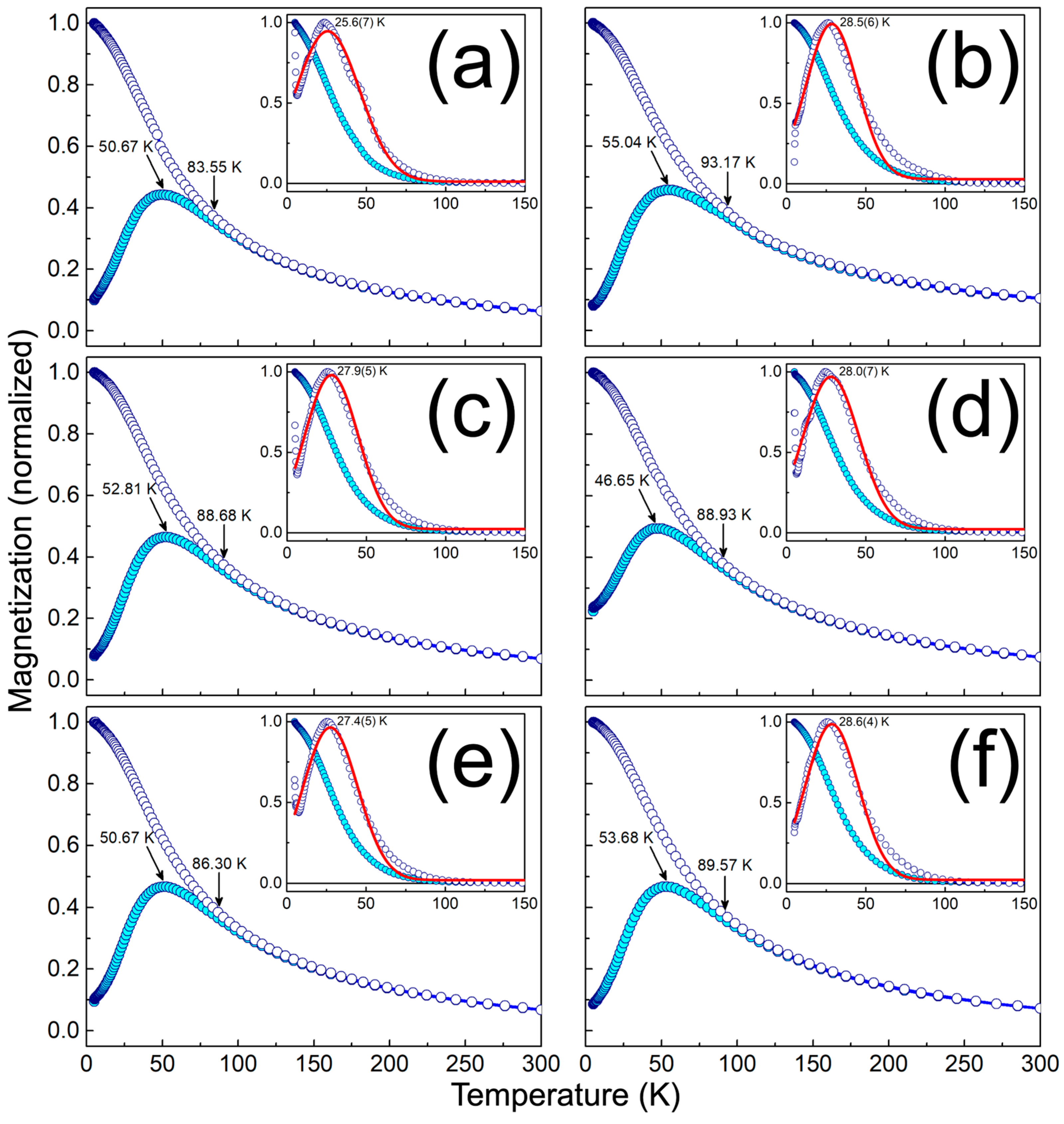
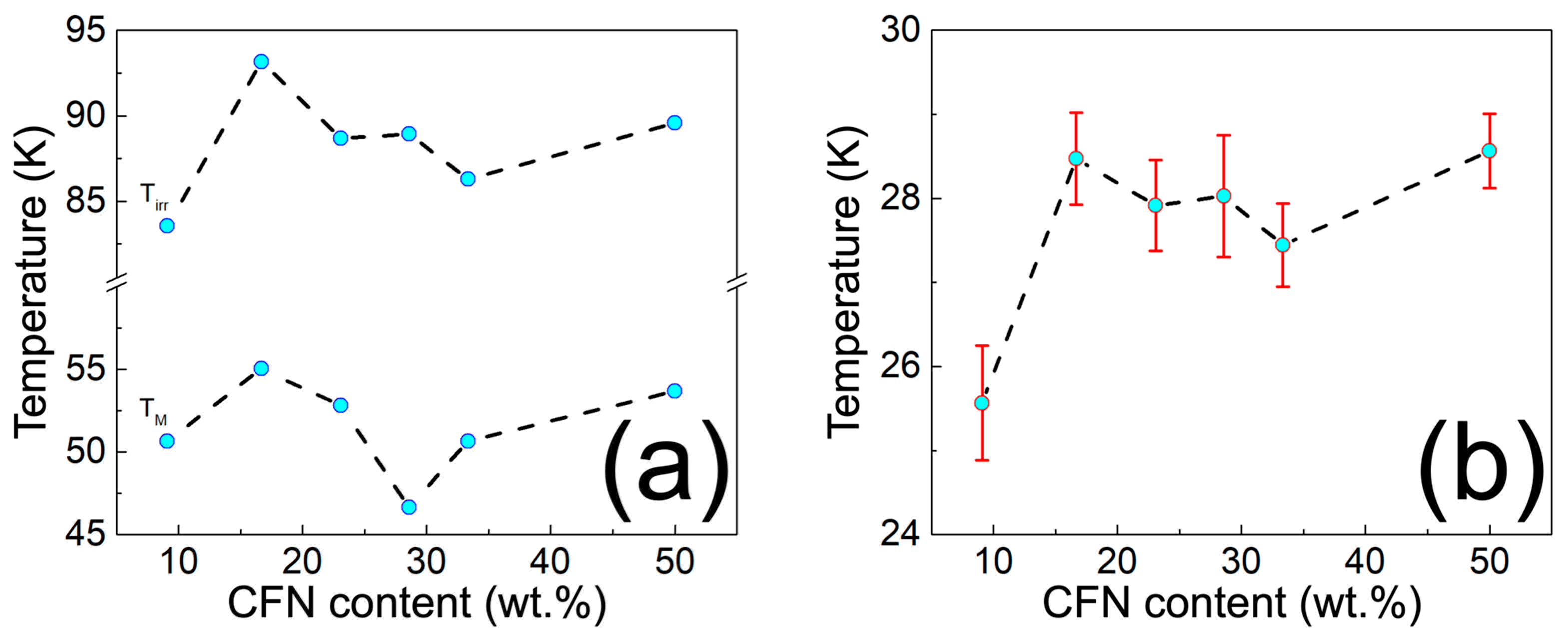
As a first approximation to examine the interparticle interactions among CFNs within the MPHM, M(T) curves were recorded under ZFC and field-cooled (FC) protocols. For the ZFC measurements, each sample was cooled from 300 to 5 K in zero magnetic field, and the magnetization was then recorded upon warming to 300 K under a constant field of 100 Oe. The FC curves were obtained during cooling to 5 K under the same applied field. As depicted in Figure 7, the ZFC curves of the samples exhibit an increase in magnetization with rising temperature, reaching a maximum at a characteristic temperature (TM), beyond which the magnetization decreases. This trend is typical for magnetic nanomaterials and corresponds to the thermal relaxation of CFNs within PT2U that contributes to magnetization of the sample [41]. Therefore, TM can be interpreted as the temperature at which a significant fraction of nanoparticles thermally overcomes the energy barrier (i.e., deblocks) that prevents the reorientation of their magnetic moment away from the direction of the applied field during ZFC measurements. As indicated in Figure 7, TM was 50.67, 55.04, 52.81, 46.65, 50.67 and 53.68 K for H1, H2, H3, H4, H5 and H10, respectively. This suggests that the energy barrier hindering the reorientation of CFN magnetic moments varies with their content in the MPHM (see Figure 8a), despite the shape, size and chemical composition of the nanoparticles remaining unchanged.
As shown in Figure 7, the FC curves display notable irreversibility compared to the trend observed in the ZFC curves, which is characterized by an increase in magnetization upon decreasing temperature. This phenomenon is associated with the blockage of the reorientation of the CFN magnetic moments along the direction of the applied field. The blockage begins at a characteristic temperature (Tirr), below which the FC magnetization surpasses the ZFC magnetization due to an increase in the fraction of the magnetic moments that become blocked parallel to the applied field. We define Tirr as the temperature at which the normalized FC and ZFC magnetization differ by less than 2% [42]. Figure 7 indicates that Tirr was 83.55, 93.17, 88.68, 88.93, 86.30 and 89.57 K for H1, H2, H3, H4, H5 and H10, respectively. The trend of Tirr with CFN content in the MPHM is shown in Figure 8a, highlighting the non-monotonic variation among the samples.
As reported, the difference Tirr − TM reflects the width of the blocking temperature (TB) distribution and hence the particle size distribution, under the assumption of constant anisotropy and negligible interparticle interactions [36]. In our case, the difference Tirr − TM ranged from 32.88 to 42.28 K across the sample series (see Figure 8a), consistent with a scenario in which interparticle interactions play a role in modifying the magnetic anisotropy of the MPHM. To determine the TB distribution considering the deblocking and blocking processes during ZFC and FC measurements, respectively, the calculation of the energy barrier distribution, f(TB), has been proposed using the following relation [32,43]:
f T B d M F C M Z F C d T
where MZFC and MFC denote the magnetization measured under ZFC and FC protocols, respectively. For weakly interacting magnetic nanoparticles, f(TB) exhibits a maximum at a temperature corresponding to the TB of particles whose size matches the mean of the size distribution [32]. To obtain TB experimentally, the normalized MFC − MZFC and −d(MFC − MZFC)/dT curves were calculated from the experimental data, and the evolution of the latter was analyzed using Gaussian fits, as shown in the insets of Figure 7 for each sample. As depicted, the MFC − MZFC curves decrease with increasing temperature, exhibiting a maximum change in slope at the temperature where the −d(MFC − MZFC)/dT curves reach their maximum. The −d(MFC − MZFC)/dT curves are well described by a Gaussian approximation, reflecting the particle size distribution of CFNs (see Figure 1b); thus, the peak of the Gaussian fit was used to extract TB. Although the Gaussian shape was consistent with the particle size distribution, TB values varied statistically between samples. The resulting TB values were 25.6(7), 28.5(6), 27.9(5), 28.0(7), 27.4(5) and 28.6(4) K for H1, H2, H3, H4, H5 and H10, respectively. Statistical analysis indicated that H1 exhibited a significantly lower TB compared to all other samples, as confirmed by the non-overlapping CI95 and Welch’s t-test (p < 0.05). Pairwise comparisons among the remaining samples revealed significant differences only between H2 and H5, and between H5 and H10 (p < 0.05), whereas all other comparisons were not statistically significant, consistent with overlapping CI95. Although H10 showed the highest TB, this value was not significantly different from those of H2, H3 and H4. Figure 8b depicts the CFN-content dependence of TB, where the data reveal a non-monotonic response among the samples. Nevertheless, the overall pattern of TB suggests that magnetic interactions among CFNs within the PT2U matrix may strengthen as interparticle separation decreases, consistent with previous reports on cobalt ferrite nanoparticle assemblies [40].
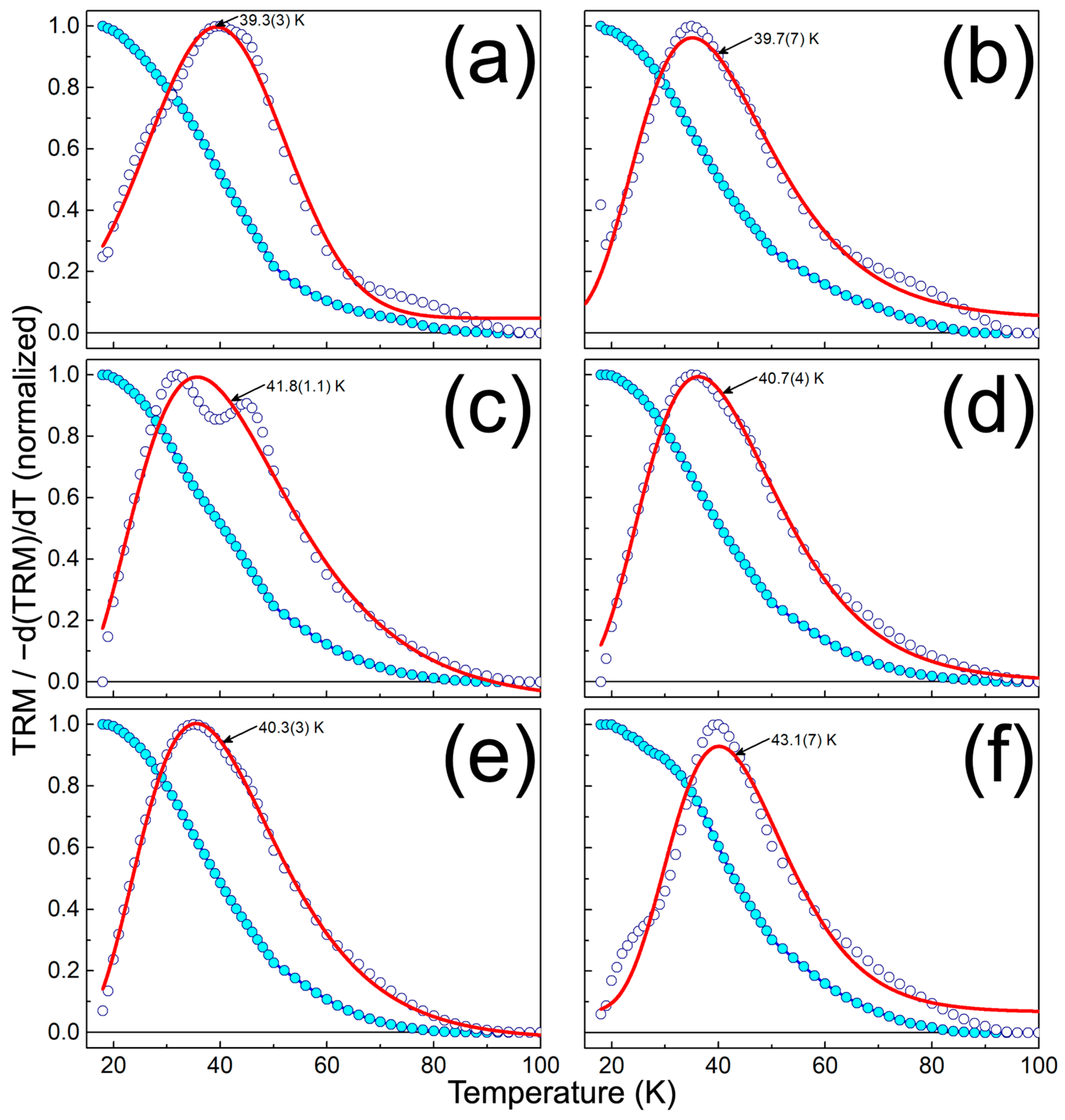
Additionally, TRM curves were measured for the MPHMs over the 18–100 K range to further investigate the magnetic interactions among CFNs. For these measurements, each sample was cooled to 18 K following a ZFC protocol and then subjected to a magnetic field of 35 kOe. The field was subsequently removed, and after 100 s, the remanent magnetization (MTRM) of the sample was measured. The TRM curves were obtained by increasing the temperature toward 100 K, repeating the procedure at each point. Figure 9 shows the normalized TRM curves obtained for the MPHMs following that procedure. As shown, the MTRM of the samples decreases with increasing temperature, reaching zero between 90 and 96 K. This behavior is associated with the progressive deblocking of CFN magnetic moments contributing to the remanence, which is consistent with the transition into the superparamagnetic regime of a nanomaterial composed of magnetic single-domain particles [25,44]. Moreover, the derivative of the TRM curve with respect to temperature provides an estimate of the distribution of anisotropy energy barriers, f(Ea), over which the magnetic moments of non-interacting nanoparticles thermally relax depending on their size [44,45]:
f E a d T R M d T
Figure 9 displays the normalized −d(TRM)/dT curves obtained from the TRM data of the MPHM samples, along with Gaussian or log-normal fits representing their trends. Due to the presence of interactions among CFNs in these samples, −d(TRM)/dT can only be regarded as a first approximation of f(Ea). In the Néel model for thermal relaxation, TB is defined as the temperature at which the relaxation time matches the measurement timescale of the characterization experiment [25]. In nanomaterials with a particle size distribution, TB is typically taken as the temperature at which 50% of the particles enter the superparamagnetic state [44,46]. Furthermore, within this model, TB is proportional to Ea. Consequently, the TB distribution can be inferred from f(Ea) by determining the temperature at which half of the nanoparticles overcome their anisotropy energy barriers (i.e., the mean blocking temperature, TBm) and cease to contribute to the remanent magnetization in the TRM measurements. As illustrated, the −d(TRM)/dT trend of H1 is well described by a Gaussian distribution function, whereas the trends observed for all other samples exhibit a log-normal form. This difference is ascribed to magnetic interactions among CFNs, which may broaden and distort the distribution of anisotropy energy barriers.
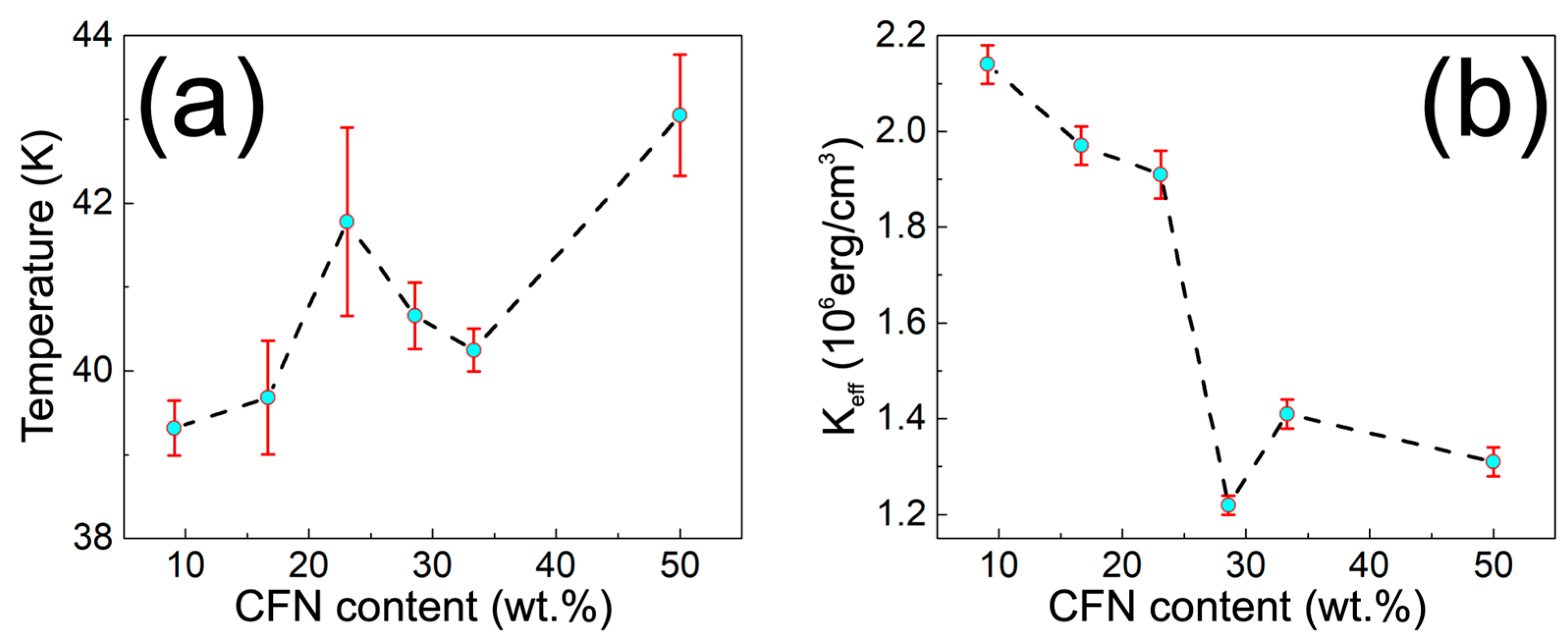
TBm is indicated in Figure 9 as the temperature representing the central tendency of each distribution, corresponding to the mean for Gaussian and to the median for log-normal functions. The resulting TBm values were 39.3(3), 39.7(7), 41.8(1.1), 40.7(4), 40.3(3) and 43.1(7) for H1, H2, H3, H4, H5 and H10, respectively. H1 exhibited a significantly lower TBm than H3, H4, H5 and H10 (p < 0.05), whereas its difference from H2 was not statistically significant. Among the remaining samples, significant differences were found between H2 and H3, H2 and H4, H2 and H10, H3 and H5, H4 and H10, and H5 and H10, while all other comparisons were not statistically significant. Figure 10a illustrates the variation of TBm with the CFN content, exhibiting a non-monotonic pattern throughout the sample series. These findings are consistent with the trend previously observed for TB determined from −d(MFC − MZFC)/dT curves (see Figure 8b), supporting the interpretation that magnetic interactions among CFNs within PT2U can effectively modify the anisotropy energy barrier governing the relaxation of magnetic moments.
Although the experimental evidence indicates that surface effects and magnetic interactions among CFNs within PT2U are present and influence the magnetic response of the MPHM, the effective magnetic anisotropy energy density (Keff) can, as a first approximation, be estimated from Hc using an empirical relation originally derived for single-domain particle models and later adapted to account for size distributions [47,48], as follows [35,49]:
K e f f = H c M s 0.96 1 T T B m 0.77
The calculated values of Keff were 2.14(4), 1.97(4), 1.91(5), 1.22(2), 1.41(3) and 1.31(3) × 106 erg/cm3 for H1, H2, H3, H4, H5 and H10, respectively. Values in parentheses indicate the uncertainty in the last digit of Keff and represent the half-width of CI95 obtained from propagation of uncertainties in Ms and TBm. Differences between samples were assessed based on the non-overlap of the CI95. The results showed that H1 exhibited the highest Keff, which was significantly greater than those of all other samples. Comparisons between H2 and H3 indicated no statistically significant difference (their CI95 overlap), whereas all other pairwise comparisons showed significant differences (non-overlapping CI95). Overall, Keff tended to decrease with increasing CFN content in the MPHM, although deviations from a strictly monotonic dependence were observed (see Figure 10b). This tendency aligns with the data obtained and analyzed from M(H), M(T) and TRM measurements, further confirming that interparticle interactions influence the energy barrier over which the magnetic moments respond.
To estimate the interaction regime among CFNs in the prepared MPHMs, IRM and DCD curves were recorded. Prior to each measurement, the samples were cooled to 5 K using a ZFC protocol. The IRM curve was obtained from a demagnetized state by applying successive positive magnetic fields up to 35 kOe and recording the remanent magnetization (MIRM) 100 s after field removal. Similarly, the DCD curve was measured on a sample first magnetized at 35 kOe and then exposed to progressively stronger reverse fields up to −35 kOe, with the remanent magnetization (MDCD) recorded after each step. As reported, for an assembly of noninteracting single-domain particles with uniaxial anisotropy, IRM and DCD measurements are connected by the Wohlfarth relation [37,50]:
M D H = 1 2 M R H
where MD(H) and MR(H) represent MDCD(H) and MIRM(H) normalized to their maxima [37]. Additionally, the Wohlfarth relation can be rewritten to highlight deviations from the noninteracting case, based on the expression proposed to estimate interactions in cobalt–phosphorus thin films [51], and applied to magnetic nanoparticle assemblies [52]:
δ M H = M D H 1 2 M R H
As documented, a positive ẟM indicates a tendency toward a magnetized state, typically arising from exchange interactions, whereas a negative ẟM reflects an inclination toward a demagnetized state, usually associated with dipole–dipole interactions [53,54].
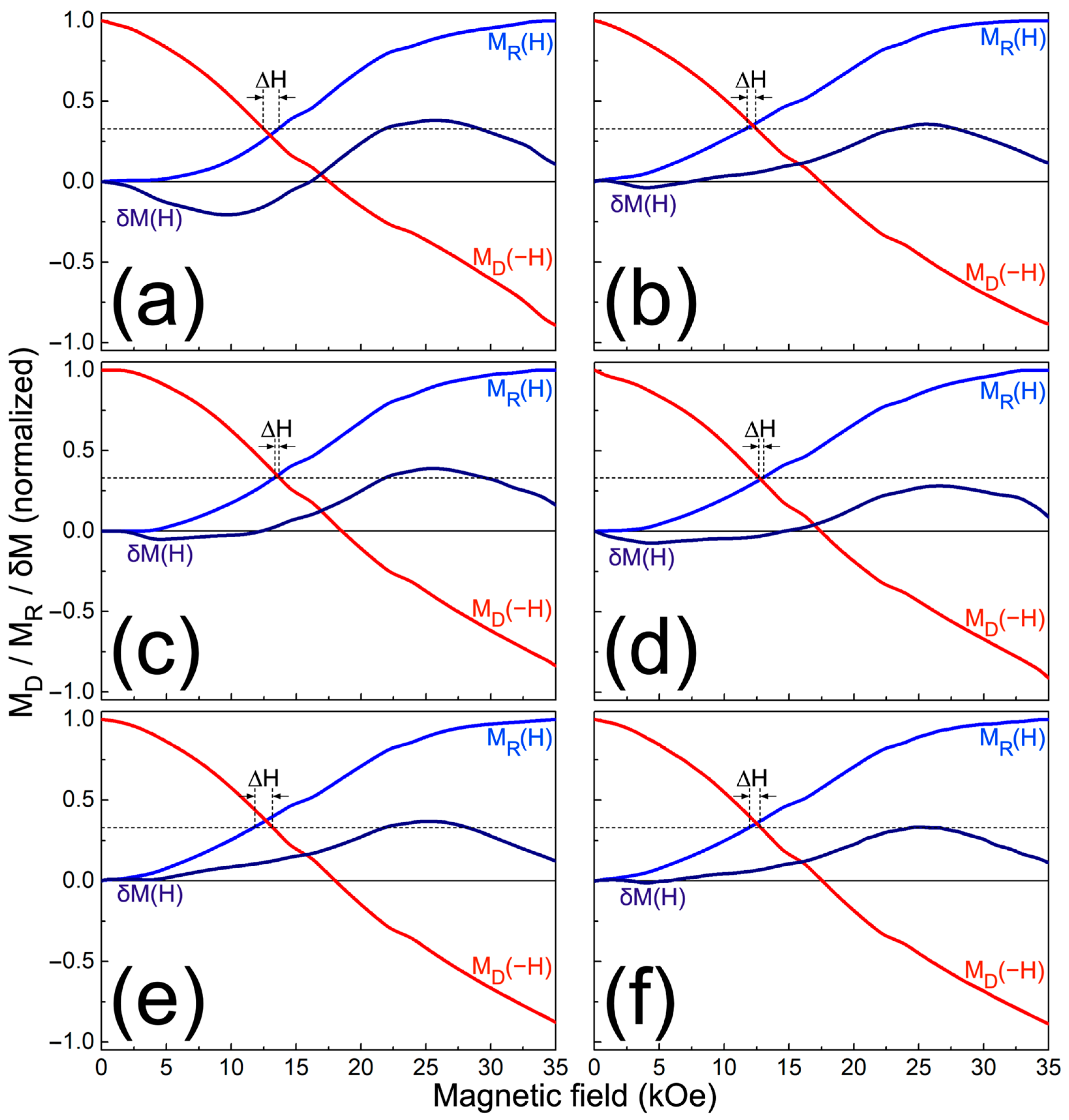
Figure 11 displays the MD(−H), MR(H) and ẟM(H) curves obtained for the MPHM samples. As inferred from Equation (5), the MD(−H) and MR(H) curves intersect at MD = MR = 1/3, at field H = H1/3, for an assembly of noninteracting magnetic nanoparticles. MD(−H) corresponds to the field-reflected DCD curve; therefore, the field value at which MD = 1/3 is actually H = −H1/3 [55]. As shown, MD(−H) and MR(H) do not intersect at M = 1/3 but exhibit a field separation (∆H) at this remanent magnetization level. This field separation can be rationalized in terms of an interaction field (Hi), as suggested in the literature [55], which is related to ∆H as follows:
H i = 2 3 Δ H
Consequently, at M = 1/3, the MR(H) curve is shifted to higher fields by H = Hi/3 with respect to H1/3, while MD(−H) is shifted by the same amount toward lower fields, resulting in a positive Hi for demagnetizing interactions [55]. In contrast, for magnetizing interactions, MR(H) shifts to lower fields and MD(−H) to higher fields by H = Hi/3 with respect to H1/3, yielding a negative Hi [55]. The calculated Hi values were 0.84, −0.53, −0.29, 0.10, −0.99 and −0.66 kOe for H1, H2, H3, H4, H5 and H10, respectively. This behavior is consistent with the features of the ẟM(H) curves at the field branch where ∆H was measured and reflects a general tendency toward magnetizing interactions in the MPHM with increasing CFN content, although the trend is not strictly monotonic (see Figure 11). The positive Hi observed for H1 indicates predominant demagnetizing interactions due to relatively isolated nanoparticles, whereas the negative Hi in H2, H3, H5 and H10 reveals the growing influence of magnetizing interactions as the CFNs are brought closer together (see Figure 2). The positive Hi in H4 suggests local heterogeneities in CFN dispersion within PT2U.
Moreover, these variations in interparticle interactions are directly related to the calculated Keff, as magnetizing interactions facilitate the alignment of magnetic moments, effectively reducing the energy barriers and resulting in lower Keff values, whereas demagnetizing interactions may maintain higher local anisotropy. These results also align with the trend observed for TBm, since magnetizing interactions can promote the cooperative blockage of magnetic moments, thereby increasing the temperature at which a significant fraction of nanoparticles cease to contribute to the remanent magnetization of the samples. Notably, at high magnetic fields, the ẟM(H) curves deviate toward positive values for all samples, indicating that local demagnetizing effects are overcome, leading to a predominantly magnetizing interaction regime (see Figure 11). The amplitude of ẟM reached values of 0.38, 0.36, 0.39, 0.28, 0.37 and 0.34 for samples H1, H2, H3, H4, H5 and H10, respectively, evidencing strong magnetizing interactions arising from the aggregation of CFNs, in agreement with observations reported for other hybrid materials containing cobalt ferrite nanoparticles [52]. These results highlight that the interfacial arrangement of CFNs within the PT2U matrix governs the balance between magnetizing and demagnetizing interactions, ultimately determining the macroscopic magnetic behavior of the MPHM.
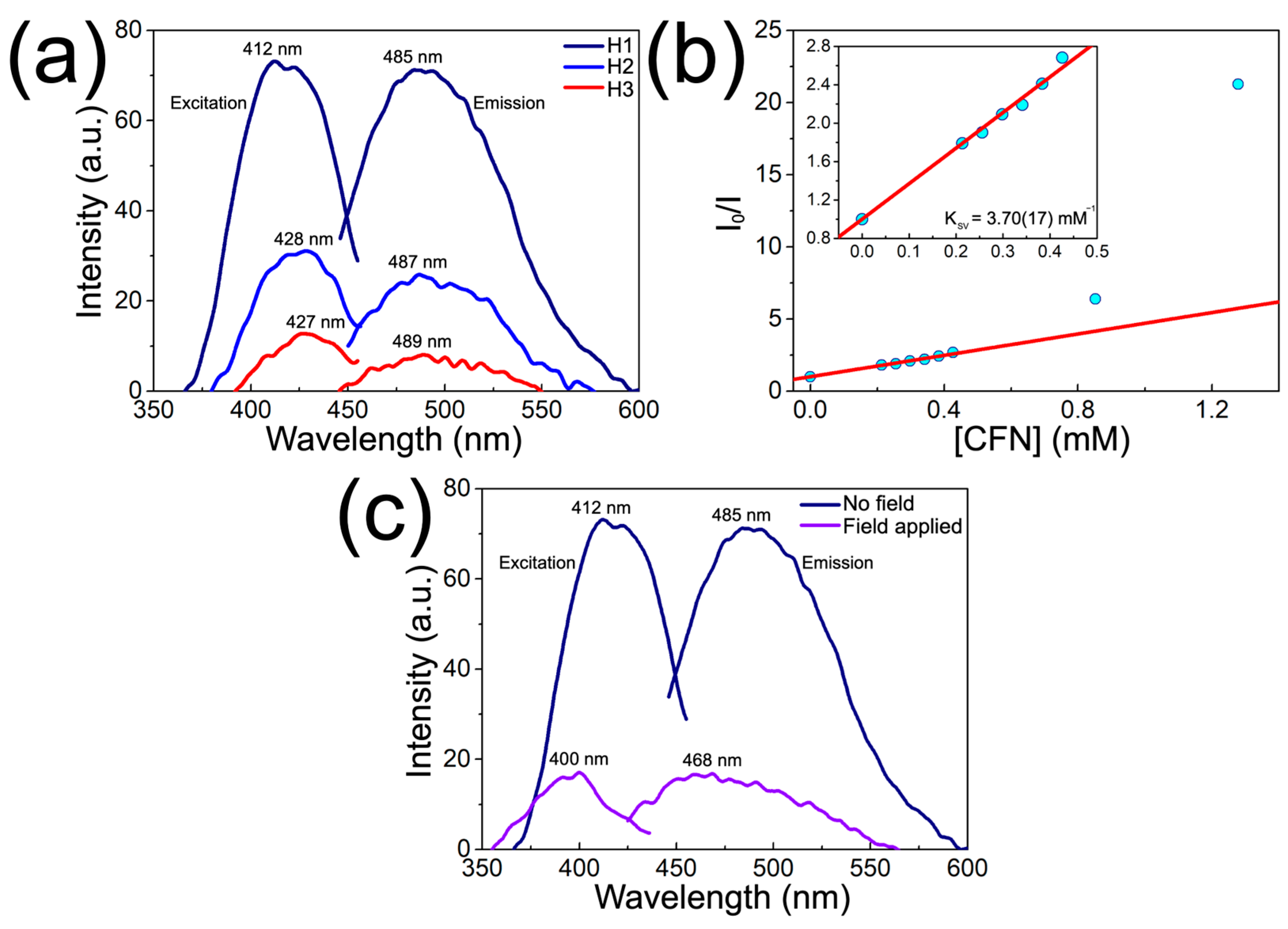
Beyond their magnetic behavior, the optical response of the MPHM provides complementary insights into CFN–PT2U interfacial coupling. Figure 12 presents the LS results obtained at room temperature for the H1, H2 and H3 samples. The LS curves for the remaining samples could not be measured due to their very low intensity. As depicted in Figure 12a, increasing the CFN content (from 9.1 to 23.1 wt.%) leads to progressive bathochromic shifts in both the excitation and emission peaks, accompanied by a reduction in their intensities. These changes indicate that the CFN content induces a deactivation of the singlet excited states of PT2U, a phenomenon known as fluorescence quenching, as reported for other magneto-luminescent materials [56,57,58].
Fluorescence quenching can occur via collisional (dynamic) or static mechanisms [59]. In collisional quenching, excited-state fluorophores are deactivated upon diffusive encounters with quenchers. In this process, the fluorescence intensity is reduced because the fluorophores return to the ground state during the collisions. Importantly, neither the fluorophores nor the quenchers undergo permanent chemical change during these interactions [59]. For collisional quenching, the decrease in fluorescence intensity is described by the Stern–Volmer equation, which relates the ratio of the unquenched-to-quenched emission intensities (I0/I) to the quencher concentration [Q], as follows [59,60]:
I 0 I = 1 + K S V Q
where KSV is the Stern–Volmer constant, which reflects the sensitivity of the fluorophores to the quenchers [59]. Alternatively, fluorophores can form nonfluorescent complexes with quenchers. This process, known as static quenching, occurs in the ground state and is independent of diffusive encounters between the fluorophores and the quenchers [59].
To obtain a first approximation of the quenching mechanism, a Stern–Volmer plot was constructed using CFN contents of 0, 4.8, 5.7, 6.5, 7.4 and 8.3 wt.%, as well as those corresponding to H1, H2 and H3 (see Table 1). In all fluorescence measurements, the mass of PT2U was kept constant (10 mg), while the CFN mass was varied to adjust the quencher concentration. This experimental design follows the usual practice in Stern–Volmer analyses, in which systematically increasing the quencher concentration on the emission intensity is evaluated within the framework described in the literature [59].
Figure 12b shows the experimental Stern–Volmer data, which fit the theoretical model described by Equation (8) within the CFN concentration range of 0 to 0.43 mM (corresponding to 0–9.1 wt.% CFN), yielding a KSV of 3.70(17) mM−1 (see inset in Figure 12b). Considering Equation (8), this KSV value implies that 50% of the PT2U fluorescence would be quenched at a CFN concentration of about 0.27 mM, confirming the predominance of collisional quenching under these conditions. Even so, for concentrations exceeding this range, the experimental points diverge from the expected linear trend. This divergence may reflect a secondary quenching process, likely of static origin [61,62,63]. The potential formation of coordination bonds between CFN and PT2U molecules at high CFN contents, as supported by the ATR-FTIR and XPS analyses of the MPHM samples (see Figure 3 and Figure 4), could account for this additional contribution.
Figure 12c compares the LS results for H1 recorded at room temperature in the absence and presence of an external magnetic field. A static magnetic field of 800 Oe was applied at the center of the fluorescence cell during the measurements. Notably, the LS curve of the H2 and H3 samples could not be measured due to their very low intensity. For H1, applying the magnetic field caused a substantial decrease in both excitation and emission intensities, by approximately 77%, along with a hypsochromic shift of 12 nm and 17 nm for the excitation and emission peaks, respectively. It has been established that the fluorescence response of PT2U is governed by aggregation-induced emission (AIE) effects [13], which are highly sensitive to the spatial arrangement of its molecules [64]. Based on this, the observed quenching under magnetic stimulation can be attributed to CFN-induced modifications in the supramolecular organization of PT2U, likely disrupting the optimal molecular stacking required for efficient AIE and leading to a reduced fluorescence response.

4. Conclusions

Magneto-photoluminescent hybrid materials (MPHMs) were successfully prepared by incorporating cobalt ferrite nanoparticles (CFNs) into the fluorescent polymer PT2U. TEM, ATR-FTIR and XPS analyses confirmed that CFNs had a mean size of 3.95 nm and showed crystalline structure and chemical composition consistent with CoFe2O4, forming aggregates within the PT2U matrix driven by interfacial interactions, with sizes ranging from 650 to 1042 nm. Magnetic properties, characterized through M(H), M(T), TRM, IRM and DCD measurements, revealed that interparticle interactions strongly influenced saturation magnetization, coercivity, blocking temperatures and effective magnetic anisotropy energy density, with the spatial arrangement of CFN aggregates governing the balance between magnetizing and demagnetizing effects. LS measurements showed progressive quenching of PT2U emission with increasing CFN content, primarily due to collisional quenching, while higher concentrations involved secondary mechanisms likely associated with coordination between CFN and PT2U molecules, as indicated by ATR-FTIR and XPS analyses. Additionally, LS measurements under an external magnetic field revealed further quenching, attributed to CFN-induced rearrangements of PT2U chains that disrupted the molecular stacking necessary for efficient AIE. Overall, these findings demonstrate that surface and interfacial phenomena control both magnetic and optical properties in MPHMs, providing a tunable magneto-photoluminescent response. This work offers valuable insights into CFN–PT2U coupling, which are relevant for the design of functional and responsive hybrid materials.

Author Contributions

Conceptualization, V.A.O.-V., M.A.G.-N. and V.A.G.-G.; methodology, V.A.O.-V., M.A.G.-N. and V.A.G.-G.; validation, E.L.-C. and A.M.-d.l.C.; formal analysis, V.A.O.-V., M.A.G.-N. and V.A.G.-G.; writing–original draft preparation, V.A.O.-V., M.A.G.-N. and V.A.G.-G.; writing–review and editing, V.A.O.-V., M.A.G.-N., E.L.-C. and A.M.-d.l.C.; supervision, M.A.G.-N. and V.A.G.-G.; funding acquisition, M.A.G.-N. All authors have read and agreed to the published version of the manuscript.

Funding

This research was funded by PROGRAMA DE APOYO A LA INVESTIGACIÓN CIENTÍFICA Y TECNOLÓGICA (PAICYT), grant number IT1401-20, of the Universidad Autónoma de Nuevo León. The APC was funded by the Universidad Autónoma de Nuevo León.

Institutional Review Board Statement

Not applicable.

Informed Consent Statement

Not applicable.

Data Availability Statement

The data that support the findings of this study are available from the corresponding author upon reasonable request.

Acknowledgments

During the preparation of this study, the authors used ChatGPT (GPT-5 2) to improve the readability and language of the manuscript. The authors have reviewed and edited the output and take full responsibility for the content of this publication.

Conflicts of Interest

The authors declare no conflicts of interest.

Abbreviations

The following abbreviations are used in this manuscript:
MPHMsMagneto-photoluminescent hybrid materials
CFNsCobalt ferrite nanoparticles
PT2UPoly(terephthalaldehyde-undecan-2-one)
TEMTransmission electron microscopy
BFBright field
SAEDSelected area electron diffraction
HAADF-STEMHigh-angle annular dark-field scanning transmission electron microscopy
ATR-FTIRAttenuated total reflectance-Fourier transform infrared spectroscopy
XPSX-ray photoelectron spectroscopy
LSLuminescence spectroscopy
TRMThermoremanence
IRMIsothermal remanent magnetization
DCDDirect current demagnetization
CI9595% confidence interval
ZFCZero-field-cooled
FCField-cooled
AIEAggregation-induced emission

References

  1. Miao, J.; Liu, A.; Wu, L.; Yu, M.; Wei, W.; Liu, S. Magnetic ferroferric oxide and polydopamine molecularly imprinted polymer nanocomposites based electrochemical impedance sensor for the selective separation and sensitive determination of dichlorodiphenyltrichloroethane (DDT). Anal. Chim. Acta 2020, 1095, 82–92. [Google Scholar] [CrossRef]
  2. Romero-Fierro, D.; Bustamante-Torres, M.; Bravo-Plascencia, F.; Magaña, H.; Bucio, E. Polymer-magnetic semiconductor nanocomposites for industrial electronic applications. Polymers 2022, 14, 2467. [Google Scholar] [CrossRef] [PubMed]
  3. Ostruszka, R.; Půlpánová, D.; Pluháček, T.; Tomanec, O.; Novák, P.; Jirák, D.; Šišková, K. Facile one-pot green synthesis of magneto-luminescent bimetallic nanocomposites with potential as dual imaging agent. Nanomaterials 2023, 13, 1027. [Google Scholar] [CrossRef]
  4. Ahmadian-Fard-Fini, S.; Salavati-Niasari, M.; Safardoust-Hojaghan, H. Hydrothermal green synthesis and photocatalytic activity of magnetic CoFe2O4–carbon quantum dots nanocomposite by turmeric precursor. J Mater. Sci. Mater. Electron. 2017, 28, 16205–16214. [Google Scholar] [CrossRef]
  5. Da Costa, L.S.; Khan, L.U.; Franqui, L.S.; Delite, F.D.S.; Muraca, D.; Martinez, D.S.T.; Knobel, M. Hybrid magneto-luminescent iron oxide nanocubes functionalized with europium complexes: Synthesis, hemolytic properties and protein corona formation. J. Mater. Chem. B 2021, 9, 428–439. [Google Scholar] [CrossRef]
  6. Kumar, P.; Pathak, S.; Jain, K.; Singh, A.; Kuldeep; Basheed, G.A.; Pant, R.P. Low-temperature large-scale hydrothermal synthesis of optically active PEG-200 capped single domain MnFe2O4 nanoparticles. J. Alloys Compd. 2022, 904, 163992. [Google Scholar] [CrossRef]
  7. Das, P.; Ganguly, S.; Margel, S.; Gedanken, A. Tailor made magnetic nanolights: Fabrication to cancer theranostics applications. Nanoscale Adv. 2021, 3, 6762–6796. [Google Scholar] [CrossRef]
  8. Liu, H.; Wu, J.; Min, J.H.; Lee, J.H.; Kim, Y.K. Synthesis and characterization of magnetic–luminescent Fe3O4–CdSe core–shell nanocrystals. Electron. Mater. Lett. 2019, 15, 102–110. [Google Scholar] [CrossRef]
  9. Reaz, M.; Haque, A.; Cornelison, D.M.; Wanekaya, A.; Delong, R.; Ghosh, K. Magneto-luminescent zinc/iron oxide core-shell nanoparticles with tunable magnetic properties. Physica E Low Dimens. Syst. Nanostruct. 2020, 123, 114090. [Google Scholar] [CrossRef]
  10. Castellanos-Rubio, I.; Barón, A.; Luis-Lizarraga, O.; Rodrigo, I.; de Muro, I.G.; Orue, I.; Martínez-Martínez, V.; Castellanos-Rubio, A.; López-Arbeloa, F.; Insausti, M. Efficient magneto-luminescent nanosystems based on rhodamine-loaded magnetite nanoparticles with optimized heating power and ideal thermosensitive fluorescence. ACS Appl. Mater. Interfaces 2022, 14, 50033–50044. [Google Scholar] [CrossRef]
  11. Li, B.; Shao, W.; Wang, Y.; Xiao, D.; Xiong, Y.; Ye, H.; Zhou, Q.; Jin, Q. Synthesis and morphological control of biocompatible fluorescent/magnetic Janus nanoparticles based on the self-assembly of fluorescent polyurethane and Fe3O4 nanoparticles. Polymers 2019, 11, 272. [Google Scholar] [CrossRef]
  12. Song, G.; Chen, M.; Zhang, Y.; Cui, L.; Qu, H.; Zheng, X.; Wintermark, M.; Liu, Z.; Rao, J. Janus iron oxides @ semiconducting polymer nanoparticle tracer for cell tracking by magnetic particle imaging. Nano Lett. 2018, 18, 182–189. [Google Scholar] [CrossRef]
  13. Ortiz-Vergara, V.A.; Garza-Navarro, M.A.; González-González, V.A.; López-Cuellar, E.; Estrada-de la Vega, A. Interactions between magnetic and luminescent phases in hybrid nanomaterials composed of magnetite nanoparticles assembled within a cross-conjugated polymer. Mater. Sci. Eng. B 2025, 313, 117901. [Google Scholar] [CrossRef]
  14. Sun, S.; Zeng, H.; Robinson, D.B.; Raoux, S.; Rice, P.M.; Wang, S.X.; Li, G. Monodisperse MFe2O4 (M = Fe, Co, Mn) nanoparticles. J. Am. Chem. Soc. 2004, 126, 273–279. [Google Scholar] [CrossRef] [PubMed]
  15. Lu, L.T.; Dung, N.T.; Tung, L.D.; Thanh, C.T.; Quy, O.K.; Chuc, N.V.; Maenosono, S.; Thanh, N.T.K. Synthesis of magnetic cobalt ferrite nanoparticles with controlled morphology, monodispersity and composition: The influence of solvent, surfactant, reductant and synthetic conditions. Nanoscale 2015, 7, 19596–19610. [Google Scholar] [CrossRef] [PubMed]
  16. Mahhouti, Z.; El Moussaoui, H.; Mahfoud, T.; Hamedoun, M.; El Marssi, M.; Lahmar, A.; El Kenz, A.; Benyoussef, A. Chemical synthesis and magnetic properties of monodisperse cobalt ferrite nanoparticles. J. Mater. Sci. Mater. Electron. 2019, 30, 14913–14922. [Google Scholar] [CrossRef]
  17. Sturges, H.A. The Choice of a Class Interval. J. Am. Stat. Assoc. 1926, 21, 65–66. [Google Scholar] [CrossRef]
  18. Aragón, F.H.; Coaquira, J.A.H.; Villegas-Lelovsky, L.; da Silva, S.W.; Cesar, D.F.; Nagamine, L.C.C.M.; Cohen, R.; Menéndez-Proupin, E.; Morais, P.C. Evolution of the doping regimes in the Al-doped SnO2 nanoparticles prepared by a polymer precursor method. J. Phys. Condens. Matter 2015, 27, 095301. [Google Scholar] [CrossRef]
  19. Taylor, J.R. An Introduction to Error Analysis, 2nd ed.; University Science Books: Melville, NY, USA, 1997; pp. 13–35. [Google Scholar]
  20. Cevallos, V.J.; Briceño, S.; Solorzano, G.; Gardener, J.; Debut, A.; Dávalos, R.; Bramer-Escamilla, W.; González, G. Electrospun polyvinylpyrrolidone fibers with cobalt ferrite nanoparticles. Carbon Trends 2025, 19, 100478. [Google Scholar] [CrossRef]
  21. Briceño, S.; Reinoso, C. CoFe2O4-chitosan-graphene nanocomposite for glyphosate removal. Environ. Res. 2022, 212, 113470. [Google Scholar] [CrossRef] [PubMed]
  22. Anantharamaiah, P.N.; Joy, P.A. Enhancing the strain sensitivity of CoFe2O4 at low magnetic fields without affecting the magnetostriction coefficient by substitution of small amounts of Mg for Fe. Phys. Chem. Chem. Phys. 2016, 18, 10516–10527. [Google Scholar] [CrossRef]
  23. Kumar, Y.; Sharma, A.; Ahmed, M.A.; Mali, S.S.; Hong, C.K.; Shirage, P.M. Morphology-controlled synthesis and enhanced energy product (BH)max of CoFe2O4 nanoparticles. New J. Chem. 2018, 42, 15793–15802. [Google Scholar] [CrossRef]
  24. Silverstein, R.M.; Webster, F.X.; Kiemle, D.J. Spectrometric Identification of Organic Compounds, 7th ed.; John Wiley & Sons: Hoboken, NJ, USA, 2005; pp. 72–108. [Google Scholar]
  25. Peddis, D.; Cannas, C.; Musinu, A.; Ardu, A.; Orrù, F.; Fiorani, D.; Laureti, S.; Rinaldi, D.; Muscas, G.; Concas, G.; et al. Beyond the effect of particle size: Influence of CoFe2O4 nanoparticle arrangements on magnetic properties. Chem. Mater. 2013, 25, 2005–2013. [Google Scholar] [CrossRef]
  26. Coey, J.M.D. Noncollinear spin arrangement in ultrafine ferrimagnetic crystallites. Phys. Rev. Lett. 1971, 27, 1140–1142. [Google Scholar] [CrossRef]
  27. Kodama, R.H.; Berkowitz, A.E.; McNiff, E.J., Jr.; Foner, S. Surface spin disorder in NiFe2O4 nanoparticles. Phys. Rev. Lett. 1996, 77, 394–397. [Google Scholar] [CrossRef]
  28. Lin, D.; Nunes, A.C.; Majkrzak, C.F.; Berkowitz, A.E. Polarized neutron study of the magnetization density distribution within a CoFe2O4 colloidal particle II. J. Magn. Magn. Mater. 1995, 145, 343–348. [Google Scholar] [CrossRef]
  29. Batlle, X.; Labarta, A. Finite-size effects in fine particles: Magnetic and transport properties. J. Phys. D Appl. Phys. 2002, 35, 201. [Google Scholar] [CrossRef]
  30. Kodama, R.H. Magnetic nanoparticles. J. Magn. Magn. Mater. 1999, 200, 359–372. [Google Scholar] [CrossRef]
  31. Estrada-de la Vega, A.; Garza-Navarro, M.A.; Durán-Guerrero, J.G.; Moreno-Cortez, I.E.; Lucio-Porto, R.; González-González, V. Tailoring the magnetic properties of cobalt-ferrite nanoclusters. J. Nanopart. Res. 2016, 18, 18. [Google Scholar] [CrossRef]
  32. Pianciola, B.N.; Lima, E.; Troiani, H.E.; Nagamine, L.C.C.M.; Cohen, R.; Zysler, R.D. Size and surface effects in the magnetic order of CoFe2O4 nanoparticles. J. Magn. Magn. Mater. 2015, 377, 44–51. [Google Scholar] [CrossRef]
  33. Brown, W.F., Jr. Theory of the approach to magnetic saturation. Phys. Rev. 1940, 58, 736–743. [Google Scholar] [CrossRef]
  34. Morrish, A.H. The Physical Principles of Magnetism, 1st ed.; Reprint; IEEE Press: New York, NY, USA, 2001; pp. 394–396. [Google Scholar]
  35. Sanna Angotzi, M.; Mameli, V.; Zákutná, D.; Kubániová, D.; Cara, C.; Cannas, C. Evolution of the magnetic and structural properties with the chemical composition in oleate-capped MnxCo1–xFe2O4 nanoparticles. J. Phys. Chem. C 2021, 125, 20626–20638. [Google Scholar] [CrossRef]
  36. Peddis, D.; Mansilla, M.V.; Mørup, S.; Cannas, C.; Musinu, A.; Piccaluga, G.; D’Orazio, F.; Lucari, F.; Fiorani, D. Spin-canting and magnetic anisotropy in ultrasmall CoFe2O4 nanoparticles. J. Phys. Chem. B 2008, 112, 8507–8513. [Google Scholar] [CrossRef] [PubMed]
  37. Peddis, D.; Orrù, F.; Ardu, A.; Cannas, C.; Musinu, A.; Piccaluga, G. Interparticle interactions and magnetic anisotropy in cobalt ferrite nanoparticles: Influence of molecular coating. Chem. Mater. 2012, 24, 1062–1071. [Google Scholar] [CrossRef]
  38. Mørup, S.; Hansen, M.F.; Frandsen, C. Magnetic interactions between nanoparticles. Beilstein J. Nanotechnol. 2010, 1, 182–190. [Google Scholar] [CrossRef]
  39. Pereira, A.M.; Pereira, C.; Silva, A.S.; Schmool, D.S.; Freire, C.; Grenche, J.M.; Arajo, J.P. Unravelling the effect of interparticle interactions and surface spin canting in γ-Fe2O3@SiO2 superparamagnetic nanoparticles. J. Appl. Phys. 2011, 109, 114319. [Google Scholar] [CrossRef]
  40. Mosiniewicz-Szablewska, E.; Figueiredo, L.C.; da Silva, A.O.; Sousa, M.H.; Morais, P.C. Magnetic studies of ultrafine CoFe2O4 nanoparticles with different molecular surface coatings. Phys. Chem. Chem. Phys. 2024, 26, 3296–3314. [Google Scholar] [CrossRef]
  41. Leslie-Pelecky, D.L.; Rieke, R.D. Magnetic properties of nanostructured materials. Chem. Mater. 1996, 8, 1770–1783. [Google Scholar] [CrossRef]
  42. Del Bianco, L.; Fiorani, D.; Testa, A.M.; Bonetti, E.; Savini, L.; Signoretti, S. Magnetothermal behavior of a nanoscale Fe/Fe oxide granular system. Phys. Rev. B 2002, 66, 174418. [Google Scholar] [CrossRef]
  43. Knobel, M.; Socolovsky, L.M.; Vargas, J.M. Propiedades magnéticas y de transporte de sistemas nanocristalinos: Conceptos básicos y aplicaciones a sistemas reales. Rev. Mex. Fis. E 2004, 50, 8–28. [Google Scholar]
  44. Cannas, C.; Musinu, A.; Piccaluga, G.; Fiorani, D.; Peddis, D.; Rasmussen, H.K.; Mørup, S. Magnetic properties of cobalt ferrite–silica nanocomposites prepared by a sol-gel autocombustion technique. J. Chem. Phys. 2006, 125, 164714. [Google Scholar] [CrossRef]
  45. Chantrell, R.W.; El-Hilo, M.; O’Grady, K. Spin-glass behavior in a fine particle system. IEEE Trans. Magn. 1991, 27, 3570–3578. [Google Scholar] [CrossRef]
  46. Rondinone, A.J.; Samia, A.C.S.; Zhang, Z.J. Superparamagnetic relaxation and magnetic anisotropy energy distribution in CoFe2O4 spinel ferrite nanocrystallites. J. Phys. Chem. B 1999, 103, 6876–6880. [Google Scholar] [CrossRef]
  47. Kneller, E.F.; Luborsky, F.E. Particle size dependence of coercivity and remanence of single-domain particles. J. Appl. Phys. 1963, 34, 656–658. [Google Scholar] [CrossRef]
  48. García-Otero, J.; García-Bastida, A.J.; Rivas, J. Influence of temperature on the coercive field of non-interacting fine magnetic particles. J. Magn. Magn. Mater. 1998, 189, 377–383. [Google Scholar] [CrossRef]
  49. Boni, A.; Basini, A.M.; Capolupo, L.; Innocenti, C.; Corti, M.; Cobianchi, M.; Orsini, F.; Guerrini, A.; Sangregorio, C.; Lascialfari, A. Optimized PAMAM coated magnetic nanoparticles for simultaneous hyperthermic treatment and contrast enhanced MRI diagnosis. RSC Adv. 2017, 7, 44104–44111. [Google Scholar] [CrossRef]
  50. Wohlfarth, E.P. Relations between different modes of acquisition of the remanent magnetization of ferromagnetic particles. J. Appl. Phys. 1958, 29, 595–596. [Google Scholar] [CrossRef]
  51. Kelly, P.E.; O’Grady, K.; Mayo, P.L.; Chantrell, R.W. Switching mechanisms in cobalt-phosphorus thin films. IEEE Trans. Magn. 1989, 25, 3881–3883. [Google Scholar] [CrossRef]
  52. Peddis, D.; Cannas, C.; Musinu, A.; Piccaluga, G. Magnetism in nanoparticles: Beyond the effect of particle size. Chem. Eur. J. 2009, 15, 7822–7829. [Google Scholar] [CrossRef] [PubMed]
  53. Blanco-Mantecón, M.; O’Grady, K. Interaction and size effects in magnetic nanoparticles. J. Magn. Magn. Mater. 2006, 296, 124–133. [Google Scholar] [CrossRef]
  54. Geshev, J.; Mikhov, M.; Schmidt, J.E. Remanent magnetization plots of fine particles with competing cubic and uniaxial anisotropies. J. Appl. Phys. 1999, 85, 7321–7327. [Google Scholar] [CrossRef]
  55. Araujo, E.; Martínez-Huerta, J.M.; Piraux, L.; Encinas, A. Quantification of the interaction field in arrays of magnetic nanowires from the remanence curves. J. Supercond. Nov. Magn. 2018, 31, 3981–3987. [Google Scholar] [CrossRef]
  56. Arias-Ramos, N.; Ibarra, L.E.; Serrano-Torres, M.; Yagüe, B.; Caverzán, M.D.; Chesta, C.A.; Palacios, R.E.; López-Larrubia, P. Iron oxide incorporated conjugated polymer nanoparticles for simultaneous use in magnetic resonance and fluorescent imaging of brain tumors. Pharmaceutics 2021, 13, 1258. [Google Scholar] [CrossRef]
  57. Howes, P.; Green, M.; Bowers, A.; Parker, D.; Varma, G.; Kallumadil, M.; Hughes, M.; Warley, A.; Brain, A.; Botnar, R. Magnetic conjugated polymer nanoparticles as bimodal imaging agents. J. Am. Chem. Soc. 2010, 132, 9833–9842. [Google Scholar] [CrossRef]
  58. Corr, S.A.; Rakovich, Y.P.; Gun’Ko, Y.K. Multifunctional magnetic-fluorescent nanocomposites for biomedical applications. Nanoscale Res. Lett. 2008, 3, 87–104. [Google Scholar] [CrossRef]
  59. Lakowicz, J.R. Principles of Fluorescence Spectroscopy, 3rd ed.; Springer: New York, NY, USA, 2006; pp. 278–280. [Google Scholar] [CrossRef]
  60. Gehlen, M.H. The centenary of the Stern-Volmer equation of fluorescence quenching: From the single line plot to the SV quenching map. J. Photochem. Photobiol. C 2020, 42, 100338. [Google Scholar] [CrossRef]
  61. Laws, W.R.; Contino, P.B. Fluorescence quenching studies: Analysis of nonlinear Stern-Volmer data. In Methods in Enzymology, 1st ed.; Brand, L., Johnson, M.L., Eds.; Elsevier: Amsterdam, The Netherlands, 1992; Volume 210, pp. 448–463. [Google Scholar] [CrossRef]
  62. Campbell, K.; Zappas, A.; Bunz, U.; Thio, Y.S.; Bucknall, D.G. Fluorescence quenching of a poly(para-phenylene ethynylenes) by C60 fullerenes. J. Photochem. Photobiol. A Chem. 2012, 249, 41–46. [Google Scholar] [CrossRef]
  63. Tanwar, A.S.; Parui, R.; Garai, R.; Chanu, M.A.; Iyer, P.K. Dual “static and dynamic” fluorescence quenching mechanisms based detection of TNT via a cationic conjugated polymer. ACS Meas. Sci. Au 2022, 2, 23–30. [Google Scholar] [CrossRef] [PubMed]
  64. Chen, Y.; Lam, J.W.Y.; Kwok, R.T.K.; Liu, B.; Tang, B.Z. Aggregation-induced emission: Fundamental understanding and future developments. Mater. Horiz. 2019, 6, 428–433. [Google Scholar] [CrossRef]
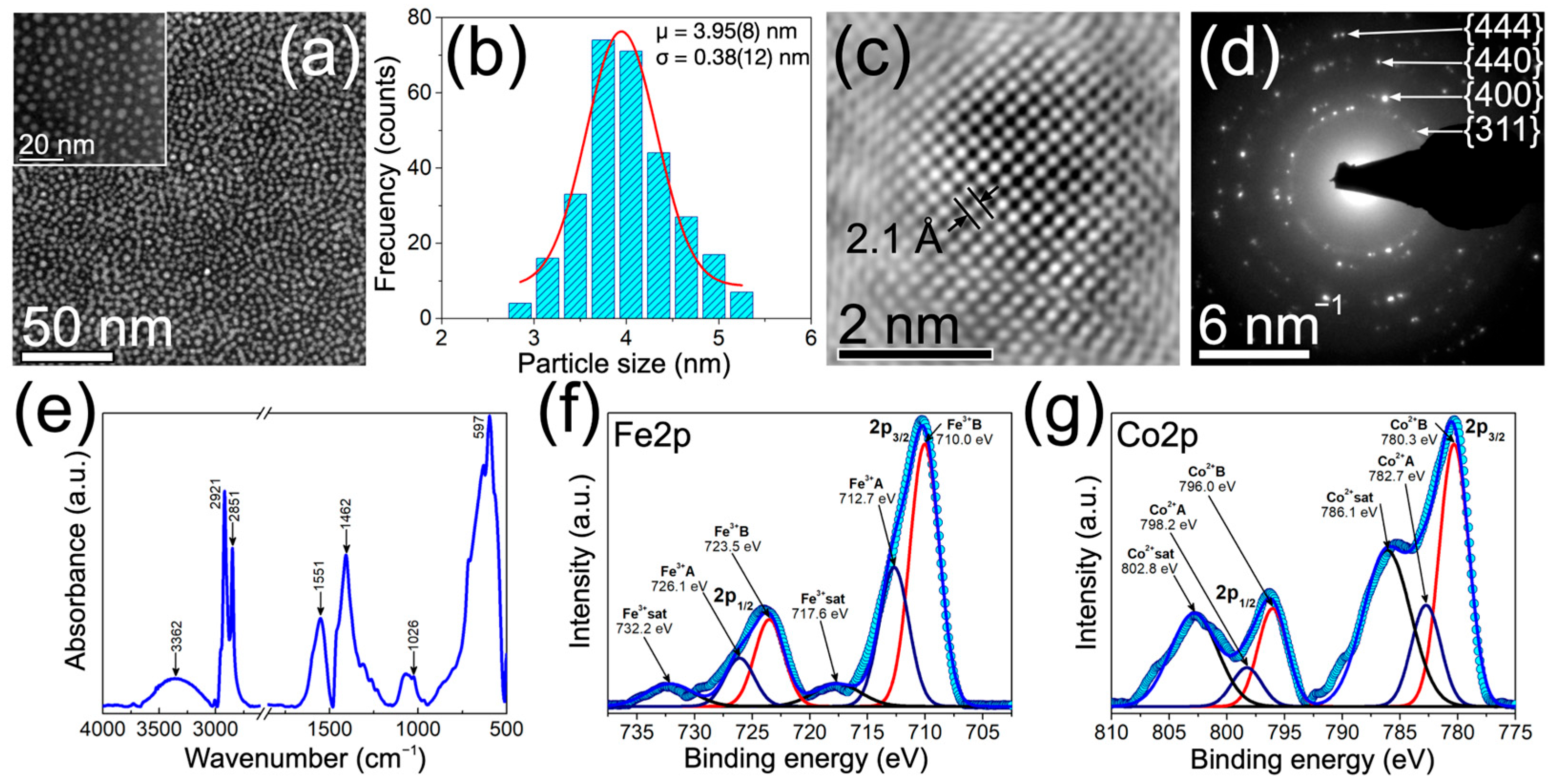
Figure 1. Structural, morphological and chemical characterization of the CFN sample: (a) HAADF-STEM image showing the morphology of the nanoparticles (inset: high magnification image); (b) corresponding particle size distribution histogram with Gaussian fit (solid line); (c) high-resolution BF image resolving atomic planes; (d) indexed SAED pattern confirming the crystalline structure; (e) ATR-FTIR spectrum highlighting vibrational bands; (f) Fe2p core-level spectrum showing main and satellite (sat) peaks; and (g) Co2p core-level spectrum displaying main and satellite (sat) signals. Values indicated in panel (b) include uncertainties in parentheses, denoting the half-width of CI95 obtained from non-linear fitting. In panels (f,g), the filled circles represent the experimental data, whereas the solid lines correspond to the deconvolution of the spectra using Gaussian fits.
Surfaces 09 00006 g001
Figure 2. Morphological characteristics of the MPHM samples, as revealed by HAADF-STEM imaging: (a) H1; (b) H2; (c) H3; (d) H4; (e) H5; and (f) H10.
Surfaces 09 00006 g002
Figure 3. ATR-FTIR spectra for the MPHM samples with varying CFN contents: (a) H1; (b) H2; (c) H3; (d) H4; (e) H5; and (f) H10.
Surfaces 09 00006 g003
Figure 4. Core-level XPS spectra of the H10 sample: (a) Fe2p; and (b) Co2p. In both panels, the filled circles represent the experimental data, whereas the solid lines correspond to the deconvolution of the spectra using Gaussian fits.
Surfaces 09 00006 g004
Figure 5. Normalized M(H) curves measured at 5 K for the MPHM samples with different CFN contents: (a) H1; (b) H2; (c) H3; (d) H4; (e) H5; and (f) H10. All curves were normalized to their respective maximum magnetization values. The insets show the high-field M(H) isotherms at 5 K for each sample (filled circles), along with the corresponding approximation to the saturation curve (solid line). Values shown in the insets include uncertainties in parentheses, denoting the half-width of CI95 from non-linear fitting. In the insets, magnetization is given in emu/g and the magnetic field in kOe.
Surfaces 09 00006 g005
Figure 6. Curves showing the evolution of (a) Ms and (b) Hc as a function of CFN content in the MPHM. In panel (a), the error bars represent the uncertainties corresponding to the half-width of CI95 obtained from non-linear fitting according to Equation (1).
Surfaces 09 00006 g006
Figure 7. Normalized M(T) curves recorded following ZFC (filled circles) and FC (open circles) protocols for the MPHM samples with different CFN contents: (a) H1; (b) H2; (c) H3; (d) H4; (e) H5; and (f) H10. All curves were normalized to their respective maximum magnetization values. The insets show the normalized MFC − MZFC (filled circles) and −d(MFC − MZFC)/dT (open circles) curves calculated from the experimental data, along with Gaussian fits (solid lines) describing the trends of the −d(MFC − MZFC)/dT curves. These curves are displayed over a temperature range of 0–150 K to emphasize their features, and all inset curves were normalized to their respective maximum calculated value. Values in the insets include uncertainties given in parentheses, corresponding to the half-width of CI95 from non-linear fitting.
Surfaces 09 00006 g007
Figure 8. Curves presenting the dependence of (a) Tirr and TM and (b) TB on CFN content in the MPHM. In panel (b), the error bars denote the uncertainties corresponding to the half-width of CI95 obtained from non-linear Gaussian fits.
Surfaces 09 00006 g008
Figure 9. Normalized TRM (filled circles) and −d(TRM)/dT curves (open circles) obtained for the MPHM samples with different CFN contents: (a) H1; (b) H2; (c) H3; (d) H4; (e) H5; and (f) H10. The solid line in panel (a) represents a Gaussian fit of the −d(TRM)/dT curve, whereas the solid lines in the other panels correspond to log-normal fits. TRM curves were normalized to their respective maximum recorded remanent magnetization, and −d(TRM)/dT curves were normalized to their corresponding maximum calculated value. Values indicated in the panels include uncertainties in parentheses, which represent the half-width of CI95 obtained from non-linear fits.
Surfaces 09 00006 g009
Figure 10. Curves showing the dependence of (a) TBm and (b) Keff on CFN content in the MPHM. In both panels, the error bars represent the uncertainties corresponding to the half-width of CI95 obtained from non-linear Gaussian and log-normal fits.
Surfaces 09 00006 g010
Figure 11. MR(H), MD(−H) and ẟM(H) curves obtained for the MPHM samples with different CFN contents: (a) H1; (b) H2; (c) H3; (d) H4; (e) H5; and (f) H10. MR(H) and MD(−H) were obtained by normalizing the IRM and DCD data, respectively, to their maximum recorded remanent magnetization, while ẟM(H) curves were calculated from these normalized values. The dashed line in each panel marks M = 1/3, whereas ∆H denotes the field separation between the MR(H) and MD(−H) curves at this remanent magnetization level.
Surfaces 09 00006 g011
Figure 12. LS analysis of the MPHM samples recorded at room temperature: (a) excitation and emission spectra corresponding to the different samples; (b) plot of I0/I versus CFN concentration, showing experimental data (filled circles) and the Stern–Volmer fit (solid line); and (c) excitation and emission spectra of H1 recorded in the absence and presence of a static magnetic field of 800 Oe. The inset in panel (b) highlights the Stern–Volmer fit over a selected range of CFN concentrations, using the same units as the main graph. The value in the inset includes uncertainty given in parentheses, corresponding to the half-width of CI95 from linear fitting.
Surfaces 09 00006 g012
Table 1. Composition of the MPHM samples.
SamplePT2U
(mg)
CFN
(mg)
PT2U:CFN
Weight Ratio
CFN Content
(wt.%)
H110110:19.1
H210210:216.7
H310310:323.1
H410410:428.6
H510510:533.3
H10101010:1050.0
Table 2. ATR-FTIR absorption bands and their assignments in MPHM samples, including the corresponding spectral shift ranges.
Wavenumber
(cm–1)
Assignment
3424–3333ν(O-H) keto–enol, 2-undecanone terminal
2919–2917νas(C-H) aliphatic methylene
2850–2851νs(C-H) aliphatic methylene
2732–2731ν(C-H) aldehyde carbonyls
1705ν(C=O) ketonic carbonyls
1668–1663ν(C=C) di- and tri-substituted
1605–1589ν(C=C) (mode 1) para-disubstituted Ar
1467–1462δas(C-H) terminal methyl
1380–1374δs(C-H) terminal methyl
1209ν(C-CO-C) ketones
1110–1106δip(C-H) (mode 1) para-disubstituted Ar
1019–1018δip(C-H) (mode 2) para-disubstituted Ar
982–969δop(C=C-H) (mode 1) double bonds
891–890δop(C=C-H) (mode 2) double bonds
828–824δop(C-H) para-disubstituted Ar
720–719ρ(C-H) methylene
608–600ν(M-O) spinel structure
Disclaimer/Publisher’s Note: The statements, opinions and data contained in all publications are solely those of the individual author(s) and contributor(s) and not of MDPI and/or the editor(s). MDPI and/or the editor(s) disclaim responsibility for any injury to people or property resulting from any ideas, methods, instructions or products referred to in the content.