
Roman Marble Collections in the Earth Sciences Museum of the University of Bari (Italy): A Valuable Heritage to Support Provenance Studies

 ,
,  ,
,
Abstract
:1. Introduction
2. Marble Collections of the Earth Sciences Museum
3. Documentation of Collections
4. Results
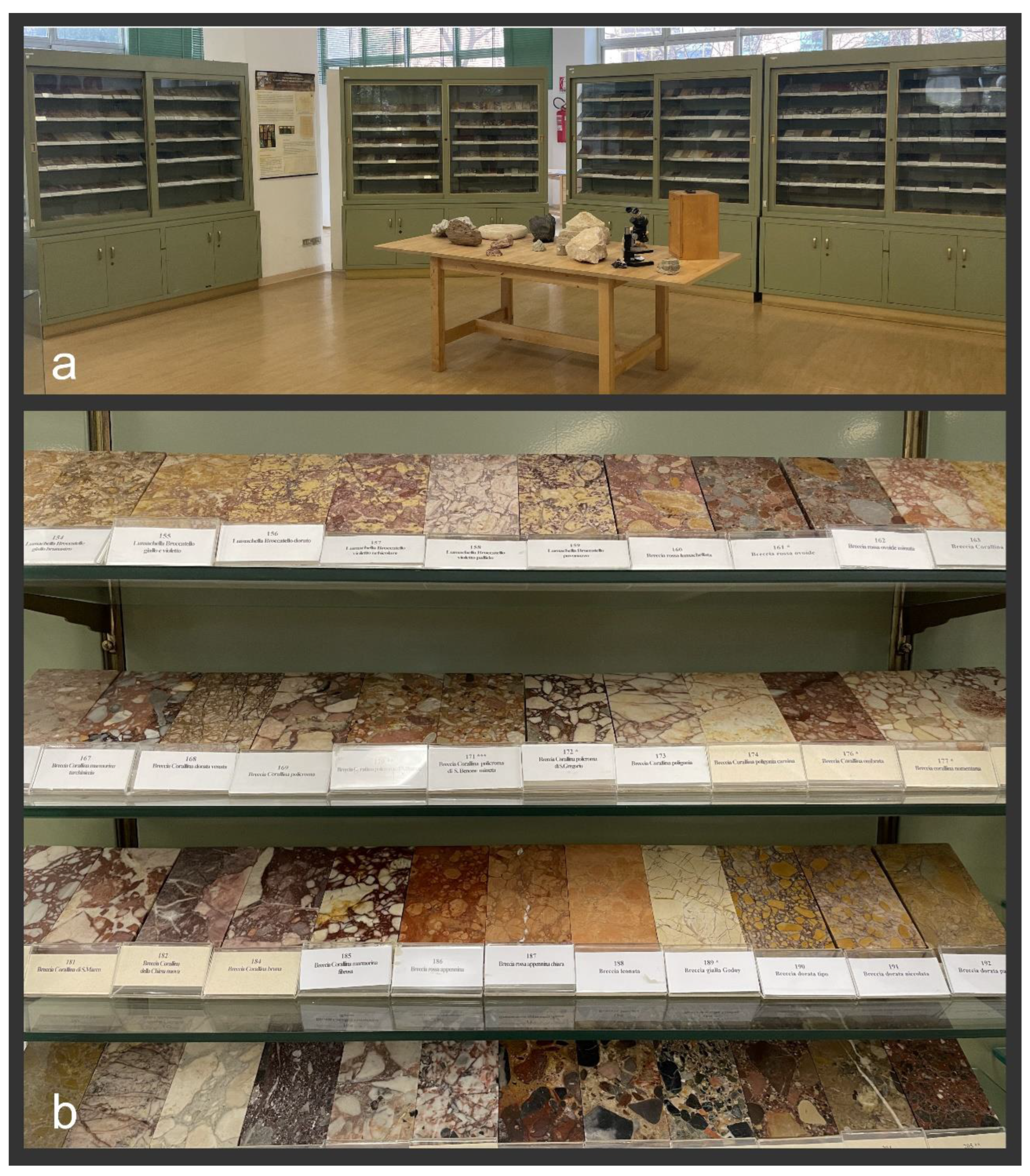
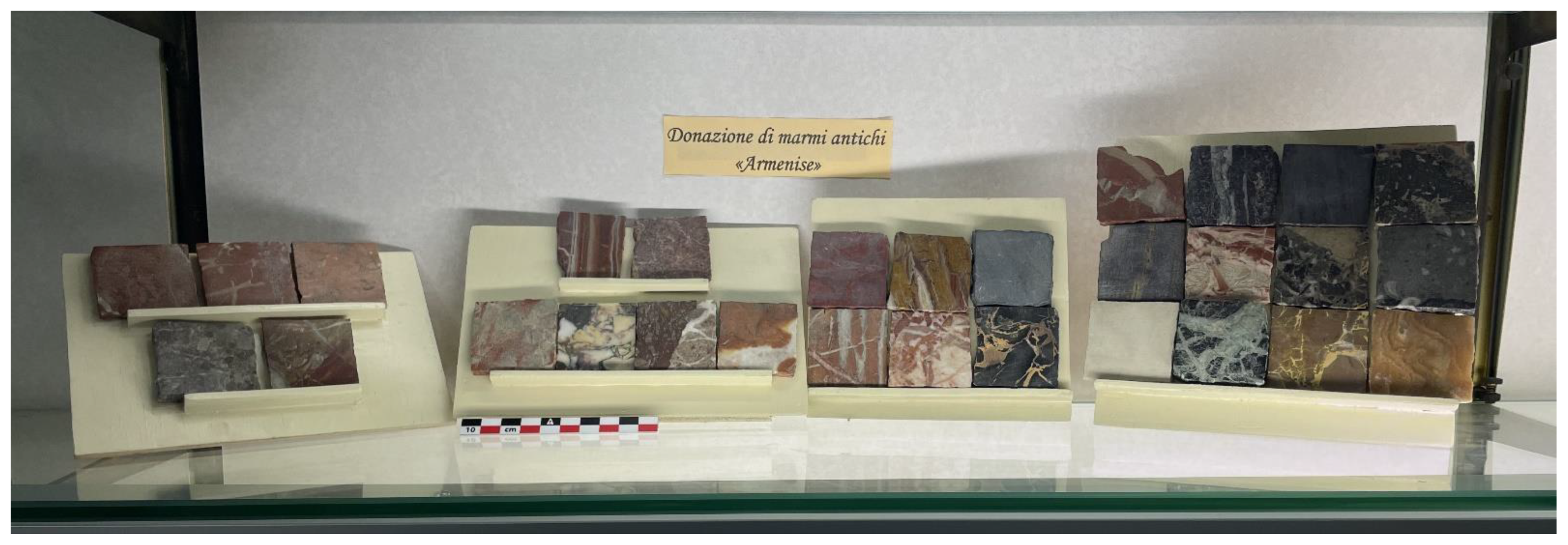
4.1. Arrangement of Collections
4.2. The Database
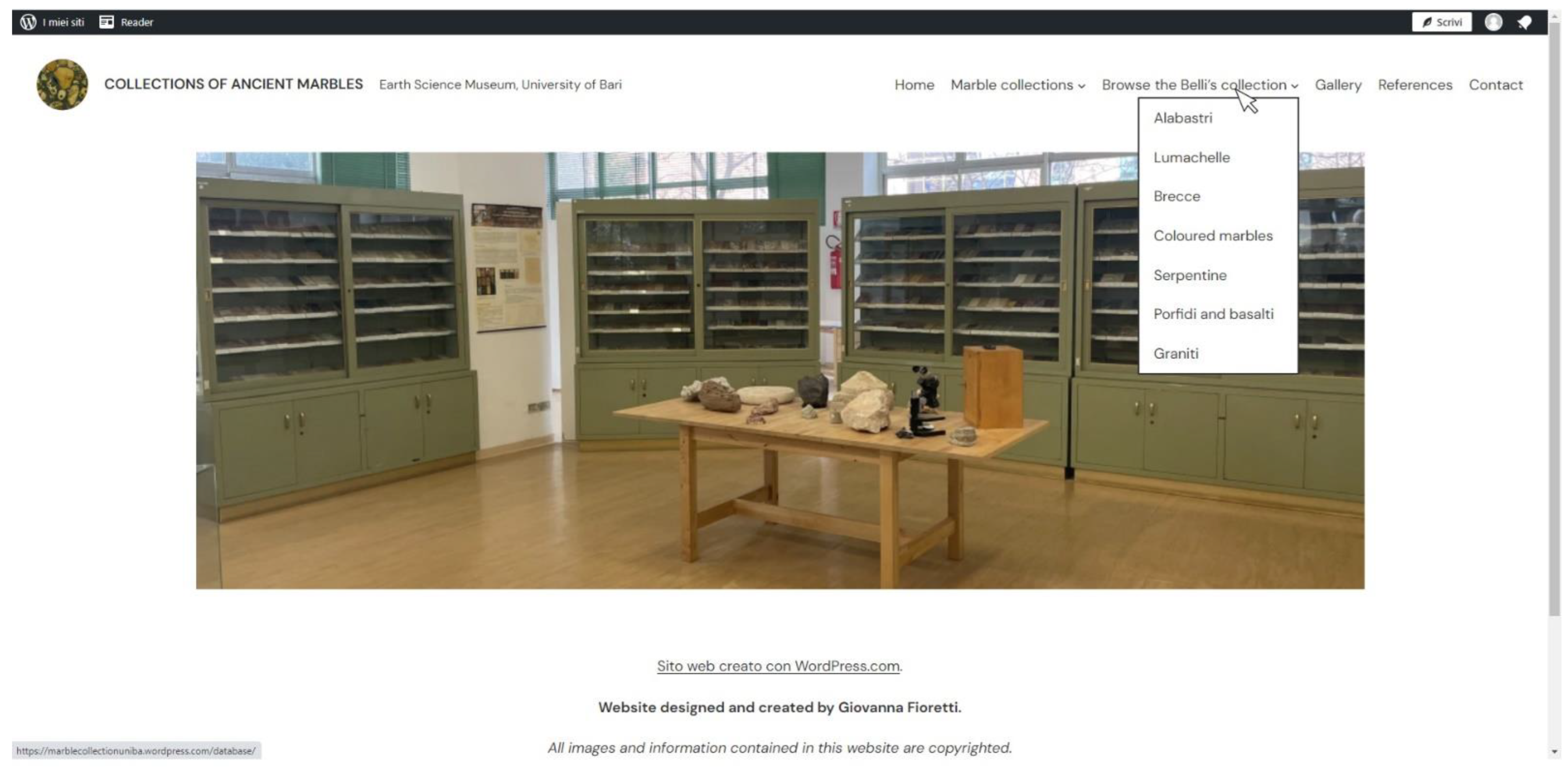
4.3. The Website
5. Conclusions
Author Contributions
Funding
Data Availability Statement
Acknowledgments
Conflicts of Interest
References
- Lazzarini, L.; Antonelli, F. L’identificazione Del Marmo Costituente Manufatti Antichi. In Pietre e Marmi Antichi-Natura, Caratterizzazione, Origine Storia D’uso, Diffusione, Collezionismo; Lazzarini, L., Ed.; CEDAM: Padova, Italy, 2004; pp. 65–71. [Google Scholar]
- Lazzarini, L.; Moschini, G.; Stievano, B.M. A contribution to the identification of Italian, Greek and Anatolian marbles through a petrological study and the evaluation of Ca/Sr ratio. Archaeometry 1980, 22, 173–183. [Google Scholar] [CrossRef]
- Lazzarini, L. Indagini Archeometriche Sui Marmi Bianchi Della Statuaria e Architettura Della Magna Grecia. MARMORA 2007, 3, 21–52. [Google Scholar]
- Antonelli, F.; Lazzarini, L.; Cancelliere, S.; Dessandier, D. Volubilis (Meknes, Morocco): Archaeometric Study of the White and Coloured Marbles Imported in the Roman Age. J. Cult. Herit. 2009, 10, 116–123. [Google Scholar] [CrossRef]
- Taelman, D.; Antonelli, F. Provenance of the White and Polychrome Marbles Used for the Architecture and Sculpture of Roman Sentinum (Sassoferrato, Marche, Italy). Archaeometry 2022, 64, 1–24. [Google Scholar] [CrossRef]
- Taelman, D.; Van Limbergen, D.; Antonelli, F. Archaeology and Archaeometry of Marbles in Roman Central Adriatic Italy. In Proceedings of the 2020 IMEKO TC-4 International Conference on Metrology for Archaeology and Cultural Heritage, Trento, Italy, 22–24 October 2020. [Google Scholar]
- Antonelli, F.; Lazzarini, L. An Updated Petrographic and Isotopic Reference Database for White Marbles Used in Antiquity. Rend. Fis. Acc. Lincei 2015, 26, 399–413. [Google Scholar] [CrossRef]
- Attanasio, D.; Bruno, M.; Prochaska, W.; Yavuz, A.B. A Multi-Method Database of the Black and White Marbles of Göktepe (Aphrodisias), Including Isotopic, EPR, Trace and Petrographic Data: The Black and White Marbles of Göktepe (Aphrodisias). Archaeometry 2015, 57, 217–245. [Google Scholar] [CrossRef]
- Brilli, M.; Antonelli, F.; Giustini, F.; Lazzarini, L.; Pensabene, P. Black Limestones Used in Antiquity: The Petrographic, Isotopic and EPR Database for Provenance Determination. J. Archaeol. Sci. 2010, 37, 994–1005. [Google Scholar] [CrossRef]
- Poretti, G.; Brilli, M.; De Vito, C.; Conte, A.M.; Borghi, A.; Günther, D.; Zanetti, A. New Considerations on Trace Elements for Quarry Provenance Investigation of Ancient White Marbles. J. Cult. Herit. 2017, 28, 16–26. [Google Scholar] [CrossRef]
- Biricotti, F.; Severi, M. A Non-Destructive Methodology for the Characterization of White Marble of Artistic and Archaeological Interest. J. Cult. Herit. 2004, 5, 49–61. [Google Scholar] [CrossRef]
- Capedri, S.; Venturelli, G.; Photiades, A. Accessory Minerals and Δ18O and Δ13C of Marbles from the Mediterranean Area. J. Cult. Herit. 2004, 5, 27–47. [Google Scholar] [CrossRef]
- Perna, S.; Antonelli, F.; Lazzarini, L. Archaeometric Analysis of the ‘Greco Scritto’ Marble Slabs from the Edificio Dei Triclinii at Murecine (Pompeii, Italy). Archaeometry 2023, 65, 1–16. [Google Scholar] [CrossRef]
- Antonelli, F.; Nestola, F. An innovative approach for provenancing ancient white marbles: The contribution of x-ray diffraction to disentangling the origins of Göktepe and Carrara marbles. Sci. Rep. 2021, 11, 22312. [Google Scholar] [CrossRef] [PubMed]
- Antonelli, F.; Lazzarini, L.; Cancelliere, S.; Dessandier, D. On the white and coloured marbles of the Roman town of Cuicul (Djemila, Algeria). Archaeometry 2009, 52, 575–596. [Google Scholar] [CrossRef]
- Prochaska, W.; Attanasio, D. The Challenge of a Successful Discrimination of Ancient Marbles (Part III): A Databank for Aphrodisias, Carrara, Dokimeion, Göktepe, Hymettos, Parian Lychnites and Pentelikon. J. Archaeol. Sci. Rep. 2022, 45, 103582. [Google Scholar] [CrossRef]
- Prochaska, W.; Attanasio, D. The Challenge of a Successful Discrimination of Ancient Marbles (Part Iii): A Databank for Aphrodisias, Carrara, Dokimeion, Göktepe, Hymettos, Parian Lychnites and Pentelikon. SSRN J. 2022. [Google Scholar] [CrossRef]
- Anevlavi, V.; Prochaska, W.; Cenati, C.; Ivanov, I.; Ladstätter, S.; Popov, H.; Georgiev, P.; Kabakchieva, G. Geochemical and Petrographic Investigation of the Provenance of White Marble Decorative Elements from the Roman Villa Armira in South-Eastern Bulgaria. Archaeol. Anthropol. Sci. 2022, 14, 229. [Google Scholar] [CrossRef]
- Maniatis, Y.; Tambakopoulos, D.; Lazzarini, L.; Sturgeon, M.C. Provenance Investigation of Three Marble Relief Sculptures from Ancient Corinth: New Evidence for the Circulation of the White Marble from Mani. Archaeometry 2021, 63, 685–704. [Google Scholar] [CrossRef]
- Raneri, S.; Košek, F.; Lazzarini, L.; Wielgosz-Rondolino, D.; Jehlicka, J.; Antonelli, F. Raman Spectroscopy as a Tool for Provenancing Black Limestones (Bigi Morati) Used in Antiquity. J. Raman Spectrosc. 2021, 52, 241–250. [Google Scholar] [CrossRef]
- Lazzarini, L.; Sangati, C. I Più Importanti Marmi e Pietre Colorati Usati Dagli Antichi. In Pietre e Marmi Antichi-Natura, Caratterizzazione, Origine Storia D’uso, Diffusione, Collezionismo; Lazzarini, L., Ed.; CEDAM: Padova, Italy, 2004; pp. 73–100. [Google Scholar]
- Corsi, F. Delle Pietre Antiche; Dalla tipografia Salviucci: Roma, Italy, 1833. [Google Scholar]
- Sutherland, J.; Sutherland, A. Roman Marble Quarrying near Karystos Southern Euboea. J. Cult. Herit. 2002, 3, 251–259. [Google Scholar] [CrossRef]
- Harrel, J.A.; Storemyr, P. Ancient Egyptian Quarries–an Illustrated Overview. QuarryScapes Proj. Conserv. Anc. Stone Quarry Landsc. East. Mediterr. 2009, 12, 7–50. [Google Scholar]
- Al-Bashaireh, K. Ancient White Marble Trade and Its Provenance Determination. J. Archaeol. Sci. Rep. 2021, 35, 102777. [Google Scholar] [CrossRef]
- Pensabene, P. Marmi Antichi. Problemi Di Impiego, Di Restauro e d’identificazione; “L’ERMA” di Bretschneider: Roma, Italy, 1993. [Google Scholar]
- Del Bufalo, D. I Marmi Antichi Nel Riuso Cosmatesco. In La Cattedrale Cosmatesca di Civita Castellana; Creti, L., Ed.; L’Erma di Bretschneider: Roma, Italy, 2012; pp. 167–184. [Google Scholar]
- Claussen, P.C. Marmi Antichi Nel Medioevo Romano. L’arte Dei Cosmati. In Marmi Antichi; Borghini, G., Ed.; Edizioni De Luca: Roma, Italy, 1992; pp. 65–80. [Google Scholar]
- Tuena, F. I Marmi Commessi Nel Tardo Rinascimento Romano. In Marmi Antichi; Borghini, G., Ed.; Edizioni De Luca: Roma, Italy, 1992; pp. 81–98. [Google Scholar]
- Pasculli Ferrara, D. L’arte Dei Marmorari in Italia Meridionale: Tipologie e Tecniche in Età Barocca; Atlante del Barocco in Italia; De Luca: Roma, Italy, 2013. [Google Scholar]
- Acquafredda, P.; Fioretti, G. Aspetti Petrografici Degli Altari in Marmi Policromi in Puglia. In Viridarium Novum Studi di Storia dell’Arte in Onore di Mimma Pasculli Ferrara; Fonseca, C.D., Di Liddo, I., Eds.; De Luca Editori d’arte: Roma, Italy, 2020; pp. 271–276. [Google Scholar]
- Acquafredda, P. Marmi policromi nella cattedrale di Altamura: Aspetti petroarcheometrici. Geol. E Territorio. Period. Dell’ordine Reg. Dei Geol.-Puglia 2015, 1, 3–14. [Google Scholar]
- Napoleone, C. Il Collezionismo Dei Marmi e Pietre Colorate Dal Secolo XVI al Secolo XIX. In Marmi Antichi; Borghini, G., Ed.; Edizioni De Luca: Roma, Italy, 1992; pp. 99–116. [Google Scholar]
- Cooke, L. The 19th Century Corsi Collection of Decorative Stones: A Resource for the 21st Century? Special Pubblication; Geological Society: London, UK, 2010; Volume 333, pp. 185–195. [Google Scholar] [CrossRef]
- Dolci, E.; Nista, L. (Eds.) Marmi Antichi Da Collezione La Raccolta Grassi Del Museo Nazionale Romano; Museo civico del marmo Carrara: Pisa, Italy, 1992. [Google Scholar]
- Matteucci, R. Cristalli, Fossili e Marmi Antichi Della Sapienza: Collezioni Storiche Dei Musei Di Scienze Della Terra e Unità d’Italia; Nuova Cultura: Roma, Italy, 2012. [Google Scholar]
- Kàrolyi, I.; Belli, F. Catalogo Della Collezione Di Pietre Usate Dagli Antichi per Costruire Ed Adornare Le Loro Fabbriche; Tip. Mugnoz: Roma, Italy, 1842. [Google Scholar]
- Giardini, G.; Colasante, S. Collezioni Di Pietre Decorative Antiche «Federico Pescetto» e «Pio De Santis». In Memorie per servire alla descrizione della carta geologica d’Italia.; Istituto Poligrafico dello Stato: Roma, Italy, 2001. [Google Scholar]
- Pensabene, P.; Bruno, M.; Stuto, G. (Eds.) Il Marmo e Il Colore: Guida Fotografica, i Marmi Della Collezione Podesti; L’Erma di Bretschneider: Roma, Italy, 1998. [Google Scholar]
- Mielsch, H. Buntmarmore aus Rom im Antikenmuseum Berlin; Antikenmuseum Berlin; Staatl. Museen Preuss; Kulturbesitz: Berlin, Germany, 1985. [Google Scholar]
- Conte, R.; D’Elia, A.; Delluniversità, E.; Fioretti, G.; Florio, E.; Navarra, M.C. Stones and Ancient Marbles of the ‘Francesco Belli’ Collection: Archaeological, Art-Historical, Antiquarian, Geological-Technical and Petrographycal Aspects; Gasparini, E., Pensabene, P., Eds.; L’Erma di Bretschneider: Roma, Italy, 2015; pp. 455–472. [Google Scholar]
- Francescangeli, R. La Collezione Di Marmi Antichi Francesco Belli; Badino, V., Baldassarre, G., Eds.; GEAM: Torino, Italy, 2006; pp. 89–94. [Google Scholar]
- Bozzini, P. La Collezione Belli. In Marmi Antichi; Borghini, G., Ed.; Edizioni De Luca: Roma, Italy, 1992; pp. 129–130. [Google Scholar]
- Fioretti, G.; Acquafredda, P.; Calò, S.; Cinelli, M.; Germanò, G.; Laera, A.; Moccia, A. Study and Conservation of the St. Nicola’s Basilica Mosaics (Bari, Italy) by Photogrammetric Survey: Mapping of Polychrome Marbles, Decorative Patterns and Past Restorations. Stud. Conserv. 2020, 65, 160–171. [Google Scholar] [CrossRef]
- Fioretti, G.; Acciani, A.; Buongiorno, R.; Catella, M.A.; Acquafredda, P. Photogrammetric Survey and 3D Model as Experimental Tool for Mapping of Polychrome Marbles in Artworks: The Case of Two Baroque Altars in Bari (Italy). J. Archit. Conserv. 2019, 25, 90–103. [Google Scholar] [CrossRef]
- Francescangeli, R.; Monno, A. Il Progetto Di Studio e Valorizzazione Della Collezione Di Marmi Antichi “Francesco Belli”. Museol. Sci. Mem. 2015, 14, 108–111. [Google Scholar]
- Borghini, G. Marmi Antichi; De Luca Editori d’Arte: Roma, Italy, 1992. [Google Scholar]
- Gnoli, R. Marmora Romana; dell’Elefante: Roma, Italy, 1988. [Google Scholar]
- Lazzarini, L. I Marmi e Le Pietre Del Pavimento Marciano. In Il Manto Di Pietra Di San Marco a Venezia.Storia, Restauri, Geometrie Del Pavimento; Vio, E., Ed.; Cicero: Venezia, Italy, 2012; pp. 51–108. [Google Scholar]
- De Nuccio, M.; Ungaro, L. . I Marmi Colorati Della Roma Imperiale; Marsilio: Venezia, Italy, 2002. [Google Scholar]
- Fioretti, G.; Campobasso, C.; Capotorto, S. Digital Photogrammetry as Tool for Mensiochronological Analysis: The Case of St. Maria Veterana Archaeological Site (Triggiano, Italy). Digit. Appl. Archaeol. Cult. Herit. 2020, 19, e00158. [Google Scholar] [CrossRef]



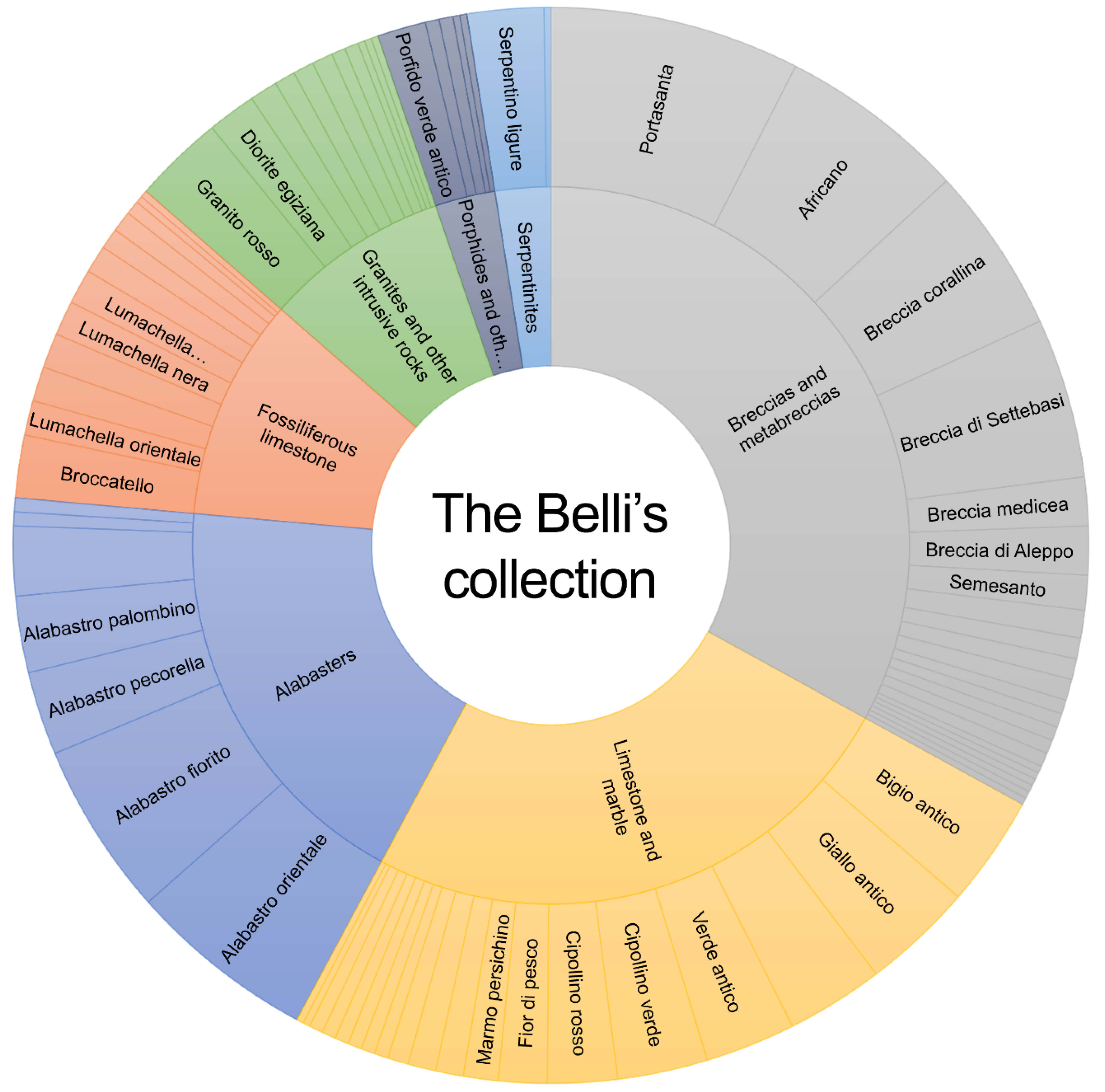
| Lithology | Sublithology | Other Name | Petrographic Description | Provenance | No. of Samples |
|---|---|---|---|---|---|
| Alabasters | Alabastro a tartaruga | - | Yellowish-brownish banded, compact travertine | Montauto, Tuscany, Italy | 10 |
| Alabastro ciliegino | Violetto ciliegino | Hematite-rich banded, compact calcite travertine | Unknown quarry | 2 | |
| Alabastro fiorito | Marmor Hierapolitanum | Fine-grained banded, compact calcite travertine | Pamukkale (ancient Hierapolis), Turkey | 25 | |
| Alabastro ghiaccione | - | Pure compact, banded calcite travertine | Circeo Mount, Italy | 2 | |
| Alabastro orientale | Alabastro egiziano, Lapis Alabastrites | Coarse-grained compact, banded travertine | Nile River Valley, Egypt | 27 | |
| Alabastro palombino | Alabastro di Palombara | White-brownish banded, compact travertine | Various quarries | 11 | |
| Alabastro pecorella | - | Hematite-rich banded, compact calcite travertine | Ain Tekbalet, Algeria | 12 | |
| Fossiliferous limestone | Broccatello | - | Red and yellow fossiliferous limestone | Tortosa, Spain | 9 |
| Broccatellone | - | Carbonate breccia with pink or yellow matrix | Minor Asia | 4 | |
| Lumachella pavonazza | - | Reddish-brownish fossiliferous limestone | Austrian Alps, Austria | 3 | |
| Lumachella astracane | Astracane dorato | Yellowish-black fossiliferous limestone | Henchir el Kasbat (ancient Tuburbo Maius), Tunisia | 5 | |
| Lumachella astacane veronese | - | Limestone with abundant recrystallized fossils | Verona, Italy | 1 | |
| Lumachella di S. Vitale | Lumachella di Verona | Fossiliferous microsparitic limestone | Lessini Mounts, Italy | 2 | |
| Lumachella nera | - | Fossiliferous sparitic black limestone | Algeria; Morocco (?) | 5 | |
| Lumachella nummulitica | Lumachella rosea | White-pink fossiliferous micritic limestone | Kairouan, Tunisia | 3 | |
| Lumachella occhio di pavone | Marmor Triponticum | Reddish fossiliferous limestone | Izmit (ancient Nicomedia), Turkey | 5 | |
| Lumachella occhio di pernice | - | Yellowish-grayish fossiliferous limestone | Verona, Italy | 5 | |
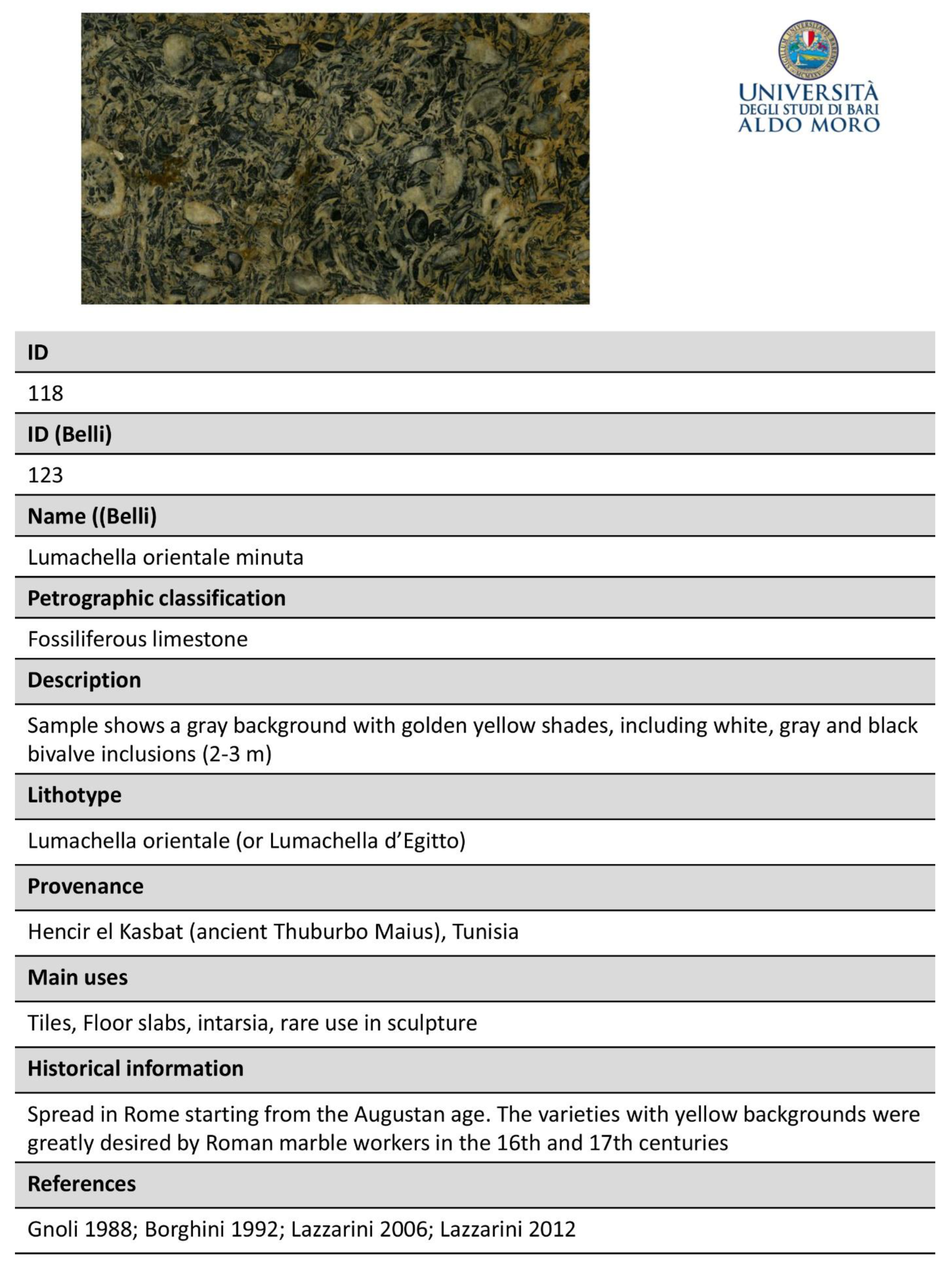
| Lumachella orientale | Lumachella d’Egitto | White-yellowish-black fossiliferous limestone | Henchir el Kasbat (ancient Tuburbo Maius), Tunisia | 5 | |
| Lumachellone antico | - | Grayish fossiliferous limestone | Eastern Alps, Italy | 1 | |
| Breccias and metabreccias | Pietra Bekhen | Basanite, Lapis Basanites | Dark-gray-greenish metagraywacke | Wadi Hammamat (ancient Mons Basanites), Egypt | 2 |
| Breccia corallina | Marmor Sagarium | Carbonate breccia with white clasts and red matrix | Vezirhan, Turkey | 24 | |
| Breccia di Aleppo | - | Poorly sorted polymictic carbonate conglomerate | Karyes, Greece | 7 | |
| Breccia di Hereke | - | Reddish well-rounded polymictic conglomerate | Hereke, Turkey | 3 | |
| Breccia di Sparta | - | Greenish, poorly sorted breccia | Sparta, Greecia | 1 | |
| Breccia dorata | - | Yellowish carbonate breccia | Apuan Alps, Italy | 4 | |
| Breccia frutticolosa | - | Well-rounded polymictic carbonate conglomerate | Unknown quarry | 1 | |
| Breccia gialla e rossa | - | Pinkish-yellow limestone | Uadi Abu Gelbano, Egypt | 2 | |
| Breccia Godoy | - | Yellowish limestone with sparry calcite-filled fractures | Unknown quarry | 1 | |
| Breccia medicea | Breccia di Seravezza, Breccia di Stazzema | White-grayish-violet carbonate metabreccia | Lucca, Italy | 7 | |
| Breccia policroma capitolina | - | Variable-colored polymict carbonate conglomerate | Minor Asia | 3 | |
| Breccia policroma della Vittoria | - | Polymict carbonate breccia with red matrix | Kocani, Macedonia | 1 | |
| Breccia policroma lucullea | - | Variable-colored and poorly sorted polymictic metaconglomerate | Minor Asia | 1 | |
| Breccia quintilina | Breccia di Tivoli | Serpentinite breccia | Apuan Alps, Italy | 1 | |
| Breccia di Settebasi | Breccia di Sciro, Marmor Scyreticum | Sheared polymict carbonate metabreccia | Skyros and near Islands, Greece | 23 | |
| Semesanto | Breccia di Sciro, Marmor Scyreticum | Sheared polymict carbonate metabreccia (minute fragment variety of Breccia di Settebasi) | Skyros and near Islands, Greece | 5 | |
| Semesantone | Breccia di Sciro, Marmor Scyreticum | Sheared polymict carbonate metabreccia (variety of Breccia di Settebasi) | Skyros and near Islands, Greece | 2 | |
| Breccia verde d’Egitto | Lapis hecatontalithos | Greenish, poorly sorted polymictic metaconglomerate | Wadi Hammamat (ancient Mons Basanites), Egypt | 2 | |
| Bianco e nero antico | Marmo d’Aquitania; Marmor Celticum | Black and white carbonate fault breccia | Aubert, Francia | 3 | |
| Breccia cinerina | - | Purple and white carbonate metabreccia | Apuan Alps, Italy | 2 | |
| Portasanta | Marmor Chium | Limestone fault breccia with variable color, mainly with red cement | Chios Island, Greece | 36 | |
| Africano | Marmor Luculleum | Carbonate metabreccia with variable-colored clasts and black matrix and cement | Teos, Turkey | 27 | |
| Limestone and marble | Cipollino mandolato | Marbre Campan | Reddish-greenish nodular metalimestone | Campan, France | 4 |
| Cipollino marino | - | Folded and banded marble with chlorite | Apuan Alps, Italy | 2 | |
| Cipollino rosso | Africanone, Marmor Iassense or Carium | Red marble, white curved veins, rich in hematite, chlorite, and graphite | Kiyikislacik (ancient Iasos), Turkey | 10 | |
| Cipollino verde | Marmor Caristium | White and green impure marble with chlorite | Karystos, Greece | 13 | |
| Cottanello antico | - | Reddish and white brecciated limestone | Italia | 2 | |
| Fior di pesco | Marmor Chalcidium | Pinkish red metalimestone with large white veins | Nea Psara (ancient Eretria), Greece | 7 | |
| Giallo antico | Marmor Numidicum | Yellow limestone with limonite and hematite | Chemtou (ancient Simitthu), Tunisia | 16 | |
| Giallo tigrato | - | Manganese-oxide-rich yellow and white limestone | Unknown quarry | 1 | |
| Greco scritto | - | White calcite marble with graphite | Ephesus, Turkey | 2 | |
| Rosso antico | Marmor Taenarium | Red hematitic marble with small white veins | Mani peninsula, Greece | 2 | |
| Rosso Francia | - | Red limestone with sparry calcite veins | Caunes-Minervois, France | 1 | |
| Marmo bianco (n.i.) | - | White saccharoid marble | - | 2 | |
| Marmo pavonazzetto | Marmor Phrygium or Docimium or Synnadicum | Brecciated white or light-yellow marble with violet veins | Iscehisar (ancient Dokymeion), Turkey | 14 | |
| Verde antico | Marmor Thessalicum | Green ophicalcite breccia | Chasabali, Greece | 13 | |
| Marmo persichino | - | Purple fractured marble | Unknown quarry | 5 | |
| Marmo proconnesio | Marmo di Proconneso, Marmo Cipolla, Marmor Proconnesium | White marble with gray veins | Marmara Island, Turkey | 4 | |
| Rosso ammonitico veronese | Rosso di Verona | Red limestone with ammonite fragments | Verona, Italy | 3 | |
| Bigio antico | Marmor Lesbium | Gray marble with white veins and fossils | Lesbos Island, Greece | 16 | |
| Pietra paesina | Pietra ruiniforme | Variable-colored micritic limestone with sparry calcite-filled fractures | Lazio and Tuscany, Italy | 2 | |
| Serpentinites | Serpentino ligure | - | Sheared or brecciated serpentinite | Liguria and Piemonte, Italy | 11 |
| Verde ranocchia | - | Serpentinite | Wadi Umm Esh, Egypt | 1 | |
| Granites and other intrusive rocks | Granito bianco e nero | Marmor Tiberianum | Quartz diorite | Uadi Barud, Egypt | 4 |
| Granito bigio grafico | - | Medium-grained syenite | Fontaine du Gènie (ancient Tipasa), Algeria | 1 | |
| Granito a morviglione | Porfido bigio | Porphyritic dacite with zoned plagioclase | Boulouris, France | 2 | |
| Granito del foro | Marmor Claudianum | Metatonalite, sometimes foliated | Gebel Fatireh (ancient Mons Claudianus) | 3 | |
| Granito della colonna | - | Coarse pegmatitic diorite/gabbro | Umm Shegilat, Egypt | 2 | |
| Granito grafico | - | Granitic pegmatite with feldspar and quartz intergrowth | Siberia, Russia | 1 | |
| Granito rosso | Lapis Pirrhopoecilos | Medium-grained pinkish-red quartz sienite | Aswan (ancient Siene), Egypt | 13 | |
| Granito verde della sedia | Lapis Ophytes | Metagabbro with dark green crystals of pyroxene and white crystals of plagioclase | Uadi Semnah (ancient Mons Ophyates), Egypt | 3 | |
| Gabbro eufotide | - | Coarse-grained metagabbro | Wadi Maghrabiya, Egypt | 3 | |
| Fluorite antica | - | Pink-yellow-green fluorite | Murrha, Spain | 1 | |
| Diorite egiziana | Granito nero | Medium-grained granodiorite | Gebel Nagug, Aswan, Egypt | 7 | |
| Porphyries and other effusive rocks | Porfido nero | - | Black porphyritic meta-andesite with white crystals of plagioclase | Gebel Dokhan (ancient Mons Porphyrites), Egypt | 1 |
| Porfido rosso antico | Lapis Porphyrites | Red porphyritic meta-andesite with white crystals of plagioclase; piemontite in the groundmass | Gebel Dokhan (ancient Mons Porphyrites), Egypt | 2 | |
| Porfido serpentino nero | - | Black porphyritic metatrachyandesite with white crystals of plagioclase | Uadi Umm Towat, Egypt | 1 | |
| Porfido verde antico | Lapis Lacedemonius, Krokeatis lithos | Green porphyritic meta-andesite with white crystals of plagioclase | Laconia (ancient Krokeai), Greece | 7 | |
| Porfido verde egiziano | Lapis Ieracites | Porphyritic meta-andesite with white crystals of plagioclase | Gebel Dokhan (ancient Mons Porphyrites), Egypt | 2 | |
| Modern stones | 9 | ||||
| n.i. samples | 89 | ||||
| Sample | Lithology | Petrographic Description | Size (mm) |
|---|---|---|---|
| 1 | n.i. | – | 45 × 45 × 7 |
| 2 | Portasanta | Limestone fault breccia with variable color, mainly with red cement | 46 × 46 × 7 |
| 3 | n.i. | – | 45 × 45 × 5 |
| 4 | Alabastro a tartaruga | Banded, compact travertine | 44 × 44 × 6 |
| 5 | Portasanta | Limestone fault breccia with variable color, mainly with red cement | 45 × 45 × 7 |
| 6 | Verde Alpi | Green ophicalcite breccia | 44 × 46 × 11 |
| 7 | n.i. | – | 44 × 44 × 5 |
| 8 | Bigio antico | Gray marble with white veins and fossils | 45 × 46 × 8 |
| 9 | Rosso Francia | Red limestone with sparry calcite veins | 44 × 44 × 7 |
| 10 | n.i. | – | 46 × 45 × 5 |
| 11 | Rosso Levanto | Red ophicalcite breccia | 47 × 45 × 6 |
| 12 | n.i. | – | 45 × 44 × 9 |
| 13 | Portoro | Black limestone with white and yellow (limonite) veins | 45 × 45 × 7 |
| 14 | n.i. | – | 44 × 44 × 8 |
| 15 | Breccia corallina | Carbonate breccia with white clasts and red matrix | 44 × 45 × 7 |
| 16 | Libeccio antico | Fossiliferous, brecciated, and very variable-colored limestone | 44 × 45 × 7 |
| 17 | Rosso Francia | Red limestone with sparry calcite veins | 45 × 45 × 4 |
| 18 | n.i. | – | 44 × 44 × 5 |
| 19 | n.i. | – | 43 × 44 × 8 |
| 20 | Libeccio antico | Fossiliferous, brecciated, and very variable-colored limestone | 43 × 43 × 7 |
| 21 | Breccia medicea | Pink, white, and black dolomitic metabreccia | 45 × 42 × 4 |
| 22 | n.i. | – | 46 × 44 × 8 |
| 23 | Alabastro pecorella | Hematite-rich banded, compact calcite travertine | 44 × 44 × 5 |
| 24 | Alabastro pecorella | Hematite-rich banded, compact calcite travertine | 44 × 39 × 6 |
| 25 | Libeccio antico | Fossiliferous, brecciated, and very variable-colored limestone | 46 × 44 × 6 |
| 27 | n.i. | – | 46 × 45 × 9 |
| 28 | Portasanta | Limestone fault breccia with variable color, mainly with red cement | 45 × 45 × 7 |
| 29 | n.i. | – | 45 × 45 × 8 |
| 30 | n.i. | – | 45 × 45 × 7 |
Disclaimer/Publisher’s Note: The statements, opinions and data contained in all publications are solely those of the individual author(s) and contributor(s) and not of MDPI and/or the editor(s). MDPI and/or the editor(s) disclaim responsibility for any injury to people or property resulting from any ideas, methods, instructions or products referred to in the content. |
© 2023 by the authors. Licensee MDPI, Basel, Switzerland. This article is an open access article distributed under the terms and conditions of the Creative Commons Attribution (CC BY) license (https://creativecommons.org/licenses/by/4.0/).
Share and Cite
Fioretti, G.; Acquafredda, P.; Monno, A.; Montenegro, V.; Francescangeli, R. Roman Marble Collections in the Earth Sciences Museum of the University of Bari (Italy): A Valuable Heritage to Support Provenance Studies. Heritage 2023, 6, 4054-4071. https://doi.org/10.3390/heritage6050213
Fioretti G, Acquafredda P, Monno A, Montenegro V, Francescangeli R. Roman Marble Collections in the Earth Sciences Museum of the University of Bari (Italy): A Valuable Heritage to Support Provenance Studies. Heritage. 2023; 6(5):4054-4071. https://doi.org/10.3390/heritage6050213
Chicago/Turabian StyleFioretti, Giovanna, Pasquale Acquafredda, Alessandro Monno, Vincenza Montenegro, and Ruggero Francescangeli. 2023. "Roman Marble Collections in the Earth Sciences Museum of the University of Bari (Italy): A Valuable Heritage to Support Provenance Studies" Heritage 6, no. 5: 4054-4071. https://doi.org/10.3390/heritage6050213
APA StyleFioretti, G., Acquafredda, P., Monno, A., Montenegro, V., & Francescangeli, R. (2023). Roman Marble Collections in the Earth Sciences Museum of the University of Bari (Italy): A Valuable Heritage to Support Provenance Studies. Heritage, 6(5), 4054-4071. https://doi.org/10.3390/heritage6050213